Cybersecurity Threats and Defensive Strategies for Small and Medium Firms: A Systematic Mapping Study



Abstract
1. Introduction
1.1. Research Objectives
- To identify and categorize the types of cybersecurity threats most faced by SMEs.
- To evaluate and classify the defensive practices currently employed by SME to mitigate cybersecurity threats.
- To know the critical areas of focus in the existing literature on cybersecurity within SMEs and how these areas have evolved.
- To identify research methodologies and approaches used to study cybersecurity in SMEs and how they contribute to understanding SME-specific cybersecurity threats.
- To compare different regions and industries regarding the focus and findings of research on SME cybersecurity.
- To know about the critical gaps in the current research on SMEs cybersecurity needs to be addressed in future studies.
1.2. Significance of the Study
2. Literature Review
2.1. Cybersecurity Threats to SMEs
2.2. Defensive Approaches for SMEs
2.3. Challenges in Cybersecurity for SMEs
2.4. Research Gaps and Opportunities
- To conduct a systematic mapping study to identify cybersecurity threats and the defensive practices employed by SMEs to address the identified cybersecurity threats.
- To conduct an empirical survey to identify the most prevalent cybersecurity threats and their mitigation practices identified through real-world industries that impact SMEs.
- To determine the gap between the findings of the literature review and real industry security threats that affect SMEs.
- To design a tailored cybersecurity mitigation model to address the cybersecurity threats facing SMEs. From the literature review, it is clear that SMEs require a more proactive approach to issues of cybersecurity. Despite several defensive strategies having been proffered, issues relating to resource concerns and awareness have not been addressed. This systematic mapping study (SMS) will fill the gap by presenting a systematic review of the existing cybersecurity threats and protective measures specifically for SMEs, thereby contributing to the development of practical, scalable solutions for enhancing their cybersecurity resilience.
3. Research Methodology
3.1. Research Questions
3.2. Search String Development
3.3. Data Extraction
3.4. Search Execution
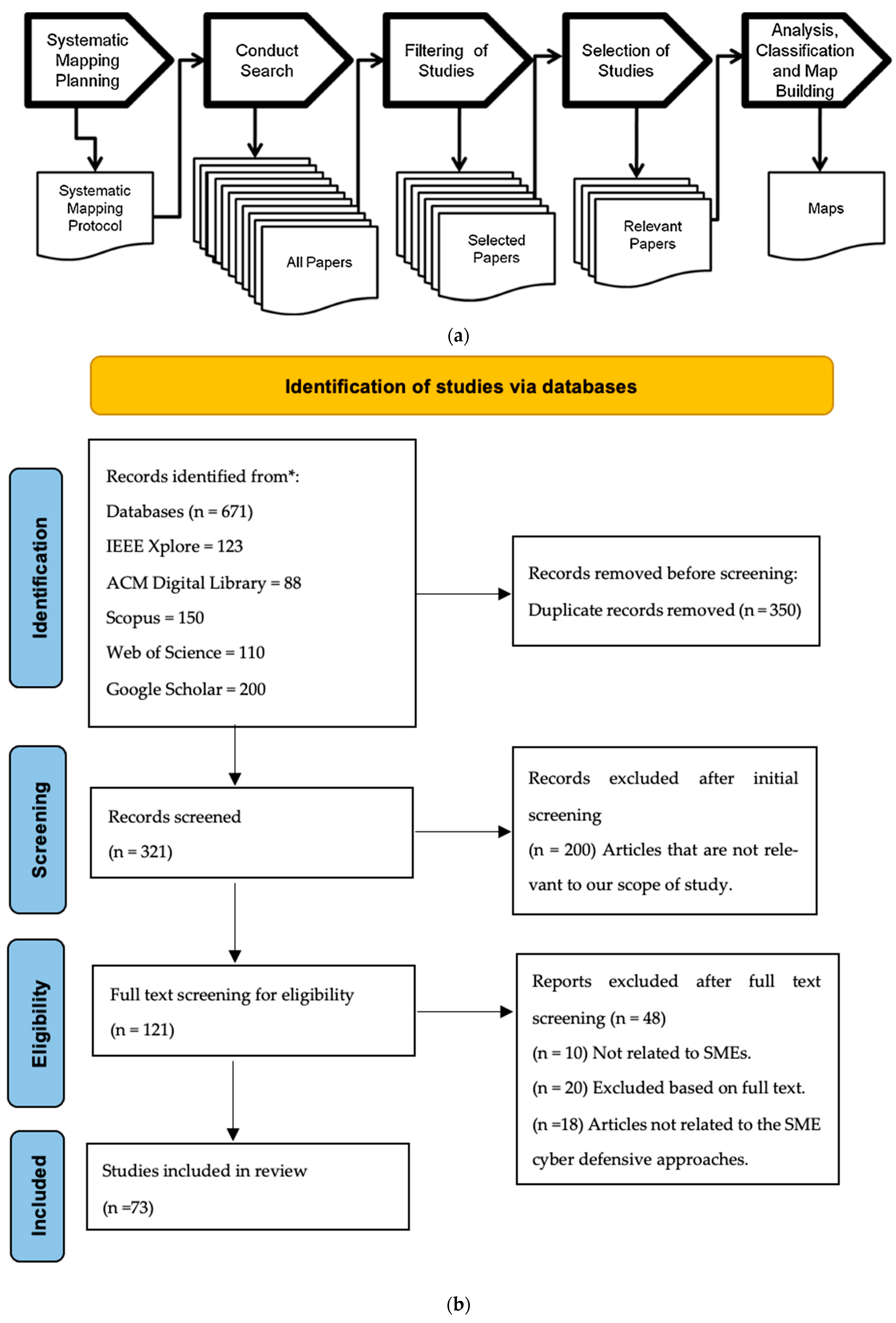
3.5. Mapping Process
- Focus of Research: Categorized as either threats or defensive approaches.
- Research Contribution Type: Theoretical, empirical, or solution proposals.
- Research Type: Conceptual framework, empirical studies, or case studies.
- Area of Focus: Categorize as early and evolution focus.
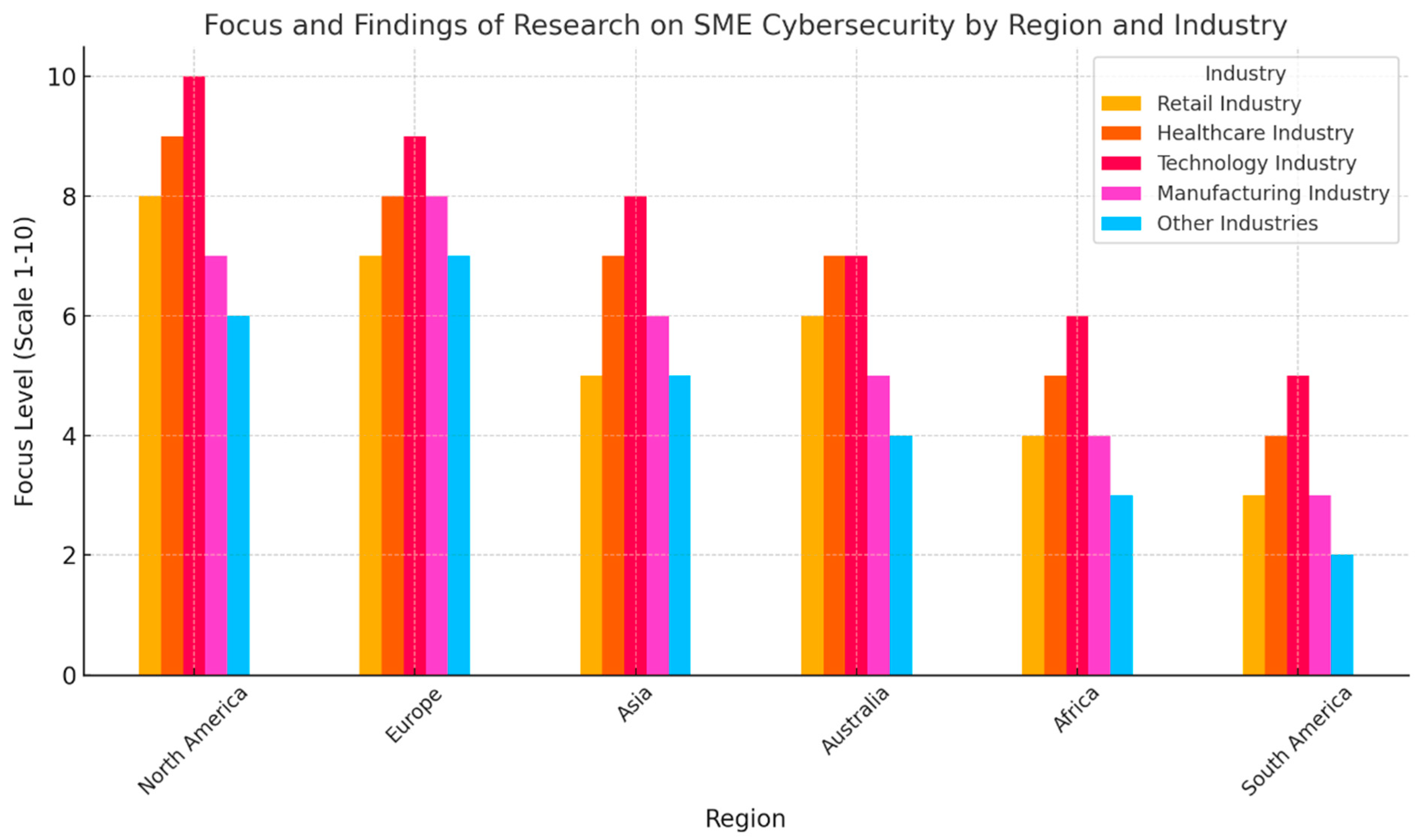
- Region and Industries: The focus and findings of research on SME cybersecurity across different regions and industries.
3.6. Primary Data Selection
- Title and Abstract Screening: All retrieved studies were screened for relevance based on their titles and abstracts.
- Full-Text Review: Studies passing the initial screening were reviewed in full to ensure they met the inclusion criteria.
- Quality Assessment: The following systematic quality assessment criteria were adopted:
- Relevance (Weight: 30%)
- ○
- How closely does the article address cybersecurity threats or defensive practices for SMEs?
- ○
- Scored as:
- ▪
- High (3): Directly relevant to both SMEs and cybersecurity
- ▪
- Medium (2): Relevant to cybersecurity, but in general, not SME-focused
- ▪
- Lower (1): Limited or tangential relevance
- Scientific Rigour (Weight: 25%)
- ○
- Does the article use a validated methodology, theoretical framework, or empirical analysis?
- ○
- Scored as:
- ▪
- High (3): Strong methodology, data-backed findings
- ▪
- Medium (2): Moderate methodology, limited empirical data
- ▪
- Lower (1): Weak or absent methodology
- Innovation (Weight: 15%)
- ○
- Does the article propose novel threats, defensive practices, or frameworks?
- ○
- Scored as:
- ▪
- High (3): Strong innovation or unique perspectives
- ▪
- Medium (2): Moderately innovative
- ▪
- Lower (1): Lacks innovation
- Citation Impact (Weight: 10%)
- ○
- How widely is the article cited within its domain
- ○
- Scored as:
- ▪
- High (3): Frequently cited
- ▪
- Medium (2): Moderately cited
- ▪
- Lower (1): Rarely cited
- Publication Quality (Weight: 10%)
- ○
- Was the article published in a reputable journal or conference?
- ○
- Scored as:
- ▪
- High (3): Tier-1 journal or conference
- ▪
- Medium (2): Tier-2 or niche publication
- ▪
- Lower (1): Low-impact source
- Recency (Weight: 10%)
- ○
- Was the article published within the last 5 years?
- ○
- Scored as:
- ▪
- High (3): Published in the last 3 years
- ▪
- Medium (2): 3–5 years old
- ▪
- Lower (1): Older than 5 years
4. Results and Analysis
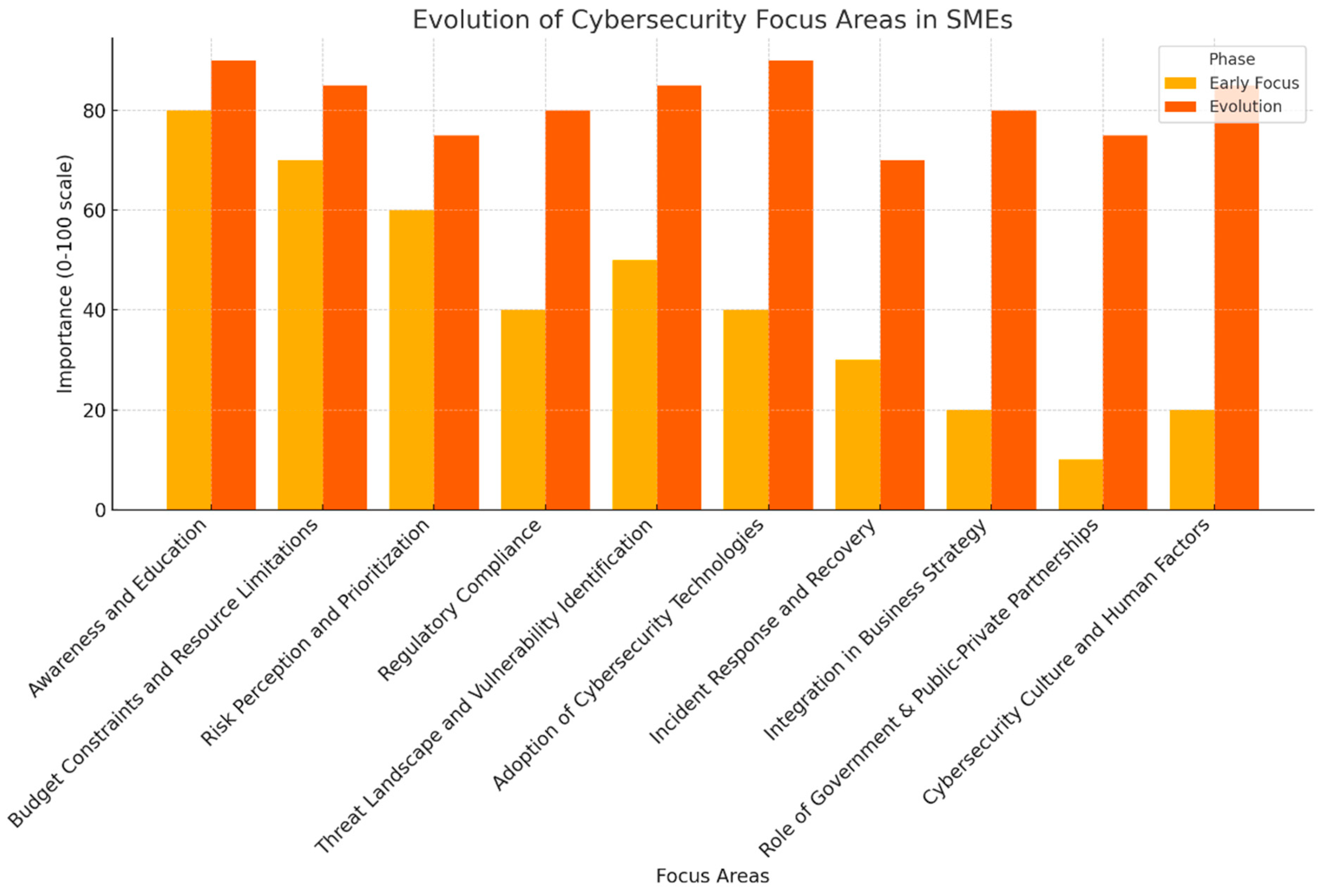
4.1. Critical Areas of Focus in Cybersecurity Within SMEs and How These Areas Evolved
- Awareness and Education:
- 2.
- Budget Constraints and Resource Limitations:
- 3.
- Risk Perception and Prioritization:
- 4.
- Regulatory Compliance:
- 5.
- Threat Landscape and Vulnerability Identification:
- 6.
- Adoption of Cybersecurity Technologies and Solutions:
- 7.
- Incident Response and Recovery:
- 8.
- Integration of Cybersecurity in Business Strategy:
- 9.
- Role of Government and Public–Private Partnerships:
- 10.
- Cybersecurity Culture and Human Factors:
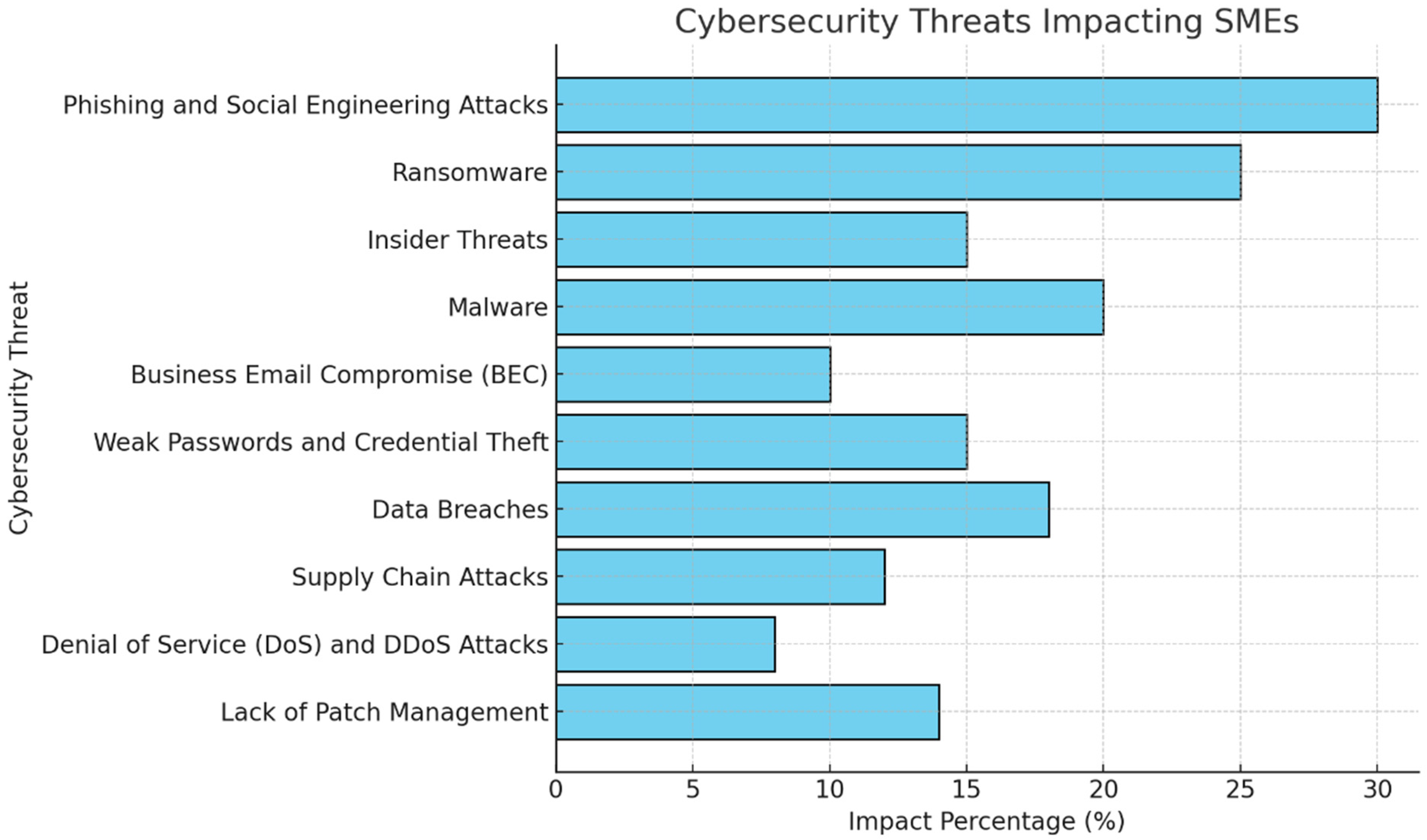
4.2. Most Prevalent Cybersecurity Threats That Impact SMEs
- Phishing and Social Engineering Attacks:
- 2.
- Ransomware:
- 3.
- Insider Threats:
- 4.
- Weak Passwords and Credential Reuse:
- 5.
- Software Vulnerabilities:
- 6.
- Supply Chain Attacks:
- 7.
- Distributed Denial of Service (DDoS) Attacks:
- 8.
- IoT Vulnerabilities:
- 9.
- Cloud Security Risks:
- 10.
- Business Email Compromise (BEC):
N
10
- High Importance: 5 threats (CST1, CST2, CST4, CST7)
- Medium Importance: 4 threat types (CST3, CST5, CST6, CST8, CST10)
- Low Importance: 1 threat (CST9)
- High Importance = 3
- Medium Importance = 2
- Low Importance = 1
- Step 1: Calculate the Total Weighted Contribution
- Step 2: Calculate the Relative Figure of Merit for Every Code
Total Weighted Contribution
- Step 3: Distribution Analysis
4.3. Defensive Practices for Addressing Cybersecurity Threats That Impact SMEs
4.4. Research Methodologies, Approaches and Their Contribution to SMEs-Specific Cybersecurity Threats
- Qualitative Research. (Fotis, 2024a; Ismail et al., 2024; Knight & Nurse, 2020; Nautiyal & Rashid, 2024; Waelchli & Walter, 2025)
- 2.
- Surveys and Quantitative Research. (Alqudhaibi et al., 2025; Ismail et al., 2024)
- 3.
- Action Research. (Liang et al., 2023)
- 4.
- Comparative Research. (Erbas et al., 2024)
- 5.
- Cybersecurity Maturity Models. (Erbas et al., 2024; Nautiyal & Rashid, 2024)
- 6.
- Scenario-based and Threat Modelling
- 7.
- Longitudinal Studies. (Zhang & Malacaria, 2025)
- 8.
- Behavioural Research. (Ismail et al., 2024; Kiran et al., 2025)
- 9.
- Literature Reviews and Meta-Analysis. (Alqudhaibi et al., 2025; Fotis, 2024b; Jada & Mayayise, 2024)
- 10.
- Risk Assessment Frameworks. (Alqudhaibi et al., 2025; Knight & Nurse, 2020; Zhang & Malacaria, 2025)
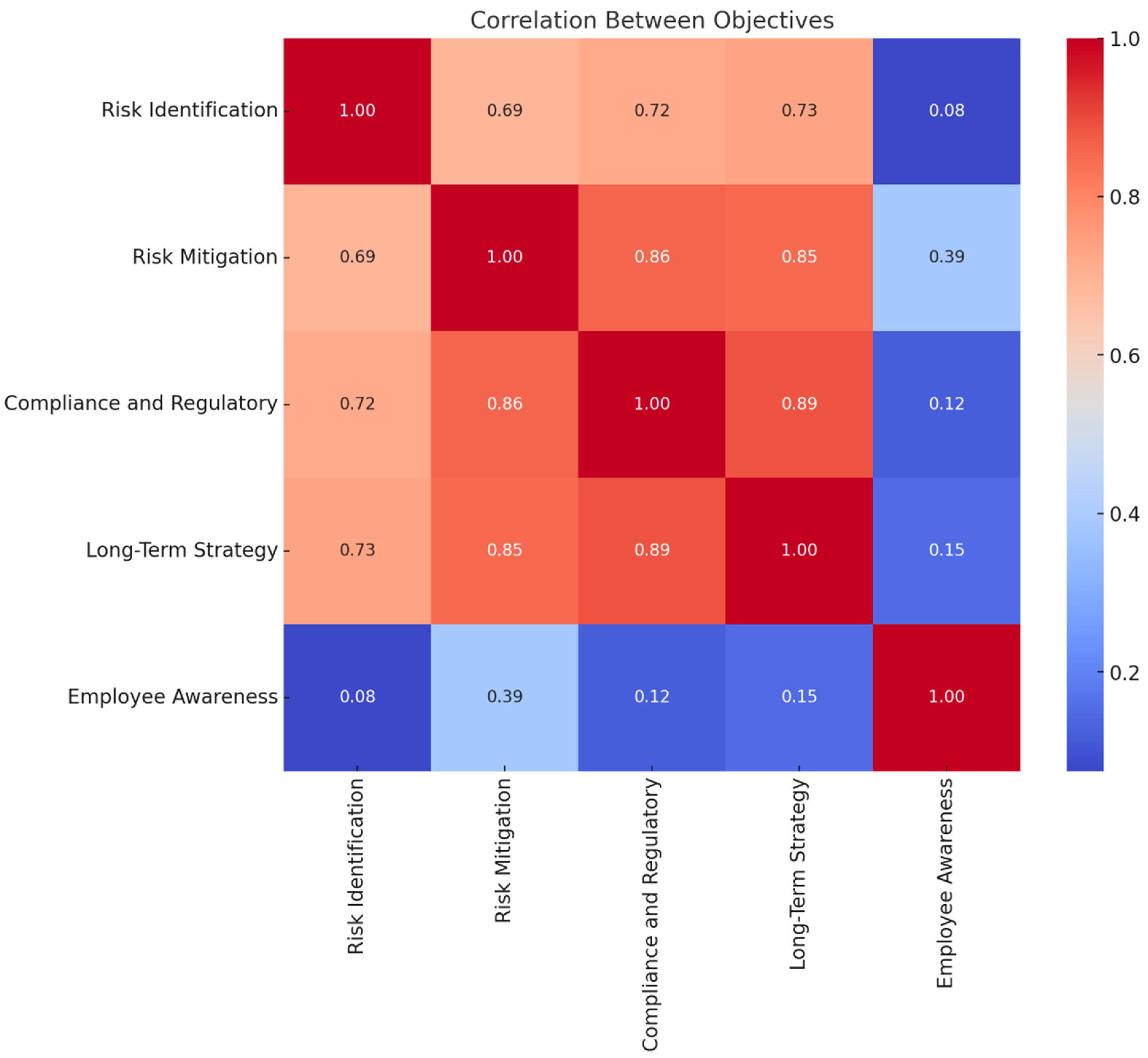
- Strong Positive Correlations:
- 2.
- Moderate Positive Correlations:
- 3.
- Low OR Negligible Correlations:
- Risk Identification (0.08)
- Compliance and Regulatory (0.12)
- Long-Term Strategy (0.15)
4.5. Focus and Research on SME Cybersecurity by Region and Industry
- 1–3 indicates low research attention,
- 4–7 indicates moderate attention, and
- 8–10 indicates high attention.
- Regional Trends:
- ○
- North America and Europe demonstrate the highest focus across all industries, indicating these regions lead in SME cybersecurity research.
- ○
- Asia shows strong research efforts, particularly in the Technology and Healthcare industries.
- ○
- Africa and South America exhibit comparatively lower levels of focus, with only modest efforts across industries.
- Industry-Specific Insights:
- ○
- The Technology Industry consistently receives the highest focus across all regions, reflecting its critical need for robust cybersecurity measures.
- ○
- The Healthcare Industry also receives significant attention, especially in North America and Europe, likely due to increased digitalization and regulatory requirements.
- ○
- Retail and Manufacturing industries see moderate levels of focus, with a stronger emphasis on developed regions.
- ○
- Other Industries, such as agriculture or small-scale services, tend to receive the least attention overall.
- Global Disparities:
- ○
- Developed regions (North America, Europe) show a more balanced and high-level focus
- ○
- across all industries, while developing areas (Africa, South America) lag, particularly in sectors outside of healthcare and technology.
- ○
- Policymakers and researchers in developing regions should prioritize cybersecurity awareness and solutions in industries like Manufacturing and Retail to ensure equitable growth.
- ○
- Industries like Technology and Healthcare require sustained investment in cybersecurity due to their critical vulnerabilities.
- ○
- Collaboration between regions with advanced research (e.g., North America and Europe) and those with lower focus levels could help address global cybersecurity challenges.
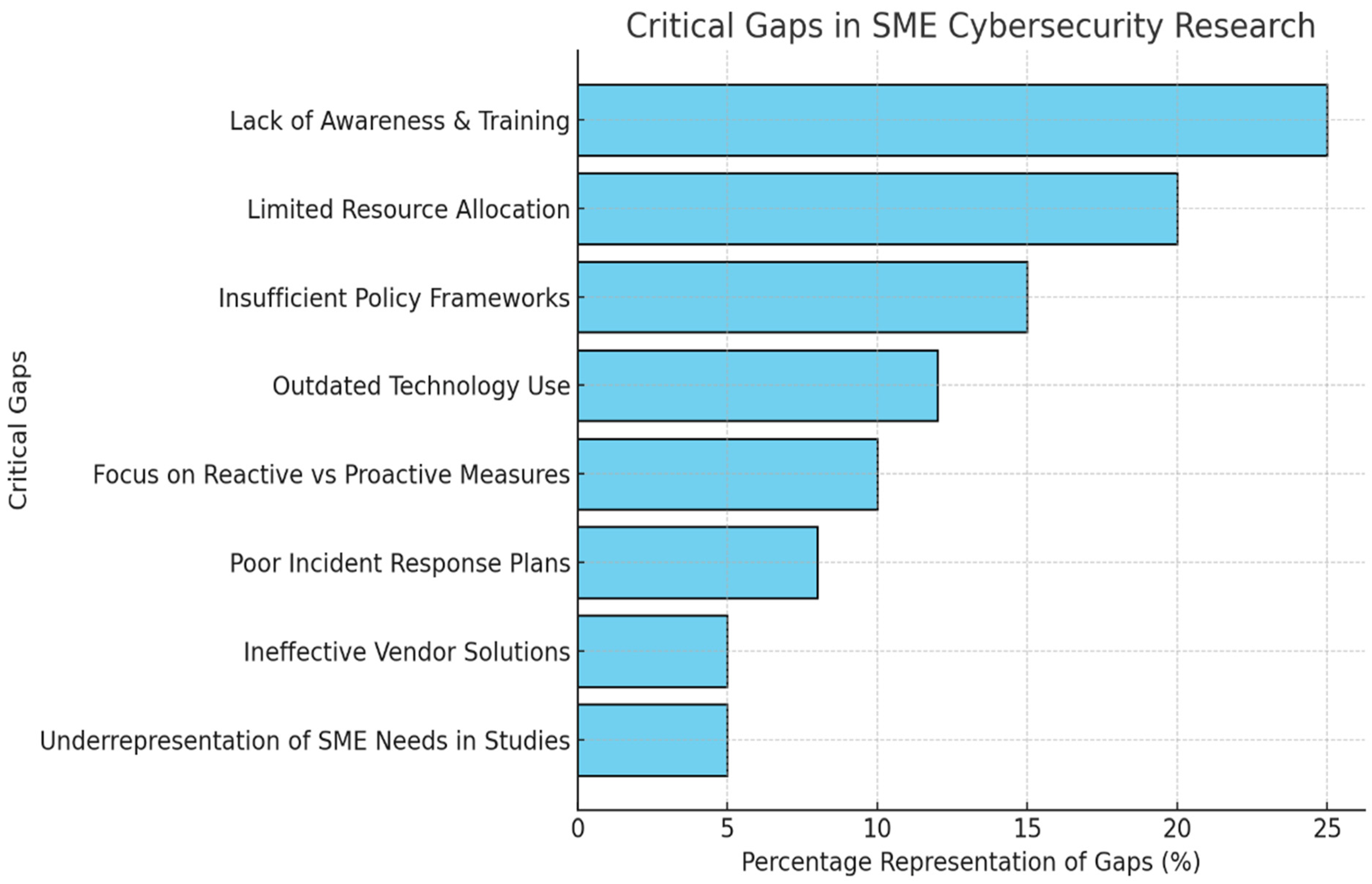
4.6. Critical Gaps in SMEs Cybersecurity Research
- Lack of Awareness and Training (25%):
- 2.
- Limited Resource Allocation (20%):
- 3.
- Insufficient Policy Frameworks (15%):
- 4.
- Outdated Technology Use (12%):
- 5.
- Focus on Reactive vs. Proactive Measures (10%):
- 6.
- Poor Incident Response Plans (8%):
- 7.
- Ineffective Vendor Solutions (5%):
- 8.
- Underrepresentation of SME Needs in Studies (5%):
- ○
- Prioritizing Awareness and Resources:
- ○
- Proactive vs. Reactive Approaches:
- ○
- Customized Solutions for SMEs:
- ○
- Collaboration Opportunities:
5. Summary and Conclusions of the Study
- Proactive Measures: Regarding cybersecurity, businesses should transform from simply responding to threats to a more strategic approach to the problem that includes constant risk analysis and future planning.
- Sustainability of Training Programmes: This is why awareness must be constant and frequently reinforced through the culture set up in the company.
- Resource Optimization: SMEs can, therefore, improve the security of their organizations by building on affordable solutions and adopting threat intelligence sharing services from the cloud across organizations at a fractional cost of exclusive control solutions.
- Policy and Vendor Collaboration: Leaders in government and technology industries should, therefore, offer policies and products that will enhance the cybersecurity frameworks in SMEs.
6. Implication of the Study
- Enhanced Awareness of Threat Landscape: This paper for SMEs summarizes the current top-level threats that this sector faces in terms of cybersecurity. Because SMEs are aware of the kind of threats and threat vectors that dominate their environment while operating, they can allocate resources and attention appropriately.
- Guidance for Resource Allocation: Since most SMEs operate under tightly controlled financial and technical resource environments, these mapped-out defensive strategies can point to where to deploy these scarce resources. The threats identified make it easier for SMEs to concentrate on cost-efficient solutions that can provide adequate security to the companies.
- Policy and Training Development: The research findings can help policymakers and industry regulators to launch the relevant programmes and policies, such as cybersecurity training and local regulatory frameworks, that address the significant hurdles to SMEs. This could motivate the adoption of the proper practices and technologies at various political stages.
- Foundation for Future Research: The discussed SMS is the prerequisite for future research on SME cybersecurity. The breakdown of the issues highlighted in the case allows the researchers to find out the directions in which new technologies and methodologies can be applied to mitigate specific risks in SMEs.
- Customized Cybersecurity Solutions: Most of the existing works call for the development of more generalized as well as more organization-specific security solutions that are more appropriate for SMEs. Businesses with limited technological expertise may adopt these findings to potentially develop cost-effective tools and services that are simple to implement using available software tools.
- Collaborative Cybersecurity Ecosystem: The benefits are not limited to promoting cooperation between SMEs and large companies and cybersecurity service providers. This approach suggests that the development of a mutual threat database and synchronized defensive measures can help SMEs increase their overall security levels.
- Encouragement for Cybersecurity Investment: This study makes the need for proper cybersecurity infrastructure investments transparent by providing examples of how cybersecurity breaches can affect an organization. It can be used as an argument for SME leadership to put their money where their protection is.
- Benchmarking and Standards: The SMS is helpful as it paints a picture of the state of the identified best practice that an SME has implemented to determine its cybersecurity posture. It also creates a foundation of best practices for the growth of field-specific cybersecurity benchmarks and policies.
- Impact on SME Competitiveness: When SMEs implement better cybersecurity, they reduce their risk of threats while, at the same time, creating more credibility in the market. It can give competitive advantages in fields that require data security for clients and partners because of its nature.
- Long-term Sustainability: Considering the study, the timely implementation of defensive measures explained above guarantees long-term functional flexibility to SMEs, reducing risks of financial and reputational loss due to cyber threats.
7. Limitations of the Study
- Scope of Data Sources: The study mainly depended on scholarly articles, business materials, and data accessible to the public. Although these sources present strong and reliable information, some of the practices and threats faced might not be fully reflected, particularly in minority sectors of SMEs or some geographic areas.
- Publication Bias: The inclusion of rich sources of published documents poses the danger of publication bias into the equation. A large number of positive research results or remarkable cases of work may be published, which may distort the picture of adequate protective measures or the share of threats.
- Generalizability: This SMS is primarily directed at the SME and its maturing cybersecurity concerns and guard mechanisms. It is also important to note that although some of the findings may refer to larger organizations or other sectors, the results are specific to the SME population and should not be generalized outside of this setting.
- Methodological Constraints: Despite this, the SMS process entails rigorous activity, which ultimately limits it owing to the selection criteria and frameworks in question. As a result of comparing the proposed empirical criteria, some relevant studies or other innovative approaches might have been filtered out because of poor fit.
- Rapid Evolution of Threats and Defensive Approaches: This sort of threat and activity changes frequently, so commemorative defensive strategies are a necessity. The very characteristic of an SMS is static, which means it trails real-life developments in the field.
Supplementary Materials
Author Contributions
Funding
Institutional Review Board Statement
Informed Consent Statement
Data Availability Statement
Conflicts of Interest
References
- Al Aamer, A. K., & Hamdan, A. (2023). Cyber security awareness and SMEs’ profitability and continuity: Literature review (pp. 593–604). Springer. [Google Scholar]
- Alahmari, A., & Duncan, B. (2020, June 15–17). Cybersecurity risk management in small and medium-sized enterprises: A systematic review of recent evidence. 2020 International Conference on Cyber Situational Awareness, Data Analytics and Assessment (CyberSA) (pp. 1–5), Dublin, Ireland. [Google Scholar]
- AlDaajeh, S., & Alrabaee, S. (2024). Strategic cybersecurity. Computers & Security, 141, 103845. [Google Scholar] [CrossRef]
- Al-Dalati, I. (2023). Digital twins and cybersecurity in healthcare systems. In Digital twin for healthcare (pp. 195–221). Academic Press. [Google Scholar]
- Alhakami, H. (2024). Enhancing IoT security: Quantum-level resilience against threats. Computers, Materials & Continua, 78(1). [Google Scholar] [CrossRef]
- Alhakami, W. (2024). Enhancing cybersecurity competency in the Kingdom of Saudi Arabia: A fuzzy decision-making approach. Computers, Materials & Continua, 79(2), 3211. [Google Scholar] [CrossRef]
- Almahmoud, Z., Yoo, P. D., Damiani, E., Choo, K. K. R., & Yeun, C. Y. (2025). Forecasting cyber threats and pertinent mitigation technologies. Technological Forecasting and Social Change, 210, 123836. [Google Scholar] [CrossRef]
- Alqudhaibi, A., Albarrak, M., Jagtap, S., Williams, N., & Salonitis, K. (2025). Securing industry 4.0: Assessing cybersecurity challenges and proposing strategies for manufacturing management. Cyber Security and Applications, 3, 100067. [Google Scholar] [CrossRef]
- Antunes, M., Maximiano, M., & Gomes, R. (2022). A customizable web platform to manage standards compliance of information security and cybersecurity auditing. Procedia Computer Science, 196, 36–43. [Google Scholar] [CrossRef]
- Arroyabe, M. F., Arranz, C. F. A., De Arroyabe, I. F., & de Arroyabe, J. C. F. (2024a). Revealing the realities of cybercrime in small and medium enterprises: Understanding fear and taxonomic perspectives. Computers & Security, 141, 103826. [Google Scholar]
- Arroyabe, M. F., Arranz, C. F. A., Fernandez De Arroyabe, I., & Fernandez de Arroyabe, J. C. (2024b). Exploring the economic role of cybersecurity in SMEs: A case study of the UK. Technology in Society, 78, 102670. [Google Scholar] [CrossRef]
- Beuran, R., Vykopal, J., Belajová, D., Čeleda, P., Tan, Y., & Shinoda, Y. (2023). Capability assessment methodology and comparative analysis of cybersecurity training platforms. Computers & Security, 128, 103120. [Google Scholar] [CrossRef]
- Budde, C. E., Karinsalo, A., Vidor, S., Salonen, J., & Massacci, F. (2023). CSEC+ framework assessment dataset: Expert evaluations of cybersecurity skills for job profiles in Europe. Data in Brief, 48, 109285. [Google Scholar] [CrossRef]
- Bukhari, S. M. S., Zafar, M. H., Abou Houran, M., Qadir, Z., Moosavi, S. K. R., & Sanfilippo, F. (2024). Enhancing cybersecurity in Edge IIoT networks: An asynchronous federated learning approach with a deep hybrid detection model. Internet of Things, 27, 101252. [Google Scholar] [CrossRef]
- Burská, K. D., Rusňák, V., & Ošlejšek, R. (2022). Data-driven insight into the puzzle-based cybersecurity training. Computers & Graphics, 102, 441–451. [Google Scholar]
- Campos, J., Sharma, P., Jantunen, E., Baglee, D., & Fumagalli, L. (2016). The challenges of cybersecurity frameworks to protect data required for the development of advanced maintenance. Procedia Cirp, 47, 222–227. [Google Scholar] [CrossRef][Green Version]
- Chae, Y. H., Lee, C., Choi, M. K., & Seong, P. H. (2022). Evaluating attractiveness of cyberattack path using resistance concept and page-rank algorithm. Annals of Nuclear Energy, 166, 108748. [Google Scholar] [CrossRef]
- Chaudhary, S., Gkioulos, V., & Katsikas, S. (2023). A quest for research and knowledge gaps in cybersecurity awareness for small and medium-sized enterprises. Computer Science Review, 50, 100592. [Google Scholar] [CrossRef]
- Chaudhuri, A., Behera, R. K., & Bala, P. K. (2025). Factors impacting cybersecurity transformation: An Industry 5.0 perspective. Computers & Security, 150, 104267. [Google Scholar]
- Chidukwani, A., Zander, S., & Koutsakis, P. (2022). A survey on the cyber security of small-to-medium businesses: Challenges, research focus and recommendations. IEEE Access, 10, 85701–85719. [Google Scholar] [CrossRef]
- Chidukwani, A., Zander, S., & Koutsakis, P. (2024). Cybersecurity preparedness of small-to-medium businesses: A Western Australia study with broader implications. Computers & Security, 145, 104026. [Google Scholar]
- Daim, T., Yalcin, H., Mermoud, A., & Mulder, V. (2024). Exploring cybertechnology standards through bibliometrics: Case of national institute of standards and technology. World Patent Information, 77, 102278. [Google Scholar] [CrossRef]
- Dawson, M., Taveras, P., & Taylor, D. (2019). Applying software assurance and cybersecurity nice job tasks through secure software engineering labs. Procedia Computer Science, 164, 301–312. [Google Scholar] [CrossRef]
- De Cassai, A., Dost, B., Tulgar, S., & Boscolo, A. (2025). Methodological standards for conducting high-quality systematic reviews. Biology, 14(8), 973. [Google Scholar] [CrossRef]
- Ding, Y., Wu, Z., Tan, Z., & Jiang, X. (2021). Research and application of security baseline in business information system. Procedia Computer Science, 183, 630–635. [Google Scholar] [CrossRef]
- Djenna, A., Belaoued, M., Lifa, N., & Moualdi, D. E. (2024). PARCA: Proactive anti-ransomware cybersecurity approach. Procedia Computer Science, 238, 821–826. [Google Scholar] [CrossRef]
- Dufera, A. G., Liu, T., & Xu, J. (2023). Regression models of Pearson correlation coefficient. Statistical Theory and Related Fields, 7(2), 97–106. [Google Scholar] [CrossRef]
- Erbas, M., Khalil, S. M., & Tsiopoulos, L. (2024). Systematic literature review of threat modeling and risk assessment in ship cybersecurity. Ocean Engineering, 306, 118059. [Google Scholar] [CrossRef]
- Erdogan, G., Halvorsrud, R., Boletsis, C., Tverdal, S., & Pickering, J. B. (2023, February 22–24). Cybersecurity awareness and capacities of SMEs. 9th International Conference on Information Systems Security and Privacy (ICISSP 2023) (pp. 296–304), Lisbon, Portugal. [Google Scholar]
- Fotis, F. (2024a). Cyberattacks: Economic Impacts and Risk Management Strategies. Procedia Computer Science, 251, 672–677. [Google Scholar] [CrossRef]
- Fotis, F. (2024b). Economic impact of cyber attacks and effective cyber risk management strategies: A light literature review and case study analysis. Procedia Computer Science, 251, 471–478. [Google Scholar] [CrossRef]
- Furfaro, A., Piccolo, A., Parise, A., Argento, L., & Saccà, D. (2018). A Cloud-based platform for the emulation of complex cybersecurity scenarios. Future Generation Computer Systems, 89, 791–803. [Google Scholar] [CrossRef]
- Geach, D. (2021). Grid cyber security: Secure by design, continuous threat monitoring, effective incident response and board oversight. Network Security, 2021(6), 9–12. [Google Scholar] [CrossRef]
- Gunes, B., Kayisoglu, G., & Bolat, P. (2021). Cyber security risk assessment for seaports: A case study of a container port. Computers & Security, 103, 102196. [Google Scholar] [CrossRef]
- Hossain, N., & Hasan, M. (2024). The impacts of cyberattack on SMEs in the USA and way to accelerate cybersecurity. Advances in Social Sciences Research Journal, 11(10), 197–203. [Google Scholar] [CrossRef]
- Ismail, M., Madathil, N. T., Alalawi, M., Alrabaee, S., Al Bataineh, M., Melhem, S., & Mouheb, D. (2024). Cybersecurity activities for education and curriculum design: A survey. Computers in Human Behavior Reports, 16, 100501. [Google Scholar] [CrossRef]
- Jada, I., & Mayayise, T. O. (2024). The impact of artificial intelligence on organisational cyber security: An outcome of a systematic literature review. Data and Information Management, 8(2), 100063. [Google Scholar] [CrossRef]
- Junior, C. R., Becker, I., & Johnson, S. (2023). Unaware, unfunded and uneducated: A systematic review of SME cybersecurity (Vol. Abs/2309.17186). CoRR.
- Khan, R. A., Khan, S. U., & Ilyas, M. (2022). Exploring security procedures in secure software engineering: A systematic mapping study. The International Conference on Evaluation and Assessment in Software Engineering, 2022, 433–439. [Google Scholar]
- Khan, R. A., Khan, S. U., Khan, H. U., & Ilyas, M. (2021). Systematic mapping study on security approaches in secure software engineering. IEEE Access, 9, 19139–19160. [Google Scholar] [CrossRef]
- Kiran, U., Khan, N. F., Murtaza, H., Farooq, A., & Pirkkalainen, H. (2025). Explanatory and predictive modeling of cybersecurity behaviors using protection motivation theory. Computers & Security, 149, 104204. [Google Scholar]
- Knight, R., & Nurse, J. R. (2020). A framework for effective corporate communication after cyber security incidents. Computers & Security, 99, 102036. [Google Scholar] [CrossRef]
- Laato, S., Farooq, A., Tenhunen, H., Pitkamaki, T., Hakkala, A., & Airola, A. (2020, July 6–9). AI in cybersecurity education—A systematic literature review of studies on cybersecurity MOOCs. 2020 IEEE 20th International Conference on Advanced Learning Technologies (ICALT) (pp. 6–10), Tartu, Estonia. [Google Scholar]
- Liang, X., Konstantinou, C., Shetty, S., Bandara, E., & Sun, R. (2023). Decentralizing cyber physical systems for resilience: An innovative case study from a cybersecurity perspective. Computers & Security, 124, 102953. [Google Scholar]
- Mantha, B., de Soto, B. G., & Karri, R. (2021). Cyber security threat modeling in the AEC industry: An example for the commissioning of the built environment. Sustainable Cities and Society, 66, 102682. [Google Scholar] [CrossRef]
- Maraveas, C., Rajarajan, M., Arvanitis, K. G., & Vatsanidou, A. (2024). Cybersecurity threats and mitigation measures in agriculture 4.0 and 5.0. Smart Agricultural Technology, 9, 100616. [Google Scholar] [CrossRef]
- McIntosh, T., Liu, T., Susnjak, T., Alavizadeh, H., Ng, A., Nowrozy, R., & Watters, P. (2023). Harnessing GPT-4 for generation of cybersecurity GRC policies: A focus on ransomware attack mitigation. Computers & Security, 134, 103424. [Google Scholar] [CrossRef]
- Medeiros, N., Ivaki, N., Costa, P., & Vieira, M. (2023). Trustworthiness models to categorize and prioritize code for security improvement. Journal of Systems and Software, 198, 111621. [Google Scholar] [CrossRef]
- Mmango, N., & Gundu, T. (2023, November 16–17). Cyber resilience in the entrepreneurial environment: A framework for enhancing cybersecurity awareness in SMEs. 2023 International Conference on Electrical, Computer and Energy Technologies (ICECET) (pp. 1–6), Cape Town, South Africa. [Google Scholar]
- Moneva, A., & Leukfeldt, R. (2023). Insider threats among Dutch SMEs: Nature and extent of incidents, and cyber security measures. Journal of Criminology, 56(4), 416–440. [Google Scholar] [CrossRef]
- Nanda, M., Saraswat, M., & Sharma, P. K. (2024). Enhancing cybersecurity: A review and comparative analysis of convolutional neural network approaches for detecting URL-based phishing attacks. E-Prime—Advances in Electrical Engineering, Electronics and Energy, 8, 100533. [Google Scholar] [CrossRef]
- Naseer, A., Naseer, H., Ahmad, A., Maynard, S. B., & Siddiqui, A. M. (2021). Real-time analytics, incident response process agility and enterprise cybersecurity performance: A contingent resource-based analysis. International Journal of Information Management, 59, 102334. [Google Scholar] [CrossRef]
- Nautiyal, L., & Rashid, A. (2024). A framework for mapping organisational workforce knowledge profile in cyber security. Computers & Security, 145, 103925. [Google Scholar] [CrossRef]
- Novelli, C., Casolari, F., Hacker, P., Spedicato, G., & Floridi, L. (2024). Generative AI in EU law: Liability, privacy, intellectual property, and cybersecurity. Computer Law & Security Review, 55, 106066. [Google Scholar] [CrossRef]
- Page, M. J., McKenzie, J. E., Bossuyt, P. M., Boutron, I., Hoffmann, T. C., Mulrow, C. D., Shamseer, L., Tetzlaff, J. M., Akl, E. A., Brennan, S. E., & Chou, R. (2021). The PRISMA 2020 statement: An updated guideline for reporting systematic reviews. BMJ, 372, n71. [Google Scholar] [CrossRef]
- Petersen, K., Feldt, R., Mujtaba, S., & Mattsson, M. (2008, June 26–27). Systematic mapping studies in software engineering. 12th International Conference on Evaluation and Assessment in Software Engineering (EASE), Bari, Italy. [Google Scholar]
- Petersen, K., Vakkalanka, S., & Kuzniarz, L. (2015). Guidelines for conducting systematic mapping studies in software engineering: An update. Information and Software Technology, 64, 1–18. [Google Scholar] [CrossRef]
- Qamar, S. (2022). Healthcare data analysis by feature extraction and classification using deep learning with cloud based cyber security. Computers and Electrical Engineering, 104, 108406. [Google Scholar] [CrossRef]
- Radanliev, P., De Roure, D., & Santos, O. (2023). Red teaming generative AI/NLP, the BB84 quantum cryptography protocol and the NIST-approved quantum-resistant cryptographic algorithms. arXiv, arXiv:2310.04425. [Google Scholar] [CrossRef]
- Saeed, S., Altamimi, S. A., Alkayyal, N. A., Alshehri, E., & Alabbad, D. A. (2023). Digital transformation and cybersecurity challenges for businesses resilience: Issues and recommendations. Sensors, 23(15), 6666. [Google Scholar] [CrossRef]
- Sedgwick, P. (2012). Pearson’s correlation coefficient. BMJ, 345, e4483. [Google Scholar] [CrossRef]
- Shaffique, M. R. (2024). Cyber resilience act 2022: A silver bullet for cybersecurity of IoT devices or a shot in the dark? Computer Law & Security Review, 54, 106009. [Google Scholar] [CrossRef]
- Soner, O., Kayisoglu, G., Bolat, P., & Tam, K. (2024). Risk sensitivity analysis of AIS cyber security through maritime cyber regulatory frameworks. Applied Ocean Research, 142, 103855. [Google Scholar] [CrossRef]
- Sushma, K. S. N., Viji, C., Rajkumar, N., Ravi, J., Stalin, M., & Najmusher, H. (2023). Healthcare 4.0: A Review of Phishing Attacks in Cyber Security. Procedia Computer Science, 230, 874–878. [Google Scholar] [CrossRef]
- Tam, T., Rao, A., & Hall, J. (2021). The good, the bad and the missing: A Narrative review of cyber-security implications for Australian small businesses. Computers & Security, 109, 102385. [Google Scholar] [CrossRef]
- Tanimu, J. A., & Abada, W. (2025). Addressing cybersecurity challenges in robotics: A comprehensive overview. Cyber Security and Applications, 3, 100074. [Google Scholar] [CrossRef]
- Toftegaard, Ø., Grøtterud, G., & Hämmerli, B. (2024). Operational Technology resilience in the 2023 draft delegated act on cybersecurity for the power sector—An EU policy process analysis. Computer Law & Security Review, 54, 106034. [Google Scholar] [CrossRef]
- Waelchli, S., & Walter, Y. (2025). Reducing the risk of social engineering attacks using SOAR measures in a real-world environment: A case study. Computers & Security, 148, 104137. [Google Scholar]
- Wang, F., Wang, H., & Li, J. (2024). The effect of cybersecurity legislation on firm cost behavior: Evidence from China. Pacific-Basin Finance Journal, 86, 102460. [Google Scholar] [CrossRef]
- Wong, L.-W., Lee, V.-H., Tan, G. W.-H., Ooi, K.-B., & Sohal, A. (2022). The role of cybersecurity and policy awareness in shifting employee compliance attitudes: Building supply chain capabilities. International Journal of Information Management, 66, 102520. [Google Scholar] [CrossRef]
- Yin, J., Tang, M., Cao, J., & Wang, H. (2020). Apply transfer learning to cybersecurity: Predicting exploitability of vulnerabilities by description. Knowledge-Based Systems, 210, 106529. [Google Scholar] [CrossRef]
- Zadeh, A., & Jeyaraj, A. (2022). A multistate modeling approach for organizational cybersecurity exploration and exploitation. Decision Support Systems, 162, 113849. [Google Scholar] [CrossRef]
- Zhang, Y., & Malacaria, P. (2025). Dealing with uncertainty in cybersecurity decision support. Computers & Security, 148, 104153. [Google Scholar]
- Zhao, T., Gasiba, T., Lechner, U., & Pinto-Albuquerque, M. (2024). Thriving in the era of hybrid work: Raising cybersecurity awareness using serious games in industry trainings. Journal of Systems and Software, 210, 111946. [Google Scholar] [CrossRef]



| ID | Mapping Questions | Motivations |
|---|---|---|
| RQ1 | What is the state of the art of cybersecurity in SMEs? | The main goal of this research question is to find out the most recent research in SMEs related to cybersecurity threats. The results can be used as a reference guide for the future direction of research. To answer RQ1, we have analyzed the literature based on the following questions. |
| RQ1.1 | What are the critical areas of focus in the existing literature on cybersecurity within SMEs, and how have these areas evolved? | To find out the critical areas of focus in the existing literature on cybersecurity within SMEs and how these areas have evolved. |
| RQ1.2 | What are the most prevalent cybersecurity threats identified in the literature review that impact small- and medium-sized organizations? | To identity from the literature what are the most common threats which highly impact small- and medium-sized organizations. |
| RQ1.3 | What are the defensive approaches (practices), as identified through the literature review, for addressing the cybersecurity threats that impact SMEs? | To explore, evaluate, and classify the currently cyber-defensive approaches employed by SMEs to mitigate cyberattacks. |
| RQ1.4 | What research methodologies and approaches are predominantly used to study cybersecurity in SMEs, and how do they contribute to understanding SME-specific cybersecurity threats? | To know what the most common research methods are adopted to study cybersecurity, specific to the SME. |
| RQ1.5 | How do different regions and industries compare regarding the focus and findings of research on SME cybersecurity? | To identify how different industries, as well as demographic changes, impact the research findings on SME cybersecurity. |
| Main Concepts | “Cybersecurity Threats” “Cybersecurity Challenges” “Cybersecurity Practices” “Cybersecurity Approaches” “Cybersecurity Tools” “Cybersecurity Models” “Cybersecurity Frameworks” “Small Medium-sized Enterprise” “SMEs” “Small Business” |
| Groups of terms | ((“Cybersecurity Threats” OR “Cybersecurity Challenges” OR “Cybersecurity Practices” OR “Cybersecurity Approaches” OR “Cybersecurity Tools” OR “Cybersecurity Models” OR “Cybersecurity Frameworks”) (“Small Medium-sized Enterprise” OR “SMEs” OR “Small Business”)) |
| Search String | ((“Cybersecurity Threats” OR “Cybersecurity Challenges” OR “Cybersecurity Practices” OR “Cybersecurity Approaches” OR “Cybersecurity Tools” OR “Cybersecurity Models” OR “Cybersecurity Frameworks”) AND (“Small Medium-sized Enterprise” OR “SMEs” OR “Small Business”)) |
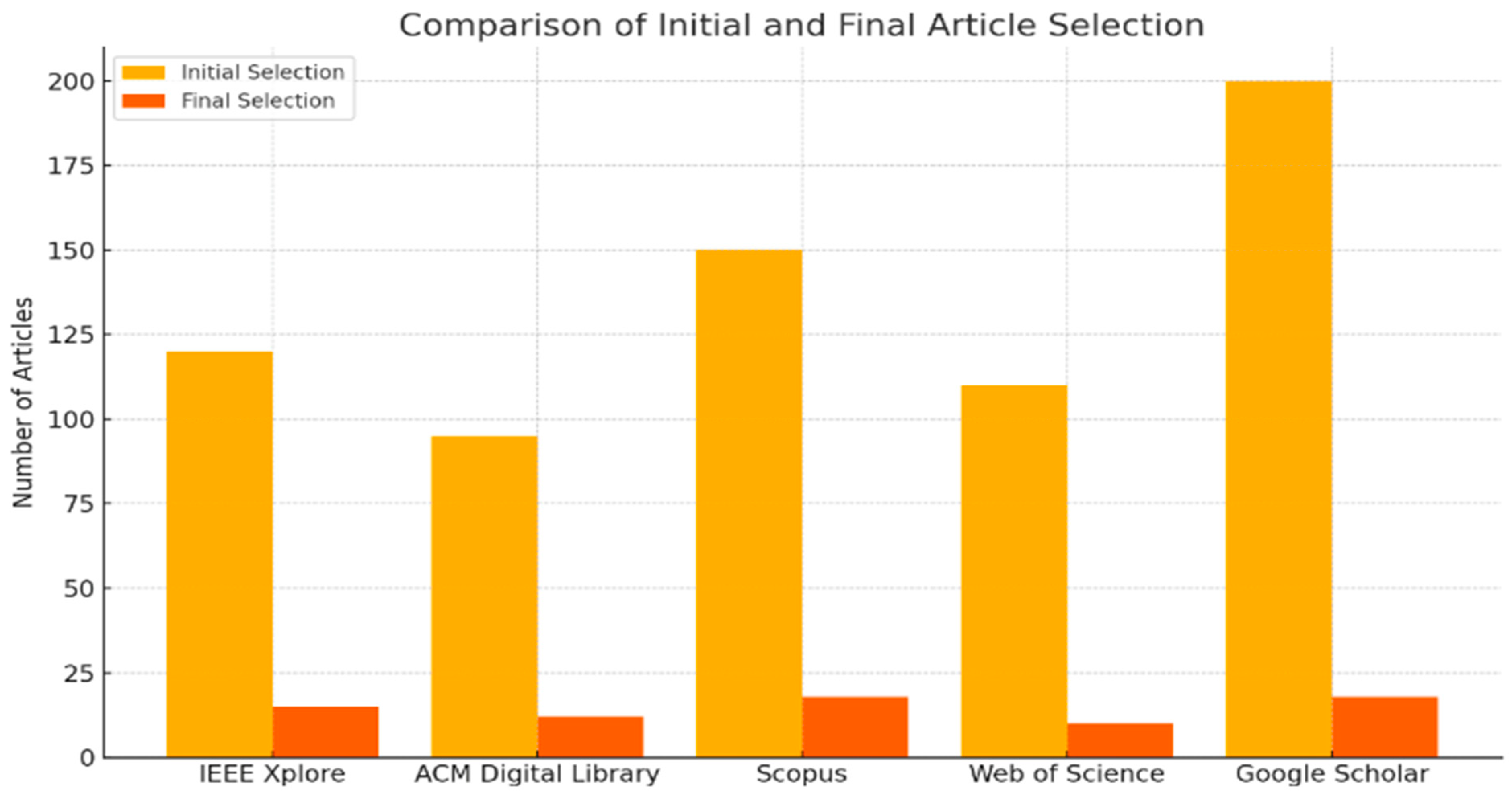
| Digital Libraries | Initial Selection | Final Selection |
|---|---|---|
| IEEE Xplore | 123 | 16 |
| ACM Digital Library | 88 | 12 |
| Scopus | 150 | 15 |
| Web of Science | 110 | 11 |
| Google Scholar | 200 | 19 |
| Total | 671 | 73 |
| Article ID | Relevance (30%) | Rigour (25%) | Innovation (15%) | Citation (10%) | Publication (10%) | Recency (10%) | Total Score |
|---|---|---|---|---|---|---|---|
| Article 1 | 3 | 3 | 3 | 2 | 1 | 3 | 2.7 |
| Article 2 | 3 | 2 | 2 | 3 | 3 | 2 | 2.5 |
| Article 3 | 2 | 1 | 3 | 1 | 1 | 2 | 1.7 |
| Article 4 | 1 | 3 | 1 | 3 | 1 | 3 | 1.9 |
| Article 5 | 1 | 1 | 3 | 2 | 1 | 3 | 1.6 |
| Article 6 | 3 | 2 | 2 | 2 | 3 | 2 | 2.4 |
| Article 7 | 3 | 3 | 1 | 1 | 2 | 2 | 2.3 |
| Article 8 | 3 | 3 | 3 | 3 | 1 | 3 | 2.8 |
| Article 9 | 3 | 1 | 2 | 3 | 2 | 3 | 2.25 |
| Article 10 | 2 | 2 | 1 | 3 | 2 | 3 | 2.05 |
| Article 11 | 2 | 2 | 3 | 3 | 1 | 1 | 2.05 |
| Article 12 | 1 | 1 | 3 | 1 | 1 | 2 | 1.4 |
| Article 13 | 2 | 3 | 1 | 3 | 1 | 1 | 2 |
| Article 14 | 2 | 2 | 3 | 3 | 2 | 1 | 2.15 |
| Article 15 | 2 | 2 | 1 | 1 | 3 | 1 | 1.75 |
| Article 16 | 2 | 2 | 1 | 2 | 1 | 1 | 1.65 |
| Article 17 | 3 | 3 | 3 | 3 | 1 | 2 | 2.7 |
| Article 18 | 1 | 2 | 3 | 2 | 1 | 3 | 1.85 |
| Article 19 | 1 | 2 | 2 | 1 | 2 | 2 | 1.6 |
| Article 20 | 1 | 2 | 2 | 3 | 3 | 2 | 1.9 |
| Article 21 | 1 | 3 | 2 | 2 | 1 | 1 | 1.75 |
| Article 22 | 2 | 1 | 3 | 3 | 3 | 3 | 2.2 |
| Article 23 | 2 | 3 | 2 | 3 | 2 | 3 | 2.45 |
| Article 24 | 1 | 1 | 1 | 3 | 3 | 2 | 1.5 |
| Article 25 | 1 | 3 | 1 | 3 | 3 | 2 | 2 |
| Article 26 | 3 | 1 | 2 | 3 | 1 | 2 | 2.05 |
| Article 27 | 3 | 2 | 2 | 1 | 3 | 3 | 2.4 |
| Article 28 | 3 | 2 | 3 | 3 | 3 | 3 | 2.75 |
| Article 29 | 2 | 3 | 3 | 3 | 3 | 1 | 2.5 |
| Article 30 | 2 | 3 | 2 | 3 | 3 | 1 | 2.35 |
| Article 31 | 1 | 2 | 1 | 2 | 3 | 2 | 1.65 |
| Article 32 | 1 | 3 | 1 | 2 | 1 | 3 | 1.8 |
| Article 33 | 2 | 1 | 1 | 3 | 2 | 3 | 1.8 |
| Article 34 | 1 | 1 | 3 | 2 | 3 | 2 | 1.7 |
| Article 35 | 1 | 1 | 3 | 3 | 1 | 1 | 1.5 |
| Article 36 | 1 | 2 | 3 | 3 | 2 | 3 | 2.05 |
| Article 37 | 3 | 3 | 3 | 3 | 3 | 1 | 2.8 |
| Article 38 | 2 | 1 | 3 | 2 | 3 | 1 | 1.9 |
| Article 39 | 2 | 3 | 2 | 2 | 2 | 2 | 2.25 |
| Article 40 | 2 | 3 | 3 | 2 | 1 | 3 | 2.4 |
| Article 41 | 1 | 3 | 2 | 1 | 1 | 3 | 1.85 |
| Article 42 | 3 | 1 | 3 | 2 | 3 | 3 | 2.4 |
| Article 43 | 3 | 1 | 3 | 1 | 2 | 3 | 2.2 |
| Article 44 | 2 | 2 | 1 | 3 | 1 | 3 | 1.95 |
| Article 45 | 1 | 3 | 1 | 2 | 2 | 3 | 1.9 |
| Article 46 | 1 | 1 | 1 | 3 | 2 | 2 | 1.4 |
| Article 47 | 2 | 3 | 1 | 1 | 1 | 2 | 1.9 |
| Article 48 | 3 | 1 | 2 | 1 | 2 | 3 | 2.05 |
| Article 49 | 2 | 1 | 2 | 1 | 1 | 2 | 1.55 |
| Article 50 | 2 | 1 | 3 | 1 | 2 | 3 | 1.9 |
| Article 51 | 2 | 2 | 3 | 2 | 1 | 2 | 2.05 |
| Article 52 | 3 | 2 | 1 | 3 | 3 | 2 | 2.35 |
| Article 53 | 2 | 2 | 3 | 3 | 1 | 1 | 2.05 |
| Article 54 | 1 | 3 | 1 | 3 | 2 | 3 | 2 |
| Article 55 | 1 | 3 | 1 | 1 | 1 | 1 | 1.5 |
| Article 56 | 3 | 2 | 3 | 3 | 3 | 1 | 2.55 |
| Article 57 | 3 | 1 | 3 | 1 | 3 | 2 | 2.2 |
| Article 58 | 1 | 3 | 1 | 1 | 1 | 3 | 1.7 |
| Article 59 | 1 | 1 | 1 | 1 | 1 | 2 | 1.1 |
| Article 60 | 2 | 1 | 1 | 2 | 3 | 1 | 1.6 |
| Article 61 | 2 | 2 | 1 | 2 | 3 | 3 | 2.05 |
| Article 62 | 2 | 2 | 3 | 1 | 1 | 3 | 2.05 |
| Article 63 | 2 | 2 | 2 | 2 | 3 | 2 | 2.1 |
| Article 64 | 3 | 2 | 3 | 3 | 1 | 2 | 2.45 |
| Article 65 | 1 | 2 | 3 | 3 | 3 | 3 | 2.15 |
| Article 66 | 3 | 3 | 1 | 2 | 1 | 1 | 2.2 |
| Article 67 | 2 | 3 | 2 | 1 | 3 | 3 | 2.35 |
| Article 68 | 1 | 2 | 1 | 1 | 1 | 1 | 1.25 |
| Article 69 | 3 | 2 | 3 | 2 | 3 | 1 | 2.45 |
| Article 70 | 2 | 3 | 1 | 2 | 3 | 2 | 2.2 |
| Article 71 | 1 | 2 | 2 | 3 | 1 | 2 | 1.7 |
| Article 72 | 1 | 3 | 2 | 3 | 1 | 3 | 2.05 |
| Article 73 | 2 | 1 | 1 | 1 | 1 | 3 | 1.5 |
| Code # | Cybersecurity Threats CSTs | Impact Percentage (%) | Importance for SMEs |
|---|---|---|---|
| CST1 | Phishing and Social Engineering Attacks | 30 | High |
| CST2 | Ransomware | 25 | High |
| CST3 | Insider Threats | 15 | Medium |
| CST4 | Malware | 20 | High |
| CST5 | Business Email Compromise (BEC) | 10 | Medium |
| CST6 | Weak Passwords and Credential Theft | 15 | Medium |
| CST7 | Data Breaches | 18 | High |
| CST8 | Supply Chain Attacks | 12 | Medium |
| CST9 | Denial of Service (DoS) and DDoS Attacks | 08 | Low |
| CST10 | Lack of Patch Management | 14 | Medium |
| Code | Impact (%) | Importance | Weight | Weighted Contribution |
|---|---|---|---|---|
| CST1 | 30 | High | 3 | 30 × 3 = 90 |
| CST2 | 25 | High | 3 | 25 × 3 = 75 |
| CST3 | 15 | Medium | 2 | 15 × 2 = 30 |
| CST4 | 20 | High | 3 | 20 × 3 = 60 |
| CST5 | 10 | Medium | 2 | 10 × 2 = 20 |
| CST6 | 15 | Medium | 2 | 15 × 2 = 30 |
| CST7 | 18 | High | 3 | 18 × 3 = 54 |
| CST8 | 12 | Medium | 2 | 12 × 4 = 24 |
| CST9 | 08 | Low | 1 | 08 × 1 = 08 |
| CST10 | 14 | Medium | 2 | 14 × 2 = 28 |
| Code # | Cybersecurity Risks to SMEs | Ref | Practices for Addressing the Identified Cybersecurity Risks | |
|---|---|---|---|---|
| Categories | Sub-Categories | |||
| Employee Training and Awareness |
| |||
| Email Security |
| |||
| Multi-Factor Authentication (MFA) |
| |||
| Access Control and Least Privilege |
| |||
| CST1 | Phishing and Social Engineering Attacks | (Arroyabe et al., 2024a; Hossain & Hasan, 2024; Mmango & Gundu, 2023; Sushma et al., 2023) | Incident Response Plan |
|
| Network Security |
| |||
| Data Encryption |
| |||
| Social Media Awareness |
| |||
| Regular Backups |
| |||
| Network Segmentation and Access Control |
| |||
| Regular Data Backup |
| |||
| User Awareness and Training |
| |||
| Endpoint Protection and Security Software |
| |||
| Regular Software Patching and Vulnerability Management |
| |||
| CST2 | Ransomware | (Djenna et al., 2024; Hossain & Hasan, 2024; Mmango & Gundu, 2023) | Multi-Factor Authentication (MFA) |
|
| Isolation of Infected System |
| |||
| Decryption Tools and Collaboration with Law Enforcement |
| |||
| Cybersecurity Insurance |
| |||
| Application Safe listing |
| |||
| Email Filtering and Web Security |
| |||
| Do Not Pay Ransom |
| |||
| Threat Intelligence Sharing |
| |||
| Outsource to Managed Security Service Providers (MSSPs) |
| |||
| Employee Screening and Monitoring |
| |||
| Role-Based Access Control (RBAC) |
| |||
| Data Loss Prevention (DLP) Solutions |
| |||
| CST3 | Insider Threats | (Alahmari & Duncan, 2020; Moneva & Leukfeldt, 2023; Saeed et al., 2023; Bukhari et al., 2024; Soner et al., 2024) | Behavioural Analytics and Anomaly Detection |
|
| Incident Response Plan for Insider Threats |
| |||
| Segmentation of Critical Data |
| |||
| Regular Audits and Compliance Checks |
| |||
| Termination and Offboarding Procedures |
| |||
| Use of non-disclosure Agreements (NDAs) |
| |||
| Psychological and Organizational Factors |
| |||
| Third-Party Vendor and Contractor Management |
| |||
| Cybersecurity Framework Adoption |
| |||
| Physical Security Measures |
| |||
| Cybersecurity Insurance |
| |||
| Endpoint Protection and Anti-Malware Software |
| |||
| Regular Software Updates and Patches |
| |||
| Network Segmentation and Firewalls |
| |||
| Backups and Recovery Plan |
| |||
| CST4 | Malware | (Hossain & Hasan, 2024; Saeed et al., 2023; Maraveas et al., 2024) | Access Control and Privilege Management |
|
| Incident Response Planning |
| |||
| Security Audits and Vulnerability Assessments |
| |||
| Vendor and Third-Party Risk Management |
| |||
| Cloud Security Practices |
| |||
| Strong Password Policies |
| |||
| Employee Training and Awareness |
| |||
| Email Filtering and Anti-Spam Solution |
| |||
| CST5 | Business Email Compromise (BEC) | (Alahmari & Duncan, 2020; Campos et al., 2016; Mmango & Gundu, 2023) | Email Authentication and Encryption |
|
| Role-Based Access Control and Least Privilege |
| |||
| Internal Communication Policies |
| |||
| Vendor Risk Management |
| |||
| Regular Audits and Monitoring |
| |||
| Enforcing Strong Password Policies |
| |||
| Multi-Factor Authentication (MFA) |
| |||
| Password Manager Tools |
| |||
| Credential Monitoring and Detection |
| |||
| CST6 | Weak Passwords and Credential Theft | (Chidukwani et al., 2024; Saeed et al., 2023) | Limit Access and Privilege Management |
|
| Secure Password Storage |
| |||
| Network Security Measures |
| |||
| External Security Audits and Penetration Testing |
| |||
| Patch Management and Software Updates |
| |||
| Regular Data Encryption |
| |||
| Strong Authentication Mechanisms |
| |||
| Regular Software Updates and Patch Management |
| |||
| CST7 | Data Breaches | (Campos et al., 2016; Tanimu & Abada, 2025; Mantha et al., 2021) | Data Backup and Disaster Recovering Planning |
|
| Network Security Measures |
| |||
| Cloud Security and Secure Backup Solutions |
| |||
| Advanced Threat Detection Technologies |
| |||
| Supply Chain Visibility |
| |||
| Cybersecurity Hygiene and Training |
| |||
| Risk Diversification and Redundancy |
| |||
| CST8 | Supply Chain Attacks | (Alahmari & Duncan, 2020; Campos et al., 2016) | Secure Software Development and Patching |
|
| Government and Industry Standards Compliance |
| |||
| Collaboration with Information Sharing Platforms |
| |||
| Network Traffic Monitoring Tools |
| |||
| Firewalls and Load Balancers |
| |||
| Rate Limiting |
| |||
| Cloud-based DDoS Protection Services |
| |||
| Content Delivery Networks (CDNs) |
| |||
| CST9 | Denial of Service (DoS) and DDoS Attacks | (Hossain & Hasan, 2024) | Redundancy and Failover Systems |
|
| IP Blocklisting and Geofencing |
| |||
| Web Application Firewalls (WAFs) |
| |||
| Multi-layered Defence Strategy (Defence in Depth) |
| |||
| Collaboration with ISPs |
| |||
| Contingency Planning and Business Continuity |
| |||
| Automated Patch Management Tools |
| |||
| Regularly Patch Audits and Assessments |
| |||
| CST10 | Lack of Patch Management | (Antunes et al., 2022; Chae et al., 2022) | Prioritization of Critical Patches |
|
| Cloud Services with Built-in Patch Management |
| |||
| Collaboration with Managed Services Providers (MSPs) |
| |||
| S. No | Research Methodology | Risk Identification | Risk Mitigation | Employee Awareness | Compliance and Regulatory | Long-Term Strategy |
|---|---|---|---|---|---|---|
| 01 | Qualitative Research (Interviews, Case Studies, Focus Groups) | █ █ █ █ █ █ █ █ █ █ (8) | █ █ █ █ █ █ (6) | █ █ █ █ █ █ █ █ █ (9) | █ █ █ █ (4) | █ █ █ (3) |
| 02 | Surveys and Quantitative Research (Survey, Statistical Analysis) | █ █ █ █ █ █ █ █ █ █ █ (11) | █ █ █ █ █ █ █ (7) | █ █ █ █ █ █ (6) | █ █ █ █ █ █ (6) | █ █ █ (3) |
| 03 | Action Research (Practical Implementation) | █ █ █ █ █ █ █ █ █ █ (8) | █ █ █ █ █ █ █ █ █ █ (10) | █ █ █ █ █ █ █ █ █ (9) | █ █ █ █ █ (7) | █ █ █ █ █ █ █ █ █ (9) |
| 04 | Comparative Research (Comparing SMEs with Large Firms) | █ █ █ █ █ █ █ (7) | █ █ █ █ █ (5) | █ █ █ (3) | █ █ █ █ (6) | █ █ █ (3) |
| 05 | Cybersecurity Maturity Models (Frameworks for Assessing Maturity) | █ █ █ █ █ █ (6) | █ █ █ █ █ █ █ █ (8) | █ █ █ (3) | █ █ █ █ █ █ █ █ █ (9) | █ █ █ █ █ █ (8) |
| 06 | Scenario-based and Threat Modelling (Simulating Attacks and Modelling Threats) | █ █ █ █ █ █ █ █ █ █ █ (11) | █ █ █ █ █ █ █ █ █ █ (10) | █ █ █ █ (4) | █ █ █ █ (6) | █ █ █ (3) |
| 07 | Longitudinal Studies (Tracking Cybersecurity Progress Over Time) | █ █ █ █ █ █ █ (7) | █ █ █ █ █ █ (6) | █ █ █ █ (4) | █ █ █ █ (6) | █ █ █ █ █ █ █ (11) |
| 08 | Behavioural Research (Human Factors, Training, Awareness) | █ █ █ █ (4) | █ █ █ █ █ █ █ (7) | █ █ █ █ █ █ █ █ █ █ █ (12) | █ █ █ (3) | █ █ █ (3) |
| 09 | Literature Reviews and Meta-Analysis (Synthesis of Previous Research) | █ █ █ █ (4) | █ █ █ (3) | █ █ █ (3) | █ █ █ (3) | █ █ █ (3) |
| 10 | Risk Analysis and Assessment (Identifying and Assembling Cyber Risks) | █ █ █ █ █ █ █ █ █ █ █ (11) | █ █ █ █ █ █ █ █ █ █ (10) | █ █ █ (3) | █ █ █ █ █ █ █ █ (10) | █ █ █ █ █ █ (6) |
Disclaimer/Publisher’s Note: The statements, opinions and data contained in all publications are solely those of the individual author(s) and contributor(s) and not of MDPI and/or the editor(s). MDPI and/or the editor(s) disclaim responsibility for any injury to people or property resulting from any ideas, methods, instructions or products referred to in the content. |
© 2025 by the authors. Licensee MDPI, Basel, Switzerland. This article is an open access article distributed under the terms and conditions of the Creative Commons Attribution (CC BY) license (https://creativecommons.org/licenses/by/4.0/).
Share and Cite
Awan, M.; Alam, A. Cybersecurity Threats and Defensive Strategies for Small and Medium Firms: A Systematic Mapping Study. Adm. Sci. 2025, 15, 481. https://doi.org/10.3390/admsci15120481
Awan M, Alam A. Cybersecurity Threats and Defensive Strategies for Small and Medium Firms: A Systematic Mapping Study. Administrative Sciences. 2025; 15(12):481. https://doi.org/10.3390/admsci15120481
Chicago/Turabian StyleAwan, Mujtaba, and Abu Alam. 2025. "Cybersecurity Threats and Defensive Strategies for Small and Medium Firms: A Systematic Mapping Study" Administrative Sciences 15, no. 12: 481. https://doi.org/10.3390/admsci15120481
APA StyleAwan, M., & Alam, A. (2025). Cybersecurity Threats and Defensive Strategies for Small and Medium Firms: A Systematic Mapping Study. Administrative Sciences, 15(12), 481. https://doi.org/10.3390/admsci15120481