
Decontaminating Terrestrial Oil Spills: A Comparative Assessment of Dog Fur, Human Hair, Peat Moss and Polypropylene Sorbents



Abstract
:1. Introduction
2. Materials and Methods
2.1. Sorbent Materials
2.2. Test Conditions
2.3. Statistical Analyses
3. Results
4. Discussion
Author Contributions
Funding
Acknowledgments
Conflicts of Interest
References
- Rogowska, J.; Namieśnik, J. Environmental implications of oil spills from shipping accidents. Rev. Environ. Contam. Toxicol. 2010, 206, 95–114. [Google Scholar] [PubMed]
- Allan, S.E.; Smith, B.W.; Anderson, K.A. Impact of the Deepwater Horizon oil spill on bioavailable polycyclic aromatic hydrocarbons in Gulf of Mexico coastal waters. Environ. Sci. Technol. 2012, 46, 2033–2039. [Google Scholar] [CrossRef] [PubMed] [Green Version]
- Shailaja, M.; D’Silva, C. Evaluation of impact of PAH on a tropical fish, Oreochromis mossambicus using multiple biomarkers. Chemosphere 2003, 53, 835–841. [Google Scholar] [CrossRef]
- Achten, C.; Hofmann, T. Native polycyclic aromatic hydrocarbons (PAH) in coals—A hardly recognized source of environmental contamination. Sci. Total Environ. 2009, 407, 2461–2473. [Google Scholar] [CrossRef] [PubMed]
- Loughlin, T.R. Marine Mammals and the Exxon Valdez. Science 1994, 267, 2013–2014. [Google Scholar]
- Fasca, H.; de Castilho, L.; de Castilho, J.; Pasqualino, I.; Alvarez, V.; de Azevedo Jurelevicius, D.; Seldin, L. Response of marine bacteria to oil contamination and to high pressure and low temperature deep sea conditions. Microbiol. Open 2017, 7, e00550. [Google Scholar] [CrossRef] [PubMed]
- Tissier, F.; Dussauze, M.; Lefloch, N.; Theron, M.; Lemaire, P.; Floch, S.P.L.; Pichavant Rafini, K. Effect of dispersed crude oil on cardiac function in seabass Dicentrarchus labrax. Chemosphere 2015, 132, 192–198. [Google Scholar] [CrossRef] [PubMed]
- Stefansson, E.S.; Langdon, C.J.; Pargee, S.M.; Blunt, S.M.; Gage, S.J.; Stubblefield, W.A. Acute effects of non-weathered and weathered crude oil and dispersant associated with the Deepwater Horizon incident on the development of marine bivalve and echinoderm larvae. Environ. Toxicol. Chem. 2016, 35, 2016–2028. [Google Scholar] [CrossRef] [PubMed]
- Suchanek, T.H. Oil impacts on marine invertebrate populations and communities. Am. Zool. 1993, 33, 510–523. [Google Scholar] [CrossRef] [Green Version]
- Garshelis, D.; Johnson, C. Prolonged recovery of sea otters from the Exxon Valdez oil spill? A re-examination of the evidence. Mar. Pollut. Bull. 2013, 71, 7–19. [Google Scholar] [CrossRef] [PubMed]
- Bartha, R.; Bosser, I. The treatment and disposal of petroleum refinery wastes. In Petroleum Microbiology; Macmillan: New York, NY, USA, 1984; pp. 553–577. [Google Scholar]
- Oil Spill Prevention + Response (2018) Cleanup, Land. 2018. Available online: http://www.oilspillprevention.org/oil-spill-cleanup/land-oil-spill-cleanup (accessed on 8 June 2020).
- Hospital, A.; Stronach, J.A.; McCarthy, M.W.; Johncox, M. Spill response evaluation using an oil spill model. Aquat. Proc. 2015, 3, 2–14. [Google Scholar] [CrossRef]
- Allen, A.; Ferek, R. Advantages and Disadvantages of Burning Spilled Oil. Int. Oil Spill Conf. Proc. 1993, 1993, 765–772. [Google Scholar] [CrossRef]
- Atlas, R. Petroleum biodegradation and oil spill bioremediation. Mar. Pollut. Bull. 1995, 31, 178–182. [Google Scholar] [CrossRef]
- Fingas, M.F.; Fingas, M. In-Situ Burning, Oil Spill Science and Technology. Elsevier Sci. Technol. 2010, Part VII, 736. [Google Scholar]
- Pagnucco, R.; Phillips, M. Comparative effectiveness of natural by-products and synthetic sorbents in oil spill booms. J. Environ. Manag. 2018, 225, 10–16. [Google Scholar] [CrossRef] [PubMed]
- Adebajo, M.O.; Frost, R.L.; Kloprogge, J.T.; Carmody, O.; Kokot, S. Porous materials for oil spill cleanup: A review of synthesis and absorbing properties. J. Porous Mater. 2003, 10, 159–170. [Google Scholar] [CrossRef] [Green Version]
- Al-Majed, A.A.; Adebayo, A.R.; Hossain, M.E. A sustainable approach to controlling oil spills. J. Environ. Manag. 2012, 113, 213–227. [Google Scholar] [CrossRef] [PubMed]
- Ifelebuegu, A.O.; Nguyen, T.V.A.; Ukotije-Ikwut, P.; Momoh, Z. Liquid-phase sorption characteristics of human hair as a natural oil spill sorbent. J. Environ. Chem. Eng. 2015, 3, 938–943. [Google Scholar] [CrossRef]
- Worthington, M.; Shearer, C.; Esdaile, L.; Campbell, J.; Gibson, C.; Legg, S.; Yin, Y.; Lundquist, N.; Gascooke, J.; Albuquerque, I.; et al. Sustainable Polymers: Sustainable Polysulfides for Oil Spill Remediation: Repurposing Industrial Waste for Environmental Benefit. Adv. Sustain. Syst. 2018, 2, 6. [Google Scholar]
- Mangiafico, S.S. Summary and Analysis of Extension Program Evaluation in R, Version 1.18.1; Rutgers Cooperative Extension: New Brunswick, NJ, USA, 2016. [Google Scholar]
- R Core Team. R: A Language and Environment for Statistical Computing; R Foundation for Statistical Computing: Vienna, Austria, 2019. [Google Scholar]
- Lenth, R.V. Least-Squares Means: The R Package lsmeans. J. Stat. Softw. 2016, 69, 1–33. [Google Scholar] [CrossRef] [Green Version]

| Sorbent Material | Description | Origin of Sorbent |
|---|---|---|
| Polypropylene | Polypropylene fabric cut into 2 cm wide straps | Global Spill Control Pty. Ltd., Melbourne, Australia |
| Peat moss | Organic peat moss in loose form | Brunnings Garden Products Pty. Ltd., Oakleigh South, Australia |
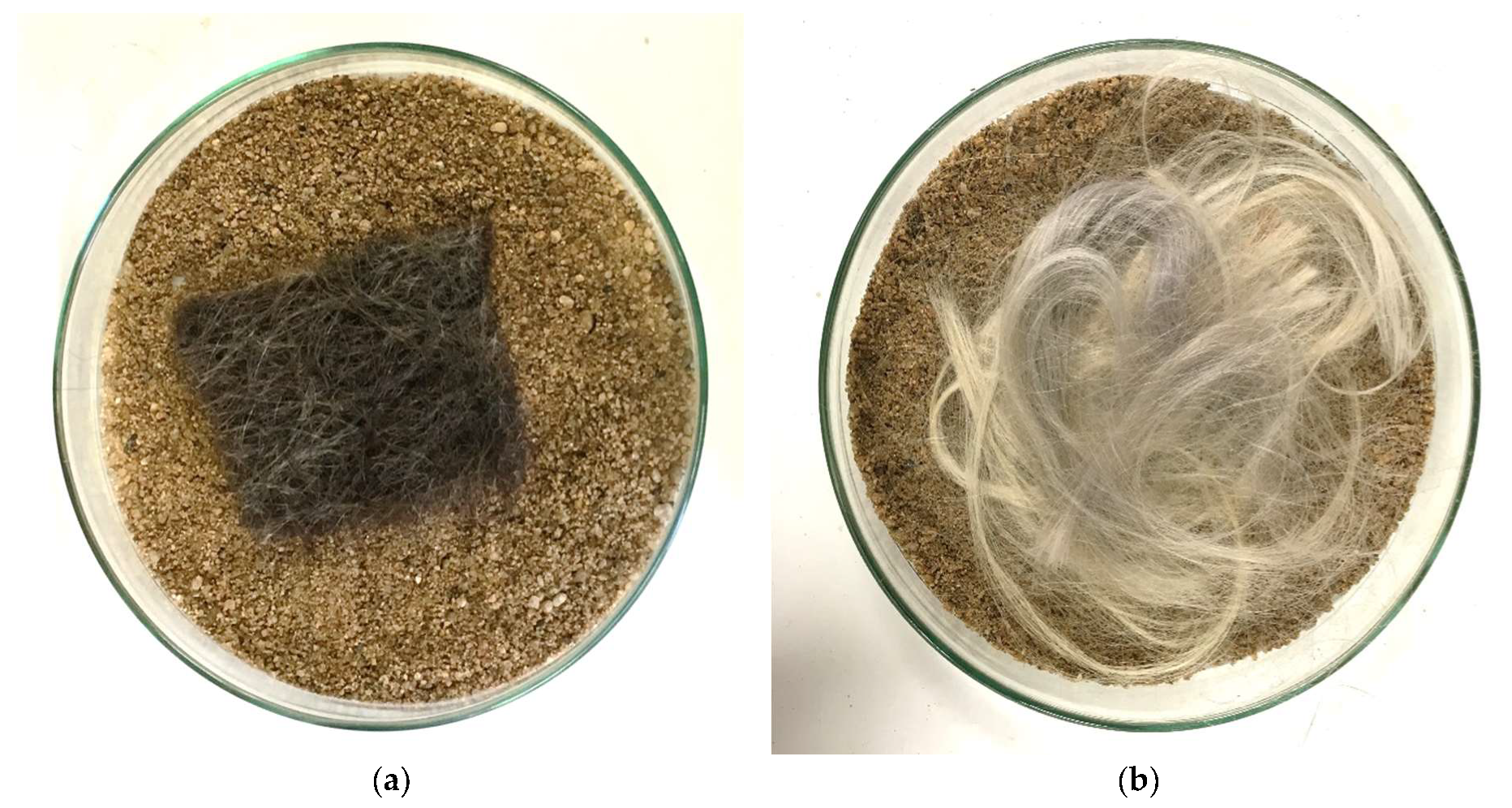
| Human hair mat | Felted product from mixed hair types, approx. 10 mm thick | Matter of Trust, San Francisco, USA |
| Dog fur mat | Felted product from mixed dog breeds, approx. 10 mm thick | Matter of Trust, San Francisco, USA |
| Human hair boom | Prototype hair-filled boom encased in socking | Sustainable Salons, Canberra, Australia |
| Dog fur boom | Prototype fur-filled boom encased in socking | Sustainable Salons, Canberra, Australia |
| Loose dog fur | Mixed breed loose dog fur | Sustainable Salons, Canberra, Australia |
| Loose human hair | Hair recycled from salon waste | Sustainable Salons, Canberra, Australia |
© 2020 by the authors. Licensee MDPI, Basel, Switzerland. This article is an open access article distributed under the terms and conditions of the Creative Commons Attribution (CC BY) license (http://creativecommons.org/licenses/by/4.0/).
Share and Cite
Murray, M.L.; Poulsen, S.M.; Murray, B.R. Decontaminating Terrestrial Oil Spills: A Comparative Assessment of Dog Fur, Human Hair, Peat Moss and Polypropylene Sorbents. Environments 2020, 7, 52. https://doi.org/10.3390/environments7070052
Murray ML, Poulsen SM, Murray BR. Decontaminating Terrestrial Oil Spills: A Comparative Assessment of Dog Fur, Human Hair, Peat Moss and Polypropylene Sorbents. Environments. 2020; 7(7):52. https://doi.org/10.3390/environments7070052
Chicago/Turabian StyleMurray, Megan L., Soeren M. Poulsen, and Brad R. Murray. 2020. "Decontaminating Terrestrial Oil Spills: A Comparative Assessment of Dog Fur, Human Hair, Peat Moss and Polypropylene Sorbents" Environments 7, no. 7: 52. https://doi.org/10.3390/environments7070052
APA StyleMurray, M. L., Poulsen, S. M., & Murray, B. R. (2020). Decontaminating Terrestrial Oil Spills: A Comparative Assessment of Dog Fur, Human Hair, Peat Moss and Polypropylene Sorbents. Environments, 7(7), 52. https://doi.org/10.3390/environments7070052