


Abstract
Heavy metal contamination in soil and the resulting groundwater pollution are common at many brownfield sites. Soil washing, which dissolves contaminants into a washing solution to separate them from the soil matrix, has emerged as a promising remediation strategy. This study assessed the feasibility of applying soil washing to Pb-contaminated soil collected from an industrial area within the Trieste Port Authority (Italy) through a series of leaching tests. Batch tests were conducted using ethylenediaminetetraacetic acid (EDTA)-based extractants combined with various reducing agents to identify the most effective and environmentally sustainable washing solution. The results show that coupling EDTA with hydroxylamine hydrochloride or sodium dithionite significantly enhanced Pb solubilisation compared with EDTA alone, with dithionite emerging as the most suitable reducing agent due to its lower toxicity and reduced environmental impact. Sequential extraction tests revealed that up to 50% of total Pb could be removed after repeated washing cycles. Column leaching tests further confirmed the high efficiency of the EDTA–sodium dithionite system, achieving Pb removal rates of approximately 70% under continuous flow conditions. Overall, the results demonstrate that EDTA combined with low-dose sodium dithionite provides an effective and practical remediation strategy for heavily polluted industrial soils.
1. Introduction
In Europe, soil contamination is a major environmental issue driven by a range of sectors and activities, including mining and industry, urbanisation and transport, agriculture, harmful agents, and military operations [1,2]. Rodríguez Eugenio et al. [3] define soil pollution as “the presence in the soil of a chemical or substance out of place and/or present at a higher-than-normal concentration that has adverse effects on any non-targeted organism”.
In 2016, national and regional inventories identified over 650,000 sites affected by past and current polluting activities [4]. However, given that around 2.8 million sites are suspected of being potentially polluted in EU Member States, existing registers appear to cover only approximately one quarter of the contaminated sites [4].
Industrial activities account for approximately two-thirds of point sources of soil pollution, together with commercial activities and waste disposal and treatment operations [5]. Associated contaminants include mineral oils, metal(loid)s (e.g., arsenic, cadmium, lead, nickel, and zinc), and organic compounds such as halogenated and non-halogenated solvents, polychlorinated biphenyls, and polycyclic aromatic hydrocarbons. Emerging contaminants such as PFAS, microplastics and pharmaceuticals are of increasing concern for European soils.
Heavy metals and mineral oil account for about 60% of soil pollution [6]. Adsorption and desorption processes at mineral–organic interfaces significantly affect the persistence of heavy metals and mineral oil in soils. Through surface complexation, ion exchange, or electrostatic interactions, heavy metals such as As, Pb, and Cd bind to soil constituents such as iron oxides, clay minerals, and organic matter [7]. Whether metals remain immobilised or become available is determined by these interactions. In view of this, contaminated soil should be considered a potential source of pollution, with a significant capacity to transfer contaminants to groundwater and the food chain through plant uptake, direct soil ingestion by grazing animals, transfer via contaminated water used for irrigation, and the bioaccumulation of pollutants in terrestrial and aquatic organisms, thus posing risks to environmental sustainability, human health, and socio-economic well-being [8,9].
In situ and ex situ remediation approaches for contaminated soil are equally employed [10]. Excavation, solidification, stabilisation, soil washing, electroremediation, and phytoremediation are some of the methods that have been employed to reduce the impact of soil contamination. Excavation and off-site disposal account for approximately one third of management practices, making it a very expensive technique due to constant increases in landfill fees and the cost of importing new soil to replace the removed soil.
In situ soil flushing has great potential for removing contaminants from soils [11,12]. The technique involves flushing the soil with a suitable chemical agent to enhance the apparent solubility of pollutants. Under optimal conditions, soil flushing leads to higher mass removal rates, shorter remediation times, and reduced remediation costs. The selection of an effective flushing agent capable of promoting pollutant solubilisation and enabling their subsequent removal from soil is critical [13].
In most cases, historically deposited heavy metals become less mobile due to strong binding to soil particles (the longer pollutants persist in the soil, the stronger their binding to soil components, particularly heavy metals, becomes) [14]. The time-dependent availability of soil pollutants, i.e., “soil ageing”, is the primary environmental contamination concern when investigating the toxicity of contaminated soils and the efficiency of their remediation [15].
Various sequential extraction methods have been used to assess the fractionation and bioavailability of heavy metals in contaminated soil. Metal fractions are influenced by ageing, with the bioavailable fraction often being substantially lower than the total metal content [16,17,18]. Villen-Guzman et al. [15] investigated the ageing effects in natural and laboratory-prepared lead-contaminated soils over a five-year period. The soils freshly contaminated in the laboratory showed more mobile lead fractions than in the natural soils. Consequently, the toxicity and remediation efficiency of contaminated soils can be most reliably predicted using soils from real contaminated sites.
This study aimed: (1) to investigate Pb immobilisation and availability in a brownfield contaminated soil and to evaluate its potential environmental remobilisation; (2) to assess the efficiency of selected leaching solutions in removing Pb from the soil through batch tests; and (3) to investigate the leaching kinetics of Pb in column tests using the most effective chemical extractants identified in the batch tests.
2. Materials and Methods
2.1. Study Area and Soil Sampling
Contaminated soil was sampled in the alluvial plain of the Ospo River within an industrial area of the Trieste Port Authority, Friuli Venezia Giulia Region, Italy. The site was used for waste disposal, furnace operations, and clay mining between the 1950s and the 1980s, when a clay processing plant was active. As a result of decades of intensive industrial activities—including clay extraction, waste incineration, disposal of ash and other industrial wastes, and operations at nearby oil refineries—large portions of the site are now affected by soil, subsoil, and groundwater contamination.
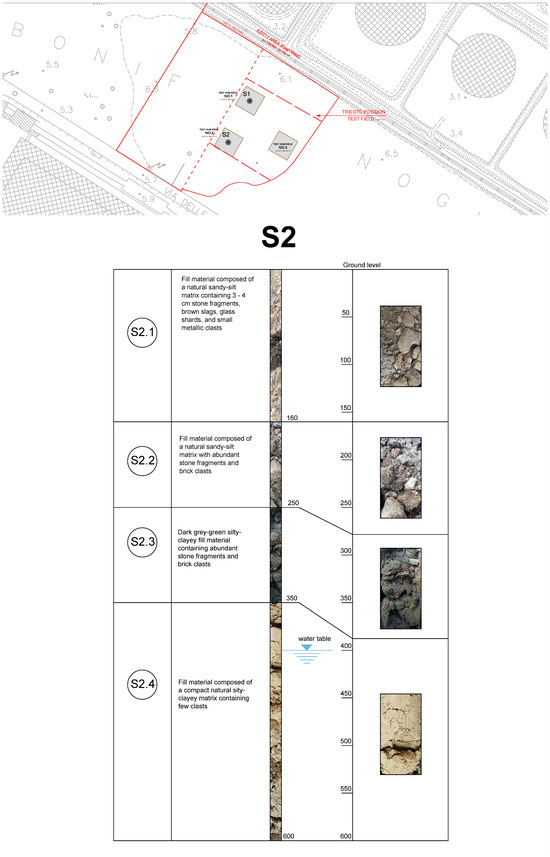
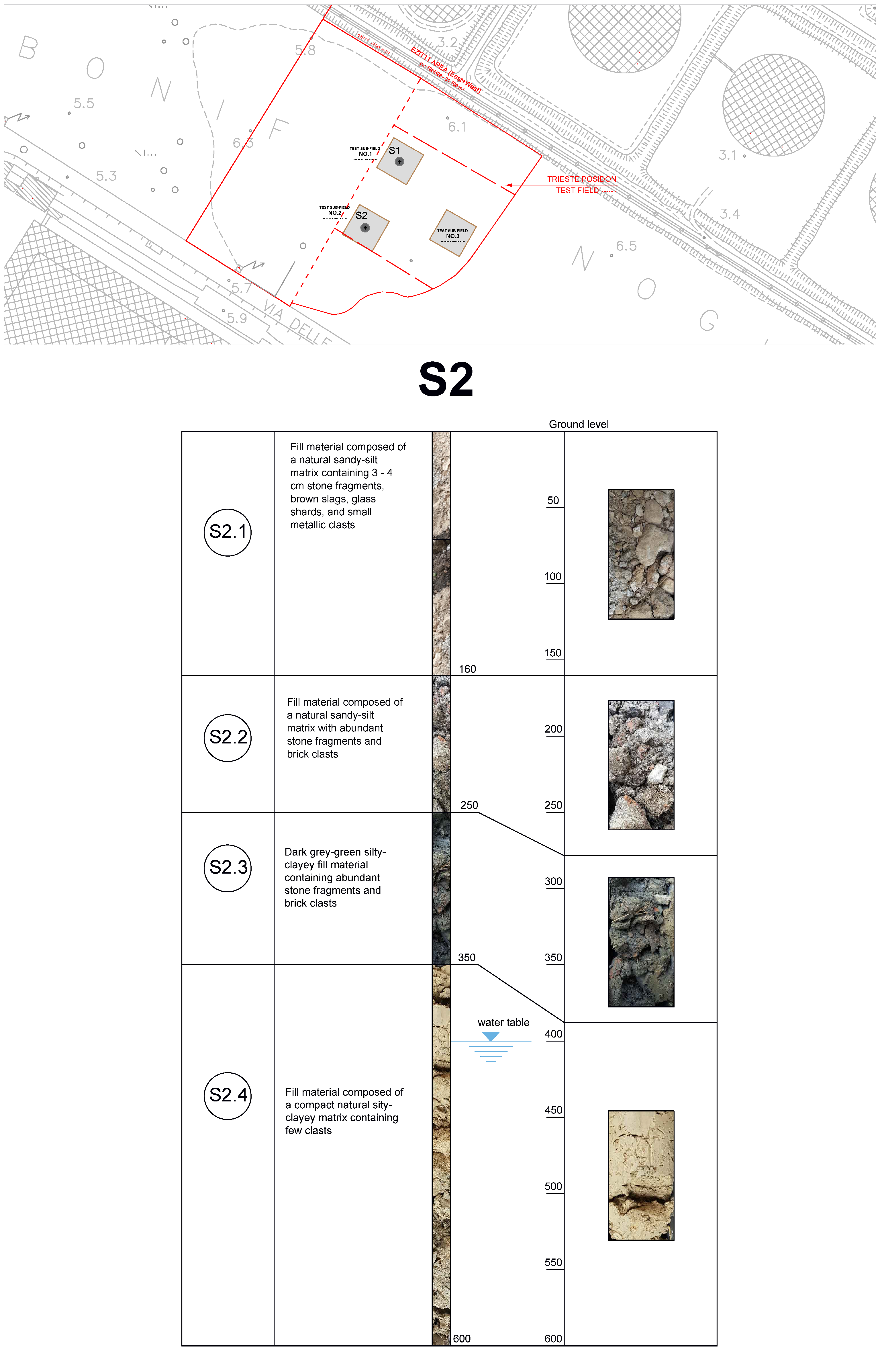
A preliminary investigation was conducted in an unused area of the site characterised by spontaneous vegetation (45.596340° N, 13.794994° E). Soil core sampling was performed at multiple locations using a continuous vertical drilling system, achieving a maximum depth of 5 m (Figure 1). Although the analytical data from this initial campaign are not reported herein, the results indicated that Pb concentrations exceeded the Italian regulatory thresholds established in Legislative Decree 152/2006 at depths between 2.5 and 3.5 m (Figure 1). Based on these findings, a composite soil sample was subsequently collected from this depth horizon, corresponding to the transition between the anthropogenic backfill layer and the underlying natural silty-clay formation (Figure 1, horizon S2.3). This sampling approach was adopted to ensure that the collected material accurately represented the contaminated horizon identified during the preliminary investigation.
Figure 1.
Soil profile. Depth profiles are expressed in cm from the ground level.
Mineralogical data reveal the presence of galena minerals (PbS) in the S2.3 soil. Galena may represent slags from ores used in primary Pb production in industrial smelting furnaces. Under near-surface oxidising conditions, galena undergoes oxidative weathering releasing Pb2+ ions and forming more stable secondary lead phases such as anglesite (PbSO4) and cerussite (PbCO3). The release of Pb into soil fluids is therefore controlled by the stability of galena and the secondary lead minerals formed during its decomposition. Pb2+ ions migrate through soils and can be readily absorbed by Mn oxides such as birnessite, which are common in soils. If this occurs, reductive dissolution of Mn oxides allows Pb to be released into soil solutions.
2.2. Methods
The air-dried soil was sieved to 2 mm and mixed homogeneously with a trowel for physical and chemical characterisation, as well as for batch and column experiments.
The soil was sandy loam with a low organic carbon content (TOC: 1.06 ± 0.1%) and an alkaline pH. To assess the state of soil contamination, the concentration thresholds established by Italian legislation (Legislative Decree No. 152/2006, Part V, Annex 5, Table 1) were applied. These thresholds are differentiated according to land-use categories: Column A refers to residential and green areas, whereas Column B refers to industrial and commercial areas. A Pb concentration exceeding the threshold for Column A was detected (687 ± 65.8 mg kg−1), as reported.
Table 1.
Main physical–chemical characteristics of the soil.
2.2.1. Chemical–Physical Analyses
Soil:water (1:5 w/v) extracts were tested for electrical conductivity (EC) and pH using the Conmet 2 selective electrode (Hanna Instruments, Woonsocket, RI, USA) and the InLab routine pro pH electrode (Sevenmulti, Mettler Toledo, Greifensee, Switzerland), respectively. Thermo Fisher Scientific’s FlashSmart Elemental Analyzer (Waltham, MA, USA) was used to measure total carbon, total organic carbon (TOC), and total nitrogen (TN) via flash combustion, in accordance with the manufacturer’s instructions. Total heavy metals were extracted by microwave acid digestion (Ethos 1, Milestone srl, Bergamo, Italy) and analysed by Inductively Coupled Plasma–Optical Emission Spectrometry (ICP-OES) (5900 ICP-OES; Agilent, Santa Clara, CA, USA).
Sample particle size distributions were analysed using a laser particle size analyser (Mastersizer 3000, Malvern Panalytical Ltd., Worcestershire, UK). Soil textural classification was determined using the method of Gerakis and Baer [19].
2.2.2. Pb Speciation Analyses
Pb speciation was determined using the Community Bureau of Reference (BCR) method [20]. Three fractions were extracted as follows: 0.11 M CH3COOH (F1), 0.1 M NH2OH HCl adjusted to pH 2 with HNO3 (F2), and 8.8 M H2O2 + 1 M CH3COONH4 adjusted to pH 2 with HNO3 (F3). Briefly, approximately 1 ± 0.02 g of soil sample was weighed into 50 mL vials, treated with 40 mL of the F1 extractant and subjected to end-over-end shaking overnight at 25 °C. The vials were then centrifuged (3000 rpm, 20 min) and the supernatant was filtered through a 0.45 µm filter (F1 fraction). Subsequently, extractant F2 was added to the residue, and the extraction procedure used for F1 was repeated to obtain the F2 fraction. The last fraction (F3) was digested with 20 mL of the H2O2 extractant for 1 h at 85 °C in a water bath. The H2O2 volume was reduced to a few millilitres by evaporation, and the residue was subjected to overnight extraction with 50 mL of CH3COONH4 at 25 °C (F3 fraction).
The residual fraction (R) was determined as the difference between the total Pb content and the sum of fractions F1, F2, and F3.
Several quality assurance and control procedures were carried out to ensure the precision and accuracy of the method. A multi-element standard solution (2 mg L−1) was used to prepare the calibration standards. For calibration, five standard samples and one blank sample were used. In addition to the unknown samples, blank and standard samples were processed for heavy metal fractionation and total heavy metal procedures. For every set of 20 samples, an extraction blank was prepared and examined. Additionally, a laboratory spike blank was examined for every 10 samples.
2.2.3. Phytotoxicity Test
The toxicity of the selected chemical extractants on soil was evaluated through a phytotoxicity test on soil water extracts after the washing treatments, using Lepidium sativum as the test plant [21,22]. Lepidium sativum seeds were examined and selected, with discoloured, damaged or abnormally low seeds removed. Ten seeds on a Petri plate (diameter of 90 mm) with a cellulose filter were treated with three millilitres of soil:water extract (1:10 w/v) and incubated for a three-day exposure period at 25 °C in the dark. At the end of the incubation period, the number of germinated seeds (G) and the relative root length (L) were determined and compared to the corresponding control values (Gc and Lc). Seedlings were incubated under the same conditions with deionised water to obtain control. Three replicates of each test were conducted. The following formula was used to calculate the GI percentage: GI (%) = (G × L)/(Gc × Lc) × 100.
2.2.4. Ecotoxicity Test
The two non-phytotoxic leaching solutions, 0.1 M EDTA and sodium dithionite at 0.025 M and 0.01 M, were analysed for ecotoxicity using Aliivibrio fischeri. The ecotoxicity assay is based on inhibition of bioluminescence in this Gram-negative bacterium in the presence of toxicants. This method is rapid and does not require time-consuming plate counting of viable microorganisms because bioluminescence is directly proportional to the number of viable individuals.
An elutriate from treated soil was prepared as follows; a representative weight of soil was shaken in seawater in a 1:5 w/v ratio for 20 min. The elutriate was filtered through a 0.45 µm filter, adjusted to near-neutral pH by adding 0.05 M NaOH or HCl, and salinity increased to over 2% by adding solid NaCl.
The elutriate was assayed using the Whole Effluent Toxicity (WET) test, which measures Aliivibrio fischeri bioluminescence in 3 replicates of 4 sequential 1:2 dilutions in seawater, plus a blank and an undiluted elutriate, to determine 50% or 20% effect concentrations, meaning that 50% or 80% of test microorganisms remain viable. The results are presented as the percentage of toxicant concentration required to produce the observed effect.
2.3. Experimental Layout Leaching Tests
2.3.1. Batch Tests
Different chemical leaching agents were evaluated, alone and/or in combination, in batch tests to select an appropriate soil-washing system to enhance Pb solubilisation and enable its subsequent removal from the soil (Table 2).
Table 2.
Chemical extractants used in batch tests.
Two grams of soil samples, prepared in triplicate, were mixed with 20 mL of leaching agents in 50 mL polypropylene centrifuge tubes, maintaining a soil-to-liquid ratio of 1:10. The soil–liquid suspensions were shaken for 1 h at 200 rpm on a thermostatic shaker at 20 °C. Following agitation, the suspensions were centrifuged at 4000 rpm for 10 min. The resulting supernatants were collected, filtered, and analysed for Pb concentration using ICP-OES. To avoid the potential degradation of leaching agents, fresh solutions were prepared immediately before each extraction.
A sequential extraction experiment was carried out using a leaching solution composed of 0.1 M EDTA, 0.5 M hydroxylamine-hydrochloride and 5% acetic acid. The procedure reported above was repeated for six consecutive cycles on the same soil sample. After each extraction cycle, the suspension was centrifuged at 10,000 rpm for 10 min to collect the supernatant. The collected supernatant was retained for analysis, while a fresh leaching solution was added to the remaining soil residue to initiate the subsequent extraction cycle.
All leachates from the six cycles were collected separately, and the concentration of Pb in each extract was determined by ICP-OES.
2.3.2. Column Tests
The column leaching experiments were designed to mimic the Pb leaching behaviour and kinetics, with the leaching agents selected based on the batch test outcome. Despite being performed under controlled laboratory conditions, column tests better approximate natural leaching processes and provide more reliable results than batch tests.
The experimental column set-up consisted of plastic columns with an inner diameter of 2.5 cm and a length of 10 cm. The columns were vertically oriented and packed with 40 g of 2 mm sieved soil samples. The bottom section of the columns was equipped with a filter plate and a layer of chemically inert material (fibreglass). The columns were filled with the soil samples, weighed to an accuracy of 0.1 g, and the dry mass of the soil samples in the columns was determined. To achieve uniform packing, the soil was gradually added to the columns in small amounts. Each addition was compacted with a plunger while the column was gently vibrated.
The column experiments were conducted in triplicate by passing the leaching solutions (Table 3) through the soil without recirculation. The solutions were introduced from the top of the columns by gravity. Prior to the leaching experiments, the columns were equilibrated under saturated conditions for 24 h. Saturated flow was maintained to avoid multiphase formation, promote uniform flow, and reduce channelling. The leaching solutions were percolated through the packed soil column from top to bottom at a constant flow rate of 8.2 mL day−1 using a peristaltic pump.
Table 3.
Chemical agents used in column tests.
Leachate samples were collected from the bottom of the columns on each working day throughout the 34-day experimental period (from 21 April to 25 May) and analysed for Pb concentration. The leachates were filtered using the appropriate membrane filters and a vacuum or pressure filtration device.
At each eluate collection, the time and volume of the eluate fraction were recorded. The eluate was stored at 4 °C until Pb analysis.
The cumulative amount of Pb released was determined by summing the amounts of Pb quantified in each collected eluate fraction. Each experimental unit was set up in three replicates. The total volume of washing solutions applied to 40 g of contaminated soil during the 34-day experimental period was of 283.6 ± 8.4 mL.
At each stage, Pb concentration analysis was performed by ICP-OES. Five Pb calibration standards (derived from a 2 mg L−1 stock standard solution) and one blank were used for calibration. Standardised quality assurance/quality control procedures were applied to validate the accuracy and precision of the methods and the data.
2.4. Statistical Analyses
Statistical analyses were performed using STATISTICA 8.0 software (StatSoft Inc., Tulsa, OK, USA). All results are reported as means of three replicates (n = 3). Differences among treatments were assessed by one-way analysis of variance (ANOVA). Mean values were compared using the least significant difference (LSD) test at a significance level of p < 0.05 (Fisher’s test). Significant differences among data were indicated by different letters.
3. Results
3.1. Pb Fractionation
To evaluate Pb fractionation and relative lability in soil, sequential extractions were carried out. The method differentiated the Pb into the following fractions: 1. Exchangeable fraction (FR1), 2. Reducible fraction (FR2), 3. Oxidisable fraction (FR3), and 4. Residual fraction (FR4) (Table 4).
Table 4.
Fractions of Pb in contaminated soil. Exchangeable (FR1), reducible (FR2), oxidisable (FR3), and residual fractions (FR4).
The high prevalence of the reducible fraction (FR2, 57%) indicates that Pb is strongly associated with Fe and Mn oxides and is potentially instable under reducing and acidic conditions. A high percentage of Pb is also observed in the residual fraction (FR4), which accounts for 32% of total Pb, indicating that Pb is occluded within crystalline structures of primary and secondary residual solids. This fraction is not extractable and is present in an inert form. However, a low quantity of Pb is associated with the carbonated phase (FR1) and organic matter (FR3). FR1 is the most mobile fraction, allowing the easy release of Pb into the soil solution, while the FR3 fraction is not regarded as bioavailable or mobile because metals are bound within stable high-molecular-weight humic substances. The low concentration of Pb in the FR3 fraction could be explained by the low content of soil organic carbon (Table 1).
3.2. Batch Tests
EDTA (0.01 M, 0.05 M and 0.1 M) and DTPA (0.01 M and 0.05 M) were tested in batch to determine the Pb removal efficiency from contaminated soil as a function of chelator concentration. Under identical concentration conditions and with a constant solid-to-liquid ratio, EDTA showed a higher Pb removal efficiency than DTPA. As reported in Table 5, the Pb removal efficiency increased significantly with increasing EDTA concentration.
Table 5.
Pb leaching in batch tests with chelators (EDTA and DTPA) and surfactants (Traiton X-100 and SDS).
However, the Pb concentration in EDTA leaching solutions was less than 80 mg Pb kg−1 (Table 5), approximately 10% of the initial concentration.
Due to this limit, we optimised by combining EDTA with other agents, e.g., chelating agents, surfactants, reducing agents, and acid compounds.
The removal efficiency of Pb was not enhanced by combining EDTA or DTPA with surfactants, such as Triton X-100 and SDS (Table 5). Conversely, significantly lower Pb concentrations were measured in leaching solutions when these surfactants were added (Table 5).
On the other hand, combining EDTA with reducing agents, such as hydroxylamine hydrochloride, improved Pb extractability (Table 6). This result is consistent with the high association of Pb with the reducible fraction (FR2).
Table 6.
Pb leaching in batch tests with EDTA, hydroxylamine hydrochloride and acetic acid.
Pb extraction using EDTA alone and in combination with hydroxylamine hydrochloride was more efficient when acidity was increased by adding the acetic acid. In 0.1 M EDTA and 0.5 M hydroxylamine hydrochloride leaching solutions, Pb reached 224 mg kg−1 when 5% acetic acid was added, which is more than 30% of the initial concentration.
When the concentration of hydroxylamine hydrochloride was reduced from 0.5 M to 0.1 M, Pb-EDTA leaching decreased. However, with the addition of 5% acetic acid, Pb leaching increased to 154 mg kg−1 (22% of the initial concentration) (Table 6).
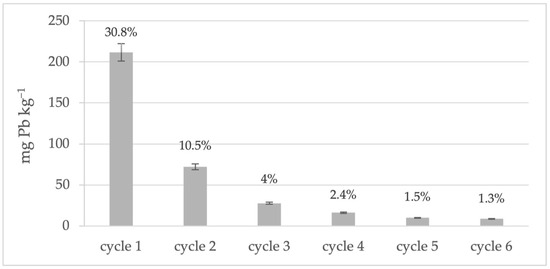
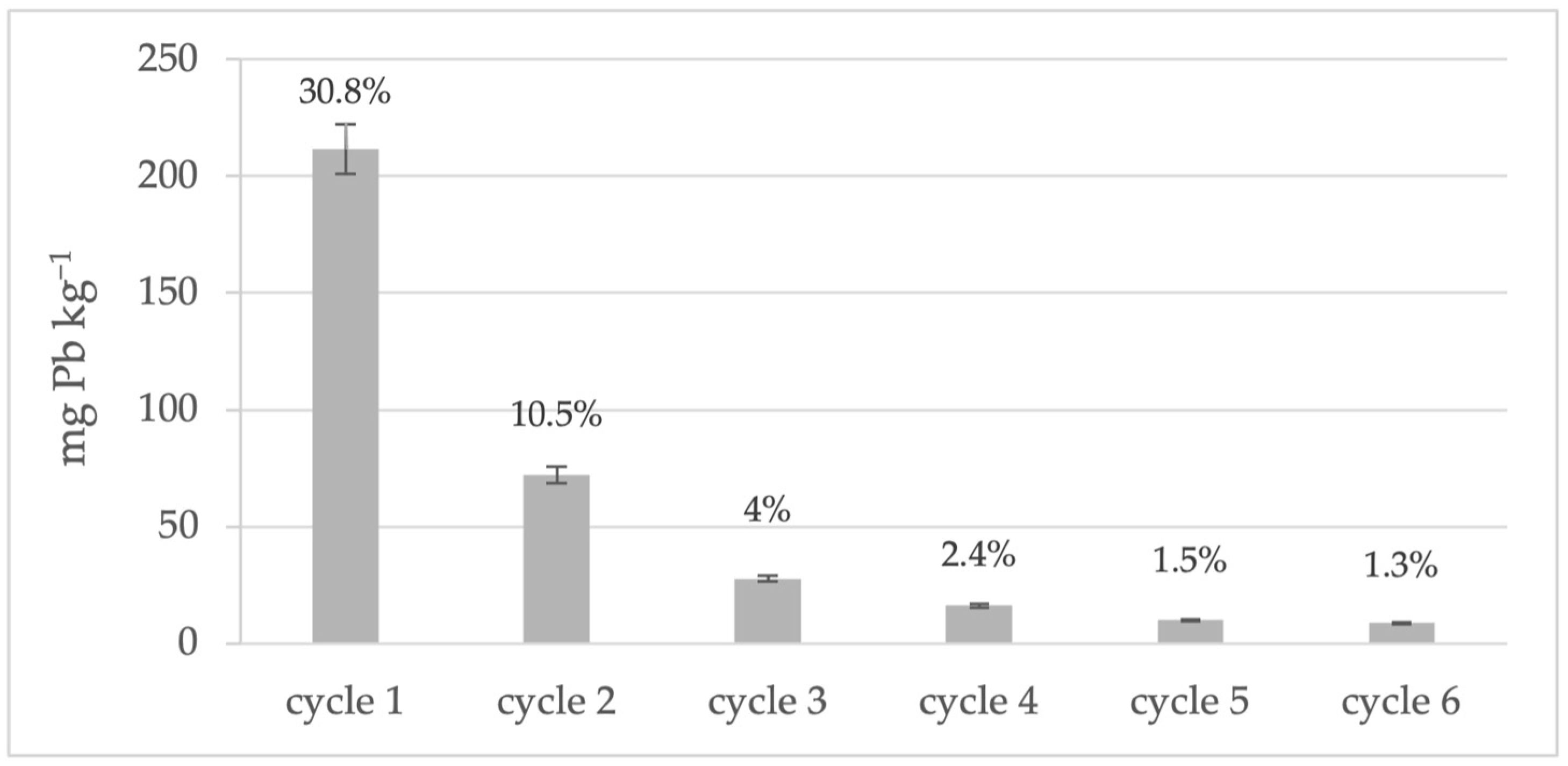
The Pb leaching test, using a solution composed of 0.1 M EDTA, 0.5 M hydroxylamine hydrochloride and 5% acetic acid, was also carried out for six sequential extraction cycles on the same soil sample (Figure 2). After the first two cycles, 40% of the total Pb was leached. The amount of leachable Pb decreased markedly with increasing extraction cycles, and, after six cycles, an overall Pb leaching of approximately 50% was achieved (Figure 2).
Figure 2.
Pb leaching in sequential extraction batch tests using a solution composed of 0.1 M EDTA, 0.5 M hydroxylamine hydrochloride, and 5% acetic acid.
Although the higher concentration of hydroxylamine hydrochloride (0.5 M compared with 0.1 M) significantly increased the effectiveness of Pb-EDTA leaching, it may also increase the risk of soil degradation by altering its physical, chemical and biological properties. In fact, low concentrations of chemicals are considered beneficial for subsequent ecological soil restoration. Based on these considerations, additional batch experiments with lower concentrations of less toxic reducing agents, including sodium oxalate, ascorbic acid and sodium dithionite, were set up to reduce the environmental risk of chemical flushing (Table 7).
Table 7.
Pb leaching in batch tests with EDTA and reducing agents (sodium oxalate, ascorbic acid and sodium dithionite).
The extraction in 0.1 M EDTA was not increased by the addition of 0.1 M ascorbic acid, whereas it was enhanced by the addition of 0.1 M sodium oxalate. In particular, Pb flushing was very effective when 0.1 M EDTA was combined with 0.1 M sodium dithionite. Under these conditions, the Pb concentration in the flushing solution was higher than 200 mg Pb kg−1 (Table 7).
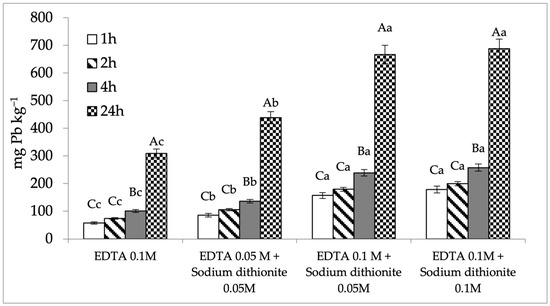
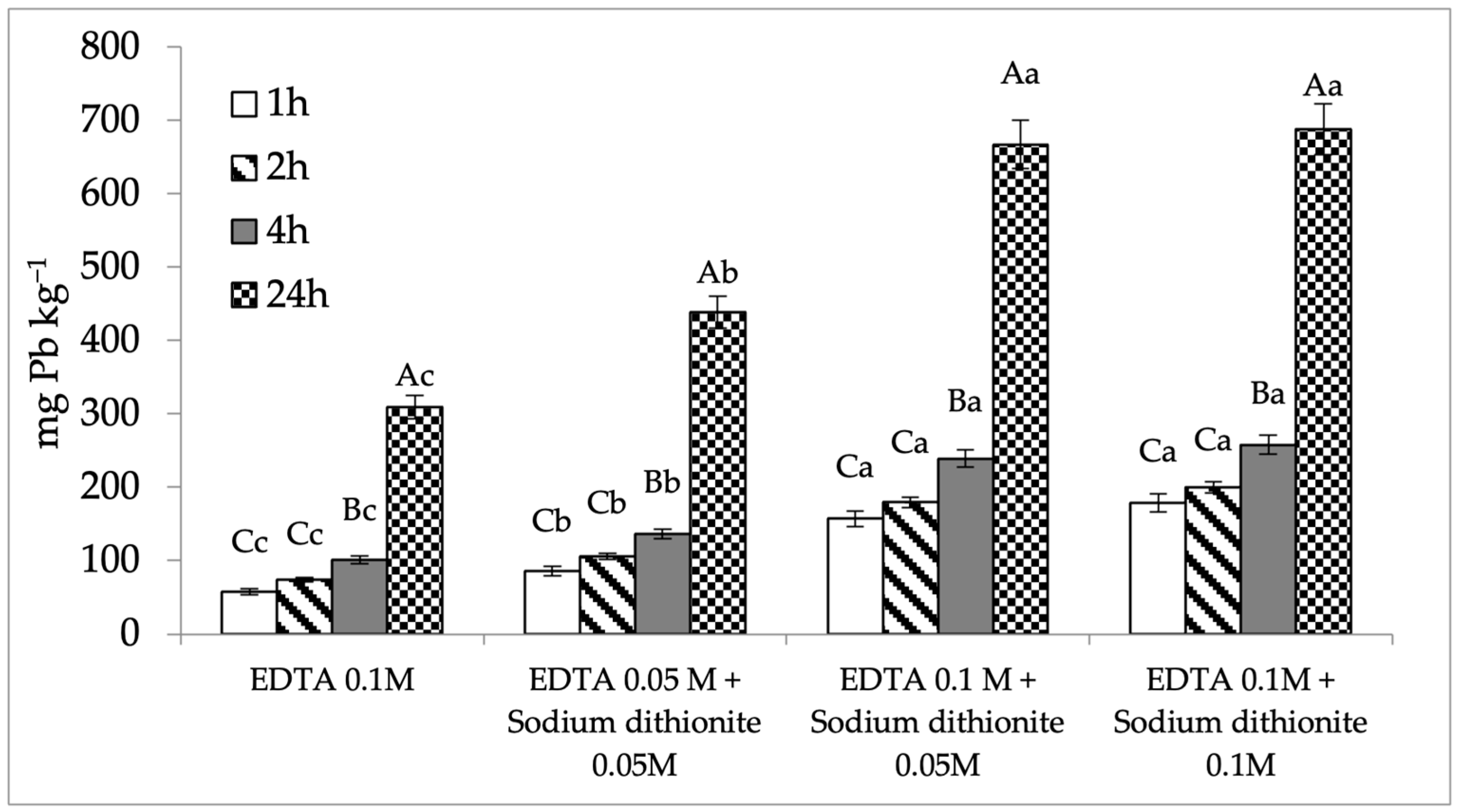
The effects of contact time and dosage of the EDTA and sodium dithionite washing solution on Pb removal efficiency were investigated. The Pb concentration in the flushing solution increased with contact time, and, after 24 h of incubation, it reached almost the same level as the total Pb content (>650 mg Pb kg−1) for both sodium dithionite concentrations (0.1 M and 0.05 M) (Figure 3).
Figure 3.
Pb leaching in batch tests using EDTA and sodium dithionite at different contact times (1 h, 2 h, 4 h and 24 h). Capital letters indicate significant differences (p < 0.05) among sampling times within each treatment (1 h, 2 h, 4 h, and 24 h). Lower-case letters indicate significant differences (p < 0.05) among treatments at the same sampling time.
When the EDTA dosage was reduced from 0.1 M to 0.05 M in the presence of 0.05 M sodium dithionite, a lower Pb extraction efficiency was observed at all incubation times (Figure 3).
3.2.1. Phytotoxicity Tests
The germination index (GI%) was measured on the soil water extracts after soil exposure to leaching solutions (0.1 M EDTA) and sodium dithionite at 0.1 M, 0.05 M, 0.025 M, 0.01 M and 0.005 M. The test showed that the higher sodium dithionite concentrations (0.1 M and 0.05 M) were toxic for seed germination and growth of Lepidium sativum, resulting in GI values below 40% (Table 8). In contrast, sodium dithionite at lower concentrations (0.025 M, 0.01 M and 0.005 M) was not phytotoxic, with GI values exceeding 50%, according to the thresholds defined by Zucconi et al. [22]. These results revealed the importance of selecting the lowest effective concentration for soil washing applications.
Table 8.
Germination index (GI%) of Lepidium sativum after soil washing with 0.1 M EDTA and sodium dithionite at different concentrations (from 0.005 M to 0.1 M).
3.2.2. Ecotoxicity Tests
The two non-phytotoxic leaching solutions, 0.1 M EDTA and sodium dithionite at the 0.025 M and 0.01 M concentrations, were analysed for ecotoxicity with Aliivibrio fischeri by Whole Effluent Toxicity (WET) test. No measurable inhibitory effect was observed at either Ec 50 or Ec 20. The maximum effect with undiluted (100%) leaching solutions is reported in Table 9.
Table 9.
Ecotoxicity test with Aliivibrio fischeri on soil sample after exposition to chemical extractants.
The results showed that soil washing with EDTA and sodium dithionite at both concentrations (0.01 M and 0.025 M) was non-toxic when undiluted. Undiluted washing solution recorded a slight inhibition of Aliivibrio fischeri luminescence; the maximum effect is 26.36 for sodium dithionite 0.025 M, suggesting a slight toxicity, and 9.33 for sodium dithionite 0.01 M, suggesting an even lower toxicity.
3.3. Column Tests
Based on the phyto- and eco-toxicity results and the Pb removal efficiency obtained in the batch tests, the leaching solution consisting of 0.1 M EDTA and sodium dithionite at 0.025 M and 0.01 M were selected for the column tests.
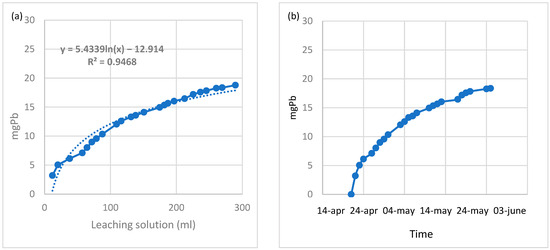
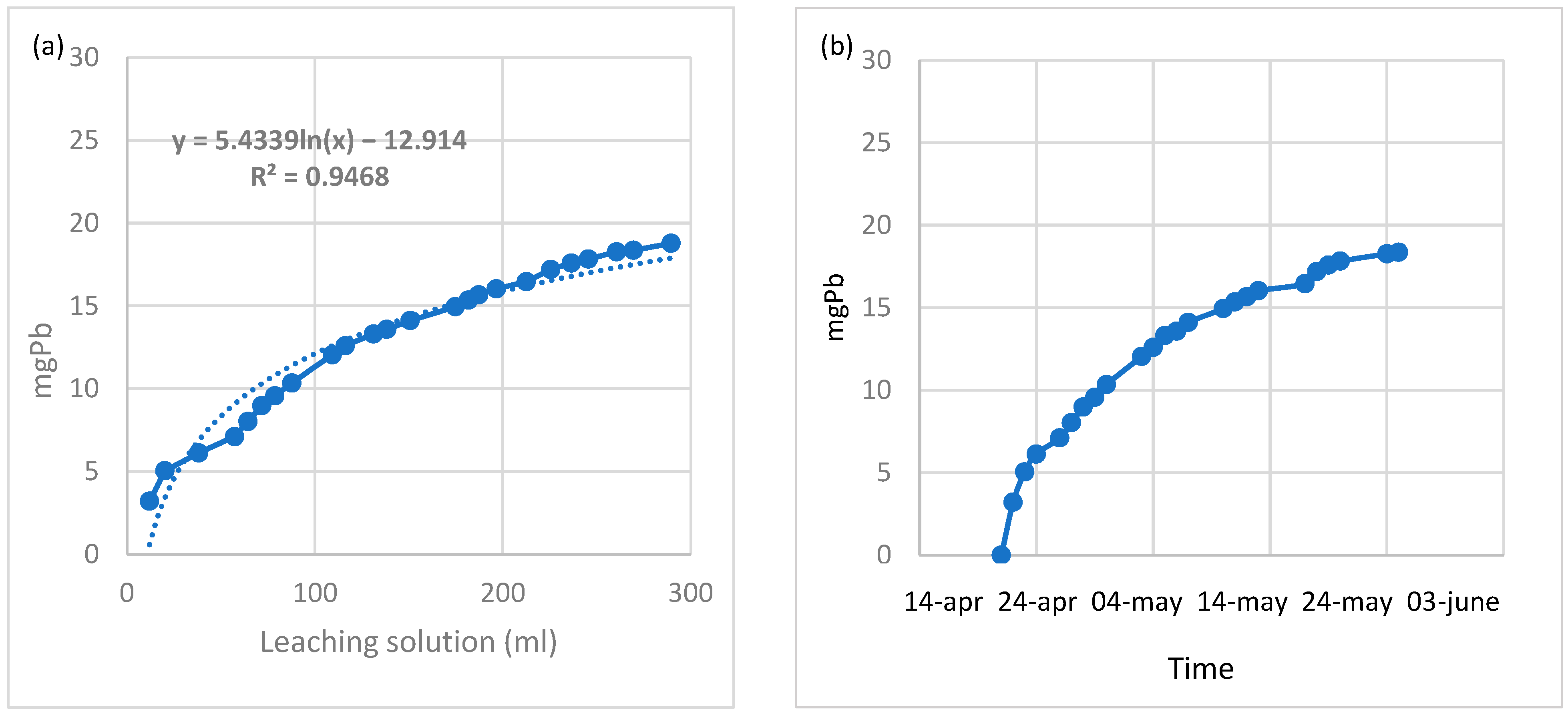
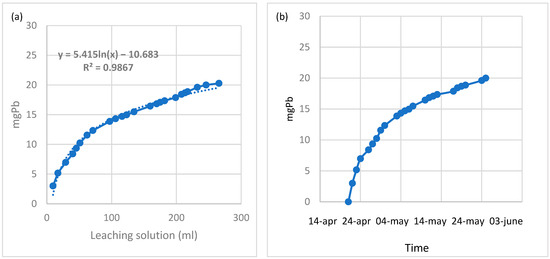
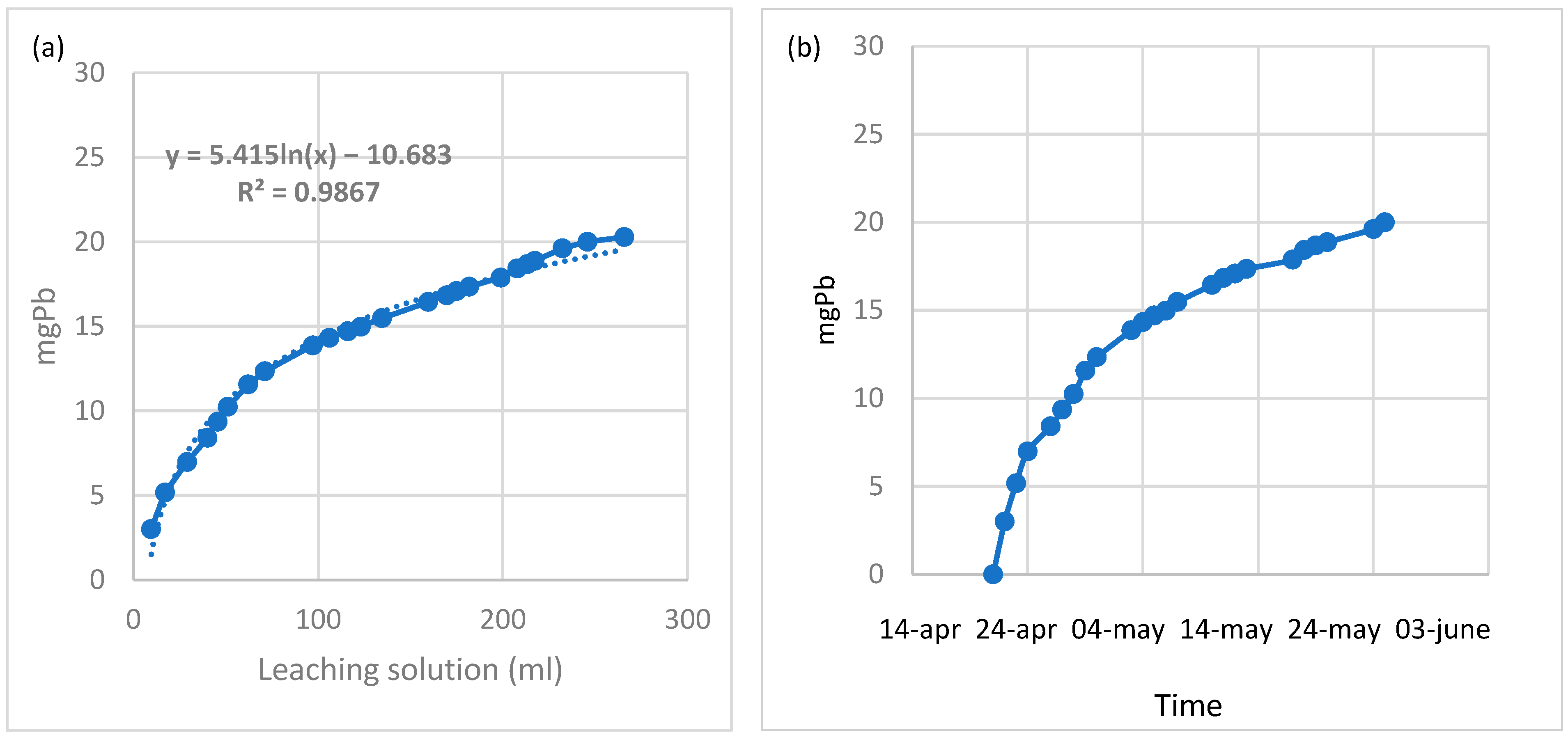
Pb monitoring in the leaching solutions enabled optimisation of leaching volumes and durations for effective soil decontamination (Figure 4 and Figure 5). The columns were maintained in under-saturated conditions. Considering that 40 g of soil contained 27.5 mg of Pb, the application of 283.6 mL ± 8.4 mL of 0.1 M EDTA and sodium dithionite at both 0.025 M and 0.01 M over a one-month period (from 21 April to 26 May, 34 days) resulted in the removal of 72.7% and 67.3% of the total Pb, respectively. This corresponds to 18.5 and 20 mg of Pb, respectively, recovered in the leaching solutions. The logarithmic equations shown in Figure 4 and Figure 5 correspond to empirical trendlines describing Pb release as functions of cumulative leaching volume and time, respectively.
Figure 4.
Column leaching tests with 0.1 M EDTA and 0.01 M sodium dithionite. Leachate samples were collected on each working day over the 34-day experimental period (from 21 April to 25 May) and separately analysed for Pb concentration. Pb release as a function of leaching solution volume (a) and time (b). The solid line represents the empirical curve; the dashed line represents the fitted curve obtained from the logarithmic equation.
Figure 5.
Column leaching tests with 0.1 M EDTA and 0.025 M sodium dithionite. Leachate samples were collected on each working day over the 34-day experimental period (from 21 April to 25 May) and separately analysed for Pb concentration. Pb release as a function of leaching solution volume (a) and time (b). The solid line represents the empirical curve; the dashed line represents the fitted curve obtained from the logarithmic equation.
4. Discussion
4.1. Batch Tests
The batch leaching results (Table 7) demonstrate that Pb mobilisation is governed by the combined effects of reductive processes and chelation, with substantial differences among treatments reflecting the chemical behaviour of the reducing agents employed. Among chelating agents, ethylenediaminetetraacetic acid (EDTA) is widely recognised for its effectiveness in detoxifying a broad range of heavy metals due to its strong complexation capacity and low biodegradability in soil and groundwater environments, which ensures long-term stability [23]. Consequently, EDTA has been extensively applied in soil washing processes for heavy metal removal [24,25].
The marked increase in Pb removal efficiency with increasing EDTA concentration is consistent with previous studies reporting enhanced extraction of As, Cd, Cu, Pb, and Zn as EDTA concentration increased from 0.05 to 0.15 M [26,27]. EDTA promotes the dissolution, dispersion, and mobilisation of weakly bound Pb, particularly that associated with the exchangeable and reducible fractions (FR1 and FR2), and subsequently forms stable, soluble Pb–EDTA complexes [28,29]. Previous studies have also shown that Pb removal efficiency can be further enhanced by combining EDTA with complementary agents, including additional chelating agents, surfactants, reducing agents, or acidic compounds [30,31]. However, not all combinations result in improved performance. For example, the addition of surfactants such as Triton X-100 or SDS to EDTA or DTPA systems has been reported to reduce Pb removal efficiency, likely due to physical interactions that strongly isolate Pb bound to soil particles and increase its resistance to desorption [32].
In the present study, Pb mobilisation increased significantly in all combined treatments involving EDTA and reducing agents compared to single-reagent systems, confirming the central role of chelation in stabilising Pb once released from the solid matrix [33]. Nevertheless, the wide variability in extraction efficiency among treatments indicates that chelation alone is insufficient to explain the observed trends and that the effectiveness of the reductive process is a key controlling factor.
The enhanced Pb extractability observed when EDTA was combined with reducing agents such as hydroxylamine hydrochloride is attributable to their ability to promote the reductive dissolution of Fe and Mn oxides [34]. This mechanism is consistent with the strong association of Pb with the reducible fraction (FR2), and the reduction of these oxides facilitates Pb desorption [35]. In addition, reducing agents may enhance metal mobility by promoting the dissolution of soil minerals and amorphous silica [36]. Pb extraction using EDTA, either alone or in combination with hydroxylamine hydrochloride, was further favoured under acidic conditions, particularly in the presence of acetic acid. Decreasing solution pH generally enhances the extraction of cationic heavy metals such as Pb, Cd, and Cu by promoting dissolution of carbonate- and oxide-bearing soil components and the exchange of metal cations with H+ ions [37,38,39].
To minimise the risk of physicochemical and biological soil degradation and to reduce wastewater treatment costs, alternative batch experiments were conducted using less toxic reducing agents than hydroxylamine hydrochloride, namely sodium oxalate, ascorbic acid, and sodium dithionite [40]. Sodium oxalate exhibited the weakest interaction with EDTA despite its known ability to promote ligand-assisted dissolution of specific Fe phases. The limited Pb mobilisation observed for the EDTA–oxalate system suggests that oxalate was unable to significantly destabilise Pb-bearing oxide fractions under the experimental conditions applied, likely due to its low reducing strength and the formation of relatively stable surface complexes.
Although ascorbic acid alone was ineffective, its combination with EDTA produced moderate synergistic Pb mobilisation. This behaviour is consistent with previous studies showing that ascorbic acid acts as a mild, surface-active reductant that preferentially reduces poorly crystalline or highly reactive Fe oxides without inducing extensive dissolution of more crystalline phases such as goethite or hematite [41,42]. In this context, EDTA plays a critical role by keeping released Pb in solution, thereby enhancing apparent extraction efficiency [43].
In contrast, sodium dithionite (Na2S2O4) significantly enhanced EDTA-mediated Pb extraction, consistent with its strong reducing capacity and its ability to promote active reducing conditions that increase metal mobility [37,44]. Sodium dithionite is well known for inducing extensive reductive dissolution of Fe(III) and Mn(IV) (hydr)oxides [45], which are key Pb-binding phases in contaminated soils through adsorption, co-precipitation, and structural incorporation [46]. Once released, Pb is efficiently complexed by EDTA, preventing re-adsorption or secondary precipitation.
The greater effectiveness of hydroxylamine hydrochloride and sodium dithionite compared with ascorbic acid can therefore be attributed to differences in reducing strength, pH regime, Fe/Mn oxide dissolution capacity, Pb binding mechanisms, and reagent stability. While hydroxylamine hydrochloride selectively targets poorly crystalline Fe and Mn oxides under acidic conditions (pH ≈ 2–4), sodium dithionite can destabilise both amorphous and crystalline oxide phases, leading to substantially higher Pb release [45,46]. In contrast, ascorbic acid exhibits surface-limited reduction and is rapidly oxidised in the presence of dissolved oxygen and metal catalysts, resulting in reduced and less stable extraction performance [34,41,47].
Overall, the results indicate that Pb mobilisation in the studied soil is primarily controlled by the efficiency of reductive dissolution of Fe/Mn oxides, while EDTA acts as an essential secondary mechanism that stabilises Pb in solution. Strong reductants such as sodium dithionite effectively target oxide-associated and structurally bound Pb, whereas milder reducing agents mainly mobilise more labile or surface-associated fractions. These findings underscore the importance of coupling chelation with sufficiently strong reductive processes when designing soil washing strategies for Pb-contaminated soils.
Operationally, phytotoxicity tests using Lepidium sativum and ecotoxicity assays with Aliivibrio fischeri proved essential for identifying optimal reagent dosages. The results indicated that sodium dithionite at concentrations of 0.01–0.025 M, in combination with EDTA, resulted in non-toxic to slightly toxic conditions, whereas higher concentrations caused significant inhibitory effects. In this regard, a dose-minimisation strategy appears critical to maintaining Pb extraction efficiency while reducing ecological risks and facilitating post-treatment soil restoration.
Despite EDTA’s high effectiveness, its low biodegradability poses a potential environmental limitation. Persistent EDTA residues may enhance the mobility of metal–EDTA complexes after soil washing, increasing the risk of secondary contamination. Moreover, EDTA application may induce changes in soil properties and microbial activity [40,48], further emphasising the need for optimised reagent selection and dosage control.
4.2. Column Tests
Characterising the leaching behaviour of Pb in column tests, despite the experimental effort required, can provide insight into long-term leaching under field-relevant conditions. Column tests reproduce a dynamic leaching phase in which the leaching solution is continuously renewed [49]. However, laboratory column tests cannot fully replicate field conditions, including preferential flow pathways, variable contact times, and spatial heterogeneity of soil [50]. Such heterogeneity can introduce significant uncertainties in contaminant transport and lead to pronounced differences between laboratory-scale and field-scale solute movement. The heterogeneous distribution of hydraulic conductivity may create preferential flow paths that enable much faster movement of water and solutes compared to the more uniform flow patterns typically observed in laboratory columns.
However, column tests remain a powerful tool as they can simulate more realistic environmental exposure scenarios and provide quantitative information on long-term leaching behaviour.
Several studies have shown that contaminant loading into underlying soil, as well as leachate concentrations at any given exposure time, can be predicted by assuming that the leaching behaviour observed in column tests reflects field conditions when the cumulative solid-to-liquid ratio is equivalent [50,51,52].
5. Conclusions
EDTA, one of the most widely used chelating agents, can enhance Pb extraction both directly, through the formation of strong Pb–EDTA complexes, and indirectly, by promoting the reductive dissolution of the oxides. Batch experiment results revealed that combining EDTA with reducing agents increased the overall Pb extraction efficiency, although the magnitude of this enhancement depended on the specific reducing agent employed.
Hydroxylamine hydrochloride significantly increased Pb–EDTA leaching, but its use may also increase the risk of soil degradation. In contrast, less toxic reducing agents such as oxalate produced only a slight increase in Pb extraction, whereas sodium dithionite led to a substantial enhancement. The choice of reducing agents therefore had a strong influence on Pb removal performance. Sodium dithionite acts as a strong reducing agent with a higher reduction potential compared to milder agents such as oxalate and ascorbic acid. Notably, the combination of 0.1 M EDTA and 0.05 M sodium dithionite achieved a very high Pb extraction from the soil within 24 h of incubation.
The germination index (GI%), carried out on soil water extract after the soil exposition to leaching solutions containing EDTA 0.1 M and sodium dithionite at different concentrations (0.05 M, 0.025 M, 0.01 M, and 0.005 M), showed that the highest sodium dithionite concentration (0.05 M) was toxic (GI% lower than 40%), whereas lower concentrations were not toxic to seed germination and growth.
Based on the batch test results, additional experiments were conducted using soil columns. The column experiments were carried out by passing 0.1 M EDTA combined with either 0.025 M or 0.01 M sodium dithionite through the soil sample. Monitoring Pb in the leachates enabled us to determine the volumes and contact times required to achieve soil decontamination. A total of 280 mL of 0.1 M EDTA and sodium dithionite at both 0.025 M and 0.01 M, extracted approximately 70% of the total Pb within one month.
By comparing the two leaching solutions based on EDTA 0.1 M plus sodium dithionite at 0.01 M and 0.025 M, it can be concluded that the solution containing 0.01 M of sodium dithionite offers the most suitable practical application for soil decontamination, while also reducing costs and the environmental impact.
Although the soil sample tested in this study was representative of the contaminated site, a deeper investigation is needed to assess the efficiency of this leaching solution across a wider range of soils with diverse physical and chemical properties. Additionally, it is important to evaluate the effectiveness of the leaching treatment on different types of pollutants, including organic contaminants, and to consider their potential interactions and competition with metals during the remediation process. Finally, despite EDTA’s high efficiency in metal extraction, the environmental sustainability of EDTA-based soil washing remains a concern because of its persistence and limited biodegradability. Therefore, future research should focus on developing and applying greener, biodegradable chelating agents as more sustainable alternatives for soil remediation.
6. Patents
Italian patent N. 102022000017199 “Processo per la decontaminazione di suolo e acque sotterranee di un’area da decontaminare da inquinanti organici e inorganici e impatto che attua tale processo”. Masciandaro G., Doni S., Garcia C., Gentini A., Parisi A., Di Gregorio S., Alzetta S. National registration date: 8 November 2022. The manuscript reports preliminary laboratory experiments (batch and column tests) that provided the scientific basis for the development of the in situ soil remediation process later formalized in the patent, without describing or disclosing the patented system itself.
Author Contributions
Conceptualisation, S.D., A.G., S.D.G., C.G.-I. and G.M.; methodology, S.D., E.P., C.M., I.R. and F.V.; validation, S.D., F.V. and E.P.; formal analysis, S.D., E.P. and I.R.; data curation, S.D., E.P., C.M. and F.V.; writing—original draft preparation, S.D. and G.M.; writing—review and editing, S.D., E.P., C.M., C.G.-I., A.G., S.D.G. and G.M.; supervision, A.G., C.G.-I. and G.M.; project administration, A.G.; funding acquisition, A.G. All authors have read and agreed to the published version of the manuscript.
Funding
This research was funded by the European Union’s Horizon 2020 research and innovation programme under grant agreement n. 776838—POSIDON: Polluted site decontamination PCP.
Data Availability Statement
The original contributions presented in this study are included in the article. Further inquiries can be directed to the corresponding authors.
Conflicts of Interest
Author Alessandro Gentini was employed by the company TB TESECO BONIFICHE srl. There is not commercial funding from the company. The remaining authors declare that the research was conducted in the absence of any commercial or financial relationships that could be construed as a potential conflict of interest.
Abbreviations
The following abbreviations are used in this manuscript:
| EDTA | Ethylenediaminetetraacetic acid |
| DTPA | Diethyltriamine pentaacetic acid |
| FR1 | Exchangeable fraction |
| FR2 | Reducible fraction |
| FR3 | Oxidizable fraction |
| FR4 | Residual fraction |
References
- Vieira, D.C.S.; Yunta, F.; Baragaño, D.; Evrard, O.; Reiff, T.; Silva, V.; de la Torre, A.; Zhang, C.; Panagos, P.; Jones, A.; et al. Soil Pollution in the European Union—An Outlook. Environ. Sci. Policy 2024, 161, 103876. [Google Scholar] [CrossRef] [Scilit]
- FAO; UNEP. Global Assessment of Soil Pollution; FAO: Rome, Italy, 2021; p. 846. [Google Scholar] [CrossRef] [Scilit]
- Rodríguez Eugenio, N.; McLaughlin, M.; Pennock, D. Soil Pollution: A Hidden Reality; FAO: Rome, Italy, 2018; p. 142. Available online: https://www.fao.org/3/I9183EN/i9183en.pdf (accessed on 25 March 2026).
- Paya Perez, A.; Rodríguez Eugenio, N. Status of Local Soil Contamination in Europe: Revision of the Indicator “Progress in the Management Contaminated Sites in Europe”; Publications Office of the European Union: Luxembourg, 2018. Available online: https://data.europa.eu/doi/10.2760/093804 (accessed on 25 March 2026).
- European Environment Agency. Key Sources of Local Soil Contamination. 2014. Available online: https://www.eea.europa.eu/en/analysis/maps-and-charts/key-sources-of-local-soil-contamination (accessed on 25 March 2026).
- Panagos, P.; Van Liedekerke, M.; Yigini, Y.; Montanarella, L. Contaminated Sites in Europe: Review of the Current Situation Based on Data Collected through a European Network. J. Environ. Public Health 2013, 2013, 158764. [Google Scholar] [CrossRef] [Scilit] [PubMed]
- Caporale, A.G.; Violante, A. Chemical Processes Affecting the Mobility of Heavy Metals and Metalloids in Soil Environments. Curr. Pollut. Rep. 2016, 2, 15–27. [Google Scholar] [CrossRef] [Scilit]
- Arias-Navarro, C.; Baritz, R.; Jones, A. The State of Soils in Europe—Fully Evidenced, Spatially Organised Assessment of the Pressures Driving Soil Degradation; Publications Office of the European Union: Luxembourg, 2024. [CrossRef]
- Poggio, L.; Vrščaj, B.; Schulin, R.; Hepperle, E.; Ajmone Marsan, F. Metals Pollution and Human Bioaccessibility of Topsoils in Grugliasco (Italy). Environ. Pollut. 2009, 157, 680–689. [Google Scholar] [CrossRef] [Scilit]
- van Liedekerke, M.; Prokop, G.; Rabl-Berger, S.; Kibblewhite, M.; Louwagie, G. Progress in the Management of Contaminated Sites in Europe; EUR 26376 EN; Publications Office of the European Union: Luxembourg, 2014; p. 68. [CrossRef]
- Mao, X.; Jiang, R.; Xiao, W.; Yu, J. Use of Surfactants for the Remediation of Contaminated Soils: A Review. J. Hazard. Mater. 2015, 285, 419–435. [Google Scholar] [CrossRef] [Scilit]
- Sharma, H.D.; Reddy, K.R. Geoenvironmental Engineering: Site Remediation, Waste Containment, and Emerging Waste Management Technologies; John Wiley & Sons: Hoboken, NJ, USA, 2004. [Google Scholar]
- Yu, H.; Liu, Z.; Song, M.; Liu, L.; Liu, Z. Soil Flushing for Remediation of Landfill Leachate-Contaminated Soil: A Comprehensive Evaluation of Optimal Flushing Agents and Influencing Factors. Waste Manag. 2025, 200, 114771. [Google Scholar] [CrossRef] [Scilit]
- Jennings, A.A.; Cox, A.N.; Hise, S.J.; Petersen, E.J. Heavy Metal Contamination in the Brownfield Soils of Cleveland. Soil Sediment Contam. 2002, 11, 719–750. [Google Scholar] [CrossRef] [Scilit]
- Villen-Guzman, M.; Garcia-Rubio, A.; Paz-Garcia, J.M.; Vereda-Alonso, C.; Gomez-Lahoz, C.; Rodriguez-Maroto, J.M. Aging Effects on the Mobility of Pb in Soil: Influence on the Energy Requirements in Electroremediation. Chemosphere 2018, 213, 351–357. [Google Scholar] [CrossRef] [Scilit]
- Shaheen, S.M.; Rinklebe, J.; Tsadilas, C.D. Fractionation and Mobilization of Toxic Elements in Floodplain Soils from Egypt, Germany, and Greece: A Comparison Study. Eurasian Soil Sci. 2015, 48, 1317–1328. [Google Scholar] [CrossRef] [Scilit]
- Huang, B.; Li, Z.; Huang, J.; Chen, G.; Nie, X.; Ma, W.; Yao, H.; Zhen, J.; Zeng, G. Aging Effect on the Leaching Behavior of Heavy Metals (Cu, Zn, and Cd) in Red Paddy Soil. Environ. Sci. Pollut. Res. 2015, 22, 11467–11477. [Google Scholar] [CrossRef] [Scilit] [PubMed]
- Li, J.; Peng, Q.; Liang, D.; Liang, S.; Chen, J.; Sun, H.; Li, S.; Lei, P. Effects of Aging on the Fraction Distribution and Bioavailability of Selenium in Three Different Soils. Chemosphere 2016, 144, 2351–2359. [Google Scholar] [CrossRef] [Scilit]
- Gerakis, A.; Baer, B. A Computer Program for Soil Textural Classification. Soil Sci. Soc. Am. J. 1999, 63, 807. [Google Scholar] [CrossRef] [Scilit]
- Moćko, A.; Wacławek, W. Three-Step Extraction Procedure for Determination of Heavy Metals Availability to Vegetables. Anal. Bioanal. Chem. 2004, 380, 813–817. [Google Scholar] [CrossRef] [Scilit]
- Hoekstra, N.; Bosker, T.; Lantinga, E. Effects of Cattle Dung Farms with Different Feeding Strategies on Germination and Initial Root Growth of Cress Lepidium sativum L. Agric. Ecosyst. Environ. 2002, 93, 189–196. [Google Scholar] [CrossRef] [Scilit]
- Zucconi, F.; Forte, M.; Monaco, A.; De Bertoldi, M. Biological evaluation of compost maturity. Biocycle 1981, 22, 27–29. [Google Scholar]
- Cheikh, M.; Magnin, J.P.; Gondrexon, N.; Willison, J.; Hassen, A. Zinc and lead leaching from contaminated industrial waste sludges using coupled processes. Environ. Technol. 2010, 31, 1577–1585. [Google Scholar] [CrossRef] [Scilit] [PubMed]
- Bilgin, M.; Tulun, S. Removal of heavy metals (Cu, Cd and Zn) from contaminated soils using EDTA and FeCl3. Glob. Nest. J. 2016, 18, 98–107. [Google Scholar]
- Voglar, D.; Lestan, D. Chelant soil-washing technology for metal-contaminated soil. Environ. Technol. 2014, 35, 1389–1400. [Google Scholar] [CrossRef] [Scilit] [PubMed]
- Deng, T.; Zhang, B.; Li, F.; Jin, L. Sediment Washing by EDTA and Its Reclamation by Sodium Polyamidoamine-Multi Dithiocarbamate. Chemosphere 2017, 168, 450–456. [Google Scholar] [CrossRef] [Scilit]
- He, L.; Li, B.; Ning, P.; Gong, X. Optimization of EDTA Enhanced Soil Washing on Multiple Heavy Metals Removal Using Response Surface Methodology. J. Environ. Eng. Landsc. Manag. 2018, 26, 241–250. [Google Scholar] [CrossRef] [Scilit]
- Finzgar, N.; Lestan, D. The Two-Phase Leaching of Pb, Zn and Cd Contaminated Soil Using EDTA and Electrochemical Treatment of the Washing Solution. Chemosphere 2008, 73, 1484–1491. [Google Scholar] [CrossRef] [Scilit]
- Labanowski, J.; Monna, F.; Bermond, A.; Cambier, P.; Fernandez, C.; Lamy, I.; van Oort, F. Kinetic Extractions to Assess Mobilization of Zn, Pb, Cu, and Cd in a Metal-Contaminated Soil: EDTA vs. Citrate. Environ. Pollut. 2008, 152, 693–701. [Google Scholar] [CrossRef] [Scilit]
- Lestan, D.; Luo, C.; Li, X. The Use of Chelating Agents in the Remediation of Metal-Contaminated Soils: A Review. Environ. Pollut. 2008, 153, 3–13. [Google Scholar] [CrossRef] [Scilit]
- Liu, J.; Zhao, L.; Liu, Q.; Li, J.; Qiao, Z.; Sun, P.; Yang, Y. A Critical Review on Soil Washing during Soil Remediation for Heavy Metals and Organic Pollutants. Int. J. Environ. Sci. Technol. 2021, 19, 602–624. [Google Scholar] [CrossRef] [Scilit]
- Zhang, W.; Tsang, D.C.W.; Lo, I.M.C. Removal of Pb and MDF from Contaminated Soils by EDTA- and SDS-Enhanced Washing. Chemosphere 2007, 66, 2025–2034. [Google Scholar] [CrossRef] [Scilit] [PubMed]
- Khalil, A.H.; Alquzweeni, S.S.; Modhloom, H.M. Removal of Copper Ions from Contaminated Soil by Enhanced Soil Washing. Int. J. Environ. Res. 2015, 9, 1141–1146. [Google Scholar]
- Li, Q.; Li, Y.; Yang, Z.; Li, X.; Tang, Z.; Yang, S.; Zhang, Y.; Liu, D. Remediation of iron oxide bound Pb and Pb-contaminated soils using a combination of acid washing agents and l-ascorbic acid. RSC Adv. 2020, 10, 37808–37817. [Google Scholar] [CrossRef] [Scilit] [PubMed]
- Wei, M.; Chen, J.; Wang, Q. Remediation of Sandy Soil Contaminated by Heavy Metals with Na2EDTA Washing Enhanced with Organic Reducing Agents: Element Distribution and Spectroscopic Analysis. Eur. J. Soil Sci. 2018, 69, 719–731. [Google Scholar] [CrossRef] [Scilit]
- Cheng, S.; Lin, Q.; Wang, Y.; Luo, H.; Huang, Z.; Fu, H.; Chen, H.; Xiao, R. The Removal of Cu, Ni, and Zn in Industrial Soil by Washing with EDTA-Organic Acids. Arab. J. Chem. 2020, 13, 5160–5170. [Google Scholar] [CrossRef] [Scilit]
- Kim, E.J.; Jeon, E.K.; Baek, K. Role of Reducing Agent in Extraction of Arsenic and Heavy Metals from Soils by Use of EDTA. Chemosphere 2016, 152, 274–283. [Google Scholar] [CrossRef] [Scilit]
- Begum, Z.A.; Rahman, I.M.; Tate, Y.; Sawai, H.; Maki, T.; Hasegawa, H. Remediation of Toxic Metal Contaminated Soil by Washing with Biodegradable Aminopolycarboxylate Chelants. Chemosphere 2012, 87, 1161–1170. [Google Scholar] [CrossRef] [Scilit] [PubMed]
- Almamoori, G.S.; Ali, Z.H.; Alhamdani, A.S.H.; Abdulhasan, M.J.; Marjan, R.H. Efficiency of EDTA-Na2 and Oxalic Acid Mixture in Removing Lead from Calcareous and Gypsum Soils. Int. J. Des. Nat. Ecodyn. 2024, 19, 685–690. [Google Scholar] [CrossRef] [Scilit]
- Chen, Y.; Jiang, H.; Li, Y.; Liu, Y.; Chen, Y.; Chen, L.; Luo, X.; Tang, P.; Yan, H.; Zhao, M.; et al. A Critical Review on EDTA Washing in Soil Remediation for Potentially Toxic Elements (PTEs) Pollutants. Rev. Environ. Sci. Biotechnol. 2022, 21, 399–423. [Google Scholar] [CrossRef] [Scilit]
- Chen, L.-J.; Zhu, M.-X.; Yang, G.-P.; Huang, X.-L. Reductive reactivity of iron (III) oxides characterized by selective extraction and kinetic dissolution. PLoS ONE 2013, 8, e80367. [Google Scholar] [CrossRef] [Scilit]
- Suda, A.; Makino, T.; Higashi, T. Improvement of the NH2OH–HCl extraction method for Fe and Mn oxides in soils. Soil Sci. Plant Nutr. 2013, 59, 771–783. [Google Scholar] [CrossRef] [Scilit]
- Kameda, T.; Suto, R.; Rahman, M.T.; Kumagai, S.; Saito, Y.; Nomura, Y.; Kawamura, D.; Yoshioka, T. Extraction and enrichment of lead from contaminated soil using chelation reactions. Results Chem. 2024, 7, 101473. [Google Scholar] [CrossRef] [Scilit]
- Houben, D.; Evrard, L.; Sonnet, P. Mobility, Bioavailability and pH-Dependent Leaching of Cadmium, Zinc and Lead in a Contaminated Soil Amended with Biochar. Chemosphere 2013, 92, 1450–1457. [Google Scholar] [CrossRef] [Scilit]
- Mehra, O.P.; Jackson, M.L. Iron oxide removal from soils and clays by a dithionite–citrate system buffered with sodium bicarbonate. Clays Clay Miner. 1958, 7, 317–327. [Google Scholar] [CrossRef] [Scilit]
- Hindersmann, I.; Mansfeldt, T. Trace element solubili ty in multimetal-contaminated soils affected by redox conditions. Water Air Soil Pollut. 2014, 225, 2158. [Google Scholar] [CrossRef] [Scilit]
- Zhang, J.-Z.; Lanning, N.T. Ascorbic acid as a reductant for extraction of iron-bound phosphorus in soil samples: A method comparison study. Commun. Soil Sci. Plant Anal. 2018, 49, 1519–1531. [Google Scholar] [CrossRef] [Scilit]
- Gusiatin, Z.M.; Kulikowska, D.; Klik, B. New-Generation Washing Agents in Remediation of Metal-Polluted Soils and Methods for Washing Effluent Treatment: A Review. Int. J. Environ. Res. Public Health 2020, 17, 6220. [Google Scholar] [CrossRef] [Scilit] [PubMed]
- Tiwari, M.; Bajpai, S.; Dewangan, U.K.; Tamrakar, R. Suitability of leaching test methods for fly ash and slag: A review. J. Radiat. Res. Appl. Sci. 2015, 8, 523–537. [Google Scholar] [CrossRef] [Scilit]
- van der Sloot, H.A.; Comans, R.N.J.; Hjelmar, O. Similarities in the leaching behaviour of trace contaminants from waste, stabilized waste, construction materials and soils. Sci. Total Environ. 1996, 178, 111–126. [Google Scholar] [CrossRef] [Scilit]
- Li, Y.; Zhang, J.; Lv, Y.; Garland, G.; Xu, J.; Liu, X. Competitive transport of heavy metals in soil: Cadmium dynamics with numerical modeling. J. Hazard. Mater. 2025, 495, 138923. [Google Scholar] [CrossRef] [Scilit]
- Wang, Y.; Zhu, P.; Zheng, J.; Chen, G.-N.; Li, X.-X.; Zhang, W.-L. Analytical evaluation of heavy metal desorption process from contaminated soil under chelator leaching. Soils Found. 2025, 65, 101619. [Google Scholar] [CrossRef] [Scilit]

Disclaimer/Publisher’s Note: The statements, opinions and data contained in all publications are solely those of the individual author(s) and contributor(s) and not of MDPI and/or the editor(s). MDPI and/or the editor(s) disclaim responsibility for any injury to people or property resulting from any ideas, methods, instructions or products referred to in the content. |
© 2026 by the authors. Licensee MDPI, Basel, Switzerland. This article is an open access article distributed under the terms and conditions of the Creative Commons Attribution (CC BY) license.