
Review

Microplastics and Antimicrobial Resistance Genes in Surface Waters Under European Union Regulatory Progress

by
Alexandre Aleluia
1,2,*,
Luís Gabriel Barboza
3,
Carla Novais
4,5,
Patrícia Antunes
4,5,6,
Ana R. Freitas
1,2,4,5 and
Joana C. Prata
1,2,*
1
Associate Laboratory i4HB—Institute for Health and Bioeconomy, University Institute of Health Sciences—CESPU, 4585-116 Gandra, Portugal
2
UCIBIO—Applied Molecular Biosciences Unit, University Institute of Health Sciences—CESPU (1H-TOXRUN, IUCS-CESPU), 4585-116 Gandra, Portugal
3
CIIMAR—Interdisciplinary Centre of Marine and Environmental Research, University of Porto, Terminal de Cruzeiros do Porto de Leixões, 4450-208 Matosinhos, Portugal
4
Associate Laboratory i4HB—Institute for Health and Bioeconomy, Faculty of Pharmacy, University of Porto, 4050-313 Porto, Portugal
5
UCIBIO—Applied Molecular Biosciences Unit, Faculty of Pharmacy, University of Porto, 4050-313 Porto, Portugal
6
Faculty of Nutrition and Food Sciences, University of Porto, Rua do Campo Alegre 823, 4150-180 Porto, Portugal
*
Authors to whom correspondence should be addressed.
Environments 2026, 13(5), 283; https://doi.org/10.3390/environments13050283
Submission received: 14 April 2026 / Revised: 11 May 2026 / Accepted: 12 May 2026 / Published: 19 May 2026

Abstract

Microplastics (MPs) and antimicrobial resistance genes (ARGs), emerging pollutants in surface waters, are viewed as a serious risk to freshwater ecosystems and public health. This review synthesizes current scientific knowledge, regulatory approaches, and monitoring methodologies on the presence and impact of these contaminants following a drivers-pressures-state-impact-response (DPSIR) framework. Major anthropogenic factors, such as pharmaceutical consumption and agricultural intensification, are putting pressure on water bodies through industrial discharges, agricultural runoff, and untreated or inadequately treated wastewaters. In order to gauge the current environmental state and discuss the impact on human and ecosystem health within a One Health framework, it is necessary to generate monitoring data and identify methodological gaps in the interaction between MPs and ARGs. Despite recent European Union (EU) regulatory progress, such as the Drinking Water Directive and the Water Framework Directive, substantial gaps remain in methodology standardization as well as practical implementation. This review underscores the need to establish enforceable thresholds and standardize monitoring protocols to effectively mitigate the growing prevalence and consequences of these contaminants.

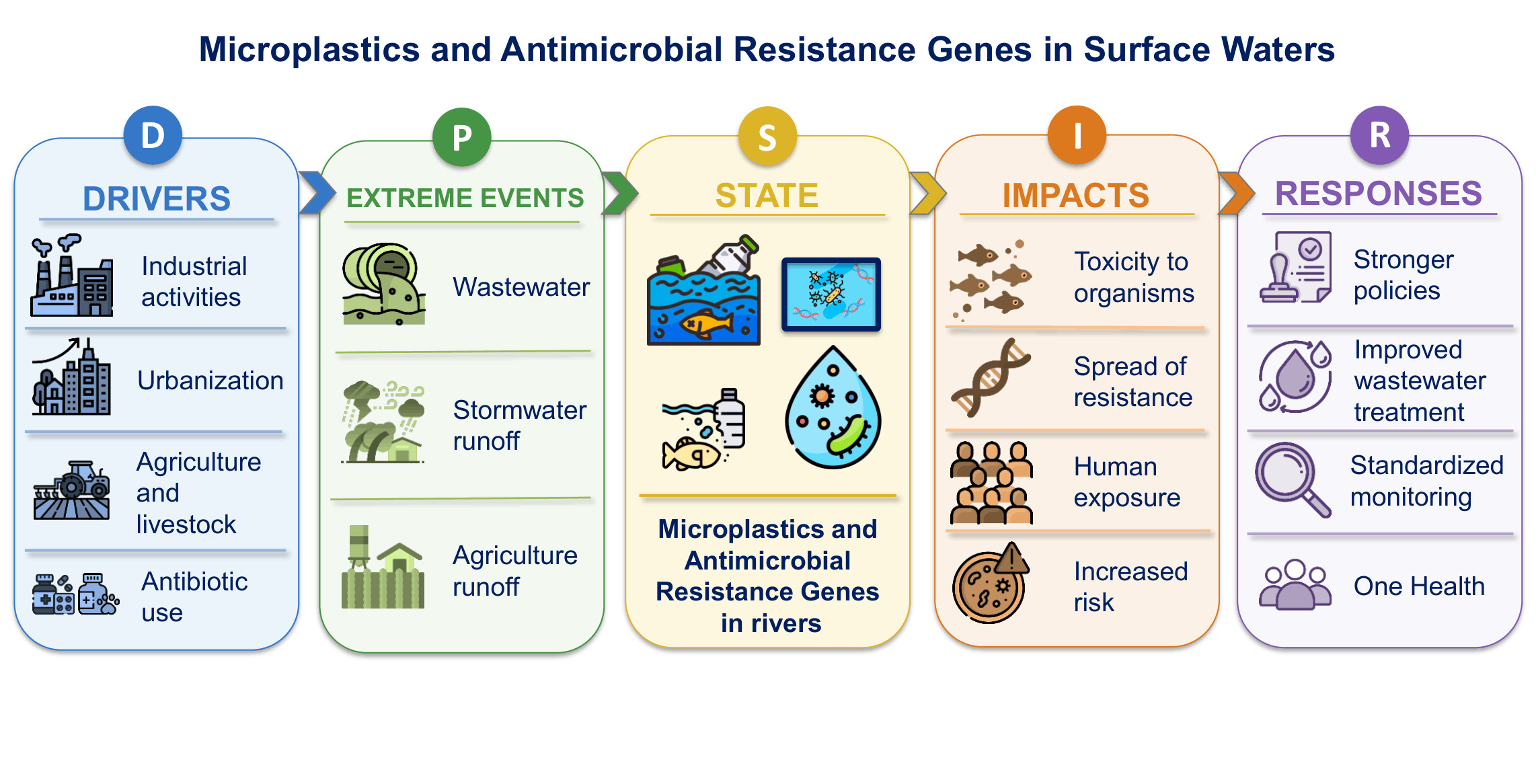
Graphical Abstract

1. Introduction

Water is a vital resource, with an estimated daily recommended quantity per person of 5.3 litres for human consumption alone [1]. However, increasing demand and contamination from anthropogenic activities have made water scarcity and safety pressing issues. In the European Union (EU), only 37% of surface waters meet good ecological status, and only 31% achieve good chemical status [2,3]. Surface waters are essential for human consumption and hygiene, as well as for the health of animals and the environment. However, they face growing threats from a wide range of unmonitored or insufficiently regulated pollutants (e.g., pharmaceuticals, novel pesticides), referred to as emerging contaminants. Among these, microplastics (MPs) and antimicrobial resistance genes (ARGs) have drawn significant scientific and policy attention due to their ubiquity, persistence, and potential threats to ecosystems and human health [3].
MPs are synthetic polymer particles under 5 mm in diameter [4,5,6], originating from diverse sources such as plastic waste fragmentation, industrial abrasives, personal care products, tire wear particles, and synthetic textile fibres released during washing [7]. They are now recognized as pervasive pollutants in aquatic systems across Europe [8], with an estimated 0.5 million tonnes entering European waters annually, despite global reduction efforts [9]. MPs have been detected not only in surface waters but also in drinking water [10] and even in human biological samples [11], raising growing concerns about their health effects [12]. Their hydrophobic surfaces further provide favourable substrates for microbial colonization and biofilm formation, creating the so-called “plastisphere” [13,14]. Within these biofilms, horizontal gene transfer of ARGs can be promoted, thereby facilitating their enrichment and dissemination in water bodies [15,16].
Due to their ubiquity, monitoring, risk assessment and identification are essential to understand the scale and impacts of microplastics. One of the current approaches that can mitigate plastic pollution in surface waters is the use of wastewater treatment plants (WWTPs). Studies have shown that the MPs removal efficiency of WWTPs was above 88% without tertiary treatment and over 97% in the WWTPs with tertiary treatment [17]. Removal from effluents mainly occurs during preliminary and primary treatment through settling or skimming, where MPs either sink or float with organic matter [18]. Implementation of tertiary treatment further improves removal through more advanced processes such as membrane bioreactors, sand filtration, dissolved air flotation, ultrafiltration, reverse osmosis, and activated carbon adsorption. Disadvantages from these processes include (i) the release of high amounts of MPs despite the high efficiency, due to the large volume of effluents treated daily; (ii) fragmentation of MPs into smaller particles, making them harder to remove; and (iii) concentration of MPs into biosolids that can be used as fertilizers, contaminating agricultural fields [18,19,20,21].
Antimicrobial resistance (AMR), meanwhile, has been identified by the United Nations (UN), World Health Organization (WHO), and the European Centre for Disease Prevention and Control (ECDC) as one of the most critical global health threats, with mortality projections ranging from 1.91 to 10 million deaths per year by 2050 in the absence of coordinated interventions [22,23,24]. ARGs confer resistance to antibiotics that can persist in aquatic environments long after the degradation of active compounds [25] and elevated levels have been observed downstream of WWTPs and agricultural zones in European rivers [26,27]. Their persistence and mobility enable horizontal gene transfer between environmental, commensal, and pathogenic bacteria [28], turning surface waters into reservoirs, amplifiers, and vectors [29,30] of AMR [31].
Climate change further exacerbates these risks. Droughts and water scarcity reduce dilution capacities, concentrate contaminants, and increase human exposure, particularly in water-stressed regions, where moderate to severe water stress is projected in river basins by 2040 [32,33,34]. This makes the interaction between MPs and ARGs particularly concerning, demanding a transdisciplinary One Health perspective that recognizes the interconnectedness of human, animal, and environmental health [35].
To address the emerging pollutants, the EU has progressively expanded its policy and regulatory attention across several water-related instruments. In particular, the proposed revision of the Urban Wastewater Treatment Directive, which entered into force on 1 January 2025, expanded the focus on risk-based monitoring and on pollution sources that had previously received less attention, including smaller urban discharges and diffuse pathways. Although emerging pollutants were initially excluded from the Drinking Water Directive (DWD) (EU 2020/2184) [36], subsequent revisions have gradually addressed this gap. MPs and ARGs have gained increasing attention in EU water policy discussions, particularly in the context of the 2022 proposal to revise the Water Framework Directive (WFD) [37] and Directive (EU) 2024/3019 [38], prompting methodological improvements. However, standardized detection methods and environmental quality thresholds are still lacking, making the development of comprehensive monitoring and mitigation strategies an urgent policy and research priority [39,40]. Against this backdrop, the present review applies the drivers–pressures–state–impact–response (DPSIR) analytical framework, endorsed by the European Environment Agency (EEA) [41], to systematically evaluate the state of knowledge on MPs and ARGs in European surface waters. Within a One Health perspective, this approach aims to inform coherent policy development, support sustainable water management strategies, and strengthen environmental and public health protection in the face of escalating climate change and water scarcity pressures [42].

2. Materials and Methods

This narrative review employed a thorough literature search to identify key publications, with a focus on peer-reviewed scientific articles, reports, and policy papers published between 2013 and 2026. Key terms such as “microplastics,” “antimicrobial resistance genes,” “surface waters,” “European Union,” and “One Health” were used to search databases like Scopus, Elsevier, PubMed, and Web of Science from June 2025 to March 2026. The focus was on studies carried out in European contexts, in accordance with legal instruments such as the WFD, the Urban Wastewater Treatment Directive (UWWTD), and the DWD, with both original and review articles being selected. Studies directly addressing microplastics and/or antimicrobial resistance genes in surface waters were included in the review. One hundred and fifty-five references were selected based on relevance, citation impact, and thematic coverage. These include experimental studies, modelling papers, policy evaluations, and European Commission communications.

3. Results

3.1. Drivers and Pressures

Population growth and, consequently, the impacts of urban development are at the heart of the spread of MPs and ARGs in surface waters. Industrial expansion, agricultural intensification, and pharmaceutical usage create massive volumes of wastewater that carry plastic residues, pharmaceuticals, and antimicrobial resistant microbes into aquatic environments [19,43].
Despite policy advances like the EU Plastics Strategy and the Single-Use Plastics Directive, plastic production in Europe remains high, with leakage into the environment still insufficiently controlled [44]. Among industrial activities, the production and consumption of plastics in packaging, construction, and consumer goods continue to represent one of the most significant drivers of MP pollution [45]. Daily use of plastic-based materials, such as microbeads in cosmetics, textiles, tires, and paint show that systemic socioeconomic factors reflect the current consumption patterns and their waste, further along the line. Similarly, the overuse and misuse of antimicrobials in both human healthcare and livestock production contribute substantially to the selection and amplification of resistant bacterial strains [46,47,48]. One Health-style analyses across Europe [49] have demonstrated that antibiotic usage in both humans and animals (especially food-producing animals) increases the prevalence of antimicrobial resistant strains in both populations [50,51,52]. The European Surveillance of Veterinary Antimicrobial Consumption (ESVAC) reports ongoing reductions in veterinary antimicrobial use, yet hotspots of high use remain, particularly in Southern and Eastern Europe [53].
Anthropogenic pressures arising from these drivers manifest as both direct and indirect inputs of MPs [20] and ARGs [54] into freshwater systems. Wastewater treatment plants are major points of entry. Although essential for mitigating water pollution, conventional treatment technologies cannot often fully eliminate MPs and ARGs. Despite high percentages of pollutant removal, the absolute mass of microplastics discharged remains environmentally significant due to the enormous volumes of wastewater processed. Even tertiary-treated effluents regularly discharge high loads of MPs and measurable concentrations of ARGs, allowing persistent dispersion of these contaminants downstream [55,56]. Industrial contributions further reinforce these pressures. Manufacturing facilities producing textile and plastic goods discharge microfibers, polymer dust, as well as resin pellets through effluent releases and inadequate waste management practices [57].
Additionally, urban stormwater runoff constitutes an important pathway by which MPs derived from tyre wear, synthetic textiles wear, road dust, and fragmented consumer products are transferred into rivers and lakes during rainfall events [58]. Atmospheric deposition has also emerged as an increasingly recognized pathway, as studies document the aerial transport of MPs even to remote freshwater ecosystems, highlighting the diffuse and transboundary nature of MP pollution [59].
Agricultural practices further exacerbate these pressures on the environment. The application of manure and sewage sludge as organic fertilizers introduces contaminants into soils, where MPs may accumulate over time and later be mobilised into freshwater systems via rainfall-driven runoff and erosion [60]. Recent evidence suggests that sludge-amended soils can act not only as recipient compartments but also as secondary long-term sources of MPs to adjacent aquatic environments [61]. Additionally, the widespread use of agricultural plastics, such as mulching films and silage wraps, contributes to the soil accumulation of MPs and their eventual transfer to aquatic systems through erosion and leaching processes [62,63].
The spread of ARGs seems to be similar to their plastic contaminant counterparts. The main vector of their release into the environment is directly tied to human activity. Due to their worldwide application in combating infections, many ARGs end up in wastewater systems or pollute water bodies due to agricultural runoff [60] and improper disposal of unused medicines [64]. Environmental conditions strongly shape the ecology and evolution of AMR by influencing microbial communities and the selective pressures under which ARGs persist and spread. Factors such as temperature, pH, oxygen, and exposure to antibiotics, metals, and emerging pollutants, such as MPs, among many others, modulate bacterial stress responses and horizontal gene transfer, processes likely to intensify under ongoing global environmental change [65]. Indeed, climate change [34] further intensifies these pressures by modulating dilution and dispersion capacities, which influences the transport of these contaminants [66]. Shifts in precipitation and temperature patterns, combined with the drought-induced concentration of water volumes aggravates contaminant intensity [67].
Collectively, these interlinked drivers and pressures form a multifaceted connection that complicates the regulation and long-term management of MP and ARGs dissemination in freshwater systems.

3.2. State

3.2.1. Microplastics in Surface Waters

As one of the most ubiquitous contaminants in aquatic environments, MPs have found their way into freshwater systems in the EU [68]. MP contamination has been widely documented in marine environments, including their wild population [69], but over the past decade, research has documented their widespread presence in surface waters, sediments, and even in the biota at concentrations ranging from a few particles per cubic meter to hundreds, depending on methodology and environmental conditions. MPs contamination ranges across several freshwater bodies, from rivers, lakes, reservoirs, groundwater, and even treated drinking water across the continent [70,71]. Recent works have shown that microplastics can derive from densely populated urban stretches of major European rivers such as the Danube, Thames, and Douro [72,73,74], to remote alpine catchments [75], albeit in very different abundances depending on the surrounding land use and anthropomorphic impacts [76,77]. Their ubiquity is no longer questioned, whether they be fibres derived from textiles, tyre and road-wear particles, fragments from packaging, or pellets lost during transport, particles are consistently detected throughout European water bodies [7].
Yet, while the broad picture of occurrence and sources is clear, quantitative comparison across studies remains limited. The problem lies in methodology, especially in the heterogeneity of analytical techniques [67,78]. Research teams studying the same river system often report MP abundances differing by orders of magnitude, resulting from methodological choices that define which fraction of particles is measured. Sampling volumes, often varying from litres to thousands of litres, represent a trade-off between accuracy and logistical challenges, namely in drinking water assessments [79]. Another divergence in sampling approaches can be attributed to the size ranges of the retrieval equipment [80]. Manta trawls and neuston nets, with mesh sizes of 300 to 500 µm, capture mainly larger floating particles and fibres, while pumped bulk-water samples filtered in the laboratory can quantify much smaller size classes, sometimes down to tens of micrometres [81]. Sediment studies also vary in size corrections and extraction protocols, leading to further inconsistencies in the report. Polymer identification is another major bottleneck because different analytical methods provide different types of information and have different detection limits. Visual sorting remains common, particularly in older studies, but it is highly prone to misclassification, especially for fibres, transparent fragments and weathered particles [82,83]. Optical microscopy is useful for counting and describing particle shape, colour and size, but it cannot reliably confirm polymer composition. Fourier transform infrared spectroscopy (FTIR)-based methods, including attenuated total reflectance FTIR (ATR-FTIR), focal plane array FTIR imaging, and micro-FTIR, are widely used because they provide polymer-specific spectra and are comparatively robust for routine monitoring [78,84]. Yet, protocols diverge on size classification, pre-treatment steps and contamination control [85], with even the units of measurement differing (e.g., items per cubic metre, items per kilogram dry weight, mass per area), severely raising the difficulty of achieving universal parameter assessment [86]. ATR-FTIR is practical for larger particles, but it is less suitable for smaller particles (e.g., <0.5 mm) because the item must be analysed individually and contact with the crystal is required. Micro-FTIR imaging enables analysis of particles down to approximately 20 µm, depending on the instrumental configuration, but analysis time and data processing demands remain substantial [78,87]. Raman micro-spectroscopy offers higher spatial resolution than FTIR and can identify particles below 20 µm, but it is more sensitive to fluorescence interference, pigment effects and sample degradation caused by laser heating [78,88]. Compared with optical microscopy, both micro-FTIR and Raman micro-spectroscopy are costly and time-consuming and are not often used as quantification methods. Therefore, even if the cost, processing time, and applicability of these techniques may vary according to technological developments and instrument availability, optical microscopy and spectroscopic methods are currently used as complementary rather than interchangeable methods [85].
Laboratory processing introduces additional variability. The organic digestion methods range from oxidative treatments using hydrogen peroxide, which can fragment or alter certain types of polymers, to enzymatic or alkaline protocols, each with different strengths and weaknesses [89]. Density separation protocols, from saturated sodium chloride to high-density zinc chloride or sodium iodide, recover different types of polymers depending on their density [88]. Once again polymer identification creates variability, as visual sorting remains common, especially in older studies, which makes it prone to misclassification, particularly for fibres and weathered fragments [82]. Interlaboratory comparisons coordinated in Europe have highlighted this variability, showing that even well-resourced laboratories can produce inconsistent results without shared protocols and reference materials [84]. Furthermore, contamination control is another inconsistency across studies. Airborne fibres, synthetic lab clothing, and unfiltered reagents can contribute to artefacts, and not all studies report blank corrections or recovery efficiencies [83]. Taken together, these sources of analytical variability compromise the comparability, reproducibility, and interpretability of MP occurrence data across studies.
In light of the emerging MP problem, the Drinking Water Directive (EU) 2020/2184 [36] requires the monitoring of MPs in water sources intended for human consumption, such as surface waters, but refrains from setting threshold values, citing insufficient toxicological data. A harmonised methodology was then established by Commission Delegated Decision (EU) 2024/1441 [87], which uses cascade filtration systems with a large volume of sample, up to around 1000 L. This is then followed by a laboratory analysis that combines optical microscopy and vibrational micro-spectroscopy (such as FTIR-ATR or Raman spectroscopy) in order to identify the particle size, shape, and polymer type. It defines a reporting size range (generally 20 µm to 5 mm for particles) and expresses results as microplastics per cubic metre, to ensure comparability across member states.
By contrast, no equivalent EU-wide harmonized method has yet been formally adopted for MPs in surface waters. Recent revisions of EU water legislation indicate that MPs are to be included in the future surface water and groundwater watch list once suitable harmonised monitoring methods become available. Despite these efforts, key gaps remain unresolved. MPs with sizes below 100 µm, although more abundant, remain difficult to quantify with reproducible protocols. These are the particles of greatest concern for ecological uptake and human exposure, as their small size makes them capable of going through biological membranes [90]. Moreover, long-term monitoring programmes capable of detecting temporal trends remain scarce, in part because of the high costs of spectroscopy-based analysis and the lack of agreed protocols across national monitoring agencies [78,91].
The reviewed studies also differ substantially in the MP size ranges and polymer types reported, which limits ecological interpretation. Most river and lake surveys focus on particles between 300 µm and 5 mm when using manta or neuston nets, whereas studies based on bulk-water filtration and micro-spectroscopy may include smaller fractions, commonly from 20 µm or 50 µm up to 5 mm [78,79,87]. This distinction is relevant because smaller particles are generally more numerous, more easily ingested by planktonic and benthic organisms, and more likely to interact with microbial biofilms [90]. Polymer composition also influences transport and fate. Low-density polymers, such as polyethylene (PE) and polypropylene (PP), commonly used in packaging and single-use products, tend to remain buoyant in surface waters unless biofouling or aggregation increases their effective density. Denser polymers such as polyethylene terephthalate (PET), polyvinyl chloride (PVC), polycarbonate (PC), and some polyamide or polyester fibres are more likely to sink, accumulate in sediments, or be transported as suspended particles under turbulent conditions. Polystyrene (PS), including expanded polystyrene, may fragment readily and is frequently associated with urban and recreational sources. Therefore, reporting size class and polymer composition is essential for interpreting sources, residence time, exposure pathways, biofilm formation, and potential interactions with ARGs.

3.2.2. Antimicrobial Resistance Genes in Surface Waters

ARGs in European freshwaters are increasingly recognised as both a public health issue and an ecological marker of anthropogenic pressure [92,93]. Like with MPs, rivers, lakes, and urban waterways routinely carry antimicrobial resistant bacteria and mobile resistance determinants, reflecting the combined inputs of municipal wastewater, hospital effluents, agricultural runoff, aquaculture [29,30] and stormwater discharges [94,95].
Monitoring strategies have traditionally been divided between culture-based and molecular approaches, each yielding complementary but non-identical insights. Conventional culture relies on the growth of viable bacteria under controlled laboratory conditions and uses Gram staining, microscopy, selective and/or differential media, and biochemical assays to characterise microbial communities [96]. This approach remains vital for tracking Enterococcus spp. and Escherichia coli, key regulatory indicators of faecal contamination and clinically-relevant hosts of ARGs. Culture-based methods enable AMR profiling of viable bacterial populations and allow direct comparison with human and veterinary surveillance data. Culturomics expands traditional culture into a systematic, large-scale approach combining standardized growth conditions with antibiotic susceptibility testing and genome sequencing. While culture-based techniques are cost-effective and allow direct observation and isolation of pure strains, they are limited to organisms able to grow under laboratory conditions and above method detection limits [97]. They are also labour-intensive and time-consuming at a large scale. On the other hand, culturomics can increase microbial diversity detection, enabling identification of rare, slow-growing, or previously uncultured organisms, and supports database enrichment through mass spectrometry or sequencing. However, high-throughput equipment tools such as matrix-assisted laser desorption/ionisation time-of-flight mass spectrometry (MALDI-TOF MS), a mass spectrometry method based on the ionisation of a sample, are costly, technically demanding, and still restricted to culturable organisms and available databases [98,99].
Molecular methods, on the other hand, provide culture-independent analysis of microbial communities based on extracted DNA. These approaches include polymerase chain reaction (PCR), quantitative PCR (qPCR), digital PCR (dPCR), and whole metagenomic sequencing (WMS). They enable detection and quantification of ARGs in absolute terms, such as copies per mL of water or per gram of sediment, often normalised to 16S rRNA gene abundance to account for microbial biomass [99]. qPCR allows simultaneous quantification of dozens to hundreds of ARGs, generating detailed resistome fingerprints at reasonable cost, while dPCR improves quantification accuracy in complex matrices such as turbid or inhibitor-rich environmental samples [100,101]. Comparative analyses indicate that qPCR offers high sensitivity for the targeted detection of low-abundance ARGs, whereas WMS provides broader insights into microbial diversity, resistome, mobile genetic elements, and co-selection processes [102]. WMS further expands this capability by capturing the entire microbial community without reliance on specific primers, enabling detection of both culturable and non-culturable organisms and allowing retrospective identification of ARGs. This high-throughput, hypothesis-free approach facilitates a comprehensive analysis of microbial diversity, resistome composition, and genetic contexts of resistance determinants, supporting the identification of subtle pollution signals and resilient microbial communities associated with ARGs and microplastics [103,104]. As such, the different metagenomic approaches currently used for the detection of ARGs can be divided into groups. Quasi-metagenomics combines selective culturing with downstream molecular analysis to detect low-abundance ARGs. Targeted approaches, such as qPCR, offer high sensitivity and specificity for known ARGs and are particularly suitable for monitoring purposes. In contrast, shotgun metagenomics provides a non-targeted analysis of the entire microbial DNA, allowing for the identification of novel ARGs and insights into their genetic context. There is also a differentiation between short-read and long-read methodologies, where the former produce short but extremely precise DNA fragments, ideal for the exact identification and measurement of known ARGs, and the latter generates significantly longer reads that make it possible to reconstruct the genomic context and link ARGs to particular hosts and mobile genetic elements like plasmids.
Moreover, metagenomics enables the discovery of latent or previously uncharacterised resistance genes, which may remain undetected using targeted approaches. Wastewater environments, in particular, are recognised as hotspots for such emerging resistance determinants, although their relationship with traditional indicators of faecal pollution remains incompletely understood [105]. Advances in long-read sequencing technologies may further enable portable metagenomics platforms for rapid environmental water-quality assessment in the future [31].
Cost-effectiveness has therefore emerged as a decisive factor for scaling. Single-gene PCR assays are relatively inexpensive, as they rely on standard laboratory equipment and straightforward assay design. These are used to detect instances in which only a small number of genetic targets need to be analysed, with the caveat of being incapable of scaling with an increase in the number of gene panels. In contrast, qPCR systems reduce the cost per gene when analysing large panels by running many reactions simultaneously, but require specialised infrastructure and trained personnel, leading to a higher upfront investment and operational complexity. Although dPCR is typically more expensive per test, it provides a more accurate quantification when targets are present at very low concentrations. Overall, despite ongoing reductions in sequencing prices, metagenomic approaches still generally require substantial sequencing depth and therefore remain costly overall.
The justification for higher-cost methodologies depend on the sample type and the study objectives. For example, isolates from water samples undergo culture and phenotypic testing alongside a qPCR panel (targeting specific microorganisms such as Enterococcus spp. and E. coli), whereas metagenomics is applied selectively to suspected hotspots or representative sites of faecal contamination, where larger samples and broader knowledge of microbe presence are required [100].
The interpretation of ARGs occurrence also depends strongly on the specific genes targeted. Studies focusing on tetracycline resistance genes, such as tetA, tetM or tetW, often reflect inputs from human wastewater, livestock production, and manure-amended soils, because tetracyclines have been extensively used in both human and veterinary medicine [31,92,93,94]. Sulfonamide resistance genes, such as sul1 and sul2, are frequently detected in wastewater-impacted rivers and are often associated with mobile genetic elements, particularly class 1 integrons, making them useful markers of anthropogenic pollution and horizontal gene transfer potential [89,90,91]. Beta-lactamase genes, including clinically-relevant extended-spectrum beta-lactamase genes such as blaCTX-M, indicate contamination by resistant Enterobacteriaceae and are particularly relevant from a public health perspective due to their association with therapeutic failure in human infections [94,95,101].
Routine surveillance of ARGs in surface waters faces a fundamental practical constraint: it is neither technically nor economically feasible to screen for the full diversity of clinically-relevant ARGs in every sample using standardized workflows. As a result, the selection of ARGs targets is inherently challenging and can introduce bias, limiting comparability across studies and over time. A pragmatic way forward is to adopt a harmonized, risk-based shortlist of priority ARGs that balances public health relevance with analytical feasibility. In this context, recent proposal by the European Food Safety Authority (EFSA) to focus on “highest priority” ARGs-blaCTX-M, blaVIM, blaNDM, blaOXA-48-like, blaOXA-23, mcr, armA, vanA, cfr, and optrA-offers a useful starting point for surface water monitoring [106]. These determinants were reported across multiple sources and along the farm-to-fork continuum, particularly faeces/manure, soil, and water, which are directly connected through runoff, leaching, drainage, and wastewater pathways and therefore act as upstream contributors to the resistome detected in surface waters. Aligning surface water surveillance panels with such priority lists could improve harmonization, support trend analysis, and help link environmental findings to sources and potential human exposure routes.
ARGs hotspots in Europe are strongly associated with wastewater treatment plants, hospital discharges, and agricultural areas with intensive livestock farming and aquaculture [29,30,107]. Sediments and biofilms function as long-term reservoirs where mobile genetic elements enable gene exchange among diverse bacteria. Spatially robust surveys have confirmed that resistome richness scales with human activity indices and that urbanised catchments consistently harbour higher ARGs loads than remote or high-altitude lakes [108]. Enterococcus spp. and E. coli remain central to this discussion. Enterococcus spp. is an enduring coloniser of aquatic environments, with resistant isolates repeatedly detected in effluents and downstream rivers [109]. Rainfall and storm events are appointed as the most immediate and influential triggers of elevated Enterococcus spp. levels in recreational waters, but these spikes are often caused by human and animal waste [110]. E. coli is consistently found in European surface waters impacted by wastewater and agriculture, with resistance frequencies reflecting or even anticipating clinical trends [90]. However, faecal indicator bacteria, such as E. coli and Enterococcus spp., may underestimate waterborne health risk as their presence is not always correlated with pathogenic microorganisms [111].
As practical considerations about sample volume are critical, culture-based testing and most qPCR assays are better targeted to ranges between 100 and 1000 mL of sample, and metagenomics can work with larger effective volumes, often 1 to 2 L, to capture low abundance ARGs, with persistent limitations such as clogging in turbid waters. Composite samples or multiple replicates increase representativeness but raise processing demands [112].

3.2.3. Microplastic and ARGs Interactions

An emerging area of concern is the synergistic interaction between MPs and ARGs. MPs can sometimes provide hydrophobic surfaces fit for microbial colonization, forming biofilms known as the “plastisphere.” Within these biofilms, microbial density, nutrient exchange, and close cellular contact enhance conditions for horizontal gene transfer via conjugation, transformation, or transduction [113,114].
The interaction between MPs and ARGs has recently been seen in Salmonella enterica [115] and E. coli [116], where the presence of MPs particles can affect a pathogen’s virulence and survival strategy. Recent studies also demonstrate that MPs in river and estuarine environments host higher ARGs loads than surrounding water columns. MP-associated biofilms showed higher abundances of relevant ARGs compared with adjacent sediments and water [117]. Laboratory and mesocosm studies corroborate these field observations. Under ciprofloxacin exposure, PVC MPs in freshwater biofilms displayed an increase in ARGs abundance, suggesting that antibiotics present in rivers amplify resistance proliferation on MPs biofilms [118]. Furthermore, aged MPs further enhance antibiotic adsorption, creating localized “selective niches” for ARGs retention and exchange [119].
Wastewater isolates retrieved from MP-associated biofilms display higher resistance rates [120,121]. These findings underscore the importance of considering MPs not only as physical pollutants but also as biological vectors in the dissemination of ARGs in aquatic systems. MPs serve as hotspots for ARGs and mobile genetic elements, given their morphology and surface heterogeneity, positively influencing microbial colonization dynamics and genetic enrichment [122]. Beyond acting as passive carriers, MPs can actively contribute to resistance development by inducing oxidative stress and DNA damage in associated microorganisms, which can increase mutation rates and facilitate the acquisition or selection of antimicrobial resistance [123].
MPs and ARGs often originate from the same environmental sources, such as wastewater treatment plants. These contaminants can be released simultaneously in effluents, where MPs provide surfaces for microbial colonisation, including bacteria carrying ARGs, facilitating their transport into rivers and coastal waters. Similarly, environmental contamination can originate from diffuse sources such as run-offs from agricultural fields containing plastic residues. These shared pathways mean that the transport and environmental fate of MPs and ARGs is highly interconnected [57,58,59].
Despite these advances, the state of knowledge remains fragmented by methodological inconsistencies. Heterogeneity in polymer types, particle size ranges, and aging conditions complicates comparisons between studies.

3.3. Impacts

The growing presence of MPs and ARGs in European surface waters carries significant risks for both environmental and human health. Humans are exposed to MPs and ARGs through multiple pathways, including consumption of drinking water or contaminated seafood, inhalation, and dermal exposure (e.g., through recreational exposure) [124]. Studies have identified microplastics in human stool, placenta, and blood samples which raises concerns about systemic exposure [125,126,127,128]. Exposed individuals may be at risk of potential health effects such as inflammation, immune disruption, and tissue toxicity [129,130]. Their chemical load, including adsorbed hydrophobic pollutants and plastic additives, present additional toxicological challenges which are yet to be fully understood.
ARGs in surface waters further increase human health risks as antimicrobial resistant bacteria and free ARGs can be transmitted to individuals through untreated or poorly treated water, food-crop irrigation, and poor food preparation hygiene [131]. The presence of resistant E. coli, Enterococcus spp., and other opportunistic pathogens in sources of human consumption may lead to multidrug-resistant infections [132]. The possibility of ingestion may lead to the accumulation of MPs in the gastrointestinal tract, which will hinder food intake and cause tissue damage, facilitating the entrance of ARG-containing microorganisms [133].
MPs can release toxic substances such as additives (e.g., bisphenol A, phthalates) and adsorbed environmental pollutants like polychlorinated biphenyls (PCBs), polycyclic aromatic hydrocarbons (PAHs), and heavy metals. These contaminants can leach from the plastic surface into the gastrointestinal tract upon ingestion, leading to physiological stress, endocrine disruption, and impaired growth [134]. Modulating effects of MPs on the immune function can affect host response to pathogens [135]. Moreover, co-exposure of mice to MPs and an antibiotic (sulfamethoxazole) interfered with pharmacokinetics, intensified effects on gut microbiota, and significantly increased the development of ARGs [136].
Additionally, the World Bank estimates that AMR-related morbidity and mortality disproportionately impact vulnerable populations within Europe’s water-insecure regions [137]. The enrichment of ARGs in microbial communities elevates the risk of horizontal gene transfer to wildlife-associated bacteria, posing long-term consequences for biodiversity and ecosystem processes. Studies on macroinvertebrate biofilms show elevated ARGs prevalence near wastewater outflows, implicating environmental dissemination that extends beyond immediate reception sites [138]. This is observed in human exposure through recreational activities such as swimming in contaminated waters.
At the ecosystem level, MPs and ARGs impacts are substantial in aquatic species. With noted negative effects on digestion, growth and reproduction across invertebrate to fish species. Wild freshwater fish exhibit gut inflammation and oxidative stress after chronic exposure to MPs [139]. A study on Javanese medaka larvae, a euryhaline fish (Oryzias javanicus), found that microplastics are eliminated faster in seawater than in freshwater. This is due to the osmoregulation in seawater, which requires an increased amount of drunk water, which in turn, increases gastrointestinal fluid movement and helps move particles through the gut. In freshwater, gut retention time was longer, suggesting slower clearance and a greater chance that microplastics remain available for transfer within food webs [140]. Furthermore, MPs can bioaccumulate adhered pollutants such as heavy metal PCBs and polycyclic aromatic hydrocarbons (PAHs), amplifying toxic effects through trophic transfers [141]. Collectively, the simultaneous presence of MPs and ARGs exacerbates pressures on water ecosystems, challenging the water safety, services, and biodiversity targets of EU’s Green Deal and Biodiversity Strategy.

3.4. Response

European legislation, particularly the WFD (2000/60/EC) [142] and its 2024 amendment, is directly addressing monitored pollutants; however, MPs and ARGs remain insufficiently regulated. The amendment’s inclusion of MPs and ARGs in the Watch List (Annex VIII) is an essential first step toward structured and harmonized monitoring. The Drinking Water Directive (EU 2020/2184) [36] now mandates MP monitoring in treated water without threshold values, promoting the data collection that is needed to form a robust understanding on how to handle the methodology. The (UWWTD) (91/271/EEC) [143], revised in 2022, aims to reduce priority concerns such as MPs and antimicrobial resistance and the EU’s One Health Action Plan on AMR and Regulation (EU) 2019/6 [144] seeks to progressively reduce antibiotic misuse in veterinary settings [2,145].
However, the lack of legally enforceable environmental quality standards for MPs and ARGs limits operational responses. In practice, monitoring programs still face major constraints related to sampling design, laboratory infrastructure, quality assurance and quality control, data harmonization and the integration of emerging pollutants into existing surveillance systems. For MPs in particular, the high cost and specialist nature of spectroscopic analyses remain significant barriers to routine monitoring, while, for ARGs, methodological diversity and the absence of agreed indicators hinder comparability and regulatory uptake. In the absence of operational threshold values and standardized assessment criteria, authorities also face difficulties in prioritizing sites, defining surveillance frequency, and translating monitoring results into proportionate management measures.
The Regulation for Registration, Evaluation, Authorization and Restriction of Chemicals (REACH) and other similar policies on specific polymers, like the EU Plastics Strategy’s emphasis on circular economies and single use plastics are several of the important, if not required, actions to scale and integrate water specific directives. Recommendations must be produced regarding the frequency and prioritized areas of surveillance. For instance, EU regulations on monitoring live bivalve molluscs recommend regular sampling schedules with geographically representative coverage based on local risk assessment [146]. It also advises adjusting monitoring to account for contaminant variability and increasing surveillance in higher risk. However, contaminant concentrations may present large fluctuations due to high geographic and temporal variability. In this context, bioindicators such as filter-feeding mussels can offer a more stable snapshot of environmental contamination. Standardized and cost-effective testing methods are imperative for MPs and ARGs surveillance. For MPs, FTIR and Raman spectroscopic analyses are the EU-proposed standard for particle characterization, but differences in data, sampling volumes, size fractions and reporting units from different laboratories and studies still highlight the need for a universal guideline for identification approaches. Even if values are proposed by the Commission Delegated Decision (EU) 2024/1441 [87], differences in the type, location, and level of contamination make a single protocol ineffective. Quality assurance mechanisms should also follow a strict protocol, which would include positive controls with reference materials, procedural blanks, contamination controls, and interlaboratory comparison tests.
As seen from multiple studies, the variability of ARG surveillance benefits from a hybrid approach combining culture-based assays and sensitive molecular tools such as qPCR and metagenomic sequencing [99,102]. An increased focus on the quantification of ARGs in indicator species, like E. coli and Enterococcus spp., should be done alongside broader resistome profiles studies. There is a need for a European AMR monitoring network to harmonize methodologies and serve as a benchmark for risk-based action.
A One Health approach aims to bridge environmental, animal and human health to address the present multisectoral pollutions. Focusing on the implementation of integrative frameworks, such as WHO Europe’s health environment initiatives, promotes harmonized surveillance and research synergy between different investigators. Cross-sector campaigns, data sharing platforms and public engagement campaigns are also essential to ensure a broader information spread which could lead to more cohesive policies and practice alignment between government and populations.
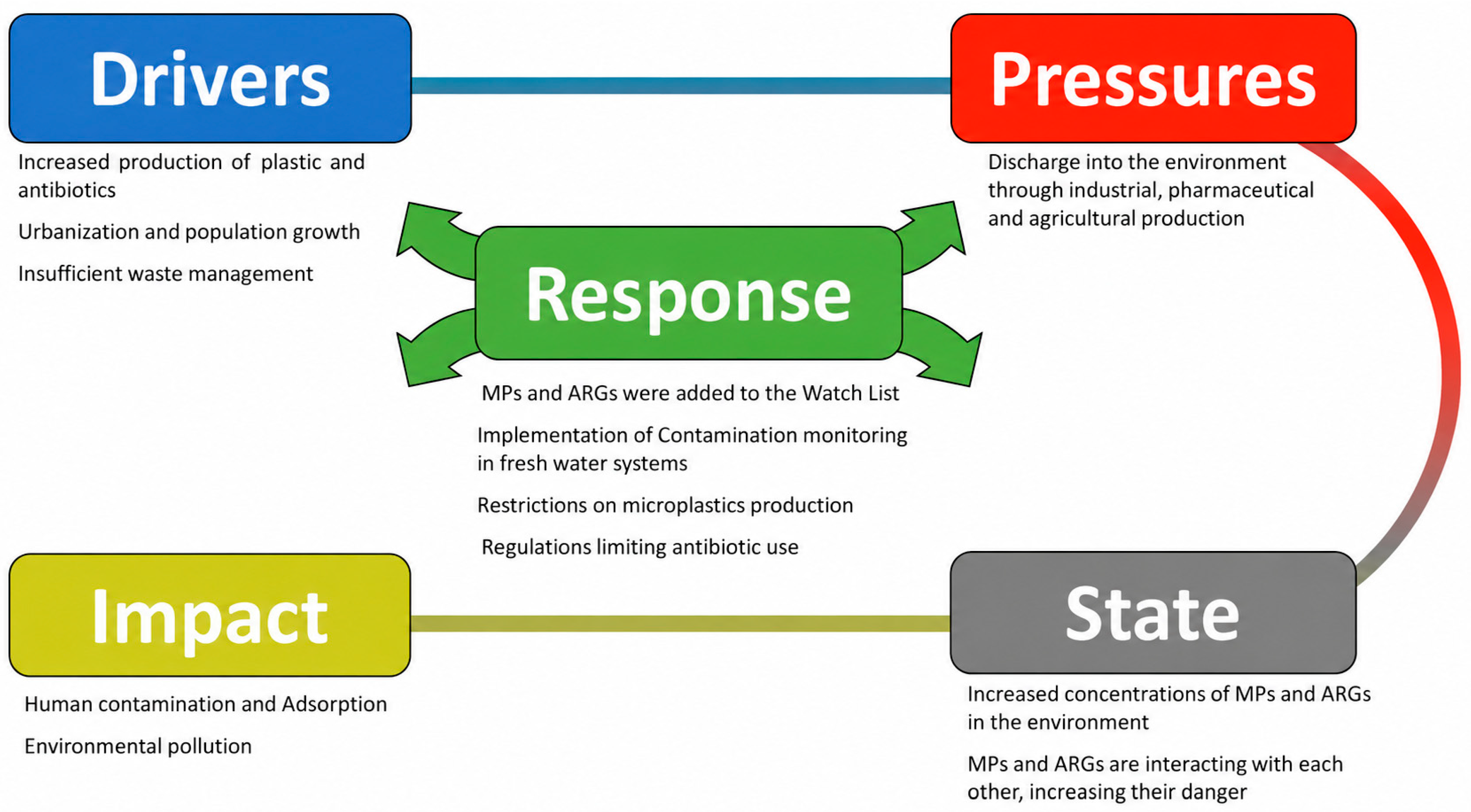
To summarize, this DPSIR framework (Figure 1) was used to compile current literature review on microplastics and antimicrobial resistance genes in surface waters, in order to highlight the current and future environmental and public health problems.

4. Discussion

Europe is actively addressing the emerging challenges caused by MPs and ARGs, as seen in recent regulatory updates like amendments to the WFD and new monitoring requirements under the Drinking Water Directive. As two priority pollutants studied worldwide, scientific research has greatly improved our understanding of their sources, environmental behaviours, and biological interactions. Despite this progress, significant obstacles remain, mainly including the lack of enforceable threshold values, fragmented monitoring efforts, and limited policy implementation. Three areas needing further clarification in regulations are (i) sample collection, (ii) sample processing, and (iii) definition of regulatory limits or targets. These challenges arise from the absence of standardized methodologies and definitions.
(i) Regarding sample collection, the minimum frequency of sampling, sampling conditions, and preferred locations shall be specified. Existing EU regulations for bathing waters recommend collecting at least four samples per bathing season, with intervals no longer than one month. Water samples (250 mL) shall be collected aseptically in sterile, transparent containers, approximately 30 cm below the surface, from locations where the water depth is at least 1 m. Samples shall be refrigerated and processed promptly. During short-term pollution events, additional samples must be taken, and appropriate management measures should be implemented.
Similar sampling principles can be implemented for monitoring ARGs and MPs in surface waters, but additional measures are required to ensure consistency of measurement data. Both contaminants show high temporal and spatial variability because concentrations can be influenced by rainfall, river flow, wastewater discharge patterns, resuspension of sediments, recreational activity, temperature, and seasonal changes in water use. Therefore, sampling should be distributed across seasons and, where possible, repeated at fixed locations using the same sampling depth, volume, equipment type, filtration limit, and preservation procedure. Consistency should be assessed through field replicates, laboratory replicates, procedural blanks, recovery tests, and the use of harmonised reporting units. Additionally, intra-and interday samplings could be conducted to determine hourly and daily variability, respectively. For long-term monitoring, results should be interpreted together with contextual metadata, including rainfall in the preceding days, flow rate, turbidity, temperature, pH, conductivity, dissolved organic carbon, and proximity to wastewater or stormwater discharge points. These supporting variables are essential because apparent changes in MPs or ARGs concentrations may reflect hydrological dilution, particle mobilisation, or episodic pollution rather than true changes in emission pressure.
Additional sampling might be necessary during short-term pollution events, which can stem from rainwater runoff, agricultural runoff, or unusual effluent discharges. Key hotspots for monitoring ARGs and MPs include stream mouths, stormwater outlets, wastewater discharge points, and downstream areas of urban or agricultural watersheds. River estuaries can provide an overall picture of water quality, though concentrations might be diluted by tidal mixing. From a public health perspective, sampling near drinking-water intake points and recreational zones is also crucial. Monitoring raw drinking water before treatment at existing intake sites can efficiently utilize current infrastructure to detect surface water contamination.
Sampling volume may determine the sensitivity of the method in detecting contaminants. Although larger water volumes can improve method sensitivity, they can also make sampling, transport, and filtration more difficult. For microbiology, sample volumes of 1 L have been used previously [147], while 0.8 L has been shown to yield relatively low variation among replicates in microbial community composition analyses [148]. Volumes may need to be adjusted based on suspended solids, organic matter, and DNA yield. Because filters can clog quickly, subsamples can be filtered onto multiple filters and then pooled to reach the target volume. Microbiological samples should be collected in at least triplicate, allowing pooling when DNA yields are low. Additional samples can be collected and filters frozen to build an archived record for future analysis. For MPs, 1 L sampling with four replicates has shown good accuracy when smaller particle sizes are included [149]. MP sampling should be carried out using glass or metal equipment to minimise contamination. Additional replicates may be collected when destructive analysis methods are used. Considering both ARGs and MPs, samples of approximately 1 L of water with an adequate number of replicates are recommended as a practical starting point, although larger volumes may be required when low-abundance ARGs or rare MP fractions are targeted. ARG samples may be collected approximately 30 cm below the surface to reduce atmospheric contamination, whereas MP samples may also include near-surface sampling to capture floating low-density polymers. Sampling in areas with a water depth of at least 1 m is recommended to minimise the influence of resuspended sediment and organic matter. Established volumes should be adjusted as new evidence emerges on concentrations relevant to ecological and public health risk.
(ii) Sample processing requires harmonization, as the lack of fully standardized and validated analytical methods presents a major obstacle to interstudy comparability. In the laboratory, water samples will be processed by filtration. For microbiology, filters of 0.22 and 0.45 µm pore size are recommended for genomics and culturomics, respectively. In some cases, innovative methods to capture organisms of interest and/or the elimination of inhibitory substances might be needed [150]. Although metagenomics provides an unprecedented capacity to characterise microbial diversity and resistome composition, interpretation of environmental resistome signals remains challenging. The detection of ARGs alone does not necessarily indicate active resistance, viable hosts, or transmission risk, as many resistance determinants may occur naturally within environmental microbial communities. In addition, the absence of longitudinal datasets or historical baselines makes it difficult to distinguish natural background levels from anthropogenic enrichment. These limitations complicate the translation of metagenomic signals into actionable surveillance indicators. Therefore, culture-based approaches remain essential to complement molecular methods, enabling phenotypic validation and identification of viable bacterial hosts carrying clinically-relevant ARGs. Given the current knowledge, integrating culturomics with metagenomics provides a more robust surveillance framework by combining broad resistome profiling with the targeted detection of high-risk resistance traits, while supporting interpretation of environmental AMR dynamics across space and time.
For MPs, filters of 1.2 µm pore size are sufficient, considering a practical limit of around 20 µm for micro-spectroscopy methods [151]. In highly contaminated filters, organic matter can be removed with digestion (e.g., hydrogen peroxide), while sediments can be separated using density-based solutions (e.g., zinc chloride). Laboratories should report detection limits, include procedural blanks (to control for contamination) and positive controls (to conduct recovery tests), and ideally validate their methods through interlaboratory comparison tests.
For MPs, reference materials are urgently needed to validate methods, alongside harmonized guidelines and recommended contamination control measures. For ARGs, standardized target genes relevant to environmental monitoring and public health need to be identified. For instance, EFSA recently established an immediate priority to investigate the occurrence and dissemination of high-priority ARGs (n = 10 genes relating to carbapenems, tigecycline, oxazolidinones, colistin, etc.) within food production environments and their dissemination into the wider/natural environment, such as via waste and run-off. Both metagenomic and culturomic approaches enable the identification of those key ARGs of the highest public health relevance [31]. A cost-effective alternative could combine culturomics based on indicator organisms (e.g., E. coli, Enterococcus spp.) with antibiotic susceptibility testing and genomic analysis.
Analytical methods for MPs include the recommended micro-spectroscopy methods and other emerging methods, such as pyrolysis–gas chromatography–mass spectrometry. These methods require controls for confounding chemical signatures (e.g., polyethylene false positives from fatty acids) [152]. Harmonized, publicly available databases to classify polymer types from spectroscopic and mass-spectrometry data should be developed (including for weathered polymers), and clear identification thresholds should be established (e.g., ≥0.7). Agreeing on standardised units and interlaboratory-validated procedures would greatly improve data reliability and comparability. Results from culturomics can be expressed in colony-forming units per millilitre (CFU/mL) followed by antibiotic susceptibility testing (e.g., by the broth microdilution reference method or the easier, yet standardized, disk diffusion testing) and, correspondingly, the percentage of susceptible and resistant strains according to international classification standards (e.g., EUCAST). Genomic results are typically reported as gene copies per litre (copies/L) or normalized to 16S rRNA gene copies (copies/16S rRNA gene copies), along with statistical metrics, such as α and β diversity. Reporting for MPs varies widely across studies. For water samples, it is recommended to report concentrations as particles per litre (MPs/L), alongside harmonized classes for polymer type and morphology (i.e., shape and size). In line with current practices, genomic data should be deposited in public repositories to enable comparison with human cases and strengthen public health relevance.
(iii) Setting regulatory limits or targets is currently constrained by limited data availability and the poor comparability across studies. Several strategies may be followed to achieve reference values. Traditionally, risk assessment is used to evaluate the impacts of environmental contaminants. However, for some contaminants, it is difficult to establish robust long-term thresholds without compromising the precautionary principle. Wastewater treatment plants classify reclaimed water into quality classes (A, B, C, and D) according to its intended reuse, particularly for agricultural irrigation. Regulation (EU) 2020/741 [153] establishes minimum requirements for water reuse, focusing on treated urban wastewater, and has been applied since June 2023. Under this regulation, WWTPs must monitor water quality at the compliance point, typically where treated effluent is discharged into receiving bodies such as rivers or streams. These compliance points could also serve as strategic sampling locations for assessing emerging contaminants like ARGs and MPs, given their role as interfaces between treated wastewater and the natural environment.
Bathing waters are also classified into quality classes based on microbiological parameters, namely Enterococcus spp. and E. coli, according to Directive 2006/7/EC [154]. For inland waters, “excellent” quality corresponds to ≤200 CFU/100 mL Enterococcus spp. and ≤500 CFU/100 mL E. coli, both based on the 95th percentile. “Good” quality corresponds to ≤400 CFU/100 mL Enterococcus spp. and ≤1000 CFU/100 mL E. coli, also based on the 95th percentile. “Sufficient” quality corresponds to ≤330 CFU/100 mL Enterococcus spp. and ≤900 CFU/100 mL E. coli, based on the 90th percentile. Waters exceeding the “sufficient” thresholds are classified as “poor.” For coastal and transitional waters, the corresponding thresholds are lower: “excellent” quality corresponds to ≤100 CFU/100 mL Enterococcus spp. and ≤250 CFU/100 mL E. coli; “good” quality corresponds to ≤200 CFU/100 mL Enterococcus spp. and ≤500 CFU/100 mL E. coli; and “sufficient” quality corresponds to ≤185 CFU/100 mL Enterococcus spp. and ≤500 CFU/100 mL E. coli [154].
A different strategy was followed in the Marine Strategy Framework Directive. A threshold was derived from reported data from EU member countries, using the 15th percentile as the threshold value (20 items/100 m) [155]. Alternatively, a target percentage of reduction could be set (e.g., 20%). In research studies, comparisons are often made with baseline concentrations measured in pristine areas or in sites under low anthropogenic pressures (i.e., reference levels). Notwithstanding the various approaches to establishing regulatory limits or targets, such efforts are only feasible after methodological harmonization and the systemic collection of comparable data.
For surface water monitoring, the main water quality analysis should combine regulatory microbiological indicators, emerging contaminant indicators, and supporting physicochemical parameters. The core microbiological analysis should include E. coli and Enterococcus spp. because they are established indicators of faecal contamination, are already used in European bathing water assessment, and provide direct regulatory comparability [154]. However, these indicators should be complemented by ARGs analysis, because faecal indicator bacteria do not necessarily reflect the abundance, diversity, or mobility of antimicrobial resistance determinants [111]. A practical monitoring panel should therefore include culture-based enumeration of E. coli and Enterococcus spp., antimicrobial susceptibility testing of recovered isolates, targeted qPCR or dPCR for priority ARGs, and metagenomic analysis at selected high-risk or representative sites. For MPs, the main analysis should report particle number, size class, morphology, and polymer type, because these parameters determine transport, exposure, and interaction with microbial biofilms. Supporting water quality parameters should include temperature, pH, conductivity or salinity, turbidity, total suspended solids, dissolved organic carbon, nutrients, rainfall history, and flow rate. These variables are necessary to interpret whether observed concentrations are driven by pollution inputs, hydrological dilution, sediment resuspension, wastewater discharge, or seasonal environmental conditions. Therefore, the main reason for combining microbiological, molecular, MPs, and physicochemical analyses is to move from simple contaminant detection toward risk-relevant interpretation and comparable long-term surveillance.
To address these challenges, it is urgent to harmonize monitoring protocols for MPs and ARGs in water and to generate data, as a prerequisite for subsequent regulation. On a second stage, it is also essential to develop and employ effective treatment technologies to remove micropollutants from waters (e.g., improving wastewater treatment). Fostering cross-sector collaboration through One Health frameworks is required to address the combined risks posed by MPs and ARGs co-occurrence, generated under evolving climate-driven environmental stress. Given the widespread presence, persistence, and potential to amplify public health risks, there is an urgent need to monitor MPs and ARGs in surface waters and develop regulation on these emerging contaminants.

Author Contributions

Conceptualization, A.A., L.G.B., A.R.F. and J.C.P.; methodology, A.A.; investigation, A.A.; writing—original draft preparation, A.A.; writing—review and editing, A.A., L.G.B., A.R.F., C.N., P.A. and J.C.P.; visualization, L.G.B., A.R.F., C.N., P.A. and J.C.P.; supervision, L.G.B., A.R.F. and J.C.P. All authors have read and agreed to the published version of the manuscript.

Funding

This work was supported by Fundação para a Ciência e Tecnologia—FCT, I.P., in the scope of the projects UID/04378/2025 (DOI identifier 10.54499/UID/04378/2025) and UID/PRR/04378/2025 (DOI identifier 10.54499/UID/PRR/04378/2025) of the Research Unit on Applied Molecular Biosciences—UCIBIO and the project LA/P/0140/2020 (DOI identifier 10.54499/LA/P/0140/2020) of the Associate Laboratory Institute for Health and Bioeconomy—i4HB. This work received financial support through the annual funding of 1H-TOXRUN of the University Institute of Health Sciences (IUCS-CESPU) and is supported by Cooperativa de Ensino Superior Politécnico e Universitário—CESPU under the grant MPeX-GI2-CESPU-2025. A.A is supported by Cooperativa de Ensino Superior Politécnico e Universitário—CESPU under the grant BD/DCB/CESPU/01/2026.

Data Availability Statement

No new data were created or analyzed in this study.

Conflicts of Interest

The authors declare no conflicts of interest.

Abbreviations

The following abbreviations are used in this manuscript:
MPsMicroplastics
ARGsAntimicrobial resistance genes
DPSIRDrivers-pressures-state-impact-response
EUEuropean Union
UNUnited Nations
WHOWorld Health Organization
WWTPWastewater treatment plant
EEAEuropean Environment Agency
WFDWater Framework Directive
UWWTDUrban Wastewater Treatment Directive
DWDDrinking Water Directive
ESVACEuropean Surveillance of Veterinary Antimicrobial Consumption
FTIR ATRAttenuated total reflectance–Fourier transform infrared spectroscopy
PCRPolymerase chain reaction
qPCRQuantitative PCR
dPCRDigital PCR
WMSWhole metagenomic sequencing
PVCPolyvinyl chloride
PCBPolychlorinated biphenyl
PAHPolycyclic aromatic hydrocarbon
REACHRegulation for Registration, Evaluation, Authorization and Restriction of Chemicals
EFSAEuropean Food Safety Authority

References

  1. World Health Organization. Domestic Water Quantity, Service Level and Health; World Health Organization: Geneva, Switzerland, 2020. [Google Scholar]
  2. Water Framework Directive|Europe’s Freshwater|WISE Freshwater. Available online: https://water.europa.eu/freshwater/europe-freshwater/water-framework-directive (accessed on 5 March 2026).
  3. European Commission. Proposal for a Directive Amending the Water Framework Directive, the Groundwater Directive and the Environ-Mental Quality Standards Directive; European Commission: Brussels, Belgium, 2022. [Google Scholar]
  4. Frias, J.P.G.L.; Nash, R. Microplastics: Finding a Consensus on the Definition. Mar. Pollut. Bull. 2019, 138, 145–147. [Google Scholar] [CrossRef] [PubMed]
  5. Eerkes-Medrano, D.; Thompson, R.C.; Aldridge, D.C. Microplastics in Freshwater Systems: A Review of the Emerging Threats, Identification of Knowledge Gaps and Prioritisation of Research Needs. Water Res. 2015, 75, 63–82. [Google Scholar] [CrossRef]
  6. Wagner, M.; Lambert, S. Freshwater Microplastics: Emerging Environmental Contaminants? The Handbook of Environmental Chemistry; Springer Nature: Berlin/Heidelberg, Germany, 2018; Volume 58, p. 302. [Google Scholar] [CrossRef]
  7. Osman, A.; Hosny, M.; Eltaweil, A.; Omar, S.; Elgarahy, A.; Farghali, M.; Yap, P.S.; Wu, Y.-S.; Nagandran, S.; Batumalaie, K.; et al. Microplastic Sources, Formation, Toxicity and Remediation: A Review. Environ. Chem. Lett. 2023, 21, 2129–2169. [Google Scholar] [CrossRef] [PubMed]
  8. Directive-EU-2026/805-EN-EUR-Lex. Available online: https://eur-lex.europa.eu/eli/dir/2026/805/oj/eng (accessed on 2 May 2026).
  9. Strokal, M.; Vriend, P.; Bak, M.P.; Kroeze, C.; van Wijnen, J.; van Emmerik, T. River Export of Macro- and Microplastics to Seas by Sources Worldwide. Nat. Commun. 2023, 14, 4842. [Google Scholar] [CrossRef]
  10. Haleem, N.; Kumar, P.; Zhang, C.; Jamal, Y.; Hua, G.; Yao, B.; Yang, X. Microplastics and Associated Chemicals in Drinking Water: A Review of Their Occurrence and Human Health Implications. Sci. Total Environ. 2024, 912, 169594. [Google Scholar] [CrossRef] [PubMed]
  11. Prata, J. Microplastics and Human Health: Integrating Pharmacokinetics. Crit. Rev. Environ. Sci. Technol. 2023, 53, 1489–1511. [Google Scholar] [CrossRef]
  12. Prata, J.C.; da Costa, J.P.; Lopes, I.; Duarte, A.C.; Rocha-Santos, T. Environmental Exposure to Microplastics: An Overview on Possible Human Health Effects. Sci. Total Environ. 2020, 702, 134455. [Google Scholar] [CrossRef]
  13. Lacerda, A.L.; Casotti, R.; Briand, J.-F.; Lenoble, V.; Muniategui-Lorenzo, S.; Kessler, F.; Barre, A.; Moscoso-Pérez, C.M.; Fernández-González, V.; Andrade-Garda, J.M.; et al. The Plastisphere: A Comprehensive Description of Geographic and Temporal Community Patterns across the Mediterranean Sea and the Atlantic Ocean. Environ. Res. 2025, 282, 121929. [Google Scholar] [CrossRef]
  14. Lu, J.; Zhang, Y.; Wu, J.; Luo, Y. Effects of Microplastics on Distribution of Antibiotic Resistance Genes in Recirculating Aquaculture System. Ecotoxicol. Environ. Saf. 2019, 184, 109631. [Google Scholar] [CrossRef]
  15. Malla, M.A.; Nomalihle, M.; Featherston, J.; Kumar, A.; Amoah, I.D.; Ismail, A.; Bux, F.; Kumari, S. Comprehensive Profiling and Risk Assessment of Antibiotic Resistomes in Surface Water and Plastisphere by Integrated Shotgun Metagenomics. J. Hazard. Mater. 2025, 487, 137180. [Google Scholar] [CrossRef]
  16. Jaafarzadeh, N.; Talepour, N. Microplastics as Carriers of Antibiotic Resistance Genes and Pathogens in Municipal Solid Waste (MSW) Landfill Leachate and Soil: A Review. J. Environ. Health Sci. Eng. 2023, 22, 1–12. [Google Scholar] [CrossRef] [PubMed]
  17. Sun, J.; Dai, X.; Wang, Q.; van Loosdrecht, M.C.M.; Ni, B.J. Microplastics in Wastewater Treatment Plants: Detection, Occurrence and Removal. Water Res. 2019, 152, 21–37. [Google Scholar] [CrossRef]
  18. Jani, V.; Wu, S.; Venkiteshwaran, K. Advancements and Regulatory Situation in Microplastics Removal from Wastewater and Drinking Water: A Comprehensive Review. Microplastics 2024, 3, 98–123. [Google Scholar] [CrossRef]
  19. Lares, M.; Ncibi, M.C.; Sillanpää, M.; Sillanpää, M. Occurrence, Identification and Removal of Microplastic Particles and Fibers in Conventional Activated Sludge Process and Advanced MBR Technology. Water Res. 2018, 133, 236–246. [Google Scholar] [CrossRef] [PubMed]
  20. Ziajahromi, S.; Neale, P.; Leusch, F. Wastewater Treatment Plant Effluent as a Source of Microplastics: Review of the Fate, Chemical Interactions and Potential Risks to Aquatic Organisms. Water Sci. Technol. 2016, 74, 2253–2269. [Google Scholar] [CrossRef]
  21. Prata, J.C. Microplastics in Wastewater: State of the Knowledge on Sources, Fate and Solutions. Mar. Pollut. Bull. 2018, 129, 262–265. [Google Scholar] [CrossRef]
  22. Naghavi, M.; Vollset, S.E.; Ikuta, K.S.; Swetschinski, L.R.; Gray, A.P.; Wool, E.E.; Robles Aguilar, G.; Mestrovic, T.; Smith, G.; Han, C.; et al. Global Burden of Bacterial Antimicrobial Resistance 1990–2021: A Systematic Analysis with Forecasts to 2050. Lancet 2024, 404, 1199–1226. [Google Scholar] [CrossRef]
  23. European Centre for Disease Prevention and Control (ECDC). Antimicrobial Resistance Surveillance in Europe; European Centre for Disease Prevention and Control (ECDC): Solna, Sweden, 2022. [Google Scholar]
  24. WHO. Health and Environment Strategic Framework for AMR; WHO: Geneva, Switzerland, 2022. [Google Scholar]
  25. Zhang, T.; Fan, L.; Zhang, Y.-N. Antibiotic Resistance Genes in Aquatic Systems: Sources, Transmission, and Risks. Aquat. Toxicol. 2025, 284, 107392. [Google Scholar] [CrossRef]
  26. Prata, J.C.; Godoy, V.; da Costa, J.P.; Calero, M.; Martín-Lara, M.A.; Duarte, A.C.; Rocha-Santos, T. Microplastics and Fibers from Three Areas under Different Anthropogenic Pressures in Douro River. Sci. Total Environ. 2021, 776, 145999. [Google Scholar] [CrossRef] [PubMed]
  27. Dong, H.; Chen, Y.; Wang, J.; Zhang, Y.; Zhang, P.; Li, X.; Zou, J.; Zhou, A. Interactions of Microplastics and Antibiotic Resistance Genes and Their Effects on the Aquaculture Environments. J. Hazard. Mater. 2021, 403, 123961. [Google Scholar] [CrossRef]
  28. Singh, A.K.; Kaur, R.; Verma, S.; Singh, S. Antimicrobials and Antibiotic Resistance Genes in Water Bodies: Pollution, Risk, and Control. Front. Environ. Sci. 2022, 10, 830861. [Google Scholar] [CrossRef]
  29. Antunes, P.; Campos, J.; Mourão, J.; Pereira, J.; Novais, C.; Peixe, L. Inflow Water Is a Major Source of Trout Farming Contamination with Salmonella and Multidrug Resistant Bacteria. Sci. Total Environ. 2018, 642, 1163–1171. [Google Scholar] [CrossRef]
  30. Novais, C.; Campos, J.; Freitas, A.R.; Barros, M.; Silveira, E.; Coque, T.M.; Antunes, P.; Peixe, L. Water Supply and Feed as Sources of Antimicrobial-Resistant Enterococcus Spp. in Aquacultures of Rainbow Trout (Oncorhyncus mykiss), Portugal. Sci. Total Environ. 2018, 625, 1102–1112. [Google Scholar] [CrossRef] [PubMed]
  31. Koutsoumanis, K.; Allende, A.; Álvarez-Ordóñez, A.; Bolton, D.; Bover-Cid, S.; Chemaly, M.; Davies, R.; Cesare, A.; Herman, L.; Hilbert, F.; et al. Role Played by the Environment in the Emergence and Spread of Antimicrobial Resistance (AMR) through the Food Chain. EFSA J. 2021, 19, e06651. [Google Scholar] [CrossRef]
  32. European Environment Agency Europe’s State of Water 2024—The Need for Improved Water Resilience. Available online: https://www.eea.europa.eu/en/analysis/publications/europes-state-of-water-2024 (accessed on 5 March 2026).
  33. Rodrigues, D.; Fonseca, A.; Stolarski, O.; Freitas, T.R.; Guimarães, N.; Santos, J.; Fraga, H. Climate Change Impacts on the Côa Basin (Portugal) and Potential Impacts on Agricultural Irrigation. Water 2023, 15, 2739. [Google Scholar] [CrossRef]
  34. Shan, X.; Cao, K.; Jeckel, H.; Alcalde, R.E.; Trindade, I.B.; Kwiecinski, J.V.; Newman, D.K. Drought Drives Elevated Antibiotic Resistance across Soils. Nat. Microbiol. 2026, 11, 867–876. [Google Scholar] [CrossRef]
  35. European Commission. European Union Strategic Approach to Pharmaceuticals in the Environment; European Commission: Brussels, Belgium, 2019. [Google Scholar]
  36. Directive-2020/2184-EN-EUR-Lex. Available online: https://eur-lex.europa.eu/eli/dir/2020/2184/oj/eng (accessed on 11 April 2026).
  37. European Commission. Proposal for a Directive Amending the Urban Waste Water Treatment Di-Rective. EUR-Lex. Article 21 Mandates Monitoring of Microplastics and AMR in Effluents from Large WWTPs; European Commission: Brussels, Belgium, 2022. [Google Scholar]
  38. Directive-EU-2024/3019-EN-EUR-Lex. Available online: https://eur-lex.europa.eu/eli/dir/2024/3019/oj/eng (accessed on 10 April 2026).
  39. Yalin, D.; Craddock, H.A.; Assouline, S.; Ben Mordechay, E.; Ben-Gal, A.; Bernstein, N.; Chaudhry, R.M.; Chefetz, B.; Fatta-Kassinos, D.; Gawlik, B.M.; et al. Mitigating Risks and Maximizing Sustainability of Treated Wastewater Reuse for Irrigation. Water Res. X 2023, 21, 100203. [Google Scholar] [CrossRef]
  40. Liguori, K.; Keenum, I.; Davis, B.; Calarco, J.; Milligan, E.; Harwood, V.; Pruden, A. Antimicrobial Resistance Monitoring of Water Environments: A Framework for Standardized Methods and Quality Control. Environ. Sci. Technol. 2022, 56, 9149–9160. [Google Scholar] [CrossRef] [PubMed]
  41. European Commission Halting the Loss of Biodiversity by 2010: Proposal for a First Set of Indicators to Monitor Progress in Europe|Publications|European Environment Agency (EEA). Available online: https://www.eea.europa.eu/en/analysis/publications/technical_report_2007_11 (accessed on 5 March 2026).
  42. European Environment Agency. One Health Approach: Addressing Interconnected Threats to Health Across Human, Animal, and Environmental Domains; European Environment Agency: Copenhagen, Denmark, 2025. [Google Scholar]
  43. Marti, E.; Variatza, E.; Balcazar, J.L. The Role of Aquatic Ecosystems as Reservoirs of Antibiotic Resistance. Trends Microbiol. 2014, 22, 36–41. [Google Scholar] [CrossRef]
  44. European Commission Single-Use Plastics-Fighting the Impact on the Environment|EUR-Lex. Available online: https://eur-lex.europa.eu/EN/legal-content/summary/single-use-plastics-fighting-the-impact-on-the-environment.html (accessed on 5 March 2026).
  45. Prasittisopin, L.; Ferdous, W.; Kamchoom, V. Microplastics in Construction and Built Environment. Dev. Built Environ. 2023, 15, 100188. [Google Scholar] [CrossRef]
  46. Velazquez-Meza, M.E.; Galarde-López, M.; Carrillo-Quiróz, B.; Alpuche-Aranda, C.M.; Vet, W. Antimicrobial Resistance: One Health Approach. Vet. World 2022, 15, 743. [Google Scholar] [CrossRef] [PubMed]
  47. European Environment Agency. Veterinary Antimicrobials in Europe’s Environment: One Health Perspective; European Environment Agency: Copenhagen, Denmark, 2024. [Google Scholar]
  48. Zhang, T.; Nickerson, R.; Zhang, W.; Peng, X.; Shang, Y.; Zhou, Y.; Luo, Q.; Wen, G.; Cheng, Z. The Impacts of Animal Agriculture on One Health-Bacterial Zoonosis, Antimicrobial Resistance, and Beyond. One Health 2024, 18, 100748. [Google Scholar] [CrossRef]
  49. European Food Safety Authority (EFSA); European Centre for Disease Prevention and Control (ECDC). The European Union Summary Report on Antimicrobial Resistance in Zoonotic and Indicator Bacteria from Humans, Animals and Food in 2023–2024. EFSA J. 2026, 24, e9887. [Google Scholar] [CrossRef]
  50. WHO Action Against Antimicrobial Resistance Requires a One Health Approach. Available online: https://www.who.int/europe/publications/i/item/WHO-EURO-2024-9510-49282-73655 (accessed on 5 March 2026).
  51. Ardakani, Z.; Canali, M.; Aragrande, M.; Tomassone, L.; Simoes, M.; Balzani, A.; Beber, C.L. Evaluating the Contribution of Antimicrobial Use in Farmed Animals to Global Antimicrobial Resistance in Humans. One Health 2023, 17, 100647. [Google Scholar] [CrossRef]
  52. Leitão, M.; Sarraguça, J.; Taghouti, M.; Monteiro, A.C. Challenges and Obstacles for Veterinary Antimicrobial Agents’ Data Collection for an “One Health” European Goal to Address Antimicrobial Resistances. Med. Sci. Forum 2024, 24, 15. [Google Scholar]
  53. European Medicines Agency. European Medicines Agency ESVAC Report. Sales of Veterinary Antimicrobial Agents in 31 European Countries in 2022; European Medicines Agency: Amsterdam, The Netherlands, 2023. [Google Scholar]
  54. Naznine, F.; Shafi, Z.; Aafreen, U.; Shahid, M.; Parveen, S.; Ansari, M.I. Tracking Antimicrobial Resistance in River Waters: Sources, Key Microbes, and Detection Techniques. Microbe 2025, 7, 100386. [Google Scholar] [CrossRef]
  55. Bhardwaj, G.; Wankhede, L.; Pulicharla, R.; Brar, S.K. Microplastic-Associated Biofilms in Wastewater Treatment Plants: Mechanisms and Impacts. J. Water Process Eng. 2025, 72, 107582. [Google Scholar] [CrossRef]
  56. Manoharan, R.K.; Ishaque, F.; Ahn, Y.H. Fate of Antibiotic Resistant Genes in Wastewater Environments and Treatment Strategies—A Review. Chemosphere 2022, 298, 134671. [Google Scholar] [CrossRef] [PubMed]
  57. Nizzetto, L.; Futter, M.; Langaas, S. Are Agricultural Soils Dumps for Microplastics of Urban Origin? Environ. Sci. Technol. 2016, 50, 10777–10779. [Google Scholar] [CrossRef] [PubMed]
  58. Beheshtimaal, A.; Alamdari, N.; Wang, B.; Kamali, M.; Salehi, M. Understanding the Dynamics of Microplastics Transport in Urban Stormwater Runoff: Implications for Pollution Control and Management. Environ. Pollut. 2024, 356, 124302. [Google Scholar] [CrossRef] [PubMed]
  59. Allen, S.; Allen, D.; Phoenix, V.R.; Le Roux, G.; Durántez Jiménez, P.; Simonneau, A.; Binet, S.; Galop, D. Atmospheric Transport and Deposition of Microplastics in a Remote Mountain Catchment. Nat. Geosci. 2019, 12, 339–344. [Google Scholar] [CrossRef]
  60. Bodor, A.; Feigl, G.; Kolossa, B.; Mészáros, E.; Laczi, K.; Kovács, E.; Perei, K.; Rákhely, G. Soils in Distress: The Impacts and Ecological Risks of (Micro)Plastic Pollution in the Terrestrial Environment. Ecotoxicol. Environ. Saf. 2024, 269, 115807. [Google Scholar] [CrossRef]
  61. Hechmi, S.; Bhat, M.A.; Kallel, A.; Khiari, O.; Louati, Z.; Khelil, M.N.; Zoghlami, R.I.; Cherni, Y.; Melki, S.; Trabelsi, I.; et al. Soil Contamination with Microplastics (MPs) from Treated Wastewater and Sewage Sludge: Risks and Sustainable Mitigation Strategies. Discov. Environ. 2024, 2, 95. [Google Scholar] [CrossRef]
  62. Bhattacharjee, L.; Jazaei, F.; Salehi, M. Insights into the Mechanism of Plastics’ Fragmentation under Abrasive Mechanical Forces: An Implication for Agricultural Soil Health. Clean 2023, 51, 2200395. [Google Scholar] [CrossRef]
  63. Li, Q.; Bogush, A.; Van De Wiel, M.; Wu, P.; Holtzman, R. Microplastics Transport in Soils: A Critical Review. Earth. Sci. Rev. 2025, 264, 105108. [Google Scholar] [CrossRef]
  64. Boelee, E.; Geerling, G.; van der Zaan, B.; Blauw, A.; Vethaak, A.D. Water and Health: From Environmental Pressures to Integrated Responses. Acta Trop. 2019, 193, 217–226. [Google Scholar] [CrossRef]
  65. Kalanxhi, E.; Laxminarayan, R. Climate Change and Antimicrobial Resistance. Nat. Rev. Microbiol. 2026, 2026, 1–12. [Google Scholar] [CrossRef]
  66. Kaushal, S.S.; Shelton, S.A.; Mayer, P.M.; Kellmayer, B.; Utz, R.M.; Reimer, J.E.; Baljunas, J.; Bhide, S.V.; Mon, A.; Rodriguez-Cardona, B.M.; et al. Freshwater Faces a Warmer and Saltier Future from Headwaters to Coasts: Climate Risks, Saltwater Intrusion, and Biogeochemical Chain Reactions. Biogeochemistry 2025, 168, 31. [Google Scholar] [CrossRef] [PubMed]
  67. Kelly, F.J.; Wright, S.L.; Woodward, G.; Fussell, J.C. Plastic Pollution under the Influence of Climate Change: Implications for the Abundance, Distribution, and Hazards in Terrestrial and Aquatic Ecosystems. Front. Sci. 2025, 3, 1636665. [Google Scholar] [CrossRef]
  68. Razeghi, N.; Hamidian, A.H.; Wu, C.; Zhang, Y.; Yang, M. Microplastic Sampling Techniques in Freshwaters and Sediments: A Review. Environ. Chem. Lett. 2021, 19, 4225–4252. [Google Scholar] [CrossRef]
  69. Lourenço, S.C.; Aleluia, A.A.M.R.A.; Barboza, L.G.A.; Otero, X.L.; Cunha, S.C.; Fernandes, J.O.; Guilhermino, L. Microplastic Contamination and Biological Alterations in Atlantic Wild Fish Populations, and Human Health Risks Associated to Fillet Consumption. Mar. Environ. Res. 2025, 208, 107139. [Google Scholar] [CrossRef]
  70. Talang, R.P.N.; Polruang, S.; Sirivithayapakorn, S. Influencing Factors of Microplastic Generation and Microplastic Contamination in Urban Freshwater. Heliyon 2024, 10, e30021. [Google Scholar] [CrossRef]
  71. Foglia, A.; Pittura, L.; Vivani, V.; Sgroi, M.; De Simoni, L.; Eusebi, A.L.; Gorbi, S.; Regoli, F.; Fatone, F. Microplastics in Urban Water Cycles: Looking for a More Scientific Approach for Sampling and Characterization in Wastewater and Drinking Water Treatment Plants. Sci. Total Environ. 2024, 952, 175919. [Google Scholar] [CrossRef]
  72. Stanković, J.; Milošević, D.; Paunović, M.; Jovanović, B.; Popović, N.; Tomović, J.; Atanacković, A.; Radulović, K.; Lončarević, D.; Raković, M. Microplastics in the Danube River and Its Main Tributaries-Ingestion by Freshwater Macroinvertebrates. Water 2024, 16, 962. [Google Scholar] [CrossRef]
  73. Devereux, R.; Westhead, E.K.; Jayaratne, R.; Newport, D. Microplastic Abundance in the Thames River during the New Year Period. Mar. Pollut. Bull. 2022, 177, 113534. [Google Scholar] [CrossRef] [PubMed]
  74. Rodrigues, S.M.; Almeida, C.M.R.; Silva, D.; Cunha, J.; Antunes, C.; Freitas, V.; Ramos, S. Microplastic Contamination in an Urban Estuary: Abundance and Distribution of Microplastics and Fish Larvae in the Douro Estuary. Sci. Total Environ. 2019, 659, 1071–1081. [Google Scholar] [CrossRef]
  75. Akdemir, T.; Terzi, Y.; Gündoğdu, S.; Öztürk, R.Ç.; Gedik, K. Microplastic Contamination in High-Altitude Glacier Lakes in Northern Anatolia. Environ. Sci. Eur. 2025, 37, 92. [Google Scholar] [CrossRef]
  76. Gao, S.; Orlowski, N.; Bopf, F.K.; Breuer, L. A Review on Microplastics in Major European Rivers. Wiley Interdiscip. Rev. Water 2024, 11, e1713. [Google Scholar] [CrossRef]
  77. Mani, T.; Burkhardt-Holm, P. Seasonal Microplastics Variation in Nival and Pluvial Stretches of the Rhine River—From the Swiss Catchment towards the North Sea. Sci. Total Environ. 2020, 707, 135579. [Google Scholar] [CrossRef] [PubMed]
  78. Primpke, S.; Christiansen, S.H.; Cowger, W.; De Frond, H.; Deshpande, A.; Fischer, M.; Holland, E.B.; Meyns, M.; O’Donnell, B.A.; Ossmann, B.E.; et al. Critical Assessment of Analytical Methods for the Harmonized and Cost-Efficient Analysis of Microplastics. Appl. Spectrosc. 2020, 74, 1012–1047. [Google Scholar] [CrossRef]
  79. Koelmans, A.A.; Mohamed Nor, N.H.; Hermsen, E.; Kooi, M.; Mintenig, S.M.; De France, J. Microplastics in Freshwaters and Drinking Water: Critical Review and Assessment of Data Quality. Water Res. 2019, 155, 410–422. [Google Scholar] [CrossRef]
  80. Horton, A.A.; Walton, A.; Spurgeon, D.J.; Lahive, E.; Svendsen, C. Microplastics in Freshwater and Terrestrial Environments: Evaluating the Current Understanding to Identify the Knowledge Gaps and Future Research Priorities. Sci. Total Environ. 2017, 586, 127–141. [Google Scholar] [CrossRef]
  81. Crutchett, T.W.; Linge, K.L.; Novak, P.; Partridge, J.; Paterson, H.; Hovey, R.K. The Shifting Baseline of Microplastic Measurement: A Comparison of Methodologies Used in Estuarine-Based Studies and Guideline Recommendations. J. Environ. Manag. 2025, 380, 125184. [Google Scholar] [CrossRef] [PubMed]
  82. de Sá, L.C.; Oliveira, M.; Ribeiro, F.; Rocha, T.L.; Futter, M.N. Studies of the Effects of Microplastics on Aquatic Organisms: What Do We Know and Where Should We Focus Our Efforts in the Future? Sci. Total Environ. 2018, 645, 1029–1039. [Google Scholar] [CrossRef] [PubMed]
  83. Prata, J.C.; Reis, V.; da Costa, J.P.; Mouneyrac, C.; Duarte, A.C.; Rocha-Santos, T. Contamination Issues as a Challenge in Quality Control and Quality Assurance in Microplastics Analytics. J. Hazard. Mater. 2021, 403, 123660. [Google Scholar] [CrossRef]
  84. Primpke, S.; Wirth, M.; Lorenz, C.; Gerdts, G. Reference Database Design for the Automated Analysis of Microplastic Samples Based on Fourier Transform Infrared (FTIR) Spectroscopy. Anal. Bioanal. Chem. 2018, 410, 5131–5141. [Google Scholar] [CrossRef] [PubMed]
  85. Masura, J.; Baker, J.E.; Foster, G.D.; Gregory, D.; Arthur, C.; Herring, C. Laboratory Methods for the Analysis of Microplastics in the Marine Environment: Recommendations for Quantifying Synthetic Particles in Waters and Sediments; NOAA Technical Memorandum NOS-OR&R-48; NOAA Marine Debris Division: Silver Spring, MD, USA, 2015. [Google Scholar]
  86. Pfeiffer, F.; Fischer, E.K. Various Digestion Protocols Within Microplastic Sample Processing—Evaluating the Resistance of Different Synthetic Polymers and the Efficiency of Biogenic Organic Matter Destruction. Front. Environ. Sci. 2020, 8, 572424. [Google Scholar] [CrossRef]
  87. European Commission Commission Delegated Decision (EU) 2024/1441 of 11 March 2024 Supplementing Directive (EU) 2020/2184 by Establishing a Methodology to Measure Microplastics in Water Intended for Human Consumption. Available online: https://eur-lex.europa.eu/eli/dec_del/2024/1441/oj/eng (accessed on 6 March 2026).
  88. Löder, M.G.J.; Gerdts, G. Methodology Used for the Detection and Identification of Microplastics—A Critical Appraisal. In Marine Anthropogenic Litter; Springer: Berlin/Heidelberg, Germany, 2015; pp. 201–227. [Google Scholar] [CrossRef]
  89. Tirkey, A.; Upadhyay, L.S.B. Microplastics: An Overview on Separation, Identification and Characterization of Microplastics. Mar. Pollut. Bull. 2021, 170, 112604. [Google Scholar] [CrossRef]
  90. Liu, W.; Liao, H.; Wei, M.; Junaid, M.; Chen, G.; Wang, J. Biological Uptake, Distribution and Toxicity of Micro(Nano)Plastics in the Aquatic Biota: A Special Emphasis on Size-Dependent Impacts. TrAC Trends Anal. Chem. 2024, 170, 117477. [Google Scholar] [CrossRef]
  91. Thompson, R.C.; Courtene-Jones, W.; Boucher, J.; Pahl, S.; Raubenheimer, K.; Koelmans, A.A. Twenty Years of Microplastic Pollution Research-What Have We Learned? Science 2024, 386, eadl2746. [Google Scholar] [CrossRef]
  92. Karkman, A.; Pärnänen, K.; Larsson, D.G.J. Fecal Pollution Can Explain Antibiotic Resistance Gene Abundances in Anthropogenically Impacted Environments. Nat. Commun. 2019, 10, 80. [Google Scholar] [CrossRef]
  93. Karkman, A.; Do, T.T.; Walsh, F.; Virta, M.P.J. Antibiotic-Resistance Genes in Waste Water. Trends Microbiol. 2018, 26, 220–228. [Google Scholar] [CrossRef]
  94. Pärnänen, K.M.M.; Narciso-Da-Rocha, C.; Kneis, D.; Berendonk, T.U.; Cacace, D.; Do, T.T.; Elpers, C.; Fatta-Kassinos, D.; Henriques, I.; Jaeger, T.; et al. Antibiotic Resistance in European Wastewater Treatment Plants Mirrors the Pattern of Clinical Antibiotic Resistance Prevalence. Sci. Adv. 2019, 5, eaau9124. [Google Scholar] [CrossRef]
  95. Cacace, D.; Fatta-Kassinos, D.; Manaia, C.M.; Cytryn, E.; Kreuzinger, N.; Rizzo, L.; Karaolia, P.; Schwartz, T.; Alexander, J.; Merlin, C.; et al. Antibiotic Resistance Genes in Treated Wastewater and in the Receiving Water Bodies: A Pan-European Survey of Urban Settings. Water Res. 2019, 162, 320–330. [Google Scholar] [CrossRef]
  96. Rocha, J.; Fernandes, T.; Riquelme, M.V.; Zhu, N.; Pruden, A.; Manaia, C.M. Comparison of Culture- and Quantitative PCR-Based Indicators of Antibiotic Resistance in Wastewater, Recycled Water, and Tap Water. Int. J. Environ. Res. Public Health 2019, 16, 4217. [Google Scholar] [CrossRef]
  97. Hahn, M.W.; Koll, U.; Schmidt, J. Isolation and Cultivation of Bacteria; Springer International Publishing: Cham, Switzerland, 2019; pp. 313–351. [Google Scholar] [CrossRef]
  98. Milligan, E.G.; Calarco, J.; Davis, B.C.; Keenum, I.M.; Liguori, K.; Pruden, A.; Harwood, V.J. A Systematic Review of Culture-Based Methods for Monitoring Antibiotic-Resistant Acinetobacter, Aeromonas, and Pseudomonas as Environmentally Relevant Pathogens in Wastewater and Surface Water. Curr. Environ. Health Rep. 2023, 10, 154–171. [Google Scholar] [CrossRef]
  99. Nowrotek, M.; Jałowiecki, Ł.; Harnisz, M.; Płaza, G.A. Culturomics and Metagenomics: In Understanding of Environmental Resistome. Front. Environ. Sci. Eng. 2019, 13, 40. [Google Scholar] [CrossRef]
  100. Maestre-Carballa, L.; Navarro-López, V.; Martinez-Garcia, M. City-Scale Monitoring of Antibiotic Resistance Genes by Digital PCR and Metagenomics. Environ. Microbiome 2024, 19, 16. [Google Scholar] [CrossRef]
  101. Smyth, C.; O’Flaherty, A.; Walsh, F.; Do, T.T. Antibiotic Resistant and Extended-Spectrum β-Lactamase Producing Faecal Coliforms in Wastewater Treatment Plant Effluent. Environ. Pollut. 2020, 262, 114244. [Google Scholar] [CrossRef]
  102. Rozman, V.; Stopnišek, N.; Lorbeg, P.M.; Obermajer, T.; Kušar, D.; Matijašić, B.B. Exploring the Resistome of Probiotics, Starter Cultures, and Cheeses via Metagenomic Analysis. Food Control 2025, 172, 111173. [Google Scholar] [CrossRef]
  103. Taylor, W.; Bohm, K.; Dyet, K.; Weaver, L.; Pattis, I. Comparative Analysis of QPCR and Metagenomics for Detecting Antimicrobial Resistance in Wastewater: A Case Study. BMC Res. Notes 2025, 18, 5. [Google Scholar] [CrossRef]
  104. Zolkefli, N.; Sharuddin, S.S.; Yusoff, M.Z.M.; Hassan, M.A.; Maeda, T.; Ramli, N. A Review of Current and Emerging Approaches for Water Pollution Monitoring. Water 2020, 12, 3417. [Google Scholar] [CrossRef]
  105. Bengtsson-Palme, J.; Abramova, A.; Berendonk, T.U.; Coelho, L.P.; Forslund, S.K.; Gschwind, R.; Heikinheimo, A.; Jarquín-Díaz, V.H.; Khan, A.A.; Klümper, U.; et al. Towards Monitoring of Antimicrobial Resistance in the Environment: For What Reasons, How to Implement It, and What Are the Data Needs? Environ. Int. 2023, 178, 108089. [Google Scholar] [CrossRef]
  106. Acharya, K.; Blackburn, A.; Mohammed, J.; Haile, A.T.; Hiruy, A.M.; Werner, D. Metagenomic Water Quality Monitoring with a Portable Laboratory. Water Res. 2020, 184, 116112. [Google Scholar] [CrossRef]
  107. Zhang, Y.; Su, Z.; Qiu, X.; Liu, H.; Wen, D.; Chen, L. Distinct ARG Profiles Associated with Class 1 Integrons in Municipal and Industrial Wastewater Treatment Plants. Environ. Sci. Ecotechnol. 2025, 26, 100586. [Google Scholar] [CrossRef]
  108. Lundström, S.V.; Östman, M.; Bengtsson-Palme, J.; Rutgersson, C.; Thoudal, M.; Sircar, T.; Blanck, H.; Eriksson, K.M.; Tysklind, M.; Flach, C.F.; et al. Minimal Selective Concentrations of Tetracycline in Complex Aquatic Bacterial Biofilms. Sci. Total Environ. 2016, 553, 587–595. [Google Scholar] [CrossRef]
  109. Adegoke, A.A.; Madu, C.E.; Reddy, P.; Stenström, T.A.; Okoh, A.I. Prevalence of Vancomycin Resistant Enterococcus in Wastewater Treatment Plants and Their Recipients for Reuse Using PCR and MALDI-ToF MS. Front. Environ. Sci. 2022, 9, 797992. [Google Scholar] [CrossRef]
  110. Peter, P.O.; Bertone, E.; Stewart, R.A. A Systematic Literature Review of Forecasting and Predictive Models for Enterococci Intrusion in Aquatic Ecosystems. Clean. Water 2025, 3, 100063. [Google Scholar] [CrossRef]
  111. Holcomb, D.A.; Stewart, J.R. Microbial Indicators of Fecal Pollution: Recent Progress and Challenges in Assessing Water Quality. Curr. Environ. Health Rep. 2020, 7, 311–324. [Google Scholar] [CrossRef]
  112. Beltrán de Heredia, I.; Alkorta, I.; Garbisu, C.; Ruiz-Romera, E. A Practical Framework for Environmental Antibiotic Resistance Monitoring in Freshwater Ecosystems. Antibiotics 2025, 14, 840. [Google Scholar] [CrossRef]
  113. Liu, Y.J.; Li, Z.H.; Hu, Y.Y.; Zhao, J.H.; Yuan, L.; Sheng, G.P. Plastispheres as Unique Niches for Promoting Turnover of Dissolved Organic Matter in Aquatic Environments. Water Res. 2025, 286, 124191. [Google Scholar] [CrossRef]
  114. Amaral-Zettler, L.A.; Zettler, E.R.; Mincer, T.J. Ecology of the Plastisphere. Nat. Rev. Microbiol. 2020, 18, 139–151. [Google Scholar] [CrossRef] [PubMed]
  115. De, J.; Banerjee, G.; De Leon, E.V.; Martinez, A.G.; Wong, C.; Banerjee, P. Polystyrene Nanoplastics and Pathogen Plasticity: Toxic Threat or Tolerated Stressor in Salmonella Enterica? J. Hazard. Mater. 2026, 503, 141264. [Google Scholar] [CrossRef]
  116. Gross, N.; Muhvich, J.; Ching, C.; Gomez, B.; Horvath, E.; Nahum, Y.; Zaman, M.H. Effects of Microplastic Concentration, Composition, and Size on Escherichia coli Biofilm-Associated Antimicrobial Resistance. Appl. Environ. Microbiol. 2025, 91, e0228224. [Google Scholar] [CrossRef]
  117. Kim, H.; Yoo, K. Marine Plastisphere Selectively Enriches Microbial Assemblages and Antibiotic Resistance Genes during Long-Term Cultivation Periods. Environ. Pollut. 2024, 344, 123450. [Google Scholar] [CrossRef] [PubMed]
  118. Zheng, Z.; Wang, X.; Zhang, W.; Wang, L.; Lyu, H.; Tang, J. Regulation of ARGs Abundance by Biofilm Colonization on Microplastics under Selective Pressure of Antibiotics in River Water Environment. J. Environ. Manag. 2024, 355, 120402. [Google Scholar] [CrossRef]
  119. Moura, D.S.; Pestana, C.J.; Moffat, C.F.; Gkoulemani, N.; Hui, J.; Irvine, J.T.S.; Lawton, L.A. Aging Microplastics Enhances the Adsorption of Pharmaceuticals in Freshwater. Sci. Total Environ. 2024, 912, 169467. [Google Scholar] [CrossRef]
  120. Tsvetanova, Z.; Boshnakov, R. Antimicrobial Resistance of Waste Water Microbiome in an Urban Waste Water Treatment Plant. Water 2025, 17, 39. [Google Scholar] [CrossRef]
  121. Cholewińska, P.; Wojnarowski, K.; Moniuszko, H.; Pokorny, P.; Palić, D. An Exploratory Review of Microplastic Pollution, Associated Microbiomes and Pathogens in Water. Appl. Sci. 2025, 15, 8128. [Google Scholar] [CrossRef]
  122. Perveen, S.; Pablos, C.; Reynolds, K.; Stanley, S.; Marugán, J. Growth and Prevalence of Antibiotic-Resistant Bacteria in Microplastic Biofilm from Wastewater Treatment Plant Effluents. Sci. Total Environ. 2023, 856, 159024. [Google Scholar] [CrossRef]
  123. Ning, Q.; Wang, D.; An, J.; Ding, Q.; Huang, Z.; Zou, Y.; Wu, F.; You, J. Combined Effects of Nanosized Polystyrene and Erythromycin on Bacterial Growth and Resistance Mutations in Escherichia coli. J. Hazard. Mater. 2022, 422, 126858. [Google Scholar] [CrossRef]
  124. Luo, Q.; Tan, H.; Ye, M.; Jho, E.H.; Wang, P.; Iqbal, B.; Zhao, X.; Shi, H.; Lu, H.; Li, G. Microplastics as an Emerging Threat to Human Health: An Overview of Potential Health Impacts. J. Environ. Manag. 2025, 387, 125915. [Google Scholar] [CrossRef]
  125. Leonard, S.V.; Liddle, C.R.; Atherall, C.A.; Chapman, E.; Watkins, M.; Calaminus, S.D.; Rotchell, J.M. Microplastics in Human Blood: Polymer Types, Concentrations and Characterisation Using ΜFTIR. Environ. Int. 2024, 188, 108751. [Google Scholar] [CrossRef]
  126. Leslie, H.A.; van Velzen, M.J.M.; Brandsma, S.H.; Vethaak, A.D.; Garcia-Vallejo, J.J.; Lamoree, M.H. Discovery and Quantification of Plastic Particle Pollution in Human Blood. Environ. Int. 2022, 163, 107199. [Google Scholar] [CrossRef]
  127. Ragusa, A.; Svelato, A.; Santacroce, C.; Catalano, P.; Notarstefano, V.; Carnevali, O.; Papa, F.; Rongioletti, M.C.A.; Baiocco, F.; Draghi, S.; et al. Plasticenta: First Evidence of Microplastics in Human Placenta. Environ. Int. 2021, 146, 106274. [Google Scholar] [CrossRef]
  128. Hartmann, C.; Lomako, I.; Schachner, C.; El Said, E.; Abert, J.; Satrapa, V.; Kaiser, A.M.; Walch, H.; Köppel, S. Assessment of Microplastics in Human Stool: A Pilot Study Investigating the Potential Impact of Diet-Associated Scenarios on Oral Microplastics Exposure. Sci. Total Environ. 2024, 951, 175825. [Google Scholar] [CrossRef] [PubMed]
  129. Dzierżyński, E.; Gawlik, P.J.; Puźniak, D.; Flieger, W.; Jóźwik, K.; Teresiński, G.; Forma, A.; Wdowiak, P.; Baj, J.; Flieger, J. Microplastics in the Human Body: Exposure, Detection, and Risk of Carcinogenesis: A State-of-the-Art Review. Cancers 2024, 16, 3703. [Google Scholar] [CrossRef] [PubMed]
  130. Anene, D.I.; Beltran, M.; Tjahjono, B.; Schultz, A.; McKenzie, M.; Stevanovic, S.; Bogush, A. Microplastics and Chemical Additives from Disposable Face Masks: Environmental, Human Health and Behavioural Impacts. Sci. Total Environ. 2025, 973, 179079. [Google Scholar] [CrossRef]
  131. Saibu, S.; Uhanie Perera, I.; Suzuki, S.; Rodó, X.; Fujiyoshi, S.; Maruyama, F. Resistomes in Freshwater Bioaerosols and Their Impact on Drinking and Recreational Water Safety: A Perspective. Environ. Int. 2024, 183, 108377. [Google Scholar] [CrossRef] [PubMed]
  132. Mukwevho, F.N.; Mbanga, J.; Bester, L.A.; Ismail, A.; Essack, S.Y.; Abia, A.L.K. Potential Environmental Transmission of Antibiotic-Resistant Escherichia coli and Enterococcus Faecium Harbouring Multiple Antibiotic Resistance Genes and Mobile Genetic Elements in Surface Waters Close to Informal Settlements: A Tale of Two Cities. Sci. Total Environ. 2025, 976, 179321. [Google Scholar] [CrossRef]
  133. Hongjin, C.; ur Rahman, S.; Rehman, A.; Khan, A.A.; Khalid, M. Microplastics and Antibiotic Resistance Genes as Rising Threats: Their Interaction Represents an Urgent Environmental Concern. Curr. Res. Microb. Sci. 2025, 9, 100447. [Google Scholar] [CrossRef] [PubMed]
  134. Li, Y.; Liu, C.; Yang, H.; He, W.; Li, B.; Zhu, X.; Liu, S.; Jia, S.; Li, R.; Tang, K.H.D. Leaching of Chemicals from Microplastics: A Review of Chemical Types, Leaching Mechanisms and Influencing Factors. Sci. Total Environ. 2024, 906, 167666. [Google Scholar] [CrossRef] [PubMed]
  135. Yang, W.; Jannatun, N.; Zeng, Y.; Liu, T.; Zhang, G.; Chen, C.; Li, Y. Impacts of Microplastics on Immunity. Front. Toxicol. 2022, 4, 956885. [Google Scholar] [CrossRef]
  136. Liu, J.; Lv, M.; Sun, A.; Ding, J.; Wang, Y.; Chang, X.; Chen, L. Exposure to Microplastics Reduces the Bioaccumulation of Sulfamethoxazole but Enhances Its Effects on Gut Microbiota and the Antibiotic Resistome of Mice. Chemosphere 2022, 294, 133810. [Google Scholar] [CrossRef]
  137. Antimicrobial Resistance (AMR). Available online: https://www.worldbank.org/en/topic/health/brief/antimicrobial-resistance-amr (accessed on 6 March 2026).
  138. Jin, L.; Yuan, L.; Bürgmann, H.; Ju, F. Wastewater Treatment Plant Effluent Drives Coupled Changes of Viral and Bacterial Community Structure and Function in Impacted Rivers. Environ. Int. 2025, 203, 109737. [Google Scholar] [CrossRef]
  139. Ghosh, S.; Dey, S.; Mandal, A.H.; Sadhu, A.; Saha, N.C.; Barceló, D.; Pastorino, P.; Saha, S. Exploring the Ecotoxicological Impacts of Microplastics on Freshwater Fish: A Critical Review. J. Contam. Hydrol. 2025, 269, 104514. [Google Scholar] [CrossRef]
  140. Pratiwi, H.M.; Takagi, T.; Rusni, S.; Inoue, K. Osmoregulation Affects Elimination of Microplastics in Fish in Freshwater and Marine Environments. Sci. Total Environ. 2025, 962, 178293. [Google Scholar] [CrossRef]
  141. Nguyen, M.K.; Rakib, M.R.J.; Lin, C.; Hung, N.T.Q.; Le, V.G.; Nguyen, H.L.; Malafaia, G.; Idris, A.M. A Comprehensive Review on Ecological Effects of Microplastic Pollution: An Interaction with Pollutants in the Ecosystems and Future Perspectives. TrAC Trends Anal. Chem. 2023, 168, 117294. [Google Scholar] [CrossRef]
  142. Directive-2000/60-EN-Water Framework Directive-EUR-Lex. Available online: https://eur-lex.europa.eu/eli/dir/2000/60/oj/eng (accessed on 10 April 2026).
  143. Directive-91/271-EN-EUR-Lex. Available online: https://eur-lex.europa.eu/eli/dir/1991/271/oj/eng (accessed on 11 April 2026).
  144. A European One Health Action Plan against Antimicrobial Resistance-EUR-Lex. Available online: https://eur-lex.europa.eu/summary/SR/4304077 (accessed on 10 April 2026).
  145. European Parliament and Council Directive-2020/2184-EN-EUR-Lex. Available online: https://eur-lex.europa.eu/legal-content/EN/TXT/?uri=CELEX%3A32020L2184 (accessed on 6 March 2026).
  146. European Parliament and Council. Regulation (EC) No 854/2004 of the European Parliament and of the Council of 29 April 2004 Laying Down Specific Rules for the Organisation of Official Controls on Products of Animal Origin Intended for Human Consumption; European Parliament and Council: Strasbourg, France, 2004. [Google Scholar]
  147. Tarek, M.H.; Hubbart, J.A.; Garner, E. Tracking Sources and Dissemination of Indicator Antibiotic Resistance Genes at a Watershed Scale. ACS EST Water 2024, 4, 399–412. [Google Scholar] [CrossRef]
  148. Chen, X.; Wang, C.; Shen, Z.; Lv, J.; Yu, B.; Shao, K.; Tang, X. Are You Filtering Enough? Unveiling the Impact of Water Sample Volumes on Eukaryotic Microbial Community in Freshwater Lakes. J. Freshw. Ecol. 2024, 39, 2413689. [Google Scholar] [CrossRef]
  149. Prata, J.C.; Manana, M.J.; da Costa, J.P.; Duarte, A.C.; Rocha-Santos, T. What Is the Minimum Volume of Sample to Find Small Microplastics: Laboratory Experiments and Sampling of Aveiro Lagoon and Vouga River, Portugal. Water 2020, 12, 1219. [Google Scholar] [CrossRef]
  150. Alfahl, Z.; Chueiri, A.; Carolan, S.; Darcy, G.; Hussain, N.; Cahill, N.; O’Connor, L. Antimicrobial Resistance Detection Methods in Water Environments: A Scoping Review. Sustain. Microbiol. 2024, 1, 34. [Google Scholar] [CrossRef]
  151. Araujo, C.F.; Nolasco, M.M.; Ribeiro, A.M.P.; Ribeiro-Claro, P.J.A. Methods for Sampling and Detection of Microplastics in Water and Sediment: A Critical Review. TrAC Trends Anal. Chem. 2019, 110, 150–159. [Google Scholar] [CrossRef]
  152. Dierkes, G.; Lauschke, T.; Becher, S.; Schumacher, H.; Földi, C.; Ternes, T. Quantification of Microplastics in Environmental Samples via Pressurized Liquid Extraction and Pyrolysis-Gas Chromatography. Anal. Bioanal. Chem. 2019, 411, 6959–6968. [Google Scholar] [CrossRef]
  153. Regulation-2020/741-EN-EUR-Lex. Available online: https://eur-lex.europa.eu/eli/reg/2020/741/oj/eng (accessed on 9 April 2026).
  154. European Parliament; Council of the European Union. Directive 2006/7/EC of the European Parliament and of the Council of 15 February 2006 Concerning the Management of Bathing Water Quality and Repealing Directive 76/160/EEC; Publications Office of the EU: Luxembourg, 2014. [Google Scholar]
  155. van Loon, W.; Hanke, G.; Fleet, D.; Werner, S.; Barry, J.; Strand, J.; Eriksson, J.; Galgani, F.; Gräwe, D.; Schulz, M. A European Threshold Value and Assessment Method for Macro Litter on Coastlines. Guidance Developed within the Common Implementation Strategy for the Marine Strategy Framework Directive. Title: A European Threshold Value and Assessment Method for Macro Litter on Coastlines; Publications Office of the European Union: Luxembourg, 2020. [Google Scholar] [CrossRef]
Figure 1. Drivers-pressure-state-impact-response (DPSIR) model for microplastics (MPs) and antimicrobial resistance genes (ARGs) in surface waters.
Environments 13 00283 g001
Disclaimer/Publisher’s Note: The statements, opinions and data contained in all publications are solely those of the individual author(s) and contributor(s) and not of MDPI and/or the editor(s). MDPI and/or the editor(s) disclaim responsibility for any injury to people or property resulting from any ideas, methods, instructions or products referred to in the content.