Article

Waste-Derived Fertilizers for Sustainable Soil Management: A Life Cycle and Multi-Indicator Assessment Within an Eco-Environment–Health Framework

Agriculture Department, Mediterranea University, 89124 Reggio Calabria, Italy
*
Author to whom correspondence should be addressed.
Environments 2026, 13(4), 226; https://doi.org/10.3390/environments13040226
Submission received: 19 March 2026 / Revised: 16 April 2026 / Accepted: 17 April 2026 / Published: 20 April 2026

Abstract

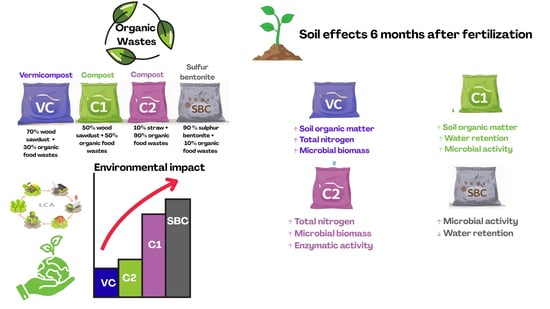
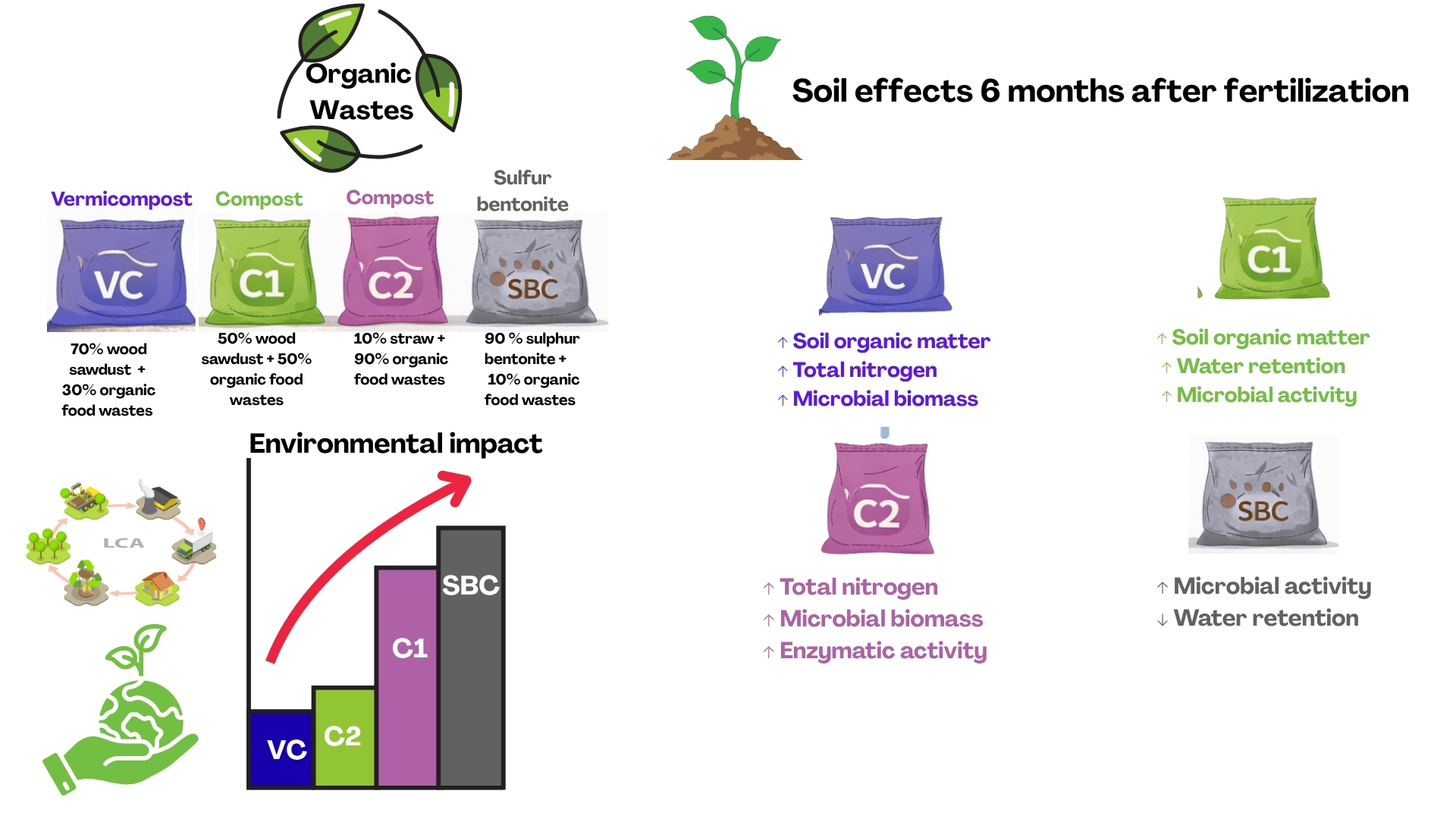
The growing global food demand has increased the use of chemical fertilizers, causing environmental issues. Previous studies have often assessed waste-derived fertilizers separately in terms of soil improvement or environmental impact, with limited integration of these aspects across different recycling processes. This study evaluated the effects on soil quality and the environmental impact of fertilizers produced with different percentages of food wastes and different recycling processes. The fertilizers investigated include vermicompost (VC, 70% wood sawdust + 30% food wastes), Compost 1 (C1, 50% wood sawdust + 50% food wastes), Compost 2 (C2, 10% straw + 90% food wastes), and sulfur–bentonite (SBC, 90% SB + 10% food wastes). Six months post-fertilization, vermicompost significantly improved soil properties, increasing soil organic matter from 3.01% to 4.70% (+56%) and total nitrogen from 0.15% to 0.22%, along with an increase in microbial biomass compared to the unfertilized control. Compost treatments also improved soil quality, although to a lesser extent. A Life Cycle Assessment (LCA) was performed across the entire life cycle of the fertilizers. Vermicompost showed the lowest environmental impact, with a global warming potential of 45 kg CO2 eq ton−1, compared to 93 and 100 kg CO2 eq ton−1 for C1 and C2, respectively, and 167 kg CO2 eq ton−1 for SBC. The results evidenced that vermicompost improved soil quality by increasing soil organic matter, total nitrogen, microbial biomass, and biological activity and that it emitted less CO2 eq, SO2 eq and PO43− during the vermicomposting process, emphasizing its environmental sustainability. The two composts improved soil quality with a moderate environmental impact. SBC positively affected soil properties but with a strong negative environmental impact. From the benefit–cost perspective, the sustainable fertilizer ranking was VC > C2 > C1 > SBC. These findings underscore that these waste management processes represent a possible transition to sustainable fertilizers derived from waste materials to mitigate the environmental degradation associated with the production and use of conventional fertilizers. By adopting these practices, the agricultural sector can boost productivity while maintaining environmental sustainability standards.

Graphical Abstract

1. Introduction

The rising global food demand has led to intensified agricultural practices and a significant increase in the use of chemical fertilizers. Approximately 13 million tonnes of these fertilizers were utilized within the European Union (EU) in 2019, according to Eurostat [1]. The manufacture and application of these fertilizers caused approximately 2.5% (1203 Tg CO2 equivalent) of global greenhouse gas (GHG) emissions. Inorganic nitrogen fertilizers contributed to 50% of agricultural output, constituting 33% of the global generation of reactive nitrogen species, amounting totally to 170 Tg N annually [2]. The demand for essential nutrients, including nitrogen, phosphorus, and potassium (NPK), is anticipated to rise to fulfil increasing agricultural needs [3]. The synthesis of phosphorus and potassium fertilizers is contingent upon the exploitation of non-renewable resources, which are not only dwindling but also geographically concentrated in a limited number of countries. The production and systematic use of mineral fertilizers can not only contribute significantly to greenhouse gas emissions, but can also cause soil degradation, water eutrophication, and biodiversity restriction [4]. Currently, over 2 billion people are suffering from nutritional deficiencies due to significantly reduced nutrient levels, which heighten the risk of various diseases, including cancer, diabetes, and heart disease. This alarming statistic underscores the urgent need to develop and implement innovative agronomic management strategies that enhance nutrient availability and improve overall public health [5]. The paradigm of the circular economy has been proposed as an innovative framework to produce goods. It entails the reconfiguration of production processes to facilitate the subsequent recovery and reutilization of waste materials, thereby obviating the need for fresh resources. Recent research has highlighted the potential for creating organic fertilizers from organic waste sources, including the organic portion of municipal waste [6] and municipal solid waste compost (MSWC) [7]. Maffia et al. [8] and Russo et al. [9] demonstrated that a fertilizer made from waste materials—specifically, sulfur–bentonite and orange residue—significantly contributed to the preservation of soil ecosystems and biodiversity, both of which are vital for a green economy. Furthermore, this fertilizer enhanced the productivity and quality of tomatoes. These findings highlighted that utilizing waste materials to produce sustainable fertilizers can be a promising strategy for alleviating the negative impacts often linked to synthetic fertilizers. These results are perfectly in line with the European Green Deal aim to achieve a fair, healthy, and environmentally friendly food system in the European Union [10]. Muscolo et al. [11] highlighted the potential of various biomass sources for compost production, emphasizing the critical role of raw material chemical composition and the parameters of the composting process in determining compost stability and quality.
Muscolo et al. [12] explored the recycling of food and hydrocarbon refining wastes as a means to reduce landfill reliance, lower greenhouse gas emissions, and produce organic–mineral fertilizers for sustainable agriculture. Their research uncovered a diverse range of fertilizer properties and effectiveness, some of which had overlapping characteristics while others functioned distinctly. This work aligns with the EU’s goals to reduce landfill waste, emphasizing the potential to convert waste into valuable resources for agriculture and mitigate environmental impact. It also supports several Sustainable Development Goals (SDGs), particularly Goal 2 (End hunger, achieve food security and improved nutrition, and promote sustainable agriculture), Goal 13 (Combat climate change and its impacts), and Goal 15 (Protect, restore, and promote sustainable use of terrestrial ecosystems, sustainably manage forests, combat desertification, and halt and reverse land degradation and biodiversity loss). Exploring biomass-derived fertilizers can offer an exciting opportunity to reduce dependence on synthetic inputs while enhancing soil fertility and agricultural productivity. This approach also aligns with circular economy principles, promoting sustainable practices within the agricultural sector [13]. Sustainable fertilizers, derived from natural or recycled sources, provide essential nutrients vital for plant growth while exemplifying circular economy principles. They facilitate the valorization of waste streams and significantly reduce reliance on finite resources, thereby contributing to a more sustainable agricultural framework [14]. The utilization of such fertilizers can markedly improve soil health, as evidenced by an increase in organic matter content, microbial diversity, and structural integrity. This enhancement fosters an agroecosystem that exhibits greater resilience to environmental stressors and diminishes reliance on chemical inputs [15]. Fertilizers, pivotal for enhancing crop yield and soil fertility, can be produced from a myriad of sources and production processes, each with a distinct environmental footprint. Despite the extensive body of literature on waste-derived fertilizers and their environmental assessment, most previous studies have addressed agronomic performance and environmental impacts separately, with limited integration of soil functionality and Life Cycle Assessment across different recycling processes.
In this context, the novelty of the present study lies in its integrated and comparative approach. Specifically, this research (i) directly compares fertilizers derived from different compositions of food waste and recycling processes (vermicomposting, composting, and a sulfur–bentonite formulation); (ii) simultaneously evaluates soil chemical and biological properties, including microbial biomass and enzymatic activities; and (iii) combines agronomic performance with a cradle-to-gate Life Cycle Assessment (LCA).
This approach enables a comprehensive evaluation of both soil quality improvement and environmental impact, allowing the identification of a sustainability ranking among fertilizers and providing a more holistic framework for selecting sustainable fertilization strategies within a circular economy perspective.
The objective of our study was to evaluate the environmental impacts of various fertilizers produced utilizing different percentages of food wastes and different recycling processes. We hypothesized that fertilizers with different chemical characteristics utilized in farming practice can exert different impacts on soil quality and environment. The specific aim was to identify the best food waste recycling process and the production of the most sustainable fertilizer capable of significantly improving soil quality, analyzing the environmental impact of the different fertilizers obtained throughout the entire supply chain. This was done by cross-referencing data from the chemical analysis of fertilizers produced with varying percentages of food wastes and other waste materials, testing their effectiveness on soil characteristics, and evaluating their environmental impact using a Life Cycle Assessment (LCA) approach.

2. Materials and Methods

2.1. Fertilizer Preparation Process, Experimental Conditions and Composting Process Optimization

The raw materials utilized in the composting and vermicomposting processes included a variety of organic humid wastes as vegetable scraps (rocket salad, lettuce, cabbage, carrot, valerian, fruit and food residues), all sourced from homes and restaurants; sawdust and straw served as structural components.
Vermicomposting was carried out in a specific worm bin, 50 L, purchased from Vevor 5-Tray Worm Composter (VEVOR, WB25101 model, Shanghai, China), as shown in Figure S1. The worm bin was filled with 30% moist organic wastes and 70% sawdust. The bedding was kept fluffy to allow for air circulation and maintained at a moisture level of 50% (w/w), ensuring a slightly damp but not dripping condition. Red wigglers (Eisenia fetida) were added to the bin: 1000 worms (or one pound) for every square foot of surface area of the bin. After 4 months, the vermicompost was mature.
The setup for the composting process involved incorporating sawdust with organic food wastes (vegetable and food scraps) or straw with organic food wastes (vegetable and food scraps) into specialized electric composters designed for efficient decomposition. These composters were equipped with separate chambers to prevent the mixing of fresh and decomposing waste, allowing for independent temperature control in each chamber to optimize microbial growth (Figure S2).
The experiment was conducted with three replicates for each type of compost mixture used under specific composting conditions: an initial mesophilic phase of 8 days at 29 °C, a thermophilic phase of 20 days at 50 °C, followed by a prolonged mesophilic phase of 92 days at 27 °C [16]. The compost then entered a stabilization phase at a constant 20 °C for 30 days to ensure the compost’s maturity, a phase characterized by a decrease in microbial activity and the depletion of decomposable organic matter (Table 1).
Moisture levels were maintained at 50%, with oxygen levels consistently above 15%. Temperature, moisture, and oxygen were monitored daily using a centrally placed multiparameter probe (LSI LASTEM S.r.l., Settala, Milan, Italy). Water was added as necessary to maintain the desired moisture content, and daily mixing was undertaken to ensure adequate oxygenation, facilitating the breakdown of organic material into stable humus. Following this, the compost was air-dried at room temperature (25 ± 2 °C) for 7 days, finely ground to a size that would pass through a 2 mm sieve, and thoroughly mixed to achieve a consistent composition. The compost produced with straw and food wastes reached maturity in six months, while the compost produced with 50% sawdust and 50% food wastes reached maturity in 8 months.
Sulfur pad fertilizer was produced using elemental sulfur (80%), a residue of hydrocarbon refining processes; bentonite clay (10%) as support and carrier; and organic humid wastes (10%) as vegetable scraps (rocket salad, lettuce, cabbage, carrot, valerian, fruit and food residues), all sourced from home and restaurants. The sulfur pads were produced with a diameter of 3–4 mm by SBS (Steel Belt System, s.r.l., Venegono, Italy) (Figure S3) [17].
The fertilizers obtained and used in this study were as follows:
VC: vermicompost, produced from 70% wood sawdust and 30% organic food wastes;
C1: Compost 1, produced from 50% wood sawdust + 50% organic food wastes;
C2: Compost 2, produced from 10% straw + 90% organic food wastes;
SBC: produced from 90% sulfur–bentonite with 10% organic food wastes.
Their chemical compositions and their efficacy as sustainable fertilizers, as measured by soil chemical and biochemical properties, as well as their environmental impact, were evaluated as reported in Muscolo et al. [17] and Panuccio et al. [18].

2.2. Soil Treatments

The experiment was conducted on sandy loam soil according to the FAO international soil classification system [19]. The experimental site was situated in Motta San Giovanni, Loc. Liso, Italy (37° 59′56.76″ N, 15°41′ 59.639″ E). The average temperature of the coldest months, January and February, stands at +11.9 °C; that of the hottest month, August, is +26.1 °C. The average annual precipitation is around 493 mm, with a minimum in summer and a peak in autumn–winter. The experimental layout followed a randomized complete block design (RCBD) with three replicates. Each block contained all five treatments (VC, C1, C2, SBC, and CTR), randomly assigned within the block to minimize spatial variability effects. Each experimental plot measured 3 m × 6 m (18 m2), consistent with the total area described. Plots were separated by 1 m buffer zones to avoid cross-contamination between treatments, while blocks were spaced 2 m apart to facilitate field operations. Within each block, treatments were randomly distributed using a randomization procedure to ensure unbiased allocation. The total experimental area consisted of 15 plots (5 treatments × 3 replicates), arranged in three parallel blocks aligned along the main slope direction to reduce variability due to drainage and soil heterogeneity. Fertilizers were applied at a depth of 10–15 cm. The application rates, reported in Table 2, were established based on the results obtained from our previous studies [17].
Soil without any fertilization served as the control group (CTR). Six months after the start of the experiment, the soils subjected to the different treatments were collected, air-dried and sieved (through a <2 mm mesh) for chemical analysis and enzyme activity determinations. For biochemical assessments, including microbial biomass, fungi, bacteria and actinomycetes, soil samples were refrigerated at 4 °C and processed within 24 h.

2.3. Soil Analyses

Six months following the application of the various treatments, soil samples were examined for their physical and biological characteristics. The soil was classified as sandy loam, comprising 11.85% clay, 23.21% silt, and 64.94% sand, following the FAO soil classification [19]. Additionally, pH and electrical conductivity (EC) [20], organic carbon (OC) content [21] and total nitrogen (TN) content [22] were assessed. The carbon content in humic and fulvic acids (C-HOM) was analyzed and calculated as described in Fernandes et al. [23]. Water-soluble phenols (WSPs) [24] and cation exchange capacity (CEC) [25] were also measured. The activity of fluorescein diacetate hydrolysis (FDA) was determined following the approach outlined by Adam and Duncan [26]. Microbial biomass carbon (MBC) was measured as described by Vance et al. [27]. The amount of MBC was determined using the chloroform fumigation extraction procedure [21]. The filtered soil extracts of both fumigated and unfumigated samples were analyzed for soluble organic C using the methods of Walkley and Black [21]. Microbial biomass C was estimated on the basis of the difference between the organic C extracted from the fumigated soil and that extracted from the unfumigated soil, and an extraction efficiency coefficient of 0.38 was used to convert soluble C into biomass [27]. Dehydrogenase (DH) activity was assessed according to the method developed by von Mersi and Schinner [28]. Anions (including NO3) and cations (including NH4+) were detected as reported in Muscolo et al. [11] by ion chromatography, using a chromatography system (DIONEX ICS-1100; Thermo Fisher Scientific, Waltham, MA, USA). The amount of NH4-N was calculated as follows: mass of element/molecular mass of compound.
Cations (Na+, K+, Ca2+ and Mg2+) were isolated from the samples and evaluated using ion chromatography equipment. To prepare the samples, 1 g of dried material was incinerated at 550 °C for 6 hours within a porcelain capsule. Subsequently, the resultant ash was acidified using a 1 M HCl solution (10 mL) for 30 minutes at 100 °C. The acidified ash was then filtered through Whatman No. 1 paper and analyzed using the ion chromatography system, employing 20 mM methane–sulfonic acid as the eluent. Iron (Fe) levels were assessed through atomic absorption spectrophotometry using a model 2380 device (PerkinElmer Co., Waltham, MA, USA). Calibration curves were established using four mixed standard solutions containing 1, 5, 25, and 50 ppm of each targeted anion to ensure accuracy, confirming the linear correlation between peak area and concentration through experimental validation. The concentration of each cation was determined based on its specific standard curve. All chemicals and reagents were sourced from Panreac Quìmica SLU, Barcelona, Spain.

2.4. Environmental Impacts Based on Life Cycle Assessment

The environmental impacts of fertilizers were analyzed using the Life Cycle Assessment (LCA) approach, in accordance with ISO 14040 [29] and ISO 14044 [30].
The guidelines followed were defined by ISO 14025, the Product Category Rules (PCRs). Currently, there are no specific PCRs for organic fertilizers obtained from organic matrices, such as those used in the present study, but, as suggested by Egas et al. [31], PCR 2010:20 [32] can be used because it is specific to fertilizer production.
According to ISO 14040 [29], an LCA study consists of four phases:
I.
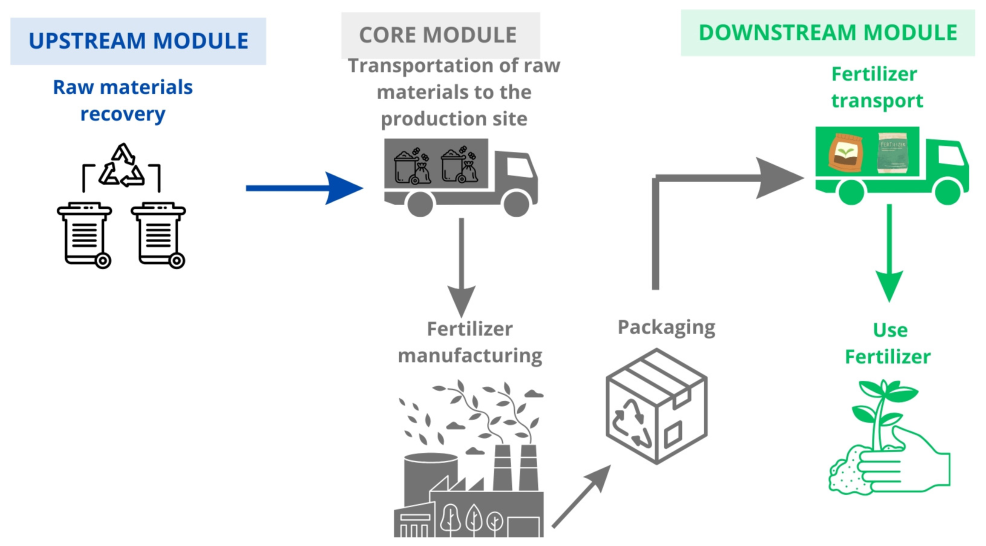
Goal and Scope Definition: The goal of the study was to assess the environmental impacts of different fertilizers using a cradle-to-gate approach. The system boundaries included three main modules: upstream, core, and downstream modules (Figure 1). The functional unit (F.U.) was set at 1 ton of fertilizer. The upstream module included the production of raw materials. The core module covered the transportation of materials to the production site, fertilizer manufacturing processes (such as dosing, homogenization, granulation, and drying), and associated emissions. The downstream module focused on the fertilizer use phase, including emissions to air and water resulting from nutrient release into the soil.
II.
Inventory Analysis (LCI): This phase involved collecting data on the inputs and outputs of the fertilizer production process, as shown in Table 3. The data collected refer to the chosen functional unit, which is one ton of fertilizer produced. For the core module, specific data collected in the field were used. Upstream module data are based on the Ecoinvent 3.9 database and supported by specific supply chain information. In the downstream module, data on the use phase were calculated according to PCR 2010:20 [32]. For the treatment of waste within the core module, the scenario was assumed based on the destination of the waste to the disposer to which the company delivers the waste, whether it is sent for recovery or disposal operations as provided by Legislative Decree 152/2006. During the composting process, many types of gaseous compounds, such as GHGs (i.e., CH4, N2O, and CO2) and NH3, are directly released into the atmosphere. As in similar studies, only emissions of CH4, NH3, and N2O were considered in the present study since they represent, together with CO2 and VOCs, 99% of total emissions [33,34]. As reported in Pergola et al. [35], the emission values used in the analysis were 0.24 kg of CH4, 0.14 kg of NH3, and 0.12 kg of N2O per ton of feedstock.
III.
Impact Assessment (LCIA): The SimaPro v. 9.01 software was used to determine the environmental impacts of the different fertilizers [36]. The impact assessment was performed following the problem-oriented LCA method CML 2001 developed by the Centre of Environmental Science of Leiden University [37]. Various impact categories were considered [38]:
-
Abiotic Depletion Potential for Elements: This measures the consumption of non-renewable resources and minerals, expressed in terms of antimony (Sb) equivalents per year, to reflect the use of elements critical to industrial processes.
-
Abiotic Depletion Potential for Fossil Fuels: This evaluates the depletion of fossil fuel resources, expressed in megajoules, rather than in antimony equivalents, to illustrate the consumption of energy resources that are not renewable.
-
Acidification Potential: This is a measure of the emission of substances like sulfur dioxide (SO2), nitrogen oxides (NOx), nitric oxide (NO), and nitrous oxide (N2O) that contribute to acid rain. It is commonly represented in sulfur dioxide equivalents.
-
Eutrophication Potential: This indicates the impact of excessive nutrient supply, often nitrogen and phosphorus, leading to over-fertilization in both land and water environments. Eutrophication is quantified in terms of phosphate (PO4) equivalents.
-
Global Warming Potential: This is a comparative index that measures the impact of different greenhouse gases on global warming over a 100-year period, expressed in carbon dioxide (CO2) equivalents. A higher GWP value signifies a greater negative impact on the climate.
-
Ozone Layer Depletion Potential: This is the potential for substances to deplete the ozone layer, quantified using CFC-11 equivalents, which indicate the impact of ozone-depleting emissions.
-
Photochemical Oxidation Potential: This describes the emission of compounds that lead to the formation of photochemical smog, such as those that contribute to high concentrations of nitrogen oxides (NOx). It is expressed in ethylene (C2H4) equivalents.
-
Freshwater Aquatic Ecotoxicity Potential: This reflects the amount of pollutants that can affect aquatic life in freshwater ecosystems, measured in 1,4-dichlorobenzene (DB) equivalents.
-
Human Toxicity Potential: This quantifies the potential harmful effects on human health due to exposure to toxic substances, using 1,4-dichlorobenzene equivalents to represent the risk levels.
-
Marine Aquatic Ecotoxicity Potential: This measures the impact of various pollutants, particularly chlorine compounds, on marine life, expressed in 1,4-dichlorobenzene equivalents.
-
Terrestrial Ecotoxicity Potential: This assesses the impact of hazardous substances, especially those containing chlorine, on terrestrial environments and human health, using 1,4-dichlorobenzene equivalents as a standard measurement.
IV.
Interpretation: The results from the impact assessment were evaluated to draw conclusions about the significance of each impact category. To evaluate the significance of each impact category within the larger environmental context, the characterization results were normalized using a “Normal” value designated for the “Europe 25” region.

2.5. Statistical Analysis

Data are expressed as the means of three analyses for each treatment and three analyses for different compost analyses. Significant difference tests were carried out to analyze the effects of fertilizers on each of the various parameters measured. Homogeneity of variance and normality were tested, respectively, with the Bartlett and Shapiro tests with a p value of 0.05. For all other variables, one-way ANOVA (p < 0.05) was performed followed by Tukey’s post hoc test to find significant differences between treatments (p < 0.05). ANOVA and t-tests were carried out using R studio 2026.01.1. To explore relationships between different fertilizers and soil parameters, datasets were analyzed using Principal Component Analysis (PCA) with XLStat 2025.1.

3. Results

3.1. Fertilizer Properties

The fertilizers demonstrated distinct characteristics: C1 and C2 had alkaline pH levels, while vermicompost and SBC presented sub-alkaline and neutral pH levels, respectively. None of the fertilizers displayed salinity. Compost 1 was notable for its high humified material, its NH4N/NO3 ratio, and the highest C/N ratio. Conversely, vermicompost was rich in organic matter and nitrogen, with a C/N ratio of 12 (Table 4).
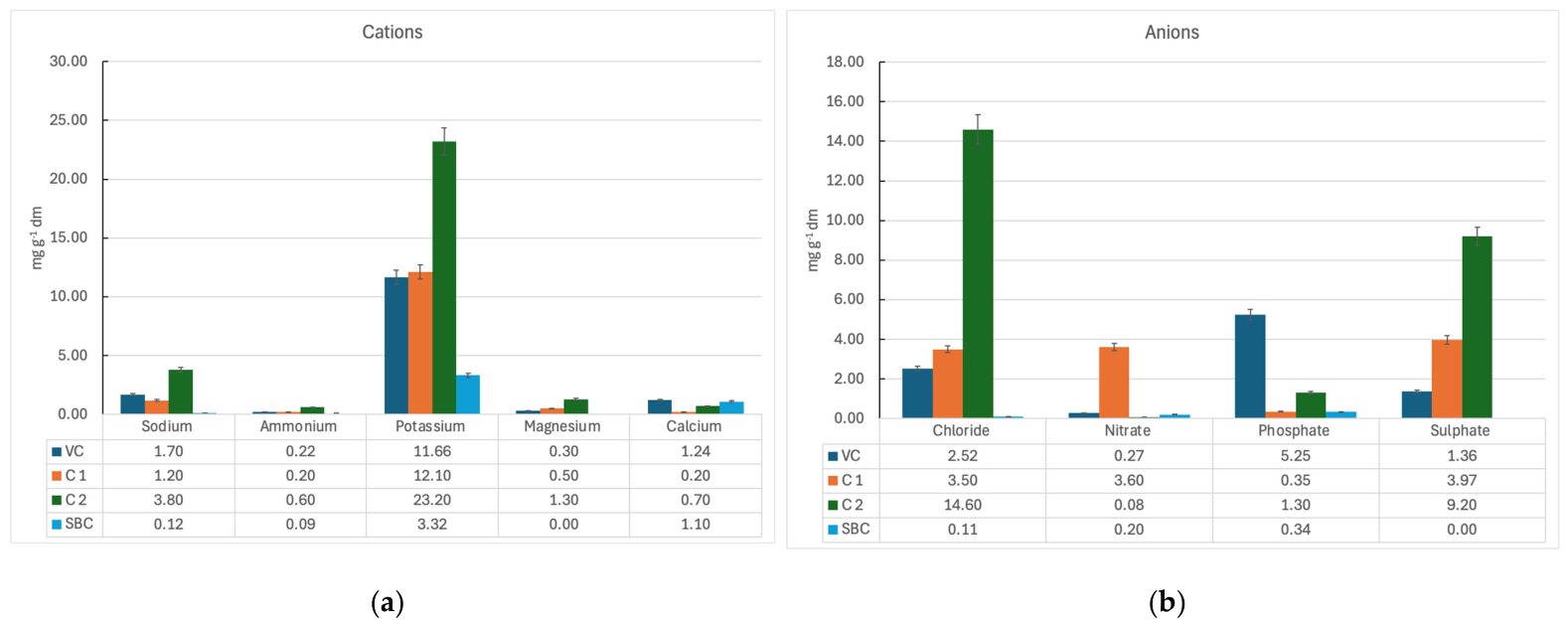
All the biomass analyzed contained significant macro- and microelements essential for plant nutrition, positioning them as excellent candidates for soil fertilization. Compared to the others, SBC had a lower concentration of cations. C2 was notable for its potassium content (23.2 mg g−1), surpassing that of C1 (12.1 mg g−1) and vermicompost (11.66 mg g−1) (Figure 2a). Vermicompost was particularly rich in calcium. Both C1 and C2 had higher levels of sulfate compared to vermicompost and SBC. On the other hand, vermicompost was rich in nitrate and chloride (Figure 2b).
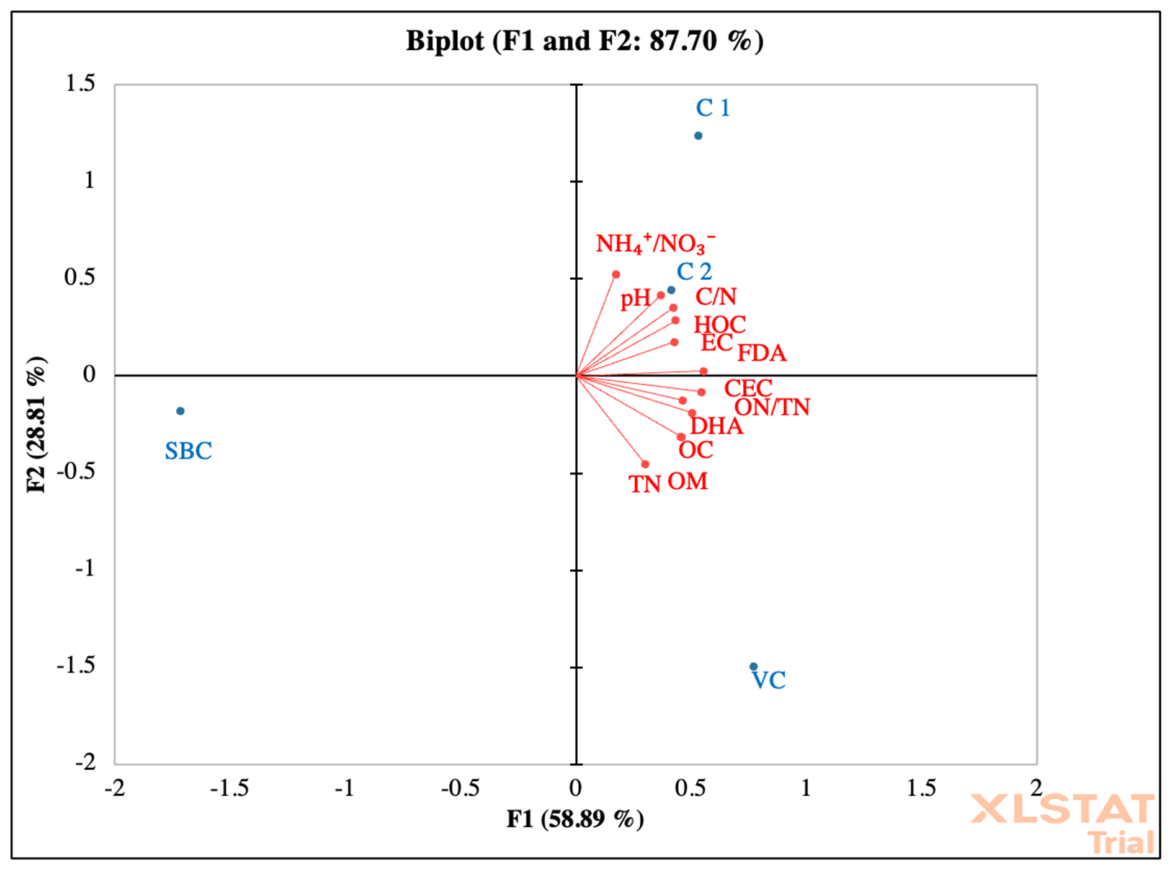
PCA analysis of the chemical characteristics of the fertilizers evidenced a correlation between C1 and C2 with respect to humified organic matter, C/N ratio, pH and NH4-N/NO3. No correlation between soil chemical properties and SBC was highlighted; conversely, VC was correlated with OM, TN, ON/TN and EC (Figure 3). Cations and anions detected in the fertilizers appeared to be more influenced by the C2 composting process and the percentage of the raw material used. Nitrate levels were influenced by C1 and SBC, while phosphate calcium, ammonium and sodium were not correlated with any kind of fertilizer (Figure 3).
A Pearson coefficient correlation matrix evidenced that in the presence of the fertilizers, the variables that were positively correlated in soils were pH, C/N, HOM, NH4N/NO3 and to a minor extent EC. OC correlated with TN and ON/TN. ON/TN positively correlated with OM and C/N (Table 5).

3.2. Soil Properties

The results indicated that all fertilizers used—composed of both composts, vermicompost, and SBC—significantly influenced the soil’s chemical properties compared to the unamended control soil. Notably, the soil texture remained unchanged. pH decreased significantly with the addition of C1 (−5.88%), vermicompost (−8.24%) and much more with SBC (−9.41%), and it did not change with the C2 treatment. EC increased with all treatments, particularly with the addition of SBC (+81.69%). Water retention increased with respect to the control with vermicompost (32.71%), C1 (14.49%) and C2 (12.62%); conversely, it decreased with SBC (8.88%). SOM increased significantly with C1 (14.62%) and C2 (31.89%); the greatest increase occurred when VC was used (56.15%). No differences from the control were observed in the presence of SBC. Total nitrogen was highest with vermicompost and C2 and lowest with SBC. Minimum differences were observed in C/N among the treatments, and between the treatments and the control, the results evidenced a mineralization process in all the situations (Table 6). Regarding water-soluble phenols, the treatments were ranked as follows: VC > C1 > C2 > SBC > CTR (Table 6).
Cations increased in the treated soils with respect to the control, and the greatest enhancement for sodium was observed in the presence of SBC (63.4%), followed by VC (29.03%). Potassium, magnesium and calcium increased in all amended soils, but much more in soil treated with C2 (19.01%) and SBC (16.3%). Chloride and sulfate showed a similar trend. Conversely, NO3 and PO43− were below the detection limit in soil amended with VC and C1 (Table 7). CEC was highest in VC and C1. MBC was highest in the C2-treated soil, followed by SBC, VC and C1. The same trend was observed for FDA. DHA showed instead the greatest activity in SBC-treated soil, followed by C2, CTR, VC and C1. Bacteria colonies were highest in C1, C2 and VC, and the same trend was observed for actinomycetes, while fungi were more abundant in C1- and C2-treated soils (Table 8).

3.3. Environmental Impacts

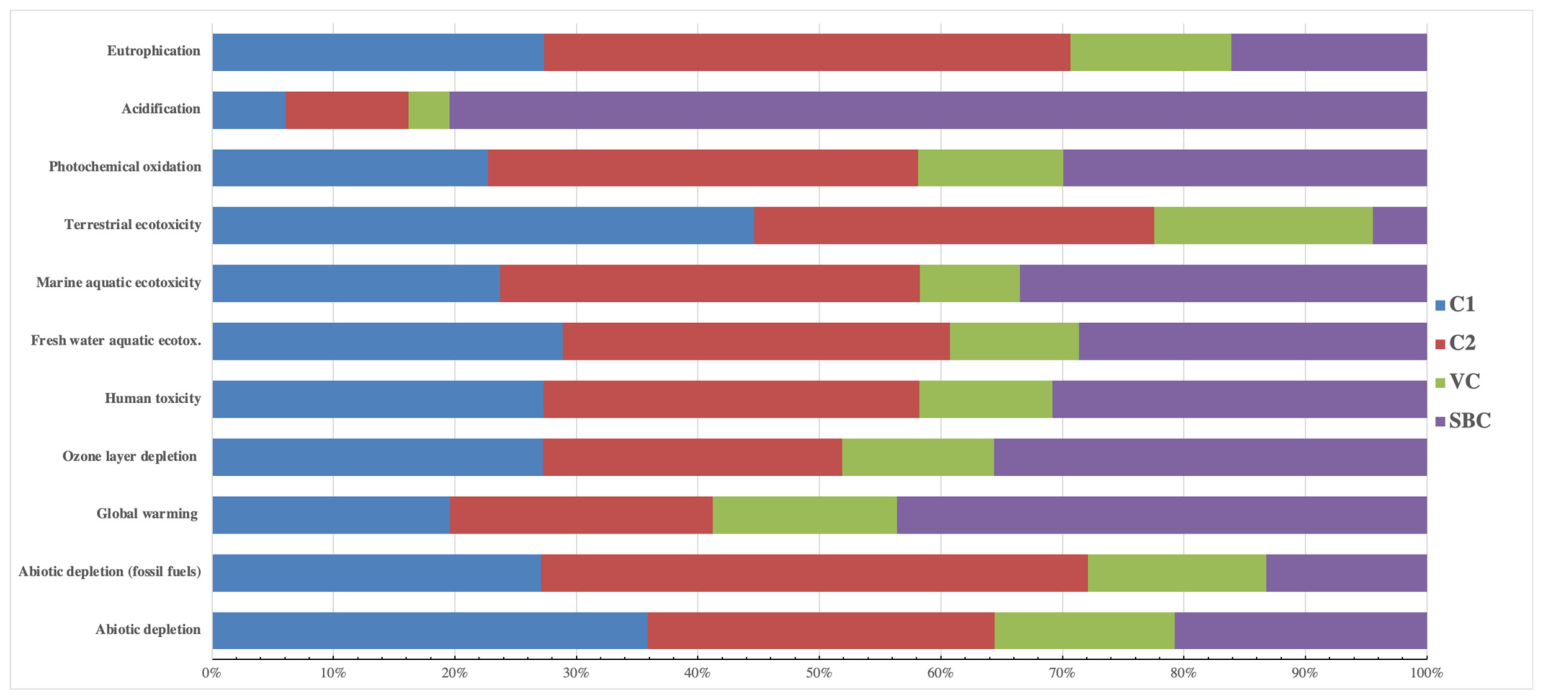
The results of the environmental analyses, given as functional units (1 Ton of fertilizer), are reported in Table 9, and the distribution percentages of different fertilizers for individual impact categories are reported in Figure 4 C2 fertilizer had a great impact on abiotic depletion (fossil fuels), human toxicity, freshwater aquatic ecotoxicity, marine aquatic ecotoxicity and eutrophication. Conversely, C1 fertilizer had a high impact on terrestrial ecotoxicity category. SBC fertilizer greatly impacted global warming (GWP100a) and acidification. VC had a minor impact on all categories, appearing as the most sustainable one.

3.3.1. Global Warming Potential

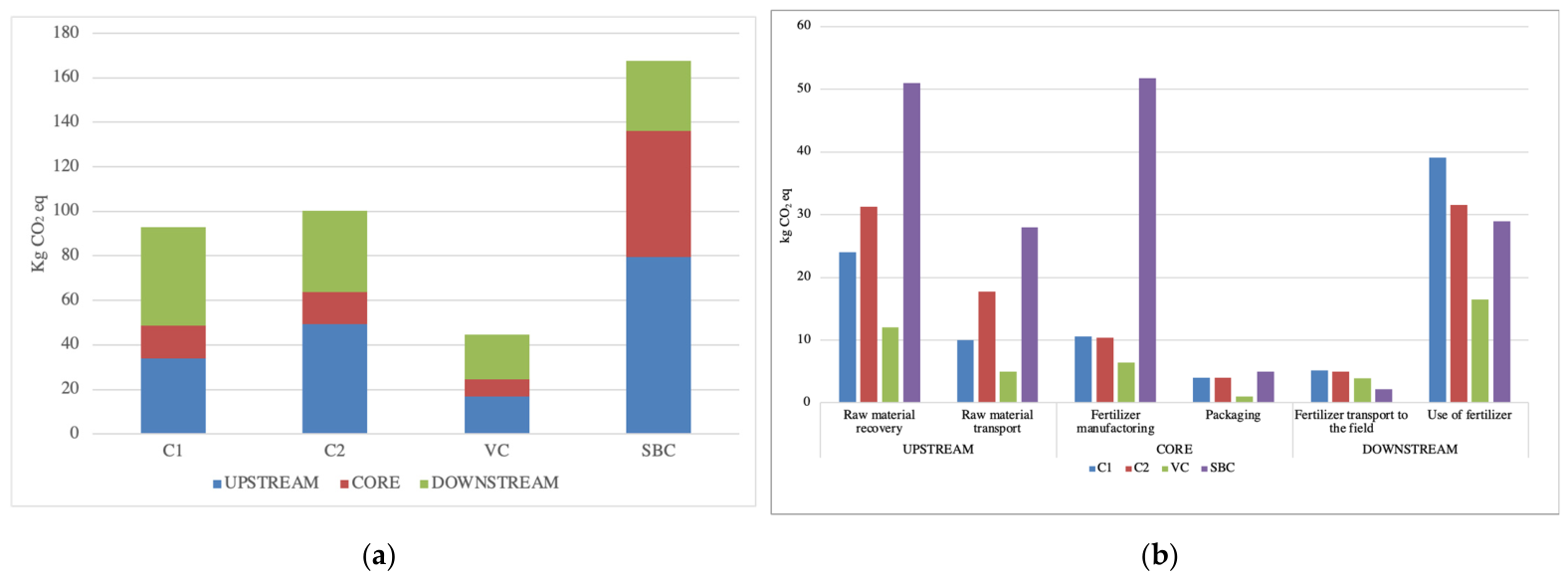
The results showed that the most impactful fertilizer in terms of kg CO2 eq emitted per ton of fertilizer was SBC, emitting 167 kg CO2 eq ton−1. The most sustainable fertilizer was VC, with an impact of 45 kg CO2 eq ton−1 (Figure 5a). Breaking down the impacts for the global warming category related to the entire fertilizer production cycle (Figure 5b), it was found that for the upstream module, the most impactful phase is raw material recovery compared to raw material transportation. In both stages of the core module, SBC fertilizer emitted more CO2 eq than the other fertilizers. In the core module, the most impactful phase is the manufacturing of fertilizers, and SBC was confirmed to be the greatest emitter of CO2, while VC appeared to be the most sustainable fertilizer.
Regarding the downstream module, the fertilizer with the highest CO2 emissions was C1, while the one with the lowest CO2 emissions was VC.

3.3.2. Acidification Potential

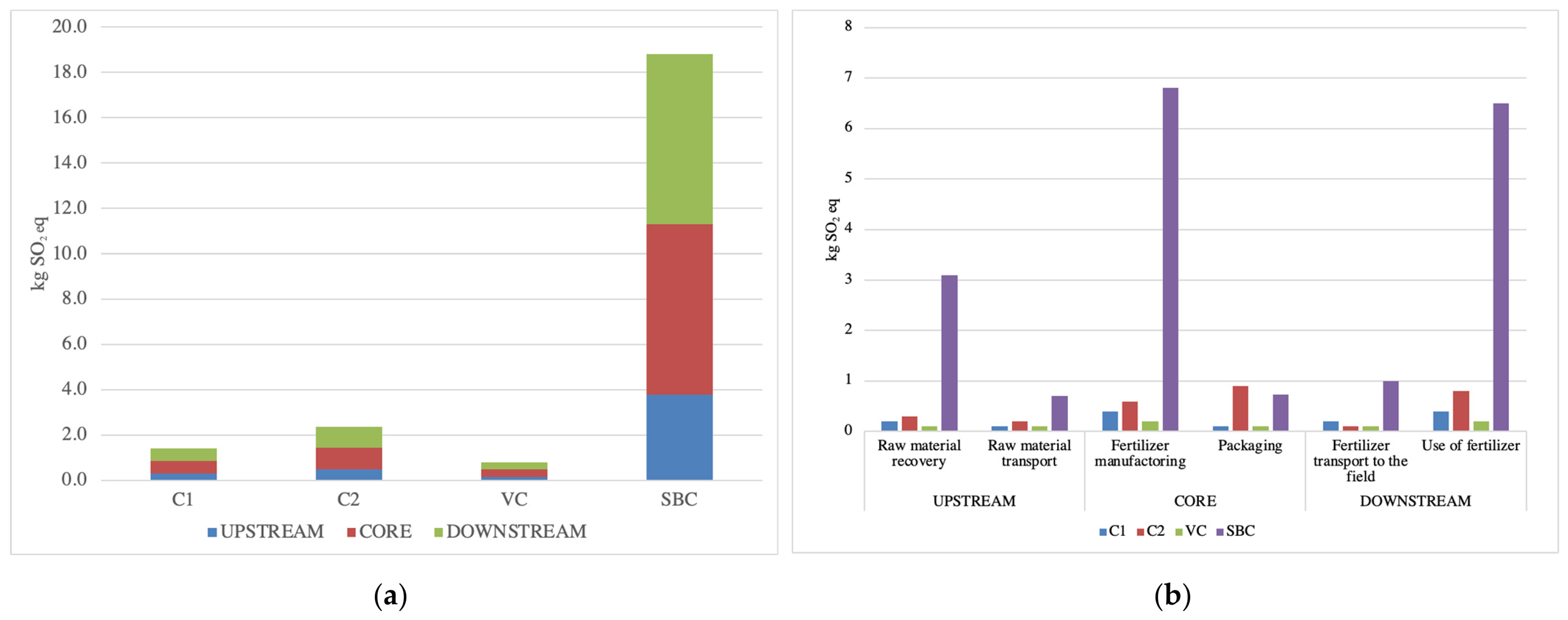
The results show that the most impactful fertilizer in terms of kg of SO2 eq per ton of fertilizers is SBC, emitting 18.8 kg SO2 eq ton−1. The most suitable fertilizer was VC, with an impact of 0.8 kg SO2 eq ton−1 (Figure 6a). Breaking down the impacts of the acidification category related to the entire fertilizer production cycle (Figure 6b), it was found that for the upstream module, the most impactful phase is raw material recovery, and the SBS fertilizer emitted more SO2 than the other fertilizers. In the core module, the most impactful fertilizer is SBC, and VC is the most suitable. Regarding the downstream module, the fertilizer with the highest SO2 emissions was SBC, while the one with the lowest SO2 emissions was VC.

3.3.3. Eutrophication Potential

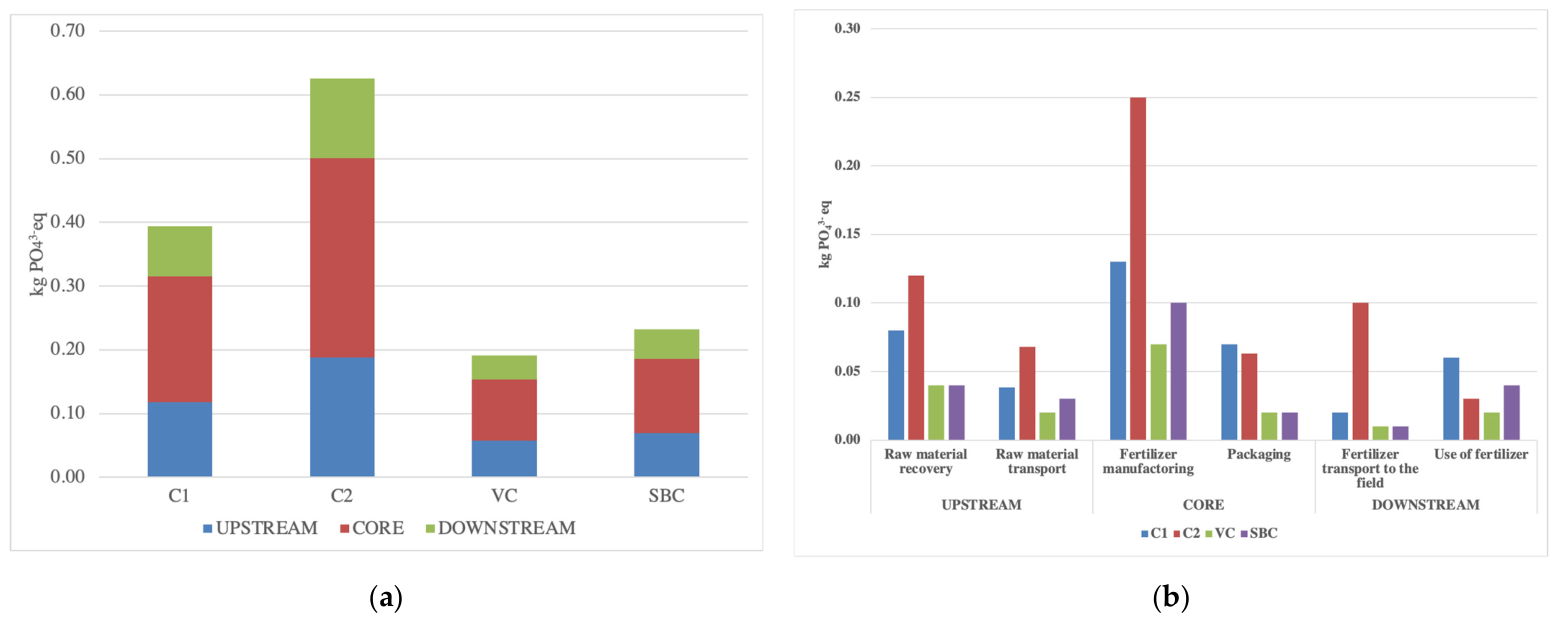
The results show that the most impactful fertilizer in terms of PO43− eq per ton of fertilizers is C2, emitting 0.62 kg of PO4 3− eq ton−1. The most suitable fertilizer was VC, with an impact of 0.2 of PO4 3− eq ton−1 (Figure 7a). Breaking down the impacts of the eutrophication category related to the entire fertilizer production cycle (Figure 7b), it was found that for the upstream module, the most impactful phase is raw material recovery, and C2 fertilizer emitted more PO4 3− eq ton−1 than the other fertilizers. In the core module, the most impactful fertilizer is C2, and VC is the most suitable. Regarding the downstream module, the fertilizer with the highest PO4 3− eq emissions was C2, while the one with the lowest emissions was VC.

4. Discussion

4.1. Effect of Fertilization on Soil

The findings of this study demonstrated that various processes and types of wastes can be effectively utilized to produce soil amendments and fertilizers, contributing to the restoration of soil fertility [39]. This aligns seamlessly with the European Union (EU) member states’ waste prioritization action plan, which is based on the principle that conserving natural resources is intrinsically linked to the efficient recovery and use of wastes as secondary raw materials [40]. All the fertilizers produced and tested in this study demonstrated a high capacity to improve soil chemical and biological properties with respect to the basic soil fertility of unamended soil, as previously demonstrated by other authors [41].
Data showed that the regular application of composts and vermicompost significantly boosted soil organic carbon levels, enhancing soil structure and increasing exchange capacity, mineral content, and biodiversity compared to untreated soils. These findings align with those of Farooqi et al. [42].
When added to the soil, composts and vermicompost, rich in multivalent ions like potassium, calcium, magnesium, and sulfates, not only provided a short-term nutrient boost but also promoted long-term benefits [43]. This addition facilitated the bridging effect between soil organic matter (SOM) and clay minerals, improving soil aggregation and positively impacting critical properties such as workability, aeration, and drainage.
Furthermore, composts and vermicompost increased MBC, as well as populations of bacteria, fungi, and actinomycete colonies. They also enhanced enzyme markers associated with oxidative and hydrolytic metabolic pathways, demonstrating a notable increase in soil biodiversity and overall ecosystem function compared to the control. Among the compost samples, C2 exhibited superior fertilizing power compared to C1. This suggests that the effectiveness of compost is more closely tied to the percentage of food waste it contains than to the composting process itself. Food waste is abundant in organic matter and minerals, which, when released into the soil, serve as vital nutrients for soil microbial biomass, enhancing their numbers and activity.
The addition of C2 resulted in a noticeable increase in bacterial and actinomycete colonies, correlating with elevated levels of FDA and DHA, which indicate increased metabolic activity in the soil. In contrast, while SBC had a minimal impact on overall soil carbon levels, it significantly enhanced the labile fraction of organic matter, positively influencing MBC and DHA and promoting actinomycete colonies. The beneficial effects of SBC on soil can be attributed to its sulfur content, which plays a crucial role in microbial processes [44]. The addition of sulfur positively affected the colonies of actinomycetes, which are involved in biogeochemical cycles that increase nutrient mobility. Actinomycetes act as a natural defense against a broad spectrum of plant pathogens and increase decomposition, improving soil nutrients but also markedly boosting soil’s microbial biomass. The comprehensive advantages of actinomycetes, ranging from pathogen suppression and organic matter breakdown to nutrient improvement and increased nitrogen availability, highlighted their vital role in promoting sustainable agriculture. These data evidenced that SBC, although it did not directly increase organic matter, significantly increased microbial biomass and actinomycete colonies. Traditionally, it was thought that plant detritus was the main source of organic carbon. However, recent studies have indicated that microbes might play a significant role in contributing to organic carbon [45,46]. According to Liang et al. [47], microbial necrotic mass may account for as much as 50–80% of soil organic carbon (SOC); thus, SBC, by promoting the growth and activity of these beneficial microbes, can indirectly enhance soil fertility and structure, leading to improved plant growth and resilience. Principal Component Analysis indicated a positive relationship between SBC- or C2-amended soils and MBC, DHA, and EC. C1 and VC differently affected soils, correlating with fungi and actinomycetes, respectively. These results show how the chemical characteristics of a fertilizer are able to guide complex interactions in soil, mainly affecting the properties closely linked to microbial dynamics and activities. The observations are consistent with the study by Arunrat et al. [48], which showed that regular use of fertilizers and specific tillage practices over a five-year period significantly increased the diversity and richness of soil microbial communities.

4.2. Effect of Life Cycle Assessment of Fertilizers on Environmental Impact

According to El Chami et al. [49], the evaluation of environmental impacts highlights the essential role of Life Cycle Assessment (LCA) in improving the transparency and comprehensiveness of circular economy practices within the fertilizer industry. By systematically analyzing the entire life cycle of fertilizers, LCA enables stakeholders to identify opportunities for sustainability, reduce resource consumption, and minimize waste, ultimately fostering more responsible and efficient practices in the industry.
To effectively compare the various fertilizers and pinpoint the most impactful areas requiring sustainability improvements, specific emphasis was placed on assessing potential global warming (GWP 100a), potential acidification (kg of SO2) and potential eutrophication (kg PO4 3− eq). By conducting a detailed analysis of each fertilizer’s most impactful production processes, the results indicated that vermicompost (VC) emerged as the best fertilizer. The unique advantage of VC lies in its very low emission production compared to other fertilizers, primarily because vermicomposting does not require electricity, unlike other composting methods. The global warming potential (GWP 100a) associated with VC application is lower than that of other fertilizers. This is also attributed to the lower amounts of VC needed for soil application (1.76 Ton ha−1), making it not only more sustainable but also highly effective in enhancing soil chemical and biological properties. When comparing two types of compost, C1 and C2, it was found that C2 is associated with higher CO2 equivalent emissions. This is due to C2’s greater impact during the raw material recovery stage, as it contains more food waste than C1. Despite this, both C1 and C2 composts were found to be less impactful than other composts derived from organic matrices, which have impacts ranging from 130 to 448 kg CO2 eq Ton−1, according to various studies [50,51].
In contrast, the SBC fertilizer was identified as the most impactful in terms of global warming potential (GWP 100a) in this study. The higher CO2 emissions are primarily due to the production process steps in the upstream and core modules, particularly the extraction of sulfur as a raw material and the energy-intensive operations of large-capacity industrial plants. Additionally, SBC fertilizer has a significant impact on acidification, expressed as kg SO2 eq, further highlighting the influence of sulfur throughout its production cycle. However, despite being the most impactful among the fertilizers analyzed, SBC fertilizer had a significantly lower impact than other sulfur-based fertilizers due to its added organic component (food waste). For instance, Liu et al. [52] reported that sulfur-based fertilizers have life cycle GHG emissions of 2380 kg CO2 eq per Ton compared to 167 kg CO2 eq per Ton for SBC fertilizer.
However, the CO2 eq emissions of the fertilizers studied showed lower impacts than synthetic fertilizers (NPK), where GWP potential values ranged from 1816 kg CO2 eq to a maximum of 2107.99 kg CO2 eq [49]. In summary, by integrating the assessment of the effects of different fertilizers on soil quality and environmental impact, our study identified the most efficient fertilizers and the critical stages contributing to environmental burdens throughout the product life cycle. However, this comparison also highlights the existence of trade-offs between soil quality improvement and environmental impacts. For instance, C2 showed strong positive effects on soil properties, including microbial biomass carbon (915.56 μg C g−1) and enzymatic activities (FDA: 6.22 μg fluorescein g−1; DHA: 29.52 μg TTF g−1 h−1), but it also exhibited higher impacts in several environmental categories such as eutrophication (0.6 kg PO43− eq) and ecotoxicity. Conversely, vermicompost (VC) combined good agronomic performance with the lowest environmental burden, representing the most balanced solution. These results indicate that the selection of sustainable fertilizers should consider both soil functionality and environmental load, rather than relying on a single evaluation criterion. The analysis of acidification expressed in kg SO2 eq shows considerable differences between the fertilizers examined, highlighting the environmental impacts of each option. In particular, the SBC fertilizer emerges as the most impactful in this category, with a value of 18.8 kg SO2 eq. This high level is mainly attributable to the fertilizer production stages, especially in the upstream and core modules, where the extraction of sulfur as a raw material plays a decisive role. In addition, the energy-intensive industrial processes associated with the large-scale production of SBC further contribute to the increased impact on acidification. These results are consistent with the existing literature, where it is observed that sulfur fertilizers tend to have significantly greater impacts on acidification than other fertilizer types [53,54]. On the other hand, VC (vermicompost), C1 and C2 fertilizers show significantly lower impacts on acidification, with values of 0.8, 1.4, and 2.4 kg SO2 eq. respectively. Vermicompost stands out for its extremely low impact, which can be attributed to the vermicomposting process, which does not require electricity and uses raw materials with a low sulfur content. Composts C1 and C2 also show a lower impact than SBC, although C2 has a higher impact than C1 due to its higher food waste content, which requires more intensive raw material recovery processes.
Eutrophication, expressed in kg PO43− eq, is another crucial impact category to consider in the environmental assessment of fertilizers. The results of the analysis show that fertilizer C2 has the highest impact in this category, with a value of 0.6 kg PO43− eq. This higher impact is mainly due to the high content of food waste used in C2, which requires a higher use of resources and leads to a higher release of nutrients during the life cycle of the fertilizer, thus increasing the potential for eutrophication of water bodies [55]. With a value of 0.2 kg PO43− eq, VC demonstrates high sustainability, supported by the fact that smaller quantities are required for soil application, thus reducing the potential for excess nutrient release into the environment. This further emphasizes the effectiveness of VC as an environmentally friendly fertilizer that is particularly suitable for reducing environmental impacts associated with eutrophication.

5. Conclusions

The use of biomass wastes as raw materials for fertilizer production can represent a cost-effective solution, given the continuous availability of these resources. The management and conversion of these biomass wastes into fertilizers not only demonstrated substantial benefits for soil and environmental health but also significantly reduced the carbon footprint associated with traditional fertilizer production. These findings underscored the potential for sustainable fertilizers to compete with chemical fertilizers in agriculture, improving soil quality while mitigating environmental impacts.
In terms of cost-effectiveness, the adoption of organic fertilizers derived from biomass waste, such as VC, C1, and C2, can provide significant economic advantages. These fertilizers, often produced at lower costs compared to synthetic alternatives, leverage locally available resources, reducing dependence on expensive and imported chemical fertilizers. In addition, their long-term benefits to soil health, including enhanced fertility and improved structure, contribute to better crop yields and reduced need for chemical inputs. This makes biomass-based fertilizers not only an environmentally sustainable choice but also a financially viable one for farmers, particularly in regions where conventional fertilizers are less accessible or costlier.
This transition to organic fertilizers could be essential to addressing the growing global food demand without exacerbating environmental degradation. It offers a strategic avenue for both farmers and fertilizer manufacturers to enhance ecological competitiveness and product sustainability. Additionally, the local production and use of these fertilizers can help reduce transportation costs and the carbon footprint associated with fertilizer distribution. Consequently, this research advocates prioritizing the use of vermicompost (VC) due to its lower environmental impact and positive effects on soil properties, while recognizing that other fertilizers, such as C1, C2, and SBC, also offer valuable advantages in comparison to chemical fertilizers.
In conclusion, this research highlights the dual contribution to SDG 2 and SDG 13, with sustainable fertilizer practices improving agricultural productivity, ensuring food security, and fostering climate action. The widespread adoption of waste-derived fertilizers, particularly vermicompost, presents a promising pathway for agriculture to meet the challenges of global food demand while ensuring environmental sustainability. The results show that the transition to sustainable fertilizers, powered by local waste sources, can provide an economically feasible and ecologically responsible solution for farmers worldwide.
By using waste products available on farms or in nearby areas, the agricultural sector can successfully transition to sustainable fertilizers, boosting productivity while safeguarding environmental health.
Future research should focus on long-term field trials to assess the persistence of soil improvements and crop productivity under different pedoclimatic conditions. Further studies are also needed to optimize the composition of waste-derived fertilizers and to evaluate their scalability within circular economy frameworks. Additionally, integrating Life Cycle Assessment with long-term agronomic performance will be crucial to support the transition toward sustainable fertilization strategies.

Supplementary Materials

The following supporting information can be downloaded at https://www.mdpi.com/article/10.3390/environments13040226/s1: Figure S1. Experimental vermicomposting unit used for the treatment of organic waste, showing the closed structure and leachate collection system (a) and obtainment of vermicompost (VC). Internal view of the composting material with visible earthworm activity, indicating the biological processing phase of the composting system (b); Figure S2. Experimental composting unit employed for the production of Compost 1 (C1) and Compost 2 (C2), consisting of a closed, mechanically operated reactor designed to ensure controlled aeration, mixing, and stabilization of organic substrates under monitored conditions; Figure S3. Industrial unit for the production of sulfur–bentonite fertilizer (SBO), illustrating the granulation process in which molten sulfur is mixed with bentonite and solidified into granules through cooling and shaping mechanisms.

Author Contributions

Conceptualization, A.M. (Adele Muscolo) and A.M. (Angela Maffia); methodology, A.M. (Adele Muscolo) and A.M. (Angela Maffia); software, F.A.M., S.B., C.M., and E.A.; validation, A.M. (Adele Muscolo) and A.M. (Angela Maffia); formal analysis, F.A.M.; investigation, F.A.M.; resources, S.B. and C.M.; data curation, F.A.M., S.B., C.M.; writing—original draft preparation A.M. (Angela Maffia); writing—review and editing, F.A.M., S.B., C.M., and E.A.; visualization, A.M. (Angela Maffia); supervision, A.M. (Adele Muscolo); project administration, A.M. (Adele Muscolo); funding acquisition, A.M. (Adele Muscolo). All authors have read and agreed to the published version of the manuscript.

Funding

This research was funded by the Agritech National Research Center and received funding from the European Union Next-Generation EU (PIANO NAZIONALE DI RIPRESA E RESILIENZA (PNRR)—MISSIONE 4 COMPONENTE 2, INVESTIMENTO 1.4—D.D. 1032 17 June 2022, CN00000022).

Data Availability Statement

The original contributions presented in this study are included in the article. Further inquiries can be directed to the corresponding author.

Conflicts of Interest

The authors declare no conflicts of interest.

References

  1. European Commission; Statistical Office of the European Union. Agriculture, Forestry and Fishery Statistics, 2020th ed.; Publications Office of the European Union: Luxembourg, 2020. [Google Scholar]
  2. Chehade, G.; Dincer, I. Progress in Green Ammonia Production as Potential Carbon-Free Fuel. Fuel 2021, 299, 120845. [Google Scholar] [CrossRef]
  3. Sinha, D.; Tandon, P.K. An Overview of Nitrogen, Phosphorus and Potassium: Key Players of Nutrition Process in Plants. In Sustainable Solutions for Elemental Deficiency and Excess in Crop Plants; Mishra, K., Tandon, P.K., Srivastava, S., Eds.; Springer: Singapore, 2020; pp. 85–117. [Google Scholar]
  4. Martínez-Dalmau, J.; Berbel, J.; Ordóñez-Fernández, R. Nitrogen Fertilization. A Review of the Risks Associated with the Inefficiency of Its Use and Policy Responses. Sustainability 2021, 13, 5625. [Google Scholar] [CrossRef]
  5. Kiani, A.K.; Dhuli, K.; Donato, K.; Aquilanti, B.; Velluti, V.; Matera, G.; Iaconelli, A.; Connelly, S.T.; Bellinato, F.; Gisondi, P.; et al. Main Nutritional Deficiencies. J. Prev. Med. Hyg. 2022, 63, E93–E101. [Google Scholar] [CrossRef] [PubMed]
  6. Campuzano, R.; González-Martínez, S. Characteristics of the Organic Fraction of Municipal Solid Waste and Methane Production: A Review. Waste Manag. 2016, 54, 3–12. [Google Scholar] [CrossRef] [PubMed]
  7. Fernández-Delgado, M.; Amo-Mateos, E.D.; Lucas, S.; García-Cubero, M.T.; Coca, M. Recovery of Organic Carbon from Municipal Mixed Waste Compost for the Production of Fertilizers. J. Clean. Prod. 2020, 265, 121805. [Google Scholar] [CrossRef]
  8. Maffia, A.; Marra, F.; Canino, F.; Oliva, M.; Mallamaci, C.; Celano, G.; Muscolo, A. Comparative Study of Fertilizers in Tomato-Grown Soils: Soil Quality, Sustainability, and Carbon/Water Footprints. Soil Syst. 2023, 7, 109. [Google Scholar] [CrossRef]
  9. Russo, M.; Di Sanzo, R.; Marra, F.; Carabetta, S.; Maffia, A.; Mallamaci, C.; Muscolo, A. Waste-Derived Fertilizer Acts as Biostimulant, Boosting Tomato Quality and Aroma. Agronomy 2023, 13, 2854. [Google Scholar] [CrossRef]
  10. Guyomard, H.; Soler, L.-G.; Détang-Dessendre, C.; Réquillart, V. The European Green Deal Improves the Sustainability of Food Systems but Has Uneven Economic Impacts on Consumers and Farmers. Commun. Earth Environ. 2023, 4, 358. [Google Scholar] [CrossRef]
  11. Muscolo, A.; Papalia, T.; Settineri, G.; Mallamaci, C.; Jeske-Kaczanowska, A. Are Raw Materials or Composting Conditions and Time That Most Influence the Maturity and/or Quality of Composts? Comparison of Obtained Composts on Soil Properties. J. Clean. Prod. 2018, 195, 93–101. [Google Scholar] [CrossRef]
  12. Muscolo, A.; Romeo, F.; Marra, F.; Mallamaci, C. Recycling Agricultural, Municipal and Industrial Pollutant Wastes into Fertilizers for a Sustainable Healthy Food Production. J. Environ. Manag. 2021, 300, 113771. [Google Scholar] [CrossRef]
  13. Tiwari, S.; Pandey, P.K.; Singh, R.; Patel, A.; Pandey, L.K.; Sobin, F.; Khare, N.; Verma, T.; Jamal, F.; Yadav, J.; et al. Detoxification of Sewage Sludge by Natural Attenuation and Its Application as a Fertilizer-A Review. Int. J. Curr. Microbiol. Appl. Sci. 2023, 12, 71–85. [Google Scholar] [CrossRef]
  14. Babcock-Jackson, L.; Konovalova, T.; Krogman, J.P.; Bird, R.; Díaz, L.L. Sustainable Fertilizers: Publication Landscape on Wastes as Nutrient Sources, Wastewater Treatment Processes for Nutrient Recovery, Biorefineries, and Green Ammonia Synthesis. J. Agric. Food Chem. 2023, 71, 8265–8296. [Google Scholar] [CrossRef] [PubMed]
  15. Montgomery, D.R.; Biklé, A. Soil Health and Nutrient Density: Beyond Organic vs. Conventional Farming. Front. Sustain. Food Syst. 2021, 5, 699147. [Google Scholar] [CrossRef]
  16. Liang, C.; Das, K.C.; McClendon, R.W. The Influence of Temperature and Moisture Contents Regimes on the Aerobic Microbial Activity of a Biosolids Composting Blend. Bioresour. Technol. 2003, 86, 131–137. [Google Scholar] [CrossRef]
  17. Muscolo, A.; Mallamaci, C.; Settineri, G.; Calamarà, G. Increasing Soil and Crop Productivity by Using Agricultural Wastes Pelletized with Elemental Sulfur and Bentonite. Agron. J. 2017, 109, 1900–1910. [Google Scholar] [CrossRef]
  18. Panuccio, M.R.; Attinà, E.; Basile, C.; Mallamaci, C.; Muscolo, A. Use of Recalcitrant Agriculture Wastes to Produce Biogas and Feasible Biofertilizer. Waste Biomass Valorization 2016, 7, 267–280. [Google Scholar] [CrossRef]
  19. Jahn, R.; Blume, H.; Asio, V.; Spaargaren, O.; Schad, P. Guidelines for Soil Description, 4th ed.; FAO, Ed.; Food and Agriculture Organization of the United Nations: Rome, Italy, 2006. [Google Scholar]
  20. Horwitz, W.; AOAC International (Eds.) Official Methods of Analysis of AOAC International, 18th ed.; Current Through rev. 1, 2006; AOAC International: Gaithersburg, MD, USA, 2006. [Google Scholar]
  21. Walkley, A.; Black, I.A. An Examination of the Degtjareff Method for Determining Soil Organic Matter, and A Proposed Modification of The Chromic Acid Titration Method. Soil Sci. 1934, 37, 29–38. [Google Scholar] [CrossRef]
  22. Kjeldahl, J. Neue Methode zur Bestimmung des Stickstoffs in organischen Körpern. Fresenius Z. Für Anal. Chem. 1883, 22, 366–382. [Google Scholar] [CrossRef]
  23. Fernandes, R.B.A.; Carvalho Junior, I.A.D.; Ribeiro Junior, E.S.; Mendonça, E.D.S. Comparison of Different Methods for the Determination of Total Organic Carbon and Humic Substances in Brazilian Soils. Rev. Ceres 2015, 62, 496–501. [Google Scholar] [CrossRef]
  24. Box, J.D. Investigation of the Folin-Ciocalteau Phenol Reagent for the Determination of Polyphenolic Substances in Natural Waters. Water Res. 1983, 17, 511–525. [Google Scholar] [CrossRef]
  25. Mehlich, A. Determination of Cation- and Anion-Exchange Properties of Soils. Soil Sci. 1948, 66, 429–446. [Google Scholar] [CrossRef]
  26. Adam, G.; Duncan, H. Development of a Sensitive and Rapid Method for the Measurement of Total Microbial Activity Using Fluorescein Diacetate (FDA) in a Range of Soils. Soil Biol. Biochem. 2001, 33, 943–951. [Google Scholar] [CrossRef]
  27. Vance, E.D.; Brookes, P.C.; Jenkinson, D.S. An Extraction Method for Measuring Soil Microbial Biomass C. Soil Biol. Biochem. 1987, 19, 703–707. [Google Scholar] [CrossRef]
  28. Von Mersi, W.; Schinner, F. An Improved and Accurate Method for Determining the Dehydrogenase Activity of Soils with Iodonitrotetrazolium Chloride. Biol. Fertil. Soils 1991, 11, 216–220. [Google Scholar] [CrossRef]
  29. ISO 14040:2006; Environmental Management—Life Cycle Assessment—Principles and Framework. International Organization for Standardization: Geneva, Switzerland, 2006. Available online: https://www.iso.org/obp/ui/#iso:std:iso:14040:ed-2:v1:en (accessed on 20 December 2025).
  30. ISO 14044:2006; Environmental Management—Life Cycle Assessment—Requirements and Guidelines. International Organization for Standardization: Geneva, Switzerland, 2006. Available online: https://www.iso.org/obp/ui/en/#iso:std:iso:14044:ed-1:v1:en (accessed on 20 December 2025).
  31. Egas, D.; Azarkamand, S.; Casals, C.; Ponsá, S.; Llenas, L.; Colón, J. Life Cycle Assessment of Bio-Based Fertilizers Production Systems: Where Are We and Where Should We Be Heading? Int. J. Life Cycle Assess. 2023, 28, 626–650. [Google Scholar] [CrossRef]
  32. The International EPD® System. Product Category Rules (PCR). Available online: https://www.environdec.com/library (accessed on 20 December 2025).
  33. Amlinger, F.; Peyr, S.; Cuhls, C. Green House Gas Emissions from Composting and Mechanical Biological Treatment. Waste Manag. Res. J. Sustain. Circ. Econ. 2008, 26, 47–60. [Google Scholar] [CrossRef]
  34. Beck-Friis, B.; Smårs, S.; Jönsson, H.; Eklind, Y.; Kirchmann, H. Composting of Source-Separated Household Organics At Different Oxygen Levels: Gaining an Understanding of the Emission Dynamics. Compost Sci. Util. 2003, 11, 41–50. [Google Scholar] [CrossRef]
  35. Pergola, M.; Persiani, A.; Pastore, V.; Palese, A.M.; D’Adamo, C.; De Falco, E.; Celano, G. Sustainability Assessment of the Green Compost Production Chain from Agricultural Waste: A Case Study in Southern Italy. Agronomy 2020, 10, 230. [Google Scholar] [CrossRef]
  36. PRé Consultants. SimaPro Software, version 8.04. LCA. PRé Consultants: Dordrecht, The Netherlands, 2015.
  37. Guinee, J.B. Handbook on Life Cycle Assessment Operational Guide to the ISO Standards. Int. J. Life Cycle Assess. 2002, 7, 311–313. [Google Scholar] [CrossRef]
  38. Kiss, N.É.; Tamás, J.; Szőllősi, N.; Gorliczay, E.; Nagy, A. Assessment of Composted Pelletized Poultry Litter as an Alternative to Chemical Fertilizers Based on the Environmental Impact of Their Production. Agriculture 2021, 11, 1130. [Google Scholar] [CrossRef]
  39. Ayilara, M.; Olanrewaju, O.; Babalola, O.; Odeyemi, O. Waste Management through Composting: Challenges and Potentials. Sustainability 2020, 12, 4456. [Google Scholar] [CrossRef]
  40. Manríquez-Altamirano, A.; Sierra-Pérez, J.; Muñoz, P.; Gabarrell, X. Analysis of Urban Agriculture Solid Waste in the Frame of Circular Economy: Case Study of Tomato Crop in Integrated Rooftop Greenhouse. Sci. Total Environ. 2020, 734, 139375. [Google Scholar] [CrossRef] [PubMed]
  41. Antileo-Mellado, S.; Muñoz, C.; Sanchez-Hernandez, J.C.; Ginebra, M.; Sandoval, M. Effect of Biochar on Vermicompost Production: Chemical, Biochemical, and Biological Properties. Agronomy 2024, 14, 615. [Google Scholar] [CrossRef]
  42. Farooqi, Z.U.R.; Qadir, A.A.; Khalid, S.; Murtaza, G.; Ashraf, M.N.; Shafeeq-ur-Rahman; Javed, W.; Waqas, M.A.; Xu, M. Greenhouse Gas Emissions, Carbon Stocks and Wheat Productivity Following Biochar, Compost and Vermicompost Amendments: Comparison of Non-Saline and Salt-Affected Soils. Sci. Rep. 2024, 14, 7752. [Google Scholar] [CrossRef]
  43. Zhang, H.; Chen, M.; Sun, C.; Tang, Y.; Ni, Y.; Dong, F. Interactions between Typical Functional Groups of Soil Organic Matter and Mica (001) Surface: A DFT Study. Appl. Clay Sci. 2022, 216, 106374. [Google Scholar] [CrossRef]
  44. Sharma, R.K.; Cox, M.S.; Oglesby, C.; Dhillon, J.S. Revisiting the Role of Sulfur in Crop Production: A Narrative Review. J. Agric. Food Res. 2024, 15, 101013. [Google Scholar] [CrossRef]
  45. Simpson, A.J.; Simpson, M.J.; Smith, E.; Kelleher, B.P. Microbially Derived Inputs to Soil Organic Matter: Are Current Estimates Too Low? Environ. Sci. Technol. 2007, 41, 8070–8076. [Google Scholar] [CrossRef]
  46. Liang, C.; Schimel, J.P.; Jastrow, J.D. The Importance of Anabolism in Microbial Control over Soil Carbon Storage. Nat. Microbiol. 2017, 2, 17105. [Google Scholar] [CrossRef]
  47. Liang, C.; Amelung, W.; Lehmann, J.; Kästner, M. Quantitative Assessment of Microbial Necromass Contribution to Soil Organic Matter. Glob. Change Biol. 2019, 25, 3578–3590. [Google Scholar] [CrossRef]
  48. Arunrat, N.; Sansupa, C.; Sereenonchai, S.; Hatano, R. Stability of Soil Bacteria in Undisturbed Soil and Continuous Maize Cultivation in Northern Thailand. Front. Microbiol. 2023, 14, 1285445. [Google Scholar] [CrossRef]
  49. El Chami, D.; Santagata, R.; Moretti, S.; Moreschi, L.; Del Borghi, A.; Gallo, M. A Life Cycle Assessment to Evaluate the Environmental Benefits of Applying the Circular Economy Model to the Fertiliser Sector. Sustainability 2023, 15, 15468. [Google Scholar] [CrossRef]
  50. Blengini, G.A. Using LCA to Evaluate Impacts and Resources Conservation Potential of Composting: A Case Study of the Asti District in Italy. Resour. Conserv. Recycl. 2008, 52, 1373–1381. [Google Scholar] [CrossRef]
  51. Mu, D.; Horowitz, N.; Casey, M.; Jones, K. Environmental and Economic Analysis of an In-Vessel Food Waste Composting System at Kean University in the U.S. Waste Manag. 2017, 59, 476–486. [Google Scholar] [CrossRef]
  52. Liu, M.; Li, Y.; Yuan, X.; Xu, Y.; Qiao, L.; Wang, Q.; Ma, Q. Life Cycle Environmental Impact Assessment of Sulfur-Based Compound Fertilizers: A Case Study in China. ACS Sustain. Chem. Eng. 2022, 10, 2308–2317. [Google Scholar] [CrossRef]
  53. Smith, L.E.D.; Siciliano, G. A Comprehensive Review of Constraints to Improved Management of Fertilizers in China and Mitigation of Diffuse Water Pollution from Agriculture. Agric. Ecosyst. Environ. 2015, 209, 15–25. [Google Scholar] [CrossRef]
  54. Bouwman, A.F.; Van Vuuren, D.P.; Derwent, R.G.; Posch, M. A Global Analysis of Acidification and Eutrophication of Terrestrial Ecosystems. Water. Air. Soil Pollut. 2002, 141, 349–382. [Google Scholar] [CrossRef]
  55. Schoumans, O.F.; Chardon, W.J.; Bechmann, M.E.; Gascuel-Odoux, C.; Hofman, G.; Kronvang, B.; Rubæk, G.H.; Ulén, B.; Dorioz, J.-M. Mitigation Options to Reduce Phosphorus Losses from the Agricultural Sector and Improve Surface Water Quality: A Review. Sci. Total Environ. 2014, 468–469, 1255–1266. [Google Scholar] [CrossRef]
Figure 1. All the phases of the production chain included in the evaluation of environmental impacts. System boundaries of “cradle-to-gate” Life Cycle Assessment of vermicompost (VC), Compost 1 (C1), Compost 2 (C2) and sulfur–bentonite + compost (SBC).
Environments 13 00226 g001
Figure 2. Cations (mg g−1 dm) (a) and anions (mg g−1 dm) (b) detected in soils fertilized with vermicompost (VC), Compost 1 (C1), Compost 2 (C2) and sulfur–bentonite + compost (SBC). The data are the means of three replicates ± standard deviations.
Environments 13 00226 g002
Figure 3. Principal Component Analysis (PCA) of chemical and biochemical characteristics of vermicompost (VC), Compost 1 (C1), Compost 2 (C2) and sulfur–bentonite + compost (SBC).
Environments 13 00226 g003
Figure 4. Percentage distributions of vermicompost (VC), Compost 1 (C1), Compost 2 (C2) and sulfur–bentonite + compost (SBC) for individual impact categories: eutrophication (kg PO4 eq), acidification (kg SO2 eq), photochemical oxidation (kg C2H4 eq), terrestrial ecotoxicity (kg 1.4-DB eq), abiotic depletion (kg Sb eq), abiotic depletion (fossil fuels) (MJ), global warming (kg CO2 eq), ozone layer depletion (kg CFC-11 eq), human toxicity (kg 1.4-DB eq), freshwater aquatic ecotox. (kg 1.4-DB eq), marine aquatic ecotoxicity (kg 1.4-DB eq).
Environments 13 00226 g004
Figure 5. Global warming potential (GWP 100a) of the entire life cycle in terms of kg of CO2 eq per ton (a) and of the entire life cycle in terms of kg of CO2 eq per ton (b) of vermicompost (VC), Compost 1 (C1), Compost 2 (C2) and sulfur–bentonite + compost (SBC).
Environments 13 00226 g005
Figure 6. Acidification potential of the entire life cycle in terms of kg of SO2 eq per ton (a) and of the entire life cycle in terms of kg of CO2 eq per ton (b) of vermicompost (VC), Compost 1 (C1), Compost 2 (C2) and sulfur–bentonite + compost (SBC).
Environments 13 00226 g006
Figure 7. Eutrophication potential of the entire life cycle in terms of kg PO43− eq (a) and of the entire life cycle in terms of kg of CO2 eq per ton (b) of vermicompost (VC), Compost 1 (C1), Compost 2 (C2) and sulfur–bentonite + compost (SBC).
Environments 13 00226 g007
Table 1. Composting condition phases: temperature and duration.
PhaseDurationTemperature
Initial Mesophilic Phase8 days29 °C
Thermophilic Phase20 days50 °C
Prolonged Mesophilic Phase92 days27 °C
Stabilization Phase30 days20 °C
Table 2. Experimental design and application rate.
TreatmentApplication Rate (ton × ha−1)
VC1.76
C14.38
C23.1
SBC0.47
CTR-
Table 3. Inventory analysis for 1 ton of vermicompost (VC), Compost 1 (C1), Compost 2 (C2) and sulfur–bentonite + compost (SBC). The data refer to one ton (functional unit).
InputsVCC1C2SBC
Upstream Module
Machinery (h)5555
Diesel and lubricant (MJ)68646167
Wood sawdust (kg)700500--
Food wastes (kg)300500900100
Straw (kg)--100-
Sulfur–bentonite (kg)---900
Human labor (h)6668
Core Module
Machinery (h)28857657632
Diesel and lubricant (MJ)23424332112
Electricity (KWh)2268257543
Human labor (h)2101015
Upstream Module
Machinery (h)1010136
Diesel and lubricant (MJ)246546612434
Human labor (h)914134
Table 4. Chemical characteristics of analyzed fertilizers. The data are the means of three replicates ± standard deviations. Different letters in the same row indicate significant differences (Tukey’s test, p ≤ 0.05).
ParameterVCC1C2SBC
pH7.7 b ± 1.09.05 a ± 0.948.30 a ± 1.006.8 c ± 1.0
EC4.20 a ± 0.984.01 a ± 0.984.06 a ± 0.981.3 b ± 0.11
HOM14.6 d ± 1.056.8 b ± 1.045.9 c ± 1.0nd
OC42.0 b ± 1.016.8 d ± 1.024.0 c ± 1.02.8 e ± 1.0
TN3.7 a ± 0.60.78 c ± 0.062.0 b ± 0.30.9 c ± 0.02
OM72.2 c ± 1.028.96 d ± 0.8741.38 c ± 1.04.81 a ± 1.0
C/N12.0 a ± 1.021.57 b ± 0.9911.97 c ± 1.03.1 d ± 1.0
NH4+/NO31.30 d ± 0.0610 a ± 1.06.50 b ± 0.92.8 c ± 0.3
ON/TN91 a ± 286 a ± 372 b ± 364 c ± 1
WSPs2.94 b ± 0.201.96 c ± 0.107.54 a ± 1.01.03 d ± 0.10
FDA40.6 c ± 1.748.6 b ± 1.579.2 a ± 7.15.2 d ± 0.7
DHA79.1 a ± 4.065.0 b ± 2.058.1 c ± 3.039.5 d ± 4.0
CEC39 a ± 335 a ± 233 a ± 320 b ± 1
pH (H2O); EC (electrical conductibility, mS cm−1); HOM (humified organic matter, %); OC (organic carbon, %); total nitrogen (TN, %), organic matter (OM, %); carbon/nitrogen ratio (C/N); ammonium nitrate–nitrogen ratio (NH4+/NO3); organic nitrogen/total nitrogen (ON/TN). Water-soluble phenols (WSPs, Ton GAE/g), fluorescein hydrolase activity (FDA, μg fluorescein g−1 ds), dehydrogenase activity (DHA, μg INTF g−1 ds h−1), and cation exchange capacity (CEC, cmol(+) kg−1).
Table 5. Correlation matrix (Pearson (n)) of chemical and biochemical characteristics of vermicompost (VC), Compost 1 (C1), Compost 2 (C2) and sulfur–bentonite + compost (SBC). Values in bold are different from 0 at significance level alpha = 0.05. Green color and its shades, in the correlation matrix, indicate a positive correlation, signifying that the variables move in the same direction. Red color and its gradations represent an inverse correlation, suggesting that the variables move in the opposite direction.
VariablespHECHOMOCTNOMC/NNH4N/NO3 ON/TN WSPs FDA DHA CEC
pH 10.7810.9710.26−0.1280.2610.9630.850.550.3280.7240.5030.669
EC0.78110.6980.7960.5150.7970.7750.3490.7810.5340.8220.8710.966
HOM0.9710.69810.122−0.2440.1240.8730.9070.3430.4590.7850.3250.532
OC0.260.7960.12210.92310.329−0.2850.7810.3680.4850.9260.886
TN−0.1280.515−0.2440.92310.922−0.058−0.6240.5520.3040.2510.7350.638
OM0.2610.7970.12410.92210.33−0.2830.7810.3690.4870.9260.886
C/N0.9630.7750.8730.329−0.0580.3310.7620.7140.110.5650.6190.729
NH4N/NO30.850.3490.907−0.285−0.624−0.2830.76210.0930.1760.489−0.0180.178
ON/TN 0.550.7810.3430.7810.5520.7810.7140.0931−0.0850.2870.9550.903
WSPs 0.3280.5340.4590.3680.3040.3690.110.176−0.08510.8820.1710.351
FDA 0.7240.8220.7850.4850.2510.4870.5650.4890.2870.88210.4560.654
DHA 0.5030.8710.3250.9260.7350.9260.619−0.0180.9550.1710.45610.968
CEC 0.6690.9660.5320.8860.6380.8860.7290.1780.9030.3510.6540.9681
Table 6. Chemical properties detected in soils fertilized with vermicompost (S+VC), Compost 1 (S+C1), Compost 2 (S+C2) and sulfur–bentonite + compost (S+SBC). CTR in unfertilized soil. Different letters in the same column indicate significant differences among the treatments (Tukey’s test, p ≤ 0.05). pH, electrical conductivity (EC, µS cm−1), water content (WC, %), total organic carbon (TOC, %), soil organic matter (SOM), total nitrogen (TN, %), carbon/nitrogen ratio (C/N), water-soluble phenols (WSPs, µg TAE g−1 dry soil) and cation exchange capacity (CEC, cmol(+) kg−1 ). Different letters in the same column indicate significant differences among the treatments (Tukey’s test, p ≤ 0.05).
IDpHECWCSOMTNC/NWSPsCEC
CTR8.50 a ± 0.04299.01 d ± 8.0421.40 c ± 1.103.01 c ± 0.050.15 c ± 0.00310 a ± 0.0614.01 d ± 1.118.72 c ± 0.101
S+VC7.80 b ± 0.05376.02 c ± 5.7728.40 a ± 0.914.70 a ± 0.230.22 a ± 0.00210.68 a ± 0.0132.01 a ± 1.122.30 a ± 0.310
S+C18.00 b ± 0.08310.01 c ± 8.1324.50 b ± 1.533.45 b ± 0.210.19 b ± 0.0019.07 ab ± 0.0327.02 b ± 1.621.80 a ± 0.105
S+C28.30 a ± 0.07463.01 b ± 4.2324.10 b ± 1.803.97 b ± 0.090.22 a ± 0.0029.02 ab ± 0.0120.01 c ± 1.620.09 b ± 0.801
S+SBC7.70 b ± 0.05543.01 a ± 2.3619.50 b ± 1.153.09 c ± 0.120.18 b ± 0.0038.33 b ± 0.0317.01 c ± 1.018.40 c ± 0.102
Table 7. Cations (g−1 dry soil) and anions (g−1 dry soil) in soils fertilized with vermicompost (S+VC), Compost 1 (S+C1), Compost 2 (S+C2) and sulfur–bentonite + compost (S+SBC). CTR in unfertilized soil. Different letters in the same column indicate significant differences among the treatments (Tukey’s test, p ≤ 0.05).
IDNa+K+Mg2+Ca2+ClNO2NO3PO43−SO42−
CTR0.124 c ± 0.0010.110 e ± 0.0040.023 d ± 0.0010.858 c ± 0.0500.206 d ± 0.007nd0.022 c ± 0.00040.001 b ± 0.0020.339 d ± 0.050
S+VC0.160 b ± 0.0050.143 d ± 0.0070.029 c ± 0.0020.468 e ± 0.0110.261 c ± 0.020ndndnd0.682 c ± 0.101
S+C10.117 d ± 0.0010.184 c ± 0.0100.029 c ± 0.0010.501 d ± 0.0100.167 e ± 0.010ndndnd0.344 d ± 0.073
S+C20.127 c ± 0.0010.320 a ± 0.0310.210 b ± 0.0041.430 b ± 0.0131.430 a ± 0.101nd0.050 b ± 0.0003nd11.530 b ± 0.721
S+SBC0.910 a ± 0.0800.290 b ± 0.0230.240 a ± 0.0011.530 a ± 0.0301.190 b ± 0.0400.001 ± 0.00080.060 a ± 0.00020.003 a ± 0.00113.090 a ± 1.130
Table 8. Biological soil characteristics in soils fertilized with vermicompost (S+VC), Compost 1 (S+C1), Compost 2 (S+C2) and sulfur–bentonite + compost (S+SBC). CTR in unfertilized soil. Different letters in the same column indicate significant differences among the treatments (Tukey’s test, p ≤ 0.05). Microbial biomass carbon (MBC, μg C g−1), fluorescein diacetate (FDA, µg fluorescein g−1 dry soil), dehydrogenase (DHA, µg TTF g−1 h−1 dry soil), bacteria (BACT, UFC g−1 dry soil), fungi (FUN, UFC g−1 dry soil), and actinomycetes (ACTINOM, UFC g−1 dry soil).
IDMBCFDADHABACTFUNACTINOM
CTR433.3 e ± 2.73.95 b ± 0.0526.98 c ± 0.11(1.3 d ± 0.21) × 105(4.6 b ± 0.53) × 104(6.7 c ± 0.47) × 104
S+VC541.8 c ± 4.33.48 c ± 0.0223.96 d ± 0.02(2.0 d ± 0.19) × 105(1.0 a ± 1.28) × 105(1.8 b ± 0.22) × 105
S+C1469.4 d ± 4.53.16 d ± 0.0121.20 e ± 0.06(2.0 c ± 0.13) × 105(1.0 a ± 0.89) × 105(1.8 b ± 0.27) × 105
S+C2915.6 a ± 3.06.22 a ± 0.1329.52 b ± 0.09(4.0 b ± 0.18) × 105(2.6 d ± 0.04) × 104(2.3 a ± 0.15) × 105
S+SBC761.4 b ± 5.73.81 b ± 0.0138.09 a ± 0.51(8.3 a ± 0.44) × 104(3.0 c ± 0.02) × 104(2.3 a ± 0.01) × 105
Table 9. Environmental impacts per 1 Ton of vermicompost (VC), Compost 1 (C1), Compost 2 (C2) and sulfur–bentonite + compost (SBC).
Impact Categories UnitVCC1C2SBC
Abiotic depletionkg Sb eq0.00020.00020.00030.0002
Abiotic depletion (fossil fuels)MJ158.9291.3484.8142.2
Global warming kg CO2 eq4593100167
Ozone layer depletion kg CFC-11 eq0.00.00.00.0
Human toxicitykg 1.4-DB eq22.556.063.663.3
Freshwater aquatic ecotox.kg 1.4-DB eq25.669.676.769.0
Marine aquatic ecotoxicitykg 1.4-DB eq1920.8843.52231.91193.1
Terrestrial ecotoxicitykg 1.4-DB eq1.43.42.50.3
Photochemical oxidationkg C2H4 eq0.00.10.10.1
Acidificationkg SO2 eq0.81.42.418.8
Eutrophicationkg PO4 eq0.20.40.60.2
Disclaimer/Publisher’s Note: The statements, opinions and data contained in all publications are solely those of the individual author(s) and contributor(s) and not of MDPI and/or the editor(s). MDPI and/or the editor(s) disclaim responsibility for any injury to people or property resulting from any ideas, methods, instructions or products referred to in the content.