
Review

The Current Status of Contaminated Site Remediation and Application Prospects of Artificial Intelligence—A Review
1
Shanghai Investigation, Design & Research Institute Co., Ltd., West Haiyang Road No. 556, Shanghai 200124, China
2
School of Environment and Architecture, University of Shanghai for Science and Technology, Jungong Road No. 516, Shanghai 200093, China
*
Author to whom correspondence should be addressed.
Environments 2026, 13(4), 212; https://doi.org/10.3390/environments13040212
Submission received: 26 February 2026 / Revised: 3 April 2026 / Accepted: 8 April 2026 / Published: 12 April 2026

Abstract

Industrialization has led to the substantial release of heavy metals and organic pollutants into soil and groundwater, resulting in severe contaminated site issues that pose significant threats to ecosystems and human health. This review aims to systematically review the current development status and challenges of contaminated site remediation technologies, and explore the potential of artificial intelligence (AI) applications in site remediation, to provide a theoretical reference for advancing intelligent remediation. Conventional remediation technologies mainly include physical methods (e.g., solidification/stabilization (S/S), soil vapor extraction (SVE), thermal desorption, pump and treat (P&T), groundwater circulation wells (GCWs)), chemical methods (e.g., chemical oxidation/reduction, electrokinetic remediation (EKR), soil washing), and biological methods (phytoremediation, microbial remediation), along with combined strategies that integrate multiple approaches. Although these technologies have achieved certain successes in engineering practice, they still face common challenges such as risks of secondary pollution, long remediation periods, high costs, poor adaptability to complex hydrogeological conditions, and insufficient long-term stability, making it difficult to fully meet the remediation demands of complex contaminated sites. Subsequently, the potential of emerging technologies—including nanomaterial-based remediation, bioelectrochemical systems, and molecular biology-assisted remediation—is introduced. On this basis, the forefront applications of AI in contaminated site remediation are discussed, covering site monitoring and characterization, risk assessment, remedial strategy selection, process prediction and parameter optimization, material design, and post-remediation intelligent stewardship. Machine learning (ML), explainable AI (XAI), and hybrid modeling approaches have markedly improved remediation efficiency and decision-making. Looking forward, with advancements in XAI, mechanism-data fusion models, and environmental foundation models, AI is poised to drive a paradigm shift toward intelligent and precision remediation. However, challenges related to data quality, model interpretability, and interdisciplinary expertise remain key barriers to overcome.

1. Introduction

1.1. Research Background and Severity

Anthropogenic activities—such as industrial emissions, agricultural fertilization, landfilling, and mining—have introduced substantial amounts of pollutants into the environment, resulting in severe site contamination. Site contamination, primarily encompassing soil and groundwater pollution, has become a global environmental challenge, posing significant threats to ecosystems, agricultural sustainability, and human health [1]. Pollutants do not exist in isolation within soil and groundwater; the two media are closely interconnected through the vadose zone, forming a complex interactive system [2]. Contaminants at polluted sites can be broadly categorized as follows [1]: heavy metals, such as lead (Pb), cadmium (Cd), arsenic (As), nickel (Ni), and chromium (Cr) [3]; organic pollutants, including polycyclic aromatic hydrocarbons (PAHs), benzene, toluene, ethylbenzene, and xylenes (BTEX) [4], chlorinated organics [5], halogenated hydrocarbons [6], and non-aqueous phase liquids (NAPLs) [7,8]; and emerging contaminants, such as micro- and nanoplastics (NMPs) [9], per- and polyfluoroalkyl substances (PFAS) [10,11], and pharmaceutically active compounds (PhACs) [12]. The hazards of contamination are long-term and often concealed: they not only degrade soil ecological functions and render groundwater unfit as a drinking water source but also pose risks of carcinogenicity, teratogenicity, and other health effects through food chain accumulation or direct exposure (e.g., via contaminated groundwater). Therefore, the remediation of contaminated sites to restore their original ecological functions is of paramount importance in the context of increasingly scarce land and water resources.

1.2. Conventional Remediation Technologies and Limitations

Contaminated site remediation refers to the process of removing, reducing, or immobilizing pollutants in soil and groundwater through physical, chemical, or biological techniques. Its primary objective is to eliminate contamination sources and associated health risks, thereby restoring the land to meet prescribed standards for its intended use (e.g., residential, commercial, or industrial) [13]. Conventional site remediation techniques encompass both in situ and ex situ approaches, yet they are associated with significant limitations. A primary concern is the potential for secondary pollution, exemplified by leachate from soil washing, impurities within stabilizing agents, and toxic byproducts from phytoremediation [14]. Furthermore, methods like S/S often lack long-term field monitoring data, leaving the durability of heavy metal immobilization and the sustained effectiveness of the remediation uncertain [15]. Certain physical or chemical techniques may also disrupt the ecological functions of soil or groundwater. Although relatively mature in developed nations such as those in Europe and North America, these traditional technologies have not yet coalesced into a comprehensive and robust technical framework [16].

1.3. Introduction of Artificial Intelligence (AI) and a Paradigm Shift

The application of AI in contaminated site remediation has garnered significant attention [17,18]. Conventional practices for site investigation, remediation design, and long-term management are often time-consuming, labor-intensive, and costly. In contrast, AI methodologies, particularly Machine Learning (ML), demonstrate considerable potential to enhance both the efficiency and precision of remediation by effectively modeling complex nonlinear relationships. This capability is applicable to key stages such as site contamination diagnosis, remediation process optimization, and decision support [9]. Multiple reviews highlight that AI is being progressively integrated into soil pollution research and practice, enabling tasks such as pollution source identification, contaminant risk quantification, process optimization, and the reduction in trial-and-error costs [17,18,19].

2. Status and Challenges of Remediation Technology for Contaminated Sites

Conventional remediation technologies for contaminated sites (including soil and groundwater) are broadly classified into physical, chemical, and biological methods, as well as their combinations. Having matured through long-term development, these technologies have been widely adopted worldwide [20].

2.1. Physical Remediation Technologies

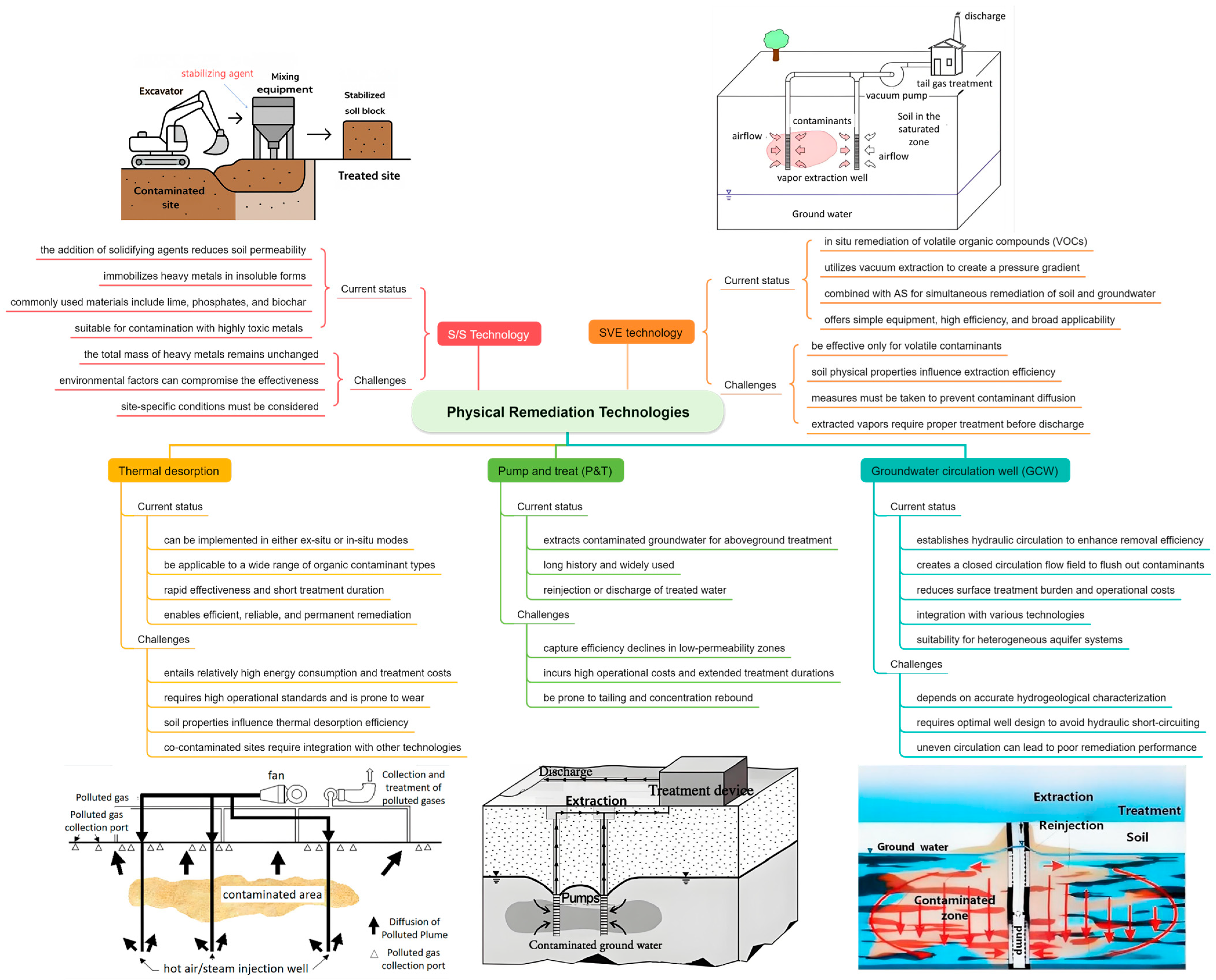
Figure 1 depicts the main conventional techniques and challenges of the physical remediation for contaminated sites.

2.1.1. Solidification/Stabilization Technology

1.
Current status
Solidification/stabilization (S/S) technology involves adding solidifying agents (e.g., cement, asphalt) or stabilizing agents to contaminated sites. This approach not only reduces soil permeability and limits the migration of heavy metals, but also immobilizes heavy metals into low-solubility forms, thereby decreasing their mobility and bioavailability [21,22]. Commonly used stabilizing materials, such as lime, phosphates, biochar, and industrial by-products (e.g., red mud), facilitate the formation of stable complexes with heavy metals through mechanisms including precipitation, adsorption, and ion exchange [21]. Studies indicate that alkaline industrial residues (e.g., soda residue, steel slag, carbide slag) are effective for stabilizing soils contaminated with Pb, Cd, zinc (Zn), and copper (Cu), while red mud shows specific efficacy for As immobilization [21]. As an in situ remediation approach, S/S is widely applied for common heavy metal contamination (particularly Pb and Cd), offering advantages of rapid implementation and convenient operation by minimizing leaching and plant uptake to enhance environmental safety [23].
2.
Challenges
A critical emphasis must be placed on the inherent limitation of stabilization technology: it does not remove heavy metals from the soil but merely “locks” them in place. Consequently, the total contaminant mass remains unchanged, and its long-term stability is contingent upon environmental conditions [15]. A primary concern among researchers is the reliability of this stability over extended periods. Studies indicate that environmental factors such as acid rain leaching, shifts in soil pH and redox potential, and microbial activity can progressively compromise the efficacy of certain passivating agents [23,24]. For instance, the immobilizing effect of biochar amendments on heavy metals may diminish after 2–3 years of application. Soil acidification, waterlogging, leaching of alkaline ions, and the activity of plant roots and soil biota can all contribute to the remobilization of metals previously fixed by biochar [24]. In practical applications, it is essential to consider site-specific environmental conditions, the characteristics of contaminants, and the properties of remediation materials to select the most appropriate stabilization materials and methods. Long-term environmental management and risk assessment strategies should also be formulated to ensure the durability of the remediation effectiveness.

2.1.2. Soil Vapor Extraction

1.
Current status
Soil vapor extraction (SVE) is an in situ remediation technology designed to treat volatile organic compounds (VOCs) in the unsaturated (vadose) zone. The core principle involves applying a vacuum through extraction wells to create a pressure gradient, which induces the flow of soil gas. This mobilizes VOCs adsorbed to soil particles or present in pore spaces, extracting them in vapor form for subsequent treatment [25]. A typical SVE system comprises extraction wells connected to a vacuum pump and an above-ground treatment unit (e.g., activated carbon adsorption or thermal oxidation) to destroy the collected contaminants [26]. SVE is highly effective for VOCs, efficiently removing gasoline components like benzene, toluene, ethylbenzene, xylenes (BTEX) and chlorinated solvents such as trichloroethylene (TCE) and tetrachloroethylene (PCE) [27]. In certain scenarios, SVE is often combined with air sparging (AS) to enable simultaneous remediation of contaminated soil and groundwater [28]. Additionally, when non-aqueous phase liquids (NAPLs) are present at a contaminated site, multi-phase extraction (MPE) can be employed to extract gas, liquid (groundwater), and free-phase contaminants simultaneously through extraction wells [29]. This approach enhances contaminant containment and enables multi-media remediation.
Due to its advantages of simple equipment, easy operation, low energy consumption, high efficiency, and broad applicability, SVE has been widely implemented for the in situ remediation of volatile petroleum hydrocarbon contamination with significant success [30]. In a diesel-contaminated site in Oman, an SVE system enhanced by air sparging reduced benzene concentrations in the unsaturated zone from an initial 15 mg/L~60 mg/L to below detection limits within 7 months. Total petroleum hydrocarbon concentrations in groundwater also dropped from 25 mg/L~50 mg/L to below 0.5 mg/L [28]. At a former chemical plant site in Beijing, an SVE application significantly reduced soil VOC concentrations, extracting approximately 720 L of contaminated liquid over 25 days of operation and substantially degrading the site’s organic pollution load [31]. Moreover, the SVE demonstrates high efficacy for moderately volatile organic contaminants (e.g., from gasoline spills, chlorinated solvents) and is particularly suited for sites where excavation is infeasible, such as beneath structures or in densely built environments [30].
2.
Challenges
Nevertheless, SVE has inherent limitations that necessitate careful site- and contaminant-specific evaluation of its applicability. First, SVE is effective only for contaminants with appreciable vapor pressure and performs poorly for low-volatility or non-volatile organic compounds [32,33]. For example, persistent pollutants with high boiling points and extremely low volatility—such as heavy polycyclic aromatic hydrocarbons (PAHs) and polychlorinated biphenyls (PCBs)—are difficult to remove from soil by SVE alone and often require complementary technologies (e.g., thermal desorption) [34]. Secondly, soil performance is highly dependent on soil physics. High moisture content and fine-textured soils can severely reduce air permeability, leading to flow bypassing and “dead zones” with poor treatment [35]. Models that ignore slow, resistant contaminant desorption phases may significantly underestimate remediation timeframes [36]. Thirdly, the induced pressure gradient must be carefully managed to prevent unintended lateral migration of vapors to uncontaminated areas, potentially causing secondary pollution. Finally, extracted vapors require effective above-ground treatment (e.g., carbon adsorption, thermal oxidation) before release, adding to system complexity and operational costs.

2.1.3. Thermal Desorption

1.
Current status
Thermal desorption is a remediation technology that removes organic contaminants from soil by applying heat to transfer them from the solid/liquid phase into the vapor phase for subsequent collection and treatment [5,37]. It can be implemented via two primary approaches: Ex Situ thermal desorption: Contaminated soil is excavated and fed into a specialized thermal treatment unit. Heating the soil to a target temperature (typically 200 °C~600 °C) causes volatilization or thermal desorption of pollutants, with the off-gas then captured and treated [38]. In Situ thermal desorption: Soil is heated directly in the subsurface using methods such as electrical resistance heating, electromagnetic heating, or steam/hot air injection. Heating the soil to temperatures between 100–300 °C mobilizes contaminants, which are then extracted via vapor recovery wells for above-ground treatment [39].
The advantages of thermal desorption lie In Its wide applicability to various types of pollutants, thorough remediation, and quick effectiveness. By elevating temperature, it effectively treats a wide spectrum of volatile and semi-volatile organic pollutants, including petroleum hydrocarbons, halogenated solvents, PAHs, PCBs, dioxins, and pesticide residues [40]. It is particularly recognized as an effective final treatment for recalcitrant persistent organic pollutants (POPs) [41]. The process operates on a significantly shorter timescale (hours to days) compared to techniques like bioremediation or vapor extraction, which can require months [42]. Engineering practice demonstrates that, with proper process control, thermal desorption can reliably reduce contaminant concentrations to meet stringent regulatory standards, positioning it as a highly efficient and permanent remediation solution [43].
2.
Challenges
Firstly, the energy consumption and cost are relatively high. Whether it is off-site or in situ treatment, the processing cost usually increases significantly as the volume of contaminated soil increases. Secondly, thermal desorption requires high equipment and operational standards; the high-temperature environment may cause wear and damage to equipment components [40]. Thirdly, desorption efficiency is notably affected by soil characteristics. High moisture content reduces thermal efficiency, as substantial energy is consumed to evaporate water [44]. Fourthly, it is ineffective for heavy metals. Soils with co-existing metal and organic pollution require a secondary treatment step (e.g., S/S) following thermal desorption [45]. Finally, it needs to strictly control air emissions. Especially, chlorinated organic substances may decompose at high temperatures to generate by-products such as dioxins [46].

2.1.4. Pump and Treat

Pump and treat (P&T) is a long-established and widely used approach for groundwater remediation, operating on the principle of extracting contaminated groundwater for aboveground treatment, followed by reinjection or discharge [47]. However, the long-term effectiveness and sustainability of P&T have been subjects of considerable debate [48]. Studies indicate that P&T systems may exhibit reduced contaminant capture efficiency in low-permeability zones, and are often associated with high long-term operational costs, extended treatment durations, as well as tailing and concentration rebound phenomena [49,50]. For instance, after pumping ceases, contaminants may back-diffuse from low-permeability matrix (inactive zones) into high-permeability channels (active zones), leading to water quality deterioration—a process that can be simulated and predicted using coupled mobile–immobile dual-domain models. A comparative study at an industrial site with a distinct geological framework found that a groundwater circulation well (GCW) system outperformed conventional P&T in terms of sustainability and efficiency [49].

2.1.5. Groundwater Circulation Wells

Groundwater circulation wells (GCWs) are an in situ remediation approach that enhances contaminant removal by establishing hydraulic circulation within the contaminated zone [51,52]. Through the combination of water extraction and injection, GCWs create a closed circulation flow field within the aquifer, which flushes contaminants from low-permeability zones, accelerates their migration toward high-permeability regions, and improves contact efficiency between remedial agents and pollutants [53]. Compared with P&T systems, GCWs enable the in situ degradation or removal of contaminants without extracting large volumes of groundwater for aboveground treatment, thereby reducing surface treatment burdens and operational costs [49]. For instance, at petroleum hydrocarbon-contaminated sites, hydraulic circulation technology has demonstrated effectiveness through laboratory and field studies; by adjusting and optimizing circulation hydraulic parameters, contaminant removal efficiency can be significantly enhanced, effectively addressing tailing and rebound issues [51].
From a technological development perspective, GCWs are not strictly a novel technology, but they exhibit continuous innovation and integration in terms of application breadth and technical coupling, giving them an “emerging” character in specific scenarios. This is mainly reflected in the following aspects: (1) Coupling and integration with other remediation technologies: GCWs are no longer applied as a standalone technique but are increasingly combined with various in situ remediation approaches such as chemical oxidation, bioremediation, electrochemical methods, and nanomaterials to create synergistic effects, addressing more complex contamination types and geological conditions [51,54]. For instance, coupling circulated groundwater electrolysis with in-well rhizobia bacteria can effectively remediate aniline-contaminated aquifers [54]. The delivery of reactive nanomaterials, such as nanoscale zero-valent iron (nZVI), through GCW systems into contaminated zones has proven effective in removing heavy metals such as chromium(VI) [55,56]. (2) Adaptation to complex hydrogeological conditions: Conventional dual-screen GCWs may face challenges related to the disruption of circulation system symmetry and containment under high hydraulic gradients or in highly heterogeneous aquifers [57,58]. To address this, novel designs such as multi-screen GCWs have been proposed to enhance applicability and remediation efficiency [57]. Numerical modeling and high-resolution aquifer characterization techniques are widely employed to optimize the design and operational strategies of GCWs in complex heterogeneous aquifers [58,59]. (3) Addressing emerging contaminants and special environmental issues: The application scope of GCWs is expanding beyond traditional pollutants to include emerging contaminants (e.g., antibiotics [51]) and specific environmental challenges such as seawater intrusion [60]. For instance, novel approaches combining treated wastewater recharge with GCWs have been proposed to mitigate seawater intrusion in coastal aquifers [60]. (4) Intelligent and sustainable development: Data-driven modeling approaches and three-dimensional dynamic models are being applied to optimize GCW operation and deepen the understanding of contaminant mechanisms, aiming to improve remediation sustainability and efficiency [59,61]. For example, the IEG-GCW® system, combined with data-driven modeling, has been successfully applied to remediate arsenic contamination in fractured rock aquifers [61]. Furthermore, the integration of GCWs with pump-and-treat (P&T) systems has also been investigated to optimize remediation performance in heterogeneous aquifers [58]. Despite significant advancements, GCW technology still faces several challenges. For instance, complex hydrogeological heterogeneity within aquifers, particularly the coexistence of low-permeability zones and high-permeability channels, poses challenges to the effective delivery of remedial agents and contaminant mass transfer [62,63]. Additionally, the effectiveness of GCWs remains highly dependent on accurate hydrogeological characterization and optimized well design to prevent hydraulic short-circuiting or uneven circulation, which could compromise remediation performance [51].

2.2. Chemical Remediation Technologies

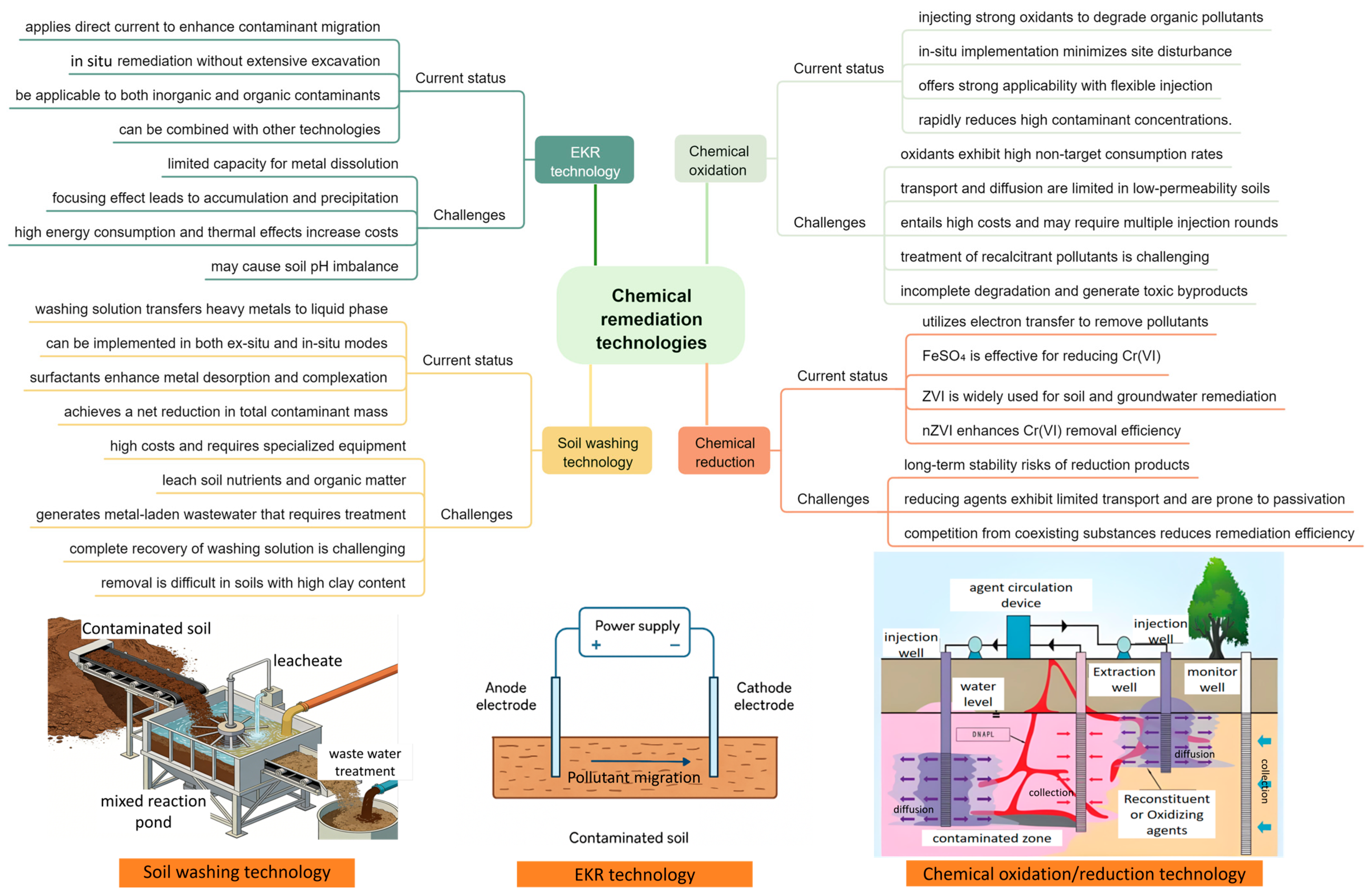
Chemical remediation technologies involve the addition of chemical substances to contaminated environmental media to degrade, transform, or remove pollutants through chemical reactions [64]. Figure 2 depicts the main conventional techniques and challenges of chemical remediation for contaminated sites.

2.2.1. Chemical Oxidation

1.
Current status
Chemical oxidation remediates organic contamination by injecting strong oxidants into the subsurface to degrade pollutants into harmless or less toxic products, a common in situ approach known as In Situ Chemical Oxidation (ISCO). Common oxidants—such as permanganate, hydrogen peroxide (Fenton’s reagent), and persulfate—generate potent free radicals that rapidly decompose organic molecules [65,66]. This method is broadly applicable, particularly effective against recalcitrant organics like chlorinated solvents, aromatic hydrocarbons, and PCBs. ISCO offers rapid and thorough degradation, significantly shortening remediation timelines and reducing contaminant mass [66]. Its in situ nature minimizes soil excavation and site disturbance [67]. The technique is highly adaptable in the field, allowing oxidants to be distributed via injection wells to target specific zones. It is especially suitable for treating high-concentration source areas, where it can quickly reduce contaminant levels to facilitate subsequent remediation steps [66].
2.
Challenges
Despite its advantages, ISCO faces significant limitations and challenges. Firstly, oxidants are susceptible to rapid consumption by soil matrix components (e.g., natural organic matter, reduced minerals), reducing their efficiency for target pollutant degradation [68]. Secondly, the transport and distribution of oxidants in the subsurface are constrained by site hydrogeological conditions. Low-permeability zones can severely restrict oxidant penetration and contact with contaminants, diminishing treatment effectiveness [69]. Thirdly, the expense of oxidants and activators, combined with the frequent need for multiple injection rounds in complex sites, can substantially increase overall remediation costs. Finally, some highly recalcitrant pollutants, such as polycyclic aromatic hydrocarbons (PAHs), exhibit strong adsorption to soil and resistance to conventional oxidants, making them exceptionally difficult to degrade via ISCO [70]. Furthermore, another limitation is that incomplete degradation processes may lead to the formation of by-products with higher toxicity than the parent compounds.

2.2.2. Chemical Reduction

1.
Current Status
Chemical reduction technology removes contaminants primarily through reduction reactions, with typical reagents including zero-valent iron (ZVI), ferrous iron salts, and sulfides. This technology is mainly employed for reductive dichlorination (e.g., converting trichloroethylene (TCE) and tetrachloroethylene (PCE) to ethylene/ethane) or for the reduction of heavy metals (e.g., reducing Cr(VI) to Cr(III)) [71,72]. The core mechanism of chemical reduction relies on the electron transfer capability of reducing agents to transform target pollutants from a high oxidation state to a low oxidation state. In chromium-contaminated remediation, FeSO4 has been demonstrated as an effective reducing agent for Cr(VI) in soil [73]. Under anaerobic conditions, the combined addition of FeSO4 (30%, w/w) and enzyme residue (30%, w/w) achieved a Cr(VI) reduction efficiency of 93.02% after 45 days, significantly higher than that of FeSO4 (72.39%) or enzyme residue (75.47%) alone [74]. Zero-valent iron (ZVI) is widely used in soil and groundwater remediation due to its strong reducing capacity and high specific surface area, particularly excelling in the treatment of Cr(VI)-contaminated groundwater [55,75]. Nanoscale zero-valent iron (nZVI), as an in situ remediation material, has demonstrated advantages in various applications; for example, carboxymethyl cellulose-stabilized biochar-supported nZVI (CMC-nZVI@BC) achieved 99.9% Cr(VI) removal within 180 min, outperforming nZVI@BC and CMC-nZVI [56].
2.
Challenges
Although chemical reduction holds significant promise for contaminated site remediation, it faces several challenges: (1) Long-term stability of reduction products: Cr(III) may be re-oxidized to Cr(VI) under certain oxidizing conditions [76]. (2) Limited transport in heterogeneous media and rapid passivation of reducing agents: Reductants such as ZVI exhibit restricted mobility in groundwater and soil, and are prone to aggregation, corrosion, and surface passivation [77]. (3) Competition from coexisting redox-sensitive species: Groundwater and soil often contain redox-sensitive substances such as nitrate (NO3), sulfate (SO42−), oxygen (O2), and natural organic matter (NOM), which compete with target contaminants for reducing equivalents, thereby diminishing remediation efficiency [78,79].

2.2.3. Electrokinetic Remediation

1.
Current status
Electrokinetic remediation (EKR) technology utilizes an applied direct current (DC) electric field to mobilize charged contaminants within the pore water of soil, facilitating the extraction of heavy metals from in situ soil [80]. The primary mechanisms involved are electromigration (driving metal ions towards the electrodes), electroosmosis (inducing pore water flow to transport solutes), and electrophoresis. In a typical setup, electrodes (anode and cathode) are inserted into the contaminated soil matrix. Upon energization, heavy metal cations migrate towards the cathode, where they are subsequently collected and removed via pumping or precipitation methods [81]. EKR is recognized as one of the most promising separation technologies for low-permeability contaminated soils [82]. Its key advantages include: (1) Strong in situ remediation capability, allowing direct field application without extensive soil excavation [81]; (2) Broad applicability to both inorganic contaminants and certain organic pollutants, enabling co-removal [82]; (3) High efficiency and relatively low environmental impact, as it relies on electric field-driven transport instead of extensive chemical reagents, minimizing secondary contamination risks [83]; (4) Good compatibility for hybrid remediation, allowing integration with other technologies to overcome the limitations of standalone EKR [84].
2.
Challenges
Despite its potential, EKR faces three primary technical bottlenecks in practical application: (1) Limited metal mobilization: It struggles to effectively dissolve and mobilize heavy metals that exist in insoluble forms within the soil, constraining overall removal efficiency [81]. (2) Focusing effect: Metals can accumulate and re-precipitate in localized zones (e.g., near electrodes) during migration, which blocks transport pathways and hampers removal [83]. (3) High energy consumption: Maintaining a continuous current results in significant power costs and heat generation, escalating project expenses [85,86]. While research into solutions—such as integrating renewable energy, developing novel electrodes, and optimizing voltage regimes—aims to reduce specific energy consumption [84], the economic feasibility for large-scale projects remains a key challenge. Furthermore, improper field application can disturb soil pH, cause electrode side-reactions (e.g., hydrogen evolution at the cathode), and degrade soil properties, necessitating auxiliary measures for soil preservation [87].

2.2.4. Soil Washing Technology

1.
Current status
Soil washing is a remediation technology designed to separate heavy metals from contaminated soil by transferring them from the solid phase to a liquid washing solution, which is then treated or disposed of to achieve soil purification [88,89]. This process can be implemented either ex situ or in situ. Common washing agents include inorganic acids, organic acids, chelating agents (e.g., ethylenediaminetetraacetic acid (EDTA), citric acid), and surfactants [90,91,92]. Surfactants play a particularly significant role in heavy metal remediation by (i) reducing interfacial tension to enhance metal desorption from soil particles, and (ii) forming soluble complexes with metal ions to improve their mobility and removal from the aqueous phase [93]. The primary mechanisms for metal removal via soil washing involve acid dissolution, complexation with chelating agents or surfactants, and ion exchange [89].
Compared to stabilization methods that merely alter contaminant form, soil washing can physically remove a significant proportion of heavy metals from the soil, achieving a net reduction in total contaminant mass [94]. Consequently, this technique plays an indispensable role in the thorough remediation of heavily contaminated sites where permanent decontamination is required. The process is rapid-acting, with typical treatment cycles achieving substantial metal extraction within hours to days [88]. Furthermore, its application can be customized through the selection of specific washing agents and process parameters tailored to target different metals. An additional strategic benefit lies in the potential to recover valuable metals from the resultant eluate or to treat the wastewater to meet discharge standards, enabling a dual approach of resource recovery and risk management [95].
2.
Challenges
The application of soil washing is constrained by several notable challenges: (1) High operational costs, especially for ex situ processes requiring soil excavation, transport, and specialized equipment, leading to significant capital and operational expenditure [96]. (2) Degradation of soil properties, as aggressive agents (e.g., strong acids, chelators) can leach essential nutrients and organic matter alongside heavy metals, impairing soil fertility and structure [88,90]. (3) Secondary pollution management, necessitating extensive treatment of the generated metal-laden wastewater or sludge to prevent it from becoming a new contamination source [89]. (4) Difficulties in field implementation: for in situ applications, incomplete recovery of the flushing solution poses a risk of contaminant migration via groundwater flow. (5) Soil dependence: compared with sandy soil, it is always challenging to remove pollutants from soil with high clay content or high organic carbon content. Therefore, soil washing is generally most suitable for scenarios requiring substantial mass reduction of heavy metals in severely contaminated sites, such as industrial brownfields [89].

2.3. Bioremediation Technologies

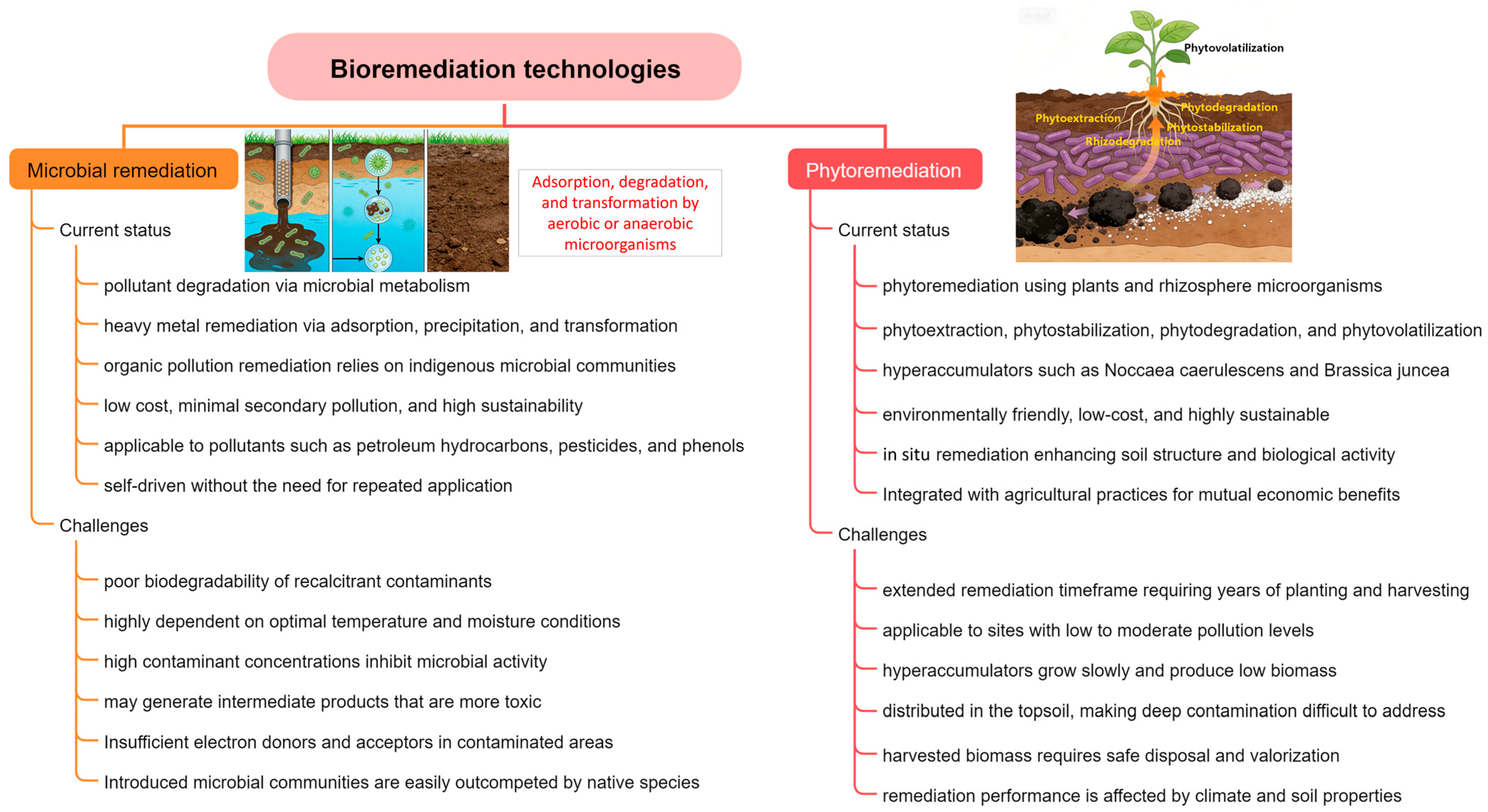
Bioremediation employs the biological activities of organisms—primarily microorganisms and plants—to degrade, transform, or remove pollutants. Recognized for its environmental friendliness, cost-effectiveness, and low risk of secondary pollution, bioremediation is considered a sustainable approach for managing various contaminants [97,98]. Figure 3 depicts the main conventional techniques and challenges of bioremediation for contaminated sites.

2.3.1. Phytoremediation

1.
Current status
Phytoremediation utilizes plants and their associated rhizosphere microorganisms to remove, immobilize, transform, or degrade contaminants in soil and water, representing a sustainable and green remediation technology [99,100]. Its primary mechanisms include phytoextraction [14], phytostabilization [101], phytodegradation, phytovolatilization [99,100], rhizodegradation [99,102], and aquatic phytoremediation [103]. Through these processes, plants uptake contaminants—primarily heavy metals—from the soil and accumulate them in harvestable aboveground tissues, thereby removing the pollutants from the site via plant harvesting. Over 500 plant species are known to naturally hyperaccumulate one or more heavy metals; for instance, hyperaccumulators such as Noccaea caerulescens and Brassica juncea exhibit exceptionally high bioconcentration factors for Cd and Zn, making them suitable for phytoextraction [104]. The most significant advantages of phytoremediation are its environmental friendliness and low cost [105,106]. It is widely regarded as one of the most sustainable remediation technologies, as it harnesses natural plant growth with minimal energy and chemical inputs [106]. Compared with physicochemical methods, phytoremediation causes minimal soil disturbance, improves soil structure and biological activity in situ, and leaves the soil viable for continued use after remediation [104]. Economically, it can be integrated with agricultural practices by selecting high-value hyperaccumulator species, enabling a dual benefit of remediation and revenue generation [107].
2.
Challenges
Traditional phytoremediation also presents distinct limitations: (1) Extended remediation duration: Compared to engineered methods, annual metal uptake by plants is limited, often requiring multiple years of cultivation and harvesting to achieve significant soil cleanup. (2) Inherent biological constraints: The technique is generally suitable for sites with low to moderate contamination levels [101]. Hyperaccumulator plants often exhibit slow growth and low biomass, whereas high-biomass crops typically have limited metal tolerance and accumulation capacity [14]. (3) Shallow treatment zone: Plant root systems are mostly confined to the topsoil layer (tens of centimeters), rendering them ineffective for deeper contamination. (4) Post-harvest contaminant management: Metals absorbed by plants accumulate primarily in the above-ground biomass, which is classified as hazardous waste and requires safe disposal or valorization [14]. (5) Environmental susceptibility: Phytoremediation efficiency is highly sensitive to climatic and soil conditions; for example, drought or low-fertility soils can limit plant growth, while the low bioavailability of certain heavy metals under high soil pH conditions can further reduce plant uptake efficiency [101]. In summary, despite their sustainable profile, the widespread application of phytoremediation and bioremediation is constrained by challenges related to biomass yield, treatment rates, and applicability scope.

2.3.2. Microbial Remediation

1.
Current status
Microbial remediation employs the metabolic activities of microorganisms—such as bacteria, fungi, and algae—to degrade, transform, or immobilize pollutants, thereby reducing their toxicity or eliminating them entirely [108,109]. In the remediation of heavy metal contamination, indigenous or exogenous microorganisms immobilize heavy metals or reduce their toxicity through mechanisms such as biosorption, precipitation, and redox transformation [110]. Here, biosorption refers to the removal and immobilization of heavy metals from soil solutions onto microbial cell surfaces through physical adsorption or chemical complexation with functional groups (e.g., carboxyl, hydroxyl, amino, and phosphate groups) on the cell walls [111]. Bioprecipitation involves microbial metabolic activities that alter the chemical environment of heavy metal ions, inducing their precipitation as insoluble compounds. Key mechanisms include the precipitation of sulfides, phosphates, and carbonates [89,112]. Representative mechanisms include the reduction of toxic hexavalent chromium to less toxic trivalent chromium by certain bacteria, and the transformation of soluble metals into insoluble metal sulfide precipitates by sulfate-reducing bacteria [113].
In the remediation of organically contaminated sites, it is typically applied in situ, relying on either the innate degradative capacity of indigenous microbial communities or its enhancement through interventions like aeration, nutrient addition, or bioaugmentation [114]. The fundamental mechanism involves microbes utilizing organic pollutants as a carbon or energy source, enzymatically breaking them down into carbon dioxide, water, and simple inorganic compounds. In some cases, incomplete mineralization results in the transformation of pollutants into intermediate products or their incorporation into biomass, thereby reducing their bioavailability and toxicity in the environment [115]. Compared to physicochemical methods, microbial remediation offers advantages of lower cost and minimal secondary pollution, positioning it as one of the most sustainable remediation strategies [116]. The applicability of microbial remediation is largely determined by the chemical structure and biodegradability of the contaminants. Generally, petroleum hydrocarbons (e.g., alkanes and aromatics in diesel and gasoline), various pesticides, phenols, and organic cyanides are susceptible to microbial degradation in the environment, making them key targets for bioremediation [117]. Moreover, microbial remediation offers rapid action and diverse mechanisms; many microorganisms are capable of simultaneously treating multiple contaminants and can self-amplify through proliferation, eliminating the need for repeated manual addition. This renders it a self-sustaining remediation approach [113]. Furthermore, Biologically Driven Reductive Dechlorination (BRD) is a key in situ bioremediation technology that employs anaerobic microorganisms to achieve stepwise reductive dichlorination of chlorinated organic pollutants into less toxic or non-toxic products in the presence of electron donors. It is widely applied for the remediation of soil and groundwater contaminated with chlorinated hydrocarbons [118,119,120]. This approach is recognized as an effective strategy for treating chlorinated organic contaminants due to its environmental friendliness, cost-effectiveness, and potential for complete mineralization [121]. Remediation is typically achieved by injecting electron donors, nutrients, or pH buffering agents into the contaminated site to stimulate the growth and dichlorination activity of indigenous microbial communities [122]. For instance, gamma-polyglutamic acid (γ-PGA) has been successfully used as both a carbon and nitrogen source for the remediation of trichloroethylene (TCE)-contaminated groundwater [123].
2.
Challenges
Nevertheless, there are significant limitations to the microbial remediation technologies. Firstly, Contaminants must be biodegradable by the target microorganisms. Structurally stable, low-solubility compounds like PCBs and high-molecular-weight PAHs are often highly persistent due to their resistance to microbial metabolism [124,125]. Secondly, the process is highly dependent on optimal environmental conditions (e.g., temperature, moisture, pH). Deviations from these ranges can significantly suppress microbial activity [126]. Thirdly, high contaminant concentrations can be toxic to microorganisms, potentially inhibiting the growth, reproduction, or enzymatic activity of degrading strains, thereby preventing the initiation of bioremediation. Fourthly, microbial degradation may generate intermediate metabolites that are sometimes more toxic than the parent contaminants [127]. Finally, the microbial degradation process faces challenges related to the limited availability of electron donors and acceptors in both the core of the contaminant plume and its margins [128]. In addition, another critical issue is the instability of the target microbial community and its rapid displacement by indigenous species [129].

2.4. Development and Challenges of Combined Remediation Technologies

Remediation of co-contaminated soils presents a complex and challenging issue, as traditional single-technology approaches often fail to achieve satisfactory outcomes. Consequently, combined remediation technologies, which integrate the strengths of different methods to enhance efficiency, reduce cost, and mitigate environmental risks, have gained increasing attention [130,131,132]. Unlike single-technology treatments, combined strategies typically synergize physical, chemical, and biological processes to address the distinct properties of both heavy metals and organic pollutants [131,133]. The core advantage of combined remediation technologies lies in functional complementarity: physical methods provide pathways for contaminant migration or enrichment, chemical methods enable rapid transformation or immobilization, and biological methods contribute targeted degradation and ecological restoration. The following outlines key combined technologies, their principles, and applications.

2.4.1. Physicochemical Combined Remediation

Physicochemical combined remediation technologies focus on enhancing contaminant migration and regulating contaminant speciation.
1.
S/S combined with chemical oxidation/reduction
Chemical oxidation or reduction is first applied to degrade or transform organic contaminants, reducing their toxicity and mobility. Subsequently, solidification/stabilization (e.g., using cement, lime, or phosphate-based agents) immobilizes heavy metals, decreasing their bioavailability and leachability [112,134,135]. For instance, at industrial sites with mixed heavy metal–organic contamination, Fenton oxidation can degrade organics prior to phosphate stabilization of lead and cadmium. Fenton oxidation has been demonstrated to effectively degrade petroleum hydrocarbon contaminants [136,137]. For heavy metal stabilization, biochar, as an organic amendment, can effectively adsorb heavy metals and reduce their bioavailability [135,138].
2.
EKR combined with chemical washing
Incorporating chemical washing agents, such as ethylenediaminetetraacetic acid (EDTA) and citric acid (CA), during EKR enhances the solubility and mobility of heavy metals while promoting electro-migration or electro-osmosis of organic pollutants [139,140,141]. Studies have shown that combining activated carbon (AC) and citric acid (CA) can significantly improve lead removal efficiency, achieving approximately 4% removal after 480 h of treatment [89]. This indicates that chemical washing agents can effectively enhance the desorption efficiency of heavy metals, thereby improving the performance of EKR [142].
3.
EKR combined with physical barriers
The combination of EKR with physical barriers, such as permeable reactive barriers (PRBs), represents an important synergistic strategy in contaminated site remediation. This approach integrates the advantage of EKR in driving contaminant migration through an electric field with the capacity of physical barriers to limit contaminant diffusion, demonstrating significant potential for treating low-permeability soils [143,144]. Physical barriers can utilize waste or recyclable materials (e.g., biochar, charcoal, cork) as fillers for EKR-PRB systems, enabling efficient and cost-effective removal of heavy metals from soil, which represents an important direction toward achieving green soil remediation goals [145]. Li et al. employed immobilized yeast to prepare a permeable reactive barrier coupled with electrokinetics (IMEK-PRB) for the remediation of cadmium-contaminated soil. The results showed that the highest removal efficiency (53.70%) was achieved at a voltage gradient of 2.5 V/cm, and the removal rate using fly ash-based yeast particles increased by more than 10% compared with the simple embedding method. This technique effectively reduces soil cadmium toxicity and exhibits promising application prospects [146]. Wang et al. utilized waste cotton fibers as a substrate to green-synthesize MIL-100(Fe)@cotton fiber (CM100) for EKR-PRB remediation of heavy metal-contaminated soil. CM100 achieved removal efficiencies of 96.1% for Pb2+ and 78.7% for Cd2+; under KCl/citric acid electrolyte conditions, the remediation efficiency increased to 98.0%, providing a novel approach for the resource utilization of waste textiles [147].

2.4.2. Physical–Biological Combined Remediation

Physical–biological combined remediation technologies emphasize the suppression of bioavailability and the synergy of in situ containment and degradation.
1.
Phytoremediation combined with biochar/stabilizers
Integrating biochar or other stabilizers (e.g., phosphate, iron-based materials) with phytoremediation rapidly reduces the bioavailability of heavy metals and organics through adsorption or chemical stabilization. This mitigates plant toxicity, promotes plant growth, and enhances remediation efficiency [111,138,148]. In agricultural soils, Maceiras et al. combined biochar with phytoremediation to treat lead-contaminated shooting range soil. The results showed that mixing biochar with soil at a 10% ratio achieved the best performance, outperforming surface application. After one month of cultivation with rapeseed and ryegrass, soil lead concentrations decreased by over 70%, significantly reducing lead bioavailability. Among the treatments, the combination of rapeseed and biochar exhibited the highest lead removal efficiency [138]. Furthermore, the combined use of plants and microorganisms represents an important development direction. Tu et al. found that corn biochar loaded with Pseudomonas NT-2 effectively stabilized cadmium- and copper-contaminated soil: it increased soil pH, reduced heavy metal bioavailability, increased the residual fraction, and enhanced soil enzyme activity and microbial community quality, providing a green approach for biochar–microbe combined remediation [149]. Plant growth-promoting rhizobacteria (PGPR) enhance both plant growth and heavy metal remediation efficiency by secreting chelating agents and regulating genes involved in metal transport and tolerance. Given that the precise molecular mechanisms underlying PGPR-mediated plant growth promotion and heavy metal phytoremediation remain unclear, Manoj et al. provided a critical theoretical foundation for elucidating the regulatory networks of PGPR-synergized phytoremediation through a comprehensive review [150].
2.
Biodegradation combined with physical barriers
The installation of physical barriers—such as clay, high-density polyethylene (HDPE) membranes, or permeable reactive barriers (PRBs)—within contaminated zones can control the migration and diffusion of contaminants [151]. Concurrently, the introduction of specialized microbial consortia or biostimulation within the barriers or along the contaminant plume pathways facilitates the degradation of organic pollutants and immobilizes heavy metals through mechanisms including microbial adsorption, precipitation, and redox transformation [152]. For example, an enriched microbial consortium was introduced into an anaerobic continuous-flow column to achieve the dichlorination of TCP to 2,4-DCP and further to 4-CP. Based on first-order kinetic modeling, the dichlorination rate constants for each step were obtained, and the corresponding biological barrier widths required for complete remediation were determined to be 126, 130, and 689 cm, respectively [153]. In column experiments simulating aquifer recharge, compost used as a reactive barrier significantly influenced microbial community structure. The results demonstrated effective removal of acetaminophen and ammonium, while sulfamethoxazole was removed only under a high compost ratio, and other micropollutants such as carbamazepine showed limited removal. The compost ratio also dictated the nitrate removal pathway (denitrification versus dissimilatory nitrate reduction to ammonium), and the net water quality improvement varied depending on the pollutant type [154].

2.4.3. Chemical Oxidation/Reduction Combined with Bioremediation

1.
Chemical oxidation/reduction combined with bioremediation
Chemical oxidation or reduction rapidly reduces initial concentrations and toxicity of organic pollutants, transforming them into more biodegradable intermediates [155]. Follow-up bioremediation utilizes microbial degradation for residual organics or immobilizes heavy metals through biosorption, bioprecipitation, and redox processes [131,156]. For example, at petroleum-contaminated sites, chemical oxidation can first be applied to remove the bulk of hydrocarbon contaminants, followed by bioaugmentation (inoculation with degrading microorganisms) or biostimulation (addition of nutrients) to promote the biodegradation of residual organics [157,158]. In a pilot-scale study, Němeček et al. combined chemical reduction using nanoscale zero-valent iron (nZVI) with whey-based bioreduction to treat Cr(VI)-contaminated groundwater. The results showed that nZVI rapidly reduced Cr(VI) concentrations, and subsequent whey addition sustained continuous biological reduction, with effects persisting for 10 months at a distance of 22 m. A synergistic effect was observed between the two stages: Fe(III) generated from nZVI oxidation was microbially reduced to Fe(II), which was recycled as a reductant for Cr(VI). Community analysis confirmed that iron-reducing and sulfate-reducing bacteria dominated this process [159].
2.
EKR combined with bioremediation
EKR mobilizes heavy metals and organics toward electrode zones for centralized treatment. Although electric fields may initially inhibit microbial activity, optimizing EKR parameters, introducing buffer systems, or applying microbial agents post-EKR can restore soil microbial communities and enable synergistic remediation [141,160]. For example, electrobioremediation combines electrokinetics with bioremediation to utilize soil microorganisms for pollutant degradation or immobilization [160]. Studies have shown that immobilizing bacteria with biochar can enhance the efficiency of electrokinetic (EK) remediation in soils co-contaminated with total petroleum hydrocarbons (TPH) and hexavalent chromium (Cr(VI)) [161]. In an electric field-assisted composting system (EACS), carbon felt electrodes increased humic acid content by 48.57%, while reducing the bioavailability of copper and chromium by 18.00% and 7.61%, respectively, with no risk of metal leaching. Additionally, the electric field increased the abundance of beneficial microbial groups such as Actinobacteria and stimulated the proliferation of heavy metal-resistant bacteria [162].
3.
Biochar amendment combined with EKR
Biochar’s porous structure and abundant surface functional groups effectively adsorb both heavy metals and organic pollutants [111,163]. Adding biochar to contaminated soil pre-adsorbs contaminants, reducing mobility. Subsequent EKR benefits from biochar’s conductivity, which improves soil electrical conductivity, enhances electric field effects, and may alleviate negative impacts on microbes [112,161]. This is particularly effective for soils co-contaminated with hydrophobic organics and heavy metals. For example, biochar-immobilized yeast used as a PRB can enhance the effectiveness of EKR for cadmium-contaminated soil [146].

2.4.4. Challenges Faced by Combined Remediation Technologies

Combined remediation technologies leverage the advantages of individual methods to overcome limitations, improving efficiency and completeness for complex contamination [131,133,156]. Multitechnology integration can shorten remediation timelines, lower costs, and reduce secondary pollution risks [133]. However, the challenges of combined remediation technologies lie in the following aspects: (1) The synergistic mechanisms among multiple technologies are complex, necessitating a thorough understanding of the interactions between different remediation approaches to achieve optimal performance. For instance, environmental conditions such as pH, redox potential, organic matter content, and soil heterogeneity may influence individual technologies differently and require precise regulation [131,141]. (2) The selection, dosage, and application method of remediation agents, along with the long-term stability assessment of remediation outcomes, are also critical issues [112,131]. Secondary risks, such as nanomaterial transport and the formation of oxidation byproducts, lack systematic evaluation. For example, although biochar is beneficial, its source and pyrolysis temperature can affect both its effectiveness in heavy metal stabilization and its potential environmental risks [164]. (3) Contaminated sites are typically highly heterogeneous, with significant variations in contaminant type, concentration, distribution, and soil physicochemical properties, which increase the complexity of designing and implementing combined remediation strategies [157]. (4) In addition to heavy metals and organic pollutants, emerging contaminants such as antibiotic-resistant bacteria (ARB) and antibiotic resistance genes (ARGs) pose new remediation challenges [165].

3. Emerging Site Remediation Technologies

Recent advances in materials science, molecular biology, and electrochemistry have spurred the development of innovative remediation technologies for complex contaminated sites. These approaches—including nanomaterial-based remediation, microbial electrochemical systems, molecular biology-assisted strategies, and the coupling of biodegradation with physical barriers—offer significant potential to enhance remediation efficiency and minimize environmental risks. However, their application is accompanied by substantial challenges [166].

3.1. Nanomaterial-Based Remediation

Nanoremediation employs nanomaterials with unique physicochemical properties to treat pollutants in soil and groundwater, garnering widespread attention due to its high efficiency, rapid action, and environmental friendliness [167,168,169]. Nanomaterials (e.g., nanoscale zero-valent iron, nano-TiO2, and nano-hydrox-yapatite) are widely employed for the adsorption, reduction, or catalytic degradation of heavy metals and organic pollutants, owing to their high specific surface area and strong reactivity [170]. For instance, nanoscale zero-valent iron can effectively reduce chlorinated hydrocarbons and immobilize hexavalent chromium, while nano-TiO2 facilitates the photocatalytic degradation of organic contaminants such as polycyclic aromatic hydrocarbons under light irradiation [171]. Carbon nanotubes (CNTs) and metal oxide nanomaterials also exhibit excellent adsorption and catalytic properties, making them suitable for the removal of petroleum contaminants and heavy metals [167].

3.2. Bioelectrochemical Remediation Technologies

Bioelectrochemical systems (BES), particularly microbial fuel cells (MFCs), combine biological approaches with electrochemical principles by utilizing electroactive microorganisms to drive in situ redox reactions, thereby enhancing the degradation of organic pollutants and the immobilization of heavy metals [172,173,174]. MFCs drive the redox transformation of pollutants through electron transfer between microorganisms and electrodes [166]. This technology enables the in situ degradation of organic contaminants such as petroleum hydrocarbons and chlorinated hydrocarbons, while simultaneously reducing hexavalent chromium and nitrates. Its advantages include energy self-sufficiency or low energy consumption, strong sustainability, and particular suitability for the in situ remediation of low-permeability soils and groundwater [175]. Bioelectrokinetic remediation combines electrokinetic technology with bioremediation, applying an electric field to enhance contaminant migration and microbial activity, thereby enabling effective remediation of contaminated soil and groundwater [160].

3.3. Molecular Biology-Assisted Remediation

Leveraging functional gene mining, genome editing, and synthetic biology, researchers can directionally modify or construct efficient degrading strains to enhance their metabolic capacity for recalcitrant organic pollutants [176]. For example, CRISPR/Cas9 technology has been employed to enhance the degradation of polychlorinated biphenyls, and engineered strains with multi-tolerant traits have been developed for the remediation of complex contamination [177].

3.4. Challenges Faced by Emerging RemediationTechnologies

Despite their significant potential, emerging remediation technologies face multiple challenges: the ecotoxicity, transport behavior, and environmental fate of nanomaterials remain poorly understood [170]; the scale-up and long-term stability of microbial electrochemical systems require further validation [166]; and the environmental release risks of molecularly modified strains necessitate rigorous assessment [178]. Future efforts should focus on fostering interdisciplinary integration to advance these technologies from the laboratory to field-scale applications, while establishing corresponding environmental safety evaluation frameworks.

4. Current Status and Prospects of AI in Contaminated Site Remediation

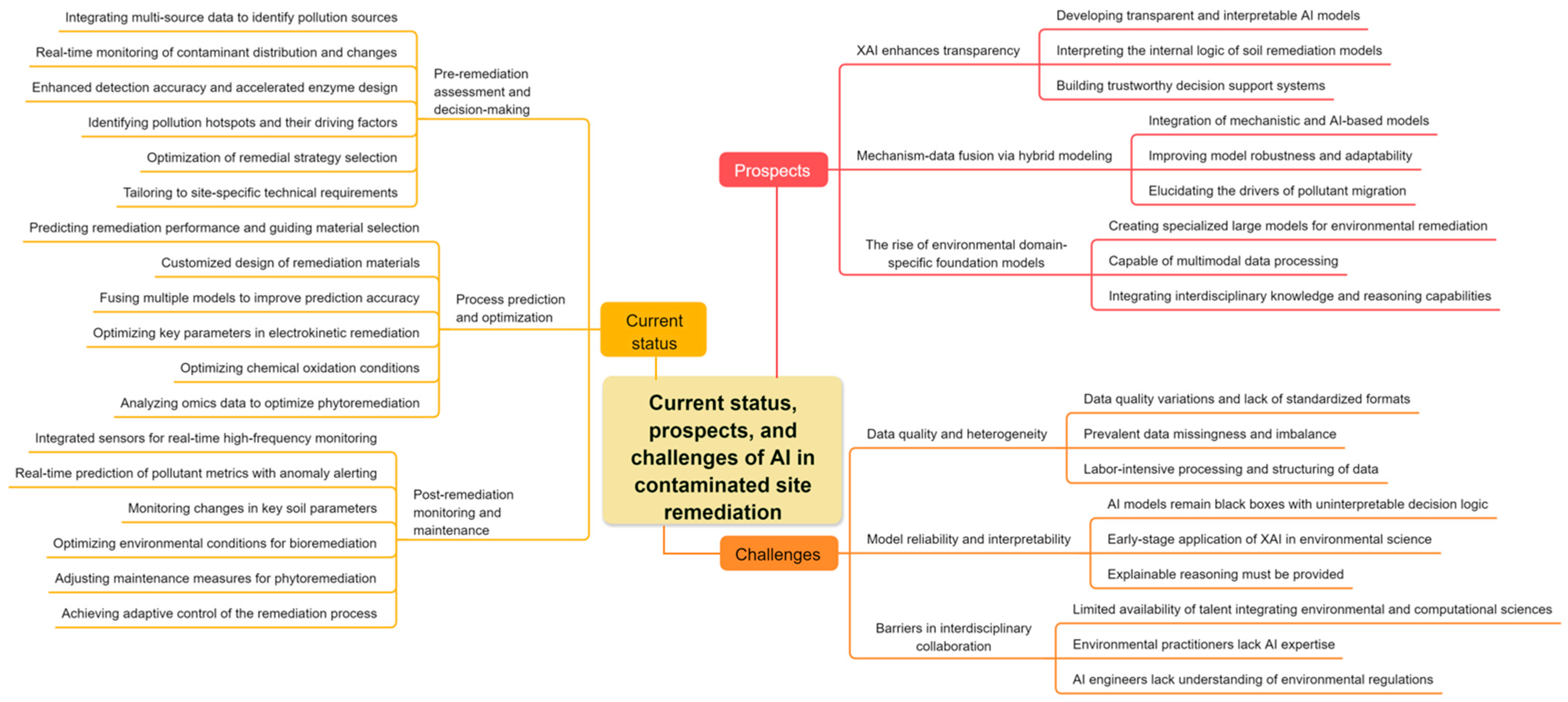
Artificial intelligence (AI) is being increasingly applied across the entire lifecycle of contaminated site remediation—from preliminary assessment and decision-making, through process prediction and optimization, to post-remediation stewardship—encompassing site characterization, risk assessment, remedial technology selection and design, process monitoring, and predictive modeling [18,179,180]. Currently, AI methodologies such as machine learning (ML) and deep learning (DL) are transforming conventional approaches to contaminated site remediation by leveraging their capabilities in handling complex data, identifying patterns, and optimizing decisions, thereby making remediation more efficient, cost-effective, and sustainable [18,180,181,182,183]. Figure 4 shows the current status, prospects, and challenges of AI in contaminated site remediation.

4.1. AI in Pre-Remediation Assessment and Decision-Making

Site monitoring and characterization: AI technologies play a pivotal role in initial site monitoring and characterization. AI and machine learning models can integrate multi-source heterogeneous data—including historical contamination records, remote sensing imagery, and geological survey data—to enable more accurate identification of pollution sources and achieve real-time monitoring and prediction of contaminant types, distribution, concentrations, and their temporal dynamics [18,180,184]. For example, Zhang et al. reviewed the application of machine learning models for spatial prediction of soil contamination. The study indicated that optimizing model performance requires meeting four conditions: selecting an appropriate model architecture, screening independent variables related to contamination sources, conducting comprehensive model evaluation, and integrating with geostatistical methods. With the accumulation of data and advances in algorithms, machine learning is poised to become an important tool for spatial prediction and source apportionment of soil contamination [185]. Li and Sun [186] employed a data-driven causal inference approach to develop an interpretable Random Forest (RF) model for identifying contaminated sites in China, achieving over 85% accuracy. This methodology enables more precise understanding of contamination mechanisms and identification of key driving factors. Furthermore, AI techniques reduce analytical complexity while maintaining predictive accuracy. For instance, AI/ML/DL models can transform sparsely sampled groundwater or soil monitoring data [185], or feature-based micro-scale/drone imagery [187], into high-resolution contaminant spatial distributions. Janga et al. synthesized multiple studies focused on contaminant concentration prediction, spatial distribution analysis, or their integration, along with associated risk assessment activities, and elaborated on how researchers worldwide have employed AI techniques to address challenges in site characterization [18]. Furthermore, AI has significantly enhanced the identification and bioremediation of persistent pollutants by improving contaminant detection accuracy (e.g., achieving over 90% accuracy in microplastic classification) and accelerating the design of efficient enzymes (e.g., enhancing PET degradation rates by a factor of 46), thereby providing innovative solutions for environmental sustainability [182].
Risk assessment and decision support: Risk assessment represents a critical phase following site characterization, where ML frameworks can identify contamination hotspots and driving factors to comprehensively elucidate associated risks [188]. AI technologies are increasingly being integrated into contaminated site management decisions, demonstrating substantial potential, particularly in environmental impact assessment approval and remedial alternative optimization. For instance, ML algorithms have been employed to construct decision tree models that support sustainable decision-making in contaminated site risk management and optimize remedial strategy selection [189]. Zhang et al. [190] developed a ML-assisted approach for optimizing site remediation strategies: reaction-transport mechanistic models (RTM) were first used to simulate performance and cost data for numerous remedial scenarios; these data subsequently trained an ML model (eXtreme gradient boosting, XGBoost) to establish relationships between remediation outcomes and parameters; finally, an optimization algorithm (SCE-UA) identified the most cost-effective solution under constraints. Li et al. [191] employed decision tree classifiers to analyze common contaminants and corresponding remediation technologies across 144 contaminated sites in four U.S. states based on the CERCLA database, revealing physical remediation technologies as the most widely applied. Shafie et al. employed artificial neural networks, TOPSIS, and fuzzy methods to prioritize remediation approaches for soils surrounding an oil pumping station in southwestern Iran. By measuring soil physicochemical properties and establishing evaluation criteria, they found that bioextraction was the most effective method. The outputs of the radial basis function (RBF) neural network were highly consistent with the TOPSIS rankings and demonstrated greater efficiency compared with the fuzzy method (r = 0.931), although it required a complete dataset for support [192]. Beyond analyzing existing remediation technology data, AI techniques can also precisely match site-specific remediation requirements based on field conditions—including soil microbial data, physicochemical properties, contaminant speciation, and pollution levels—thereby enabling tailored technology selection [193].

4.2. Application of AI in Prediction and Optimization of Remediation Process

Remediation performance prediction and material design optimization: After completing a comprehensive site assessment and carefully selecting the remediation technology, the critical next step is the efficient design of the chosen remedial strategy. Janga et al. demonstrated multiple models for designing or optimizing specific remediation technologies, confirming the application of AI/ML/DL-based models in remediation design and optimization [18]. Wang et al. proposed an optimization framework integrating machine learning with process-based models to achieve low-cost, high-efficiency remediation at an arsenic-contaminated site through the synergistic combination of active remediation and natural attenuation potential, providing a transferable optimization pathway for similar sites [194]. Furthermore, Rabbi developed a unified AI framework incorporating graph neural networks, generative adversarial networks, reinforcement learning, and physics-informed neural networks for contaminant transport simulation and remediation strategy optimization. In synthetic environmental scenarios, the hybrid AI-physics model achieved a prediction accuracy of 89%, significantly outperforming conventional methods, while offering interpretability and computational scalability, thereby providing effective support for precise and sustainable contaminant modeling [183]. For the development of remediation materials for contaminated sites, AI offers a novel “design-on-demand” paradigm for developing remediation materials, enabling performance prediction through big data analytics and guiding material selection and modification. Using biochar for heavy metal immobilization as an example, researchers have developed ANN and random forest (RF) models based on hundreds of experimental datasets to predict the immobilization efficiency of various biochars for Pb, Cd, As, Cu, and Zn [195]. These models not only achieve accurate prediction of remediation performance but also identify key factors influencing immobilization efficacy. For instance, Sun et al. [195] identified contaminant type, biochar pH, application rate, and contact time as the primary determinants of passivation effectiveness. Furthermore, XAI methods such as ensemble learning and Shapley Additive exPlanations (SHAP) values have elucidated both direct and indirect mechanistic contributions of individual factors to heavy metal immobilization rates [196]. These advances provide scientific basis for rapidly screening optimal biochar types and application strategies for diverse contaminated sites, enabling customized design of remediation materials [196,197,198].
Process parameter optimization: In specific remediation processes like chemical oxidation or bioremediation, AI enables the construction of data-driven process models to optimize key parameters and reduce trial-and-error costs [17]. For instance, in EKR, ML models have been employed to predict efficiency and identify critical parameters. Barkhordari et al. [199] developed an interpretable XGBoost model to predict heavy metal removal rates via EKR. Through SHAP analysis, they identified electrode spacing, electrode area, electrolyte type, and treatment time as the most significant influencing factors. Similarly, data-driven models show significant potential for optimizing chemical oxidation processes. Zhang et al. [200] trained an XGBoost model on over 1400 experimental datasets to predict ISCO efficiency. The model quantitatively assessed the contribution of factors such as oxidant dosage, reaction time, contaminant type, and soil properties. Such models provide a quantitative basis for field engineering, assisting practitioners in determining the optimal oxidant dosage and treatment duration while balancing cost-effectiveness. In phytoremediation, AI enables analysis of omics data to precisely identify key genes, proteins, and metabolic pathways involved in pollutant metabolism and plant-microbe interactions [201]. Furthermore, AI-based techniques can predict suitable plant species for specific contaminant types and determine optimal amendment conditions from limited experimental data, thereby enabling efficient phytoremediation.

4.3. AI in Post-Remediation Monitoring and Maintenance

The role of AI in intelligent post-remediation stewardship and long-term operation and maintenance is increasingly prominent, primarily manifested in real-time monitoring and early warning, as well as optimization of remediation strategies [180,202,203,204].
Real-time monitoring and early warning: Continuous environmental monitoring is critical during post-remediation phases to verify long-term remediation efficacy and sustained contaminant reduction [205]. Conventional monitoring approaches are often time-consuming, labor-intensive, and geographically limited. AI technologies enable real-time, high-frequency monitoring of remediation sites through integration of diverse sensor data, coupled with predictive analytics. By combining IoT sensor networks with AI algorithms—such as Long Short-Term Memory (LSTM) networks and graph neural networks—dynamic prediction of contamination indicators and anomaly early warning can be achieved [206,207]. Smart sensors can monitor key parameters including contaminant concentrations (e.g., heavy metals, petroleum hydrocarbons, pesticides), pH, oxidation-reduction potential, temperature, and moisture [206,208]. AI models learn patterns from historical data to identify potential issues—such as contaminant migration, changes in biodegradation rates, or amendment failure—and issue advance warnings [207]. For instance, a groundwater heavy metal prediction system integrating pH, oxidation-reduction potential, and dissolved oxygen sensors with ML algorithms enables real-time monitoring and prediction of heavy metal contamination [209].
Optimizing maintenance strategies and adaptive control: AI plays a pivotal role in optimizing post-remediation maintenance strategies, particularly for long-term approaches such as bioremediation and phytoremediation [210,211]. (1) Bioremediation optimization: AI systems continuously collect real-time data from contaminated sites, analyzing variables including microbial activity, contaminant concentrations, and environmental conditions. Through processing these data, AI models optimize bioremediation conditions by adjusting pH, temperature, and nutrient levels to maximize microbial degradation efficiency while avoiding resource waste or secondary pollution from excessive amendment application [207]. (2) Phytoremediation optimization: AI facilitates identification of key factors influencing phytoextraction efficiency—including soil properties, plant species, and contaminant bioavailability—and guides efficient phytoremediation by identifying optimal hyperaccumulator plants and elucidating their underlying remediation mechanisms [212]. Integrated with remote sensing data, AI enables real-time monitoring of vegetation health and biomass, optimizing irrigation, fertilization, and harvesting strategies. For instance, predictive models allow maintenance adjustments before plants experience stress, ensuring sustained and effective contaminant uptake and immobilization [213]. (3) Adaptive control: Integrating AI with automated control systems enables adaptive control of remediation processes. Duan et al. [214] developed a novel AI-based Self-Adaptive Dynamic Process Control (SADPC) system for in situ bioremediation of benzene-contaminated groundwater, employing stepwise reasoning and genetic algorithm optimization. This system effectively captures the dynamic and complex nature of bioremediation processes and controls remediation systems based on feedback information. Furthermore, AI models predicting contaminant concentration changes during remediation can automatically adjust amendment dosage or initiate auxiliary remediation measures to ensure sustained achievement of remediation goals, thereby reducing operational costs and enhancing remediation efficiency [207].
To summarize the aforementioned applications of AI, Table 1 lists the application fields, specific directions, key technologies and corresponding references of AI in contaminated site remediation. Overall, AI is driving a paradigm shift in site remediation from traditional “monitoring–assessment” approaches toward an integrated “monitoring–diagnosis–intervention” model of intelligent stewardship across the entire lifecycle: preliminary assessment and decision-making, in-process prediction and optimization, and post-remediation monitoring and maintenance [215].

4.4. Prospects and Challenges

4.4.1. Prospects

Enhancing model transparency with XAI: When applying AI in environmental engineering, model interpretability (XAI) is crucial, as it directly affects the trust of engineers and regulators in AI-driven decisions [216,217]. Future research will prioritize the development of transparent and highly interpretable AI models [218]. For example, current explorations use methods like SHAP to elucidate the internal logic of ML models for soil remediation [196,199]. Such efforts lay the groundwork for building trustworthy AI-powered decision support systems in this field.
Mechanism-data fusion via hybrid modeling: Purely data-driven models perform well when training data is sufficient but often lack generalizability beyond their training domain or in data-scarce scenarios [219]. To address this, hybrid modeling that integrates physicochemical mechanistic models with AI models is emerging as a key development direction [219,220]. Such mechanism-informed AI models are anticipated to be more robust for predicting contaminant transport/transformation and simulating remediation processes. By incorporating mechanistic constraints, these models can not only predict outcomes (“What”) but also partially reveal the underlying drivers (“Why”), thereby enhancing adaptability across diverse site conditions and scenarios.
The rise of environmental domain-specific foundation models: With advancements in AI, domain-specific foundation models for environmental remediation are poised to emerge. These models would first be pre-trained on vast, interdisciplinary datasets to acquire general environmental science knowledge and reasoning capabilities, then fine-tuned for specific site applications. Future environmental foundation models may possess multimodal capabilities: the ability to interpret textual reports, sensor data, spatial geoinformation, and historical cases, thereby functioning as a comprehensive “intelligent advisor” for contaminated site remediation [179,221].

4.4.2. Challenges

Data quality and heterogeneity: Contaminated site data frequently suffer from poor quality, high heterogeneity, and lack of standardized formats [18]. Environmental datasets often contain missing values, inconsistencies, and measurement errors that compromise AI model training and predictive accuracy [180]. Transforming field data into structured formats suitable for AI analysis requires substantial manual processing and domain expertise [222]. Furthermore, many historical remediation projects have incomplete or non-digitized records, with prevalent data missingness and imbalance [223]. In the foreseeable future, data remains a primary bottleneck constraining AI deployment, necessitating sustained investment to address these challenges.
Model reliability and interpretability: Many current AI models, particularly DL approaches, remain “black boxes” with opaque internal decision-making processes that are difficult to interpret [224]. This inherent opacity conflicts with the demand for mechanistic understanding and interpretability in contaminated site remediation [225]. Effective remedial strategy design requires clear comprehension of contaminant transport and transformation mechanisms—understanding that AI’s black-box nature may impede [226]. The emergence of XAI aims to enhance transparency and comprehensibility of AI decision processes [224]. However, in environmental remediation, regulators and stakeholders require trust in AI recommendations, demanding not only accurate predictions but also interpretable reasoning [218]. Currently, XAI applications in environmental domains remain in early developmental stages.
Barriers in interdisciplinary talent and team collaboration: The deep integration of AI into contaminated site remediation faces challenges in personnel and teamwork. Environmental science and computer science are distinct fields, and the relative scarcity of professionals with a hybrid background creates communication gaps and collaboration barriers [227]. On one hand, many environmental engineering practitioners lack specialized knowledge in AI modeling. On the other hand, AI engineers typically have limited understanding of contaminant behavior mechanisms and environmental regulations. Only by overcoming this talent barrier and fostering an integrated “Environment + AI” innovation model can the full potential of AI in environmental remediation be realized.

5. Conclusions and Prospects

This review systematically examines the current state of remediation technologies for contaminated sites, the associated challenges, and the application prospects of AI. Conventional remediation technologies have evolved into relatively mature technical systems. Physical methods (e.g., S/S, SVE, thermal desorption) can rapidly reduce contaminant concentrations but are associated with risks of secondary pollution, high energy consumption, and insufficient long-term stability. Chemical methods (e.g., chemical oxidation/reduction, EKR, soil washing) offer rapid reactions and thorough degradation, yet face limitations such as non-target consumption, restricted transport, high costs, and potential disruption of soil ecological functions. Biological methods (phytoremediation, microbial remediation) are regarded as sustainable strategies due to their environmental friendliness and low cost; however, their engineering application is severely constrained by long remediation periods, sensitivity to contaminant types, and dependence on environmental conditions. Combined remediation technologies leverage synergistic effects among multiple approaches and show promising potential for treating co-contaminated sites, but challenges remain—including the complexity of synergistic mechanisms, difficulties in regulating environmental conditions, and unclear secondary risks associated with remediation agents—that require further investigation. Concurrently, emerging technologies such as nanomaterial-based remediation, bioelectrochemical remediation, and molecular biology-assisted remediation are advancing rapidly; nevertheless, their ecological safety, engineering scalability, and environmental release risks necessitate systematic evaluation.
The integration of AI heralds a paradigm shift in contaminated site remediation. During preliminary assessment, ML fuses multi-source data to enable high-precision spatial prediction of contaminants and intelligent selection of remediation strategies. In process optimization, AI-driven data modeling accurately predicts remediation performance, guides material design, and optimizes operational parameters, substantially reducing trial-and-error costs. For post-remediation stewardship, deep integration of AI with the IoT enables dynamic contaminant prediction, anomaly early warning, and adaptive control, facilitating a transition toward intelligent supervision. Nevertheless, critical challenges persist: data quality and heterogeneity remain primary bottlenecks due to prevalent missing values, inconsistencies, and lack of standardization in environmental datasets; model interpretability requires urgent enhancement, as “black-box” issues conflict with the demand for mechanistic understanding in remediation; and the scarcity of interdisciplinary expertise constrains “environmental + AI” integration.
Future remediation technologies will evolve toward intelligent, precision, and green paradigms. XAI will enhance model transparency and stakeholder trust. Hybrid modeling integrating mechanistic knowledge with data-driven approaches will overcome the generalization limitations of purely data-driven models. Domain-specific foundation models for environmental remediation hold promise as comprehensive “intelligent advisors.” The deep integration of combined and emerging technologies with AI will enable dynamic optimization and adaptive control of remediation strategies. Leveraging big data analytics and intelligent decision-support systems, future site remediation will precisely match optimal technology combinations, minimizing environmental risks and economic costs while ensuring remediation effectiveness, thereby providing robust support for soil quality improvement and sustainable land utilization.

Author Contributions

Conceptualization, G.Z. and S.M.; writing—original draft preparation, G.Z. and Y.W.; writing—review and editing, P.C.; funding acquisition, G.Z. All authors have read and agreed to the published version of the manuscript.

Funding

This work was funded by the Project of Shanghai Investigation, Design & Research Institute Co., Ltd. (Research project: Task Book for “Research on Carbon Footprint–Based Remediation Strategies for Heavy Metal–Contaminated Soil”; Project No.: 2023HJ(83)-021).

Data Availability Statement

No new data were created or analyzed in this study.

Acknowledgments

During the preparation of this manuscript/study, the author(s) used DeepSeek-V3.2 and Doubao-Seedream-4.5 for the purposes of language editing and graphics. The authors have reviewed and edited the output and take full responsibility for the content of this publication.

Conflicts of Interest

Guodong Zheng and Shengcheng Mei were employed by the company Shanghai Investigation, Design & Research Institute Co., Ltd. The authors declare that this study received funding from Shanghai Investigation, Design & Research Institute Co., Ltd. The funder was not involved in the study design, collection, analysis, interpretation of data, the writing of this article, or the decision to submit it for publication.

References

  1. Zhao, Y.; Song, J.; Cheng, K.; Liu, Z.Q.; Yang, F. Migration and remediation of typical contaminants in soil and groundwater: A state of art review. Land Degrad. Dev. 2024, 35, 2700–2715. [Google Scholar] [CrossRef]
  2. Sheng, Y.; Jiang, W.; Zhang, M. Mobilization, Speciation, and Transformation of Organic and Inorganic Contaminants in Soil–Groundwater Ecosystems. Appl. Sci. 2023, 13, 11454. [Google Scholar] [CrossRef]
  3. Yan, K.; Wang, H.Z.; Lan, Z.; Zhou, J.H.; Fu, H.Z.; Wu, L.S.; Xu, J.M. Heavy metal pollution in the soil of contaminated sites in China: Research status and pollution assessment over the past two decades. J. Clean. Prod. 2022, 373, 133780. [Google Scholar] [CrossRef]
  4. Ghobakhloo, S.; Khoshakhlagh, A.H.; Alwan, N.; Carlsen, L. Health Risk Assessment of Exposure to BTEX and PAH Compounds in Workers of Burnt Oil Recycling Factory: Simulation Using Monte Carlo Method. Environ. Process. 2024, 11, 37. [Google Scholar] [CrossRef]
  5. Chen, Z.F.; Chen, Z.G.; Li, Y.; Zhang, R.; Liu, Y.Y.; Hui, A.D.; Cao, W.Q.; Liu, J.C.; Bai, H.; Song, J.P. A review on remediation of chlorinated organic contaminants in soils by thermal desorption. J. Ind. Eng. Chem. 2024, 133, 112–121. [Google Scholar] [CrossRef]
  6. Yang, X.; Du, J.Y.; Jia, C.; Yang, T.; Shao, S. Groundwater pollution risk, health effects and sustainable management of halocarbons in typical industrial parks. Environ. Res. 2024, 250, 118422. [Google Scholar] [CrossRef]
  7. Wei, K.H.; Zheng, Y.M.; Sun, Y.; Zhao, Z.Q.; Xi, B.D.; He, X.S. Larger aggregate formed by self-assembly process of the mixture surfactants enhance the dissolution and oxidative removal of non-aqueous phase liquid contaminants in aquifer. Sci. Total Environ. 2024, 912, 169532. [Google Scholar] [CrossRef]
  8. Kueper, B.H.; Davies, K.L. DNAPL Source Zone Characterization and Delineation of the chapter. In Chlorinated Solvent Source Zone Remediation; Kueper, B.H., Stroo, H.F., Vogel, C.M., Ward, C.H., Eds.; Springer: New York, NY, USA, 2014; pp. 63–82. [Google Scholar] [CrossRef]
  9. Xu, J.; Zuo, R.; Shang, J.H.; Wu, G.L.; Dong, Y.N.; Zheng, S.D.; Xu, Z.R.; Liu, J.C.; Xu, Y.X.; Wu, Z.Y.; et al. Nano- and micro-plastic transport in soil and groundwater environments: Sources, behaviors, theories, and models. Sci. Total Environ. 2023, 904, 166641. [Google Scholar] [CrossRef]
  10. Smith, J.; Brusseau, M.L.; Guo, B. An integrated analytical modeling framework for determining site-specific soil screening levels for PFAS. Water Res. 2024, 252, 121236. [Google Scholar] [CrossRef]
  11. Gamlin, J.; Newell, C.J.; Holton, C.; Kulkarni, P.R.; Skaggs, J.; Adamson, D.T.; Blotevogel, J.; Higgins, C.P. Data Evaluation Framework for Refining PFAS Conceptual Site Models. Groundw. Monit. Remediat. 2024, 44, 53–66. [Google Scholar] [CrossRef]
  12. Vaddoriya, Y.; Patel, V.; Patel, P.; Gohil, M.; Gono, C.; Mgaiwa, K.; Shah, M.N. Origin, fate, and risk assessment of emerging contaminants in groundwater bodies: A holistic review. Emergent Mater. 2021, 4, 1275–1294. [Google Scholar] [CrossRef]
  13. Zhang, H.; Yang, Y.; Ma, S.; Yuan, W.; Gao, M.; Li, T.; Wei, Y.; Wang, Y.; Xiong, Y.; Li, A.; et al. Development of a Multifaceted Perspective for Systematic Analysis, Assessment, and Performance for Environmental Standards of Contaminated Sites. ACS Omega 2024, 9, 3078–3091. [Google Scholar] [CrossRef] [PubMed]
  14. Suman, J.; Uhlik, O.; Viktorova, J.; Macek, T. Phytoextraction of Heavy Metals: A Promising Tool for Clean-Up of Polluted Environment? Front. Plant Sci. 2018, 9, 1476. [Google Scholar] [CrossRef]
  15. Xu, D.M.; Fu, R.B.; Wang, J.X.; Shi, Y.X.; Guo, X.P. Chemical stabilization remediation for heavy metals in contaminated soils on the latest decade: Available stabilizing materials and associated evaluation methods-A critical review. J. Clean. Prod. 2021, 321, 128730. [Google Scholar] [CrossRef]
  16. Huo, J.G.; Yu, Y.C.; Zhang, D.L.; Cao, H. Current Status and Prospects of Remediation Technology for POPs Contaminated Sites. Adv. Mater. Res. 2014, 878, 806–811. [Google Scholar] [CrossRef]
  17. Gautam, K.; Sharma, P.; Dwivedi, S.; Singh, A.; Gaur, V.K.; Varjani, S.; Srivastava, J.K.; Pandey, A.; Chang, J.S.; Ngo, H.H. A review on control and abatement of soil pollution by heavy metals: Emphasis on artificial intelligence in recovery of contaminated soil. Environ. Res. 2023, 225, 115592. [Google Scholar] [CrossRef] [PubMed]
  18. Janga, J.K.; Reddy, K.R.; Raviteja, K.V.N.S. Integrating artificial intelligence, machine learning, and deep learning approaches into remediation of contaminated sites: A review. Chemosphere 2023, 345, 140476. [Google Scholar] [CrossRef]
  19. Biazar, S.M.; Golmohammadi, G.; Nedhunuri, R.R.; Shaghaghi, S.; Mohammadi, K. Artificial Intelligence in Hydrology: Advancements in Soil, Water Resource Management, and Sustainable Development. Sustainability 2025, 17, 2250. [Google Scholar] [CrossRef]
  20. Liao, S.G.; Li, D.W. Review of Contaminated Sites Remediation Technology. Adv. Mater. Res. 2012, 414, 1–4. [Google Scholar] [CrossRef]
  21. Jiang, Q.; He, Y.M.; Wu, Y.L.; Dian, B.; Zhang, J.L.; Li, T.G.; Jiang, M. Solidification/stabilization of soil heavy metals by alkaline industrial wastes: A critical review. Environ. Pollut. 2022, 312, 120094. [Google Scholar] [CrossRef] [PubMed]
  22. Shu, J.C.; Liu, R.L.; Liu, Z.H.; Chen, H.L.; Du, J.; Tao, C.Y. Solidification/stabilization of electrolytic manganese residue using phosphate resource and low-grade MgO/CaO. J. Hazard. Mater. 2016, 317, 267–274. [Google Scholar] [CrossRef]
  23. Xu, D.M.; Fu, R.B.; Liu, H.Q.; Guo, X.P. Current knowledge from heavy metal pollution in Chinese smelter contaminated soils, health risk implications and associated remediation progress in recent decades: A critical review. J. Clean. Prod. 2021, 286, 124989. [Google Scholar] [CrossRef]
  24. Wang, J.; Shi, L.; Zhai, L.L.; Zhang, H.W.; Wang, S.X.; Zou, J.W.; Shen, Z.G.; Lian, C.L.; Chen, Y.H. Analysis of the long-term effectiveness of biochar immobilization remediation on heavy metal contaminated soil and the potential environmental factors weakening the remediation effect: A review. Ecotoxicol. Environ. Saf. 2021, 207, 111261. [Google Scholar] [CrossRef]
  25. Albergaria, J.T.; Alvim-Ferraz, M.D.C.M.; Delerue-Matos, C. Soil vapor extraction in sandy soils: Influence of airflow rate. Chemosphere 2008, 73, 1557–1561. [Google Scholar] [CrossRef] [PubMed][Green Version]
  26. Hinchee, R.E.; Dahlen, P.R.; Johnson, P.C.; Burris, D.R. 1,4-Dioxane Soil Remediation Using Enhanced Soil Vapor Extraction: I. Field Demonstration. Groundw. Monit. Remediat. 2018, 38, 40–48. [Google Scholar] [CrossRef]
  27. Khan, F.I.; Husain, T.; Hejazi, R. An overview and analysis of site remediation technologies. J. Environ. Manag. 2004, 71, 95–122. [Google Scholar] [CrossRef]
  28. Al-Maamari, R.S.; Hirayama, A.; Sueyoshi, M.N.; Abdalla, O.A.E.; Al-Bemani, A.S.; Islam, M.R. The Application of Air-sparging, Soil Vapor Extraction and Pump and Treat for Remediation of a Diesel-contaminated Fractured Formation. Energy Sources Part A 2009, 31, 911–922. [Google Scholar] [CrossRef]
  29. Crawford, R.; Surbeck, C.Q.; Worley, S.B.; Capps, H.Q.P. Multiphase extraction radius of influence: Evaluation of design and operational parameters. Remediat. J. 2012, 22, 37–48. [Google Scholar] [CrossRef]
  30. Cao, W.; Zhang, L.; Miao, Y.; Qiu, L. Research progress in the enhancement technology of soil vapor extraction of volatile petroleum hydrocarbon pollutants. Environ. Sci. Process. Impacts 2021, 23, 1650–1662. [Google Scholar] [CrossRef]
  31. Nilsson, B.; Tzovolou, D.; Jeczalik, M.; Kasela, T.; Slack, W.; Klint, K.E.; Haeseler, F.; Tsakiroglou, C.D. Combining steam injection with hydraulic fracturing for the in situ remediation of the unsaturated zone of a fractured soil polluted by jet fuel. J. Environ. Manag. 2011, 92, 695–707. [Google Scholar] [CrossRef] [PubMed]
  32. Albergaria, J.T.; Alvim-Ferraz, M.D.C.M.; Delerue-Matos, C. Remediation of sandy soils contaminated with hydrocarbons and halogenated hydrocarbons by soil vapour extraction. J. Environ. Manag. 2012, 104, 195–201. [Google Scholar] [CrossRef]
  33. Poppendieck, D.G.; Loehr, R.C.; Webster, M.T. Predicting hydrocarbon removal from thermally enhanced soil vapor extraction systems: 1. Laboratory studies. J. Hazard. Mater. 1999, 69, 81–93. [Google Scholar] [CrossRef]
  34. Yu, Y.; Liu, L.; Yang, C.; Kang, W.; Yan, Z.; Zhu, Y.; Wang, J.; Zhang, H. Removal kinetics of petroleum hydrocarbons from low-permeable soil by sand mixing and thermal enhancement of soil vapor extraction. Chemosphere 2019, 236, 124319. [Google Scholar] [CrossRef]
  35. Brusseau, M.L.; Mainhagu, J.; Morrison, C.; Carroll, K.C. The vapor-phase multi-stage CMD test for characterizing contaminant mass discharge associated with VOC sources in the vadose zone: Application to three sites in different lifecycle stages of SVE operations. J. Contam. Hydrol. 2015, 179, 55–64. [Google Scholar] [CrossRef]
  36. Chen, W.; Lakshmanan, K.; Kan, A.T.; Tomson, M.B. A program for evaluating dual-equilibrium desorption effects on remediation. Ground Water 2004, 42, 620–624. [Google Scholar] [CrossRef] [PubMed]
  37. Wang, B.; Wu, A.; Li, X.; Ji, L.; Sun, C.; Shen, Z.; Chen, T.; Chi, Z. Progress in fundamental research on thermal desorption remediation of organic compound-contaminated soil. Waste Dispos. Sustain. Energy 2021, 3, 83–95. [Google Scholar] [CrossRef]
  38. Gomes, H.I.; Dias-Ferreira, C.; Ribeiro, A.B. Overview of in situ and ex situ remediation technologies for PCB-contaminated soils and sediments and obstacles for full-scale application. Sci. Total Environ. 2013, 445–446, 237–260. [Google Scholar] [CrossRef] [PubMed]
  39. Kingston, J.L.T.; Johnson, P.C.; Kueper, B.H.; Mumford, K.G. In Situ Thermal Treatment of Chlorinated Solvent Source Zones of the chapter. In Chlorinated Solvent Source Zone Remediation; Kueper, B.H., Stroo, H.F., Vogel, C.M., Ward, C.H., Eds.; Springer: New York, NY, USA, 2014; pp. 509–557. [Google Scholar] [CrossRef]
  40. Zhao, C.; Dong, Y.; Feng, Y.; Li, Y.; Dong, Y. Thermal desorption for remediation of contaminated soil: A review. Chemosphere 2019, 221, 841–855. [Google Scholar] [CrossRef] [PubMed]
  41. Fajal, S.; Dutta, S.; Ghosh, S.K. Porous organic polymers (POPs) for environmental remediation. Mater. Horiz. 2023, 10, 4083–4138. [Google Scholar] [CrossRef]
  42. Barnes, D.L. Estimation of Operation Time for Soil Vapor Extraction Systems. J. Environ. Eng. 2003, 129, 873–878. [Google Scholar] [CrossRef]
  43. Gao, G.L.; Jiang, J.G. Thermal desorption remediation of soil highly polluted by 1, 2-dichloroethane in China. Adv. Mater. Res. 2012, 356, 1131–1134. [Google Scholar] [CrossRef]
  44. Li, J.; He, C.; Cao, X.; Sui, H.; Li, X.; He, L. Low temperature thermal desorption-chemical oxidation hybrid process for the remediation of organic contaminated model soil: A case study. J. Contam. Hydrol. 2021, 243, 103908. [Google Scholar] [CrossRef] [PubMed]
  45. Wu, B.; Guo, S.; Zhang, M.; Chen, C.; Zhang, Y. Coupling effects of combined thermal desorption and stabilisation on stability of cadmium in the soil. Environ. Pollut. 2022, 310, 119905. [Google Scholar] [CrossRef]
  46. Zhuang, X.; Xu, D.; Gu, Q. On the thermal desorption kinetics of HCHs from the soil. J. Saf. Environ. 2014, 14, 251–255. [Google Scholar] [CrossRef]
  47. Song, Z.; Wang, Y.; Wang, J.; Huan, H.; Li, H. Design of Pump-and-Treat Strategies for Contaminated Groundwater Remediation Using Numerical Modeling: A Case Study. Water 2024, 16, 3665. [Google Scholar] [CrossRef]
  48. Carroll, K.C.; Brusseau, M.L.; Tick, G.R.; Soltanian, M.R. Rethinking pump-and-treat remediation as maximizing contaminated groundwater. Sci. Total Environ. 2024, 918, 170600. [Google Scholar] [CrossRef] [PubMed]
  49. Ciampi, P.; Esposito, C.; Bartsch, E.; Alesi, E.J.; Petrangeli Papini, M. Pump-and-treat (P&T) vs groundwater circulation wells (GCW): Which approach delivers more sustainable and effective groundwater remediation? Environ. Res. 2023, 234, 116538. [Google Scholar] [CrossRef] [PubMed]
  50. Litter, M.I.; Cortina, J.L.; Fiúza, A.M.A.; Futuro, A.; Tsakiroglou, C. In-situ technologies for groundwater treatment: The case of arsenic. In In-Situ Remediation of Arsenic-Contaminated Sites; CRC Press: Boca Raton, FL, USA, 2018; pp. 35–68. [Google Scholar] [CrossRef]
  51. Chen, Z.; Wu, Y.-L.; Li, T.; Wang, Y.-X.; Xuan, L.-K.; Lu, S.-F. Hydraulic circulation technology remediates the contaminated groundwater with petroleum hydrocarbon: Evidence from laboratory and field tests. J. Clean. Prod. 2023, 429, 139529. [Google Scholar] [CrossRef]
  52. Ciampi, P.; Esposito, C.; Petrangeli Papini, M. Review on groundwater circulation wells (GCWs) for aquifer remediation: State of the art, challenges, and future prospects. Groundw. Sustain. Dev. 2024, 24, 101068. [Google Scholar] [CrossRef]
  53. Tatti, F.; Petrangeli Papini, M.; Torretta, V.; Mancini, G.; Boni, M.R.; Viotti, P. Experimental and numerical evaluation of Groundwater Circulation Wells as a remediation technology for persistent, low permeability contaminant source zones. J. Contam. Hydrol. 2019, 222, 89–100. [Google Scholar] [CrossRef] [PubMed]
  54. Wang, X.; Zhang, L.; Han, C.; Zhang, Y.; Zhuo, J. Simulation study of oxytetracycline contamination remediation in groundwater circulation wells enhanced by nano-calcium peroxide and ozone. Sci. Rep. 2023, 13, 9136. [Google Scholar] [CrossRef] [PubMed]
  55. Yang, M.; Zhang, X.; Sun, Y. Remediation of Cr(VI) Polluted Groundwater Using Zero-Valent Iron Composites: Preparation, Modification, Mechanisms, and Environmental Implications. Molecules 2024, 29, 5697. [Google Scholar] [CrossRef]
  56. Qiao, H.; Hu, J.; Xu, H.; Zhao, Y. Study of the nano zero-valent iron stabilized by carboxymethyl cellulose loaded on biochar for remediation of Cr(VI)-contaminated groundwater. Sep. Purif. Technol. 2025, 353, 128494. [Google Scholar] [CrossRef]
  57. Dong, S.; Cui, J.; Zhou, R.; Zhao, Q. Variation Characteristics of Hydraulic Circulation in Groundwater Circulation Well Under Natural Hydraulic Gradient Influence and Method to Expand Applicability. Water 2026, 18, 164. [Google Scholar] [CrossRef]
  58. Zhang, Z.; Ran, B.; Wang, Y.-L.; Zhang, C.; Hou, P.; Shao, J.; Yang, J.; Gong, C. Effectiveness and optimization strategies for contaminant remediation using integrated groundwater circulation well and pump-and-treat methods in heterogeneous aquifer. Process Saf. Environ. Prot. 2026, 205, 108243. [Google Scholar] [CrossRef]
  59. Ciampi, P.; Esposito, C.; Bartsch, E.; Alesi, E.J.; Petrangeli Papini, M. 3D dynamic model empowering the knowledge of the decontamination mechanisms and controlling the complex remediation strategy of a contaminated industrial site. Sci. Total Environ. 2021, 793, 148649. [Google Scholar] [CrossRef] [PubMed]
  60. Saad, S.; Javadi, A.A.; Abd-Elhamid, H.F.; Farmani, R. Mitigating seawater intrusion in coastal aquifers: Novel approach with treated wastewater injection and groundwater circulation. J. Hydrol. 2023, 626, 130139. [Google Scholar] [CrossRef]
  61. Ciampi, P.; Esposito, C.; Bartsch, E.; Alesi, E.J.; Rehner, G.; Morettin, P.; Pellegrini, M.; Olivieri, S.; Ranaldo, M.; Liali, G.; et al. A data-driven modeling approach for the sustainable remediation of persistent arsenic (As) groundwater contamination in a fractured rock aquifer through a groundwater recirculation well (IEG-GCW®). Environ. Res. 2023, 217, 114827. [Google Scholar] [CrossRef]
  62. Wang, P.; Li, J.; An, P.; Yan, Z.; Xu, Y.; Pu, S. Enhanced delivery of remedial reagents in low-permeability aquifers through coupling with groundwater circulation well. J. Hydrol. 2023, 618, 129260. [Google Scholar] [CrossRef]
  63. Wang, P.; Li, J.; An, P.; Yang, B.; Hou, D.; Pu, S. Understanding the dilemmas and breakdown of the reactive migration of in situ groundwater injection reagents from an environmental geology perspective. Crit. Rev. Env. Sci. Tec. 2023, 54, 747–770. [Google Scholar] [CrossRef]
  64. Jovanovic, T.; Petrovic, M.; Kostic, M.; Bojic, D.; Bojic, A. Chemical remediation technologies. Facta Univ.—Ser. Phys. Chem. Technol. 2021, 19, 1–15. [Google Scholar] [CrossRef]
  65. Baciocchi, R.; D’aprile, L.; Innocenti, I.; Massetti, F.; Verginelli, J. Development of technical guidelines for the application of in-situ chemical oxidation to groundwater remediation. J. Clean. Prod. 2014, 77, 47–55. [Google Scholar] [CrossRef]
  66. Yeh, C.K.-J.; Wu, H.-M.; Chen, T.-C. Chemical oxidation of chlorinated non-aqueous phase liquid by hydrogen peroxide in natural sand systems. J. Hazard. Mater. 2003, 96, 29–51. [Google Scholar] [CrossRef]
  67. Caliman, F.A.; Robu, B.M.; Smaranda, C.; Pavel, V.L.; Gavrilescu, M. Soil and groundwater cleanup: Benefits and limits of emerging technologies. Clean Technol. Environ. Policy 2011, 13, 241–268. [Google Scholar] [CrossRef]
  68. Yu, J.; Yu, J.; Deng, S.; Huang, Z.; Wang, Z.; Zhu, W.; Zhou, X.; Liu, L.; Wu, D.; Zhang, H. Oxidation of chromium(III): A potential risk of using chemical oxidation processes for the remediation of 2-chlorophenol contaminated soils. J. Environ. Manage. 2024, 359, 120973. [Google Scholar] [CrossRef] [PubMed]
  69. Ottosen, L.M.; Larsen, T.H.; Jensen, P.E.; Kirkelund, G.M.; Kerrn-Jespersen, H.; Tuxen, N.; Hyldegaard, B.H. Electrokinetics applied in remediation of subsurface soil contaminated with chlorinated ethenes—A review. Chemosphere 2019, 235, 113–125. [Google Scholar] [CrossRef] [PubMed]
  70. Lemaire, J.; Mora, V.; Faure, P.; Hanna, K.; Buès, M.; Simonnot, M.O. Chemical oxidation efficiency for aged, PAH-contaminated sites: An investigation of limiting factors. J. Environ. Chem. Eng. 2019, 7, 103061. [Google Scholar] [CrossRef]
  71. Yang, Z.; Zhang, X.; Jiang, Z.; Li, Q.; Huang, P.; Zheng, C.; Liao, Q.; Yang, W. Reductive materials for remediation of hexavalent chromium contaminated soil—A review. Sci. Total Environ. 2021, 773, 145654. [Google Scholar] [CrossRef] [PubMed]
  72. Chen, B.; Xu, J.; Zhu, L. Controllable chemical redox reactions to couple microbial degradation for organic contaminated sites remediation: A review. J. Environ. Sci. 2024, 139, 428–445. [Google Scholar] [CrossRef] [PubMed]
  73. Pei, Y.; Yang, Y.; Chen, L.; Yang, Y.; Song, L. Remediation of chromium-contaminated soil in semi-arid areas by combined chemical reduction and stabilization. Environ. Pollut. Bioavailab. 2022, 35, 2157332. [Google Scholar] [CrossRef]
  74. Shi, K.; Zhang, Y.; Ding, G.; Wang, X.; Yan, X.; Pan, H.; Zhao, Y. Remediation of Cr(VI)-contaminated soil mixed with chromite ore processing residue by ferrous sulfate and enzyme residue. Sci. Total Environ. 2023, 892, 164743. [Google Scholar] [CrossRef]
  75. Li, Y.; Zhao, H.-P.; Zhu, L. Remediation of soil contaminated with organic compounds by nanoscale zero-valent iron: A review. Sci. Total Environ. 2021, 760, 143413. [Google Scholar] [CrossRef] [PubMed]
  76. Yan, G.; Gao, Y.; Xue, K.; Qi, Y.; Fan, Y.; Tian, X.; Wang, J.; Zhao, R.; Zhang, P.; Liu, Y.; et al. Toxicity mechanisms and remediation strategies for chromium exposure in the environment. Front. Environ. Sci. 2023, 11, 1131204. [Google Scholar] [CrossRef]
  77. Yan, Z.; Ouyang, J.; Wu, B.; Liu, C.; Wang, H.; Wang, A.; Li, Z. Nonmetallic modified zero-valent iron for remediating halogenated organic compounds and heavy metals: A comprehensive review. Environ. Sci. Ecotechnol. 2024, 21, 100417. [Google Scholar] [CrossRef]
  78. Amoako-Nimako, G.K.; Yang, X.; Chen, F. Denitrification using permeable reactive barriers with organic substrate or zero-valent iron fillers: Controlling mechanisms, challenges, and future perspectives. Environ. Sci. Pollut. Res. 2021, 28, 21045–21064. [Google Scholar] [CrossRef] [PubMed]
  79. Liu, Z.; Fu, J.; Liu, A.; Zhang, W.-X. Influence of natural organic matter on nanoscale zero-valent iron for contaminants removal in water: A critical review. Chem. Eng. J. 2024, 488, 150836. [Google Scholar] [CrossRef]
  80. Suzuki, T.; Kawai, K.; Nishibayashi, Y.; Oyama, Y.; Niinae, M. Electrokinetic Remediation of Soils Contaminated by Cationic Metals. Resour. Process. 2015, 62, 63–68. [Google Scholar] [CrossRef]
  81. Sun, Z.Y.; Zhao, M.M.; Chen, L.; Gong, Z.Y.; Hu, J.J.; Ma, D.G. Electrokinetic remediation for the removal of heavy metals in soil: Limitations, solutions and prospection. Sci. Total Environ. 2023, 903, 165970. [Google Scholar] [CrossRef]
  82. Wen, D.D.; Fu, R.B.; Li, Q. Removal of inorganic contaminants in soil by electrokinetic remediation technologies: A review. J. Hazard. Mater. 2021, 401, 123345. [Google Scholar] [CrossRef]
  83. Hu, W.L.; Cheng, W.C.; Wen, S.J. Investigating the effect of degree of compaction, initial water content, and electric field intensity on electrokinetic remediation of an artificially Cu- and Pb-contaminated loess. Acta Geotech. 2023, 18, 937–949. [Google Scholar] [CrossRef]
  84. Wang, Y.C.; Li, A.; Cui, C.W. Remediation of heavy metal-contaminated soils by electrokinetic technology: Mechanisms and applicability. Chemosphere 2021, 265, 129071. [Google Scholar] [CrossRef]
  85. Yuan, C.; Hung, C.H.; Chen, K.C. Electrokinetic remediation of arsenate spiked soil assisted by CNT-Co barrier-The effect of barrier position and processing fluid. J. Hazard. Mater. 2009, 171, 563–570. [Google Scholar] [CrossRef] [PubMed]
  86. Yuan, S.H.; Zheng, Z.H.; Chen, J.; Lu, X.H. Use of solar cell in electrokinetic remediation of cadmium-contaminated soil. J. Hazard. Mater. 2009, 162, 1583–1587. [Google Scholar] [CrossRef] [PubMed]
  87. Xu, J.W.; Liu, C.; Hsu, P.C.; Zhao, J.; Wu, T.; Tang, J.; Liu, K.; Cui, Y. Remediation of heavy metal contaminated soil by asymmetrical alternating current electrochemistry. Nat. Commun. 2019, 10, 2440. [Google Scholar] [CrossRef]
  88. Dermont, G.; Bergeron, M.; Mercier, G.; Richer-Laflèche, M. Soil washing for metal removal: A review of physical/chemical technologies and field applications. J. Hazard. Mater. 2008, 152, 1–31. [Google Scholar] [CrossRef]
  89. Liu, L.W.; Li, W.; Song, W.P.; Guo, M.X. Remediation techniques for heavy metal-contaminated soils: Principles and applicability. Sci. Total Environ. 2018, 633, 206–219. [Google Scholar] [CrossRef]
  90. Beiyuan, J.Z.; Tsang, D.C.W.; Valix, M.; Zhang, W.H.; Yang, X.; Ok, Y.S.; Li, X.D. Selective dissolution followed by EDDS washing of an e-waste contaminated soil: Extraction efficiency, fate of residual metals, and impact on soil environment. Chemosphere 2017, 166, 489–496. [Google Scholar] [CrossRef] [PubMed]
  91. Beiyuan, J.Z.; Lau, A.Y.T.; Tsang, D.C.W.; Zhang, W.H.; Kao, C.M.; Baek, K.; Ok, Y.S.; Li, X.D. Chelant-enhanced washing of CCA-contaminated soil: Coupled with selective dissolution or soil stabilization. Sci. Total Environ. 2018, 612, 1463–1472. [Google Scholar] [CrossRef]
  92. Yoo, J.C.; Beiyuan, J.Z.; Wang, L.; Tsang, D.C.W.; Baek, K.; Bolan, N.S.; Ok, Y.S.; Li, X.D. A combination of ferric nitrate/EDDS-enhanced washing and sludge-derived biochar stabilization of metal-contaminated soils. Sci. Total Environ. 2018, 616, 572–582. [Google Scholar] [CrossRef]
  93. Mao, X.H.; Jiang, R.; Xiao, W.; Yu, J.G. Use of surfactants for the remediation of contaminated soils: A review. J. Hazard. Mater. 2015, 285, 419–435. [Google Scholar] [CrossRef]
  94. Hazrati, S.; Farahbakhsh, M.; Heydarpoor, G.; Besalatpour, A.A. Mitigation in availability and toxicity of multi-metal contaminated soil by combining soil washing and organic amendments stabilization. Ecotoxicol. Environ. Saf. 2020, 201, 110807. [Google Scholar] [CrossRef]
  95. Liu, Q.; Peng, K.; Zeng, J.; Marzouki, R.; Majdi, A.; Jan, A.; Salameh, A.A.; Assilzadeh, H. Effects of mining activities on Nano-soil management using artificial intelligence models of ANN and ELM. Adv. Nano Res. 2022, 12, 549–566. [Google Scholar] [CrossRef]
  96. Hou, D.Y.; O’connor, D.; Igalavithana, A.D.; Alessi, D.S.; Luo, J.; Tsang, D.C.W.; Sparks, D.L.; Yamauchi, Y.; Rinklebe, J.; Ok, Y.S. Metal contamination and bioremediation of agricultural soils for food safety and sustainability. Nat. Rev. Earth Environ. 2020, 1, 366–381. [Google Scholar] [CrossRef]
  97. Jehanzeb Khan, U. Bioremediation Of Contaminated Soil And Ground Water: A Review. Annu. Methodol. Arch. Res. Rev. 2025, 3, 233–243. [Google Scholar] [CrossRef]
  98. Patel, R.; Naorem, A.; Batabyal, K.; Murmu, S. Bioremediation Current Status, Prospects and Challenges. In Bioremediation Science; CRC Press: Boca Raton, FL, USA, 2021; pp. 15–36. [Google Scholar] [CrossRef]
  99. Lavanya, M.B.; Viswanath, D.S.; Sivapullaiah, P.V. Phytoremediation: An eco-friendly approach for remediation of heavy metal-contaminated soils-A comprehensive review. Environ. Nanotechnol. Monit. Manag. 2024, 22, 100975. [Google Scholar] [CrossRef]
  100. Kannan, S.P.; Babu, B.H.; Murali Krishnan, G.; Stanislas, M.W.; Dinakarkumar, Y. Integrative approaches to phytoremediation: Mechanisms, enhancing strategies, and environmental applications. Next Res. 2025, 2, 100636. [Google Scholar] [CrossRef]
  101. Ashraf, S.; Ali, Q.; Zahir, Z.A.; Ashraf, S.; Asghar, H.N. Phytoremediation: Environmentally sustainable way for reclamation of heavy metal polluted soils. Ecotoxicol. Environ. Saf. 2019, 174, 714–727. [Google Scholar] [CrossRef]
  102. Montreemuk, J.; Stewart, T.N.; Prapagdee, B. Bacterial-assisted phytoremediation of heavy metals: Concepts, current knowledge, and future directions. Environ. Technol. Innov. 2024, 33, 103488. [Google Scholar] [CrossRef]
  103. Kristanti, R.A.; Hadibarata, T. Phytoremediation of contaminated water using aquatic plants, its mechanism and enhancement. Curr. Opin. Environ. Sci. Health 2023, 32, 100451. [Google Scholar] [CrossRef]
  104. Li, C.F.; Zhou, K.H.; Qin, W.Q.; Tian, C.J.; Qi, M.; Yan, X.M.; Han, W.B. A Review on Heavy Metals Contamination in Soil: Effects, Sources, and Remediation Techniques. Soil Sediment Contam. 2019, 28, 380–394. [Google Scholar] [CrossRef]
  105. Sharma, P.; Pandey, A.K.; Kim, S.H.; Singh, S.P.; Chaturvedi, P.; Varjani, S. Critical review on microbial community during in-situ bioremediation of heavy metals from industrial wastewater. Environ. Technol. Innov. 2021, 24, 101826. [Google Scholar] [CrossRef]
  106. Shen, X.; Dai, M.; Yang, J.W.; Sun, L.; Tan, X.; Peng, C.S.; Ali, I.; Naz, I. A critical review on the phytoremediation of heavy metals from environment: Performance and challenges. Chemosphere 2022, 291, 132979. [Google Scholar] [CrossRef]
  107. He, L.; Zhong, H.; Liu, G.; Dai, Z.; Brookes, P.C.; Xu, J. Remediation of heavy metal contaminated soils by biochar: Mechanisms, potential risks and applications in China. Environ. Pollut. 2019, 252, 846–855. [Google Scholar] [CrossRef] [PubMed]
  108. Devendrapandi, G.; Liu, X.H.; Balu, R.; Ayyamperumal, R.; Arasu, M.V.; Lavanya, M.; Reddy, V.R.M.; Kim, W.K.; Karthika, P.C. Innovative remediation strategies for persistent organic pollutants in soil and water: A comprehensive review. Environ. Res. 2024, 249, 118404. [Google Scholar] [CrossRef]
  109. Zouboulis, A.I.; Moussas, P.A.; Psaltou, S.G. Groundwater and Soil Pollution: Bioremediation. In Encyclopedia of Environmental Health; Elsevier: Amsterdam, The Netherlands, 2019; pp. 369–381. [Google Scholar] [CrossRef]
  110. Tiwari, S.; Lata, C. Heavy Metal Stress, Signaling, and Tolerance Due to Plant-Associated Microbes: An Overview. Front. Plant Sci. 2018, 9, 452. [Google Scholar] [CrossRef] [PubMed]
  111. Liang, M.A.; Lu, L.; He, H.J.; Li, J.X.; Zhu, Z.Q.; Zhu, Y.N. Applications of Biochar and Modified Biochar in Heavy Metal Contaminated Soil: A Descriptive Review. Sustainability 2021, 13, 14041. [Google Scholar] [CrossRef]
  112. Cui, W.W.; Li, X.Q.; Duan, W.; Xie, M.X.; Dong, X.Q. Heavy metal stabilization remediation in polluted soils with stabilizing materials: A review. Environ. Geochem. Health 2023, 45, 4127–4163. [Google Scholar] [CrossRef]
  113. Bolan, N.; Kunhikrishnan, A.; Thangarajan, R.; Kumpiene, J.; Park, J.; Makino, T.; Kirkham, M.B.; Scheckel, K. Remediation of heavy metal(loid)s contaminated soils—To mobilize or to immobilize? J. Hazard. Mater. 2014, 266, 141–166. [Google Scholar] [CrossRef] [PubMed]
  114. Dehnavi, S.M.; Ebrahimipour, G. Comparative remediation rate of biostimulation, bioaugmentation, and phytoremediation in hydrocarbon contaminants. Int. J. Environ. Sci. Technol. 2022, 19, 11561–11586. [Google Scholar] [CrossRef]
  115. Cycon, M.; Mrozik, A.; Piotrowska-Seget, Z. Bioaugmentation as a strategy for the remediation of pesticide-polluted soil: A review. Chemosphere 2017, 172, 52–71. [Google Scholar] [CrossRef]
  116. Ali, Z.; Abdullah, M.; Yasin, M.T.; Amanat, K.; Ahmad, K.; Ahmed, I.; Qaisrani, M.M.; Khan, J. Organic waste-to-bioplastics: Conversion with eco-friendly technologies and approaches for sustainable environment. Environ. Res. 2024, 244, 117949. [Google Scholar] [CrossRef]
  117. Roy, A.; Sar, P.; Sarkar, J.; Dutta, A.; Sarkar, P.; Gupta, A.; Mohapatra, B.; Pal, S.; Kazy, S.K. Petroleum hydrocarbon rich oil refinery sludge of North-East India harbours anaerobic, fermentative, sulfate-reducing, syntrophic and methanogenic microbial populations. BMC Microbiol. 2018, 18, 151. [Google Scholar] [CrossRef] [PubMed]
  118. Amanat, N.; Matturro, B.; Villano, M.; Lorini, L.; Rossi, M.M.; Zeppilli, M.; Rossetti, S.; Petrangeli Papini, M. Enhancing the biological reductive dechlorination of trichloroethylene with PHA from mixed microbial cultures (MMC). J. Environ. Chem. Eng. 2022, 10, 107047. [Google Scholar] [CrossRef]
  119. Rossi, M.M.; Dell’armi, E.; Lorini, L.; Amanat, N.; Zeppilli, M.; Villano, M.; Petrangeli Papini, M. Combined Strategies to Prompt the Biological Reduction of Chlorinated Aliphatic Hydrocarbons: New Sustainable Options for Bioremediation Application. Bioengineering 2021, 8, 109. [Google Scholar] [CrossRef] [PubMed]
  120. Xiao, Z.; Jiang, W.; Chen, D.; Xu, Y. Bioremediation of typical chlorinated hydrocarbons by microbial reductive dechlorination and its key players: A review. Ecotoxicol. Environ. Saf. 2020, 202, 110925. [Google Scholar] [CrossRef]
  121. Dutta, N.; Usman, M.; Ashraf, M.A.; Luo, G.; Zhang, S. A critical review of recent advances in the bio-remediation of chlorinated substances by microbial dechlorinators. Chem. Eng. J. Adv. 2022, 12, 100359. [Google Scholar] [CrossRef]
  122. Yaqoubi, H.; Sassetto, G.; Presutti, M.; Belfaquir, M.; Matturro, B.; Rossetti, S.; Lorini, L.; Petrangeli Papini, M.; Zeppilli, M. Evaluation of the biological treatment of a real contaminated groundwater through reductive dechlorination biostimulation. Front. Chem. Eng. 2025, 7, 11251. [Google Scholar] [CrossRef]
  123. Luo, S.G.; Chen, S.C.; Cao, W.Z.; Lin, W.H.; Sheu, Y.T.; Kao, C.M. Application of γ-PGA as the primary carbon source to bioremediate a TCE-polluted aquifer: A pilot-scale study. Chemosphere 2019, 237, 124449. [Google Scholar] [CrossRef]
  124. O’carroll, D.; Sleep, B.; Krol, M.; Boparai, H.; Kocur, C. Nanoscale zero valent iron and bimetallic particles for contaminated site remediation. Adv. Water Resour. 2013, 51, 104–122. [Google Scholar] [CrossRef]
  125. Jing, R.; Fusi, S.; Kjellerup, B.V. Remediation of Polychlorinated Biphenyls (PCBs) in Contaminated Soils and Sediment: State of Knowledge and Perspectives. Front. Environ. Sci. 2018, 6, 79. [Google Scholar] [CrossRef]
  126. Haghollahi, A.; Fazaelipoor, M.H.; Schaffie, M. The effect of soil type on the bioremediation of petroleum contaminated soils. J. Environ. Manag. 2016, 180, 197–201. [Google Scholar] [CrossRef]
  127. Guerin, T.F. A safe, efficient and cost effective process for removing petroleum hydrocarbons from a highly heterogeneous and relatively inaccessible shoreline. J. Environ. Manag. 2015, 162, 190–198. [Google Scholar] [CrossRef] [PubMed]
  128. Greg, B.D. Reviewing the Bioremediation of Contaminants in Groundwater: Investigations over 40 Years Provide Insights into What’s Achievable. Front. Biosci.-Elite 2023, 15, 16. [Google Scholar] [CrossRef]
  129. Thompson, I.P.; Van Der Gast, C.J.; Ciric, L.; Singer, A.C. Bioaugmentation for bioremediation: The challenge of strain selection. Environ. Microbiol. 2005, 7, 909–915. [Google Scholar] [CrossRef]
  130. Mai, X.R.; Tang, J.; Tang, J.X.; Zhu, X.Y.; Yang, Z.H.; Liu, X.; Zhuang, X.J.; Feng, G.; Tang, L. Research progress on the environmental risk assessment and remediation technologies of heavy metal pollution in agricultural soil. J. Environ. Sci. 2025, 149, 1–20. [Google Scholar] [CrossRef]
  131. Xu, L.; Zhao, F.F.; Xing, X.Y.; Peng, J.B.; Wang, J.M.; Ji, M.F.; Li, B.L. A Review on Remediation Technology and the Remediation Evaluation of Heavy Metal-Contaminated Soils. Toxics 2024, 12, 897. [Google Scholar] [CrossRef]
  132. Yu, J.A.; Chen, Z.; Gao, W.H.; He, S.; Xiao, D.; Fan, W.; Huo, M.X.; Nugroho, W.A. Global trends and prospects in research on heavy metal pollution at contaminated sites. J. Environ. Manag. 2025, 383, 125402. [Google Scholar] [CrossRef] [PubMed]
  133. Zheng, W.; Cui, T.; Li, H. Combined technologies for the remediation of soils contaminated by organic pollutants. A review. Environ. Chem. Lett. 2022, 20, 2043–2062. [Google Scholar] [CrossRef]
  134. Zhang, L.; Wang, J.; Zou, R.; Xie, D.; Chen, L.; Wang, H.; Zeng, K.; Dai, Y. Remediation of Composite Contaminated Soil by Lead, Arsenic, Uranium and Thorium of Radioactive and Heavy Metal Using Chemical Drenching Combined with Passivation. Water Air Soil. Pollut. 2024, 235, 599. [Google Scholar] [CrossRef]
  135. Wang, X.; Chen, J.; An, J.; Wang, X.; Shao, Y. Comparison of the Effects of Different Organic Amendments on the Immobilization and Phytoavailability of Lead. Sustainability 2024, 16, 2981. [Google Scholar] [CrossRef]
  136. Gu, M.; Zhou, G.; Zhu, W.; Guo, S.; Dong, J.; Tian, L.; Dai, H.; Kong, D.; Yin, X.; Lou, B.; et al. Remediation of petroleum-contaminated soil by Fenton oxidation–pyrolysis. CLEAN—Soil Air Water 2024, 52, 2300082. [Google Scholar] [CrossRef]
  137. Xu, J.; Rong, Y.; Liu, L.; Bai, W.; Dai, J. Efficient Fenton oriented oxidation of petroleum hydrocarbons in soil by regulating hydrophilic functional groups in soil organic matter. J. Environ. Chem. Eng. 2024, 12, 111772. [Google Scholar] [CrossRef]
  138. Maceiras, R.; Perez-Rial, L.; Alfonsin, V.; Feijoo, J.; Lopez, I. Biochar Amendments and Phytoremediation: A Combined Approach for Effective Lead Removal in Shooting Range Soils. Toxics 2024, 12, 520. [Google Scholar] [CrossRef] [PubMed]
  139. Li, M.; Zhou, H.; Li, X.; Pang, L.; Zhao, Z.; Liu, Z. Remediation of Contaminated Soil with Compound Heavy Metals Using an Array-Electrode Electrokinetics Coupled with Permeable Reactive Barrier System with Different Electrolytes. Eurasian Soil Sci. 2022, 55, 1939–1953. [Google Scholar] [CrossRef]
  140. Zou, K.; Wei, J.; Cui, L.; Kong, Z.; Zhang, H.; Niu, C.; Wang, X.; Wang, H. Functional polypropylene fibers sphere combined with citric acid for efficient remediation of heavily cadmium (Cd) contaminated soil based on adsorption and citric acid recycling. J. Clean. Prod. 2023, 385, 135692. [Google Scholar] [CrossRef]
  141. Song, P.P.; Xu, D.; Yue, J.Y.; Ma, Y.C.; Dong, S.J.; Feng, J. Recent advances in soil remediation technology for heavy metal contaminated sites: A critical review. Sci. Total Environ. 2022, 838, 156417. [Google Scholar] [CrossRef]
  142. Wang, N.; Lu, H.; Liu, B.; Xiong, T.; Li, J.; Wang, H.; Yang, Q. Enhancement of heavy metals desorption from the soil by eddy deep leaching in hydrocyclone. J. Environ. Sci. 2024, 135, 242–251. [Google Scholar] [CrossRef]
  143. Peng, S.; Wang, X.; Zhang, X. Research progress of in-situ remediation of polluted soil and groundwater by electrokinetic and permeable reaction barrier. E3S Web Conf. 2020, 143, 2043. [Google Scholar] [CrossRef]
  144. Yang, Z.; Tang, J.; Feng, H.; Liu, X.; Zhuang, X.; Wang, H.; Wu, Y.; Guo, Y.; Tang, L. Research progress on remediation of heavy metal contaminated soil by electrokinetic-permeable reactive barrier. Chem. Eng. J. 2024, 490, 151548. [Google Scholar] [CrossRef]
  145. Naseer, U.; Ali, M.; Younis, M.A.; Du, Z.; Mushtaq, A.; Yousaf, M.; Qiu, C.; Yue, T. Sustainable Permeable Reactive Barrier Materials for Electrokinetic Remediation of Heavy Metals-Contaminated Soil. Adv. Sustain. Syst. 2024, 9, 2400722. [Google Scholar] [CrossRef]
  146. Li, M.; Zhou, H.; Wangjin, Y.; Ye, M.; Xu, X.; Li, X. Remediation of Cd-contaminated soil by electrokinetics coupled with the permeable reactive barrier from immobilized yeast. Sci. Total Environ. 2023, 882, 163451. [Google Scholar] [CrossRef]
  147. Wang, M.; Li, Y.; Jiang, N.; Lian, Q.; Bao, L.; Wang, H.; Xu, X.; Huang, M. MIL-100(Fe)@cotton fiber as permeable reactive barrier for heavy metal contaminated soils: Preparation, performance and mechanism. J. Environ. Chem. Eng. 2023, 11, 110308. [Google Scholar] [CrossRef]
  148. Wang, W.; Wu, S.; Sui, X.; Cheng, S. Phytoremediation of contaminated sediment combined with biochar: Feasibility, challenges and perspectives. J. Hazard. Mater. 2024, 465, 133135. [Google Scholar] [CrossRef]
  149. Tu, C.; Wei, J.; Guan, F.; Liu, Y.; Sun, Y.H.; Luo, Y.M. Biochar and bacteria inoculated biochar enhanced Cd and Cu immobilization and enzymatic activity in a polluted soil. Environ. Int. 2020, 137, 105576. [Google Scholar] [CrossRef]
  150. Manoj, S.R.; Karthik, C.; Kadirvelu, K.; Arulselvi, P.I.; Shanmugasundaram, T.; Bruno, B.; Rajkumar, M. Understanding the molecular mechanisms for the enhanced phytoremediation of heavy metals through plant growth promoting rhizobacteria: A review. J. Environ. Manag. 2020, 254, 109779. [Google Scholar] [CrossRef]
  151. Rasmussen, G.; Fremmersvik, G.; Olsen, R.A. Treatment of creosote-contaminated groundwater in a peat/sand permeable barrier—A column study. J. Hazard. Mater. 2002, 93, 285–306. [Google Scholar] [CrossRef]
  152. Wang, W.; Zhang, M.; Qiu, H.; Gong, T.; Xiang, M.; Li, H. Microbe–Mineral Interaction-Induced Microorganism-Augmented Permeable Reactive Barriers for Remediation of Contaminated Soil and Groundwater: A Review. ACS ES&T Water 2023, 3, 2024–2040. [Google Scholar] [CrossRef]
  153. Li, Z.; Inoue, Y.; Mizoguchi, T.; Simizu, Y.; Yoshida, N.; Katayama, A. Simulation of reductive dechlorination processes in a lab-scale anaerobic biobarrier with enriched TCP dechlorinating consortium. Trans. Tianjin Univ. 2012, 18, 441–449. [Google Scholar] [CrossRef]
  154. Modrzyński, J.J.; Aamand, J.; Wittorf, L.; Badawi, N.; Hubalek, V.; Canelles, A.; Hallin, S.; Albers, C.N. Combined removal of organic micropollutants and ammonium in reactive barriers developed for managed aquifer recharge. Water Res. 2021, 190, 116669. [Google Scholar] [CrossRef]
  155. Fitch, A.; Balderas-Hernandez, P.; Ibanez, J.G. Electrochemical technologies combined with physical, biological, and chemical processes for the treatment of pollutants and wastes: A review. J. Environ. Chem. Eng. 2022, 10, 107810. [Google Scholar] [CrossRef]
  156. Nie, J.; Wang, Q.-M.; Han, L.-J.; Li, J.-S. Synergistic remediation strategies for soil contaminated with compound heavy metals and organic pollutants. J. Environ. Chem. Eng. 2024, 12, 113145. [Google Scholar] [CrossRef]
  157. Wu, M.; Feng, S.; Liu, Z.; Tang, S. Bioremediation of petroleum-contaminated soil based on both toxicity risk control and hydrocarbon removal—Progress and prospect. Environ. Sci. Pollut. Res. 2024, 31, 59795–59818. [Google Scholar] [CrossRef]
  158. Wang, Y.; Sun, S.; Liu, Q.; Su, Y.; Zhang, H.; Zhu, M.; Tang, F.; Gu, Y.; Zhao, C. Characteristic microbiome and synergistic mechanism by engineering agent MAB-1 to evaluate oil-contaminated soil biodegradation in different layer soil. Environ. Sci. Pollut. Res. 2024, 31, 10802–10817. [Google Scholar] [CrossRef] [PubMed]
  159. Němeček, J.; Pokorný, P.; Lacinová, L.; Černík, M.; Masopustová, Z.; Lhotský, O.; Filipová, A.; Cajthaml, T. Combined abiotic and biotic in-situ reduction of hexavalent chromium in groundwater using nZVI and whey: A remedial pilot test. J. Hazard. Mater. 2015, 300, 670–679. [Google Scholar] [CrossRef] [PubMed]
  160. Cameselle, C.; Reddy, K.R. Electrobioremediation: Combined Electrokinetics and Bioremediation Technology for Contaminated Site Remediation. Indian Geotech. J. 2022, 52, 1205–1225. [Google Scholar] [CrossRef]
  161. Ma, L.; Li, Z.; Qiao, M.; Liu, J.; Jia, B.; Yang, B.; Liu, Y. Enhancing electrokinetic remediation of TPH-Cr(VI) co-contaminated soils with biochar-immobilized bacteria as biological permeable reactive barriers. Chem. Eng. J. 2023, 478, 147301. [Google Scholar] [CrossRef]
  162. Chen, Y.; Yuan, Y.; Li, Y.; Chen, L.; Jiang, H.; Wang, J.; Li, H.; Chen, Y.; Wang, Q.; Luo, M. The effects of different electrode materials on the electric field-assisted co-composting system for the soil remediation of heavy metal pollution. Sci. Total Environ. 2024, 924, 171600. [Google Scholar] [CrossRef]
  163. Liu, K.; Liang, J.; Zhang, N.; Li, G.; Xue, J.; Zhao, K.; Li, Y.; Yu, F. Global perspectives for biochar application in the remediation of heavy metal-contaminated soil: A bibliometric analysis over the past three decades. Int. J. Phytoremediat. 2022, 25, 1052–1066. [Google Scholar] [CrossRef]
  164. Li, X.; Lin, S.; Ouvrard, S.; Sirguey, C.; Qiu, R.; Wu, B. Environmental remediation potential of a pioneer plant (Miscanthus sp.) from abandoned mine into biochar: Heavy metal stabilization and environmental application. J. Environ. Manag. 2024, 366, 121751. [Google Scholar] [CrossRef]
  165. Li, S.; Ondon, B.S.; Ho, S.-H.; Li, F. Emerging soil contamination of antibiotics resistance bacteria (ARB) carrying genes (ARGs): New challenges for soil remediation and conservation. Environ. Res. 2023, 219, 115132. [Google Scholar] [CrossRef] [PubMed]
  166. Li, J.L.; Yang, J.Y.; Liu, Y.Y.; Kareem, A.A. Microbial-electrochemical remediation of contaminated soils combined with nanomaterials: Feasibility, challenges and prospects. J. Environ. Chem. Eng. 2026, 14, 120586. [Google Scholar] [CrossRef]
  167. Alazaiza, M.Y.D.; Albahnasawi, A.; Ali, G.A.M.; Bashir, M.J.K.; Copty, N.K.; Amr, S.S.A.; Abushammala, M.F.M.; Al Maskari, T. Recent Advances of Nanoremediation Technologies for Soil and Groundwater Remediation: A Review. Water 2021, 13, 2186. [Google Scholar] [CrossRef]
  168. Mohanapragash, A.G.; Kaleeswari, R.K.; Meena, S.; Baskar, M.; Umamaheswari, T.; Selvamurugan, M.; Ramesh, T.; Madhupriyaa, D. Innovative Nanoremediation Techniques for Soil Contamination: Exploring Metal Based Nanomaterial Approaches—A Review. Soil Sediment Contam. Int. J. 2025, 34, 2022–2090. [Google Scholar] [CrossRef]
  169. Kumar, L.; Ragunathan, V.; Chugh, M.; Bharadvaja, N. Nanomaterials for remediation of contaminants: A review. Environ. Chem. Lett. 2021, 19, 3139–3163. [Google Scholar] [CrossRef]
  170. Marcon, L.; Oliveras, J.; Puntes, V.F. In situ nanoremediation of soils and groundwaters from the nanoparticle’s standpoint: A review. Sci. Total Environ. 2021, 791, 148324. [Google Scholar] [CrossRef] [PubMed]
  171. Mukhopadhyay, R.; Sarkar, B.; Khan, E.; Alessi, D.S.; Biswas, J.K.; Manjaiah, K.M.; Eguchi, M.; Wu, K.C.W.; Yamauchi, Y.; Ok, Y.S. Nanomaterials for sustainable remediation of chemical contaminants in water and soil. Crit. Rev. Environ. Sci. Tec. 2022, 52, 2611–2660. [Google Scholar] [CrossRef]
  172. Gebregiorgis Ambaye, T.; Vaccari, M.; Franzetti, A.; Prasad, S.; Formicola, F.; Rosatelli, A.; Hassani, A.; Aminabhavi, T.M.; Rtimi, S. Microbial electrochemical bioremediation of petroleum hydrocarbons (PHCs) pollution: Recent advances and outlook. Chem. Eng. J. 2023, 452, 139372. [Google Scholar] [CrossRef]
  173. Lan, J.; Wen, F.; Ren, Y.; Liu, G.; Jiang, Y.; Wang, Z.; Zhu, X. An overview of bioelectrokinetic and bioelectrochemical remediation of petroleum-contaminated soils. Environ. Sci. Ecotechnol. 2023, 16, 100278. [Google Scholar] [CrossRef] [PubMed]
  174. Liang, Y.; Yu, D.; Ma, H.; Zhang, T.; Chen, Y.; Akbar, N.; Pu, S. Progress in enhancing the remediation performance of microbial fuel cells for contaminated groundwater. J. Environ. Sci. 2024, 145, 28–49. [Google Scholar] [CrossRef]
  175. Li, T.; Li, R.X.; Zhou, Q.X. The application and progress of bioelectrochemical systems (BESs) in soil remediation: A review. Green Energy Environ. 2021, 6, 50–65. [Google Scholar] [CrossRef]
  176. Francés Mesa, J.L.; Brito Espinosa, N. Bioremediation using genetically modified microorganisms for the degradation of environmental pollutants. Multidisciplinar 2025, 3, 206. [Google Scholar] [CrossRef]
  177. Saxena, S. Enhancing Microbial Bioremediation: The Role of CRISPR-Cas9 in? ?Environmental Restoration. Int. J. Res. Appl. Sci. Eng. Technol. 2025, 13, 1804–1813. [Google Scholar] [CrossRef]
  178. Sharma, P.; Singh, S.P.; Iqbal, H.M.N.; Tong, Y.W. Omics approaches in bioremediation of environmental contaminants: An integrated approach for environmental safety and sustainability. Environ. Res. 2022, 211, 113102. [Google Scholar] [CrossRef]
  179. Balakumar, S.; Mahesh, N.; Kamaraj, M.; Aravind, J. Harnessing artificial intelligence for sustainable environmental remediation a review. Int. J. Environ. Sci. Technol. 2025, 22, 13189–13206. [Google Scholar] [CrossRef]
  180. Raviteja, K.V.N.S.; Reddy, K.R. Application of Artificial Intelligence, Machine Learning, and Deep Learning in Contaminated Site Remediation. In Recent Developments in Energy and Environmental Engineering; Lecture Notes in Civil Engineering; Springer: Singapore, 2023; pp. 411–425. [Google Scholar] [CrossRef]
  181. Sabour, M.R.; Sakhaie, P.; Sharifian, F. Trend analysis of machine learning application in the study of soil and sediment contamination. Int. J. Environ. Sci. Technol. 2024, 21, 8327–8336. [Google Scholar] [CrossRef]
  182. Alavian, F.; Khodabakhshi, F. Integrating artificial intelligence with microbial biotechnology for sustainable environmental remediation. Environ. Monit. Assess. 2025, 197, 1183. [Google Scholar] [CrossRef] [PubMed]
  183. Rabbi, M.F. Unified artificial intelligence framework for modeling pollution dynamics and sustainable remediation in environmental chemistry. Sci. Rep. 2025, 15, 36196. [Google Scholar] [CrossRef]
  184. Luo, N.L. Methods for controlling heavy metals in environmental soils based on artificial neural networks. Sci. Rep. 2024, 14, 2563. [Google Scholar] [CrossRef] [PubMed]
  185. Zhang, Y.; Lei, M.; Li, K.; Ju, T.A. Spatial prediction of soil contamination based on machine learning: A review. Front. Environ. Sci. Eng. 2023, 17, 93. [Google Scholar] [CrossRef]
  186. Li, K.; Sun, R.H. Understanding the driving mechanisms of site contamination in China through a data-driven approach. Environ. Pollut. 2024, 342, 123105. [Google Scholar] [CrossRef]
  187. Jia, X.Y.; O’connor, D.; Shi, Z.; Hou, D.Y. VIRS based detection in combination with machine learning for mapping soil pollution. Environ. Pollut. 2021, 268, 115845. [Google Scholar] [CrossRef]
  188. Yang, S.Y.; Taylor, D.; Yang, D.; He, M.J.; Liu, X.M.; Xu, J.M. A synthesis framework using machine learning and spatial bivariate analysis to identify drivers and hotspots of heavy metal pollution of agricultural soils. Environ. Pollut. 2021, 287, 117611. [Google Scholar] [CrossRef] [PubMed]
  189. Li, X.N.; Yi, S.Y.; Cundy, A.B.; Chen, W.P. Sustainable decision-making for contaminated site risk management: A decision tree model using machine learning algorithms. J. Clean. Prod. 2022, 371, 133612. [Google Scholar] [CrossRef]
  190. Zhang, B.W.; Wang, X.; Liu, C.X. Screening and Optimization of Soil Remediation Strategies Assisted by Machine Learning. Processes 2024, 12, 1157. [Google Scholar] [CrossRef]
  191. Li, H.Y.; Zhou, Z.; Long, T.; Wei, Y.; Xu, J.C.; Liu, S.Y.; Wang, X.P. Big-Data Analysis and Machine Learning Based on Oil Pollution Remediation Cases from CERCLA Database. Energies 2022, 15, 5698. [Google Scholar] [CrossRef]
  192. Shafie, A.; Fard, N.J.H.; Monavari, M.; Sabzalipour, S.; Fathian, H. Artificial neural network and multi-criteria decision-making methods for the remediation of soil oil pollution in the southwest of Iran. Model. Earth Syst. Environ. 2023, 10, 417–424. [Google Scholar] [CrossRef]
  193. Wijaya, J.; Byeon, H.; Jung, W.S.; Park, J.; Oh, S. Machine learning modeling using microbiome data reveal microbial indicator for oil-contaminated groundwater. J. Water Process Eng. 2023, 53, 103610. [Google Scholar] [CrossRef]
  194. Wang, X.; Li, R.; Tian, Y.; Zhang, B.W.; Zhao, Y.; Zhang, T.T.; Liu, C.X. A Computational Framework for Design and Optimization of Risk-Based Soil and Groundwater Remediation Strategies. Processes 2022, 10, 2572. [Google Scholar] [CrossRef]
  195. Sun, Y.; Zhang, Y.Y.; Lu, L.; Wu, Y.J.; Zhang, Y.C.; Kamran, M.A.; Chen, B.L. The application of machine learning methods for prediction of metal immobilization remediation by biochar amendment in soil. Sci. Total Environ. 2022, 829, 154668. [Google Scholar] [CrossRef]
  196. Guo, G.M.; Lin, L.Y.; Jin, F.M.; Masek, O.; Huang, Q. Application of heavy metal immobilization in soil by biochar using machine learning. Environ. Res. 2023, 231, 116098. [Google Scholar] [CrossRef]
  197. Sun, Y.Q.; Sun, X.M.; Wu, Z.F.; Yan, J.Y.; Ma, C.Y.; Zhang, J.Y.; Zhao, Y.F.; Chen, J. Using a variety of machine learning approaches to predict and map topsoil pH of arable land on a regional scale. Soil Sci. Soc. Am. J. 2023, 87, 613–630. [Google Scholar] [CrossRef]
  198. Palansooriya, K.N.; Li, J.; Dissanayake, P.D.; Suvarna, M.; Li, L.Y.; Yuan, X.Z.; Sarkar, B.; Tsang, D.C.W.; Rinklebe, J.; Wang, X.N.; et al. Prediction of Soil Heavy Metal Immobilization by Biochar Using Machine Learning. Environ. Sci. Technol. 2022, 56, 4187–4198. [Google Scholar] [CrossRef]
  199. Barkhordari, M.S.; Zhou, N.N.; Li, K.C.; Qi, C.C. Interpretable machine learning for predicting heavy metal removal efficiency in electrokinetic soil remediation. J. Environ. Chem. Eng. 2024, 12, 114330. [Google Scholar] [CrossRef]
  200. Zhang, Y.S.; Chen, H.J.; Cao, Y.D.; Liang, X.X.; Ji, H.B.; Lin, K.S.; Yang, Y. An interpretable machine learning framework for optimizing chemical oxidative remediation of organic pollutants in soils. J. Environ. Chem. Eng. 2025, 13, 118564. [Google Scholar] [CrossRef]
  201. Aasim, M.; Ali, S.A.; Aydin, S.; Bakhsh, A.; Sogukpinar, C.; Karatas, M.; Khawar, K.M.; Aydin, M.E. Artificial intelligence–based approaches to evaluate and optimize phytoremediation potential of in vitro regenerated aquatic macrophyte Ceratophyllum demersum L. Environ. Sci. Pollut. Res. 2023, 30, 40206–40217. [Google Scholar] [CrossRef]
  202. Sun, P.; Zhang, B.; Tian, R.; Zhu, J. Intelligent Management and Control System of Polluted Site Remediation Based on Internet of Things. In 2020 IEEE International Conference on Advances in Electrical Engineering and Computer Applications (AEECA); IEEE: Piscataway, NJ, USA, 2020; pp. 118–122. [Google Scholar] [CrossRef]
  203. Luo, J.; Ma, X.; Ji, Y.; Li, X.; Song, Z.; Lu, W. Review of machine learning-based surrogate models of groundwater contaminant modeling. Environ. Res. 2023, 238, 117268. [Google Scholar] [CrossRef]
  204. Ejimofor, M.I.; Aniagor, C.O.; Oba, S.N.; Menkiti, M.C.; Ugonabo, V.I. Artificial intelligence in the reduction and management of land pollution. In Current Trends and Advances in Computer-Aided Intelligent Environmental Data Engineering; Academic Press: San Diego, CA, USA, 2022; pp. 319–333. [Google Scholar] [CrossRef]
  205. Wainwright, H.; Meray, A.; Xu, Z.; Dafflon, B.; Gonzalez-Raymat, H.; Siddiquee, M.; Uhlemann, S.; Upadhyay, H.; Denham, M.; Quiter, B.; et al. Advanced Long-term Environmental Monitoring Systems (ALTEMIS) for Sustainable Remediation-22041. In Proceedings of the WM2022—48th Annual Waste Management Conference, Phoenix, AZ, USA, 6–10 March 2022. [Google Scholar]
  206. Shi, Y.Z.; Wang, P. Research on Real-Time Monitoring and Remediation System of Petroleum Contaminated Soil Based on Intelligent Sensing and Microbial Remediation. Chem. Technol. Fuels Oils 2025, 61, 1376–1386. [Google Scholar] [CrossRef]
  207. Akeem Akinkunmi Akintola, U. AI-driven monitoring systems for bioremediation: Real-time data analysis and predictive modelling. World J. Adv. Res. Rev. 2024, 24, 788–803. [Google Scholar] [CrossRef]
  208. Kong, C.; Ren, L.L.; Zhang, T.; Sun, Y.H.; Chang, Z.Y. Rapid identification of pesticides in soil by bionic sniffing sensing system with unknown category detection function. Comput. Electron. Agric. 2024, 217, 108667. [Google Scholar] [CrossRef]
  209. Zhang, J.F.; Xuan, Y.Z.; Lei, J.J.; Bai, L.P.; Zhou, G.B.; Mao, Y.L.; Gong, P.N.; Zhang, M.H.; Pan, D.J. Heavy metals prediction system in groundwater using online sensor and machine learning for water management: The case of typical industrial park. Environ. Pollut. 2025, 374, 126270. [Google Scholar] [CrossRef]
  210. Li, X.G.; Xiao, J.; Gai, X.; Du, Z.Y.; Salam, M.M.A.; Chen, G.C. Facilitated remediation of heavy metals contaminated land using Quercus spp. with different strategies: Variations in amendments and experiment periods. Sci. Total Environ. 2023, 876, 163245. [Google Scholar] [CrossRef]
  211. Mohan, I.; Joshi, B.; Pathania, D.; Dhar, S.; Bhau, B.S. Phytobial remediation advances and application of omics and artificial intelligence: A review. Environ. Sci. Pollut. Res. 2024, 31, 37988–38021. [Google Scholar] [CrossRef] [PubMed]
  212. Shi, L.; Li, J.; Palansooriya, K.N.; Chen, Y.H.; Hou, D.Y.; Meers, E.; Tsang, D.C.W.; Wang, X.N.; Ok, Y.S. Modeling phytoremediation of heavy metal contaminated soils through machine learning. J. Hazard. Mater. 2023, 441, 129904. [Google Scholar] [CrossRef] [PubMed]
  213. Singh, P.; Pani, A.; Mujumdar, A.S.; Shirkole, S.S. New strategies on the application of artificial intelligence in the field of phytoremediation. Int. J. Phytoremediat. 2023, 25, 505–523. [Google Scholar] [CrossRef]
  214. Duan, X.; He, L.; Li, C.Y.; Ji, M.Y.; Xu, Y.; Yang, Y.W. An artificial intelligence based self-adaptive dynamic process control system for enhancing in-situ bioremediation of benzene-contaminated groundwater—Part I methods. Chem. Eng. J. 2024, 499, 156306. [Google Scholar] [CrossRef]
  215. Rosca, C.M.; Stancu, A. Emerging Trends in AI-Based Soil Contamination Monitoring and Prevention. Agriculture 2025, 15, 1280. [Google Scholar] [CrossRef]
  216. Arashpour, M. AI explainability framework for environmental management research. J. Environ. Manag. 2023, 342, 118149. [Google Scholar] [CrossRef]
  217. Fan, F.; Wu, G.; Yang, Y.N.; Liu, F.; Qian, Y.L.; Yu, Q.M.; Ren, H.Q.; Geng, J.J. A Graph Neural Network Model with a Transparent Decision-Making Process Defines the Applicability Domain for Environmental Estrogen Screening. Environ. Sci. Technol. 2023, 57, 18236–18245. [Google Scholar] [CrossRef]
  218. Schiller, J.; Stiller, S.; Ryo, M. Artificial intelligence in environmental and Earth system sciences: Explainability and trustworthiness. Artif. Intell. Rev. 2025, 58, 316. [Google Scholar] [CrossRef]
  219. Bernardini, L.G.; Rosinger, C.; Bodner, G.; Keiblinger, K.M.; Izquierdo-Verdiguier, E.; Spiegel, H.; Retzlaff, C.O.; Holzinger, A. Learning vs. understanding: When does artificial intelligence outperform process-based modeling in soil organic carbon prediction? New Biotechnol. 2024, 81, 20–31. [Google Scholar] [CrossRef] [PubMed]
  220. Ding, Z.J.; Liu, K.; Grunwald, S.; Smith, P.; Ciais, P.; Wang, B.; Wadoux, A.; Ferreira, C.; Karunaratne, S.; Shurpali, N.; et al. Advancing Soil Organic Carbon Prediction: A Comprehensive Review of Technologies, AI, Process-Based and Hybrid Modelling Approaches. Adv. Sci. 2025, 12, e04152. [Google Scholar] [CrossRef]
  221. Liu, W.J.; Chen, J.W.; Wang, H.B.; Fu, Z.Q.; Peijnenburg, W.J.G.M.; Hong, H.X. Perspectives on Advancing Multimodal Learning in Environmental Science and Engineering Studies. Environ. Sci. Technol. 2024, 58, 16690–16703. [Google Scholar] [CrossRef]
  222. Samlani, N.; Pino, D.S.; Bertolo, R.; Pak, T. A comprehensive dataset of environmentally contaminated sites in the state of São Paulo in Brazil. Sci. Data 2024, 11, 263. [Google Scholar] [CrossRef]
  223. Wang, Y.F.; Xu, L.; Li, J.E.; Li, Y.; Zhou, Y.T.; Liu, W.; Ai, Y.H.; Zhang, B.; Qu, J.H.; Zhang, Y. Development and optimization of an artificial neural network (ANN) model for predicting the cadmium fixation efficiency of biochar in soil. J. Environ. Chem. Eng. 2024, 12, 114196. [Google Scholar] [CrossRef]
  224. Umm-E-Habiba; Habib, M.K.; Bogner, J.; Fritzsch, J.; Wagner, S. How do ML practitioners perceive explainability? an interview study of practices and challenges. Empir. Softw. Eng. 2024, 30, 18. [Google Scholar] [CrossRef]
  225. Wang, J.; Aghajani Delavar, M. Modelling phytoremediation: Concepts, methods, challenges and perspectives. Soil Environ. Health 2024, 2, 100062. [Google Scholar] [CrossRef]
  226. Tchuente, D.; Lonlac, J.; Kamsu-Foguem, B. A methodological and theoretical framework for implementing explainable artificial intelligence (XAI) in business applications. Comput. Ind. 2024, 155, 104044. [Google Scholar] [CrossRef]
  227. An, H.Y.; Li, X.Y.; Huang, Y.M.; Wang, W.C.; Wu, Y.H.; Liu, L.; Ling, W.B.; Li, W.; Zhao, H.Z.; Lu, D.W.; et al. A new ChatGPT-empowered, easy-to-use machine learning paradigm for environmental science. Eco-Environ. Health 2024, 3, 131–136. [Google Scholar] [CrossRef]
Figure 1. Main techniques and challenges of physical remediation for contaminated sites (S/S indicates solidification/stabilization; SVE indicates soil vapor extraction).
Environments 13 00212 g001
Figure 2. Main techniques and challenges of chemical remediation for contaminated sites (EKR indicates electrokinetic remediation).
Environments 13 00212 g002
Figure 3. Main techniques and challenges of the bioremediation for contaminated sites (The arrows indicate the direction of pollutant transport).
Environments 13 00212 g003
Figure 4. The current status, prospects, and challenges of AI in contaminated site remediation (XAI indicates Explainable Artificial Intelligence).
Environments 13 00212 g004
Table 1. Application fields and key technologies of AI in contaminated site remediation.
Application FieldsSpecific DirectionKey TechnologiesRef.
Pre-remediationSite monitoring and characterizationRS and IoT data + AI algorithm; Explainable RF model; Prediction of contaminant spatial distribution.[18,182,185,186,187]
Risk assessment and decision supportDecision tree model; RTM + XGBoost + SCE-UA for strategy optimization; CERCLA database + Decision tree classifier.[188,189,190,191,192,193]
During remediationPerformance prediction and optimization of material designArtificial neural network (ANN) and RF model; RFR + SCE-UA algorithm; AI framework incorporating GNN, GAN, RL, PINNs; Ensemble learning and SHAP values[18,183,194,195,196,197,198]
Optimization of remediation process parametersXGBoost for predicting remediation efficiency; SHAP analysis of key parameters; Omics data analysis in phytoremediation.[199,200,201]
Post-remediationReal-time monitoring and early warningIoT sensor networks; LSTM and graph neural networks; Dynamic prediction and anomaly early warning.[206,207,208,209]
Optimization of maintenance strategies and adaptive controlOptimization of bioremediation environmental parameters; Identification of key factors in phytoremediation; Self-adaptive dynamic process control (SADPC)[207,212,213,214]
Note: RS, Remote Sensing; IoT, Internet of Things; AI, Artificial Intelligence; RF, Random Forest; RTM, Reaction-Transport Mechanistic; SCE-UA, Shuffled Complex Evolution - University of Arizona; CERCLA, Comprehensive Environmental Response, Compensation, and Liability Act; RFR, Random Forest Regression; GNN, Graph Neural Network; GAN, Generative Adversarial Network; RL, Reinforcement Learning; PINNs, Physics-Informed Neural Networks; SHAP, SHapley Additive exPlanations; LSTM, Long Short-Term Memory.
Disclaimer/Publisher’s Note: The statements, opinions and data contained in all publications are solely those of the individual author(s) and contributor(s) and not of MDPI and/or the editor(s). MDPI and/or the editor(s) disclaim responsibility for any injury to people or property resulting from any ideas, methods, instructions or products referred to in the content.