Article

Different Approaches, Same Indication: Using Plants as a Potentially Valuable Alternative to Assess the Genotoxicity of Urban Fine Particulate Matter


Department of Medical and Surgical Specialties, Radiological Sciences and Public Health, Università di Brescia, 25123 Brescia, Italy
*
Author to whom correspondence should be addressed.
Environments 2026, 13(3), 170; https://doi.org/10.3390/environments13030170
Submission received: 28 January 2026 / Revised: 13 March 2026 / Accepted: 17 March 2026 / Published: 19 March 2026

Abstract

The objective of this study was to use plant models, Allium cepa and Lepidium sativum, to assess the genotoxic effects of the urban particulate matter (PM) collected in a Northern Italian town. Aqueous extracts of different particle sizes (PM10–3, PM3–0.5, PM0.5) were tested alongside the organic extracts through the standard Ames test. The organic particulate matter extracts were subjected to mutagenicity testing in the Salmonella typhimurium strains TA98 and TA100 (without and with metabolic activation), whereas the aqueous extracts were evaluated for genotoxicity in the emerging seedlings of L. sativum and in the root tips of A. cepa bulbs using the comet test to detect the primary DNA damage. Furthermore, the micronuclei frequency was assessed in the bulbs of A. cepa. As expected, the organic extracts of PM3–0.5 and PM0.5 induced point mutations in bacteria. The aqueous extracts of the finest fractions caused a significant increase in genotoxic damage in both plant models. These findings indicate that the two plant models (L. sativum seeds and A. cepa bulbs) are able to detect the genotoxicity of aqueous extracts of air pollutants, with many potential advantages as screening-level tools to complement Ames testing for an easier assessment of urban air quality in terms of DNA toxicity.

1. Introduction

Air pollution represents a significant global challenge. It is widely recognised as a primary environmental health risk, contributing to the development of cardiovascular and respiratory diseases, which in turn result in a loss of years of healthy life and an increase in premature mortality [1,2]. It has recently been established that air pollution represents one of the most significant environmental threats to public health in Italy, with particular concern in the Po Valley regions [3]. The province of Brescia is one of the Italian areas most affected by atmospheric pollution [4], with numerous instances of exceedances of the daily limit value (50 µg/m3 according to the Decree n.155 2010 [5]) for particulate matter (PM) with an aerodynamic diameter of less than or equal to 10 µm (PM10). Despite the significant progress achieved over several decades, with substantial reductions in pollutant levels, in 2025 the mean annual concentration of PM10 was 26 µg/m3, that of PM2.5 was 17 µg/m3, and that of NO2 was 28 µg/m3, with 28 days exceeding the daily threshold for PM10 [6].
The issue is particularly problematic in the municipality of Brescia, which has one of the highest annual PM10 emissions per km2 in Lombardy (more than 9 ton/km2) [7]. In response, the European Commission has urged Italy to implement measures to address air pollution and protect public health [8].
PM has been the subject of intensive study with regard to its effects on human health. Fine and ultrafine PM is constituted of particles with the potential to reach the respiratory tree and even enter the circulatory system, in which a variety of toxic and genotoxic compounds can be bound [9]. Particular attention should be paid to the finest fractions (with dimension lower than 2.5 µm), which have been identified as the most relevant to the mutagenic and genotoxic activity of the PM [10].
Among the most studied there are polycyclic aromatic hydrocarbons (PAHs) and nitro-PAHs, including carcinogenic PAHs such as benzo(a)pyrene [11,12] and many toxic metals and semimetals such as arsenic, cadmium, lead and nickel [10]. The measurement of these five parameters is undertaken for the specific purpose of acting as a proxy for the spread of pollution caused by PM. As previously stated, a significant decrease in pollutant levels was accomplished over the course of several decades. However, in 2023, the annual mean concentrations of the proxy parameters in the PM10 of Brescia were as follows: that of benzo(a)pyrene (B[a]P) was found to be 0.4 ng/m3, that of lead (Pb) was 0.014 µg/m3, and those of arsenic (As), cadmium (Cd) and nickel (Ni) were 0.6, 0.3 and 2.5 ng/m3, respectively. All of the aforementioned substances were measurable, albeit well below the prescribed legal limits [13].
Even at very low concentration, each of the numerous elements present in the air matrix contributes to forming a complex and bioactive mixture. In particular, PM is recognised to form a mixture capable of causing mutations in biological systems of increasing complexity, as evidenced by numerous studies conducted on bacteria, plant cells and mammalian cells [11,12,14,15,16], and can even promote carcinogenesis in humans [17].
The assessment of carcinogenic risks from exposure to chemical compounds, whether single substances or mixtures, is a highly complex process that relies on a range of information obtained through various studies, including short-term mutagenicity tests. This type of investigation is characterised by simplicity, rapidity, cost-effectiveness and high predictivity of carcinogenic potency, thereby fulfilling the need to classify a compound or mixture as a potential carcinogen in a short time.
The evaluation of mutagenic activity is conducted in biological systems, both in vitro (e.g., bacteria, yeasts, plant tissues, and mammalian cells, including human cells) and in vivo (e.g., plants, insects, fish, and mammals). A multitude of short-term mutagenesis tests exist, which are further subdivided according to the type of mutation they detect, including gene mutation, chromosome mutation, DNA damage and DNA damage repair.
Among the short-term tests, the Ames test or reversion test in Salmonella typhimurium strains is one of the most well-known and standardised [18] and allows the detection of substances that induce gene mutations in bacteria. To assess damage at the chromosomal level, the most commonly employed tests are the micronucleus (MN) test [19] and the single-cell gel electrophoresis (SCGE) or comet test [20], which can be applied to a variety of cell types. The first method highlights DNA damage in the form of MN, which are small additional nuclei formed during cell division as a result of direct DNA breaks, duplication of damaged DNA, or inhibition of DNA synthesis. Alternatively, whole chromosomes may be formed as a result of malfunctioning of the mitotic spindle or other parts of the mitotic apparatus. The comet test enables the identification of single- or double-strand breaks in the DNA of a eukaryotic cell. The DNA fragments that are generated, moving within an electrophoretic field, migrate in a manner proportional to their size and form a comet tail relative to the nucleus; the greater the DNA damage, the longer the tail. The two types of assays demonstrate stable and very early damage, respectively [21].
In the field of air quality assessment, with regard to the effects on living organisms, higher plants serve as a valuable toxicological model. The advantages offered by this method are numerous, including the possibility of using various parts of the organism for the analysis of different endpoints (e.g., toxicity, genotoxicity, mutagenicity) in the same organism and of performing in vitro, in vivo and in situ experiments (ranging from cell cultures to entire organisms). Finally, this method allows the avoidance of the use of animals in testing, as well as being both low-cost and easy to use.
Among the most widely used plants in toxicological research, there are barley (Hordeum vulgare), watercress (Lepidium sativum), and onion (Allium cepa). A plethora of other species have also been proposed as models for toxicity studies, both monocotyledonous (e.g., rye cereal, Lolium perenne; rice, Oryza sativa; wheat, Triticum aestivum; and sorghum, Sorghum bicolor) and dicotyledonous (e.g., cucumber, Cucumis sativus; white mustard, Sinapis alba; rapeseed, Brassica napus; and cabbage, Brassica oleracea) plants [22,23]. Additionally, numerous genotoxicity assays have been proposed on the same plants, including A. cepa, Arabidopsis thaliana, Glycine max, Hordeum vulgare, Tradescantia spp., Vicia faba, and Zea mays [24]. The primary applications of this approach pertain to the study of contaminated soils and water, as well as solid and liquid waste [25,26,27,28].
As plant-based models are particularly useful for genotoxicity evaluation, they could be employed to reveal structural chromosome aberrations and genetic damage caused by both mutagen and promutagen molecules [29]. The mechanisms responsible for such damage in plants are analogous to those observed in animal cells, including those of human origin [30]. This enables the consideration of plant-based tests as a potential preliminary step in a wide evaluation process of samples to which living organisms could be exposed.
Among the various plants listed, particular attention should be paid to the A. cepa, which represents an excellent in vivo study model, suitable for both toxicity and genotoxicity assessments of different samples [31], by means of several parameters, including the mitotic index, micronuclei and chromosome aberrations (such as c-mitoses, bridges and fragments) [32,33,34].
Moreover, the chromosomes of A. cepa exhibit morphological similarities with those of mammalian cells [35,36], a feature that provides an excellent correlation between this cell system and that of mammals [37,38,39].
In view of the aforementioned characteristics, the International Programme on Plant Bioassay (IPPB) has adopted the A. cepa test for environmental monitoring since the late 1990s [40,41] and numerous authors have proposed the A. cepa test as the gold standard for environmental studies for decades.
However, as highlighted in a recent publication [42], the utilisation of the A. cepa test for the assessment of genotoxic effects associated with air exposure has been observed to be a relatively underutilised approach, despite the established capacity of this system to effectively identify damage caused by airborne contaminants [10].
As previously indicated, plants also facilitate the integration of toxicological and genotoxicological assessment. In this study such approach was proposed to evaluate the impact of PM10 using different plant-based assays. In particular, the same L. sativum seedlings and A. cepa bulbs were subsequently used to study toxicity and genotoxicity in a battery of plant tests, as recently proposed [28].
Notwithstanding the numerous advantages that have been identified, there has been a paucity of studies that have employed plant-based methodologies for the assessment of urban particulate matter pollution.
The aims of this study were (i) to compare the use of plant models (Allium cepa and Lepidium sativum) to assess the genotoxic effects of the urban PM fractions (aqueous extract of PM10–3, PM3–0.5, PM0.5) and the traditional methods based on bacteria using organic extracts and (ii) to support the plant-based approach in the environmental field.

2. Materials and Methods

2.1. Particulate Matter Sampling

The particulate matter (PM10) was collected in an area of high traffic density of Brescia, Italy (45°33′44.0″ N 10°13′58.1″ E) by using a high-volume air sampler equipped with an electronic flow control with a Venturi tube system set to a flow rate of 1.13 m3/min (Air Flow HVS PM10, AMS Analitica S.r.l., Pesaro, Italy), continuously monitored by the instrument. The sampler was situated at ground level throughout the winter period. It was equipped with a five-stage cascade impactor mounted on the PM10 selector (particle cut size of 10–7.2, 7.2–3.0, 3.0–1.5, 1.5–0.95, 0.95–0.50, >0.5 µm). The particles were thus grouped into three granulometric fractions of PM10—PM3–10 (particle diameter > 3.0 µm but ≤10.0 µm), PM0.5–3, (particle diameter > 0.5 µm but ≤3.0 µm), and PM0.5 (particle diameter ≤ 0.5 µm)—on pre-weighed fibreglass filters. The duration of the collection of PM10 was eight-ten hours per day (with a daily filter replacement) during the working days of the sampling campaign. The total period of the campaign was 29 days, allowing the collection of 18,771.40 m3. After exposure, the filters were dried and weighed to determine the amount of PM collected (Table S1).

2.2. Organic and Aqueous Extraction of Fibreglass Filters

The exposed filters were extracted by sonication using a mixture of hexane, acetone and methanol in a 1:1:1 ratio for two consecutive 30 min cycles [43]. The extract was then subjected to vacuum drying in a rotary evaporator and subsequently resuspended in dimethyl sulfoxide (DMSO) at the concentration of 1 m3eq/mL. Once the organic extraction process was complete, the filters were stored at room temperature until the solvents had fully evaporated. They were then sonicated in distilled water for two consecutive 30 min cycles at room temperature [44] to obtain a solution with a nominal concentration of 2 m3eq/mL. Subsequently, the aqueous extract was filtered through Whatman No. 2 paper, and the pH and conductivity were determined. A non-exposed set of filters (blank membranes, BM) was subjected to the extraction procedure described above.

2.3. Salmonella/Microsome Mutagenicity (Ames) Test on Organic Extracts

The Salmonella/microsome assay [45] was performed using S. typhimurium strains TA98 and TA100 to detect frameshift and base-substitution mutations, respectively. The organic extracts of PM3–10, PM0.5–3, and PM0.5 were tested at increasing doses equivalent to 25, 50, and 75 m3 of air/plate in the absence or presence of the in vitro exogenous metabolic activation (±S9 mix). DMSO was employed as a negative control. The strain-specific positive controls were as follows: 2-nitrofluorene for the TA98 −S9 strain (10 μg/plate), sodium azide for the TA100 −S9 strain (10 μg/plate) and 2-aminofluorene for both strains with S9 (20 μg/plate). Additionally, blank filter extracts were subjected to analysis. The results were expressed using the mutagenicity ratio (MR). This was calculated by dividing the mean number of revertant colonies per plate for each sample by the mean number of revertant colonies per plate in the negative control, which represents the spontaneous mutation rate. The results were interpreted as positive when two consecutive dose levels, or the highest non-toxic dose level, elicited a response at least twice that of the solvent control (MR > 2), and at least two of these consecutive doses demonstrated a dose–response relationship [46].

2.4. Lepidium sativum Seed Toxicity Test on Aqueous Extracts

The root elongation assays on seeds were performed following the Italian standard [47] with some modifications to evaluate the toxicity of the aqueous extracts. Briefly, seeds of garden cress (L. sativum) not treated with fungicides were preliminarily checked for vitality in distilled water in the dark at 25 ± 1 °C (germination rates > 90%). Aqueous solutions were tested at different concentrations (2, 1, 0.2 m3eq/mL). Distilled water was used to dilute samples and as negative control. Three replicates per treatment were arranged by wetting a Whatman no. 1 filter paper with 2 mL of each solution. Ten seeds for each replicate were distributed on the filter. The three dishes of each replicate were packed into a tightly closed plastic bag and incubated at 25 ± 1 °C in the dark for 72 h. At the end of the incubation time, the root length of the sprouts (≥1 mm) was assessed. The results were expressed as mean root length (mm) ± standard deviation (SD). Statistical analysis was performed using Student’s t test, where p < 0.05 was considered significant. The mean root length was used to calculate the median effect concentration value (EC50).

2.5. Allium cepa Bulb Toxicity Test on Aqueous Extracts

The root elongation test on bulbs was performed on equal-sized young onion bulbs purchased from the local market without any treatment. Six bulbs were exposed to samples with different concentrations (2, 1, 0.2 m3eq/mL) in the dark. Distilled water was used to dilute samples and as negative control. After 72 h, macroscopic parameters of toxicity (turgidity, consistency, colour change and root tip shape) were also evaluated and the roots’ length was measured [48]. The average root length (mm) was expressed as the mean ± SD. Statistical analysis was performed using Student’s t test, where p < 0.05 was considered significant. The mean root length was used to calculate the EC50.

2.6. Lepidium sativum Seedling Single-Cell Gel Electrophoresis (Comet) Test on Aqueous Extracts

At the end of the elongation test (72 h), thirty seedlings exposed to the solutions of each PM fraction and negative and positive controls (distilled water and methyl methanesulfonate (MMS) 10 µM, respectively) were collected in an ice-cold dish. The tips were minced with a scalpel and resuspended in 500 μL of ice-cold nuclei isolation buffer (200 mM Tris at pH of 7.5, 4 mM MgCl2 × 6H2O, 0.5% Triton-X100) [49]. The suspension was allowed to sediment on ice for several minutes. The supernatant (180 μL) was mixed with low-melting agarose (0.35% agarose final concentration). The mixture was spread on an agarose-coated glass slide and immediately covered with a coverslip. The slides were then left on ice for 5 min to allow the agarose to solidify. After that, the coverslips were gently removed and the samples subjected to 1 h of unwinding and 20 min of electrophoresis (0.8 V/cm) in alkaline buffer (1.5 mM Na2 ethylenediaminetetraacetic acid, 30 mM NaOH, pH of 12.3). Then, the slides were neutralised in distilled water, dehydrated in 100% ethanol, and air-dried overnight. Finally, the slides were stained with GelRed Nucleic Acid Gel Stain (Biotinum, Fremont, CA, USA). Fifty nuclei per slide (100 nuclei per experimental condition) were examined with a fluorescence microscope (Olympus CX 41RF, Hamburg, Germany) equipped with a band pass (BP) 515–560 nm excitation filter and a long pass (LP) 580 nm barrier filter. For each slide, levels of DNA damage were assessed by the median value of the comet parameter tail intensity (percentage of DNA migrated in the tail) detected by automatic image analysis software (Komet 5, Kinetic Imaging, Ltd., now Andor Technology-Oxford Instruments, Oxford, UK). The mean (±SD) of tail intensity values was calculated for each experimental condition. Statistical analysis was performed using univariate analysis of variance (ANOVA) and Dunnett’s multiple-comparison test, where p < 0.05 was considered significant. Each experiment was conducted in duplicate.

2.7. Allium cepa Bulb Comet Test on Aqueous Extracts

At the end of the toxicity test, fifty meristematic root tips (5 mm long) from three onion bulbs per condition were collected in an ice-cold dish. As negative controls bulbs were exposed to distilled water, while as positive controls bulbs were exposed to MMS (8 mM) for 2 h. The procedure described in Section 2.6 for the seedlings was followed in full for the bulbs.

2.8. Allium cepa Bulb Micronuclei Test on Aqueous Extracts

The evaluation of micronuclei (MN) was performed on the other three onion bulbs used in the toxicity evaluation (three per condition), with modification of the method described by Cabaravdic [50]. As negative and positive controls, bulbs were exposed to distilled water and maleic hydrazide (10 mM) for 6 h. At the end, the roots were cut, fixed in acetic acid and ethanol (1:3) for 24 h and stored in 70% ethanol [41]. Five roots from each experimental condition were randomly chosen for microscopic analysis. The root tips were cut and stained with 2% acetic orcein to assess the mitotic index (MI) (1000 cells/slide; 5000 cells/experimental condition). The mitotic index alteration percentage (MIA%) was calculated as described by Tzima and colleagues [51] using the following formula:
MIA %   =   M I % s a m p l e M I % c o n t r o l × 100
The cells in interphase were then evaluated to assess the frequency of micronuclei (2000 cells/slide; 10,000 cells/experimental condition). The analysis also enabled the assessment of genic amplification, a nuclear alteration, in terms of the frequency of nuclear buds (NB). Results are reported as the mean ± SD. Statistical analysis was performed using univariate ANOVA and Dunnett’s multiple-comparison test, where p < 0.05 was considered significant. Each experiment was conducted in duplicate.

3. Results

3.1. Mutagenic Effects of Organic Extracts of PM3–10, PM0.5–3, and PM0.5

The results of the Ames test, expressed as mutagenicity ratios (MRs), are presented in Table 1. In accordance with the twofold rule (MR > 2) for positive results, samples from PM3–10 did not show mutagenic activity, while the others exhibited this activity in S. typhimurium. In particular, samples from fractions PM0.5–3 and PM0.5 induced frameshift mutations in the TA98 strain both in the absence and presence of metabolic activation. A borderline effect was observed in the TA100 strain for the same fractions, but only at the highest dose tested (75 m3eq/plate) in the presence of metabolic activation. The number of revertants per plate is given in Table S2.

3.2. Toxic Effects of Aqueous Extract of PM3–10, PM0.5–3, and PM0.5 Fractions

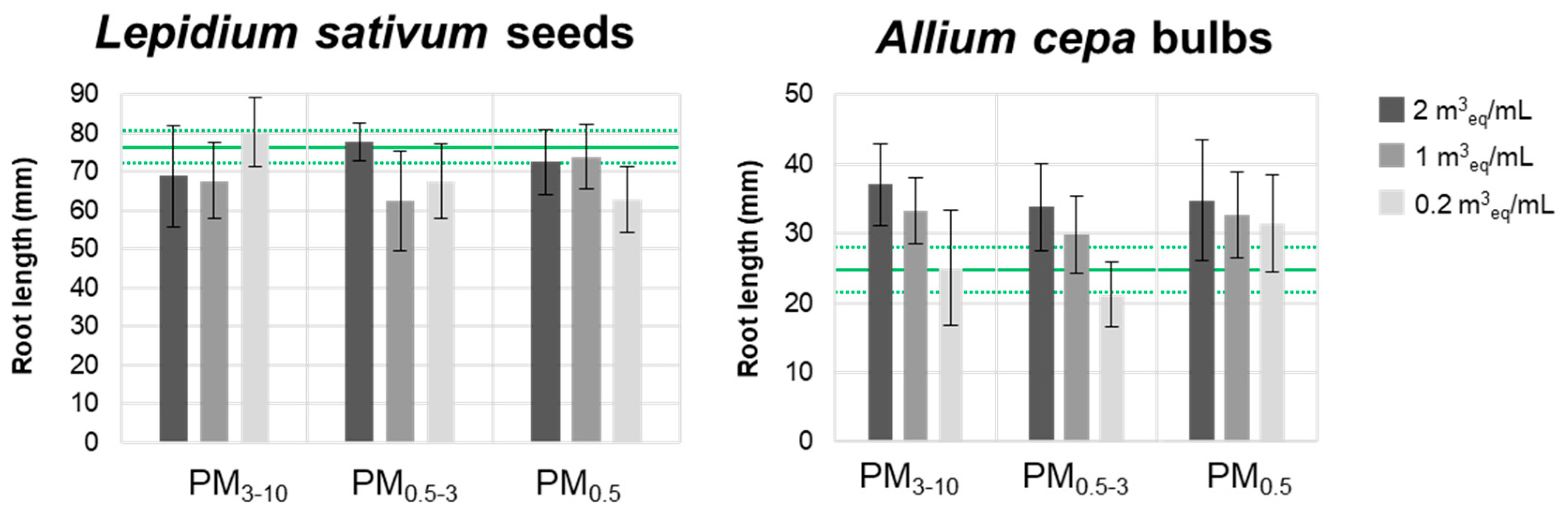
The toxicity of leachates obtained from the aqueous extraction of the different fractions of PM10 was assessed through the root elongation of L. sativum seeds and A. cepa bulbs (Figure 1).
The results demonstrated that the samples had no adverse effect on plant growth, as indicated by the root lengths which were found to be within the range of the negative control values (samples vs. negative control according to t-test). Furthermore, in the case of A. cepa roots, the absence of macroscopic signs of toxicity was recorded, as well as, in the case of the undiluted extracts, a slight tendency for the growth process to be supported.

3.3. DNA Damaging Effect of Aqueous Extracts of PM3–10, PM0.5–3, and PM0.5 Fractions

Damage to the DNA was assessed on seedlings of L. sativum and on bulbs of A. cepa previously subjected to the root elongation test using the comet test (Table 2). The assessment of DNA damage in both the plant was carried out on samples at doses 2 and 1 m3eq/mL, due to the absence of toxicity. The comet test on both plants showed a significant DNA-damaging effect caused by the exposure to the undiluted extract of finest fractions PM0.5–3 (TIL.sativum = 13.0 ± 1.1 and TIA.cepa = 12.3 ± 2.3) and PM0.5 (TIL.sativum = 12.9 ± 1.7 and TIA.cepa = 11.7 ± 1.7). No genotoxic effects were caused by the PM3–10 fraction.

3.4. Genotoxic Effect of Aqueous Extracts of PM3–10, PM0.5–3, and PM0.5 Fractions

The genotoxicity of aqueous extracts of PM10 fractions was evaluated in terms of micronuclei (MN) on A. cepa bulbs that had already been used in the toxicity assessment (Table 3). The onions exposed to the two highest doses (2 and 1 m3eq/mL) of each fraction were considered.
The absence of cytotoxic effects was confirmed by the evaluation of the mitotic index alteration. Indeed, the MIA% values were all well above the 70%. Regarding the genotoxic effect, only the undiluted extract of the PM0.5 fraction caused a significant increase in the frequency of micronuclei (MN = 0.14 ± 0.07). None of the samples induced the formation of nuclear buds.

4. Discussion

The genotoxicological characteristics of water extracts derived from fractions of urban fine particulate matter were elucidated through the utilisation of a comprehensive battery of assays based on plant models.
The genotoxicity assessment on L. sativum seedlings and A. cepa bulbs demonstrated that both plants exhibited the capacity to detect early DNA damaging effects caused by the two finest fractions of PM10 (PM0.5–3 and PM0.5), with a comparable sensitivity. Interestingly, the stable chromosomal alteration effect, evidenced by an increased micronuclei frequency, was detected and found to be associated with the finest PM fraction (PM0.5) extract. These findings are consistent with the extant literature, which demonstrates that finer fractions are those with higher concentrations of chemical substances capable of inducing genotoxic and mutagenic damage.
The combination of PM aqueous extracts and plant-based tests proved to be effective in highlighting the importance of PM0.5 as a mixture capable of damaging DNA, both in terms of primary damage (DNA breaks) and stable damage (micronuclei). Notably, even if the lower doses were not statistically significant, there is an indication of dose–response relationship, as evidenced by the linear correlation among the values.
Concurrently, the method based on bacteria evidenced the mutagenicity of organic extracts of the finest fractions derived from the same air collection.
The endpoints measured by plant assays represent distinct layers of genotoxic information, allowing the detection of additional types of genetic damage not captured by bacterial systems. Consequently, plant models have the potential to serve as effective complementary screening tools in relation to Ames testing.
The two extraction methods result in markedly divergent mixtures, in terms of composition and mixture quality. As widely known, the organic preparation is characterised by an enrichment in polycyclic aromatic hydrocarbons (PAHs) and nitro-PAHs, including carcinogenic PAHs such as benzo(a)pyrene [11,12], while the aqueous fraction accumulates water-soluble elements such as metals and semimetals [10].
The chemically distinct nature of the mixtures precludes direct comparison of the biological responses observed in the two systems. It is evident that the plant assays cannot be regarded as direct substitutes for the Ames test, even when employing the same exposure matrix.
In this study, the numerous advantages correlated to the evaluation of the genotoxicity of aqueous extracts by means of plants are highlighted. Indeed, the results demonstrate that plants appear sensitive enough to show genotoxic effects of only a few equivalent m3 of air samples, thus reducing the volume of air sampled needed for the tests by two or more orders of magnitude compared to those required by the bacteria-based tests. Indeed, a complete plant-based experiment (almost three doses, each tested in triplicate) needs nearly 10 m3, while a comprehensive Ames test (almost three doses, each dose on triple plate, two strains, ±S9) needs almost 2000 m3. This also has the added advantage of reduced time frames, which in turn generates the benefit of enabling the planning of shorter and more easily managed sampling campaigns and avoiding the necessity of using a high-volume air sampler. Moreover, the preparation of aqueous samples is a significantly quicker, less laborious and less expensive process than organic extraction. It should be noted that the procedure circumvents the necessity for organic solvents, obviates the removal step of evaporation, and eliminates the drying of the sample under a nitrogen current. The extraction process is completed expeditiously, with the extract ready for the analysis within 60–90 min from the extraction commencement. This is in stark contrast to the conventional organic extraction method, which necessitates a duration of several days. Interestingly, this approach is in compliance with the United Nations 2030 Agenda for Sustainable Development [52]. In particular, the responsible management of chemical reagents is in accordance with the Goal 12, which aims to “ensure sustainable consumption and production patterns”. This represents a fundamental imperative even in the field of scientific research, with a particular emphasis on avoiding the use of reagents that have a significant impact on the environment and human health in terms of production, use and disposal.
In addition, aqueous extracts are the most reliable representation of the solution that would be produced in the natural environment as a result of water-leached airborne contaminants, in comparison to other extraction techniques. Indeed, although plants predominantly absorb PM through their leaves, root adsorption constitutes a significant route of PM exposure, particularly to heavy metals [53,54].
Plants interact directly with the terrestrial and atmospheric environment, they are sensitive to different contaminants present in complex matrices, they possess cellular responses similar to those of animal organisms and, from an ethical point of view, their use in experimentation is more acceptable and more easily achievable [55]. For this reason, the use of plants for toxicity assays has acquired considerable importance in recent years with experiments carried out both in vivo and in vitro.
The utilisation of plants is accompanied by certain disadvantages, including the presence of significant biological variability, the lack of standardisation of methods, and, in certain instances, seasonal availability constraints. However, the advantages offered by this method are numerous: (i) it is possible to perform in vitro, in vivo and in situ experiments (ranging from cell cultures to entire organisms); (ii) various parts of the organism can be used for analysis (e.g., leaves, roots, pollen, isolated cells); (iii) it is possible to analyse different endpoints (e.g., toxicity, genotoxicity, mutagenicity) in the same organism; (iv) it is possible to correlate the results with other biological systems; (v) this method allows the avoidance of the ethical constraints associated with animal testing [56,57]; (vi) it is low-cost and easy to use.
It is also noteworthy that the same organisms are used to assess a range of different endpoints. The toxicological workflow has been documented by several authors who have investigated the toxicity and genotoxicity of chemicals on plants using the same organisms, which were subsequently subjected to different assessments. In a study published in 2022 [58], Passatore and colleagues investigated the effects of bismuth exposure on L. sativum seedlings. Similarly, Pietrini and colleagues [59] investigated the physiological and genotoxic effects of phthalate on Lemna minor and Spirodela polyrhiza.
The present research was focused on the effects of PM10, subdivided into three granulometric fractions. The specific fraction PM2.5, which is the smallest considered by the international air quality regulations and guidelines [60,61,62],was not included among them due to a technical limitation related to the air sampler capacity. This could be interpreted as a weakness. Notwithstanding, the objective of this study was to compare the genotoxic activity of three distinct granulometric fractions (namely, coarse, fine and ultrafine) of PM10 on plant cells.
Another potential drawback of this study could be the absence of chemical characterisation of PM extracts. This issue may be resolved through the use of consistent sources from the literature [10,15,63], which provide support for the estimation of the air composition of the city of interest. However, a more significant aspect is the emphasis placed on evaluating the direct effects of potential genotoxic air pollutants on plant organisms. Indeed, the plant-based tests are a reliable and sensitive tool capable of accentuating the synergistic effects of mixtures.
In general, biological assays are considered powerful tools precisely because of their independence from a necessarily predetermined analytical characterisation, which in any case does not necessarily guarantee the complete description of a sample [64,65,66].
Among the plant models, A. cepa holds a distinctive position of interest due to its unique characteristics in the context of genotoxicity research. Indeed, there is a notable correlation between the findings obtained through this model and the data derived from carcinogenesis studies in mammals [67,68].
From a public health perspective, the strategy outlined can be considered a potential measure implemented by regulatory authorities within the framework of ongoing monitoring programmes, encompassing various environmental matrices such as air, water, and soil.
From this perspective, the employment of the plant model in genotoxicity research is advantageous for three principal reasons: (i) its relatively minimal resource requirements; (ii) its expeditious execution of sample preparation and resultant data acquisition; (iii) the substantial relevance of the knowledge it engenders. Furthermore, the proposed methodologies (comet assay and micronuclei test) have the potential to be implemented with automated data analysis in high-throughput versions [69,70]. This could assist regulatory laboratories in acquiring a greater volume of data within a reduced timeframe, thereby facilitating the implementation of such an approach.

5. Conclusions

The findings presented indicate that air pollutants extractable in aqueous matrices, although not toxic, can elicit genotoxic effects (primary DNA damage and MN formation) in two plant models (L. sativum seeds and A. cepa bulbs). This highlights the valuable role of the combination of aqueous extracts of PM10 and plant-based model as a reliable screening-level tool for assessing urban air quality to complement Ames testing.
The incorporation of this multi-model approach into regulatory authorities’ established monitoring programmes would be a significant advantage.

Supplementary Materials

The following supporting information can be downloaded at https://www.mdpi.com/article/10.3390/environments13030170/s1. Table S1: Amount of PM10 fractions collected. Table S2: Mutagenic activity of organic extracts of different granulometric fractions of PM10 in Salmonella typhimurium strains TA98 and TA100, without and with metabolic activation (±S9). Data are expressed as revertants/plate (mean ± SD).

Author Contributions

Conceptualization, C.A., I.Z. and D.F.; methodology, C.A. and I.Z.; formal analysis, I.Z.; investigation, C.A. and I.Z.; resources, C.Z. and D.F.; data curation, C.A. and I.Z.; writing—original draft preparation, C.A.; writing—review and editing, C.Z., I.Z. and D.F. All authors have read and agreed to the published version of the manuscript.

Funding

This research received no external funding.

Data Availability Statement

The raw data supporting the conclusions of this article will be made available by the authors on request.

Conflicts of Interest

The authors declare no conflicts of interest.

Abbreviations

The following abbreviations are used in this manuscript:
ANOVAAnalysis of variance
BMBlank membrane
BPBand pass
DMSODimethyl sulfoxide
LPLong pass
MIMitotic index
MIAMitotic index alteration
MMSMethyl methanesulfonate
MNMicronuclei
MRMutagenicity ratio
NBNuclear bud
PMParticulate matter
SDStandard deviation
SEStandard error
TITail intensity

References

  1. EEA. How Air Pollution Affects Our Health. European Environment Agency Reports. 2023. Available online: https://www.eea.europa.eu/en/topics/in-depth/air-pollution/eow-it-affects-our-health (accessed on 3 June 2024).
  2. EEA. Europe’s Air Quality Status 2023. European Environment Agency Reports. 2023. Available online: https://www.eea.europa.eu/publications/europes-air-quality-status-2023 (accessed on 17 July 2025).
  3. Stafoggia, M.; De’ Donato, F.; Ancona, C.; Ranzi, A.; Michelozzi, P. Health impact of air pollution and air temperature in Italy: Evidence for policy actions. Epidemiol. Prev. 2023, 47, 22–31. [Google Scholar] [CrossRef]
  4. Khomenko, S.; Cirach, M.; Pereira-Barboza, E.; Mueller, N.; Barrera-Gómez, J.; Rojas-Rueda, D.; De Hoogh, K.; Hoek, G.; Nieuwenhuijsen, M. Premature mortality due to air pollution in European cities: A health impact assessment. Lancet Planet. Health 2021, 5, e121–e134. [Google Scholar] [CrossRef]
  5. Ministerial Decree “Decreto Legislativo 13 Agosto 2010, n. 155 Attuazione Della Direttiva 2008/50/CE Rlativa alla Qualità Dell’aria Ambiente e per un’aria più Pulita in Europa.” 2010. Available online: https://www.gazzettaufficiale.it/eli/id/2010/09/15/010G0177/sg (accessed on 2 March 2026).
  6. Legambiente. MalAria. 2026. Available online: https://www.legambiente.it/wp-content/uploads/2026/02/MalAria-report-2026.pdf (accessed on 2 March 2026).
  7. ARPA Lombardia. Emissioni di Materiale Particolato <10 Microgrammi. ARPA. 2025. Available online: https://www.arpalombardia.it/indicatori/2024/inventario-emissioni/emissioni-di-materiale-particolato-10-microgrammi/ (accessed on 18 February 2026).
  8. European Commission. Air Quality: Commission Urges Italy to Take Action Against Small Particulate Matter (PM10) to Safeguard Public Health. 2017. Available online: http://europa.eu/rapid/press-release_IP-17-1046_en.htm (accessed on 15 January 2026).
  9. Quezada-Maldonado, E.M.; Sánchez-Pérez, Y.; Chirino, Y.I.; García-Cuellar, C.M. Airborne particulate matter induces oxidative damage, DNA adduct formation and alterations in DNA repair pathways. Environ. Pollut. 2021, 287, 117313. [Google Scholar] [CrossRef]
  10. Feretti, D.; Pedrazzani, R.; Ceretti, E.; Dal Grande, M.; Zerbini, I.; Viola, G.C.V.; Gelatti, U.; Donato, F.; Zani, C. “Risk is in the air”: Polycyclic aromatic hydrocarbons, metals and mutagenicity of atmospheric particulate matter in a town of Northern Italy (Respira study). Mutat. Res. 2019, 842, 35–49. [Google Scholar] [CrossRef] [PubMed]
  11. Zani, C.; Ceretti, E.; Feretti, D.; Villarini, M.; Moretti, M.; Verani, M.; De Donno, A.; Bonetta, S.; Buschini, A.; Bonetti, A.; et al. Winter air pollution and genotoxic effects in children living in a highly polluted urban area. Atmosphere 2021, 12, 1191. [Google Scholar] [CrossRef]
  12. Bonetta, S.; Bonetta, S.; Schilirò, T.; Ceretti, E.; Feretti, D.; Covolo, L.; Vannini, S.; Villarini, M.; Moretti, M.; Verani, M.; et al. Mutagenic and genotoxic effects induced by PM0.5 of different Italian towns in human cells and bacteria: The MAPEC_LIFE study. Environ. Pollut. 2019, 245, 1124–1135. [Google Scholar] [CrossRef] [PubMed]
  13. ARPA Lombardia. IPA (B(a)P) e Metalli (As, Cd, Ni, Pb) Nella Frazione PM10 del Particolato. 2023. Available online: https://www.arpalombardia.it/indicatori/2023/aria/ipa-b-a-p-e-metalli-as-cd-ni-pb-nella-frazione-pm10-del-particolato/ (accessed on 18 February 2026).
  14. Ceretti, E.; Zani, C.; Zerbini, I.; Viola, G.; Moretti, M.; Villarini, M.; Dominici, L.; Monarca, S.; Feretti, D. Monitoring of volatile and non-volatile urban air genotoxins using bacteria, human cells and plants. Chemosphere 2015, 120, 221–229. [Google Scholar] [CrossRef]
  15. Zani, C.; Donato, F.; Ceretti, E.; Pedrazzani, R.; Zerbini, I.; Gelatti, U.; Feretti, D. Genotoxic activity of particulate matter and in vivo tests in children exposed to air pollution. Int. J. Environ. Res. Public Health 2021, 18, 5345. [Google Scholar] [CrossRef]
  16. Santibáñez-Andrade, M.; Quezada-Maldonado, E.M.; Rivera-Pineda, A.; Chirino, Y.I.; García-Cuellar, C.M.; Sánchez-Pérez, Y. The Road to Malignant Cell Transformation after Particulate Matter Exposure: From Oxidative Stress to Genotoxicity. Int. J. Mol. Sci. 2023, 24, 1782. [Google Scholar] [CrossRef]
  17. Hill, W.; Lim, E.L.; Weeden, C.E.; Lee, C.; Augustine, M.; Chen, K.; Kuan, F.C.; Marongiu, F.; Evans, E.J., Jr.; Moore, D.A. Lung adenocarcinoma promotion by air pollutants. Nature 2023, 616, 159–167. [Google Scholar] [CrossRef]
  18. OECD. Test No. 471: Bacterial Reverse Mutation Test; OECD: Paris, France, 2020. [Google Scholar] [CrossRef]
  19. OECD. Test No. 487: In Vitro Mammalian Cell Micronucleus Test; OECD: Paris, France, 2016. [Google Scholar] [CrossRef]
  20. OECD. Test No. 489: In Vivo Mammalian Alkaline Comet Assay; OECD: Paris, France, 2016. [Google Scholar] [CrossRef]
  21. Migliore, L. Genomica e Mutagenesi Ambientale; Zanichelli: Bologna, Italy, 2018. [Google Scholar]
  22. APAT. Technical Guide on Analytical Methods for Soil and Contaminated Sites; Agenzia per la Protezione dell’Ambiente e per i servizi Tecnici: Rome, Italy, 2004; pp. 1–161. (In Italian) [Google Scholar]
  23. United States Environmental Protection Agency. Ecological Effects Test Guidelines. OPPTS 850.4200. Seed Germination/Root Elongation Toxicity Test; United States Environmental Protection Agency: Washington, DC, USA, 1996; pp. 1–8. [Google Scholar]
  24. de Souza, C.P.; Guedes Tde, A.; Fontanetti, C.S. Evaluation of herbicides action on plant bioindicators by genetic biomarkers: A review. Environ. Monit. Assess. 2016, 188, 694. [Google Scholar] [CrossRef] [PubMed]
  25. Menzyanova, N.G.; Shishatskaya, E.I.; Pyatina, S.A.; Volova, T.G. Cytogenotoxic activity of herbicidal and fungicidal pesticides on Triticum aestivum root meristem. Environ. Sci. Pollut. Res. 2022, 29, 87602–87612. [Google Scholar] [CrossRef]
  26. Chowdhary, P.; Singh, A.; Chandra, R.; Kumar, P.S.; Raj, A.; Bharagava, R.N. Detection and identification of hazardous organic pollutants from distillery wastewater by GC-MS analysis and its phytotoxicity and genotoxicity evaluation by using Allium cepa and Cicer arietinum L. Chemosphere 2022, 297, 134123. [Google Scholar] [CrossRef]
  27. Alias, C.; Bulgari, D.; Gobbi, E. It Works! Organic-Waste-Assisted Trichoderma spp. Solid-State Fermentation on Agricultural Digestate. Microorganisms 2022, 10, 164. [Google Scholar] [CrossRef]
  28. Alias, C.; Zerbini, I.; Abbà, A.; Benassi, L.; Gelatti, U.; Sorlini, S.; Piovani, G.; Feretti, D. Ecotoxicity Evaluation of Industrial Waste and Construction Materials: Comparison between Leachates from Granular Steel Slags and Steel Slags-containing Concrete through a Plant-based Approach. Bull. Environ. Contam. Toxicol. 2023, 111, 3. [Google Scholar] [CrossRef] [PubMed]
  29. Fiskesjö, G. The Allium test as a standard in environmental monitoring. Hereditas 1985, 102, 99–112. [Google Scholar] [CrossRef]
  30. Ma, T.-H.; Cabrera, G.L.; Owens, E. Genotoxic agents detected by plant bioassays. Rev. Environ. Health 2005, 20, 1–13. [Google Scholar] [CrossRef]
  31. Tedesco, S.B.; Laughinghouse, H.D., IV. Bioindicator of Genotoxicity: The Allium cepa Test. In Environmental Contamination; Srivastava, J.K., Ed.; IntechOpen: Rijeka, Croatia, 2012. [Google Scholar] [CrossRef]
  32. Ragazzo, P.; Feretti, D.; Monarca, S.; Dominici, L.; Ceretti, E.; Viola, G.; Piccolo, V.; Chiucchini, N.; Villarini, M. Evaluation of cytotoxicity, genotoxicity, and apoptosis of wastewater before and after disinfection with performic acid. Water Res. 2017, 116, 44–52. [Google Scholar] [CrossRef]
  33. Felisbino, K.; Santos-Filho, R.; Piancini, L.D.S.; Cestari, M.M.; Leme, D.M. Mesotrione herbicide does not cause genotoxicity, but modulates the genotoxic effects of Atrazine when assessed in mixture using a plant test system (Allium cepa). Pestic. Biochem. Physiol. 2018, 150, 83–88. [Google Scholar] [CrossRef]
  34. Gupta, K.; Srivastava, S.; Saxena, G.; Kumar, A. Evaluation of Phytoremediation Potential of Pteris vittata L. on Arsenic Contaminated Soil Using Allium cepa Bioassay. Bull. Environ. Contam. Toxicol. 2022, 108, 423–429. [Google Scholar] [CrossRef] [PubMed]
  35. Bonciu, E.; Firbas, P.; Fontanetti, C.S.; Wusheng, J.; Karaismailoğlu, M.C.; Liu, D.; Menicucci, F.; Pesnya, D.S.; Popescu, A.; Romanovsky, A.V. An evaluation for the standardization of the Allium cepa test as cytotoxicity and genotoxicity assay. Caryologia 2018, 71, 191–209. [Google Scholar] [CrossRef]
  36. Firbas, P.; Amon, T. Chromosome damage studies in the onion plant Allium cepa L. Caryologia 2014, 67, 25–35. [Google Scholar] [CrossRef]
  37. Grant, W.F. The present status of higher plant bioassays for the detection of environmental mutagens. Mutat. Res. 1994, 310, 175–185. [Google Scholar] [CrossRef] [PubMed]
  38. Grant, W.F.; Salamone, M.F. Comparative mutagenicity of chemicals selected for test in the International Program on Chemical Safety’s collaborative study on plant systems for the detection of environmental mutagens. Mutat. Res. Mol. Mech. Mutagen. 1994, 310, 187–209. [Google Scholar] [CrossRef]
  39. Aksoy, Ö. Detection of Environmental Mutagens Through Plant Bioassays. In Plant Ecology—Traditional Approaches to Recent Trends; Yousaf, Z., Ed.; IntechOpen: London, UK, 2017. [Google Scholar] [CrossRef]
  40. Ma, T.-H. The international program on plant bioassays and the report of the follow-up study after the hands-on workshop in China. Mutat. Res. Fundam. Mol. Mech. Mutagen. 1999, 426, 103–106. [Google Scholar] [CrossRef]
  41. Ma, T.-H.; Xu, Z.; Xu, C.; McConnell, H.; Valtierra Rabago, E.; Adriana Arreola, G.; Zhang, H. The improved Allium/Vicia root tip micronucleus assay for clastogenicity of environmental pollutants. Mutat. Res. 1995, 334, 185–195. [Google Scholar] [CrossRef] [PubMed]
  42. Alias, C.; Zerbini, I.; Feretti, D. A scoping review of recent advances in the application of comet assay to Allium cepa roots. Environ. Mol. Mutagen. 2023, 64, 264–281. [Google Scholar] [CrossRef]
  43. Christensen, A.; Östman, C.; Westerholm, R. Ultrasound-assisted extraction and on-line LC–GC–MS for determination of polycyclic aromatic hydrocarbons (PAH) in urban dust and diesel particulate matter. Anal. Bioanal. Chem. 2005, 381, 1206–1216. [Google Scholar] [CrossRef]
  44. Carvalho-Oliveira, R.; Pozo, R.M.K.; Lobo, D.J.A.; Lichtenfels, A.J.F.C.; Martins-Junior, H.A.; Bustilho, J.O.W.V.; Saiki, M.; Sato, I.M.; Saldiva, P.H.N. Diesel emissions significantly influence composition and mutagenicity of ambient particles: A case study in São Paulo, Brazil. Environ. Res. 2005, 98, 1–7. [Google Scholar] [CrossRef]
  45. Maron, D.M.; Ames, B.N. Revised methods for the Salmonella mutagenicity test. Mutat. Res. 1983, 113, 173–215. [Google Scholar] [CrossRef]
  46. Baird, R.B.; Eaton, A.D.; Rice, E.W. Standard Methods For the Examination of Water and Wastewater, 23rd ed.; American Public Health Association: Washington, DC, USA, 2018; Available online: https://www.standardmethods.org/doi/book/10.2105/smww.2882 (accessed on 18 February 2026).
  47. UNI 11357; Water Quality—Determination of the Inhibition of the Seed Germination and Root Elongation of Cucumis sativus L. (cucumber), Lepidium sativum L. (Water Cress), Sorghum Saccharatum Moench (Sorghum) Short-Chronic Toxicity Test. Italian Organization for Standardization: Milan, Italy, 2010.
  48. Fiskesjö, G. Allium test. Methods Mol. Biol. 1995, 43, 119–127. [Google Scholar] [CrossRef]
  49. Liman, R.; Ciğerci, I.H.; Öztürk, N.S. Determination of genotoxic effects of Imazethapyr herbicide in Allium cepa root cells by mitotic activity, chromosome aberration, and comet assay. Pestic. Biochem. Physiol. 2015, 118, 38–42. [Google Scholar] [CrossRef]
  50. Cabaravdic, M. Induction of chromosome aberrations in the Allium cepa test system caused by the exposure of cells to benzo(a) pyrene. Med. Arh. 2010, 64, 215–218. [Google Scholar]
  51. Tzima, C.S.; Banti, C.N.; Hadjikakou, S.K. Assessment of the biological effect of metal ions and their complexes using Allium cepa and Artemia salina assays: A possible environmental implementation of biological inorganic chemistry. J. Biol. Inorg. Chem. 2022, 27, 611–629. [Google Scholar] [CrossRef]
  52. UN. Sustainable Development. 2026. Available online: https://sdgs.un.org/goals (accessed on 18 February 2026).
  53. Luo, X.; Bing, H.; Luo, Z.; Wang, Y.; Jin, L. Impacts of atmospheric particulate matter pollution on environmental biogeochemistry of trace metals in soil-plant system: A review. Environ. Pollut. 2019, 255, 113138. [Google Scholar] [CrossRef]
  54. Roy, A.; Mandal, M.; Das, S.; Popek, R.; Rakwal, R.; Agrawal, G.K.; Awasthi, A.; Sarkar, A. The cellular consequences of particulate matter pollutants in plants: Safeguarding the harmonious integration of structure and function. Sci. Total Environ. 2024, 914, 169763. [Google Scholar] [CrossRef] [PubMed]
  55. Arambašić, M.B.; Bjelić, S.; Subakov, G. Acute toxicity of heavy metals (copper, lead, zinc), phenol and sodium on Allium cepa L., Lepidium sativum L. and Daphnia magna St.: Comparative investigations and the practical applications. Water Res. 1995, 29, 497–503. [Google Scholar] [CrossRef]
  56. United Kindom National Centre for the 3Rs. The 3Rs. Available online: https://nc3rs.org.uk/who-we-are/3rs (accessed on 17 January 2023).
  57. Russell, W.M.S.; Burch, R.L. The Principles of Humane Experimental Technique; Methuen: London, UK, 1959. [Google Scholar]
  58. Passatore, L.; Pietrini, F.; Carloni, S.; Massimi, L.; Giusto, C.; Zacchini, M.; Iannilli, V. Morpho-physiological and molecular responses of Lepidium sativum L. seeds induced by bismuth exposure. Sci. Total Environ. 2022, 831, 154896. [Google Scholar] [CrossRef]
  59. Pietrini, F.; Iannilli, V.; Passatore, L.; Carloni, S.; Sciacca, G.; Cerasa, M.; Zacchini, M. Ecotoxicological and genotoxic effects of dimethyl phthalate (DMP) on Lemna minor L. and Spirodela polyrhiza (L.) Schleid. plants under a short-term laboratory assay. Sci. Total Environ. 2022, 806, 150972. [Google Scholar] [CrossRef] [PubMed]
  60. The European Parliament and The Council of the European Union. Directive 2008/50/EC of the European Parliament and of the Council of 21 May 2008 on Ambient Air Quality and Cleaner Air for Europe; The European Parliament and The Council of the European Union: Strasbourg, France, 2008. [Google Scholar]
  61. US EPA. National Ambient Air Quality Standards (NAAQS) for PM; US EPA: Washington, DC, USA, 2024. [Google Scholar]
  62. WHO. WHO Global air quality guidelines. In Particulate Matter (PM2.5 and PM10), Ozone, Nitrogen Dioxide, Sulfur Dioxide and Carbon Monoxide; WHO: Geneva, Switzerland, 2021. [Google Scholar]
  63. Monarca, S.; Crebelli, R.; Feretti, D.; Zanardini, A.; Fuselli, S.; Filini, L.; Resola, S.; Bonardelli, P.G.; Nardi, G. Mutagens and carcinogens in size-classified air particulates of a Northern Italian town. Sci. Total Environ. 1997, 205, 137–144. [Google Scholar] [CrossRef] [PubMed]
  64. Kortenkamp, A.; Faust, M. Regulate to reduce chemical mixture risk. Science 2018, 361, 224–226. [Google Scholar] [CrossRef] [PubMed]
  65. Escher, B.I.; Stapleton, H.M.; Schymanski, E.L. Tracking complex mixtures of chemicals in our changing environment. Science 2020, 367, 388–392. [Google Scholar] [CrossRef]
  66. Luo, Y.S.; Chen, Z.; Hsieh, N.H.; Lin, T.E. Chemical and biological assessments of environmental mixtures: A review of current trends, advances, and future perspectives. J. Hazard. Mater. 2022, 432, 128658. [Google Scholar] [CrossRef]
  67. Leme, D.M.; Marin-Morales, M.A. Allium cepa test in environmental monitoring: A review on its application. Mutat. Res. 2009, 682, 71–81. [Google Scholar] [CrossRef]
  68. Rank, J.; Nielsen, M.H. Evaluation of the Allium anaphase-telophase test in relation to genotoxicity screening of industrial wastewater. Mutat. Res. Mutagen. Relat. Subj. 1994, 312, 17–24. [Google Scholar] [CrossRef]
  69. Barbé, L.; Lam, S.; Holub, A.; Faghihmonzavi, Z.; Deng, M.; Iyer, R.; Finkbeiner, S. AutoComet: A fully automated algorithm to quickly and accurately analyze comet assays. Redox Biol. 2023, 62, 102680. [Google Scholar] [CrossRef]
  70. DiPeso, L.; Pendyala, S.; Huang, H.Z.; Fowler, D.M.; Hatch, E.M. Image-based identification and isolation of micronucleated cells to dissect cellular consequences. eLife 2025, 13, RP101579. [Google Scholar] [CrossRef] [PubMed]
Figure 1. The root elongation in L. sativum seeds and A. cepa bulbs (mean ± SD) treated with different dilutions of aqueous extracts of three PM10 fractions. Green continuous and dotted lines represent the reference values of negative control ± SD for both the seeds and the bulbs (77.4 ± 3.4 mm and 25.0 ± 4.0 mm, respectively).
Environments 13 00170 g001
Table 1. Mutagenic activity of organic extracts of different granulometric fractions of PM10 in Salmonella typhimurium strains TA98 and TA100, without and with metabolic activation (±S9). Data are expressed as mutagenicity ratios (MRs).
SampleDoseMR
(m3eq/Plate)TA98 − S9TA98 + S9TA100 − S9TA100 + S9
PM3–1075 0.91.31.31.4
501.11.91.21.4
251.21.00.81.1
PM0.5–375 4.84.41.72.3
503.13.11.71.6
251.92.41.51.4
PM0.575 3.83.81.52.0
502.73.81.61.6
252.11.71.51.4
BM-0.91.11.01.1
Significant results are reported in bold. Positive control results: TA98 (±S9) > 1000 revertants; TA100 (±S9) > 1000 revertants. BM: blank membrane.
Table 2. DNA damage of aqueous extracts of PM3–10, PM0.5–3, and PM0.5 fractions in Lepidium sativum and Allium cepa root cells. Data are expressed as mean tail intensity (TI) ± SD.
SampleDose (m3eq/mL)TI
Lepidium sativumAllium cepa
PM3–1028.4 ± 1.68.2 ± 0.9
17.1 ± 1.03.9 ± 3.1
PM0.5–3213.0 ± 1.1 *12.3 ± 2.3 *
18.5 ± 0.56.1 ± 4.6
PM0.5212.9 ± 1.7 *11.7 ± 1.7 *
19.2 ± 4.56.8 ± 4.0
Negative control 4.6 ± 0.83.4 ± 1.3
Positive control 17.8 ± 0.616.4 ± 0.6
Statistically significant versus negative control according to Dunnett’s test: * p < 0.05.
Table 3. Genotoxicity of aqueous extracts of PM3–10, PM0.5–3, and PM0.5 fractions in Allium cepa root cells, expressed as mitotic index alteration (MIA%) and frequency of micronuclei (MN; expressed as mean ± SD).
SampleDose
(m3eq/mL)
MIA%MN
PM3–102101.70.06 ± 0.07
1104.10.04 ± 0.05
PM0.5–3294.30.06 ± 0.02
179.90.07 ± 0.03
PM0.5296.70.14 ± 0.07 *
1106.70.08 ± 0.08
Negative control -0.03 ± 0.04
Positive control 71.30.28 ± 0.13
Statistically significant versus negative control according to Dunnett’s test: * p < 0.05.
Disclaimer/Publisher’s Note: The statements, opinions and data contained in all publications are solely those of the individual author(s) and contributor(s) and not of MDPI and/or the editor(s). MDPI and/or the editor(s) disclaim responsibility for any injury to people or property resulting from any ideas, methods, instructions or products referred to in the content.