Correction: Ittipong et al. Soil Moisture and Growth Rates During Peak Yield Accumulation of Cassava Genotypes for Drought and Full Irrigation Conditions. Environments 2025, 12, 420

 , , ,
, , , 
1. Error in Table
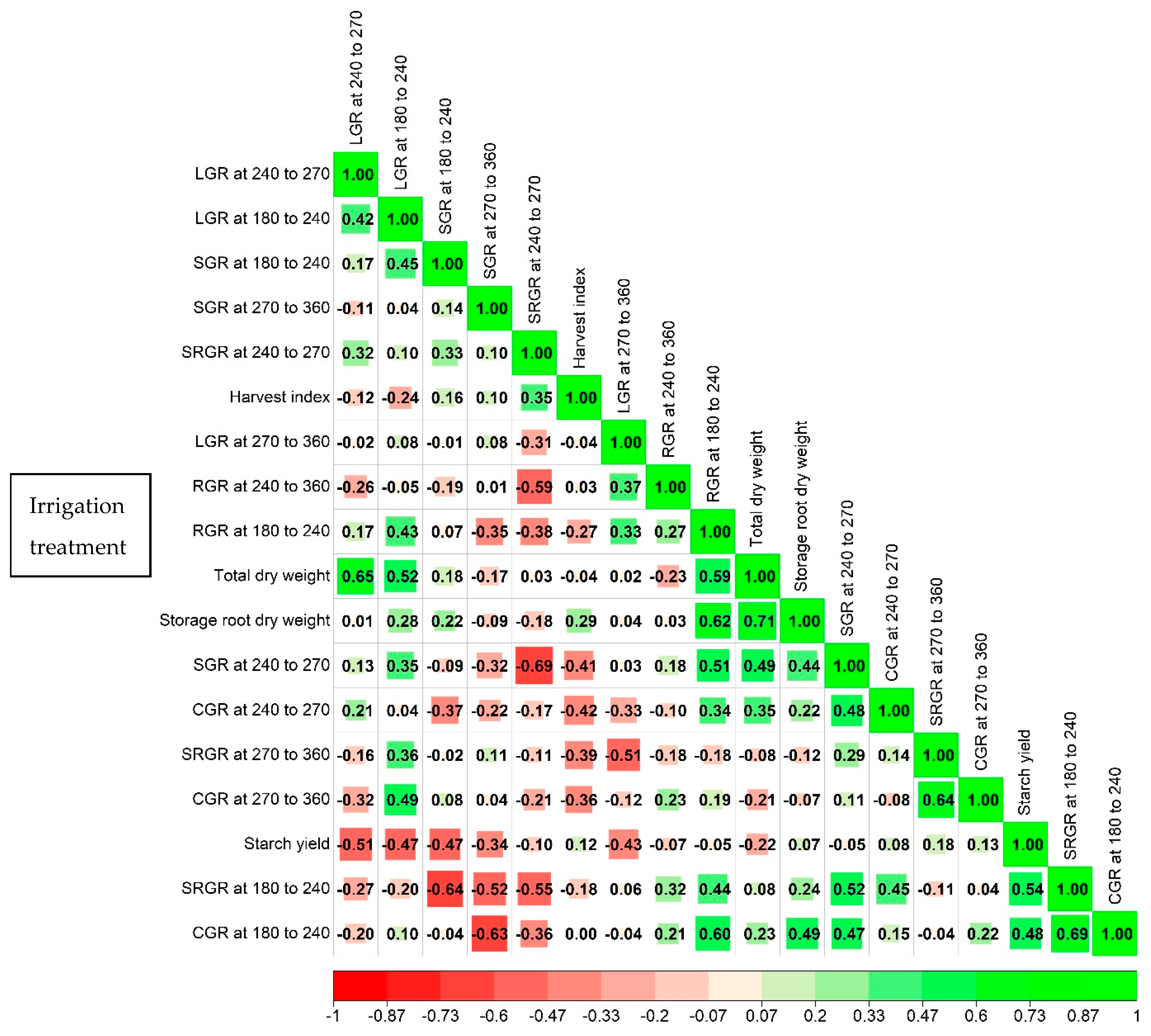
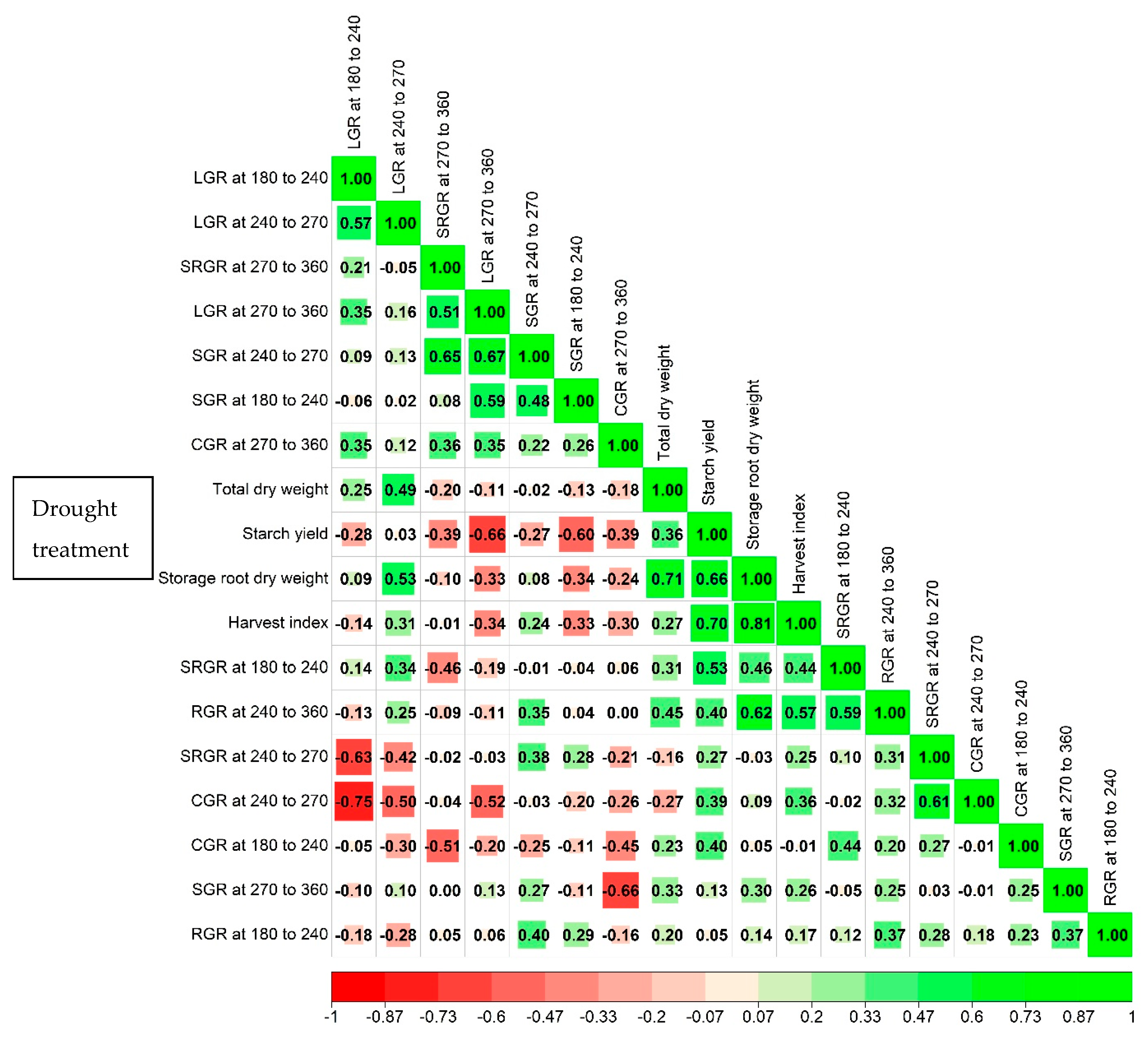
2. Error in Figure
3. Text Correction
- In the Abstract, the phrase “and starch yield” should be deleted and please replace the phrase “with SRGR and starch yield reduced by 26.4% and 9.5%, respectively” with “with SRGR and starch yield reduced by 16.9% and 7.4%.”
- In the Materials and Methods (Section 2.2., Equation (6)), please replace the word “storage root dry weight” with “storage root fresh weight”.
- In the Results (Section 3.4., paragraph 1), please replace the word “four metrics” with “three metrics”, replace the phrase “four crop characteristics” with “three crop characteristics”. The phrase “, and starch yield (5.28 t ha–1; p ≤ 0.01)”, “, and starch yield (6.00 t ha–1; p ≤ 0.01)”, “, and starch yield (p ≤ 0.05)”, “, and starch yield (3.87 t ha–1)” should be deleted.
- In the Results (Section 3.4., paragraph 2) and Conclusions, please replace the value “6.66 t ha–1” with “13.13 t ha–1”.
- In the Results (Section 3.5., paragraph 1), please replace the phrase “a negative correlation was observed between starch yield and LGR during 270–360 DAP (r = −0.50, p ≤ 0.01).” with “a negative correlation was observed between starch yield and LGR during 270–360 DAP (r = −0.66, p ≤ 0.01)”.
- In the Discussion (paragraph 1), the phrase “, and starch yield” should be deleted.
- In the Discussion (paragraph 3), the phrase “and starch yield” should be deleted.
- In the Discussion (paragraph 4), please replace the phrase “Despite yield reductions of –47.2% (storage root dry weight) and –25.9% (starch yield) in 2022/2023, and –73.6% for both traits in 2023/2024” with “Despite yield reductions of –46.1% (storage root dry weight) and –2.3% (starch yield) in 2022/2023, and reductions of –95.9% and –91.4% for storage root dry weight and starch yield, respectively, in 2023/2024”. The phrase “or starch yield,” should be deleted.
- In the Conclusions, the phrase “, and 6.00 t ha–1 for starch yield”, “and starch yield” should be deleted and please replace the phrase “starch yield (6.85 and 5.95 t ha−1, respectively)” with “starch yield (15.10 and 13.97 t ha−1, respectively)”.
Reference
- Ittipong, P.; Santanoo, S.; Vorasoot, N.; Jogloy, S.; Vongcharoen, K.; Theerakulpisut, P.; Lawson, T.; Banterng, P. Soil Moisture and Growth Rates During Peak Yield Accumulation of Cassava Genotypes for Drought and Full Irrigation Conditions. Environments 2025, 12, 420. [Google Scholar] [CrossRef]



| Genotype (G) | Total Dry Weight (t ha−1) | Storage Root Dry Weight (t ha−1) | Starch Yield (t ha−1) | Harvest Index | ||||||||||||||||||
|---|---|---|---|---|---|---|---|---|---|---|---|---|---|---|---|---|---|---|---|---|---|---|
| Irrigation | Drought | Reduction (%) | Irrigation | Drought | Reduction (%) | Irrigation | Drought | Reduction (%) | Irrigation | Drought | ||||||||||||
| 2022/2023 | ||||||||||||||||||||||
| Kasetsart 50 | 29.0 | B | 35.1 | A | −21.6 | B | 16.1 | BC | 26.7 | A | −66.9 | D | 18.17 | B | 19.97 | B | −10.2 | B | 0.56 | B | 0.76 | A |
| Rayong 9 | 31.6 | A | 37.4 | A | −18.3 | B | 17.5 | B | 22.8 | B | −30.9 | C | 17.00 | B | 18.51 | B | −9.5 | B | 0.55 | B | 0.62 | B |
| Rayong 72 | 23.3 | C | 30.0 | B | −29.4 | B | 15.2 | BC | 22.1 | B | −46.1 | C | 24.19 | A | 24.69 | A | −2.3 | B | 0.65 | A | 0.74 | A |
| CMR38–125–77 | 30.9 | AB | 24.5 | C | 20.2 | A | 21.5 | A | 16.4 | C | 22.7 | B | 11.71 | C | 11.00 | D | 5.9 | B | 0.69 | A | 0.67 | AB |
| CMR35–91–63 | 30.9 | AB | 25.6 | BC | 17.2 | A | 14.9 | C | 4.2 | D | 71.6 | A | 16.94 | B | 3.93 | E | 76.8 | A | 0.48 | C | 0.16 | C |
| CM523–7 | 19.1 | D | 26.2 | BC | −38.9 | B | 11.7 | D | 15.1 | C | −29.9 | C | 7.98 | D | 13.92 | C | −74.6 | C | 0.58 | B | 0.58 | B |
| F-test (G) | ** | ** | ** | ** | ** | ** | ** | ** | ** | ** | ** | |||||||||||
| Water regime (W) | 27.5 | b | 29.8 | a | −11.8 | 16.2 | b | 17.9 | a | −13.2 | 16.00 | 15.34 | −2.3 | 0.59 | 0.59 | |||||||
| F-test (W) | ** | ** | ns | ns | ||||||||||||||||||
| 2023/2024 | ||||||||||||||||||||||
| Kasetsart 50 | 34.9 | B | 25.1 | E | 27.9 | AB | 19.2 | C | 11.7 | C | 39.3 | A | 13.65 | A | 11.40 | BC | 15.0 | A | 0.55 | BC | 0.36 | E |
| Rayong 9 | 47.1 | A | 40.8 | A | 13.5 | B | 30.1 | A | 24.9 | A | 16.9 | AB | 15.10 | A | 13.97 | A | 7.4 | A | 0.64 | A | 0.58 | B |
| Rayong 72 | 34.8 | B | 29.8 | CD | 14.3 | B | 6.5 | E | 19.2 | B | −95.9 | C | 7.19 | C | 13.72 | AB | −91.4 | C | 0.60 | AB | 0.53 | C |
| CMR38–125–77 | 32.4 | B | 35.6 | B | −10.9 | C | 21.2 | C | 25.6 | A | −22.9 | AB | 10.70 | B | 13.13 | AB | −24.8 | B | 0.66 | A | 0.66 | A |
| CMR35–91–63 | 24.3 | C | 27.4 | DE | −14.2 | C | 11.2 | D | 16.7 | B | −49.2 | B | 7.60 | C | 10.12 | C | −35.0 | B | 0.50 | C | 0.48 | D |
| CM523–7 | 49.7 | A | 30.8 | C | 38.0 | A | 25.8 | B | 16.7 | B | 35.3 | A | 5.10 | D | 4.75 | D | 6.9 | A | 0.52 | BC | 0.54 | BC |
| F-test (G) | ** | ** | ** | ** | ** | ** | ** | ** | ** | ** | ** | |||||||||||
| Water regime (W) | 37.2 | a | 31.6 | b | 11.4 | 19.1 | 19.0 | −12.8 | 9.89 | B | 11.18 | A | −20.3 | 0.58 | a | 0.53 | b | |||||
| F-test (W) | ** | ns | * | * | ||||||||||||||||||
Disclaimer/Publisher’s Note: The statements, opinions and data contained in all publications are solely those of the individual author(s) and contributor(s) and not of MDPI and/or the editor(s). MDPI and/or the editor(s) disclaim responsibility for any injury to people or property resulting from any ideas, methods, instructions or products referred to in the content. |
© 2026 by the authors. Licensee MDPI, Basel, Switzerland. This article is an open access article distributed under the terms and conditions of the Creative Commons Attribution (CC BY) license.
Share and Cite
Ittipong, P.; Santanoo, S.; Vorasoot, N.; Jogloy, S.; Vongcharoen, K.; Theerakulpisut, P.; Lawson, T.; Banterng, P. Correction: Ittipong et al. Soil Moisture and Growth Rates During Peak Yield Accumulation of Cassava Genotypes for Drought and Full Irrigation Conditions. Environments 2025, 12, 420. Environments 2026, 13, 90. https://doi.org/10.3390/environments13020090
Ittipong P, Santanoo S, Vorasoot N, Jogloy S, Vongcharoen K, Theerakulpisut P, Lawson T, Banterng P. Correction: Ittipong et al. Soil Moisture and Growth Rates During Peak Yield Accumulation of Cassava Genotypes for Drought and Full Irrigation Conditions. Environments 2025, 12, 420. Environments. 2026; 13(2):90. https://doi.org/10.3390/environments13020090
Chicago/Turabian StyleIttipong, Passamon, Supranee Santanoo, Nimitr Vorasoot, Sanun Jogloy, Kochaphan Vongcharoen, Piyada Theerakulpisut, Tracy Lawson, and Poramate Banterng. 2026. "Correction: Ittipong et al. Soil Moisture and Growth Rates During Peak Yield Accumulation of Cassava Genotypes for Drought and Full Irrigation Conditions. Environments 2025, 12, 420" Environments 13, no. 2: 90. https://doi.org/10.3390/environments13020090
APA StyleIttipong, P., Santanoo, S., Vorasoot, N., Jogloy, S., Vongcharoen, K., Theerakulpisut, P., Lawson, T., & Banterng, P. (2026). Correction: Ittipong et al. Soil Moisture and Growth Rates During Peak Yield Accumulation of Cassava Genotypes for Drought and Full Irrigation Conditions. Environments 2025, 12, 420. Environments, 13(2), 90. https://doi.org/10.3390/environments13020090