Article

Assessing Virus Concentration Methods for Norovirus and SARS-CoV-2 Detection in Wastewater

by
Rakshya Baral
1,
Daniel A. Nwaubani
1,
Tamunobelema Solomon
1 and
Samendra P. Sherchan
1,2,*
1
Center of Research Excellence in Wastewater based Epidemiology, Morgan State University, Baltimore, MD 21251, USA
2
Organization for Public Health and Environmental Management, Lalitpur 44700, Nepal
*
Author to whom correspondence should be addressed.
Environments 2026, 13(2), 86; https://doi.org/10.3390/environments13020086
Submission received: 23 October 2025 / Revised: 9 January 2026 / Accepted: 12 January 2026 / Published: 4 February 2026
(This article belongs to the Special Issue Wastewater-Based Epidemiology Assessment and Surveillance)

Abstract

Polyethylene Glycol (PEG) precipitation and Nanotrap® Microbiome Particles (NMP) are widely used methods for concentrating viruses in wastewater due to their simplicity, cost-effectiveness, efficiency, and rapid turnaround time. This study compared the performance of these methods in detecting noroviruses (GI and GII) and SARS-CoV-2 collected from two wastewater treatment facilities using quantitative PCR. Norovirus was detected in all samples (23/23) using both protocols, but PEG yielded higher mean concentrations for GI and GII than NMP, indicating improved quantitative recovery for non-enveloped viruses. For SARS-CoV-2, NMP showed significantly higher positive ratios for the N2 gene (Fisher’s Exact Test, p < 0.01), but no significant difference was observed for the N1 gene (p > 0.05), indicating comparable performance between the methods for this target. These findings highlight PEG’s effectiveness for non-enveloped viruses and NMP’s suitability for enveloped viruses, emphasizing the importance of selecting virus concentration methods based on viral structure. This study provides a framework for optimizing wastewater-based epidemiology (WBE) protocols and enhancing public health surveillance for diverse viral targets. Future research should focus on refining these methodologies and exploring their applicability to other viral pathogens to enhance public health surveillance frameworks.

1. Introduction

Wastewater-based epidemiology (WBE) has emerged as a powerful tool in public health surveillance enabling the monitoring and detection of pathogens circulating in populations served by a wastewater catchment [1]. However, pathogens are often severely diluted in wastewater, making their detection challenging. Pathogens in wastewater include bacteria, viruses, protozoa, and fungi that vary in size and molecular weight. Bacteria typically range from 0.5 to 2 μm in size, while protozoa are generally larger, ranging from 1 to 15 μm [2,3]. The larger size and high molecular weight of bacteria and protozoa allow for excellent recovery from wastewater through economical and rapid methods of pathogen concentration, such as centrifugation or mechanical filtration through an appropriate pore-size membrane. In contrast, viruses are much smaller, typically ranging from 0.03 to 0.1 μm [4], making it more challenging to recover viruses from wastewater as mechanical filtration is often impossible.
Various virus concentration techniques have been developed and applied for optimum recovery of viruses from wastewater. These techniques include adsorption to an electronegative filter membrane in the presence of a cation [5] or an electropositive filter membrane [6,7], ultrafiltration [8], centrifugation [9], ultracentrifugation [10,11], precipitation using aluminum hydroxide adsorption [12,13] or activated charcoal [14] or moringa seeds [15] or Skimmed-Milk [16] or Polyethylene Glycol (PEG) [17,18,19], magnetic nanoparticle separation [20], and automated filtration with concentrating pipettes (CP Select, InnovaPrep, Drexel, MO, USA) [21,22,23]. When developing and refining virus concentration methods, it is crucial to consider factors such as recovery efficiency, simplicity, cost, time taken to process wastewater samples, analysis of sample volume, availability of reagents, and scalability [17,24].
Among the above-mentioned virus concentration methods, PEG precipitation is widely used for concentrating viruses in wastewater due to its simplicity, cost-effectiveness, and efficiency. PEG acts as a polymer that is hydrated by water molecules, reducing the solubility of proteins and facilitating the aggregation and precipitation of viral particles [24]. Similarly, bio-magnetic separation using Nanotrap® Microbiome Particles (NMPs) with the Thermo Scientific KingFisher system offers a rapid turnaround time, requires low sample volumes (as little as 5 mL), and is simple to perform without the need for complex laboratory equipment, making it ideal for quick on-site analysis. NMPs are highly porous hydrogel structures that utilize magnetic beads to capture and concentrate a wide range of analytes, including proteins, nucleic acids, and live pathogens. They attach to viral or pathogen-specific targets through surface interactions, enabling efficient separation through bio-magnetic techniques by applying a magnetic field, thus isolating the target molecules from complex mixtures [25]. The simplicity, specificity, and cost-effectiveness of magnetic nanotrap-based separation have garnered significant interest across various disciplines [26,27]. Recently, magnetic nanotrap particle-based techniques have been employed for detecting SARS-CoV-2 and other respiratory viruses like influenza and respiratory syncytial virus in wastewater, demonstrating the ability to simultaneously concentrate multiple viral targets [28,29,30].
This study aimed to assess both PEG precipitation and NMP for monitoring norovirus and SARS-CoV-2 in wastewater. Unlike previous studies that relied on lab-grown, spiked viral surrogates [25], this research analyzes endogenous viruses in wastewater, where the structure of virus is uncertain. Despite the growing use of PEG and NMP workflows, direct head-to-head comparisons using the same wastewater samples remain limited in the literature. Moreover, no previous study has simultaneously evaluated both norovirus (GI/GII) and SARS-CoV-2 (N1/N2) across these two concentration methods under identical experimental conditions. By generating method-specific quantitative performance metrics from the same set of endogenous wastewater samples, this study provides a unique and rigorous assessment of PEG versus NMP workflows.
Norovirus and SARS-CoV-2 were selected to represent non-enveloped and enveloped viruses, respectively, because both viruses are key targets for public health surveillance in wastewater. Norovirus is a leading cause of gastroenteritis worldwide, making it crucial for environmental monitoring [29,30]. Meanwhile, SARS-CoV-2, responsible for the recent COVID-19 pandemic, has driven the expansion of WBE for tracking respiratory viruses. This study addresses a critical gap in understanding the efficiency of the two methods for detecting endogenous non-enveloped and enveloped viruses in wastewater. Comparing the NMP method against the PEG precipitation method will help epidemiologists in selecting an effective approach to detect structurally different viruses in wastewater.

2. Materials and Methods

2.1. Wastewater Samples

Wastewater samples were collected from two wastewater treatment plants (WWTP-A and WWTP-B) in Baltimore, Maryland in between August and November 2023. WWTP-A serves an estimated 450,000 individuals with an average flow of 180 million gallons per day (MGD). WWTP-B serves approximately 1.3 million people with an average daily flow of ~73 MGD. Each of the 23 wastewater samples was processed once per method (PEG and NMP). Samples were transported to the laboratory under 4 °C and processed within 6 h of arrival at the lab. The pH, temperature, conductivity, TDS, and salinity of wastewater were measured onsite using a handheld multiparameter meter. These measurements were recorded for quality assurance but were not included as processing variables.

2.2. Polyethylene Glycol (PEG) Precipitation Workflow

Forty mL of wastewater was mixed with 4.0 g of PEG8000 (Sigma Aldrich, St.Louis, MO, USA) and 0.94 g of NaCl, followed by 10 min of vortex mixing to ensure complete PEG hydration [31]. No incubation or overnight precipitation step was included in this protocol. PEG precipitation was performed using a direct centrifugation approach, which had been previously applied in wastewater studies. The mixture was then centrifuged at 12,000× g for 100 min at 4 °C with no incubation, the sample was immediately centrifuged after vortexing, with no additional holding time [31,32]. The supernatant was discarded post-centrifugation leaving approximately 5 mL of sample, which was then centrifuged again under the same conditions for an additional 5 min. After discarding the supernatant, the sediment was reconstituted in 600 μL of PCR-grade water.
Nucleic acids were then extracted using the Allprep PowerViral DNA/RNA kit (QIAGEN, Germantown, MD, USA) according to the manufacturer’s instructions, yielding 100 μL of eluate.

2.3. NMP Workflow

NMP workflow is carried out automatically with ThermoFisher KingFisher Apex (Waltham, USA) instrument performing preset binding and mixing steps (15 min) followed by washing and elution (55 min). The NMP kit (Ceres Nanoscience Inc., Manassas, VA, USA) was used according to the manufacturer’s directions for virus concentration and nucleic acid extraction [33]. One liter of the sample collected from WWTP-A and WWTP-B was homogenized by shaking the bottle gently and incubated for 45 s in room temperature. Then, 4.9 mL of the homogenized sample was added to each of two separate KingFisher 24-well deep well plates. To these plates, 50 μL of Enhancement Reagent 1 and 500 μL of MagMax microbiome lysis solution were added, ensuring that the number and locations of wells matched. The process continued with the KingFisher automatic extraction system, where a binding plate was prepared with the lysate, MagMax binding solution (530 μL), proteinase K (10 μL), and binding beads (20 μL). Following this, 1 mL of wash buffer and 1 mL of 80% ethanol were added to additional matched 96-well plates. The final elution step involved adding MagMax elution buffer (100 μL), and after running the KingFisher protocol, 80 μL of eluate was obtained, ready for downstream analysis. The eluates from the two replicate wells were combined to yield a single 80 μL eluate per sample for downstream analysis.

2.4. Reverse Transcription (RT) and qPCR

Five microliters of RNA were reversed transcribed using a High-Capacity cDNA Reverse Transcription Kit with RNase inhibitor (Applied Biosystems, Waltham, MA, USA) according to the manufacturer’s instructions. A previously developed assay for detecting norovirus and SARS-CoV-2 was used [33,34]. The viral targets were assayed using a BioRad Opus CFX96 RT-qPCR machine (Bio-Rad Laboratories Inc., Hercules, CA, USA). Each target was tested on a 96-well plate, with 2.5 μL of sample (cDNA) added to labeled wells containing 22.5 μL of reaction mixture. The reaction mixture for each target included 12.5 μL of qPCR Toughmix (Quantabio, Beverly, MA, USA), forward and reverse primers (1.0 μL each, 10 µM), and molecular-grade water, with slight variations for probes and water volume as follows: NoV GI—FAM-labeled probes (Probe a: 1.5 μL, 10 µM and Probe b: 0.5 μL, 10 µM) and 6 μL of water; NoV GII—FAM-labeled probes (1.5 μL, 10 µM) and 6.5 μL of water; SARS-CoV-2 (N1 and N2)—FAM-labeled probes (1.5 μL, 10 µM) and 6.5 μL of water.
Standard curves were constructed by performing tenfold serial dilutions of gBlocks gene fragments (Integrated DNA Technologies (IDT), Coralville, IA, USA) for NoVGI, ranging from 4.0 × 10⁵ to 4.0 × 100 copies per reaction, and for NoVGII, ranging from 4.4 × 10⁵ to 4.4 × 100 copies per reaction. For SARS-CoV-2, serial dilutions ranged from 2.0 × 10⁵ to 2.0 × 100 copies per reaction. PCR-grade water served as the negative control, while the highest dilution of the gBlock standard was used as the positive control. All reactions were performed in duplicate (see Supplementary Table S1 for primer and probe sequences). The qPCR protocol for NoVGI and NoVGII included an initial denaturation step at 95 °C for 10 min, followed by 44 cycles at 95 °C for 45 s and 56 °C for 60 s. For SARS-CoV-2, the conditions were 95 °C for 10 min, followed by 45 cycles at 95 °C for 10 s and 55 °C for 30 s.
Data from the qPCR were exported to an Excel workbook, and analysis was based on Ct values below 40. The efficiencies for these assays ranged from 91% to 112%.

2.5. Statistical Analysis

All data sets were analyzed using R (v4.4.1) and RStudio (v2024.04.2+764). Scatter plots with regression lines were generated to visualize the relationship between the detection values of the two methods using R. The significance level for all analyses was set at p = 0.05. Additionally, to assess and compare the recovery efficiencies of PEG precipitation and NMP for detecting endogenous norovirus (GI and GII) and SARS-CoV-2 (N1 and N2 genes) in wastewater, a Welch Two Sample t-test was selected as the primary statistical analysis. This decision was guided by the nature of our data and the study’s objective to quantify differences in mean viral concentrations rather than merely the presence or absence of detection. The t-test is particularly suited for continuous data and provides a robust measure of whether the average recovery efficiency, in terms of viral load, significantly differs between the two methods. In contrast, Fisher’s Exact Test, which analyzes categorical or binary data, would be suitable for studies focused on detection frequency alone. However, our research seeks to establish which method, PEG or NMP, provides higher quantitative recovery, making the t-test an ideal choice for determining if there is a statistically significant difference in average viral concentrations recovered by each method.

3. Results

3.1. Comparison of Performance of PEG and NMP Workflows for Noroviruses

The present analysis (Table 1) indicates total of 23 samples were tested, and the percentage of positive detections along with the mean capture values (log10 copies/L) ± standard deviation was calculated for both methods. Both the PEG and NMP methods achieved 100% detection of norovirus GI and GII across all 23 samples tested.
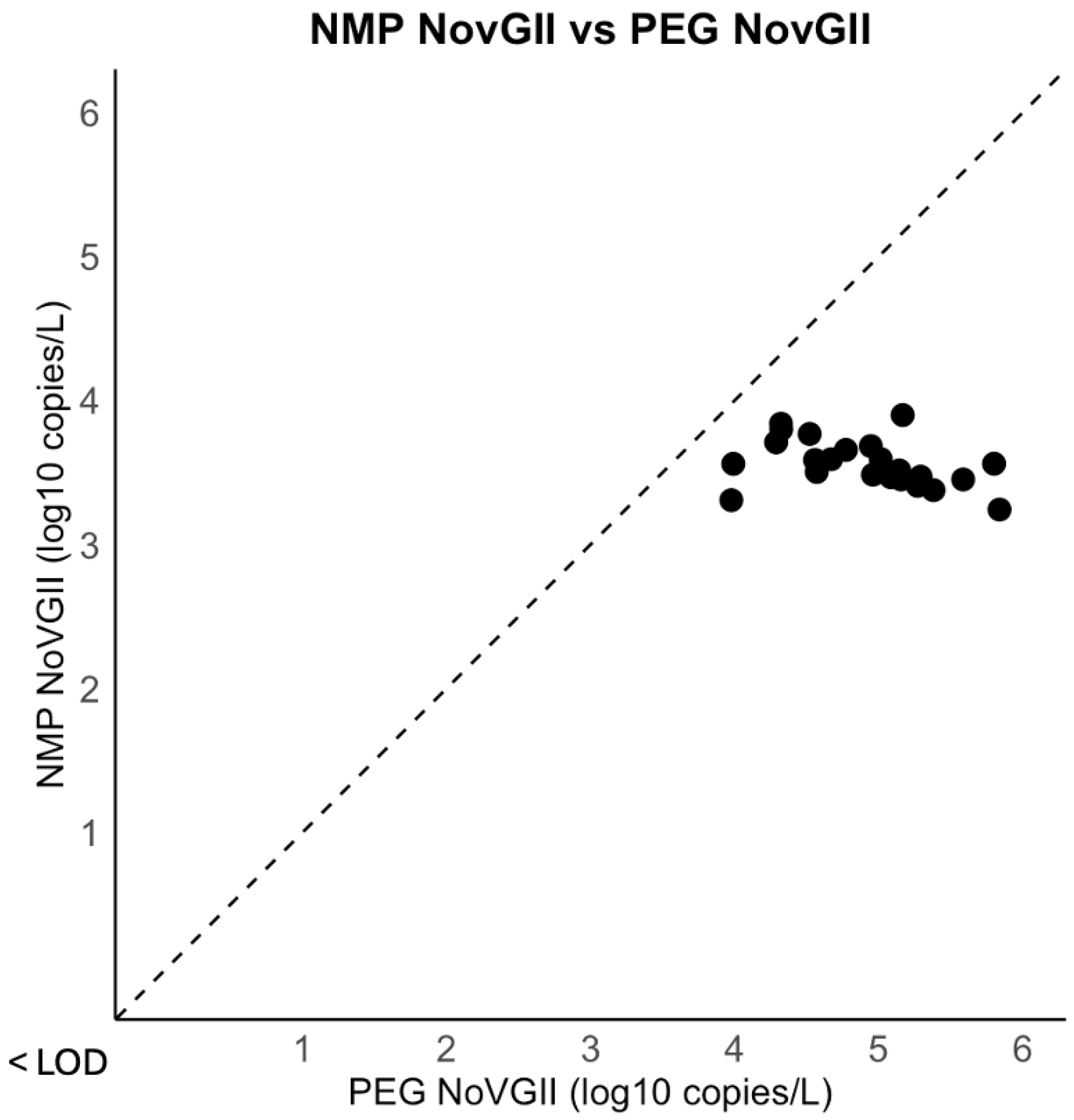
The PEG method demonstrated a higher quantitative recovery, with mean capture values of 3.9 log10 copies/L ± 0.24 for norovirus GI and 4.9 log10 copies/L ± 0.53 for norovirus GII. In comparison, the NMP method yielded mean capture values of 3.0 log10 copies/L ± 0.38 for Norovirus GI and 3.6 log10 copies/L ± 0.17 for norovirus GII. These results suggest that while both methods are effective for viral detection, PEG precipitation consistently provides higher recovery and concentration of viral particles for both GI and GII.
The scatter plots in Figure 1 and Figure 2 illustrate the comparison of norovirus concentrations detected by two different workflows—PEG and NMP—for genogroups I (NoV GI) and II (NoV GII). In both plots, the x-axis represents the concentrations detected using the PEG workflow, and the y-axis represents the concentrations detected using the NMP workflow, with all concentrations expressed in log10 copies per liter. In the plot for NoV GI, all the points are situated below the 1:1 line, indicating that the PEG workflow generally detects higher concentrations of NoV GI compared to the NMP workflow. The points are primarily clustered around 4 log10 copies/L for PEG and between 2 and 4 log10 copies/L for NMP, suggesting a consistent pattern where PEG detects significantly higher concentrations than NMP. Similarly, the plot for NoV GII shows that most points lie below the 1:1 line, indicating higher concentrations detected by the PEG workflow relative to the NMP workflow for NoV GII. The concentration values ranged from 4 to 5 log10 copies/L for PEG and from 2.5 to 4 log10 copies/L for NMP, reflecting the consistent quantitative difference observed between the two methods. This suggests that, like NoV GI, the PEG workflow is more effective in detecting and quantifying NoV GII concentrations in the samples. The results from both plots suggest that the PEG workflow consistently detects higher concentrations of each norovirus genogroups (GI and GII) compared to the NMP workflow. This indicates that PEG provides higher quantitative recovery for norovirus concentration and detection in wastewater samples.

3.2. Comparison of Performance of PEG and NMP Workflows for SARS-CoV-2

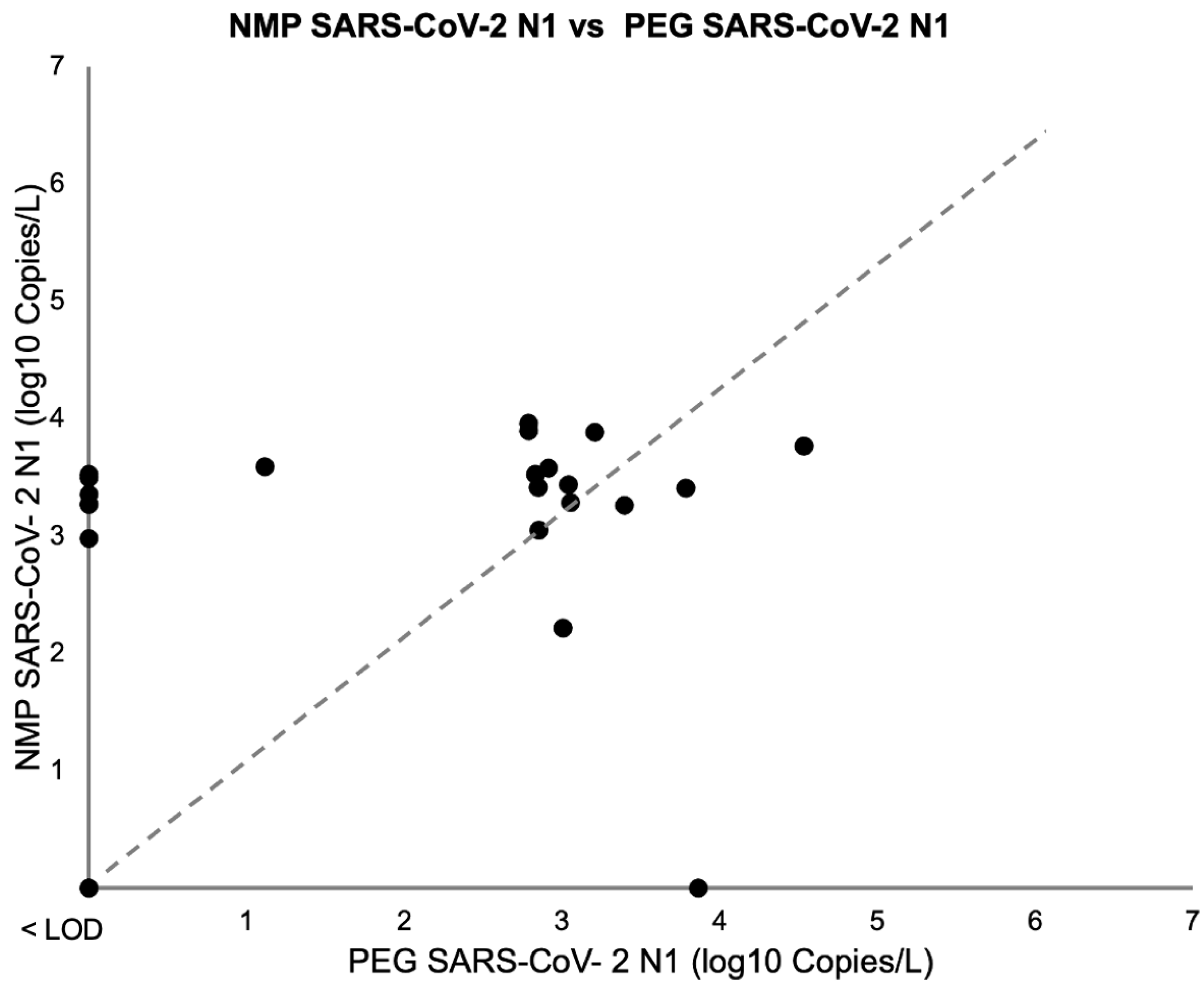
A total of 23 samples were tested, and the percentage of positive detections, along with the mean capture values (log10 copies/L) ± standard deviation, was calculated for both the NMP and PEG methods (Table 2). In analyzing 23 samples using both the NMP and PEG methods, the NMP method demonstrated an 86.96% positive detection rate for the SARS-CoV-2 N1 gene (20/23 samples) and a 91.30% rate for the SARS-CoV-2 N2 gene (21/23 samples). In comparison, the PEG method detected the SARS-CoV-2 N1 gene in 65.22% of samples (15/23) and the N2 gene in 52.17% of samples (12/23). The mean concentration values for the NMP method were 3.20 log10 copies/L ± 0.56 for SARS-CoV-2 N1 and 3.67 log10 copies/L ± 0.52 for N2. In contrast, the PEG method yielded mean concentrations of 2.33 log10 copies/L ± 1.12 for N1 and 2.11 log10 copies/L ± 0.96 for N2. These results highlight that the NMP method consistently achieves higher detection rates and improved recovery for SARS-CoV-2 N1 and N2 gene targets from wastewater samples compared to the PEG method.
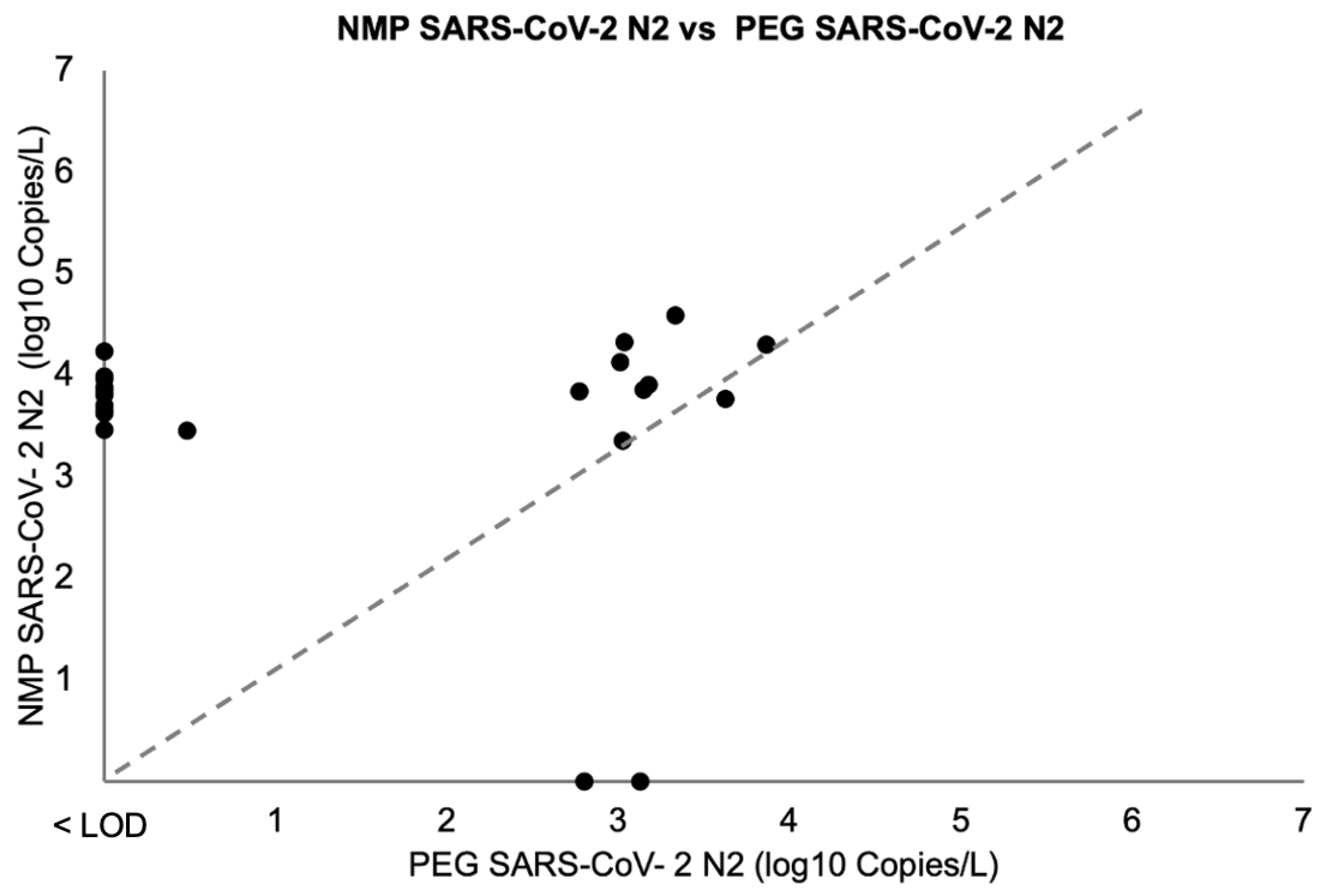
Figure 3 and Figure 4 display scatter plots comparing the detection efficiency of SARS-CoV-2 N1 and N2 genes in wastewater samples using two concentration methods, NMP and PEG. The dashed diagonal line in each plot represents the 1:1 ratio, indicating equal detection efficiency between methods. For SARS-CoV-2 N1, most data points are positioned above the 1:1 line, indicating that NMP generally detects higher concentrations compared to PEG. Specifically, NMP detected concentrations of SARS-CoV-2 N1 up to 4 log10 copies/L, while PEG concentrations mostly ranged between 0 and 3 log10 copies/L. This trend suggests that the NMP method may have a higher recovery efficiency for detecting SARS-CoV-2 N1 in wastewater samples. Similarly, for SARS-CoV-2 N2 (Figure 4), data points primarily lie above the 1:1 line, indicating that NMP detects higher concentrations than PEG for SARS-CoV-2 N2. Concentration levels for NMP reached up to 4 log10 copies/L, whereas PEG concentrations were generally lower, with a range of 0 to 3 log10 copies/L.
Consistent detection of higher SARS-CoV-2 N2 concentrations by the NMP method also supports its suitability for enhanced quantitative recovery of this enveloped virus in our dataset. These results highlight the superior performance of the NMP concentration method over PEG for detecting SARS-CoV-2 N1 and N2 genes at higher concentration levels, reinforcing NMP as a preferable method for monitoring SARS-CoV-2 in wastewater.

3.3. Statistical Comparison of Viral Recovery Efficiencies for Norovirus and SARS-CoV-2 Using PEG and NMP Methods

Statistical analyses of both detection frequencies and measured viral concentrations were performed to compare the quantitative performance of PEG and NMP workflows. Both workflows resulted in 100% detection for norovirus GI and GII on all 23 samples (Table 1), and no difference in detection rate between two methods. Quantitative recovery, however, was different for both genogroups. For both GI and GII, the PEG workflow led to significantly higher mean log10 concentrations than the NMP workflow. Welch Two-Sample t-test confirmed these differences: GI: PEG > NMP (t-test, p < 0.0001), GII: PEG > NMP (t-test, p < 0.0001). These results suggest that although both methods detect norovirus reliably, PEG achieves better quantitative recovery and higher viral loads for both genogroups.
Unlike norovirus, SARS-CoV-2 detected frequencies were variable between methods. NMP possessed higher detection ratios for N2 gene whereas N1 detection frequencies were similar between methods. Quantitative analyses also revealed gene-specific differences: N2 gene: NMP had significantly higher mean concentrations than PEG (t-test, p < 0.01). N1 gene: No statistically significant difference in mean concentration was observed between methods (t-test, p > 0.05). These results indicate that NMP can achieve better quantitative recovery for SARS-CoV-2 N2 gene and the two methods are similar for N1 gene.
We quantified positivity agreement for each SARS-CoV-2 gene target to assess detection overlap between workflows. For the N1 gene, 15 of 23 samples were positive by both methods, 5 positives by NMP and 3 negatives by both; no samples were positive only by PEG. For the N1 gene, NMP showed 20 positives, and 3 negatives and PEG showed 15 positives and 8 negatives. For the N2 gene, NMP showed 21 positives and 2 negatives and PEG showed 12 positives and 11 negatives.

4. Discussion

For non-enveloped norovirus detection, the PEG method demonstrated significantly higher mean concentration values compared to the NMP method (p < 0.0001), consistent with prior studies supporting PEG as a robust technique for environmental virus concentration [35]. In a study carried out by Angga et al. [36], coliphage MS2, a surrogate of non-enveloped viruses, PEG precipitation method demonstrated a significantly higher recovery rate to the NMP method. This difference can be attributed to the fact that non-enveloped viruses, such as norovirus and MS2, lack an outer envelope composed of phospholipids, making it likely that NMPs are less effective at binding to these viruses [37]. Viral concentrations were often associated with wastewater quality indicators such as turbidity, TDS, conductivity, and salinity. Higher levels of these parameters typically reflect greater particulate and organic content in the wastewater, which can carry more viral particles and therefore increase measured viral recovery. However, prior research revealed that high turbidity negatively impacts the efficiency of the NMP concentration method for pepper mild mottle virus [38,39] suggesting that different viruses are recovered at varying yields with this technique.
Conversely, the results revealed that while the detection ratio for the N1 gene was not statistically significant (p > 0.05), a significant difference was observed for the N2 gene (p < 0.01), with NMP demonstrating higher detection rate and an odds ratio of 0.109. These findings indicate that NMP recovered higher SARS-CoV-2 at low concentrations than PEG under the conditions tested, particularly for the N2 gene target. Based on these results, implementing multiple assays that target distinct viral genes can enhance detection accuracy and minimize false negatives. Targeting multiple regions of the viral genome helps compensate for variability in gene stability and recovery efficiency, especially in complex and low-concentration wastewater samples where certain genes may degrade more quickly or be less efficiently captured by specific methods. It is important to note that the N1 and N2 assays target different regions of the SARS-CoV-2 N gene and have different analytical limits of detection and quantification, which may contribute to the observed gene-specific differences in recovery.
For SARS-CoV-2, some samples had detectable concentrations with NMP but were below the limit of detection with PEG. One explanation is that some viral RNA may remain in the PEG/NaCl supernatant after centrifugation due to incomplete pelleting of viral particles or lysis with subsequent loss of free RNA in the discarded fraction. We did not quantify RNA in supernatants, and this hypothesis could not be directly evaluated and should be investigated in future optimization studies.
The potential areas of viral loss in the protocol must be addressed to optimize recovery. Viral decay during storage or processing can be mitigated by using stabilizing agents, such as RNA preservatives, and reducing processing times [40]. Inefficiencies during magnetic bead separation or washing steps may also lead to viral loss, which can be improved by optimizing bead-binding times and wash conditions, such as pH and ionic strength [41]. Increasing the ratio of magnetic beads to sample volume and incorporating pre-treatment steps like enzymatic digestion or filtration may also help remove PCR inhibitors and improve downstream detection [42].
For PEG precipitation, several factors may explain the lower quantitative recovery. Differences in PEG recovery are unlikely to be related to virion size. Noroviruses (~27–38 nm; ~7.5 kb genome) are substantially smaller than SARS-CoV-2 (~60–140 nm; ~29.9 kb genome), yet PEG demonstrated higher quantitative recovery for both GI and GII. Therefore, recovery differences more likely arise from workflow-specific factors such as precipitation chemistry, pellet resuspension efficiency, or matrix effects rather than particle size [43]. This study did not perform a spike-and-recovery validation experiment, so the exact proportion of input material recovered during PEG precipitation could not be quantified, representing a methodological limitation. Centrifugation steps may lead to viral loss due to adhesion to tube walls; this can be minimized by using low-retention tubes or coating tube surfaces with blocking agents [44]. Additionally, co-precipitation of PCR inhibitors with the virus may affect detection performance and modifying elution conditions or incorporating further purification steps can enhance recovery. Efficient resuspension of viral pellets is also critical, and using smaller elution volumes or increasing resuspension time may reduce loss [45].
In this study, recovery of low-abundance targets depended on virus type. For non-enveloped viruses such as norovirus GI and GII, PEG precipitation achieved higher quantitative recovery—even at low concentrations—than NMP. On the other hand, for enveloped SARS-CoV-2 at low abundance, the NMP method showed higher sensitivity, especially for the N2 gene. Thus, the concentration method that is most appropriate for low-abundance viral particles is virus-dependent: PEG is better suited for low-abundance non-enveloped viruses while NMP is sensitive to low-abundance enveloped viral RNA. Norovirus has been widely detected in raw influent wastewater during active community circulation. Several long-term wastewater surveillance studies have reported near complete as well as 100% detection of norovirus GI and/or GII in influent samples during seasonal monitoring campaigns [46,47,48]. These findings support WBE as an effective tool for tracking community norovirus circulation and contextualize the high detection frequency observed in the current study.
To minimize viral loss during detection workflows, future studies should consider combining NMP and PEG methods to leverage the strengths of both. NMP can provide quick and sensitive detection, while PEG may offer better recovery for non-enveloped or low-abundance viruses. Evaluating alternative nucleic acid extraction kits with stronger binding and elution chemistries tailored for environmental samples could further improve recovery. Additionally, using advanced magnetic bead technologies with higher binding capacities or virus-specific surface modifications may enhance the efficiency of NMP. Incorporating pre-treatment steps, such as size filtration or chemical treatments to neutralize inhibitors, could also reduce viral loss. Reassessing detection thresholds and testing different assay concentrations may help refine protocols to maximize detection performance and minimize false negatives.
The NMP method processes samples more quickly than the PEG precipitation method, as it eliminates the need for prolonged incubation. Several rapid concentration methods, typically taking less than 30 min, have proven effective in detecting SARS-CoV-2 RNA in wastewater. These methods include simple centrifugation [49,50] and automated direct filtration [21,22,23]. However, many of these methods require the use of a centrifuge to separate solid and liquid phases, which involves high initial costs. In contrast, the NMP method does not require a centrifuge, as the entire wastewater sample can undergo direct magnetic separation [51].
The findings of this study suggest that the NMP method is suitable for certain WBE applications. For example, in scenarios where rapid results are needed, such as quickly determining the presence or absence of viruses, the NMP method offers a fast concentration approach. This method can be automated, and with sample volumes reduced to 10 mL, it allows for high-throughput testing [52].
The results of this study have practical implications for WBE. The PEG method is a cost-effective option for routine monitoring of viruses like enteric viruses [52,53,54], while the NMP method, with its rapid processing and efficiency for SARS-CoV-2, is ideal for real-time virus tracking [55].
When comparing the direct costs, including concentration reagents, consumables, and RNA extraction kits, the PEG workflow emerges as the more affordable option between the two methods (NMP and PEG). However, considering indirect costs such as processing time, equipment needs, and ease of sample collection, the NMP workflow stands out as the more convenient choice, despite its higher direct cost. The use of Nanotrap particles for concentrating viruses from wastewater offers several benefits over the PEG method: (1) small sample volume requirement (10 mL per replicate), which simplifies collection and transportation; (2) minimal equipment needs, requiring only a magnetic tube rack, making it suitable for low-resource settings; (3) adaptability to high-throughput platforms in well-equipped labs for scalable applications [56]; (4) increased sensitivity; (5) rapid processing time—concentration takes less than an hour without additional centrifugation or filtration steps; and (6) a long shelf life of Nanotrap particles, facilitating storage and transport [56,57]. These features make the NMP method particularly suitable for resource-limited settings where centrifuges may not be available. However, if a centrifuge is accessible, the PEG workflow remains a viable choice. In settings with ample resources, automated Nanotrap workflows can be effectively employed for SARS-CoV-2 wastewater surveillance.
This study compared two widely used virus concentration methods in WBE: PEG precipitation and NMP concentration. Both methods were chosen for their ease of use, speed, and efficiency in processing wastewater samples. The PEG method is well established for its ability to concentrate viral particles and its cost-effectiveness. While PEG precipitation is slightly more time-consuming due to the centrifugation and precipitation steps, it offers high recovery rates for non-enveloped viruses like norovirus. On the other hand, the NMP method is faster and requires minimal handling, with its efficiency being especially notable for enveloped viruses, such as SARS-CoV-2, although the mechanism responsible for this improved performance was not assessed in this study.
When positioned within commonly used wastewater virus concentration workflows—such as adsorption-elution using electronegative/electropositive membranes, ultrafiltration, skimmed-milk flocculation, and aluminum hydroxide precipitation—PEG precipitation remains widely applied due to its low cost and scalability, while magnetic capture workflows provide rapid, simplified handling for viral nucleic acids in complex matrices [5,6,7,8,12,13,16,17,18,19,20,24,25]. Since reported recovery values across these approaches are highly dependent on virus type, wastewater matrix and whether studies employ spiked surrogates versus endogenous targets, we conducted quantitative comparison based on parallel processing of identical endogenous wastewater samples under analytical conditions [17,18,19,25]. Although both PEG and NMP identified 100% norovirus GII and GI (23/23), PEG produced substantially higher mean levels of GI (3.9 ± 0.24 vs. 3.0 ± 0.38 log10 copies/L) and GII (4.9 ± 0.53 vs. 3.6 ± 0.17 log10 copies/L; p < 0.0001), in line with the utility of PEG concentration for enteric virus surveillance [17,18,19]. For SARS-CoV-2, NMP showed higher detection frequency and significantly higher mean concentrations for the N2 target (p < 0.01), aligning with the demonstrated performance of magnetic capture/automated workflows for wastewater respiratory virus detection [21,22,23,28,29,30]. Thus, the feasibility is supported by the standardized, implementable protocols used; repeatability is supported by duplicate qPCR analyses and consistent method-specific patterns across the same sample set; and reliability is supported by statistically significant, reproducible method-specific differences that were target-dependent across viruses.

Limitations

This study focused on comparing the recovery efficiency of PEG precipitation and NMP methods for detecting norovirus (GI and GII) and SARS-CoV-2 (N1 and N2) in wastewater. The limitation of this study is the lack of direct analysis of viral loss during nucleic acid extraction, which could significantly impact recovery efficiency. It remains unclear whether the loss is primarily due to the extraction kit or earlier steps in the protocol. Further research should evaluate the efficiency of different extraction kits and workflows to identify optimal options for wastewater-based epidemiology. Additionally, this study focused on specific viral targets; the findings may not fully generalize to other viruses or environmental conditions. Future studies should test these protocols under varying environmental conditions and sample types to provide further insights into minimizing viral loss.
The study focused specifically on norovirus and SARS-CoV-2 as representative non-enveloped and enveloped viruses, respectively. While these targets are highly relevant for public health, the results may not fully generalize to other types of viruses in wastewater, especially those with different structures or environmental stability.
This study focused on detecting viral concentrations without performing genotyping or sequencing of norovirus or SARS-CoV-2 strains. Genotyping could offer insights into specific strains present, which may vary in their detection efficiency depending on the concentration method used. Future studies could explore typing as an additional layer of analysis.
Environmental factors and seasonal changes could affect virus concentrations and recovery efficiencies in wastewater. Since samples were collected from a single geographical area over a specific period, the results may not account for seasonal or environmental variability, which could influence the applicability of the findings across different regions or climates.

5. Conclusions

In this study, we compared the performance of PEG precipitation and NMP concentration methods for detecting norovirus (GI/GII) and SARS-CoV-2 (N1/N2) in wastewater samples. Our results demonstrate that the PEG method achieves higher quantitative recovery for non-enveloped viruses such as norovirus with higher mean capture values despite similar detection frequencies between methods. For SARS-CoV-2, higher recovery was observed for the N2 gene using NMP method, indicating better quantitative performance for this enveloped virus in the conditions tested. However, no statistically significant difference was observed between PEG and NMP for the N1 gene, suggesting comparable performance for this target.
These results suggest that PEG is more suitable for norovirus surveillance, while NMP offers an advantage for SARS-CoV-2 detection, particularly when targeting the N2 gene. Integrating multiple assays and optimizing workflows can help reduce false negatives and improve viral recovery. By addressing potential areas of loss in current protocols, this research provides a foundation for advancing wastewater surveillance of SARS-CoV-2 and other viral targets.
The distinct advantages of each method underline the importance of selecting the appropriate concentration technique based on the specific viral targets in WBE. Future research should aim to refine these methodologies and explore their application to a broader range of viral pathogens to further enhance public health surveillance frameworks.

Supplementary Materials

The following supporting information can be downloaded at: https://www.mdpi.com/article/10.3390/environments13020086/s1, Table S1: Primers and Probe sequence used for the detection of four virus targets in wastewater from two WWTPs in Baltimore; Method S1: Calculation of Viral Copies per Liter.

Author Contributions

R.B.: Writing—original draft, Visualization, Methodology, Investigation. T.S.: Methodology, investigation. D.A.N.: Methodology. S.P.S.: Writing—review & editing, Writing—original draft, Visualization, Validation, Supervision, Resources, Project administration, Methodology, Investigation, Funding acquisition, Conceptualization. All authors have read and agreed to the published version of the manuscript.

Funding

This research was supported by the NSF award #2244396 and NIH grant U54MD013376 to Dr. Samendra.

Data Availability Statement

Data will be made available upon request.

Conflicts of Interest

The authors declare no conflicts of interest.

References

  1. Kumblathan, T.; Liu, Y.; Uppal, G.K.; Hrudey, S.E.; Li, X.-F. Wastewater-based epidemiology for community monitoring of SARS-CoV-2: Progress and challenges. ACS Environ. Au 2021, 1, 18–31. [Google Scholar] [CrossRef]
  2. Schulz, H.N.; Jørgensen, B.B. Big bacteria. Annu. Rev. Microbiol. 2001, 55, 105–137. [Google Scholar] [CrossRef] [PubMed]
  3. Yaeger, R.G. Protozoa: Structure, classification, growth, and development. In Medical Microbiology, 4th ed.; University of Texas Medical Branch at Galveston: Galveston, TX, USA, 2011. [Google Scholar]
  4. Louten, J. Virus structure and classification. In Essential Human Virology; Elsevier: Amsterdam, The Netherlands, 2016. [Google Scholar]
  5. Haramoto, E.; Katayama, H.; Utagawa, E.; Ohgaki, S. Recovery of human norovirus from water by virus concentration methods. J. Virol. Methods 2009, 160, 206–209. [Google Scholar] [CrossRef]
  6. Karim, M.R.; Rhodes, E.R.; Brinkman, N.; Wymer, L.; Fout, G.S. New electropositive filter for concentrating enteroviruses and noroviruses from large volumes of water. Appl. Environ. Microbiol. 2009, 75, 2393–2399. [Google Scholar] [CrossRef] [PubMed]
  7. Queiroz, A.P.S.; Santos, F.M.; Sassaroli, A.; Härsi, C.M.; Monezi, T.A.; Mehnert, D.U. Electropositive filter membrane as an alternative for elimination of PCR inhibitors from sewage and water samples. Appl. Environ. Microbiol. 2001, 67, 4614–4618. [Google Scholar] [CrossRef]
  8. Ahmed, W.; Bertsch, P.M.; Bivins, A.; Bibby, K.; Farkas, K.; Gathercole, A.; Haramoto, E.; Gyawali, P.; Korajkic, A.; McMinn, B.R.; et al. Comparison of virus concentration methods for the RT-qPCR-based recovery of murine hepatitis virus, a surrogate for SARS-CoV-2 from untreated wastewater. Sci. Total Environ. 2020, 739, 139960. [Google Scholar] [CrossRef] [PubMed]
  9. Lewis, M.A.; Nath, M.W.; Johnson, J.C. A multiple extraction–centrifugation method for the recovery of viruses from wastewater treatment plant effluents and sludges. Can. J. Microbiol. 1983, 29, 1661–1670. [Google Scholar] [CrossRef]
  10. Fumian, T.M.; Leite, J.P.G.; Castello, A.A.; Gaggero, A.; de Caillou, M.S.L.; Miagostovich, M.P. Detection of rotavirus A in sewage samples using multiplex qPCR and an evaluation of the ultracentrifugation and adsorption-elution methods for virus concentration. J. Virol. Methods 2010, 170, 42–46. [Google Scholar] [CrossRef]
  11. Ye, Y.; Ellenberg, R.M.; Graham, K.E.; Wigginton, K.R. Survivability, partitioning, and recovery of enveloped viruses in untreated municipal wastewater. Environ. Sci. Technol. 2016, 50, 5077–5085. [Google Scholar] [CrossRef]
  12. Randazzo, W.; Truchado, P.; Cuevas-Ferrando, E.; Simón, P.; Allende, A.; Sánchez, G. SARS-CoV-2 RNA in wastewater anticipated COVID-19 occurrence in a low prevalence area. Water Res. 2020, 181, 115942. [Google Scholar] [CrossRef]
  13. Cuevas-Ferrando, E.; Randazzo, W.; Pérez-Cataluña, A.; Sánchez, G. HEV occurrence in waste and drinking water treatment plants. Front. Microbiol. 2020, 10, 2937. [Google Scholar] [CrossRef] [PubMed]
  14. Cormier, J.; Gutierrez, M.; Goodridge, L.; Janes, M. Concentration of enteric virus indicator from seawater using granular activated carbon. J. Virol. Methods 2014, 196, 212–218. [Google Scholar] [CrossRef]
  15. Canh, V.D.; Nga, T.T.V.; Lien, N.T.; Katayama, H. Development of a simple and low-cost method using Moringa seeds for efficient virus concentration in wastewater. Sci. Total Environ. 2023, 905, 167101. [Google Scholar] [CrossRef]
  16. Tandukar, S.; Thakali, O.; Tiwari, A.; Baral, R.; Malla, B.; Haramoto, E.; Shakya, J.; Tuladhar, R.; Joshi, D.R.; Sharma, B.; et al. Application of Skimmed-Milk Flocculation for Wastewater Surveillance of COVID-19 in Kathmandu, Nepal. Pathogens 2024, 13, 366. [Google Scholar] [CrossRef]
  17. Barril, P.A.; Pianciola, L.A.; Mazzeo, M.; Ousset, M.J.; Jaureguiberry, M.V.; Alessandrello, M.; Sánchez, G.; Oteiza, J.M. Evaluation of viral concentration methods for SARS-CoV-2 recovery from wastewater. Sci. Total Environ. 2021, 756, 144105. [Google Scholar] [CrossRef]
  18. Kumar, M.; Patel, A.K.; Shah, A.V.; Raval, J.; Rajpara, N.; Joshi, M.; Joshi, C.G. First proof of the capability of wastewater surveillance for COVID-19 in India through detection of genetic material of SARS-CoV-2. Sci. Total Environ. 2020, 746, 141326. [Google Scholar] [CrossRef]
  19. Torii, S.; Furumai, H.; Katayama, H. Applicability of polyethylene glycol precipitation followed by acid guanidinium thiocyanate-phenol-chloroform extraction for the detection of SARS-CoV-2 RNA from municipal wastewater. Sci. Total Environ. 2021, 756, 143067. [Google Scholar] [CrossRef]
  20. Ramos-Mandujano, G.; Salunke, R.; Mfarrej, S.; Rachmadi, A.T.; Hala, S.; Xu, J.; Alofi, F.S.; Khogeer, A.; Hashem, A.M.; Almontashiri, N.A. A robust, safe, and scalable magnetic nanoparticle workflow for RNA extraction of pathogens from clinical and wastewater samples. Glob. Chall. 2021, 5, 2000068. [Google Scholar] [CrossRef]
  21. Gonzalez, R.; Curtis, K.; Bivins, A.; Bibby, K.; Weir, M.H.; Yetka, K.; Thompson, H.; Keeling, D.; Mitchell, J.; Gonzalez, D. COVID-19 surveillance in Southeastern Virginia using wastewater-based epidemiology. Water Res. 2020, 186, 116296. [Google Scholar] [CrossRef] [PubMed]
  22. Juel, M.A.I.; Stark, N.; Nicolosi, B.; Lontai, J.; Lambirth, K.; Schlueter, J.; Gibas, C.; Munir, M. Performance evaluation of virus concentration methods for implementing SARS-CoV-2 wastewater based epidemiology emphasizing quick data turnaround. Sci. Total Environ. 2021, 801, 149656. [Google Scholar] [CrossRef] [PubMed]
  23. Kevill, J.L.; Pellett, C.; Brown, M.R.; Bassano, I.; Denise, H.; McDonald, J.E.; Malham, S.K.; Porter, J.; Warren, J.; Evens, N.P.; et al. A comparison of precipitation and filtration-based SARS-CoV-2 recovery methods and the influence of temperature, turbidity, and surfactant load in urban wastewater. Sci. Total Environ. 2022, 808, 151916. [Google Scholar] [CrossRef]
  24. Atha, D.H.; Ingham, K.C. Mechanism of precipitation of proteins by polyethylene glycols. Analysis in terms of excluded volume. J. Biol. Chem. 1981, 256, 12108–12117. [Google Scholar] [CrossRef]
  25. Angga, M.S.; Malla, B.; Raya, S.; Kitano, A.; Xie, X.; Saitoh, H.; Ohnishi, N.; Haramoto, E. Development of a magnetic nanoparticle-based method for concentrating SARS-CoV-2 in wastewater. Sci. Total Environ. 2022, 848, 157613. [Google Scholar] [CrossRef]
  26. Achak, M.; Bakri, S.A.; Chhiti, Y.; Alaoui, F.E.M.H.; Barka, N.; Boumya, W. SARS-CoV-2 in hospital wastewater during outbreak of COVID-19: A review on detection, survival and disinfection technologies. Sci. Total Environ. 2021, 761, 143192. [Google Scholar] [CrossRef]
  27. Šafařík, I.; Šafaříková, M. Use of magnetic techniques for the isolation of cells. J. Chromatogr. B 1999, 722, 33–53. [Google Scholar] [CrossRef]
  28. Karthikeyan, S.; Ronquillo, N.; Belda-Ferre, P.; Alvarado, D.; Javidi, T.; Longhurst, C.A.; Knight, R. High-throughput wastewater SARS-CoV-2 detection enables forecasting of community infection dynamics in San Diego County. mSystems 2021, 6, e00045-21. [Google Scholar] [CrossRef] [PubMed]
  29. Ahmed, W.; Bivins, A.; Korajkic, A.; Metcalfe, S.; Smith, W.J.; Simpson, S.L. Comparative analysis of Adsorption-Extraction (AE) and Nanotrap® Magnetic Virus Particles (NMVP) workflows for the recovery of endogenous enveloped and non-enveloped viruses in wastewater. Sci. Total Environ. 2023, 859, 160072. [Google Scholar] [CrossRef]
  30. Shafagati, N.; Narayanan, A.; Baer, A.; Fite, K.; Pinkham, C.; Bailey, C.; Kashanchi, F.; Lepene, B.; Kehn-Hall, K. The use of NanoTrap particles as a sample enrichment method to enhance the detection of Rift Valley Fever Virus. PLoS Negl. Trop. Dis. 2013, 7, e2296. [Google Scholar] [CrossRef] [PubMed]
  31. Andersen, P.; Barksdale, S.; Barclay, R.A.; Smith, N.; Fernandes, J.; Besse, K.; Goldfarb, D.; Barbero, R.; Dunlap, R.; Jones-Roe, T.; et al. Magnetic hydrogel particles improve nanopore sequencing of SARS-CoV-2 and other respiratory viruses. Sci. Rep. 2023, 13, 2163. [Google Scholar] [CrossRef] [PubMed]
  32. Daza-Torres, M.L.; Montesinos-López, J.C.; Kim, M.; Olson, R.; Bess, C.W.; Rueda, L.; Susa, M.; Tucker, L.; García, Y.E.; Schmidt, A.J.; et al. Model training periods impact estimation of COVID-19 incidence from wastewater viral loads. Sci. Total Environ. 2023, 858, 159680. [Google Scholar] [CrossRef]
  33. Ahmed, S.M.; Hall, A.J.; Robinson, A.E.; Verhoef, L.; Premkumar, P.; Parashar, U.D.; Mounts, A.; Barclay, L.; Vinjé, J.; Lopman, B.A. Global prevalence of norovirus in cases of gastroenteritis: A systematic review and meta-analysis. Lancet Infect. Dis. 2014, 14, 725–730. [Google Scholar] [CrossRef]
  34. Goodgame, R. Norovirus gastroenteritis. Curr. Gastroenterol. Rep. 2006, 8, 401–408. [Google Scholar] [CrossRef] [PubMed]
  35. Malla, B.; Thakali, O.; Shrestha, S.; Segawa, T.; Kitajima, M.; Haramoto, E. Application of a high-throughput quantitative PCR system for simultaneous monitoring of SARS-CoV-2 variants and other pathogenic viruses in wastewater. Sci. Total Environ. 2022, 853, 158659. [Google Scholar] [CrossRef]
  36. Kageyama, T.; Kojima, S.; Shinohara, M.; Uchida, K.; Fukushi, S.; Hoshino, F.B.; Takeda, N.; Katayama, K. Broadly reactive and highly sensitive assay for Norwalk-like viruses based on real-time quantitative reverse transcription-PCR. J. Clin. Microbiol. 2003, 41, 1548–1557. [Google Scholar] [CrossRef]
  37. Sherchan, S.P.; Shahin, S.; Ward, L.M.; Tandukar, S.; Aw, T.G.; Schmitz, B.; Ahmed, W.; Kitajima, M. First detection of SARS-CoV-2 RNA in wastewater in North America: A study in Louisiana, USA. Sci. Total Environ. 2020, 743, 140621. [Google Scholar] [CrossRef] [PubMed]
  38. CDC. 2019-nCoV RT-PCR Diagnostic Panel; CDC: Atlanta, GA, USA, 2020. [Google Scholar]
  39. Corman, V.M.; Landt, O.; Kaiser, M.; Molenkamp, R.; Meijer, A.; Chu, D.K.; Bleicker, T.; Brünink, S.; Schneider, J.; Schmidt, M.L.; et al. Detection of 2019 novel coronavirus (2019-nCoV) by real-time RT-PCR. Eurosurveillance 2020, 25, 2000045. [Google Scholar] [CrossRef] [PubMed]
  40. IDT. gBlocks Gene Fragments; Integrated DNA Technologies: Coralville, IA, USA, 2023. [Google Scholar]
  41. Farkas, K.; Kevill, J.L.; Williams, R.C.; Pântea, I.; Ridding, N.; Lambert-Slosarska, K.; Woodhall, N.; Grimsley, J.M.; Wade, M.J.; Singer, A.C.; et al. Comparative assessment of Nanotrap and polyethylene glycol-based virus concentration in wastewater samples. FEMS Microbes 2024, 5, xtae007. [Google Scholar] [CrossRef]
  42. Weng, Y.; Zhou, J.; Shi, Y. A virus preservation solution that inactivates the virus while maintaining the virus particle intact. Ann. Transl. Med. 2022, 10, 1064. [Google Scholar] [CrossRef]
  43. Kumblathan, T. Detection of SARS-CoV-2 and Variants in Clinical and Environmental Samples. Ph.D. Thesis, University of Alberta, Edmonton, AB, Canada, 2024. [Google Scholar]
  44. Dunbar, S.A. Nucleic acid sample preparation techniques for bead-based suspension arrays. Methods 2023, 219, 22–29. [Google Scholar] [CrossRef]
  45. Sanmiguel, J.; Gao, G.; Vandenberghe, L.H. Quantitative and digital droplet-based AAV genome titration. Methods Mol. Biol. 2019, 1950, 51–83. [Google Scholar]
  46. Campos, C.J.A.; Avant, J.; Lowther, J.; Till, D.; Lees, D.N. Human norovirus in untreated sewage and effluents from primary, secondary and tertiary treatment processes. Water Res. 2016, 103, 224–232. [Google Scholar] [CrossRef]
  47. Flannery, J.; Keaveney, S.; Rajko-Nenow, P.; O’Flaherty, V.; Doré, W. Concentration of norovirus during wastewater treatment and its impact on oyster contamination. Appl. Environ. Microbiol. 2012, 78, 3400–3407. [Google Scholar] [CrossRef] [PubMed]
  48. Wang, S.; Xu, M.; Lin, X.; Xiong, P.; Liu, Y.; Xu, A.; Chen, M.; Ji, S.; Tao, Z. Detection of human noroviruses in sewage by next generation sequencing in Shandong Province, 2019–2021. Virol. J. 2025, 22, 18. [Google Scholar] [CrossRef] [PubMed]
  49. Segura, M.M.; Kamen, A.A.; Garnier, A. Overview of current scalable methods for purification of viral vectors. Methods Mol. Biol. 2011, 737, 89–116. [Google Scholar] [PubMed]
  50. Kaya, D.; Niemeier, D.; Ahmed, W.; Kjellerup, B.V. Evaluation of multiple analytical methods for SARS-CoV-2 surveillance in wastewater samples. Sci. Total Environ. 2022, 808, 152033. [Google Scholar] [CrossRef]
  51. Zheng, X.; Deng, Y.; Xu, X.; Li, S.; Zhang, Y.; Ding, J.; On, H.Y.; Lai, J.C.; Yau, C.I.; Chin, A.W.; et al. Comparison of virus concentration methods and RNA extraction methods for SARS-CoV-2 wastewater surveillance. Sci. Total Environ. 2022, 824, 153687. [Google Scholar] [CrossRef]
  52. Mousazadeh, M.; Ashoori, R.; Paital, B.; Kabdaşlı, I.; Frontistis, Z.; Hashemi, M.; Sandoval, M.A.; Sherchan, S.; Das, K.; Emamjomeh, M.M. Wastewater based epidemiology perspective as a faster protocol for detecting coronavirus RNA in human populations: A review with specific reference to SARS-CoV-2 virus. Pathogens 2021, 10, 1008. [Google Scholar] [CrossRef]
  53. Brighton, K.; Fisch, S.; Wu, H.; Vigil, K.; Aw, T.G. Targeted community wastewater surveillance for SARS-CoV-2 and Mpox virus during a festival mass-gathering event. Sci. Total Environ. 2024, 906, 167443. [Google Scholar] [CrossRef]
  54. Hmaïed, F.; Jebri, S.; Saavedra, M.E.R.; Yahya, M.; Amri, I.; Lucena, F.; Hamdi, M. Comparison of two concentration methods for the molecular detection of enteroviruses in raw and treated sewage. Curr. Microbiol. 2016, 72, 12–18. [Google Scholar]
  55. Lin, S.C.; Carey, B.D.; Callahan, V.; Lee, J.H.; Bracci, N.; Patnaik, A.; Smith, A.K.; Narayanan, A.; Lepene, B.; Kehn-Hall, K. Use of Nanotrap particles for the capture and enrichment of Zika, chikungunya and dengue. PLoS ONE 2020, 15, e0227058. [Google Scholar] [CrossRef]
  56. Wang, L.; Lin, J. Recent advances on magnetic nanobead-based biosensors: From separation to detection. TrAC Trends Anal. Chem. 2020, 128, 115915. [Google Scholar] [CrossRef]
  57. Lucas, W.; Knipe, D.M. Viral capsids and envelopes: Structure and function. Encycl. Life Sci. 2010, 10, a0001091. [Google Scholar]
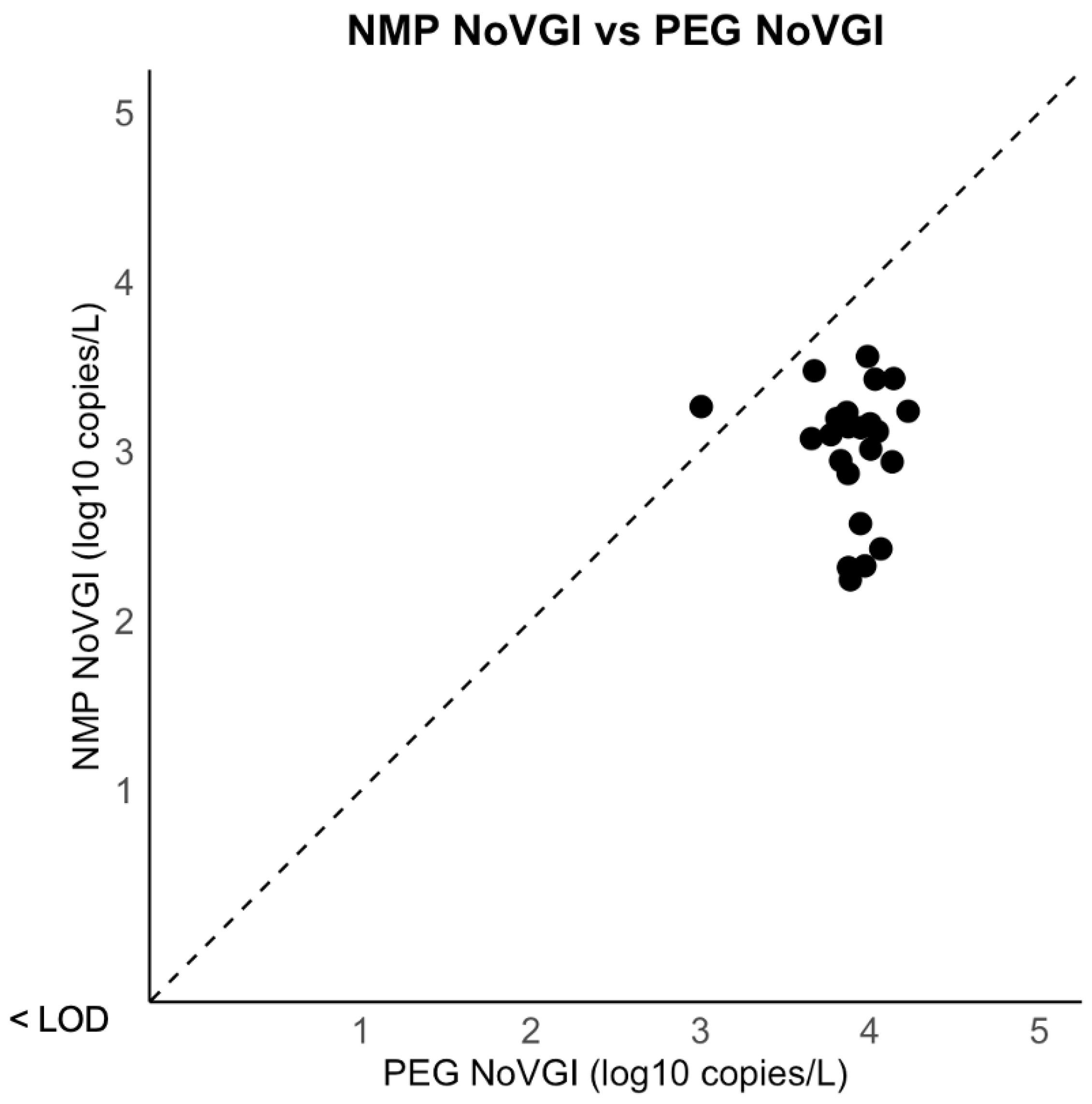
Figure 1. Scatter plot showing the correlation between PEG and NMP methods in detecting norovirus GI (log10 copies/L) in wastewater samples. The diagonal line in each plot is the line of equality, where points falling along this line would indicate equal concentrations detected by both methods.
Environments 13 00086 g001
Figure 2. Scatter plot showing the correlation between PEG and NMP methods in detecting norovirus GII (log10 copies/L) in wastewater samples. The diagonal line in each plot is the line of equality, where points falling along this line would indicate equal concentrations detected by both methods.
Environments 13 00086 g002
Figure 3. Scatter plot showing the correlation between PEG and NMP methods in detecting SARS-CoV-2 N1 Gene. The diagonal line in each plot is the line of equality, where points falling along this line would indicate equal concentrations detected by both methods.
Environments 13 00086 g003
Figure 4. Scatter plot showing the correlation between PEG and NMP methods in detecting SARS-CoV-2 N2 Gene. The diagonal line in each plot is the line of equality, where points falling along this line would indicate equal concentrations detected by both methods.
Environments 13 00086 g004
Table 1. Percentage Comparison of PEG and NMP Target Capture for norovirus GI and GII
WorkflowNo. of SamplesNorovirus GINorovirus GII
No. of Positive Samples (%)Concentration (log10 Copies/L)No. of Positive Samples (%)Concentration (log10 Copies/L)
PEG2323 (100)3.9 ± 0.2423 (100)4.9 ± 0.53
NMP2323 (100)3.0 ± 0.3823 (100)3.6 ± 0.17
Norovirus GI: p < 0.0001; Norovirus GII: p < 0.0001.
Table 2. Percentage Comparison of PEG and NMP Target Capture for SARS-CoV-2 N1 and N2
MethodNo. of SamplesSARS-CoV-2 N1SARS-CoV-2 N2
No. of Positive Samples (%)Concentration (log10 Copies/L)No. of Positive Samples (%)Concentration (log10 Copies/L)
NMP2320 (86.96)3.20 ± 0.5621 (91.30)3.67 ± 0.52
PEG2315 (65.22)2.33 ± 1.1212 (52.17)2.11 ± 0.96
SARS-CoV-2 N1: p > 0.05; SARS-CoV-2 N2: p < 0.01.
Disclaimer/Publisher’s Note: The statements, opinions and data contained in all publications are solely those of the individual author(s) and contributor(s) and not of MDPI and/or the editor(s). MDPI and/or the editor(s) disclaim responsibility for any injury to people or property resulting from any ideas, methods, instructions or products referred to in the content.