

The Association Between Serum Perfluorooctanoic Acid (PFOA) Above the Intervention Threshold Level and Vaccine Antibody Concentrations in an Environmentally Exposed Population
 , , , , , ,
Abstract
1. Introduction
2. Materials and Methods
3. Results
3.1. Population Description
3.2. PFOA
3.3. Diphtheria
3.3.1. Antibody Status
3.3.2. Vaccination Rates
3.3.3. Comparison Between Base Immunisation and Vaccination in the Last 10 Years
3.3.4. Results of Regression Analysis
3.4. Tetanus
3.4.1. Antibody Status
3.4.2. Vaccination Rates
3.4.3. Comparison Between Base Immunisation and Vaccination in the Last 10 Years
3.4.4. Antibody Status Based on PFOA Serum Concentrations
3.5. SARS-CoV-2
3.5.1. Antibody Response Based on Vaccination Status
3.5.2. Vaccination Rates
3.5.3. Results of Regression Analysis
3.6. Analyses with the PFOA Serum Concentrations from 2018
4. Discussion
5. Conclusions
Author Contributions
Funding
Institutional Review Board Statement
Informed Consent Statement
Data Availability Statement
Acknowledgments
Conflicts of Interest
Abbreviations
| CDC | Centers for Disease Control and Prevention |
| EFSA | European Food Safety Authority |
| HBM | Human BioMonitoring |
| PFAS | Perfluorinated alkyl substances |
| PFOA | Perfluorooctanoic acid |
| RKI | Robert Koch Institute |
| STIKO | Standing Committee on Vaccination |
| WHO | World Health Organization |
References
- Brunn, H.; Arnold, G.; Körner, W.; Rippen, G.; Steinhäuser, K.G.; Valentin, I. PFAS: Forever chemicals—Persistent, bioaccumulative and mobile. Reviewing the status and the need for their phase out and remediation of contaminated sites. Environ. Sci. Eur. 2023, 35, 20. [Google Scholar] [CrossRef] [Scilit]
- Glüge, J.; Scheringer, M.; Cousins, I.T.; DeWitt, J.C.; Goldenman, G.; Herzke, D.; Lohmann, R.; Ng, C.A.; Trier, X.; Wang, Z. An overview of the uses of per-and polyfluoroalkyl substances (PFAS). Environ. Sci. Process. Impacts 2020, 22, 2345–2373. [Google Scholar] [CrossRef] [Scilit] [PubMed]
- Fromme, H.; Wöckner, M.; Roscher, E.; Völkel, W. ADONA and perfluoroalkylated substances in plasma samples of German blood donors living in South Germany. Int. J. Hyg. Environ. Health 2017, 220, 455–460. [Google Scholar] [CrossRef] [Scilit] [PubMed]
- Kärrman, A.; Elgh-Dalgren, K.; Lafossas, C.; Møskeland, T. Environmental levels and distribution of structural isomers of perfluoroalkyl acids after aqueous fire-fighting foam (AFFF) contamination. Environ. Chem. 2011, 8, 372–380. [Google Scholar] [CrossRef] [Scilit]
- European Comission. Commission Delegated Regulation (EU) 2020/784 of 8 April 2020 amending Annex I to Regulation (EU) 2019/1021 of the European Parliament and of the Council as regards the listing of perfluorooctanoic acid (PFOA), its salts and PFOA-related compounds. Off. J. Eur. Union 2020, L 188, I/1–I/5. [Google Scholar]
- Key, B.D.; Howell, R.D.; Criddle, C.S. Fluorinated organics in the biosphere. Environ. Sci. Technol. 1997, 31, 2445–2454. [Google Scholar] [CrossRef] [Scilit]
- Prescher, D.; Gross, U.; Wotzka, J.; Txcheu-Schlueter, M.; Starke, W. Environmental behavior of fluoro surfactants: Part 2: Study on biochemical degradability. Acta Hydrochim. Hydrobiol. 1985, 13, 17–24. [Google Scholar] [CrossRef] [Scilit]
- De Silva, A.O.; Armitage, J.M.; Bruton, T.A.; Dassuncao, C.; Heiger-Bernays, W.; Hu, X.C.; Kärrman, A.; Kelly, B.; Ng, C.; Robuck, A.; et al. PFAS exposure pathways for humans and wildlife: A synthesis of current knowledge and key gaps in understanding. Environ. Toxicol. Chem. 2021, 40, 631–657. [Google Scholar] [CrossRef] [Scilit]
- Sunderland, E.M.; Hu, X.C.; Dassuncao, C.; Tokranov, A.K.; Wagner, C.C.; Allen, J.G. A review of the pathways of human exposure to poly-and perfluoroalkyl substances (PFASs) and present understanding of health effects. J. Expo. Sci. Environ. Epidemiol. 2019, 29, 131–147. [Google Scholar] [CrossRef] [Scilit]
- Lau, C.; Anitole, K.; Hodes, C.; Lai, D.; Pfahles-Hutchens, A.; Seed, J. Perfluoroalkyl acids: A review of monitoring and toxicological findings. Toxicol. Sci. 2007, 99, 366–394. [Google Scholar] [CrossRef] [Scilit]
- Gomis, M.I.; Vestergren, R.; MacLeod, M.; Mueller, J.F.; Cousins, I.T. Historical human exposure to perfluoroalkyl acids in the United States and Australia reconstructed from biomonitoring data using population-based pharmacokinetic modelling. Environ. Int. 2017, 108, 92–102. [Google Scholar] [CrossRef] [Scilit] [PubMed]
- Russell, M.H.; Waterland, R.L.; Wong, F. Calculation of chemical elimination half-life from blood with an ongoing exposure source: The example of perfluorooctanoic acid (PFOA). Chemosphere 2015, 129, 210–216. [Google Scholar] [CrossRef] [Scilit] [PubMed]
- Worley, R.R.; Moore, S.M.; Tierney, B.C.; Ye, X.; Calafat, A.M.; Campbell, S.; Woudneh, M.B.; Fisher, J. Per-and polyfluoroalkyl substances in human serum and urine samples from a residentially exposed community. Environ. Int. 2017, 106, 135–143. [Google Scholar] [CrossRef] [Scilit] [PubMed]
- Wang, W.; Hong, X.; Zhao, F.; Wu, J.; Wang, B. The effects of perfluoroalkyl and polyfluoroalkyl substances on female fertility: A systematic review and meta-analysis. Environ. Res. 2023, 216, 114718. [Google Scholar] [CrossRef] [Scilit]
- Melzer, D.; Rice, N.; Depledge, M.H.; Henley, W.E.; Galloway, T.S. Association between serum perfluorooctanoic acid (PFOA) and thyroid disease in the US National Health and Nutrition Examination Survey. Environ. Health Perspect. 2010, 118, 686–692. [Google Scholar] [CrossRef] [Scilit]
- Geiger, S.D.; Xiao, J.; Ducatman, A.; Frisbee, S.; Innes, K.; Shankar, A. The association between PFOA, PFOS and serum lipid levels in adolescents. Chemosphere 2014, 98, 78–83. [Google Scholar] [CrossRef] [Scilit]
- Li, Y.; Barregard, L.; Xu, Y.; Scott, K.; Pineda, D.; Lindh, C.H.; Jakobsson, K.; Fletcher, T. Associations between perfluoroalkyl substances and serum lipids in a Swedish adult population with contaminated drinking water. Environ. Health 2020, 19, 33. [Google Scholar] [CrossRef] [Scilit]
- Liang, L.; Pan, Y.; Bin, L.; Liu, Y.; Huang, W.; Li, R.; Lai, K.P. Immunotoxicity mechanisms of perfluorinated compounds PFOA and PFOS. Chemosphere 2022, 291, 132892. [Google Scholar] [CrossRef] [Scilit]
- Schrenk, D.; Bignami, M.; Bodin, L.; Chipman, J.K.; Del Mazo, J.; Grasl-Kraupp, B.; Hogstrand, C.; Hoogenboom, L.R.; Leblanc, J.C.; Nebbia, C.S.; et al. Risk to human health related to the presence of perfluoroalkyl substances in food. EFSA J. 2020, 18, e06223. [Google Scholar] [CrossRef] [Scilit]
- Dewitt, J.C.; Copeland, C.B.; Strynar, M.J.; Luebke, R.W. Perfluorooctanoic acid-induced immunomodulation in adult C57BL/6J or C57BL/6N female mice. Environ. Health Perspect. 2008, 116, 644–650. [Google Scholar] [CrossRef] [Scilit]
- DeWitt, J.C.; Williams, W.C.; Creech, N.J.; Luebke, R.W. Suppression of antigen-specific antibody responses in mice exposed to perfluorooctanoic acid: Role of PPARα and T- and B-cell targeting. J. Immunotoxicol. 2016, 13, 38–45. [Google Scholar] [CrossRef] [Scilit]
- Vetvicka, V.; Vetvickova, J. Reversal of perfluorooctanesulfonate-induced immunotoxicity by a glucan-resveratrol-vitamin C combination. Orient. Pharm. Exp. Med. 2013, 13, 77–84. [Google Scholar] [CrossRef] [Scilit]
- Antoniou, E.; Colnot, T.; Zeegers, M.; Dekant, W. Immunomodulation and exposure to per- and polyfluoroalkyl substances: An overview of the current evidence from animal and human studies. Arch. Toxicol. 2022, 96, 2261–2285. [Google Scholar] [CrossRef] [Scilit]
- Grandjean, P.; Andersen, E.W.; Budtz-Jørgensen, E.; Nielsen, F.; Mølbak, K.; Weihe, P.; Heilmann, C. Serum vaccine antibody concentrations in children exposed to perfluorinated compounds. JAMA 2012, 307, 391–397. [Google Scholar] [CrossRef] [Scilit] [PubMed]
- Grandjean, P.; Heilmann, C.; Weihe, P.; Nielsen, F.; Mogensen, U.B.; Budtz-Jørgensen, E. Serum Vaccine Antibody Concentrations in Adolescents Exposed to Perfluorinated Compounds. Environ. Health Perspect. 2017, 125, 077018. [Google Scholar] [CrossRef] [Scilit] [PubMed]
- Abraham, K.; Mielke, H.; Fromme, H.; Völkel, W.; Menzel, J.; Peiser, M.; Zepp, F.; Willich, S.N.; Weikert, C. Internal exposure to perfluoroalkyl substances (PFASs) and biological markers in 101 healthy 1-year-old children: Associations between levels of perfluorooctanoic acid (PFOA) and vaccine response. Arch. Toxicol. 2020, 94, 2131–2147. [Google Scholar] [CrossRef] [Scilit] [PubMed]
- Kielsen, K.; Shamim, Z.; Ryder, L.P.; Nielsen, F.; Grandjean, P.; Budtz-Jørgensen, E.; Heilmann, C. Antibody response to booster vaccination with tetanus and diphtheria in adults exposed to perfluorinated alkylates. J. Immunotoxicol. 2016, 13, 270–273. [Google Scholar] [CrossRef] [Scilit]
- Shih, Y.-H.; Blomberg, A.J.; Bind, M.-A.; Holm, D.; Nielsen, F.; Heilmann, C.; Weihe, P.; Grandjean, P. Serum vaccine antibody concentrations in adults exposed to per-and polyfluoroalkyl substances: A birth cohort in the Faroe Islands. J. Immunotoxicol. 2021, 18, 85–92. [Google Scholar] [CrossRef] [Scilit]
- Angerer, J.; Aylward, L.L.; Hays, S.M.; Heinzow, B.; Wilhelm, M. Human biomonitoring assessment values: Approaches and data requirements. Int. J. Hyg. Environ. Health 2011, 214, 348–360. [Google Scholar] [CrossRef] [Scilit]
- Schümann, M.; Lilienthal, H.; Hölzer, J. Human biomonitoring (HBM)-II values for perfluorooctanoic acid (PFOA) and perfluorooctane sulfonic acid (PFOS)—Description, derivation and discussion. Regul. Toxicol. Pharmacol. 2021, 121, 104868. [Google Scholar] [CrossRef] [Scilit]
- Bavarian Health and Food Safety Authority. Human-Biomonitoring von Perfluorierten Substanzen in Teilen des Landkreises Altötting. Abschlussbericht; Bayerisches Landesamt für Gesundheit und Lebensmittelsicherheit (LGL): München, Germany, 2018. [Google Scholar]
- Catelan, D.; Biggeri, A.; Russo, F.; Gregori, D.; Pitter, G.; Da Re, F.; Fletcher, T.; Canova, C. Exposure to Perfluoroalkyl Substances and Mortality for COVID-19: A Spatial Ecological Analysis in the Veneto Region (Italy). Int. J. Environ. Res. Public Health 2021, 18, 2734. [Google Scholar] [CrossRef] [Scilit] [PubMed]
- Lahne, H.; Gerstner, D.; Völkel, W.; Schober, W.; Aschenbrenner, B.; Herr, C.; Heinze, S.; Quartucci, C. Human biomonitoring follow-up study on PFOA contamination and investigation of possible influencing factors on PFOA exposure in a German population originally exposed to emissions from a fluoropolymer production plant. Int. J. Hyg. Environ. Health 2024, 259, 114387. [Google Scholar] [CrossRef] [Scilit] [PubMed]
- Centers for Disease Control and Prevention (CDC). Interim Guidelines for COVID-19 Antibody Testing. Available online: https://archive.cdc.gov/www_cdc_gov/coronavirus/2019-ncov/hcp/testing/antibody-tests-guidelines.html (accessed on 24 October 2024).
- Ständige Impfkommission (STIKO). Empfehlungen der Ständigen Impfkommission (STIKO) beim Robert Koch-Institut 2024—Impfkalender. Epidemiol. Bull. 2024, 4, 4–66. [Google Scholar]
- Borella-Venturini, M.; Frasson, C.; Paluan, F.; De Nuzzo, D.; Di Masi, G.; Giraldo, M.; Chiara, F.; Trevisan, A. Tetanus vaccination, antibody persistence and decennial booster: A serosurvey of university students and at-risk workers. Epidemiol. Infect. 2017, 145, 1757–1762. [Google Scholar] [CrossRef] [Scilit]
- Le, T.V.; Nguyen, V.T.T.; Nguyen, Q.H.; Nguyen, T.T.T.; Duong, T.T.N.; Ly, T.T.T.; Pham, T.N.; Nguyen, V.L.; Vien, C.C. The evaluation of anti-diphtheria toxoid antibodies in healthy population in Kon Tum, Vietnam: A population-based study. IJID Reg. 2022, 3, 171–176. [Google Scholar] [CrossRef] [Scilit]
- Crawford, L.; Halperin, S.A.; Dzierlenga, M.W.; Skidmore, B.; Linakis, M.W.; Nakagawa, S.; Longnecker, M.P. Systematic review and meta-analysis of epidemiologic data on vaccine response in relation to exposure to five principal perfluoroalkyl substances. Environ. Int. 2023, 172, 107734. [Google Scholar] [CrossRef] [Scilit]
- Starling, A.P.; Adgate, J.L.; Hamman, R.F.; Kechris, K.; Calafat, A.M.; Dabelea, D. Prenatal exposure to per- and polyfluoroalkyl substances and infant growth and adiposity: The Healthy Start Study. Environ. Int. 2019, 131, 104983. [Google Scholar] [CrossRef] [Scilit]
- Wu, X.; Braun, J.M.; Papandonatos, G.D.; Tong, J.; Gan, H.; Tao, S.; Geng, M.; Liang, C.; Chen, A.; Yolton, K.; et al. Does the timing of sample collection confound the association between prenatal serum PFAS concentrations and birthweight: Results from two prospective cohort studies. Environ. Int. 2026, 207, 109990. [Google Scholar] [CrossRef] [Scilit]
- Cavicchio, L.; Zenesini, C.; Righetto, M.L.; Rosato, I.; Fletcher, T.; Sera, F.; Canova, C. Exposure to per- and polyfluoroalkyl substances (PFAS) and timing of menarche: A systematic review and meta-analysis. Environ. Res. 2026, 291, 123596. [Google Scholar] [CrossRef] [Scilit]
- Andersson, A.G.; Lundgren, A.; Xu, Y.; Nielsen, C.; Lindh, C.H.; Pineda, D.; Cederlund, J.; Pataridou, E.; Søgaard Tøttenborg, S.; Ugelvig Petersen, K.; et al. High Exposure to Perfluoroalkyl Substances and Antibody Responses to SARS-CoV-2 mRNA Vaccine—An Observational Study in Adults from Ronneby, Sweden. Environ. Health Perspect. 2023, 131, 87007. [Google Scholar] [CrossRef] [Scilit]
- Bailey, J.M.; Wang, L.; McDonald, J.M.; Gray, J.S.; Petrie, J.G.; Martin, E.T.; Savitz, D.A.; Karrer, T.A.; Fisher, K.A.; Geiger, M.J.; et al. Immune response to COVID-19 vaccination in a population with a history of elevated exposure to per- and polyfluoroalkyl substances (PFAS) through drinking water. J. Expo. Sci. Environ. Epidemiol. 2023, 33, 725–736. [Google Scholar] [CrossRef] [Scilit] [PubMed]
- Porter, A.K.; Kleinschmidt, S.E.; Andres, K.L.; Reusch, C.N.; Krisko, R.M.; Taiwo, O.A.; Olsen, G.W.; Longnecker, M.P. Antibody response to COVID-19 vaccines among workers with a wide range of exposure to per- and polyfluoroalkyl substances. Environ. Int. 2022, 169, 107537. [Google Scholar] [CrossRef] [Scilit] [PubMed]
- Hollister, J.; Caban-Martinez, A.J.; Ellingson, K.D.; Beitel, S.; Fowlkes, A.L.; Lutrick, K.; Tyner, H.L.; Naleway, A.L.; Yoon, S.K.; Gaglani, M.; et al. Serum per- and polyfluoroalkyl substance concentrations and longitudinal change in post-infection and post-vaccination SARS-CoV-2 antibodies. Environ. Res. 2023, 239, 117297. [Google Scholar] [CrossRef] [Scilit] [PubMed]
- Kaur, K.; Lesseur, C.; Chen, L.; Andra, S.S.; Narasimhan, S.; Pulivarthi, D.; Midya, V.; Ma, Y.; Ibroci, E.; Gigase, F.; et al. Cross-sectional associations of maternal PFAS exposure on SARS-CoV-2 IgG antibody levels during pregnancy. Environ. Res. 2023, 219, 115067. [Google Scholar] [CrossRef] [Scilit]
- Pera, A.; Campos, C.; López, N.; Hassouneh, F.; Alonso, C.; Tarazona, R.; Solana, R. Immunosenescence: Implications for response to infection and vaccination in older people. Maturitas 2015, 82, 50–55. [Google Scholar] [CrossRef] [Scilit]
- Crooke, S.N.; Ovsyannikova, I.G.; Poland, G.A.; Kennedy, R.B. Immunosenescence and human vaccine immune responses. Immun. Ageing 2019, 16, 25. [Google Scholar] [CrossRef] [Scilit]
- Hammarlund, E.; Thomas, A.; Poore, E.A.; Amanna, I.J.; Rynko, A.E.; Mori, M.; Chen, Z.; Slifka, M.K. Durability of vaccine-induced immunity against tetanus and diphtheria toxins: A cross-sectional analysis. Clin. Infect. Dis. 2016, 62, 1111–1118. [Google Scholar] [CrossRef] [Scilit]
- Weinberger, B.; Keller, M.; Putzer, C.; Breitenberger, D.; Koller, B.; Fiegl, S.; Moreno-Villanueva, M.; Bernhardt, J.; Franceschi, C.; Voutetakis, K.; et al. Protection against Tetanus and Diphtheria in Europe: The impact of age, gender and country of origin based on data from the MARK-AGE Study. Exp. Gerontol. 2018, 105, 109–112. [Google Scholar] [CrossRef] [Scilit]
- Wagner, K.S.; White, J.M.; Andrews, N.J.; Borrow, R.; Stanford, E.; Newton, E.; Pebody, R.G. Immunity to tetanus and diphtheria in the UK in 2009. Vaccine 2012, 30, 7111–7117. [Google Scholar] [CrossRef] [Scilit]
- Weinberger, B. Adult vaccination against tetanus and diphtheria: The European perspective. Clin. Exp. Immunol. 2017, 187, 93–99. [Google Scholar] [CrossRef] [Scilit]
- di Giovine, P.; Kafatos, G.; Nardone, A.; Andrews, N.; Ölander, R.M.; Alfarone, G.; Broughton, K.; Cohen, D.; Kriz, B.; Mikova, I.; et al. Comparative seroepidemiology of diphtheria in six European countries and Israel. Epidemiol. Infect. 2013, 141, 132–142. [Google Scholar] [CrossRef] [Scilit]
- World Health Organization. Diphtheria-Tetanus-Pertussis (DTP3) Immunization Coverage Among 1-Year-Olds (%). Available online: https://data.who.int/indicators/i/48D7D19/F8E084C (accessed on 16 August 2024).
- Poethko-Müller, C.; Schmitz, R. Vaccination coverage in German adults: Results of the German Health Interview and Examination Survey for Adults (DEGS1). Bundesgesundheitsblatt Gesundheitsforschung Gesundheitsschutz 2013, 56, 845–857. [Google Scholar] [CrossRef] [Scilit]
- RKI. Impfquoten bei Erwachsenen in Deutschland. Available online: https://www.rki.de/DE/Content/Infekt/EpidBull/Archiv/2022/49/Art_01.html (accessed on 20 May 2024).
- RKI. Digitales Impfquotenmonitoring des Robert-Koch-Instituts zur COVID-19-Impfung; RKI: Berlin, Germany, 2023. [Google Scholar]
- Kanitz, E.E.; Wu, L.A.; Giambi, C.; Strikas, R.A.; Levy-Bruhl, D.; Stefanoff, P.; Mereckiene, J.; Appelgren, E.; D’Ancona, F. Variation in adult vaccination policies across Europe: An overview from VENICE network on vaccine recommendations, funding and coverage. Vaccine 2012, 30, 5222–5228. [Google Scholar] [CrossRef] [Scilit]
- Hasselhorn, H.-M.; Nübling, M.; Tiller, F.W.; Hofmann, F. Factors influencing immunity against diphtheria in adults. Vaccine 1998, 16, 70–75. [Google Scholar] [CrossRef] [Scilit]
- Petráš, M.; Oleár, V.; Molitorisová, M.; Dáňová, J.; Čelko, A.M.; Nováková, E.; Štefkovičová, M.; Krištúfková, Z.; Malinová, J.; Králová Lesná, I. Factors Influencing Persistence of Diphtheria Immunity and Immune Response to a Booster Dose in Healthy Slovak Adults. Vaccines 2019, 7, 139. [Google Scholar] [CrossRef] [Scilit]
- Ji, J.; Song, L.; Wang, J.; Yang, Z.; Yan, H.; Li, T.; Yu, L.; Jian, L.; Jiang, F.; Li, J.; et al. Association between urinary per- and poly-fluoroalkyl substances and COVID-19 susceptibility. Environ. Int. 2021, 153, 106524. [Google Scholar] [CrossRef] [Scilit]
- Beyerlein, A.; Heinze, S.; Quartucci, C.; Katz, K. No increased rates of COVID-19 breakthrough infections in Altötting, a Bavarian district with a history of environmental PFOA contamination—Results from a retrospective observational study. Infection 2024, 52, 1639–1642. [Google Scholar] [CrossRef] [Scilit]

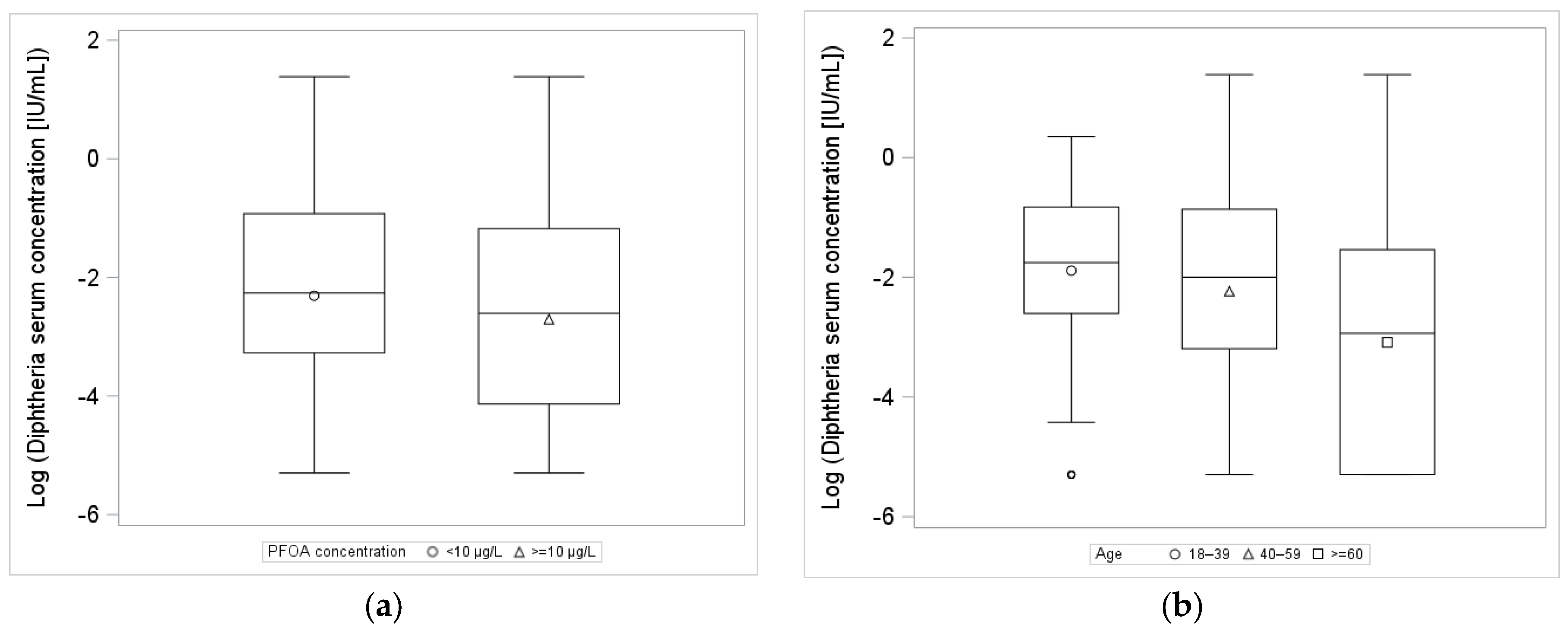

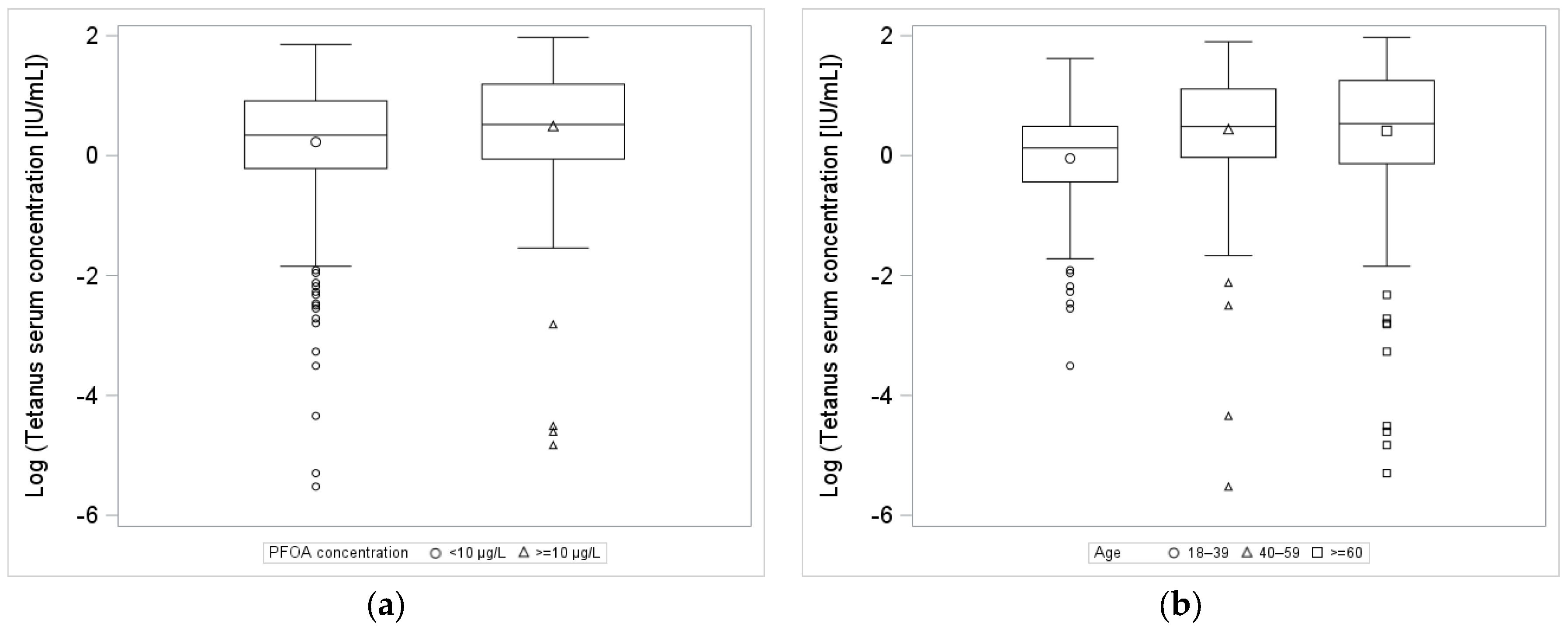
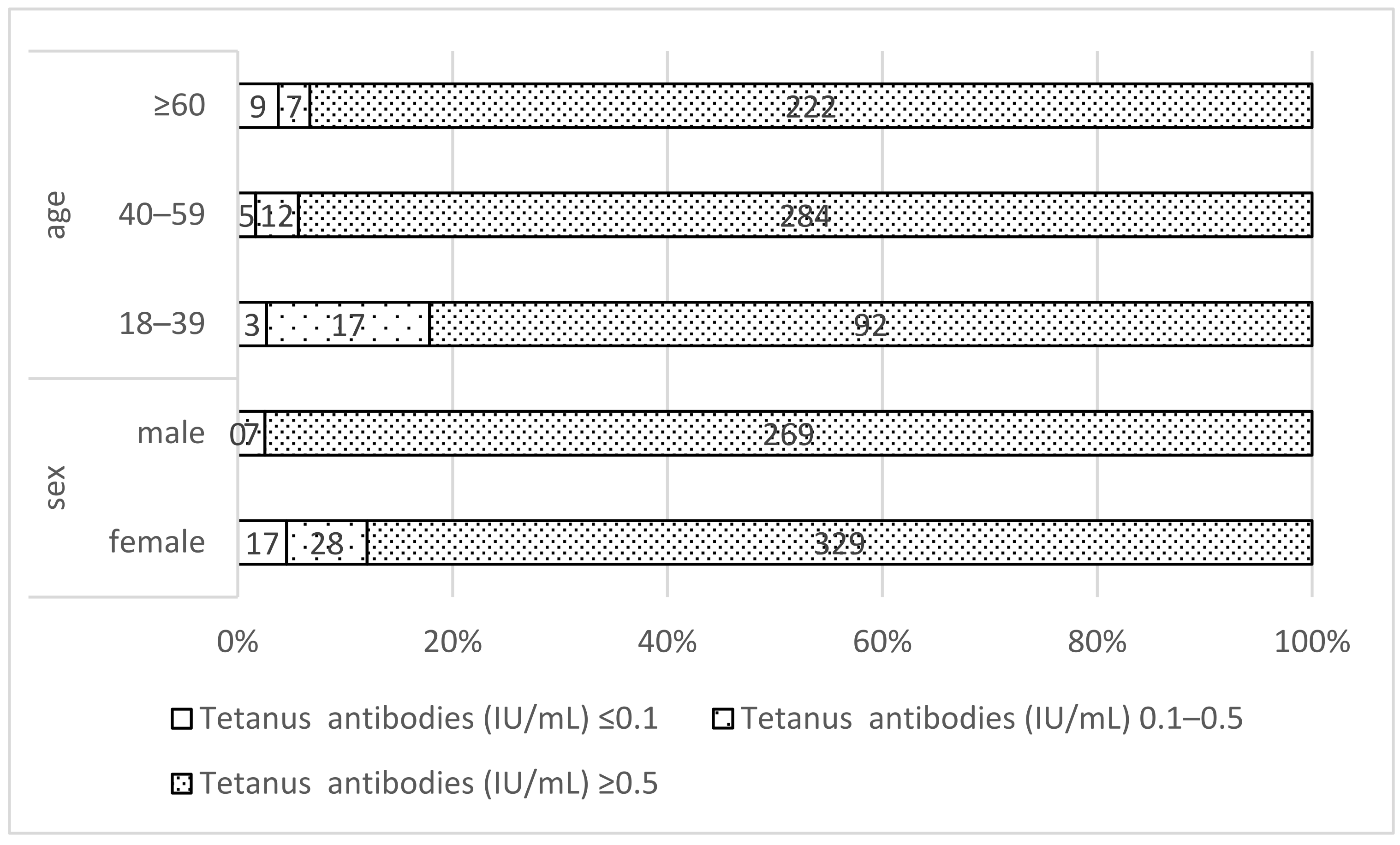


| n | % | PFOA (µg/L) | ||||
|---|---|---|---|---|---|---|
| Median (Min–Max) | 25th Percentile | 75th Percentile | IQR 1 | |||
| Sex | ||||||
| Female | 378 | 57.1% | 8.0 (0.7–73.1) | 4.3 | 14.1 | 9.8 |
| Male | 284 | 42.9% | 10.4 (2.1–151.7) | 6.4 | 17.3 | 10.9 |
| Age (in years) | ||||||
| 18–39 | 113 | 17.1% | 5.0 (1.0–32.0) | 2.8 | 9.7 | 6.9 |
| 40–59 | 306 | 46.2% | 8.4 (0.7–50.9) | 4.9 | 13.6 | 8.7 |
| ≥60 | 243 | 36.7% | 13.0 (0.9–151.7) | 7.6 | 20.7 | 13.1 |
| Age Category | Diphtheria Base Immunisation | Diphtheria Antibodies (IU/mL) | ||||
|---|---|---|---|---|---|---|
| ≤0.01 | 0.01–0.09 | ≥0.1 | Total | Missing | ||
| 18–39 | yes | 4 (3.6%) | 41 (36.9%) | 66 (59.5%) | 111 | 1 |
| no | 0 (0%) | 0 (0%) | 0 (0%) | 0 | ||
| 40–59 | yes | 28 (9.7%) | 100 (34.5%) | 162 (55.9%) | 290 | 7 |
| no | 1 (33.3%) | 1 (33.3%) | 1 (33.3%) | 3 | ||
| ≥60 | yes | 51 (25.3%) | 84 (41.6%) | 67 (33.2%) | 202 | 15 |
| no | 9 (56.3%) | 3 (18.8%) | 4 (25.0%) | 16 | ||
| Age category | Diphtheria vaccination in the last 10 years | Diphtheria antibodies (IU/mL) | ||||
| ≤0.01 | 0.01–0.09 | ≥0.1 | Total | Missing | ||
| 18–39 | yes | 2 (2.6%) | 20 (26.0%) | 55 (71.4%) | 77 | 5 |
| no | 1 (3.3%) | 18 (60.0%) | 11 (36.7%) | 30 | ||
| 40–59 | yes | 18 (9.3%) | 60 (31.1%) | 115 (59.6%) | 193 | 15 |
| no | 10 (10.9%) | 40 (43.5%) | 42 (4.7%) | 92 | ||
| ≥60 | yes | 35 (21.3%) | 70 (42.7%) | 59 (36.0%) | 164 | 16 |
| no | 21 (39.62%) | 21 (39.62%) | 11 (20.8%) | 53 | ||
| Parameter | OR [95% CI] | |
|---|---|---|
| PFOA | <10 µg/L PFOA | 1.0 |
| ≥10 µg/L PFOA | 1.1 [0.8; 1.5] | |
| Age | 18–39 years | 1.0 |
| 40–59 years | 1.3 [0.8; 2.1] | |
| ≥ 60 years | 3.9 [2.4; 6.4] | |
| Vaccination in the last 10 years | Yes | 1.0 |
| No | 2.1 [1.5; 3.0] | |
| Base immunisation | Yes | 1.0 |
| No | 4.4 [1.4; 13.5] |
| Age (in Years) | Tetanus Base Immunisation | Tetanus Antibodies (IU/mL) | ||||
|---|---|---|---|---|---|---|
| ≤0.1 | 0.1–0.5 | ≥0.5 | Total | Missing | ||
| 18–39 | yes | 3 (2.7%) | 17 (15.3%) | 91 (82.0%) | 111 | 1 |
| no | 0 (0%) | 0 (0%) | 0 (0%) | 0 | ||
| 40–59 | yes | 5 (1.7%) | 12 (4.1%) | 274 (94.2%) | 291 | 6 |
| no | 0 (0%) | 0 (0%) | 4 (100%) | 4 | ||
| ≥60 | yes | 7 (3.3%) | 7 (3.3%) | 196 (93.3%) | 210 | 12 |
| no | 0 (0%) | 0 (0%) | 16 (100%) | 16 | ||
| Age (in years) | Tetanus vaccination in the last 10 years | Tetanus antibodies (IU/mL) | ||||
| ≤0.1 | 0.1–0.5 | ≥0.5 | Total | Missing | ||
| 18–39 | yes | 1 (1.2%) | 7 (8.5%) | 74 (90.2%) | 82 | 3 |
| no | 1 (3.7%) | 9 (33.3%) | 17 (63.0%) | 27 | ||
| 40–59 | yes | 2 (1.0%) | 3 (1.4%) | 202 (97.6%) | 207 | 23 |
| no | 1 (1.4%) | 7 (9.9%) | 63 (88.7%) | 71 | ||
| ≥60 | yes | 4 (2.2%) | 5 (2.8%) | 171 (95.0%) | 180 | 22 |
| no | 2 (5.6%) | 2 (5.6%) | 32 (88.9%) | 36 | ||
| Age (in Years) | PFOA Serum Concentrations | Tetanus Antibodies (IU/mL) | ||||
|---|---|---|---|---|---|---|
| ≤0.1 | 0.1–0.5 | ≥0.5 | Total | Missing | ||
| 18–39 | <10 µg/L PFOA | 3 (3.5%) | 13 (15.1%) | 70 (81.4%) | 86 | 1 |
| ≥10 µg/L PFOA | 0 (0.0%) | 4 (15.4%) | 22 (84.6%) | 26 | ||
| 40–59 | <10 µg/L PFOA | 5 (2.7%) | 8 (4.4%) | 170 (92.9%) | 183 | 5 |
| ≥10 µg/L PFOA | 0 (0.0%) | 4 (3.4%) | 114 (96.6%) | 118 | ||
| ≥60 | <10 µg/L PFOA | 5 (5.6%) | 5 (5.6%) | 80 (88.9%) | 90 | 5 |
| ≥10 µg/L PFOA | 4 (2.7%) | 2 (1.4%) | 142 (95.9%) | 148 | ||
Disclaimer/Publisher’s Note: The statements, opinions and data contained in all publications are solely those of the individual author(s) and contributor(s) and not of MDPI and/or the editor(s). MDPI and/or the editor(s) disclaim responsibility for any injury to people or property resulting from any ideas, methods, instructions or products referred to in the content. |
© 2026 by the authors. Licensee MDPI, Basel, Switzerland. This article is an open access article distributed under the terms and conditions of the Creative Commons Attribution (CC BY) license.
Share and Cite
Zamfir, M.; Lahne, H.; Fingerle, V.; Gerstner, D.; Redwitz, J.; Völkel, W.; Schober, W.; Aschenbrenner, B.; Röhl, C.; Herr, C.; et al. The Association Between Serum Perfluorooctanoic Acid (PFOA) Above the Intervention Threshold Level and Vaccine Antibody Concentrations in an Environmentally Exposed Population. Environments 2026, 13, 84. https://doi.org/10.3390/environments13020084
Zamfir M, Lahne H, Fingerle V, Gerstner D, Redwitz J, Völkel W, Schober W, Aschenbrenner B, Röhl C, Herr C, et al. The Association Between Serum Perfluorooctanoic Acid (PFOA) Above the Intervention Threshold Level and Vaccine Antibody Concentrations in an Environmentally Exposed Population. Environments. 2026; 13(2):84. https://doi.org/10.3390/environments13020084
Chicago/Turabian StyleZamfir, Mihai, Heidi Lahne, Volker Fingerle, Doris Gerstner, Johannes Redwitz, Wolfgang Völkel, Wolfgang Schober, Bettina Aschenbrenner, Claudia Röhl, Caroline Herr, and et al. 2026. "The Association Between Serum Perfluorooctanoic Acid (PFOA) Above the Intervention Threshold Level and Vaccine Antibody Concentrations in an Environmentally Exposed Population" Environments 13, no. 2: 84. https://doi.org/10.3390/environments13020084
APA StyleZamfir, M., Lahne, H., Fingerle, V., Gerstner, D., Redwitz, J., Völkel, W., Schober, W., Aschenbrenner, B., Röhl, C., Herr, C., Quartucci, C., & Heinze, S. (2026). The Association Between Serum Perfluorooctanoic Acid (PFOA) Above the Intervention Threshold Level and Vaccine Antibody Concentrations in an Environmentally Exposed Population. Environments, 13(2), 84. https://doi.org/10.3390/environments13020084