1. Introduction
Understanding the characteristics of particulate matter (PM) in the atmosphere is essential for assessing its potential health impacts. Air quality, to which we are exposed daily, has become an increasingly important topic, particularly due to its association with premature deaths in Europe [
1]. Research on airborne particles has a long scientific tradition, rooted in physical and chemical sciences and supported by regulatory frameworks that have evolved over several decades.
PM originates from diverse sources, including soil erosion, atmospheric deposition, and anthropogenic activities [
2,
3]. Anthropogenic PM in the atmosphere primarily originates from traffic emissions, industrial activities, infrastructure construction, and residential sources in urban and industrial areas. In rural settings, the main contributors include biomass burning and emissions from agricultural and livestock activities [
4]. Natural sources of PM are also significant and include marine aerosols (from seas and oceans), desert and soil dust, volcanic ash, biological particles from vegetation, wildfires, and lightning. This diversity of sources produces particles with widely varying chemical compositions and aerodynamic properties, which are often tied to their origin [
4].
The aerodynamic diameter is a critical characteristic of PM because it influences whether inhaled particles are retained within the respiratory system, potentially causing a range of health problems [
5]. Smaller aerodynamic diameters are associated with higher health risks, as smaller particles penetrate deeper into the respiratory tract [
5]. Monitored PM fractions include particles with aerodynamic diameters of 100 µm or less, categorised as TSP (total suspended particles), PM
10, PM
2.5, PM
1, and UFP (ultrafine particles), the latter being on the nanometre scale.
PM can contain a wide range of organic and inorganic compounds, such as major elements, trace elements, heavy metals, and ions (e.g., [
6,
7,
8]). A specific type of organic PM is bioaerosols, which include viruses, bacteria, fungi, pollen, and other biologically derived particles. These bioaerosols are airborne and can impact living organisms through infectious, allergic, toxic, or irritative processes [
9]. Once released into the atmosphere, aerosols are not inert; they undergo transformation (forming secondary aerosols), deposition, and resuspension. These changes are influenced by their physico-chemical properties and atmospheric conditions [
10].
Atmospheric PM can be sampled using either passive or active methods, each requiring specific equipment. Active samplers collect air at a controlled flow rate over a defined period. Sampling methods may involve gravimetric analysis on filters or surfaces, although some techniques aim solely to count particles, eliminating the need for a deposition surface. Passive samplers, by contrast, do not employ air suction; instead, they collect particles naturally as they settle, either through gravity or wind action.
The field of PM research is extensive, encompassing numerous studies that analyse a variety of inorganic compounds, as well as the influence of aerodynamic size and contaminants on transportation distances (e.g., [
11,
12]), with some research exploring the impact of mineralogy on particle morphology and toxicity [
13]. This field is highly diverse, not only in terms of the compounds studied and the sampling and analytical methods used but also in the context and objectives of the research, making it a topic of considerable significance today. For example, Liu, Shang [
6] compared the concentration of heavy metals in the fine fraction (PM
2.5) between rural and urban environments during a photochemical smog episode in Taiwan (China). Lucarelli [
14] conducted a study with high temporal resolution over a short period to assess daily PM concentration events to detect the specific impact of industrial activities in the area, which were influenced by varying processes throughout the day. There are also more focused studies that aim to determine the influence of specific phenomena in defined contexts [
6,
15,
16,
17]. For instance, Lucarelli et al. [
17] investigated the distribution of PM near a waste incinerator in a polluted environment over the course of a year; their research identified various constituents of PM
10, such as major and trace elements, ions, and metals, in the soluble fraction, as well as elemental and organic carbon.
The characteristics of atmospheric PM—such as concentration, size, and chemical composition—vary significantly depending on emission source. These variations are particularly pronounced in urban and industrial areas, where pollutant concentrations can exceed legal limits, posing potential risks to human health [
10,
18]. Over the past few decades, extensive experimental and theoretical work has contributed to understanding aerosol formation, transformation, and transport in the atmosphere. Recently, the scientific community has increasingly focused on characterising the chemical composition, variability, and associated toxicity of PM in different environments.
Despite extensive research on PM in urban environments, important gaps remain in the literature regarding vertical contrasts and seasonal chemical variability within the same sampling area. Many studies have documented seasonal variations in PM concentration and composition, showing that elemental and ionic components can vary significantly between seasons—often with higher loadings in cold periods due to stagnant conditions and combustion influences [
19]. Others have shown that PM chemical composition, including metals and secondary species, exhibits substantial seasonal and spatial variability in urban settings, which can be linked to both local emissions and regional transport processes [
20]. However, the vertical distribution of PM and its chemical composition between ground level and elevated sampling points remains less explored, despite evidence that vertical gradients can influence pollutant exposure and composition within urban boundary layers [
21]. Furthermore, established studies on PM composition rarely integrate size-resolved optical measurements with filter-based elemental analyses across multiple seasons and heights, limiting a comprehensive understanding of how meteorology and source influences act simultaneously across vertical and temporal scales.
The objective of this study was to integrate different detection techniques to analyse PM across distinct spatial and temporal scales. This included measurements at ground level and at higher altitude (rooftop), as well as comparisons across seasons and years. The study determines the concentration of PM fractions (TSP, PM10, PM4, PM2.5, and PM1) and elemental concentration of their sum, present in the atmosphere of an urban area, Porto, Portugal.
2. Materials and Methods
2.1. Sampling Location
This study examines the composition and quantity of PM in Porto, Portugal, located at 41°09′08″ N and 8°38′05″ W. Porto is Portugal’s second-largest city, with a population of 231,962 and a density of 5600.2 residents per square kilometre, based on 2021 data from the National Institute of Statistics (INE). The high population density reflects an intense urban occupation, associated with heavy road traffic, residential activities, and commercial infrastructure, which are relevant sources of particulate-matter emissions. In addition, the city is influenced by industrial facilities and port-related activities, which contribute to both local and regional PM inputs. These demographic and urban characteristics are, therefore, important for interpreting potential PM sources and assessing population exposure in the study area.
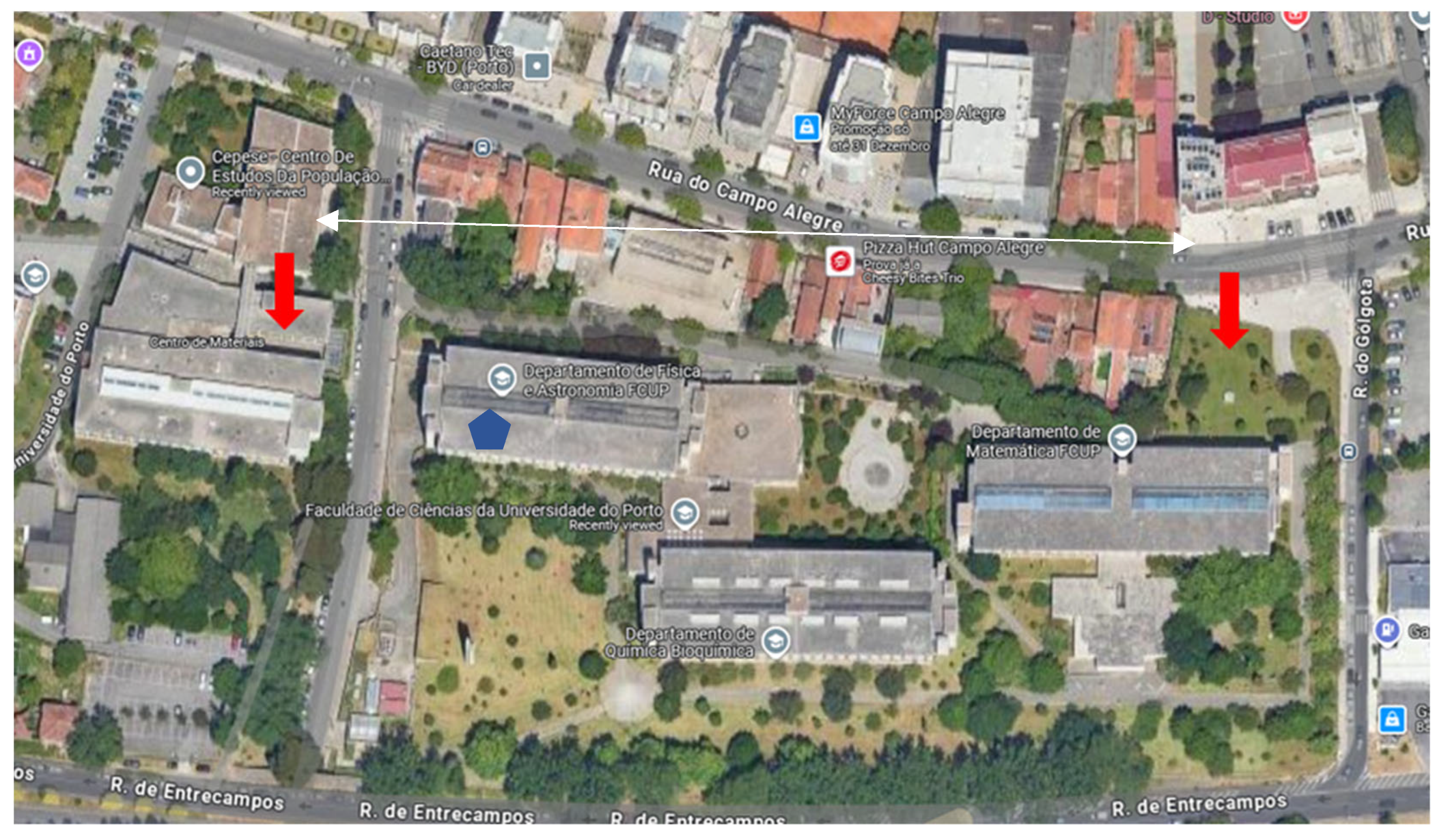
The study’s sampling points (
Figure 1) were selected on the Faculty of Sciences of the University of Porto’s campus, in the Campo Alegre area, a residential neighbourhood. This location is close to the inner ring road (VCI), a major urban highway encircling central Porto, which lies approximately 200–300 m south of the sampling site and contributes to traffic-related emissions in the vicinity. The Douro River estuary is situated roughly 3–4 km to the northwest of the sampling location, and the Atlantic Ocean coastline (Foz do Douro) is approximately 5–6 km to the west, placing the site within an urban corridor influenced by both fluvial and maritime air-mass trajectories. Land use around the campus is predominantly residential and commercial, with green urban spaces (gardens) interspersed, and there are no immediately adjacent heavy industrial facilities. This location is highly impacted by frequent traffic jams during peak hours, reflecting the area’s role as a significant urban thoroughfare with notable anthropogenic influences.
Based on long-term data from the Portuguese Institute for Sea and Atmosphere (IPMA), Porto’s climate is characterised by an average annual temperature of 14.7 °C, and average annual precipitation is 898.5 mm, primarily occurring in December and January, while the city experiences a relative annual humidity of 82%. Wind patterns shift seasonally: westerly and north-westerly in summer and easterly or south-easterly during winter.
2.2. Sampling Methodology
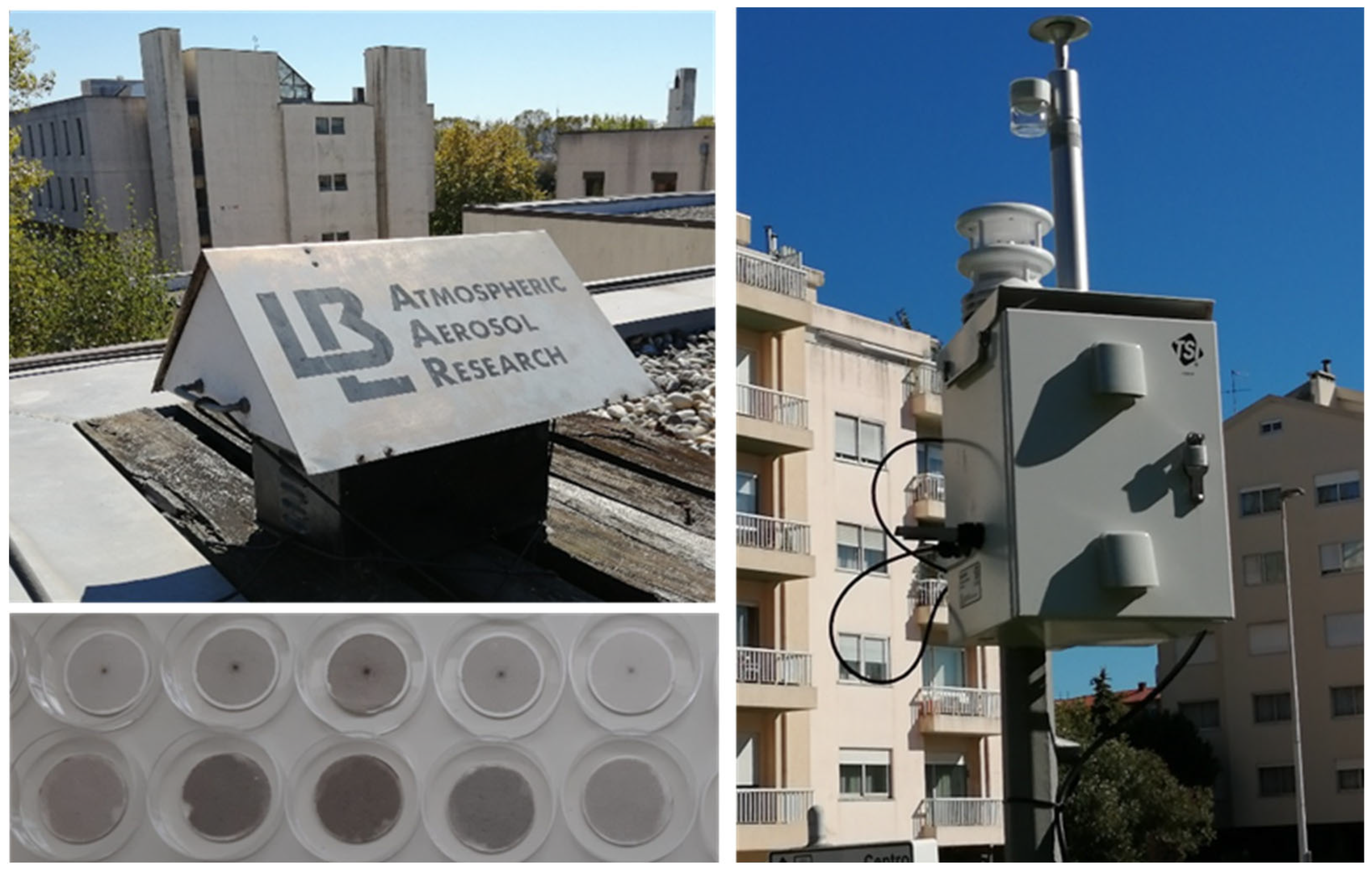
PM sampling was conducted at two heights: at ground level (approximately 3 m above ground level) and on the rooftop of a building (approximately 20 m above ground level), approximately 250 m horizontal distance apart. For rooftop sampling, an active sampler (~10 L/min) was used to collect total suspended particles (TSP) (
Figure 2) on quartz filters (Whatman™ QM-H, Cytiva, Marlborough, MA, USA; 37 mm diameter). These filters were selected due to their heat-treated composition, which minimises trace organic contamination, their binder-free design ensuring maximum purity, a low background in metal content, and their ability to withstand high temperatures of up to 1000 °C, making them ideal for trace-level particulate analysis.
At ground level, PM samples (TSP) were also collected on quartz filters, along with concentration measurements for different aerodynamic particle-size fractions (defined by aerodynamic diameter). Filter-based sampling for chemical analysis was applied to TSP at both heights, although the DustTrak provided size-resolved optical concentrations only at ground level. The airborne PM concentration was measured using a TSI 8520 DustTrak (
Figure 2), a laser photometer equipped with an impactor that determines the mass of particles across different size fractions. This device draws air at a flow rate of 4 L/min and provides continuous, real-time measurements of mass concentrations for PM
1, PM
2.5, PM
4, PM
10, and TSP fractions. Concentration values were recorded every two minutes based on the selected programming. TSP was selected for filter-based chemical analysis because this was the only particulate fraction that the equipment allowed to be collected on filters under the applied sampling configuration.
Although the DustTrak monitor provides real-time PM mass concentrations, its optical response depends on aerosol properties such as density and refractive index. The DustTrak Environmental Monitor is factory-calibrated using a standard test dust, no additional field calibration against filter-based mass concentrations was performed in this study. During the monitoring period, the instrument underwent one factory calibration. Consequently, the reported PM concentrations should be regarded as indicative and are primarily used for relative comparisons between periods and particle-size fractions.
Sampling followed a seasonal calendar repeated over two years. Sampling was conducted during mid-month periods, chosen to reflect typical meteorological conditions for each season. While this approach allows for a general seasonal characterisation, it does not capture short-term variability or extreme pollution events, which may introduce some bias in the seasonal interpretation.
No major local extreme meteorological events (such as severe storms or cold waves) were recorded during the sampling campaigns. Nevertheless, episodes of long-range dust transport, including possible Saharan dust intrusions affecting the Iberian Peninsula, may have occurred and could have influenced PM levels, which is considered a source of uncertainty in the seasonal interpretation. While this approach allows for general seasonal characterisation, it does not capture short-term variability or extreme pollution events, which may introduce some bias in the seasonal interpretation.
Concentration measurements and filter samples were collected during Summer (July 2021 and 2022), Autumn (October 2021 and 2022), Winter (January 2022 and 2023), and Spring (April 2022 and 2023). The filter collection, corresponding to TSP, occurred twice a week at both sampling points, consistently on the same days. PM concentration measurements were performed continuously throughout the sampling periods. The sampling design and dataset size were intended to characterise seasonal variability and vertical contrasts rather than to support formal source apportionment or receptor modelling analyses, which typically require larger datasets and multi-species fingerprints.
Daily meteorological data were obtained from a weather station located between the two sampling points at approximately the same altitude as the sampler on the roof (~20 m). The aim was to assess the influence of meteorological factors on particulate matter concentration. Data from the Campbell Scientific weather station, model CR200Series, were also used. Information was collected on daily precipitation, temperature, relative humidity, wind speed, and wind direction.
2.3. Chemical Analysis of Filters
Inductively Coupled Plasma–Mass Spectrometry (ICP-MS) was employed to perform the elemental characterisation of PM. The analysis was conducted on quartz filters to collect particles (TSP) from ground-level and rooftop sampling points. A total of 128 filters were selected for chemical analysis, representing the different sampling periods of the study, with an average of 17 filters sampled per sampling period. Although a larger number of filters were originally collected, only a subset was analysed due to technical constraints and cost–benefit considerations. Nevertheless, the selected filters provide representative temporal coverage, allowing for the assessment of general seasonal trends. Each filter was processed and analysed at the certified Bureau Veritas Laboratories in Ontario, Canada.
The filters were digested using HNO3, and quality control was ensured by including certified reference materials, blanks, and randomly selected duplicate samples. Blank filters were analysed for quality control. All elements were below detection limits except Ba, which was just above the detection limit in the blank. Although blank subtraction was not applied, this contribution is not expected to affect the general trends or statistical relationships discussed. Still, it may introduce additional uncertainty for samples with the lowest Ba contents. This contribution is considered negligible with respect to the observed temporal trends and statistical analyses. The analytical package chosen for this study, designed for total metals analysis on small filters, allowed for the detection of 30 chemical elements. Accordingly, all elemental data discussed in this study correspond exclusively to TSP filters from both sampling locations. To validate the findings, a blank filter was also analysed, ensuring that any detected elements originated from the actual samples. The laboratory results, reported in micrograms (µg), were screened to remove elements with concentrations below the detection limit across all samples. Element validation was further performed by comparison with the blank sample. Element concentrations were compared across the two sampling locations and different seasons.
While TSP samples provide an integrated representation of particulate-matter composition, they do not allow discrimination between fine and coarse particle fractions. As a result, differences in chemical enrichment related to particle size, such as the preferential association of traffic-related metals with finer particles or crustal elements with coarser fractions, could not be evaluated. This limits source apportionment and the assessment of size-dependent exposure risks.
2.4. Data Analysis
To evaluate the temporal variation in the concentration and composition of different atmospheric particulate-matter fractions at the FCUP campus, a descriptive statistical analysis was performed using Microsoft Excel and IBM SPSS v.30. Additionally, boxplot diagrams representing the average, quartiles, and maximum and minimum values were made to summarise the data distribution.
The relationships between the variables and weather parameters were calculated through Spearman’s correlation coefficients at significance levels of 5% and 1%. No receptor models or multivariate source-apportionment techniques were applied. The analysis consists of descriptive statistics and correlation-based interpretation.
3. Results
3.1. PM Concentration Analysis at Ground Level
The mass concentrations of PM
10, PM
2.5, PM
4, PM
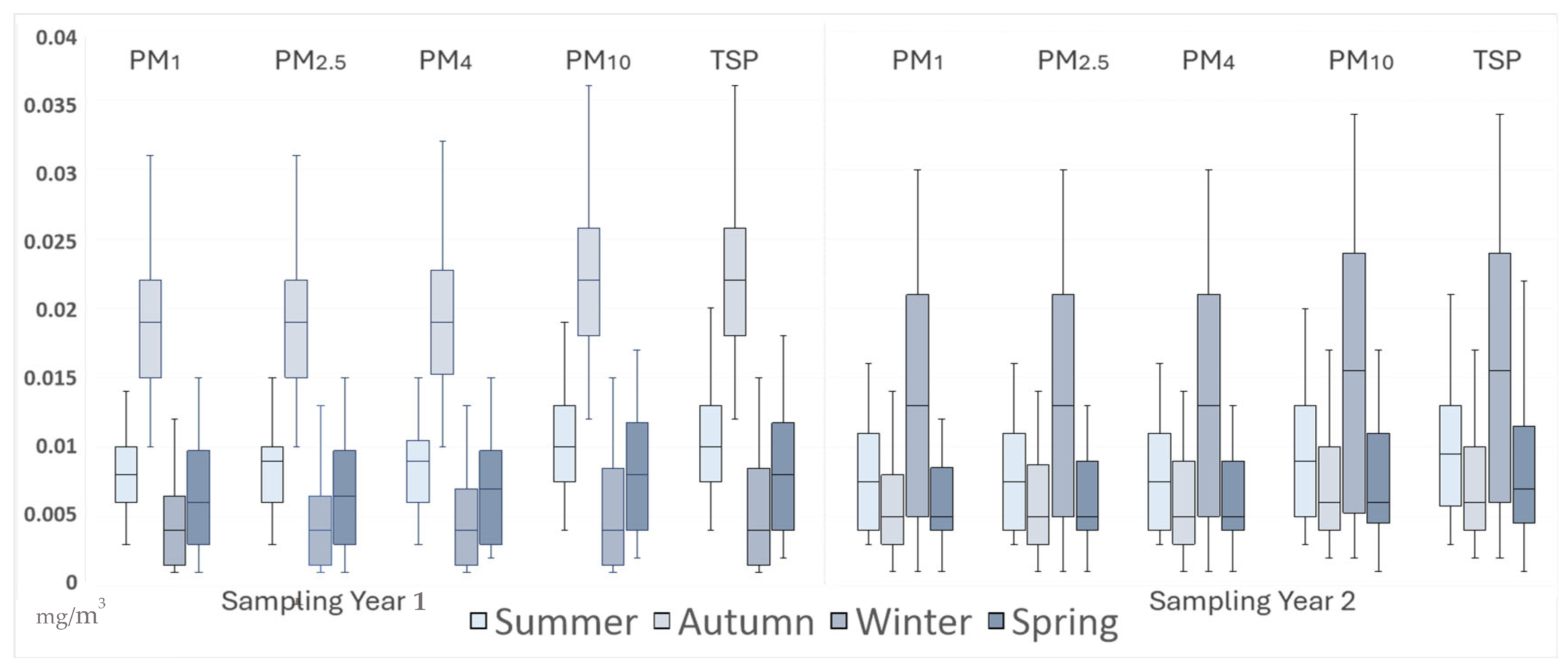
1, and TSP were monitored using the TSI DustTrak over a two-year period. Continuous monitoring was conducted during the mid-month of each season, providing daily average values, which are summarised in
Figure 3.
During the first year, the autumn season stands out with higher average and maximum concentration values across all PM size fractions. This can suggest increased particle emissions during this period, likely influenced by seasonal activities such as biological residues burning from agricultural activities or increased vehicle use.
In the second year, although the trend is less pronounced, winter emerges as the season with the highest concentrations, possibly due to increased heating activities and atmospheric stability that traps particles closer to the ground.
Because DustTrak measurements are influenced by aerosol optical properties, such as particle density and refractive index, some uncertainty in the absolute PM concentrations cannot be excluded. This potential bias was considered during data interpretation, and the discussion, therefore, focuses mainly on relative seasonal patterns and contrasts between size fractions rather than on absolute concentration values.
Table 1 highlights the impact of meteorological factors on PM concentrations. Variables precipitation and wind speed exhibit a negative correlation with PM concentrations. This indicates that precipitation acts as a cleansing mechanism by removing particles from the atmosphere through wet deposition, while higher wind speeds likely disperse particles, reducing their concentrations near the sampling location.
Additionally, a positive correlation with temperature was also observed, suggesting that warmer conditions may favour the resuspension of particles or increase emissions from sources such as soil dust. For the relative humidity variable, no significant correlations were observed, indicating a limited direct influence on PM levels.
Although temperature shows a positive overall correlation with PM concentrations, this relationship reflects the combined dataset across seasons and years and does not imply a simple seasonal control. In the first year, elevated PM levels during autumn under relatively mild conditions likely contributed to this trend, whereas in the second year, winter higher values were probably driven by increased heating emissions and enhanced atmospheric stability. This indicates that different processes may dominate PM variability depending on the period considered.
These meteorological controls are consistent with the seasonal patterns observed and were, therefore, considered when interpreting temporal variations in PM concentrations derived from optical measurements. These patterns were also taken into account when interpreting the behaviour of specific chemical elements, particularly those commonly associated with crustal material (e.g., Ca), marine influence (Na and Mg) and traffic-related emissions (Cu and Pb).
3.2. PM Chemical Analysis at Ground Level
The elemental composition of PM analysed using the ICP technique detected 16 elements in the samples. However, some elements were only present in specific samples or during particular sampling periods. Elements such as Al, As, Bi, Ni, and V were only identified in highly specific instances. Al and Bi were detected exclusively in the autumn of the second sampling period, while As, Ni, and V appeared during summer.
Elements like Ca, Fe, and Zn were found in limited samples. Ca was detected across most sampling periods, except for winter. Fe was observed during both summer periods and the autumn of the second sampling period, while Zn was present in the autumn of the first year and the winter of the second year.
Elements such as Cr, Pb, and Mn were more frequently detected but not consistently across all samples. Pb was the only element identified in all sampling periods, while Cr was absent during the spring sampling of the first period, and Mn was undetected in the same period as well as in winter.
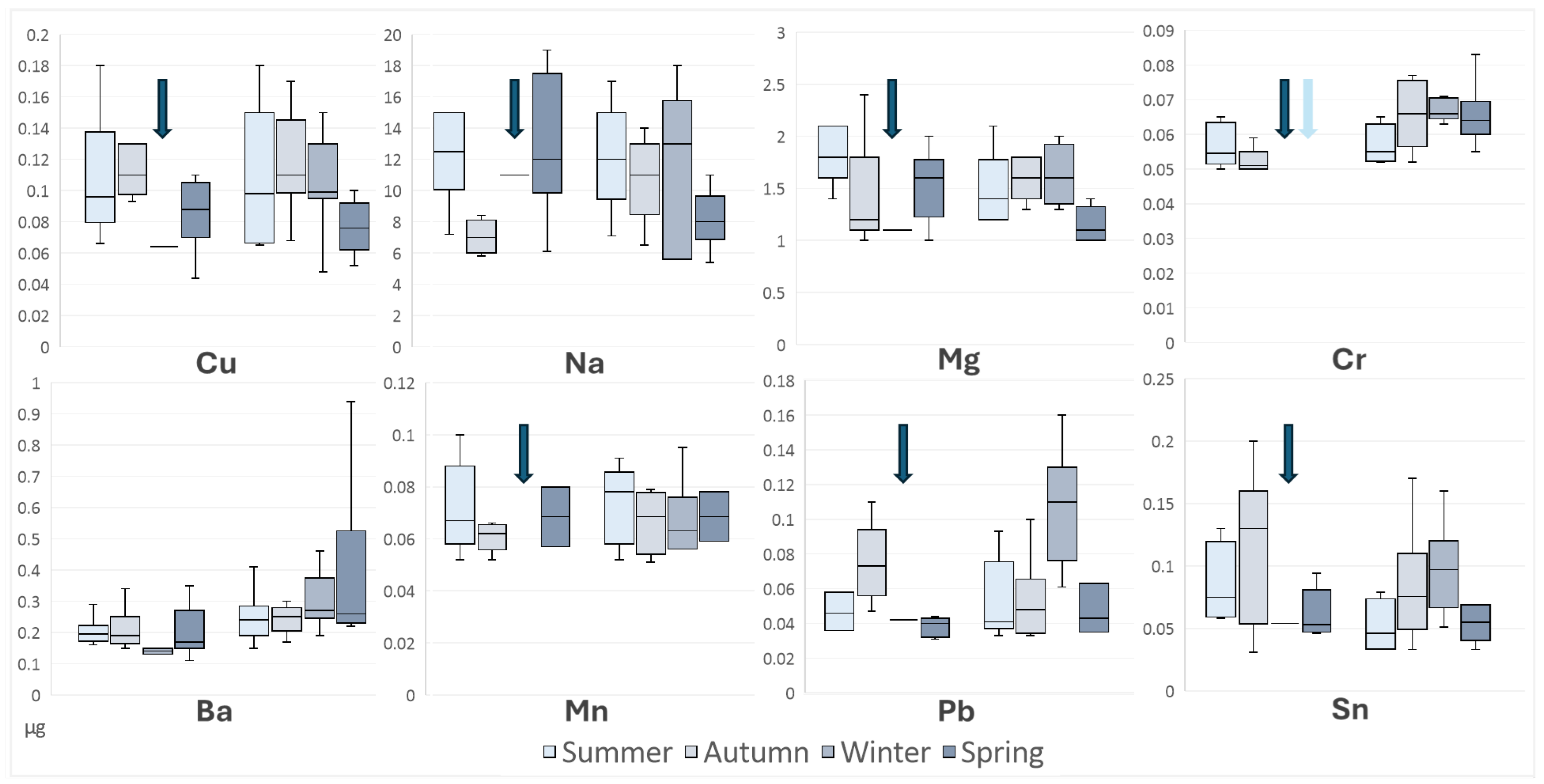
To identify broader trends, the analysis focused on elements consistently present across all sampling periods and nearly all samples: Ba, Cu, Mg, Na, Cr, Mn, Pb, and Sn. These elements were selected because of their known relevance as potential source tracers, with Na and Mg frequently linked to marine aerosols, Ca and Mn to crustal material and resuspended soil, and Cu and Pb commonly associated with traffic-related emissions. These trends are graphically represented in
Figure 4, which displays elemental concentrations as boxplots for each seasonal sampling period.
Comparing the seasonal sampling trends between the first and second years, only Cu and Sn present a similar pattern across both years. However, this cannot be confirmed due to the lack of filter samples for the winter season in the first sampling period. All other elements exhibit differing trends.
In the first-year sampling, Na, Mg, and Mn exhibited lower average, maximum, and minimum concentrations during the autumn sampling period compared to other seasons. Ba and Cu displayed consistent trends of increasing and decreasing concentrations, respectively, across seasons. Pb and Sn showed their highest average and maximum values during autumn representative sampling.
In the second year, although more variable, the discrepancies between average concentrations were smaller. Cu, Na, and Mg maintained similar values except for spring, which showed significantly lower levels. Pb concentrations were notably higher during winter, while Sn, Cr, and Ba exhibited increasing trends across the sampling periods, followed by a decline in spring.
Table 2 reveals that the precipitation significantly reduced Ba, Cu, and Mn concentrations, while wind speed negatively influenced Cu, Ba, and Zn.
Elements like Cr and Pb showed a negative correlation with temperature, suggesting possible reductions in emissions or atmospheric processes affecting their presence during warmer periods. Fe, Mg, and Na exhibited positive correlations with wind direction, indicating the potential transport of these elements from specific source regions. In contrast, Cu and Pb showed negative correlations, implying local sources may dominate their concentrations. The contrasting behaviour of these elements supports this interpretation, as traffic-related tracers such as Cu and Pb tend to respond more strongly to local emission patterns, whereas Na and Mg are often influenced by regional transport and maritime air masses.
The analysis demonstrates clear seasonal patterns and meteorological influences on elemental concentrations (Ba, Cu, Pb, Mg, Mn, and Na) at ground level.
3.3. Element Concentration Analysis at Rooftop Level
The characterisation of PM sampled at the rooftop level revealed the presence of 20 chemical elements. However, not all elements were consistently detected across all sampling periods or samples.
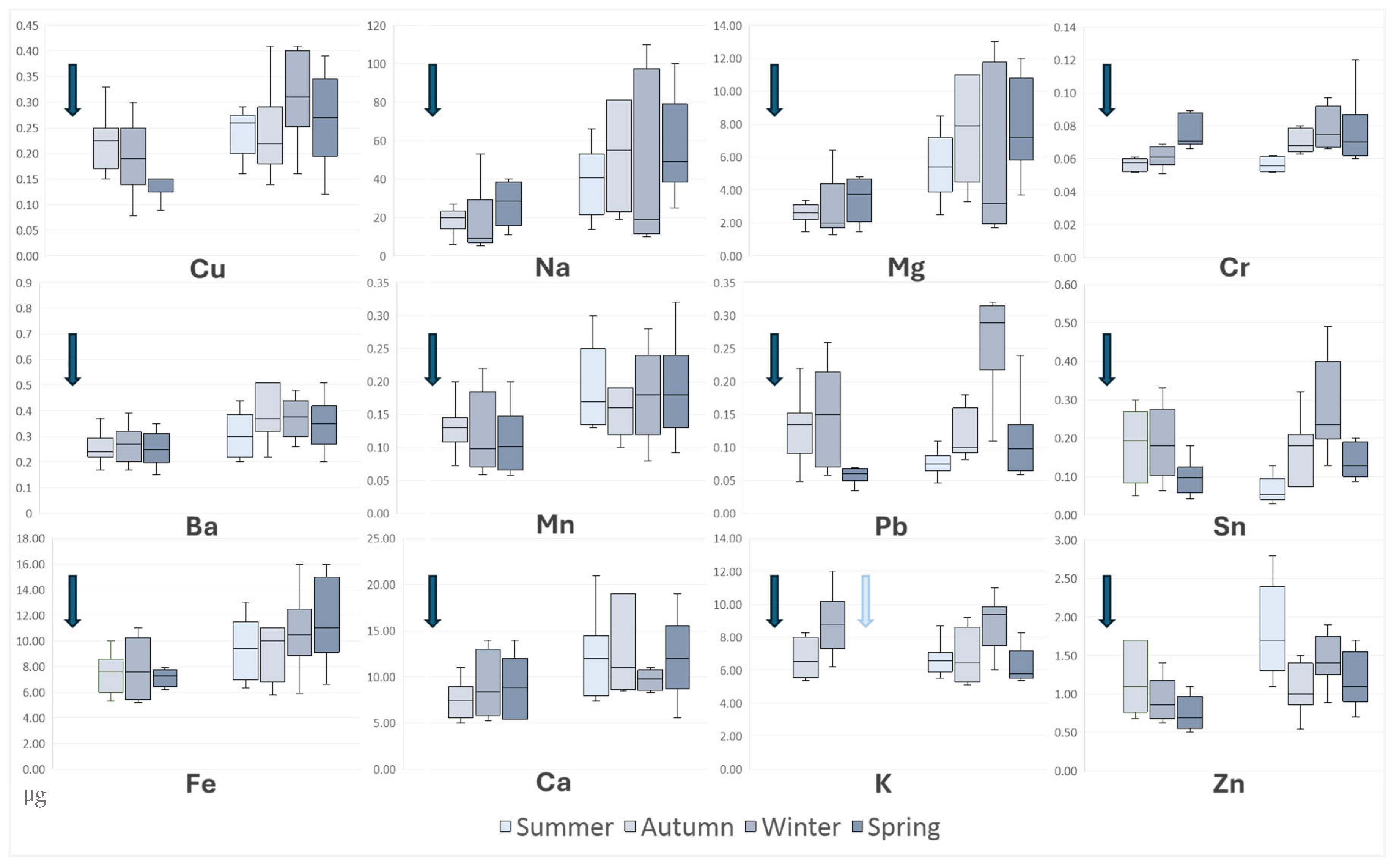
Elements such as As, Sb, Cd, Ni, and V were only present in highly specific samples, indicating potential episodic sources or transport phenomena. Al, K, Sr, and Ti were detected more frequently but not consistently across all sampling periods. However, Ba, Ca, Cr, Cu, Fe, Pb, Mg, Mn, Na, Sn, and Zn were identified in nearly all samples and across all periods. These frequently detected elements form the basis of a more detailed analysis to identify trends over time (
Figure 5).
Focusing on the first sampling period, elements such as Cu, Zn, and Sn displayed decreasing trends across seasons. In contrast, concentrations of Ca, K, and Cr increased over the same periods. Na, Mg, and Mn tended to have lower average concentrations during winter and higher concentrations in spring, while Pb exhibited the opposite trend. Fe and Ba showed relatively stable average concentrations across all seasons.
In the second-year sampling, Cu and Zn exhibited patterns of increase, decrease, and subsequent fluctuations across seasons, suggesting more complex seasonal dynamics. Ca showed a decreasing trend, with an increase in spring, while Cr followed the opposite pattern. Mn maintained stable average concentrations, except for slightly lower values during autumn.
Precipitation and relative humidity negatively affected Ba, Fe, Mn, and Cu concentrations, highlighting their susceptibility to atmospheric cleansing processes (
Table 3). Cu was also negatively correlated with wind speed, reflecting potential deposition mechanisms dependent on wind. Pb, Sn, and K displayed negative correlations with temperature and wind direction, while K showed a positive correlation with wind speed, possibly indicating its resuspension under stronger wind conditions. Mg and Na were positively correlated with precipitation, relative humidity, and wind direction. Such behaviour is consistent with sea-spray aerosols transported inland under humid and windy conditions, in contrast to Cu and Pb, whose correlations point to more localised urban sources.
3.4. Comparative Analysis of Sampling Heights
Rooftop- and ground-level sampling reveal distinct influences on the concentration of elements. Concentrations on the rooftop level exhibit greater seasonal variability, elements such as Ba, Ca, Cr, Cu, Fe, Pb, Mg, Mn, Na, Sn, and Zn are common to both levels, while Sb, Cd, and Ni were only detected at the rooftop level, suggesting more regional contribution or long-range transport. Mg and Na showed positive correlations with precipitation and humidity, which, due to sampling location, suggests maritime sources. The increase in Ca during spring may be linked to soil resuspension driven by stronger winds. Rooftop-level data also displayed stronger correlations with wind direction and relative humidity, suggesting that transport mechanisms and atmospheric conditions play a larger role at this height.
The variability in average concentration values was lower at ground level, indicating a stronger influence of local factors such as traffic. For instance, Cu and Zn displayed fluctuating patterns, likely tied to seasonal changes in traffic.
Precipitation significantly reduces the concentration of various elements at both levels, highlighting the role of “atmospheric washing” processes.
Rooftop-level sampling captures the impact of regional and long-range sources as well as atmospheric conditions, while ground-level sampling is more influenced by local factors.
4. Discussion
Monitoring atmospheric particulate-matter concentration helps to gain knowledge about temporal variability in their concentration, influencing factors, as well as the composition of materials present in the air. These studies can, in the medium- and long-term, help predict the behaviour of pollution events as well as address them in a timely manner to protect the population from one of the leading causes of premature death in Europe [
1]. However, the present work is restricted to the two-year study period and does not attempt to derive long-term climatological trends. The calculation of PM
2.5/PM
10 ratios and the relative contribution of fine particles to TSP would provide additional insight into the importance of secondary aerosol formation (i.e., particles formed in the atmosphere from gaseous precursors) and long-range transport. Although not explored in detail here, this aspect is identified as an important avenue for future investigations.
Our results showed a clear seasonal variation in PM concentration across all monitored particle sizes. In the first year, mean and maximum values were higher in autumn, whereas in the second year, winter exhibited the highest levels, suggesting additional emissions during these seasons, with the possible origin from biomass burning and low boundary layer height promoting greater mixing of particles and enhanced deposition [
22]. This seasonal pattern aligns with observations reported by Chae et al. [
23], Lee et al. [
24], and Chatoutsidou et al. [
25], who reported higher PM concentrations (PM
2.5 and UFP, respectively) in winter, likely due to the greater rigidity in road surfaces, intense traffic emissions, or heating emissions [
23,
25,
26]. Mostaghim et al. [
27] found that PM
10 levels in autumn and winter were much higher than in spring and summer for the Tehran region, which is in line with our observations. Biancardi et al. [
22], using low-cost equipment, arrived at similar conclusions, highlighting distinct seasonal trends in PM
2.5 air quality, with a good state of the air prevailing across all seasons—most prominently and stably in summer, and least in winter.
However, other studies highlight opposing seasonal variations. For example, Alsowaidan et al.’s [
28] results showed that PM
10 levels were higher in summer. Also, in some cases, it is attributed to enhanced particle dispersion under favourable atmospheric conditions and increased anthropogenic emissions. These contrasts reflect the influence of local sources and regional characteristics. This study was designed to provide a detailed characterisation of particulate matter at a representative urban site in Porto. While the single-location approach limits direct extrapolation to the entire metropolitan area, it enables a focused assessment of seasonal variability and vertical contrasts under well-defined local conditions rather than formal source apportionment.
The PM mass concentrations derived from optical measurements may be influenced by aerosol properties; consequently, the interpretation emphasises relative temporal patterns rather than absolute values. The influence of meteorological factors on PM concentration is reported in many studies [
29,
30]. In our study, a correlation analysis revealed significant negative relationships between precipitation and wind speed with PM concentrations, indicating their role as atmospheric cleansing mechanisms. These findings corroborate studies such as [
27,
31], which emphasise the influence of wind speed and precipitation in dispersing and removing particles [
27,
31]. Chatoutsidou et al. [
25] state that, regarding wind direction, statistically higher concentrations of particles were measured during land-prevailing air conditions as a direct result of particle enrichment from anthropogenic activities.
A positive correlation with temperature suggests that warmer conditions favour particle resuspension or increase emissions from sources like soil dust. This pattern is similar to that reported by Diksha et al. [
29] and Wang et al. [
31], who attributed higher particle or pollution levels to anthropogenic activities during summer [
29,
31] and to temperature influence.
The concentrations of elements such as Pb, Cu, and Sn were higher in winter, while others, such as Mg and Na, peaked in spring. These patterns indicate distinct sources: Pb and Cu are associated with anthropogenic emissions like vehicular traffic, whereas Mg and Na may reflect natural influences such as dust resuspension or maritime contributions [
26,
32]. The absence of real-time traffic flow data restricts a direct quantitative linkage between traffic intensity and elemental concentrations. However, correlations with meteorological parameters and the proximity to major roadways provide useful indirect indicators of source influences. Accordingly, interpretations regarding emission sources are based on indirect indicators and comparisons from the literature rather than receptor modelling outputs.
Previous studies have indicated that elements like Zn and Cd are predominant in tyre wear particles, particularly under high-traffic conditions, suggesting a direct link between seasonality and local emission sources [
23,
26].
Elements such as Ba, Cu, and Mn showed significant reductions in their concentrations due to precipitation, while Mg and Na exhibited positive correlations with relative humidity and wind direction, suggesting possible maritime influence, as Porto is located near the Atlantic Ocean or more regional sources. These findings align with Wonaschütz et al.’s [
32] results, who highlighted the influence of the air-mass origin on bulk PM concentrations, coarse-mode chemical composition, and the mass size distribution, while it was less important for fine-fraction chemical composition.
On the other hand, Pb exhibited a negative correlation with temperature, indicating that its emissions may be more intense under colder conditions. Studies support these observations, highlighting seasonal variations in emission dispersion driven by atmospheric processes [
26,
31].
Differences between the sampling levels indicate distinct influences. At ground level, concentrations were more stable, reflecting stronger local influences such as traffic and dust resuspension. In contrast, rooftop concentrations exhibited greater seasonal variability, suggesting the influence of regional or long-distance atmospheric transport. These findings are consistent with [
26,
32], who observed significant differences between fine and coarse PM sources depending on air-mass origin and sampling height. Additionally, elements such as Zn, Pb, and Cu were more concentrated at ground level, reinforcing the importance of local sources in shaping the vertical distribution of PM.
5. Conclusions
This study highlights the complex dynamics of PM and elemental concentrations across two sampling levels—ground and rooftop—and their interactions with meteorological factors.
At the ground level, the results reveal a stronger influence of local sources, such as traffic and soil resuspension. Seasonal variations were evident, with autumn and winter showing higher concentrations for most PM fractions and elements, likely due to increased emissions and atmospheric stability. Elements such as Cu and Zn displayed seasonal fluctuations, potentially linked to traffic-related activities.
At the rooftop level, the findings emphasise the role of regional and long-range transport. The detection of elements such as Sb, Cd, and Ni—absent at ground level—suggests contributions from more distant sources. Positive correlations between Mg and Na with precipitation and humidity reinforce the influence of maritime sources at this height. Seasonal trends, such as the increase in Ca during spring, could indicate the impact of atmospheric resuspension processes.
Meteorological factors played an important role in controlling PM and elemental concentrations. Precipitation and wind speed showed consistent negative correlations with most elements and PM fractions, underlining their role in atmospheric cleansing and dispersion. Conversely, temperature and wind direction exhibited variable effects, reflecting the interplay between local and transported sources.
By comparing the two levels, the study demonstrates that ground-level concentrations are more affected by localised emissions, while rooftop sampling captures broader regional patterns. This dual-level approach provides a comprehensive understanding of PM dynamics, reinforcing the importance of multi-level monitoring to informed air-quality management.