Article

Integrated Emission Inventory and Socioeconomic Drivers of Air Pollutants and Greenhouse Gases from Municipal Solid Waste Incineration in China

1
College of Resources and Environment, University of Chinese Academy of Sciences, Beijing 100049, China
2
Foreign Environmental Cooperation Center, Ministry of Ecology and Environment, Beijing 100035, China
*
Authors to whom correspondence should be addressed.
Environments 2026, 13(2), 124; https://doi.org/10.3390/environments13020124

Submission received: 23 January 2026 / Revised: 14 February 2026 / Accepted: 19 February 2026 / Published: 22 February 2026

Abstract

To comprehensively assess the emissions of flue gas pollutants from municipal solid waste incineration (MSWI) in China and their socioeconomic driving factors, this study employs a bottom-up approach to develop an integrated carbon and air pollutant emission inventory for 1016 MSWI plants in 2024. We apply a Random Forest (RF) model to analyze the underlying drivers. Results indicate that for air pollutants, NOx has the highest emissions, whereas mercury (Hg) and dioxins (polychlorinated dibenzo-p-dioxins and dibenzofurans, PCDD/Fs) are identified as priority control pollutants due to their high toxicity. Spatially, emissions display a distinct “high in the east, low in the west” pattern, concentrated in eastern coastal provinces, with characteristic pollutants being prominent in specific regions. Meanwhile, among greenhouse gases (GHGs), CO2 dominates mass emissions, while N2O exhibits significant global warming potential. Driver analysis reveals that Gross Domestic Product (GDP) and MSWI treatment capacity are key common drivers, showing stable positive and negative contributions, respectively. The number of invention patent applications is specifically and strongly associated with NOx and heavy metal emissions. This study provides a national-scale integrated quantification of MSWI emissions and a quantitative analysis of their driving mechanisms using RF, offering a critical data foundation and scientific basis for supporting synergistic pollution and carbon reduction.

1. Introduction

With the continuous economic development of China, the annual collection and transportation volume of municipal solid waste (MSW) increased from 179 million tons in 2014 to 260 million tons in 2024 [1,2]. Over the past decade, driven by multiple policy incentives and the pressing reality of “cities besieged by waste”, municipal solid waste incineration (MSWI) technology has rapidly expanded due to its integrated advantages in waste reduction, harmless treatment, and resource recovery [3,4]. By 2024, MSWI accounted for 84.60% of the total harmless treatment capacity for MSW in China [5]. However, flue gas pollutants emitted from MSWI pose significant environmental hazards. They are not only a major source of secondary environmental pollution but also exert substantial pressure on global climate change [6].
This issue is directly linked to the core control objectives of several key international conventions. For instance, the United Nations Framework Convention on Climate Change (UNFCCC) [7] and its Paris Agreement [8] focus on greenhouse gas (GHGs) mitigation, explicitly requiring the control of GHGs such as Carbon Dioxide (CO2), Methane (CH4), and Nitrous Oxide (N2O) from MSWI. The Stockholm Convention on Persistent Organic Pollutants [9] lists dioxins (Polychlorinated Dibenzo-p-Dioxins and Polychlorinated Dibenzofurans, PCDD/Fs), substances characterized by toxicity, persistence, bioaccumulation, and long-range transport potential, as priority substances for elimination, with MSWI being a significant anthropogenic source. The Basel Convention on the Control of Transboundary Movements of Hazardous Wastes and Their Disposal [10] imposes strict controls on wastes containing heavy metals such as Mercury (Hg), Lead (Pb), Cadmium (Cd), and Arsenic (As). Furthermore, the Minamata Convention on Mercury [11] specifically designates MSWI facilities as key sources for mercury emission control. Therefore, the systematic management of pollutants from MSWI is an intrinsic requirement for China to fulfill its international environmental responsibilities. In this context, the development and application of an emission inventory are particularly critical. An emission inventory, defined as a systematic quantitative representation of pollutant emissions within a specific spatiotemporal scope [12], serves not only as a vital tool for quantifying emission levels and identifying key pollution sources within the incineration sector but also as an indispensable data foundation for supporting precise decision-making aimed at “coordinated pollution reduction and carbon mitigation” [13]. Therefore, conducting research focused on the flue gas pollutant emission inventory from MSWI in China carries urgent practical significance and clear scientific value.
In the research field of flue gas pollutant emissions from MSWI, scholars have conducted systematic work primarily from two directions: emission inventory development and driver analysis. Regarding inventory development, studies have mainly focused on aspects such as spatiotemporal distribution characteristics and the optimization of accounting methodologies. For instance, Tian et al. [14] estimated the emissions of pollutants, including Particulate Matter (PM), Sulfur Dioxide (SO2), Nitrogen Oxides (NOx), Carbon Monoxide (CO), heavy metals, and PCDD/Fs from MSWI across China from 2003 to 2010 using optimized emission factors, thereby clarifying their spatial distribution patterns. Liu et al. [15] compiled an inventory of GHGs for Beijing from 2004 to 2014 based on the IPCC Guidelines, highlighting the contribution of waste treatment to the city’s emission structure. Wang et al. [16] conducted a specific accounting of GHGs from the Beijing Gao’antun MSW-to-Energy Plant in 2015. Zhang et al. [17] developed a typical flue gas pollutant emission inventory for Hebei Province in 2021 and evaluated the emission reduction potential of end-of-pipe treatment facilities. However, existing inventory studies still exhibit notable limitations. First, there is an issue of timeliness, as most data fail to reflect the rapid industry expansion over the past three years. Second, there is a lack of systematic integration. Most studies either focus on conventional pollutants or concentrate solely on GHGs, lacking an integrated accounting of multiple species encompassing both “carbon” and “air pollutants,” which hinders their ability to support decision-making for synergistic control. From the perspective of coordinated pollution reduction and carbon mitigation, constructing an integrated emission inventory encompassing both greenhouse gases and air pollutants has become a necessary foundation and a cutting-edge approach for assessing the environmental impacts of the waste management sector.
Regarding the analysis of emission driving factors, machine learning has been increasingly applied in this field with the advancement of data analysis techniques. Machine learning, as an interdisciplinary domain, utilizes computers as tools to achieve the structured construction and efficient application of knowledge systems. Among various methods, Random Forest (RF) is an ensemble learning approach widely used for both classification and regression tasks [18]. Wang Michuan [19] and Guo Jiachen [20], using specific incineration plants as case studies, respectively validated the superior performance of the RF model in predicting flue gas nitrogen oxides and acidic gas concentrations. Xu Han [21] further integrated causal interpretation algorithms to reveal the influence of different driving factors on ozone formation. Based on constructing a high-resolution national emission inventory for 2020, Cui Jicui [22] employed neural networks to achieve city-level emission predictions. These studies demonstrate that machine learning models, including RF, possess significant advantages in capturing complex nonlinear relationships and identifying key influencing factors. However, existing research has predominantly focused on process-related or environmental factors such as incineration operating conditions, flue gas parameters, and meteorological conditions, with relatively scant attention paid to the driving effects of socioeconomic factors. Therefore, quantifying the differential impacts of socioeconomic factors on various pollutant emissions is crucial for formulating precise and synergistic abatement policies.
Therefore, this study employs a bottom-up approach to construct a plant-level integrated carbon and air pollutant emission inventory for China’s MSWI sector in 2024, systematically revealing the emission levels and spatial characteristics of air pollutants and GHGs. On this basis, a Random Forest (RF) model is applied to investigate the driving effects of socioeconomic factors, including population, economic scale, industrial structure, technological support, and governance assurance on emissions, and to quantify their relative contributions. The main methodological innovations are twofold: (i) a plant-level integrated emission inventory covering both greenhouse gases and multiple air pollutants; and (ii) the integration of such an inventory with an interpretable machine learning approach (RF combined with SHapley Additive exPlanations, SHAP) to link the impacts of socioeconomic drivers on MSWI emissions.

2. Materials and Methods

2.1. Study Area and Subjects

This study covers 31 provinces, autonomous regions, and municipalities in mainland China (excluding Hong Kong, Macao, and Taiwan). The research subjects are the 1016 MSWI plants that were constructed and operational by the end of 2024. The plant-level activity data required for the study, including MSW incineration volume, geographical location, incinerator type, and types of air pollution control devices (APCDs), were primarily sourced from official statistical materials such as the National Statistical Yearbooks and publicly available corporate information.

2.2. GHG Emission Inventory Methodology

The emissions of three key GHGs, specifically CO2, CH4, and N2O, are calculated in accordance with the 2006 IPCC Guidelines for National Greenhouse Gas Inventories [23] and the Guidelines for the Compilation of Provincial Greenhouse Gas Inventories (Trial) issued by the National Development and Reform Commission of China [24]. The specific calculation formulas are shown in Equations (1) and (2).
E C O 2 = MSWF × CCW × FCF × EF × 44 12
where E C O 2 is the CO2 emissions from the MSWI process (tons, t); MSWF is the amount of MSW (tons per year, t·y−1); CCW is the carbon content of waste (MSW), taken as 20% [25]; FCF is the fossil carbon fraction in the total carbon, and the detailed data are available in Table S1 of the Supplementary Materials [25,26,27,28,29,30,31,32]; EF is the combustion efficiency of the incinerator, taken as 95%; 44 12 is the conversion factor from C to CO2.
E C H 4 / N 2 O = ( IW × E F C H 4 / N 2 O ) × 10 6
where E C H 4 / N 2 O are CH4 or N2O emissions from the MSWI process (t); IW (Incineration Waste) is the amount of MSW (t); E F C H 4 / N 2 O is the emission factor for CH4 or N2O.
Note: The summation (∑) accounts for different incinerator types or emission factors within a province. The factor 10 6 is a conversion factor from grams to tons.

2.3. Air Pollutant Emission Inventory Methodology

The emissions of air pollutants, including NOx, HCl, SO2, PM, heavy metals, and PCDD/Fs are calculated primarily with reference to the EMEP/EEA Air Pollutant Emission Inventory Guidebook 2023 [33] and relevant existing studies [21]. The calculation formula is as follows.
E j = A D × E F j × V N
where E j is the emission of pollutant j (t); AD (Activity Data) is the activity level, namely the annual amount of MSW incinerated (t); E F j is the post-control emission factor for pollutant j (mg/m3), and E F j for different APCD combinations are provided in Table 1; V N is the volume of flue gas under standard conditions generated from incinerating a unit amount of MSW (m3/t). The value of V N is taken with reference to the correlation coefficients for the MSWI industry in the Emission Source Statistical Survey Manual for Pollution Generation and Discharge Coefficients: 3500 m3/t for grate furnace (GF) and 4600 m3/t for circulating fluidized bed (CFB) [34].

2.4. Activity Level and Emission Factor Data Sources

The activity level data are sourced from the China Urban Construction Statistical Yearbook (2024) [35]. The selection and determination of emission factors are based on a comprehensive review of mainstream emission inventory guidelines, both domestic and international, as well as previous research findings by Chinese scholars. The detailed emission factors for various pollutants are provided in Table 1.

2.5. Random Forest Model and Feature Selection

To systematically investigate the driving mechanisms of socioeconomic factors on pollutant emissions from MSWI, this study constructs an analytical framework encompassing five dimensions: economic scale, population characteristics, industrial structure, technological support, and governance assurance. Based on this framework, ten key indicators are selected as shown in Table 2. In this analytical framework, these selected socioeconomic indicators are termed drivers to reflect the research objective of identifying key influences on emissions. Among these, the economic scale dimension reflects the fundamental driving effect of regional economic activity intensity and development quality on emissions; the population characteristics dimension captures the direct impact of population size, agglomeration level, and urbanization progress on waste generation and emission load; the industrial structure dimension represents the structural effect of differences in pollution emission intensity across various industrial sectors on the overall emission level; the technological support dimension reflects the crucial enabling role of pollution control technology research, development, and application in emission reduction; the governance assurance dimension embodies the supportive role of environmental infrastructure and capital investment in emission control [36,37].
Based on this framework, the study employs a Random Forest (RF) model to analyze the nonlinear relationships of the aforementioned socioeconomic factors with both the emission levels of individual pollutants and a composite pollution index, thereby obtaining their corresponding feature importance. To ensure robustness, five-fold cross-validation is conducted for the composite pollution index model. Furthermore, SHapley Additive exPlanations (SHAP) analysis is introduced to interpret the model predictions by quantifying each feature’s influence, which enhances transparency and interpretability [38]. Therefore, the calculation of SHAP values focuses on quantifying the contribution of each driving factor and revealing its direction of influence and marginal effect.

3. Results

3.1. Status of MSWI Technologies and APCDs

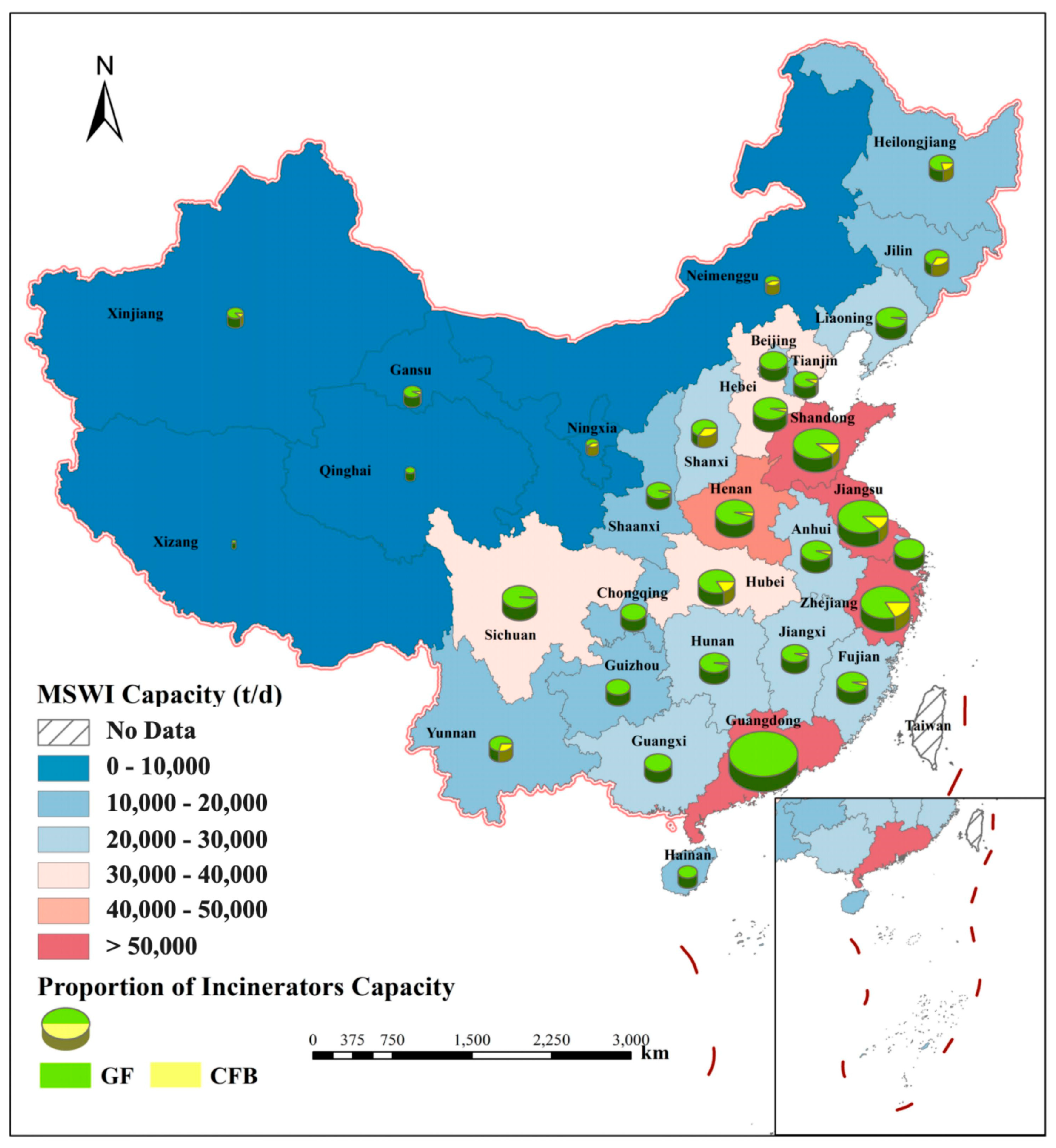
Grate furnace (GF) and circulating fluidized bed (CFB) furnaces are the two mainstream technologies for MSWI in China. Among them, the GF, with its advantages in adapting to complex waste compositions, large single-unit treatment capacity, and stable operation [39], accounted for a dominant application share of 92.50% in 2024, serving as the primary contributor to the harmless treatment capacity of MSWI in China. Their geographical distribution exhibits a distinct “GF in the south, CFB in the north” pattern (Figure 1), indicating that the GF is densely distributed in southern China and major urban agglomerations, whereas the CFB is primarily concentrated in North and Northeast China. This pattern can be attributed to the following reasons: on the one hand, the CFB is more suitable for low-calorific-value, high-ash waste [40,41], and the abundant coal resources in northern China provide convenient auxiliary fuel conditions for its operation, making it more adaptable to the needs of some northern regions; on the other hand, the GF, as a mature furnace technology, offers comprehensive advantages that better align with the current development trend towards large-scale and standardized incineration projects [42].
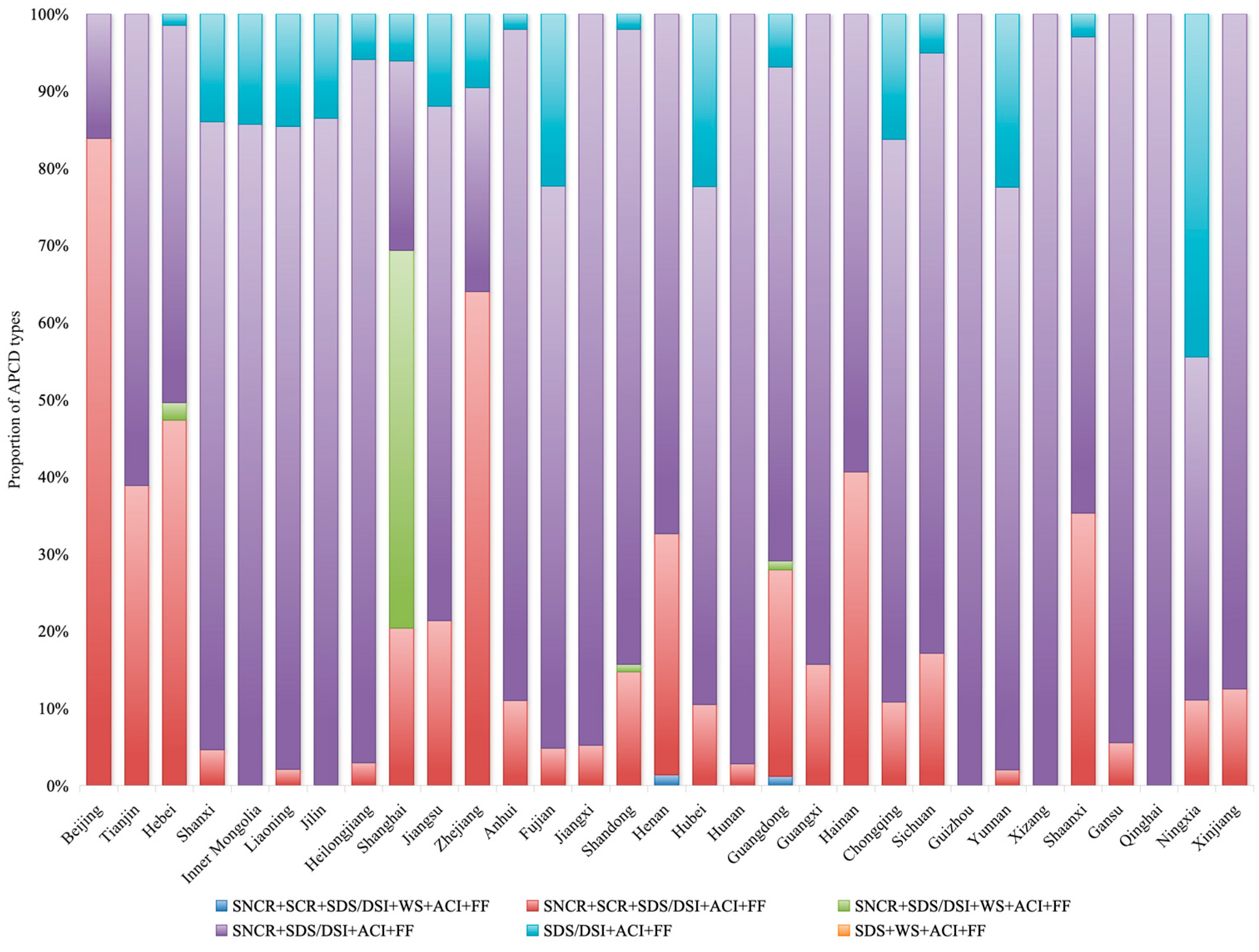
In recent years, to meet the pollutant emission limits specified in the Standard for Pollution Control on Municipal Solid Waste Incineration (GB 18485-2014) [43], the MSWI industry has continuously promoted ultra-low emission retrofits. Many plants have upgraded or installed advanced purification technologies, such as selective catalytic reduction (SCR) and wet scrubbing (WS). This has led to the continuous optimization of flue gas pollution control technologies and processes, and the rapid development of APCDs [44]. As shown in Figure 2, among the composition of APCD types in MSWI plants in China in 2024, the combined process “SNCR + SDS/DSI + ACI + FF” dominated, accounting for 68.52% of the total.

3.2. Air Pollutant Emissions from the MSWI Process in China

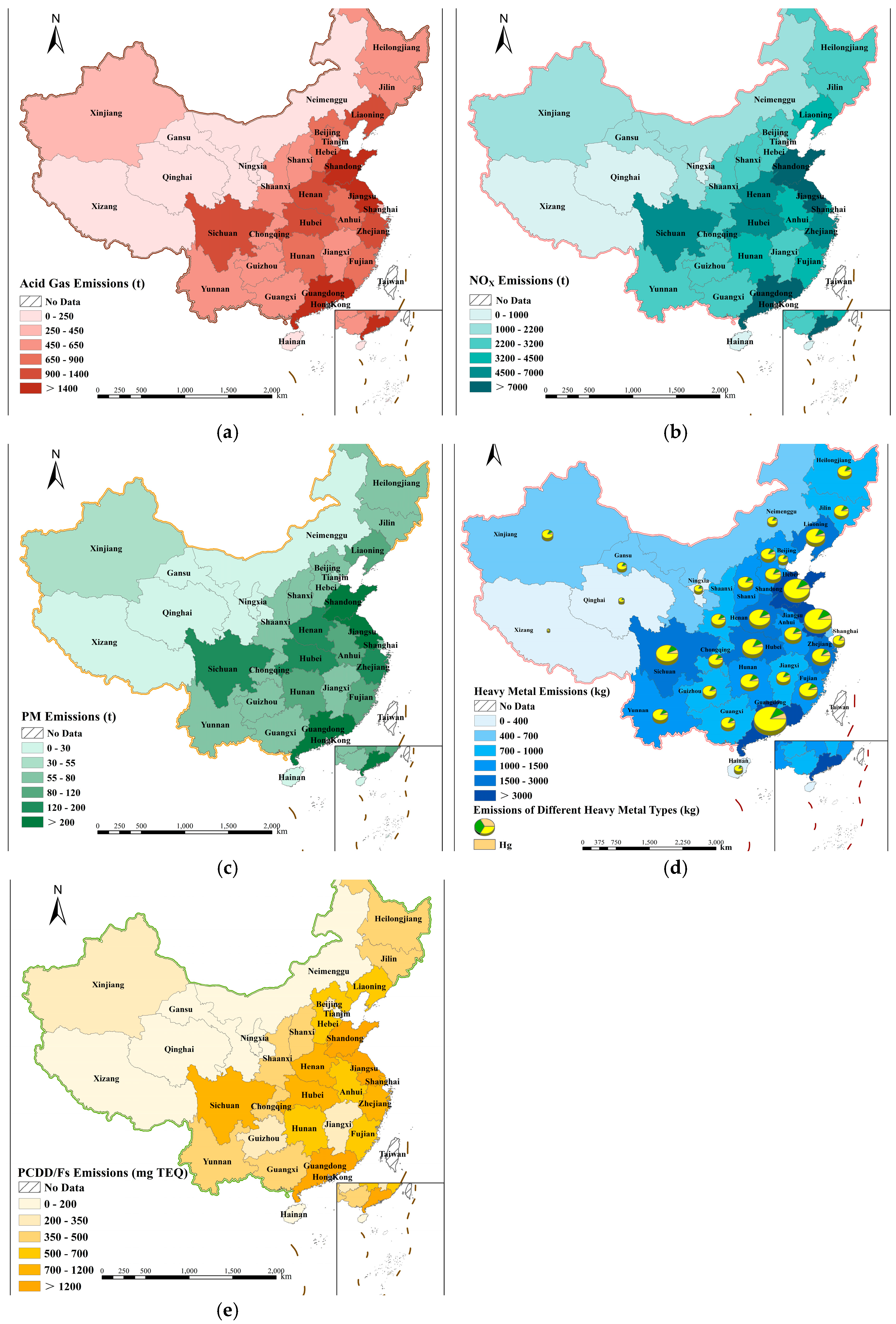
In the integrated carbon and air pollutant emission inventory compiled in this study, flue gas pollutants from the MSWI process mainly include GHGs (CO2, CH4 and N2O), acid gases (SO2, HCl), NOx, PM, heavy metals (Hg, Cd + Tl, Sb + As + Pb + Cr + Co + Cu + Mn + Ni), and PCDD/Fs. In 2024, the inventory results reveal that NOx dominates with an annual emission of 104.6 thousand tons, making it the primary target for industry-wide emission reduction. Its emission scale is 4.6 times and 38.7 times that of acid gases (22.6 thousand tons) and PM (2.7 thousand tons), respectively. Meanwhile, although the total emissions of heavy metals (38.06 tons) and PCDD/Fs are less than 0.04% of NOx emissions, they are considered priority control pollutants due to their high toxicity, persistence, and bioaccumulation potential, which warrant priority attention from a hazard-based management perspective.
The emissions of air pollutants exhibit a high degree of geographical concentration in their spatial distribution, with their emission patterns showing significant similarity, all presenting an “high in the east, low in the west” pattern (Figure 3). High-emission regions are concentrated in the eastern coastal provinces, such as Guangdong, Jiangsu, Shandong, and Zhejiang, which rank at the top of the emission inventories for all pollutant categories. This phenomenon is highly correlated with the provincial MSWI treatment volumes. Although these provinces widely employ efficient flue gas purification combination processes such as “SNCR + SDS/DSI + ACI + FF” in their APCDs, their large-scale MSWI treatment capacity constitutes a large portion of the national total MSWI treatment volume. Consequently, even with relatively high per-plant pollution control efficiency, the large incineration treatment base still makes these regions the primary source of national total emissions.
However, spatial differences also exist in the emissions of air pollutants, which are attributed to variations in the formation pathways and control mechanisms of different pollutants. As direct products generated during the MSWI process [45], the emissions of NOx and acid gases primarily depend on the regional incineration treatment scale and the removal efficiency control of APCDs. Consequently, their high-emission areas show a high degree of overlap with provinces possessing high treatment capacity. In contrast, although the emission patterns of heavy metals (represented by Hg) and PCDD/Fs remain highly concentrated in major eastern provinces, the composition of their high-emission areas has shifted. The generation and emissions of these two pollutant categories are not only related to the scale of incineration activities but are also constrained at two additional levels: at the source level, their generation potential depends on the content differences in key precursors such as chlorine sources and heavy metals in the input municipal solid waste (MSW) [46]; at the process control level, their final emission concentrations are influenced by combustion conditions within the incinerator (e.g., temperature, residence time), incineration technology, and APCDs [47].
For the MSWI industry, the spatial pattern characterized by “aggregated total emissions with differentiated characteristics” suggests the implementation of differentiated regional control strategies. In the eastern high-intensity emission regions represented by Guangdong, Jiangsu, Shandong, and Zhejiang, the core of environmental management should be strict control over the growth pace and total ceiling of incineration treatment capacity, aiming to mitigate the expansion of the emission base from the source. For the central and western regions that exhibit relatively high-intensity signals of characteristic pollutants, the management focus should shift towards enhancing the stable operational efficiency of end-of-pipe pollution control facilities, thereby enabling targeted mitigation of environmental hazards.
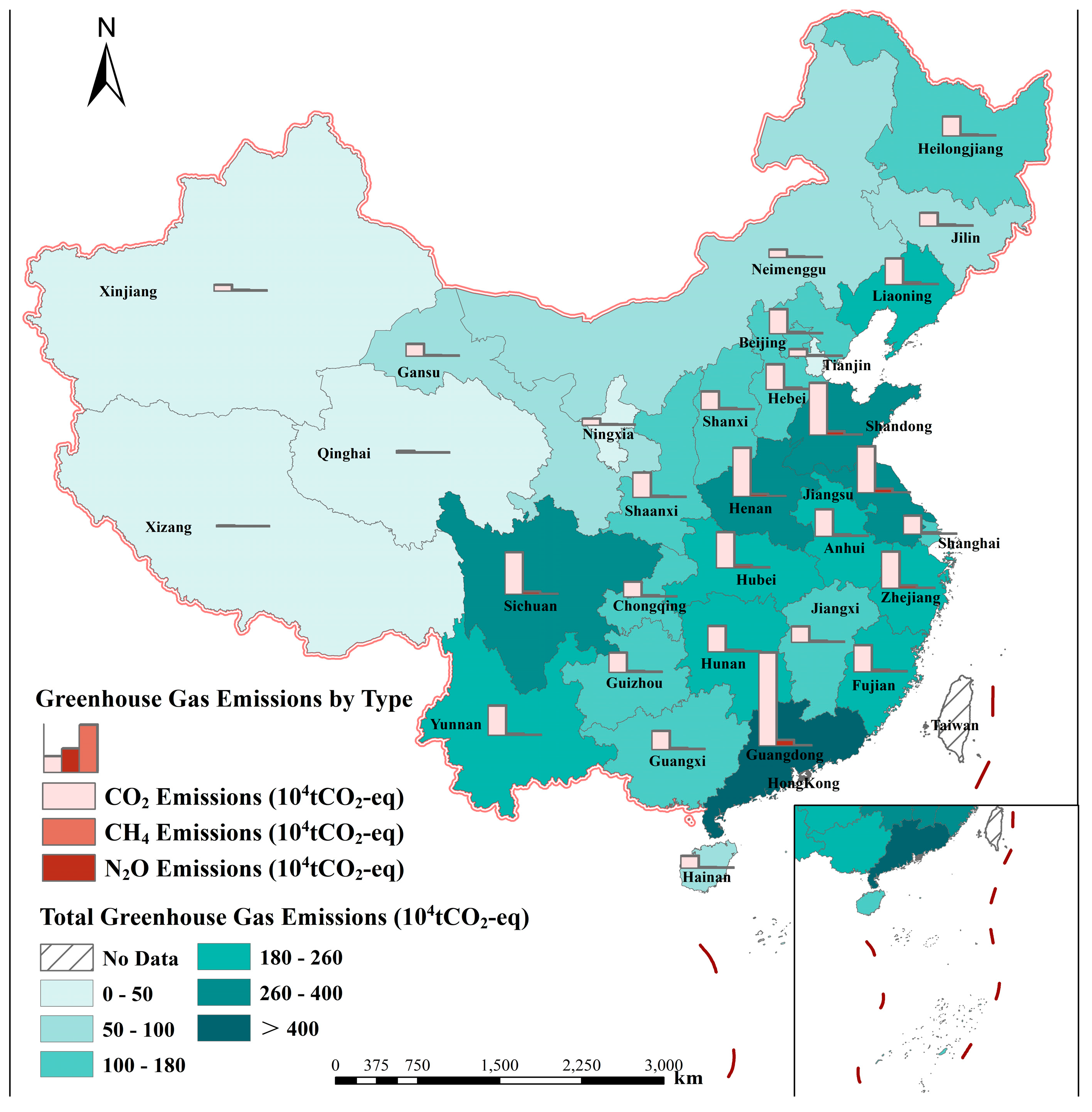
The GHGs emitted from the MSWI process are primarily CO2, CH4 and N2O. The 2024 inventory accounting results show that the emissions of CO2, CH4 and N2O are 49.7491 million tons, 40.65 tons, and 10.60 thousand tons, respectively, with CO2 dominating the total emissions. Although the emissions of CH4 and N2O are relatively small, their global warming potentials (GWPs) are 27 and 273 times that of CO2, respectively, making their potential impact on climate change non-negligible [48]. In terms of carbon dioxide equivalent (CO2-eq), the national GHG emissions from MSWI amount to 52.6485 million tCO2-eq (Figure 4). Among these, the CO2-eq emissions from CO2 are 49.7491 million tCO2-eq, accounting for 94.4% of the total and remaining dominant. The CO2-eq emissions from N2O are 2.894 million tCO2-eq, accounting for 5.5% of the total. However, its mass emission constitutes only 0.02% of the total GHG mass emissions. This significant discrepancy clearly illustrates the characteristic of “low mass emission but high impact potential”. In contrast, the CO2-eq contribution of CH4 is less than 0.1%, rendering its impact negligible. Therefore, within the composition of GHG emissions, N2O emerges as the non-CO2 greenhouse gas requiring focused attention.
GHG emissions exhibit an unbalanced pattern of “more in the east, less in the west”. High-emission regions are concentrated in economically developed and densely populated provinces such as Guangdong, Shandong, Henan, Jiangsu, Sichuan, and Zhejiang [49]. The combined emissions of the top six provinces account for 42.7% of the national total, with Guangdong Province alone contributing 12.5%. This spatial distribution aligns highly with provincial MSWI volumes and treatment capacity, indicating that regional treatment scale is the dominant factor driving spatial emission differences.
Further analysis reveals that some provinces significantly deviate from the above trend. Under comparable MSWI treatment capacities, notable gaps exist in GHG emissions: Shanghai’s emissions are significantly lower than Hebei’s; Hubei’s emissions are higher than Fujian’s; and, most typically, Yunnan’s emissions far exceed those of Guangxi, despite Guangxi having higher treatment capacity. These special cases indicate that local structural factors, such as incineration technology efficiency and operational management levels, play a key regulatory role in GHG emissions. Therefore, a differentiated national strategy for carbon emission reduction is necessary. While optimizing the layout of treatment capacity, it is essential to synergistically promote the upgrading of incineration pollution control technologies in high-intensity emission regions to systematically reduce emission intensity.

3.3. Analysis of Key Socioeconomic Drivers

To analyze the driving effects of the 10 selected feature indicators on pollutant emissions, this study constructs independent RF models for each pollutant. The models demonstrate good fit, with the coefficient of determination (R2) for each ranging from 0.82 to 0.95 (where R2 closer to 1 indicates better predictive capability). These results confirm the explanatory power of the selected features for emission variations, providing a reliable basis for identifying key drivers.
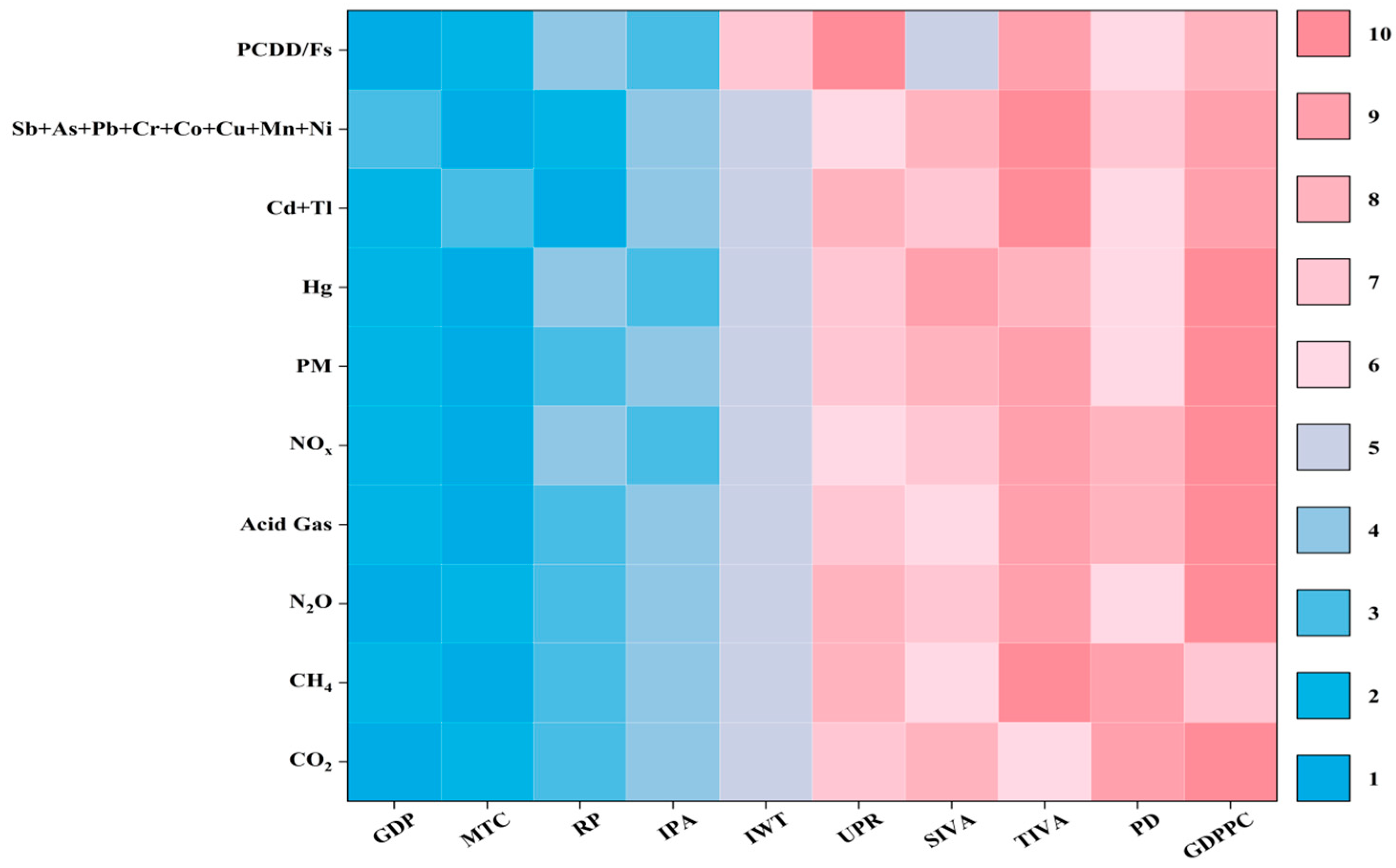
The feature importance scores generated by the RF models directly quantify the influence of each socioeconomic indicator on pollutant emissions. The ranking results based on these importance scores (Figure 5) reveal distinct patterns of association between socioeconomic indicators and emissions for different pollutants, which exhibit both stable commonalities and variations. Among them, GDP and MSWI Treatment Capacity emerge as the most important drivers [50]. For nine out of the ten pollutant categories, these two factors jointly occupy the top two positions in the importance ranking. The importance of Resident Population is also prominent, consistently ranking third or fourth for seven pollutant categories. These three factors collectively constitute a stable driving framework: regional economic and population scales determine the source pressure of waste generation, while the scale of end-of-pipe treatment facilities directly bears and translates this pressure into corresponding emissions, thereby systematically shaping the overall national emission pattern.
The differences in drivers further reveal the specific dependence of emissions from various pollutants on distinct socioeconomic conditions. Among them, Invention Patent Applications show a strong association with NOx emissions, ranking third in importance, even surpassing population-related factors. For heavy metal emissions (represented by Hg), they show greater sensitivity to Population Density and Invention Patent Applications. As an indicator of regional technological capacity, the higher importance of patent activity highlights its influence on emissions.
In contrast, the driver structure for PCDD/Fs is the most centralized, with their emissions almost entirely dominated by GDP and MSWI Treatment Capacity, while contributions from other socioeconomic factors are minimal. This highlights the direct dependence of their generation quantity on the total MSWI treatment volume. This spectrum of patterns, from stable commonalities to ordered differences, clearly distinguishes the fundamental drivers associated with all pollutants from the differentiated factors acting only on specific ones, thereby providing a direct decision-making basis for implementing a synergistic control strategy characterized by “integrated management of commonalities and precise classification”.
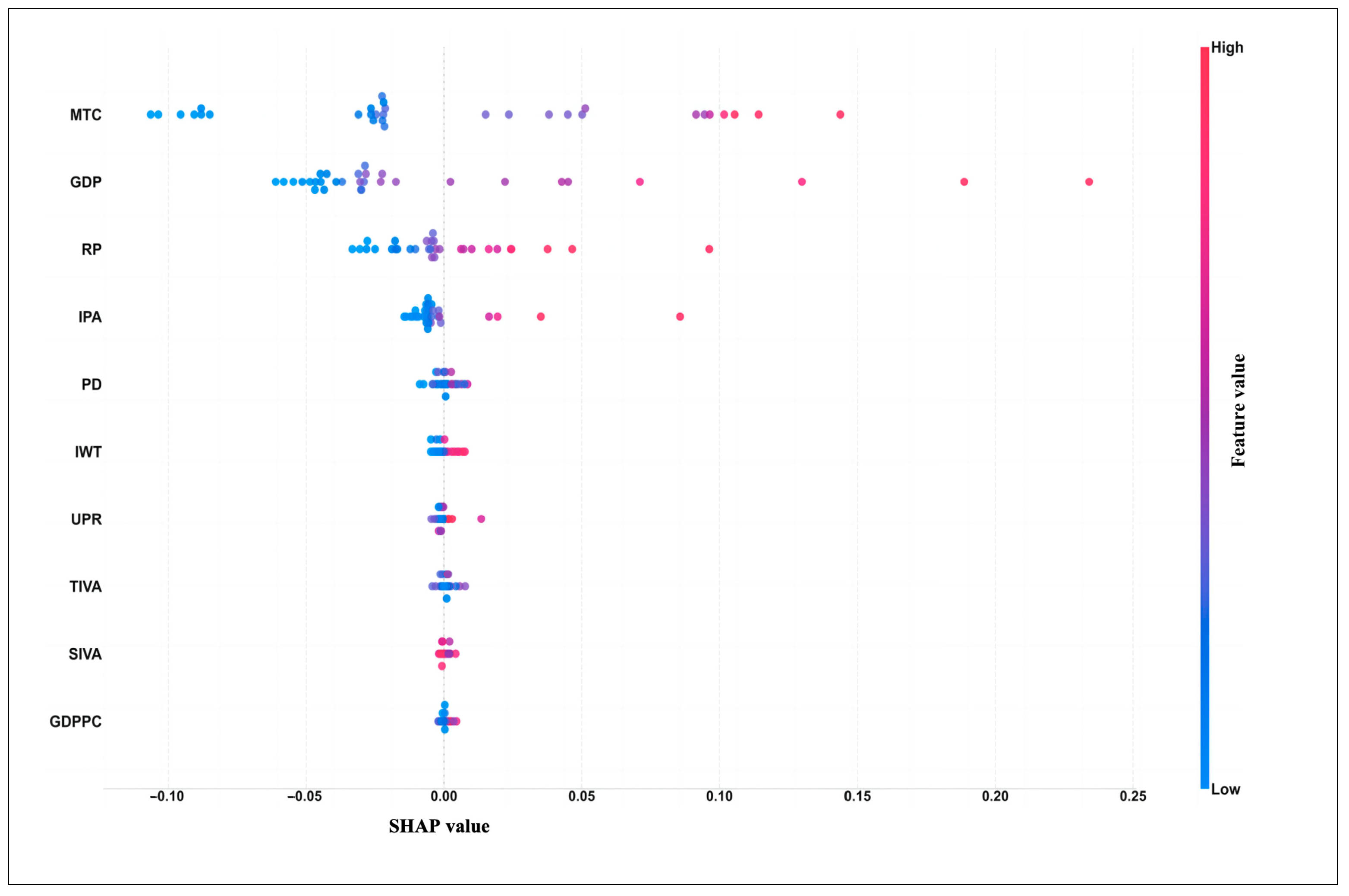
To further elucidate the specific direction and marginal effects of these associations, this study employs SHAP values for attribution analysis. SHAP quantifies the contribution of each feature to the predicted emission for each province. In Figure 6, each point represents an individual province, and the spread of SHAP values for each feature reflects the degree of provincial heterogeneity in its effect, with a wider spread indicating greater regional differences.
The results reveal clear distinctions in the influence direction and magnitude across features. The SHAP values for MSWI Treatment Capacity are predominantly negative, indicating a strong suppressive effect with the largest absolute magnitude, which suggests that, holding other socioeconomic conditions constant, greater treatment capacity is directly associated with lower emission intensity and validates the tangible emission reduction benefits achieved through the industry’s sustained technology upgrades of APCDs. Conversely, GDP and Resident Population exhibit consistently positive effects, identifying them as primary drivers of emission increases. The influence of Invention Patent Applications is also primarily positive [51,52], its SHAP values display a broader distribution across provinces, reflecting considerable variability in its impact strength that aligns with regional disparities in industrial structure and technology intensity. Notably, the SHAP values for GDP Per Capita are distributed widely on both sides of zero, revealing a typical non-linear relationship and indicating that the link between economic development and emissions is not monotonic, with the direction of influence potentially reversing across different development stages. For other structural factors, including the Proportion of Secondary Industry Value Added and Waste Treatment Investment, the absolute SHAP values are relatively small, indicating their limited direct marginal mitigating effect within the current analytical framework.
In summary, through the feature importance and SHAP attribution analyses, this study systematically quantifies the driving contributions, effect directions, and influence intensities of socioeconomic factors on pollutant emissions from MSWI. This approach clarifies the contribution ranking and causal pathways through which social factors affect emissions. The resulting driver analysis framework provides quantitative decision-making support for advancing precise and scientific environmental management in the MSWI industry.

4. Discussion

MSWI is a key technology for urban waste disposal in China, and the accurate accounting of its flue gas pollutant emissions forms the foundation for scientific environmental management. This study constructed a carbon-pollution integrated emission inventory for MSWI in 2024 and employed an RF model to unveil its socioeconomic driving mechanisms. Furthermore, the province-level integrated emission inventory constitutes a valuable data resource for the research community. This dataset can serve as a foundational reference for future studies, such as benchmarking analyses and the refinement of emission factors.
The inventory results identify MSWI as a significant composite source of both GHGs and air pollutants. GHG emissions are dominated by CO2. Air pollutant emissions exhibit a clear hierarchy: NOx has the largest emission volume, while Hg and PCDD/Fs constitute the priority control pollutants due to their high toxicity and persistence. Spatially, emissions are highly concentrated in the most economically developed eastern provinces, such as Guangdong, Jiangsu, Zhejiang, and Shandong.
The driver analysis further clarifies the socioeconomic drivers underlying this spatial pattern. GDP and MSWI treatment capacity are two universal key socioeconomic variables driving emissions of all pollutants. Specifically, GDP acts as a fundamental positive driver promoting emission growth, while treatment capacity is directly linked to the actual effectiveness of engineered emission reduction. Simultaneously, the emission structure shows pollutant-specific characteristics. For instance, Hg emissions show a strong association with Invention Patent Applications from industrial enterprises. This indicator serves as a proxy for regional technological capacity, suggesting that industrial and technological activities are important contextual factors associated with its emission profile.
Therefore, pollutant emissions from MSWI in China are driven by a dual socioeconomic pathway: “total emission scale” and “emission structure”. This finding implies that effective environmental management must address both mechanisms concurrently: first, by acknowledging and regulating the growth of total emissions dominated by regional economic and population scales, particularly when evaluating the siting and capacity limits of MSWI facilities; and second, by identifying and responding to the emission characteristics shaped by structural factors like industrial-technological activities, thereby implementing more targeted monitoring and control strategies. This differentiated management logic, based on the dual pathways of scale and structure, is of significant practical importance for formulating precise emission control policies, addressing the regional imbalance in waste treatment capacity, and promoting the sustainable development of the MSWI sector [53].
Nevertheless, several limitations should be addressed in future work. First, the emission inventory is constructed for 2024, with an extension to 2023 provided in the Supplementary Information (Tables S2 and S3) as an initial step; however, a full multi-year trend analysis remains to be conducted. Second, the Random Forest model identifies statistical associations rather than causal relationships. While this aligns with our exploratory objective, future research could employ causal inference frameworks such as instrumental variables or difference-in-differences to strengthen causal inference. In addition, future studies could apply other machine learning algorithms, such as XGBoost, support vector regression, or neural networks, to further validate the robustness of the feature importance. Third, the spatial analysis is conducted at the provincial level, which is sufficient for identifying broad regional patterns but not for robust spatial autocorrelation tests like Moran’s I; developing city or county-level emission inventories would enable such analysis and is an important direction for future work.

Supplementary Materials

The following supporting information can be downloaded at: https://www.mdpi.com/article/10.3390/environments13020124/s1, Table S1: Proportion of mineral carbon in MSW incineration in China [25,26,27,28,29,30,31,32]; Table S2: Province-level integrated emission inventory of GHGs and air pollutants from MSWI in China in 2023; Table S3: Province-level integrated emission inventory of GHGs and air pollutants from MSWI in China in 2024; Table S4: Comparison of Random Forest feature importance rankings for individual pollutants between 2023 and 2024; Figure S1: Importance ranking of socioeconomic drivers for CO2 emissions from MSWI; Figure S2: Importance ranking of socioeconomic drivers for CH4 emissions from MSWI; Figure S3: Importance ranking of socioeconomic drivers for N2O emissions from MSWI; Figure S4: Importance ranking of socioeconomic drivers for Acid gas emissions from MSWI; Figure S5: Importance ranking of socioeconomic drivers for NOx emissions from MSWI; Figure S6: Importance ranking of socioeconomic drivers for PM emissions from MSWI; Figure S7: Importance ranking of socioeconomic drivers for Hg emissions from MSWI; Figure S8: Importance ranking of socioeconomic drivers for Cd + Tl emissions from MSWI; Figure S9: Importance ranking of socioeconomic drivers for Sb + As + Pb + Cr + Co + Cu + Mn + Ni emissions from MSWI; Figure S10: Importance ranking of socioeconomic drivers for PCDD/Fs emissions from MSWI; Figure S11: Importance ranking of socioeconomic drivers for individual pollutants in 2023.

Author Contributions

Conceptualization, H.L., J.G., Q.F., Y.C. and L.L.; methodology, H.L., and J.G.; investigation, H.L., M.Z., R.Z., Z.Y., G.L. and Y.L.; data curation, H.L., J.G., M.Z., R.Z., Z.Y., G.L. and Y.L.; writing—original draft preparation, H.L.; writing—review and editing, Q.F., Y.C., W.Z. and L.L.; visualization, M.Z.; supervision, Q.F., Y.C., W.Z. and L.L.; resources, L.L.; project administration, W.Z. All authors have read and agreed to the published version of the manuscript.

Funding

This research was funded by the GEF Project of Enabling China to Prepare Its Fourth National Communication and Biennial Update Reports on Climate Change, grant number 6399 and the GEF Project of Capacity Strengthening for Implementation of Minamata Convention on Mercury, grant number 9240. The APC was funded by the authors.

Data Availability Statement

The raw data supporting the conclusions of this article will be made available by the authors on request.

Acknowledgments

During the revision of the manuscript, the authors used ChatGPT (GPT-4o) for English language polishing and expression optimization. The authors have reviewed and edited the output and take full responsibility for the content of this publication.

Conflicts of Interest

Author Zheng, Wenru was employed by the Foreign Environmental Cooperation Center, Ministry of Ecology and Environment, 100035 Beijing, China. The remaining authors declare that the research was conducted in the absence of any commercial or financial relationships that could be construed as a potential conflict of interest.

Abbreviations

The following abbreviations are used in this manuscript:
MSWMunicipal Solid Waste
MSWIMunicipal Solid Waste Incineration
GHGGreenhouse Gas
GWPGlobal Warming Potential
RFRandom Forest

References

  1. National Bureau of Statistics of China. China Statistical Yearbook; China Statistics Press: Beijing, China, 2015.
  2. National Bureau of Statistics of China. China Statistical Yearbook; China Statistics Press: Beijing, China, 2025.
  3. Zhang, N.R. Environmental hazards of municipal solid waste incineration. Ecol. Econ. 2023, 39, 5–8. [Google Scholar]
  4. Wang, J.Q.; Dan, Z.; Zhou, W.W.; Zhu, K.Z.; Shang, X.T.; Wan, X.Y.; Zheng, Z.X. Analysis of the changing trends in main disposal methods of municipal solid waste in different regions of China. Recycl. Resour. Circ. Econ. 2024, 17, 12–17. [Google Scholar]
  5. National Bureau of Statistics of China. China Statistical Yearbook 2024; China Statistics Press: Beijing, China, 2024.
  6. Ma, Z.Y.; Jiang, Y.C.; Ren, J.X.; Zhang, Y.; Feng, P.; Gao, Q.X.; Meng, D. Emission inventory of air pollutants from harmless treatment of municipal solid waste. Environ. Sci. 2021, 42, 1333–1342. [Google Scholar] [CrossRef]
  7. United Nations. United Nations Framework Convention on Climate Change; United Nations: New York, NY, USA, 1992. [Google Scholar]
  8. United Nations. Paris Agreement Under the United Nations Framework Convention on Climate Change; United Nations: New York, NY, USA, 2015. [Google Scholar]
  9. United Nations Environment Programme. Stockholm Convention on Persistent Organic Pollutants; UNEP: Stockholm, Sweden, 2001.
  10. United Nations Environment Programme. Basel Convention on the Control of Transboundary Movements of Hazardous Wastes and Their Disposal; UNEP: Basel, Switzerland, 1989.
  11. United Nations Environment Programme. Minamata Convention on Mercury; UNEP: Kumamoto, Japan, 2013.
  12. General Office of the Ministry of Environmental Protection. Technical Guide for Compiling Urban Air Pollution Source Emission Inventory (Trial); Document No. HDBan Da Qi Han 2014 974; Ministry of Environmental Protection: Beijing, China, 2014.
  13. Xu, X.; Shan, W.Y.; Zhang, Z.; Wang, Q.; Bo, X. Research status and future prospects of air pollutant emission inventory and CO2 emission inventory in the iron and steel industry. Chin. J. Eng. 2025, 47, 1360–1376. [Google Scholar] [CrossRef]
  14. Tian, H.Z.; Gao, J.J.; Lu, L.; Zhao, D.; Cheng, K.; Qiu, P. Temporal trends and spatial variation characteristics of hazardous air pollutant emission inventory from municipal solid waste incineration in China. Environ. Sci. Technol. 2012, 46, 10364–10371. [Google Scholar] [CrossRef]
  15. Liu, R. Study on Greenhouse Gas Emission Inventory of Beijing. Master’s Thesis, Beijing University of Civil Engineering and Architecture, Beijing, China, 2016. [Google Scholar]
  16. Wang, L.; Li, Y. Greenhouse gas emissions and influencing factors of municipal solid waste incineration power plants in Beijing. Chin. J. Environ. Eng. 2017, 11, 6490–6496. [Google Scholar]
  17. Zhang, S.X. Compilation of High-Resolution Emission Inventory and Emission Reduction Assessment for Air Pollutants from Municipal Solid Waste Incineration Power Plants in Hebei Province. Master’s Thesis, Hebei University of Science and Technology, Shijiazhuang, China, 2024. [Google Scholar] [CrossRef]
  18. Li, H.P. Research on intelligent robots based on machine learning methods. Commun. World 2019, 26, 241–242. [Google Scholar]
  19. Wang, M.C. Prediction and Optimization of Nitrogen Oxides in Waste Incineration Process Based on Machine Learning. Master’s Thesis, Beijing Foreign Studies University, Beijing, China, 2022. [Google Scholar] [CrossRef]
  20. Guo, J.C. Construction of Prediction Model for Flue Gas Emissions from Plateau Municipal Solid Waste Incineration Based on Machine Learning. Master’s Thesis, Tibet University, Lhasa, China, 2023. [Google Scholar] [CrossRef]
  21. Xu, H. Research on Multi-Factor Influence of Air Pollutants Based on Machine Learning Methods. Master’s Thesis, Nankai University, Tianjin, China, 2024. [Google Scholar] [CrossRef]
  22. Cui, J.C. Analysis and Prediction of Flue Gas Pollutant Emissions from Municipal Solid Waste Incineration Power Plants in China. Master’s Thesis, Tianjin University, Tianjin, China, 2021. [Google Scholar] [CrossRef]
  23. IPCC. 2006 IPCC Guidelines for National Greenhouse Gas Inventories; Institute for Global Environmental Strategies (IGES): Hayama, Japan, 2006. [Google Scholar]
  24. National Development and Reform Commission. Guidelines for Provincial Greenhouse Gas Inventory Compilation (Trial); NDRC: Beijing, China, 2011.
  25. Guo, J.B.; Liu, L.Y.; Zhang, G.R.; Yue, R.; Wang, T.; Zhang, X.; Yang, S.; Zhang, Y.; Wang, K.; Long, H.; et al. Temporal and spatial analysis of anthropogenic mercury and CO2 emissions from municipal solid waste incineration in China: Implications for mercury and climate change mitigation. Environ. Int. 2023, 178, 108068. [Google Scholar] [CrossRef]
  26. Wang, S.; Luo, K.; Wang, X.; Sun, Y. Estimate of sulfur, arsenic, mercury, fluorine emissions due to spontaneous combustion of coal gangue: An important part of Chinese emission inventories. Environ. Pollut. 2016, 209, 107–113. [Google Scholar] [CrossRef] [PubMed]
  27. Yang, N.; Shao, L.; He, P. Study on the moisture content and its features for municipal solid waste fractions in China. China Environ. Sci. 2018, 38, 1033–1038. [Google Scholar] [CrossRef]
  28. Tang, W.; Zheng, S.W.; He, P. Characteristics of main greenhouse gas and VOCs emissions from municipal solid waste disposal in Hangzhou City. Res. Environ. Sci. 2018, 31, 1883–1890. [Google Scholar] [CrossRef]
  29. Liu, C.H.; Hao, X.J.; Liu, F. Greenhouse gas emission characteristics and emission reduction strategies of municipal solid waste treatment in Beijing. J. Environ. Eng. Technol. 2022, 12, 1041–1047. [Google Scholar]
  30. Guo, Y.J.; Gong, Y.P.; Zou, Y.F. Temporal variation characteristics and influencing factors of carbon emissions from municipal solid waste treatment in Tianjin. J. Environ. Eng. Technol. 2022, 12, 834–842. [Google Scholar]
  31. Han, Z.Y.; Fei, Y.Q.; Liu, D.Y. Yield and physical characteristics analysis of domestic waste in rural areas of China and its disposal proposal. Trans. Chin. Soc. Agric. Eng. 2017, 33, 1–14. [Google Scholar]
  32. Chen, S.Q. GHG Emissions Pattern from MSW Sector and the Potential Reduction Processes: A Case Study of Shanghai. Ph.D. Thesis, Shanghai Jiao Tong University, Shanghai, China, 2018. [Google Scholar] [CrossRef]
  33. EEA. EMEP/EEA Air Pollutant Emission Inventory Guidebook 2023; Publications Office of the European Union: Luxembourg, 2023. [Google Scholar]
  34. Ministry of Ecology and Environment of the People’s Republic of China. Accounting Methods and Coefficient Manual for Pollutant Generation and Emission in Emission Source Statistical Surveys; Ministry of Ecology and Environment of the People’s Republic of China: Beijing, China, 2021.
  35. Ministry of Housing and Urban-Rural Development of the People’s Republic of China. 2024 China Urban Construction Statistical Yearbook; Ministry of Housing and Urban-Rural Development of the People’s Republic of China: Beijing, China, 2025.
  36. Chang, Q.; Li, H.W.; Zhang, B.; He, M.Z.; Liu, Y. Spatiotemporal characteristics of air quality and its socio-economic influencing factors in major cities along the Yellow River. Ecol. Econ. 2021, 37, 183–189. [Google Scholar]
  37. Xie, P.C.; Wang, W.J.; Wang, W.X.; Liao, C.P.; Zhao, D.Q. Current Status and Projection of Greenhouse Gas Emissions from Municipal Solid Waste Treatment in Guangzhou. Sci. Technol. Manag. Res. 2020, 40, 247–252. [Google Scholar]
  38. Zhong, N.C.; Liu, Y.Y.; Kang, P.; Hu, R.; Wang, A.; Xiu, M.; Schaefer, S.; Zhong, L. Construction of a county-level PM2.5 pollution forecasting model in Chengdu based on machine learning. Res. Environ. Sci. 2026, 39, 1–18. [Google Scholar] [CrossRef]
  39. Wu, C. Comparison of operation management and maintenance of two types of municipal solid waste grate furnaces. Clean. World 2025, 41, 104–109. [Google Scholar]
  40. Wang, J.Y.; Ren, C.F.; Li, W. Comparative analysis of the operational status of municipal solid waste grate furnaces and circulating fluidized bed boilers. China Spec. Equip. Saf. 2022, 38, 56–60. [Google Scholar]
  41. Han, Q.; Liu, H.; Wei, G.; Zhu, Y.; Li, Q.; Li, T.; Su, X.; Duan, W. Environmental-energy-economic analyses of waste incinerators and Co-combustion pathways: A bottom-up study of over 300 cities in China. Energy Convers. Manag. 2025, 325, 119437. [Google Scholar] [CrossRef]
  42. Li, X.J.; Hong, X.L.; He, R.N.; Ge, S.; Gao, H.; Yan, D. Ultra-low emission technology route and synergistic removal of waste incineration flue gas. Appl. Chem. Ind. 2024, 53, 499–510. [Google Scholar] [CrossRef]
  43. GB 18485-2014; Standard for Pollution Control on Municipal Solid Waste Incineration. Ministry of Ecology and Environment: Beijing, China, 2014.
  44. Pu, M.; Chen, D.Z. Pollution Control and Flue Gas Purification in Municipal Solid Waste Incineration; Chemical Industry Press: Beijing, China, 2022. [Google Scholar]
  45. Ma, Y.Y.; Li, Q.Q.; Sun, B.H.; Meng, J.; Shi, B.; Sun, Y.; Su, G. Research progress on PCDD/Fs prevention and control technologies in the whole process of municipal solid waste incineration. Energy Environ. Prot. 2025, 39, 44–55. [Google Scholar] [CrossRef]
  46. Su, H.T. Study on Atmospheric Mercury Emission Characteristics of Municipal Solid Waste Incineration Industry in China. Master’s Thesis, Qingdao University of Science and Technology, Qingdao, China, 2016. [Google Scholar]
  47. Han, Y.S.; Wang, Y.; Wang, X.M.; Huang, J.; Ma, W.C. Exploring the greenhouse gas emissions inventory and driving mechanisms of municipal solid waste in China. Environ. Impact Assess. Rev. 2024, 105, 107428. [Google Scholar] [CrossRef]
  48. IPCC. Climate Change 2021: The Physical Science Basis. Contribution of Working Group I to the Sixth Assessment Report of the Intergovernmental Panel on Climate Change; Cambridge University Press: Cambridge, UK, 2021; pp. 7–19. [Google Scholar]
  49. Fan, Y.; Jing, S.Y.; Wang, N.; Zhang, J. Impact of Socio-Economic Factors on Coordinated Pollution Reduction and Carbon Mitigation in China. Ecol. Econ. 2025, 41, 193–201+229. [Google Scholar]
  50. Cai, A.; Wang, L.; Zhang, Y.; Wu, H.; Zhang, H.; Guo, R.; Wu, J. Uncovering the multiple socio-economic driving factors of carbon emissions in nine urban agglomerations of China based on machine learning. Energy 2025, 319, 134859. [Google Scholar] [CrossRef]
  51. Chen, Y.Z.; Gao, M. Factor Decomposition and Carbon Reduction Potential of Municipal Solid Waste Carbon Emissions in the Yangtze River Economic Belt at the Urban Scale. Environ. Sci. 2025. [Google Scholar] [CrossRef]
  52. Zhang, A.F. Research on the Spatial-Temporal Characteristics and Driving Factors of Innovation in Solid Waste Disposal Technology. Ph.D. Thesis, Hefei University of Technology, Hefei, China, 2023. [Google Scholar] [CrossRef]
  53. Liu, J.F.; Zheng, L. Structure characteristics and development sustainability of municipal solid waste treatment in China. Ecol. Indic. 2023, 152, 110391. [Google Scholar] [CrossRef]
Figure 1. Geographical distribution of MSWI types by Incineration Treatment Capacity in China in 2024.
Environments 13 00124 g001
Figure 2. Proportion of APCD types in the MSWI amount by province in China in 2024. Note: The category “SDS + WS + ACI + FF” had a count of 0 in all provinces and is therefore not visible in this figure. (SNCR: Selective Non-Catalytic Reduction; SCR: Selective Catalytic Reduction; SDS: Semi-Dry Scrubbing; DSI: Dry Sorbent Injection; WS: Wet Scrubbing; ACI: Activated Carbon Injection; FF: Fabric Filter).
Environments 13 00124 g002
Figure 3. Geographical distribution of air pollutant emissions from the MSWI process in China in 2024. (a) Geographical distribution of Acid Gas emissions; (b) Geographical distribution of NOx emissions; (c) Geographical distribution of PM emissions; (d) Geographical distribution of Heavy Metals emissions; (e) Geographical distribution of PCDD/Fs emissions.
Environments 13 00124 g003
Figure 4. Geographical distribution of GHG emissions from the MSWI process in China in 2024.
Environments 13 00124 g004
Figure 5. Importance ranking of socioeconomic drivers for emissions from MSWI. Note: Features are ranked per pollutant by descending importance, with rank 1 being the most important. (GDP: Gross Domestic Product; MTC: MSWI Treatment Capacity; RP: Resident Population; IPA: Invention Patent Applications; PD: Population Density; IWT: Waste Treatment Investment; UPR: Urbanization Rate; GDPPC: GDP Per Capita; SIVA: Proportion of Secondary Industry Value Added; TIVA: Proportion of Tertiary Industry Value Added).
Environments 13 00124 g005
Figure 6. SHAP values of socioeconomic drivers for emissions from MSWI. Note: The horizontal position indicates the SHAP value: positive values (right) increase predicted emissions, negative values (left) decrease predicted emissions. Color represents the feature value. Features are ordered by Random Forest feature importance. (GDP: Gross Domestic Product; MTC: MSWI Treatment Capacity; RP: Resident Population; IPA: Invention Patent Applications; PD: Population Density; IWT: Waste Treatment Investment; UPR: Urbanization Rate; GDPPC: GDP Per Capita; SIVA: Proportion of Secondary Industry Value Added; TIVA: Proportion of Tertiary Industry Value Added).
Environments 13 00124 g006
Table 1. Emission factors of flue gas pollutants from MSWI [22].
Types of Air Pollution Control Devices (APCDs)Acid
Gases (mg/m3)
NOx
(mg/m3)
PM
(mg/m3)
Hg
(mg/m3)
Cd + Tl
(mg/m3)
Sb + As + Pb + Cr +
Co + Cu + Mn + Ni (mg/m3)
PCDD/Fs
(ng TEQ/m3)
SNCR + SCR + SDS/DSI + WS + ACI + FF13.0297.161.830.002490.000310.011880.02951
SNCR + SCR + SDS/DSI + ACI + FF30.6097.163.100.003260.004330.035300.01504
SNCR + SDS/DSI + WS + ACI + FF13.02147.001.830.002490.000310.011880.02951
SNCR + SDS/DSI + ACI + FF30.60147.003.690.003040.006350.045400.02263
SDS/DSI + ACI + FF30.60137.563.690.003040.006350.045400.02263
SDS + WS + ACI + FF4.55137.561.830.002490.000310.011880.02951
Note: The emission factor data in this table are modified from the Master’s thesis by Cui, J.C. (2021) [22]. (SNCR: Selective Non-Catalytic Reduction; SCR: Selective Catalytic Reduction; SDS: Semi-Dry Scrubbing; DSI: Dry Sorbent Injection; WS: Wet Scrubbing; ACI: Activated Carbon Injection; FF: Fabric Filter; TEQ: Toxic Equivalent Quantity).
Table 2. Feature indicator system and descriptions.
Feature DimensionIndicator NameIndicator AbbreviationUnit
Population CharacteristicsResident PopulationRP104 persons
Population DensityPDpersons/km2
Urbanization RateUPR%
Economic ScaleGross Domestic ProductGDP108 CNY
GDP Per CapitaGDPPC104 CNY/person
Industrial StructureProportion of Secondary Industry Value AddedSIVA%
Proportion of Tertiary Industry Value AddedTIVA%
Technological SupportInvention Patent ApplicationsIPAitem(s)
MSWI Treatment Capacity (Daily)MTCt/d
Governance AssuranceWaste Treatment InvestmentIWT104 CNY
Note: The abbreviations defined in the “Indicator Abbreviation” column are used as consistent axis/legend labels in subsequent figures. Data for “Invention Patent Applications” are from industrial enterprises above a designated size; “Waste Treatment Investment” refers to fixed-asset investment in urban municipal public utilities. All indicator values reported in this table are based on 2024 data.
Disclaimer/Publisher’s Note: The statements, opinions and data contained in all publications are solely those of the individual author(s) and contributor(s) and not of MDPI and/or the editor(s). MDPI and/or the editor(s) disclaim responsibility for any injury to people or property resulting from any ideas, methods, instructions or products referred to in the content.