Systematic Review

Carbon Disclosure Policy as a Strategic Driver for Carbon Emission Reduction: A Systematic Review and Quantitative Policy Synthesis


by
Freida Ozavize Ayodele
1,*,
Bamidele Victor Ayodele
2,*,
Thomas Oyetunde Oladele
3,
Titik Setyaningsih
4 and
Sa’adiah Munir
5
1
Department of Management, Universiti Teknologi PETRONAS, Bandar Seri Iskandar 32610, Perak, Malaysia
2
Chemical Engineering Department, Universiti Teknologi PETRONAS, Bandar Seri Iskandar 32610, Perak, Malaysia
3
School of Business, Woxsen University, Sangareddy District, Hyderabad 502345, India
4
Vocational School, Universitas Sebelas Maret Surakarta, Kota Surakarta 57126, Indonesia
5
Department of Accounting, School of Business, Monash University Malaysia, Bandar Sunway 47500, Selangor, Malaysia
*
Authors to whom correspondence should be addressed.
Environments 2026, 13(2), 115; https://doi.org/10.3390/environments13020115
Submission received: 29 December 2025 / Revised: 8 February 2026 / Accepted: 16 February 2026 / Published: 18 February 2026

Abstract

One of the main takeaways of the recently concluded Conference of the Parties (COP) 30 is the need for all humanity to unite against climate change. Effective climate-related risk and carbon footprint disclosure could serve as a systematic approach to reduce the menace of climate change. Several frameworks for carbon disclosure have been developed and implemented. Nevertheless, there is lack of consistency and clarity in the implementation of the frameworks and how they are integrated into climate reporting. This has created a gap in accountability, often resulting in the misalignment of climate goals, thereby necessitating the need to delve into strategic imperatives of carbon disclosure policies as a mechanism for carbon reduction. In view of this, the main objective of this study is to elucidate how carbon disclosure policies have been strategically positioned as a mechanism for climate-aligned decision making. The study explores and synthesizes existing literature and data on the strategic role of carbon disclosure policies in the carbon emission management of selected countries using the PRISMA framework and secondary data policy synthesis. The analysis reveals that there was a noticeable carbon emissions reduction in countries like Estonia, Ireland, and the United Kingdom. This indicates a strong correlation between carbon emissions reduction and high carbon tax implementation. However, there was a lack of perfectly linear correlation between disclosure scores and the carbon emission reduction in some countries, an indication that carbon disclosure is not the sole determinant of carbon emissions management, even though it plays an important role as a catalyst for transparency awareness. The robustness of carbon disclosure policies can be said to be linked to a broader national climate policy, stressing its importance as a climate action framework.

Graphical Abstract

1. Introduction

The need for carbon emission reduction has necessitated the transformation of the global landscape for carbon disclosure, which is informed by important frameworks and standards such as carbon disclosure projects (CPD) [1], the Task Force on Climate-Related Financial Disclosure (TCFD) [2], the International Sustainability Standards Board (ISSB) [3], the Global Reporting Initiative (GRI) [4], and the foundation Greenhouse Gas (GHG) Protocol [5]. There has been concerted progress towards harmonization, with specific focus on streamlining the reporting processes and enhanced data for stakeholders. There have been persistent challenges regarding the wholistic measurement and reporting of carbon emissions, even though the harmonization has been implemented. The presence of the challenges has not ruled out the continuing importance of carbon emission disclosure policies as a mechanism that focuses on the overall carbon footprint.
Several benefits such as improved reliability and reputation, as well as identification of critical climate-related risks, have been attributed to the implementation of carbon disclosure policies [6,7]. One such benefit is the global increase in mandatory carbon disclosure reporting and regulations [6,7]. Additionally, the implementation of carbon disclosure policies has facilitated a clearer understanding of key environmental issues [8,9]. Also, the tracking of progress in reducing GHG emissions, which is key for assessing collective efforts against climate change, has been facilitated through appropriate implementation of carbon disclosure policies [10]. It advances the alignment of corporate strategies with ambitious global climate goals, thereby contributing directly to the global transition towards a low-carbon economy [11]. This alignment can position carbon disclosure policies as tools to more broadly promote sustainable practices [9,12]. Beyond the focus on carbon emissions, carbon disclosure policies encourage organizations to adopt a wider array of environmentally responsible practices [13].
Previous studies have focused on the direct relationship between carbon disclosures and their financial performance [14,15]. However, these studies lack the construction of an end-to-end conceptual framework for carbon disclosure policies and carbon emission reduction. One of the main goals of this study is to employ the PRISMA framework to conceptualize the entire causal chain of carbon disclosure policies from the external and internal drivers, through the core policy itself, to the internal corporate mediating mechanisms, conditioned by moderating factors, leading to final environmental and corporate outcomes. This integrative approach provides a complete and realistic picture of dyadic analysis, which is common in the literature. One major distinction between this study and those reported in the literature is that the effects of disclosure are not assumed to be uniform. Rather, the study proposes that the policy’s success is contingent upon moderating factors such as policy stringency, firm characteristics (such as size and resources), and industry type. This nuanced approach explains why the same policy might yield different results across different contexts and provides a more sophisticated understanding of its practical limitations and enablers.

2. Historical Overview of Carbon Disclosure Policies

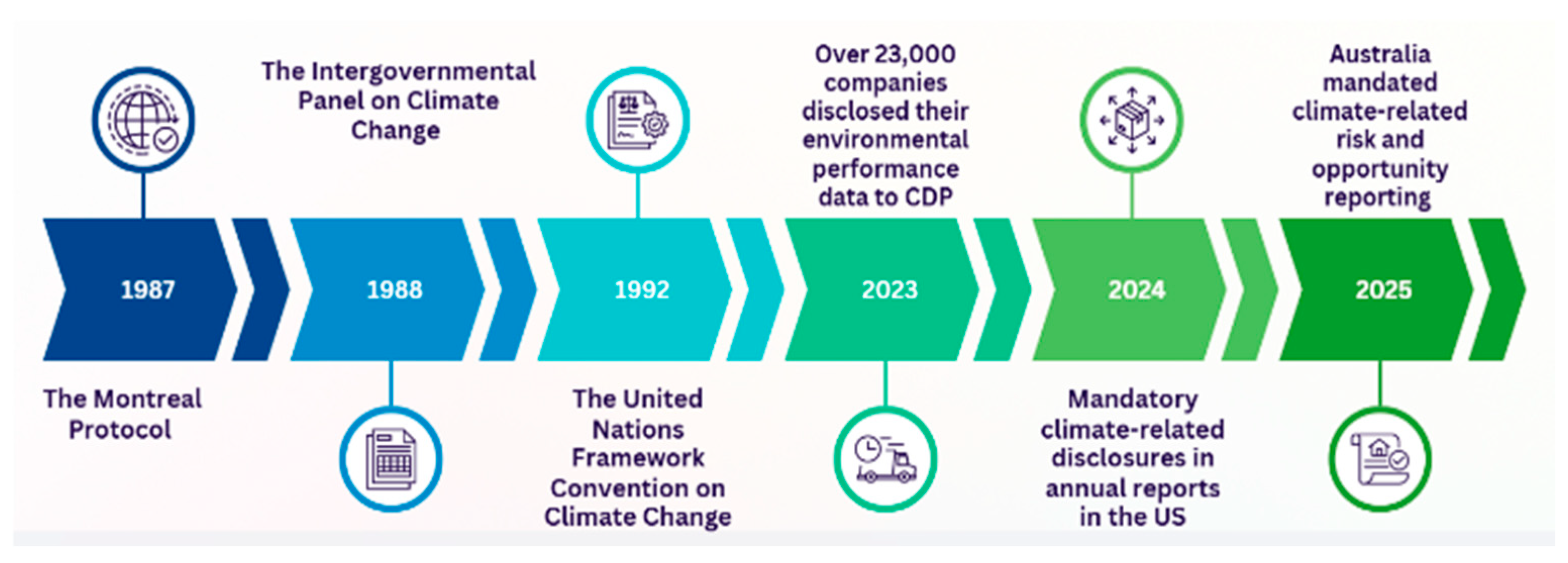
Figure 1 depicts the key global milestones in the development and implementation of carbon disclosure policies. The ideation of carbon disclosure policies started with the signing of the Montreal Protocol in 1987 [16]. The protocol demonstrated one of the most important instances of global cooperation in addressing climate change [17]. The Montreal Protocol is well known for its clear binding timeline for the phase-out of specific ozone-depleting substances [18]. The ozone-depleting substances covered in the protocol include chlorofluorocarbons, halons, carbon tetrachloride, methyl chloroform, hydrochlorofluorocarbons, and methyl bromide [19]. The protocol operates on the principle of “common but differentiated responsibilities”, recognizing that developed and developing countries have different capacities to implement phase-out schedules [20]. Developing countries were given a grace period and financial assistance through a multilateral fund for the implementation of the Montreal Protocol to help them transition to ozone-friendly alternatives [21]. Significant success was achieved through the implementation of the Montreal Protocol [22]. One of its key successes is phasing out the production and consumption of the most potent ozone-depleting substances. Evidence from different studies has revealed that there is a gradual recovery of the depleted ozone layer, and the Antarctic ozone holes have shown signs of gradual healing [23,24,25,26]. In addition, the implementation of the protocol has contributed positively to climate change since ozone-depleting substances have been phased out [27]. Since the implementation of the Montreal Protocol, there has been a tremendous increase in innovative solutions, which has led to the development of environmentally friendly technologies and alternatives [28]. In addition, through the Montreal Protocol, complex environmental issues have been identified and addressed by concerted efforts of global communities. This has played a significant role in safeguarding the earth for future generations. There has been a continuous review of the protocols through regular meetings of parties to ensure effectiveness in protecting the earth from climate change.
Despite the successes recorded from the implementation of the Montreal Protocol, there are a series of criticisms arising from different schools of thought. The Montreal Protocol’s approach to replacing the ozone-depleting substances is one of the critical criticisms [29]. The initial transition away from ozone-depleting substances resulted in widespread adoption of hydrochlorofluorocarbons (HCFCs) and subsequently, hydrofluorocarbons (HFCs) [30]. Although newly adopted substances are less damaging to the ozone layer, they present a new and formidable environmental threat through their high global warming potential [31].
Similar to the Montreal Protocol, the Intergovernmental Panel on Climate Change (IPCC) was established in 1988 by the World Meteorological Organization and the United Nations Environmental Program as a body charged with developing scientifically verified policies related to climate change [32]. The IPCC provides policymakers with regular scientific assessments of climate change, its implications, and its potential future risks [33]. The IPCC has also proposed adaptation and mitigation options [34]. This is the most authoritative international source of scientific information on climate change. The core mandate of the IPCC is to provide a clear, objective, and comprehensive scientific view of the current state of knowledge on climate change and its potential environmental and socioeconomic impacts [35]. However, the IPCC has not conducted its own original research. Instead, it synthesizes a vast body of peer-reviewed scientific, technical, and socioeconomic literature worldwide. This process has involved thousands of volunteer scientists globally. The IPCC core functions include producing assessments, developing special reports, and creating methodological summaries. As a global organization, the IPCC is made up of 195 member countries involved in the decision-making process that are instrumental in various climate negotiations [36]. Due to the key achievements of the IPCC, the 2007 Nobel Peace Prize was jointly awarded to the organization and U.S. Vice President Al Gore [37].
Similar to the IPCC, the UNFCC, established in 1992, also serves as a platform for international cooperation through which climate change is addressed [38]. It focuses on mitigating the impact of GHG on humans by adjudicating for its acceptable concentration in the atmosphere [39]. The main objective of the UNFCC is to ensure that food production is not threatened due to climate change, along with sustainability, enabling economic development [40]. Additionally, the UNFCC has made concerted efforts to develop institutional frameworks for sustainable development considering the impact of climate change.

Systematic Review Objective

The main objective of this review is to systematically explore and synthesize existing knowledge on the strategic role of carbon disclosure policy in global carbon emission management using PRISMA guidelines [41] and secondary data policy synthesis.

3. Materials and Methods

This study employs a mixed-methods synthesis design. This approach combines a systematic literature review following PRISMA guidelines, in which 36 peer-reviewed records were analyzed to identify theoretical drivers and barriers, with a secondary data policy synthesis. To bridge the gap between literature and practice, we independently analyzed national-level data (e.g., carbon tax rates and emissions per capita) from the OECD and World Bank for a subset of countries. This allows for a “triangulation” of literature-based findings with real-world emission trajectories.

3.1. Systematic Review Methodology Using PRISMA

In this study, we adopted the Preferred Reporting Items for Systematic Reviews and Meta-Analyses (PRISMA) approach to elucidate carbon disclosure policy as a strategic driver for carbon emission reduction [42]. The PRISMA review protocol was agreed upon by all the authors and registered in the Open Science Framework (OSF). The PRISMA guidelines for systematic review are divided into identification screening and inclusion [43]. During the identification stage, all the potential records that might answer the research questions are captured prior to the commencement of filtering. During the screening stage, the large pool of records obtained from the searched database are filtered into a refined list of highly relevant studies. The filtering can be done using the Title and Abstract, as well as the full-text eligibility assessment. The last stage of the PRISMA flow process is the inclusion stage, whereby the library of records that would be used to answer the research questions is finalized.

3.2. Search Strategy, Inclusion and Exclusion Criteria

The search strategy followed a dual-track approach to capture both theoretical depth and policy-level relevance.
Firstly, a systematic search was conducted in Scopus. The Scopus database was selected because it represents one of the largest curated repositories of peer-reviewed literature on carbon disclosure and environmental policy. For example, a combination of terms such as (“Carbon Disclosure” OR “Carbon Reporting” OR “GHG Accounting”) AND (“Emission Reduction” OR “Carbon Performance”) AND (“Strategy” OR “Strategic Driver”) were employed. The search was limited to peer-reviewed empirical studies published between 2010 and 2025 to align with the global evolution of environmental governance policies [44].
Secondly, to ensure the inclusion of current policy dynamics, we manually searched the digital libraries of the IPCC, Word Bank, IEA, OECD, and the CDP. These were identified as “high-impact repositories” for climate governance documentation. These organizations were chosen for their role as the primary architects of international carbon accounting and climate mitigation protocols. Databases such as PubMed, which focus more on biomedical or broader social science outcomes, were not consulted. Web of Science, on the other hand, yielded a high degree of duplicate results already found in Scopus, which justifies using Scopus as the “master” database. It was ensured that the articles included focused on carbon disclosure policies as a mechanism for carbon emission mitigation. Studies not focused on the causal link between disclosure and operational emissions were excluded. The exclusion criteria are based on studies not peered-reviewed, not indexed in Scopus, of irrelevant scope, lacking in rigor, and out of the publication year range. Articles not published in English were also excluded. The search strategy employed Boolean logic to combine terms related to carbon performance.

3.3. Quality Assessment Protocol

To ensure that bias is minimized and to ascertain an improved reliability of the article selection for the study, the study employs a dual-reviewer protocol, as recommended by Castellanos-Bermejo et al. [45]. The protocol entails the recruitment of two independent reviewers to evaluate all the identified records based on the pre-defined inclusion and exclusion criteria. To ensure assessment consistency, inter-rater reliability was calculated (Cohen’s kappa = 0.84), indicating strong agreement. In instances of disagreement, reviewers first attempted to reach a consensus through discussion. If a consensus could not be reached, a third senior reviewer acted as an arbitrator to make the final determination. The dual-reviewer protocol was validated by assessing a subset of 36 items included in the review. The reviewers reached an observed agreement of 94.4% (34/36 items). After adjusting for chance agreement (pe = 0.65), the resulting Cohen’s Kappa was 0.84, indicating “almost perfect” agreement between the two primary assessors. The remaining two discrepancies were resolved through consultation with a third senior reviewer.

3.4. A Secondary Data Policy Synthesis

Secondary data for the countries that implemented carbon disclosure mechanisms, along with their emission trajectories, were employed to support the interpretative comparison. The documents were analyzed to evaluate national carbon disclosure regulations, climate action frameworks, corporate sustainability reports, and publications on global climate governance. The data were analyzed using thematic content analysis to extract, categorize, and synthesize insights from the literature and policy documents. The trend analysis of global emission data for pre-and post-carbon disclosure adoption was also conducted. All data were processed and analyzed using Microsoft Excel.
The following research questions guided the thematic analysis of the literature:
  • What is the evolving importance of the carbon disclosure policy in a sustainable economy?
  • What are the strategic benefits of carbon disclosure policies?
  • What are the effects of carbon disclosure policies on carbon emission reduction?

4. Results and Discussion

4.1. Literature Data Screening and Trend Analysis

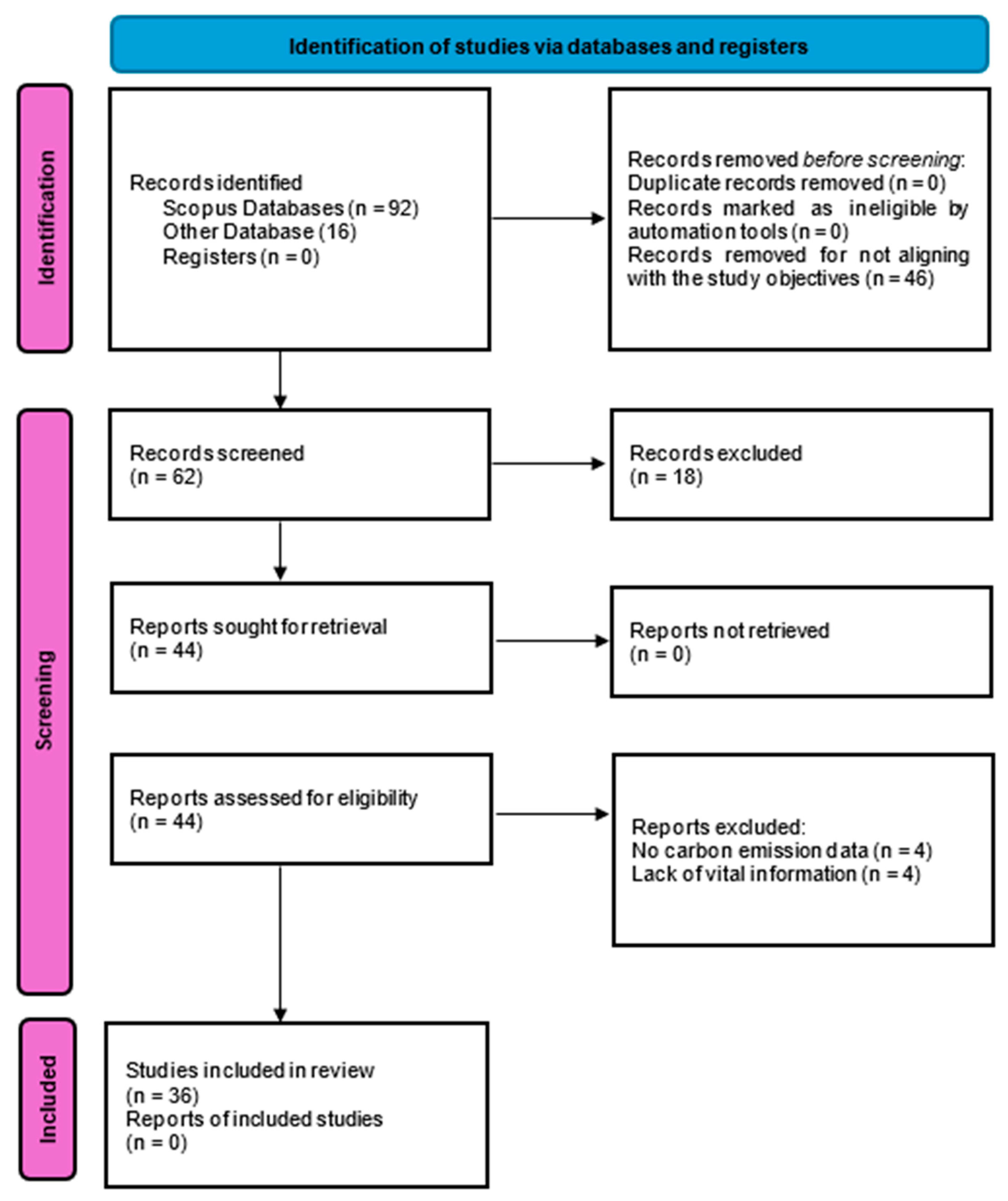
Figure 2 depicts the summary of the literature search based on the PRISMA framework. The literature is based on empirical studies related to carbon disclosure policies and carbon mitigation processes. Using the Scopus database and other corporate databases, 108 records were obtained. Thereafter, a multi-stage screening was conducted, leading to the removal of 46 records which were not aligned with the objectives of the study and 18 records which involved irrelevant abstracts. About eight records which lacked insufficient carbon data or vital information were excluded. After the necessary screening, 36 peer-reviewed articles met the final inclusion criteria for the systematic review.
The synthesis of the 108 included records was conducted manually using the constant comparative method. To ensure rigor and minimize bias, the following three-step iterative process was employed:
Step 1. Descriptive Evidence Mapping: A master evidence matrix was developed (using Microsoft Excel) to record key findings, variables (drivers, mediators, moderators), and outcomes from each paper.
Step 2. Cross-Study Pattern Identification: The authors compared findings across different contexts. Through this iterative comparison, “initial themes” were identified based on the frequency and weight of the evidence.
Step 3. Analytical Abstraction: The initial themes were refined into the final conceptual framework.
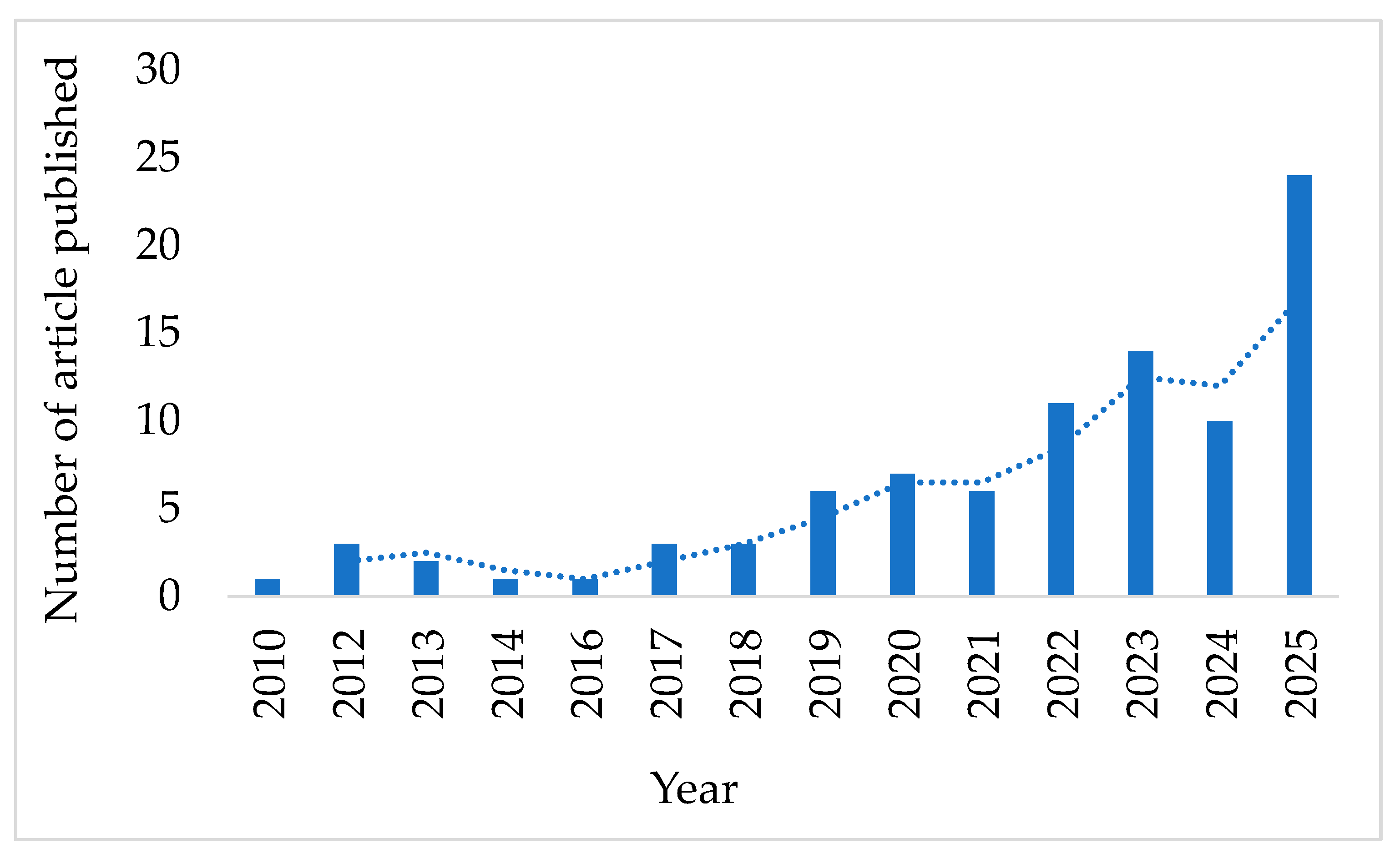
Figure 3 indicates the trend of the literature related to carbon disclosure policies and the mitigation of carbon emissions obtained from Scopus database. The trend shows that the literature distribution is characterized by a low output in the early 2010s. An exponential inflection occurs in 2022, resulting in increased publications. The increasing integration of environmental data into climate risk assessment frameworks is evident in the surge in the literature (to about 24) in 2025.

4.2. The Evolving Importance of Carbon Disclosure Policy in a Sustainable Economy

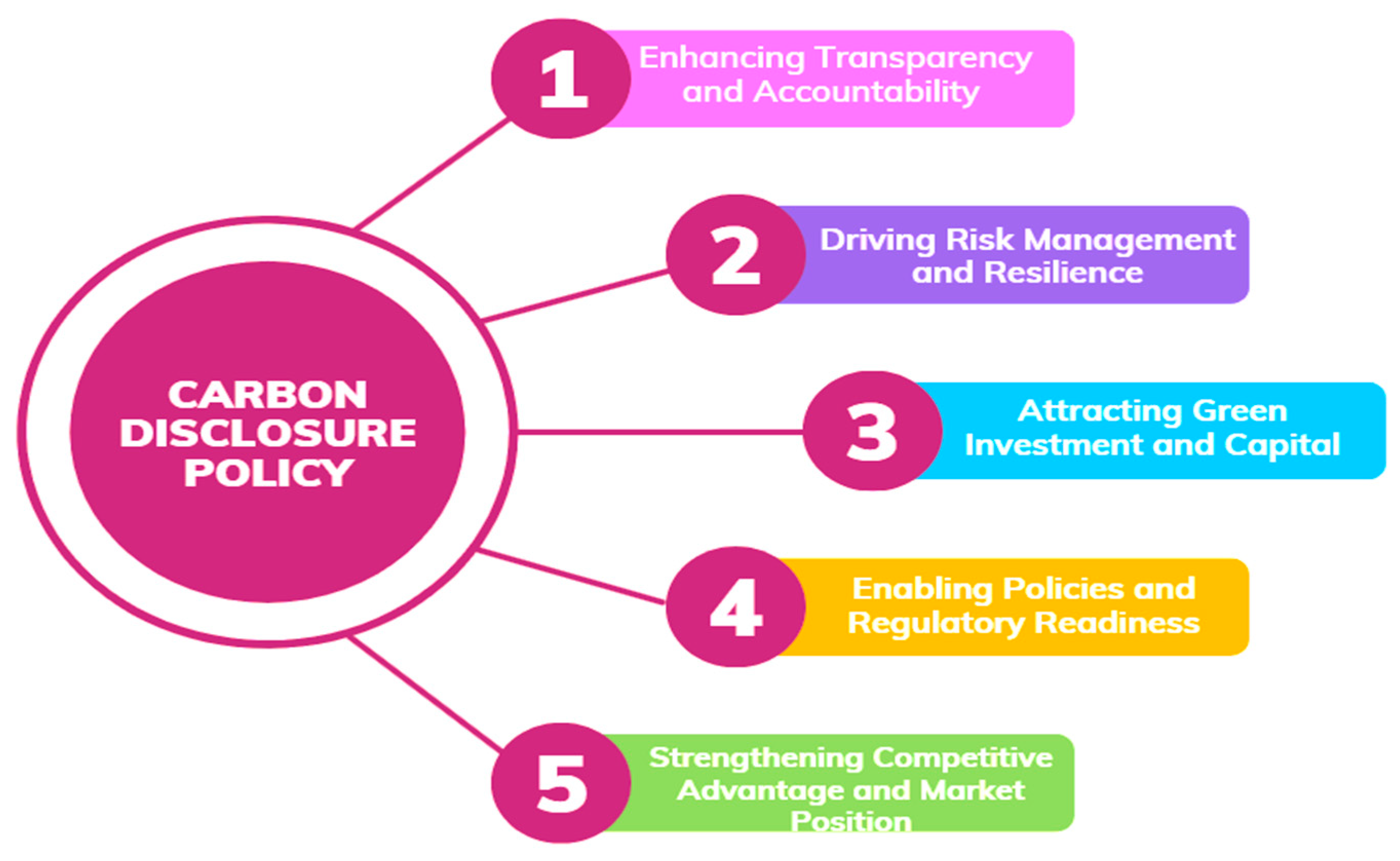
This section highlights the evolving importance of carbon disclosure policy in a sustainable economy, which answers research question 1. The different literature samples reviewed revealed that the carbon disclosure policies are dynamic and continuously evolving, with interplay of different frameworks and regulations. These inherent features of carbon disclosure policies improve transparency and facilitate reduction in global carbon emissions [47]. As carbon disclosure policies evolve, there has been a visible increase in sustainability reporting, which has been helpful in global efforts to address environmental challenges [9]. Figure 4 reveals how the implementation of carbon disclosure policies has helped to achieve enhanced transparency and accountability, driving climate risk management, attracting green investment and improving regulatory readiness.
The evolving landscape of carbon disclosure has served both ethical obligations and economic resilience in the face of climate change [48]. It has transitioned from a mere voluntary “green” activity to a more focused environmental reporting, which has helped to combat climate change and contributed to a net-zero future [49]. Carbon disclosure policies have facilitated an increase in the integration of environmental data into financial decision making of different organizations [50]. Studies have shown that organizations that exhibit transparency in disclosing their environmental impacts often have a strengthened credibility and attract more ESG-conscious investors [51]. On the contrary, organizations that fail to disclose their carbon data often face significant regulatory penalties and financial and reputational damages. Hence, carbon disclosure has been regarded as a modern aspect of corporate governance, necessary for ethical mechanism and persistent economic performance.

4.3. Classification of Carbon Disclosure Policy

Based on the work of Jiang et al. [52], carbon disclosure policy can be voluntary or mandatory. Both categories of carbon disclosure policy possess common features in regards to information and reporting frameworks. Mandatory carbon disclosure policy is legally required and imposed by regulatory agencies across several countries [9,53]. For instance, the European Union’s Corporate Sustainability Reporting Directive (CSRD) necessitates extensive sustainability reporting, which also includes climate data [54]. In contrast, the voluntary carbon disclosure policy relies on the willingness of participating companies to disclose their carbon emission data [55]. The policy is often driven by investor pressure, market demand for transparency, and a desire to enhance corporate reputation [56]. The carbon disclosure project is one of the most prominent examples of voluntary carbon disclosure policy [57]. The carbon disclosure project is a global nonprofit organization that runs a voluntary disclosure system for different categories of entities.
Table 1 summarizes the detailed frameworks and standards that guide global carbon disclosure. The individual contributions and their increasing convergence are highlighted. The frameworks and standards that guide carbon disclosure differ from country to country.
The global landscape of carbon disclosure reveals a clear hierarchy of regulatory maturity, transitioning from voluntary transparency to systemic integration. In advanced economies like the European Union and the United States, the implementation of the CSRD and SEC mandatory rules signifies a shift toward treating climate metrics with the same legal rigor as that required for financial data. This strategic alignment aims to protect investors by framing climate risk as a material financial risk, thereby “pricing in” carbon into capital markets. Conversely, in emerging economies such as those in India, Brazil, and Indonesia, the focus remains on a “hybrid” transition. Frameworks like India’s BRSR serve as a bridge to attract global ESG investment and align with international standards like the ISSB, though they often lack the mandatory enforcement seen in Western jurisdictions.
While the tools of disclosure such as TCFD and CDP are becoming standardized, the strategic intent varies significantly by geographic location, leading to a “policy-to-reduction” disconnect. In regions like South Africa, the King IV Code promotes “integrated reporting” as a core tenet of corporate citizenship, yet this administrative success does not always translate into operational decarbonization. A critical synthesis suggests that disclosure often acts as a diagnostic tool rather than a curative policy; it identifies emission sources but frequently lacks the “regulatory teeth”, such as carbon pricing or hard caps, required to force substantive technological shifts. This divergence is particularly evident in Brazil and Indonesia, where increased attention to ESG-linked bonds has not yet fully reconciled with national industrial or agricultural carbon intensities.
The global frameworks highlight a persistent efficacy gap driven by symbolic versus substantive compliance. In many emerging markets, firms may adopt high-quality reporting to secure lower costs of capital—a form of “symbolic disclosure”—without fundamentally altering their core carbon-intensive operations. This “decoupling” is further exacerbated by the granularity gap, where the absence of mandatory Scope 3 reporting allows for carbon leakage across the supply chain. To evolve from a valuable roadmap to a rigorous primary determinant of change, carbon disclosure must move beyond mere transparency. Future efficacy depends on whether these mandates trigger internal organizational learning and technological upgrades or merely result in sophisticated, performative reporting.
A critical synthesis of the primary global disclosure framework summarized in Table 2 reveals a significant shift from voluntary, impact-based storytelling to mandatory, investor-grade risk accounting. By analyzing the interplay between these organizations, the landscape can be categorized into three functional pillars: methodological foundations, financial risk frameworks, and regulatory mandates.
The first pillar consists of the GHG Protocol and ISO 14064, which serve as the “technical bedrock” of the industry. While the GHG Protocol provides the widely adopted conceptual definitions for Scope 1, 2, and 3 emissions, ISO 14064 offers the rigorous methodological consistency required for formal verification. Together, they bridge the “granularity gap”, ensuring that data is not only reported but is quantifiable and auditable. Without these standardized accounting foundations, the subsequent reporting frameworks would lack the comparability necessary for global benchmarking.
The second pillar represents the financial-materiality pivot, led by the TCFD and the ISSB. This reflects a crucial evolution in strategic intent, i.e., moving beyond the GRI’s focus on a firm’s impact on the environment (multi-stakeholder approach) toward the environment’s financial impact on the firm (investor-centric approach). TCFD’s four-pillar structure comprising governance, strategy, risk Management, and metrics has become the global lingua franca for climate reporting. The recent ISSB (S1 and S2) standards represent a “harmonization phase”, effectively consolidating the alphabet soup of voluntary standards into a singular, high-quality global baseline designed specifically for capital markets to price climate risk accurately.
The final pillar is regulatory institutionalization, evidenced by the EU CSRD and the U.S. SEC proposals. This stage marks the end of the “voluntary era” of carbon disclosure. By making ESG reporting mandatory and expanding its scope, these regulations aim to solve the “symbolic compliance” issue. When disclosure moves from a non-profit-led initiative (like the CDP) to a legal mandate, it shifts the internal corporate function from providing marketing and PR work to dealing with legal and financial issues. This transition is essential for closing the “policy-to-reduction” disconnect, as it subjects carbon data to the same institutional “teeth” and oversight as those for financial earnings, theoretically reducing the greenwashing gap.
As summarized in Table 3, carbon disclosure has evolved from a voluntary corporate social responsibility (CSR) exercise into a strategic financial and regulatory imperative. The current research landscape can be categorized into three analytical pillars: financial and risk signaling, policy-driven institutionalization, and operational decarbonization pathways.
  • Financial and Risk Signaling: The Market-Legitimacy Link
A significant cluster of the literature focuses on how disclosure alters the relationship between a firm and its external financial environment. Studies by Zhang et al. [70] and Rehman et al. [83] establish that robust disclosure is strongly correlated with lower idiosyncratic risks and a reduced cost of capital. This suggests that transparency acts as a “de-risking” mechanism for investors. However, Liu et al. [71] and Guo & Pan [87] add a layer of complexity, noting that these benefits are mediated by investor perception and stakeholder trust. In this context, disclosure is not just about reporting numbers; it is about building “moral capital”. This financial signaling is further reinforced by Kim et al. [86], who find that voluntary disclosure improves accounting comparability, thereby reducing information asymmetry in global markets.
  • Policy-Driven Institutionalization: From Voluntary to Mandatory
A clear shift toward the institutionalization of carbon reporting can be identified through state-led mandates and credit policies. Fan et al. [74] and Du et al. [78] demonstrate, in the Chinese context, how “green credit” policies and pilot emission trading schemes (ETS) effectively coerce firms into disclosure, moving it from a peripheral activity to a core compliance function. Moses et al. [73] and Carattini et al. [88] extend this to a global scale, arguing that “mandatory readiness” is now a defining characteristic of resilient firms in the UK and Australia. The transition to mandatory disclosure, as highlighted by Greenstone et al. [83], is critical because it reveals the true extent of “corporate carbon damages”, holding firms accountable to a level that voluntary frameworks cannot achieve.
  • Operational Decarbonization: Disclosure as a Catalyst for Innovation
Perhaps the most vital theme is whether disclosure leads to a “green transition”. The literature suggests a positive, yet contingent, correlation. Zhang et al. [72] and Wang et al. [75] argue that disclosure fosters green technology innovation and improves carbon reduction efficiency by forcing firms to confront their internal operational inefficiencies. This is echoed by Xia et al. [76] and Frankovic & Koib [80], who see comprehensive disclosure as an accelerator for low-carbon transitions. However, Zhu et al. [79] provide a necessary “critical edge” to this narrative, noting that a lack of standardized carbon accounting frameworks remains a primary barrier to achieving SDG-13. Without methodological consistency, the “low-carbon transition” remains difficult to benchmark and verify across industries.

4.4. Strategic Benefits of Carbon Disclosure Policies

This section highlights the strategic benefits of carbon disclosure policies, answering research question 2. Different compelling strategic advantages have been articulated. The advantages extend beyond mere compliance, making a strong case for robust carbon disclosure.

4.4.1. Enhancing Credibility and Reputation

According to Saha et al. [89], the credibility and reputation of organizations are often enhanced by transparent carbon disclosure. Carbon disclosure by any organization has been reported as a commitment to accountability regarding climate change and environmental issues [90]. The public often has a positive perception towards companies that disclose their environmental data transparently [91]. It has been proven that customers are often attracted to organizations with a positive perception of carbon disclosure [92]. Moreover, persistent continuous carbon disclosure standards have been reported to strengthen the company’s brand, which invariably results in high market valuation. Xu and Su [93] confirmed that companies with highly trusted carbon disclosure outperformed their counterparts who present a negative perception of carbon disclosure.

4.4.2. Attracting ESG-Conscious Investors and Lowering Cost of Capital

The implementation of carbon disclosure policies has been reported to attract ESG-consciousness among investors and reduce capital costs [94]. As a result of this, there has been a progressive integration of ESG into corporate decision-making processes by different organizations [94]. Organizations that exhibit transparency in their ESG data attract investors that have positive perceptions towards ESG [95,96,97]. A proper alignment with investors resulting in a positive disposition towards carbon disclosure has been reported to unlock financial advantage [98,99]. On the contrary, companies with poor ESG performance often discourage investor interest [100]. There have been reports showing improved company financial performance due to improved corporate carbon disclosure, which also demonstrates a clear market reward for transparency in climate action [101].

4.4.3. Identifying Climate Risks and Opportunities for Effective Risk Management and Innovation

Carbon disclosure provides organizations with a clear direction for spotting and tackling climate risks directly [102]. The climate risks are often revealed in a chaotic manner, resulting in the disruption of organizational operations and the supply chain and causing sudden shifts in regulations [103,104]. More effective and proactive climate risk management can be developed if companies understand how vulnerable they are, therefore enhancing their resilience towards climate change. Companies can be compelled to identify opportunities arising from global energy transition through appropriate disclosure process [105].This new opportunity can open up sustainable product diversifications, thereby positioning the company for future success. Proper understanding of how organization success depends on environmental data would enhance the chances of securing capital for green projects [106]. Reporting scope emissions has been demonstrated to help companies save substantial costs [107]. In addition, a rigorous climate risk assessment process could help organizations to be resilient in the face of climate change, which can also help to deepen supply chains related to carbon emissions. There has been continuous facilitation of green technological innovation through enhanced carbon information disclosure, thereby reducing green financing constraints and resulting in more attractive investments in renewable energy [108].

4.4.4. Supporting Corporate Social Responsibility (CSR) and Combating Climate Change

There is a direct correlation between an organization’s environmental impact and its commitment to its corporate social responsibility, as reported by Caputo et al. [109]. The commitment of any organization to protecting the environment is enshrined in their openness to sharing their environmental data. This can promote deeper trust from stakeholders and promote positive relationships between customers, employees, and investors. Transparency in disclosure of environmental data is vital to a broader effort for mitigating climate change [110]. Therefore, coordinated climate action can be encouraged by tracking collective progress in the reduction of GHG [111]. As part of the coordinated efforts, environmental stewardship has been demonstrated in the modern workforce, whereby young professionals often reject job offers from companies perceived to have a negative perception towards ESG [112,113].

4.4.5. Gaining Competitive Advantage and Preparing for Regulatory Demands

There is a direct correlation between carbon disclosure policies and growth in products related to sustainability [114]. This is a result of a preference for products from companies with high environmental responsibility [115]. Companies with high openness towards carbon disclosure have a competitive advantage, positioning them for a better partnership. Disclosure through a well-known platform like CDP offers a competitive advantage, thereby allowing organizations to anticipate incoming regulations. The emergence of mandatory disclosure of environmental data has become a product of legal requirements across different parts of the world [116]. Also, there has been an integration of climate-related requirements into certain supplier contracts by large multinational corporations [117]. Hence, valuable contracts are often lost by organizations that fail to disclose climate-related information and conduct climate-related scenario analysis.

4.5. Carbon Disclosure Policy Effect on Carbon Emission Reduction

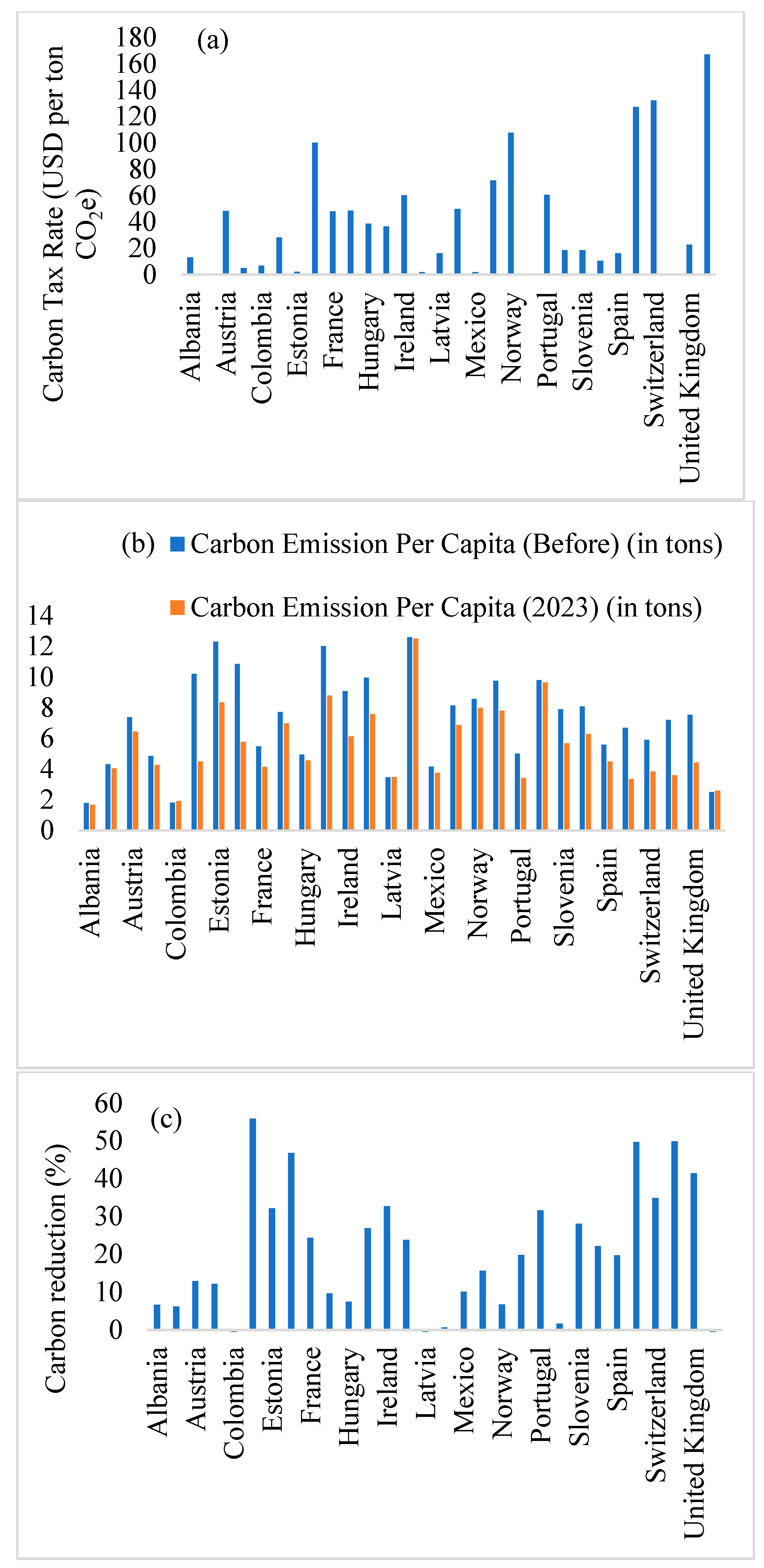
This section highlights the effects of carbon disclosure policies on carbon emission reduction, answering research question 3. Figure 4 depicts the effect of carbon disclosure policies on carbon emission reduction across various countries. The carbon tax rates for the different countries are shown in Figure 5a. There is variation in the carbon tax rate across different countries. Some countries, such as France, Norway, Switzerland, and the United Kingdom, have a relatively high carbon tax rate, suggesting a strong engagement with carbon disclosure. Other countries, such as Albania, Australia, and Slovenia, have much lower carbon tax rates. It can be observed that there is a variation in the level of commitment and maturity in the carbon disclosure policies of the countries investigated. It can be insinuated that there will be more proactiveness in measuring and reporting carbon emissions by organization in countries where there is high carbon tax, which can help in effective carbon management.
As shown in Figure 5b, there is reduction in carbon emissions per capita in countries where a carbon tax has been implemented. Of particular interest is the significant carbon emission reduction per capita in Estonia, Ireland, Latvia, and the United Kingdom. A slight increase or relatively stable carbon emission reduction can be observed in Mexico and Portugal. There were significant carbon emissions before the implementation of the carbon tax across some countries. Countries such as Estonia and Ireland exhibited substantial initial carbon emission before the carbon tax implementation. The occurrence of a reduction in carbon emissions per capita over time can be inferred from the trend. Although the reduction in carbon emissions cannot be solely attributed to the role of carbon disclosure, the carbon emission trend aligns with the notion that increased transparency and awareness in carbon disclosure could lead to effective carbon emission reduction. A greater scope for carbon emission reduction can be observed for countries with higher initial emissions.
The percentage of carbon emission reduction for each country is depicted in Figure 5c. A positive percentage of carbon emission reduction can be observed for several countries. A significant carbon emission reduction of about 40% was recorded for Estonia, Ireland, and the United Kingdom. On the contrary, there was a negative percentage reduction in Albania and Mexico, signifying an increase in carbon emissions. While disclosure policies are intended to catalyze decarbonization, our findings for Albania and Mexico highlight a “decoupling” effect. In these instances, the downward pressure of disclosure of emissions was likely overwhelmed by macro-economic countervailing forces. For example, Mexico’s emission trajectory during the study period was heavily influenced by a shift toward carbon-intensive heavy manufacturing and changes in the national energy grid, which may negate the incremental gains of corporate transparency [118].
A critical tension identified in the literature and one that challenges the optimistic view of transparency is the phenomenon of decoupling. As noted by Wang et al. [119], firms often engage in symbolic disclosure to gain social legitimacy and “moral capital” without committing to substantive operational shifts. This creates a “greenwashing gap” in which reporting quality and carbon performance are inversely related. In these scenarios, disclosure serves as a defensive mechanism. Firms may provide exhaustive data on Scope 1 and 2 emissions (which are easier to manage), while deliberately “obscuring” Scope 3 emissions or omitting data on long-term capital expenditures for fossil fuel assets. Consequently, a high disclosure score can paradoxically act as a lead indicator of organizational inertia rather than a catalyst for decarbonization. This suggests that without rigorous external auditing and performance-linked penalties, transparency mandates may facilitate sophisticated forms of greenwashing rather than genuine environmental progress.
Through the various trends in carbon emissions, an insight into the direct impact of carbon disclosure policy on carbon emissions can be observed. It can be inferred from this analysis that there is a significant carbon emission in the different countries investigated. These reductions indicate that carbon disclosure mechanisms and carbon tax policies can be tools to facilitate carbon emission reduction. However, factors such as economic structure, energy policies, technological advancements, and national climate targets could also influence carbon emission reduction. The complexity of climate change can be ascertained from the fact that there is an increase in carbon emissions in some countries, even though there is implementation of carbon disclosure policies. It is very important not to conclude that carbon disclosure is the sole cause of carbon emission reduction, even though this study revealed a trend whereby carbon emission reduction is correlated with carbon disclosure policies. A transparent groundwork for carbon emission management can be laid through effective carbon disclosure policies. It can be inferred that carbon disclosure policies are important mechanisms that could be integrated within a broader suite of climate action to achieve significant and sustained carbon emission reductions.
As depicted in Figure 5a,c, there is a direct relationship between the percentage of emission reduction and the carbon tax rates; however, this does not cut across all the countries depicted in the figures. There is a high percentage of carbon emissions in the UK during the post-carbon tax implementation period, despite the initial high carbon tax. On the contrary, a high carbon reduction is observed in Estonia, even though high carbon tax rates were implemented.

Unintended Negative Effects of Disclosure

The effectiveness of disclosure is also mediated by several potential negative externalities that were not previously detailed. First, greenwashing remains a significant barrier; without rigorous third-party auditing, firms may engage in selective reporting, disclosing “low-hanging fruit” while obscuring core carbon-intensive activities. Second, for small and medium enterprises, the transaction costs of compliance including data collection, life-cycle assessments, and administrative overhead can be prohibitive. These costs may divert capital away from actual technological upgrades, paradoxically slowing the rate of emission reduction in sectors dominated by smaller players.

4.6. Integrated Analysis via Conceptual Framework

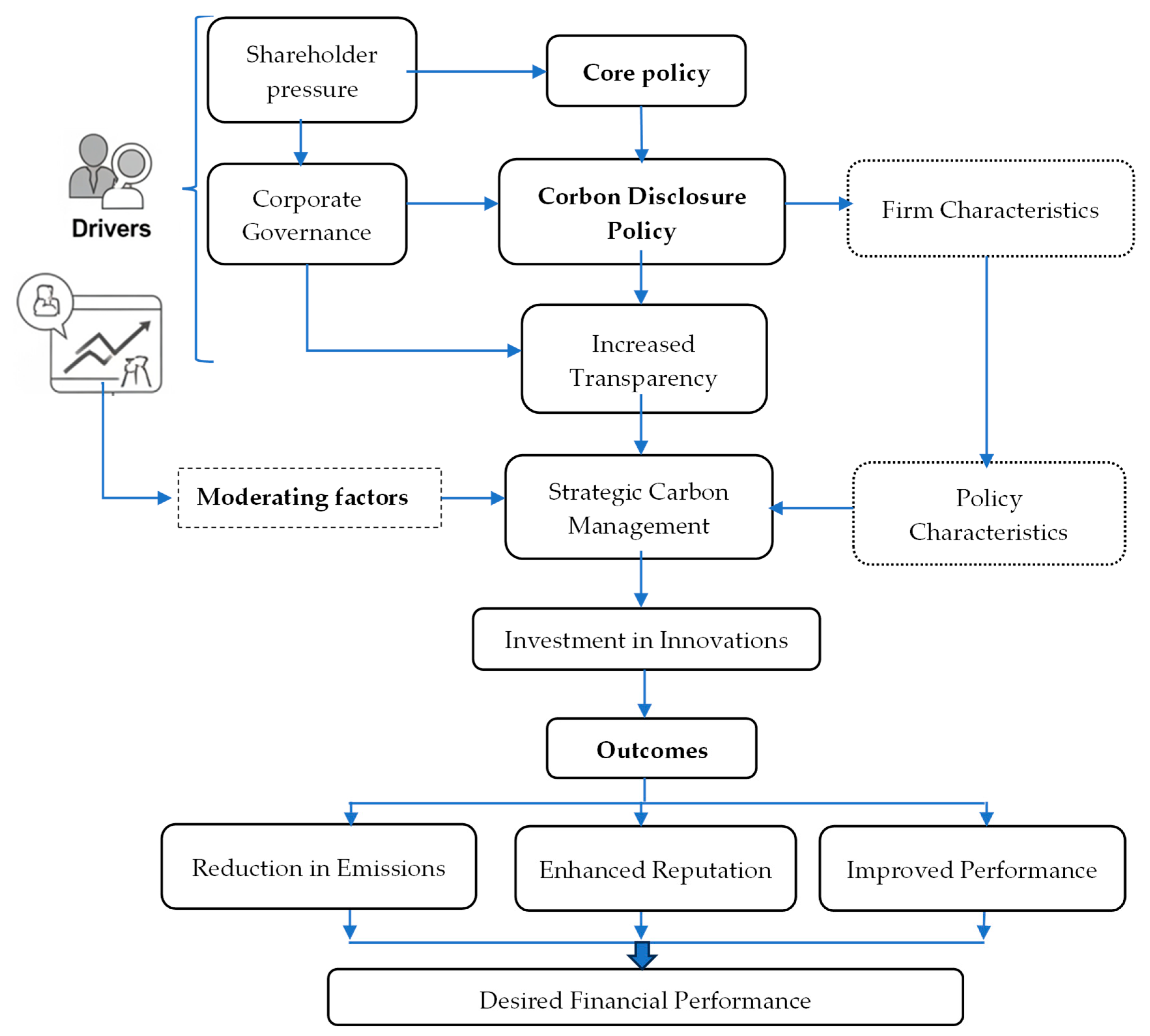
To move beyond a descriptive account of the literature, we apply the conceptual framework developed in Figure 6 to synthesize the relationship between disclosure and carbon emission management. The literature reveals that the influence of disclosure is not direct but is filtered through specific moderating and mediating variables.
The conceptual framework is grounded in the “signaling theory,” which posits that firms utilize carbon disclosure as a strategic tool to communicate organizational quality and reduce information asymmetry among stakeholders [120]. Internal drivers, such as corporate governance and shareholder pressure, serve as the primary catalysts for establishing a core policy, as robust leadership and investor demand for transparency are essential for building market trust [121]. This relationship is further solidified by policy mandates, which transition disclosure from a voluntary exercise into a mandatory compliance function, thereby improving a firm’s readiness to manage climate-related financial risks.
The transition from a carbon disclosure policy to strategic carbon management is heavily moderated by external regulatory design and internal organizational capacity [122]. Policy stringency and policy characteristics, such as the inclusion of Scope 3 emissions or the implementation of carbon pricing, provide the “regulatory teeth” necessary to move beyond symbolic transparency and force substantive accountability. Firm characteristics, including size, industry type, and financial quality, act as critical moderators that determine a company’s “absorptive capacity” to integrate environmental metrics into its core business strategy [123].
The framework connects these strategic shifts to tangible outcomes, specifically reduction in emissions, enhanced reputation, and improved performance. Studies have shown that comprehensive disclosure fosters investment in innovations and green technology, which in turn improves carbon reduction efficiency and accelerates the transition toward SDG 13 [72,124]. These operational and environmental successes converge to drive desired financial performance, as the market rewards transparent firms with a lower cost of capital and enhanced firm value.
Figure 6 depicts the conceptual framework of carbon disclosure policies for carbon emission reduction. The different drivers that could influence carbon disclosure policies in relation to carbon emission reduction are highlighted in the framework. These drivers include shareholder pressure and corporate governance. Based on the framework, the demands from investors, customers, and the public are referred to as stakeholder pressure, which is a function of corporate accountability and transparency regarding climate issues. Corporate governance is an internal corporate strategy which includes proactive leadership, ethical considerations, and the desire to build long-term resilience and competitive advantages. The core policy of the framework is a central strategic intervention that influences other components of the carbon disclosure policy. As indicated in the framework, the carbon disclosure policy represents a formal requirement for an organization to measure, monitor, and publicly report its greenhouse gas emissions and climate-related business risks. This makes invisible carbon emissions visible and quantifiable.
The mediating mechanism in the framework comprises internal company actions that translate policy into tangible results. The policy’s impact is channeled by this mechanism. The carbon disclosure policies in the business organization could translate into increased transparency and accountability, which creates immediate accountability to stakeholders. The direct output of carbon disclosure policy is strategic carbon management. Once emissions are measured, management can set reduction targets, allocate budgets, and integrate carbon performance into their business strategies. Investment in low-carbon innovation in the framework entails the disclosure of incentive investment in cleaner technologies, energy efficiency, and operational improvements to meet reduction targets. The moderating factors in this framework are contextual variables that can strengthen or weaken the effectiveness of the disclosure policy. Policy stringency and enforcement are robust policies with clear rules, and penalties are more effective than voluntary or lenient policies. Based on firm characteristics, the policy’s impact will differ according to the firm’s emission intensity, size, financial resources, and existing corporate culture regarding sustainability. The overall outcome of the framework is the ultimate result of the entire process, which includes a reduction in carbon emissions, enhanced reputation and brand value, and improved financial performance and risk mitigation. Reduction in carbon emissions is the primary and most crucial environmental outcome. Enhanced reputation and brand value result from transparency, and business heads are viewed as responsible leaders who can improve brand loyalty and public image. Companies often uncover cost savings through energy efficiency, gain better access to capital from ESG investors, and are better prepared to manage climate-related financial risk.
The framework extends institutional theory by demonstrating how regulatory and normative pressures (drivers) translate into specific organizational practices (mediators). It also enriches stakeholder theory by showing how disclosure policies serve as a formal mechanism to meet the information demands of diverse stakeholders (investors, customers, and regulators), ultimately leading to value-creating outcomes. It contributes to a more nuanced theoretical model that refines the understanding of corporate environmental behavior. By incorporating mediators and moderators, it moves beyond simplistic assumptions and provides a testable framework that explains the complex, multilayered process through which external pressures for transparency lead to tangible environmental performance improvements. This framework can serve as a strategic roadmap that could help stakeholders understand how the disclosure values lie not in the report itself, but in using the disclosure process to drive internal strategy, justify investment in innovation, and manage climate-related risks proactively. It provides clear logic for allocating resources to sustainability initiatives. Findings related to the moderating role of policy stringency and enforcement offer direct, actionable insights. This finding provides evidence that disclosure policies must be robust, clear, and non-symbolic. This can guide the design of future climate regulations to ensure that they achieve their intended emission-reduction goals. This study provides a sophisticated lens for evaluating corporate climate action. Instead of taking disclosure reports at face value, investors can use this framework to look for evidence of the mediating mechanisms (e.g., R and D spending and capital expenditures for green tech.). This helps differentiate between companies engaged in genuine strategic transformation and those engaged in “greenwashing”.

5. Conclusions

The critical overview of carbon disclosure policy highlighted how it has evolved. The important positive step towards this is the increasing recognition of the duality of the imperative of net-zero carbon emission as an ethical environmental responsibility and the provision of long-term economic resilience. Carbon disclosure is not just a peripheral corporate activity but a key modern business strategy, firmly tied to financial performance and risk management, as well as to competitive positioning. The major trend in carbon disclosure policy is moving toward the non-harmonization and interoperability of the different standards. The practical application of this trend is shown in the example of the ISSB’s cooperation with the CDP and GRI by the TCFD addition and their involvement in building a single, strong internal carbon accounting system that can be utilized for multiple reports.
The advantages of carbon disclosure are overwhelming and quantifiable. In addition to improving organization credence and image, clearer environmental reporting also attracts individuals who care about the ESG, and this leads to lower costs of capital and higher acquisition premiums. Moreover, it is one of the key tools to reveal the risks posed by climate change, to mitigate them efficiently, and to find new areas for innovation and growth. Carbon disclosure functions as a basis for corporate social responsibility, lays the foundation of the trust of the stakeholders, and raises the motivation of the employees.
Carbon disclosure, mainly shaped by further regulatory development and the global implementation of ISSB standards, will comprise major future trends, and state-level frameworks in regions like the U.S. will make up other notable trends. Several technological developments are intended to be the driving force to counter existing data constraints and to empower companies with new strategies. As organizations steer through the intricacies of the current global environment, a proactive, comprehensive carbon disclosure policy is not just about being in line with regulations; it is an necessity that will drive financial performance, build resilience, and contribute to sustainable growth in a world that is more focused on climate.

Author Contributions

Conceptualization, F.O.A. and B.V.A.; methodology, F.O.A. and B.V.A.; software, B.V.A.; validation, F.O.A., B.V.A. and T.O.O.; formal analysis, B.V.A.; investigation, T.S. and S.M.; resources, F.O.A.; data curation, T.O.O.; writing—original draft preparation, B.V.A. and F.O.A.; writing—review and editing, F.O.A.; visualization, T.S. All authors have read and agreed to the published version of the manuscript.

Funding

This research received no external funding.

Data Availability Statement

The original contributions presented in this study are included in the article. Further inquiries can be directed to the corresponding author(s).

Conflicts of Interest

The authors declare no conflicts of interest.

Abbreviations

The following abbreviations are used in this manuscript:
CDPCarbon Disclosure Report
ESGEnvironmental, Social, and Governance
TCFDTask Force on Climate-Related Financial Disclosure
ISSBInternational Sustainability Standards Board
GRIGlobal Report Initiative
GHGsGreenhouse Gases
IPCCIntergovernmental Panel on Climate Change
UN-FCCCUnited Nations Framework Convention on Climate Change
HCFCsHydrochlorofluorocarbons

References

  1. Huang, H.; Zou, Y.; Wang, L.; Wang, W.; Ren, X. Impact of Carbon Information Disclosure on Corporate Financing Constraints: Evidence from the Carbon Disclosure Project. Aust. J. Manag. 2025, 50, 104–131. [Google Scholar] [CrossRef]
  2. Xhindole, C.; Tarquinio, L.; Sierra-García, L. Climate Change and Task Force on Climate-Related Financial Disclosures (TCFD) Reports. A Comparison between Italy and Spain. J. Account. Organ. Change 2025, 21, 1–28. [Google Scholar] [CrossRef]
  3. de Villiers, C.; Dimes, R.; La Torre, M.; Molinari, M. The International Sustainability Standards Board’s (ISSB) Past, Present, and Future: Critical Reflections and a Research Agenda. Pac. Account. Rev. 2024, 36, 255–273. [Google Scholar] [CrossRef]
  4. Mougenot, B.; Doussoulin, J.-P. A Bibliometric Analysis of the Global Reporting Initiative (GRI): Global Trends in Developed and Developing Countries. Environ. Dev. Sustain. 2024, 26, 6543–6560. [Google Scholar] [CrossRef] [PubMed]
  5. Sharaf-Addin, H.H. Towards Net-Zero Carbon Emissions: A Systematic Review of Carbon Sustainability Reporting Based on GHG Protocol Framework. Environ. Sustain. Indic. 2024, 24, 100516. [Google Scholar] [CrossRef]
  6. Shah, S.Z.A.; Akbar, S.; Zhu, X. Mandatory CSR Disclosure, Institutional Ownership and Firm Value: Evidence from China. Int. J. Financ. Econ. 2025, 30, 71–85. [Google Scholar] [CrossRef]
  7. Dhar, B.K.; Hosen, M.; Bağış, M.; Sousa, M.J.; Khatun, K.M. Diverse Boards and Firm Performance: The Strategic Role of Carbon Disclosure in Heavily Polluting Companies in Bangladesh. Bus. Strategy Dev. 2024, 7, e70017. [Google Scholar] [CrossRef]
  8. Borghei, Z. Carbon Disclosure: A Systematic Literature Review. Account. Financ. 2021, 61, 5255–5280. [Google Scholar] [CrossRef]
  9. Ma, B.; Lin, S.; Bashir, M.F.; Sun, H.; Zafar, M. Revisiting the Role of Firm-Level Carbon Disclosure in Sustainable Development Goals: Research Agenda and Policy Implications. Gondwana Res. 2023, 117, 230–242. [Google Scholar] [CrossRef]
  10. Augoye, O.; Muyiwa-Ajayi, T.P.; Sobowale, A. The Effectiveness of Carbon Accounting in Reducing Corporate Carbon Footprints. Int. J. Multidiscip. Res. Growth Evaluation. 2024, 5, 1364–1371. [Google Scholar] [CrossRef]
  11. Mudhee, K.H.; Hilal, M.M.; Alyami, M.; Rendal, E.; Algburi, S.; Sameen, A.Z.; Khurramov, A.; Abboud, N.G.; Barakat, M. Assessing Climate Strategies of Major Energy Corporations and Examining Projections in Relation to Paris Agreement Objectives within the Framework of Sustainable Energy. Unconv. Resour. 2025, 5, 100127. [Google Scholar] [CrossRef]
  12. Cai, W.; Bai, M.; Davey, H. Mandatory Environmental Disclosure Policy in the Largest Carbon Emission Country. Pac. Account. Rev. 2024, 36, 527–560. [Google Scholar] [CrossRef]
  13. Porporato, M.; Samuels-Jones, T. Carbon Emissions Measurement as Intra-Action: Incentives to Disclose Air Emissions at a Canadian University. Int. J. Sustain. High. Educ. 2023, 24, 1540–1560. [Google Scholar] [CrossRef]
  14. Thuy, C.T.M.; Khuong, N.V.; Canh, N.T.; Liem, N.T. Corporate Social Responsibility Disclosure and Financial Performance: The Mediating Role of Financial Statement Comparability. Sustainability 2021, 13, 10077. [Google Scholar] [CrossRef]
  15. Omran, M.; Khallaf, A.; Gleason, K.; Tahat, Y. Non-Financial Performance Measures Disclosure, Quality Strategy, and Organizational Financial Performance: A Mediating Model. Total Qual. Manag. Bus. Excell. 2021, 32, 652–675. [Google Scholar] [CrossRef]
  16. Cracknell Arthur, P.; Varotsos, C.A. The Montreal Protocol. In Remote Sensing and Atmospheric Ozone: Human Activities Versus Natural Variability; Springer: Berlin/Heidelberg, Germany, 2012; pp. 339–378. [Google Scholar]
  17. Whitesides, G. Learning from Success: Lessons in Science and Diplomacy from the Montreal Protocol. 2020. Available online: https://www.sciencediplomacy.org/article/2020/learning-success-lessons-in-science-and-diplomacy-montreal-protocol (accessed on 29 October 2025).
  18. Gonzalez, M.; Taddonio, K.N.; Sherman, N.J. The Montreal Protocol: How Today’s Successes Offer a Pathway to the Future. J. Environ. Stud. Sci. 2015, 5, 122–129. [Google Scholar] [CrossRef]
  19. Perry, C.; Nickson, T.; Starr, C.; Grabiel, T.; Geoghegan, S.; Porter, B.; Mahapatra, A.; Walravens, F. More to Offer from the Montreal Protocol: How the Ozone Treaty Can Secure Further Significant Greenhouse Gas Emission Reductions in the Future. J. Integr. Environ. Sci. 2024, 21, 2362124. [Google Scholar] [CrossRef]
  20. Öztürk, S. Balancing Responsibilities: The Integration of CBDR in the Montreal Protocol. Sürdürülebilir Çevre Derg. 2023, 3, 75–84. [Google Scholar]
  21. Luken, R.; Grof, T. The Montreal Protocol’s Multilateral Fund and Sustainable Development. Ecol. Econ. 2006, 56, 241–255. [Google Scholar] [CrossRef]
  22. Birmpili, T. Montreal Protocol at 30: The Governance Structure, the Evolution, and the Kigali Amendment. Comptes Rendus Geosci. 2018, 350, 425–431. [Google Scholar] [CrossRef]
  23. Kuttippurath, J.; Kumar, P.; Nair, P.J.; Pandey, P.C. Emergence of Ozone Recovery Evidenced by Reduction in the Occurrence of Antarctic Ozone Loss Saturation. NPJ Clim. Atmos. Sci. 2018, 1, 42. [Google Scholar] [CrossRef]
  24. Zhang, E. The Recovery of the Antarctic Ozone Layer and Suggestions for Addressing the Global Warming. Appl. Comput. Eng. 2024, 58, 112–118. [Google Scholar] [CrossRef]
  25. Petrescu, R.V.; Aversa, R.; Apicella, A.; Petrescu, F.I.T. NASA Sees First in 2018 the Direct Proof of Ozone Hole Recovery. J. Aircr. Spacecr. Technol. 2018, 2, 53–64. [Google Scholar] [CrossRef]
  26. Rivera, N.; Kaminer, I.; Zhen, B.; Joannopoulos, J.D.; Soljačić, M. Shrinking Light to Allow Forbidden Transitions on the Atomic Scale. Science (1979) 2016, 353, 263–269. [Google Scholar] [CrossRef] [PubMed]
  27. Tsai, W.-T. Environmental Policies and Countermeasures for the Phase-Out of Ozone-Depleting Substances (ODSs) over the Last 30 Years: A Case Study in Taiwan. Atmosphere 2024, 15, 961. [Google Scholar] [CrossRef]
  28. Park, W.Y.; Shah, N.; Vine, E.; Blake, P.; Holuj, B.; Kim, J.H.; Kim, D.H. Ensuring the Climate Benefits of the Montreal Protocol: Global Governance Architecture for Cooling Efficiency and Alternative Refrigerants. Energy Res. Soc. Sci. 2021, 76, 102068. [Google Scholar] [CrossRef]
  29. Fang, X.; Ravishankara, A.R.; Velders, G.J.M.; Molina, M.J.; Su, S.; Zhang, J.; Hu, J.; Prinn, R.G. Changes in Emissions of Ozone-Depleting Substances from China Due to Implementation of the Montreal Protocol. Environ. Sci. Technol. 2018, 52, 11359–11366. [Google Scholar] [CrossRef]
  30. Simmonds, P.G.; Rigby, M.; McCulloch, A.; O’Doherty, S.; Young, D.; Mühle, J.; Krummel, P.B.; Steele, P.; Fraser, P.J.; Manning, A.J.; et al. Changing Trends and Emissions of Hydrochlorofluorocarbons (HCFCs) and Their (HFCs) Replacements. Atmos. Chem. Phys. 2017, 17, 4641–4655. [Google Scholar] [CrossRef]
  31. Velders, G.J.M.; Daniel, J.S.; Montzka, S.A.; Vimont, I.; Rigby, M.; Krummel, P.B.; Muhle, J.; O’Doherty, S.; Prinn, R.G.; Weiss, R.F.; et al. Projections of Hydrofluorocarbon (HFC) Emissions and the Resulting Global Warming Based on Recent Trends in Observed Abundances and Current Policies. Atmos. Chem. Phys. 2022, 22, 6087–6101. [Google Scholar] [CrossRef]
  32. Change, O.C. Intergovernmental Panel on Climate Change; World Meteorological Organization: Geneva, Switzerland, 2007; Volume 52, pp. 1–43. [Google Scholar]
  33. Tangney, P. Understanding Climate Change as Risk: A Review of IPCC Guidance for Decision-Making. J. Risk Res. 2020, 23, 1424–1439. [Google Scholar] [CrossRef]
  34. Mechler, R.; Singh, C.; Ebi, K.; Djalante, R.; Thomas, A.; James, R.; Tschakert, P.; Wewerinke-Singh, M.; Schinko, T.; Ley, D.; et al. Loss and Damage and Limits to Adaptation: Recent IPCC Insights and Implications for Climate Science and Policy. Sustain. Sci. 2020, 15, 1245–1251. [Google Scholar] [CrossRef]
  35. Borie, M.; Mahony, M.; Obermeister, N.; Hulme, M. Knowing like a Global Expert Organization: Comparative Insights from the IPCC and IPBES. Glob. Environ. Change 2021, 68, 102261. [Google Scholar] [CrossRef]
  36. Gao, Y.; Gao, X.; Zhang, X. The 2 °C Global Temperature Target and the Evolution of the Long-Term Goal of Addressing Climate Change—From the United Nations Framework Convention on Climate Change to the Paris Agreement. Engineering 2017, 3, 272–278. [Google Scholar] [CrossRef]
  37. Milner, B.; Ahmad, I. The Nobel Peace Prize Goes to Gore and IPCC. Soc. Educ. 2008, 72, 69–74. [Google Scholar]
  38. Hermwille, L.; Obergassel, W.; Ott, H.E.; Beuermann, C. UNFCCC before and after Paris—What’s Necessary for an Effective Climate Regime? Clim. Policy 2017, 17, 150–170. [Google Scholar] [CrossRef]
  39. Roberts, E.; Huq, S. Coming Full Circle: The History of Loss and Damage under the UNFCCC. Int. J. Glob. Warm. 2015, 8, 141–157. [Google Scholar] [CrossRef]
  40. Rajamani, L. The Principle of Common but Differentiated Responsibilities and Respective Capabilities in the International Climate Change Regime. In Research Handbook on Climate Disaster Law: Barriers and Opportunities; Edward Elgar Publishing Ltd.: Cheltenham, UK, 2018; pp. 46–60. ISBN 9781786430038. [Google Scholar]
  41. Makrygiannakis, G.; Jack, L. Designing a Conceptual Methodology for Structuration Research. Meditari Account. Res. 2018, 26, 70–87. [Google Scholar] [CrossRef]
  42. Page, M.J.; McKenzie, J.E.; Bossuyt, P.M.; Boutron, I.; Hoffmann, T.C.; Mulrow, C.D.; Shamseer, L.; Tetzlaff, J.M.; Akl, E.A.; Brennan, S.E.; et al. The PRISMA 2020 Statement: An Updated Guideline for Reporting Systematic Reviews. BMJ 2021, 372, n71. [Google Scholar] [CrossRef] [PubMed]
  43. Iram, S.; Qaisar, I.; Shabbir, R.; Pomee, M.S.; Schmidt, M.; Hertig, E. Impact of Air Pollution and Smog on Human Health in Pakistan: A Systematic Review. Environments 2025, 12, 46. [Google Scholar] [CrossRef]
  44. Ren, S.; Hao, Y.; Wu, H. Digitalization and Environment Governance: Does Internet Development Reduce Environmental Pollution? J. Environ. Plan. Manag. 2023, 66, 1533–1562. [Google Scholar] [CrossRef]
  45. Castellanos-Bermejo, J.E.; Cervantes-Guevara, G.; Cervantes-Pérez, E.; Cervantes-Cardona, G.A.; Ramírez-Ochoa, S.; Fuentes-Orozco, C.; Delgado-Hernández, G.; Tavares-Ortega, J.A.; Gómez-Mejía, E.; Chejfec-Ciociano, J.M.; et al. Diagnostic Efficacy of Chest Computed Tomography with a Dual-Reviewer Approach in Patients Diagnosed with Pneumonia Secondary to Severe Acute Respiratory Syndrome Coronavirus 2. Tomography 2023, 9, 1617–1628. [Google Scholar] [CrossRef]
  46. Fiore, M.; Palella, M.; Ferroni, E.; Miligi, L.; Portaluri, M.; Marchese, C.A.; Mensi, C.; Civitelli, S.; Tanturri, G.; Mangia, C. Air Pollution and Breast Cancer Risk: An Umbrella Review. Environments 2025, 12, 153. [Google Scholar] [CrossRef]
  47. Hahn, R.; Reimsbach, D.; Schiemann, F. Organizations, Climate Change, and Transparency: Reviewing the Literature on Carbon Disclosure. Organ. Environ. 2015, 28, 80–102. [Google Scholar] [CrossRef]
  48. Allam, Z.; Cheshmehzangi, A.; Jones, D.S. Redefining Climate Policy and Economic Resilience in the Consuming World. In Climate and Social Justice: The Political Economy of Urban Resilience and Mercantilism; Springer Nature: Singapore, 2023; pp. 77–102. ISBN 978-981-99-6624-0. [Google Scholar]
  49. Perkins, J.; Jeffrey, C.; Freedman, M. Cultural Influences on the Quality of Corporate Social Responsibility Disclosures: An Examination of Carbon Disclosure. Sustain. Account. Manag. Policy J. 2022, 13, 1169–1200. [Google Scholar] [CrossRef]
  50. Wang, D.; Li, X.; Tian, S.; He, L.; Xu, Y.; Wang, X. Quantifying the Dynamics between Environmental Information Disclosure and Firms’ Financial Performance Using Functional Data Analysis. Sustain. Prod. Consum. 2021, 28, 192–205. [Google Scholar] [CrossRef]
  51. Raghunandan, A.; Rajgopal, S. Do ESG Funds Make Stakeholder-Friendly Investments? Rev. Account. Stud. 2022, 27, 822–863. [Google Scholar] [CrossRef]
  52. Jiang, Y.; Tang, Q. Mandatory Carbon Reporting, Voluntary Carbon Disclosure and ESG Performance. Pac. Account. Rev. 2023, 35, 534–561. [Google Scholar] [CrossRef]
  53. Maaloul, A.; Wegener, M. Mandatory Versus Voluntary GHG Emissions Disclosures and Credit Risk. Soc. Environ. Account. J. 2022, 42, 63–92. [Google Scholar] [CrossRef]
  54. Hummel, K.; Jobst, D. An Overview of Corporate Sustainability Reporting Legislation in the European Union. Account. Eur. 2024, 21, 320–355. [Google Scholar] [CrossRef]
  55. Sun, Z.-Y.; Wang, S.-N.; Li, D. The Impacts of Carbon Emissions and Voluntary Carbon Disclosure on Firm Value. Environ. Sci. Pollut. Res. 2022, 29, 60189–60197. [Google Scholar] [CrossRef] [PubMed]
  56. Amel-Zadeh, A.; Tang, Q. Managing the Shift from Voluntary to Mandatory Climate Disclosure: The Role of Carbon Accounting. Br. Account. Rev. 2025, 57, 101594. [Google Scholar] [CrossRef]
  57. Khalid, F.; Ye, Z.; Voinea, C.L.; Naveed, K. Carbon Disclosure Project: Chinese Chief Executive Officer Background and Corporate Voluntary Climate Change Reporting. Carbon Manag. 2022, 13, 321–336. [Google Scholar] [CrossRef]
  58. Story, P. Impact of EU CSRD on Auditing Finnish Companies’ Sustainability and Climate Reports. Master’s Thesis, Hanken School of Economics, Helsinki, Finland, 2025. [Google Scholar]
  59. Puglisa, C.L. SEC’s Proposed Climate-Related Disclosure Rule: Comment Analysis and Recommendation for Scope 3 Emissions. Corp. Bus. Law J. 2024, 5, 84. [Google Scholar]
  60. Simnett, R.; Tan, Y.; You, J.; Zhou, S. Australian Listed Entities’ Preparedness for Mandatory Reporting and Assurance of Climate-Related Disclosures. Abacus 2025, 1–55. [Google Scholar] [CrossRef]
  61. Ghose, B.; Gogoi, N.; Singh, P.K.; Gope, K. Impact of Corporate Climate Change Disclosure on Firm Performance: Empirical Evidence from an Emerging Economy. Sustain. Account. Manag. Policy J. 2025, 16, 389–414. [Google Scholar] [CrossRef]
  62. Joy, N. India’s Regulatory and Strategic Approach to Sustainable Development. In Implementing ESG Frameworks Through Capacity Building and Skill Development; IGI Global: Hershey, PA, USA, 2024; pp. 1–26. ISBN 9798369366196. [Google Scholar]
  63. Bimha, A.; Nhamo, G. Sustainable Development, Share Price and Carbon Disclosure Interactions: Evidence From South Africa’s JSE 100 Companies. Sustain. Dev. 2017, 25, 400–413. [Google Scholar] [CrossRef]
  64. CDP. Brazilian Market Regulator CVM and CDP Announce First-of-Its-Kind Partnership to Accelerate Climate Compliance in the Capital Market; CDP: London, UK, 2025. [Google Scholar]
  65. OJK. Sustainable Finance Roadmap Phase II (2021–2025); Sustainable Finance: Jakarta, Indonesia, 2021; pp. 1–21. [Google Scholar]
  66. Choi, B.; Lee, D.; Luo, L. Carbon Disclosure and Common Ownership. J. Account. Audit. Financ. 2024, 41, 220–253. [Google Scholar] [CrossRef]
  67. Reinstein, A.; Weirich, T.R.; Akresh, A.D. Connecting You to Content on EBSCOhost Title the ISSB’s New Sustainability Disclosure Standards. CPA J. 2024, 94, 56. [Google Scholar]
  68. Raghupathi, W.; Wu, S.J.; Raghupathi, V. Understanding Corporate Sustainability Disclosures from the Securities Exchange Commission Filings. Sustainability 2023, 15, 4134. [Google Scholar] [CrossRef]
  69. Robinson, S.J. RE: Enhancement and Standardization of Climate-Related Disclosures for Investors (S7-10-22). J. Sustain. Real Estate 2022, 14, 1–3. [Google Scholar] [CrossRef]
  70. Zhang, Q.; Hu, Z.; Zhang, Z.; Zhao, R. Carbon Emission and Idiosyncratic Risk: Role of Environmental Regulation and Disclosure. Int. Rev. Financ. Anal. 2025, 105, 104419. [Google Scholar] [CrossRef]
  71. Liu, R.; Che Abdul Rahman, M.R.; Jamil, A.H. From Policy Mandates to Market Signals: Causal and Dynamic Effects of Carbon Information Disclosure on Firm Value. Int. J. Financ. Stud. 2025, 13, 98. [Google Scholar] [CrossRef]
  72. Zheng, S.; Wang, C.; Nawaz, A.; Ali, S. The Nexus of Carbon Disclosure and Green Technology Innovation: An Empirical Analysis Based on Chinese Listed Companies. J. Environ. Manag. 2025, 383, 125218. [Google Scholar] [CrossRef]
  73. Moses, O.; Bui, B.; Houqe, M.N.; Borghei, Z. Readiness for Mandatory Climate-Related Disclosures: A Tri-Jurisdictional Analysis of Governance Attributes in Australia, New Zealand and the United Kingdom. Bus. Strategy Environ. 2025, 34, 3739–3763. [Google Scholar] [CrossRef]
  74. Rahman, A. Decarbonizing India’s Economy: The Role of Carbon Pricing in Reducing Carbon Intensity. J. Risk Anal. Crisis Response 2025, 15, 601–621. [Google Scholar] [CrossRef]
  75. Wang, Y.; Lin, W.; Yan, Z.; Hu, Y. Mechanism for Improving Carbon Reduction Efficiency in the Construction Industry Based on ESG Information Disclosure. Eng. Constr. Archit. Manag. 2025, 1–31. [Google Scholar] [CrossRef]
  76. Xia, T.; Appiah-Otoo, I.; Chen, X. Carbon Disclosure and Carbon Performance in Green Transition: An Empirical Study of Policy Regulation and Regional Differences. Sustain. Dev. 2025. [Google Scholar] [CrossRef]
  77. Fan, C.; Lin, C. Can Green Credit Policy Promote Corporate Carbon Information Disclosure: The Evidence from Chinese Listed Companies. Appl. Econ. 2025, 1–16. [Google Scholar] [CrossRef]
  78. Du, X.; Tao, H.; Cai, Z. Is the Pilot Policy for Carbon Emission Trading Beneficial for ESG Disclosure? Evidence from a Quasi-Natural Experiment in China. China J. Account. Stud. 2025, 1–53. [Google Scholar] [CrossRef]
  79. Zhu, N.; Wiredu, I.; Agyemang, A.O.; Osei, A. Addressing Corporate Governance and Carbon Accounting Disclosure Gaps: A Path toward Firms Commitment to Sustainable Development Goal 13. Sustain. Dev. 2024, 32, 5421–5436. [Google Scholar] [CrossRef]
  80. Frankovic, I.; Kolb, B. The Role of Emission Disclosure for the Low-Carbon Transition. Eur. Econ. Rev. 2024, 167, 104792. [Google Scholar] [CrossRef]
  81. Wahyuningrum, I.F.S.; Ihlashul’amal, M.; Utami, S.; Djajadikerta, H.G.; Sriningsih, S. Determinants of Carbon Emission Disclosure and the Moderating Role of Environmental Performance. Cogent Bus. Manag. 2024, 11, 2300518. [Google Scholar] [CrossRef]
  82. Rehman, A.; Gonenc, H.; Hermes, N. Carbon Disclosure Policy, External Financing Needs and the Cost of Capital: Does Financial Market Quality Matter? Bus. Strategy Environ. 2023, 32, 5854–5872. [Google Scholar] [CrossRef]
  83. Greenstone, M.; Leuz, C.; Breuer, P. Mandatory Disclosure Would Reveal Corporate Carbon Damages. Science (1979) 2023, 381, 837–840. [Google Scholar] [CrossRef]
  84. Wang, H. Does the Low-Carbon Transition Promote the ESG Disclosure of Renewable Energy Enterprises? Environ. Sci. Pollut. Res. 2023, 30, 91369–91376. [Google Scholar] [CrossRef]
  85. Kim, Y.-S. The Association between Voluntary Carbon Disclosure and Accounting Comparability: Examining the Moderating Effect of Korean Business Groups. Sustainability 2023, 15, 4830. [Google Scholar] [CrossRef]
  86. Guo, C.; Pan, W. Research on Voluntary Carbon Information Disclosure Mechanism of Enterprises from the Perspective of Stakeholders—A Case Study on the Automobile Manufacturing Industry. Int. J. Environ. Res. Public Health 2022, 19, 17053. [Google Scholar] [CrossRef]
  87. Bilal; Tan, D.; Komal, B.; Ezeani, E.; Usman, M.; Salem, R. Carbon Emission Disclosures and Financial Reporting Quality: Does Ownership Structure and Economic Development Matter? Environ. Sci. Policy 2022, 137, 109–119. [Google Scholar] [CrossRef]
  88. Carattini, S.; Hertwich, E.; Melkadze, G.; Shrader, J.G. Mandatory Disclosure Is Key to Address Climate Risks. Science (1979) 2022, 378, 352–354. [Google Scholar] [CrossRef] [PubMed]
  89. Saha, A.K.; Dunne, T.; Dixon, R. Carbon Disclosure, Performance and the Green Reputation of Higher Educational Institutions in the UK. J. Account. Organ. Change 2021, 17, 604–632. [Google Scholar] [CrossRef]
  90. Chen, Y.; Xie, Z.; Wang, L.; Zhu, L. ESG Disclosure, Public Perception and Corporate Financial Performance: An Empirical Study Based on Textual Analysis. J. Environ. Manag. 2025, 383, 125320. [Google Scholar] [CrossRef]
  91. Pitrakkos, P.; Maroun, W. Evaluating the Quality of Carbon Disclosures. Sustain. Account. Manag. Policy J. 2020, 11, 553–589. [Google Scholar] [CrossRef]
  92. Kouloukoui, D.; de Marcellis-Warin, N.; Armellini, F.; Warin, T.; Torres, E.A. Factors Influencing the Perception of Exposure to Climate Risks: Evidence from the World’s Largest Carbon-Intensive Industries. J. Clean. Prod. 2021, 306, 127160. [Google Scholar] [CrossRef]
  93. Xu, A.; Su, Y.; Wang, Y.; Liao, J. Carbon Information Disclosure and Corporate Financial Performance—Empirical Evidence Based on Heavily Polluting Industries in China. PLoS ONE 2025, 20, e0313638. [Google Scholar] [CrossRef] [PubMed]
  94. Kaakandikar, R.; Kamalkishor Soni, K.; Pradip Barole, P.; Vinayak More, A.; Kapil Waghmare, S. The Impact of ESG Awareness on Personal Investment Decisions. SSRN Electron. J. 2025, 21, 666–689. [Google Scholar] [CrossRef]
  95. Sari, R.; Muslim, M. Corporate Transparency and Environmental Reporting: Trends and Benefits. Amkop Manag. Account. Rev. (AMAR) 2024, 4, 1–18. [Google Scholar] [CrossRef]
  96. Arvidsson, S.; Dumay, J. Corporate ESG Reporting Quantity, Quality and Performance: Where to Now for Environmental Policy and Practice? Bus. Strategy Environ. 2022, 31, 1091–1110. [Google Scholar] [CrossRef]
  97. Odeyemi, O.; Usman, F.O.; Mhlongo, N.Z.; Elufioye, O.A.; Ike, C.U. Sustainable Entrepreneurship: A Review of Green Business Practices and Environmental Impact. World J. Adv. Res. Rev. 2023, 21, 346–358. [Google Scholar] [CrossRef]
  98. Carlsson, J.; Tenggren, C. Do Companies Value ESG? An Investigation of the Potential Relationship Between ESG Performance and Deal Premiums Paid in Acquisitions. Master’s Thesis, Lund University, Lund, Sweden, 2022; pp. 1–55. [Google Scholar]
  99. Kajala, N. Assessing the Influence of Target’s CSR on Acquisition Premiums in Europe: An Examination of ESG Premiums. Master’s Thesis, University of Vaasa, Vaasa, Finland, 2025; pp. 1–116. [Google Scholar]
  100. Tintin, A.; Fredrik, W.; Mussa, H. ESG Performance-Effect on Acquisition Premium ESG Prestanda-Effekt På Transaktions-Premier. Bachelor’s Thesis, The University of Gothenburg, Gothenburg, Sweden, 2022. [Google Scholar]
  101. Siddique, M.A.; Akhtaruzzaman, M.; Rashid, A.; Hammami, H. Carbon Disclosure, Carbon Performance and Financial Performance: International Evidence. Int. Rev. Financ. Anal. 2021, 75, 101734. [Google Scholar] [CrossRef]
  102. Jona, J.; Soderstrom, N. Evolution of Climate-Related Disclosure Guidance and Application of Climate Risk Measurement in Research. In Handbook of Accounting and Sustainability; Edward Elgar Publishing Ltd.: Cheltenham, UK, 2022; pp. 397–420. ISBN 9781800373518. [Google Scholar]
  103. Borghei, Z.; Linnenluecke, M.; Bui, B. The Disclosure of Climate-Related Risks and Opportunities in Financial Statements: The UK’s FTSE 100. Meditari Account. Res. 2024, 32, 1031–1063. [Google Scholar] [CrossRef]
  104. Campiglio, E.; Daumas, L.; Monnin, P.; von Jagow, A. Climate-Related Risks in Financial Assets. J. Econ. Surv. 2023, 37, 950–992. [Google Scholar] [CrossRef]
  105. Lashitew, A.A. Corporate Uptake of the Sustainable Development Goals: Mere Greenwashing or an Advent of Institutional Change? J. Int. Bus. Policy 2021, 4, 184–200. [Google Scholar] [CrossRef]
  106. Wang, Q. Financial Effects of Carbon Risk and Carbon Disclosure: A Review. Account. Financ. 2023, 63, 4175–4219. [Google Scholar] [CrossRef]
  107. Xu, W.; Sun, Z.; Ni, H. Transparency Pays: How Carbon Emission Disclosure Lowers Cost of Capital. Econ. Anal. Policy 2024, 83, 165–177. [Google Scholar] [CrossRef]
  108. Wang, G.; Lou, X.; Shen, J.; Dan, E.; Zheng, X.; Shao, J.; Li, J. Corporate Carbon Information Disclosure and Financing Costs: The Moderating Effect of Sustainable Development. Sustainability 2022, 14, 9159. [Google Scholar] [CrossRef]
  109. Caputo, F.; Pizzi, S.; Ligorio, L.; Leopizzi, R. Enhancing Environmental Information Transparency through Corporate Social Responsibility Reporting Regulation. Bus. Strategy Environ. 2021, 30, 3470–3484. [Google Scholar] [CrossRef]
  110. Wong, C.W.Y.; Wong, C.Y.; Boon-itt, S.; Tang, A.K.Y. Strategies for Building Environmental Transparency and Accountability. Sustainability 2021, 13, 9116. [Google Scholar] [CrossRef]
  111. Salha, R. The Influence of a Company’s Sustainability Initiatives on Its Employee Retention. (C2022). Master’s Thesis, Lebanese America University, Lausanne, Switzerland, 2022; pp. 1–114. [Google Scholar]
  112. Anand, N.; Sharma, S.; Shikha Yadav, M.; Goyal, C.; Jambur, M.A. Sustainable Economic and Management Practices Challenges and Future Prospects; Empyreal Publishing House: Ghaziabad, India, 2023; ISBN 978-93-93810-98-4. [Google Scholar]
  113. Kamel, W.; Leithy, A. The Impact of Green Human Resource Management Practices on Employee Retention and Environmental Sustainability: A Conceptual Model. Ymer 2023, 22, 1005–1034. [Google Scholar] [CrossRef]
  114. Houf, L.; Szymkowiak, A.; Shepherd, L.A. Promotion of Sustainable Products: Can Sustainability Labels Promote User Selection of Environmentally Friendly Products? Sustainability 2024, 16, 5390. [Google Scholar] [CrossRef]
  115. Tilsted, J.P.; Palm, E.; Bjørn, A.; Lund, J.F. Corporate Climate Futures in the Making: Why We Need Research on the Politics of Science-Based Targets. Energy Res. Soc. Sci. 2023, 103, 103229. [Google Scholar] [CrossRef]
  116. Singhania, M.; Saini, N. Institutional Framework of ESG Disclosures: Comparative Analysis of Developed and Developing Countries. J. Sustain. Financ. Investig. 2023, 13, 516–559. [Google Scholar] [CrossRef]
  117. Allen, F.; Barbalau, A.; Chavez, E.; Zeni, F. Leveraging the Capabilities of Multinational Firms to Address Climate Change: A Finance Perspective. J. Int. Bus. Stud. 2025, 56, 461–480. [Google Scholar] [CrossRef]
  118. Hannah, R.; Pablo, R. CO2 and Greenhouse Gas Emissions. Published Online at OurWorldinData.org. 2025. Available online: https://ourworldindata.org/profile/co2/mexico (accessed on 15 February 2026).
  119. Wang, Y.; Ma, J.; Chang, X.; Wang, T. The Multifaceted Government Influence on CSR Activities: CSR Decoupling in an Emerging Market. Long Range Plan. 2025, 58, 102497. [Google Scholar] [CrossRef]
  120. Moussa, A.S.; Elmarzouky, M. Sustainability Reporting and Market Uncertainty: The Moderating Effect of Carbon Disclosure. Sustainability 2024, 16, 5290. [Google Scholar] [CrossRef]
  121. He, P.; Shen, H.; Zhang, Y.; Ren, J. External Pressure, Corporate Governance, and Voluntary Carbon Disclosure: Evidence from China. Sustainability 2019, 11, 2901. [Google Scholar] [CrossRef]
  122. Herold, D.M.; Lee, K.-H. The Influence of Internal and External Pressures on Carbon Management Practices and Disclosure Strategies. Australas. J. Environ. Manag. 2019, 26, 63–81. [Google Scholar] [CrossRef]
  123. Balasubramanian, S.; Shukla, V.; Mangla, S.; Chanchaichujit, J. Do Firm Characteristics Affect Environmental Sustainability? A Literature Review-Based Assessment. Bus. Strategy Environ. 2021, 30, 1389–1416. [Google Scholar] [CrossRef]
  124. Li, X.; Tian, Z.; Chang, B. Environmental Information Disclosure and Green Innovation: Examining the Connection. Manag. Decis. 2025, 1–36. [Google Scholar] [CrossRef]
Figure 1. Key global milestones in the development and institutionalization of climate change and environmental disclosure policies.
Environments 13 00115 g001
Figure 2. PRISMA flow chart describing the selection of included articles (adapted from Fiore et al. [46]).
Environments 13 00115 g002
Figure 3. Trend of publications on carbon disclosure policies (source: Scopus Database).
Environments 13 00115 g003
Figure 4. Importance of carbon disclosure policy in a sustainable economy.
Environments 13 00115 g004
Figure 5. (a) Carbon tax rate per CO2 equivalent for different countries. (b) Comparison of carbon emissions before and after implementation of carbon tax. (c) Percentage of carbon emission reduction for different countries.
Environments 13 00115 g005
Figure 6. Conceptual framework for strategic imperatives of carbon disclosure policy on carbon emission management.
Environments 13 00115 g006
Table 1. Frameworks and standards that guide carbon disclosure.
RegionPolicy FrameworkStrategic FocusNotable OutcomesReference
European Union (EU)CSRD, EU Taxonomy, alignment with TCFD/ISSBRegulatory alignment, sustainable finance, emission trackingStronger climate metrics, integrated reporting, decarbonization strategies[58]
United States (USA)SEC mandatory climate-related disclosures (2024)Investor protection, climate risk as financial riskEnhanced ESG governance, climate scenario analysis adoption[59]
AustraliaMandatory climate disclosure under Treasury guidance (2025)Climate risk governance, investor confidenceClimate-integrated business decisions, supply chain resilience[60]
Emerging EconomiesVoluntary to hybrid frameworks (e.g., BRSR—India, South Africa)Attracting ESG investments, global alignment with SDGsGradual increase in ESG reporting, CDP participation, institutional reforms[61]
IndiaBRSR (Business Responsibility and Sustainability Reporting) under SEBI for top 1000 listed companiesMandatory ESG reporting, investor alignment, stakeholder engagementGrowing alignment with GRI, CDP participation, digital ESG platforms[62]
South AfricaKing IV Code on Corporate Governance promoting integrated ESG reportingPromoting responsible corporate citizenship and sustainability integrationAdoption of integrated reports by major firms[63]
BrazilNational Policy on Climate Change and voluntary reporting via CDP/GRIAttracting green investment, improving global ESG rankingIncreased attention to deforestation-linked emissions and ESG-linked bonds[64]
IndonesiaOJK Sustainable Finance Roadmap and voluntary ESG disclosuresEncouraging sustainable banking and green finance practicesSustainable finance policies gaining traction in the banking sector[65]
Table 2. Key global carbon disclosure frameworks.
FrameworkDeveloper/
Organization
Focus AreaScopeKey FeaturesReference
Carbon Disclosure Project (CDP)Non-profit organizationCarbon emissions, water, forestsGlobal; corporateCollects and scores data from companies, cities, states, and regions on climate change, water security, and forests. Aims to make environmental reporting mainstream and drive action.[66]
Task Force on Climate-Related Financial Disclosures (TCFD)Financial Stability Board (FSB)Financial risk disclosure due to climate changeGlobal; financial institutionsRecommends climate-related financial disclosures (governance, strategy, etc.). Provides recommendations for companies to disclose climate-related financial risks and opportunities across four core pillars: governance, strategy, risk management, and metrics & targets. Highly influential for financial disclosures.[2]
Greenhouse Gas Protocol (GHG Protocol)World Resources Institute (WRI) & World Business Council for Sustainable Development (WBCSD)GHG accounting and reportingGlobal; all sectorsProvides standards for Scope 1, 2, and 3 emissions. Provides standardized global frameworks for measuring and managing greenhouse gas (GHG) emissions (Scope 1, 2, and 3). It is the most widely used standard for corporate GHG accounting.[5]
EU Corporate Sustainability Reporting Directive (EU CSRD) ESG disclosure (including carbon)European UnionMandatory; expands ESG reporting scope and rigor.[58]
IFRS Sustainability Disclosure Standards (ISSB S1 & S2)International Sustainability Standards Board (ISSB) under the IFRS FoundationClimate-related disclosuresGlobal; IFRS jurisdictionsHarmonizes global baseline for sustainability disclosures. Develops a global baseline of high-quality, comprehensive, and comparable sustainability disclosures, primarily for capital markets. S2 specifically addresses climate-related disclosures, building on TCFD.[67]
U.S. Securities and Exchange Commission Climate-related financial risksUnited States; public companiesProposes mandatory emissions and climate risk disclosures.[68]
Global Reporting Initiative (GRI Standards)Global Reporting InitiativeBroad sustainability reportingGlobal; multi-sectorIncludes energy, emissions, and climate strategy disclosures. Provides a comprehensive set of standards for organizations to report on their economic, environmental, and social impacts. Widely used for general sustainability reporting, including carbon emissions. [4]
International Organization for Standardization (ISO 14064) GHG emissions quantification and verificationGlobal; organizations of all typesProvides methodological consistency for carbon reporting.[69]
Table 3. Carbon disclosure policies and carbon emissions mitigation strategies.
Key FactorsResearch FocusData and MethodologyKey FindingsReference
Environmental regulations
Environmental disclosure
Carbon emissions
Idiosyncratic risks
Correlations between environmental disclosure, regulations, and carbon emissions and idiosyncratic risks.Corporate environmental disclosures and emission reportsStrong correlation between environmental regulation, disclosure, and carbon emission and lower idiosyncratic risks.Zhang et al. [70]
Carbon information disclosure
Policy mandate
Correlation between carbon information disclosure and firm value under policy mandate.Corporate environmental disclosure reportsInvestor perception is influenced by disclosure about carbon emissions.Liu et al. [71]
Carbon disclosure
Green technology innovations
Corporate performance
Correlation between carbon disclosure and green technology innovations.Financial reports and carbon disclosure recordsCarbon disclosure is perceived to be a commitment to environmental sustainability.Zhang et al. [72]
Climate-related disclosure
Mandatory disclosure readiness
Readiness for mandatory climate-related disclosure in Australia, New Zealand, and United Kingdom.Governance framework and company reportsCompanies with robust sustainability practices prepare for mandatory carbon disclosure.Moses et al. [73]
Carbon pricing
Carbon intensity
Decarbonization
The role of carbon pricing to reduce carbon intensity in India.Data for India’s carbon emissionsCarbon pricing requires strong policy framework.Rahman [74]
ESG information disclosure
Carbon reduction efficiency
Environmental impact
How ESG disclosure can improve carbon reduction efficiency. ESG reports and carbon emission reduction dataDisclosure ESG metrics can improve carbon reduction metrics.Wang et al. [75]
Carbon disclosure
Green transition
Policy regulation
Correlation between disclosure and carbon performance as a function of green transition.Carbon disclosure reports, company carbon performanceCarbon performance is strongly associated with carbon disclosure.Xia et al. [76]
Green credit policy
Corporate carbon disclosure
Financial performance
Effect of China’s green credit policy on promoting corporate carbon disclosure policy.Chinese-listed companies’ carbon disclosure reports and green credit policy reportsCompanies involve in green credit policy engaged in carbon disclosure. Fan et al. [77]
Carbon emission trading policy
ESG disclosure
Investigating whether pilot carbon emission trading policy promote ESG disclosure.Data from Chinese companies Carbon emission pilot policy significantly improves company disclosure of emissions.Du et al. [78]
Corporate governance
Carbon accounting disclosure
SDG 13
Investigating the relationship between corporate governance, carbon accounting disclosure, and firm commitment to SDG-13. Corporate governance report and carbon accounting disclosureLack of standardized framework for carbon accounting hinders accurate reporting of emissions.Zhu et al. [79]
Emission disclosure
Corporate sustainability
Low-carbon transition
Examining the role of carbon emission disclosure on low-carbon transition.Corporate emission disclosure reportsCompanies with comprehensive emission disclosure accelerate low-carbon transition.Frankovic and Koib [80]
Carbon emission disclosure
Environment performance
Corporate governance
Investigating the factors that influence carbon emission disclosure.Corporate sustainability report, carbon emission disclosure metricsFirm size, industry type, corporate governance structure, and regulatory pressure were the key determinants of carbon emission disclosure.Wahyuningrum et al. [81]
Carbon disclosure policy
External financial needs
Corporate financial behavior
Investigating the relationship between carbon disclosure policies, external financial need, and corporate financial behavior.Corporate financial statement and carbon disclosure reportCompanies that disclose carbon emissions tends to have low capital costs.Rehman et al. [82]
Mandatory disclosure
Corporate carbon damages
Environmental accountability
Examining the impact of potential carbon disclosure on corporate carbon damage.Corporate carbon emission reportsMandatory carbon disclosure reveals the extent of carbon damages.Greenstone et al. [83]
Low-carbon transition
ESG disclosure
Corporate sustainability
Examining whether low-carbon transition drives increased ESG disclosure.ESG reports, sustainable practicesLow-carbon transition promotes ESG disclosure.Wang [84]
Firm-level carbon disclosure
SDG-13
Corporate sustainability
Investigating the role of firm-level carbon disclosure on achievement of SDG.Corporate sustainability reports on carbon disclosure Firm-level carbon disclosure plays a significantly a role in achieving SDG-13.Ma et al. [9]
Voluntary carbon disclosure
Accounting comparability
Corporate transparency
Investigating the relationship between voluntary carbon disclosure and accounting comparability.Financial report and accounting comparability indexImproved accounting comparability is influenced by voluntary carbon disclosure.Kim et al. [85]
Voluntary carbon disclosure
Corporate transparency
Environmental responsibility
Examining the factors influencing corporate disclosure practices.Carbon disclosure reportsCarbon disclosure helps companies build trust with stakeholders.Guo and Pan [86]
Carbon emission disclosure
Ownership structure
Corporate transparency
Investigating the relationship between carbon emission disclosure and quality. Corporate carbon emission dataCompanies with better financial quality tend to disclose accurate carbon emission data.Bilai et al. [87]
Mandatory disclosure
Climate risks
Corporate sustainbility
Examining the importance of mandatory carbon disclosure in addressing climate risk.Policy review and corporate reportsMandatory carbon disclosure enhances the effectiveness of climate risk management.Carattini et al. [88]
Disclaimer/Publisher’s Note: The statements, opinions and data contained in all publications are solely those of the individual author(s) and contributor(s) and not of MDPI and/or the editor(s). MDPI and/or the editor(s) disclaim responsibility for any injury to people or property resulting from any ideas, methods, instructions or products referred to in the content.