Review

Biomagnification of Potentially Toxic Elements and Metal-Based Nanomaterials in Food

by
L. Gilary Acosta-Lizárraga
1,
Susana Rodríguez-Jurado
1,
Magdalena E. Bergés-Tiznado
2,
Humberto Aguirre-Becerra
1,
Karen Esquivel Escalante
3,
Claudia E. Pérez-García
4 and
Ana A. Feregrino-Perez
1,3,*
1
Facultad de Ingeniería, Universidad Autónoma de Querétaro, Carretera a Chichimequillas s/n Km 1, El Marques 76265, Querétaro, Mexico
2
Ingeniería Ambiental y Sustentabilidad, Universidad Politécnica de Sinaloa, Carretera Municipal Libre Mazatlán-Higueras Km 3, Mazatlán 82199, Sinaloa, Mexico
3
Graduate and Research Division, Engineering Faculty, Universidad Autónoma de Querétaro, Cerro de las Campanas, Santiago de Querétaro 76010, Querétaro, Mexico
4
Facultad de Química, Universidad Autónoma de Querétaro, Cerro de las Campanas, Santiago de Querétaro 76010, Querétaro, Mexico
*
Author to whom correspondence should be addressed.
Environments 2026, 13(2), 116; https://doi.org/10.3390/environments13020116
Submission received: 30 December 2025 / Revised: 26 January 2026 / Accepted: 17 February 2026 / Published: 18 February 2026

Abstract

The introduction of heavy metals into water or soil is a significant global issue affecting environmental health and food security. Potentially toxic elements (PTEs), such as chromium (Cr), arsenic (As), cadmium (Cd), mercury (Hg), and lead (Pb), are non-biodegradable and toxic to living organisms. In contrast, essential elements, such as copper (Cu), zinc (Zn), or selenium (Se), can cause harm due to their deficit or excess. The exposure of an organism to such substances increases the concentration of them at a higher level of the trophic chain, a process known as biomagnification. Pollution of farmlands, coasts, or water bodies in agriculture is a major concern. The increase in the use of nanotechnologies, such as nanomaterials in agriculture, has introduced such substances into the environment and into the food chain. The consumption of products that contain PTEs can cause harm to human health, including neurotoxicity, genotoxicity, and several types of cancer. The aim of this research is to present the current advances regarding biomagnification in aquatic and terrestrial food chains of PTEs and metal-based nanomaterials in order to understand the data related to biomagnification, to find the routes of exposure to these substances, and, finally, to establish and monitor the risk assessment for human health.

1. Introduction

The input and mobilization of potentially toxic elements (PTEs), such as metals and metalloids, into water or soil have become a serious issue related to environmental health and global food security [1,2]. Although it is known that the mobilization of those elements into the environment is related to human activities, the formation of Earth’s crust and other natural processes are also involved [3]. In recent years, the use of nanotechnology in food production has increased, leading to the possibility of metallic substances at the nanoscale being introduced to the food chain [4]. While their physicochemical properties offer substantial technological and industrial advantages, these same features drive complex interactions within organisms and ecosystems.
The main concern of PTEs is the detoxification pathways they use. Although some metallic elements can be important for several organisms due to their role in enzymes, non-essential metals and metalloids, such as arsenic (As), cadmium (Cd), chromium (Cr), nickel (Ni), mercury (Hg), and lead (Pb), are usually metabolized, bonded to a protein, or trapped inside intracellular granules in an insoluble chemical form, awaiting the excretion process, if there is any [5,6,7,8,9,10]. As this process can be slow, the element can remain within the organism, generally causing damage [11]. Nevertheless, in the case of essential elements, such as copper (Cu), iron (Fe), or zinc (Zn), their deficiency or excess is what can cause damage [12,13,14,15].
Even though human settlements are generally not in the center of a contamination site, people can still be at risk of exposure to such substances due to biological processes such as bioaccumulation and biomagnification, which can bring PTEs into food products from fisheries and agriculture [16].
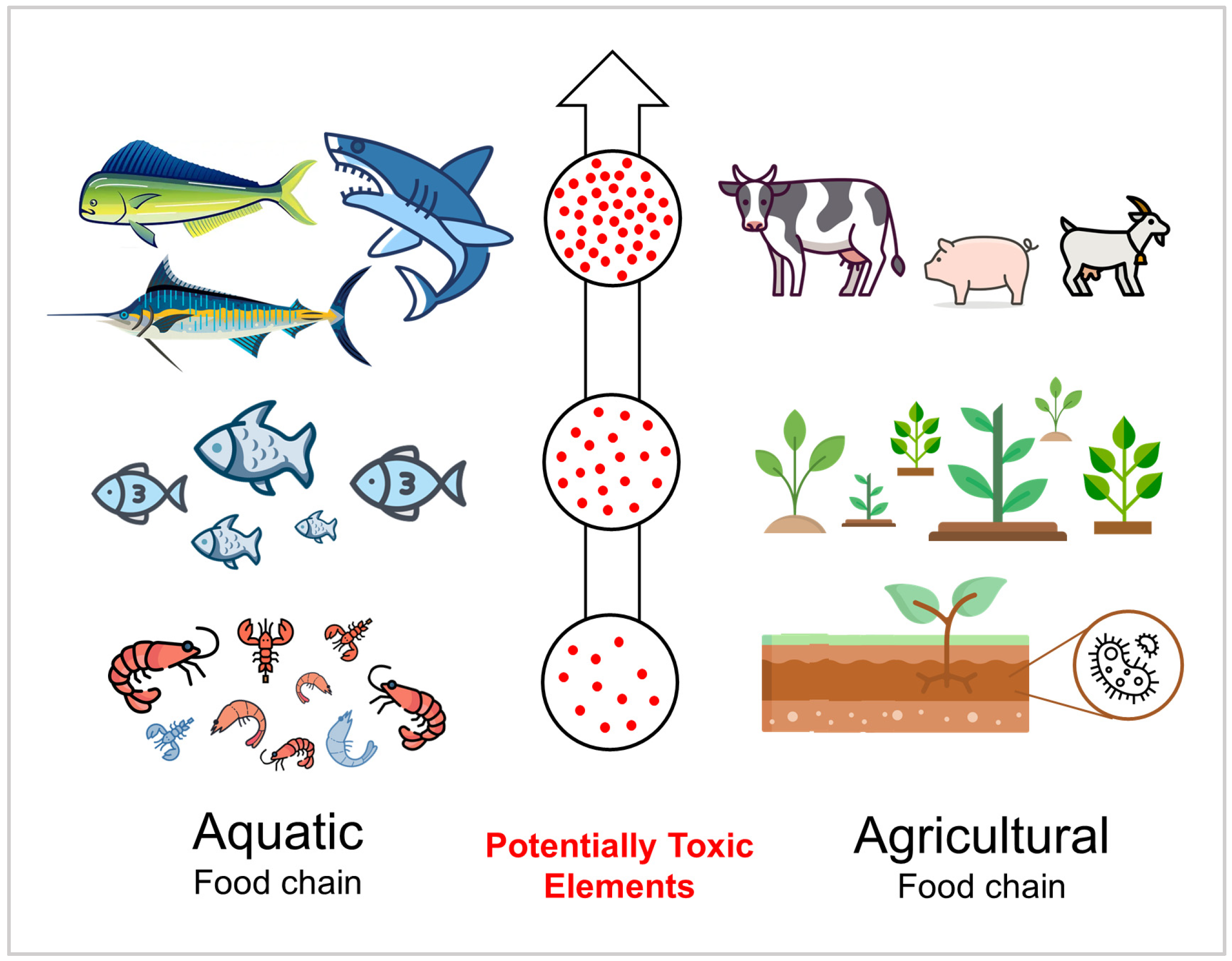
PTEs such as Pd, Hg, and Cd can accumulate within the tissues of living organisms in such a way that the net concentration of the substance found in a tissue of interest or in a whole organism as a result of exposure to that substance is known as bioaccumulation [17]. When the prey bioaccumulates a toxic element, it becomes the main source of such a substance for predators, resulting in higher concentrations of it in the higher trophic levels, a process known as biomagnification (Figure 1) [18].
In the last ten years, the reviews regarding only biomagnification of PTEs are mostly related to As, Hg, and Se in aquatic ecosystems, due to the evidence of the capacity of those elements to travel through the trophic chain [19,20,21,22,23]. And there are just a few approaches to other elements or nanomaterials, with less evidence of their potential biomagnification [24,25].
Thus, it is important to compile the information related to the biomagnification of PTEs not only in food. This work aims to review the current situation regarding the biomagnification of PTEs and metal-based nanomaterials in food from the perspective of human health risk over the last 10 years.

2. Sources of PTEs

In general, human activities are the main causes of the mobilization of PTEs and, thus, the pollution of the environment. The principal activities include mining, metal smelting, combustion processes, and industrial discharges to water bodies and the atmosphere, which can cause direct damage and alter the final destination through acidification, oxygen depletion, and draining of waterlogged areas [26,27].
Among human activities, mining is the most important cause of PTE mobilization and contamination of water and soil. Because of the lack of economic value of the mining waste, there is no interest in the transformation of the effluent, which is later disposed of on large areas of land called tailings. These tailings are aqueous and generally consist of fine mineral particles, which not only include the targeted mined minerals but also other metals and metalloids associated with the rock. They are generated through milling, ore washing, dust suppression, and general work of personnel and equipment [28,29].
Mining waste dumps are an important source of contamination to soil, water bodies nearby, and groundwater (Table 1). More than one million mine sites are estimated to be abandoned worldwide, a situation that is currently affecting approximately 500,000 km of river channels [30,31].
PTEs can also be present in soil because of the use of agrochemicals [44,45]. For example, phosphorus (P)-based fertilizers can contain elements such as Cd, Co, Pb, Zn, Cr, Ni, and Cu. Other formulas include PTEs; insecticides, such as arsenic acid and lead arsenate; fungicides based on Cu, such as copper chloride, or those based on Hg, such as mercuric oxide; herbicides based on As; rodenticides, such as zinc phosphide; or defoliants, such as sodium dichromate [46]. The application of such substances can increase the accumulation of naturally occurring PTEs or other rare elements such as yttrium or scandium [47].
Also, PTEs can be moved by natural processes, such as runoffs [3], dragging them from the arable land to water bodies that can be used for human consumption. For example, in Mexico, around 90% of agriculture is produced in states with arid weather conditions, meaning a low rainfall rate, which reduces the surface water available for irrigation and leads to the use of groundwater as the main source for crop irrigation [48]. Unfortunately, almost half of the states in Mexico have a problem of As contamination in their groundwater wells, making it the main source of PTEs into agricultural products [49]. Also, six different PTEs—Cu, Zn, Cd, Ni, As, and Hg—and two pesticides—atrazine and acetochlor—were detected in drinking water that supplies more than 4 million citizens from Dalian, China [50].
In addition, aquaculture has been shown to accumulate PTEs in the farmed organisms, which can be due to the content of those elements in the feed and/or in the water used [51,52]. This is an important industry of food production, as it represents 43% of the total seafood supply worldwide [53,54]. It was found that Pb and Cr concentrations in the adult whiteleg shrimp (Penaeus vannamei) after three months of monitoring were higher than the safety guidelines applied to Shanghai, China, and the content of Cu, Cd, and Cr in the water exceeded those guidelines as well. The investigation showed that shrimp Cu intake was through its diet, while Pb, Cd, and Cr were taken up through water contact.
Other PTEs, such as Mn and Zn, have been detected above 60% in the sediments in aquaculture water bodies, and those elements were found to match the formula of the fish feed used [55]. Furthermore, runoffs coming from agriculture or cattle are considered sources of PTEs in aquaculture [56], which increases the presence of other PTEs, including the ones in fish feed, such as Cu, Cr, Cd, Pb, or Ni [57].

3. Biomagnification

Biomagnification refers to a phenomenon in which the concentration of a PTE increases along with the food chain, and thus, the accumulation of the element (Figure 1) [18]. The ratio of the concentration of a PTE in a certain organism and the concentration of the same in its prey results in the biomagnification factor (BMF), a way of measuring the process and an indicator of the ability of the PTE to be found in high concentrations, the higher the trophic level; the opposite process is known as biodilution [23,58].
Although it can be confused with bioaccumulation, it describes a different process. Bioaccumulation describes the increase in the concentration of a PTE in an organism over time, and it is considered a metabolic process of the detoxification pathway of PTEs that requires energy from the organism [59]. Bioaccumulation is a more common topic to review related to PTEs because it requires finding the presence and concentration of the element in organs and/or tissues of an organism, in situ or ex situ [60]. When the prey cannot be studied, the induced bioaccumulation through enriched diet can be used along with the trophic level of the organism studied to calculate the trophic transfer factor (TTF), which, as with the BMF, indicates the ability of a PTE to be transferred from a certain trophic level to the next one above, or the bioconcentration factor (BCF), which indicates the ability of a PTE to move from soil to plant [23].
In both cases, BMF and TTF are unitless values, and when the results are greater than 1, it means that the PTE biomagnifies and/or can be transferred to the next trophic level. Otherwise, with values below 1, such ability is discarded [23,58].
On the other hand, biomagnification is necessary to know if the element bioaccumulates not only in the organism but also in its prey and/or in its predator, which includes its trophic chain level, meaning a more elaborate investigation or project. Considering the results obtained, it is common to study the bioaccumulation of PTEs in living organisms and use those to establish jurisdictions [58]. Nevertheless, biomagnification tracks the path of the PTE back to the source, which provides the key to finding that source and, thus, to potentially controlling it and/or reducing the impacts on the environment and on public health [18]. The mobilization of such hazardous substances through the food chain may represent a risk to human health, which includes neurological, cardiovascular, central nervous system, dermal, and metabolic diseases [61].

4. PTEs in Food

As previously mentioned, biomagnification is complicated to study due to the amount of work needed. This impacts the information available, which is not only scarce and mainly related to marine environments but is also focused on areas with singular characteristics and sources, and even though biomagnification is commonly observed in marine species, it is not exclusive to that ecosystem [62,63]. Thus, there are more investigations in sites where the diet of the inhabitants is rich in seafood, such as China and the coast of the Mediterranean Sea. Hence, biomagnification in the terrestrial food chain has been poorly explored. In general, the main focus of agricultural-related trophic chain investigations is soil–plant–animal–human. This implies the presence of PTEs in the meat and/or milk of animals raised for human consumption that were fed with polluted fodder [63,64].

4.1. Fruits and Vegetables

In the last 10 years, the biomagnification of PTEs in fruits and vegetables has been poorly assessed, which is not the case for bioaccumulation [65,66,67,68,69]. Nevertheless, some approaches are worth noting.
In 2021, the transfer factor (TF) of several PTEs (As, Cd, Cr, Cu, Pb, and Zn) was assessed in fresh fruit, fruit vegetables, and leafy vegetables of the Shaanxi Province, China. The TF quantifies how easily a PTE moves from soil to plants, with results working the same as in BMF or TMF. Although none of the TFs were above 1, the results indicated that essential PTEs, Cu and Zn, along with Cd, tended to be transferred to all types of fruits and vegetables studied, while As, Cr, and Pb were transferred only to leafy vegetables [70].
Also, ref. [71], in 2024, studied the TF of PTEs from wastewater to crops in Pakistan. Samples surrounding a polluted drain were collected in order to find the PTEs present in water, soil, and plants such as spinach (Spinacia oleracea L.), cauliflower (Brassica oleracea var. botrytis L.), radish (Raphanus sativus L.), garlic (Allium sativum L.), coriander (Coriander sativum L.), mustard (Brassica juncea L.), meadow clover (Trifolium sp. L.), brinjal (Solanum melongena L.), and mint (Mentha L.). The results showed that Cr, Cu, Ni, Zn, Cd, Pb, Mg, and Fe were all present in water, soil, and plants; nevertheless, the higher concentrations were found in plants for all PTEs. They also reported TF > 1 for all PTEs, demonstrating the starting point of the biomagnification at lower trophic levels.
In the same year, a similar study was carried out by [72], in which the TF from soil to plants was reported. The plants studied included grape (Vitis vinifera), melon (Cucumis melo var. saccharimus), watermelon (Citrullus vulgaris Schrade), tomato (Lycopersicon esculentum L.), zucchini (Cucurbita pepo), carrot (Daucus carota), lettuce (Lactuca sattiva), potato (Convolvulus batatas), and green pepper (Capsicum annum L.) of the Boumerdes region of Algeria. The PTEs studied were found in the irrigation water and included Cd, Cr, Cu, Fe, Ni, Pb, and Zn. Among the results, Cd and Cr were, in most of the cases, below the detection limit. In the case of essential PTEs such as Cu, Zn, and Fe, they were highly present in all fruits and vegetables. The TF demonstrated that Cd was not transferred from the soil to the studied food; meanwhile, the mean TFs were as follows: Fe > Zn = Cu > Ni > Pb > Cr > Cd. That matched the results of accumulation, in which the essential PTEs were found in the highest amounts.
Although biomagnification is not directly studied, recent studies have adopted TF approaches to evaluate the initial step of trophic mobilization from water to soil and from soil to crops. In most cases, essential PTEs are mostly transferred to edible plants, which is expected based on nutritional values. Meanwhile, other non-essential PTEs show a more selective uptake, often restricted to leafy vegetables. For example, in 2021, [73] demonstrated the mobilization of Pb and Zn from contaminated soil to spinach and rabbits. The spinach was grown in fields with Pb and Zn concentrations of 1000 and 150 mg kg−1 soil and was fed to rabbits for 14 days. After harvest, the concentration of Pb and Zn in the spinach leaves was 39.1 and 113 mg kg−1. The presence of both PTEs in the blood of the rabbits was immediate and started to decrease with time as a consequence of the assimilation processes. Although in this case no biomagnification was studied, the results indicate the ability of the PTEs to move from soil to higher trophic levels, in this case, to rabbits.
It is worth considering that some plants may also have the ability to hyperaccumulate certain elements within their tissues without being dangerous; despite the majority of those plant species not being grown for human consumption, there have been cases in which edible plants have demonstrated hyperaccumulation characteristics. For example, in 2015, it was reported that the potential of the highly consumed Chinese cabbage Brassica chinensis to hyperaccumulate Cd at levels above 100 mg kg−1 dry weight (DW), in comparison to 0.1 mg kg−1 DW, the normal average accumulation of other plants [74].
The use of hyperaccumulator plants for remediation is considered a promising technique for the restoration of sites (soils and water bodies) contaminated with PTEs, in comparison with more traditional techniques such as thermal remediation [75]. Moreover, the successful development and harvest of crops for human consumption not polluted with PTEs ensures food availability for the future.

4.2. Cereals and Grains

Biomagnification in cereals and grains represents a pathway of exposure to PTEs for humans due to their importance in global diets. Cereals, such as rice, wheat, and maize, are highly consumed and frequently cultivated in soils and irrigation systems impacted by PTEs [76]. Hence, cereals serve as a link between contaminated soils and both direct human consumption and secondary transfer through livestock. Moreover, crops of great importance for human consumption have been reported to accumulate PTEs [77,78,79,80].
In 2017, ref. [81] studied the flow of total Hg through rice-based food webs in mining and non-mining regions of Guizhou, China. In addition to the rice, soil, herbivores, insects, frogs, fish, and rats were sampled. Among their results, they reported that in some patterns the rice is the main source of total Hg into the chain and that the highest concentrations were found at higher trophic levels, in spiders when the rice was the main source, and in birds when it was not. Their findings are directly involved with the biomagnification process and prove the ability of Hg to biomagnify.
Also in China, ref. [82] evaluated the biomagnification of Cu, Zn, Pb, and Cd from maize (Zea mays L.) and wheat (Triticum aestivum L.) grown in a polluted area to tree sparrows. In their results, they report that Zn was the PTE with the highest concentrations in both maize and wheat and in the soil, followed by Cu. The BMF values were >1 for all PTEs, indicating the biomagnification of these from the diet to the bird, especially in its early stages of growth.
In 2022, ref. [83] studied the mobilization of Cu from water to soil to wheat. The study was carried out in seven provinces of Pakistan, from which water, soil, root, shoot, and grain samples were collected. The sites were indicated as polluted due to industrial activity. Their results report that the TF of Cu was <1 in most cases, except for 1.65 for the wheat irrigated with industrial wastewater. The same case was reported by [84] for Hg from soil to wheat, in which all BCF were <1, showing no potential for biomagnification of the element.
The biomagnification process in cereals and grains is still being investigated. Nevertheless, the information discussed shows how total Hg can be efficiently transferred from rice to higher trophic levels, resulting in elevated concentrations in predatory organisms such as spiders and birds. In contrast, the biomagnification of PTEs in maize or wheat is shown to occur when their growth is carried out in contaminated soil, meaning that this process is strongly modulated by contamination sources, irrigation practices, and the PTE itself.

4.3. Meat

Current evidence indicates that biomagnification of PTEs in meat-producing systems has been investigated only sporadically and indirectly, with most studies emphasizing contamination levels and human health risks rather than trophic transfer processes. Recent global and regional assessments have documented the presence of Pb, Cd, Hg, and As in red meat and edible organs, confirming the mobilization of these PTEs from contaminated environments into animal tissues consumed by humans [85,86,87].
Meanwhile, investigations into wildlife species provide complementary evidence of PTEs’ mobilization to high-trophic-level organisms such as wild boars. However, the limited number of studies explicitly quantifying BMFs in meat highlights a significant research gap [87,88].

4.4. Fish and Seafood

There is evidence of marine food webs around coastal areas of the world showing how PTEs such as Hg and Pb can biomagnify at the higher levels of the trophic chain, while Cd may do the same without raising those levels. The case of As is inconclusive due to the inconsistent behavior it has shown in many studies, in which As has been seen to dilute and to be biomagnified and, therefore, to be species-specific [89]. This discrepancy, when compared to other PTEs, is primarily due to its complex chemical speciation; inorganic forms are more readily assimilated at lower trophic levels, particularly under reducing conditions, but are efficiently biotransformed into less toxic organic compounds in higher organisms, which are rapidly excreted and exhibit limited trophic transfer, often resulting in biodilution [22]. Environmental factors such as redox state, salinity, and organic matter further regulate As speciation and, thus, the biomagnification fate, which cannot be reliably determined from total As concentrations alone [90,91].
In a study carried out in the coastal areas of the Chinese Bohai Sea in 2015, the biomagnification of methyl-Hg and total Hg in the marine mollusk food web (including mollusks and gastropods) was analyzed. The results showed higher concentrations of both Hg species in gastropods, which were on the top level of the chain, compared with those in bivalves, which were on the levels below. TMF was >1 for both total Hg and methyl-Hg, demonstrating the biomagnification potential of both Hg species [92].
Another study performed in the Laizhou Bay in the Bohai Sea of North China in 2019 analyzed the content of Cd, Cr, Cu, and Hg in water, sediment, and 43 marine species representative of the main trophic levels of the bay. It was found that Hg and Cr tended to be bioaccumulated mainly in predatory fish, while Cu was significantly biodiluted, and, along with Cd, both tended to bioaccumulate in cephalopods and crustaceans [93].
In the same area but in 2020, the concentrations of methyl-Hg and total Hg in water, sediment, and 54 species of marine biota were assessed. The concentration of total Hg in surface sediment was more than twice that in seawater (57.8 and 126 ng L−1, respectively), while methyl-Hg was not different. In the case of the species studied, total Hg ranged from 4.8 in primary producers to 437 in the spotted seabass (Lateolabrax maculatus) (ng g−1 DW), while methyl-Hg ranged from 13.4 to 411 (ng g−1 DW) in the same species. The BMF for methyl-Hg was 1.7 × 10⁵, a value discussed to be the result of the enrichment of the methyl-Hg in the organisms [94].
More recently, in 2022, the trophodynamics of Zn, As, Cr, Cu, and Hg in the food chain of the Yangzong Lake in the Yunnan Province, China, were investigated. The results showed that PTEs were more highly accumulated in species lower in the food chain, such as phytoplankton, zooplankton, arthropods, and mollusks. With the 24 species, they were able to connect 15 food chains, and according to the BMF, Zn and As can biomagnify in four and two food chains, respectively; Cr and Cu in four and three, respectively; nonetheless, Hg showed BMFs that ranged between 1.35 and 7.93 across 12 food chains [95].
The areas surrounding the Mediterranean Sea are also of great concern. In 2017, in the Augusta Harbor in the Central Mediterranean Sea, total Hg and Cd in 20 species of fish were measured. According to the findings, the TMFs for total Hg were 1.22 and 0.83 for Cd; the linear regressions proved that total Hg was biomagnified while Cd biodiluted through the entire analyzed food web; nevertheless, considering just the invertebrate benthic food web, in the lower levels of the whole, Cd was biomagnified [96].
Other studies of the same area mainly focus on bioaccumulation [97,98], which is the same case with Mexico, where the majority of the publications are related to bioaccumulation of elements such as Cd, Hg, Zn, Cu, Se, and Pb in fish, shrimp, and mollusks for human consumption [99,100,101,102].
Nevertheless, few investigations find biomagnification of PTEs in Mexico, such as the report made on the top predator sailfish, Istiophorus platypterus, from the Eastern Pacific in 2016, in which, according to the stomach contents, from the four elements analyzed (Cd, Pb, Cu, and Zn), only Pb was biomagnified [103].
Ref. [104] also reported in the dolphinfish Coryphaena hippurus from the SE Gulf of California that 100% of the specimens larger than 90 cm biomagnified Hg and 65% biomagnified Se. The same author in 2021 evaluated the distribution of As in tissues of the sailfish I. platypterus and the dolphinfish C. hippurus from the same region. Their results showed an increase in the concentration of As from the prey to the predators, which was later corroborated by calculations of biomagnification [105]. Although both fish are exclusive to recreational fishing, their meat is highly appreciated in the regions adjacent to the Gulf of California.
Overall, these studies show the geographical differences in PTEs’ behavior. The patterns reflect the variations in food-web complexity, habitat, and exposure pathways. Furthermore, the coastal systems analyzed, such as the Bohai Sea and the Mediterranean, are particularly prone to enhanced Hg biomagnification due to the limited water exchange, elevated sediment contamination, and/or a benthic-pelagic coupling, which facilitates the movement of PTEs as particles into higher trophic levels [106,107]. On the other hand, in systems where primary production is dominated by phytoplankton or where trophic webs are shorter, PTEs such as Cd, Cu, and Cr tend to biodilute, as PTE uptake at lower trophic levels outpaces transfer efficiency to predators [23,108].
Additionally, the species-specific behavior observed for As across geographically distinct regions further highlights the importance of biological regulation, including detoxification mechanisms and metabolic transformation. Collectively, these spatial contrasts emphasize that biomagnification is not an intrinsic property of a given element but emerges from the interaction between regional environmental conditions and structure.

4.5. Dairy Products and Eggs

In the case of milk, recent studies provide valuable insight into biomagnification processes within terrestrial food chains. The evidence demonstrates that PTEs, such as Pb, Cd, As, Hg, and Cr, can be mobilized from contaminated soils and irrigation water into forage crops and subsequently detected in raw cow milk. In 2025 [109], the concentration of Pb, Cd, Hg, As, and Se in soil, forage, and raw cow milk from the surroundings of the Tungurahua volcano in Ecuador was studied. In their results, they found the presence of all PTEs in forage, with the highest concentrations of Hg. This was the same with the milk, in which 8 of the 16 samples presented Hg concentrations above 0.01 mg kg−1, while Pb and Cd were below the detection limit. Nevertheless, the TF showed efficient mobilization (TF > 1) from root to shoot for Se, Pb, and Cd, contrary to Hg and As. In the case of cow milk, the TF calculated for the PTEs above the detection limit showed values <1. Polluted water with PTEs does not indicate mobilization or biomagnification into milk, as in most cases, the concentration of the PTE in the water is higher than in the milk. This is due to the detoxification processes carried out by the animal, which transform the elements or excrete them before transferring them into milk [110]. Contrary to other milks, such as buffalo milk, in which TFs have proven the potential for biomagnification of PTEs such as Pb, Cu, and Zn [111].
In the case of eggs, the available studies have been conducted near mining, industrial, and peri-urban areas and consistently report the presence of Pb, Cd, Hg, and As in poultry eggs, indicating effective transfer from contaminated soil, feed, and water into edible egg components. Elevated concentrations are often observed in free-grazing or backyard production systems, suggesting that uncontrolled dietary exposure may enhance trophic transfer at lower levels of the food chain [112,113,114]. However, as with the rest of the food groups, most of the studies are focused on concentration measurements and health risks.

5. Biomagnification of Metal-Based Nanomaterials

Nanomaterials (NMs) are materials with at least one dimension in the range of 1–100 nm [115]. NMs have unique physicochemical features that provide numerous advantages over traditional materials [116]. However, NMs may accumulate, transform, and increase their concentration in biological systems. Bioaccumulation of NMs begins with nanoparticles (NPs) in the organism, then biomagnification follows in the predatory organism [117,118].
Biomagnification of NMs has been proven in several food chains, in which the physicochemical properties and the exposure route have affected the phenomenon. For example, Au NPs (5, 10, and 15 nm) administered to tobacco (Nicotiana tabacum L. cv Xanthi) and tobacco hornworm (Manduca sexta) showed plant uptake of NPs and their potential for trophic transfer and biomagnification from a primary producer to a primary consumer by mean factors of 6.2, 11.6, and 9.6, respectively. These results indicate the association of the size of NPs and the considerable risk associated with their physicochemical properties [119]. In contrast, in a separate study, kidney bean plants (Phaseolus vulgaris var. red hawk) grown in contaminated soil with nano-CeO2 or bulk-CeO2, which subsequently feed Mexican bean beetles (Epilachna varivestis), later consumed by spined soldier bugs (Podisus maculiventris), evidenced that the Ce accumulation in plants and insects was independent of particle size, 26 and 19 μg g−1 Ce for nano- and bulk-CeO2, respectively [119].
In a lettuce crop (L. sattiva) exposed to sulfurized AgNPs via root uptake or metallic AgNPs through foliar application, significant biomagnification was observed in giant African land snails (Lissachatina fulica) consuming root-exposed plants. The TTFs ranged from 2.0 to 5.9 in soft tissues. Notably, AgNP size shifted from 55 to 68 nm to 17–26 nm within the snails, indicating significant biotransformation of the NPs’ original features as they move through the trophic chain [120].
Another extensive research has highlighted the potential risks associated with the trophic transfer of metal-based NP mixtures. Following a 22-day dietary exposure of white-lipped snails (Cepaea hortensis) to lettuce (L. sattiva) previously treated with AgNO3, AgNPs, TiO2NPs, and a mixture of AgNPs and TiO2NPs, distinct accumulation patterns emerged. Both the single TiO2NP treatment and the TiO2NP-containing mixtures induced significant biomagnification from lettuce to snails, with kinetic TTFs (TTFk) of 7.99 and 6.46, respectively. Notably, the TTFk for Ag was significantly higher in the single AgNP treatment (1.15 kg leaves kg snail−1) compared to the mixture (0.85 kg leaves kg snail−1). However, the retained Ag fraction in snails was lower in the single exposure (36%) than in the mixture (50%). These results suggest that while TiO2NPs inhibit the trophic transfer of AgNPs, they simultaneously enhance Ag retention within the organism [121].
In addition, the interaction between NPs and distinct pollutants can significantly exacerbate biomagnification, as demonstrated by the influence of polystyrene microplastics (PS MPs) on the biotoxicity and trophic transfer of ZnO NPs in a green algae–planktonic crustacean (Chlorella vulgaris–Daphnia magna) food chain. PS MPs compound the toxicity of ZnO NPs in D. magna following dietary exposure; specifically, heart rate and reactive oxygen species (ROS) levels increased by 21.25% and 16.32%, respectively, in the co-exposure system. Interestingly, while PS MPs attenuated ZnO NP accumulation in C. vulgaris, they significantly facilitated their trophic transfer to D. magna. Biomagnification was observed exclusively in the presence of PS MPs, with BMF reaching 1.49 under acute exposure (72 h) and 2.11 under chronic conditions (21 d), a 41.61% increase [122]. The latter reveals that the exposure period is another factor to be considered in NPs’ biomagnification phenomena.
Conversely, another study evaluated the toxicological impacts of TiO2NP across a food chain: green algae (Tetradesmus obliquus) and the rotifer (Brachionus calyciflorus). Exposure to these NMs resulted in deleterious effects at both levels: a significant decline in algal density and a marked reduction in the life-history traits of rotifers (including hatching life expectancy, average lifespan, net reproductive rate, and the intrinsic growth rate). The study observed a clear trophic transfer of NPs from algae to consumers, with BMF frequently exceeding 1.0, thereby confirming biomagnification. Statistical analysis indicated that NP accumulation in both algae and rotifers is a function of concentration, exposure time, and their interactions. Overall, these results underscore the potential of TiO2NP to disrupt planktonic communities and threaten aquatic biodiversity [123].
Recent research indicates that silver (Ag) NPs, such as AgNPs and Ag2S-NPs, are sequestered by D. magna and undergo trophic transfer to zebrafish (Danio rerio). Although Ag+ displayed superior bioaccumulation in D. magna, its BMF was notably lower than that of particulate Ag forms, with BMF values for AgNPs, Ag2S-NPs, and Ag+ of 0.191, 0.156, and 0.0607, respectively. This discrepancy is attributed to the restricted bioavailability of Ag+ during digestive processing in zebrafish. Analysis of tissue distribution revealed that Ag species predominantly accumulate in the zebrafish intestine. Specifically, the strong adsorption of AgNPs to the intestinal cell membrane inhibits depuration, thereby exacerbating their biomagnification potential compared to Ag2S-NPs and Ag+. Consequently, accounting for the environmental transformation of NMs is essential for accurate risk assessment [124].
In contrast, the toxicokinetics of Ag from sulfide Ag NPs (Ag2S NPs) and AgNO3 (ionic counterpart) were evaluated in the tadpole snail (Physa acuta) and the brown planarian (Girardia tigrine). Following dual-route exposure (water and the bioindicator alga Raphidocelis subcapitata), snails served as prey for planarians to assess trophic transfer. Both species exhibited higher Ag uptake from AgNO3 than from Ag2S NPs. In snails, dietary ingestion was the primary driver of NPs accumulation, whereas planarians showed no Ag uptake from waterborne NPs, highlighting diet as the critical exposure route. Notably, no biomagnification was observed from snails to planarians, and depuration did not significantly alter internal Ag concentrations [125].
However, the mechanisms by which engineered NPs influence or restructure food web dynamics remain poorly understood. Recent evidence indicates that food chain dynamics play a critical role in modulating toxicity, driven by the biotransformation and accumulation of different NMs. Understanding these processes is essential for predicting the long-term environmental behavior of NPs [126]. Additionally, the physicochemical characteristics of NMs cannot be overlooked; their interference in bioaccumulation and biomagnification phenomena is mediated by properties such as size (with smaller particles facilitating cellular internalization), concentration (determining toxic versus hormetic effects), morphology (governing affinity for specific cell types), exposure duration (dictating the nature of the response), and material composition (influencing the initial biological interaction) [127]. Moreover, some evidence confirms that the co-occurrence of NPs and toxic metals can exacerbate metallic toxicity in soil. This synergy underscores the pivotal role of soil physicochemical parameters in modulating the bioavailability of these contaminants [128].
Currently, the literature presents a fragmented picture of these phenomena that underscores the urgent need for knowledge. Specifically, there are contradictory reports that preclude the identification of paths of reaction of NPs’ biomagnification, expanding the possibilities and exacerbating the knowledge gap. For instance, while biomagnification may be negligible when a single type of NP interacts in a trophic chain, they accumulate in cells, resulting in tissue retention leading to ultrastructural damage and lipid droplet aggregation, a process that may be influenced by the stage of life of animals, contributing to increasing the excretion rate in early stages but also resulting in facilitating the biomagnification factor in some trophic chain levels [122].
Furthermore, available knowledge suggests that several factors modulate these outcomes, including exposure duration, the synergistic effects of NP mixtures, and the presence of co-contaminants. Notably, the mode of administration plays a pivotal role; for instance, it has been demonstrated that foliar application reduces the cancer risk to humans by 72%, compared to root-based exposure [79]. Consequently, the bioaccumulation and biomagnification of NPs may be modulated by additional factors, such as the presence of co-contaminants. Collectively, these findings underscore the complexity of the factors modulating such phenomena. They emphasize the imperative for continued research to support the development of robust safety protocols aimed at mitigating the environmental and human health risks associated with the bioaccumulation and biomagnification of nanomaterials.

6. Human Health Risks

The detrimental effects of PTEs on human health are directly related to the amount of food of a certain type they are consuming. In this sense, communities established in productive regions are more sensitive to bioaccumulation and biomagnification effects, because their diet is based on the food produced locally, a common situation in developing countries [62,129].
Therefore, the average consumption of certain products may not reflect the reality of the entire country, but rather the average between over- and under-consumption in sites near and far from productive areas, respectively. For example, the worldwide average annual consumption per capita (AACPC) of aquatic foods was 20.5 kg in 2019, a number clearly affected by the extremes: in the highest rank was China with 40 kg, and in the lowest were countries with just 1 kg, such as Ethiopia [130].
Nevertheless, AACPC can reflect patterns in the overall panorama when comparing a single country or several countries with each other and with the worldwide numbers, as in this case (Table 2). According to the World Food and Agriculture Statistical Yearbook, as of 2024, the proportion of dietary energy supply worldwide consists of around 15% from fish and seafood, 8% of roots, tubers, and pulses, 5% of fruit and vegetables, and at least 40% of cereals, which matches the worldwide AACPC [131].
The consumption patterns shown in Table 2 have important implications for human exposure to PTEs. Although biomagnification is more pronounced in higher trophic levels, such as predatory fish and meat, the relatively lower consumption of these products may reduce overall dietary risk compared with plant-based foods. On the other side, the volume of fruits, vegetables, and cereals consumed globally could result in significant cumulative exposure, particularly for PTEs that are efficiently taken up by plants from soils and water.
Human exposure to PTEs remains one of the most significant pathways for potential toxic effects, particularly for non-essential elements such as Cd, Pb, Hg, or As [141]. Regulatory agencies such as the World Health Organization (WHO) within the Codex Alimentarius Commission have established maximum permissible limits for these PTEs in food (Table 3) to protect public health [142].
Risk assessment frameworks typically integrate measured contaminant concentrations with food consumption rates to estimate chronic daily intake (CDI) and compare them against toxicological reference thresholds such as tolerable daily intake (TDI) or provisional tolerable weekly intake (PTWI). These assessments are critical for identifying populations at risk, including children, pregnant women, and subsistence consumers who rely heavily on local produce and livestock products [143].
To better quantify potential health impacts, multiple risk indexes have been developed and applied in food contamination studies. For example, the Target Hazard Quotient (THQ), calculated as the ratio of estimated daily intake to the reference dose, allows evaluation of non-carcinogenic risks of individual PTEs, with THQ values greater than 1 indicating potential health concerns [144]. For multiple PTE exposure, the Hazard Index (HI) sums the THQs across PTEs to account for cumulative effects, while the carcinogenic risk (CR) metric estimates lifetime cancer probability associated with exposure to PTEs with recognized carcinogenicity, such as Cd and As [145]. Although these indices provide valuable insights, most assessments rely on total PTE concentrations without considering bioavailability, chemical speciation, or biomagnification, which may underestimate actual exposure. The advance in biomagnification studies could provide enough information to incorporate into this assessment in order to refine the risks and to fill the unknown gaps of information required to protect public health.

6.1. Human Health Risk of Non-Essential PTEs

Exposure to PTEs for humans may cause adverse effects on their health [61,146].
It is well documented that Pb causes adverse effects on human health. Acute ingestion or inhalation concentrations (reported toxic thresholds exceeding 100 µg dL−1 in blood) can cause gastrointestinal distress, anemia, nephropathy, encephalopathy, and, in severe cases, death [147,148]. On the other side, chronic exposure (commonly presented through contaminated food, water, and air) has been associated with neurodevelopmental deficits in children, cognitive decline in adults, kidney dysfunctions, and reproductive toxicity [149]. The WHO recognizes that no level of exposure to Pb is entirely safe, with current guidance recommending Pb levels below 3.5 µg dL−1 in the blood of children and adults [150].
On the other hand, As, particularly in its organic forms, is well recognized to be a human carcinogen able to cause several types of disease due to its interference with the DNA repairing system [151]. Acute high-dose exposure can induce gastrointestinal distress, including vomiting, abdominal pain, and diarrhea, progressing to neurological symptoms and, in severe cases, death [152]. Chronic exposure, typically through contaminated drinking water, has been linked to characteristic dermal lesions, hyperkeratosis, and pigmentation changes, as well as skin and bladder cancers [153]. Other long-term detrimental effects include cardiovascular disease, respiratory dysfunction, peripheral neuropathy, diabetes, and developmental neurotoxicity, especially in children [154].
Chronic exposure to methyl Hg primarily occurs through consumption of contaminated fish and seafood, and it is associated with neurodevelopmental deficits in fetuses and children, sensory and motor impairments, cardiovascular effects in adults, and immune dysfunction [155]. Due to the mutagenesis it can provoke, it has been observed that Hg can influence DNA methylation patterns and the conformation of histones, thus causing epigenetic changes. Also, Hg can cause alterations in the nervous, cardiovascular, immune, reproductive, and renal systems. In addition, Hg can cross the placenta and the blood–brain barrier, making it a teratogenic substance [156,157]. Acute high-dose exposure can produce gastrointestinal, renal, and neurological symptoms [155].
A similar case is Cr, which has been classified as a carcinogen in its hexavalent (Cr(VI)) form, and it has also been found to be genotoxic, causing epigenetic alterations in DNA methylation as well as histone modification [158]. Acute exposure to Cr(VI) via ingestion or inhalation can cause severe gastrointestinal distress, ulceration of the gastrointestinal tract, hemolysis, and acute renal failure, as well as respiratory irritation and pulmonary edema [159]. Chronic exposure, on the other hand, particularly through drinking water, has been linked to increased risks of lung cancer, nasal and sinus cancers, dermatitis, and ulcerative skin lesions, as well as liver and kidney dysfunction [160].
Another substance to be considered as a human carcinogen is Cd; this element can accumulate in the human body due to its low excretion rate, which allows it to remain in the body for 10 to 30 years [151]. Chronic dietary exposure to Cd, even at low levels, is associated with renal tubular dysfunction, bone demineralization (Itai-Itai disease), and an increased risk of cardiovascular disease, osteoporosis, and certain cancers such as breast, lung, and prostate [161]. Acute Cd poisoning, though rare, can lead to severe gastrointestinal symptoms, pulmonary edema, and organ failure [161]. Furthermore, Cd can affect fertility, causing prenatal death, abnormal embryonic development, changes in hormonal production, and a decrease in sperm motility; additionally, it can cause neurotoxicity, osteoporosis, and renal lesions [162].

6.2. Human Health Risk of Essential PTEs

In the case of elements such as Zn or Cu, since they are essential elements, they are not necessarily considered harmful to human health. Nevertheless, high concentrations of such elements may cause detrimental effects [5].
Zn can induce neurotoxicity associated with strokes, epilepsy, and Alzheimer’s disease, while overexposure to the element can include symptoms such as epigastric pain, nausea, and vomiting. In the case of Cu, toxicity induces stomach pain, hematemesis, headaches, and tachycardia, while acute toxicity may affect the individual neurologically through depression, irritability, and anorexia, and can even cause heart and renal failure and death [2,163,164].

7. Future Research Directions

Despite substantial advances in understanding PTEs’ biomagnification in marine systems, significant geographical and ecosystem biases persist in the literature. Other regions besides those of high biodiversity and intense anthropogenic pressure, such as Southeast Asia, West Africa, and North and South America, remain underrepresented. Moreover, transitional environments, such as estuaries, mangroves, or coral reefs, exhibit physicochemical dynamics and trophic structures that may participate in the mobilization of PTEs, which makes it important to consider them as opportunity areas in terms of biomagnification of such substances.
Current biomagnification research highly emphasizes aquatic food webs, often neglecting terrestrial and plant-based pathways despite their relevance to human exposure and ecosystem health. Plants and soil invertebrates play critical roles in PTEs’ transfer at the land–sea interface, yet the mechanisms between soil chemistry, plant uptake, and the higher trophic levels are poorly resolved. Similarly, the interaction between terrestrial and aquatic food chains remains insufficiently quantified. Thus, future research should integrate terrestrial food chains, agroecosystems, and nutrient flow across habitats to unravel or confirm trophic linkages; likewise, it needs to evaluate how land use, climate change, and agricultural practices modulate contaminant biomagnification across the ecosystem.
Finally, the current methodologies fail to capture nonlinear dynamics associated with new pollutants such as NMs, constraining the capacity to characterize them and thus to study their biomagnification. Therefore, there is an urgent need for studies that link environmental biomagnification data with human dietary exposure and health risk assessment in the long term.

8. Conclusions

The presented evidence confirms that the introduction of PTEs into environmental food webs is unavoidable and is a consequence of intensified human activities, including fisheries, agriculture, and industrial production, representing a risk to ecosystem and human health. Nevertheless, important uncertainties remain. Biomagnification patterns for several PTEs, including Cd and As, continue to show strong variability depending on chemical speciation and environmental conditions, contrary to Hg, whose behavior is well established. Moreover, existing knowledge is heavily focused on aquatic ecosystems, while terrestrial and plant-based food chains remain comparatively underexplored. These gaps limit the ability to generalize risk assessments and may lead to underestimation of dietary exposure in non-aquatic systems.
These findings have important implications for environmental monitoring, food safety, and human health risk assessment. There is a clear need to expand investigations to be more integrative toward PTE mixtures, multiple exposure pathways, trophic complexity, and new pollutants such as NMs, as both environmental contamination and biotechnology continue to grow. Therefore, understanding the trophic transfer processes will be critical for safeguarding both the ecosystem and public health.

Author Contributions

Writing—original draft preparation, visualization, writing—review and editing, and investigation, L.G.A.-L. and S.R.-J.; writing—review and editing, M.E.B.-T. and A.A.F.-P.; editing—supervision, H.A.-B., K.E.E. and C.E.P.-G. All authors have read and agreed to the published version of the manuscript.

Funding

This research received no external funding.

Data Availability Statement

All investigations discussed and data related to them can be found in the reference list of this article. Complete access to those can be restricted depending on the editorial policies.

Acknowledgments

The authors would like to thank the Secretaría de Ciencia, Humanidades, Tecnología e Innovación (SECIHTI) for its national scholarship program for doctoral studies.

Conflicts of Interest

The authors declare no conflicts of interest.

References

  1. Li, C.; Zhou, K.; Qin, W.; Tian, C.; Qi, M.; Yan, X.; Han, W. A Review on Heavy Metals Contamination in Soil: Effects, Sources, and Remediation Techniques. Soil Sediment Contam. Int. J. 2019, 28, 380–394. [Google Scholar] [CrossRef]
  2. Alengebawy, A.; Abdelkhalek, S.T.; Qureshi, S.R.; Wang, M.-Q. Heavy Metals and Pesticides Toxicity in Agricultural Soil and Plants: Ecological Risks and Human Health Implications. Toxics 2021, 9, 42. [Google Scholar] [CrossRef]
  3. Zwolak, A.; Sarzyńska, M.; Szpyrka, E.; Stawarczyk, K. Sources of Soil Pollution by Heavy Metals and Their Accumulation in Vegetables: A Review. Water Air Soil Pollut. 2019, 230, 164. [Google Scholar] [CrossRef]
  4. Tripathi, S.; Mahra, S.; J, V.; Tiwari, K.; Rana, S.; Tripathi, D.K.; Sharma, S.; Sahi, S. Recent Advances and Perspectives of Nanomaterials in Agricultural Management and Associated Environmental Risk: A Review. Nanomaterials 2023, 13, 1604. [Google Scholar] [CrossRef]
  5. Fu, Z.; Xi, S. The Effects of Heavy Metals on Human Metabolism. Toxicol. Mech. Methods 2020, 30, 167–176. [Google Scholar] [CrossRef]
  6. Li, M.-L.; Kwon, S.Y.; Poulin, B.A.; Tsui, M.T.-K.; Motta, L.C.; Cho, M. Internal Dynamics and Metabolism of Mercury in Biota: A Review of Insights from Mercury Stable Isotopes. Environ. Sci. Technol. 2022, 56, 9182–9195. [Google Scholar] [CrossRef]
  7. Genchi, G.; Carocci, A.; Lauria, G.; Sinicropi, M.S.; Catalano, A. Nickel: Human Health and Environmental Toxicology. Int. J. Environ. Res. Public Health 2020, 17, 679. [Google Scholar] [CrossRef] [PubMed]
  8. Pavesi, T.; Moreira, J.C. Mechanisms and Individuality in Chromium Toxicity in Humans. J. Appl. Toxicol. 2020, 40, 1183–1197. [Google Scholar] [CrossRef] [PubMed]
  9. Charkiewicz, A.E.; Omeljaniuk, W.J.; Nowak, K.; Garley, M.; Nikliński, J. Cadmium Toxicity and Health Effects—A Brief Summary. Molecules 2023, 28, 6620. [Google Scholar] [CrossRef] [PubMed]
  10. González-Martínez, F.; Johnson-Restrepo, B.; Quiñones, L.A. Arsenic Inorganic Exposure, Metabolism, Genetic Biomarkers and Its Impact on Human Health: A Mini-Review. Toxicol. Lett. 2024, 398, 105–117. [Google Scholar] [CrossRef]
  11. Briffa, J.; Sinagra, E.; Blundell, R. Heavy Metal Pollution in the Environment and Their Toxicological Effects on Humans. Heliyon 2020, 6, e04691. [Google Scholar] [CrossRef] [PubMed]
  12. Zoroddu, M.A.; Aaseth, J.; Crisponi, G.; Medici, S.; Peana, M.; Nurchi, V.M. The Essential Metals for Humans: A Brief Overview. J. Inorg. Biochem. 2019, 195, 120–129. [Google Scholar] [CrossRef]
  13. Hussain, A.; Jiang, W.; Wang, X.; Shahid, S.; Saba, N.; Ahmad, M.; Dar, A.; Masood, S.U.; Imran, M.; Mustafa, A. Mechanistic Impact of Zinc Deficiency in Human Development. Front. Nutr. 2022, 9, 717064. [Google Scholar] [CrossRef]
  14. Yang, J.; Li, Q.; Feng, Y.; Zeng, Y. Iron Deficiency and Iron Deficiency Anemia: Potential Risk Factors in Bone Loss. Int. J. Mol. Sci. 2023, 24, 6891. [Google Scholar] [CrossRef]
  15. Altarelli, M.; Ben-Hamouda, N.; Schneider, A.; Berger, M.M. Copper Deficiency: Causes, Manifestations, and Treatment. Nutr. Clin. Pract. 2019, 34, 504–513. [Google Scholar] [CrossRef] [PubMed]
  16. Waqas, W.; Yuan, Y.; Ali, S.; Zhang, M.; Shafiq, M.; Ali, W.; Chen, Y.; Xiang, Z.; Chen, R.; Ikhwanuddin, M.; et al. Toxic Effects of Heavy Metals on Crustaceans and Associated Health Risks in Humans: A Review. Environ. Chem. Lett. 2024, 22, 1391–1411. [Google Scholar] [CrossRef]
  17. Jamil Emon, F.; Rohani, M.F.; Sumaiya, N.; Tuj Jannat, M.F.; Akter, Y.; Shahjahan, M.; Abdul Kari, Z.; Tahiluddin, A.B.; Goh, K.W. Bioaccumulation and Bioremediation of Heavy Metals in Fishes—A Review. Toxics 2023, 11, 510. [Google Scholar] [CrossRef] [PubMed]
  18. Verma, N.; Rachamalla, M.; Kumar, P.S.; Dua, K. Assessment and Impact of Metal Toxicity on Wildlife and Human Health. In Metals in Water; Elsevier: Amsterdam, The Netherlands, 2023; pp. 93–110. [Google Scholar]
  19. Canham, R.; González-Prieto, A.M.; Elliott, J.E. Mercury Exposure and Toxicological Consequences in Fish and Fish-Eating Wildlife from Anthropogenic Activity in Latin America. Integr. Environ. Assess. Manag. 2020, 17, 13–26. [Google Scholar] [CrossRef]
  20. Wang, Z.; Li, Y.; Kong, F.; Li, M.; Xi, M.; Yu, Z. How Do Trophic Magnification Factors (TMFs) and Biomagnification Factors (BMFs) Perform on Toxic Pollutant Bioaccumulation Estimation in Coastal and Marine Food Webs. Reg. Stud. Mar. Sci. 2021, 44, 101797. [Google Scholar] [CrossRef]
  21. Córdoba-Tovar, L.; Marrugo-Negrete, J.; Barón, P.R.; Díez, S. Drivers of Biomagnification of Hg, As and Se in Aquatic Food Webs: A Review. Environ. Res. 2022, 204, 112226. [Google Scholar] [CrossRef]
  22. Ghosh, D.; Ghosh, A.; Bhadury, P. Arsenic through Aquatic Trophic Levels: Effects, Transformations and Biomagnification—A Concise Review. Geosci. Lett. 2022, 9, 20. [Google Scholar] [CrossRef]
  23. Saidon, N.B.; Szabó, R.; Budai, P.; Lehel, J. Trophic Transfer and Biomagnification Potential of Environmental Contaminants (Heavy Metals) in Aquatic Ecosystems. Environ. Pollut. 2024, 340, 122815. [Google Scholar] [CrossRef]
  24. Uddin, M.M.; Peng, G.; Huang, L. Trophic Transfer, Bioaccumulation, and Potential Health Risk of Trace Elements in Water and Aquatic Organisms of Yundang Lagoon at Xiamen in China. Toxin Rev. 2023, 42, 242–256. [Google Scholar] [CrossRef]
  25. Zhang, Z.; Wu, H.; Zhang, A.; Tan, M.; Yan, S.; Jiang, D. Transfer of Heavy Metals along the Food Chain: A Review on the Pest Control Performance of Insect Natural Enemies under Heavy Metal Stress. J. Hazard. Mater. 2024, 478, 135587. [Google Scholar] [CrossRef] [PubMed]
  26. Bjerregaard, P.; Andersen, C.B.I.; Andersen, O. Ecotoxicology of Metals—Sources, Transport, and Effects on the Ecosystem. In Handbook on the Toxicology of Metals; Elsevier: Amsterdam, The Netherlands, 2022; pp. 593–627. [Google Scholar]
  27. Belaid, A.; Jebara, A.; Nava, V.; Santana Rodríguez, J.J.; Di Bella, G.; Ben Mansour, H. Physicochemical Analysis and Metallic Trace Elements Assessment in Aquatic Matrices of the Coastal Region of Mahdia, Tunisia. Int. J. Environ. Sci. Technol. 2025, 22, 14123–14136. [Google Scholar] [CrossRef]
  28. Agboola, O.; Babatunde, D.E.; Isaac Fayomi, O.S.; Sadiku, E.R.; Popoola, P.; Moropeng, L.; Yahaya, A.; Mamudu, O.A. A Review on the Impact of Mining Operation: Monitoring, Assessment and Management. Results Eng. 2020, 8, 100181. [Google Scholar] [CrossRef]
  29. Bamigboye, G.O.; Bassey, D.E.; Olukanni, D.O.; Ngene, B.U.; Adegoke, D.; Odetoyan, A.O.; Kareem, M.A.; Enabulele, D.O.; Nworgu, A.T. Waste Materials in Highway Applications: An Overview on Generation and Utilization Implications on Sustainability. J. Clean. Prod. 2021, 283, 124581. [Google Scholar] [CrossRef]
  30. Tomiyama, S.; Igarashi, T. The Potential Threat of Mine Drainage to Groundwater Resources. Curr. Opin. Environ. Sci. Health 2022, 27, 100347. [Google Scholar] [CrossRef]
  31. Macklin, M.G.; Thomas, C.J.; Mudbhatkal, A.; Brewer, P.A.; Hudson-Edwards, K.A.; Lewin, J.; Scussolini, P.; Eilander, D.; Lechner, A.; Owen, J.; et al. Impacts of Metal Mining on River Systems: A Global Assessment. Science 2023, 381, 1345–1350. [Google Scholar] [CrossRef]
  32. Luo, C.; Routh, J.; Dario, M.; Sarkar, S.; Wei, L.; Luo, D.; Liu, Y. Distribution and Mobilization of Heavy Metals at an Acid Mine Drainage Affected Region in South China, a Post-Remediation Study. Sci. Total Environ. 2020, 724, 138122. [Google Scholar] [CrossRef]
  33. Chileshe, M.N.; Syampungani, S.; Festin, E.S.; Tigabu, M.; Daneshvar, A.; Odén, P.C. Physico-Chemical Characteristics and Heavy Metal Concentrations of Copper Mine Wastes in Zambia: Implications for Pollution Risk and Restoration. J. For. Res. 2020, 31, 1283–1293. [Google Scholar] [CrossRef]
  34. Mantey, J.; Nyarko, K.B.; Owusu-Nimo, F.; Awua, K.A.; Bempah, C.K.; Amankwah, R.K.; Akatu, W.E.; Appiah-Effah, E. Influence of Illegal Artisanal Small-Scale Gold Mining Operations (Galamsey) on Oil and Grease (O/G) Concentrations in Three Hotspot Assemblies of Western Region, Ghana. Environ. Pollut. 2020, 263, 114251. [Google Scholar] [CrossRef]
  35. Jiang, X.; Liu, W.; Xu, H.; Cui, X.; Li, J.; Chen, J.; Zheng, B. Characterizations of Heavy Metal Contamination, Microbial Community, and Resistance Genes in a Tailing of the Largest Copper Mine in China. Environ. Pollut. 2021, 280, 116947. [Google Scholar] [CrossRef]
  36. Gutiérrez-Mosquera, H.; Marrugo-Negrete, J.; Díez, S.; Morales-Mira, G.; Montoya-Jaramillo, L.J.; Jonathan, M.P. Mercury Distribution in Different Environmental Matrices in Aquatic Systems of Abandoned Gold Mines, Western Colombia: Focus on Human Health. J. Hazard. Mater. 2021, 404, 124080. [Google Scholar] [CrossRef] [PubMed]
  37. Dusengemungu, L.; Mubemba, B.; Gwanama, C. Evaluation of Heavy Metal Contamination in Copper Mine Tailing Soils of Kitwe and Mufulira, Zambia, for Reclamation Prospects. Sci. Rep. 2022, 12, 11283. [Google Scholar] [CrossRef]
  38. Fodoué, Y.; Ismaila, A.; Yannah, M.; Wirmvem, M.J.; Mana, C.B. Heavy Metal Contamination and Ecological Risk Assessment in Soils of the Pawara Gold Mining Area, Eastern Cameroon. Earth 2022, 3, 907–924. [Google Scholar] [CrossRef]
  39. Akoto, O.; Yakubu, S.; Ofori, L.A.; Bortey-sam, N.; Boadi, N.O.; Horgah, J.; Sackey, L.N.A. Multivariate Studies and Heavy Metal Pollution in Soil from Gold Mining Area. Heliyon 2023, 9, e12661. [Google Scholar] [CrossRef]
  40. Obasi, P.N.; Eyankware, M.O.; Edene, E.N. Contamination of Potable Water Supply Sources in the Lead–Zinc Mining Communities of Mkpuma Akpatakpa, Southeastern Nigeria. Int. J. Energy Water Resour. 2024, 8, 225–239. [Google Scholar] [CrossRef]
  41. Hao, W.; Liu, H.; Hao, S.; Mao, K. Characterization of Heavy Metal Contamination in Groundwater of Typical Mining Area in Hunan Province. Sci. Rep. 2024, 14, 13054. [Google Scholar] [CrossRef]
  42. Wang, F.; Li, W.; Wang, H.; Hu, Y.; Cheng, H. The Leaching Behavior of Heavy Metal from Contaminated Mining Soil: The Effect of Rainfall Conditions and the Impact on Surrounding Agricultural Lands. Sci. Total Environ. 2024, 914, 169877. [Google Scholar] [CrossRef] [PubMed]
  43. Adekiya, A.O.; Oloruntoba, A.; Ewulo, B.S.; Ogunbode, T.; Sangoyomi, T. Heavy Metal Pollution in Soils near Ilesha Gold Mining Area, Nigeria. Open Agric. J. 2024, 18, e18743315290216. [Google Scholar] [CrossRef]
  44. Dewi, T.; Martono, E.; Hanudin, E.; Harini, R. Impact of Agrochemicals Application on Lead and Cadmium Concentrations in Shallot Fields and Their Remediation with Biochar, Compost, and Botanical Pesticides. IOP Conf. Ser. Earth Environ. Sci. 2022, 1109, 012050. [Google Scholar] [CrossRef]
  45. Mitra, B.; Chowdhury, A.R.; Dey, P.; Hazra, K.K.; Sinha, A.K.; Hossain, A.; Meena, R.S. Use of Agrochemicals in Agriculture: Alarming Issues and Solutions. In Input Use Efficiency for Food and Environmental Security; Springer Nature Singapore: Singapore, 2021; pp. 85–122. [Google Scholar]
  46. Rashid, A.; Schutte, B.J.; Ulery, A.; Deyholos, M.K.; Sanogo, S.; Lehnhoff, E.A.; Beck, L. Heavy Metal Contamination in Agricultural Soil: Environmental Pollutants Affecting Crop Health. Agronomy 2023, 13, 1521. [Google Scholar] [CrossRef]
  47. Naccarato, A.; Tassone, A.; Cavaliere, F.; Elliani, R.; Pirrone, N.; Sprovieri, F.; Tagarelli, A.; Giglio, A. Agrochemical Treatments as a Source of Heavy Metals and Rare Earth Elements in Agricultural Soils and Bioaccumulation in Ground Beetles. Sci. Total Environ. 2020, 749, 141438. [Google Scholar] [CrossRef] [PubMed]
  48. Cortés, F.I.A.; Pérez, M.L.; Mogollon, H.M. Mexico’s Water Challenges for the 21st Century. In Water Resources in Mexico; Springer: Berlin/Heidelberg, Germany, 2012; pp. 21–38. [Google Scholar]
  49. Osuna-Martínez, C.C.; Armienta, M.A.; Bergés-Tiznado, M.E.; Páez-Osuna, F. Arsenic in Waters, Soils, Sediments, and Biota from Mexico: An Environmental Review. Sci. Total Environ. 2021, 752, 142062. [Google Scholar] [CrossRef]
  50. Dong, W.; Zhang, Y.; Quan, X. Health Risk Assessment of Heavy Metals and Pesticides: A Case Study in the Main Drinking Water Source in Dalian, China. Chemosphere 2020, 242, 125113. [Google Scholar] [CrossRef]
  51. Alam, M.; Rohani, M.F.; Hossain, M.S. Heavy Metals Accumulation in Some Important Fish Species Cultured in Commercial Fish Farm of Natore, Bangladesh and Possible Health Risk Evaluation. Emerg. Contam. 2023, 9, 100254. [Google Scholar] [CrossRef]
  52. Barszcz, A.A.; Sidoruk, M. Impacts of Water Management in Aquaculture on Heavy Metal Accumulation in Rainbow Trout Muscles and Associated Health Risks from Consumption. Food Control 2024, 164, 110617. [Google Scholar] [CrossRef]
  53. Emenike, E.C.; Iwuozor, K.O.; Anidiobi, S.U. Heavy Metal Pollution in Aquaculture: Sources, Impacts and Mitigation Techniques. Biol. Trace Elem. Res. 2022, 200, 4476–4492. [Google Scholar] [CrossRef]
  54. Wang, Q.; Tian, Y.; Wang, J.; Li, J.; He, W.; Craig, N.J. Assessing Pathways of Heavy Metal Accumulation in Aquaculture Shrimp and Their Introductions into the Pond Environment Based on a Dynamic Model and Mass Balance Principle. Sci. Total Environ. 2023, 881, 163164. [Google Scholar] [CrossRef]
  55. Kong, W.; Xu, Q.; Lyu, H.; Kong, J.; Wang, X.; Shen, B.; Bi, Y. Sediment and Residual Feed from Aquaculture Water Bodies Threaten Aquatic Environmental Ecosystem: Interactions among Algae, Heavy Metals, and Nutrients. J. Environ. Manag. 2023, 326, 116735. [Google Scholar] [CrossRef]
  56. Sultana, S.; Hossain, M.B.; Choudhury, T.R.; Yu, J.; Rana, M.S.; Noman, M.A.; Hosen, M.M.; Paray, B.A.; Arai, T. Ecological and Human Health Risk Assessment of Heavy Metals in Cultured Shrimp and Aquaculture Sludge. Toxics 2022, 10, 175. [Google Scholar] [CrossRef] [PubMed]
  57. Hossain, M.B.; Sultana, J.; Pingki, F.H.; Nur, A.-A.U.; Mia, M.S.; Bakar, M.A.; Yu, J.; Paray, B.A.; Arai, T. Accumulation and Contamination Assessment of Heavy Metals in Sediments of Commercial Aquaculture Farms from a Coastal Area along the Northern Bay of Bengal. Front. Environ. Sci. 2023, 11, 1148360. [Google Scholar] [CrossRef]
  58. Fremlin, K.M.; Elliott, J.E.; Gobas, F.A.P.C. Guidance for Measuring and Evaluating Biomagnification Factors and Trophic Magnification Factors of Difficult Substances: Application to Decabromodiphenylethane. Integr. Environ. Assess. Manag. 2025, 21, 263–278. [Google Scholar] [CrossRef] [PubMed]
  59. Behl, K.; Devi, A.; Yadav, Y.; Jaiswal, P. Cyanobacteria: A Precious Bioresource for Bioremediation. In Cyanobacteria; Elsevier: Amsterdam, The Netherlands, 2024; pp. 341–382. [Google Scholar]
  60. Schäfer, S.; Buchmeier, G.; Claus, E.; Duester, L.; Heininger, P.; Körner, A.; Mayer, P.; Paschke, A.; Rauert, C.; Reifferscheid, G.; et al. Bioaccumulation in Aquatic Systems: Methodological Approaches, Monitoring and Assessment. Environ. Sci. Eur. 2015, 27, 5. [Google Scholar] [CrossRef]
  61. Uddin, S.; Afroz, H.; Hossain, M.; Briffa, J.; Blundell, R.; Islam, M. Heavy Metals/Metalloids in Food Crops and Their Implications for Human Health. In Heavy Metal Toxicity and Tolerance in Plants: A Biological, Omics, and Genetic Engineering Approach; John Wiley & Sons Ltd.: Hoboken, NJ, USA, 2023; pp. 59–86. [Google Scholar]
  62. Ali, H.; Khan, E.; Ilahi, I. Environmental Chemistry and Ecotoxicology of Hazardous Heavy Metals: Environmental Persistence, Toxicity, and Bioaccumulation. J. Chem. 2019, 2019, 6730305. [Google Scholar] [CrossRef]
  63. Murtaza, G.; Shehzad, M.T.; Kanwal, S.; Farooqi, Z.U.R.; Owens, G. Biomagnification of Potentially Toxic Elements in Animals Consuming Fodder Irrigated with Sewage Water. Environ. Geochem. Health 2022, 44, 4523–4538. [Google Scholar] [CrossRef]
  64. Iqbal, Z.; Abbas, F.; Ibrahim, M.; Qureshi, T.I.; Gul, M.; Mahmood, A. Human Health Risk Assessment of Heavy Metals in Raw Milk of Buffalo Feeding at Wastewater-Irrigated Agricultural Farms in Pakistan. Environ. Sci. Pollut. Res. 2020, 27, 29567–29579. [Google Scholar] [CrossRef]
  65. Kaur, N.; Singh, J.; Sharma, N.R.; Natt, S.K.; Mohan, A.; Malik, T.; Girdhar, M. Heavy Metal Contamination in Wastewater-Irrigated Vegetables: Assessing Food Safety Challenges in Developing Asian Countries. Environ. Sci. Process Impacts 2025, 27, 1747–1767. [Google Scholar] [CrossRef] [PubMed]
  66. Zhou, H.; Yang, W.-T.; Zhou, X.; Liu, L.; Gu, J.-F.; Wang, W.-L.; Zou, J.-L.; Tian, T.; Peng, P.-Q.; Liao, B.-H. Accumulation of Heavy Metals in Vegetable Species Planted in Contaminated Soils and the Health Risk Assessment. Int. J. Environ. Res. Public Health 2016, 13, 289. [Google Scholar] [CrossRef]
  67. Zhang, T.; Zhang, Y.; Li, W.; Wang, L.; Jiao, Y.; Wang, Y.; Jiang, D.; Gao, X. Occurrence and Dietary Exposure of Heavy Metals in Marketed Vegetables and Fruits of Shandong Province, China. Food Sci. Nutr. 2021, 9, 5166–5173. [Google Scholar] [CrossRef] [PubMed]
  68. Mawari, G.; Kumar, N.; Sarkar, S.; Daga, M.K.; Singh, M.M.; Joshi, T.K.; Khan, N.A. Heavy Metal Accumulation in Fruits and Vegetables and Human Health Risk Assessment: Findings from Maharashtra, India. Environ. Health Insights 2022, 16, 11786302221119151. [Google Scholar] [CrossRef] [PubMed]
  69. HABU, M.A.; BAWA, U.; MUSA, S.I. Health Risk Assessment and Heavy Metal Bioaccumulation in Vegetables Irrigated with Waste Water in Kano State, Nigeria. Not. Sci. Biol. 2021, 13, 10890. [Google Scholar] [CrossRef]
  70. Chen, Z.; Muhammad, I.; Zhang, Y.; Hu, W.; Lu, Q.; Wang, W.; Huang, B.; Hao, M. Transfer of Heavy Metals in Fruits and Vegetables Grown in Greenhouse Cultivation Systems and Their Health Risks in Northwest China. Sci. Total Environ. 2021, 766, 142663. [Google Scholar] [CrossRef]
  71. Shakoor, I.; Sultan, A.; Shaukat, K.; Alam, T.M.; Nazir, A. A Novel Method to Investigate Environmental Risk in Wastewater Toxicity. Agronomy 2025, 15, 841. [Google Scholar] [CrossRef]
  72. Aksouh, M.Y.; Boudieb, N.; Benosmane, N.; Moussaoui, Y.; Michalski, R.; Klyta, J.; Kończyk, J. Presence of Heavy Metals in Irrigation Water, Soils, Fruits, and Vegetables: Health Risk Assessment in Peri-Urban Boumerdes City, Algeria. Molecules 2024, 29, 4187. [Google Scholar] [CrossRef]
  73. Hussain, T.; Murtaza, G.; Wang, X.; Zia, M.H.; Aziz, H.; Ali, S.; Murtaza, B.; Fiaz, S. Bioassimilation of Lead and Zinc in Rabbits Fed on Spinach Grown on Contaminated Soil. Ecotoxicol. Environ. Saf. 2021, 224, 112638. [Google Scholar] [CrossRef]
  74. Sudmoon, R.; Neeratanaphan, L.; Thamsenanupap, P.; Tanee, T. Hyperaccumulation of Cadmium and DNA Changes in Popular Vegetable, Brassica chinensis L. Int. J. Environ. Res. 2015, 9, 433–438. [Google Scholar]
  75. Yan, A.; Wang, Y.; Tan, S.N.; Mohd Yusof, M.L.; Ghosh, S.; Chen, Z. Phytoremediation: A Promising Approach for Revegetation of Heavy Metal-Polluted Land. Front. Plant Sci. 2020, 11, 359. [Google Scholar] [CrossRef]
  76. Singh, K.; Negi, C.; Kumar, A.; Chaturvedi, N.; Vyas, P. Heavy Metal Toxicity in Cereals: Uptake Mechanisms, Physiological Impacts, and Mitigation Strategies. Toxics 2025, 13, 1074. [Google Scholar] [CrossRef]
  77. Antoniadis, V.; Golia, E.E.; Liu, Y.-T.; Wang, S.-L.; Shaheen, S.M.; Rinklebe, J. Soil and Maize Contamination by Trace Elements and Associated Health Risk Assessment in the Industrial Area of Volos, Greece. Environ. Int. 2019, 124, 79–88. [Google Scholar] [CrossRef]
  78. Cao, L.; Lin, C.; Gao, Y.; Sun, C.; Xu, L.; Zheng, L.; Zhang, Z. Health Risk Assessment of Trace Elements Exposure through the Soil-Plant (Maize)-Human Contamination Pathway near a Petrochemical Industry Complex, Northeast China. Environ. Pollut. 2020, 263, 114414. [Google Scholar] [CrossRef]
  79. Liu, Q.; Li, X.; He, L. Health Risk Assessment of Heavy Metals in Soils and Food Crops from a Coexist Area of Heavily Industrialized and Intensively Cropping in the Chengdu Plain, Sichuan, China. Front. Chem. 2022, 10, 988587. [Google Scholar] [CrossRef] [PubMed]
  80. Kong, X.; Liu, T.; Yu, Z.; Chen, Z.; Lei, D.; Wang, Z.; Zhang, H.; Li, Q.; Zhang, S. Heavy Metal Bioaccumulation in Rice from a High Geological Background Area in Guizhou Province, China. Int. J. Environ. Res. Public Health 2018, 15, 2281. [Google Scholar] [CrossRef] [PubMed]
  81. Abeysinghe, K.S.; Qiu, G.; Goodale, E.; Anderson, C.W.N.; Bishop, K.; Evers, D.C.; Goodale, M.W.; Hintelmann, H.; Liu, S.; Mammides, C.; et al. Mercury Flow through an Asian Rice-Based Food Web. Environ. Pollut. 2017, 229, 219–228. [Google Scholar] [CrossRef]
  82. Ai, S.; Yang, Y.; Ding, J.; Yang, W.; Bai, X.; Bao, X.; Ji, W.; Zhang, Y. Metal Exposure Risk Assessment for Tree Sparrows at Different Life Stages via Diet from a Polluted Area in Northwestern China. Environ. Toxicol. Chem. 2019, 38, 2785–2796. [Google Scholar] [CrossRef] [PubMed]
  83. Khan, Z.I.; Hussain, M.I.; Zafar, A.; Ahmad, K.; Ashraf, M.A.; Ahmed, M.; ALrashidi, A.A.; ALHaithloul, H.A.S.; Alghanem, S.M.; Khan, M.I.; et al. Ecological Risk Assessment and Bioaccumulation of Trace Element, Copper, in Wheat Varieties Irrigated with Non-Conventional Water Resources in a Semi-Arid Tropics. Agric. Water Manag. 2022, 269, 107711. [Google Scholar] [CrossRef]
  84. Hussain, S.; Yang, J.; Hussain, J.; Sattar, A.; Ullah, S.; Hussain, I.; Rahman, S.U.; Zandi, P.; Xia, X.; Zhang, L. Mercury Fractionation, Bioavailability, and the Major Factors Predicting Its Transfer and Accumulation in Soil–Wheat Systems. Sci. Total Environ. 2022, 847, 157432. [Google Scholar] [CrossRef]
  85. Raeeszadeh, M.; Gravandi, H.; Akbari, A. Determination of Some Heavy Metals Levels in the Meat of Animal Species (Sheep, Beef, Turkey, and Ostrich) and Carcinogenic Health Risk Assessment in Kurdistan Province in the West of Iran. Environ. Sci. Pollut. Res. 2022, 29, 62248–62258. [Google Scholar] [CrossRef]
  86. Rabeey, M.A.; Sabala, R.F.; Zakaria, A.I.; Sallam, K.I. Health Risk Assessment of Heavy Metals in Imported Frozen Bovine Meat and Organs Marketed in Sohag, Egypt. Sci. Rep. 2025, 15, 43828. [Google Scholar] [CrossRef]
  87. Salim, S.A.; Sarraf ov, N.; Dana, Z.; Hashami, Z.; Afrah, A.; Sadeghi, E.; Bashiry, M. A Comprehensive Image of Environmental Toxic Heavy Metals in Red Meat: A Global Systematic Review and Meta-Analysis and Risk Assessment Study. Sci. Total Environ. 2023, 889, 164100. [Google Scholar] [CrossRef] [PubMed]
  88. Liu, W.; Zhou, W.; Fu, C.; Yu, J.; Hou, G.; Zhang, M.; He, L.; Ding, H. Heavy Metals and Antibiotic Resistance Genes in Large-Scale Livestock Farming Environments: Pollution Characteristics, Driving Factors, and Risks to Humans. Biocontaminant 2025, 1, e006. [Google Scholar] [CrossRef]
  89. Sun, Y.; Lan, J.; Chen, X.; Ye, H.; Du, D.; Li, J.; Hou, H. High Arsenic Levels in Sediments, Jianghan Plain, Central China: Vertical Distribution and Characteristics of Arsenic Species, Dissolved Organic Matter, and Microbial Community. J. Geochem. Explor. 2021, 228, 106822. [Google Scholar] [CrossRef]
  90. Wang, N.; Ye, Z.; Huang, L.; Zhang, C.; Guo, Y.; Zhang, W. Arsenic Occurrence and Cycling in the Aquatic Environment: A Comparison between Freshwater and Seawater. Water 2022, 15, 147. [Google Scholar] [CrossRef]
  91. Zhang, W.; Miao, A.-J.; Wang, N.-X.; Li, C.; Sha, J.; Jia, J.; Alessi, D.S.; Yan, B.; Ok, Y.S. Arsenic Bioaccumulation and Biotransformation in Aquatic Organisms. Environ. Int. 2022, 163, 107221. [Google Scholar] [CrossRef]
  92. Meng, M.; Shi, J.; Liu, C.; Zhu, N.; Shao, J.; He, B.; Cai, Y.; Jiang, G. Biomagnification of Mercury in Mollusks from Coastal Areas of the Chinese Bohai Sea. RSC Adv. 2015, 5, 40036–40045. [Google Scholar] [CrossRef]
  93. Liu, J.; Cao, L.; Dou, S. Trophic Transfer, Biomagnification and Risk Assessments of Four Common Heavy Metals in the Food Web of Laizhou Bay, the Bohai Sea. Sci. Total Environ. 2019, 670, 508–522. [Google Scholar] [CrossRef]
  94. Cao, L.; Liu, J.; Dou, S.; Huang, W. Biomagnification of Methylmercury in a Marine Food Web in Laizhou Bay (North China) and Associated Potential Risks to Public Health. Mar. Pollut. Bull. 2020, 150, 110762. [Google Scholar] [CrossRef] [PubMed]
  95. Yan, H.; Xiang, Q.-Q.; Wang, P.; Zhang, J.-Y.; Lian, L.-H.; Chen, Z.-Y.; Li, C.-J.; Chen, L.-Q. Trophodynamics and Health Risk Assessment of Toxic Trace Metals in the Food Web of a Plateau Freshwater Lake. J. Hazard. Mater. 2022, 439, 129690. [Google Scholar] [CrossRef]
  96. Signa, G.; Mazzola, A.; Tramati, C.D.; Vizzini, S. Diet and Habitat Use Influence Hg and Cd Transfer to Fish and Consequent Biomagnification in a Highly Contaminated Area: Augusta Bay (Mediterranean Sea). Environ. Pollut. 2017, 230, 394–404. [Google Scholar] [CrossRef]
  97. Corrias, F.; Atzei, A.; Addis, P.; Secci, M.; Russo, M.; Angioni, A. Integrated Environmental Evaluation of Heavy Metals and Metalloids Bioaccumulation in Invertebrates and Seaweeds from Different Marine Coastal Areas of Sardinia, Mediterranean Sea. Environ. Pollut. 2020, 266, 115048. [Google Scholar] [CrossRef]
  98. Özyurt, G.; Tabakoğlu, Ş.S.; Özyurt, C.E. Metal Bioaccumulation in the Gill, Liver, and Muscle of Bluefish (Pomatomus saltatrix) From the Northeastern Mediterranean and Human Health Risk Assessment Associated with Their Seasonal Consumption. Arch. Environ. Contam. Toxicol. 2021, 81, 58–66. [Google Scholar] [CrossRef]
  99. Acosta-Lizárraga, L.G.; Bergés-Tiznado, M.E.; Bojórquez-Sánchez, C.; Osuna-Martínez, C.C.; Páez-Osuna, F. Bioaccumulation of Mercury and Selenium in Tissues of the Mesopelagic Fish Pacific Hake (Merluccius Productus) from the Northern Gulf of California and the Risk Assessment on Human Health. Chemosphere 2020, 255, 126941. [Google Scholar] [CrossRef] [PubMed]
  100. Alvarado, C.; Ramírez, J.M.; Herrera-López, E.J.; Cortez-Valladolid, D.; Ramírez, G. Bioaccumulation of Metals in Cultured Carp (Cyprinus carpio) from Lake Chapala, Mexico. Biol. Trace Elem. Res. 2020, 195, 226–238. [Google Scholar] [CrossRef] [PubMed]
  101. Alvarado-Flores, J.; Rubio-Franchini, I.; Sánchez-Ávila, A.S.; Ramírez-Tlalolín, G.d.J.; Rico-Martínez, R. Arsenic Toxicity, Bioaccumulation and Risk Assessment: A Case Study in Tolimique Dam, Aguascalientes, Mexico. Cogent Environ. Sci. 2019, 5, 1650630. [Google Scholar] [CrossRef]
  102. Delgado-Alvarez, C.; Ruelas-Inzunza, J.; Escobar-Sánchez, O.; Covantes-Rosales, R.; Pineda-Pérez, I.B.; Osuna-Martínez, C.C.; Aguilar-Júarez, M.; Osuna-López, J.I.; Voltolina, D.; Frías-Espericueta, M.G. Metal Concentrations in Age-Groups of the Clam, Megapitaria squalida, from a Coastal Lagoon in Mexico: A Human Health Risk Assessment. Bull. Environ. Contam. Toxicol. 2019, 103, 822–827. [Google Scholar] [CrossRef]
  103. Moreno-Sierra, D.; Bergés-Tiznado, M.E.; Márquez-Farías, F.; Torres-Rojas, Y.E.; Ruelas-Inzunza, J.R.; Páez-Osuna, F. Trace Metals in Target Tissues and Stomach Contents of the Top Predator Sailfish Istiophorus platypterus from the Eastern Pacific: Concentrations and Contrasting Behavior of Biomagnification. Environ. Sci. Pollut. Res. 2016, 23, 23791–23803. [Google Scholar] [CrossRef]
  104. Bergés-Tiznado, M.E.; Fernando Márquez-Farías, J.; Cristina Osuna-Martínez, C.; Torres-Rojas, Y.E.; Galván-Magaña, F.; Páez-Osuna, F. Patterns of Mercury and Selenium in Tissues and Stomach Contents of the Dolphinfish Coryphaena hippurus from the SE Gulf of California, Mexico: Concentrations, Biomagnification and Dietary Intake. Mar. Pollut. Bull. 2019, 138, 84–92. [Google Scholar] [CrossRef] [PubMed]
  105. Bergés-Tiznado, M.E.; Márquez-Farías, J.F.; Osuna-Martínez, C.C.; Páez-Osuna, F. Arsenic in the Top Predators Sailfish (Istiophorus platypterus) and Dolphinfish (Coryphaena hippurus) off the Southeastern Gulf of California. Environ. Geochem. Health 2021, 43, 3441–3455. [Google Scholar] [CrossRef]
  106. Huo, M.; Pang, M.; Ma, X.; Wang, P.; Sun, C.; Zhang, Y.; Gong, Y.; Sun, Z.; Zhang, Z.; Wang, Z.; et al. Trophic Transfer of Mercury in Marine Food Chains from the Offshore Waters of Changshan Archipelago. Front. Mar. Sci. 2025, 12, 1566875. [Google Scholar] [CrossRef]
  107. Chen, J.; Liu, Y.; Chao, L.; Hou, L.; Wang, Y.; Chu, J.; Sun, J. Distribution, Trophic Magnification and Risk of Trace Metals and Perfluoroalkyl Acids in Marine Organisms from Haizhou Bay. Environ. Res. 2024, 261, 119746. [Google Scholar] [CrossRef]
  108. Rohonczy, J.; Chételat, J.; Robinson, S.A.; Arragutainaq, L.; Heath, J.P.; McClelland, C.; Mickpegak, R.; Forbes, M.R. Contrasting Trophic Transfer Patterns of Cadmium and Mercury in the Arctic Marine Food Web of East Hudson Bay, Canada. Environ. Sci. Pollut. Res. 2024, 31, 20586–20600. [Google Scholar] [CrossRef]
  109. Carrera-Beltrán, L.; Gavilanes-Terán, I.; Valverde-Orozco, V.H.; Ramos-Romero, S.; Paredes, C.; Carbonell-Barrachina, Á.A.; Signes-Pastor, A.J. Assessment of Heavy Metal Transfer from Soil to Forage and Milk in the Tungurahua Volcano Area, Ecuador. Agriculture 2025, 15, 2072. [Google Scholar] [CrossRef]
  110. Özbay, S.; Dikici, E.; Soylukan, C. Evaluation of Biological (Feed, Water), Seasonal, and Geological Factors Affecting the Heavy Metal Content of Raw Milk. J. Food Compos. Anal. 2023, 121, 105401. [Google Scholar] [CrossRef]
  111. Atta, M.I.; Zehra, S.S.; Ali, H.; Ali, B.; Abbas, S.N.; Aimen, S.; Sarwar, S.; Ahmad, I.; Hussain, M.; Al-Ashkar, I.; et al. Assessing the Effect of Heavy Metals on Maize (Zea mays L.) Growth and Soil Characteristics: Plants-Implications for Phytoremediation. PeerJ 2023, 11, e16067. [Google Scholar] [CrossRef]
  112. Hossain, A.; Ahmed, M.W.; Rabin, M.H.; Kaium, A.; Razzaque, M.A.; Zamil, S.S. Heavy Metal Quantification in Chicken Meat and Egg: An Emerging Food Safety Concern. J. Food Compos. Anal. 2024, 126, 105876. [Google Scholar] [CrossRef]
  113. Guerrini, A.; Roncada, P.; Al-Qudah, K.M.; Isani, G.; Pacicco, F.; Peloso, M.; Sardi, L.; Tedesco, D.E.A.; Romeo, G.A.; Caprai, E. Content of Toxic Elements (Arsenic, Cadmium, Mercury, Lead) in Eggs from an Ethically Managed Laying Hen Farm. Animals 2024, 14, 1133. [Google Scholar] [CrossRef] [PubMed]
  114. Aendo, P.; Mingkhwan, R.; Senachai, K.; Pinniam, N.; Sonthong, K.; Tulayakul, P. Heavy Metal Contamination in Eggs on Poultry Farms and Ecological Risk Assessment around a Gold Mine Area in Northern Thailand. Environ. Geochem. Health 2024, 46, 457. [Google Scholar] [CrossRef]
  115. Ingle, P.U.; Ingle, A.P.; Philippini, R.R.; da Silva, S.S. Emerging Role of Nanotechnology in Precision Farming. In Nanotechnology in Agriculture and Agroecosystems; Elsevier: Amsterdam, The Netherlands, 2023; pp. 71–91. [Google Scholar]
  116. Danai-Varsou, D.; Zhang, P.; Afantitis, A.; Guo, Z.; Lynch, I.; Melagraki, G. Nanoinformatics and Artificial Intelligence for Nano-Enabled Sustainable Agriculture. In Nano-Enabled Sustainable and Precision Agriculture; Elsevier: Amsterdam, The Netherlands, 2023; pp. 503–531. [Google Scholar]
  117. Uddin, M.N.; Desai, F.; Asmatulu, E. Engineered Nanomaterials in the Environment: Bioaccumulation, Biomagnification and Biotransformation. Environ. Chem. Lett. 2020, 18, 1073–1083. [Google Scholar] [CrossRef]
  118. Shi, Q.; Wang, C.L.; Zhang, H.; Chen, C.; Zhang, X.; Chang, X.-L. Trophic Transfer and Biomagnification of Fullerenol Nanoparticles in an Aquatic Food Chain. Environ. Sci. Nano 2020, 7, 1240–1251. [Google Scholar] [CrossRef]
  119. Judy, J.D.; Unrine, J.M.; Bertsch, P.M. Evidence for Biomagnification of Gold Nanoparticles within a Terrestrial Food Chain. Environ. Sci. Technol. 2011, 45, 776–781. [Google Scholar] [CrossRef]
  120. Dang, F.; Li, C.; Nunes, L.M.; Tang, R.; Wang, J.; Dong, S.; Peijnenburg, W.J.G.M.; Wang, W.; Xing, B.; Lam, S.S.; et al. Trophic Transfer of Silver Nanoparticles Shifts Metabolism in Snails and Reduces Food Safety. Environ. Int. 2023, 176, 107990. [Google Scholar] [CrossRef]
  121. Wu, J.; Sun, J.; Bosker, T.; Vijver, M.G.; Peijnenburg, W.J.G.M. Toxicokinetics and Particle Number-Based Trophic Transfer of a Metallic Nanoparticle Mixture in a Terrestrial Food Chain. Environ. Sci. Technol. 2023, 57, 2792–2803. [Google Scholar] [CrossRef]
  122. Guo, J.; Liu, N.; Xie, Q.; Zhu, L.; Ge, F. Polystyrene Microplastics Facilitate the Biotoxicity and Biomagnification of ZnO Nanoparticles in the Food Chain from Algae to Daphnia. Environ. Pollut. 2023, 324, 121181. [Google Scholar] [CrossRef] [PubMed]
  123. Li, M.; Zhang, Y.; Feng, S.; Zhang, X.; Xi, Y.; Xiang, X. Bioaccumulation and Biomagnification Effects of Nano-TiO2 in the Aquatic Food Chain. Ecotoxicology 2022, 31, 1023–1034. [Google Scholar] [CrossRef] [PubMed]
  124. Xiao, B.; Yang, R.; Chen, P.; Yang, J.; Sun, B.; Wang, K.; Zhang, T.; Zhu, L. Insights into the Lower Trophic Transfer of Silver Ions than Silver Containing Nanoparticles along an Aquatic Food Chain. Sci. Total Environ. 2022, 804, 150228. [Google Scholar] [CrossRef]
  125. Silva, P.V.; Pinheiro, C.; Morgado, R.G.; Verweij, R.A.; van Gestel, C.A.M.; Loureiro, S. Bioaccumulation but No Biomagnification of Silver Sulfide Nanoparticles in Freshwater Snails and Planarians. Sci. Total Environ. 2022, 808, 151956. [Google Scholar] [CrossRef] [PubMed]
  126. Zhao, X.; Liang, J.; Li, Y.; Isaacson, C.W.; Meng, X.; Luo, Y.; Zhou, X.; Hollert, H.; Zhou, Q.; Liu, R.; et al. Trophic Transfer of Metal Nanoparticles in an Aquatic Food Chain Diminishes Their Toxicity Disparities. Environ. Sci. Technol. 2025, 59, 6812–6824. [Google Scholar] [CrossRef]
  127. Gutiérrez-Cruz, S.G.; Muñoz-Diosdado, A.; Gutiérrez-Calleja, R.A.; Rodríguez-Cortés, O.; Ortiz-Reyez, A.E.; Flores-Mejía, R. Influence of Physicochemical Factors on the Interaction of Metallic Nanoparticles with Immune System Cells. Front. Nanotechnol. 2025, 6, 1496230. [Google Scholar] [CrossRef]
  128. Djibril Sekou, K.; Patel, H. A Review on the Interaction between Nanoparticles and Toxic Metals in Soil: Meta-Analysis of Their Effects on Soil, Plants and Human Health. Soil Sediment Contam. Int. J. 2023, 32, 417–447. [Google Scholar] [CrossRef]
  129. Nkwunonwo, U.C.; Odika, P.O.; Onyia, N.I. A Review of the Health Implications of Heavy Metals in Food Chain in Nigeria. Sci. World J. 2020, 2020, 6594109. [Google Scholar] [CrossRef]
  130. FAO. The State of World Fisheries and Aquaculture 2022; FAO: Roma, Italy, 2022; ISBN 978-92-5-136364-5. [Google Scholar]
  131. FAO. World Food and Agriculture—Statistical Yearbook 2024; FAO: Roma, Italy, 2024; ISBN 978-92-5-139255-3. [Google Scholar]
  132. FAO. Per Capita Consumption of Fruit. Available online: https://ourworldindata.org/grapher/fruit-consumption-per-capita?tab=table (accessed on 10 November 2025).
  133. FAO. Per Capita Consumption of Vegetables. Available online: https://ourworldindata.org/grapher/vegetable-consumption-per-capita?tab=table#explore-the-data (accessed on 10 November 2025).
  134. Zhang, K.; Dong, R.; Hu, X.; Ren, C.; Li, Y. Oat-Based Foods: Chemical Constituents, Glycemic Index, and the Effect of Processing. Foods 2021, 10, 1304. [Google Scholar] [CrossRef]
  135. Erenstein, O.; Jaleta, M.; Sonder, K.; Mottaleb, K.; Prasanna, B.M. Global Maize Production, Consumption and Trade: Trends and R&D Implications. Food Secur. 2022, 14, 1295–1319. [Google Scholar] [CrossRef]
  136. Erenstein, O.; Jaleta, M.; Mottaleb, K.A.; Sonder, K.; Donovan, J.; Braun, H.-J. Global Trends in Wheat Production, Consumption and Trade. In Wheat Improvement; Springer International Publishing: Cham, Switzerland, 2022; pp. 47–66. [Google Scholar]
  137. Makwana, K. Soybeans for Global Nutrition: A Numbers Story. Available online: https://sustainablenutritioninitiative.com/soybeans-for-global-nutrition-a-numbers-story/ (accessed on 8 November 2025).
  138. Ritchie, H.; Rosado, P.; Roser, M. Meat and Dairy Production. Available online: https://ourworldindata.org/meat-production (accessed on 8 October 2025).
  139. Organization for Economic Co-operation and Development; Food and Agriculture Organization of the United Nations. OECD-FAO Agricultural Outlook 2019–2028; OECD Publishing: Paris, France, 2019; ISBN 9789264289253. [Google Scholar]
  140. FAO. Per Capita Consumption of Eggs—FAO [Dataset]. Available online: https://ourworldindata.org/grapher/per-capita-egg-consumption-kilograms-per-year?tab=table (accessed on 11 November 2025).
  141. Mitra, S.; Chakraborty, A.J.; Tareq, A.M.; Bin Emran, T.; Nainu, F.; Khusro, A.; Idris, A.M.; Khandaker, M.U.; Osman, H.; Alhumaydhi, F.A.; et al. Impact of Heavy Metals on the Environment and Human Health: Novel Therapeutic Insights to Counter the Toxicity. J. King Saud Univ. Sci. 2022, 34, 101865. [Google Scholar] [CrossRef]
  142. WHO. Codex Alimentarium. International Food Standards; WHO: Geneva, Switzerland, 2025. [Google Scholar]
  143. Zuo, T.-T.; Zhang, L.; Wang, Y.; Nie, L.-X.; Shen, M.-R.; Liu, L.-N.; Yu, J.-D.; Jin, H.-Y.; Wei, F.; Ma, S.-C. Technical Guidelines for Risk Assessment of Heavy Metals in Traditional Chinese Medicines. Chin. Med. 2023, 18, 69. [Google Scholar] [CrossRef] [PubMed]
  144. Kyowe, H.A.; Awotoye, O.O.; Oyekunle, J.A.O.; Olusola, J.A. Index of Heavy Metal Pollution and Health Risk Assessment with Respect to Artisanal Gold Mining Operations in Ibodi-Ijesa, Southwest Nigeria. J. Trace Elem. Miner. 2024, 9, 100160. [Google Scholar] [CrossRef]
  145. Kim, H.S.; Kim, Y.J.; Seo, Y.R. An Overview of Carcinogenic Heavy Metal: Molecular Toxicity Mechanism and Prevention. J. Cancer Prev. 2015, 20, 232–240. [Google Scholar] [CrossRef] [PubMed]
  146. Sall, M.L.; Diaw, A.K.D.; Gningue-Sall, D.; Efremova Aaron, S.; Aaron, J.-J. Toxic Heavy Metals: Impact on the Environment and Human Health, and Treatment with Conducting Organic Polymers, a Review. Environ. Sci. Pollut. Res. 2020, 27, 29927–29942. [Google Scholar] [CrossRef]
  147. Flora, G.; Gupta, D.; Tiwari, A. Toxicity of Lead: A Review with Recent Updates. Interdiscip. Toxicol. 2012, 5, 47–58. [Google Scholar] [CrossRef]
  148. Jaishankar, M.; Tseten, T.; Anbalagan, N.; Mathew, B.B.; Beeregowda, K.N. Toxicity, Mechanism and Health Effects of Some Heavy Metals. Interdiscip. Toxicol. 2014, 7, 60–72. [Google Scholar] [CrossRef]
  149. FAO. Lead Poisoning. Available online: https://www.who.int/news-room/fact-sheets/detail/lead-poisoning-and-health (accessed on 8 November 2025).
  150. CDC. About Childhood Lead Poisoning Prevention. Available online: https://www.cdc.gov/lead-prevention/about/index.html (accessed on 22 January 2026).
  151. IARC. IARC Monographs on the Evaluation of Carcinogenic Risks to Humans (Vols. 100C, Arsenic, Metals, Fibers, and Dusts); IARC: Lyon, France, 2012; Volume 100C. [Google Scholar]
  152. Yamauchi, H.; Takata, A. Arsenic Metabolism Differs between Child and Adult Patients during Acute Arsenic Poisoning. Toxicol. Appl. Pharmacol. 2021, 410, 115352. [Google Scholar] [CrossRef]
  153. Hong, Y.-S.; Song, K.-H.; Chung, J.-Y. Health Effects of Chronic Arsenic Exposure. J. Prev. Med. Public Health 2014, 47, 245–252. [Google Scholar] [CrossRef] [PubMed]
  154. Jomova, K.; Alomar, S.Y.; Nepovimova, E.; Kuca, K.; Valko, M. Heavy Metals: Toxicity and Human Health Effects. Arch. Toxicol. 2025, 99, 153–209. [Google Scholar] [CrossRef]
  155. Rice, K.M.; Walker, E.M.; Wu, M.; Gillette, C.; Blough, E.R. Environmental Mercury and Its Toxic Effects. J. Prev. Med. Public Health 2014, 47, 74–83. [Google Scholar] [CrossRef] [PubMed]
  156. Basu, N.; Bastiansz, A.; Dórea, J.G.; Fujimura, M.; Horvat, M.; Shroff, E.; Weihe, P.; Zastenskaya, I. Our Evolved Understanding of the Human Health Risks of Mercury. Ambio 2023, 52, 877–896. [Google Scholar] [CrossRef]
  157. Khan, F.; Momtaz, S.; Abdollahi, M. The Relationship between Mercury Exposure and Epigenetic Alterations Regarding Human Health, Risk Assessment and Diagnostic Strategies. J. Trace Elem. Med. Biol. 2019, 52, 37–47. [Google Scholar] [CrossRef] [PubMed]
  158. DesMarias, T.L.; Costa, M. Mechanisms of Chromium-Induced Toxicity. Curr. Opin. Toxicol. 2019, 14, 1–7. [Google Scholar] [CrossRef]
  159. Perosa, F.F.; Gris, A.H.; Piva, M.M.; Menegatt, J.C.O.; Schwertz, C.I.; Sônego, P.; Watanabe, T.T.N.; Pavarini, S.P.; Driemeier, D.; Panziera, W. Acute Oral Chromium Exposure Resulting in Ulcerative Gastritis and Perforated Ulcers in Swine. Animals 2023, 14, 63. [Google Scholar] [CrossRef]
  160. Sun, H.; Brocato, J.; Costa, M. Oral Chromium Exposure and Toxicity. Curr. Environ. Health Rep. 2015, 2, 295–303. [Google Scholar] [CrossRef]
  161. Rasin, P.; V, A.A.; Basheer, S.M.; Haribabu, J.; Santibanez, J.F.; Garrote, C.A.; Arulraj, A.; Mangalaraja, R.V. Exposure to Cadmium and Its Impacts on Human Health: A Short Review. J. Hazard. Mater. Adv. 2025, 17, 100608. [Google Scholar] [CrossRef]
  162. Suhani, I.; Sahab, S.; Srivastava, V.; Singh, R.P. Impact of Cadmium Pollution on Food Safety and Human Health. Curr. Opin. Toxicol. 2021, 27, 1–7. [Google Scholar] [CrossRef]
  163. Hordyjewska, A.; Popiołek, Ł.; Kocot, J. The Many “Faces” of Copper in Medicine and Treatment. BioMetals 2014, 27, 611–621. [Google Scholar] [CrossRef] [PubMed]
  164. Morris, D.R.; Levenson, C.W. Neurotoxicity of Zinc. In Neurotoxicity of Metals; Springer: Berlin/Heidelberg, Germany, 2017; pp. 303–312. [Google Scholar]
Figure 1. Biomagnification of potentially toxic elements (PTEs) through two food chains (aquatic and agricultural).
Environments 13 00116 g001
Table 1. Contamination of ecosystems due to mining dumps.
SiteTargetMineral ExtractedPTEs PresentReference
Dabaoshan mine site, ChinaHengshi River, groundwater, soilSulfidic minerals (pyrite, pyrrhotite, copper-bearing pyrite)As, Cd, Cr, Cu, Ni, Pb, Zn[32]
Chingola district, ZambiaSoilCuCu, As, Ba, Pb, Cr, Co, Ni, V, Zn, Cd[33]
Western region of GhanaBackground soil, surface waterAuHg[34]
Dexing, ChinaSoilCuCu, Cd, Pb, As, Cr, Zn[35]
San Juan Mining District, ColombiaWater, sedimentsAuHg[36]
Copperbelt Province, ZambiaSoilCu, CoCu, Co, Fe, Mn, Pb, Zn[37]
Pawara, CameroonSoilAuCu, Hg, Pb, Zn, Fe, Al, Cd, Cr[38]
Nangodi, GhanaSoilAuHg, Pb, Cd, As[39]
Mkpuma Akpatakpa mining community, NigeriaSurface water, groundwater, sedimentsPb, ZnPb, Zn, Cr, Hg, Ni, Cd, Fe, Mn, As, Co, Ag[40]
Lengshuijiang City, ChinaGroundwaterSbAs, Sb[41]
Shaoguan, ChinaSoil, farmland soilPolymetallic mineCr, Ni, Cu, Zn, As, Cd, Pb[42]
Ilesha, NigeriaSoilAuAs, Cd, Co, Cr, Cu, Ni, Pb, Zn[43]
Table 2. Average annual consumption per capita of food worldwide by group.
Food GroupWorld
(kg/Capita per Year)
Reference
Fruits86.40[132]
Vegetables147.04[133]
Cereals and grains *146.83[134,135,136,137]
Meat42.85[138]
Fish and seafood20.5[130]
Dairy products19.6[131,139]
Eggs10.34[140]
* The group shows the summation of the consumption of maize, oat, rice, wheat, and soybean.
Table 3. The World Health Organization limits concentrations of non-essential PTEs in food.
Food GroupAsCdCrHgPb
Fruits and vegetablesn.s.0.05–0.1n.s.n.s.0.05–0.1
Cereals and grains 0.2–0.350.1–0.4n.s.n.s.0.2
Meatn.s.n.s.n.s.n.s.0.1–0.2
Fish and seafoodn.s.2.0n.s.0.8–1.70.3
Dairy productsn.s.n.s.n.s.n.s.0.02
Eggsn.s.n.s.n.s.n.s.n.s.
Drinking water0.01 mg L-10.0030.05n.s.0.01
Concentrations in solids are presented in mg kg−1; concentrations in liquids are presented in mg L−1. n.s. = not specified.
Disclaimer/Publisher’s Note: The statements, opinions and data contained in all publications are solely those of the individual author(s) and contributor(s) and not of MDPI and/or the editor(s). MDPI and/or the editor(s) disclaim responsibility for any injury to people or property resulting from any ideas, methods, instructions or products referred to in the content.