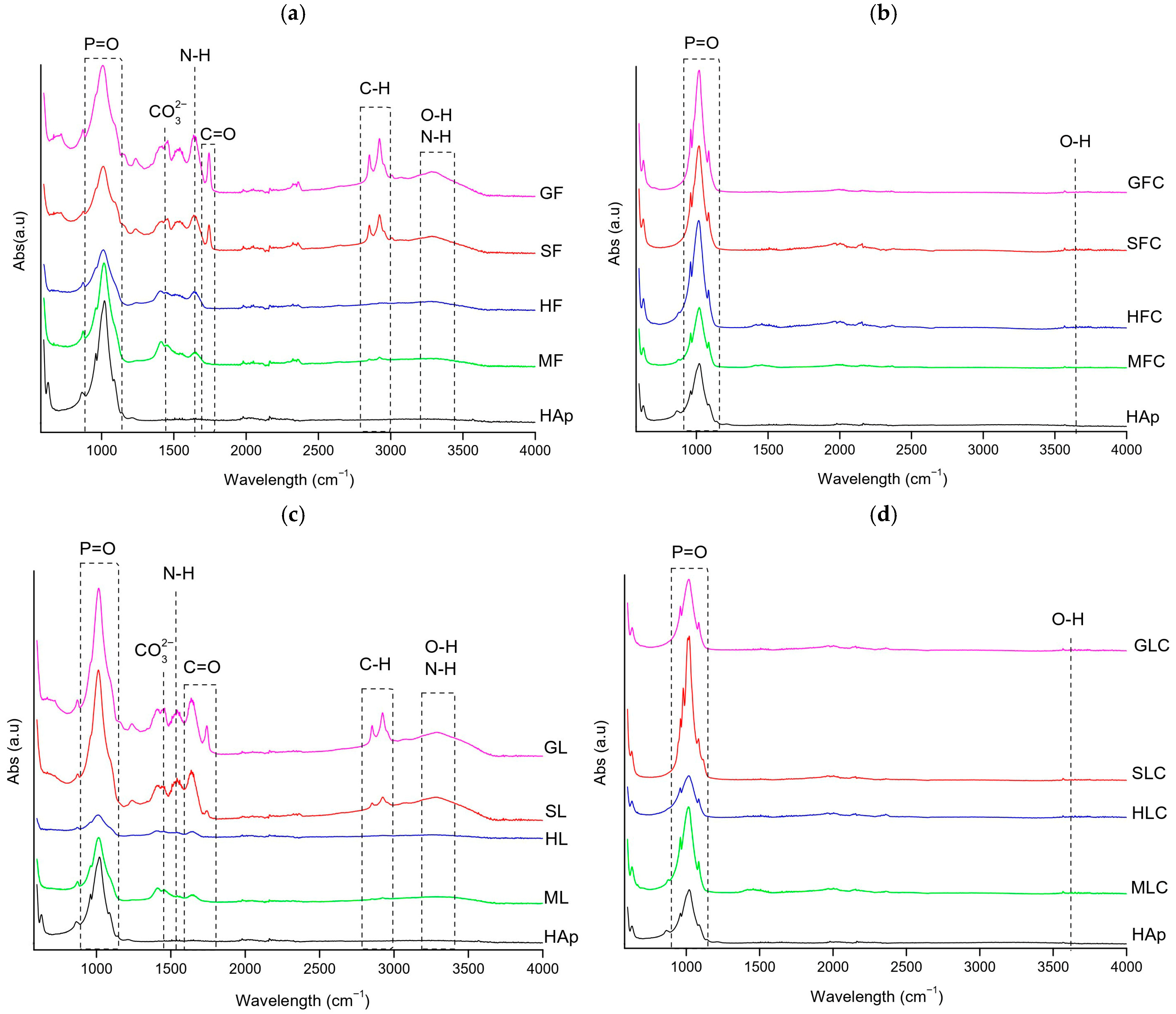
Figure 1.
FT-IR spectra of the clean fishbone samples: (a) XF, (b) XFC, (c) XL, (d) XLC.
Figure 1.
FT-IR spectra of the clean fishbone samples: (a) XF, (b) XFC, (c) XL, (d) XLC.
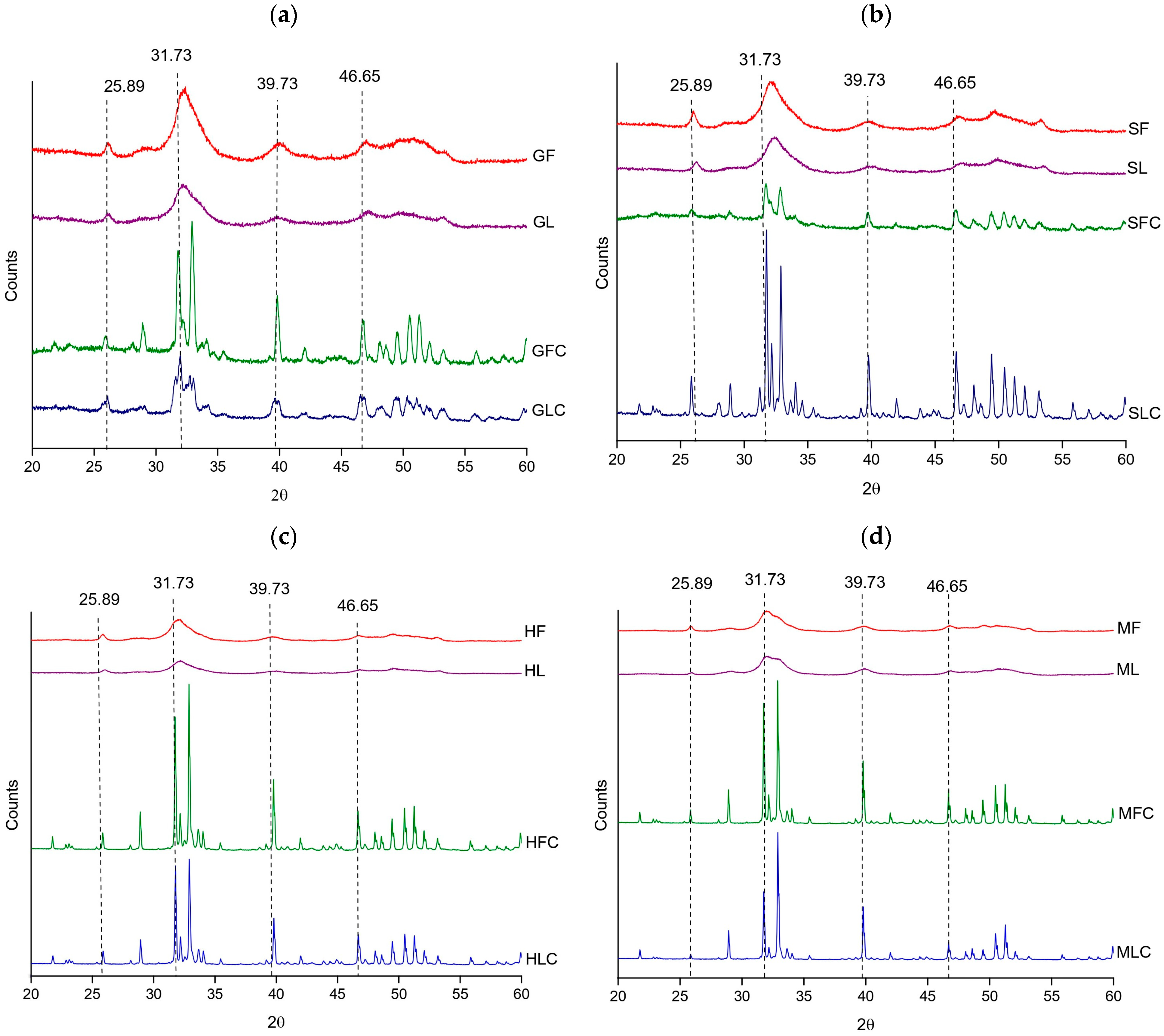
Figure 2.
XRD diffractograms of the treated fishbones: (a) gilt-head bream, (b) salmon, (c) hake, and (d) megrim.
Figure 2.
XRD diffractograms of the treated fishbones: (a) gilt-head bream, (b) salmon, (c) hake, and (d) megrim.
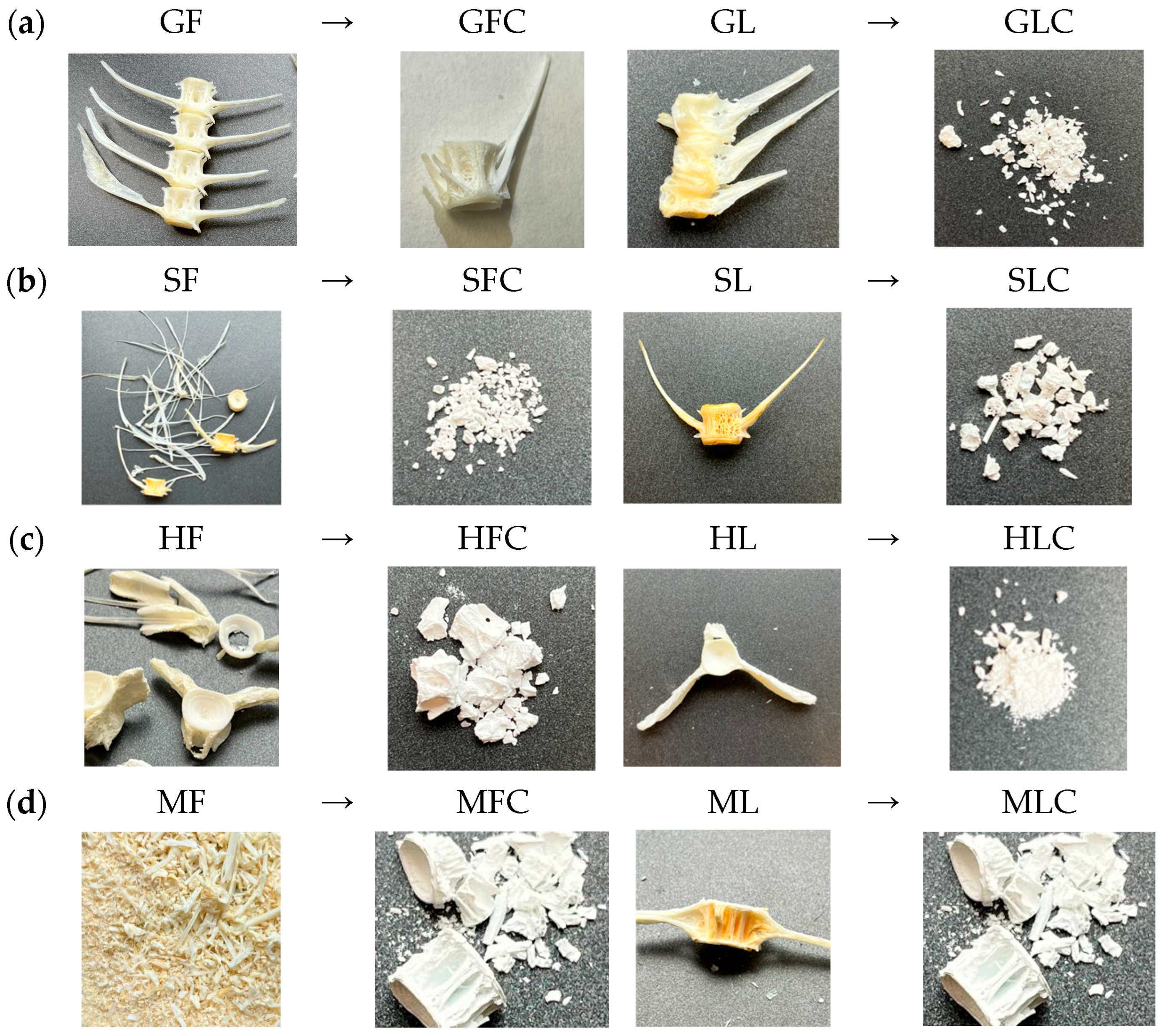
Figure 3.
Photographs of samples before and after calcination: (a) G, (b) S, (c) H, (d) M.
Figure 3.
Photographs of samples before and after calcination: (a) G, (b) S, (c) H, (d) M.
Figure 4.
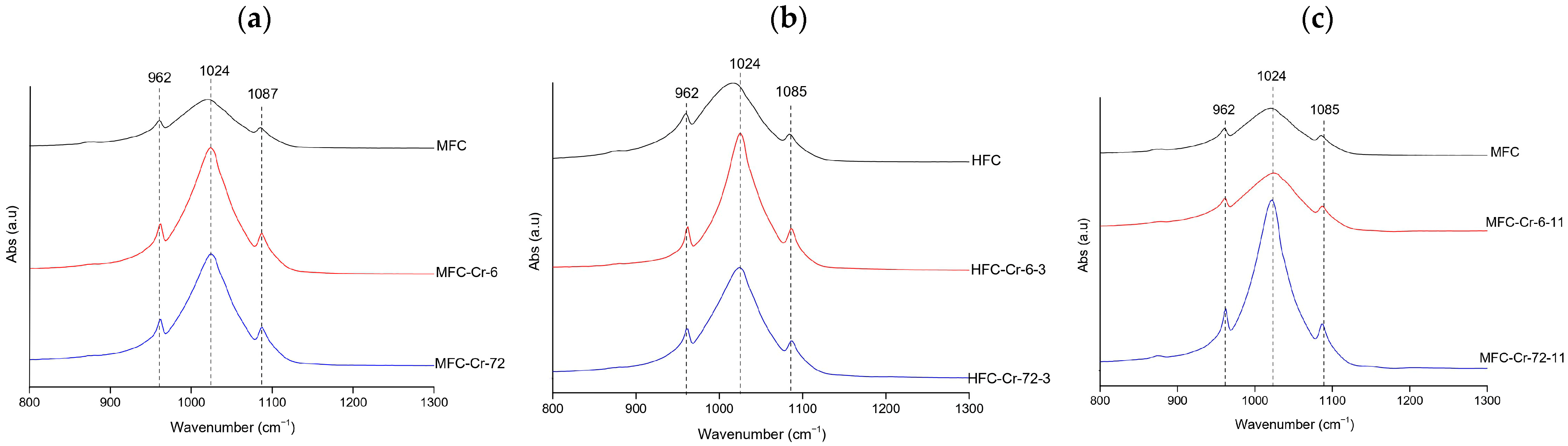
Representative FTIR spectra of Cr-treated hydroxyapatite (XFC) at (a) natural pH (megrim), (b) pH 3 (hake), and (c) pH 11 (megrim), showing the samples with the highest adsorption capacity at 6 h and 72 h of contact.
Figure 4.
Representative FTIR spectra of Cr-treated hydroxyapatite (XFC) at (a) natural pH (megrim), (b) pH 3 (hake), and (c) pH 11 (megrim), showing the samples with the highest adsorption capacity at 6 h and 72 h of contact.
Figure 5.
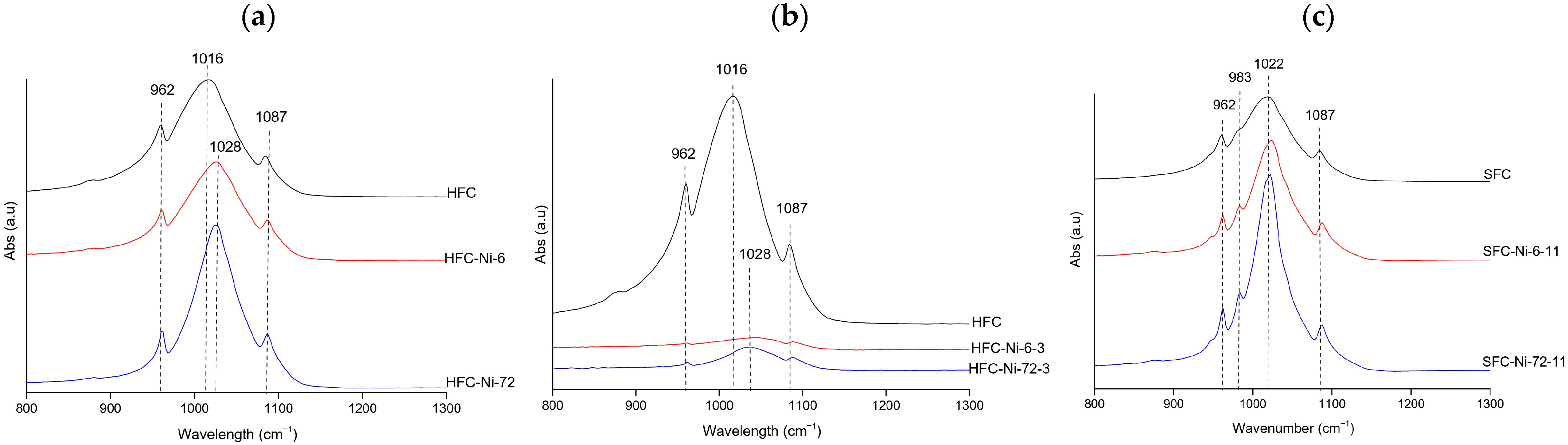
Representative FTIR spectra of Ni-treated hydroxyapatite (XFC) at (a) natural pH (hake tail), (b) pH 3 (hake tail), and (c) pH 11 (salmon), showing the samples with the highest adsorption capacity at 6 h and 72 h of contact.
Figure 5.
Representative FTIR spectra of Ni-treated hydroxyapatite (XFC) at (a) natural pH (hake tail), (b) pH 3 (hake tail), and (c) pH 11 (salmon), showing the samples with the highest adsorption capacity at 6 h and 72 h of contact.
Figure 6.
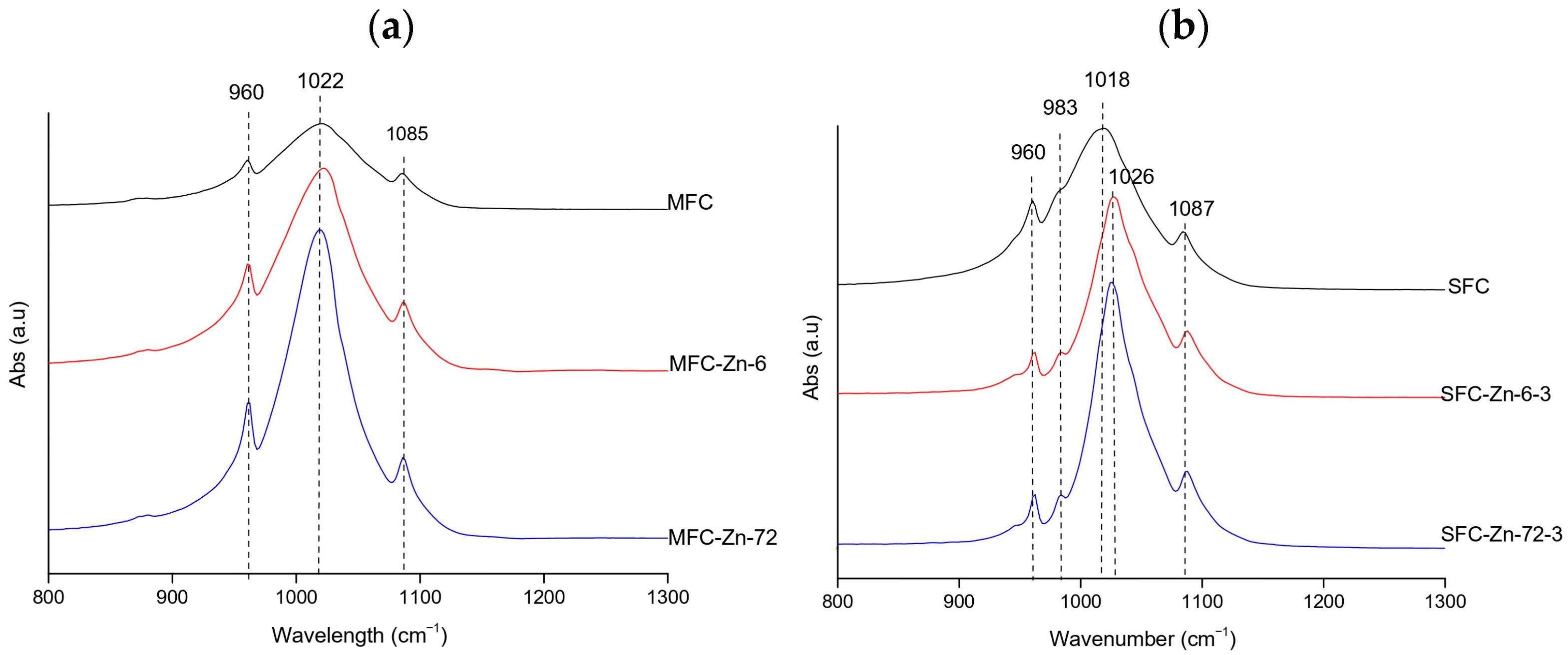
Representative FTIR spectra of Zn-treated hydroxyapatite (XFC) at (a) natural pH (megrim) and (b) pH 3 (salmon), showing the samples with the highest adsorption capacity at 6 h and 72 h of contact. No spectra were obtained at pH 11 due to precipitation phenomena.
Figure 6.
Representative FTIR spectra of Zn-treated hydroxyapatite (XFC) at (a) natural pH (megrim) and (b) pH 3 (salmon), showing the samples with the highest adsorption capacity at 6 h and 72 h of contact. No spectra were obtained at pH 11 due to precipitation phenomena.
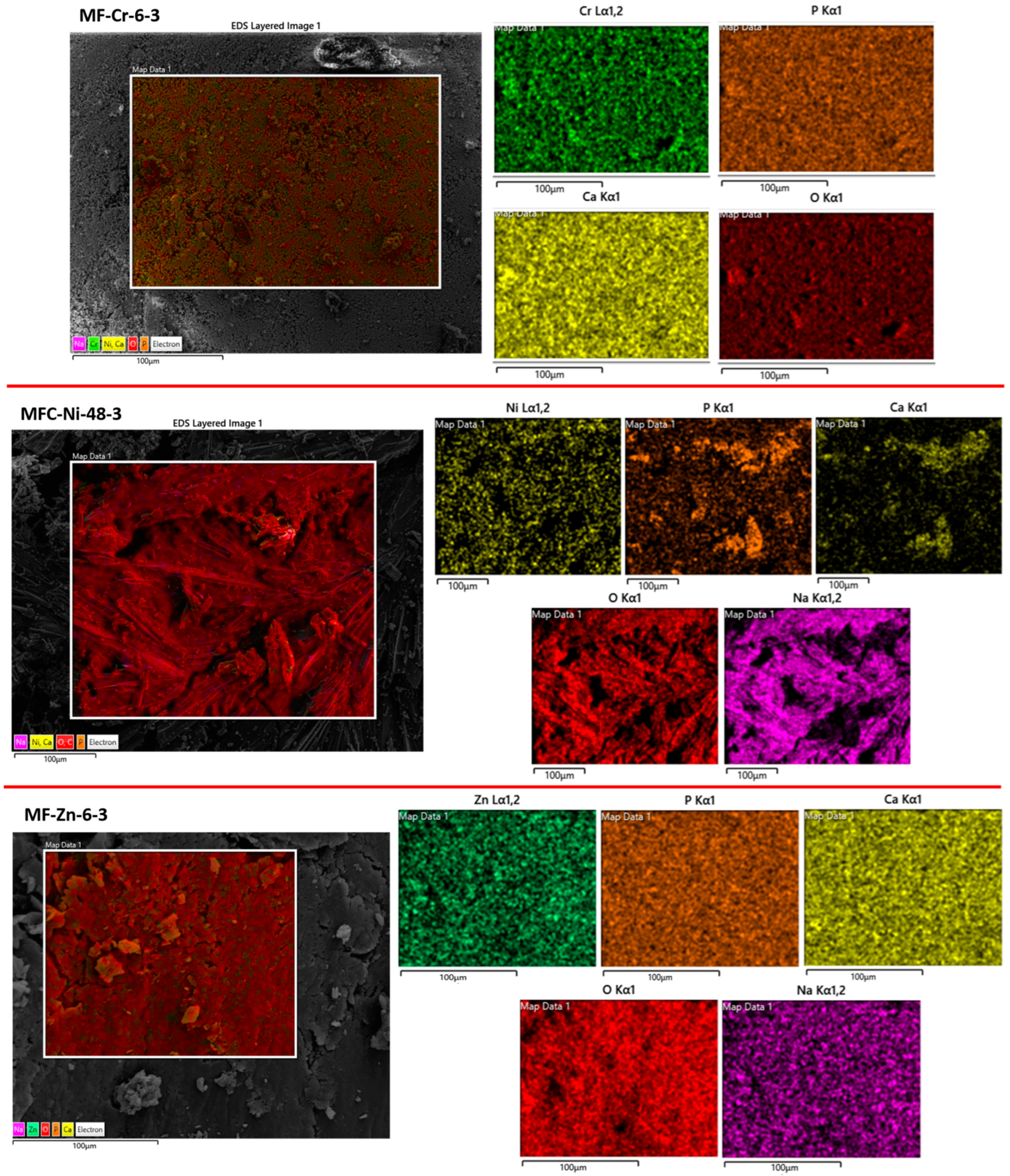
Figure 7.
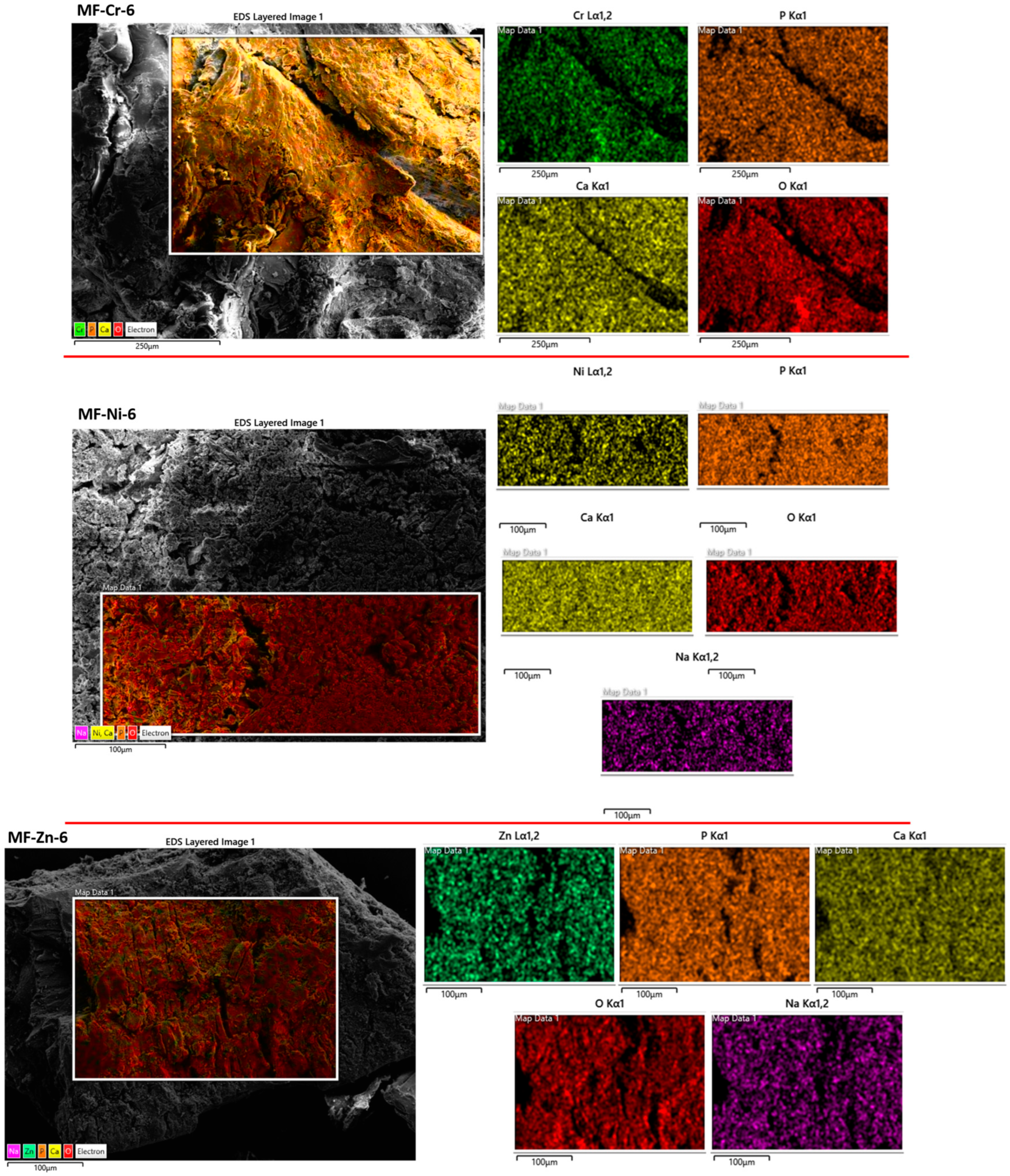
SEM-EDX mapping corresponding to samples at natural pH.
Figure 7.
SEM-EDX mapping corresponding to samples at natural pH.
Figure 8.
SEM-EDX mapping corresponding to samples at pH 3.
Figure 8.
SEM-EDX mapping corresponding to samples at pH 3.
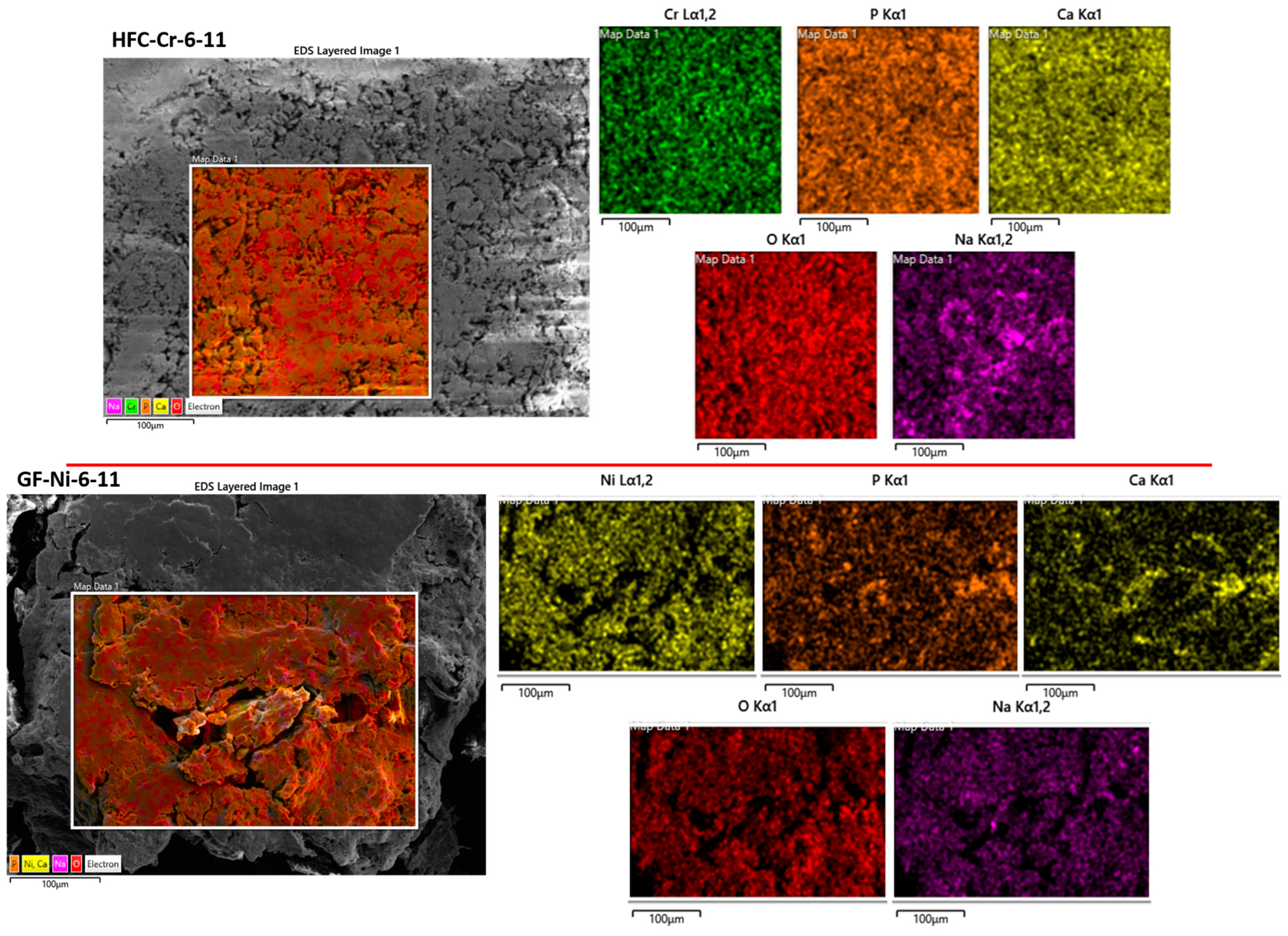
Figure 9.
SEM-EDX mapping corresponding to samples at pH 11.
Figure 9.
SEM-EDX mapping corresponding to samples at pH 11.
Table 1.
Comparison of heavy metal removal using fishbone-derived hydroxyapatite.
Table 1.
Comparison of heavy metal removal using fishbone-derived hydroxyapatite.
| Adsorbent Material | Metal | qmax
(mg·g−1) | Reference |
|---|
| Nano-Hydroxyapatite | Pb2+ | 4.9 | [17] |
| Nano-Hydroxyapatite | Ni2+ | 2.2 | [17] |
| Hydroxyapatite | Ni2+ | 18.6 | [18] |
| Hydroxyapatite | Co2+ | 22.5 | [18] |
Hydroxyapatite
(red snapper) | Cu2+ | 24.1 | [9] |
Table 2.
Sample coding used in the pretreatment procedures.
Table 2.
Sample coding used in the pretreatment procedures.
| General Coding | Sample Code | Procedure One | Sample Code | Procedure Two |
|---|
X
(X = G, S, H or M) | XF | Furnace | XFC | Furnace + Calcination |
| XL | Lyophilization | XLC | Lyophilization + Calcination |
| Fish Sample | Sample Code | Procedure One | Sample Code | Procedure Two |
| Gilt-head bream | GF | Furnace | GFC | Furnace + Calcination |
| GL | Lyophilization | GLC | Lyophilization + Calcination |
| Salmon | SF | Furnace | SFC | Furnace + Calcination |
| SL | Lyophilization | SLC | Lyophilization + Calcination |
| Hake Tail | HF | Furnace | HFC | Furnace + Calcination |
| HL | Lyophilization | HLC | Lyophilization + Calcination |
| Megrim | MF | Furnace | MFC | Furnace + Calcination |
| ML | Lyophilization | MLC | Lyophilization + Calcination |
Table 3.
Summary of adsorption experimental conditions.
Table 3.
Summary of adsorption experimental conditions.
| Experiment Block | Metals (Salts) | Temperature (°C) | rpm | C0
(mg/L) | V (mL) | m (mg) | Adsorbent Dosage (g/L) | pH Conditions | Ionic Strength Control |
|---|
Preliminary screening
(commercial HAp) | Cr3+ (CrCl3·6H2O) | 20 ± 1 | 160 | 50 | 25–50 | 40–80 | 0.8–3.2 | Natural (3.80) | Not adjusted (no background electrolyte added) |
| Ni2+ (NiCl2·6H2O) | 20 ± 1 | 160 | 50 | 25/50 | 40/80 | 0.8–3.2 | Natural (6.41) |
| Zn2+ (ZnCl2) | 20 ± 1 | 160 | 50 | 25/50 | 40/80 | 0.8–3.2 | Natural (6.44) |
Main adsorption tests
(XF samples fishbone-derived HAp) | Cr3+ (CrCl3·6H2O) | 20 ± 1 | 160 | 50 | 25 | 80 | 3.2 | 3, 11, and natural (3.80) |
| Ni2+ (NiCl2·6H2O) | 20 ± 1 | 160 | 50 | 25 | 80 | 3.2 | 3, 11, and natural (6.41) |
| Zn2+ (ZnCl2) | 20 ± 1 | 160 | 50 | 25 | 80 | 3.2 | 3, natural (6.44) |
| Main adsorption tests (XFC samples, calcined fishbone-derived HAp) | Cr3+ (CrCl3·6H2O) | 20 ± 1 | 160 | 50 | 25 | 80 | 3.2 | 3, 11, and natural (3.80) |
| Ni2+ (NiCl2·6H2O) | 20 ± 1 | 160 | 50 | 25 | 80 | 3.2 | 3, 11, and natural (6.41) |
| Zn2+ (ZnCl2) | 20 ± 1 | 160 | 50 | 25 | 80 | 3.2 | 3, natural (6.44) |
Table 4.
Mass losses (%) at different temperature ranges obtained from TGA.
Table 4.
Mass losses (%) at different temperature ranges obtained from TGA.
| | Mass Loss (%) |
|---|
| | <200 °C | 200–600 °C | 600–1000 °C | Total |
|---|
| Gilt-head bream | 4.3 | 31.2 | 4.5 | 40.0 |
| Salmon | 3.4 | 31.4 | 4.2 | 39.0 |
| Hake tail | 3.8 | 19.5 | 6.0 | 29.3 |
| Megrim | 2.7 | 13.5 | 5.6 | 21.8 |
Table 5.
Crystallinity index (CI) of the fishbone samples *.
Table 5.
Crystallinity index (CI) of the fishbone samples *.
| | HAp | GF | GL | GFC | GLC | SF | SL | SFC | SLC | HF | HL | HFC | HLC | MF | ML | MFC | MLC |
|---|
| CI (%) | 91.3 | 75.0 | 65.6 | 76.1 | 84.3 | 74.3 | 73.4 | 92.1 | 90.3 | 70.0 | 74.0 | 91.6 | 90.2 | 82.4 | 84.5 | 91.6 | 91.3 |
Table 6.
Average colorimetric parameters (mean ± SD, n = 4 species per group) of fishbone samples before adsorption.
Table 6.
Average colorimetric parameters (mean ± SD, n = 4 species per group) of fishbone samples before adsorption.
| | L∗ | a∗ | b∗ | C∗ | h° |
|---|
| XF samples | 75.72 ± 7.75 | 0.57 ± 2.12 | 14.05 ± 9.33 | 14.14 ± 9.43 | 88.52 ± 5.99 |
| XL samples | 79.74 ± 4.53 | 0.33 ± 1.27 | 11.48 ± 6.14 | 11.53 ± 6.17 | 90.01 ± 5.66 |
| XFC samples | 86.61 ± 1.28 | −0.40 ± 0.80 | 3.10 ± 1.32 | 3.17 ± 1.44 | 94.47 ± 9.58 |
| XLC samples | 86.05 ± 2.48 | 0.04 ± 0.30 | 1.92 ± 0.17 | 1.94 ± 0.15 | 89.28 ± 9.42 |
Table 7.
Nonlinear fitting parameters of the isotherm models for adsorption of the heavy metals on HAp adsorbent at natural pH.
Table 7.
Nonlinear fitting parameters of the isotherm models for adsorption of the heavy metals on HAp adsorbent at natural pH.
| Model | Parameter | Cr | Ni | Zn |
|---|
| Langmuir | KL (L mg−1) | 0.1506 | 0.4561 | 0.8397 |
| | qM (mg g−1) | 17.86 | 15.68 | 15.49 |
| | R2 | 0.9530 | 0.9808 | 0.9818 |
| | RMSE | 1.047 | 0.6423 | 0.6278 |
| | RSS | 9.876 | 3.713 | 3.547 |
| Freundlich | KF (mg1−1/n L1/n mg−1) | 5.049 | 8.203 | 9.358 |
| | n | 3.209 | 5.871 | 6.857 |
| | R2 | 0.9407 | 0.9771 | 0.9666 |
| | RMSE | 1.166 | 0.6977 | 0.7952 |
| | RSS | 12.25 | 4.381 | 5.691 |
Table 8.
Adsorption performance of HAp at natural pH (benchmark results) [pH values: Cr3+ 3.80, Ni2+ 6.41, Zn2+ 6.44].
Table 8.
Adsorption performance of HAp at natural pH (benchmark results) [pH values: Cr3+ 3.80, Ni2+ 6.41, Zn2+ 6.44].
| Metal | Sample | Time (h) | qe (mg·g−1) | Removal Efficiency (%) |
|---|
| Cr3+ | HAp-Cr | 48 | 14.9 | 98.7 |
| Ni2+ | HAp-Ni | 72 | 14.3 | 94.4 |
| Zn2+ | HAp-Zn | 17 | 13.5 | 99.2 |
Table 9.
Adsorption capacities of hydroxyapatites reported in the literature under near-neutral pH conditions.
Table 9.
Adsorption capacities of hydroxyapatites reported in the literature under near-neutral pH conditions.
| Metal | HAp Type | qe (mg·g−1) | Reference |
|---|
| Cr3+ | HAp (commercial) | 79.7 | [26] |
| Cr3+ | HAp–F127 (modified) | 134 | [26] |
| Ni2+ | Nano-HAp (synthetic) | 46.2 | [27] |
| Zn2+ | Ca-HAp (synthetic) | 102 | [28] |
| Zn2+ | Mg-HAp (modified) | 62.1 | [29] |
Table 10.
Summary of Cr3+ adsorption in XF and XFC samples at natural pH (highest and lowest performances).
Table 10.
Summary of Cr3+ adsorption in XF and XFC samples at natural pH (highest and lowest performances).
| Group | Sample | Time (h) | qe (mg·g−1) | Removal Efficiency (%) |
|---|
| XF | HF-Cr-17 | 17 | 15.6 | 97.9 |
| XF | SF-Cr-6 | 6 | 1.5 | 9.3 |
| XFC | MFC-Cr-6 | 6 | 15.9 | 99.5 |
| XFC | SFC-Cr-6 | 6 | 6.2 | 38.8 |
Table 11.
Summary of Ni2+ adsorption in XF and XFC samples at natural pH (highest and lowest performances).
Table 11.
Summary of Ni2+ adsorption in XF and XFC samples at natural pH (highest and lowest performances).
| Group | Sample | Time (h) | qe (mg·g−1) | Removal Efficiency (%) |
|---|
| XF | HF-Ni-48 | 48 | 15.3 | 94.6 |
| XF | GF-Ni-6 | 6 | 3.2 | 19.9 |
| XFC | HFC-Ni-24 | 24 | 15.8 | 97.8 |
| XFC | SFC-Ni-6 | 6 | 8.8 | 54.2 |
Table 12.
Summary of Zn2+ adsorption in XF and XFC samples at natural pH (highest and lowest performances).
Table 12.
Summary of Zn2+ adsorption in XF and XFC samples at natural pH (highest and lowest performances).
| Group | Sample | Time (h) | qe (mg·g−1) | Removal Efficiency (%) |
|---|
| XF | MF-Zn-6 | 6 | 15.0 | 100.0 |
| XF | GF-Zn-6 | 6 | 7.6 | 50.4 |
| XFC | MFC-Zn-6 | 6 | 14.3 | 95.9 |
| XFC | GFC-Zn-6 | 6 | 7.9 | 53.3 |
Table 13.
Adsorption capacities of biowaste-derived hydroxyapatites under near-neutral pH conditions (literature comparison).
Table 13.
Adsorption capacities of biowaste-derived hydroxyapatites under near-neutral pH conditions (literature comparison).
| Metal | HAp Origin (Biogenic) | qe (mg·g−1) | Time (h) | Reference |
|---|
| Ni2+ | Fish scales | 114–181 | 2 | [30] |
| Ni2+ | Fishbones | 20–40 | 1/3–2/3 | [9] |
| Zn2+ | Fishbones (powdered) | 8–20 | 8 | [31] |
| Zn2+ | Fishbones | 20–40 | 1/3–2/3 | [9] |
Table 14.
Summary of Cr3+ adsorption in XF and XFC samples at acidic pH (highest and lowest performances).
Table 14.
Summary of Cr3+ adsorption in XF and XFC samples at acidic pH (highest and lowest performances).
| Group | Sample | Time (h) | qe (mg·g−1) | Removal Efficiency (%) |
|---|
| XF | MF-Cr-6-3 | 6 | 13.9 | 98.5 |
| XF | GF-Cr-6-3 | 6 | 9.9 | 69.6 |
| XFC | SFC-Cr-6-3 | 6 | 14.3 | 100.0 |
| XFC | HFC-Cr-6-3 | 6 | 14.0 | 98.6 |
Table 15.
Summary of Ni2+ adsorption in XF and XFC samples at acidic pH (highest and lowest performances).
Table 15.
Summary of Ni2+ adsorption in XF and XFC samples at acidic pH (highest and lowest performances).
| Group | Sample | Time (h) | qe (mg·g−1) | Removal Efficiency (%) |
|---|
| XF | MF-Ni-48-3 | 48 | 13.7 | 84.3 |
| XF | GF-Ni-6-3 | 6 | 2.4 | 15.1 |
| XFC | HFC-Ni-48-3 | 48 | 16.2 | 97.9 |
| XFC | HFC-Ni-6-3 | 6 | 4.6 | 38.3 |
Table 16.
Summary of Zn2+ adsorption in XF and XFC samples at acidic pH (highest and lowest performances).
Table 16.
Summary of Zn2+ adsorption in XF and XFC samples at acidic pH (highest and lowest performances).
| Group | Sample | Time (h) | qe (mg·g−1) | Removal Efficiency (%) |
|---|
| XF | MF-Zn-6-3 | 6 | 13.9 | 98.5 |
| XF | GF-Zn-6-3 | 6 | 9.9 | 69.6 |
| XFC | SFC-Zn-6-3 | 6 | 14.3 | 100.0 |
| XFC | HFC-Zn-6-3 | 6 | 14.0 | 98.6 |
Table 17.
Summary of Cr3+ adsorption in XF and XFC samples at basic pH (highest and lowest performances).
Table 17.
Summary of Cr3+ adsorption in XF and XFC samples at basic pH (highest and lowest performances).
| Group | Sample | Time (h) | qe (mg·g−1) | Removal Efficiency (%) |
|---|
| XF | HF-Cr-72-11 | 72 | 7.2 | 53.1 |
| XF | GF-Cr-6-11 | 6 | 0.23 | 1.7 |
| XFC | GFC-Cr-6-11 | 6 | 13.6 | 99.5 |
| XFC | MFC-Cr-6-11 | 6 | 13.4 | 98.7 |
Table 18.
Summary of Ni2+ adsorption in XF and XFC samples at basic pH (highest and lowest performances).
Table 18.
Summary of Ni2+ adsorption in XF and XFC samples at basic pH (highest and lowest performances).
| Group | Sample | Time (h) | qe (mg·g−1) | Removal Efficiency (%) |
|---|
| XF | GF-Ni-6-11 | 6 | 12.9 | 95.4 |
| XF | MF-Ni-6-11 | 6 | 12.6 | 92.1 |
| XFC | SFC-Ni-6-11 | 6 | 13.5 | 99.1 |
| XFC | MFC-Ni-6-11 | 6 | 13.4 | 97.5 |
Table 19.
XRF analyses of non-calcined (XF) and calcined species (XFC).
Table 19.
XRF analyses of non-calcined (XF) and calcined species (XFC).
| Sample Code | Na % | Mg % | Si % | P % | Ca % | Al % | K % | Sr % | S % | Ratio Ca/P |
|---|
| HAp | 2.85 | 1.92 | 1.62 | 22.3 | 69.90 | 1.23 | 0.15 | 0.05 | 0 | 2.42 |
| XF samples | |
| GF | 1.57 | 1.40 | 0.50 | 15.74 | 78.30 | 0.73 | 0.31 | 0.72 | 0.64 | 3.84 |
| SF | 1.95 | 1.70 | 0.62 | 17.29 | 76.08 | 0.79 | 0.25 | 0.68 | 0.47 | 3.40 |
| HF | 3.70 | 2.33 | 1.28 | 19.93 | 70.89 | 1.04 | 0.23 | 0.40 | 0.17 | 2.75 |
| MF | 3.48 | 2.32 | 1.40 | 20.75 | 70.33 | 1.10 | 0.19 | 0.36 | 0.05 | 2.62 |
| XFC samples | |
| GFC | 3.77 | 2.81 | 1.50 | 21.87 | 68.07 | 1.18 | 0.28 | 0.38 | 0.07 | 2.41 |
| SFC | 4.73 | 2.73 | 1.52 | 22.42 | 66.50 | 1.18 | 0.23 | 0.35 | 0.10 | 2.29 |
| HFC | 4.63 | 2.63 | 1.54 | 20.87 | 68.37 | 1.10 | 0.30 | 0.24 | 0.09 | 2.53 |
| MFC | 4.06 | 2.43 | 1.52 | 21.29 | 68.95 | 1.07 | 0.26 | 0.29 | 0.06 | 2.50 |
Table 20.
Optimal adsorption conditions for each metal and pH.
Table 20.
Optimal adsorption conditions for each metal and pH.
| Metal | pH | Best Performance | Treatment Type | Efficiency (%) | qe (mg·g−1) | Time (h) |
|---|
| Chromium | Natural | MF-Cr-6 | XF (non-calcined) | >96 | 15.3 | 6 |
| Nickel | Natural | MF-Ni-6 | XF (non-calcined) | >89 | 14.8 | 6 |
| Zinc | Natural | MF-Zn-6 | XF (non-calcined) | >99 | 15.0 | 6 |
| Chromium | 3 | MF-Cr-6-3 | XF (non-calcined) | >98 | 13.9 | 6 |
| Nickel | 3 | MFC-Ni-48-3 | XFC (calcined) | >96 | 15.7 | 48 |
| Zinc | 3 | MF-Zn-6-3 | XF (non-calcined) | >98 | 14.0 | 6 |
| Chromium | 11 | HFC-Cr-6-11 | XFC (calcined) | >99 | 13.5 | 6 |
| Nickel | 11 | GF-Ni-6-11 | XF (non-calcined) | >95 | 12.9 | 6 |
Table 21.
Crystallinity index (CI) and standard deviation (SD) of hydroxyapatite samples exposed to heavy metals (Cr3+, Ni2+, and Zn2+) at different pH values and two contact times (6 h and 72 h).
Table 21.
Crystallinity index (CI) and standard deviation (SD) of hydroxyapatite samples exposed to heavy metals (Cr3+, Ni2+, and Zn2+) at different pH values and two contact times (6 h and 72 h).
| Metal | pH | Contact Time (h) | CI (%) | SD (%) |
|---|
| Cr3+ | Natural | 6 | 70.2 | 28.6 |
| 72 | 66.5 | 27.0 |
| 3 | 6 | 71.7 | 28.5 |
| 72 | 86.5 | 28.1 |
| 11 | 6 | 77.2 | 29.1 |
| 72 | 78.6 | 28.9 |
| Ni2+ | Natural | 6 | 80.3 | 14.5 |
| 72 | 78.9 | 28.1 |
| 3 | 6 | 77.8 | 18.8 |
| 72 | 78.7 | 6.1 |
| 11 | 6 | 92.7 | 7.1 |
| 72 | 78.8 | 6.8 |
| Zn2+ | Natural | 6 | 72.8 | 17.5 |
| 72 | 81.0 | 15.4 |
| 3 | 6 | 83.0 | 14.4 |
| 72 | 87.8 | 8.6 |
Table 22.
Condition-wise averages of retained metal (%).
Table 22.
Condition-wise averages of retained metal (%).
| Ph | Metal | Metal Retained (%) | SD |
|---|
| Natural | Cr3+ | 7.34 | 3.29 |
| Ni2+ | 5.97 | 2.49 |
| Zn2+ | 8.40 | 4.87 |
| 3 | Cr3+ | 4.13 | 2.95 |
| Ni2+ | 3.98 | 1.77 |
| Zn2+ | 7.68 | 2.70 |
| 11 | Cr3+ | 3.01 | 0.71 |
| Ni2+ | 3.70 | 0.98 |
| Zn2+ | N/A | N/A |
Table 23.
The best (top-5) and worst (bottom-5) samples according to metal retention by XRF.
Table 23.
The best (top-5) and worst (bottom-5) samples according to metal retention by XRF.
| Top 5 | | Bottom-5 | |
|---|
| Sample | Metal Retained (%) | Sample | Metal Retained (%) |
|---|
| SS-Zn-6 | 16.6 | HS-Cr-72-11 | 1.67 |
| SS-Zn-72 | 15.1 | GSC-Cr-6-3 | 1.71 |
| HS-Cr-6 | 13.7 | GSC-Zn-6 | 1.73 |
| SS-Cr-72 | 12.7 | HSC-Ni-6-3 | 1.74 |
| GS-Zn-72 | 12.5 | HSC-Zn-6 | 1.76 |
Table 24.
Photographic record of gilt-head bream samples (GF and GFS) after chromium adsorption at natural, acidic (pH 3), and alkaline (pH 11) conditions, showing visual changes at 0, 6, and 72 h.
Table 25.
Photographic record of gilt-head bream samples (GF and GFS) after nickel adsorption at natural, acidic (pH 3), and alkaline (pH 11) conditions, showing visual changes at 0, 6, and 72 h.
Table 26.
Photographic record of gilt-head bream samples (GF and GFS) after zinc adsorption at natural, acidic (pH 3), conditions, showing visual changes at 0, 6, and 72 h.