Article

Strengthening Remote Sensing-Based Estimation of Riverine Total Phosphorus Concentrations by Incorporating Land Surface Temperature


Guangdong Basic Research Center of Excellence for Ecological Security and Green Development, School of Ecology, Environment and Resources, Guangdong University of Technology, Guangzhou 510006, China
*
Author to whom correspondence should be addressed.
Environments 2026, 13(1), 63; https://doi.org/10.3390/environments13010063
Submission received: 18 November 2025 / Revised: 16 January 2026 / Accepted: 17 January 2026 / Published: 22 January 2026

Abstract

Direct retrieval of Total Phosphorus (TP) from remote sensing is not possible because TP is not optically active. Unlike optically active parameters, TP does not exhibit spectral signals and relies on indirect correlations with Optically Active Constituents (OACs) such as Chl-a and suspended solids. Existing approaches often rely solely on spectral reflectance while neglecting the environmental variables, such as temperature, that can affect the correlations between OACs such as Chl-a and temperature. To address this, this study integrates satellite-derived Land Surface Temperature (LST) with Landsat 8/9 spectral features, utilizing LST as a spatial proxy for the aquatic thermodynamic environment. Focusing on the Dongjiang River, a subtropical river in China, a machine learning framework was constructed based on in situ measurements collected from 2020 to 2023. Feature selection using Pearson’s correlation and Random Forest importance identified the optimal combination of spectral bands and thermal inputs. The results from the model revealed the following: (1) annual mean TP concentrations in the delta were higher than in the main channel, with more pronounced seasonal fluctuations; (2) statistical verification (Wilcoxon signed-rank test, p < 0.01) confirmed that incorporating LST yielded a certain reduction in retrieval error compared to the spectral-only model; (3) the most influential predictors for TP estimation were a combination of the blue, green, and red spectral bands along with LST; (4) models incorporating LST achieved significantly higher accuracy than those based solely on spectral reflectance, with improved R2 and RMSE values across most TP concentration ranges (except for 0.04–0.06 mg/L). These findings demonstrate that integrating LST with spectral features enhances the accuracy of remote sensing-based TP retrieval in rivers, offering new opportunities for improved large-scale water quality monitoring.

1. Introduction

In recent years, inland water pollution has become increasingly prominent due to nutrient excess. Total Phosphorus (TP) is one of the most ubiquitous nutrients, as excessive concentrations can lead to severe environmental problems, including algal blooms, eutrophication, and fish mortality [1]. To protect the ecological environment and water resources of urban regions, it is therefore essential to conduct long-term and systematic monitoring of water resources and river basin water quality [2]. Traditional TP monitoring methods, based on field sampling and laboratory analysis, are highly accurate but constrained by labor, cost, and terrain. These limitations restrict monitoring to specific locations, making it difficult to achieve comprehensive assessment, prediction, and management of entire water bodies [3]. In contrast, remote sensing offers advantages such as wide spatial coverage, rapid response, and relatively low cost, making it an increasingly important tool for long-term and large spatial water quality monitoring [4]. Remote sensing can also be used to track the diffusion dynamics of pollution sources and other environmental issues, further broadening its applications in water environment management [5] and scientific research [6].
However, TP is a non-optically active parameter, and has no spectral features present that can be used for remote sensing retrieval [7]. Unlike OACs such as Chl-a and SS, TP does not exhibit any measurable optical properties in the multi-spectral data. Consequently, its retrieval relies on correlations with detectable OACs, which act as environmental proxies for nutrient enrichment. While TP cannot be measured directly, its strong biogeochemical correlation with algae can be used to indirectly estimate TP through spectral reflectance [8]. Current approaches to retrieving non-optical parameters generally fall into two categories: indirect and direct methods. The indirect method uses correlations between optical and non-optical parameters; for example, Lu et al. [9] developed an inversion model based on the relationship between organic matter and TP. The direct method establishes purely mathematical relationships without considering physical or biological mechanisms; for instance, He et al. [10] applied multiple linear regression to estimate non-optical parameters. More recently, with advances in artificial intelligence, machine learning methods have become increasingly prominent. Dong et al. [11] evaluated multiple algorithms to identify the optimal model for different water quality parameters, while Liang et al. [12] used multi-source imagery and Partial Least Squares Regression (PLSR) to predict TP concentrations at large spatial scales. Nonetheless, most existing machine learning models for TP retrieval rely solely on spectral reflectance features, often neglecting environmental variables that govern water quality dynamics. The spatiotemporal variation of TP is driven by a complex interplay of physicochemical and biogeochemical factors, including interactions with Potentially Toxic Elements (PTEs), water temperature, pH, and turbidity [13]. Water temperature, for instance, is a key driver of aquatic biogeochemical processes; it regulates microbial activity and phytoplankton growth, which are intrinsically linked to the uptake and release of phosphorus [14]. While in situ water temperature measurements are accurate, they are spatially discrete and limited to specific monitoring stations, making it difficult to capture basin-wide thermal gradients. In contrast, satellite-derived Land Surface Temperature (LST) offers spatially continuous coverage. Although LST represents the radiative temperature of the surface rather than the bulk water temperature, previous studies have established a certain correlation between them [15]. For instance, Attiah et al. [16] successfully retrieved water temperature in the North Slave Region using a Landsat LST dataset. Consequently, LST serves as a spatial proxy for aquatic thermal conditions, allowing the model to incorporate temperature-related biochemical effects across the river network. Compared with precipitation and runoff, which are mainly obtained from sparse hydrological stations and have limited spatial coverage, LST provides spatially continuous remotely sensed thermal information that captures the spatial heterogeneity of environmental conditions related to TP dynamics.
Overall, this study proposes a method for retrieving TP concentration by integrating Landsat 8/9 spectral data with LST products. Focusing on the Dongjiang River Basin, a machine learning-based model was constructed using in situ TP measurements. This study aims to demonstrate that incorporating LST products enhances the accuracy of riverine TP estimation, providing a more robust approach for large-scale water quality monitoring.

2. Materials and Methods

2.1. Study Area

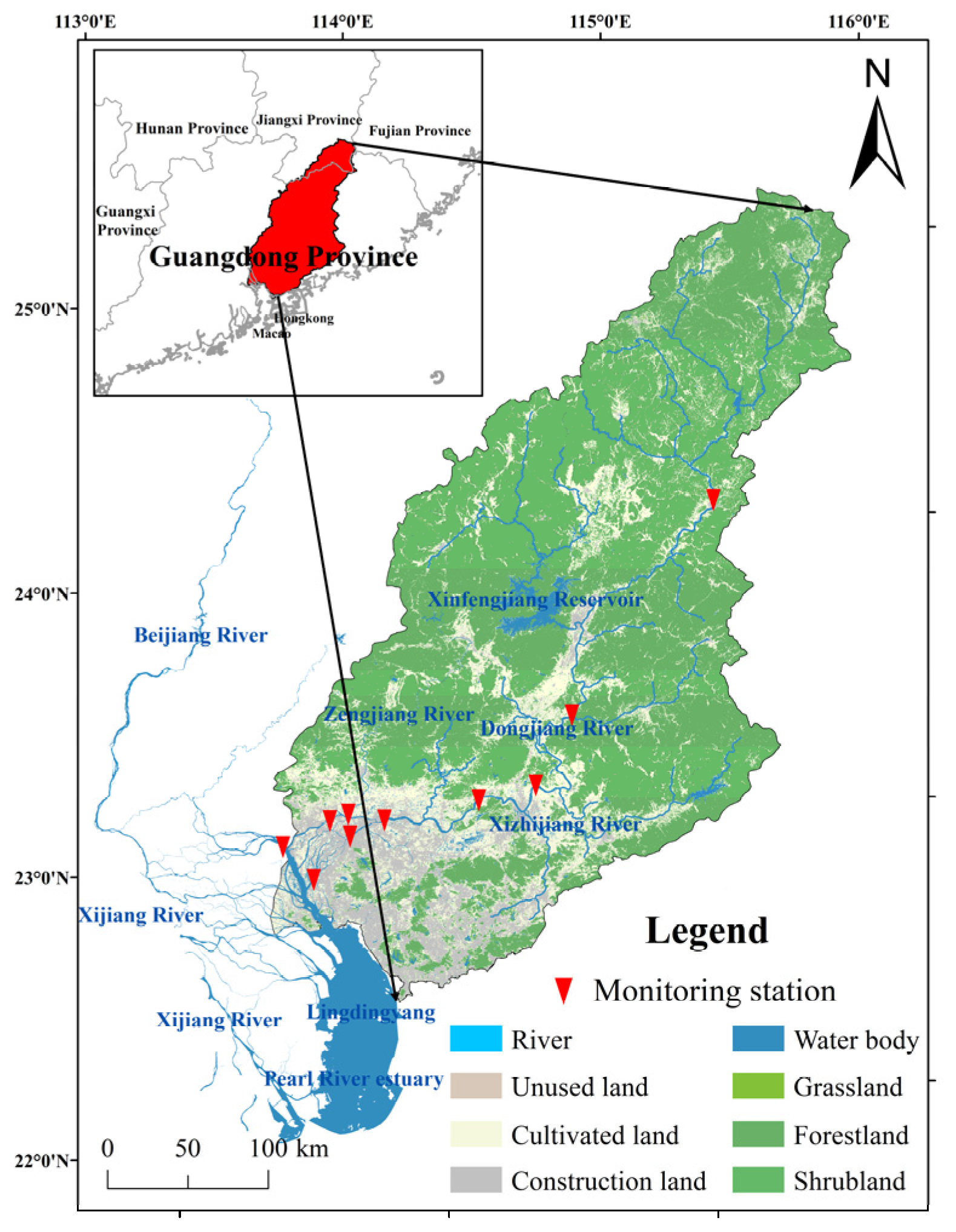
The Dongjiang River (Figure 1), one of the three major river systems of the Pearl River Basin, originates from Yajibo Mountain in Xunwu County, Jiangxi Province, with its headwaters extending across Xunwu, Anyuan, and Dingnan counties [17]. The main channel subsequently flows through Longchuan County, Dongyuan County, Yuancheng District, and Jiangdong New District in Heyuan City, as well as Boluo County, Huicheng District, and Zhongkai High-tech Zone in Huizhou City. Serving as a vital water source for Guangdong Province, the Dongjiang River supplies water to Shenzhen and Hong Kong through a trans-basin water diversion project. Consequently, its water quality directly affects the water supply security of local communities along the river, as well as that of Shenzhen and Hong Kong [18]. In recent years, however, rapid economic development and urbanization have contributed to a decline in water quality within the Dongjiang River Basin, with eutrophication emerging as an increasingly severe concern [19].

2.2. Water Quality Monitoring Data

Water quality monitoring data for the Dongjiang River were obtained from the National Surface Water Quality Automatic Monitoring and Real-time Data Publication System (https://szzdjc.cnemc.cn:8070/GJZ/Business/Publish/Main.html accessed on 15 May 2025). The system, launched by the Ministry of Environmental Protection on 1 July 2009, releases data six times daily at four-hour intervals (0:00, 4:00, 8:00, 12:00, 16:00, and 20:00). The primary monitoring indicators include Water Temperature (°C), pH, DO (mg/L), Electrical Conductivity (μS/cm), Turbidity (NTU), CODMn (mg/L), NH3-N (mg/L), TN (mg/L), and TP (mg/L) [20]. Nine monitoring sections were selected: Duntouji, Shatiansisheng, Dadun, Zengjiang estuary, Shilong Nanhe, Boluo Chengxia (Xinjiao), Huizhou Ruhu, Dongjiang Jiangkou, and Longchuancheng Railway Bridge. Water temperature and TP concentration data spanning from November 2020 to May 2023 were utilized. This study primarily focuses on TP as the main water quality parameter. Since Landsat satellite images are acquired around 11:00 AM (Beijing Time), in situ water quality data collected at 12:00 PM were selected and spatially matched with the corresponding remote sensing image pixels at the monitoring station locations, yielding a total of 290 data pairs.

2.3. Satellite Data and Preprocessing

2.3.1. Data Used

Landsat 8, launched on 11 February 2013, carries the Operational Land Imager (OLI) for spectral data and the Thermal Infrared Sensor (TIRS) to acquire spectral data. Landsat 9, launched on 27 September 2021, features an OLI-2 sensor identical to Landsat 8’s OLI and an improved TIRS-2 that addresses limitations of its predecessor [21]. Some studies [3,22,23,24] have shown that the sensor configurations of both satellites are suitable for retrieving water quality parameters.
This study used Landsat 9 OLI-2/TIRS-1 and Landsat 8 OLI/TIRS surface reflectance data obtained from the Google Earth Engine (GEE) platform (https://earthengine.google.com/, accessed on 15 May 2025), courtesy of the U.S. Geological Survey [25]. Both satellites provide 30 m spatial resolution imagery with a 16-day revisit cycle. The datasets were preprocessed in GEE to derive surface reflectance, which subsequently served as the basis for constructing spectral band combinations applied in TP estimation.
This study utilized the Landsat Level-2 Surface Temperature (LST) Science Product, which provides the Earth’s surface temperature in Kelvin (K). The product is derived primarily from Top-of-Atmosphere (TOA) thermal infrared data using a Single-Channel algorithm. Notably, this algorithm is sophisticated, integrating auxiliary data such as emissivity from the ASTER satellite and atmospheric profiles from reanalysis data. The final product is distributed as georeferenced rasters (GeoTIFF format) with a spatial resolution of 30 m in the Universal Transverse Mercator (UTM) coordinate system.

2.3.2. Preprocessing Process

Preprocessing involved cloud, shadow, and snow removal using the quality assurance band (QA_PIXEL), water body extraction using the Normalized Difference Water Index (NDWI), and application of scaling factors [23]. Water bodies were then delineated with NDWI derived from Landsat imagery [26]. Water bodies were delineated from the green and near-infrared band reflectance using NDWI, with pixels classified as water if NDWI > 0 and non-water otherwise [27]. The formula is
N D W I = B a n d   3 B a n d   5 B a n d   3 + B a n d   5
where Band 3 is green surface reflectance (0.533–0.590 μm) and Band 5 is near-infrared surface reflectance (0.851–0.879 μm).
Original imagery has reflectance values from 0 to 1. GEE stores these as 16-bit integers, reducing precision, so a scaling factor is needed to recover the true values. This can be simply expressed by the following formula:
B a n d = D N × s c a l e + offset
where Band is the true reflectance (0–1), DN is the original digital value, scale is the scaling factor, and offset is the bias.

2.4. Machine Learning Model

Random Forest (RF), first introduced by Breiman [28], is a machine learning algorithm based on bootstrap aggregating (bagging). In this approach, multiple independent decision trees are trained on random samples drawn with replacement from the original dataset. To enhance model diversity and reduce variance, RF incorporates random feature selection during tree construction. Final predictions are obtained by aggregating the outputs of all trees, with regression tasks using the mean of predicted values [29]. In addition to prediction, RF provides an effective assessment of variable importance, which facilitates the elimination of redundant predictors and improves both accuracy and computational efficiency [30]. Due to its robustness and interpretability, RF has been widely applied in both regression and classification tasks, and it has proven particularly effective in environmental and remote sensing studies [31].

2.5. Establishment and Screening of Feature Combinations

2.5.1. Establishment of Feature Combinations

To effectively extract the spectral information of TP and enhance the model’s sensitivity and retrieval accuracy, various band combination methods were explored. Previous studies [32,33] have demonstrated that band ratio combinations, such as NDVI and NDWI, perform well in retrieving water quality parameters. Accordingly, this study generated new feature combinations by combining two to four bands, following approaches reported in the literature [34,35,36], to improve predictive performance for TP concentration. The resulting band combination schemes are summarized in Table 1.

2.5.2. Feature Combination Screening

All constructed combinations were initially screened using Pearson’s correlation, with selection criteria of a p-value < 0.01 and correlation coefficient |r| > 0.98, to remove statistically insignificant or highly redundant combinations. Unlike conventional strategies that retain only highly correlated combinations, this study did not adopt such an approach because RF inherently mitigates the effects of multicollinearity through random feature selection, importance-based pruning, and random sampling of the training set [21]. Relying exclusively on high correlation may discard combinations that, although weakly correlated with TP in a linear sense, still enhance model performance.
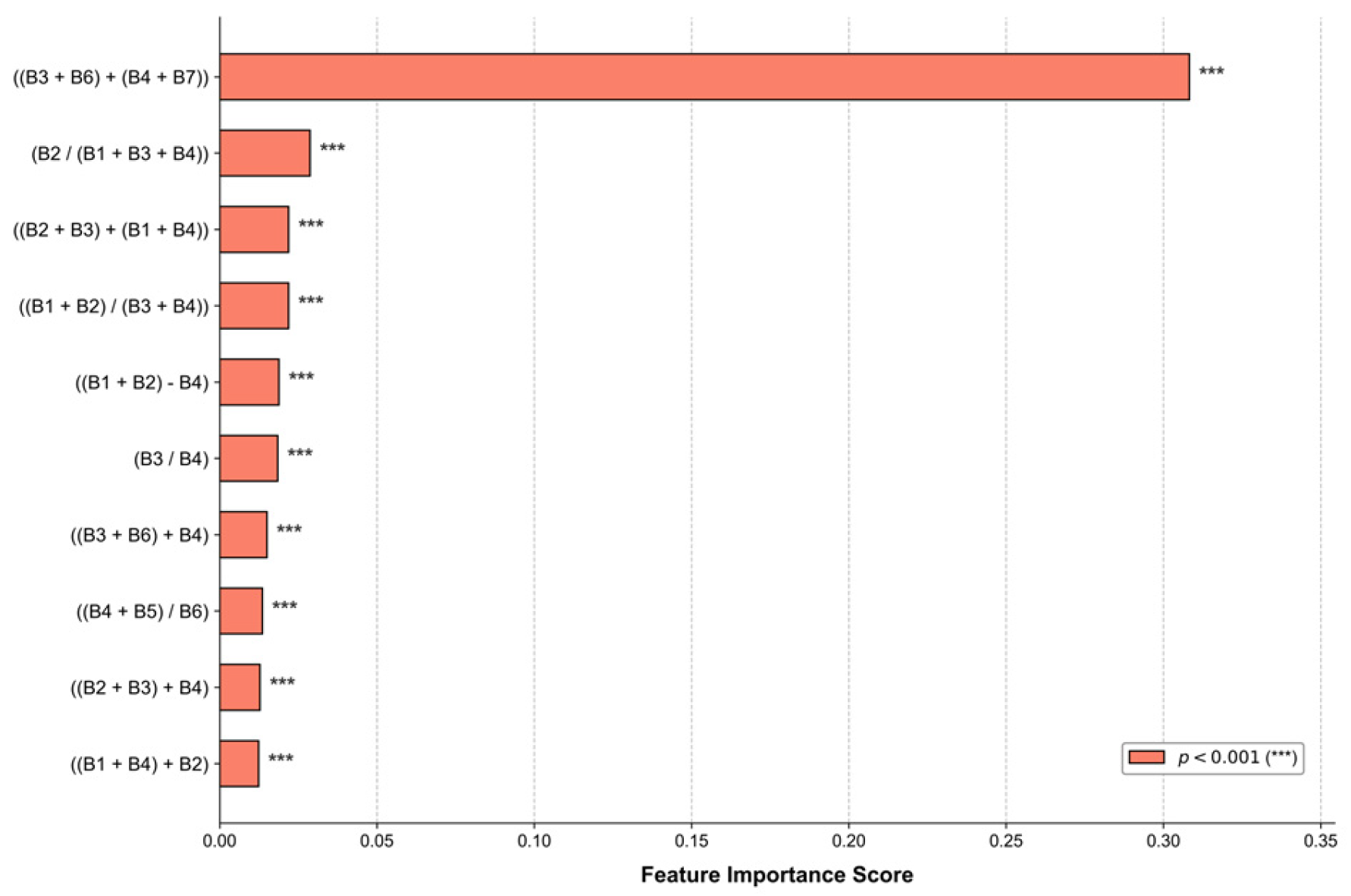
Following correlation screening, we performed feature selection using the Gini decrease index in the Random Forest model to evaluate the importance of the remaining 870 band combinations. As shown in Figure 2, the top 10 combinations were all statistically significant, although the importance scores of the lower-ranked 10 were relatively small. The most important feature (F1) exhibited a score exceeding 0.3, whereas the second-ranked feature (F2) dropped below 0.05. Subsequent features showed a gradual decline in importance, with the 20th feature scoring below 0.02.

2.5.3. Screening Results

To finalize feature selection, forward stepwise selection [37] was applied, models were sequentially constructed by adding the top five features. This procedure resulted in three band combinations—F1, F2, and F4 (formulas provided in Table 2)—which, together with the land surface temperature feature, were selected as the final input variables for the Random Forest model. Using the four selected feature combinations as inputs, the hyperparameters of the Random Forest model were selected based on OOB error, and the tuning details are provided in Table 3.
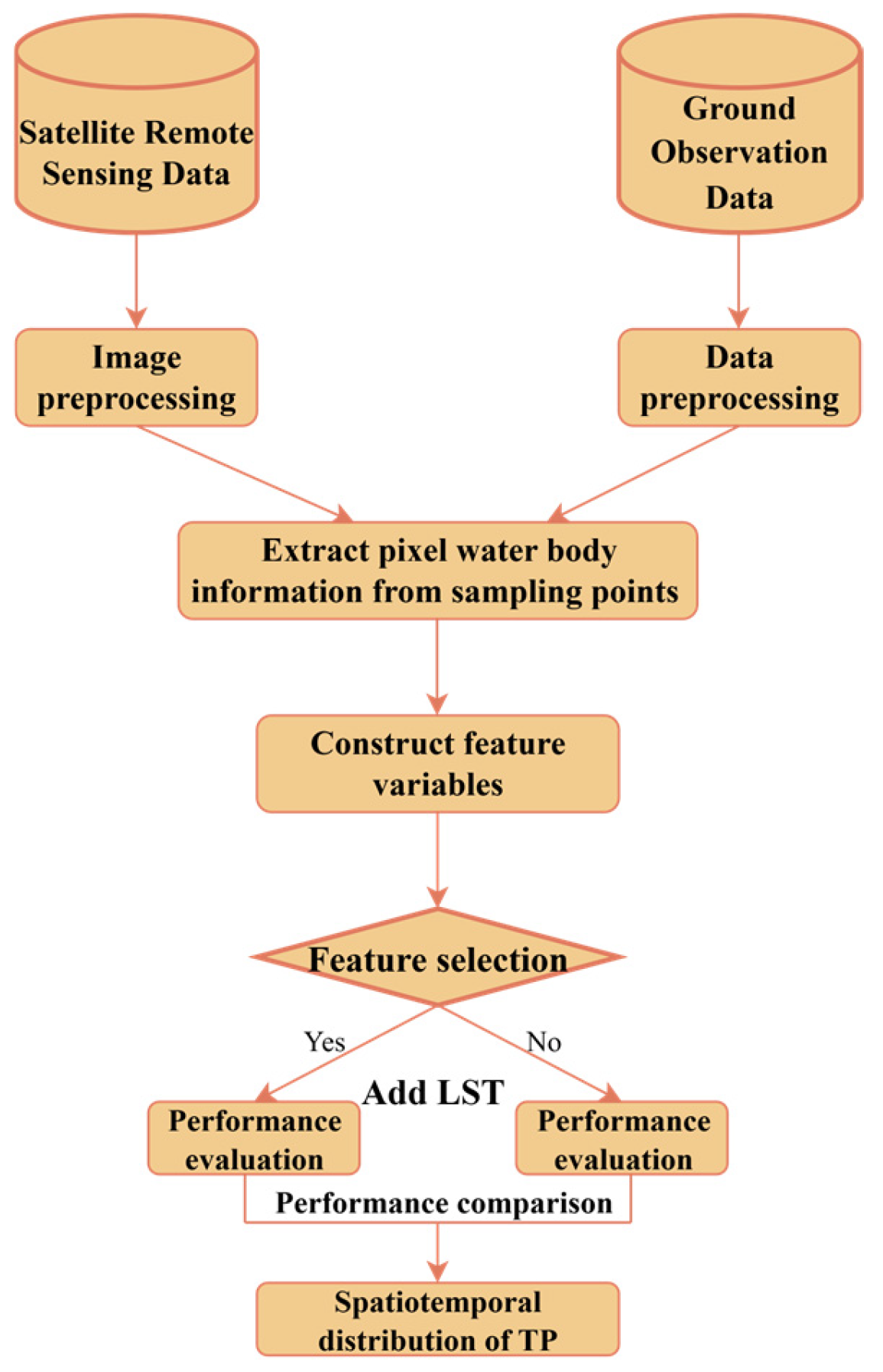
Based on this feature selection, two Random Forest regression models were developed for TP estimation. The first model, serving as a baseline, used spectral feature combinations as independent variables and in situ TP concentrations as the dependent variable. In the second model, spectral band combinations and land surface temperature jointly served as independent variables, with in situ TP concentration as the response variable. The modeling process is shown in Figure 3.

2.6. Model Accuracy Evaluation

Feature selection was conducted in two steps: (1) initial screening of spectral band and water temperature combinations using correlation analysis; (2) final selection based on feature importance derived from Random Forest. The dataset was randomly partitioned into training and testing subsets at a ratio of 7:3.
Model performance was assessed using the coefficient of determination (R2), mean squared error (MSE), root mean squared error (RMSE), and mean absolute error (MAE). The specific formula is as follows:
R 2 = 1 i = 1 n y i y ^ ı 2 i = 1 n y i y ¯ 2
R M S E = 1 n i = 1 n y i y ^ ı 2
M S E = 1 n i = 1 n y i y ^ ı 2
M A E = 1 n i = 1 n y i y ^ ı
where y i and y ^ ı are the measured and predicted values of the water quality parameter, respectively. The term y ¯ represents the meaning of the measured values, and n is the total number of samples.

3. Results

3.1. Performance Evaluation of the TP Estimation Model

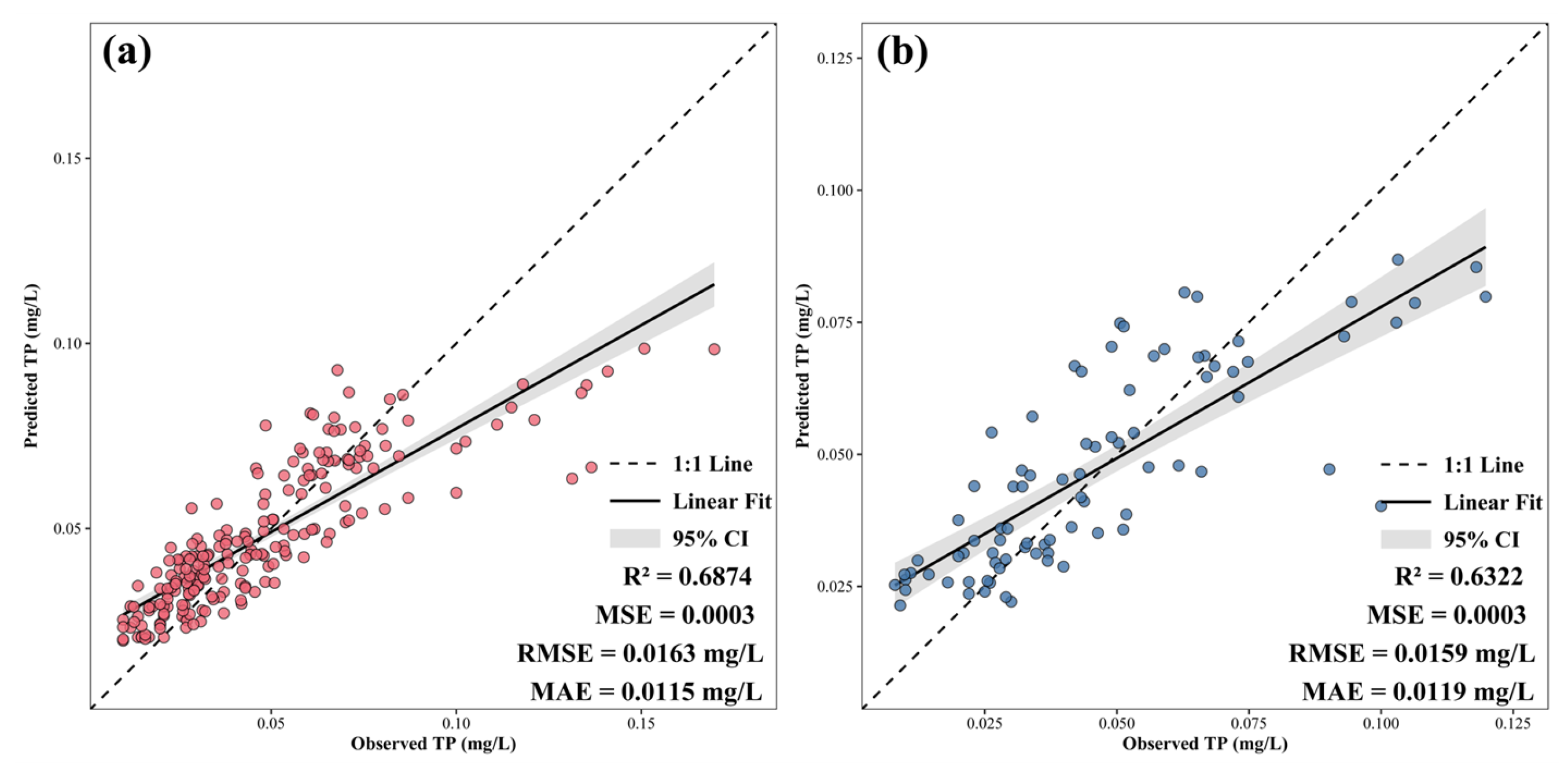
The validation results show that the proposed model achieves modest accuracy within the hydro-environmental context of the study area and effectively captures the region-specific relationships between TP and the features. For the training set (Figure 4a), the model achieved an R2 of 0.69 and an RMSE of 0.0163 mg/L, accompanied by low MSE and MAE values, indicating a good overall fit. For the testing set (Figure 4b), the model yielded an R2 of 0.63 and an RMSE of 0.0159 mg/L, also with low MSE and MAE values. The small difference in R2 (0.05) between training and testing sets suggests robust generalization with minimal overfitting or underfitting. The testing set R2 of 0.63 demonstrates modest predictive capability for retrieving total phosphorus concentrations from remote sensing imagery, while the low error metrics confirm good agreement between predicted and observed values.

3.2. Seasonal and Spatiotemporal Variation of TP Concentration in the Dongjiang River Delta

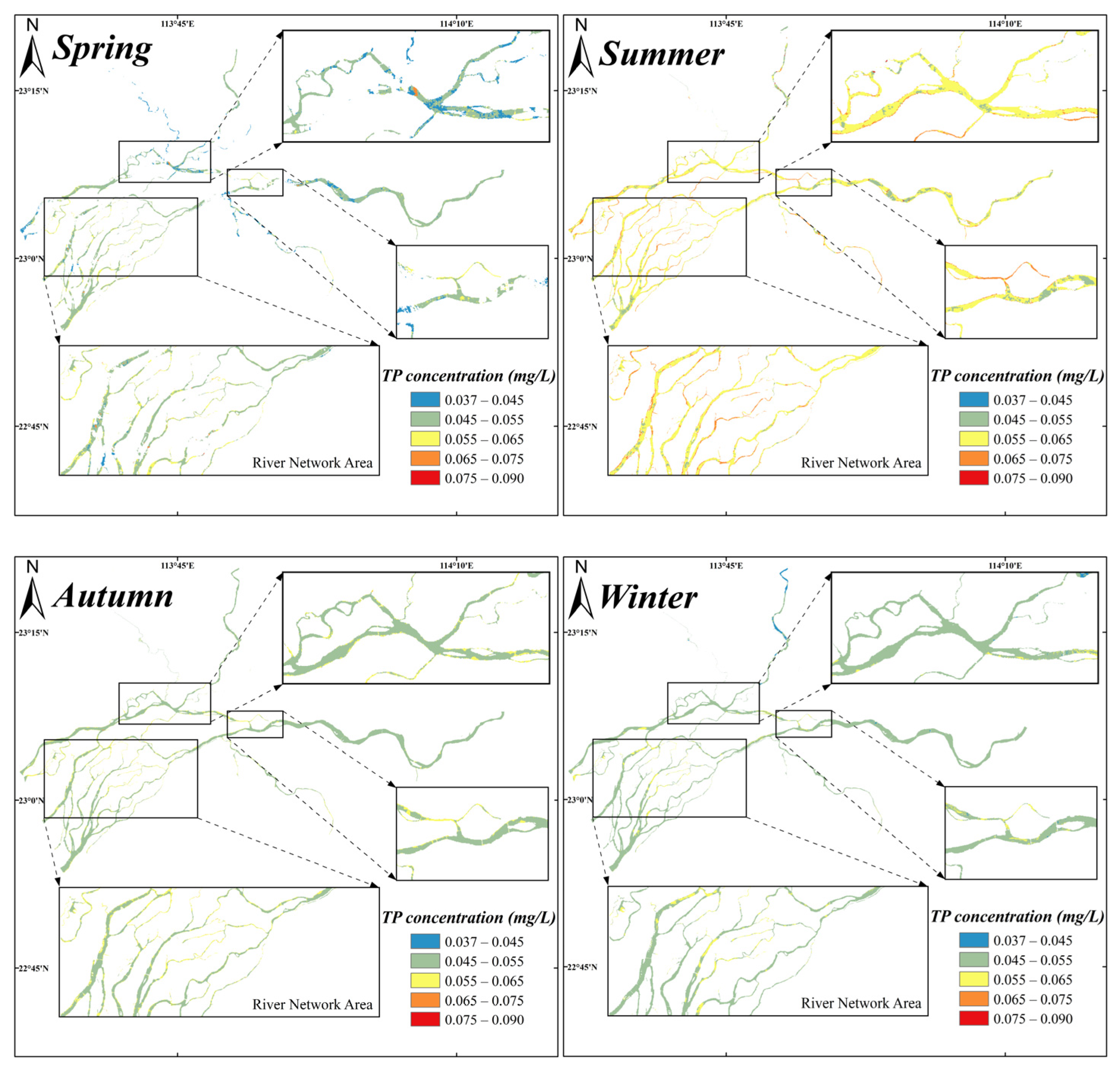
Remote sensing imagery of the Dongjiang River Delta from four seasons during 2022–2023 was used to analyze the seasonal distribution of TP concentrations. Figure 5 illustrates the spatial patterns of TP in spring, summer, autumn, and winter. Considering the uncertainty of LST near riverbanks, LST pixel values within 120 m of the riverbanks were replaced with the corresponding LST values at the river centerline.
In spring, TP concentrations in parts of the delta ranged mainly from 0.045 to 0.055 mg/L, with some tributary areas reaching 0.055–0.060 mg/L, indicating mild eutrophication. Lower concentrations were observed in the Zengjiang estuary tributary and sections of the mainstream (0.037–0.045 mg/L). In summer, TP concentrations increased markedly, ranging from 0.055 to 0.065 mg/L, with parts of the mainstream and areas around the Shilongnan River reaching 0.065–0.075 mg/L, and some local spots approaching 0.09 mg/L. This seasonal rise is likely related to enhanced phosphorus release from sediments under high temperatures. During autumn and winter, TP concentrations decreased relative to summer, returning to 0.045–0.055 mg/L, though autumn levels remained slightly higher than those in spring. In winter, the tributary network exhibited relatively lower TP concentrations.
Overall, TP concentrations in the Dongjiang River Delta exhibited clear seasonal variations, with the highest levels in summer, the lowest in spring and winter, and intermediate levels in autumn. Notably, some areas reached moderate eutrophication in summer, highlighting potential ecological risks, while TP levels in autumn and winter reflected mild eutrophication, indicating a continued risk of phosphorus accumulation in the delta. It should be noted that the relatively coarse spatial resolution of LST products may limit their ability to capture fine-scale thermal variability in narrow rivers, which may in turn introduce uncertainties in TP estimation, and the associated results should therefore be interpreted with caution.

3.3. Annual Mean Retrieval Results from the Reflectance and Water Temperature Model

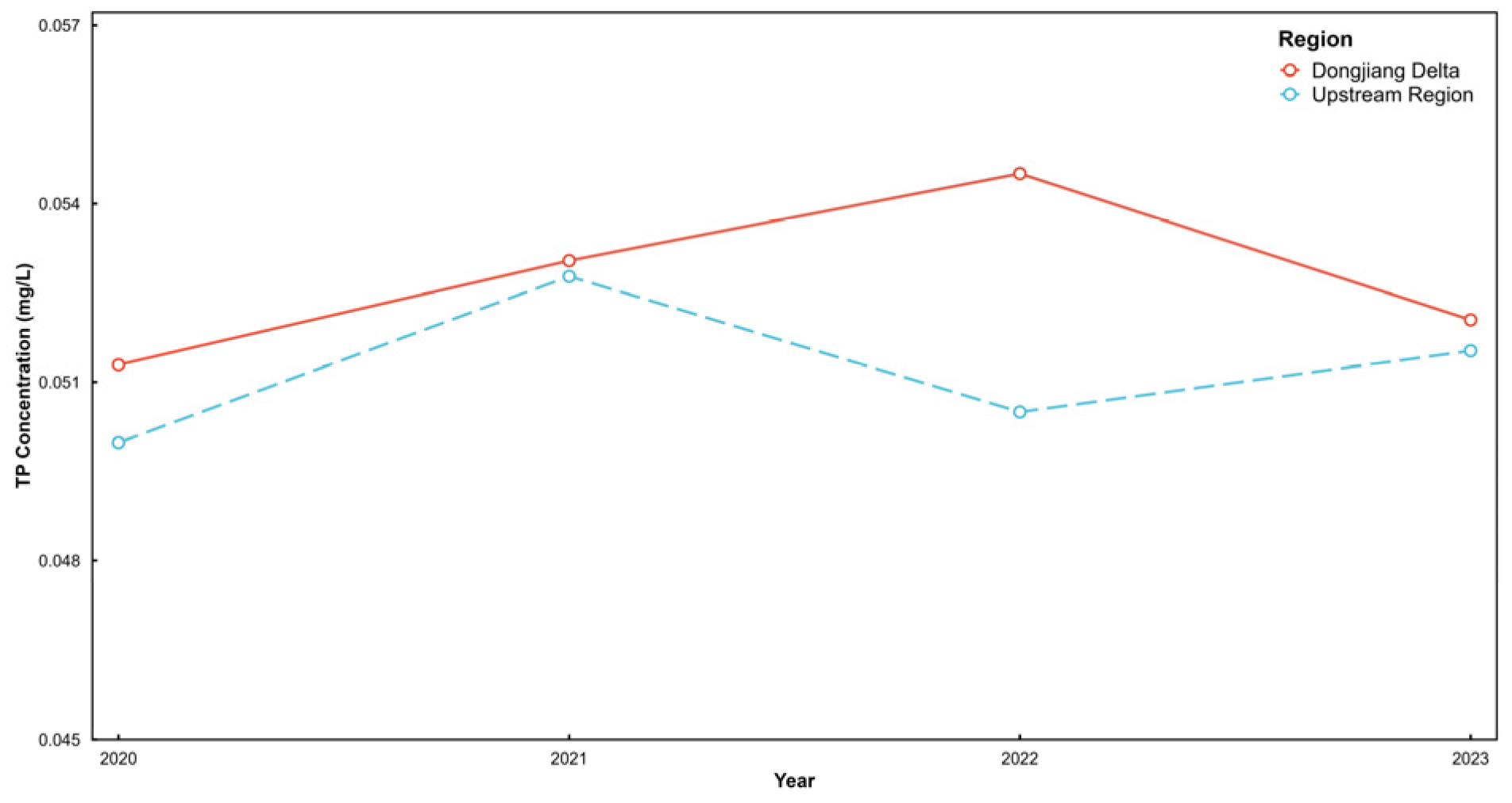
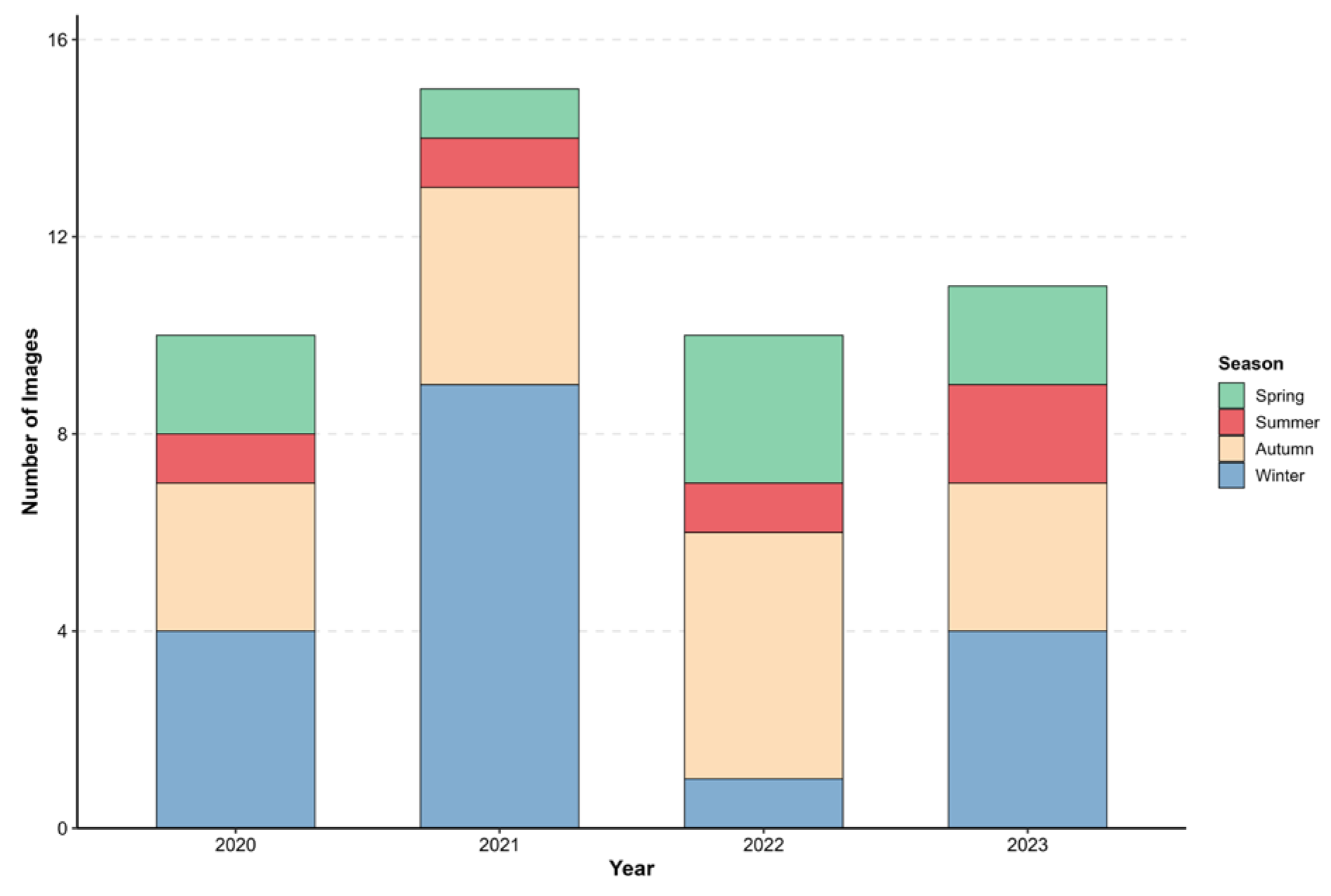
Landsat 8 images from 2020–2023 were filtered to retain scenes with cloud cover below 20%, and annual mean composites were generated using the GEE platform. Seasonal image counts for each year are shown in Figure A1. A retrieval model was developed based on remote sensing reflectance and land surface temperature data. Figure 6 presents the annual mean TP concentration at the regional scale. The results indicate that the annual average TP concentration in the Dongjiang Delta region consistently exceeds that in the upstream region. Notably, from 2020 to 2023, TP concentrations in both regions exhibited moderate fluctuations. Overall, these observations align well with the findings reported by Huang and Chen [38]. The higher TP levels in the Dongjiang Delta appear to be associated with urbanization and land-use change [19]; however, the increase in TP concentrations cannot be simply attributed to these factors alone.
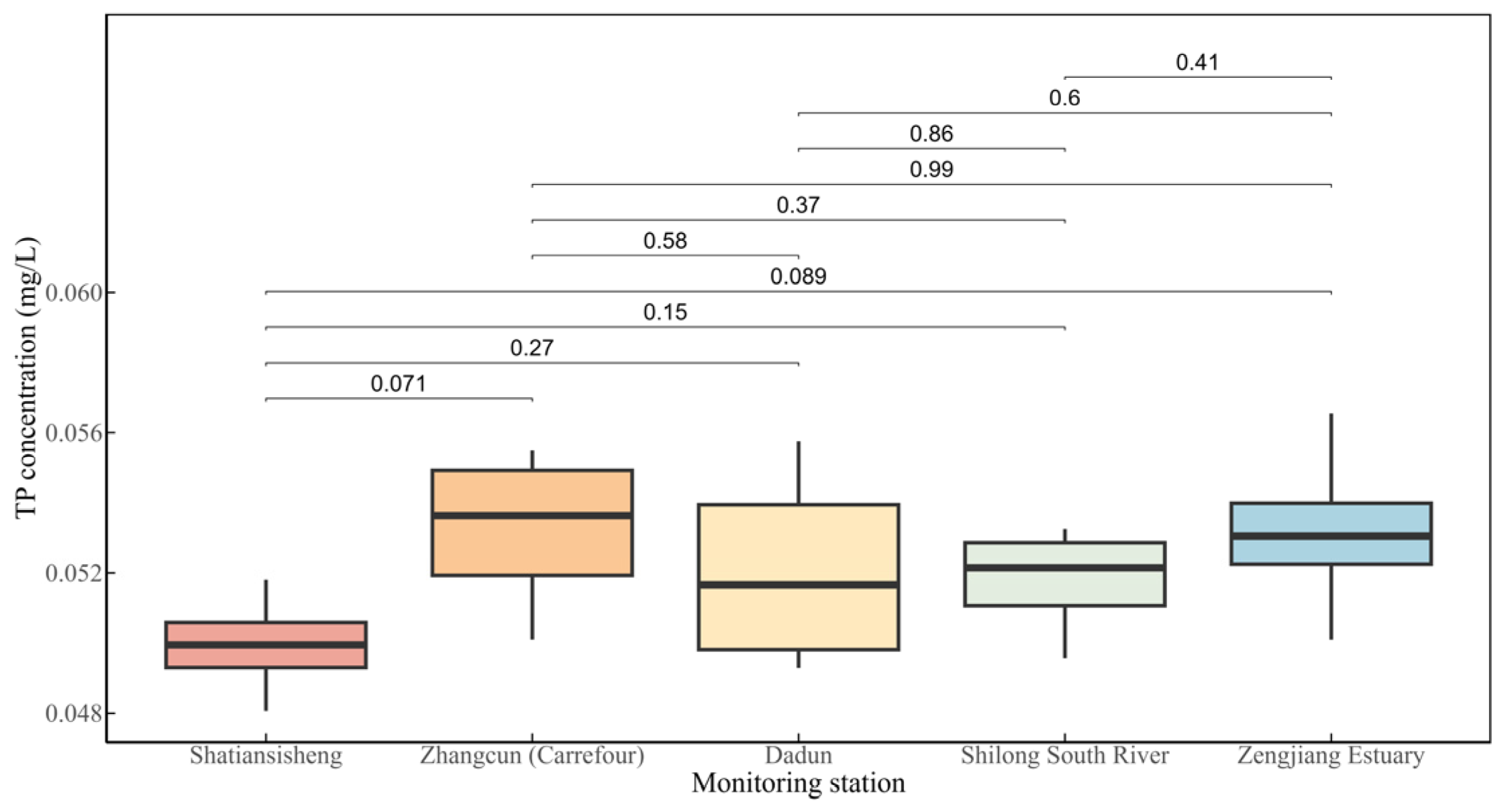
Further analysis was conducted on the annual mean TP concentrations retrieved at six water quality monitoring stations in the Dongjiang River Delta (Figure 7). Overall, the retrieved TP concentrations were consistent across the stations, primarily ranging from 0.050 to 0.054 mg/L, indicating minor inter-annual fluctuations. Among the stations, Zhangcun (Carrefour) exhibited the highest median TP concentration, likely reflecting higher urbanization and greater pollution sources in its vicinity. In contrast, the Shilong South River station recorded the lowest median concentration, while the Zengjiang Estuary Station showed a more dispersed TP distribution. Based on t-test p-values, no statistically significant differences were observed in the annual mean TP concentrations among the six stations. Given that TP is a non-optically active parameter, its true spatial variability needs to be considered in relation to OACs, while the lack of statistically significant differences may reflect similar model responses driven by major OACs.

4. Discussion

4.1. Analysis of Factor Importance in the Model

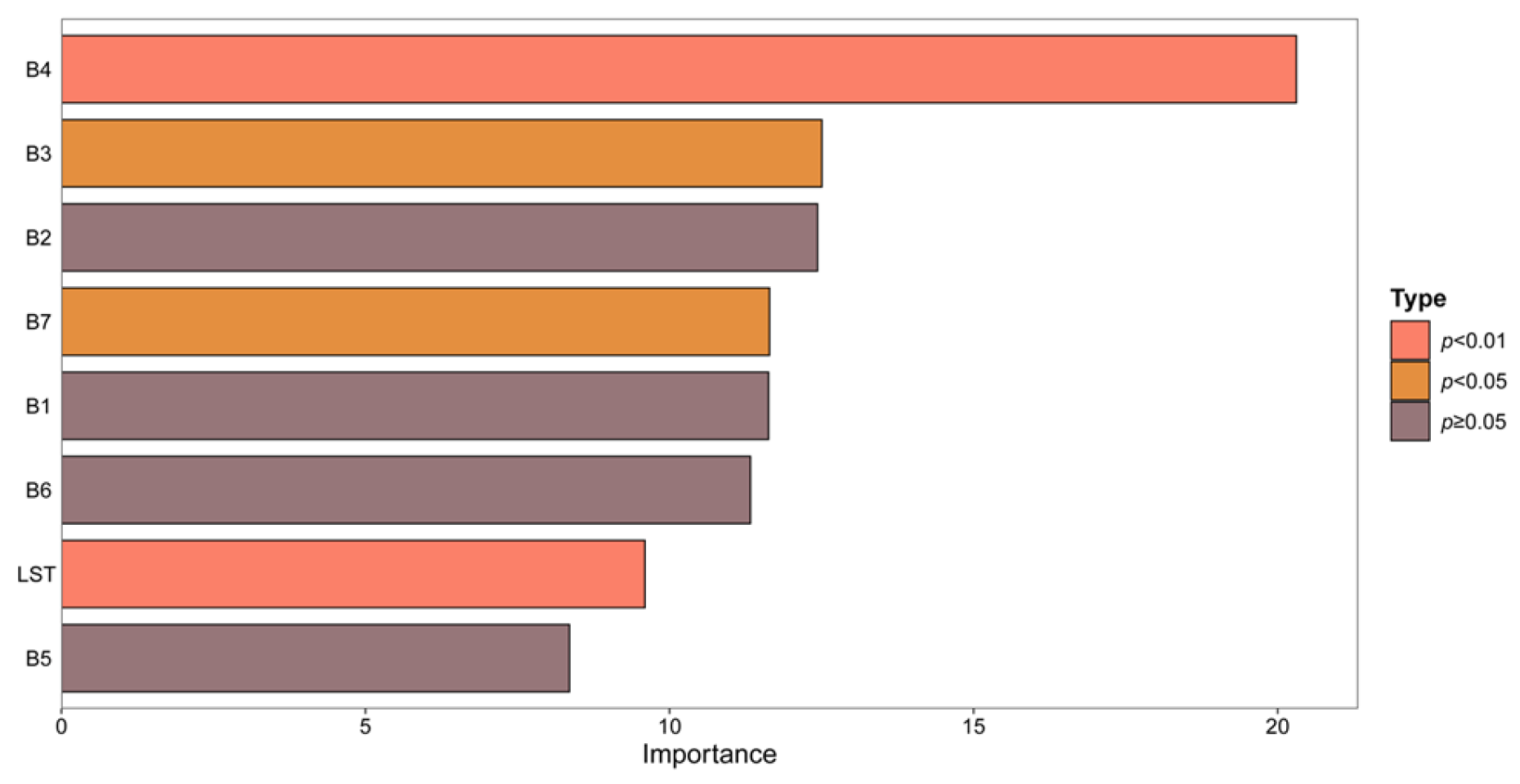
The OOB-based Random Forest variable importance (Figure 8) and Pearson’s correlation analysis (Table 4) identify the B3 and B4 bands (p < 0.01) as dominant predictors for the TP model. The prominence of these bands can be reasonably interpreted in the context of aquatic optical processes, as they are sensitive to variations in algal biomass and suspended solids [39]. These OACs are closely linked to phosphorus dynamics, given that phosphorus acts as a key nutrient regulating algal growth and can also be associated with particulate matter. Through these indirect pathways to TP variability, reflecting underlying biogeochemical interactions rather than purely statistical associations. It should be noted that correlation between TP and any OAC materials is strongly dependent on other environmental parameters such as temperature, trace nutrients, ecological systems, and other processes. These correlations may hold for a given location and time, but cannot be generalized.
Furthermore, in contrast to spectral bands, LST plays a different but complementary role in the model. Although its direct correlation with TP is relatively weak, its high importance ranking indicates that it provides additional contextual information. LST is more likely to act as a thermal environmental variable that modulates the coupling between TP and optically active constituents via temperature-dependent biogeochemical processes. However, LST may also partially serve as a proxy for seasonal phenology rather than solely representing a direct causal thermal regulator. While the lack of synchronous in situ OAC data prevents direct validation of this pathway, incorporating hydrological covariates to bridge the gap between non-optical drivers and optical responses remains a critical direction for future research.

4.2. Model Performance Comparison

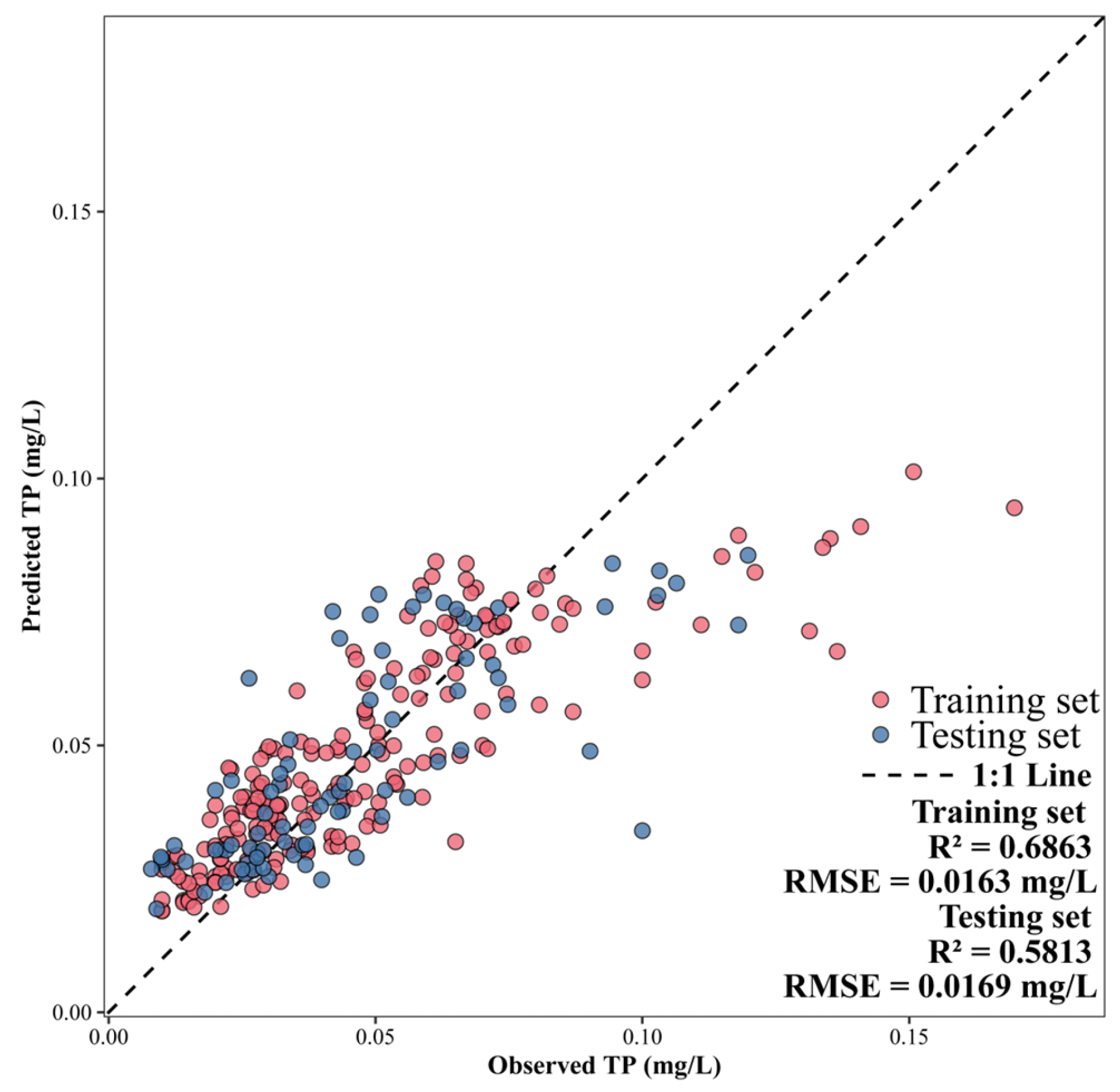
The model training results are shown in Figure 9, with R2 values of 0.69 for the training set and 0.58 for the testing set. Although the model exhibited slight overfitting, the overall low RMSE indicates satisfactory training performance.
To assess the impact of LST, a comparative analysis was conducted between the proposed model and a baseline model using only reflectance variables (Table 5). Incorporating LST reduced the MSE from 2.9 × 10⁻⁴ to 2.5 × 10⁻⁴, RMSE from 0.0169 mg/L to 0.0159 mg/L, and MAE from 0.0125 mg/L to 0.0119 mg/L. The R2 on the testing set increased from 0.58 to 0.63. LST likely acts as a contextual variable that modulates the relationships between TP and optically active proxies. By providing information on the thermal state, LST potentially enables the model to dynamically weight different proxies, for instance, distinguishing between Chl-a dominated conditions (which are strongly temperature-dependent) and turbidity-dominated conditions. This suggests that the model may be exploiting conditional relationships that vary with season and hydrodynamic state, thereby refining the indirect retrieval of TP.
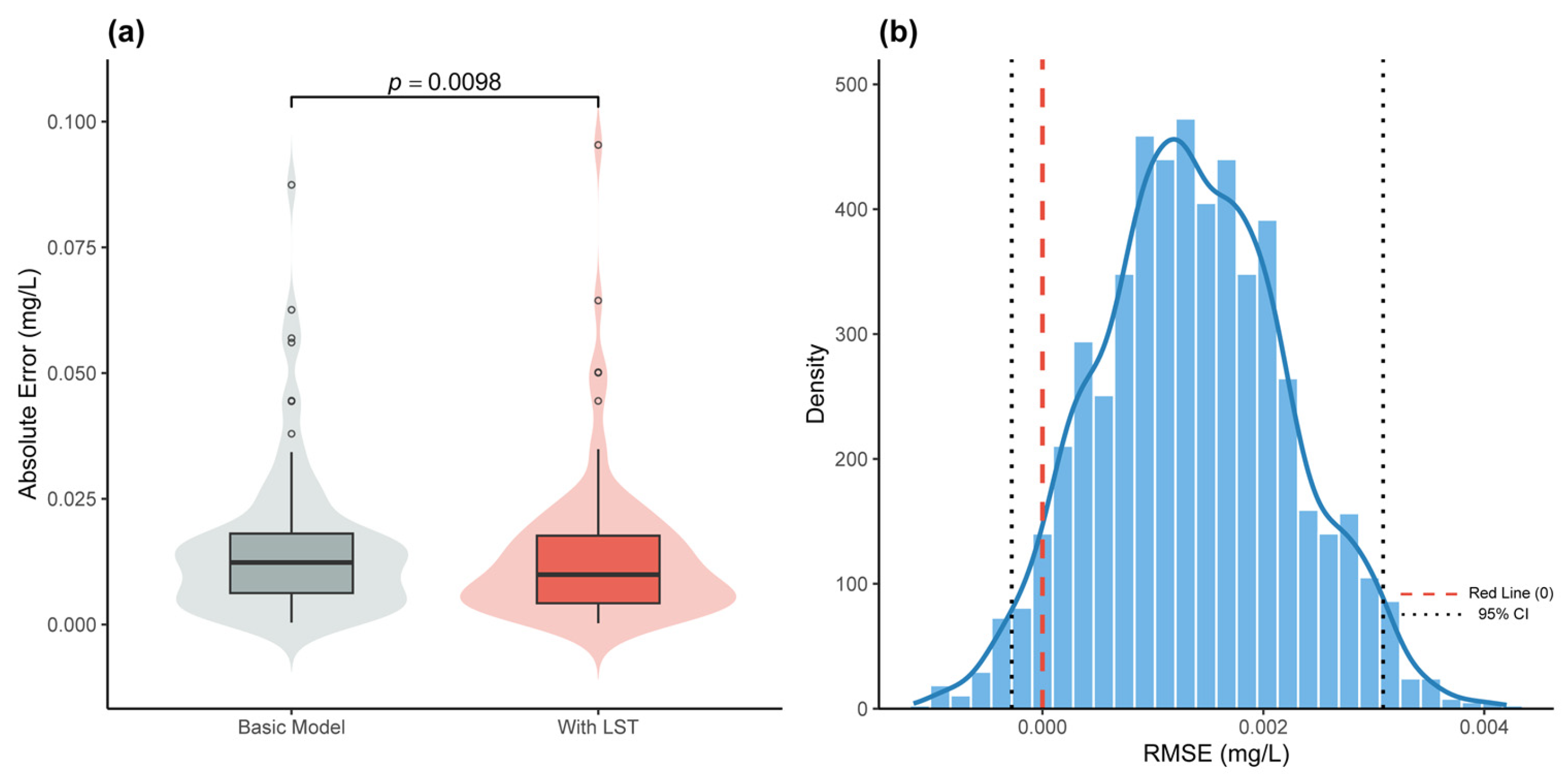
In addition, the Wilcoxon signed-rank test (Figure 10) conducted on the absolute prediction errors between the basic model and the with-LST model yielded a p-value of 0.0098. The bootstrap results further show that the RMSE reduction is generally shifted toward positive improvement, although a small portion of the distribution exhibits negative values, likely reflecting cases where LST introduces noise under extreme conditions. Overall, these results indicate that incorporating LST provides a modest improvement in model performance.

4.3. Influence of Land Surface Temperature on TP Concentration Retrieval Across Different Concentration Ranges

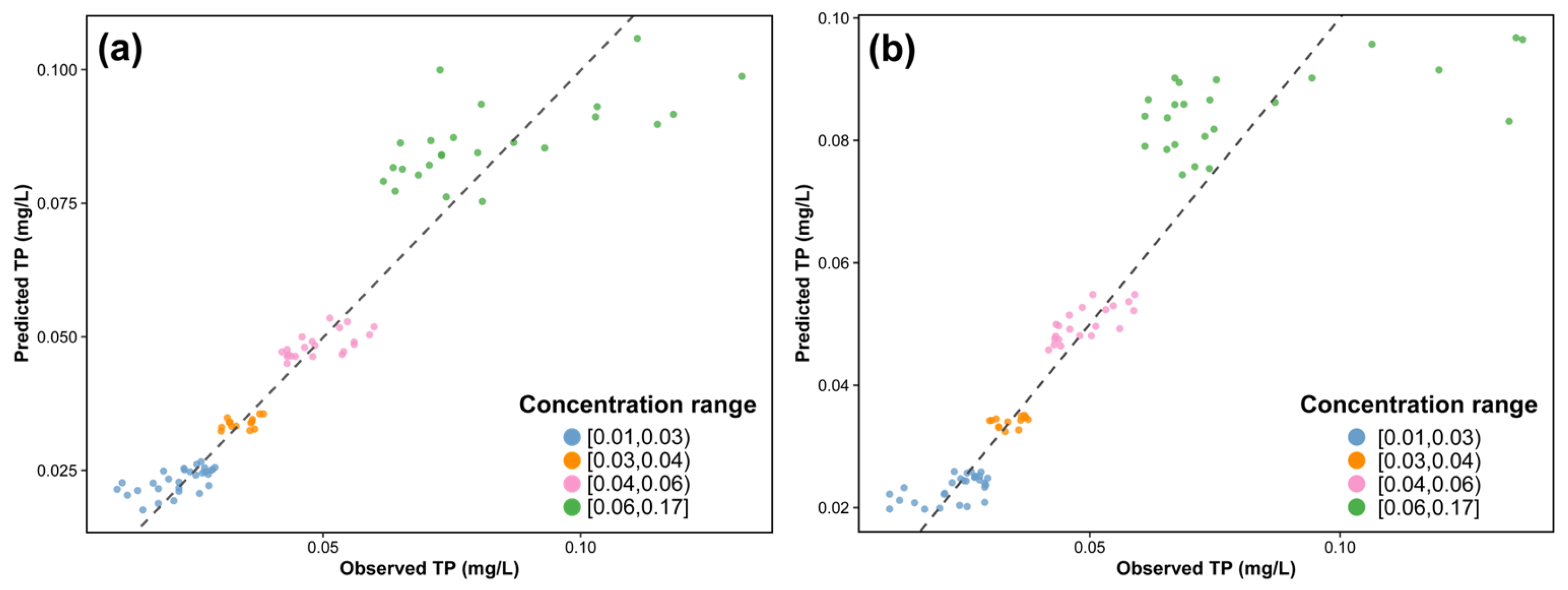
To evaluate model applicability and retrieval performance across different TP concentration ranges and ensure relevance to the Environmental Quality Standards for Surface Water (GB 3838-2002), measured TP values were divided into four intervals: [0.01, 0.03), [0.03, 0.04), [0.04, 0.06), and [0.06, 0.17] mg/L. Comparative analyses of the spectral-only and spectral/temperature models were conducted for each range, with results summarized in Table 6 and corresponding scatter plots presented in Figure 11a,b.
In the low concentration range, namely [0.01, 0.03) mg/L, the spectral-temperature model achieved an R2 of 0.30, slightly higher than the spectral-only model (0.28), with RMSE decreasing from 0.0051 mg/L to 0.0048 mg/L, indicating a positive contribution of water temperature. For [0.03, 0.04) mg/L, the spectral-temperature model also outperformed the spectral-only model, with the R2 increasing from 0.15 to 0.23 and the RMSE decreasing from 0.0024 mg/L to 0.0019 mg/L, reflecting improved model fit.
In the medium range, namely [0.04, 0.06) mg/L, both models performed well. While the spectral-only model showed a higher R2, the spectral-temperature model achieved a lower RMSE, suggesting enhanced stability with the inclusion of water temperature. In the high concentration range, that is, [0.06, 0.17] mg/L, the spectral-temperature model improved the R2 from 0.19 to 0.24 and reduced the RMSE from 0.0219 mg/L to 0.0169 mg/L; however, both models exhibited low R2 and high RMSE, indicating limited predictive capability at elevated TP levels, likely due to fewer high-concentration samples or outliers.
Overall, the spectral-temperature model outperformed the spectral-only model across the four TP concentration ranges, highlighting the utility of incorporating water temperature. The model demonstrated notably greater stability and accuracy across the other three concentration ranges, suggesting that combining remote sensing reflectance with land surface temperature is a promising approach for retrieving TP.

4.4. Limitations of the Study

4.4.1. Limitations of the LST Products

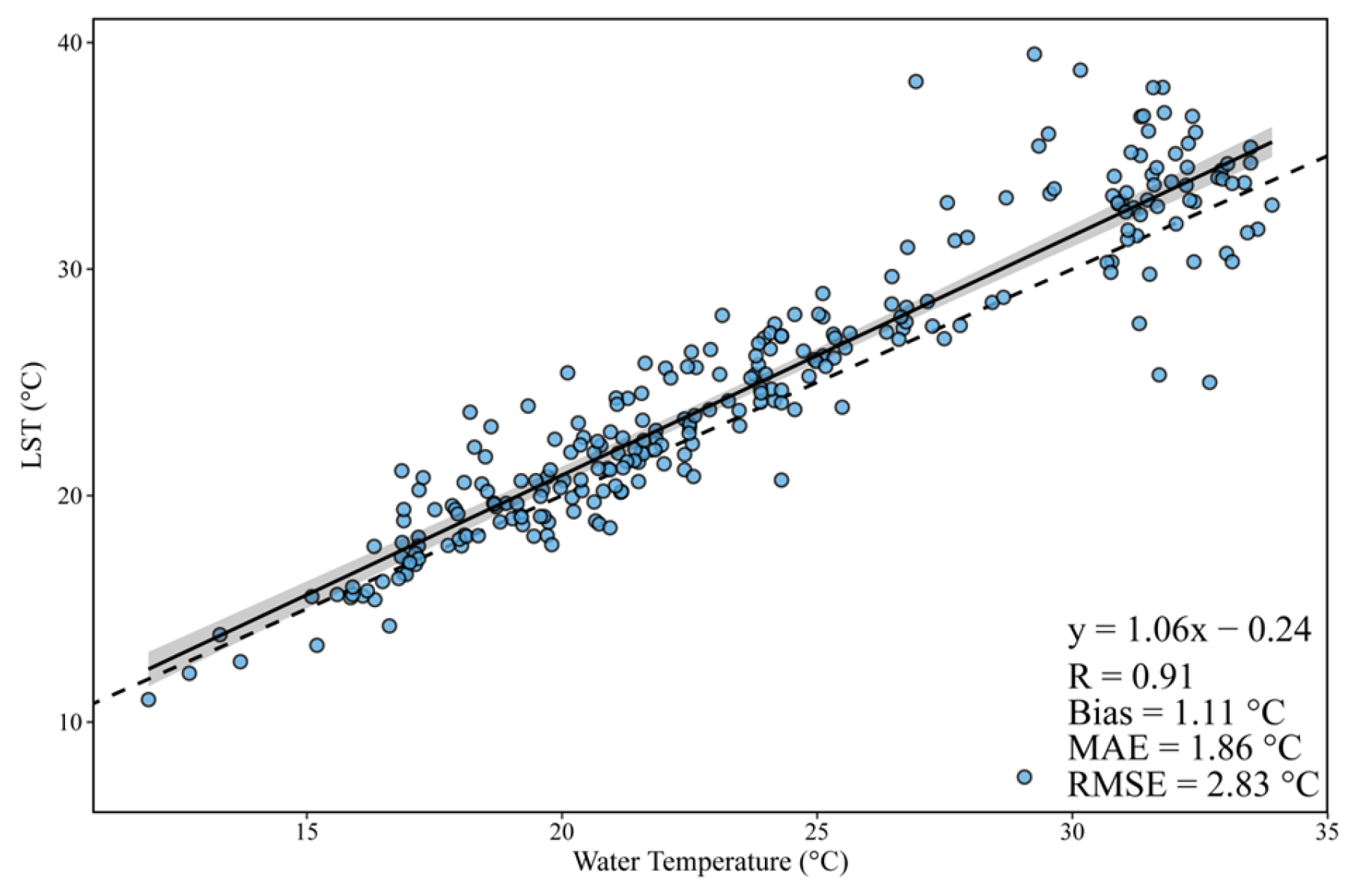
The LST products derived from Landsat 8 and Landsat 9 show a clear correlation with in situ water temperature (Figure A2) and contribute to improved TP estimation performance. However, it should be noted that thermal infrared measurements represent the water surface temperature at wavelengths of approximately 10–12 μm, whereas in situ water temperature is typically measured at a depth of about 0.5 m. This difference may introduce discrepancies between remotely sensed and measured values [40].
Nevertheless, although LST products can retrieve river water temperature with high accuracy under deep-water (>2 m) and cloud-free conditions [41], their reliability decreases at temperatures above 30 °C. This suggests increased uncertainty under extreme thermal conditions and highlights the need for cautious interpretation and supplementary in situ measurements [42].

4.4.2. Limitations of TP Estimation by Remote Sensing

The approach aims to improve the accuracy of TP estimation in surface waters, providing more reliable technical support for water quality monitoring and environmental management.
Nevertheless, several limitations of the current study warrant further investigation. As TP is a non-optically active parameter, it has no spectral response, and so its presence cannot be directly observed, which necessitates proxy-based retrieval approaches relying on correlations with optically active constituents such as algae and suspended solids [43]. This indirect linkage assumes that TP plays a dominant role in regulating algal growth or particulate dynamics. However, under conditions where algal development is constrained by other factors (e.g., light limitation, extreme toxicity), the correlation between TP and optical signals may change, thereby reducing TP estimation reliability when relying solely on spectral information [44,45].
In this context, previous studies [46,47] have shown that water temperature influences phosphorus release through its effects on microbial activity and sediment phosphorus flux. Based on this relationship, LST was incorporated as an auxiliary variable in this study, leading to improved TP estimation performance. Although LST does not fully represent in situ water temperature, it can still serve as a thermal environmental indicator to enhance the estimation of water quality parameters.

5. Conclusions

This study aimed to improve the accuracy of riverine TP concentration estimation by integrating LST with spectral features from remote sensing data. This improves the methods as correlations between TP and OACs, such as Chl-a, are temperature- and light-dependent as all three parameters—nutrients, temperature, and light availability, have major impacts on algae growth and the correlation of Chl-a with TP. In addition, different algae species have different Chl-a signatures and responses to nutrients such as TP. Acknowledging that TP estimation is driven by correlation with spectral signals of environmental proxies, this study utilized LST to capture the thermodynamic context of these biogeochemical processes. Water surface temperature was extracted and combined with multi-band spectral reflectance to construct feature sets for modeling using the Random Forest algorithm. Feature importance ranking and sequential feature elimination were employed to identify the most representative predictors, leading to a novel TP estimation method that fuses spectral and temperature information. The model evaluation results show that the proposed approach outperforms traditional models based solely on spectral features, achieving higher fitting accuracy without a significant increase in error metrics. A stratified accuracy assessment further confirmed that the new model performs well across different TP concentration ranges, with particularly strong predictive capability in the low-concentration range. Nonetheless, uncertainties remain in retrieving TP under both low and high concentration conditions. Future research should focus on integrating additional environmental information from multi-source datasets to further enhance retrieval accuracy. In summary, this study demonstrates the considerable potential of incorporating temperature features into the remote sensing retrieval process for TP. The findings provide both theoretical support and a practical pathway for advancing large-scale water quality monitoring through the fusion of multi-source remote sensing data.

Author Contributions

S.L.: Writing—original draft, Software, Visualization. W.G.: Writing—review and editing, Project administration. Y.Y.: Methodology. Y.C.: Supervision and Funding acquisition. All authors have read and agreed to the published version of the manuscript.

Funding

This work was funded by the National Key Research and Development Program of China (2022YFC3202203). The work was also supported by the Program for Guangdong Introducing Innovative and Entrepreneurial Teams (2021ZT090543).

Data Availability Statement

The original data support the findings of this study and are openly available on Google Earth Engine. This study’s training and testing data and code can be obtained through author email, shegluo2025@163.com.

Conflicts of Interest

The authors declare that there are no financial interests, commercial affiliations, or other potential conflicts of interest that could have influenced the objectivity of this research or the writing of this paper.

Appendix A

Figure A1. Seasonal number of satellite images from 2020 to 2023.
Environments 13 00063 g0a1
Figure A2. Correlation analysis between band ST_B10 and water temperature.
Environments 13 00063 g0a2

References

  1. Chapman, D. Water Quality Assessments: A Guide to the Use of Biota, Sediments and Water in Environmental Monitoring, 2nd ed.; CRC Press: London, UK, 2021; ISBN 978-1-003-06210-3. [Google Scholar]
  2. Ma, T.; Zhao, N.; Ni, Y.; Yi, J.; Wilson, J.P.; He, L.; Du, Y.; Pei, T.; Zhou, C.; Song, C.; et al. China’s Improving Inland Surface Water Quality since 2003. Sci. Adv. 2020, 6, eaau3798. [Google Scholar] [CrossRef] [PubMed]
  3. Gholizadeh, M.; Melesse, A.; Reddi, L. A Comprehensive Review on Water Quality Parameters Estimation Using Remote Sensing Techniques. Sensors 2016, 16, 1298. [Google Scholar] [CrossRef] [PubMed]
  4. Topp, S.N.; Pavelsky, T.M.; Jensen, D.; Simard, M.; Ross, M.R.V. Research Trends in the Use of Remote Sensing for Inland Water Quality Science: Moving Towards Multidisciplinary Applications. Water 2020, 12, 169. [Google Scholar] [CrossRef]
  5. Cao, Z.; Ma, R.; Duan, H.; Pahlevan, N.; Melack, J.; Shen, M.; Xue, K. A Machine Learning Approach to Estimate Chlorophyll-a from Landsat-8 Measurements in Inland Lakes. Remote Sens. Environ. 2020, 248, 111974. [Google Scholar] [CrossRef]
  6. Chebud, Y.; Naja, G.M.; Rivero, R.G.; Melesse, A.M. Water Quality Monitoring Using Remote Sensing and an Artificial Neural Network. Water Air Soil Pollut. 2012, 223, 4875–4887. [Google Scholar] [CrossRef]
  7. Yang, H.; Kong, J.; Hu, H.; Du, Y.; Gao, M.; Chen, F. A Review of Remote Sensing for Water Quality Retrieval: Progress and Challenges. Remote Sens. 2022, 14, 1770. [Google Scholar] [CrossRef]
  8. Huang, C.; Guo, Y.; Yang, H.; Li, Y.; Zou, J.; Zhang, M.; Lyu, H.; Zhu, A.; Huang, T. Using Remote Sensing to Track Variation in Phosphorus and Its Interaction With Chlorophyll-a and Suspended Sediment. IEEE J. Sel. Top. Appl. Earth Obs. Remote Sens. 2015, 8, 4171–4180. [Google Scholar] [CrossRef]
  9. Lu, S.; Deng, R.; Liang, Y.; Xiong, L.; Ai, X.; Qin, Y. Remote Sensing Retrieval of Total Phosphorus in the Pearl River Channels Based on the GF-1 Remote Sensing Data. Remote Sens. 2020, 12, 1420. [Google Scholar] [CrossRef]
  10. He, S.; Zhang, Y.; Luo, L.; Song, Y. Establishment of Remote Sensing Inversion Model and Its Application in Pollution Source Identification: A Case Study of East Lake in Wuhan. Remote Sens. 2024, 16, 3402. [Google Scholar] [CrossRef]
  11. Dong, L.; Liu, P.; Qi, Z.; Lin, J.; Duan, M. Development and Validation of a Machine-Learning Model for Predicting the Risk of Death in Sepsis Patients with Acute Kidney Injury. Heliyon 2024, 10, e29985. [Google Scholar] [CrossRef]
  12. Liang, Y.; Yin, F.; Xie, D.; Liu, L.; Zhang, Y.; Ashraf, T. Inversion and Monitoring of the TP Concentration in Taihu Lake Using the Landsat-8 and Sentinel-2 Images. Remote Sens. 2022, 14, 6284. [Google Scholar] [CrossRef]
  13. Biedunkova, O.; Kuznietsov, P.; Mandryk, O. Study of the Dominant Modes of Formation and Variability of Potentially Toxic Element Concentrations and Their Impact on Environmental Quality. Chemosphere 2025, 388, 144688. [Google Scholar] [CrossRef] [PubMed]
  14. Delpla, I.; Jung, A.-V.; Baures, E.; Clement, M.; Thomas, O. Impacts of Climate Change on Surface Water Quality in Relation to Drinking Water Production. Environ. Int. 2009, 35, 1225–1233. [Google Scholar] [CrossRef] [PubMed]
  15. Sharaf, N.; Fadel, A.; Bresciani, M.; Giardino, C.; Lemaire, B.J.; Slim, K.; Faour, G.; Vinçon-Leite, B. Lake Surface Temperature Retrieval from Landsat-8 and Retrospective Analysis in Karaoun Reservoir, Lebanon. JARS 2019, 13, 044505. [Google Scholar] [CrossRef]
  16. Attiah, G.; Kheyrollah Pour, H.; Scott, K.A. Lake Surface Temperature Retrieved from Landsat Satellite Series (1984 to 2021) for the North Slave Region. Earth Syst. Sci. Data 2023, 15, 1329–1355. [Google Scholar] [CrossRef]
  17. Ma, H.Y.; Qiu, J.Z.; Wang, Y.P. Time Series Remote Sensing of Land Use Changes and Influences on Runoff and Sediment Yield in Dongjiang River Basin, China. In Proceedings of the 2022 Photonics & Electromagnetics Research Symposium (PIERS), Hangzhou, China, 25–27 April 2022; pp. 660–665. [Google Scholar]
  18. Zhou, T.; Wu, J.; Peng, S. Assessing the Effects of Landscape Pattern on River Water Quality at Multiple Scales: A Case Study of the Dongjiang River Watershed, China. Ecol. Indic. 2012, 23, 166–175. [Google Scholar] [CrossRef]
  19. Zeng, J.; Liu, Z.; Liu, X.; Zhang, L.; Zhang, J.; Zeng, Y. The Spatiotemporal Variations and Potential Causes of Water Quality of Headwaters of Dongjiang River, Southeastern China. Sustainability 2023, 15, 6455. [Google Scholar] [CrossRef]
  20. Cao, X.; Zhang, J.; Meng, H.; Lai, Y.; Xu, M. Remote Sensing Inversion of Water Quality Parameters in the Yellow River Delta. Ecol. Indic. 2023, 155, 110914. [Google Scholar] [CrossRef]
  21. Masek, J.G.; Wulder, M.A.; Markham, B.; McCorkel, J.; Crawford, C.J.; Storey, J.; Jenstrom, D.T. Landsat 9: Empowering Open Science and Applications through Continuity. Remote Sens. Environ. 2020, 248, 111968. [Google Scholar] [CrossRef]
  22. Alrashed, R.M.; Hasan, S.M.; Al-Mutairi, N.Z.; Al-Attar, I. Analyzing the Impacts of Discharges from Coastal Outfalls on Water Quality of Kuwait Bay via Landsat Monitoring. J. Eng. Res. 2024, 13, 2950–2964. [Google Scholar] [CrossRef]
  23. Mamun, M.; Hasan, M.; An, K.-G. Advancing Reservoirs Water Quality Parameters Estimation Using Sentinel-2 and Landsat-8 Satellite Data with Machine Learning Approaches. Ecol. Inform. 2024, 81, 102608. [Google Scholar] [CrossRef]
  24. Wang, X.; Yang, W. Water Quality Monitoring and Evaluation Using Remote Sensing Techniques in China: A Systematic Review. Ecosyst. Health Sustain. 2019, 5, 47–56. [Google Scholar] [CrossRef]
  25. Earth Resources Observation and Science (EROS) Center. Landsat 8–9 Operational Land Imager/Thermal Infrared Sensor Level-2, Collection 2; U.S. Geological Survey: Reston, VA, USA, 2020. [Google Scholar] [CrossRef]
  26. Zhao, Z.; Yang, J.; Wang, M.; Chen, J.; Sun, C.; Song, N.; Wang, J.; Feng, S. The PCA-NDWI Urban Water Extraction Model Based on Hyperspectral Remote Sensing. Water 2024, 16, 963. [Google Scholar] [CrossRef]
  27. Özelkan, E. Water Body Detection Analysis Using NDWIIndices Derived from Landsat-8 OLI. Pol. J. Environ. Stud. 2020, 29, 1759–1769. [Google Scholar] [CrossRef]
  28. Breiman, L. Random Forests. Mach. Learn. 2001, 45, 5–32. [Google Scholar] [CrossRef]
  29. Genuer, R.; Poggi, J.-M.; Tuleau-Malot, C. Variable Selection Using Random Forests. Pattern Recognit. Lett. 2010, 31, 2225–2236. [Google Scholar] [CrossRef]
  30. Gómez, D.; Salvador, P.; Sanz, J.; Casanova, J.L. A New Approach to Monitor Water Quality in the Menor Sea (Spain) Using Satellite Data and Machine Learning Methods. Environ. Pollut. 2021, 286, 117489. [Google Scholar] [CrossRef]
  31. Dong, L.; Gong, C.; Wang, X.; Wang, Y.; He, D.; Hu, Y.; Li, L.; Yang, Z. Seasonal Monitoring Method for TN and TP Based on Airborne Hyperspectral Remote Sensing Images. Remote Sens. 2024, 16, 1614. [Google Scholar] [CrossRef]
  32. Hafeez, S.; Wong, M.S.; Ho, H.C.; Nazeer, M.; Nichol, J.; Abbas, S.; Tang, D.; Lee, K.H.; Pun, L. Comparison of Machine Learning Algorithms for Retrieval of Water Quality Indicators in Case-II Waters: A Case Study of Hong Kong. Remote Sens. 2019, 11, 617. [Google Scholar] [CrossRef]
  33. Yang, Y.; Zhang, X.; Gao, W.; Zhang, Y.; Hou, X. Improving Lake Chlorophyll-a Interpreting Accuracy by Combing Spectral and Texture Features of Remote Sensing. Environ. Sci. Pollut. Res. 2023, 30, 83628–83642. [Google Scholar]
  34. Chen, L.; Liu, L.; Liu, S.; Shi, Z.; Shi, C. The Application of Remote Sensing Technology in Inland Water Quality Monitoring and Water Environment Science: Recent Progress and Perspectives. Remote Sens. 2025, 17, 667. [Google Scholar] [CrossRef]
  35. Hu, W.; Liu, J.; Wang, H.; Miao, D.; Shao, D.; Gu, W. Retrieval of TP Concentration from UAV Multispectral Images Using IOA-ML Models in Small Inland Waterbodies. Remote Sens. 2023, 15, 1250. [Google Scholar] [CrossRef]
  36. Yu, X.; Yi, H.; Liu, X.; Wang, Y.; Liu, X.; Zhang, H. Remote-Sensing Estimation of Dissolved Inorganic Nitrogen Concentration in the Bohai Sea Using Band Combinations Derived from MODIS Data. Int. J. Remote Sens. 2016, 37, 327–340. [Google Scholar] [CrossRef]
  37. Oliveira Santos, V.; Guimarães, B.M.D.M.; Neto, I.E.L.; de Souza Filho, F.D.A.; Costa Rocha, P.A.; Thé, J.V.G.; Gharabaghi, B. Chlorophyll-a Estimation in 149 Tropical Semi-Arid Reservoirs Using Remote Sensing Data and Six Machine Learning Methods. Remote Sens. 2024, 16, 1870. [Google Scholar] [CrossRef]
  38. Huang, Y.; Chen, Y. Prediction of Total Phosphorus Based on Distance Correlation and Machine Learning Methods—A Case Study of Dongjiang River, China. Water Air Soil Pollut. 2024, 235, 105. [Google Scholar] [CrossRef]
  39. Vinh, P.Q.; Ha, N.T.T.; Binh, N.T.; Thang, N.N.; Oanh, L.T.; Thao, N.T.P. Developing Algorithm for Estimating Chlorophyll-a Concentration in the Thac Ba Reservoir Surface Water Using Landsat 8 Imagery. Vietnam J. Earth Sci. 2019, 41, 10–20. [Google Scholar] [CrossRef]
  40. Wang, Y.; Deng, Y.; Yang, Y.; Tuo, Y.; Wang, X.; Zhu, J. Investigation of the Spatiotemporal Patterns in Water Surface Temperature from Landsat Data in Plateau Rivers. Remote Sens. 2025, 17, 1141. [Google Scholar] [CrossRef]
  41. Cook, M. Atmospheric Compensation for a Landsat Land Surface Temperature Product; ProQuest LLC: Ann Arbor, MI, USA, 2014. [Google Scholar]
  42. Woolway, R.I.; Jennings, E.; Shatwell, T.; Golub, M.; Pierson, D.C.; Maberly, S.C. Lake Heatwaves under Climate Change. Nature 2021, 589, 402–407. [Google Scholar] [CrossRef]
  43. Xiong, J.; Lin, C.; Ma, R.; Cao, Z. Remote Sensing Estimation of Lake Total Phosphorus Concentration Based on MODIS: A Case Study of Lake Hongze. Remote Sens. 2019, 11, 2068. [Google Scholar] [CrossRef]
  44. Beck, W.S.; Hall, E.K. Confounding Factors in Algal Phosphorus Limitation Experiments. PLoS ONE 2018, 13, e0205684. [Google Scholar] [CrossRef]
  45. Ghane, A.; Boegman, L. Vertical Mixing, Light Penetration and Phosphorus Cycling Regulate Seasonal Algae Blooms in an Ice-Covered Dimictic Lake. J. Geophys. Res. Biogeosci. 2025, 130, e2024JG008258. [Google Scholar] [CrossRef]
  46. Cheng, X.; Huang, Y.; Li, R.; Pu, X.; Huang, W.; Yuan, X. Impacts of Water Temperature on Phosphorus Release of Sediments under Flowing Overlying Water. J. Contam. Hydrol. 2020, 235, 103717. [Google Scholar] [CrossRef]
  47. Sarkar, A.; Biswas, D.R.; Datta, S.C.; Manjaiah, K.M.; Roy, T. Release of Phosphorus from Laboratory Made Coated Phosphatic Fertilizers in Soil Under Different Temperature and Moisture Regimes. Proc. Natl. Acad. Sci. India Sect. B Biol. Sci. 2017, 87, 1299–1308. [Google Scholar] [CrossRef]
Figure 1. Location of the Dongjiang River Basin.
Environments 13 00063 g001
Figure 2. Selection of top 10 features based on Random Forest importance.
Environments 13 00063 g002
Figure 3. Flowchart of modeling process.
Environments 13 00063 g003
Figure 4. Evaluation of the retrieval accuracy for TP concentrations in the Dongjiang River Basin: (a) results for the training set; (b) results for the testing set.
Environments 13 00063 g004
Figure 5. Seasonal spatiotemporal distribution of TP concentration in the Dongjiang River Delta during 2022–2023.
Environments 13 00063 g005
Figure 6. Annual mean concentration of TP in the Dongjiang River Delta and its upstream region from 2020 to 2023.
Environments 13 00063 g006
Figure 7. Annual mean concentration of TP at various stations in the Dongjiang River Delta from 2020 to 2023.
Environments 13 00063 g007
Figure 8. Ranking of the original spectral bands by OOB-based Random Forest importance.
Environments 13 00063 g008
Figure 9. Retrieval results of TP concentration based on spectral reflectance.
Environments 13 00063 g009
Figure 10. Statistical validation and comparison of the two models were conducted: (a) Wilcoxon signed-rank test; (b) bootstrap analysis.
Environments 13 00063 g010
Figure 11. Comparison of TP estimation performance between the spectral model and the hybrid model across different concentration ranges: (a) spectral + LST model; (b) spectral model.
Environments 13 00063 g011
Table 1. Spectral reflectance combinations for retrieving TP concentration.
VariablesExpression Example
One variable B i
Two variables B i B j
Three variables B i + B j B k
Four variables B i + B j B k + B l
Table 2. The result of feature combination selection.
NumberFeature Combination
F1B3 + B6 + B4 + B7
F2B2/(B1 + B3 + B4)
F4(B2 + B3)/(B1 + B4)
Table 3. Random Forest parameter optimization.
Random Forest ParametersValues
ntree1000
mtry1
nodesize15
set.seed494
Table 4. Correlation index between total phosphorus and band.
BandCorrelationBandCorrelation
B10.4 **B50.32 **
B20.4 **B60.27 **
B30.41 **B70.31 **
B40.51 **LST0.27 **
** represents p < 0.01.
Table 5. Comparison of model performance metrics for TP estimation.
ModelR2RMSE (mg/L)MSEMAE (mg/L)
Spectral model0.580.01692.9 × 10−40.0125
Spectral + LST model0.630.01592.5 × 10−40.0119
Table 6. Model performance in different TP concentration ranges.
ModelConcentration IntervalR2RMSE (mg/L)
Spectral model0.01–0.030.280.0051
0.03–0.040.150.0024
0.04–0.060.430.0043
0.06–0.170.190.0219
Spectral + LST model0.01–0.030.300.0048
0.03–0.040.230.0019
0.04–0.060.340.0036
0.06–0.170.240.0169
Disclaimer/Publisher’s Note: The statements, opinions and data contained in all publications are solely those of the individual author(s) and contributor(s) and not of MDPI and/or the editor(s). MDPI and/or the editor(s) disclaim responsibility for any injury to people or property resulting from any ideas, methods, instructions or products referred to in the content.