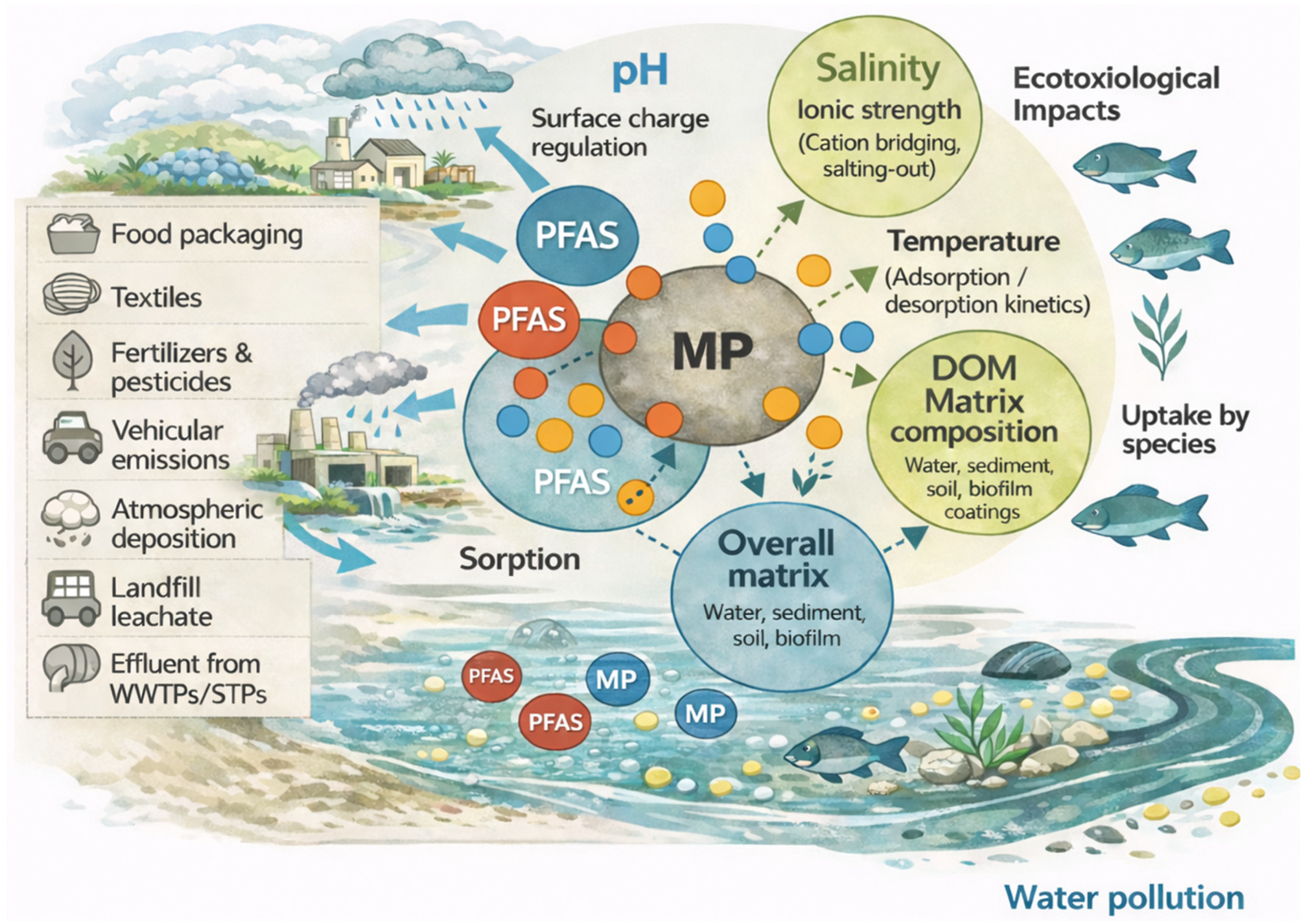

Combined Environmental Impacts and Toxicological Interactions of Per- and Polyfluoroalkyl Substances (PFAS) and Microplastics (MPs)

 ,
,  ,
,  and
and 
Abstract
1. Introduction
2. Literature Search and Methodology
3. Co-Existence of MPs and PFAS in the Environment
3.1. Characteristics, Sources, and Impacts of MPs
3.2. Environmental Occurrence and Toxicological Profile of PFAS
3.3. Status of Management and Mitigation of MPs Pollution
4. Mechanisms of Interaction
Interactions and Combined Effects
5. Combined Exposure and Toxicological Effects
6. Environmental and Health Implications
7. Research Gaps and Future Directions
7.1. Monitoring, Sampling, and Analytical Standardization
7.2. Reporting Metrics and Interaction-Relevant Data Gaps
7.3. Environmental Realism: Aging, Biofilms, and Mixture Complexity
7.4. Modeling, Transport, and Ecological Integration
8. Conclusions
Author Contributions
Funding
Data Availability Statement
Conflicts of Interest
References
- De Jesus Gaffney, V.; Almeida, C.M.M.; Rodrigues, A.; Ferreira, E.; Benoliel, M.J.; Cardoso, V.V. Occurrence of pharmaceuticals in a water supply system and related human health risk assessment. Water Res. 2015, 72, 199–208. [Google Scholar] [CrossRef]
- Umar, A.; Soltanighias, T.; Orsini, L.; Abdallah, M.A.-E. Toxicity of microplastics and per- and polyfluoroalkyl substances in sentinel freshwater models, Daphnia, Zebrafish and unicellular green algae: A systemic review. Environ. Pollut. Manag. 2025, 2, 196–215. [Google Scholar] [CrossRef]
- Gallo, F.; Fossi, C.; Weber, R.; Santillo, D.; Sousa, J.; Ingram, I.; Nadal, A.; Romano, D. Marine litter plastics and microplastics and their toxic chemicals components: The need for urgent preventive measures. Environ. Sci. Eur. 2018, 30, 13. [Google Scholar] [CrossRef] [PubMed]
- Bakir, A.; Rowland, S.J.; Thompson, R.C. Enhanced desorption of persistent organic pollutants from microplastics under simulated physiological conditions. Environ. Pollut. 2014, 185, 16–23. [Google Scholar] [CrossRef]
- Elgarahy, A.M.; Akhdhar, A.; Elwakeel, K.Z. Microplastics prevalence, interactions, and remediation in the aquatic environment: A critical review. J. Environ. Chem. Eng. 2021, 9, 106224. [Google Scholar] [CrossRef]
- Wang, F.; Shih, K.M.; Li, X.Y. The partition behavior of perfluorooctanesulfonate (PFOS) and perfluorooctanesulfonamide (FOSA) on microplastics. Chemosphere 2015, 119, 841–847. [Google Scholar] [CrossRef]
- Jha, G.; Kankarla, V.; McLennon, E.; Pal, S.; Sihi, D.; Dari, B.; Diaz, D.; Nocco, M. Per- and Polyfluoroalkyl Substances (PFAS) in Integrated Crop-Livestock Systems: Environmental Exposure and Human Health Risks. Int. J. Environ. Res. Public Health 2021, 18, 12550. [Google Scholar] [CrossRef]
- Xie, W.; Wang, J.; Song, Z.; Chen, Y.; Lyu, X. Effects of Nano- and Microplastic Particles (NMPs) on the Transport of PFOA in Natural Sediment. Water Air Soil Pollut. 2025, 236, 936. [Google Scholar] [CrossRef]
- Kang, P.; Zhao, Y.; Zuo, C.; Cai, Y.; Shen, C.; Ji, B.; Wei, T. The unheeded inherent connections and overlap between microplastics and poly- and perfluoroalkyl substances: A comprehensive review. Sci. Total Environ. 2023, 878, 163028. [Google Scholar] [CrossRef] [PubMed]
- Sobhani, Z.; Fang, C.; Naidu, R.; Megharaj, M. Microplastics as a vector of toxic chemicals in soil: Enhanced uptake of perfluorooctane sulfonate and perfluorooctanoic acid by earthworms through sorption and reproductive toxicity. Environ. Technol. Innov. 2021, 22, 101476. [Google Scholar] [CrossRef]
- Parashar, N.; Mahanty, B.; Hait, S. Microplastics as carriers of per- and polyfluoroalkyl substances (PFAS) in aquatic environment: Interactions and ecotoxicological effects. Water Emerging Contam. Nanoplastics 2023, 2, 15. [Google Scholar] [CrossRef]
- Dai, Y.; Zhao, J.; Sun, C.; Li, D.; Liu, X.; Wang, Z.; Yue, T.; Xing, B. Interaction and combined toxicity of microplastics and per- and polyfluoroalkyl substances in aquatic environment. Front. Environ. Sci. Eng. 2022, 16, 136. [Google Scholar] [CrossRef]
- Ihsanullah, I.; Bilal, M.; Khan, U.; Zulfiqar, R.; Ali, S.; Khan, M.T. Biochar as a sustainable solution for per- and polyfluoroalkyl substances (PFAS) Removal: Progress, Challenges, and Future Horizons. Sep. Purif. Technol. 2025, 365, 132674. [Google Scholar] [CrossRef]
- Hasan, A.K.M.M.; Hossain, M.F.; Uddin, M.; Khan, M.T.; Saif, U.M.; Hamed, M.; Martyniuk, C.J.; Chivers, D.P. Mechanistic insights into microplastic-induced reproductive toxicity in aquatic organisms: A comprehensive review. Aquat. Toxicol. 2025, 286, 107478. [Google Scholar] [CrossRef]
- Jian, M.; Chen, X.; Liu, S.; Liu, Y.; Liu, Y.; Wang, Q.; Tu, W. Combined exposure with microplastics increases the toxic effects of PFOS and its alternative F-53B in adult zebrafish. Sci. Total Environ. 2024, 920, 170948. [Google Scholar] [CrossRef]
- Leslie, H.A.; van Velzen, M.J.M.; Brandsma, S.H.; Vethaak, A.D.; Garcia-Vallejo, J.J.; Lamoree, M.H. Discovery and quantification of plastic particle pollution in human blood. Environ. Int. 2022, 163, 107199. [Google Scholar] [CrossRef]
- Roslan, N.S.; Lee, Y.Y.; Ibrahim, Y.S.; Tuan Anuar, S.; Yusof, K.M.K.K.; Lai, L.A.; Brentnall, T. Detection of microplastics in human tissues and organs: A scoping review. J. Glob. Health 2024, 14, 04179. [Google Scholar] [CrossRef]
- Weis, J. Marine Pollution: What Everyone Needs to Know, 2nd ed.; Oxford University Press: Oxford, UK, 2024. [Google Scholar]
- Chen, Q.; Zhao, H.; Liu, Y.; Jin, L.; Peng, R. Factors Affecting the Adsorption of Heavy Metals by Microplastics and Their Toxic Effects on Fish. Toxics 2023, 11, 490. [Google Scholar] [CrossRef]
- Wu, H.; Huang, X.; Duan, X.; Lao, A.; Zheng, Z. Meta-analysis evaluates toxicity of PFAS to microalgae: Mechanisms and ecological risks. J. Hazard. Mater. 2025, 496, 139328. [Google Scholar] [CrossRef] [PubMed]
- Vdovchenko, A.; Resmini, M. Mapping Microplastics in Humans: Analysis of Polymer Types, and Shapes in Food and Drinking Water—A Systematic Review. Int. J. Mol. Sci. 2024, 25, 7074. [Google Scholar] [CrossRef] [PubMed]
- Dallaev, R.; Papež, N.; Allaham, M.M.; Holcman, V. Biodegradable Polymers: Properties, Applications, and Environmental Impact. Polymers 2025, 17, 1981. [Google Scholar] [CrossRef]
- Liu, S.; Qiu, Y.; He, Z.; Shi, C.; Xing, B.; Wu, F. Microplastic-derived dissolved organic matter and its biogeochemical behaviors in aquatic environments: A review. Crit. Rev. Environ. Sci. Technol. 2024, 54, 865–882. [Google Scholar] [CrossRef]
- Qi, Y.; Cao, H.; Pan, W.; Wang, C.; Liang, Y. The role of dissolved organic matter during Per- and Polyfluorinated Substance (PFAS) adsorption, degradation, and plant uptake: A review. J. Hazard. Mater. 2022, 436, 129139. [Google Scholar] [CrossRef] [PubMed]
- Hahladakis, J.N.; Velis, C.A.; Weber, R.; Iacovidou, E.; Purnell, P. An overview of chemical additives present in plastics: Migration, release, fate and environmental impact during their use, disposal and recycling. J. Hazard. Mater. 2018, 344, 179–199. [Google Scholar] [CrossRef]
- Wiesinger, H.; Wang, Z.; Hellweg, S. Deep Dive into Plastic Monomers, Additives, and Processing Aids. Environ. Sci. Technol. 2021, 55, 9339–9351. [Google Scholar] [CrossRef]
- Caldwell, J.; Taladriz-Blanco, P.; Lehner, R.; Lubskyy, A.; Ortuso, R.D.; Rothen-Rutishauser, B.; Petri-Fink, A. The micro-, submicron-, and nanoplastic hunt: A review of detection methods for plastic particles. Chemosphere 2022, 293, 133514. [Google Scholar] [CrossRef]
- Li, H.; Lee, L.M.; Yu, D.; Chan, S.H.; Li, A. An optimized multi-technique based analytical platform for identification, characterization and quantification of nanoplastics in water. Talanta 2024, 272, 125800. [Google Scholar] [CrossRef]
- Ośko, J.; Kadac-Czapska, K.; Jażdżewska, K.; Nowak, N.; Kowalczyk, P.; Grembecka, M. Nanoplastics: From Separations to Analysis—Challenges and Limitations. Separations 2025, 12, 185. [Google Scholar] [CrossRef]
- Emenike, P.C.; Araoye, O.V.; Academe, S.O.; Unokiwedi, P.; Omole, D.O. The effects of microplastics in oceans and marine environment on public health–A mini-review. IOP Conf. Ser. Earth Environ. Sci. 2022, 993, 012019. [Google Scholar] [CrossRef]
- Xia, Y.; Niu, S.; Yu, J. Microplastics as vectors of organic pollutants in aquatic environment: A review on mechanisms, numerical models, and influencing factors. Sci. Total Environ. 2023, 887, 164008. [Google Scholar] [CrossRef] [PubMed]
- World Health Organization. Microplastics in Drinking Water; World Health Organization: Geneva, Switzerland, 2019. [Google Scholar]
- Avio, C.G.; Gorbi, S.; Milan, M.; Benedetti, M.; Fattorini, D.; d’Errico, G.; Pauletto, M.; Bargelloni, L.; Regoli, F. Pollutants bioavailability and toxicological risk from microplastics to marine mussels. Environ. Pollut. 2015, 198, 211–222. [Google Scholar] [CrossRef]
- Canesi, L.; Ciacci, C.; Bergami, E.; Monopoli, M.P.; Dawson, K.A.; Papa, S.; Canonico, B.; Corsi, I. Evidence for immunomodulation and apoptotic processes induced by cationic polystyrene nanoparticles in the hemocytes of the marine bivalve Mytilus. Mar. Environ. Res. 2015, 111, 34–40. [Google Scholar] [CrossRef]
- von Moos, N.; Burkhardt-Holm, P.; Köhler, A. Uptake and Effects of Microplastics on Cells and Tissue of the Blue Mussel Mytilus edulis L. after an Experimental Exposure. Environ. Sci. Technol. 2012, 46, 11327–11335. [Google Scholar] [CrossRef]
- Cole, M.; Coppock, R.; Lindeque, P.K.; Altin, D.; Reed, S.; Pond, D.W.; Sørensen, L.; Galloway, T.S.; Booth, A.M. Effects of Nylon Microplastic on Feeding, Lipid Accumulation, and Moulting in a Coldwater Copepod. Environ. Sci. Technol. 2019, 53, 7075–7082. [Google Scholar] [CrossRef]
- Watts, A.J.R.; Lewis, C.; Goodhead, R.M.; Beckett, S.J.; Moger, J.; Tyler, C.R.; Galloway, T.S. Uptake and retention of microplastics by the shore crab Carcinus maenas. Environ. Sci. Technol. 2014, 48, 8823–8830. [Google Scholar] [CrossRef] [PubMed]
- Rochman, C.; Browne, M.; Halpern, B.; Hentschel, B.; Karapanagioti, H.; Hoh, E.; Rios-Mendoza, L.; Takada, H.; Teh, S.; Thompson, R. Classify Plastic Waste as Hazardous. Nature 2013, 494, 169–171. [Google Scholar] [CrossRef]
- Jovanović, B. Ingestion of microplastics by fish and its potential consequences from a physical perspective. Integr. Environ. Assess. Manag. 2017, 13, 510–515. [Google Scholar] [CrossRef] [PubMed]
- Wright, S.L.; Kelly, F.J. Plastic and Human Health: A Micro Issue? Environ. Sci. Technol. 2017, 51, 6634–6647. [Google Scholar] [CrossRef]
- Law, K.L.; Morét-Ferguson, S.; Maximenko, N.A.; Proskurowski, G.; Peacock, E.E.; Hafner, J.; Reddy, C.M. Plastic Accumulation in the North Atlantic Subtropical Gyre. Science 2010, 329, 1185–1188. [Google Scholar] [CrossRef]
- Binda, G.; Kalčíková, G.; Allan, I.J.; Hurley, R.; Rødland, E.; Spanu, D.; Nizzetto, L. Microplastic aging processes: Environmental relevance and analytical implications. TrAC Trends Anal. Chem. 2024, 172, 117566. [Google Scholar] [CrossRef]
- Yu, F.; Wu, J.; Wang, H.; Bao, Y.; Xing, H.; Ye, W.; Li, X.; Huang, M. Interaction of microplastics with perfluoroalkyl and polyfluoroalkyl substances in water: A review of the fate, mechanisms and toxicity. Sci. Total Environ. 2024, 948, 175000. [Google Scholar] [CrossRef]
- Deng, Y.; Zhang, Y.; Lemos, B.; Ren, H. Tissue accumulation of microplastics in mice and biomarker responses suggest widespread health risks of exposure. Sci. Rep. 2017, 7, 46687. [Google Scholar] [CrossRef]
- Lu, Y.; Zhang, Y.; Deng, Y.; Jiang, W.; Zhao, Y.; Geng, J.; Ding, L.; Ren, H. Uptake and Accumulation of Polystyrene Microplastics in Zebrafish (Danio rerio) and Toxic Effects in Liver. Environ. Sci. Technol. 2016, 50, 4054–4060. [Google Scholar] [CrossRef] [PubMed]
- Amato-Lourenço, L.F.; Carvalho-Oliveira, R.; Júnior, G.R.; dos Santos Galvão, L.; Ando, R.A.; Mauad, T. Presence of airborne microplastics in human lung tissue. J. Hazard. Mater. 2021, 416, 126124. [Google Scholar] [CrossRef]
- Ragusa, A.; Svelato, A.; Santacroce, C.; Catalano, P.; Notarstefano, V.; Carnevali, O.; Papa, F.; Rongioletti, M.C.A.; Baiocco, F.; Draghi, S.; et al. Plasticenta: First evidence of microplastics in human placenta. Environ. Int. 2021, 146, 106274. [Google Scholar] [CrossRef] [PubMed]
- Kadac-Czapska, K.; Bukowska, B.; Sicińska, P.; Grembecka, M. Hidden Threats in Infant Diets and Environment—Risks of Microplastics and Nanoplastics in Food. Rev. Environ. Contam. Toxicol. 2025, 263, 24. [Google Scholar] [CrossRef]
- Cox, K.D.; Covernton, G.A.; Davies, H.L.; Dower, J.F.; Juanes, F.; Dudas, S.E. Human Consumption of Microplastics. Environ. Sci. Technol. 2019, 53, 7068–7074. [Google Scholar] [CrossRef]
- Cai, Q.; Xu, M.; Ma, J.; Zhang, X.; Yang, G.; Long, L.; Chen, C.; Wu, J.; Song, C.; Xiao, Y. Improvement of cadmium immobilization in contaminated paddy soil by using ureolytic bacteria and rice straw. Sci. Total Environ. 2023, 874, 162594. [Google Scholar] [CrossRef]
- Li, Y.; Tao, L.; Wang, Q.; Wang, F.; Li, G.; Song, M. Potential Health Impact of Microplastics: A Review of Environmental Distribution, Human Exposure, and Toxic Effects. Environ. Health 2023, 1, 249–257. [Google Scholar] [CrossRef]
- Leonard, S.; Liddle, C.R.; Atherall, C.A.; Chapman, E.; Watkins, M.; Calaminus, S.; Rotchell, J.M. Microplastics in human blood: Polymer types, concentrations and characterisation using μFTIR. Environ. Int. 2024, 188, 108751. [Google Scholar] [CrossRef]
- Marfella, R.; Prattichizzo, F.; Sardu, C.; Fulgenzi, G.; Graciotti, L.; Spadoni, T.; D’Onofrio, N.; Scisciola, L.; La Grotta, R.; Frigé, C.; et al. Microplastics and Nanoplastics in Atheromas and Cardiovascular Events. N. Engl. J. Med. 2024, 390, 900–910. [Google Scholar] [CrossRef] [PubMed]
- Gałęziewska, J.; Gromek, P.; Kruczkowska, W.; Grabowska, K.; Jęckowski, M.; Capuano, F.; Kciuk, M.; Pasieka, Z.; Kłosiński, K. Evaluating the relationship between microplastics and nanoplastics contamination and diverse cancer types development. Environ. Pollut. 2025, 385, 127052. [Google Scholar] [CrossRef]
- Evich, M.G.; Davis, M.J.B.; McCord, J.P.; Acrey, B.; Awkerman, J.A.; Knappe, D.R.U.; Lindstrom, A.B.; Speth, T.F.; Tebes-Stevens, C.; Strynar, M.J.; et al. Per- and polyfluoroalkyl substances in the environment. Science 2022, 375, eabg9065. [Google Scholar] [CrossRef]
- Blaine, A.C.; Rich, C.D.; Sedlacko, E.M.; Hundal, L.S.; Kumar, K.; Lau, C.; Mills, M.A.; Harris, K.M.; Higgins, C.P. Perfluoroalkyl Acid Distribution in Various Plant Compartments of Edible Crops Grown in Biosolids-Amended soils. Environ. Sci. Technol. 2014, 48, 7858–7865. [Google Scholar] [CrossRef]
- Sunderland, E.M.; Hu, X.C.; Dassuncao, C.; Tokranov, A.K.; Wagner, C.C.; Allen, J.G. A review of the pathways of human exposure to poly- and perfluoroalkyl substances (PFASs) and present understanding of health effects. J. Expo. Sci. Environ. Epidemiol. 2019, 29, 131–147. [Google Scholar] [CrossRef]
- Pi, N.; Ng, J.Z.; Kelly, B.C. Uptake and elimination kinetics of perfluoroalkyl substances in submerged and free-floating aquatic macrophytes: Results of mesocosm experiments with Echinodorus horemanii and Eichhornia crassipes. Water Res. 2017, 117, 167–174. [Google Scholar] [CrossRef]
- Wang, X.; Zheng, H.; Zhao, J.; Luo, X.; Wang, Z.; Xing, B. Photodegradation Elevated the Toxicity of Polystyrene Microplastics to Grouper (Epinephelus moara) through Disrupting Hepatic Lipid Homeostasis. Environ. Sci. Technol. 2020, 54, 6202–6212. [Google Scholar] [CrossRef]
- Le, S.-T.; Kibbey, T.C.G.; Weber, K.P.; Glamore, W.C.; O’Carroll, D.M. A group-contribution model for predicting the physicochemical behavior of PFAS components for understanding environmental fate. Sci. Total Environ. 2021, 764, 142882. [Google Scholar] [CrossRef] [PubMed]
- Pelch, K.E.; Reade, A.; Wolffe, T.A.M.; Kwiatkowski, C.F. PFAS health effects database: Protocol for a systematic evidence map. Environ. Int. 2019, 130, 104851. [Google Scholar] [CrossRef]
- Gharehveran, M.M.; Walus, A.M.; Anderson, T.A.; Subbiah, S.; Guelfo, J.; Frigon, M.; Longwell, A.; Suski, J.G. Per- and polyfluoroalkyl substances (PFAS)-free aqueous film forming foam formulations: Chemical composition and biodegradation in an aerobic environment. J. Environ. Chem. Eng. 2022, 10, 108953. [Google Scholar] [CrossRef]
- Guelfo, J.L.; Adamson, D.T. Evaluation of a national data set for insights into sources, composition, and concentrations of per- and polyfluoroalkyl substances (PFASs) in U.S. drinking water. Environ. Pollut. 2018, 236, 505–513. [Google Scholar] [CrossRef]
- Allen, J.G. Opinion. These Toxic Chemicals are Everywhere—Even in Your Body. And They Won’t Ever Go Away. The Washington Post, 2 January 2018. Available online: https://www.washingtonpost.com/opinions/these-toxic-chemicals-are-everywhere-and-they-wont-ever-go-away/2018/01/02/82e7e48a-e4ee-11e7-a65d-1ac0fd7f097e_story.html (accessed on 28 September 2025).
- Amarelo, M. EWG Study: Humans Serve as Sentinels for ‘Forever Chemicals’ Harm to Wildlife Health. Environmental Working Group. 2023. Available online: https://www.ewg.org/news-insights/news-release/2023/09/ewg-study-humans-serve-sentinels-forever-chemicals-harm-wildlife (accessed on 3 October 2025).
- Stockton, G.; Wurzer, C. Scientist: “Forever Chemicals” are Harming Wildlife Along with Humans. MPR News, 29 September 2023. Available online: https://www.mprnews.org/story/2023/09/29/pfas-forever-chemicals-harming-wildlife-scientist-says (accessed on 20 September 2025).
- Andrews, D.Q.; Stoiber, T.; Temkin, A.M.; Naidenko, O.V. Discussion. Has the human population become a sentinel for the adverse effects of PFAS contamination on wildlife health and endangered species? Sci. Total Environ. 2023, 901, 165939. [Google Scholar] [CrossRef]
- Dehghani, M.H.; Aghaei, M.; Bashardoust, P.; Rezvani Ghalhari, M.; Nayeri, D.; Malekpoor, M.; Sheikhi, S.; Shi, Z. An insight into the environmental and human health impacts of per- and polyfluoroalkyl substances (PFAS): Exploring exposure pathways and their implications. Environ. Sci. Eur. 2025, 37, 81. [Google Scholar] [CrossRef]
- Lewis, N.; Abdulkadir, A.; Kandel, S.; Rosby, R.; Hossain, E. Per- and Polyfluoroalkyl Substances (PFAS) as Emerging Obesogens: Mechanisms, Epidemiological Evidence, and Regulatory Challenges. Physiologia 2024, 4, 517–567. [Google Scholar] [CrossRef]
- US EPA. Our Current Understanding of the Human Health and Environmental Risks of PFAS [Overviews and Factsheets]. 2021. Available online: https://www.epa.gov/pfas/our-current-understanding-human-health-and-environmental-risks-pfas (accessed on 1 October 2025).
- European Commission. PFASs. Available online: https://food.ec.europa.eu/food-safety/chemical-safety/contaminants/catalogue/pfass_en (accessed on 18 September 2025).
- US EPA. Per- and Polyfluoroalkyl Substances (PFAS) [Reports and Assessments]. 2021. Available online: https://www.epa.gov/sdwa/and-polyfluoroalkyl-substances-pfas (accessed on 1 October 2025).
- Ateia, M.; Ersan, G.; Alalm, M.G.; Boffito, D.C.; Karanfil, T. Emerging investigator series: Microplastic sources, fate, toxicity, detection, and interactions with micropollutants in aquatic ecosystems–a review of reviews. Environ. Sci. Process. Impacts 2022, 24, 172–195. [Google Scholar] [CrossRef]
- Salawu, O.A.; Olivares, C.I.; Adeleye, A.S. Adsorption of PFAS onto secondary microplastics: A mechanistic study. J. Hazard. Mater. 2024, 470, 134185. [Google Scholar] [CrossRef]
- Torres, F.G.; Dioses-Salinas, D.C.; Pizarro-Ortega, C.I.; De-la-Torre, G.E. Sorption of chemical contaminants on degradable and non-degradable microplastics: Recent progress and research trends. Sci. Total Environ. 2021, 757, 143875. [Google Scholar] [CrossRef]
- Atugoda, T.; Vithanage, M.; Wijesekara, H.; Bolan, N.; Sarmah, A.K.; Bank, M.S.; You, S.; Ok, Y.S. Interactions between microplastics, pharmaceuticals and personal care products: Implications for vector transport. Environ. Int. 2021, 149, 106367. [Google Scholar] [CrossRef] [PubMed]
- Yang, G.; Tang, X.; Wilhelm, S.W.; Pan, W.; Rui, Z.; Xu, L.; Zhong, C.; Hu, X. Intermittent disturbance benefits colony size, biomass and dominance of Microcystis in Lake Taihu under field simulation condition. Harmful Algae 2020, 99, 101909. [Google Scholar] [CrossRef] [PubMed]
- Llorca, M.; Schirinzi, G.; Martínez, M.; Barceló, D.; Farré, M. Adsorption of perfluoroalkyl substances on microplastics under environmental conditions. Environ. Pollut. 2018, 235, 680–691. [Google Scholar] [CrossRef] [PubMed]
- Zoumpouli, G.A.; Herron, D.; Thornton, A.; Jefferson, B.; Campo, P. The role of coagulation on the fate of PFAS, brominated flame retardants and other trace contaminants in tertiary wastewater treatment for phosphorus control. Sci. Total Environ. 2023, 887, 163982. [Google Scholar] [CrossRef]
- Joo, S.H.; Liang, Y.; Kim, M.; Byun, J.; Choi, H. Microplastics with adsorbed contaminants: Mechanisms and Treatment. Environ. Chall. 2021, 3, 100042. [Google Scholar] [CrossRef]
- Zhuang, S.; Wang, J. Interaction between antibiotics and microplastics: Recent advances and perspective. Sci. Total Environ. 2023, 897, 165414. [Google Scholar] [CrossRef]
- Jin, Y.H.; Liu, W.; Sato, I.; Nakayama, S.F.; Sasaki, K.; Saito, N.; Tsuda, S. PFOS and PFOA in environmental and tap water in China. Chemosphere 2009, 77, 605–611. [Google Scholar] [CrossRef]
- Su, H.; Lu, Y.; Wang, P.; Shi, Y.; Li, Q.; Zhou, Y.; Johnson, A.C. Perfluoroalkyl acids (PFAAs) in indoor and outdoor dusts around a mega fluorochemical industrial park in China: Implications for human exposure. Environ. Int. 2016, 94, 667–673. [Google Scholar] [CrossRef] [PubMed]
- Xiao, F.; Jin, B.; Golovko, S.A.; Golovko, M.Y.; Xing, B. Sorption and Desorption Mechanisms of Cationic and Zwitterionic Per- and Polyfluoroalkyl Substances in Natural Soils: Thermodynamics and Hysteresis. Environ. Sci. Technol. 2019, 53, 11818–11827. [Google Scholar] [CrossRef] [PubMed]
- Mejías, C.; Martín, J.; Santos, J.L.; Aparicio, I.; Alonso, E. Adsorption of perfluoroalkyl substances on polyamide microplastics: Effect of sorbent and influence of environmental factors. Environ. Res. 2023, 216, 114834. [Google Scholar] [CrossRef] [PubMed]
- Corcoran, P.L.; Belontz, S.L.; Ryan, K.; Walzak, M.J. Factors Controlling the Distribution of Microplastic Particles in Benthic Sediment of the Thames River, Canada. Environ. Sci. Technol. 2020, 54, 818–825. [Google Scholar] [CrossRef]
- Mani, T.; Blarer, P.; Storck, F.R.; Pittroff, M.; Wernicke, T.; Burkhardt-Holm, P. Repeated detection of polystyrene microbeads in the Lower Rhine River. Environ. Pollut. 2019, 245, 634–641. [Google Scholar] [CrossRef]
- Sun, Z.; Zhang, C.; Yan, H.; Han, C.; Chen, L.; Meng, X.; Zhou, Q. Spatiotemporal distribution and potential sources of perfluoroalkyl acids in Huangpu River, Shanghai, China. Chemosphere 2017, 174, 127–135. [Google Scholar] [CrossRef]
- Lau, C.; Anitole, K.; Hodes, C.; Lai, D.; Pfahles-Hutchens, A.; Seed, J. Perfluoroalkyl Acids: A Review of Monitoring and Toxicological Findings. Toxicol. Sci. 2007, 99, 366–394. [Google Scholar] [CrossRef]
- Scott, J.; Gunderson, K.; Green, L.; Rediske, R.; Steinman, A. Perfluoroalkylated Substances (PFAS) Associated with Microplastics in a Lake Environment. Toxics 2021, 9, 106. [Google Scholar] [CrossRef]
- Guzzetti, E.; Sureda, A.; Tejada, S.; Faggio, C. Microplastic in marine organism: Environmental and toxicological effects. Environ. Toxicol. Pharmacol. 2018, 64, 164–171. [Google Scholar] [CrossRef]
- Meng, L.; Song, B.; Zhong, H.; Ma, X.; Wang, Y.; Ma, D.; Lu, Y.; Gao, W.; Wang, Y.; Jiang, G. Legacy and emerging per- and polyfluoroalkyl substances (PFAS) in the Bohai Sea and its inflow rivers. Environ. Int. 2021, 156, 106735. [Google Scholar] [CrossRef]
- Ng, K.; Alygizakis, N.; Androulakakis, A.; Galani, A.; Aalizadeh, R.; Thomaidis, N.S.; Slobodnik, J. Target and suspect screening of 4777 per- and polyfluoroalkyl substances (PFAS) in river water, wastewater, groundwater and biota samples in the Danube River Basin. J. Hazard. Mater. 2022, 436, 129276. [Google Scholar] [CrossRef] [PubMed]
- Zhang, Y.; Lee, C.-S.; Li, D.; Zheng, S.; Hsiao, B.S.; Venkatesan, A.K. Hydrophobic Ion Pairing as a Pretreatment to Enhance the Removal of Short-Chain Per- and Polyfluoroalkyl Substances by Granular Activated Carbon. Environ. Sci. Technol. 2025, 59, 20761–20771. [Google Scholar] [CrossRef]
- Liu, X.; Xu, J.; Zhao, Y.; Shi, H.; Huang, C.-H. Hydrophobic sorption behaviors of 17β-Estradiol on environmental microplastics. Chemosphere 2019, 226, 726–735. [Google Scholar] [CrossRef] [PubMed]
- Hüffer, T.; Hofmann, T. Sorption of non-polar organic compounds by micro-sized plastic particles in aqueous solution. Environ. Pollut. 2016, 214, 194–201. [Google Scholar] [CrossRef] [PubMed]
- Zhang, H.; Wang, J.; Zhou, B.; Zhou, Y.; Dai, Z.; Zhou, Q.; Chriestie, P.; Luo, Y. Enhanced adsorption of oxytetracycline to weathered microplastic polystyrene: Kinetics, isotherms and influencing factors. Environ. Pollut. 2018, 243, 1550–1557. [Google Scholar] [CrossRef]
- Liu, G.; Zhu, Z.; Yang, Y.; Sun, Y.; Yu, F.; Ma, J. Sorption behavior and mechanism of hydrophilic organic chemicals to virgin and aged microplastics in freshwater and seawater. Environ. Pollut. 2019, 246, 26–33. [Google Scholar] [CrossRef]
- Bakir, A.; Rowland, S.J.; Thompson, R.C. Transport of persistent organic pollutants by microplastics in estuarine conditions. Estuar. Coast. Shelf Sci. 2014, 140, 14–21. [Google Scholar] [CrossRef]
- Seidensticker, S.; Grathwohl, P.; Lamprecht, J.; Zarfl, C. A combined experimental and modeling study to evaluate pH-dependent sorption of polar and non-polar compounds to polyethylene and polystyrene microplastics. Environ. Sci. Eur. 2018, 30, 30. [Google Scholar] [CrossRef]
- Dai, Z.; Zhang, H.; Zhou, Q.; Tian, Y.; Chen, T.; Tu, C.; Fu, C.; Luo, Y. Occurrence of microplastics in the water column and sediment in an inland sea affected by intensive anthropogenic activities. Environ. Pollut. 2018, 242, 1557–1565. [Google Scholar] [CrossRef] [PubMed]
- Fu, L.; Li, J.; Wang, G.; Luan, Y.; Dai, W. Adsorption behavior of organic pollutants on microplastics. Ecotoxicol. Environ. Saf. 2021, 217, 112207. [Google Scholar] [CrossRef]
- Mei, W.; Sun, H.; Song, M.; Jiang, L.; Li, Y.; Lu, W.; Ying, G.-G.; Luo, C.; Zhang, G. Per- and polyfluoroalkyl substances (PFASs) in the soil–plant system: Sorption, root uptake, and translocation. Environ. Int. 2021, 156, 642. [Google Scholar] [CrossRef]
- Daly, E.R.; Chan, B.P.; Talbot, E.A.; Nassif, J.; Bean, C.; Cavallo, S.J.; Metcalf, E.; Simone, K.; Woolf, A.D. Per- and polyfluoroalkyl substance (PFAS) exposure assessment in a community exposed to contaminated drinking water, New Hampshire, 2015. Int. J. Hyg. Environ. Health 2018, 221, 569–577. [Google Scholar] [CrossRef]
- Prevedouros, K.; Cousins, I.; Buck, R.; Korzeniowski, S. Sources, Fate and Transport of Perfluorocarboxylates. Environ. Sci. Technol. 2005, 40, 32–44. [Google Scholar] [CrossRef]
- Wu, X.; Zhao, X.; Chen, R.; Liu, P.; Liang, W.; Wang, J.; Teng, M.; Wang, X.; Gao, S. Wastewater treatment plants act as essential sources of microplastic formation in aquatic environments: A critical review. Water Res. 2022, 221, 118825. [Google Scholar] [CrossRef] [PubMed]
- Pranić, M.; Zhou, K.; Biesheuvel, P.M.; van der Wal, A.; Dykstra, J.E. Temperature impacts PFAS Adsorption on Activated Carbon. ACS EST Water 2025, 5, 5233–5242. [Google Scholar] [CrossRef]
- McCormick, A.R.; Hoellein, T.J.; London, M.G.; Hittie, J.; Scott, J.W.; Kelly, J.J. Microplastic in surface waters of urban rivers: Concentration, sources, and associated bacterial assemblages. Ecosphere 2016, 7, e01556. [Google Scholar] [CrossRef]
- Lv, X.; Dong, Q.; Zuo, Z.; Liu, Y.; Huang, X.; Wu, W.-M. Microplastics in a municipal wastewater treatment plant: Fate, dynamic distribution, removal efficiencies, and control strategies. J. Clean. Prod. 2019, 225, 579–586. [Google Scholar] [CrossRef]
- Wang, F.; Zhang, M.; Sha, W.; Wang, Y.; Hao, H.; Dou, Y.; Li, Y. Sorption Behavior and Mechanisms of Organic Contaminants to Nano and Microplastics. Science 2020, 25, 1827. [Google Scholar] [CrossRef]
- Breite, D.; Went, M.; Prager, A.; Schulze, A. The critical zeta potential of polymer membranes: How electrolytes impact membrane fouling. RSC Adv. 2016, 6, 98180–98189. [Google Scholar] [CrossRef]
- Ma, B.; Xue, W.; Ding, Y.; Hu, C.; Liu, H.; Qu, J. Removal characteristics of microplastics by Fe-based coagulants during drinking water treatment. J. Environ. Sci. 2019, 78, 267–275. [Google Scholar] [CrossRef]
- Ma, B.; Xue, W.; Hu, C.; Liu, H.; Qu, J.; Li, L. Characteristics of microplastic removal via coagulation and ultrafiltration during drinking water treatment. Chem. Eng. J. 2019, 359, 159–167. [Google Scholar] [CrossRef]
- Rainieri, S.; Conlledo, N.; Larsen, B.K.; Granby, K.; Barranco, A. Combined effects of microplastics and chemical contaminants on the organ toxicity of zebrafish (Danio rerio). Environ. Res. 2018, 162, 135–143. [Google Scholar] [CrossRef] [PubMed]
- Liu, Y.; Shi, Q.; Liu, X.; Wang, L.; He, Y.; Tang, J. Perfluorooctane sulfonate (PFOS) enhanced polystyrene particles uptake by human colon adenocarcinoma Caco-2 cells. Sci. Total Environ. 2022, 848, 157640. [Google Scholar] [CrossRef]
- Chen, H.; Zou, Y.; Kang, X.; Yang, G.; Yang, X.; Yao, Y.; Magnuson, J.T.; Cao, X.; Qiu, W.; Xu, E.G.; et al. Perfluorooctane Sulfonamide Induced Autotoxic Effects on the Zebrafish Immune System. Environ. Sci. Technol. 2024, 58, 13205–13216. [Google Scholar] [CrossRef] [PubMed]
- Zou, X.; Pan, M.; Liu, Y.; Wang, S.; Xu, H.; Chu, X. Effects of co-exposure to microplastics and perfluorooctanoic acid on the Caco-2 cells. Toxicology 2025, 515, 154152. [Google Scholar] [CrossRef]
- Chen, C.C.; Shi, Y.; Zhu, Y.; Zeng, J.; Qian, W.; Zhou, S.; Ma, J.; Pan, K.; Jiang, Y.; Tao, Y.; et al. Combined toxicity of polystyrene microplastics and ammonium perfluorooctanoate to Daphnia magna: Mediation of intestinal blockage. Water Res. 2022, 219, 118536. [Google Scholar] [CrossRef]
- Soltanighias, T.; Umar, A.; Abdullahi, M.; Abdallah, M.A.-E.; Orsini, L. Combined toxicity of perfluoroalkyl substances and microplastics on the sentinel species Daphnia magna: Implications for freshwater ecosystems. Environ. Pollut. 2024, 363, 125133. [Google Scholar] [CrossRef] [PubMed]
- Santhanam, S.D.; Ramamurthy, K.; Priya, P.S.; Sudhakaran, G.; Guru, A.; Arockiaraj, J. A combinational threat of micro- and nano-plastics (MNPs) as potential emerging vectors for per- and polyfluoroalkyl substances (PFAS) to human health. Environ. Monit. Assess. 2024, 196, 1182. [Google Scholar] [CrossRef]
- Prada, A.F.; Scott, J.W.; Green, L.; Hoellein, T.J. Microplastics and per- and polyfluoroalkyl substances (PFAS) in landfill-wastewater treatment systems: A field study. Sci. Total Environ. 2024, 954, 176751. [Google Scholar] [CrossRef]
- Li, Q.; Xiao, Y.; Zhang, W.; Li, S.; Liu, J.; Yu, Y.; Wen, Y.; Zhang, Y.; Lei, N.; Wang, Q. Single and combined toxicity effects of microplastics and perfluorooctanoic acid on submerged macrophytes and biofilms. Sci. Total Environ. 2023, 897, 165370. [Google Scholar] [CrossRef] [PubMed]
- Wang, Y.; Good, K.D. Microplastics and PFAS air-water interaction and deposition. Sci. Total Environ. 2024, 954, 176247. [Google Scholar] [CrossRef]
- Li, Y.; Hou, Y.; Hou, Q.; Long, M.; Wang, Z.; Rillig, M.C.; Liao, Y.; Yong, T. Soil microbial community parameters affected by microplastics and other plastic residues. Front. Microbiol. 2023, 14, 1258606. [Google Scholar] [CrossRef]
- Kooi, M.; Primpke, S.; Mintenig, S.M.; Lorenz, C.; Gerdts, G.; Koelmans, A.A. Characterizing the multidimensionality of microplastics across environmental compartments. Water Res. 2021, 202, 117429. [Google Scholar] [CrossRef]
- Crawford, K.A.; Gallagher, L.G.; Giffard, N.G.; Gardiner, C.L.; Keirns, T.; Fernando, S.; Holsen, T.M.; Petali, J.M.; Chen, C.Y.; Romano, M.E. Patterns of Seafood Consumption Among New Hampshire Residents Suggest Potential Exposure to Per- and Polyfluoroalkyl Substances. Expo. Health 2024, 16, 1501–1517. [Google Scholar] [CrossRef]
- Kannan, K.; Vimalkumar, K. A Review of Human Exposure to Microplastics and Insights into Microplastics as Obesogens. Front. Endocrinol. 2021, 12, 724989. [Google Scholar] [CrossRef] [PubMed]
- Bline, A.P.; DeWitt, J.C.; Kwiatkowski, C.F.; Pelch, K.E.; Reade, A.; Varshavsky, J.R. Public Health Risks of PFAS-Related Immunotoxicity Are Real. Curr. Environ. Health Rep. 2024, 11, 118–127. [Google Scholar] [CrossRef] [PubMed]
- Food Packaging Forum. ECHA Publishes Updated PFAS Restriction Proposal. 2025. Available online: https://foodpackagingforum.org/news/echa-publishes-updated-pfas-restriction-proposal (accessed on 18 September 2025).
- Belz, S.; Cella, C.; Geiss, O.; Gilliland, D.; La, S.R.; Mėhn, D.; Sokull-Kluettgen, B. Analytical Methods to Measure Microplastics in Drinking Water: Review and Evaluation of Methods; No. JRC136859; Publications Office of the European Union: Luxembourg, 2024. [Google Scholar] [CrossRef]
- European Union. Regulation—2023/915—EN-EUR-Lex. Available online: https://eur-lex.europa.eu/eli/reg/2023/915/oj/eng (accessed on 18 September 2025).
- Environmental Protection Agency (EPA). Designation of Perfluorooctanoic Acid (PFOA) and Perfluorooctanesulfonic Acid (PFOS) as CERCLA Hazardous Substances. Federal Register. 2024. Available online: https://www.federalregister.gov/documents/2024/05/08/2024-08547/designation-of-perfluorooctanoic-acid-pfoa-and-perfluorooctanesulfonic-acid-pfos-as-cercla-hazardous (accessed on 6 September 2025).
- Schwab, A.D. Forever Chemicals Now Subject to Hazardous Designation Under Superfund. Reuters, 24 May 2024. Available online: https://www.reuters.com/legal/legalindustry/forever-chemicals-now-subject-hazardous-designation-under-superfund-2024-05-24/ (accessed on 18 September 2025).
- UNECE. UNECE to Introduce the First Ever Methodology to Measure Particle Emissions from Tyres. 2024. Available online: https://unece.org/environment/press/unece-introduce-first-ever-methodology-measure-particle-emissions-tyres (accessed on 24 September 2025).
- ASTM D8332-20; Standard Practice for Collection of Water Samples with High, Medium, or Low Suspended Solids for Identification and Quantification of Microplastic Particles and Fibers. ASTM Compass: West Conshohocken, PA, USA, 2020. Available online: https://store.astm.org/d8332-20.html (accessed on 22 September 2025).
- Lebreton, L.; Egger, M.; Slat, B. A global mass budget for positively buoyant macroplastic debris in the ocean. Sci. Rep. 2019, 9, 12922. [Google Scholar] [CrossRef] [PubMed]
- Meegoda, J.N.; Hettiarachchi, M.C. A Path to a Reduction in Micro and Nanoplastics Pollution. Int. J. Environ. Res. Public. Health 2023, 20, 5555. [Google Scholar] [CrossRef] [PubMed]


| Polymer Type | Dominant Interaction(s) | Key Environmental Modifiers | Implications for Environmental Fate | References |
|---|---|---|---|---|
| PE, PP | Hydrophobic affinity driven partitioning | Aging, salinity | Promotes long-term PFAS association with buoyant MPs, facilitating horizontal transport across surface waters and enhancing redistribution from source regions to remote marine environments. | [6,78] |
| PS | Electrostatic + π interactions | pH, ionic strength | Results in condition-dependent PFAS binding that may shift between sequestration and release, leading to variable bioavailability during transitions between freshwater, estuarine, and marine systems. | [79] |
| PA | Pore filling | pH, PZC, DOM | Favors retention of PFAS within polymer matrices, potentially acting as a delayed-release reservoir that prolongs environmental persistence and exposure duration in sediments and soils. | [80] |
| Study (Organism) | Co-Exposure Design | Key Findings on Interaction | Reference |
|---|---|---|---|
| Zebrafish | Fish fed with MPs alone, PFAS (PFOS/PFOA) alone, or PFAS pre-adsorbed onto MPs | Combined exposure (PFAS-coated MPs) caused significantly greater toxicity than individual exposures. Fish showed disrupted organ homeostasis and liver stress markers far worse in the combined group, indicating synergistic harm to organ systems. | [114] |
| Earthworms | Soil invertebrates in soil spiked with PFOA/PFOS, with and without added MPs fragments | Presence of MPs in soil increased PFAS bioaccumulation ~2.5× in earthworms compared with PFAS without MPs. MPs sorbed and ferried PFAS into worm tissues, leading to higher internal doses and enhanced toxic effects on worm growth and survival. | [10] |
| Daphnia magna | Freshwater planktonic crustaceans exposed to MPs + PFAS (PFOA) at varying concentration ratios | Interaction effects varied with dose ratio: At some ratios, MPs and PFOA acted synergistically to reduce Daphnia feeding and reproduction (toxicity greater than sum of parts), while at other ratios effects were merely additive or slightly antagonistic. This shows that outcome of MPs–PFAS co-exposure can depend on relative concentrations, possibly due to limited adsorption capacity or biological compensatory responses. | [110] |
| Human intestinal cells | Cells were exposed to PFOS alone, PS-MPs alone, and combined PFOS + PS-MPs treatments | Low-dose PFOS exposure with polystyrene MPs (PS-MPs) resulted in a mitigating or “cleaning effect.” The PS-MPs adsorbed part of the PFOS, reducing its bioavailability and cytotoxicity to intestinal cells. Desorption at higher concentrations could later increase PFOS uptake and toxicity. | [115] |
| Human intestinal cells | Exposed intestinal epithelial cells to PFAS alone, MPs alone, and combinations thereof (i.e., PFAS pre-adsorbed onto MPs or co-incubated) across a gradient of concentrations | Co-exposure of human intestinal epithelial cells to PFAS and MPs altered PFAS uptake and toxicity in a dose- and particle-dependent manner: MPs could sorb PFAS, reducing its free concentration and cellular toxicity under certain conditions, but also facilitate PFAS internalization or desorption at higher doses, thereby modulating net cell exposure. | [116] |
| Human intestinal cells | In vitro co-exposure of human intestinal Caco-2 cells to PET MPs plus PFOA | PFOA alone induced oxidative stress, mitochondrial dysfunction, and reduced expression of tight-junction proteins. In Caco-2 cells, compromised intestinal barrier integrity and when co-exposed with PET MPs, these harmful effects were exacerbated via increased PFOA accumulation (through reduced membrane permeability) and stronger inhibition of tight-junction proteins. | [117] |
| Action | Regulatory Program/Domain | What Is Required (Interaction Focused) | Reference |
|---|---|---|---|
| Define and report MPs-bound PFAS compartment | Water, wastewater, biosolids, seafood | Paired results: (a) dissolved PFAS and (b) PFAS on isolated MPs; include gut bioaccessibility (desorbable fraction) | [132] |
| Extend mixture metrics to include particle-bound dose | Drinking water (MCL/HI), food (EFSA/MAF) | Add site-specific MPs-bound PFAS term to EPA HI (as dissolved equivalent via gut desorption); apply MAF/combined exposure with explicit particle-borne pathway | [71] |
| Hot spot triggers for interaction risk | Ambient water, shellfish sanitation, CERCLA, stormwater | Mandate MPs × PFAS co-monitoring at predefined hot spots | [72] |
| Wastewater and biosolids: measure the complex | NPDES/WWTP permits; biosolids | Quantify PFAS on sludge-borne MPs and in effluent MPs fractions | [73] |
| Seafood advisories that are interaction aware | Fish/shellfish advisories; food safety | Flag elevated MPs occurrence and, where available, MPs-bound PFAS alongside PFAS-in-tissue data | [71] |
| Mobility: Euro 7 tire-wear + PFAS screens on TRWP | Vehicle type approval; non-exhaust emissions | Implement tire abrasion limits and include PFAS screens on TRWP in conformity of production datasets | [133] |
| Source restrictions addressing the pair | REACH/market restrictions | Enforce restriction on intentionally added MPs (2023/2055); require substitution plans where PFAS-containing polymer additives could create PFAS-laden MPs | [134] |
Disclaimer/Publisher’s Note: The statements, opinions and data contained in all publications are solely those of the individual author(s) and contributor(s) and not of MDPI and/or the editor(s). MDPI and/or the editor(s) disclaim responsibility for any injury to people or property resulting from any ideas, methods, instructions or products referred to in the content. |
© 2026 by the authors. Licensee MDPI, Basel, Switzerland. This article is an open access article distributed under the terms and conditions of the Creative Commons Attribution (CC BY) license.
Share and Cite
Brenckman, C.M.; Borgaonkar, A.D.; Pennock, W.H., III; Meegoda, J.N. Combined Environmental Impacts and Toxicological Interactions of Per- and Polyfluoroalkyl Substances (PFAS) and Microplastics (MPs). Environments 2026, 13, 38. https://doi.org/10.3390/environments13010038
Brenckman CM, Borgaonkar AD, Pennock WH III, Meegoda JN. Combined Environmental Impacts and Toxicological Interactions of Per- and Polyfluoroalkyl Substances (PFAS) and Microplastics (MPs). Environments. 2026; 13(1):38. https://doi.org/10.3390/environments13010038
Chicago/Turabian StyleBrenckman, Christina M., Ashish D. Borgaonkar, William H. Pennock, III, and Jay N. Meegoda. 2026. "Combined Environmental Impacts and Toxicological Interactions of Per- and Polyfluoroalkyl Substances (PFAS) and Microplastics (MPs)" Environments 13, no. 1: 38. https://doi.org/10.3390/environments13010038
APA StyleBrenckman, C. M., Borgaonkar, A. D., Pennock, W. H., III, & Meegoda, J. N. (2026). Combined Environmental Impacts and Toxicological Interactions of Per- and Polyfluoroalkyl Substances (PFAS) and Microplastics (MPs). Environments, 13(1), 38. https://doi.org/10.3390/environments13010038