Review

Maximum Adsorption Capacity of Perfluorooctanoic Acid (PFOA) on Clays

Department of Civil and Environmental Engineering, New Jersey Institute of Technology, Newark, NJ 07102, USA
*
Author to whom correspondence should be addressed.
Environments 2026, 13(1), 37; https://doi.org/10.3390/environments13010037
Submission received: 7 December 2025 / Revised: 28 December 2025 / Accepted: 6 January 2026 / Published: 8 January 2026

Abstract

Per- and polyfluoroalkyl substances (PFAS) are emerging contaminants that persist in soil environments, necessitating reliable models to predict their fate and transport. This study evaluates the performance of three theoretical models in estimating the maximum adsorption capacity (Qmax) of perfluorooctanoic acid (PFOA) on kaolinite and montmorillonite clay minerals. The models assessed include a van der Waals interaction-based approach, a monolayer adsorption capacity model, and a surface site density model emphasizing reactive hydroxyl groups at mineral edges. Benzene, nitrogen, and glyphosate molecules were used as reference compounds for model validation. Results indicated that the van der Waals model significantly underestimated Qmax (0.0007 mg·g−1 for kaolinite), while the monolayer capacity model produced substantial overestimations (17.51 mg·g−1) compared to the experimental range (0.10–10.0 mg·g−1). The surface site density model provided the most accurate predictions (3.39 mg·g−1 for kaolinite), although it slightly underestimated values for montmorillonite (0.20 mg·g−1) by excluding interlayer adsorption. These discrepancies demonstrate that simplified models cannot adequately capture the complex adsorption behavior of PFAS. Accurate prediction requires site-specific approaches incorporating electrostatic forces, hydrogen bonding, and steric effects. As PFAS accumulation in soil directly contributes to groundwater contamination, improving adsorption models is essential for accurate risk assessment and the development of effective remediation strategies.

1. Introduction

1.1. Per- and Polyfluoroalkyl Substances (PFAS)

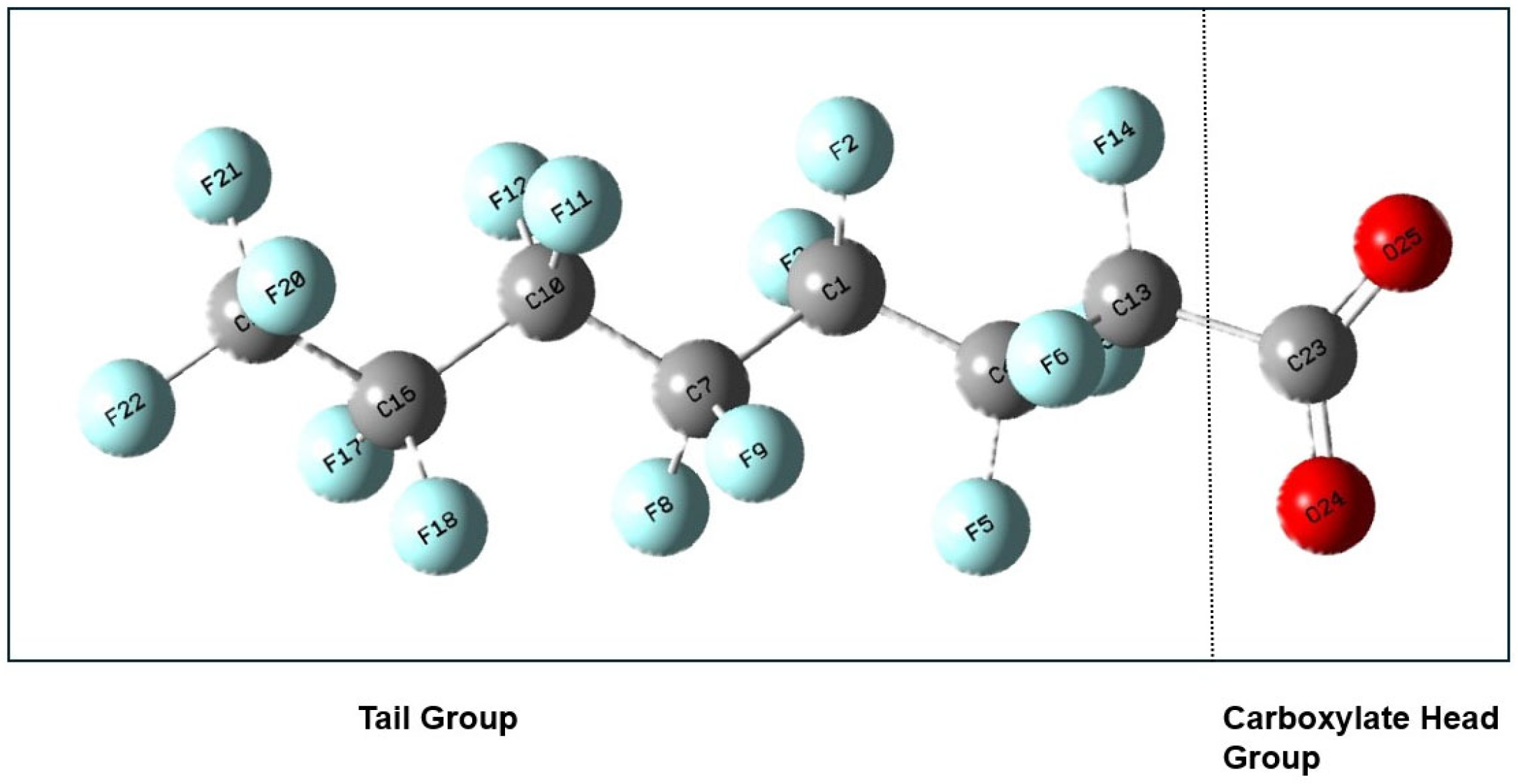
Per- and polyfluoroalkyl substances simply known as PFAS are a large group of man-made organic chemicals specifically characterized by the presence of multiple carbon–fluorine (C–F) bonds. These C-F bonds are considered as one of the strongest bonds in organic chemistry [1,2,3]. This makes PFAS highly resistant to heat and chemical reactions and due to these properties, they are very difficult to break down in environmental settings or biological systems [1]. The molecular structure of PFAS primarily consists of two distinct segments: a hydrophobic tail made up of fluorinated carbon atoms and a hydrophilic head that includes functional groups such as carboxylate or sulfonate. Figure 1 below is a structural representation of perfluorooctanoic acid (PFOA) molecule, a widely studied legacy PFAS [4], illustrating the C-F tail group and the carboxylic head group. The hydrophobic tail contributes to molecular persistence, while the carboxylate head governs electrostatic and hydrogen-bonding interactions with mineral surfaces. This combination of two distinct parts allows PFAS to interact with both water and oil thus creating surfactant-like properties [1,5,6].

1.2. Sources and Environmental Distribution of PFAS

Due to their remarkable surfactant and surface-active properties, PFAS have been extensively used across a wide range of industrial and commercial applications. The unique strength of the carbon–fluorine bond imparts exceptional thermal and chemical stability, while the amphiphilic molecular structure consisting of a hydrophobic fluorinated tail and a hydrophilic head group enables PFAS to significantly reduce surface tension and form durable hydrophobic–hydrophilic interfaces [7]. These physicochemical properties make PFAS ideal for use as wetting agents, emulsifiers, and surface protectants in numerous industrial formulations. Among the most notable applications are aqueous film-forming foams (AFFFs), firefighting foams engineered to rapidly spread across fuel surfaces and form a thin aqueous film that suppresses vapor release and extinguishes hydrocarbon fires [8]. Beyond firefighting, PFAS serve as surfactants and processing aids in textile and leather finishing (to provide oil, stain, and water repellency), metal plating and etching baths (to enhance coating uniformity and reduce misting), semiconductor fabrication (for photolithography and etching), and non-stick and anti-fouling coatings used in cookware, paints, lubricants, and food packaging materials [4,9]. The widespread and long-term use of PFAS in these sectors has led to their global distribution and persistence in environmental matrices, with residuals from manufacturing and product disposal contributing significantly to soil and groundwater contamination [3,10].
This man-made chemical was firstly developed in the 1940s as a form of Teflon (commercially known as PTFE), which is a famous PFAS to this day [2,8]. Since their initial development, the production of PFAS has grown extensively, leading to the creation of more than 4700 compounds. Owing to their exceptional heat resistance, chemical stability, and surfactant characteristics, PFAS have been incorporated into diverse industrial and consumer applications. These include non-stick cookware, where fluoropolymer coatings such as PTFE provide durable, low-friction surfaces [4]; stain- and water-resistant textiles and leather treatments that exploit PFAS’s hydrophobic tail groups to repel liquids and oils [9]; aqueous film-forming foams used in firefighting for their ability to rapidly suppress hydrocarbon-based fires [8]; and applications in electronics, semiconductor processing, and metal plating, where PFAS-based surfactants enhance coating uniformity, reduce surface tension, and prevent vapor formation [3,7]. PFAS are also found in cosmetics, hydraulic fluids, paints, and food packaging materials, where they act as slip agents, emulsifiers, and grease barriers, contributing to their widespread release into the environment [10].
The same properties that make PFAS ideal for various industries have caused PFAS to make them extremely persistent in all the environmental conditions including heat, acid and microbial degradation. Because of this reason, PFAS has been identified as an persistent environmental pollutant known as “forever chemicals” [10]. Therefore, PFAS are now widely detected almost everywhere including soil, groundwater, rain, remote Arctic regions, and the tissues of wildlife and humans [1,2]. PFAS compounds are found to have strong affinity for protein such as albumin in human and animal bodies. This led to PFAS accumulation in human and animal tissues, specifically the liver, kidneys, and blood serum [11]. Recent studies have demonstrated that exposure to PFAS can lead to various adverse health effects, including endocrine and metabolic disruption, immunotoxicity, developmental and reproductive toxicity, as well as carcinogenic outcomes [1,8].
Given their widespread occurrence and potential for bioaccumulation, PFAS contamination has become a major public health concern. Exposure through contaminated drinking water, food, and air can affect large populations, including vulnerable groups such as children and pregnant women [2]. Understanding the environmental behavior and fate of PFAS is therefore critical not only for assessing ecological risks but also for protecting community health and guiding effective regulatory and remediation efforts.
The primary pathways for PFAS contamination of soil are diverse and include the repeated application of AFFFs at military bases and airports, the land application of contaminated biosolids from wastewater treatment facilities, direct industrial discharges, and leachate from landfills containing PFAS-laden waste [12]. After entering the soil environment, the behavior and movement of these compounds are largely governed by adsorption mechanisms [13,14]. The degree to which PFAS adhere to soil particles determines their mobility, bioavailability, and likelihood of migrating into underlying groundwater aquifers, which frequently serve as sources of drinking water [12]. Therefore, a thorough understanding of the mechanisms governing PFAS adsorption to key soil components like clay minerals is fundamental for accurate risk assessment and the design of effective remediation strategies.

1.3. Health Consequences of Environmental PFAS Exposure

The long-term persistence of PFAS in both the environment and human tissues has resulted in growing evidence linking these substances to a range of adverse health effects. Recent reviews indicate that PFAS exposure disrupts endocrine and metabolic functions, leading to thyroid hormone imbalances and dyslipidemia [1]. Moreover, PFAS have been linked to immunotoxic outcomes, including decreased vaccine antibody responses and heightened susceptibility to infections [2]. Developmental and reproductive toxicity associated with PFAS exposure has been consistently reported in both epidemiological and animal studies. Elevated maternal serum PFAS concentrations have been linked to reduced birth weight, preterm delivery, and impaired fertility outcomes [15,16]. Chronic PFAS bioaccumulation has also been implicated in carcinogenic risks, particularly liver, kidney, and testicular cancers, mediated through oxidative stress, peroxisome proliferation, and DNA damage mechanisms [17,18]. Hepatic and renal impairments, including elevated alanine aminotransferase (ALT) levels and reduced glomerular filtration rate, further demonstrate systemic toxicity of these persistent compounds [19,20]. Because of their long biological half-lives and strong protein-binding capacity, PFAS accumulate in blood serum, breast milk, and internal organs, leading to prolonged internal exposure even after environmental inputs decline [21,22].

1.4. Significance of Soil Adsorption to Human Exposure

The degree of PFAS adsorption in soils controls their environmental persistence and mobility, which are key determinants of human exposure. When adsorption is weak, PFAS rapidly percolate to groundwater and contaminate drinking water sources. Conversely, strong adsorption can serve as a natural attenuation mechanism. The adsorption capacity (Qmax) and affinity constants derived from adsorption models are therefore crucial parameters in risk assessment frameworks and remediation planning [2].
Modeling adsorption phenomena not only improves predictive understanding of PFAS fate in soils but also supports the design of engineered solutions, such as the use of modified clays or biochar to enhance sorption capacity [23]. Such approaches represent practical pathways to protect groundwater quality and, by extension, community health.
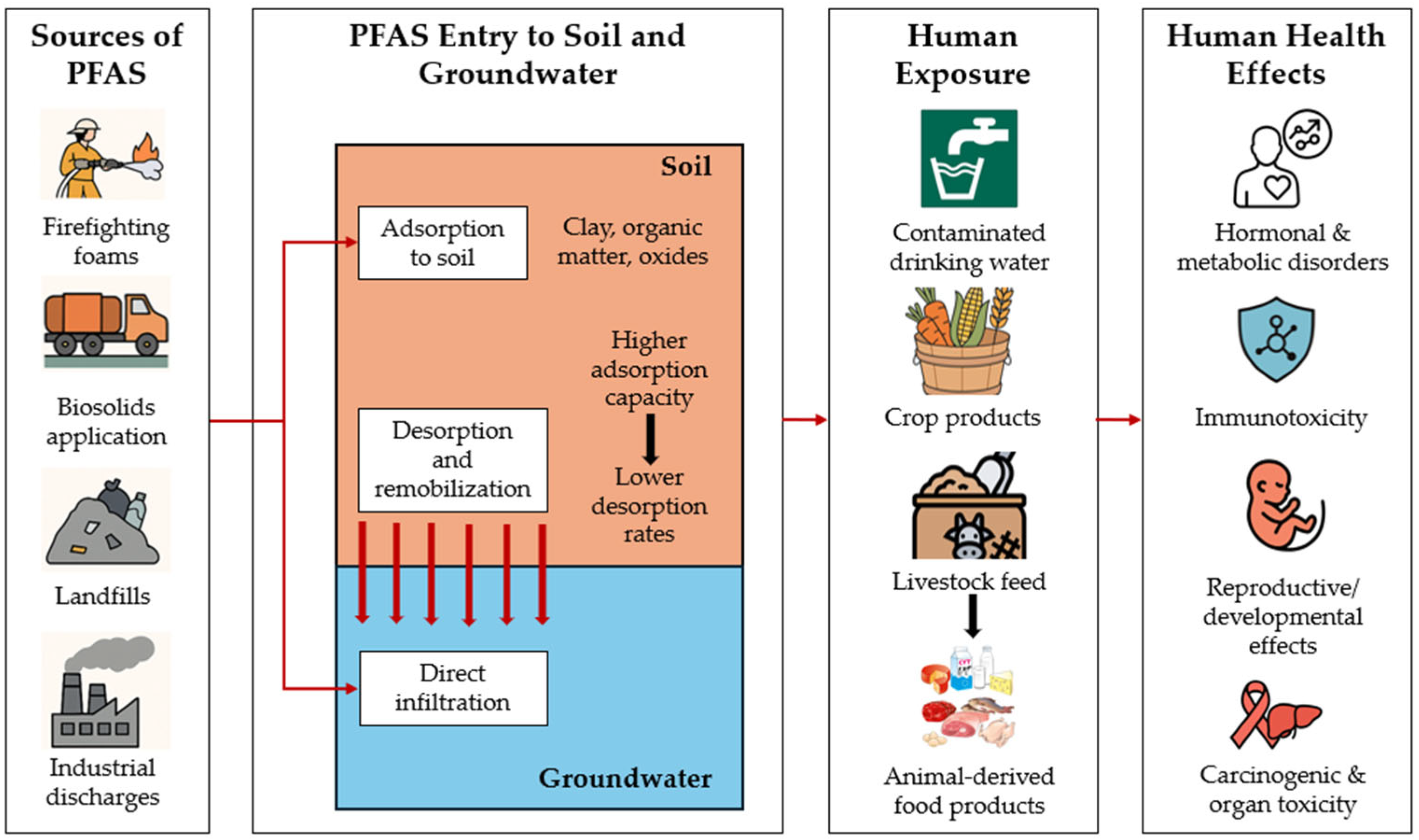
As illustrated in Figure 2, PFAS released from multiple environmental sources can migrate through soil and groundwater, eventually entering the human food chain and leading to various health effects.
Recent reviews emphasize that PFAS pose a multifaceted threat spanning environmental chemistry, toxicology, and public health. These reviews highlight that the adsorption-based mitigation is one of the most viable short-term strategies to contain PFAS migration from contaminated soils [2].

1.5. Adsorption of PFAS on Clay Minerals

Clay minerals and soil organic matter serve as the primary sorbents for PFAS in most soil systems. Clay minerals, such as kaolinite and montmorillonite, offer large surface areas and possess charged surfaces that can interact with the polar head groups of PFAS molecules [24]. Montmorillonite, a 2:1 expandable clay, typically demonstrates a significantly higher adsorption capacity for PFAS than kaolinite, a 1:1 non-expandable clay [24]. This is attributed not only to its larger specific surface area and higher cation exchange capacity (CEC), but also to its ability to adsorb PFAS into its interlayer spaces [13]. Soil organic matter, especially humic substances, introduces hydrophobic domains that can sequester the fluorinated tails of PFAS molecules. Depending on the conditions, organic matter can either enhance overall sorption by providing additional binding sites or compete with PFAS for sites on mineral surfaces, thereby reducing adsorption [24].
The efficacy of PFAS adsorption is controlled by a confluence of the molecule’s structure, soil characteristics, and ambient environmental conditions. Long-chain PFAS (e.g., PFOS, PFOA) tend to sorb more strongly than short-chain PFAS due to greater hydrophobic interactions and van der Waals forces [25,26]. Additionally, PFAS with sulfonate head groups (PFSAs) generally show higher adsorption than carboxylates (PFCAs) due to their increased molecular polarity and affinity for soil surfaces [14]. Soil properties that promote retention include high organic carbon content, which provides domains for hydrophobic partitioning, and a high cation exchange capacity (CEC), which offers more sites for electrostatic interactions [14]. The presence of divalent cations (e.g., Ca2+) can further augment adsorption by creating cation bridges between the anionic PFAS head group and negatively charged clay surfaces [13,25]. Environmental factors like low pH and high ionic strength also favor adsorption by making mineral surfaces more positively charged and by compressing the electrical double layer, both of which reduce electrostatic repulsion and promote attraction [13,26,27].

1.6. Modeling PFAS Adsorption

The study of PFAS adsorption relies on a combination of experimental and modeling approaches. Experimental methods range from batch sorption tests, used to determine adsorption isotherms (e.g., Langmuir, Freundlich) and kinetics [13,28], to more complex column studies that simulate transport and leaching under realistic flow conditions [29]. To elucidate the specific interaction mechanisms at the molecular level, researchers employ spectroscopic and microscopic techniques like Fourier Transform Infrared Spectroscopy (FTIR) and X-ray Photoelectron Spectroscopy (XPS), which can identify the functional groups involved in binding [13,30]. In addition to experimental studies, molecular modeling and simulation techniques such as Molecular Dynamics (MD) and Density Functional Theory (DFT) offer atomic-level understanding of adsorption mechanisms. These approaches reveal detailed information on binding energies, preferred adsorption configurations, and the significant influence of factors such as solvation, surface charge, and cation bridging in governing the adsorption process [31,32,33].

1.7. Quantifying Adsorption: The Maximum Adsorption Capacity (Qmax)

An essential parameter for assessing and comparing the effectiveness of various adsorbents is the maximum adsorption capacity (Qmax). This value represents the theoretical maximum quantity of a substance that can be adsorbed per unit mass of adsorbent, assuming the formation of a complete monolayer on the surface. Qmax is typically determined using the Langmuir isotherm model, which is founded on several key assumptions: (1) adsorption takes place at a fixed number of specific sites on a homogeneous surface, (2) each site accommodates only one adsorbate molecule, (3) all adsorption sites possess identical energy levels, and (4) no interactions occur between adjacent adsorbed molecules [34].
While the Langmuir model and its Qmax parameter are invaluable for describing adsorption on uniform surfaces like pure clay minerals, soil systems are often heterogeneous. For such complex surfaces, the Freundlich isotherm, an empirical model, is frequently a better fit, as it does not assume a finite adsorption capacity or surface homogeneity [28]. However, the Qmax value from the Langmuir model remains a standard benchmark for assessing the ultimate potential of an adsorbent material.
Table S1 (Supplementary Materials) summarizes the experimentally reported Q max values available in the literature for these systems under comparable conditions, providing a contextual basis for model comparison.
Traditionally, Qmax is determined through a series of batch sorption experiments in which the adsorbent is exposed to varying concentrations of the adsorbate under controlled conditions. The equilibrium concentrations are measured and fitted into isotherm models to derive the Qmax [35]. While this experimental approach is widely regarded as robust, it can be time-consuming and resource-intensive, especially when screening large numbers of adsorbent materials or varying environmental parameters [36]. This limitation has prompted the development of theoretical and computational models to estimate Qmax more efficiently.
This paper presents a comparative analysis of three theoretical models designed to predict the maximum adsorption capacity Qmax. We focus on PFOA and its adsorption onto kaolinite and montmorillonite clay minerals. To evaluate model performance and generalizability, adsorption of representative reference compounds (benzene, nitrogen, and glyphosate) was also analyzed to compare nonpolar, inert, and polar organic adsorption behavior on clay surfaces.
The novelty of this study lies in establishing a unified theoretical framework to compare three adsorption models: van der Waals interaction, monolayer capacity, and surface site density for predicting the Qmax of PFOA and reference compounds on clay minerals. Unlike prior molecular dynamics or density functional theory studies that require extensive computation, this approach provides a simplified and physically interpretable method for linking molecular-scale properties with measurable adsorption behavior. The results highlight the predictive potential of the surface site density approach and clarify the limitations of traditional models, contributing to the development of more efficient and transparent tools for PFAS adsorption modeling.

2. Materials and Methods

This work is purely theoretical and does not involve new experimental measurements. The models were developed using literature-derived physicochemical parameters and experimentally reported adsorption capacities for validation. The following subsections describe the theoretical basis of each model and the procedure for their comparison.

2.1. Chemicals and Clay Minerals

In this context, PFOA serves as the primary focus of this study, while selected reference molecules such as benzene, nitrogen, and glyphosate are included to represent distinct adsorption behaviors. Benzene and nitrogen exemplify weak, non-specific physisorption dominated by van der Waals interactions, whereas polar and anionic compounds such as PFAS and glyphosate exhibit adsorption influenced by the availability and configuration of reactive edge sites on clay mineral surfaces.
Kaolinite and montmorillonite were selected as representative clay minerals due to their contrasting structural and surface characteristics.

2.2. Benchmark Compounds for Model Validation

Benzene and nitrogen were selected as benchmark compounds to validate the theoretical adsorption models because their adsorption behavior on clay minerals is well-characterized and governed by simple, physical interactions rather than complex chemisorption mechanisms. Benzene, a nonpolar aromatic hydrocarbon, primarily interacts with mineral surfaces through London dispersion and van der Waals forces, making it an ideal reference molecule to test the accuracy of models based on physical adsorption (physisorption) [37]. Nitrogen (N2), on the other hand, is a chemically inert diatomic gas commonly used in Brunauer–Emmett–Teller (BET) surface area measurements due to its uniform adsorption characteristics on solid surfaces [38]. The inclusion of these two compounds provides essential calibration points for the theoretical framework by spanning a range of interaction strengths: nitrogen representing ideal physisorption with negligible polarity, and benzene introducing mild van der Waals interactions and limited molecular polarizability [39]. To further evaluate the applicability of the models to environmentally relevant polar organic contaminants, glyphosate was also incorporated as a comparative compound. Glyphosate is an amphoteric, anionic herbicide whose adsorption on clay minerals such as kaolinite and montmorillonite primarily occurs at hydroxylated edge sites [40] through inner-sphere complexation and hydrogen bonding rather than van der Waals forces. Its inclusion bridges the gap between purely physisorptive systems (benzene, nitrogen) and strongly interactive species like PFOA, allowing assessment of how well the models capture adsorption driven by specific site–molecule interactions under hydrated conditions.
By comparing model predictions for these well-understood systems against reported experimental adsorption capacities, the robustness and physical realism of each model can be evaluated prior to applying them to more complex and amphiphilic molecules such as PFOA, whose adsorption involves a combination of electrostatic, hydrophobic, and hydrogen bonding interactions [32,33].
In this study, three distinct theoretical models were employed to predict the Qmax of PFOA on pure clay minerals.

2.3. Model 1: Van Der Waals Interaction Energy Modeling Based on Molecular Properties

This model follows a first-principles approach, estimating Qmax by quantifying the van der Waals dispersion forces between an individual PFOA molecule and the clay surface. To establish the method, benzene was initially selected as a reference compound because of its simple molecular structure and well-documented adsorption behavior. Once validated, the same approach was extended to the more complex PFOA molecule to evaluate its applicability and subsequently tested for nitrogen adsorption as well.
First, the interaction energy (EvdW) is computed using the Hamaker equation [41] given in Equation (1) below.
E v d W = A R 6 D
where A represents the Hamaker constant (a function of the material properties of the molecule and the surface), R is the effective radius of the PFOA molecule, and D is the distance between the PFOA molecule and the clay surface. All the parameters used in calculating the interaction energy (EvdW) are given in Tables S2 and S3 (Supplementary Materials).
Second, the number of occupied adsorption sites (N) is calculated using a canonical partition function derived from statistical mechanics (Equation (2)—Derivation given in Supplementary Materials S1), which links the probability of site occupancy to the interaction energy and the chemical potential of the system.
N = N 0 1 + e 1 k T + μ
where N0 is total number of adsorption sites in kaolinite, N is number of occupied sites for adsorption, K is Boltzmann constant, T is absolute temperature of the system, is binding energy (Considered as E v d W = ) and μ is chemical potential of adsorbate.
Considering monolayer adsorption [39,42], N will be equal to the number of adsorbed PFOA molecules.
Finally, Qmax is determined from the number of adsorbed molecules (N), the molecular weight of PFOA (M), and Avogadro’s number (NA) using Equation (3).
Q m a x = N M N A

2.4. Model 2: Monolayer Capacity-Based Calculation

Monolayer capacity refers to the maximum amount of adsorbate that can form a complete monolayer on the surface of an adsorbent per unit mass [34]. This concept, derived from Langmuir adsorption theory, assumes uniform surface sites and no interaction between adsorbed molecules.
The monolayer capacity (nm) in moles per gram is calculated using Equation (4) [43].
n m = A s u r f a c e a m N A
where A s u r f a c e is the specific surface area of clay mineral (taken as 20 m2/g for kaolinite) [13], am is the average area occupied by an adsorbate molecule in the completed monolayer and N A is Avogadro’s number. The average area occupied per molecule (am) was estimated from the molecular radius, assuming circular geometry (Table S6).
Three adsorbates such as benzene, PFOA, and nitrogen were used to compare the theoretical monolayer capacity with the experimentally reported maximum adsorption capacity (Qmax).
Models 1 and 2 were developed under neutral surface conditions and do not explicitly include electrostatic interactions or the effects of pH and ionic strength. These parameters significantly influence adsorption of anionic PFAS such as PFOA but were excluded here to maintain theoretical consistency and focus on fundamental van der Waals and monolayer adsorption mechanisms. The inclusion of electrostatic correction factors and variable surface charge terms will be explored in future model refinements.

2.5. Model 3: Surface Site Density-Based Adsorption Model

This model estimates Qmax by calculating the number of available adsorption sites on the clay surface, specifically on edge hydroxyl groups, which are chemically active for PFOA binding [32].
According to Surface Complexation Modeling [44], number of adsorption sites (N) can be calculated as in Equation (5).
N = σ A s u r f a c e
where σ is surface site density and A s u r f a c e is the specific surface area of clay minerals.
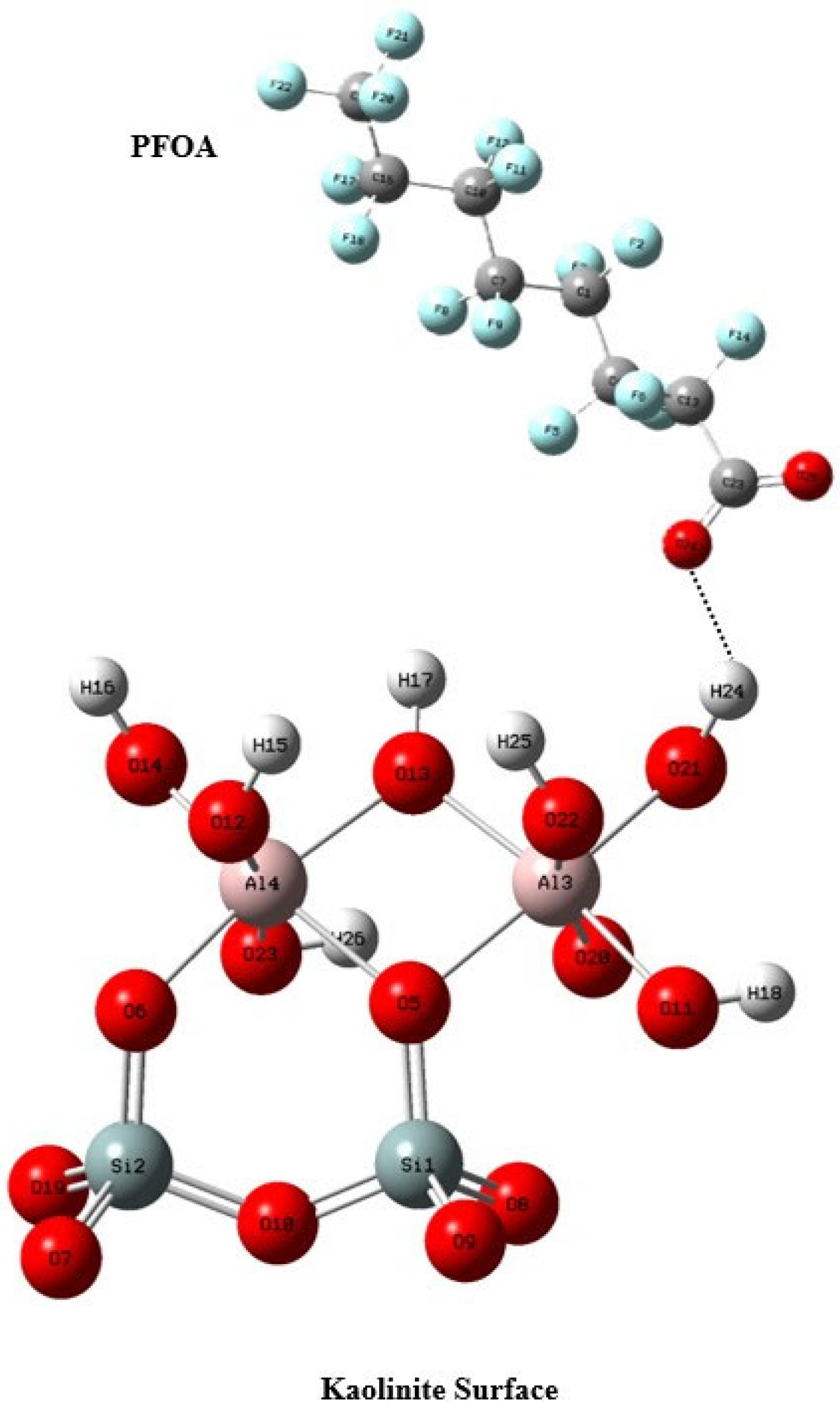
According to past studies, only edge hydroxyl groups (mainly Al–OH) on kaolinite are chemically active for PFAS [32]. Basal sites are largely inert and do not participate in PFAS adsorption. With this observation, we can consider only the edge area for the PFOA adsorption, as shown in Figure 3 below. Figure 3 is the schematic illustration of the head group carboxylic oxygen interaction with the hydrogen in the edge hydroxyl group of kaolinite.
To find the edge area of a clay particle, consider a clay particle as a plate with a diameter of D and a thickness of T. The edge area of that clay particle is given by Equation (6).
A e d g e = π D T
Its thickness (T) is calculated from the specific surface area (Asurface), specific gravity (Gs), and the density of water (γw) using Equation (7).
T = 2 G S A s u r f a c e γ w
Then, the number of available adsorption sites (N) on the edge of a single particle is found by multiplying the edge area by the reported surface site density (σ).
Assuming that each active site is occupied by one PFOA molecule, the total mass of PFOA adsorbed on a single clay particle is calculated using Equation (8):
M a s s P F O A / P a r t i c l e = N M N A
where N is the number of sites, NA is Avogadro’s number, and M is the molecular weight of PFOA.
The mass of a single clay particle was calculated from its cylindrical volume and particle density. Using this value, the total number of particles present in one gram of clay was determined. Qmax was then obtained by multiplying the number of particles per gram by the mass of PFOA adsorbed onto each particle (Calculated parameters are given in Table S7).
In this model, each reactive edge hydroxyl site is assumed to adsorb one PFOA molecule. This assumption represents an idealized condition and provides an upper-limit estimate of adsorption capacity. In practice, the large molecular footprint of PFOA may prevent full site occupancy due to steric constraints, and the effective number of accessible sites may therefore be lower than the total calculated surface site density [45].
The central assumption of Model 3 is that adsorption is restricted to specific, chemically active sites, specifically hydroxyl groups found predominantly on the edges of clay platelets. Molecular dynamics simulations by Loganathan & Wilson [32] have shown that the polar carboxylate head group of PFOA forms strong, targeted interactions (like electrostatic attraction and hydrogen bonds) with these reactive edge sites. The large, flat basal surfaces of the clay are comparatively inert and do not offer these specific bonding opportunities. Therefore, for PFOA, limiting the calculation to the edge area is a justified approach.
However, this assumption is not valid for benzene and nitrogen. These molecules are nonpolar and lack specific functional groups to form strong, directional bonds with the edge hydroxyls. Their adsorption is governed by weaker, non-specific van der Waals forces. As noted by Castro and Martins [46] in their theoretical work, these forces can occur between the adsorbate molecule and any part of the clay surface, including the expansive basal planes. In fact, the adsorption of nitrogen is so non-specific that it is the standard method used in BET analysis to measure the total specific surface area of a material, assuming uniform monolayer coverage across all accessible surfaces [43].
Therefore, to apply the “surface site density” concept of Model 3 to these nonpolar molecules, the model was adapted. Instead of restricting the calculation to the edge area, the total specific surface area (SSA) of the clay was used. The total number of available adsorption sites was calculated by multiplying the total SSA by a reported surface site density (σ), assuming a uniform distribution of potential adsorption sites across the entire surface (Calculated parameters are given in Tables S8 and S9).
Glyphosate was included as an additional adsorbate for Model 3 due to its known site-specific interaction with hydroxylated edge surfaces of kaolinite. Both FTIR/XPS and MD analyses have confirmed that glyphosate adsorbs primarily through hydrogen bonding and electrostatic coordination between its phosphonyl and carboxylate groups and surface Al–OH edge sites [40] (Calculated parameters are given in Table S10).
In this model, fixed surface site densities were used for kaolinite and montmorillonite to enable direct theoretical comparison across adsorbates. These values represent average site densities reported for neutral pH conditions and do not account for variations due to protonation–deprotonation equilibria, electrolyte composition, or surface heterogeneity. This assumption provides a simplified baseline for theoretical evaluation, but the actual site density in natural systems is pH- and ion-dependent. Future work will incorporate these environmental factors to refine model accuracy.

3. Results

The Qmax values for PFOA, benzene, nitrogen and glyphosate adsorption on kaolinite and montmorillonite, as calculated by the three theoretical models, were compared against experimental values reported in the literature as given in Table 1. The comparison reveals the strengths and weaknesses of each modeling approach.

3.1. Comparison of Model Results

This comparison ensures a consistent evaluation of model performance under comparable physicochemical conditions, excluding organo- or nutrient-modified clays that exhibit enhanced adsorption through hydrophobic, or intercalation effects not represented in the present theoretical framework.

3.1.1. Model 1 (Van Der Waals Interaction Energy Model)

Model 1 substantially underpredicted adsorption capacities for all tested systems. For PFOA, predicted values for kaolinite (0.0007 mg g−1) were far below the experimental range (0.10–10.0 mg g−1), indicating that dispersion forces alone cannot account for the strong interactions between the polar carboxylate headgroup and surface hydroxyl sites. Similarly low values were obtained for benzene (0.0013 mg g−1), confirming that Model 1 neglects key electrostatic and solvation effects required to describe realistic adsorption behavior.

3.1.2. Model 2 (Monolayer Adsorption Capacity Model)

Model 2 overestimated adsorption, yielding unrealistically high capacities. For example, the predicted Qmax for PFOA was 17.5 mg g−1, and for benzene, it was 10.9 mg g−1, both of which are higher than the reported experimental ranges (0.05 to 6.7 mg g−1 for benzene). The assumption of uniform surface coverage and ideal molecular packing overstates the available adsorption area, particularly for amphiphilic or bulky molecules such as PFOA.

3.1.3. Model 3 (Surface Site Density Model)

Model 3 produced the most realistic predictions across all systems. For PFOA, the calculated capacities of 3.39 mg g−1 on kaolinite and 0.20 mg g−1 on montmorillonite were within the lower to middle portion of the experimental range. This difference can be attributed to the exclusion of interlayer adsorption in the current model formulation. Model 3 considers only the reactive hydroxyl sites located at particle edges, whereas montmorillonite also adsorbs PFAS within its interlayer spaces through cation bridging and physical intercalation. The omission of these mechanisms limits the model’s applicability to expandable clays. Comparable agreement was obtained for nitrogen, with predicted values between 2.79 and 4.68 mg g−1 compared to experimental values ranging from 1.4 to 8.4 mg g−1, confirming the model’s ability to capture physisorption governed by van der Waals interactions. For benzene, Model 3 predicted 7.78 mg g−1 on kaolinite and 13.0 mg g−1 on montmorillonite, which are consistent with the variability reported in experimental studies. In contrast, glyphosate adsorption was slightly underestimated, with predicted values of 1.38 mg g−1 on kaolinite and 0.082 mg g−1 on montmorillonite compared to experimental ranges of 5.45 to 6.3 mg g−1 and 2.7 to 5.5 mg g−1, respectively. This discrepancy likely results from the omission of pH-dependent protonation and cation-bridging mechanisms that strongly influence glyphosate binding at clay edge sites.
Overall, Model 1 consistently underestimates adsorption because it omits electrostatic and hydration effects, whereas Model 2 overpredicts due to the assumption of ideal monolayer coverage. Model 3 provides the most balanced and mechanistically meaningful performance, capturing both the relative magnitudes and observed trends in adsorption capacity. Its parameterization based on surface site density and mineral-specific reactivity offers a practical theoretical framework for simulating PFAS adsorption in heterogeneous soil systems.

3.2. Sensitivity Analysis of Model 1 Parameters

To evaluate the robustness of the theoretical framework, a sensitivity analysis was conducted specifically for Model 1, which relies on estimated parameters including ionization energy, chemical potential, polarizability, and the interaction distance between PFOA and kaolinite (Tables S3 and S4). The analysis revealed that the model is moderately sensitive to most descriptors, but highly sensitive to the chemical potential (μ). When μ was varied from −20 to −40 kJ mol−1 (a −42.9% to +14.3% change from the baseline of −35 kJ mol−1), the predicted Q max values shifted dramatically from 0.314 to 0.0001 mg g−1, corresponding to a deviation of +42.000% to −86.7%. This pronounced nonlinear response reflects the exponential dependence of adsorption energy on μ and confirms that interfacial thermodynamics exert the dominant control on adsorption behavior. The μ values employed in Model 1 were taken from solution-phase thermodynamic data, as these effectively capture the energetics of hydrated interfaces where adsorption is governed by both solvation–desolvation equilibria and electrostatic coordination between PFOA and surface sites. In such systems, the solvated-state μ effectively represents both aqueous and interfacial free-energy contributions, and previous molecular dynamics and DFT studies have shown that solvation-corrected potentials reproduce PFAS–clay adsorption energetics with good accuracy [32,33].

4. Discussion

4.1. Limitations of the Van Der Waals Interaction Energy Model

The van der Waals interaction energy model, even when combined with a partition function, produced Qmax values far below experimental observations for both benzene and PFOA. A key factor was that the chemical potential term strongly reduced the calculated number of adsorption sites, leading to underprediction. This underprediction is primarily attributed to the dominance of the chemical potential (μ) term, which exponentially scales adsorption energy. The sensitivity analysis confirmed that small variations in μ lead to large changes in predicted Q max , highlighting its critical influence on adsorption energetics. Earlier theoretical studies suggested that van der Waals forces could reasonably approximate adsorption of small, nonpolar molecules such as benzene [46]. However, more recent molecular dynamics studies demonstrate that electrostatic interactions and hydrogen bonding dominate PFAS adsorption on clays, while van der Waals interactions play a secondary role [31]. This indicates that a van der Waals-only framework inherently underestimates adsorption capacity. Model 1 was therefore developed as a conceptual framework to isolate the contribution of dispersion forces to overall adsorption behavior. Given its high sensitivity and limited predictive power for polar or ionic systems, this model is best interpreted as a benchmarking tool that provides qualitative insight into molecular-scale interactions rather than a quantitative predictive model.

4.2. Overestimation by the Monolayer Adsorption Model

The monolayer capacity model (Model 2) produced realistic adsorption capacities for small, nonpolar molecules such as nitrogen and benzene but overestimated Q max for PFOA by more than an order of magnitude. This demonstrates that the ideal monolayer assumption fails for large, amphiphilic PFAS molecules whose adsorption geometry is constrained by molecular size, hydration shells, and headgroup orientation. Previous studies have shown that PFAS adsorption is highly dependent on molecular structure, especially chain length, hydrophobic tail interactions, and headgroup polarity suggesting that monolayer-based models should be limited to smaller, neutral adsorbates [32].

4.3. Applicability of Edge-Site Density Model Across Clay Types

The surface site density approach, which considers adsorption primarily at edge hydroxyl groups, produced Qmax values close to experimental reports for PFOA on kaolinite. This is consistent with findings that hydroxylated edge sites are the most reactive domains for PFAS adsorption [32]. However, extending the same edge-only assumption to montmorillonite is questionable, as interlayer adsorption also contributes significantly to PFAS retention in expandable clays [52]. The researchers observed that the interlayer spacing of the montmorillonite expanded after adsorbing PFOA and PFOS, which directly confirms that the PFAS molecules entered the space between the clay layers [52]. In the present work, the edge-only assumption was intentionally applied to maintain theoretical consistency between kaolinite and montmorillonite and to isolate the contribution of reactive edge hydroxyl sites that are common to both minerals. This controlled simplification avoids introducing variability from interlayer spacing, hydration state, or exchangeable cation composition, which differ substantially among montmorillonite systems. Future refinements of the model will incorporate interlayer adsorption mechanisms and cation-mediated binding effects to better represent adsorption in expandable clays.

4.4. Influence of Molecular Structure on Adsorption Capacity

Among the three models evaluated, the van der Waals interaction energy approach incorporated PFAS-specific molecular properties such as polarizability, ionization energy, and chemical potential. In contrast, the monolayer capacity and surface site density models emphasized clay mineral characteristics, including surface area and site density, while treating PFAS largely in terms of molecular weight. Recent experimental studies, however, indicate that PFAS structure including chain length, hydrophobicity, and functional group chemistry plays the dominant role in determining adsorption affinity, whereas clay properties exert a secondary influence [53]. This suggests that predictive frameworks should be more adsorbate-centered, explicitly integrating PFAS molecular descriptors alongside mineral parameters.

4.5. Role of Reactive Site Density on Adsorption Capacity

Adjusting the total surface area of the clay, even over a wide range of values, had negligible impact on predicted Qmax in the surface-site density model. This outcome reflects the fact that adsorption is constrained by the number and accessibility of reactive edge sites, not by the bulk surface area of the clay. For kaolinite, basal planes are largely inert toward PFAS, while only edge hydroxyl groups act as active adsorption sites [32].

4.6. Introducing a Steric Hindrance Factor

The importance of steric hindrance in adsorption has been experimentally demonstrated in other systems. For example, Deepatana & Valix [45] showed that bulky nickel and cobalt organic complexes exhibited significantly reduced adsorption capacities on aminophosphonate resins compared to smaller ionic species, explicitly attributing this to steric hindrance effects [45]. Their findings highlight how molecular size and geometry can prevent full occupancy of adsorption sites, even when chemical affinity is strong.
PFOA is a relatively bulky anionic surfactant, and steric crowding prevents full site occupancy. The cross-sectional area of a PFOA molecule (0.785 nm2) is larger than the area available per site on kaolinite edges (1/σ ≈ 0.125 nm2 per site, where σ = 8 sites/nm2). This implies that one PFOA molecule spans more than two potential adsorption sites, rendering 100% site occupancy impossible.
To approximate this limitation in the present model, a simple steric correction factor ( f s ) can be introduced, defined as the ratio of the characteristic site area ( A site ) to the molecular cross-sectional area ( A mol ). A mol is estimated at approximately 0.785 nm2 (based on a 0.5 nm radius), while A site is approximately 0.35 nm2. This gives a theoretical f s of about 0.45, suggesting that roughly 45% of the reactive sites may be sterically accessible under ideal packing conditions.

4.7. Future Directions

The limitations of the current models highlight several priorities for future research.

4.7.1. Adapt the Model 3 for Expandable Clays

While edge hydroxyl groups are dominant adsorption sites in kaolinite, assuming edge-only adsorption in montmorillonite is problematic. Experimental studies have shown that PFAS molecules enter the interlayer galleries of montmorillonite, causing measurable basal spacing expansion [54]. We need to develop a two-part adsorption model for montmorillonite that separately calculates contributions from both edge sites and interlayers.

4.7.2. pH- and Ion-Specific Parameterization

Future studies should explicitly include the effects of pH, ionic strength, as well as cation type on surface charge and PFAS binding affinity. These parameters strongly influence site protonation and the electrostatic environment of the mineral–solution interface.

4.7.3. Incorporate Electrostatics, Hydration Effects and Hydrogen Bonding Explicitly

Model 1 considered only van der Waals interactions, while neglecting electrostatic, hydrogen-bonding, and hydration effects. Molecular dynamics studies have shown that electrostatic attraction between the anionic PFOA head group and protonated clay edge sites, along with hydrogen bonding to surface hydroxyls, are dominant mechanisms governing PFAS adsorption on mineral surfaces [31]. In addition, restructuring of the hydration shell surrounding the PFOA carboxylate group during adsorption introduces an energetic barrier that must be overcome for surface attachment, thereby lowering the effective adsorption affinity compared with theoretical predictions that neglect solvation effects. These processes were not explicitly included in the present simplified theoretical framework, which was designed to isolate specific physical interactions. Future refinements of the model will incorporate electrostatic and hydration energy correction terms to better represent the adsorption behavior of ionic PFAS species.

4.7.4. Experimental Validation and Molecular Simulation Integration

To strengthen the predictive capability of the proposed theoretical framework, future work will include controlled experimental validation and molecular-scale simulations. Laboratory adsorption experiments under well-defined pH, ionic strength, and mineral purity conditions will be conducted to obtain consistent datasets for model calibration.

5. Conclusions

This study evaluated three theoretical models for predicting the maximum adsorption capacity (Qmax) of PFOA on kaolinite and montmorillonite. The main conclusions are as follows: (i) Model performance: Simplified models based solely on van der Waals interactions or ideal monolayer packing do not adequately describe PFAS adsorption behavior, systematically underestimating or overestimating Qmax. (ii) Dominant mechanism: The surface site density model, which considers reactive hydroxyl edge sites, produced Qmax values closest to experimental data and provides the most realistic framework for PFOA adsorption on clays. (iii) Key controlling factors: Accurate prediction of PFAS adsorption requires explicit inclusion of steric hindrance, electrostatic interactions, hydrogen bonding, and hydration effects, which strongly influence surface affinity and site accessibility. (iv) Model limitations: The present framework assumes edge-only adsorption and ideal site occupancy, representing a simplified baseline for comparison across clay types.
Overall, this study provides a mechanistically grounded theoretical basis for improving adsorption modeling of PFAS on clay minerals, bridging the gap between molecular-level understanding and macroscopic environmental modeling.

Supplementary Materials

The following supporting information can be downloaded at https://www.mdpi.com/article/10.3390/environments13010037/s1. Table S1: Experimentally reported maximum adsorption capacities ( Q max ) for Perfluorooctanoic acid (PFOA) and reference compounds (benzene, nitrogen, and glyphosate) on clay minerals, Table S2: Parameters used for the Qmax calculation in Model 1 for all adsorbates, Table S3: Calculated values for all adsorbates in Model 1, Table S4: Considered ranges for sensitivity analysis of estimated PFOA parameters, Table S5: Sensitivity analysis results for estimated PFOA parameters, Table S6: Monolayer capacity calculation for three adsorbates, Table S7: Calculate Qmax values for PFOA using site density model, Table S8: Calculate Qmax values for benzene using site density model, Table S9: Calculate Qmax values for nitrogen using site density model, Table S10: Calculated Qmax values for glyphosate using site density model. References [13,31,32,37,38,39,40,41,42,47,48,49,50,55,56,57,58,59,60,61,62,63,64,65,66,67,68,69,70,71,72,73,74,75,76,77,78,79,80,81,82,83,84,85,86,87,88,89,90,91] are cited in the supplementary materials.

Author Contributions

Conceptualization: J.N.M., Writing—original draft preparation: R.N.M., Writing—Review and Editing: J.N.M. and D.C.P. Visualization/Figures: D.C.P. All authors have read and agreed to the published version of the manuscript.

Funding

This research received no external funding.

Data Availability Statement

No new data were created or analyzed in this study.

Conflicts of Interest

The authors declare no conflicts of interest.

References

  1. Panieri, E.; Baralic, K.; Djukic-Cosic, D.; Djordjevic, A.B.; Saso, L. PFAS Molecules: A Major Concern for the Human Health and the Environment. Toxics 2022, 10, 44. [Google Scholar] [CrossRef] [PubMed]
  2. Perera, D.C.; Meegoda, J.N. PFAS: The Journey from Wonder Chemicals to Environmental Nightmares and the Search for Solutions. Appl. Sci. 2024, 14, 8611. [Google Scholar] [CrossRef]
  3. Zhang, M.; Zhao, X.; Zhao, D.; Soong, T.Y.; Tian, S. Poly- and Perfluoroalkyl Substances (PFAS) in Landfills: Occurrence, Transformation and Treatment. Waste Manag. 2023, 155, 162–178. [Google Scholar] [CrossRef]
  4. Wang, Z.; Dewitt, J.C.; Higgins, C.P.; Cousins, I.T. A Never-Ending Story of Per- and Polyfluoroalkyl Substances (PFASs)? Environ. Sci. Technol. 2017, 51, 2508–2518. [Google Scholar] [CrossRef] [PubMed]
  5. Leung, S.C.E.; Wanninayake, D.; Chen, D.; Nguyen, N.T.; Li, Q. Physicochemical properties and interactions of perfluoroalkyl substances (PFAS)—Challenges and opportunities in sensing and remediation. Sci. Total. Environ. 2023, 905, 166764. [Google Scholar] [CrossRef]
  6. Schymanski, E.L.; Zhang, J.; Thiessen, P.A.; Chirsir, P.; Kondic, T.; Bolton, E.E. Per- and Polyfluoroalkyl Substances (PFAS) in PubChem: 7 Million and Growing. Environ. Sci. Technol. 2023, 57, 16918–16928. [Google Scholar] [CrossRef]
  7. Glüge, J.; Scheringer, M.; Cousins, I.T.; DeWitt, J.C.; Goldenman, G.; Herzke, D.; Lohmann, R.; Ng, C.A.; Trier, X.; Wang, Z. An overview of the uses of per- And polyfluoroalkyl substances (PFAS). Environ. Sci. Process. Impacts 2020, 22, 2345–2373. [Google Scholar] [CrossRef]
  8. Meegoda, J.N.; Kewalramani, J.A.; Li, B.; Marsh, R.W. A review of the applications, environmental release, and remediation technologies of per-and polyfluoroalkyl substances. Int. J. Environ. Res. Public Health 2020, 17, 8117. [Google Scholar] [CrossRef]
  9. Gaines, L.G.T. Historical and current usage of per- and polyfluoroalkyl substances (PFAS): A literature review. Am. J. Ind. Med. 2023, 66, 353–378. [Google Scholar] [CrossRef]
  10. Abunada, Z.; Alazaiza, M.Y.D.; Bashir, M.J.K. An overview of per-and polyfluoroalkyl substances (Pfas) in the environment: Source, fate, risk and regulations. Water 2020, 12, 3590. [Google Scholar] [CrossRef]
  11. Metcalfe, C.D.; Bayen, S.; Desrosiers, M.; Muñoz, G.; Sauvé, S.; Yargeau, V. An introduction to the sources, fate, occurrence and effects of endocrine disrupting chemicals released into the environment. Environ. Res. 2022, 207, 112658. [Google Scholar] [CrossRef]
  12. Li, H.; Koosaletse-Mswela, P. Occurrence, fate, and remediation of per- and polyfluoroalkyl substances in soils: A review. Curr. Opin. Environ. Sci. Health 2023, 34, 100487. [Google Scholar] [CrossRef]
  13. Zhao, L.; Bian, J.; Zhang, Y.; Zhu, L.; Liu, Z. Comparison of the sorption behaviors and mechanisms of perfluorosulfonates and perfluorocarboxylic acids on three kinds of clay minerals. Chemosphere 2014, 114, 51–58. [Google Scholar] [CrossRef]
  14. Luft, C.M.; Schutt, T.C.; Shukla, M.K. Properties and Mechanisms for PFAS Adsorption to Aqueous Clay and Humic Soil Components. Environ. Sci. Technol. 2022, 56, 10053–10061. [Google Scholar] [CrossRef]
  15. Gui, S.Y.; Chen, Y.N.; Wu, K.J.; Liu, W.; Wang, W.J.; Liang, H.R.; Jiang, Z.X.; Li, Z.L.; Hu, C.Y. Association Between Exposure to Per- and Polyfluoroalkyl Substances and Birth Outcomes: A Systematic Review and Meta-Analysis. Front. Public Health 2022, 10, 855348. [Google Scholar] [CrossRef] [PubMed]
  16. Zhang, Y.; Mustieles, V.; Sun, Q.; Coull, B.; McElrath, T.; Rifas-Shiman, S.L.; Martin, L.; Sun, Y.; Wang, Y.-X.; Oken, E.; et al. Association of Early Pregnancy Perfluoroalkyl and Polyfluoroalkyl Substance Exposure with Birth Outcomes. JAMA Netw. Open 2023, 6, e2314934. [Google Scholar] [CrossRef]
  17. Lin, Z.; Li, Y.; Zhao, J.; Li, J.; Pan, S.; Wang, X.; Lin, H.; Lin, Z. Exploring the environmental contamination toxicity and potential carcinogenic pathways of perfluorinated and polyfluoroalkyl substances (PFAS): An integrated network toxicology and molecular docking strategy. Heliyon 2024, 10, e37003. [Google Scholar] [CrossRef]
  18. van Gerwen, M.; Colicino, E.; Guan, H.; Dolios, G.; Nadkarni, G.N.; Vermeulen, R.C.; Wolff, M.S.; Arora, M.; Genden, E.M.; Petrick, L.M. Per- and polyfluoroalkyl substances (PFAS) exposure and thyroid cancer risk. EBioMedicine 2023, 97, 104831. [Google Scholar] [CrossRef]
  19. Kim, O.J.; Kim, S.; Park, E.Y.; Oh, J.K.; Jung, S.K.; Park, S.; Hong, S.; Jeon, H.L.; Kim, H.-J.; Park, B.; et al. Exposure to serum perfluoroalkyl substances and biomarkers of liver function: The Korean national environmental health survey 2015–2017. Chemosphere 2023, 322, 138208. [Google Scholar] [CrossRef] [PubMed]
  20. Niu, S.; Cao, Y.; Chen, R.; Bedi, M.; Sanders, A.P.; Ducatman, A.; Ng, C. A State-of-the-Science Review of Interactions of Per-and Polyfluoroalkyl Substances (PFAS) with Renal Transporters in Health and Disease: Implications for Population Variability in PFAS Toxicokinetics. Environ. Health Perspect. 2023, 131, 76002. [Google Scholar] [CrossRef]
  21. Blomberg, A.J.; Norén, E.; Haug, L.S.; Lindh, C.; Sabaredzovic, A.; Pineda, D.; Jakobsson, K.; Nielsen, C. Estimated transfer of perfluoroalkyl substances (Pfas) from maternal serum to breast milk in women highly exposed from contaminated drinking water: A study in the ronneby mother-child cohort. Environ. Health Perspect. 2023, 131, 17005. [Google Scholar] [CrossRef]
  22. Wallis, D.J.; Kotlarz, N.; Knappe, D.R.U.; Collier, D.N.; Lea, C.S.; Reif, D.; McCord, J.; Strynar, M.; DeWitt, J.C.; Hoppin, J.A. Estimation of the Half-Lives of Recently Detected Per-and Polyfluorinated Alkyl Ethers in an Exposed Community. Environ. Sci. Technol. 2023, 57, 15348–15355. [Google Scholar] [CrossRef]
  23. Dias, D.; Bons, J.; Kumar, A.; Kabir, M.H.; Liang, H. Forever Chemicals, Per-and Polyfluoroalkyl Substances (PFAS), in Lubrication. Lubricants 2024, 12, 114. [Google Scholar] [CrossRef]
  24. Zhang, R.; Yan, W.; Jing, C. Mechanistic study of PFOS adsorption on kaolinite and montmorillonite. Colloids Surf. A Physicochem. Eng. Asp. 2014, 462, 252–258. [Google Scholar] [CrossRef]
  25. Ahmad, A.; Tian, K.; Tanyu, B.; Foster, G.D. Effect of Clay Mineralogy on the Partition Coefficients of Perfluoroalkyl Substances. ACS ES T Water 2023, 3, 2899–2909. [Google Scholar] [CrossRef]
  26. Nguyen, T.M.H.; Bräunig, J.; Thompson, K.; Thompson, J.; Kabiri, S.; Navarro, D.A.; Kookana, R.S.; Grimison, C.; Barnes, C.M.; Higgins, C.P.; et al. Influences of Chemical Properties, Soil Properties, and Solution pH on Soil-Water Partitioning Coefficients of Per- And Polyfluoroalkyl Substances (PFASs). Environ. Sci. Technol. 2020, 54, 15883–15892. [Google Scholar] [CrossRef]
  27. Campos-Pereira, H.; Kleja, D.B.; Ahrens, L.; Enell, A.; Kikuchi, J.; Pettersson, M.; Gustafsson, J.P. Effect of pH, surface charge and soil properties on the solid–solution partitioning of perfluoroalkyl substances (PFASs) in a wide range of temperate soils. Chemosphere 2023, 321, 138133. [Google Scholar] [CrossRef] [PubMed]
  28. Wei, C.; Song, X.; Wang, Q.; Hu, Z. Sorption kinetics, isotherms and mechanisms of PFOS on soils with different physicochemical properties. Ecotoxicol. Environ. Saf. 2017, 142, 40–50. [Google Scholar] [CrossRef]
  29. Wang, C.; Yan, B.; Munoz, G.; Sauvé, S.; Liu, J. Modified clays reduce leaching of per- and polyfluoroalkyl substances from AFFF-contaminated soils. AWWA Water Sci. 2021, 3, e1241. [Google Scholar] [CrossRef]
  30. Yan, B.; Munoz, G.; Sauvé, S.; Liu, J. Molecular mechanisms of per- and polyfluoroalkyl substances on a modified clay: A combined experimental and molecular simulation study. Water Res. 2020, 184, 116166. [Google Scholar] [CrossRef]
  31. Ke, Z.W.; Wei, S.J.; Shen, P.; Chen, Y.M.; Li, Y.C. Mechanism for the adsorption of Per- and polyfluoroalkyl substances on kaolinite: Molecular dynamics modeling. Appl. Clay Sci. 2023, 232, 106804. [Google Scholar] [CrossRef]
  32. Loganathan, N.; Wilson, A.K. Adsorption, Structure, and Dynamics of Short- and Long-Chain PFAS Molecules in Kaolinite: Molecular-Level Insights. Environ. Sci. Technol. 2022, 56, 8043–8052. [Google Scholar] [CrossRef] [PubMed]
  33. Willemsen, J.A.R.; Bourg, I.C. Molecular dynamics simulation of the adsorption of per- and polyfluoroalkyl substances (PFASs) on smectite clay. J. Colloid Interface Sci. 2021, 585, 337–346. [Google Scholar] [CrossRef]
  34. Langmuir, I. The Adsorption of Gases on Plane Surfaces of Glass, Mica and Platinum. J. Am. Chem. Soc. 1918, 40, 1361–1403. [Google Scholar] [CrossRef]
  35. Al-Anber, Z.A.; Matouq, M.A.D. Batch adsorption of cadmium ions from aqueous solution by means of olive cake. J. Hazard. Mater. 2008, 151, 194–201. [Google Scholar] [CrossRef]
  36. Salman, M.; Athar, M.; Shafique, U.; Rehman, R.; Ameer, S.; Ali, S.Z.; Azeem, M. Removal of formaldehyde from aqueous solution by adsorption on kaolin and bentonite: A comparative study. Turk. J. Eng. Environ. Sci. 2012, 36, 263–270. [Google Scholar] [CrossRef]
  37. Lloyd, M.K.; Conley, R.F. Adsorption Studies on Kaolinites. PergamonPress. PdntedinGreatBritain. 2025. Available online: https://www.cambridge.org/core (accessed on 5 January 2026).
  38. Atilhan, M.; Atilhan, S.; Ullah, R.; Anaya, B.; Cagin, T.; Yavuz, C.T.; Aparicio, S. High-pressure methane, carbon dioxide, and nitrogen adsorption on amine-impregnated porous montmorillonite nanoclays. J. Chem. Eng. Data 2016, 61, 2749–2760. [Google Scholar] [CrossRef]
  39. Brady, P.V.; Cygan, R.T.; Nagy, K.L. Molecular Controls on Kaolinite Surface Charge. J. Colloid Interface Sci. 1996, 183, 356–364. [Google Scholar] [CrossRef]
  40. Guo, F.; Zhou, M.; Xu, J.; Fein, J.B.; Yu, Q.; Wang, Y.; Huang, Q.; Rong, X. Glyphosate adsorption onto kaolinite and kaolinite-humic acid composites: Experimental and molecular dynamics studies. Chemosphere 2021, 263, 127979. [Google Scholar] [CrossRef]
  41. Hamaker, H.C. The London—Van der Waals attraction between spherical particles. Physica 1937, 4, 1058–1072. [Google Scholar] [CrossRef]
  42. Zhao, R.; Xue, H.; Lu, S.; Greenwell, H.C.; Erastova, V. Revealing crucial effects of reservoir environment and hydrocarbon fractions on fluid behaviour in kaolinite pores. Chem. Eng. J. 2024, 489, 151362. [Google Scholar] [CrossRef]
  43. Gregg, S.J.; Sing, K.S.W.; Salzberg, H.W. Adsorption Surface Area and Porosity. J. Electrochem. Soc. 1967, 114, 279Ca. [Google Scholar] [CrossRef]
  44. Piasecki, W.; Lament, K. Application of Surface Complexation Modeling to Investigate the Mechanism of Cu2+ Adsorption on TiO2, Al2O3, and SiO2 Under High Surface Coverage. Molecules 2024, 29, 5595. [Google Scholar] [CrossRef]
  45. Deepatana, A.; Valix, M. Steric hindrance effect on adsorption of metal-organic complexes onto aminophosphonate chelating resin. Desalination 2008, 218, 297–303. [Google Scholar] [CrossRef]
  46. Castro, E.A.S.; Martins, J.B.L. Theoretical Study of Benzene Interaction on Kaolinite. J. Comput. Mater. Des. 2006, 12, 121–129. [Google Scholar] [CrossRef]
  47. Zhang, Y.; He, H.; Xu, Z.; Zu, B. Mechanisms of PFOA immobilization in typical clay minerals during wet-dry cycling in reservoir drawdown zones. Environ. Technol. Innov. 2025, 40, 104470. [Google Scholar] [CrossRef]
  48. Wu, M.; Zhao, Z.; Cai, G.; Wang, C.; Cheng, G.; Wang, X. Adsorption behaviour and mechanism of benzene, toluene and m-xylene (BTX) solution onto kaolinite: Experimental and molecular dynamics simulation studies. Sep. Purif. Technol. 2022, 291, 120940. [Google Scholar] [CrossRef]
  49. Lu, Y.; Li, Y.; Liu, D.; Ning, Y.; Yang, S.; Yang, Z. Adsorption of benzene vapor on natural silicate clay minerals under different moisture contents and binary mineral mixtures. Colloids Surf. A Physicochem. Eng. Asp. 2020, 585, 124072. [Google Scholar] [CrossRef]
  50. Nourmoradi, H.; Nikaeen, M.; Khiadani, H.H. Removal of benzene, toluene, ethylbenzene and xylene (BTEX) from aqueous solutions by montmorillonite modified with nonionic surfactant: Equilibrium, kinetic and thermodynamic study. Chem. Eng. J. 2012, 191, 341–348. [Google Scholar] [CrossRef]
  51. Olazar, M.; San José, M.J.; Aguayo, A.T.; Arandes, J.M.; Bilbao, J. Adsorption of Glyphosate on the Clay Mineral Montmorillonite: Effect of Cu(II) in Solution and Adsorbed on the Mineral. Environ. Sci. Technol. 1997, 31, 3588–3592. [Google Scholar] [CrossRef]
  52. Dong, Q.; Min, X.; Zhao, Y.; Wang, Y. Adsorption of per- and polyfluoroalkyl substances (PFAS) by ionic liquid-modified clays: Effect of clay composition and PFAS structure. J. Colloid Interface Sci. 2024, 654, 925–934. [Google Scholar] [CrossRef]
  53. Fu, X.; Sun, J.; Tian, K.; Liu, Y.; Zhang, H. Predicting the Sorption Capacity of Perfluoroalkyl and Polyfluoroalkyl Substances in Soils: Meta-Analysis and Machine Learning Modeling. Environ. Sci. Technol. 2025, 59, 17699–17710. [Google Scholar] [CrossRef]
  54. Mikhael, E.; Bouazza, A.; Gates, W.P.; Haque, A. Unlocking the sorption mechanism of perfluoroalkyl acids (PFAAs) on geosynthetics: Case of the geotextile components of geosynthetic clay liners. Geotext. Geomembr. 2024, 52, 59–71. [Google Scholar] [CrossRef]
  55. Wang, M.; Orr, A.A.; Jakubowski, J.M.; Bird, K.E.; Casey, C.M.; Hearon, S.E.; Tamamis, P.; Phillips, T.D. Enhanced adsorption of per- and polyfluoroalkyl substances (PFAS) by edible, nutrient-amended montmorillonite clays. Water Res. 2021, 188, 116534. [Google Scholar] [CrossRef]
  56. Deng, L.; Yuan, P.; Liu, D.; Annabi-Bergaya, F.; Zhou, J.; Chen, F.; Liu, Z. Effects of microstructure of clay minerals, montmorillonite, kaolinite and halloysite, on their benzene adsorption behaviors. Appl. Clay Sci. 2017, 143, 184–191. [Google Scholar] [CrossRef]
  57. Igene, J.O.; Yamauchi, K.; Pearson, A.M.; Gray, J.I.; Aust, S.D. Evaluation of 2-thiobarbituric acid reactive substances (TBRS) in relation to warmed-over flavor (WOF) development in cooked chicken. J. Agric. Food Chem. 1985, 33, 364–367. [Google Scholar] [CrossRef]
  58. Lee, S.-W.; Sigmund, W.M. AFM Study of Repulsive van der Waals Forces Between Teflon AFTM thin Film and Silica or Alumina. 2002. Available online: www.elsevier.com/locate/colsurfa (accessed on 5 January 2026).
  59. Goodison, J.W.; Toms, D.J. The canonical partition function for quons. Phys. Lett. A 1994, 195, 38–42. [Google Scholar] [CrossRef][Green Version]
  60. Tillner-Roth, R.; Friend, D.G. A Helmholtz Free Energy Formulation of the Thermodynamic Properties of the Mixture {Water + Ammonia}. J. Phys. Chem. Ref. Data 1998, 27, 63–96. [Google Scholar] [CrossRef]
  61. Hasenfratz, P.; Karsch, F. Chemical potential on the lattice. Phys. Lett. B 1983, 125, 308–310. [Google Scholar] [CrossRef]
  62. Oura, K. Surface Science: An Introduction; Springer: Berlin/Heidelberg, Germany, 2003. [Google Scholar]
  63. Kutsuna, S.; Hori, H.; Sonoda, T.; Iwakami, T.; Wakisaka, A. Preferential solvation of perfluorooctanoic acid (PFOA) by methanol in methanol-water mixtures: A potential overestimation of the dissociation constant of PFOA using a Yasuda-Shedlovsky plot. Atmos. Environ. 2012, 49, 411–414. [Google Scholar] [CrossRef]
  64. Johnson, E.R.; Otero-De-La-Roza, A. Adsorption of organic molecules on kaolinite from the exchange-hole dipole moment dispersion model. J. Chem. Theory Comput. 2012, 8, 5124–5131. [Google Scholar] [CrossRef]
  65. Benzene|C6H6|CID 241—PubChem. Available online: https://pubchem.ncbi.nlm.nih.gov/compound/Benzene (accessed on 30 September 2025).
  66. Table 4-2, Physical and Chemical Properties of Perfluoroalkyls—Toxicological Profile for Perfluoroalkyls—NCBI Bookshelf. Available online: https://www.ncbi.nlm.nih.gov/books/NBK592145/table/ch4.tab2/ (accessed on 30 September 2025).
  67. Nitrogen Density. Available online: https://kg-m3.com/material/nitrogen (accessed on 5 October 2025).
  68. Archibong, E.F.; Thakkar, A.J. Polarizabilities of aromatic six-membered rings: Azines and ‘inorganic benzenes’. Mol. Phys. 1994, 81, 557–567. [Google Scholar] [CrossRef]
  69. Polarizability—Wikipedia. Available online: https://en.wikipedia.org/wiki/Polarizability (accessed on 26 February 2025).
  70. Wu, T.; Kalugina, Y.N.; Thakkar, A.J. Choosing a density functional for static molecular polarizabilities. Chem. Phys Lett. 2015, 635, 257–261. [Google Scholar] [CrossRef]
  71. Garnett, J.; Halsall, C.; Winton, H.; Joerss, H.; Mulvaney, R.; Ebinghaus, R.; Frey, M.; Jones, A.; Leeson, A.; Wynn, P. Increasing Accumulation of Perfluorocarboxylate Contaminants Revealed in an Antarctic Firn Core (1958–2017). Environ. Sci. Technol. 2022, 56, 11246–11255. [Google Scholar] [CrossRef]
  72. Du, X.; Pang, D.; Zhao, Y.; Hou, Z.; Wang, H.; Cheng, Y. Investigation into the adsorption of CO2, N2 and CH4 on kaolinite clay. Arab. J. Chem. 2022, 15, 103665. [Google Scholar] [CrossRef]
  73. Available online: https://webbook.nist.gov/cgi/inchi?ID=C71432&Mask=20 (accessed on 5 January 2026).
  74. Trifluoroacetic Acid. Available online: https://webbook.nist.gov/cgi/cbook.cgi?ID=76-05-1 (accessed on 13 July 2025).
  75. Buldakov, M.A.; Cherepanov, V.N. Polarizability functions of the N2 and O2 molecules. In Proceedings of the Tenth Joint International Symposium on Atmospheric and Ocean Optics/Atmospheric Physics. Part I: Radiation Propagation in the Atmosphere and Ocean, Tomsk, Russia, 24–28 June 2004; Volume 5396, pp. 35–41. [Google Scholar] [CrossRef]
  76. Khare, A.A.; Rutledge, G.C. Chemical potential of model benzene fluids using expanded ensemble Monte Carlo simulations. J. Chem. Phys. 1999, 110, 3063–3069. [Google Scholar] [CrossRef]
  77. Alkhaldi, H.; Kroll, P. Chemical Potential of Nitrogen at High Pressure and High Temperature: Application to Nitrogen and Nitrogen-Rich Phase Diagram Calculations. J. Phys. Chem. C 2019, 123, 7054–7060. [Google Scholar] [CrossRef]
  78. Kaolinite Mineral Data. Available online: https://webmineral.com/data/Kaolinite.shtml (accessed on 9 February 2025).
  79. Refractive Index—Wikipedia. Available online: https://en.wikipedia.org/wiki/Refractive_index (accessed on 10 February 2025).
  80. Dielectric Permittivities of Minerals—GPG 0.0.1 Documentation. Available online: https://gpg.geosci.xyz/content/physical_properties/tables/permittivity_minerals.html (accessed on 10 February 2025).
  81. 2022 CODATA Value: Vacuum Electric Permittivity. The NIST Reference on Constants, Units, and Uncertainty. 2024. Available online: https://physics.nist.gov/cgi-bin/cuu/Value?ep0 (accessed on 10 February 2025).
  82. Richard, D.; Rendtorff, N.M. First principles study of structural properties and electric field gradients in kaolinite. Appl. Clay Sci. 2019, 169, 67–73. [Google Scholar] [CrossRef]
  83. Boltzmann Constant|Value, Dimensions, Symbol, & Facts|Britannica. Available online: https://www.britannica.com/science/Boltzmann-constant (accessed on 30 September 2025).
  84. Lesniak, L.; Salas, J.; Burner, J.; Diedhiou, M.; Paci, M.A.B.; Bodi, A.; Mayer, P.M. Trifluoroacetic Acid and Trifluoroacetic Anhydride Radical Cations Dissociate near the Ionization Limit. J. Phys. Chem. A 2019, 123, 6313–6318. [Google Scholar] [CrossRef] [PubMed]
  85. Martínez, Y.B.; Bava, Y.B.; Filho, R.L.C.; Erben, M.F.; Romano, R.M.; Della Védova, C.O. Valence and Inner Electronic Excitation, Ionization, and Fragmentation of Perfluoropropionic Acid. J. Phys. Chem. A 2018, 122, 9842–9850. [Google Scholar] [CrossRef]
  86. Oladele, J.O.; Xenophontos, X.; Wang, M.; Tamamis, P.; Phillips, T.D. Adsorption of Per- and Polyfluoroalkyl Substances by Edible Nutraceutical-Amended Montmorillonite Clays: In Vitro, In Vivo and In Silico Enterosorption Strategies. 123AD. Water Air Soil Pollut. 2025, 236, 293. [Google Scholar] [CrossRef] [PubMed]
  87. Minervino, A.; Belfield, K.D. Review of Recent Computational Research on the Adsorption of PFASs with a Variety of Substrates. Int. J. Mol. Sci. 2024, 25, 3445. [Google Scholar] [CrossRef] [PubMed]
  88. Montmorillonite Mineral Data. Available online: https://webmineral.com/data/Montmorillonite.shtml (accessed on 23 September 2025).
  89. Cheng, Y.; Xing, J.; Bu, C.; Zhang, J.; Piao, G.; Huang, Y.; Xie, H.; Wang, X. Dehydroxylation and structural distortion of kaolinite as a high-temperature sorbent in the furnace. Minerals 2019, 9, 587. [Google Scholar] [CrossRef]
  90. Tan, X.; Liu, F.; Hu, L.; Reed, A.H.; Furukawa, Y.; Zhang, G. Evaluation of the particle sizes of four clay minerals. Appl. Clay Sci. 2017, 135, 313–324. [Google Scholar] [CrossRef]
  91. Tournassat, C.; Tinnacher, R.M.; Grangeon, S.; Davis, J.A. Modeling uranium(VI) adsorption onto montmorillonite under varying carbonate concentrations: A surface complexation model accounting for the spillover effect on surface potential. Geochim. Cosmochim. Acta 2018, 220, 291–308. [Google Scholar] [CrossRef]
Figure 1. Schematic diagram of anionic perfluorooctanoic acid (PFOA) illustrating the head and tail parts of the molecule. Oxygen, carbon, and fluorine atoms are represented with red, gray and turquoise blue, respectively.
Environments 13 00037 g001
Figure 2. Schematic diagram of Per- and polyfluoroalkyl substances (PFAS) pathways from environmental sources to human health effects. PFAS released from sources such as firefighting foams, biosolids, landfills, and industrial discharges enter soil and groundwater through adsorption and desorption processes. Implications for Environmental Health Management.
Environments 13 00037 g002
Figure 3. Illustration of perfluorooctanoic acid (PFOA) adsorption on edge hydroxyl group of Kaolinite. Oxygen, Carbon, Fluorine, Aluminum, Silicon and Hydrogen atoms are represented in red, gray, turquoise blue, pink, dark gray and white, respectively.
Environments 13 00037 g003
Table 1. Calculated and experimentally reported maximum adsorption capacities ( Q max ) for PFOA and reference compounds on clay minerals.
AdsorbateModelClay TypeCalculated Qmax (mg·g−1)Experimental Range (mg·g−1)References
PFOAModel 1Kaolinite0.00070.10–10.0[13,47]
Model 2Kaolinite17.51
Model 3Kaolinite3.39
Model 3Montmorillonite0.20.11[13]
BenzeneModel 1Kaolinite0.00130.05–6.72[48,49]
Model 2Kaolinite10.92
Model 3Kaolinite7.78
Model 3Montmorillonite13.045.92[50]
NitrogenModel 1Kaolinite0.00011.4–8.4[37]
Model 2Kaolinite5.89
Model 3Kaolinite2.79
Model 3Montmorillonite4.6844.8[38]
GlyphosateModel 3Kaolinite1.385.45–6.3[40,51]
Model 3Montmorillonite0.0822.7–5.5[40]
Disclaimer/Publisher’s Note: The statements, opinions and data contained in all publications are solely those of the individual author(s) and contributor(s) and not of MDPI and/or the editor(s). MDPI and/or the editor(s) disclaim responsibility for any injury to people or property resulting from any ideas, methods, instructions or products referred to in the content.