Article

Effects of Ether Perfluoro Carboxyl Acids (PFECAs) on Innate Immunity in Earthworms (Eisenia fetida)


Department of Science and Technological Innovation, Università del Piemonte Orientale, 15121 Alessandria, Italy
*
Authors to whom correspondence should be addressed.
Environments 2025, 12(11), 430; https://doi.org/10.3390/environments12110430
Submission received: 8 October 2025 / Revised: 5 November 2025 / Accepted: 7 November 2025 / Published: 10 November 2025

Abstract

Per- and polyfluoroalkyl substances (PFAS) persist in soils, yet their effects on invertebrate immunity remain poorly understood. We compared a legacy congener, perfluorooctanoic acid (PFOA), with three short-chain ether acids GenX (C6), MOBA (C5), and MOPrA (C4) using a 72 h OECD-207 filter-paper assay in the earthworm Eisenia fetida. Endpoints spanned cellular and humoral defenses: amoebocyte morphometry, oxidative burst (ROS production), phenol oxidase (PO) activity, and the transcription of the lectin CCF-1 and the pore-forming protein lysenin. MOBA and MOPrA caused enlargement of amoebocytes, whereas PFOA and GenX had no morphometric impact. Oxidative burst fell significantly for all congeners. PO inhibition followed the same potency order (MOPrA > GenX > MOBA ≫ PFOA), with near-complete loss at 229 µM MOPrA. Gene expression assays for CCF-1 and lysenin showed shifts in relative fold change for each PFAS congener. The combined biomarker panel—amoebocyte size, ROS, CAT, PO, CCF-1, and lysenin—offers a concise framework for assessing terrestrial PFAS risk and guiding remediation monitoring.

1. Introduction

Emerging pollutants, such as per- and polyfluoroalkyl substances (PFAS), pose a serious threat to the environment and ecosystems, potentially causing irreversible disruptions to their delicate balance [1]. Compared to other emerging contaminants, PFAS are exceptionally persistent due to their resistance to biodegradation, resulting in long environmental half-lives—often lasting several years—which are further influenced by their mobility and distribution across environmental compartments [2,3,4].
PFAS are characterized by carbon chains of variable length (typically C2–C14), which may be fully fluorinated (perfluoroalkyl) or partially fluorinated (polyfluoroalkyl). The high fluorine content, comprising the most electronegative element in the periodic table [5], leads to the formation of strong carbon–fluorine (C–F) bonds, among the most stable covalent bonds known. These hydrophobic chains are commonly terminated with polar functional groups such as carboxylate, sulfonate, or phosphate moieties [6], conferring amphiphilic properties to the molecules [7].
Due to their unique physicochemical properties, PFAS have been extensively used in industrial applications and consumer products. These include their role as surfactants in the emulsion polymerization of polytetrafluoroethylene (PTFE), as well as in fast-food packaging, textile treatments (e.g., waterproofing), non-stick cookware coatings, dyes, and as active agents in aqueous film-forming foams (AFFFs) used for fire suppression [8]. Over the past century, PFAS contamination has been widely documented in soil, primarily due to anthropogenic and industrial activities and the compounds’ exceptional environmental persistence [6,9]. Multiple studies have reported PFAS in water, soil, air, food, and biological fluids [10], raising significant concerns about their potential impact on both human and environmental health.
Among various environmental matrices, soil is recognized as a sink for pollutants, including PFAS, serving as a long-term exposure source for both humans and animals [11].
Additionally, soil is widely acknowledged as a critical reservoir for biodiversity, with approximately two-thirds of all species on Earth residing in both belowground and aboveground ecosystems [12]. Therefore, assessing the effects of anthropogenic activities on the soil ecosystem should be a priority for the scientific community.
The need to detect and assess the effects of contamination at low concentrations and in complex mixtures has permitted the development of molecular and cellular (bio)markers of exposure. Between terrestrial invertebrates, earthworms are the species most frequently used in standard laboratory and field tests as bio-indicators of soil contamination with different classes of contaminants [13,14,15]. Earthworms are fairly common in a wide range of soils and may represent 60% of the total soil biomass [16]. These organisms indicate soil quality through several factors: the richness and diversity of oligochaete species present at the site, the behavioral responses of individuals upon contact with the soil, the bioaccumulation of soilborne chemicals, and the expression of stress-related biomarkers [17,18]. Earthworms ingest significant amounts of soil or specific soil fractions, leading to continuous exposure to pollutants through their gut. This exposure is closely linked to the coelomic fluid, which is a primary target for toxicants. Pollutants that are deposited in the coelomic fluid are then distributed throughout the animal’s tissues via interactions with the circulatory system’s capillaries. Coelomocytes, the cells within the coelomic fluid, play a crucial role in the immune defense of the earthworm [19,20], and any dysfunction of these cells can adversely affect the health of the entire organism.
Recently, there has been great attention on the potential effects of PFAS on the immune system. This led different researchers to investigate the effects of these compounds on the immune system of different organisms. The aim of this work was to investigate the effect of PFAS on the immune system from an ecotoxicological perspective in non-target species. To this end, our study focused on assessing the potential cytotoxicity of four different PFAS congeners—PFOA and three short-chain perfluoroethercarboxylic acids, specifically hexafluoropropylene oxide dimer acid (HFPO-DA), also known by the trademark GenX, MOBA, and MOPrA—on immune system cells (amoebocytes) of sexually mature earthworms (Eisenia fetida) within a previously tested concentration range of 0.6–229 µM [21]. MOBA (C5) and MOPrA (C4) represent shorter-chain homologues of HFPO-DA/GenX (C6), each differing by one carbon atom in the perfluoroalkyl chain, thus forming a C6–C5–C4 homologous series of short-chain ether PFAS. Exposures were carried out according to OECD Test No 207 (also known as the filter-paper test); thus, a series of different immunological parameters such as amoebocytes morphometric alterations, oxidative burst, phenol oxidase measurement, and selected gene expression analyses were performed in different cells/tissues.

2. Materials and Methods

2.1. Compounds

PFAS congeners were purchased of the highest purity available (analytical grade). 2,2,3,3,4,4,5,5,6,6,7,7,8,8,8-pentadecafluorooctanoic acid (PFOA) CAS n° 335-67-1 (95%) was obtained from Merck (Darmstadt, Germany); 2,3,3,3-tetrafluoro-2-(1,1,2,2,3,3,3-heptafluoropropoxy) propanoic acid (GenX or HFPO-DA) CAS n° 13252-13-6 (97%) was obtained from Synquest Laboratories Inc. (Alachua, FL, USA); 2,2,3,3-tetrafluoro-3-(trifluoromethoxy) propanoic acid (MOPrA) CAS n° 377-73-1 (98%) was obtained from Synquest Laboratories Inc. (Alachua, FL, USA); and 2,2,3,3,4,4-hexafluoro-4-(trifluoromethoxy) butanoic acid (MOBA) CAS n° 863090-89-5 (97%) was obtained from ApolloScientific (Bredbury, UK). This study focused on studying PFECAs not only due to their increasing detection in the environment and drinking water but also for the significant lack of knowledge concerning their biological effects [22]. While the toxicological effects of PFOA and GenX have been largely studied and assessed, this is not true for other congeners such as MOBA and MOPrA. To our knowledge, the only experimental study explicitly examining these compounds was conducted on the aquatic invertebrate Hirudo verbana, where their biological effects were evaluated under controlled laboratory conditions [23].
A homogeneous batch of Eisenia fetida individuals (n = 120) of similar size (individual wet weight after gut content clearance: 0.63 ± 0.06 g, mean ± SE) was acclimated for 48 h in 4 containers (30 animals per container), each partially filled with 3 kg of soil at 20 ± 1 °C, 40% humidity, and 16:8 h light/dark regime. The artificial standard soil utilized was a mixture of 10% sphagnum peat, 20% kaolin clay, and 70% sand, as OECD guideline dictates [24]. The dry constituents were blended in the correct proportions and mixed thoroughly. The soil moisture content was adjusted to 45% of the water holding capacity with deionized water. The initial pH was 5.6, subsequently adjusted to 6.0 with calcium carbonate.

2.2. Experimental Setup

After the acclimation period, OECD Test No. 207 (the filter-paper contact test) [24] was conducted. Petri dishes were prepared by placing a filter-paper disk (Whatman No. 451) in each dish. The dishes were assigned to different treatment groups (PFOA, GenX, MOBA, MOPrA), each exposed to gradually increasing concentrations of the tested contaminant. Specifically, 1 mL of each PFAS congener at the selected concentration in aqueous solution 0.6 μM, 4.2 μM, 31 μM, and 229 μM or vehicle control (0.005% 2-propanol: water) was evenly distributed onto the filter paper. Subsequently, individual earthworms, previously rinsed with distilled water to remove any soil residues, were placed onto the prepared filter paper in each Petri dish. The concentration of 2-propanol in the control was minimized to match the concentration used in the test solutions.
For the entire duration of the experiment (72 h), the animals were kept in controlled conditions at 20 ± 1 °C in the dark. At the end of the exposure, specimens were taken from plates, and coelomocytes were collected using a hypodermic syringe [25] prefilled with 0.25 mL of Hank’s Balanced Salt Solution (HBS) with 5 mM EDTA. Cells were passed through a 70 μm strain to eliminate aggregates and used in subsequent biotests. After coelomocytes extraction, the animals were sampled and frozen at −80 ± 1 °C until needed for further biochemical and molecular analyses.

2.3. Amoebocytes Morphometric Analysis

Amoebocyte morphometric alterations were determined by image analysis on Diff-Quick® (Dade Behring, Newark, NJ, USA) stained cells [26]. A volume (40 µL) of coelomic fluid (diluted 1:1 in a saline solution containing 10 mM N-[Hydroxyethyl]piperazine-N0-[2-ethanesulfonic acid] (HEPES), 125 mM NaCl, 0.4 mM MgSO4, 2.7 mM KCl, 1.8 mM CaCl2, and pH 7.4 with NaOH 1 M) was dispensed on a poly-L-lysine coated slide, incubated in a humid chamber (16 °C) for 30 min and stained with the Diff-Quick® kit. Samples were fixed and stained on slides by repeated 1 s dips in the three reagents of the Diff-Quick® kit in sequence—Fast Green (fixative) (five dips), Eosin G in phosphate buffer pH 6.5 (eighteen dips), and Thiazine Dye in phosphate buffer pH 6.5 (two dips)—then were subsequently washed in distilled water and air-dried. Diff-Quick stained amoebocytes were observed by an optic microscope (Axiostar Plus; Zeiss, Oberkochen, Germany), and the images obtained from video camera (AxioCam ERc 5s, Zeiss, Oberkochen, Germany) were digitized using the ImageJ™ software (version 1.53t) (public domain Java image processing program). The cell area and perimeter of 2D digitalized images were automatically calculated by the software. Approximately 80 cells per sample were analyzed.

2.4. Oxidative Burst Assay

Oxidative burst was assessed by quantifying reactive oxygen species (ROS) as described by Szychowski et al. [27]. This semi-quantitative assay evaluates overall ROS formation in amoebocytes using the cell-permeant dye 2′,7′-dichlorodihydrofluorescein diacetate (H2DCFDA; Thermo Fisher Scientific, Waltham, MA, USA).
Following cell extraction, the coelomic fluid was incubated with 2.5 μM H2DCFDA for 15 min under continuous agitation at room temperature. Subsequently, 25,000 cells were analyzed by fluorescence flow cytometry using a SYSMEX CyFlow Space instrument (Hamburg, Germany) equipped with a blue-green argon laser (50 mW at 488 nm and 16 mW at 375 nm). Results were expressed as the percentage of amoebocytes positive for H2DCFDA staining and as the mean fluorescence intensity.

2.5. Phenol Oxidase (PO) Assay

Frozen earthworms (−80 °C) were homogenized in an ice-cold buffer (100 mM Tris-HCl, pH 7.6, 0.1% Triton X-100) using a glass–Teflon Potter–Elvehjem homogeniser. Homogenates were centrifuged at 10,000× g for 20 min at 4 °C, and the resulting supernatant (SN10) was collected.
The assessment of the enzymatic activity of phenol oxidase was carried out according to Prochazková et al. [28], as modified by Rotondo et al. [21], by means of a photometric assay measuring the oxidation of L-DOPA to dopachrome. The experiment setup was carried out using a 96-well plate using 10 μL of SN10 (7.5 μg of total protein) and 80μL of 100 mM Tris-HCl pH 8.0, 50 mM CaCl2, and 10 mM L-DOPA. The oxidation of L-DOPA to dopachrome was measured at RT for 6 h at 490 nm using a Tecan Infinite® F200 PRO microplate reader spectrophotometer (Männedorf, Switzerland).

2.6. Gene Expression Analysis

Real-time quantitative PCR (qPCR) was employed using a TaqMan™ multiplex protocol [29] to quantify the relative mRNA levels of the CCF-1 and lysenin genes (Table 1). A probe targeting the E. fetida 18S ribosomal gene was used as an internal reference to normalize gene expression across samples. The qPCR data were analyzed using the ∆∆Cq method [30]. All primers and probes were synthesized and purified by Eurofins Genomics (Ebersberg, Germany).

2.7. Statistical Analysis

Statistical analysis was performed with software for analysis—GraphPad Prism™ 9 (GraphPad Software, San Diego, CA, USA) and RStudio (version 2025.09.1+401) (Posit PBC, Boston, MA, USA).
All data sets were tested for normality using Kolmogorov–Smirnov and for homoscedasticity using Barlett’s test.
Subsequently, the data were found not to follow a normal distribution; therefore, the non-parametric Kruskal–Wallis test was applied instead of ANOVA, followed by Dunn’s post hoc test to evaluate statistical differences between controls and treatments for all biomarkers.

3. Results

3.1. Morphometric Alteration Results

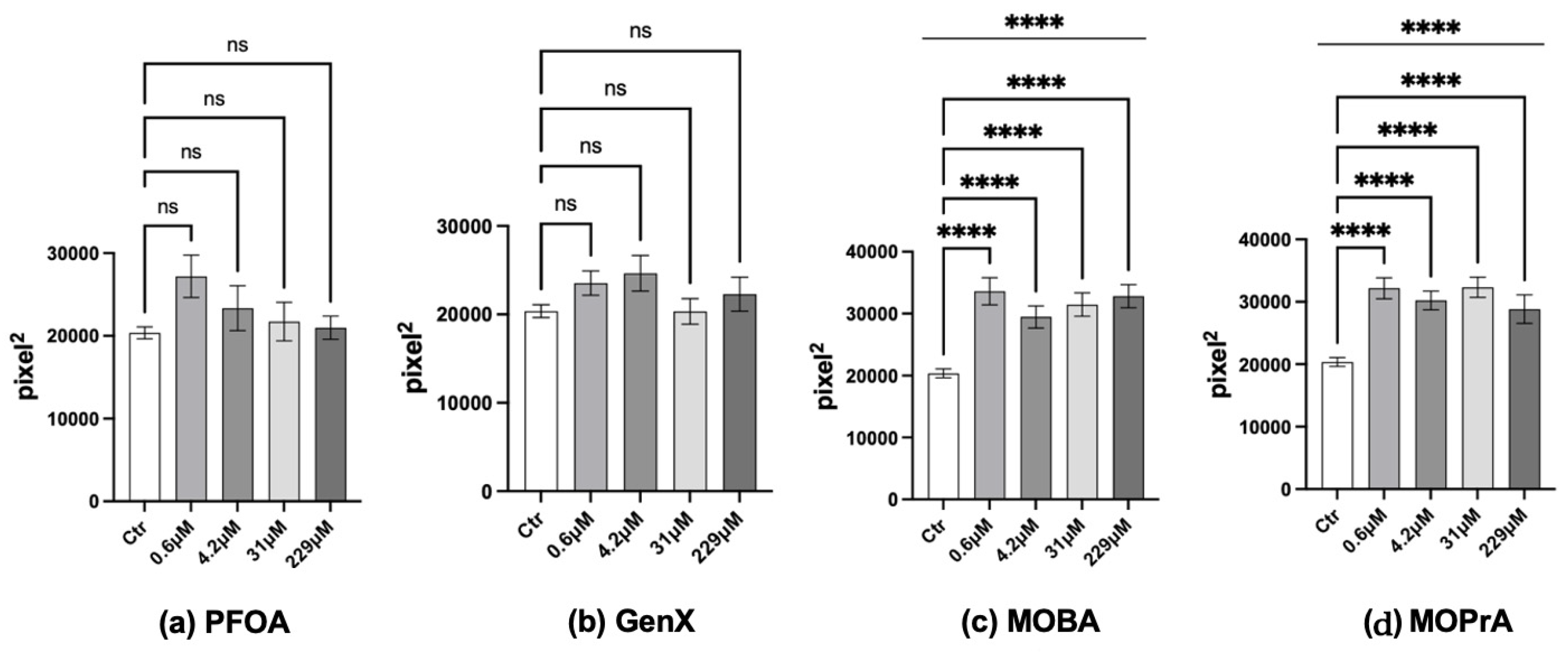
First, morphometric alterations in amoebocytes were assessed. The results revealed an overall increase in amoebocyte size in earthworms exposed to PFAS, although the changes were not always statistically significant (Figure 1). The cell size was determined by measuring the area of two-dimensional digitized images using ImageJ®. Notably, specimens treated with new generation PFAS (specifically MOBA or MOPrA) exhibited a marked enlargement of approximately 70%. In contrast, no significant changes in cell area were observed in organisms exposed to different concentrations of PFOA and GenX.
Statistical analysis showed a significant effect (p value < 0.001) in the specimen treated with MOBA and MOPrA on amoebocytes enlargement.
This suggests that, for this assessed parameter, only short-chain, new-generation PFAS can induce a statistically significant enlargement of amoebocytes.

3.2. Oxidative Burst Assay Results

The second biomarker assessed was the production of reactive oxygen species (ROS) by immune system cells, specifically amoebocytes, to determine whether the treatments induced activation of a key defense mechanism known as the oxidative burst [31].
Flow cytometry, coupled with a fluorescent stain (H2DCFDA-ROS staining), was used to quantify ROS in amoebocytes.
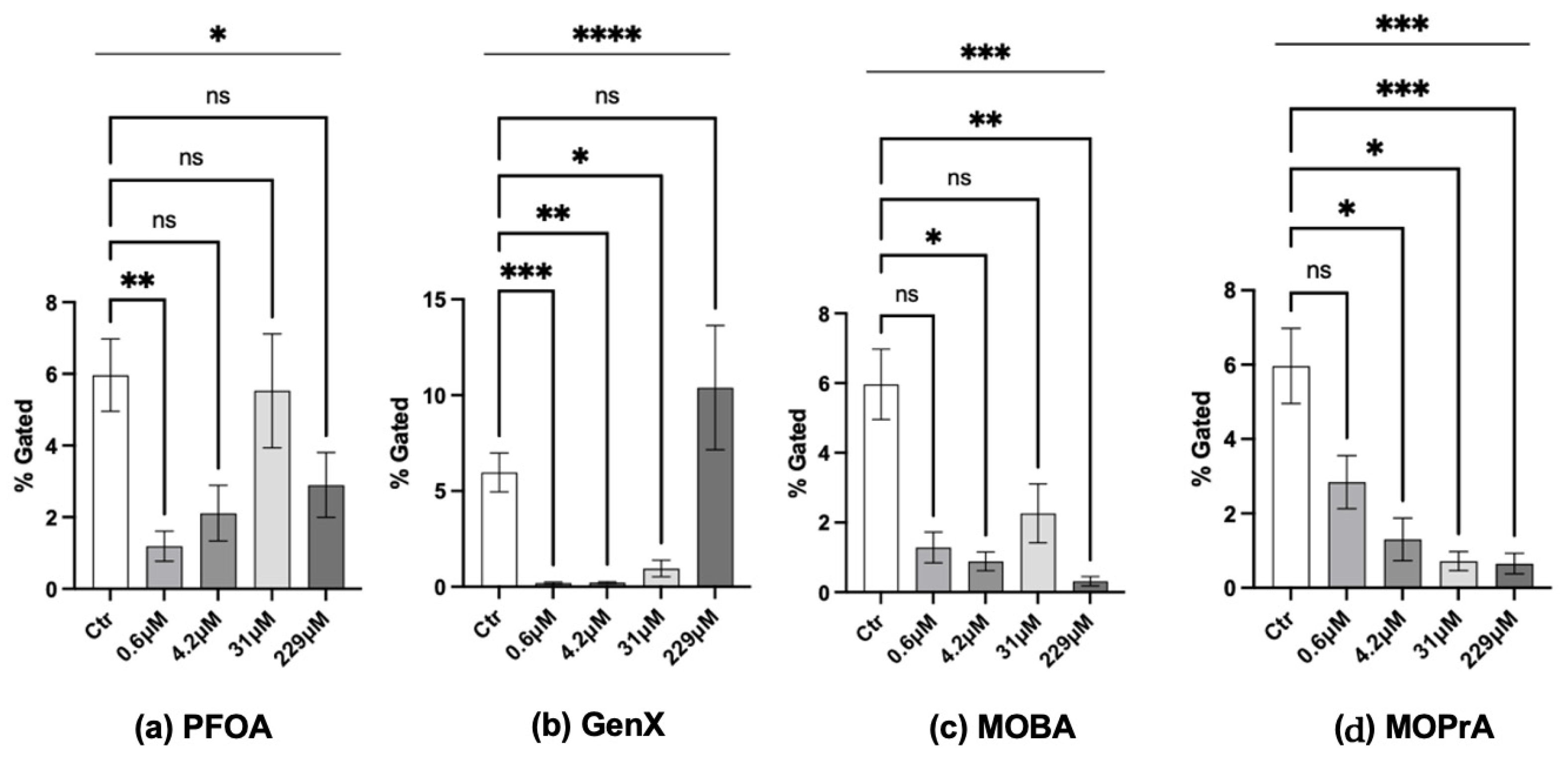
Figure 2 illustrates the percentage of amoebocytes positive for H2DCFDA staining, an indicator of intracellular ROS production. All tested PFAS congeners significantly reduced the proportion of ROS-positive cells, suggesting a substantial impairment in oxidative activity and, by extension, a potential weakening of immune defense mechanisms after 72 h of PFAS exposure.
For PFOA, GenX, and MOBA, no clear dose-dependent trend was evident; however, GenX exerted the strongest suppressive effect at the lowest concentration tested (0.6 µM), significantly reducing ROS production. At the highest concentration (229 µM), a partial recovery in ROS levels was observed, though this increase was not statistically significant. PFOA similarly showed its most pronounced effect at 0.6 µM, with a significant decrease in ROS-positive amoebocytes, but no consistent pattern was detected at higher doses.
In contrast, MOPrA demonstrated a clear dose-dependent trend, with a progressive reduction in ROS-positive cells as the concentration increased. While MOBA did not exhibit a consistent dose–response, the highest concentration (229 µM) led to the lowest percentage of ROS-positive amoebocytes.

3.3. Phenol Oxidase Assay (PO) Results

Subsequently, phenol oxidase activity was measured to uncover the putative immuno-toxic effect, since it is important for the immune response [32].
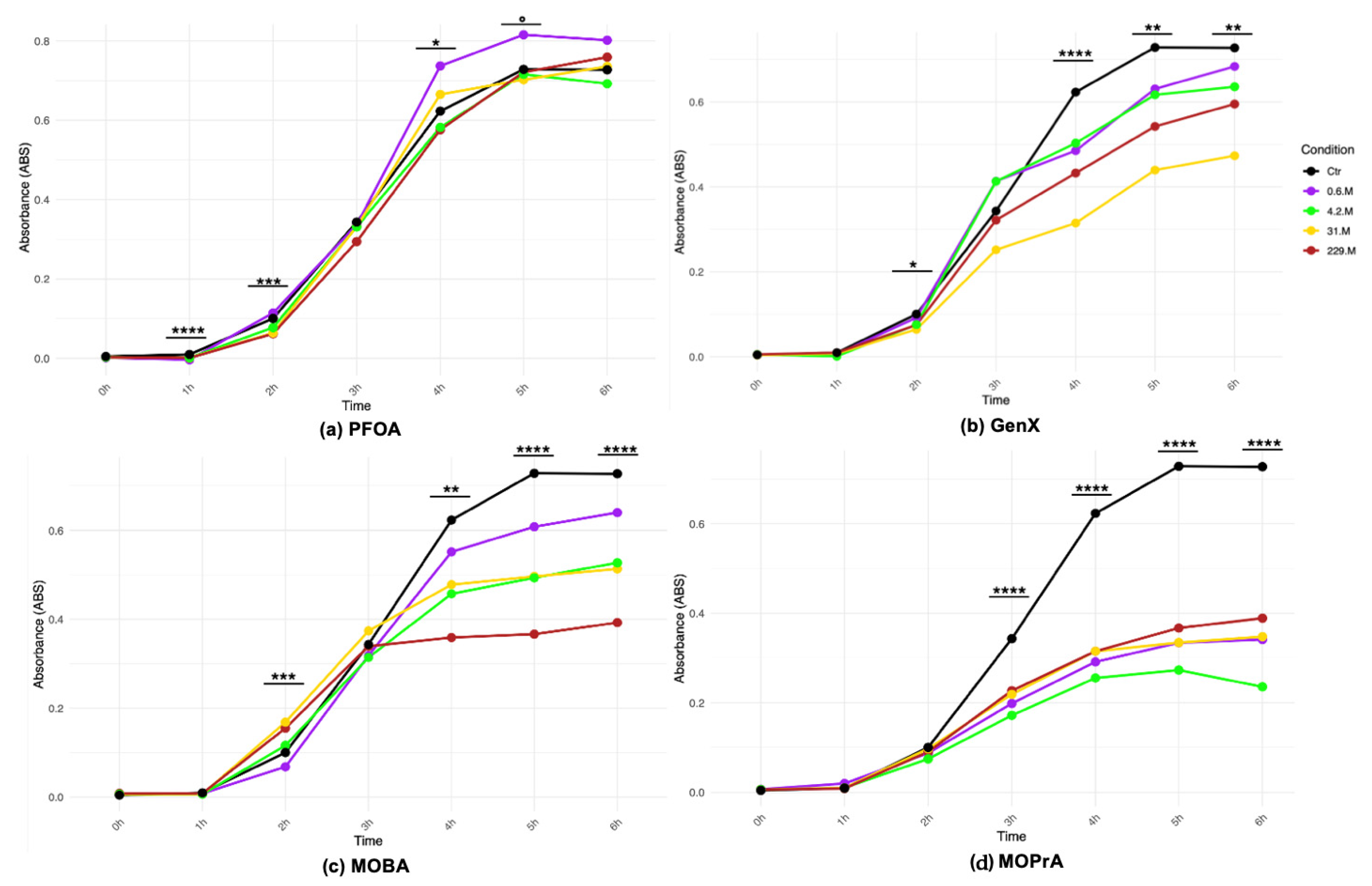
This test assessed the ability of PO to transform L-DOPA, via oxidation, into dopachrome. The timepoints were taken from 0 h to 6 h (Figure 3), enabling the observation of its kinetic trend over the selected time span. The assay was performed using whole E. fetida tissue lysate (SN10 ≈ 7.5μg of protein) exposed to the four congeners. The findings indicate that new-generation PFAS (GenX, MOBA, and MOPrA) exert a more pronounced inhibitory effect on phenol oxidase (PO) activity compared to the legacy compound PFOA. Interestingly, during the initial three hours of exposure, PFOA demonstrated greater inhibition of PO activity relative to the new-generation congeners.
Among the tested congeners, all three new-generation PFAS yielded a significant inhibition in phenol oxidase (PO) activity. With MOPrA emerging as the most potent compound, displaying a severe and threshold-like inhibitory effect, with all tested concentrations leading to near-complete suppression of PO activity. MOBA showed a marked dose-dependent inhibition, particularly evident in the final three hours of the assay, with higher concentrations resulting in progressively stronger effects.
GenX also induced general inhibition of PO activity across all concentrations; notably, the strongest suppression occurred at 31 µM, which also coincided with a marked downregulation of CCF-1 expression (Figure 4), suggesting a potential mechanistic link.
In contrast, PFOA elicited a non-linear response: while 4.2 µM slightly reduced PO activity, both lower (0.6 µM) and higher concentrations (31 µM and 229 µM) were associated with increased enzymatic activity, possibly reflecting a compensatory or hormetic response with limited overall toxicity compared to controls. Interestingly, 31 µM and 229 µM were also the most effective concentrations in the oxidative burst assay, eliciting increase in ROS production.

3.4. q-PCR Results

Furthermore, the relative abundances of two genes covering a crucial role in the defense against pathogens, CCF-1 (Coelomic Cytolytic Factor 1) and lysenin were assessed in order to gain molecular insight immune response pathways of E. fetida.
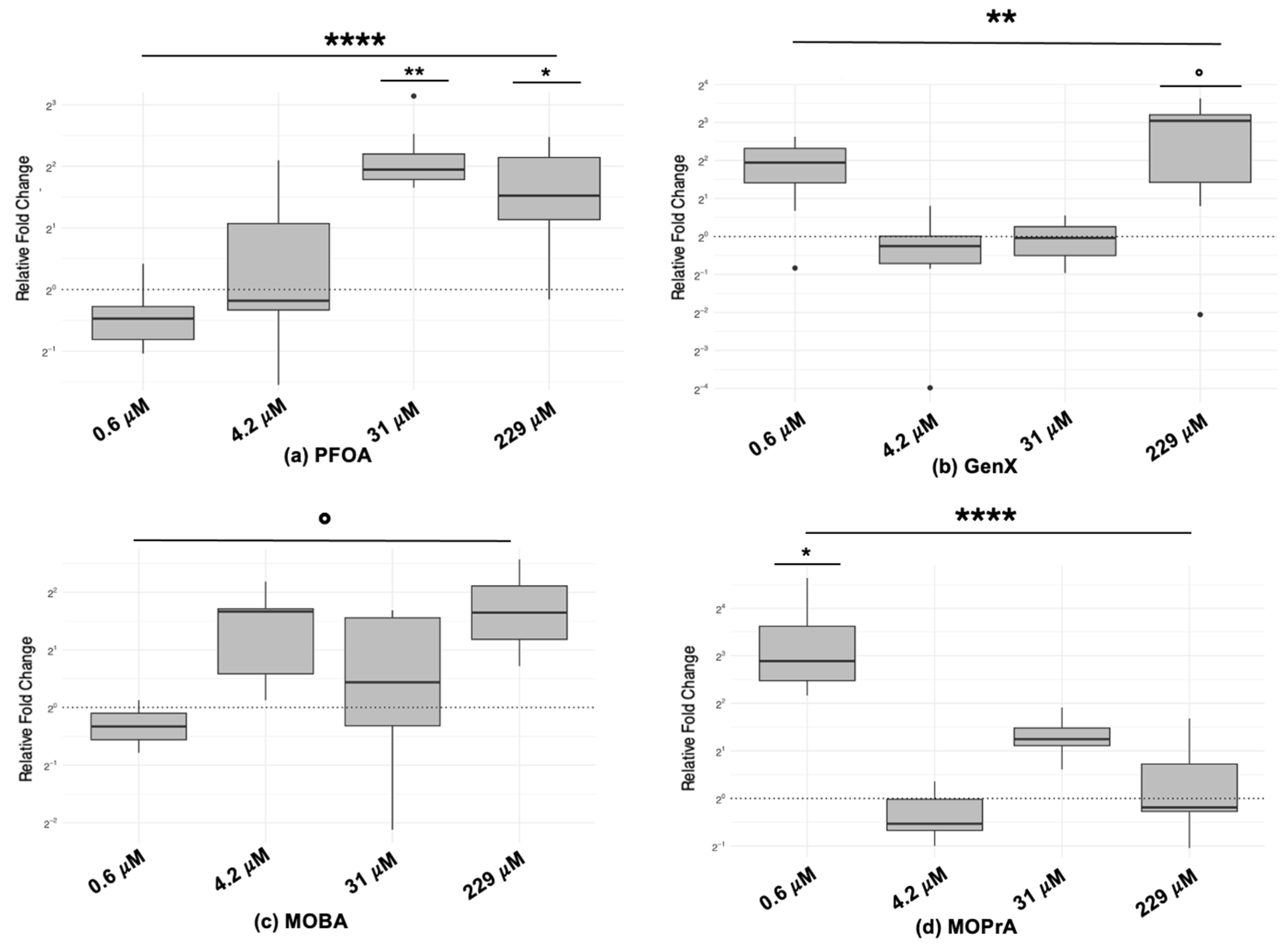
Figure 4 illustrates the relative expression of CCF-1 in Eisenia fetida following 72 h of exposure to increasing concentrations of four PFAS congeners.
PFOA (Figure 4a) induced a concentration-dependent upregulation of CCF-1, with increases observed from 0.6 µM to 31 µM. However, the slight reduction at 229 µM relative to 31 µM hints to a possible saturation effect that yields a partial plateau. Although the overall shift was statistically significant, the most effective conditions that were capable of affecting the CCF-1 gene were the two highest (31 µM and 229 µM). This result follows the pattern of PO assay, where these same two conditions were capable of inducing an increase in the biomarker response.
GenX (Figure 4b) displayed a biphasic response, with an initial decrease in expression between 0.6 µM and 4.2 µM, followed by a progressive increase from 4.2 µM to 229 µM. Notably, the highest fold change was recorded at 229 µM, coinciding with the most pronounced inhibition of phenol oxidase activity (Figure 3), indicating a potential compensatory upregulation of CCF-1 under high-stress conditions. Although the overall shift in these genes was statistically significant, no single condition on its own against the control resulted in statistically significant shift, suggesting that each condition on its own did not induce a marked alteration.
Meanwhile, MOBA (Figure 4c) elicited a mild, non-significant increase in gene expression across the tested concentrations, consistent with a limited transcriptional response.
In contrast, MOPrA (Figure 4d) induced a significantly elevated expression of CCF-1 at the lowest concentration (0.6 µM), while higher concentrations were associated with diminished expression levels. This suggests a threshold-like effect, whereby low-dose exposure strongly activates CCF-1, potentially as an acute stress response, whereas higher doses may impair transcriptional activity or reflect toxic suppression.
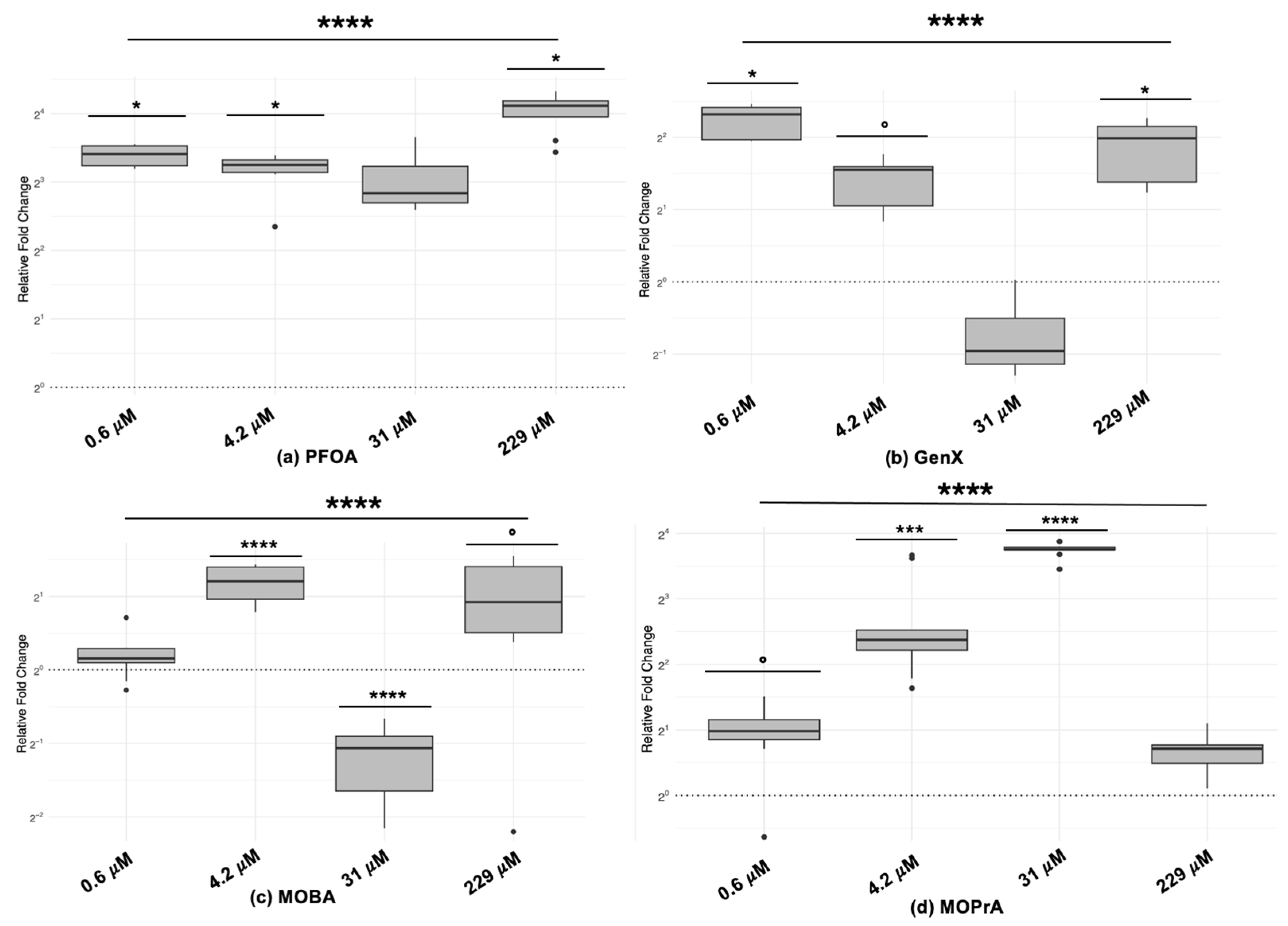
Figure 5 shows the expression of lysenin in Eisenia fetida after 72 h of exposure to increasing concentrations of four PFAS congeners. PFOA (Figure 5a) and GenX (Figure 5b) exhibited similar expression dynamics, characterized by an initial high expression at 0.6 µM (log2 fold change ≈ 3.5 for PFOA and ≈ 2.5 for GenX), followed by a decline at intermediate concentrations, reaching a minimum at 31 µM. For GenX, expression at 31 µM dropped significantly to below baseline (log2 fold change ≈ −1; p < 0.0001), indicating strong downregulation.
PFOA also showed a significant decrease at this concentration (p < 0.0001), though the suppression was more moderate (≈2.75 log2 units). Notably, at the highest concentration (229 µM), PFOA triggered a marked upregulation of lysenin expression (log2 fold change ≈ 4; p < 0.05), suggesting a late-stage compensatory or stress-induced response. In contrast, GenX expression at 229 µM returned to near-baseline levels, showing partial recovery without full induction.
MOBA (Figure 5c) exhibited a more variable expression pattern with no clear dose–response trend. The highest expression levels were observed at 4.2 µM and 229 µM, while a significant downregulation occurred at 31 µM (p < 0.0001), where expression dropped below baseline, similarly to GenX. These results suggest that lysenin expression under MOBA exposure is condition-specific rather than dose-dependent, with possible repression at intermediate stress levels.
MOPrA (Figure 5d) demonstrated a dose-dependent induction pattern across the first three concentrations. Expression steadily increased from 0.6 µM (log2 ≈ 1) to a peak at 31 µM (log2 ≈ 3.75), with statistically significant differences at each step (p < 0.001–0.0001). However, at 229 µM, a significant drop in expression was observed (p < 0.0001), indicating that high-dose MOPrA may suppress the transcriptional activation of lysenin, potentially due to cytotoxicity or a saturation threshold beyond which stimulatory effects are lost.

4. Discussion

Per- and polyfluoroalkyl substances (PFAS) are renowned for their extraordinary chemical resilience. The C–F bond is one of the strongest in organic chemistry [5,33], which explains its environmental persistence, resistance to biodegradation, and bioaccumulation in organisms. Growing toxicological and epidemiological evidence indicates that PFAS can interfere with vertebrate and invertebrate innate immunity [34]. In earthworms, innate defense is mediated by two coelomocyte lineages: amoebocytes (phagocytosis, oxidative burst, cytotoxicity) and eleocytes (secretion of humoral factors such as lysenin) [35].
We therefore assessed four biomarker suites that together span cellular and humoral immunity: (i) amoebocyte morphometrics alterations [26] and oxidative burst [31]; (ii) phenol oxidase (PO) activity, a linchpin of melanisation/encapsulation [32,36]; (iii) transcription of CCF-1, a TNF-like pattern-recognition lectin that both recognizes microbial glycans and activates pro-PO via proteolysis [37,38]; and (iv) transcription of lysenin, an eleocyte-derived pore-forming antimicrobial protein [39,40]. This design allowed us to capture PFAS-induced modulation across the major immune pathways in Eisenia fetida.

4.1. Amoebocyte Enlargement as an Early Sentinel of Immune Stress

Short-chain ether acids MOBA (C5) and MOPrA (C4) enlarged amoebocytes by ≈70% (p < 0.001), whereas the longer-chain HFPO-DA/GenX (C6) and legacy PFOA (C8) did not. Cell size is tightly linked to metabolic rate and immune activation [41,42] and has been used as a biomarker of stress in oligochaetes [26].
Because cell swelling anticipates ROS production and mitotic activity in E. fetida coelomocytes [26], these data imply that carbon-chain shortening improves membrane penetration and triggers early activation, echoing the cell-size responses seen in vertebrate neutrophils [43] and marine bivalve hemocytes [44].

4.2. Oxidative Burst Suppression and Antioxidant Countermeasures

After 72 h, ROS-positive amoebocytes declined sharply: 45% for GenX at 0.6 µM and 18 → −62% across MOPrA from 0.6 → 229 µM, with PFOA and MOBA producing weaker, non-monotonic inhibition. These results match the whole-worm data of Rotondo et al. [21], who reported a parallel drop in ROS under identical GenX doses, accompanied by ≈35% inhibition of superoxide dismutase (SOD) and a three-fold rise in catalase (CAT) at 0.6 and 229 µM.
The concordance suggests a biphasic sequence: an initial oxidative burst [45,46] is followed by SOD blockade potentially via PFAS–hemoprotein binding [47] and CAT hyper-induction that over-quells ROS, a pattern compatible with brown-body dynamics, where melanin subsequently neutralizes excess oxidants [48]. Such antioxidant overshoot may undermine microbicidal competence in the long run [49].

4.3. Phenol Oxidase Inhibition: Convergence of Humoral and Cellular Immunity

PO activity followed the same potency order as the redox endpoints (MOPrA > GenX > MOBA ≫ PFOA), dropping 78% at 229 µM MOPrA. Because PO requires quinone-coupled ROS for catalysis [50], CAT driven peroxide removal offers a parsimonious explanation for its suppression. PFAS affinity for hydrophobic protein cavities [51] and direct inhibition of antioxidant enzymes [52] suggest an additional direct interaction with aromatic residues at the PO active site [53], although this still needs empirical confirmation.

4.4. Transcriptional Compensation and Thresholds

CCF-1 increased dose-dependently under MOBA and PFOA but showed a U-shape with GenX (lowest at 4.2 µM, four-fold higher at 229 µM), mirroring GenX-induced CAT hyperactivity [21] and suggesting oxidative-quenching-driven immune stimulation. MOPrA elicited a spike at 0.6 µM then fell, indicating threshold toxicity.
Lysenin displayed a threshold-saturation profile with MOPrA (max +3.8 log2 at 31 µM, collapse at 229 µM) and a biphasic response with GenX/PFOA (down ≤ 31 µM, rebound at 229 µM). These patterns are consistent with moderate stress promoting AMP transcription and a high redox burden curtailing energetically costly peptide synthesis.

4.5. Integrated Mode of Action Framework

Short-chain ether PFAS appear to derail earthworm immunity through a sequential, self-reinforcing cascade that links redox imbalance to enzyme blockade and, ultimately, to a faltering transcriptional rescue.
Step 1—Membrane access and primary oxidative insult. Their small size and amphiphilicity favor rapid partitioning into coelomocyte membranes, an event likely aided by the high phospholipid content of amoebocyte surfaces. This initial penetration triggers the canonical NADPH-oxidase burst that accompanies phagocytic activation, producing a surge of superoxide and downstream peroxide.
Step 2—SOD inhibition. Docking and spectroscopic works show that PFAS carboxylates can coordinate transition-metal centers or displace active-site water in hemoproteins [52]. The same interaction plausibly occurs with the Cu/Zn and Mn centers of SOD, as suggested by the 30–40% activity loss measured by Rotondo et al. [21], throttling superoxide dismutation while peroxide continues to accumulate.
Step 3—CAT hyper-induction. In response, earthworms overexpress CAT, particularly at ≥31 µM MOPrA, consuming H2O2 so efficiently that total ROS levels fall below the threshold required for antimicrobial chemistry. While adaptive in the short term, this overshoot depletes the oxidative arsenal needed for pathogen killing.
Step 4—Phenol oxidase blockade and burst collapse. PO depends on quinone-coupled ROS for catalytic cycling; when ROS are scarce, melanin formation stalls. Additional direct binding of PFAS to PO’s hydrophobic active pocket [53] may lock the enzyme in an inactive conformation. The combined loss of oxidative burst and PO activity removes both fast (respiratory) and slow (melanisation) cytotoxic pathways.
Step 5—Transcriptional rescue and exhaustion. Sensing functional failure, the worm upregulates CCF-1 to relaunch the proPO cascade and boosts lysenin to strengthen humoral defenses. Yet this rescue is energetically costly and, under high CAT/low-ROS conditions, plateauing or even declining transcripts signal systemic exhaustion. The outcome is an immunocompromised organism vulnerable to soil-borne pathogens. Although delineated here for earthworms, the same redox–enzyme–transcription triad could constitute a unifying PFAS mode of action across invertebrates and possibly vertebrate phagocytes.

4.6. Ecological Relevance, Knowledge Gaps, and Future Perspectives

The concentration that initiates this cascade (≥0.6 µM, ≈250 µg kg−1 soil) matches PFAS loads reported at AFFF training areas, industrial sites, and some agricultural fields irrigated with contaminated biosolids [9]. Earthworms are ecosystem engineers that regulate litter turnover, soil aggregation, and microbial community structure; chronic immunosuppression could therefore propagate upward, altering nutrient cycling, plant health, and disease dynamics [54]. Field studies should now verify whether community-level shifts reduced earthworm biomass, altered cast production, increased pathogen incidence—co-occur with ether PFAS hotspots.
A key limitation of the present study lies in its temporal resolution. All endpoints were quantified at a single acute timepoint, namely 72 h, as imposed by the OECD 207 filter-paper protocol. Within this framework, we cannot clearly distinguish between transient, potentially adaptive responses and a true impairment of immune function. Nevertheless, the concerted inhibition of cellular (e.g., oxidative burst), humoral (e.g., PO), and molecular (e.g., CCF-1 and lysenin) responses, together with the lack of any indication of recovery at the highest concentrations tested, is more consistent with a genuine immunotoxic effect than with a short-lived homeostatic adjustment, although this interpretation still requires formal confirmation. In this regard, future experiments should explicitly include both shorter-term and longer-term exposure scenarios, ideally with multiple sampling points and recovery phases, to clarify whether the observed effects are reversible or reflect a persistent impairment of immune function.
Mechanistically, early time-course experiments (minutes to 6 h) combining ROS imaging, enzymology, and targeted metabolomics are needed to capture the elusive pro-oxidant spike and map its conversion into an antioxidant overshoot. Multi-omics (transcriptome–proteome–metabolome) and redox-proteomics could clarify whether CAT induction is transcriptional, post translational, or both, and whether other ROS-processing enzymes (GPx, Prx) participate.
Moreover, future investigations should address direct alterations in the earthworms’ resistance to pathogens by performing pathogen-challenge assays involving controlled exposures to known infectious agents. Nonetheless, the development of such tests is still hindered by the absence of standardized and validated protocols for assessing infection outcomes in annelid models. Because soils contain PFAS mixtures, mixture-interaction designs, legacy and ether compounds, and common cofactors such as metals or pesticides are essential to derive additive versus synergistic risks. Cross-phyla validation in collembolans, nematodes, and microbial consortia would test the generality of the oxidative–antioxidant immune axis, while trophic-transfer trials (earthworm → predator) could reveal immunomodulatory carryover. Finally, coupling these mechanistic biomarkers with passive PFAS samplers and high-resolution analytical chemistry will enable weight-of-evidence frameworks for site prioritization, remediation monitoring, and regulatory guideline refinement for the still-expanding universe of short-chain and ether-linked PFAS.

5. Conclusions

By integrating morphometric alterations of amoebocytes, redox, enzymatic, and gene expression data alongside findings from Rotondo et al. [21], this study refines the understanding of the oxidative–antioxidant immune axis through which short-chain ether PFAS disrupt immune function in Eisenia fetida.
Our results reveal a coordinated cascade: an early oxidative burst with short-chain PFECAs inducing the most pronounced inhibitions; enzymatic inhibition (PO), showing that MOBA and MOPrA (short-chain PFECAs) produce the most marked decrease in this enzyme’s activity; and, ultimately, transcriptional dysregulation, marked by CCF-1 and lysenin expression. This sequence culminates in immune exhaustion, particularly under high-dose exposure to emerging PFAS such as MOBA, MOPrA, and GenX.
The biomarker suite—comprising amoebocyte size, ROS, CAT, PO activity, and immune gene expression—emerges as a robust and mechanistically informative tool for assessing PFAS hazards in terrestrial ecosystems. Beyond E. fetida, this integrated framework may help guide cross-species immunotoxicity testing, support weight-of-evidence risk assessments, and inform regulatory strategies for the expanding class of short-chain and ether-linked PFAS.

Author Contributions

D.G.; Writing, Original draft, Investigations, Formal Analysis, Validation, Methodology, Data Curation, Review and Editing. D.R.; Investigations, Formal Analysis, Methodology, Validation. C.L.; Investigations, Validation. V.A.; Methodology, Review and Editing. A.C.; Writing, Investigations, Review and Editing, Visualization, Funding acquisition. F.D.; Formal Analysis, Writing, Investigations, Methodology, Visualization, Review and Editing, Resources, Supervision, Project Administration, Funding acquisition. All authors have read and agreed to the published version of the manuscript.

Funding

This project has received funding from the European Union’s Horizon 2020 research and innovation program under grant agreement No. 101037509 (SCENARIOS project).

Data Availability Statement

The data that support the findings of this study are available from the corresponding author upon reasonable request.

Acknowledgments

The authors thank the anonymous reviewers for their constructive comments and suggestions, which greatly helped to improve the quality and clarity of the manuscript.

Conflicts of Interest

The authors declare no conflicts of interest.

References

  1. Mishra, R.K.; Mentha, S.S.; Misra, Y.; Dwivedi, N. Emerging pollutants of severe environmental concern in water and wastewater: A comprehensive review on current developments and future research. Water-Energy Nexus 2023, 6, 74–95. [Google Scholar] [CrossRef]
  2. Androulakakis, A.; Alygizakis, N.; Gkotsis, G.; Nika, M.C.; Nikolopoulou, V.; Bizani, E.; Chadwick, E.; Cincinelli, A.; Claßen, D.; Danielsson, S.; et al. Determination of 56 per- and polyfluoroalkyl substances in top predators and their prey from Northern Europe by LC-MS/MS. Chemosphere 2022, 287, 131775. [Google Scholar] [CrossRef]
  3. Meegoda, J.N.; Kewalramani, J.A.; Li, B.; Marsh, R.W. A Review of the Applications, Environmental Release, and Remediation Technologies of Per- and Polyfluoroalkyl Substances. Int. J. Environ. Res. Public Health 2020, 17, 8117. [Google Scholar] [CrossRef]
  4. Wang, Y.; Munir, U.; Huang, Q. Occurrence of per- and polyfluoroalkyl substances (PFAS) in soil: Sources, fate, and remediation. Soil Environ. Health 2023, 1, 100004. [Google Scholar] [CrossRef]
  5. O’Hagan, D. Understanding organofluorine chemistry. An introduction to the C–F bond. Chem. Soc. Rev. 2008, 37, 308–319. [Google Scholar] [CrossRef]
  6. Brase, R.A.; Mullin, E.J.; Spink, D.C. Legacy and Emerging Per- and Polyfluoroalkyl Substances: Analytical Techniques, Environmental Fate, and Health Effects. Int. J. Mol. Sci. 2021, 22, 995. [Google Scholar] [CrossRef] [PubMed]
  7. Panieri, E.; Baralic, K.; Djukic-Cosic, D.; Buha Djordjevic, A.; Saso, L. PFAS Molecules: A Major Concern for the Human Health and the Environment. Toxics 2022, 10, 44. [Google Scholar] [CrossRef]
  8. Xiao, F. Emerging poly- and perfluoroalkyl substances in the aquatic environment: A review of current literature. Water Res. 2017, 124, 482–495. [Google Scholar] [CrossRef]
  9. Van Asselt, E.D.; Rietra, R.P.J.J.; Römkens, P.F.A.M.; Van Der Fels-Klerx, H.J. Perfluorooctane sulphonate (PFOS) throughout the food production chain. Food Chem. 2011, 128, 1–6. [Google Scholar] [CrossRef] [PubMed]
  10. Fromme, H.; Tittlemier, S.A.; Völkel, W.; Wilhelm, M.; Twardella, D. Perfluorinated compounds—Exposure assessment for the general population in western countries. Int. J. Hyg. Environ. Health 2009, 212, 239–270. [Google Scholar] [CrossRef]
  11. Brusseau, M.L.; Anderson, R.H.; Guo, B. PFAS concentrations in soils: Background levels versus contaminated sites. Sci. Total Environ. 2020, 740, 140017. [Google Scholar] [CrossRef]
  12. Anthony, M.A.; Bender, S.F.; Van Der Heijden, M.G.A. Enumerating soil biodiversity. Proc. Natl. Acad. Sci. USA 2023, 120, e2304663120. [Google Scholar] [CrossRef] [PubMed]
  13. Calisi, A.; Semeraro, T.; Giordano, M.E.; Dondero, F.; Lionetto, M.G. Earthworms multi-biomarker approach for ecotoxicological assessment of soils irrigated with reused treated wastewater. Appl. Soil Ecol. 2025, 206, 105866. [Google Scholar] [CrossRef]
  14. Giulia, M.; Calisi, A.; Schettino, T. Earthworm Biomarkers as Tools for Soil Pollution Assessment. In Soil Health and Land Use Management; Hernandez Soriano, M.C., Ed.; InTech: Vienna, Austria, 2012; Available online: http://www.intechopen.com/books/soil-health-and-land-use-management/earthworm-biomarkers-as-tools-for-soil-pollution-assessment (accessed on 7 October 2025).
  15. Xiao, R.; Ali, A.; Xu, Y.; Abdelrahman, H.; Li, R.; Lin, Y.; Bolan, N.; Shaheen, S.M.; Rinklebe, J.; Zhang, Z. Earthworms as candidates for remediation of potentially toxic elements contaminated soils and mitigating the environmental and human health risks: A review. Environ. Int. 2022, 158, 106924. [Google Scholar] [CrossRef]
  16. Ouellet, G.; Lapen, D.R.; Topp, E.; Sawada, M.; Edwards, M. A heuristic model to predict earthworm biomass in agroecosystems based on selected management and soil properties. Appl. Soil Ecol. 2008, 39, 35–45. [Google Scholar] [CrossRef]
  17. Fründ, H.C.; Graefe, U.; Tischer, S. Earthworms as Bioindicators of Soil Quality. In Biology of Earthworms; Karaca, A., Ed.; Soil Biology; Springer: Berlin/Heidelberg, Germany, 2011; Volume 24, pp. 261–278. [Google Scholar] [CrossRef]
  18. Vig, A.P. (Ed.) Earthworm Engineering and Applications; Life Sciences Research and Development; Nova Science Publishers: New York, NY, USA, 2022; 270p. [Google Scholar]
  19. Engelmann, P.; Hayashi, Y.; Bodó, K.; Ernszt, D.; Somogyi, I.; Steib, A.; Orbán, J.; Pollák, E.; Nyitrai, M.; Németh, P.; et al. Phenotypic and functional characterization of earthworm coelomocyte subsets: Linking light scatter-based cell typing and imaging of the sorted populations. Dev. Comp. Immunol. 2016, 65, 41–52. [Google Scholar] [CrossRef]
  20. Alesci, A.; Capillo, G.; Fumia, A.; Albano, M.; Messina, E.; Spanò, N.; Pergolizzi, S.; Lauriano, E.R. Coelomocytes of the Oligochaeta earthworm Lumbricus terrestris (Linnaeus, 1758) as evolutionary key of defense: A morphological study. Zool. Lett. 2023, 9, 5. [Google Scholar] [CrossRef] [PubMed]
  21. Rotondo, D.; Gualandris, D.; Lorusso, C.; Braeuning, A.; Calisi, A.; Dondero, F. Impact of Short-Chain Perfluoropropylene Oxide Acids on Biochemical and Behavioural Parameters in Eisenia fetida (Savigny, 1826). J. Xenobiotics 2024, 15, 2. [Google Scholar] [CrossRef] [PubMed]
  22. Sun, M.; Arevalo, E.; Strynar, M.; Lindstrom, A.; Richardson, M.; Kearns, B.; Pickett, A.; Smith, C.; Knappe, D.R. Legacy and Emerging Perfluoroalkyl Substances Are Important Drinking Water Contaminants in the Cape Fear River Watershed of North Carolina. Environ. Sci. Technol. Lett. 2016, 3, 415–419. [Google Scholar] [CrossRef]
  23. Calisi, A.; Baranzini, N.; Marcolli, G.; Bon, C.; Rotondo, D.; Gualandris, D.; Pulze, L.; Grimaldi, A.; Dondero, F. Evaluation of per- and polyfluoroalkyl substances (PFAS) toxic effects on the acute inflammatory response in the medicinal leech Hirudo verbana. Chemosphere 2024, 366, 143519. [Google Scholar] [CrossRef]
  24. OECD Test No. 207: Earthworm, Acute Toxicity Tests [Internet]. OECD; 1984. (OECD Guidelines for the Testing of Chemicals, Section 2). Available online: https://www.oecd.org/en/publications/test-no-207-earthworm-acute-toxicity-tests_9789264070042-en.html (accessed on 6 August 2025).
  25. Josková, R.; Šilerová, M.; Procházková, P.; Bilej, M. Identification and cloning of an invertebrate-type lysozyme from Eisenia andrei. Dev. Comp. Immunol. 2009, 33, 932–938. [Google Scholar] [CrossRef] [PubMed]
  26. Calisi, A.; Lionetto, M.G.; Schettino, T. Pollutant-induced alterations of granulocyte morphology in the earthworm Eisenia foetida. Ecotoxicol. Environ. Saf. 2009, 72, 1369–1377. [Google Scholar] [CrossRef] [PubMed]
  27. Szychowski, K.A.; Rybczyńska-Tkaczyk, K.; Leja, M.L.; Wójtowicz, A.K.; Gmiński, J. Tetrabromobisphenol A (TBBPA)-stimulated reactive oxygen species (ROS) production in cell-free model using the 2′,7′-dichlorodihydrofluorescein diacetate (H2DCFDA) assay—Limitations of method. Environ. Sci. Pollut. Res. 2016, 23, 12246–12252. [Google Scholar] [CrossRef]
  28. Procházková, P.; Šilerová, M.; Stijlemans, B.; Dieu, M.; Halada, P.; Josková, R.; Beschin, A.; De Baetselier, P.; Bilej, M. Evidence for proteins involved in prophenoloxidase cascade Eisenia fetida earthworms. J. Comp. Physiol. B 2006, 176, 581–587. [Google Scholar] [CrossRef]
  29. Shi, X.; Liu, X.; Wang, Q.; Das, A.; Ma, G.; Xu, L.; Sun, Q.; Peddireddi, L.; Jia, W.; Liu, Y.; et al. A multiplex real-time PCR panel assay for simultaneous detection and differentiation of 12 common swine viruses. J. Virol. Methods 2016, 236, 258–265. [Google Scholar] [CrossRef]
  30. Livak, K.J.; Schmittgen, T.D. Analysis of Relative Gene Expression Data Using Real-Time Quantitative PCR and the 2−ΔΔCT Method. Methods 2001, 25, 402–408. [Google Scholar] [CrossRef]
  31. Chen, Y.; Junger, W.G. Measurement of Oxidative Burst in Neutrophils. In Leucocytes; Ashman, R.B., Ed.; Methods in Molecular Biology; Humana Press: Totowa, NJ, USA, 2012; Volume 844, pp. 115–124. [Google Scholar] [CrossRef]
  32. González-Santoyo, I.; Córdoba-Aguilar, A. Phenoloxidase: A key component of the insect immune system. Entomol. Exp. Appl. 2012, 142, 1–16. [Google Scholar] [CrossRef]
  33. Gaballah, S.; Swank, A.; Sobus, J.R.; Howey, X.M.; Schmid, J.; Catron, T.; McCord, J.; Hines, E.; Strynar, M.; Tal, T. Evaluation of Developmental Toxicity, Developmental Neurotoxicity, and Tissue Dose in Zebrafish Exposed to GenX and Other PFAS. Environ. Health Perspect. 2020, 128, 047005. [Google Scholar] [CrossRef]
  34. Von Holst, H.; Nayak, P.; Dembek, Z.; Buehler, S.; Echeverria, D.; Fallacara, D.; John, L. Perfluoroalkyl substances exposure and immunity, allergic response, infection, and asthma in children: Review of epidemiologic studies. Heliyon 2021, 7, e08160. [Google Scholar] [CrossRef]
  35. Homa, J. Earthworm coelomocyte extracellular traps: Structural and functional similarities with neutrophil NETs. Cell Tissue Res. 2018, 371, 407–414. [Google Scholar] [CrossRef] [PubMed]
  36. Cerenius, L.; Söderhäll, K. The prophenoloxidase-activating system in invertebrates. Immunol. Rev. 2004, 198, 116–126. [Google Scholar] [CrossRef] [PubMed]
  37. Beschin, A.; Bilej, M.; Hanssens, F.; Raymakers, J.; Van Dyck, E.; Revets, H.; Brys, L.; Gomez, J.; De Baetselier, P.; Timmermans, M. Identification and Cloning of a Glucan- and Lipopolysaccharide-binding Protein from Eisenia foetidaearthworm Involved in the Activation of Prophenoloxidase Cascade. J. Biol. Chem. 1998, 273, 24948–24954. [Google Scholar] [CrossRef]
  38. Bilej, M.; Joskova, R.; Van Den Bergh, R.; Prochazkova, P.; Silerova, M.; Ameloot, P.; De Baetselier, P.; Beschin, A. An invertebrate TNF functional analogue activates macrophages via lectin-saccharide interaction with ion channels. Int. Immunol. 2006, 18, 1663–1670. [Google Scholar] [CrossRef]
  39. Kobayashi, H.; Ohta, N.; Umeda, M. Biology of Lysenin, a Protein in the Coelomic Fluid of the Earthworm Eisenia foetida. Int. Rev. Cytol. 2004, 236, 45–99. [Google Scholar] [CrossRef]
  40. Opper, B.; Bognár, A.; Heidt, D.; Németh, P.; Engelmann, P. Revising lysenin expression of earthworm coelomocytes. Dev. Comp. Immunol. 2013, 39, 214–218. [Google Scholar] [CrossRef]
  41. Ginzberg, M.B.; Kafri, R.; Kirschner, M. On being the right (cell) size. Science 2015, 348, 1245075. [Google Scholar] [CrossRef]
  42. Glazier, D.S. How Metabolic Rate Relates to Cell Size. Biology 2022, 11, 1106. [Google Scholar] [CrossRef] [PubMed]
  43. Mantovani, A.; Cassatella, M.A.; Costantini, C.; Jaillon, S. Neutrophils in the activation and regulation of innate and adaptive immunity. Nat. Rev. Immunol. 2011, 11, 519–531. [Google Scholar] [CrossRef] [PubMed]
  44. Calisi, A.; Giordano, M.E.; Dondero, F.; Maisano, M.; Fasulo, S.; Lionetto, M.G. Morphological and functional alterations in hemocytes of Mytilus galloprovincialis exposed in high-impact anthropogenic sites. Mar. Environ. Res. 2023, 188, 105988. [Google Scholar] [CrossRef]
  45. Valembois, P.; Lassègues, M. In vitro generation of reactive oxygen species by free coelomic cells of the annelid Eisenia fetida andrer: An analysis by chemiluminescence and nitro blue tetrazolium reduction. Dev. Comp. Immunol. 1995, 19, 195–204. [Google Scholar] [CrossRef]
  46. Homa, J.; Stalmach, M.; Wilczek, G.; Kolaczkowska, E. Effective activation of antioxidant system by immune-relevant factors reversely correlates with apoptosis of Eisenia andrei coelomocytes. J. Comp. Physiol. B 2016, 186, 417–430. [Google Scholar] [CrossRef]
  47. Yang, Y.D.; Lu, N.; Tian, R. The interaction of perfluorooctane sulfonate with hemoproteins and its relevance to molecular toxicology. Int. J. Biol. Macromol. 2024, 254, 128069. [Google Scholar] [CrossRef] [PubMed]
  48. Homa, J.; Zorska, A.; Wesolowski, D.; Chadzinska, M. Dermal exposure to immunostimulants induces changes in activity and proliferation of coelomocytes of Eisenia andrei. J. Comp. Physiol. B 2013, 183, 313–322. [Google Scholar] [CrossRef] [PubMed]
  49. Livingston, G.; Huntley, J.; Liu, K.Y.; Costafreda, S.G.; Selbæk, G.; Alladi, S.; Ames, D.; Banerjee, S.; Burns, A.; Brayne, C.; et al. Dementia prevention, intervention, and care: 2024 report of the Lancet standing Commission. Lancet 2024, 404, 572–628. [Google Scholar] [CrossRef]
  50. Lu, A.; Zhang, Q.; Zhang, J.; Yang, B.; Wu, K.; Xie, W.; Luan, Y.X.; Ling, E. Insect prophenoloxidase: The view beyond immunity. Front. Physiol. 2014, 5, 252. [Google Scholar] [CrossRef]
  51. Cheng, W.; Doering, J.A.; LaLone, C.; Ng, C. Integrative Computational Approaches to Inform Relative Bioaccumulation Potential of Per- and Polyfluoroalkyl Substances Across Species. Toxicol. Sci. 2021, 180, 212–223. [Google Scholar] [CrossRef]
  52. Rajak, P.; Ganguly, A. The ligand-docking approach explores the binding affinity of PFOS and PFOA for major endogenous antioxidants: A potential mechanism to fuel oxidative stress. Sustain. Chem. Environ. 2023, 4, 100047. [Google Scholar] [CrossRef]
  53. Nappi, A.J.; Christensen, B.M. Melanogenesis and associated cytotoxic reactions: Applications to insect innate immunity. Insect Biochem. Mol. Biol. 2005, 35, 443–459. [Google Scholar] [CrossRef]
  54. Ghosh, S. Environmental pollutants, pathogens and immune system in earthworms. Environ. Sci. Pollut. Res. 2018, 25, 6196–6208. [Google Scholar] [CrossRef] [PubMed]
Figure 1. (a) PFOA, (b) GenX, (c) MOBA, and (d) MOPrA. Amoebocyte morphological alteration (area alteration assay; all data were analyzed with GraphPad Prism 9, using the Kruskal–Wallis test and Dunn’s post hoc test (**** p < 0.0001; ns = not significant); all data are expressed as mean ± SEM.
Environments 12 00430 g001
Figure 2. Percentage of ROS-positive amoebocytes (% Gated) in Eisenia fetida following 48 h exposure to increasing concentrations (0.6–229 µM) of four PFAS congeners. (a) PFOA, (b) HFPO-DA (GenX), (c) MOBA, and (d) MOPrA. ROS levels were assessed via H2DCFDA staining and flow cytometry. All congeners significantly reduced ROS generation, indicating impaired oxidative response. GenX showed maximal suppression at the lower concentrations, whereas MOPrA exhibited a dose-dependent decrease in ROS-positive cells. Data are presented as mean ± SD (n = 5). Asterisks denote significance levels: * p < 0.05, ** p < 0.01, *** p < 0.001, and **** p < 0.0001; ns = not significant.
Environments 12 00430 g002
Figure 3. (a) PFOA, (b) GenX, (c) MOBA, and (d) MOPrA. Kinetic trend of phenol oxidase enzyme activity for the analyzed PFAS congeners. The Kruskal–Wallis test with Dunn’s post hoc test was performed (° p < 0.1, * p < 0.05, ** p < 0.01, *** p < 0.001, and **** p < 0.0001).
Environments 12 00430 g003
Figure 4. (a) PFOA, (b) GenX, (c) MOBA, and (d) MOPrA. q-PCR results for CCF-1 gene expression after 24 h of exposure. The Kruskal–Wallis test followed by Dunn’s post hoc test was performed (° p < 0.1, * p < 0.05, ** p < 0.01, and **** p < 0.0001).
Environments 12 00430 g004
Figure 5. (a) PFOA, (b) GenX, (c) MOBA, and (d) MOPrA. q-PCR results for lysenin gene expression after 24 h of exposure. The Kruskal–Wallis test followed by Dunn’s post hoc test was performed (° p < 0.1, * p < 0.05, *** p < 0.001, and **** p < 0.0001).
Environments 12 00430 g005
Table 1. Primers and probes used for QPCR. NCBI GeneID is given. All sequences are given in the 5′–3′ direction.
NCBI IDSequence (5′–3′)
AF030028.1 CCF-1_FAGAACCAGGCTCTGCTCGAT
AF030028.1 CCF-1_RGATTGATGCAACCGTCCGGG
AF030028.1 CCF-1_PROBEAGCCGTTCGTTCCTCCGACAGCC
D85846.1 Lysenin_FCAATAAGTCATTGCCTCTTCGTCA
D85846.1 Lysenin_RTGTCCAGACAGIACACGITTGT
D85846.1 Lysenin_ PROBECCGGTCCATCATCGTAGCACAGCC
X79872.1 18S_FCCTTTAACGAGGATCAATTGGAGG
X79872.1 18S_RAGTATACGCTATTGGAGCTGGAAT
X79872.1 18S_PROBECAAGTCTGGTGCCAGCAGCCGC
Disclaimer/Publisher’s Note: The statements, opinions and data contained in all publications are solely those of the individual author(s) and contributor(s) and not of MDPI and/or the editor(s). MDPI and/or the editor(s) disclaim responsibility for any injury to people or property resulting from any ideas, methods, instructions or products referred to in the content.