




Association of Weekly Moderate-to-Vigorous Physical Activity with Subjective Vitality and Mental Toughness in Spanish Adolescents Aged 10–16 Years

 ,
,  ,
,  and
and
Abstract
1. Introduction
2. Materials and Methods
2.1. Participants
2.2. Measures
2.3. Procedure
2.4. Statistical Analysis
3. Results
3.1. Multiple Linear Regression Analysis: Weekly MVPA and Subjective Vitality
3.2. Multiple Linear Regression Analysis Between Weekly MVPA and Mental Toughness
3.3. Differences in Subjective Vitality Between Active and Inactive Adolescents (ANCOVA)
3.4. Differences in Mental Toughness Between Active and Inactive Adolescents (ANCOVA)
4. Discussion
4.1. Practical Recommendations
4.2. Strengths, Limitations and Future Directions
5. Conclusions
Author Contributions
Funding
Institutional Review Board Statement
Informed Consent Statement
Data Availability Statement
Acknowledgments
Conflicts of Interest
Abbreviations
| MVPA | Moderate-to-vigorous physical activity |
| BMI | Body Mass Index |
| PA | Physical Activity |
References
- Akin, U., Akin, A., & Uğur, E. (2016). Mediating role of mindfulness on the associations of friendship quality and subjective vitality. Psychological Reports, 119(2), 516–526. [Google Scholar] [CrossRef] [Scilit]
- Aubert, S., Barnes, J. D., Demchenko, I., Hawthorne, M., Abdeta, C., Abi Nader, P., Sala, J. C. A., Aguilar-Farias, N., Aznar, S., Bakalár, P., Bhawra, J., Brazo-Sayavera, J., Bringas, M., Cagas, J. Y., Carlin, A., Chang, C. K., Chen, B., Christiansen, L. B., Christie, C. J. A., … Tremblay, M. S. (2022). Global matrix 4.0 physical activity report card grades for children and adolescents: Results and analyses from 57 countries. Journal of Physical Activity and Health, 19(11), 700–728. [Google Scholar] [CrossRef] [Scilit]
- Belaire, E., Mualla, F., Ball, L., Ma, I., Berkey, D., & Chen, W. (2024). Relationship of social–Emotional learning, resilience, psychological well-being, and depressive symptoms with physical activity in school-aged children. Children, 11(8), 1032. [Google Scholar] [CrossRef] [Scilit]
- Belcher, B. R., Zink, J., Azad, A., Campbell, C. E., Chakravartti, S. P., & Herting, M. M. (2021). The roles of physical activity, exercise, and fitness in promoting resilience during adolescence: Effects on mental well-being and brain development. Biological Psychiatry. Cognitive Neuroscience and Neuroimaging, 6(2), 225–237. [Google Scholar] [CrossRef] [Scilit]
- Bostic, T. J., McGartland Rubio, D., & Hood, M. (2000). A validation of the subjective vitality scale using structural equation modeling. Social Indicators Research, 52, 313–324. [Google Scholar] [CrossRef] [Scilit]
- Brand, S., Gerber, M., Kalak, N., Kirov, R., Lemola, S., Clough, P. J., Puhse, U., & Holsboer-Trachsler, E. (2014). Adolescents with greater mental toughness show higher sleep efficiency, more deep sleep and fewer awakenings after sleep onset. Journal of Adolescent Health, 54(1), 109–113. [Google Scholar] [CrossRef] [Scilit]
- Brand, S., Kalak, N., Gerber, M., Clough, P. J., Lemola, S., Sadeghi-Bahmani, D., Pühse, U., & Holsboer-Trachsler, E. (2017). During early to mid adolescence, moderate to vigorous physical activity is associated with restoring sleep, psychological functioning, mental toughness and male gender. Journal of Sports Sciences, 35(5), 426–434. [Google Scholar] [CrossRef] [Scilit]
- Brusseau, T. A., Burns, R. D., & Hannon, J. C. (2018). Physical activity and health-related fitness of adolescents within the juvenile justice system. BioMed Research International, 2018(1), 9710714. [Google Scholar] [CrossRef] [Scilit]
- Castillo, I., Tomás, I., & Balaguer, I. (2017). The Spanish-version of the subjective vitality scale: Psychometric properties and evidence of validity. The Spanish Journal of Psychology, 20, E26. [Google Scholar] [CrossRef] [Scilit]
- Clough, P., Earle, K., & Sewell, D. (2002). Mental toughness: The concept and its measurement. Solutions in Sport Psychology, 1(1), 32–46. [Google Scholar]
- Cortés-Cortés, M. E., Alfarod-Silva, A., Martínez, V., & Veloso, B. C. (2019). Desarrollo cerebral y aprendizaje en adolescentes: Importancia de la actividad física. Revista Médica de Chile, 147(1), 130–131. [Google Scholar] [CrossRef] [Scilit]
- Costa, M. P. D. S., Schmidt, A., Vitorino, P. V. D. O., & Corrêa, K. D. S. (2021). Physical inactivity and symptoms of depression, anxiety and stress in adolescent students. Acta Paulista de Enfermagem, 34, eAPE03364. [Google Scholar] [CrossRef] [Scilit]
- Cowden, R. G. (2017). Mental toughness and success in sport: A review and prospect. The Open Sports Sciences Journal, 10(1), 1–14. [Google Scholar] [CrossRef] [Scilit]
- Csabai, B., Pollard, B. A., & Woodruff, S. J. (2024). Perceived physical competence, self-esteem, and leadership among girls: A program evaluation of GOALS (girls organizing and learning sport). Adolescents, 4(1), 14–27. [Google Scholar] [CrossRef] [Scilit]
- Espinoza, L. K. B., Calle, M. A. L., Rodríguez, P. E. R., & Faican, R. G. E. (2022). Desarrollo psicológico del adolescente: Una revisión sistemática. Pro Sciences: Revista de Producción, Ciencias e Investigación, 6(42), 389–398. [Google Scholar] [CrossRef] [Scilit]
- Fengjun, Q., Jing, Z., & Liguang, L. (2022). The effect of mental toughness on learning burnout of junior middle school students: Putting school adaptation as a mediator variable. Discrete Dynamics in Nature and Society, 2022(1), 9706046. [Google Scholar] [CrossRef] [Scilit]
- Fu, Q., Li, L., Li, Q., & Wang, J. (2025). The effects of physical activity on the mental health of typically developing children and adolescents: A systematic review and meta-analysis. BMC Public Health, 25, 1514. [Google Scholar] [CrossRef] [Scilit]
- Gucciardi, D. F., Hanton, S., Gordon, S., Mallett, C. J., & Temby, P. (2015). The concept of mental toughness: Tests of dimensionality, nomological network, and traitness. Journal of Personality, 83(1), 26–44. [Google Scholar] [CrossRef] [Scilit]
- Hanif, S., Ahmed, I., Nawaz, R., Shabbir, H., & Asif, K. (2024). Association of fatigue level and physical activity among university students: A cross-sectional survey. Journal of Health and Rehabilitation Research, 4(1), 1642–1646. [Google Scholar] [CrossRef] [Scilit]
- Kukić, F., Koropanovski, N., Vesković, A., & Petrović, N. (2023). Physical activity as a means to improve subjective vitality of university students. Research Quarterly for Exercise and Sport, 94(4), 1101–1109. [Google Scholar] [CrossRef] [Scilit]
- Li, N., Wang, D., Zhao, X., Li, Z., & Zhang, L. (2024). The association between physical exercise behavior and psychological resilience of teenagers: An examination of the chain mediating effect. Scientific Reports, 14, 9372. [Google Scholar] [CrossRef] [Scilit]
- Lu, H., Saenz, F., Raju, P., Gutierrez, E. N., Chew, S. A., & Nair, S. (2025). The effects of moderate-intensity physical exercise and yoga interventions on stress in Hispanic college students: A pilot study. Sports, 13(8), 266. [Google Scholar] [CrossRef] [Scilit]
- Madigan, D. J., & Nicholls, A. R. (2017). Mental toughness and burnout in junior athletes: A longitudinal investigation. Psychology of Sport and Exercise, 32, 138–142. [Google Scholar] [CrossRef] [Scilit]
- Marquez, D. X., Aguiñaga, S., Vásquez, P. M., Conroy, D. E., Erickson, K. I., Hillman, C., Stillman, C. M., Ballard, R. M., Sheppard, B. B., Petruzzello, S. J., King, A. C., & Powell, K. E. (2020). A systematic review of physical activity and quality of life and well-being. Translational Behavioral Medicine, 10(5), 1098–1109. [Google Scholar] [CrossRef] [Scilit]
- Martínez-López, E. J., Hita-Contreras, F., Moral-García, J. E., Grao-Cruces, A., Ruiz, J. R., Redecillas-Peiró, M. T., & Martínez-Amat, A. (2015). Association of low weekly physical activity and sedentary lifestyle with self-perceived health, pain, and well-being in a Spanish teenage population. Science & Sports, 30(6), 342–351. [Google Scholar] [CrossRef] [Scilit]
- Martínez-López, E. J., Torre-Cruz, M. J. D. L., Suárez-Manzano, S., & Ruiz-Ariza, A. (2018). Analysis of the effect size of overweight in muscular strength tests among adolescents: Reference values according to sex, age, and body mass index. The Journal of Strength & Conditioning Research, 32(5), 1404–1414. [Google Scholar] [CrossRef] [Scilit]
- Matias, T. S., Silva, K. S., Silva, J. A. D., Mello, G. T. D., & Salmon, J. (2018). Clustering of diet, physical activity and sedentary behavior among Brazilian adolescents in the national school-based health survey (PeNSE 2015). BMC Public Health, 18(1), 1283. [Google Scholar] [CrossRef] [Scilit]
- Molina-García, J., Castillo, I., & Queralt, A. (2011). Leisure-time physical activity and psychological well-being in university students. Psychological Reports, 109(2), 453–460. [Google Scholar] [CrossRef] [Scilit]
- Prochaska, J. J., Sallis, J. F., & Long, B. (2001). A physical activity screening measure for use with adolescents in primary care. Archives of Pediatrics & Adolescent Medicine, 155, 554–559. [Google Scholar] [CrossRef] [Scilit]
- Qi, H., Kang, Q., Bi, C., Wu, Q., Jiang, L., & Wu, D. (2023). Are fathers more important? The positive association between the parent-child relationship and left-behind adolescents’ subjective vitality. Journal of Child and Family Studies, 32(11), 3612–3624. [Google Scholar] [CrossRef] [Scilit]
- Ramer, J. D., Houser, N. E., Duncan, R. J., & Bustamante, E. E. (2021). Enjoyment of physical activity—Not MVPA during physical education—Predicts future MVPA participation and sport self-concept. Sports, 9(9), 128. [Google Scholar] [CrossRef] [Scilit]
- Ramírez-Espejo, P., Rusillo-Magdaleno, A., Ruiz-Ariza, A., & Torre-Cruz, M. J. D. L. (2025a). Association between bullying/cyberbullying and subjective vitality in children and adolescents: The mediating role of mental toughness. Pediatric Reports, 17(2), 27. [Google Scholar] [CrossRef] [Scilit]
- Ramírez-Espejo, P., Solas-Martínez, J. L., Roldán-Roldán, R., & Rusillo-Magdaleno, A. (2025b). Influence of sedentary behavior on school engagement among youth aged 10 to 18 in southern Spain. Societies, 15(4), 103. [Google Scholar] [CrossRef] [Scilit]
- Ruiz-Ranz, E., & Asín-Izquierdo, I. (2024). Physical activity, exercise, and mental health of healthy adolescents: A review of the last 5 years. Sports Medicine and Health Science, 7(3), 161–172. [Google Scholar] [CrossRef] [Scilit]
- Ryan, R. M., & Deci, E. L. (2008). From ego depletion to vitality: Theory and findings concerning the facilitation of energy available to the self. Social and Personality Psychology Compass, 2(2), 702–717. [Google Scholar] [CrossRef] [Scilit]
- Sampasa-Kanyinga, H., Colman, I., Goldfield, G. S., Janssen, I., Wang, J., Podinic, I., Temblay, M. S., Saunders, T. J., Sampson, M., & Chaput, J. P. (2020). Combinations of physical activity, sedentary time, and sleep duration and their associations with depressive symptoms and other mental health problems in children and adolescents: A systematic review. International Journal of Behavioral Nutrition and Physical Activity, 17(1), 72. [Google Scholar] [CrossRef] [Scilit]
- Santana-Monagas, E., Núñez, J. L., Loro, J. F., Moreno-Murcia, J. A., & León, J. (2023). What makes a student feel vital? Links between teacher-student relatedness and teachers’ engaging messages. European Journal of Psychology of Education, 38(3), 1201–1226. [Google Scholar] [CrossRef] [Scilit]
- Santos, R. M. S., Mendes, C. G., Sen Bressani, G. Y., de Alcantara Ventura, S., de Almeida Nogueira, Y. J., de Miranda, D. M., & Romano-Silva, M. A. (2023). The associations between screen time and mental health in adolescents: A systematic review. BMC Psychology, 11(1), 127. [Google Scholar] [CrossRef] [Scilit]
- Sanz-Martín, D. (2020). Relationship between physical activity in children and perceived support: A case studies. Apunts. Educación Física y Deportes, 139, 19–26. [Google Scholar] [CrossRef] [Scilit]
- Schaefer, J., Vella, S. A., Allen, M. S., & Magee, C. A. (2016). Competition anxiety, motivation and mental toughness in golf. Journal of Applied Sport Psychology, 28(3), 309–320. [Google Scholar] [CrossRef] [Scilit]
- Solas-Martínez, J. L., Rusillo-Magdaleno, A., Ruiz-Ariza, A., & Martínez-López, E. J. (2025). Physical activity intensity and learning strategies in students aged 10 to 16: A pilot study. Sports, 13(3), 68. [Google Scholar] [CrossRef] [Scilit]
- Stamp, E., Crust, L., Swann, C., & Perry, J. (2017). Relationships between mental toughness, barriers to exercise, and exercise behaviour in undergraduate students. International Journal of Sport Psychology, 48(3), 262–277. [Google Scholar] [CrossRef] [Scilit]
- Trajković, N., Mitić, P. M., Barić, R., & Bogataj, Š. (2023). Effects of physical activity on psychological well-being. Frontiers in Psychology, 14, 1121976. [Google Scholar] [CrossRef] [Scilit]
- Valadez, A., Iribe, M. X. T., Morales, P. M., & López, A. J. (2024). Asociación entre fortaleza mental y la presencia de mascotas con la calidad de sueño, sedentarismo y niveles de actividad física en jóvenes universitarios. Retos: Nuevas Tendencias en Educación Física, Deporte y Recreación, 55, 718–725. [Google Scholar] [CrossRef] [Scilit]
- Vergara-Torres, A. P., Tristán, J., López-Walle, J. M., González-Gallegos, A., Pappous, A., & Tomás, I. (2020). Students’ perceptions of teachers’ corrective feedback, basic psychological needs and subjective vitality: A multilevel approach. Frontiers in Psychology, 11, 558954. [Google Scholar] [CrossRef] [Scilit]
- Wang, P., Gao, X., Cui, X., & Shi, C. (2025). Associations between physical exercise and social-emotional competence in primary school children. Scientific Reports, 15(1), 19554. [Google Scholar] [CrossRef] [Scilit]
- World Health Organization (WHO). (2024). Global status report on physical activity 2024. World Health Organization. Available online: https://www.who.int/es/news-room/fact-sheets/detail/physical-activity (accessed on 10 June 2026).
- Wunsch, K., Kasten, N., & Fuchs, R. (2017). The effect of physical activity on sleep quality, well-being, and affect in academic stress periods. Nature and Science of Sleep, 1(1), 117–126. [Google Scholar] [CrossRef] [Scilit]
- Yang, S., Jing, L., He, Q., & Wang, H. (2024). Fostering emotional well-being in adolescents: The role of physical activity, emotional intelligence, and interpersonal forgiveness. Frontiers in Psychology, 15, 1408022. [Google Scholar] [CrossRef] [Scilit]
- Zalewska, A. M., Krzywosz-Rynkiewicz, B., Clough, P. J., & Dagnall, N. (2019). Mental toughness development through adolescence: Effects of age group and community size. Social Behavior and Personality: An International Journal, 47(1), 1–8. [Google Scholar] [CrossRef] [Scilit]
- Zhang, G., Feng, W., Zhao, L., Zhao, X., & Li, T. (2024). The association between physical activity, self-efficacy, stress self-management and mental health among adolescents. Scientific Reports, 14(1), 5488. [Google Scholar] [CrossRef] [Scilit]
- Zhang, K., Liu, M., Yin, Z., Kong, N., & Gong, H. (2025). The effect of exercise motivation on adolescents’ subjective well-being: Chain mediation of physical activity and social-emotional competency. BMC Public Health, 25, 1698. [Google Scholar] [CrossRef] [Scilit]
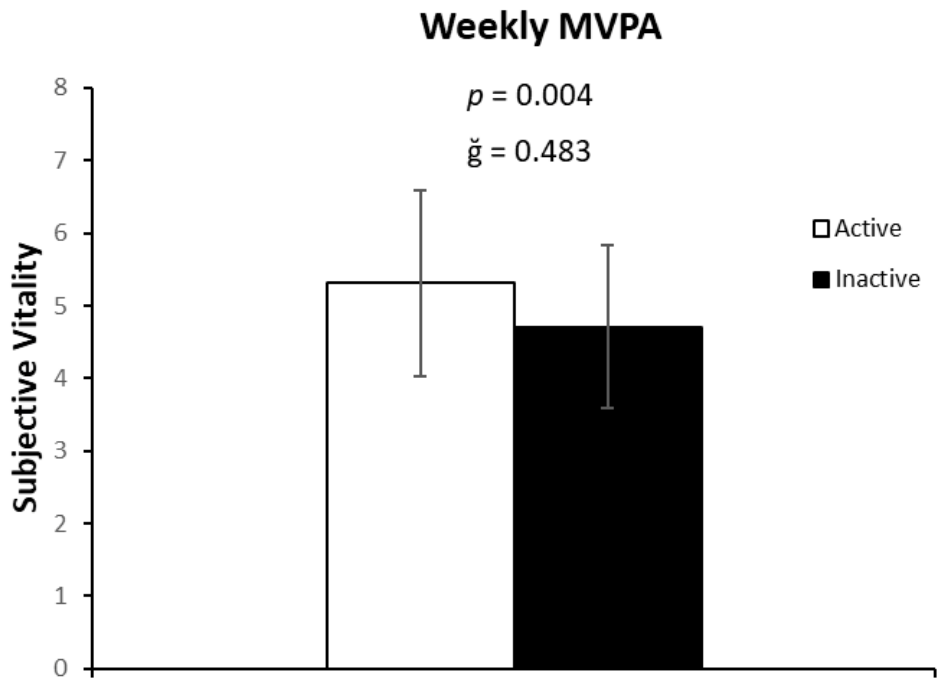
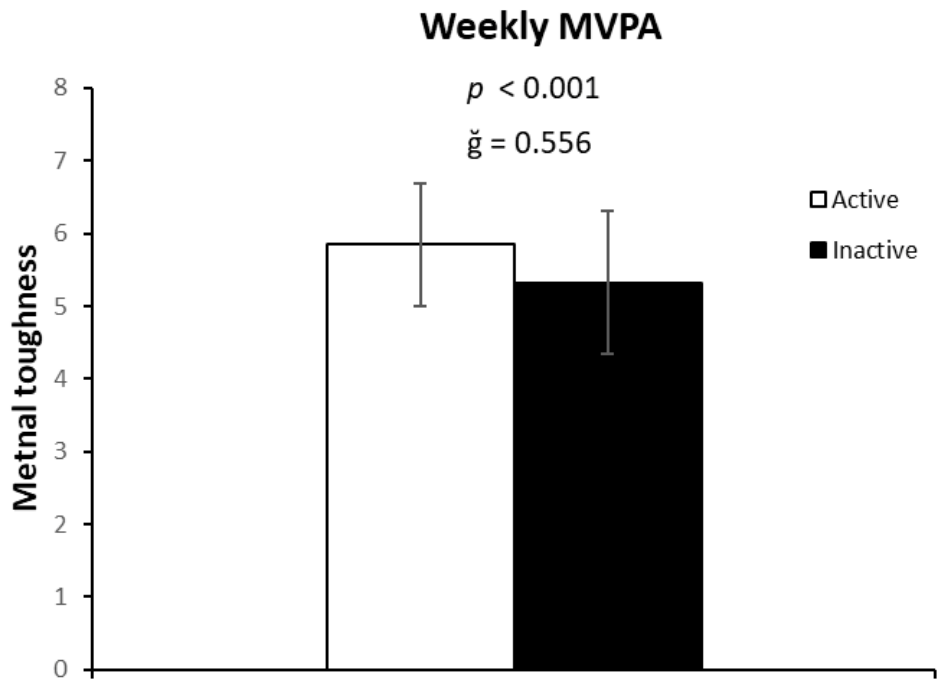

| Variables | All n = 286 | Boys n = 136 | Girls n = 150 | ||||
|---|---|---|---|---|---|---|---|
| Mean | SD | Mean | SD | Mean | SD | p | |
| Age (Years) | 13.34 | 1.61 | 13.44 | 1.59 | 13.25 | 1.62 | 0.307 |
| Weight (kg) | 53.88 | 13.82 | 56.48 | 14.04 | 51.45 | 13.20 | 0.002 |
| Height (m) | 1.60 | 0.10 | 1.63 | 0.11 | 1.57 | 0.08 | <0.001 |
| BMI (kg/m2) | 21.02 | 4.53 | 21.11 | 4.08 | 20.93 | 4.93 | 0.739 |
| Weekly MVPA | 4.07 | 1.76 | 4.58 | 1.69 | 3.60 | 1.68 | <0.001 |
| Subjective vitality | 4.86 | 1.26 | 5.06 | 1.26 | 4.68 | 1.24 | 0.012 |
| Mental toughness | 5.45 | 0.97 | 5.57 | 1.03 | 5.35 | 0.91 | 0.064 |
| Variable | Subjective Vitality | ||
|---|---|---|---|
| Β | SE | p | |
| Age (Years) | −0.142 | 0.047 | 0.003 |
| Sex | −0.307 | 0.153 | 0.046 |
| BMI (kg/m2) | 0.001 | 0.017 | 0.965 |
| Weekly MVPA | 0.093 | 0.044 | 0.034 |
| Variable | Mental Toughness | ||
|---|---|---|---|
| β | SE | p | |
| Age (Years) | −0.070 | 0.036 | 0.054 |
| Sex | −0.107 | 0.118 | 0.367 |
| BMI (kg/m2) | −0.007 | 0.013 | 0.556 |
| Weekly MVPA | 0.122 | 0.034 | <0.001 |
Disclaimer/Publisher’s Note: The statements, opinions and data contained in all publications are solely those of the individual author(s) and contributor(s) and not of MDPI and/or the editor(s). MDPI and/or the editor(s) disclaim responsibility for any injury to people or property resulting from any ideas, methods, instructions or products referred to in the content. |
© 2026 by the authors. Licensee MDPI, Basel, Switzerland. This article is an open access article distributed under the terms and conditions of the Creative Commons Attribution (CC BY) license.
Share and Cite
Ramírez-Espejo, P.; Solas-Martínez, J.L.; Carcelén-Fraile, M.d.C.; de la Torre-Cruz, M.J. Association of Weekly Moderate-to-Vigorous Physical Activity with Subjective Vitality and Mental Toughness in Spanish Adolescents Aged 10–16 Years. Behav. Sci. 2026, 16, 1660. https://doi.org/10.3390/bs16091660
Ramírez-Espejo P, Solas-Martínez JL, Carcelén-Fraile MdC, de la Torre-Cruz MJ. Association of Weekly Moderate-to-Vigorous Physical Activity with Subjective Vitality and Mental Toughness in Spanish Adolescents Aged 10–16 Years. Behavioral Sciences. 2026; 16(9):1660. https://doi.org/10.3390/bs16091660
Chicago/Turabian StyleRamírez-Espejo, Pablo, José Luis Solas-Martínez, María del Carmen Carcelén-Fraile, and Manuel J. de la Torre-Cruz. 2026. "Association of Weekly Moderate-to-Vigorous Physical Activity with Subjective Vitality and Mental Toughness in Spanish Adolescents Aged 10–16 Years" Behavioral Sciences 16, no. 9: 1660. https://doi.org/10.3390/bs16091660
APA StyleRamírez-Espejo, P., Solas-Martínez, J. L., Carcelén-Fraile, M. d. C., & de la Torre-Cruz, M. J. (2026). Association of Weekly Moderate-to-Vigorous Physical Activity with Subjective Vitality and Mental Toughness in Spanish Adolescents Aged 10–16 Years. Behavioral Sciences, 16(9), 1660. https://doi.org/10.3390/bs16091660

