AI Chatbot Service Adoption Among C2C Second-Hand Sellers: An Integrated UTAUT-TTAT Framework


Abstract
1. Introduction
2. Literature Review
2.1. AI Chatbots in E-Commerce
2.2. Behavioral and Decision Characteristics of Individual Sellers on C2C Second-Hand Platforms
2.3. Theories of Digital Technology Acceptance and Avoidance
3. Research Model and Hypotheses
3.1. Conceptual Research Model
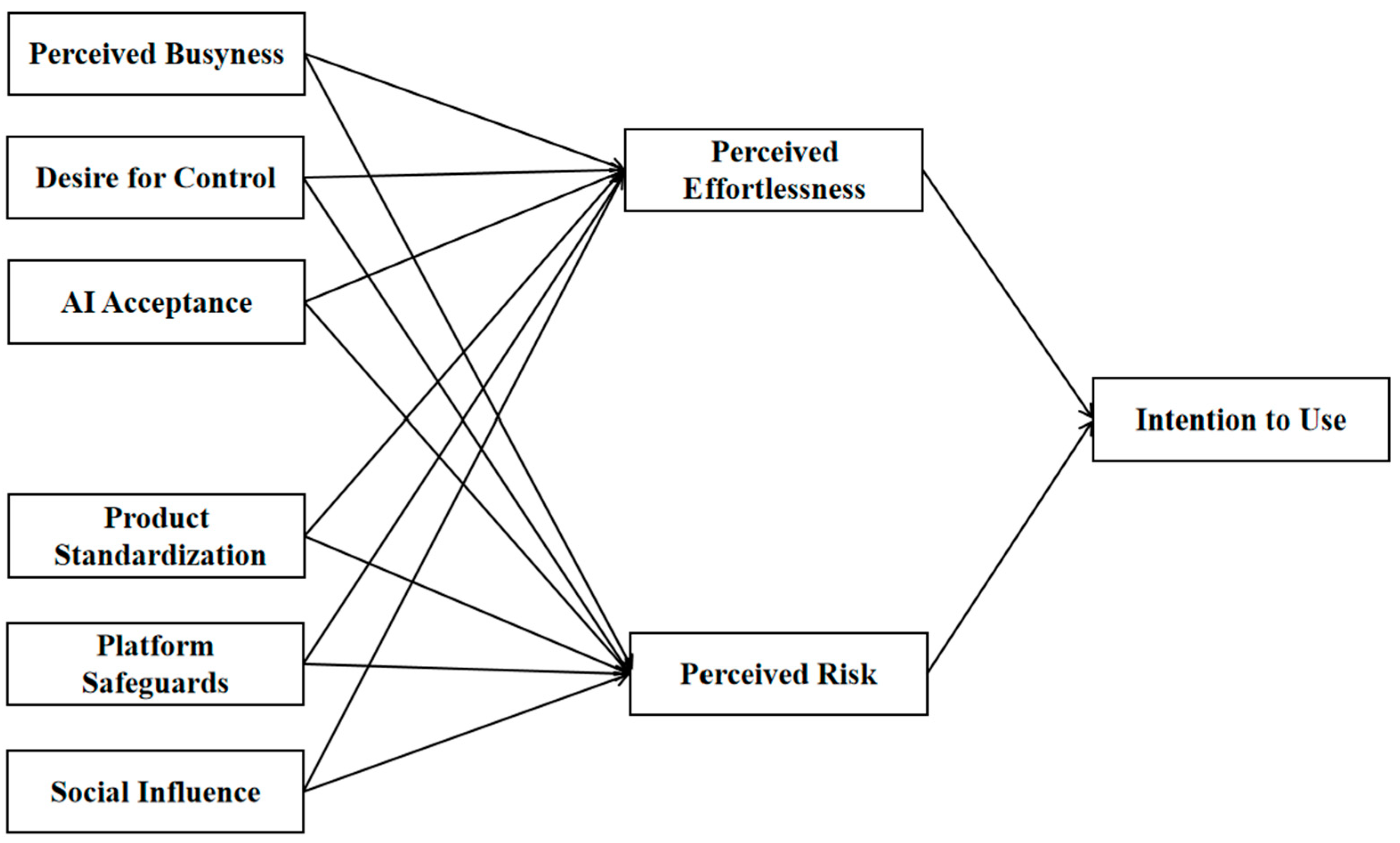
- Incorporation of situational factors. C2C second-hand transactions are restricted by objective external environments such as product attributes, peer interactions and platform rules. These situational conditions act as important driving forces and constraints for individual sellers’ perception and behavior. Accordingly, this model incorporates typical situational factors as antecedent variables, to reflect the influence of real transaction scenarios on AI service adoption.
- Human-centered approach to technology adoption. Studying individual sellers’ behavioral intentions toward using AI chatbots must follow a human-centered perspective. Individual sellers’ inherent personal traits such as work status, psychological tendencies and technology attitudes fundamentally shape their perceptions of intelligent tools. Therefore, the research model takes various personal factors as key antecedent variables, to explore how individual characteristics drive subsequent behavioral decisions.
- Inclusion of both technology acceptance and avoidance factors. AI chatbot adoption in C2C second-hand trading contexts has the potential to generate both positive and negative impacts on individual sellers’ operational experiences. To interpret individual sellers’ mixed attitudes toward AI tools, the model integrates two parallel mediating mechanisms: perceived effortlessness representing positive adoption motivation and perceived risk representing negative avoidance psychology. This dual-path design can fully explain individual sellers’ contradictory decision-making logic.
3.2. Development of Research Hypotheses
3.2.1. Personal Antecedent Factors
3.2.2. Situational Antecedent Factors
3.2.3. Mediating Mechanisms and Outcome Variable
4. Research Methodology
4.1. Measures of Constructs
4.2. Sample and Data Collection
4.3. Respondents
4.4. Common Method and Non-Response Bias
5. Model Testing and Findings
5.1. Evaluation of the Measurement Model and Structural Model
5.2. Hypothesis Testing
5.2.1. Direct Effects
5.2.2. Mediation Analysis
6. Discussion
6.1. Discussion of Results
6.2. Theoretical Contributions
6.3. Practical Implications
6.4. Research Limitations and Future Research Directions
7. Conclusions
Supplementary Materials
Author Contributions
Funding
Institutional Review Board Statement
Informed Consent Statement
Data Availability Statement
Conflicts of Interest
References
- Adam, M., Wessel, M., & Benlian, A. (2021). AI-based chatbots in customer service and their effects on user compliance: M. Adam et al. Electronic Markets, 31(2), 427–445. [Google Scholar] [CrossRef] [Scilit]
- Benitez, J., Henseler, J., Castillo, A., & Schuberth, F. (2020). How to perform and report an impactful analysis using partial least squares: Guidelines for confirmatory and explanatory IS research. Information & Management, 57(2), 103168. [Google Scholar] [CrossRef] [Scilit]
- Breward, M., Hassanein, K., & Head, M. (2017). Understanding consumers’ attitudes toward controversial information technologies: A contextualization approach. Information Systems Research, 28(4), 760–774. [Google Scholar] [CrossRef] [Scilit]
- Burger, J. M. (2013). Desire for control: Personality, social and clinical perspectives. Springer Science & Business Media. [Google Scholar]
- Burger, J. M., & Cooper, H. M. (1979). The desirability of control. Motivation and Emotion, 3(4), 381–393. [Google Scholar] [CrossRef] [Scilit]
- Cao, G. M., Duan, Y. Q., Edwards, J. S., & Dwivedi, Y. K. (2021). Understanding managers’ attitudes and behavioral intentions towards using artificial intelligence for organizational decision-making. Technovation, 106, 102312. [Google Scholar] [CrossRef] [Scilit]
- Carpenter, D., Young, D. K., Barrett, P., & McLeod, A. J. (2019). Refining technology threat avoidance theory. Communications of the Association for Information Systems, 44, 380–407. [Google Scholar] [CrossRef] [Scilit]
- Chen, G., Fan, J., & Azam, M. (2025). Exploring artificial intelligence (AI) chatbots adoption among research scholars using unified theory of acceptance and use of technology (UTAUT). Journal of Librarianship and Information Science, 57(4), 1205–1223. [Google Scholar] [CrossRef] [Scilit]
- Chen, Q., Lu, Y., Gong, Y., & Xiong, J. (2023). Can AI chatbots help retain customers? Impact of AI service quality on customer loyalty. Internet Research, 33(6), 2205–2243. [Google Scholar] [CrossRef] [Scilit]
- Fan, H., Gao, W., & Han, B. (2023). Are AI chatbots a cure-all? The relative effectiveness of chatbot ambidexterity in crafting hedonic and cognitive smart experiences. Journal of Business Research, 156, 113526. [Google Scholar] [CrossRef] [Scilit]
- Faraji-Rad, A., Melumad, S., & Johar, G. V. (2017). Consumer desire for control as a barrier to new product adoption. Journal of Consumer Psychology, 27(3), 347–354. [Google Scholar] [CrossRef] [Scilit]
- Gansser, O., & Reich, C. S. (2021). A new acceptance model for artificial intelligence with extensions to UTAUT2: An empirical study in three segments of application. Technology in Society, 65, 101535. [Google Scholar] [CrossRef] [Scilit]
- Gursoy, D., Chi, O. H., Lu, L., & Nunkoo, R. (2019). Consumers acceptance of artificially intelligent (AI) device use in service delivery. International Journal of Information Management, 49, 157–169. [Google Scholar] [CrossRef] [Scilit]
- Hair, J. F., Ringle, C. M., & Sarstedt, M. (2013). Partial least squares structural equation modeling: Rigorous applications, better results and higher acceptance. Long Range Planning, 46(1), 1–12. [Google Scholar] [CrossRef] [Scilit]
- Iddris, F., Agyapong, K., Amuzu, E., Mohammed, S. A., & Aikins, E. (2026). Boosting insurance sales performance with marketing strategy: The power of artificial intelligence, chatbot engagement and machine learning. Journal of Electronic Business & Digital Economics, 5(1), 19–42. [Google Scholar] [CrossRef] [Scilit]
- Jang, Y., & Kim, S. (2023). The factors influencing users’ trust in and loyalty to consumer-to-consumer secondhand marketplace platform. Behavioral Sciences, 13(3), 242. [Google Scholar] [CrossRef] [Scilit] [PubMed]
- Jiang, H., Cheng, Y., Yang, J., & Gao, S. (2022). AI-powered chatbot communication with customers: Dialogic interactions, satisfaction, engagement, and customer behavior. Computers in Human Behavior, 134, 107329. [Google Scholar] [CrossRef] [Scilit]
- Kahneman, D. (1973). Attention and effort. Prentice-Hall. [Google Scholar]
- Kim, J. C., Wadhwa, M., & Chattopadhyay, A. (2019). When busy is less indulging: Impact of busy mindset on self-control behaviors. Journal of Consumer Research, 45(5), 933–952. [Google Scholar] [CrossRef] [Scilit]
- Korhonen, J., Honkasalo, A., & Seppälä, J. (2018). Circular economy: The concept and its limitations. Ecological Economics, 143, 37–46. [Google Scholar] [CrossRef] [Scilit]
- Li, H., Shahzad, K., Khan, A. N., Ahmad, B., & Ashfaq, M. (2026). Understanding perceived values and risk in guest adoption of generative AI chatbots. Journal of Hospitality Marketing & Management. [Google Scholar] [CrossRef] [Scilit]
- Li, J., Wu, L., Qi, J., Zhang, Y., Wu, Z., & Hu, S. (2023). Determinants affecting consumer trust in communication with AI chatbots: The moderating effect of privacy concerns. Journal of Organizational and End User Computing (JOEUC), 35(1), 1–24. [Google Scholar] [CrossRef] [Scilit]
- Li, Y., & Zhang, L. (2024). The neighborhood advantage: Exploring the impact of negotiation cost on user satisfaction in local second-hand trading platforms. Journal of Electronic Commerce Research, 25(2), 112–128. [Google Scholar] [CrossRef] [Scilit]
- Liang, H., & Xue, Y. (2009). Avoidance of information technology threats: A theoretical perspective. MIS Quarterly, 33(1), 71–90. [Google Scholar] [CrossRef] [Scilit]
- Lindell, M. K., & Whitney, D. J. (2001). Accounting for common method variance in cross-sectional research designs. Journal of Applied Psychology, 86(1), 114–121. [Google Scholar] [CrossRef] [Scilit] [PubMed]
- Liu, M. Z., Yang, Y. X., & Ren, Y. (2024). What influences consumer AI chatbot use intention? An application of the extended technology acceptance model. Journal of Hospitality and Tourism Technology, 15(4), 667–689. [Google Scholar] [CrossRef] [Scilit]
- Liu, S. F., & Wang, S. (2025). An integrated analysis of consumer purchase decision-making on second-hand trading platforms: Evidence from China. Journal of Organizational Computing and Electronic Commerce, 35(1), 72–88. [Google Scholar] [CrossRef] [Scilit]
- Lopes, J. M., Gomes, S., Nogueira, E., & Trancoso, T. (2025). AI’s invisible touch: How effortless browsing shapes customer perception, experience and engagement in online retail. Cogent Business & Management, 12(1), 2440628. [Google Scholar] [CrossRef] [Scilit]
- Marjerison, R. K., Dong, H., Kim, J. M., Zheng, H., Zhang, Y., & Kuan, G. (2025). Understanding user acceptance of AI-driven chatbots in China’s e-commerce: The roles of perceived authenticity, usefulness, and risk. Systems, 13(2), 71. [Google Scholar] [CrossRef] [Scilit]
- Martin, M., & Park, D. C. (2003). The Martin and Park Environmental Demands (MPED) questionnaire: Psychometric properties of a brief instrument to measure self-reported environmental demands. Aging Clinical and Experimental Research, 15(1), 77–82. [Google Scholar] [CrossRef] [Scilit] [PubMed]
- Moriuchi, E., & Takahashi, I. (2022). The role of perceived value, trust and engagement in the C2C online secondary marketplace. Journal of Business Research, 148, 76–88. [Google Scholar] [CrossRef] [Scilit]
- Myin, M. T., & Watchravesringkan, K. (2024). Investigating consumers’ adoption of AI chatbots for apparel shopping. Journal of Consumer Marketing, 41(3), 314–327. [Google Scholar] [CrossRef] [Scilit]
- Nicolescu, L., & Tudorache, M. T. (2022). Human-computer interaction in customer service: The experience with AI chatbots—A systematic literature review. Electronics, 11(10), 1579. [Google Scholar] [CrossRef] [Scilit]
- Pavlou, P. A., & Gefen, D. (2004). Building effective online marketplaces with institution-based trust. Information Systems Research, 15(1), 37–59. [Google Scholar] [CrossRef] [Scilit]
- Peng, L., Luo, M., & Guo, Y. (2023). Deposit AI as the “invisible hand” to make the resale easier: A moderated mediation model. Journal of Retailing and Consumer Services, 75, 103480. [Google Scholar] [CrossRef] [Scilit]
- Podsakoff, P. M., MacKenzie, S. B., & Podsakoff, N. P. (2012). Sources of method bias in social science research and recommendations on how to control it. Annual Review of Psychology, 63, 539–569. [Google Scholar] [CrossRef] [Scilit] [PubMed]
- Puntoni, S., Reczek, R. W., Giesler, M., & Botti, S. (2021). Consumers and artificial intelligence: An experiential perspective. Journal of Marketing, 85(1), 1–19. [Google Scholar] [CrossRef] [Scilit]
- Reimann, M., Schilke, O., & Thomas, J. S. (2010). Toward an understanding of industry commoditization: Its nature and role in evolving marketing competition. International Journal of Research in Marketing, 27(2), 188–197. [Google Scholar] [CrossRef] [Scilit]
- Schepman, A., & Rodway, P. (2020). Initial validation of the general attitudes towards artificial intelligence scale. Computers in Human Behavior, 111, 106404. [Google Scholar] [CrossRef] [Scilit]
- Sharma, N., Payal, R., & Paul, J. (2025). Hello! How can I help you? Role of technology appetite on AI adoption in the post-pandemic era. R&D Management, 55(5), 1560–1581. [Google Scholar] [CrossRef] [Scilit]
- Silva, S. C., De Cicco, R., Vlačić, B., & Elmashhara, M. G. (2023). Using chatbots in e-retailing—How to mitigate perceived risk and enhance flow experience. International Journal of Retail & Distribution Management, 51(3), 285–305. [Google Scholar] [CrossRef] [Scilit]
- Slovic, P. (1987). Perception of risk. Science, 236(4799), 280–285. [Google Scholar] [CrossRef] [Scilit] [PubMed]
- Sohn, K., & Kwon, O. (2020). Technology acceptance theories and factors influencing artificial intelligence-based intelligent products. Telematics and Informatics, 47, 101324. [Google Scholar] [CrossRef] [Scilit]
- Sohn, S. M. (2025). Effortlessness as the measurement of the impact of artificial intelligence (AI) adoption and innovation: Towards the theory of relative AI. Technology in Society, 83, 102962. [Google Scholar] [CrossRef] [Scilit]
- Stoilova, E. (2021). AI chatbots as a customer service and support tool. ROBONOMICS: The Journal of the Automated Economy, 2, 21. [Google Scholar] [CrossRef] [Scilit]
- Tian, K., Chen, J., & Sun, X. (2025). Investigating the actual usage behavior of Thai traditional craftsmen in adopting AI through a hybrid SEM-ANN approach. Humanities & Social Sciences Communications, 12(1), 1887. [Google Scholar] [CrossRef] [Scilit]
- Venkatesh, V., Morris, M. G., Davis, G. B., & Davis, F. D. (2003). User acceptance of information technology: Toward a unified view. MIS Quarterly, 27(3), 425–478. [Google Scholar] [CrossRef] [Scilit]
- Venkatesh, V., Thong, J. Y. L., & Xu, X. (2012). Consumer acceptance and use of information technology: Extending the unified theory of acceptance and use of technology. MIS Quarterly, 36(1), 157–178. [Google Scholar] [CrossRef] [Scilit]
- Wang, L., & Sun, H. (2023). Influencing factors of second-hand platform trading in C2C E-commerce. Journal of Intelligent Management Decisions, 2, 21–29. [Google Scholar] [CrossRef] [Scilit]
- Wang, X., Lin, X., & Shao, B. (2022). How does artificial intelligence create business agility? Evidence from chatbots. International Journal of Information Management, 66, 102535. [Google Scholar] [CrossRef] [Scilit]
- Wetzels, M., Odekerken-Schröder, G., & van Oppen, C. (2009). Using PLS path modeling for assessing hierarchical construct models: Guidelines and empirical illustration. MIS Quarterly, 33(1), 177–195. [Google Scholar] [CrossRef] [Scilit]
- Zhang, Y., Lau, R. Y., Xu, J. D., Rao, Y., & Li, Y. (2024). Business chatbots with deep learning technologies: State-of-the-art, taxonomies, and future research directions. Artificial Intelligence Review, 57(5), 113. [Google Scholar] [CrossRef] [Scilit]
- Zhao, X., Lynch, J. G., Jr., & Chen, Q. (2010). Reconsidering Baron and Kenny: Myths and truths about mediation analysis. Journal of Consumer Research, 37(2), 197–206. [Google Scholar] [CrossRef] [Scilit]


| Construct | Abbreviation | No. of Items | Reference |
|---|---|---|---|
| Perceived Busyness | PB | 3 | Martin and Park (2003); Kim et al. (2019) |
| Desire for Control | DC | 3 | Burger and Cooper (1979) |
| AI Acceptance | AA | 3 | Schepman and Rodway (2020) |
| Product Standardization | PST | 3 | Self-developed, drawing on Reimann et al. (2010) |
| Platform Safeguard | PSA | 3 | Self-developed, drawing on Pavlou and Gefen (2004) |
| Social Influence | SI | 3 | Venkatesh et al. (2012); Gansser and Reich (2021) |
| Perceived Effortlessness | PE | 3 | Self-developed, drawing on S. M. Sohn (2025) |
| Perceived Risk | PR | 3 | Marjerison et al. (2025) |
| Intention to Use | IU | 3 | Venkatesh et al. (2012) |
| Characteristic | Category | No (%) | Characteristic | Category | No (%) |
|---|---|---|---|---|---|
| Gender | Male | 144 (55.17%) | Monthly transaction frequency | <5 orders | 118 (45.21%) |
| Female | 117 (44.83%) | 5–10 orders | 86 (32.95%) | ||
| Age | 18–25 | 63 (24.14%) | 10–20 orders | 38 (14.56%) | |
| 25–35 | 91 (34.87%) | >20 orders | 19 (7.28%) | ||
| 35–45 | 77 (29.50%) | AI chatbot usage experience | Never used | 141 (54.02%) | |
| >45 | 30 (11.49%) | Have used | 120 (45.98%) | ||
| Operating years | <1 year | 27 (10.34%) | AI chatbot usage frequency (among users) | Rarely | 46 (38.33%) |
| 1–3 year | 56 (21.46%) | Occasionally | 42 (35.00%) | ||
| 3–5 year | 117 (44.83%) | Frequently | 32 (26.67%) | ||
| >5 year | 61 (23.37%) |
| Construct | Items | Loading | Item Reliability | Cronbach’s α | CR | AVE |
|---|---|---|---|---|---|---|
| PB | PB1 | 0.913 | 0.834 | 0.863 | 0.916 | 0.784 |
| PB2 | 0.879 | 0.773 | ||||
| PB3 | 0.864 | 0.746 | ||||
| DC | DC1 | 0.899 | 0.808 | 0.881 | 0.926 | 0.808 |
| DC2 | 0.912 | 0.832 | ||||
| DC3 | 0.885 | 0.783 | ||||
| AA | AA1 | 0.941 | 0.885 | 0.898 | 0.936 | 0.830 |
| AA2 | 0.923 | 0.852 | ||||
| AA3 | 0.866 | 0.750 | ||||
| PST | PST1 | 0.919 | 0.845 | 0.887 | 0.930 | 0.816 |
| PST2 | 0.914 | 0.835 | ||||
| PST3 | 0.876 | 0.767 | ||||
| PSA | PSA1 | 0.935 | 0.874 | 0.918 | 0.948 | 0.859 |
| PSA2 | 0.923 | 0.852 | ||||
| PSA3 | 0.922 | 0.850 | ||||
| SI | SI1 | 0.918 | 0.843 | 0.868 | 0.918 | 0.789 |
| SI2 | 0.918 | 0.843 | ||||
| SI3 | 0.825 | 0.681 | ||||
| PE | PE1 | 0.830 | 0.689 | 0.775 | 0.869 | 0.689 |
| PE2 | 0.833 | 0.694 | ||||
| PE3 | 0.827 | 0.684 | ||||
| PR | PR1 | 0.934 | 0.872 | 0.888 | 0.930 | 0.817 |
| PR2 | 0.901 | 0.812 | ||||
| PR3 | 0.875 | 0.766 | ||||
| IU | IU1 | 0.970 | 0.941 | 0.943 | 0.963 | 0.898 |
| IU2 | 0.944 | 0.891 | ||||
| IU3 | 0.928 | 0.861 |
| M | SD | 1 | 2 | 3 | 4 | 5 | 6 | 7 | 8 | 9 | |
|---|---|---|---|---|---|---|---|---|---|---|---|
| 1. PB | 4.055 | 1.390 | 0.885 | ||||||||
| 2. DC | 3.476 | 1.362 | −0.042 | 0.899 | |||||||
| 3. AA | 4.015 | 1.408 | 0.110 | −0.017 | 0.911 | ||||||
| 4. PST | 3.971 | 1.395 | 0.344 *** | 0.018 | 0.194 ** | 0.903 | |||||
| 5. PSA | 3.851 | 1.496 | 0.156 * | −0.065 | 0.204 ** | 0.182 ** | 0.927 | ||||
| 6. SI | 4.198 | 1.402 | 0.036 | 0.070 | −0.023 | 0.121 * | −0.342 *** | 0.888 | |||
| 7. PE | 4.052 | 0.901 | 0.503 *** | −0.136 | 0.242 *** | 0.491 *** | 0.246 *** | 0.122 | 0.830 | ||
| 8. PR | 3.907 | 1.313 | −0.360 *** | 0.193 ** | −0.256 *** | −0.369 *** | −0.439 *** | −0.048 | −0.474 *** | 0.904 | |
| 9. IU | 3.922 | 1.583 | 0.346 *** | −0.094 | 0.121 | 0.352 *** | 0.259 *** | 0.071 | 0.498 *** | −0.567 *** | 0.948 |
| Year | 2.812 | 0.911 | 0.058 | −0.076 | −0.092 | −0.058 | −0.050 | −0.047 | −0.005 | 0.046 | −0.022 |
| 1 | 2 | 3 | 4 | 5 | 6 | 7 | 8 | 9 | |
|---|---|---|---|---|---|---|---|---|---|
| 1. PB | |||||||||
| 2. DC | 0.050 | ||||||||
| 3. AA | 0.130 | 0.030 | |||||||
| 4. PST | 0.395 | 0.062 | 0.214 | ||||||
| 5. PSA | 0.171 | 0.073 | 0.223 | 0.201 | |||||
| 6. SI | 0.057 | 0.079 | 0.039 | 0.139 | 0.386 | ||||
| 7. PE | 0.612 | 0.165 | 0.285 | 0.591 | 0.291 | 0.147 | |||
| 8. PR | 0.413 | 0.216 | 0.281 | 0.413 | 0.485 | 0.063 | 0.572 | ||
| 9. IU | 0.380 | 0.102 | 0.131 | 0.385 | 0.273 | 0.080 | 0.578 | 0.618 |
| Hypotheses | Path | β | t-Value | p-Value | f2 | Conclusion |
|---|---|---|---|---|---|---|
| H1a | PB → PE | 0.351 | 6.967 | <0.001 | 0.186 | Supported |
| H1b | PB → PR | −0.208 | 3.963 | <0.001 | 0.062 | Supported |
| H2a | DC → PE | −0.125 | 2.341 | 0.019 | 0.027 | Supported |
| H2b | DC → PR | 0.172 | 3.195 | 0.001 | 0.048 | Supported |
| H3a | AA → PE | 0.114 | 2.078 | 0.038 | 0.021 | Supported |
| H3b | AA → PR | −0.118 | 2.386 | 0.018 | 0.021 | Supported |
| H4a | PST → PE | 0.307 | 5.619 | <0.001 | 0.135 | Supported |
| H4b | PST → PR | −0.185 | 3.283 | 0.001 | 0.046 | Supported |
| H5a | PSA → PE | 0.150 | 2.821 | 0.005 | 0.031 | Supported |
| H5b | PSA → PR | −0.394 | 6.053 | <0.001 | 0.203 | Supported |
| H6a | SI → PE | 0.135 | 2.394 | 0.017 | 0.027 | Supported |
| H6b | SI → PR | −0.167 | 2.427 | 0.015 | 0.039 | Supported |
| H7 | PE → IU | 0.298 | 5.423 | <0.001 | 0.112 | Supported |
| H8 | PR → IU | −0.430 | 7.533 | <0.001 | 0.234 | Supported |
| Hypotheses | Path | β | t-Value | 95% CI | Conclusion |
|---|---|---|---|---|---|
| H9a | PB → PE → IU | 0.105 | 4.273 | [0.061, 0.156] | Supported |
| H9b | DC → PE → IU | −0.037 | 2.107 | [−0.077, −0.007] | Supported |
| H9c | AA → PE → IU | 0.034 | 1.968 | [0.004, 0.072] | Supported |
| H9d | PST → PE → IU | 0.092 | 3.600 | [0.049, 0.150] | Supported |
| H9e | PSA → PE → IU | 0.045 | 2.498 | [0.015, 0.086] | Supported |
| H9f | SI → PE → IU | 0.040 | 2.163 | [0.006, 0.080] | Supported |
| H10a | PB → PR → IU | 0.090 | 3.376 | [0.043, 0.149] | Supported |
| H10b | DC → PR → IU | −0.074 | 2.970 | [−0.126, −0.029] | Supported |
| H10c | AA → PR → IU | 0.051 | 2.323 | [0.011, 0.093] | Supported |
| H10d | PST → PR → IU | 0.080 | 2.914 | [0.031, 0.138] | Supported |
| H10e | PSA → PR → IU | 0.170 | 4.567 | [0.104, 0.250] | Supported |
| H10f | SI → PR → IU | 0.072 | 2.249 | [0.012, 0.135] | Supported |
Disclaimer/Publisher’s Note: The statements, opinions and data contained in all publications are solely those of the individual author(s) and contributor(s) and not of MDPI and/or the editor(s). MDPI and/or the editor(s) disclaim responsibility for any injury to people or property resulting from any ideas, methods, instructions or products referred to in the content. |
© 2026 by the authors. Licensee MDPI, Basel, Switzerland. This article is an open access article distributed under the terms and conditions of the Creative Commons Attribution (CC BY) license.
Share and Cite
Zhao, Y.; Yang, X.; Fam, K.-S. AI Chatbot Service Adoption Among C2C Second-Hand Sellers: An Integrated UTAUT-TTAT Framework. Behav. Sci. 2026, 16, 1670. https://doi.org/10.3390/bs16091670
Zhao Y, Yang X, Fam K-S. AI Chatbot Service Adoption Among C2C Second-Hand Sellers: An Integrated UTAUT-TTAT Framework. Behavioral Sciences. 2026; 16(9):1670. https://doi.org/10.3390/bs16091670
Chicago/Turabian StyleZhao, Yurou, Xiao Yang, and Kim-Shyan Fam. 2026. "AI Chatbot Service Adoption Among C2C Second-Hand Sellers: An Integrated UTAUT-TTAT Framework" Behavioral Sciences 16, no. 9: 1670. https://doi.org/10.3390/bs16091670
APA StyleZhao, Y., Yang, X., & Fam, K.-S. (2026). AI Chatbot Service Adoption Among C2C Second-Hand Sellers: An Integrated UTAUT-TTAT Framework. Behavioral Sciences, 16(9), 1670. https://doi.org/10.3390/bs16091670