


Dual Degrees, Dual Identities? A Longitudinal Q Methodology Study of Learner Identity Profiles in a Chinese “English + Engineering” Interdisciplinary Dual-Degree Program



Abstract
1. Introduction
2. Literature Review
2.1. Conceptualizing Learner Identity in Dual-Degree Contexts
2.2. Relevant Studies of Learner Identity in Dual-Degree Learning
3. Methodology
3.1. Q Methodology
3.2. Follow-Up Semi-Structured Interviews
3.3. Research Positionality
3.4. Ethical Considerations
4. Findings
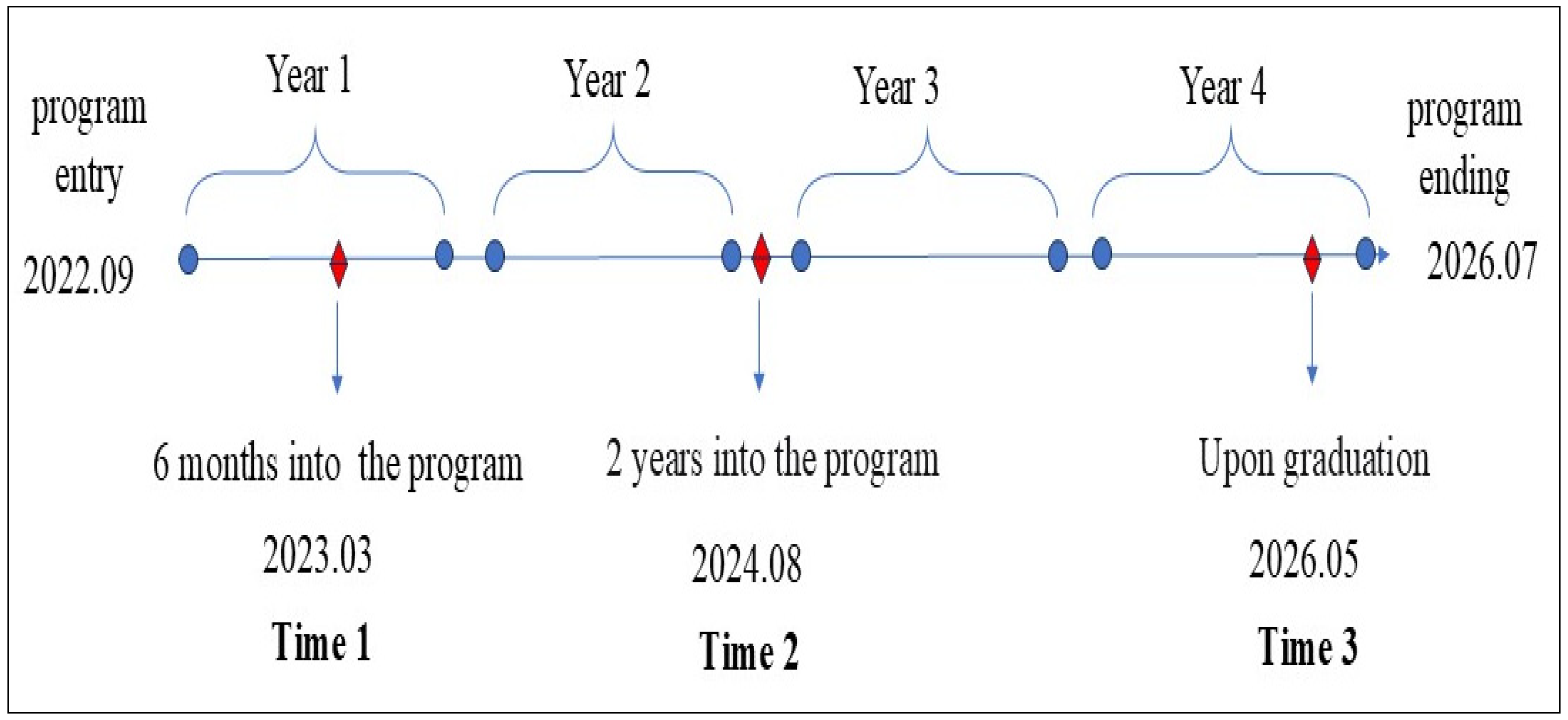
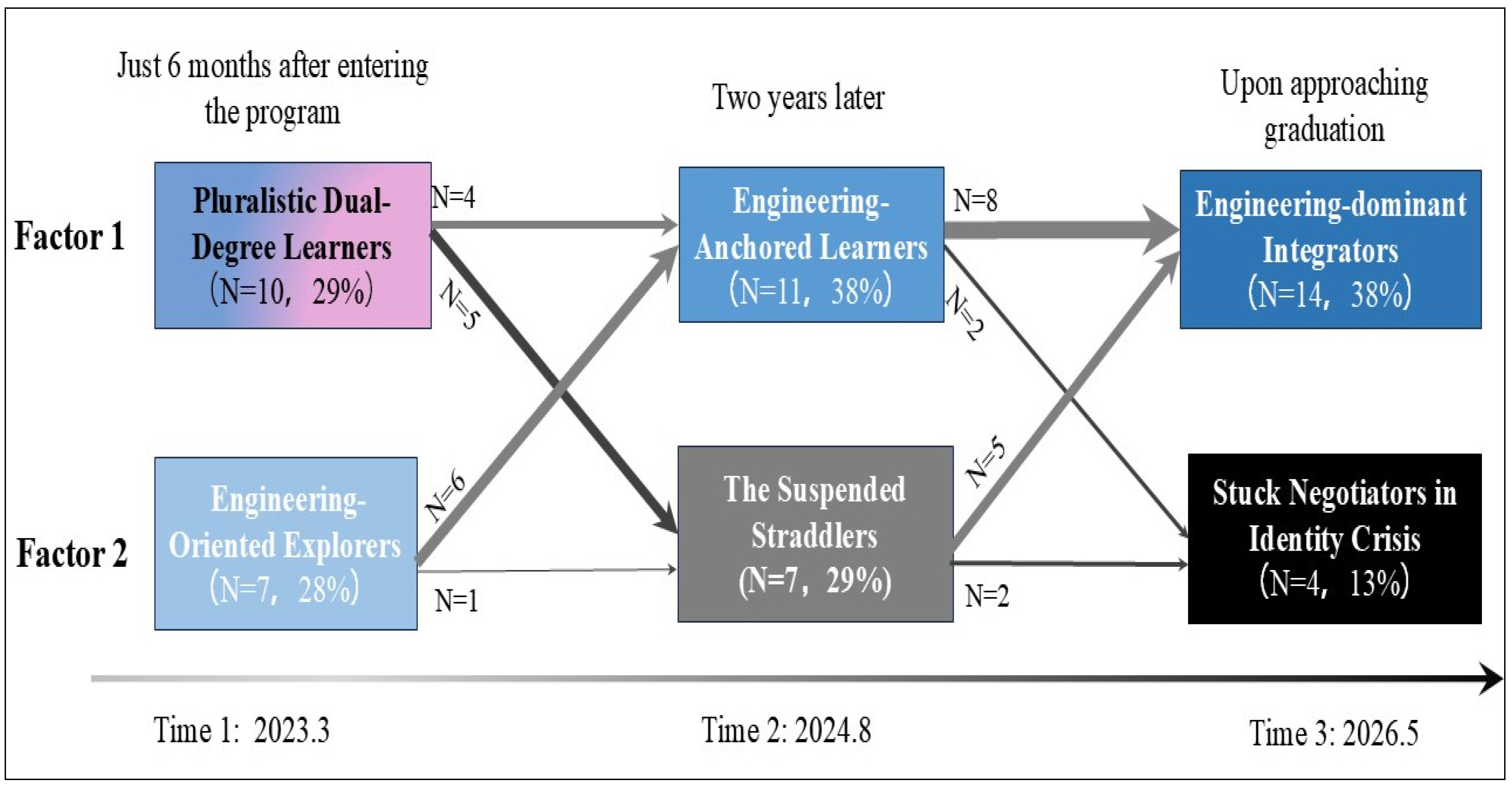
4.1. Time 1: Just Six Months After Entering the Program
4.1.1. Factor 1: Pluralistic Dual-Degree Learners
“From the very start, choosing this dual-degree program felt like taking a risk. We were the first cohort, after all, with no available data on employment or graduate study to refer to. Even so, in such a rapidly evolving world, learning extra skills can never be a bad thing. The combination of arts and science studies also shapes my personality in diverse ways and broadens my range of interests, helping me develop a more open, adaptable personality.”(Q4)
“Many people argue that pairing English with a technical specialization gives you a competitive edge, while proficiency in English alone is no longer sufficient. I fully agree, as employers are clearly prioritizing interdisciplinary talents in today’s job market.”(Q18)
4.1.2. Factor 2: Engineering-Oriented Explorers
“To me, English is just a tool rather than a standalone career skill. Basic communication and the ability to read technical papers are sufficient, and my core competitive strength still lies in my engineering expertise.”(Q10)
“I’ve actually always leaned more toward science and engineering subjects in my high school. To skip the Gaokao (China’s national college entrance examination, which is usually highly competitive), I gained university admission through the English recommended admission track (a pathway that spares outstanding English students from taking Gaokao). I originally planned that if I could only enroll as an English major, I would transfer to a science and engineering program at the start of my sophomore year.”(Q19)
4.2. Two Years Later
4.2.1. Factor 1: Engineering-Anchored Learners
“Others always say having a dual degree sounds cool, but I am actually quite worried about its recognition. Since this model is relatively new, I do not know whether employers will truly value it or if they will think we just dabbled in both fields without mastering either.”(Q9)
“Honestly, when I first joined the dual-degree program, my choices and how I saw myself were all driven by personal interest. I was just genuinely curious about both fields. But as coursework grew heavier each year, I gradually lost that interest-focused way of thinking. These days, how I define myself and where I direct my efforts are increasingly governed by practical career prospects and the demands of the job market, rather than my initial inner motivations.”(Q1)
4.2.2. Factor 2: The Suspended Straddlers
“Before entering the program, I assumed that there would be some interdisciplinary integrated courses. However, the two majors were delivered entirely separately, with no substantive connection between the coursework. This turned out to be quite different from my initial expectations of what a dual-degree education would entail.”(Q11)
“Sometimes I really feel torn, and even a bit anxious. I know that if I do well with the “English + Engineering” combination, it will definitely give me an advantage, but I can’t help gravitating toward the more difficult engineering courses while neglecting the foreign language. This is not intentional, but gradually I have lost balance between the two disciplines and moved further away from what I initially envisioned for myself.”(Q2)
4.3. Upon Approaching Graduation
4.3.1. Factor 1: Engineering-Dominant Integrators
“When I attended my postgraduate admission interviews, nearly every interviewer showed strong interest in my English and engineering background. They asked how I managed language learning within a demanding technical program and how the two fields connected. I realized that English gave me extra attention and a unique edge. I no longer see it as just a tool for reading manuals. It has become an indispensable part of my professional identity, distinguishing me from graduates who only major in engineering.”(Q3)
“Honestly, I once disliked English because it felt useless and took time away from engineering. I just wanted to graduate and find an engineering job. But during job hunting, my English background helped me secure a starting salary 10% higher than what pure engineering graduates received. At that moment, I truly embraced my English identity and felt genuine gratitude for all the language training.”(Q18)
4.3.2. Factor 2: Stuck Negotiators in Identity Crisis
“As graduation approaches, I feel stuck. I have been running between two different academic worlds for years without finding a true anchor. I lack the technical depth to compete with pure engineering students, and my language skills are not strong enough to rely on either. Seeing my classmates succeed with clear identities only makes me more anxious, because I feel like an outsider in both departments with nowhere to go.”(Q11)
5. Discussion
5.1. Discussion of Main Findings
5.2. Practical Implications
5.3. Limitations and Future Research
6. Conclusions
Author Contributions
Funding
Institutional Review Board Statement
Informed Consent Statement
Data Availability Statement
Acknowledgments
Conflicts of Interest
Appendix A

| No. | Q Statement | Time 1 | Time 2 | Time 3 | |||
|---|---|---|---|---|---|---|---|
| Factor1 | Factor2 | Factor1 | Factor2 | Factor1 | Factor2 | ||
| 1 | I recognize the unique value of integrating English and Engineering as an interdisciplinary program. | 4 | 2 | 2 | 3 | 1 | 1 |
| 2 | I voluntarily chose the “English + Engineering” dual degree learning model based on my personal interests and development needs. | 2 | 0 | 1 | 1 | 1 | 2 |
| 3 | Dual degree learning can meet my diverse development needs. | 4 | 2 | 0 | 0 | 1 | 0 |
| 4 | I am more inclined to identify myself as an English major. | −4 | −4 | −3 | 0 | −2 | 1 |
| 5 | I am more inclined to identify myself as an engineering major. | −3 | 4 | 4 | 1 | 4 | −2 |
| 6 | I consider myself both an English major and an engineering major. | 3 | −3 | −3 | 1 | 0 | −3 |
| 7 | I am unsure which major I truly belong in. | −3 | −2 | −2 | −2 | −4 | 3 |
| 8 | I perform better in English than in Engineering, whether in academic coursework or practical application | 0 | 1 | 3 | 2 | 0 | 2 |
| 9 | I perform better in Engineering than in English, whether in academic coursework or practical application | −3 | −1 | −1 | 0 | −3 | 0 |
| 10 | I spend more after-class time on English than on engineering. | −2 | −3 | −4 | −4 | −3 | −1 |
| 11 | I spend more after-class time on engineering than on English. | 2 | 4 | 4 | 0 | 3 | 2 |
| 12 | I follow news and trends related to English more closely than those related to Engineering, such as graduate school opportunities and career prospects. | 0 | −1 | −2 | 0 | −1 | 0 |
| 13 | I follow news and trends related to Engineering more closely than those related to English, such as graduate school opportunities and career prospects. | −1 | 3 | 2 | −1 | 2 | −3 |
| 14 | I participated in more English-focused extracurricular activities than engineering ones. | 0 | 0 | 1 | −1 | 2 | 1 |
| 15 | I participated in more Engineering-focused extracurricular activities than English ones. | −3 | 1 | 0 | −1 | 0 | −4 |
| 16 | I devote more attention to my Engineering coursework than to my English coursework. | 2 | 3 | 2 | 0 | 2 | 1 |
| 17 | I devote more attention to my English coursework than to my Engineering coursework. | −1 | 1 | 0 | −3 | −3 | −2 |
| 18 | I have a sense of belonging to both of my current majors. | 1 | −2 | −2 | −3 | 1 | −4 |
| 19 | I believe that dual degree learning makes me more competitive than students with a single major. | 3 | −1 | 0 | −2 | 4 | 1 |
| 20 | The dual degree program has helped me build networks across different fields. | 1 | −1 | −1 | −1 | 0 | 2 |
| 21 | My English proficiency and engineering competencies have achieved synchronous development. | 0 | −3 | −4 | −2 | −1 | −1 |
| 22 | I feel proud to have a dual-major learning experience. | 3 | 0 | −1 | 0 | 3 | 0 |
| 23 | I feel anxious or stressed when facing the learning pressure of the two majors or switching between the two identity positions. | −1 | −1 | −1 | 3 | −1 | 4 |
| 24 | I find it difficult to give equal attention and commitment to both majors | 1 | 3 | 2 | 2 | 0 | 3 |
| 25 | I worry about whether a dual degree will be valued in the job market. | 0 | 1 | 3 | 3 | −2 | 4 |
| 26 | I have never considered switching programs or dropping either of my current majors. | −4 | −1 | −2 | 0 | −2 | 1 |
| 27 | I can adapt my study approach and way of thinking to suit the demands of each major. | 1 | 0 | 0 | −1 | −1 | 0 |
| 28 | I can draw flexibly on knowledge from both majors depending on what a given situation requires. | 0 | 1 | −1 | −4 | 0 | −3 |
| 29 | I believe English can support my Engineering studies. | 2 | 0 | 1 | 4 | 0 | 0 |
| 30 | I believe Engineering provides concrete, real-world contexts for applying English, which in turn enhances my English learning. | 1 | 1 | 0 | 1 | 1 | −1 |
| 31 | I believe that interdisciplinary learning helps cultivate my comprehensive learning ability and the capacity to tackle complex problems. | 3 | 2 | 1 | 2 | 2 | 3 |
| 32 | Studying across both the humanities and sciences has shaped a more multifaceted personality and a more versatile way of thinking. | 0 | 0 | 0 | 1 | 0 | −3 |
| 33 | I actively seek out interdisciplinary opportunities where I can integrate and apply both my English and Engineering knowledge. | −2 | 0 | −1 | 3 | −1 | 0 |
| 34 | I plan to pursue postgraduate studies in a field related to the engineering major. | 1 | 3 | 3 | 2 | 3 | −1 |
| 35 | I plan to pursue postgraduate studies in a field related to the English major. | −2 | −4 | −3 | −3 | −4 | −2 |
| 36 | I plan to pursue graduate studies in an interdisciplinary field that draws on the strengths of both degrees. | −2 | −2 | 0 | −1 | −2 | 0 |
| 37 | I hope to work in a language-related field. | −1 | −3 | −3 | −3 | −3 | −1 |
| 38 | I hope to work in an engineering or technology-related field. | −1 | 2 | 3 | −2 | 3 | −2 |
| 39 | I hope to apply knowledge from both majors in my future career and work across disciplines. | 0 | 0 | 1 | 1 | 1 | −1 |
| 40 | I currently feel uncertain about my future direction and have not yet developed a clear career plan. | −1 | −2 | 1 | 4 | −1 | 3 |
Appendix B
Interview Prompts
- Review of the sorting experience
- -
- How do you feel about the sorting experience in general?
- -
- Before I move on to my questions, is there anything you’d like to ask me?
- Retrospect to the Q-sort result
- -
- You put X at the most agree position. Could you elaborate on why? Anything that might have led you to think this way?
- -
- You ranked Statement Y as the one you most disagree with. Could you share your thoughts on this?
- -
- You did not express strong opinions on Statement Z and placed it in the middle. Could you share your thoughts on this statement?
- Conclusion
- -
- Do you have any additional thoughts, feelings, or suggestions to share?
Appendix C
| Time 1 | Time 2 | Time 3 | |
|---|---|---|---|
| Q1 | Factor 1 | Factor 1 | Factor 2 |
| Q2 | Factor 1 | Factor 2 | Factor 1 |
| Q3 | Factor 2 | Factor 1 | Factor 1 |
| Q4 | Factor 1 | Factor 1 | Factor 2 |
| Q5 | Factor 2 | Factor 1 | Factor 1 |
| Q6 | Factor 1 | Factor 2 | Factor 1 |
| Q7 | Factor 1 | Factor 2 | Factor 1 |
| Q8 | Factor 2 | Factor 2 | Factor 1 |
| Q9 | Factor 1 | Factor 1 | Non-significant |
| Q10 | Factor 2 | Factor 1 | Factor 1 |
| Q11 | Factor 1 | Factor 2 | Factor 2 |
| Q12 | Factor 2 | Factor 1 | Factor 1 |
| Q13 | Confounding | Factor 2 | Factor 1 |
| Q14 | Factor 1 | Factor 1 | Factor 1 |
| Q15 | Factor 2 | Factor 1 | Factor 1 |
| Q16 | Confounding | Factor 1 | Factor 1 |
| Q17 | Factor 1 | Factor 2 | Factor 2 |
| Q18 | Factor 1 | Non-significant | Factor 1 |
| Q19 | Factor 2 | Factor 1 | Factor 1 |
References
- Apple, M. T., Falout, J., & Hill, G. (2020). The relationship between future career self images and English achievement test scores of Japanese STEM students. IEEE Transactions on Professional Communication, 63(4), 372–385. [Google Scholar] [CrossRef] [Scilit]
- Ashmore, R. D., Deaux, K., & McLaughlin-Volpe, T. (2004). An organizing framework for collective identity: Articulation and significance of multidimensionality. Psychological Bulletin, 130(1), 80. [Google Scholar] [CrossRef] [Scilit]
- Baldry, S., Märtsin, M., & Eivers, A. (2018). Traveling without a destination? A dialogical analysis of professional identity construction among Australian double degree psychology students. Identity, 18(2), 94–108. [Google Scholar] [CrossRef] [Scilit]
- Burk, N. R., & Larson, G. S. (2025). Inter/disciplining identities: How disciplinary identity impacts interdisciplinary collaboration. Perspectives on Science, 33(5), 545–578. [Google Scholar] [CrossRef] [Scilit]
- Burke, P. J., & Stets, J. E. (2022). Identity theory: Revised and expanded. Oxford University Press. [Google Scholar]
- Chen, Y., Su, J., Zhang, Y., & Yan, W. (2021). Optimism, social identity, mental health: Findings form Tibetan college students in China. Frontiers in Psychology, 12, 747515. [Google Scholar] [CrossRef] [Scilit]
- Chen, Z., Liu, T., & Hu, R. (2025). Bridging computer science and English education: A curriculum approach to interdisciplinary research and teaching. In 2025 11th international symposium on system security, safety, and reliability (ISSSR) (pp. 487–491). IEEE. [Google Scholar] [CrossRef] [Scilit]
- Cheng, J. (2022). Interdisciplinary education of foreign language majors in Chinese local universities under the background of new liberal arts. English Language Teaching, 15(3), 38–47. [Google Scholar] [CrossRef] [Scilit]
- Davies, M., & Devlin, M. T. (2007). Interdisciplinary higher education: Implications for teaching and learning (p. 81). Centre for the Study of Higher Education. [Google Scholar]
- Fraschini, N. (2023). Language learners’ emotional dynamics: Insights from a Q methodology intensive single-case study. Language, Culture and Curriculum, 36(2), 222–239. [Google Scholar] [CrossRef] [Scilit]
- Holley, K. A. (2015). Doctoral education and the development of an interdisciplinary identity. Innovations in Education and Teaching International, 52(6), 642–652. [Google Scholar] [CrossRef] [Scilit]
- Holley, K. A. (2017). Interdisciplinary curriculum and learning in higher education. In K. Hytten (Ed.), Oxford research encyclopedia of education. Oxford University Press. [Google Scholar]
- Hsu, T. C., & Liang, Y. S. (2021). Simultaneously improving computational thinking and foreign language learning: Interdisciplinary media with plugged and unplugged approaches. Journal of Educational Computing Research, 59(6), 1184–1207. [Google Scholar] [CrossRef] [Scilit]
- Lange, M. (2019). What is the identity of interdisciplinarity? Journal of Interdisciplinary Studies in Education, 8(1), 1–5. [Google Scholar]
- Li, X. (2022). The significance of Q-methodology as an innovative method for the investigation of affective variables in second language acquisition. Frontiers in Psychology, 13, 995660. [Google Scholar] [CrossRef] [Scilit]
- Li, Y., Liu, C., & Chen, M. (2026). Unpacking the identity profiles of undergraduates in an “English+ Engineering” interdisciplinary dual degree program in eastern China: A comparative Q methodology study. The Asia-Pacific Education Researcher. [Google Scholar] [CrossRef] [Scilit]
- Liu, X. (2026). From language training to interdisciplinary learning: A case study of task reconstruction in vocational undergraduate college English. International Journal of Teaching, Learning and Education, 5(4), 1–10. [Google Scholar] [CrossRef] [Scilit]
- Liu, X., Ji, X., Zhang, Y., & Gao, W. (2023). Professional identity and career adaptability among Chinese engineering students: The mediating role of learning engagement. Behavioral Sciences, 13(6), 480. [Google Scholar] [CrossRef] [Scilit]
- Makhachashvili, R., Semenist, I., & Moskalov, D. (2021). Interdisciplinarity of foreign languages education design and management in COVID-19. In International conference on artificial intelligence in education technology (pp. 239–255). Springer Nature. [Google Scholar] [CrossRef] [Scilit]
- McKinney, C., & Norton, B. (2024). Identity, language, and learning. In The Routledge companion to English studies (pp. 225–237). Routledge. [Google Scholar]
- Pineda, P. (2024). Double the degree, double the identity? Identification and experiences of students studying two simultaneous degrees. International Journal of Educational Research, 125, 102346. [Google Scholar] [CrossRef] [Scilit]
- Qian, M., Xu, Z., & Yan, C. (2026). Navigating academic identity: A qualitative exploration of graduate students’ conference participation behaviors and academic socialization processes. Behavioral Sciences, 16(2), 217. [Google Scholar] [CrossRef] [Scilit]
- Russell, A. W., Dolnicar, S., & Ayoub, M. (2008). Double degrees: Double the trouble or twice the return? Higher Education, 55(5), 575–591. [Google Scholar] [CrossRef] [Scilit]
- Shaw, A. (2025). Inclusion of higher education disabled students: A Q-methodology study of lecturers’ attitudes. Teaching in higher education, 30(4), 821–842. [Google Scholar] [CrossRef] [Scilit]
- Stets, J. E., & Burke, P. J. (2000). Identity theory and social identity theory. Social Psychology Quarterly, 63(3), 224–237. [Google Scholar] [CrossRef] [Scilit]
- Tajfel, H., & Turner, J. C. (1979). An integrative theory of intergroup conflict. In W. G. Austin, & S. Worchel (Eds.), The social psychology of intergroup relations (pp. 33–47). Brooks/Cole. [Google Scholar]
- Tao, Y., Xiao, M., Mofreh, S. A. M., & Salem, S. (2026). The effect of EFL learners’ identity on English speaking proficiency and autonomous learning skills among university students: The mediating role of speaking anxiety. Frontiers in Psychology, 17, 1773756. [Google Scholar] [CrossRef] [Scilit]
- Watson, K. E., Schindel, T. J., Meilianti, S., Tsuyuki, R. T., & Al Hamarneh, Y. N. (2025). An international portrait of pharmacists’ professional role identities: A Q-methodology innovative study. Exploratory Research in Clinical and Social Pharmacy, 19, 100616. [Google Scholar] [CrossRef] [Scilit]
- Watts, S., & Stenner, P. (2012). Doing Q methodological research: Theory, method & interpretation. Sage. [Google Scholar]
- Wimshurst, K., & Manning, M. (2017). Making sense of the combined degree experience: The example of criminology double degrees. Studies in Higher Education, 42(4), 669–684. [Google Scholar] [CrossRef] [Scilit]
- Wu, X. R., & Forbes, K. (2023). Contextualising the temporal dimension in multilingual identity construction: A longitudinal Q methodological study with Chinese LOTE-learning public high school students. System, 116, 103090. [Google Scholar] [CrossRef] [Scilit]
- Xie, Q. (2024). Using interdisciplinary approach in business English courses for China’s English majors. European Journal of Education, 59(4), e12782. [Google Scholar] [CrossRef] [Scilit]
- Yao, G., & Liu, Z. (2026). ChatGPT feedback and emotional engagement in L2 writing: A control-value theory perspective using Q-methodology. Assessing Writing, 68, 101045. [Google Scholar] [CrossRef] [Scilit]
- Zhou, X., & Liu, H. (2026). L2 Selves, control-value appraisals, and engagement in AI-supported informal digital learning of English: An SEM and fsQCA approach. Journal of Intelligence, 14(7), 127. [Google Scholar] [CrossRef] [Scilit]
- Zhu, Y., Zhang, Y., & Yao, C. (2026). Navigating emotional resonance and language identity through World Englishes education: An experimental intervention with EFL learners in China. Frontiers in Psychology, 17, 1793431. [Google Scholar] [CrossRef] [Scilit]
| Time 1 | Time 2 | Time 3 | ||||
|---|---|---|---|---|---|---|
| Factor 1 | Factor 2 | Factor 1 | Factor 2 | Factor 1 | Factor 2 | |
| Eigenvalue | 7.15 | 3.54 | 9.50 | 3.16 | 7.42 | 2.33 |
| Numbers of significant loaders | 10 | 7 | 11 | 7 | 14 | 4 |
| % explained variance | 29% | 28% | 38% | 29% | 38% | 13% |
Disclaimer/Publisher’s Note: The statements, opinions and data contained in all publications are solely those of the individual author(s) and contributor(s) and not of MDPI and/or the editor(s). MDPI and/or the editor(s) disclaim responsibility for any injury to people or property resulting from any ideas, methods, instructions or products referred to in the content. |
© 2026 by the authors. Licensee MDPI, Basel, Switzerland. This article is an open access article distributed under the terms and conditions of the Creative Commons Attribution (CC BY) license.
Share and Cite
Li, Y.; Chen, M.; Liu, H. Dual Degrees, Dual Identities? A Longitudinal Q Methodology Study of Learner Identity Profiles in a Chinese “English + Engineering” Interdisciplinary Dual-Degree Program. Behav. Sci. 2026, 16, 1656. https://doi.org/10.3390/bs16091656
Li Y, Chen M, Liu H. Dual Degrees, Dual Identities? A Longitudinal Q Methodology Study of Learner Identity Profiles in a Chinese “English + Engineering” Interdisciplinary Dual-Degree Program. Behavioral Sciences. 2026; 16(9):1656. https://doi.org/10.3390/bs16091656
Chicago/Turabian StyleLi, Yue, Meihua Chen, and Honggang Liu. 2026. "Dual Degrees, Dual Identities? A Longitudinal Q Methodology Study of Learner Identity Profiles in a Chinese “English + Engineering” Interdisciplinary Dual-Degree Program" Behavioral Sciences 16, no. 9: 1656. https://doi.org/10.3390/bs16091656
APA StyleLi, Y., Chen, M., & Liu, H. (2026). Dual Degrees, Dual Identities? A Longitudinal Q Methodology Study of Learner Identity Profiles in a Chinese “English + Engineering” Interdisciplinary Dual-Degree Program. Behavioral Sciences, 16(9), 1656. https://doi.org/10.3390/bs16091656

