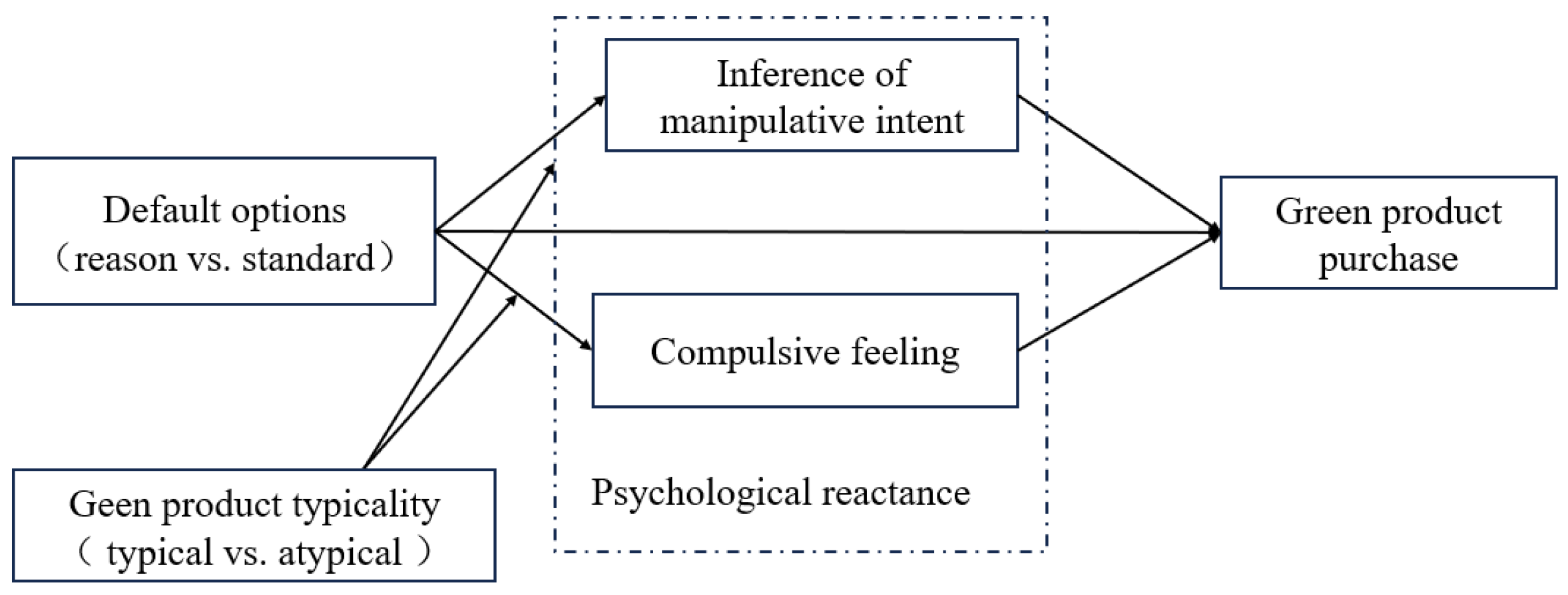
Beyond Standard Defaults: How Reason Defaults Promote Green Product Purchase Through Reduced Psychological Reactance
Abstract
1. Introduction
2. Literature Review and Hypothesis Development
2.1. Reason Default
2.2. The Impact of Reason Defaults on Green Product Purchase
2.3. The Mediating Role of Psychological Reactance
2.4. The Moderated Mediating Role of Green Product Typicality
3. Study 1: Main Impact of Reason Defaults on Green Product Purchase
3.1. Pretest
3.2. Sample
3.3. Procedures
3.4. Measures
3.5. Results
3.6. Discussion
4. Study 2: Mediating Role of Psychological Reactance
4.1. Sample
4.2. Procedures
4.3. Measures
4.4. Results
4.4.1. Direct Effect Analysis
4.4.2. Mediation Analysis
4.5. Discussion
5. Study 3: Moderated Mediating Role of Green Product Typicality
5.1. Pretest
5.2. Sample
5.3. Procedures
5.4. Results
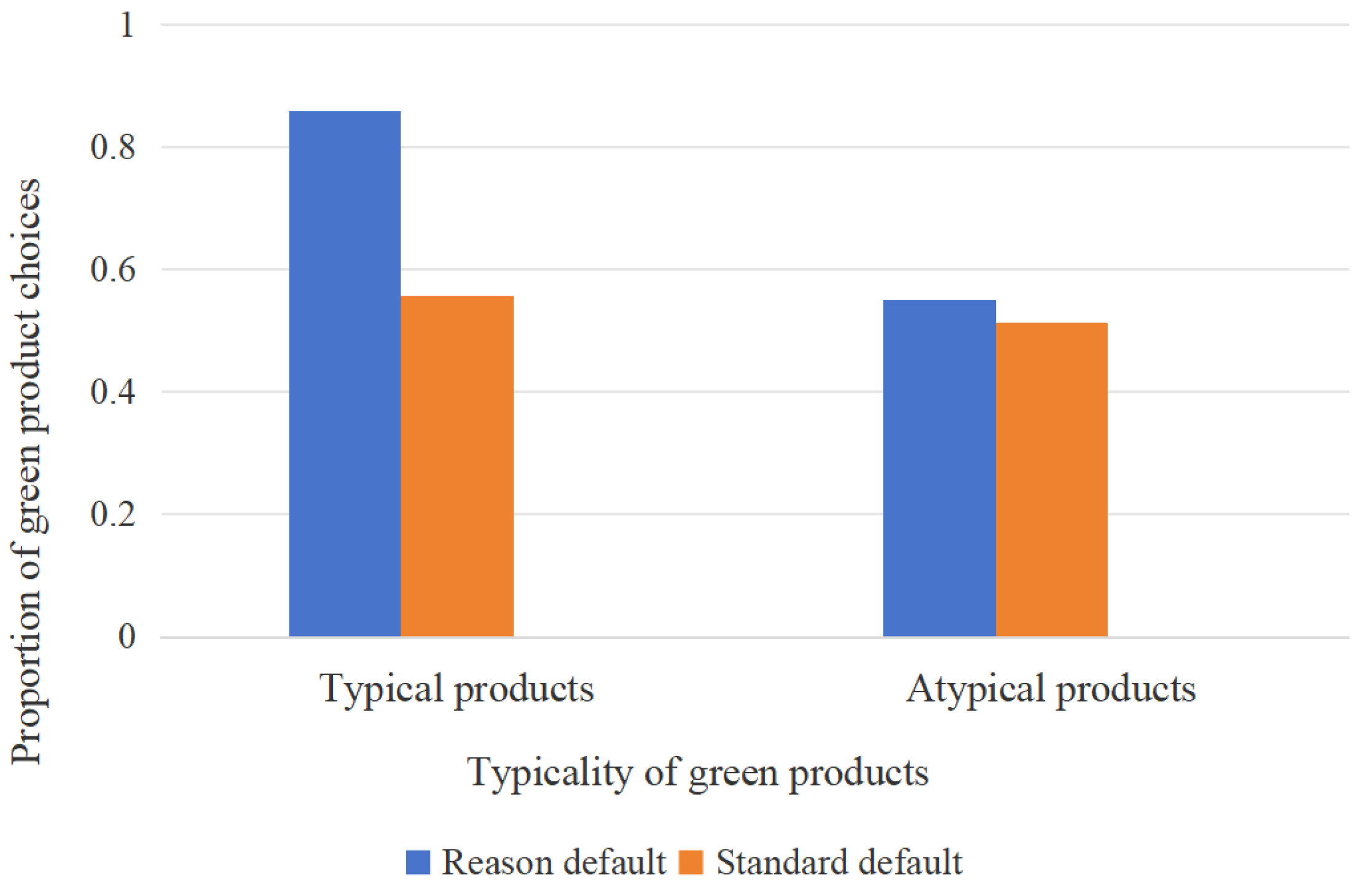
5.4.1. Impact of Default Options and Green Product Typicality on Green Product Choice
5.4.2. Impact of Default Options and Green Product Typicality on Psychological Reactance
5.4.3. Moderated Mediation Analysis
5.5. Discussion
6. Conclusions
6.1. Theoretical Contributions
6.2. Managerial Implications
6.3. Limitations and Future Research
Author Contributions
Funding
Institutional Review Board Statement
Informed Consent Statement
Data Availability Statement
Conflicts of Interest
Appendix A. The Experimental Materials in Study 1
| A. |
 |
| B. |
 |
| C. |
 |
| D. |
 |
| Note. A: example of the presentation of products (laundry detergent). B–D: examples of options participants could choose from, respectively, from the reason default, standard default, and control conditions. The Chinese term “净含量 2 kg” is Net weight 2 kg; The Chinese term “查看详情” is a standard interface button meaning “View Details”. |
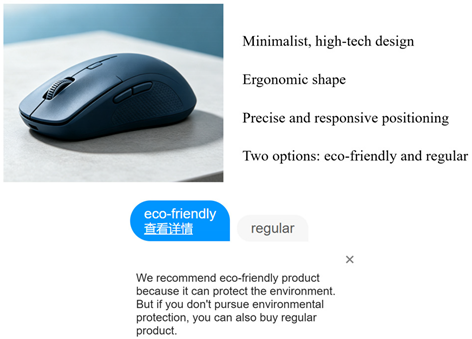
Appendix B. The Experimental Materials in Study 3
| A. |
 |
| B. |
 |
| C. |
 |
| D. |
 |
| Note. A: rational default under a typical green product. B: Standard default under typical green product; C: rational default under atypical green product context. D: Standard default under atypical green product. The Chinese term “查看详情” is a standard interface button meaning “View Details”. |
References
- Ahn, R., & Ham, C. (2022). Exploring the effect of ad choice in online video-streaming platforms: Moderated by ad involvement and mediated by psychological reactance. Journal of Current Issues & Research in Advertising, 43, 360–376. [Google Scholar] [CrossRef] [Scilit]
- Altmann, S., Falk, A., Heidhues, P., Jayaraman, R., & Teirlinck, M. (2019). Defaults and donations: Evidence from a field experiment. Review of Economics and Statistics, 101(5), 808–826. [Google Scholar] [CrossRef] [Scilit]
- Arias Puentes, C. P., & Trujillo, C. A. (2025). The role of online experiments in the understanding of sustainable consumption behaviors: A systematic methodological literature review. International Journal of Consumer Studies, 49(2), e70033. [Google Scholar] [CrossRef] [Scilit]
- Baca, G., & Reshidi, N. (2025). Green branding and consumer behavior, unveiling the impact of environmental marketing strategies on purchase decisions. Business Strategy and the Environment, 34(3), 3701–3713. [Google Scholar] [CrossRef] [Scilit]
- Brehm, J. W. (1966). A theory of psychological reactance. Academic Press. [Google Scholar]
- Brock, J. K.-U. (2023). The ‘power’ of international business research. Journal of International Business Studies, 34(1), 90–99. [Google Scholar]
- Bruns, H., & Perino, G. (2023). The role of autonomy and reactance for nudging—Experimentally comparing defaults to recommendations and mandates. Journal of Behavioral and Experimental Economics, 106, 102047. [Google Scholar] [CrossRef] [Scilit]
- Buchanan, T. M., Buchanan, J., Diedericks, D., & Davis, L. (2023). I’ll have what she’s having: (Social) Perceptions of default options and implications for marketing and decision making. International Journal of Consumer Studies, 47(2), 509–522. [Google Scholar] [CrossRef] [Scilit]
- Cadario, R., & Chandon, P. (2020). Which healthy eating nudges work best? A meta-analysis of field experiments. Marketing Science, 39(3), 465–486. [Google Scholar] [CrossRef] [Scilit]
- Cadario, R., Zimmermann, J., & Van den Bergh, B. (2026). Beyond opt-out: How presumed-consent language shapes persuasion. Journal of Marketing, 90(1), 72–90. [Google Scholar] [CrossRef] [Scilit]
- Dai, T., Wang, H., Dong, Y., & Wang, H. (2025). A study on the influence mechanism of anthropomorphic communication on users’ advertising avoidance. Asia Pacific Journal of Marketing and Logistics, 38(5), 1377–1395. [Google Scholar] [CrossRef] [Scilit]
- Damgaard, M. T., & Nielsen, H. S. (2018). Nudging in education. Economics of Education Review, 64, 313–342. [Google Scholar] [CrossRef] [Scilit]
- Desiraju, S., & Dietvorst, B. J. (2023). Reason defaults: Presenting defaults with reasons for choosing each option helps decision-makers with minority interests. Psychological Science, 34(12), 1363–1376. [Google Scholar] [CrossRef] [Scilit] [PubMed]
- de Vries, R., Bol, N., & van der Laan, N. (2025). “Just-in-time” but a bit delayed: Personalizing digital nudges for healthier online food choices. Appetite, 206, 107852. [Google Scholar] [CrossRef] [Scilit] [PubMed]
- Edwards, S. M., Li, H., & Lee, J. H. (2002). Forced exposure and psychological reactance: Antecedents and consequences of the perceived intrusiveness of pop-up ads. Journal of Advertising, 31(3), 83–95. [Google Scholar] [CrossRef] [Scilit]
- Eisend, M., & Tarrahi, F. (2022). Persuasion knowledge in the marketplace: A meta-analysis. Journal of Consumer Psychology, 32(1), 3–22. [Google Scholar] [CrossRef] [Scilit]
- Everett, J. A., Caviola, L., Kahane, G., Savulescu, J., & Faber, N. S. (2015). Doing good by doing nothing? The role of social norms in explaining default effects in altruistic contexts. European Journal of Social Psychology, 45(2), 230–241. [Google Scholar] [CrossRef] [Scilit]
- Fisher, M., & Oppenheimer, D. M. (2025). When a nudge becomes invisible: How behavioral interventions prompt metacognitive miscalibration. International Journal of Research in Marketing, 43(1), 113–130. [Google Scholar] [CrossRef] [Scilit]
- Frank, P., & Brock, C. (2018). Bridging the intention–behavior gap among organic grocery customers: The crucial role of point-of-sale information. Psychology & Marketing, 35(8), 586–602. [Google Scholar] [CrossRef] [Scilit]
- Griskevicius, V., Tybur, J. M., & Van den Bergh, B. (2010). Going green to be seen: Status, reputation, and conspicuous conservation. Journal of Personality and Social Psychology, 98(3), 392. [Google Scholar] [CrossRef] [Scilit] [PubMed]
- Ha, S., Park, J. S., & Jeong, S. W. (2025). Let me shop alone: Consumers’ psychological reactance toward retail robotics. Technological Forecasting and Social Change, 212, 123962. [Google Scholar] [CrossRef] [Scilit]
- Halpern, S. D., Ubel, P. A., & Asch, D. A. (2007). Harnessing the power of default options to improve health care. New England Journal of Medicine, 357(13), 1340–1344. [Google Scholar] [CrossRef] [Scilit] [PubMed]
- Hayes, A. F. (2017). Introduction to mediation, moderation, and conditional process analysis: A regression-based approach (2nd ed.). Guilford Press. [Google Scholar]
- He, H., Kukar-Kinney, M., & Ridgway, N. M. (2018). Compulsive buying in China: Measurement, prevalence, and online drivers. Journal of Business Research, 91, 28–39. [Google Scholar] [CrossRef] [Scilit]
- He, J., Calluso, C., Donato, C., Thouvarecq, R., & Iodice, P. (2026). Self-image matters: Examining individual differences in resistance to loss framing messages. Journal of Retailing and Consumer Services, 89, 104583. [Google Scholar] [CrossRef] [Scilit]
- He, Y., He, D., & Xu, Q. (2026). Optimal product line design strategy for green and non-green products with blockchain technology. Annals of Operations Research, 359, 1697–1726. [Google Scholar] [CrossRef] [Scilit]
- Hu, X., & Wise, K. R. (2021). How playable ads influence consumer attitude: Exploring the mediation effects of perceived control and freedom threat. Journal of Research in Interactive Marketing, 15(2), 295–315. [Google Scholar] [CrossRef] [Scilit]
- Huang, Y., & Sengupta, J. (2020). The influence of disease cues on preference for typical versus atypical products. Journal of Consumer Research, 47(3), 393–411. [Google Scholar] [CrossRef] [Scilit]
- Hummel, D., & Maedche, A. (2019). How effective is nudging? A quantitative review on the effect sizes and limits of empirical nudging studies. Journal of Behavioral and Experimental Economics, 80, 47–58. [Google Scholar] [CrossRef] [Scilit]
- Isaac, M. S., & Grayson, K. (2017). Beyond skepticism: Can accessing persuasion knowledge bolster credibility? Journal of Consumer Research, 43(6), 895–912. [Google Scholar] [CrossRef] [Scilit]
- Jachimowicz, J. M., Duncan, S., Weber, E. U., & Johnson, E. J. (2019). When and why defaults influence decisions: A meta-analysis of default effects. Behavioural Public Policy, 3(2), 159–186. [Google Scholar] [CrossRef] [Scilit]
- Ju, I., & Jun, J. W. (2025). Effects of a branded webtoon on ad avoidance: The persuasion knowledge model of dual experiences. Journal of Marketing Communications, 31(1), 62–80. [Google Scholar] [CrossRef] [Scilit]
- Kronrod, A., Grinstein, A., & Wathieu, L. (2012). Go green! Should environmental messages be so assertive? Journal of Marketing, 76(1), 95–102. [Google Scholar] [CrossRef] [Scilit]
- Kumar, V., Zhang, X., & Luo, A. (2014). Modeling customer opt-in and opt-out in a permission-based marketing context. Journal of Marketing Research, 51(4), 403–419. [Google Scholar] [CrossRef] [Scilit]
- Lin, C. J., & Chen, H. Y. (2016). User expectancies for green products: A case study on the internal customers of a social enterprise. Social Enterprise Journal, 12(3), 281–301. [Google Scholar]
- Liu, M., Liu, L., Shi, M., He, G., Zhang, S., Shi, M., Ren, Y., & Luan, B. (2020). Effect of comparative feedback on consumers’ energy-saving behavior: A college dormitory example. IEEE Transactions on Engineering Management, 69(3), 589–601. [Google Scholar] [CrossRef] [Scilit]
- Lwin, M., & Phau, I. (2014). An exploratory study of existential guilt appeals in charitable advertisements. Journal of Marketing Management, 30(13–14), 1467–1485. [Google Scholar] [CrossRef] [Scilit]
- Milfont, T. L., & Duckitt, J. (2010). The environmental attitudes inventory: A valid and reliable measure to assess the structure of environmental attitudes. Journal of Environmental Psychology, 30(1), 80–94. [Google Scholar] [CrossRef] [Scilit]
- Paunov, Y., Wänke, M., & Vogel, T. (2019). Ethical defaults: Which transparency components can increase the effectiveness of default nudges? Social Influence, 14(3–4), 104–116. [Google Scholar] [CrossRef] [Scilit]
- Pierre, L., Wang, J., & Zambrano Rodriguez, V. C. (2026). Exploring the influence of ‘artificial intelligence’ mentions in advertising and persuasion knowledge on brand skepticism, perceived manipulativeness, and purchase intention. Journal of Marketing Communications, 1–26. [Google Scholar] [CrossRef] [Scilit]
- Rains, S. A. (2013). The nature of psychological reactance revisited: A meta-analytic review. Human Communication Research, 39(1), 47–73. [Google Scholar] [CrossRef] [Scilit]
- Rauh, C., Sucky, E., & Straubert, C. (2026). The comparative effects of digital green nudging, gamification, and monetary incentives on return motivation in e-commerce. International Journal of Electronic Commerce, 30(2), 254–288. [Google Scholar] [CrossRef] [Scilit]
- Reinders, M. J., Bouwman, E. P., & Onwezen, M. C. (2024). Reducing meat consumption in restaurants: Exploring the default mechanism in a surprise menu, combined with effort and price incentives. Journal of Environmental Psychology, 98, 102402. [Google Scholar] [CrossRef] [Scilit]
- Ren, S., & Liu, D. (2024). Effects of digital nudging on the adoption of APPs for value co-creation among online consumers. Information Technology and Management, 25(2), 161–172. [Google Scholar] [CrossRef] [Scilit]
- Rosch, E., & Mervis, C. B. (1975). Family resemblances: Studies in the internal structure of categories. Cognitive Psychology, 7(4), 573–605. [Google Scholar] [CrossRef] [Scilit]
- Shehawy, Y. M. (2023). In green consumption, why consumers do not walk their talk: A cross cultural examination from Saudi Arabia and UK. Journal of Retailing and Consumer Services, 75, 103499. [Google Scholar] [CrossRef] [Scilit]
- Sheng, G., Xie, F., Gong, S., & Pan, H. (2019). The role of cultural values in green purchasing intention: Empirical evidence from Chinese consumers. International Journal of Consumer Studies, 43(3), 315–326. [Google Scholar] [CrossRef] [Scilit]
- Shevchenko, Y., von Helversen, B., & Scheibehenne, B. (2014). Change and status quo in decisions with defaults: The effect of incidental emotions depends on the type of default. Judgment and Decision Making, 9(3), 287–296. [Google Scholar] [CrossRef] [Scilit]
- Steffen, A., Weibel, C., Stämpfli, A. E., & von Arx, W. (2020). Upselling by default: The effect of default options on travelers’ board and lodging choices. Journal of Travel Research, 59(7), 1253–1267. [Google Scholar] [CrossRef] [Scilit]
- Sullivan, N. J., Breslav, A., Doré, S. S., Bachman, M. D., & Huettel, S. A. (2025). The golden halo of defaults in simple choices. Journal of Marketing Research, 62(2), 386–404. [Google Scholar] [CrossRef] [Scilit]
- Taube, O., & Vetter, M. (2019). How green defaults promote environmentally friendly decisions: Attitude-conditional default acceptance but attitude-unconditional effects on actual choices. Journal of Applied Social Psychology, 49(11), 721–732. [Google Scholar] [CrossRef] [Scilit]
- Thaler, R. H., & Sunstein, C. R. (2008). Nudge: Improving decisions about health, wealth, and happiness. Yale University Press. [Google Scholar]
- Usrey, B., Palihawadana, D., Saridakis, C., & Theotokis, A. (2020). How downplaying product greenness affects performance evaluations examining the effects of implicit and explicit green signals in advertising. Journal of Advertising, 49(2), 125–140. [Google Scholar] [CrossRef] [Scilit]
- Wang, L., Xiao, J., Luo, Z., Guo, Y., & Xu, X. A. (2024). The impact of default options on tourist intention post tourism chatbot failure: The role of service recovery and emoticon. Tourism Management Perspectives, 53, 101299. [Google Scholar] [CrossRef] [Scilit]
- Wang, S. (2026). Reexamining tipping guidelines in full-service restaurants: The moderating role of the lowest default tip and mediating pathways. International Journal of Hospitality Management, 134, 104573. [Google Scholar] [CrossRef] [Scilit]
- Yan, H., & Yates, J. F. (2019). Improving acceptability of nudges: Learning from attitudes towards opt-in and opt-out policies. Judgment and Decision Making, 14(1), 26–39. [Google Scholar] [CrossRef] [Scilit]
- Yang, Y., & Xu, H. (2025). Does just saying good things work? The interactive effect of message sidedness and green benefit appeals on consumers’ purchase intentions. Asia Pacific Journal of Marketing and Logistics, 38(7), 1982–1997. [Google Scholar] [CrossRef] [Scilit]
- Yao, Q., Zhang, H., Zeng, K. J., & Yang, M. X. (2025). Leveraging the strategic promotion of green consumption amid financial scarcity: The atypicality advantage. Business Strategy and the Environment, 34(8), 10637–10652. [Google Scholar]
- Zheng, X., Tang, Y., & Liang, S. (2026). What makes eco-friendly products appear greener? The effect of aesthetic design on consumers’ purchase intentions. Sustainable Development, 1–15. [Google Scholar]



| Effect | Path | Coef. | SE | t/Z | p | LLCI | ULCI |
|---|---|---|---|---|---|---|---|
| Direct effect | Default option → Inference of manipulative intent | −0.82 | 0.29 | −2.7626 | 0.0065 | −1.4067 | −0.2329 |
| Default option → Compulsive feeling | −1.01 | 0.28 | −3.5475 | 0.0005 | −1.5739 | −0.4471 | |
| Inference of manipulative intent → Green product purchase choice | −1.28 | 0.49 | −2.6155 | 0.0089 | −2.2538 | −0.3229 | |
| Compulsive feeling → Green product purchase choice | −1.04 | 0.38 | −2.6751 | 0.0075 | −1.8051 | −0.2785 | |
| Indirect effect | Total indirect effect | 2.10 | 9.7720 | — | — | 0.7956 | 5.8593 |
| Inference of manipulative intent | 1.05 | 4.0488 | — | — | 0.2935 | 3.0016 | |
| Compulsive feeling | 1.05 | 6.4156 | — | — | 0.2254 | 3.3170 |
| Variable | Predictor | b | SE | t | p | LLCI | ULCI |
|---|---|---|---|---|---|---|---|
| Inference of manipulative intent | Default option | 0.3223 | 0.2859 | 1.1270 | 0.2607 | −0.2407 | 0.8851 |
| Green product typicality | 0.3103 | 0.2849 | 1.0890 | 0.2771 | −0.2506 | 0.8712 | |
| Interaction | −1.1226 | 0.4015 | −2.7960 | 0.0055 | −1.9130 | −0.3322 | |
| Simple slope analysis: atypical green products | 0.3223 | 0.2859 | 1.1270 | 0.2607 | −0.2407 | 0.8852 | |
| Simple slope analysis: typical green products | −0.8004 | 0.2819 | −2.8395 | 0.0049 | −1.3552 | −0.2455 | |
| Compulsive feeling | Default option | 0.3372 | 0.2708 | 1.2451 | 0.2141 | −0.1959 | 0.8703 |
| Green product typicality | 0.2968 | 0.2698 | 1.1001 | 0.2722 | −0.2344 | 0.8281 | |
| Interaction | −1.1123 | 0.3802 | −2.9252 | 0.0037 | −1.8608 | −0.3637 | |
| Simple slope analysis: atypical green products | 0.3372 | 0.2708 | 1.2451 | 0.2141 | −0.1959 | 0.8703 | |
| Simple slope analysis: typical green products | −0.7751 | 0.2669 | −2.9038 | 0.0040 | −1.3006 | −0.2496 |
| Mediator | Green Product Typicality | Effect | SE | LLCI | ULCI |
|---|---|---|---|---|---|
| Inference of manipulative intent | Atypical | −0.3752 | 0.3811 | −1.1691 | 0.3251 |
| Typical | 0.9318 | 0.4120 | 0.2961 | 1.8513 | |
| Index of moderated mediation | 1.3070 | 0.5905 | 0.3710 | 2.6247 | |
| Compulsive feeling | Atypical | −0.4525 | 0.4340 | −1.3855 | 0.3333 |
| Typical | 1.0403 | 0.4612 | 0.3352 | 2.1420 | |
| Index of moderated mediation | 1.4928 | 0.6647 | 0.4768 | 3.0433 | |
Disclaimer/Publisher’s Note: The statements, opinions and data contained in all publications are solely those of the individual author(s) and contributor(s) and not of MDPI and/or the editor(s). MDPI and/or the editor(s) disclaim responsibility for any injury to people or property resulting from any ideas, methods, instructions or products referred to in the content. |
© 2026 by the authors. Licensee MDPI, Basel, Switzerland. This article is an open access article distributed under the terms and conditions of the Creative Commons Attribution (CC BY) license.
Share and Cite
Ge, W.; Jiang, Y. Beyond Standard Defaults: How Reason Defaults Promote Green Product Purchase Through Reduced Psychological Reactance. Behav. Sci. 2026, 16, 1655. https://doi.org/10.3390/bs16091655
Ge W, Jiang Y. Beyond Standard Defaults: How Reason Defaults Promote Green Product Purchase Through Reduced Psychological Reactance. Behavioral Sciences. 2026; 16(9):1655. https://doi.org/10.3390/bs16091655
Chicago/Turabian StyleGe, Wanda, and Yumei Jiang. 2026. "Beyond Standard Defaults: How Reason Defaults Promote Green Product Purchase Through Reduced Psychological Reactance" Behavioral Sciences 16, no. 9: 1655. https://doi.org/10.3390/bs16091655
APA StyleGe, W., & Jiang, Y. (2026). Beyond Standard Defaults: How Reason Defaults Promote Green Product Purchase Through Reduced Psychological Reactance. Behavioral Sciences, 16(9), 1655. https://doi.org/10.3390/bs16091655