Types of Punishment and Self-Reported Willingness to Change Behavior: Chain Mediation by Perceived Motivation for Punishment and Trust, and the Moderating Role of Group Relationship
Abstract
1. Introduction
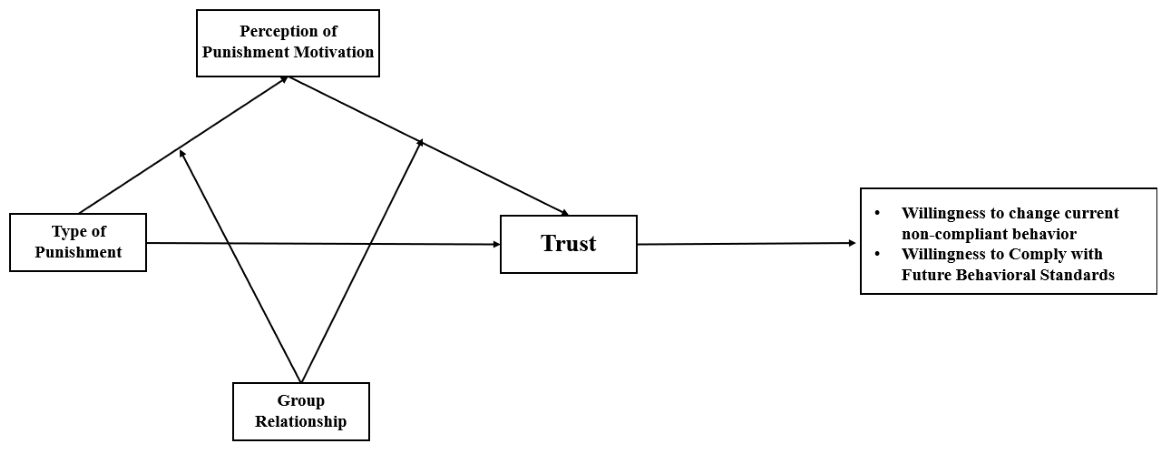
1.1. Perception of Punishment Motivation as a Mediator Between Punishment Type and Trust
1.2. The Chain Mediation of Perceived Motivation for Punishment and Trust
1.3. The Moderating Role of Group Relationship
2. Research Methods
2.1. Participants
2.2. Experimental Design
2.3. Experimental Materials and Tools
2.3.1. Punishment Scenario
2.3.2. Manipulation Check
2.3.3. Perceived Punishment Motivation Scale
2.3.4. Trust Scale
2.3.5. Behavior Change Intention Scale
2.4. Experimental Procedure
3. Results
3.1. Manipulation Check
3.2. Correlation Analysis Among Variables
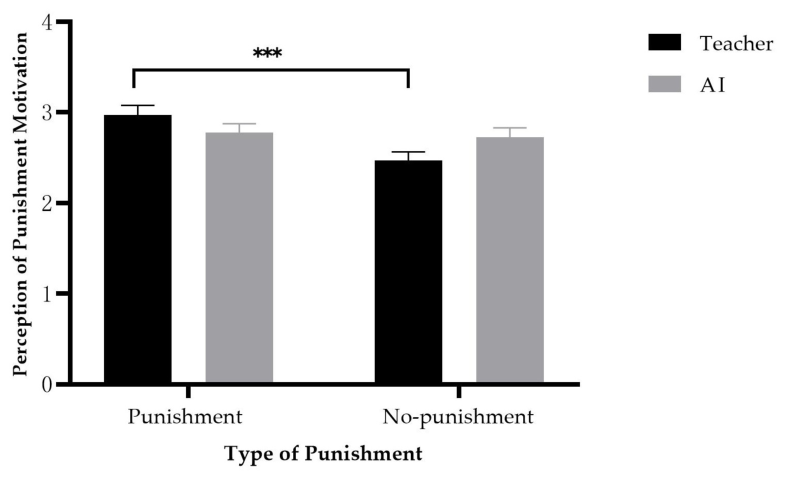
3.3. Analysis of Variance
3.4. Analysis of Mediating Effects
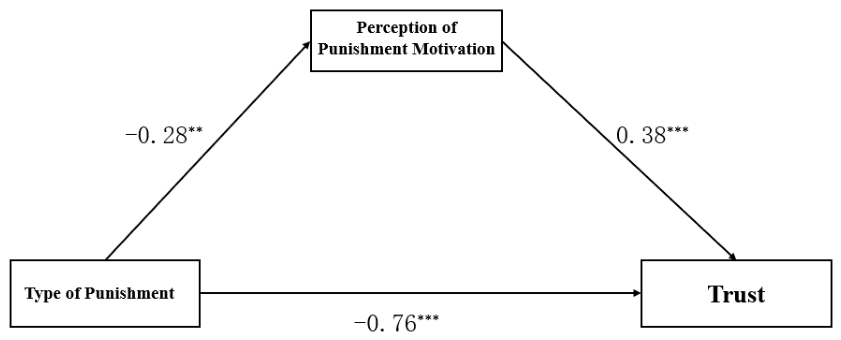
3.4.1. The Independent Mediating Effect of Perceived Punishment Motives
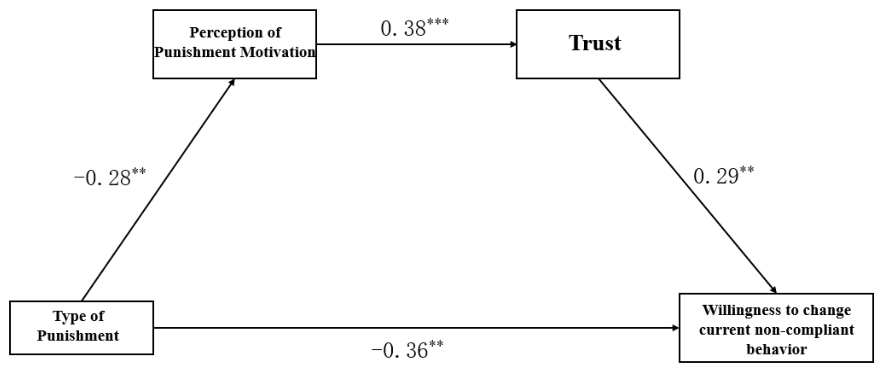
3.4.2. The Chain Mediation Effect of Perceived Punishment Motivation and Trust Between Punishment Type and the Willingness to Change Current Violative Behavior
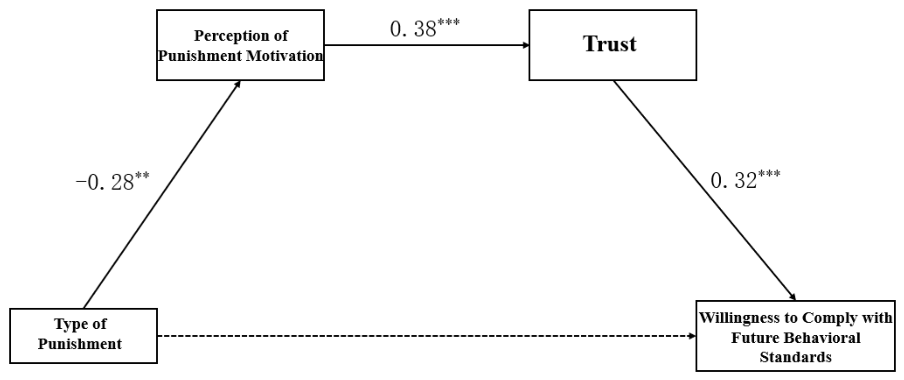
3.4.3. The Chain Mediation Effect of Perception of Punishment Motivation and Trust on the Relationship Between Punishment Type and Future Willingness to Comply with Behavioral Norms
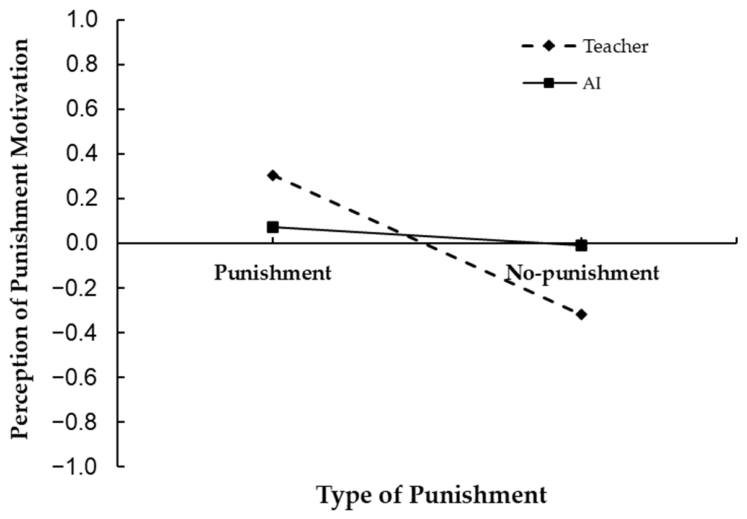
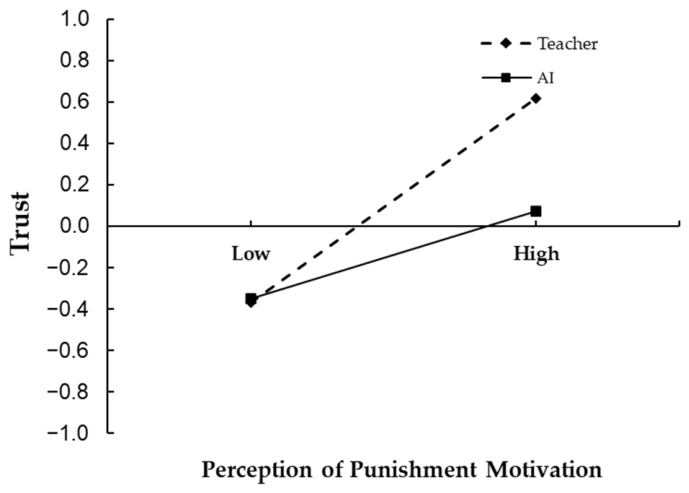
3.5. Moderated Mediation Analysis
4. Discussion
4.1. The Impact of Punishment Types on Students’ Willingness to Change Their Behavior
4.2. The Chain Mediation of Perceived Motivation for Punishment and Trust
4.3. The Moderating Role of Group Relationship
5. Limitations and Future Prospects
6. Conclusions
Author Contributions
Funding
Institutional Review Board Statement
Informed Consent Statement
Data Availability Statement
Conflicts of Interest
Appendix A
References
- Ajzen, I. (1991). The theory of planned behavior. Organizational Behavior and Human Decision Processes, 50(2), 179–211. [Google Scholar] [CrossRef] [Scilit]
- Ali, S. A. M., Said, N. A., Yunus, N. A. M., Abd Kader, S. F., Ab Latif, D. S., & Munap, R. (2014). Hackman and Oldham’s job characteristics model to job satisfaction. Procedia-Social and Behavioral Sciences, 129, 46–52. [Google Scholar] [CrossRef] [Scilit]
- Amemiya, J., Fine, A., & Wang, M. T. (2020). Trust and discipline: Adolescents’ institutional and teacher trust predict classroom behavioral engagement following teacher discipline. Child Development, 91(2), 661–678. [Google Scholar] [CrossRef] [Scilit] [PubMed]
- Amodio, D. M., & Devine, P. G. (2005). Changing prejudice: The effects of persuasion on implicit and explicit forms of race bias. In Persuasion: Psychological insights and perspectives. Sage Publications, Inc. [Google Scholar]
- Balliet, D., & Van Lange, P. A. (2013). Trust, punishment, and cooperation across 18 societies: A meta-analysis. Perspectives on Psychological Science, 8(4), 363–379. [Google Scholar] [CrossRef] [Scilit] [PubMed]
- Bandura, A. (1986). Social foundations of thought and action: A social cognitive theory. Prentice-Hall, Inc. [Google Scholar]
- Bicchieri, C., Dimant, E., & Xiao, E. (2021). Deviant or wrong? The effects of norm information on the efficacy of punishment. Journal of Economic Behavior & Organization, 188, 209–235. [Google Scholar] [CrossRef] [Scilit]
- Calabrese, C. G., Molesworth, B. R., & Hatfield, J. (2023). The effect of punishment and feedback on correcting erroneous behavior. Journal of Safety Research, 87, 481–487. [Google Scholar] [CrossRef] [Scilit] [PubMed]
- Carlsmith, K. M., Darley, J. M., & Robinson, P. H. (2002). Why do we punish? Deterrence and just deserts as motives for punishment. Journal of Personality and Social Psychology, 83(2), 284. [Google Scholar] [CrossRef] [Scilit] [PubMed]
- Cheng, Y. H., Yan, L., & Zhang, F. (2025). The effect of criticism on behavior improvement intention of junior and senior high school students: The effect of teacher-student relationship intimacy. Psychological Development and Education, 41(1), 42–50. [Google Scholar]
- Cikara, M., & Van Bavel, J. J. (2014). The neuroscience of intergroup relations: An integrative review. Perspectives on Psychological Science, 9(3), 245–274. [Google Scholar] [PubMed]
- Conner, M., & Norman, P. (2025). Attitudes, intentions, and behavior change. Annual Review of Psychology, 77, 311–337. [Google Scholar] [CrossRef] [Scilit] [PubMed]
- Cui, L., He, X., Luo, J., Huang, X., Cao, W., & Chen, X. (2017). The effects of moral punishment and relationship punishment on junior middle school students’ cooperation behaviors in public goods dilemma. Acta Psychologica Sinica, 49(10), 1322–1333. [Google Scholar] [CrossRef] [Scilit]
- De Freitas, J., Agarwal, S., Schmitt, B., & Haslam, N. (2023). Psychological factors underlying attitudes toward AI tools. Nature Human Behaviour, 7(11), 1845–1854. [Google Scholar] [CrossRef] [Scilit] [PubMed]
- Deutchman, P., Bračič, M., Raihani, N., & McAuliffe, K. (2021). Punishment is strongly motivated by revenge and weakly motivated by inequity aversion. Evolution and Human Behavior, 42(1), 12–20. [Google Scholar] [CrossRef] [Scilit]
- de Vel-Palumbo, M., Twardawski, M., & Gollwitzer, M. (2023). Making sense of punishment: Transgressors’ interpretation of punishment motives determines the effects of sanctions. British Journal of Social Psychology, 62(3), 1395–1417. [Google Scholar] [CrossRef] [Scilit] [PubMed]
- Douglas, B. D., Holley, K., Isenberg, N., Kennedy, K. R., & Brauer, M. (2024). Social sanctions in response to injunctive norm violations. Current Opinion in Psychology, 59, 101850. [Google Scholar] [CrossRef] [Scilit] [PubMed]
- Ettekal, I., & Shi, Q. (2020). Developmental trajectories of teacher-student relationships and longitudinal associations with children’s conduct problems from Grades 1 to 12. Journal of School Psychology, 82, 17–35. [Google Scholar] [CrossRef] [Scilit] [PubMed]
- Ferrier, S., Cengher, M., & Clearfield, A. (2025). Punishment happens, but the state of behavior analysis is changing for the better. Behavioral Interventions, 40(2), e2064. [Google Scholar] [CrossRef] [Scilit]
- Fishbein, M., & Ajzen, I. (1977). Belief, attitude, intention, and behavior: An introduction to theory and research. Addison-Wesley. [Google Scholar]
- Fritz, M. S., & MacKinnon, D. P. (2007). Required sample size to detect the mediated effect. Psychological Science, 18(3), 233–239. [Google Scholar] [CrossRef] [Scilit] [PubMed]
- Gilgan, N. O., & Titz, M. (2025). Navigating the cultural landscape: The impact of individualism on trust and opportunism in B2B data sharing. Academy of Management Proceedings, 2025(1), 11720. [Google Scholar]
- Gollwitzer, M., & Okimoto, T. G. (2021). Downstream consequences of post-transgression responses: A motive-attribution framework. Personality and Social Psychology Review, 25(4), 275–294. [Google Scholar] [CrossRef] [Scilit] [PubMed]
- Green, J. D., Pinter, B., & Sedikides, C. (2005). Mnemic neglect and self-threat: Trait modifiability moderates self-protection. European Journal of Social Psychology, 35(2), 225–235. [Google Scholar] [CrossRef] [Scilit]
- Gregory, A., & Ripski, M. B. (2008). Adolescent trust in teachers: Implications for behavior in the high school classroom. School Psychology Review, 37(3), 337–353. [Google Scholar] [CrossRef] [Scilit]
- Hamby, A., Orazi, D., & Moreau, P. (2024). Whose story is this? Source reveal as a communication tactic to increase consumers’ advocacy for social causes. Journal of Business Research, 170, 114309. [Google Scholar] [CrossRef] [Scilit]
- Hao, M., & Xu, S. (2023). The impact of penalty on residents’ waste separation behavior: A moderated mediation model. Polish Journal of Environmental Studies, 32(2), 1145–1158. [Google Scholar] [CrossRef] [Scilit] [PubMed]
- Harvey, J. H., & Weary, G. (1984). Current issues in attribution theory and research. Annual Review of Psychology, 35(1), 427–459. [Google Scholar] [CrossRef] [Scilit]
- Heffernan, C. J. (1988). Social foundations of thought and action: A social cognitive theory, albert bandura Englewood cliffs, New Jersey: Prentice hall, 1986, xiii+ 617 pp. Hardback. US $39.50. Behaviour Change, 5(1), 37–38. [Google Scholar] [CrossRef] [Scilit]
- Heimlich, J. E., & Ardoin, N. M. (2008). Understanding behavior to understand behavior change: A literature review. Environmental Education Research, 14(3), 215–237. [Google Scholar] [CrossRef] [Scilit]
- Hein, I., Cecil, J., & Lermer, E. (2024). Acceptance and motivational effect of AI-driven feedback in the workplace: An experimental study with direct replication. Frontiers in Organizational Psychology, 2, 1468907. [Google Scholar] [CrossRef] [Scilit]
- Ho, M. K., Cushman, F., Littman, M. L., & Austerweil, J. L. (2019). People teach with rewards and punishments as communication, not reinforcements. Journal of Experimental Psychology: General, 148(3), 520. [Google Scholar] [CrossRef] [Scilit] [PubMed]
- Iskandar, S., Rosmana, P. S., Agnia, A., Safitri, R., & Gustavisiana, T. S. (2024). The use of reward and punishment in classroom management in elementary schools. Journal of Pedagogi, 1(3), 61–66. [Google Scholar] [CrossRef] [Scilit]
- Jiang, J., Vauras, M., Volet, S., & Salo, A. E. (2019). Teacher beliefs and emotion expression in light of support for student psychological needs: A qualitative study. Education Sciences, 9(2), 68. [Google Scholar] [CrossRef] [Scilit]
- Jones, R., Kreppner, J., Marsh, F., & Hartwell, B. (2023). Punitive behaviour management policies and practices in secondary schools: A systematic review of children and young people’s perceptions and experiences. Emotional and Behavioural Difficulties, 28(2–3), 182–197. [Google Scholar] [CrossRef] [Scilit]
- Jordan, J. J., Hoffman, M., Bloom, P., & Rand, D. G. (2016). Third-party punishment as a costly signal of trustworthiness. Nature, 530(7591), 473–476. [Google Scholar] [CrossRef] [Scilit] [PubMed]
- Kluger, A. N., & DeNisi, A. (1996). The effects of feedback interventions on performance: A historical review, a meta-analysis, and a preliminary feedback intervention theory. Psychological Bulletin, 119(2), 254. [Google Scholar] [CrossRef] [Scilit]
- Kollmuss, A., & Agyeman, J. (2002). Mind the gap: Why do people act environmentally and what are the barriers to pro-environmental behavior? Environmental Education Research, 8(3), 239–260. [Google Scholar] [CrossRef] [Scilit]
- Kondo, J., Li, D., & Papanikolaou, D. (2021). Trust, collaboration, and economic growth. Management Science, 67(3), 1825–1850. [Google Scholar] [CrossRef] [Scilit]
- Krause, A., & David Smith, J. (2023). The interconnected school context: Meta-analyses of the associations between peer aggression involvement and teacher-student relationship closeness. School Psychology International, 44(4), 396–446. [Google Scholar] [CrossRef] [Scilit]
- Kuhnen, C. M., & Tymula, A. (2012). Feedback, self-esteem, and performance in organizations. Management Science, 58(1), 94–113. [Google Scholar] [CrossRef] [Scilit]
- Kupfer, T. R., & Tybur, J. M. (2023). Third-party punishers who express emotions are trusted more. Proceedings of the Royal Society B: Biological Sciences, 290(2005), 20230916. [Google Scholar] [CrossRef] [Scilit] [PubMed]
- Liberman, Z., & Shaw, A. (2018). Secret to friendship: Children make inferences about friendship based on secret sharing. Developmental Psychology, 54(11), 2139. [Google Scholar] [CrossRef] [Scilit] [PubMed]
- Liu, C. J., Chi, H. J., & Hao, F. (2025). Interaction effects of punishment probability and punishment sensitivity on dishonest behavior. Current Psychology, 44(11), 10055–10069. [Google Scholar] [CrossRef] [Scilit]
- Liu, X., Ma, J. H., & Zhu, Y. (2010). The influence of sanction system on cooperation in public good games from attributional perspective. Chinese Journal of Applied Psychology, 16, 332–340. [Google Scholar]
- Malti, T., Averdijk, M., Zuffianò, A., Ribeaud, D., Betts, L. R., Rotenberg, K. J., & Eisner, M. P. (2016). Children’s trust and the development of prosocial behavior. International Journal of Behavioral Development, 40(3), 262–270. [Google Scholar] [CrossRef] [Scilit]
- Martinko, M. J., & Mackey, J. D. (2019). Attribution theory: An introduction to the special issue. Journal of Organizational Behavior, 40(5), 523–527. [Google Scholar] [CrossRef] [Scilit]
- McAuliffe, K., & Dunham, Y. (2016). Group bias in cooperative norm enforcement. Philosophical Transactions of the Royal Society B: Biological Sciences, 371(1686), 20150073. [Google Scholar] [CrossRef] [Scilit] [PubMed]
- Michaelsen, M. M., & Esch, T. (2023). Understanding health behavior change by motivation and reward mechanisms: A review of the literature. Frontiers in Behavioral Neuroscience, 17, 1151918. [Google Scholar] [CrossRef] [Scilit] [PubMed]
- Moin, M. F., Behl, A., Zhang, J. Z., & Shankar, A. (2025). AI in the organizational nexus: Building trust, cementing commitment, and evolving psychological contracts. Information Systems Frontiers, 27(4), 1413–1424. [Google Scholar] [CrossRef] [Scilit]
- Mott, C., & Solomon, L. H. (2025). Undoing harm: The communicative content of action-oriented and person-oriented punishment. Journal of Experimental Social Psychology, 119, 104749. [Google Scholar] [CrossRef] [Scilit]
- Mulder, L. B. (2008). The difference between punishments and rewards in fostering moral concerns in social decision making. Journal of Experimental Social Psychology, 44(6), 1436–1443. [Google Scholar] [CrossRef] [Scilit]
- Nass, C., & Moon, Y. (2000). Machines and mindlessness: Social responses to computers. Journal of Social Issues, 56(1), 81–103. [Google Scholar] [CrossRef] [Scilit]
- Nass, C., Moon, Y., Fogg, B. J., Reeves, B., & Dryer, C. (1995). Can computer personalities be human personalities? In Conference companion on human factors in computing systems (pp. 228–229). Association for Computing Machinery. [Google Scholar]
- Neal, A., & Griffin, M. A. (2006). A study of the lagged relationship among safety climate, safety motivation, safety behavior, and accidents at the individual and group levels. Journal of Applied Psychology, 91(4), 946. [Google Scholar] [CrossRef] [Scilit] [PubMed]
- Podsakoff, P. M., Bommer, W. H., Podsakoff, N. P., & MacKenzie, S. B. (2006). Relationship between leader reward and punishment behavior and subordinate attitudes, perceptions, and behaviors: A meta-analytic review of existing and new research. Organizational Behavior and Human Decision Processes, 99(2), 113–142. [Google Scholar] [CrossRef] [Scilit]
- Radkani, S., Tenenbaum, J. B., & Saxe, R. (2025). What people learn from punishment: A cognitive model. Proceedings of the National Academy of Sciences, 122(32), e2500730122. [Google Scholar] [CrossRef] [Scilit] [PubMed]
- Raihani, N. J., & Bshary, R. (2019). Punishment: One tool, many uses. Evolutionary Human Sciences, 1, e12. [Google Scholar] [CrossRef] [Scilit] [PubMed]
- Savela, N., Kaakinen, M., Ellonen, N., & Oksanen, A. (2021). Sharing a work team with robots: The negative effect of robot co-workers on in-group identification with the work team. Computers in Human Behavior, 115, 106585. [Google Scholar] [CrossRef] [Scilit]
- Seaborn, K. (2025). Social identity in human-agent interaction: A primer. Association for Computing Machinery. [Google Scholar]
- Shen, Q., & Wang, W. (2021). When robots become social actors: Stereotypes in human-robot interaction. Journalism & Communication, 28(2), 37–52. [Google Scholar]
- Siddique, S., Jeffery, L., Palermo, R., Collova, J. R., & Sutherland, C. A. (2022). Children’s dynamic use of face-and behavior-based cues in an economic trust game. Developmental Psychology, 58(12), 2275. [Google Scholar] [CrossRef] [Scilit] [PubMed]
- Simões, F., & Calheiros, M. M. (2019). A matter of teaching and relationships: Determinants of teaching style, interpersonal resources and teacher burnout. Social Psychology of Education, 22(4), 991–1013. [Google Scholar] [CrossRef] [Scilit]
- Skiba, R., & Peterson, R. (1999). The dark side of zero tolerance: Can punishment lead to safe schools? The Phi Delta Kappan, 80(5), 372–382. [Google Scholar]
- Skinner, B. F. (1965). Science and human behavior (No. 92904). The Free Press.
- Sun, B., Jin, L., Yue, G., & Ren, Z. (2023). Is a punisher always trustworthy? In-group punishment reduces trust. Current Psychology, 42(26), 22965–22975. [Google Scholar] [CrossRef] [Scilit]
- Thuillard, S., Adams, M., Jelmini, G., Schmutz, S., Sonderegger, A., & Sauer, J. (2022). When humans and computers induce social stress through negative feedback: Effects on performance and subjective state. Computers in Human Behavior, 133, 107270. [Google Scholar] [CrossRef] [Scilit]
- Tricomi, E., & DePasque, S. (2016). The role of feedback in learning and motivation. Emerald Group Publishing Limited. [Google Scholar]
- Turel, O., & Kalhan, S. (2023). Prejudiced against the machine? Implicit associations and the transience of algorithm aversion. Mis Quarterly, 47(4), 1369–1394. [Google Scholar] [CrossRef] [Scilit]
- Turner, J. C., & Reynolds, K. J. (2012). Self-categorization theory. Handbook of Theories of Social Psychology, 2, 399–417. [Google Scholar] [CrossRef] [Scilit]
- van Prooijen, J. W., Gallucci, M., & Toeset, G. (2008). Procedural justice in punishment systems: Inconsistent punishment procedures have detrimental effects on cooperation. British Journal of Social Psychology, 47(2), 311–324. [Google Scholar] [CrossRef] [Scilit] [PubMed]
- Vygotsky, L. (2011). Interaction between learning and development (pp. 79–91). Linköpings Universitet. [Google Scholar]
- Wang, L., & Murnighan, J. K. (2017). The dynamics of punishment and trust. Journal of Applied Psychology, 102(10), 1385. [Google Scholar] [CrossRef] [Scilit] [PubMed]
- Yamagishi, T., Akutsu, S., Cho, K., Inoue, Y., Li, Y., & Matsumoto, Y. (2015). Two-component model of general trust: Predicting behavioral trust from attitudinal trust. Social Cognition, 33(5), 436–458. [Google Scholar] [CrossRef] [Scilit]
- Yokoi, R., & Nakayachi, K. (2021). Trust in autonomous cars: Exploring the role of shared moral values, reasoning, and emotion in safety-critical decisions. Human Factors, 63(8), 1465–1484. [Google Scholar] [CrossRef] [Scilit] [PubMed]
- Yuan, B., Zhao, J., Qi, D., Zhao, T., & Hu, J. (2025). The influence of social reward and punishment on deception. Acta Psychologica Sinica, 57(9), 1622. [Google Scholar] [CrossRef] [Scilit]
- Yuda Mahendra, I., Sri Adnyani, N. L. P., & Marsakawati, N. P. E. (2024). An exploration of the effect of teacher’s positive reinforcement and punishment towards young learner’s motivation in 21st century learning. Jurnal Pendidikan Indonesia, 5(10), 910–918. [Google Scholar] [CrossRef] [Scilit]
- Zhang, D.-J. (2016). Reward and punishment mental mechanism and its effective application in school education. Journal of Cangzhou Normal University, 32(1), 80–83. [Google Scholar]
- Zhang, Z., & Qi, C. (2024). Teachers’ punishment intensity and student observer trust: A moderated mediation model. Behavioral Sciences, 14(6), 471. [Google Scholar] [CrossRef] [Scilit] [PubMed]
- Zhang, Z., Qi, C., Wang, Y., Zhao, H., Wang, X., & Gao, X. (2020). In-group favoritism or the black sheep effect? Group bias of fairness norm enforcement during economic games. Advances in Psychological Science, 28(2), 329. [Google Scholar] [CrossRef] [Scilit]



| Variable | M | SD | 1 | 2 | 3 | 4 | 5 |
|---|---|---|---|---|---|---|---|
| 1. Type of Punishment | 0.52 | 0.50 | 1 | ||||
| 2. Group Relationship | 0.50 | 0.50 | −0.05 | 1 | |||
| 3. Perception of Punishment Motivation | 2.72 | 0.79 | −0.17 ** | 0.03 | 1 | ||
| 4. Trust | 2.59 | 0.82 | −0.52 ** | −0.11 | 0.45 ** | 1 | |
| 5. Willingness to change behavior | 3.00 | 0.92 | −0.29 ** | −0.39 ** | −0.01 | 0.28 ** | 1 |
| Outcome Variable | Predictor Variables | R2 | F | β | t | 95% CI |
|---|---|---|---|---|---|---|
| Trust | Type of Punishment | 0.28 | 30.17 *** | −0.87 | −9.54 | [−1.05, −0.69] |
| Perception of Punishment Motivation | Type of Punishment | 0.04 | 3.14 * | −0.28 | −2.79 ** | [−0.48, −0.08] |
| Trust | Type of Punishment | 0.41 | 41.25 *** | −0.76 | −9.06 *** | [−0.93, −0.60] |
| Perception of Punishment Motivation | 0.38 | 7.25 *** | [0.28, 0.49] |
| Outcome Variable | Predictor Variables | R2 | F | β | t | 95% CI |
|---|---|---|---|---|---|---|
| Perception of Punishment Motivation | Type of Punishment | 0.04 | 3.84 ** | −0.28 | −3.48 ** | [−0.48, −0.08] |
| Trust | Type of Punishment | 0.41 | 41.25 *** | −0.76 | −9.06 *** | [−0.93, −0.60] |
| Perception of Punishment Motivation | 0.38 | 7.25 *** | [0.28, 0.49] | |||
| Willingness to change current non-compliant behavior | Type of Punishment | 0.14 | 7.37 *** | −0.36 | −2.63 ** | [−0.63, −0.09] |
| Trust | 0.29 | 3.19 ** | [0.11, 0.47] |
| Outcome Variable | Predictor Variables | R2 | F | β | t | 95% CI |
|---|---|---|---|---|---|---|
| Perception of Punishment Motivation | Type of Punishment | 0.04 | 3.15 ** | −0.28 | −2.79 ** | [−0.48, −0.08] |
| Trust | Type of Punishment | 0.41 | 41.25 *** | −0.76 | −9.06 *** | [−0.93, −0.60] |
| Perception of Punishment Motivation | 0.38 | 7.25 *** | [0.28, 0.49] | |||
| Willingness to Comply with Future Behavioral Standards conduct | Type of Punishment | 0.12 | 6.43 *** | −0.26 | −1.82 | [−0.53, 0.02] |
| Trust | 0.32 | 3.19 *** | [0.13, 0.50] |
| Perception of Punishment Motivation | Trust | |||||
|---|---|---|---|---|---|---|
| β | t | 95% CI | β | t | 95% CI | |
| Type of Punishment | −0.49 | −3.47 *** | [−0.77, −0.21] | |||
| Type of Punishment × Group Relationship | 0.43 | 2.12 * | [0.03, 0.83] | |||
| Perception of Punishment Motivation | 0.62 | 8.29 *** | [0.47, 0.77] | |||
| Perception of Punishment Motivation × Group Relationship | −0.38 | −3.15 *** | [−0.62, −0.14] | |||
| Teacher | −0.49 | −3.47 *** | [−0.77, −0.21] | 0.62 | 8.29 *** | [0.47, 0.77] |
| AI | −0.06 | −0.45 | [−0.34, 0.21] | 0.23 | 2.46 ** | [0.04, 0.42] |
| Willingness to Change Current Non-Compliant Behavior | Willingness to Comply with Future Behavioral Standards | |||||
|---|---|---|---|---|---|---|
| Effect | SE | 95% CI | Effect | SE | 95% CI | |
| Chain mediation effect | 0.05 | 0.03 | [0.01, 0.12] | 0.02 | 0.01 | [0.01, 0.06] |
| Moderating effect | ||||||
| Teacher | −0.06 | 0.02 | [−0.12, −0.01] | −0.04 | 0.02 | [−0.09, −0.01] |
| AI | −0.00 | 0.01 | [−0.04, 0.02] | −0.02 | 0.01 | [−0.05, −0.01] |
| Comparison | 0.05 | 0.03 | [0.01, 0.12] | 0.02 | 0.01 | [0.01, 0.06] |
Disclaimer/Publisher’s Note: The statements, opinions and data contained in all publications are solely those of the individual author(s) and contributor(s) and not of MDPI and/or the editor(s). MDPI and/or the editor(s) disclaim responsibility for any injury to people or property resulting from any ideas, methods, instructions or products referred to in the content. |
© 2026 by the authors. Licensee MDPI, Basel, Switzerland. This article is an open access article distributed under the terms and conditions of the Creative Commons Attribution (CC BY) license.
Share and Cite
Zhang, Z.; Kong, L.; Qi, C. Types of Punishment and Self-Reported Willingness to Change Behavior: Chain Mediation by Perceived Motivation for Punishment and Trust, and the Moderating Role of Group Relationship. Behav. Sci. 2026, 16, 1450. https://doi.org/10.3390/bs16081450
Zhang Z, Kong L, Qi C. Types of Punishment and Self-Reported Willingness to Change Behavior: Chain Mediation by Perceived Motivation for Punishment and Trust, and the Moderating Role of Group Relationship. Behavioral Sciences. 2026; 16(8):1450. https://doi.org/10.3390/bs16081450
Chicago/Turabian StyleZhang, Zhen, Li Kong, and Chunhui Qi. 2026. "Types of Punishment and Self-Reported Willingness to Change Behavior: Chain Mediation by Perceived Motivation for Punishment and Trust, and the Moderating Role of Group Relationship" Behavioral Sciences 16, no. 8: 1450. https://doi.org/10.3390/bs16081450
APA StyleZhang, Z., Kong, L., & Qi, C. (2026). Types of Punishment and Self-Reported Willingness to Change Behavior: Chain Mediation by Perceived Motivation for Punishment and Trust, and the Moderating Role of Group Relationship. Behavioral Sciences, 16(8), 1450. https://doi.org/10.3390/bs16081450