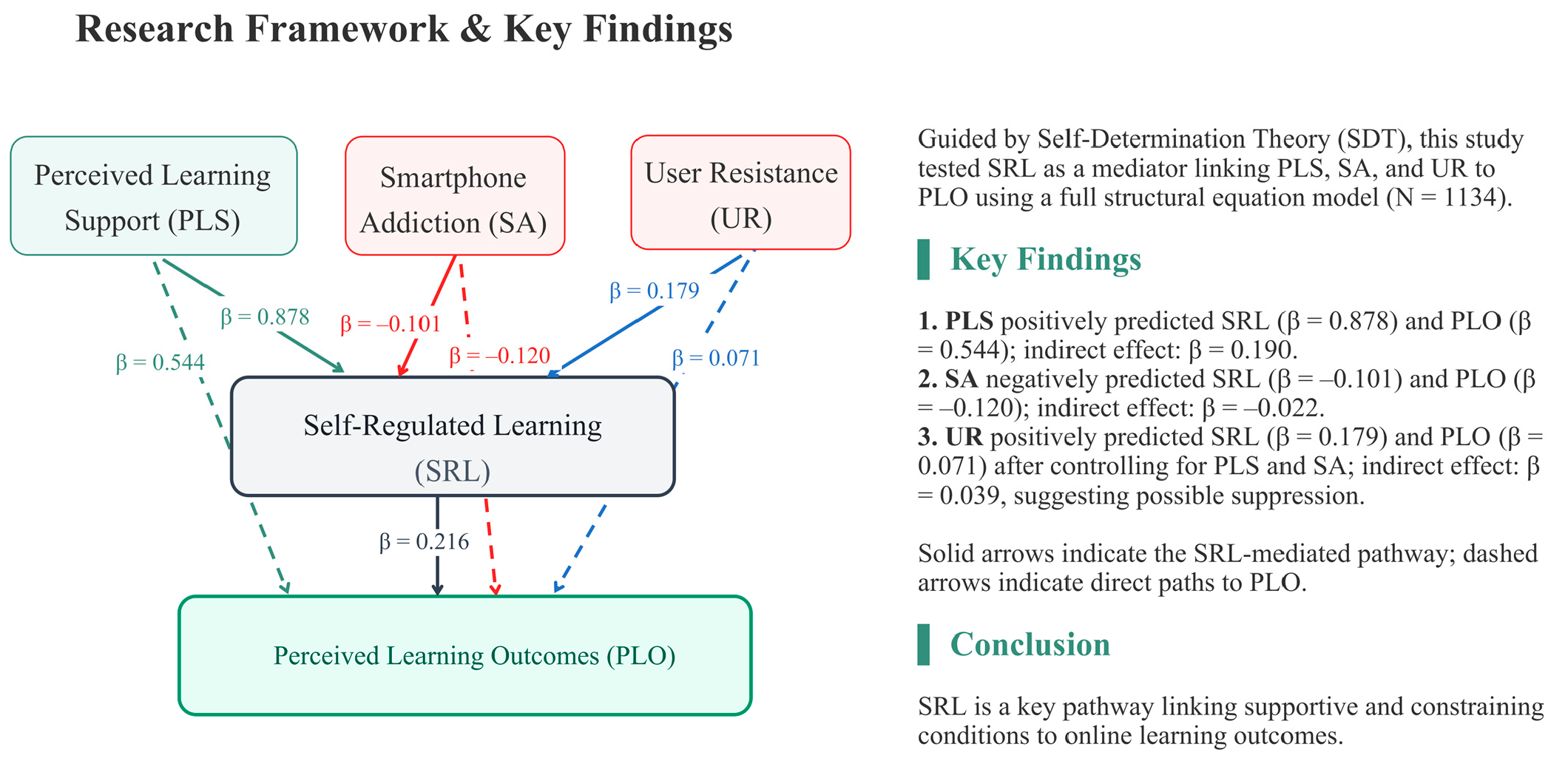
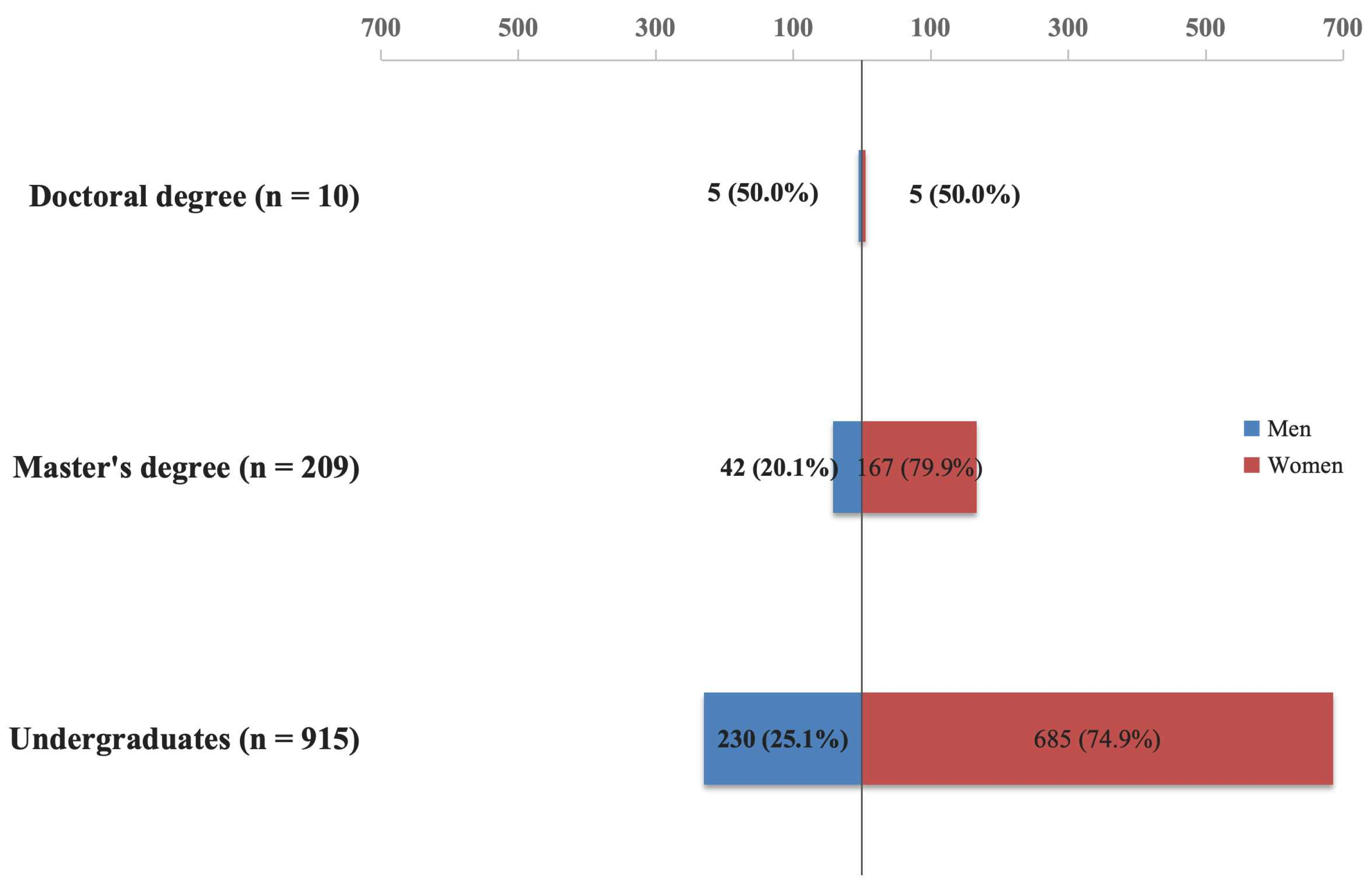
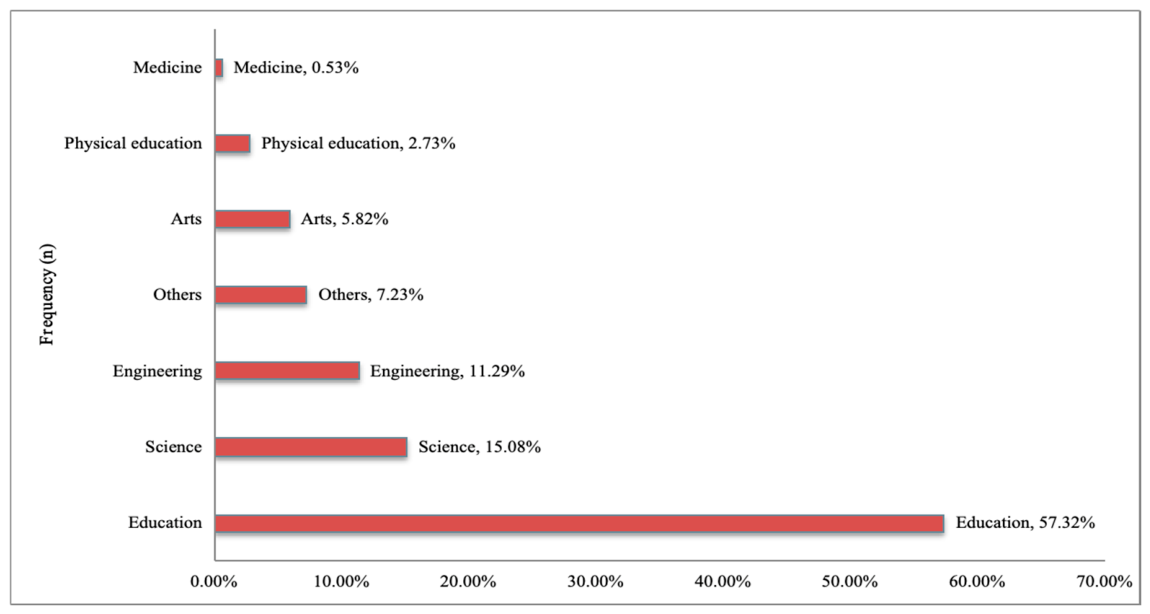
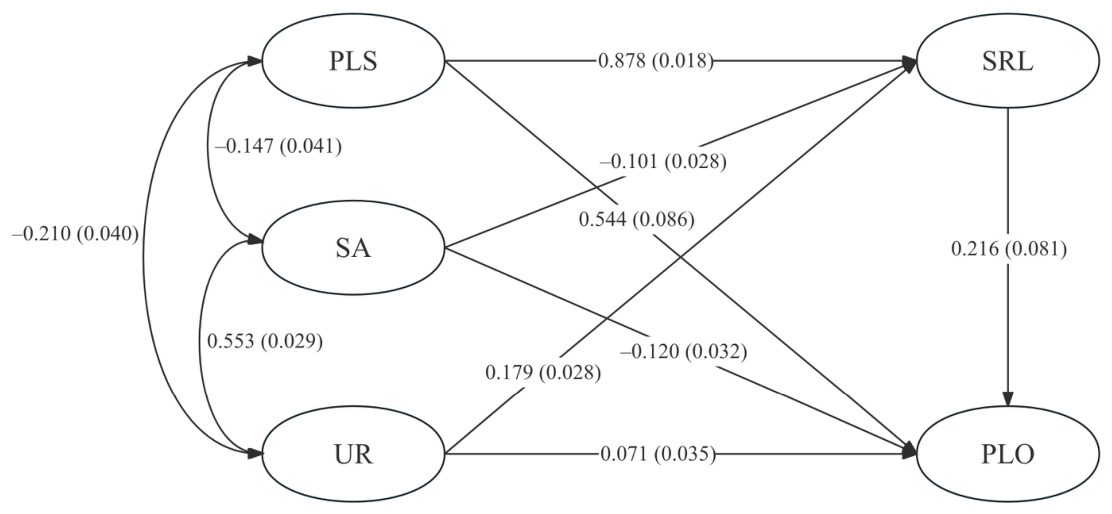
Learning Support, Digital Constraints, and Online Learning Outcomes Among Pre-Service Teachers in China’s Government-Funded Teacher Education Program: The Mediating Role of Self-Regulated Learning

 , and
, and 
Abstract
1. Introduction
2. Literature Review and Hypotheses Development
2.1. Perceived Learning Support and Online Learning Outcomes
2.2. Smartphone Addiction, User Resistance, and Learning Outcomes
2.3. The Mediating Role of Self-Regulated Learning Strategies
2.4. Research Hypotheses
3. Methods
3.1. Participants
3.2. Measures
3.3. Data Analysis
4. Findings
4.1. Descriptive Statistics and Correlations
4.2. The Mediating Analysis
4.2.1. Single-Predictor Mediation Models
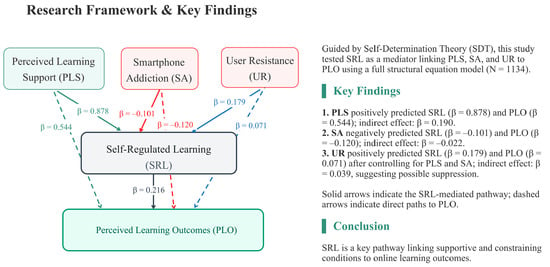
4.2.2. Full Structural Equation Model
5. Discussion
6. Conclusions
7. Limitations and Future Prospects
Author Contributions
Funding
Institutional Review Board Statement
Informed Consent Statement
Data Availability Statement
Acknowledgments
Conflicts of Interest
References
- Ali, M., Zhou, L., Miller, L., & Ieromonachou, P. (2016). User resistance in IT: A literature review. International Journal of Information Management, 36(1), 35–43. [Google Scholar] [CrossRef] [Scilit]
- Alqurashi, E. (2019). Predicting student satisfaction and perceived learning within online learning environments. Distance Education, 40(1), 133–148. [Google Scholar] [CrossRef] [Scilit]
- Artino, A. R., Jr. (2007). Online military training: Using a social cognitive view of motivation and self-regulation to understand students’ satisfaction, perceived learning, and choice. Quarterly Review of Distance Education, 8(3), 191. [Google Scholar]
- Baber, H. (2020). Determinants of students’ perceived learning outcome and satisfaction in online learning during the pandemic of COVID-19. Journal of Education and e-Learning Research, 7(3), 285–292. [Google Scholar] [CrossRef] [Scilit]
- Barak, M. (2018). Are digital natives open to change? Examining flexible thinking and resistance to change. Computers & Education, 121, 115–123. [Google Scholar] [CrossRef] [Scilit]
- Barak, M., & Levenberg, A. (2016a). A model of flexible thinking in contemporary education. Thinking Skills and Creativity, 22, 74–85. [Google Scholar] [CrossRef] [Scilit]
- Barak, M., & Levenberg, A. (2016b). Flexible thinking in learning: An individual differences measure for learning in technology-enhanced environments. Computers & Education, 99, 39–52. [Google Scholar] [CrossRef] [Scilit]
- Barnard, L., Lan, W. Y., To, Y. M., Paton, V. O., & Lai, S.-L. (2009). Measuring self-regulation in online and blended learning environments. The Internet and Higher Education, 12(1), 1–6. [Google Scholar] [CrossRef] [Scilit]
- Broadbent, J. (2017). Comparing online and blended learner’s self-regulated learning strategies and academic performance. The Internet and Higher Education, 33, 24–32. [Google Scholar] [CrossRef] [Scilit]
- Broadbent, J., & Poon, W. L. (2015). Self-regulated learning strategies & academic achievement in online higher education learning environments: A systematic review. The Internet and Higher Education, 27, 1–13. [Google Scholar] [CrossRef] [Scilit]
- Carter, R. A., Jr., Rice, M., Yang, S., & Jackson, H. A. (2020). Self-regulated learning in online learning environments: Strategies for remote learning. Information and Learning Sciences, 121(5–6), 321–329. [Google Scholar] [CrossRef] [Scilit]
- Chan, N. N., Walker, C., & Gleaves, A. (2015). An exploration of students’ lived experiences of using smartphones in diverse learning contexts using a hermeneutic phenomenological approach. Computers & Education, 82, 96–106. [Google Scholar] [CrossRef] [Scilit]
- Chang, C.-Y., Panjaburee, P., Lin, H.-C., Lai, C.-L., & Hwang, G.-H. (2022). Effects of online strategies on students’ learning performance, self-efficacy, self-regulation and critical thinking in university online courses. Educational Technology Research and Development, 70(1), 185–204. [Google Scholar] [CrossRef] [Scilit]
- Cheng, G., & Chau, J. (2013). Exploring the relationship between students’ self-regulated learning ability and their ePortfolio achievement. The Internet and Higher Education, 17, 9–15. [Google Scholar] [CrossRef] [Scilit]
- Ching, K. H., & Tak, L. M. (2017). The structural model in parenting style, attachment style, self-regulation and self-esteem for smartphone addiction. IAFOR Journal of Psychology & the Behavioral Sciences, 3(1), 85–103. [Google Scholar] [CrossRef] [Scilit]
- Deep, P. D., Chen, Y., Ghosh, N., & Rahaman, M. S. (2025). The influence of student–instructor communication methods on student engagement and motivation in higher education online courses during and after the COVID-19 pandemic. Education Sciences, 15(1), 33. [Google Scholar] [CrossRef] [Scilit]
- Ertmer, P. A., & Ottenbreit-Leftwich, A. T. (2010). Teacher technology change: How knowledge, confidence, beliefs, and culture intersect. Journal of Research on Technology in Education, 42(3), 255–284. [Google Scholar] [CrossRef] [Scilit]
- Faza, A., & Lestari, I. A. (2025). Self-regulated learning in the digital age: A systematic review of strategies, technologies, benefits, and challenges. The International Review of Research in Open and Distributed Learning, 26(2), 23–58. [Google Scholar] [CrossRef] [Scilit]
- Fernández Ortube, A., Panadero, E., & Dignath, C. (2024). Self-regulated learning interventions for pre-service teachers: A systematic review. Educational Psychology Review, 36, 113. [Google Scholar] [CrossRef] [Scilit]
- Fu, C., Zhao, Z., Wang, H., Ouyang, M., Mao, X., Cai, X., & Tan, X. (2022). How perceived school culture relates to work engagement among primary and secondary school teachers? Roles of affective empathy and job tenure. Frontiers in Psychology, 13, 878894. [Google Scholar] [CrossRef] [Scilit] [PubMed]
- Garnjost, P., & Lawter, L. (2019). Undergraduates’ satisfaction and perceptions of learning outcomes across teacher-and learner-focused pedagogies. The International Journal of Management Education, 17(2), 267–275. [Google Scholar] [CrossRef] [Scilit]
- Gopal, R., Singh, V., & Aggarwal, A. (2021). Impact of online classes on the satisfaction and performance of students during the pandemic period of COVID 19. Education and Information Technologies, 26(6), 6923–6947. [Google Scholar] [CrossRef] [Scilit] [PubMed]
- Gress, C. L., Fior, M., Hadwin, A. F., & Winne, P. H. (2010). Measurement and assessment in computer-supported collaborative learning. Computers in Human Behavior, 26(5), 806–814. [Google Scholar] [CrossRef] [Scilit]
- Haverila, M. (2011). Prior E-learning experience and perceived learning outcomes in an undergraduate E-learning course. MERLOT Journal of Online Learning and Teaching, 7(2), 206–218. [Google Scholar]
- Hawi, N. S., & Samaha, M. (2016). To excel or not to excel: Strong evidence on the adverse effect of smartphone addiction on academic performance. Computers & Education, 98, 81–89. [Google Scholar] [CrossRef] [Scilit]
- He, J., Wang, Q., & Lee, H. (2025). Enhancing online learning engagement: Teacher support, psychological needs satisfaction and interaction. BMC Psychology, 13(1), 696. [Google Scholar] [CrossRef] [Scilit] [PubMed]
- Hew, K. F. (2016). Promoting engagement in online courses: What strategies can we learn from three highly rated MOOCS. British Journal of Educational Technology, 47(2), 320–341. [Google Scholar] [CrossRef] [Scilit]
- Hodges, C. B., Moore, S., Lockee, B. B., Trust, T., & Bond, M. A. (2020). The difference between emergency remote teaching and online learning. Educause Review, 55(1), 1–12. [Google Scholar] [CrossRef] [Scilit]
- Hu, L. T., & Bentler, P. M. (1999). Cutoff criteria for fit indexes in covariance structure analysis: Conventional criteria versus new alternatives. Structural Equation Modeling: A Multidisciplinary Journal, 6(1), 1–55. [Google Scholar] [CrossRef] [Scilit]
- Huang, R. T., Jang, S. J., Machtmes, K., & Deggs, D. (2012). Investigating the roles of perceived playfulness, resistance to change and self-management of learning in mobile English learning outcome. British Journal of Educational Technology, 43(6), 1004–1015. [Google Scholar] [CrossRef] [Scilit]
- Huisman, B., Admiraal, W., Pilli, O., van de Ven, M., & Saab, N. (2018). Peer assessment in MOOCs: The relationship between peer reviewers’ ability and authors’ essay performance. British Journal of Educational Technology, 49(1), 101–110. [Google Scholar] [CrossRef] [Scilit]
- Jansen, R. S., van Leeuwen, A., Janssen, J., Conijn, R., & Kester, L. (2020). Supporting learners’ self-regulated learning in Massive Open Online Courses. Computers & Education, 146, 103771. [Google Scholar] [CrossRef] [Scilit]
- Jenkins, D. M. (2015). Integrated course design: A facelift for college courses. Journal of Management Education, 39(3), 427–432. [Google Scholar] [CrossRef] [Scilit]
- Jo, I.-H., Park, Y., Yoon, M., & Sung, H. (2016). Evaluation of online log variables that estimate learners’ time management in a Korean online learning context. The International Review of Research in Open and Distributed Learning, 17(1), 195–213. [Google Scholar] [CrossRef] [Scilit]
- Judd, T. (2014). Making sense of multitasking: The role of Facebook. Computers & Education, 70, 194–202. [Google Scholar] [CrossRef] [Scilit]
- Kang, M., & Im, T. (2013). Factors of learner-instructor interaction which predict perceived learning outcomes in online learning environment. Journal of Computer Assisted Learning, 29(3), 292–301. [Google Scholar] [CrossRef] [Scilit]
- Kim, H.-W., & Kankanhalli, A. (2009). Investigating user resistance to information systems implementation: A status quo bias perspective. MIS Quarterly, 33(3), 567–582. [Google Scholar] [CrossRef] [Scilit]
- Kizilcec, R. F., Pérez-Sanagustín, M., & Maldonado, J. J. (2017). Self-regulated learning strategies predict learner behavior and goal attainment in Massive Open Online Courses. Computers & Education, 104, 18–33. [Google Scholar] [CrossRef] [Scilit]
- Kurucay, M., & Inan, F. A. (2017). Examining the effects of learner-learner interactions on satisfaction and learning in an online undergraduate course. Computers & Education, 115, 20–37. [Google Scholar] [CrossRef] [Scilit]
- Lee, D., Watson, S. L., & Watson, W. R. (2020). The relationships between self-efficacy, task value, and self-regulated learning strategies in massive open online courses. The International Review of Research in Open and Distributed Learning, 21(1), 23–39. [Google Scholar] [CrossRef] [Scilit]
- Lee, J.-K., & Lee, W.-K. (2008). The relationship of e-Learner’s self-regulatory efficacy and perception of e-Learning environmental quality. Computers in Human Behavior, 24(1), 32–47. [Google Scholar] [CrossRef] [Scilit]
- Lin, Y.-H., Chang, L.-R., Lee, Y.-H., Tseng, H.-W., Kuo, T. B., & Chen, S.-H. (2014). Development and validation of the Smartphone Addiction Inventory (SPAI). PLoS ONE, 9(6), e98312. [Google Scholar] [CrossRef] [Scilit] [PubMed]
- Lin, Y.-H., Chiang, C.-L., Lin, P.-H., Chang, L.-R., Ko, C.-H., Lee, Y.-H., & Lin, S.-H. (2016). Proposed diagnostic criteria for smartphone addiction. PLoS ONE, 11(11), e0163010. [Google Scholar] [CrossRef] [Scilit] [PubMed]
- Lin, Y.-H., Lin, Y.-C., Lee, Y.-H., Lin, P.-H., Lin, S.-H., Chang, L.-R., Tseng, H.-W., Yen, L.-Y., Yang, C. C. H., & Kuo, T. B. J. (2017). Development of short-form and screening cutoff point of the Smartphone Addiction Inventory (SPAI-SF). International Journal of Methods in Psychiatric Research, 26(2), e1525. [Google Scholar] [CrossRef] [Scilit] [PubMed]
- Madjar, N., Nave, A., & Hen, S. (2013). Are teachers’ psychological control, autonomy support and autonomy suppression associated with students’ goals? Educational Studies, 39(1), 43–55. [Google Scholar] [CrossRef] [Scilit]
- Margaryan, A., Bianco, M., & Littlejohn, A. (2015). Instructional quality of massive open online courses (MOOCs). Computers & Education, 80, 77–83. [Google Scholar] [CrossRef] [Scilit]
- Martin, F., Ritzhaupt, A., Kumar, S., & Budhrani, K. (2019). Award-winning faculty online teaching practices: Course design, assessment and evaluation, and facilitation. The Internet and Higher Education, 42, 34–43. [Google Scholar] [CrossRef] [Scilit]
- Means, B., Toyama, Y., Murphy, R., Bakia, M., & Jones, K. (2010). Evaluation of evidence-based practices in online learning: A meta-analysis and review of online learning studies. U.S. Department of Education, Office of Planning, Evaluation, and Policy Development, Policy and Program Studies Service. Available online: https://www.ed.gov/media/document/evaluation-of-evidence-based-practices-online-learning-meta-analysis-and-review-of-online-learning-studies-revised-september-2010-107159.pdf (accessed on 2 July 2026).
- Milligan, C., & Littlejohn, A. (2016). How health professionals regulate their learning in massive open online courses. The Internet Higher Education, 31, 113–121. [Google Scholar] [CrossRef] [Scilit] [PubMed]
- Ministry of Education of the People’s Republic of China. (2021). The plan for targeted cultivation of excellent teachers in less developed areas in Central and Western China. Available online: http://www.moe.gov.cn/srcsite/A10/s7011/202108/t20210803_548644.html (accessed on 2 July 2026).
- Moore, J. L., Dickson-Deane, C., & Galyen, K. (2011). e-Learning, online learning, and distance learning environments: Are they the same? The Internet and Higher Education, 14(2), 129–135. [Google Scholar] [CrossRef] [Scilit]
- Nawrot, I., & Doucet, A. (2014, April 7–11). Building engagement for MOOC students: Introducing support for time management on online learning platforms. 23rd international world wide web conference, Seoul, Republic of Korea. [Google Scholar] [CrossRef] [Scilit]
- Paechter, M., Maier, B., & Macher, D. (2010). Students’ expectations of, and experiences in e-learning: Their relation to learning achievements and course satisfaction. Computers & Education, 54(1), 222–229. [Google Scholar] [CrossRef] [Scilit]
- Panadero, E. (2017). A review of self-regulated learning: Six models and four directions for research. Frontiers in Psychology, 8, 422. [Google Scholar] [CrossRef] [Scilit] [PubMed]
- Paris, S. G., & Paris, A. H. (2001). Classroom applications of research on self-regulated learning. Educational Psychologist, 36(2), 89–101. [Google Scholar] [CrossRef] [Scilit] [PubMed]
- Pintrich, P. R., & De Groot, E. V. (1990). Motivational and self-regulated learning components of classroom academic performance. Journal of Educational Psychology, 82(1), 33. [Google Scholar] [CrossRef]
- Prasse, D., Webb, M., Deschênes, M., Parent, S., Aeschlimann, F., Goda, Y., Yamada, M., & Raynault, A. (2024). Challenges in promoting self-regulated learning in technology-supported learning environments: An umbrella review of systematic reviews and meta-analyses. Technology, Knowledge and Learning, 29(4), 1809–1830. [Google Scholar] [CrossRef] [Scilit]
- Quality Matters. (2023). HE specific review standards from the QM higher education rubric, seventh edition. Available online: https://www.qualitymatters.org/sites/default/files/PDFs/StandardsfromtheQMHigherEducationRubric.pdf (accessed on 2 July 2026).
- Radha, R., Mahalakshmi, K., Kumar, V. S., & Saravanakumar, A. (2020). E-Learning during lockdown of COVID-19 pandemic: A global perspective. International Journal of Control and Automation, 13(4), 1088–1099. [Google Scholar]
- Rasheed, R. A., Kamsin, A., & Abdullah, N. A. (2020). Challenges in the online component of blended learning: A systematic review. Computers & Education, 144, 103701. [Google Scholar] [CrossRef] [Scilit]
- Ryan, R. M., & Deci, E. L. (2000). Self-determination theory and the facilitation of intrinsic motivation, social development, and well-being. American Psychologist, 55(1), 68–78. [Google Scholar] [CrossRef] [PubMed]
- Ryan, R. M., & Deci, E. L. (2017). Self-determination theory: Basic psychological needs in motivation, development, and wellness. Guilford Publications. [Google Scholar] [CrossRef] [Scilit]
- Scheel, L., Vladova, G., & Ullrich, A. (2022). The influence of digital competences, self-organization, and independent learning abilities on students’ acceptance of digital learning. International Journal of Educational Technology in Higher Education, 19(1), 44. [Google Scholar] [CrossRef] [Scilit] [PubMed]
- Schermelleh-Engel, K., Moosbrugger, H., & Müller, H. (2003). Evaluating the fit of structural equation models: Tests of significance and descriptive goodness-of-fit measures. Methods of Psychological Research Online, 8(2), 23–74. [Google Scholar]
- Tondeur, J., van Braak, J., Sang, G., Voogt, J., Fisser, P., & Ottenbreit-Leftwich, A. (2012). Preparing pre-service teachers to integrate technology in education: A synthesis of qualitative evidence. Computers & Education, 59(1), 134–144. [Google Scholar] [CrossRef] [Scilit]
- van Deursen, A. J. A. M., Bolle, C. L., Hegner, S. M., & Kommers, P. A. M. (2015). Modeling habitual and addictive smartphone behavior. Computers in Human Behavior, 45, 411–420. [Google Scholar] [CrossRef] [Scilit]
- Wang, Y., & Zhang, Y. (2015). Relation of mobile phone addiction to perceived social support and subjective well-being in college students. Chinese Mental Health Journal, 29(11), 868–873. [Google Scholar]
- Wei, X., Saab, N., & Admiraal, W. (2021). Assessment of cognitive, behavioral, and affective learning outcomes in massive open online courses: A systematic literature review. Computers & Education, 163, 104097. [Google Scholar] [CrossRef] [Scilit]
- Wei, X., Saab, N., & Admiraal, W. (2023). Do learners share the same perceived learning outcomes in MOOCs? Identifying the role of motivation, perceived learning support, learning engagement, and self-regulated learning strategies. The Internet and Higher Education, 56, 100880. [Google Scholar] [CrossRef] [Scilit]
- Wentworth, D. K., & Middleton, J. H. (2014). Technology use and academic performance. Computers & Education, 78, 306–311. [Google Scholar] [CrossRef] [Scilit]
- Xu, J. (2015). Investigating factors that influence conventional distraction and tech-related distraction in math homework. Computers & Education, 81, 304–314. [Google Scholar] [CrossRef] [Scilit]
- Yunusa, A. A., & Umar, I. N. (2021). A scoping review of critical predictive factors (CPFs) of satisfaction and perceived learning outcomes in E-learning environments. Education and Information Technologies, 26, 1223–1270. [Google Scholar] [CrossRef] [Scilit]
- Zhang, M. X., & Wu, A. M. (2020). Effects of smartphone addiction on sleep quality among Chinese university students: The mediating role of self-regulation and bedtime procrastination. Addictive Behaviors, 111, 106552. [Google Scholar] [CrossRef] [Scilit] [PubMed]
- Zimmerman, B. J. (2000). Attaining self-regulation: A social cognitive perspective. In M. Boekaerts, P. R. Pintrich, & M. Zeidner (Eds.), Handbook of self-regulation (pp. 13–39). Academic Press. [Google Scholar] [CrossRef] [Scilit]



| N | % | N | % | ||||
|---|---|---|---|---|---|---|---|
| Most popular way | Live class | 703 | 61.99 | Favorite app | Ding Talk | 66 | 5.8 |
| Video class | 42 | 3.7 | Super Star Learning | 728 | 64.2 | ||
| MOOC | 31 | 2.73 | MOOC | 81 | 7.14 | ||
| Live class + Videos class | 137 | 12.08 | Tencent Class | 104 | 9.17 | ||
| Live class +MOOC | 174 | 15.34 | Rain Class | 28 | 2.47 | ||
| Videos class + MOOC | 26 | 2.29 | Zoom | 5 | 0.44 | ||
| Others | 21 | 1.85 | 23 | 2.03 | |||
| Total | 1134 | 100 | Tencent Meeting | 30 | 2.65 | ||
| Device | Phone | 846 | 74.60 | THEOL | 1 | 0.09 | |
| Computer | 831 | 73.30 | Others | 68 | 6 | ||
| Tablet | 313 | 27.60 | - | - | - | ||
| No equipment | 8 | 0.70 | - | - | - | ||
| Total | 1998 | 176.20 | Total | 1134 | 100 |
| Construct | Dimensions | AVE | Construct Reliability (CR) | Cronbach’s α |
|---|---|---|---|---|
| Perceived learning support | Course design | 0.623 | 0.832 | 0.935 |
| Interaction with instructors | 0.485 | 0.789 | ||
| Interaction with peer students | 0.585 | 0.849 | ||
| Learner autonomy | 0.648 | 0.846 | ||
| Perceived learning outcomes | - | 0.624 | 0.891 | 0.890 |
| Online Self-regulated Learning Strategies | Goal setting | 0.652 | 0.903 | 0.958 |
| Environment structuring | 0.569 | 0.841 | ||
| Task strategies | 0.576 | 0.844 | ||
| Time management | 0.571 | 0.799 | ||
| Help seeking | 0.517 | 0.809 | ||
| Self-evaluation | 0.637 | 0.840 | ||
| Smartphone addiction | Compulsive behavior | 0.583 | 0.807 | 0.920 |
| Functional impairment | 0.625 | 0.833 | ||
| Withdrawal | 0.755 | 0.861 | ||
| Tolerance | 0.729 | 0.843 | ||
| User resistance | - | 0.724 | 0.912 | 0.916 |
| No. | Variable | 1 | 2 | 3 | 4 | 5 |
|---|---|---|---|---|---|---|
| 1 | PLO | - | ||||
| 2 | PLS | 0.665 ** | - | |||
| 3 | SA | −0.151 ** | −0.119 ** | - | ||
| 4 | SRL | 0.637 ** | 0.778 ** | −0.117 ** | - | |
| 5 | UR | −0.154 ** | −0.205 ** | 0.535 ** | −0.088 ** | - |
| M | 3.290 | 3.661 | 3.282 | 3.559 | 2.717 | |
| SD | 0.814 | 0.605 | 0.774 | 0.631 | 0.907 |
| Mediation Path | Effect | β | SE | p | Boot LLCI | Boot ULCI |
|---|---|---|---|---|---|---|
| PLS → SRL → PLO | Total effect | 0.734 | 0.026 | <0.001 | 0.675 | 0.779 |
| Indirect | 0.190 | 0.070 | 0.007 | 0.054 | 0.329 | |
| Direct | 0.544 | 0.086 | <0.001 | 0.368 | 0.703 | |
| UR → SRL → PLO | Total effect | 0.110 | 0.033 | 0.001 | 0.047 | 0.176 |
| Indirect | 0.039 | 0.015 | 0.010 | 0.013 | 0.072 | |
| Direct | 0.071 | 0.035 | 0.044 | 0.003 | 0.142 | |
| SA → SRL → PLO | Total effect | −0.142 | 0.034 | <0.001 | −0.210 | −0.077 |
| Indirect | −0.022 | 0.011 | 0.037 | −0.050 | −0.006 | |
| Direct | −0.120 | 0.032 | <0.001 | −0.183 | −0.055 |
Disclaimer/Publisher’s Note: The statements, opinions and data contained in all publications are solely those of the individual author(s) and contributor(s) and not of MDPI and/or the editor(s). MDPI and/or the editor(s) disclaim responsibility for any injury to people or property resulting from any ideas, methods, instructions or products referred to in the content. |
© 2026 by the authors. Licensee MDPI, Basel, Switzerland. This article is an open access article distributed under the terms and conditions of the Creative Commons Attribution (CC BY) license.
Share and Cite
Huang, L.; Zeng, L.; Guo, J.; Liu, X.; Duan, B.; Zhang, X.; Cheng, Z. Learning Support, Digital Constraints, and Online Learning Outcomes Among Pre-Service Teachers in China’s Government-Funded Teacher Education Program: The Mediating Role of Self-Regulated Learning. Behav. Sci. 2026, 16, 1409. https://doi.org/10.3390/bs16081409
Huang L, Zeng L, Guo J, Liu X, Duan B, Zhang X, Cheng Z. Learning Support, Digital Constraints, and Online Learning Outcomes Among Pre-Service Teachers in China’s Government-Funded Teacher Education Program: The Mediating Role of Self-Regulated Learning. Behavioral Sciences. 2026; 16(8):1409. https://doi.org/10.3390/bs16081409
Chicago/Turabian StyleHuang, Lanzi, Lingqin Zeng, Jianwen Guo, Xian Liu, Boyuan Duan, Xiaoxuan Zhang, and Zhao Cheng. 2026. "Learning Support, Digital Constraints, and Online Learning Outcomes Among Pre-Service Teachers in China’s Government-Funded Teacher Education Program: The Mediating Role of Self-Regulated Learning" Behavioral Sciences 16, no. 8: 1409. https://doi.org/10.3390/bs16081409
APA StyleHuang, L., Zeng, L., Guo, J., Liu, X., Duan, B., Zhang, X., & Cheng, Z. (2026). Learning Support, Digital Constraints, and Online Learning Outcomes Among Pre-Service Teachers in China’s Government-Funded Teacher Education Program: The Mediating Role of Self-Regulated Learning. Behavioral Sciences, 16(8), 1409. https://doi.org/10.3390/bs16081409