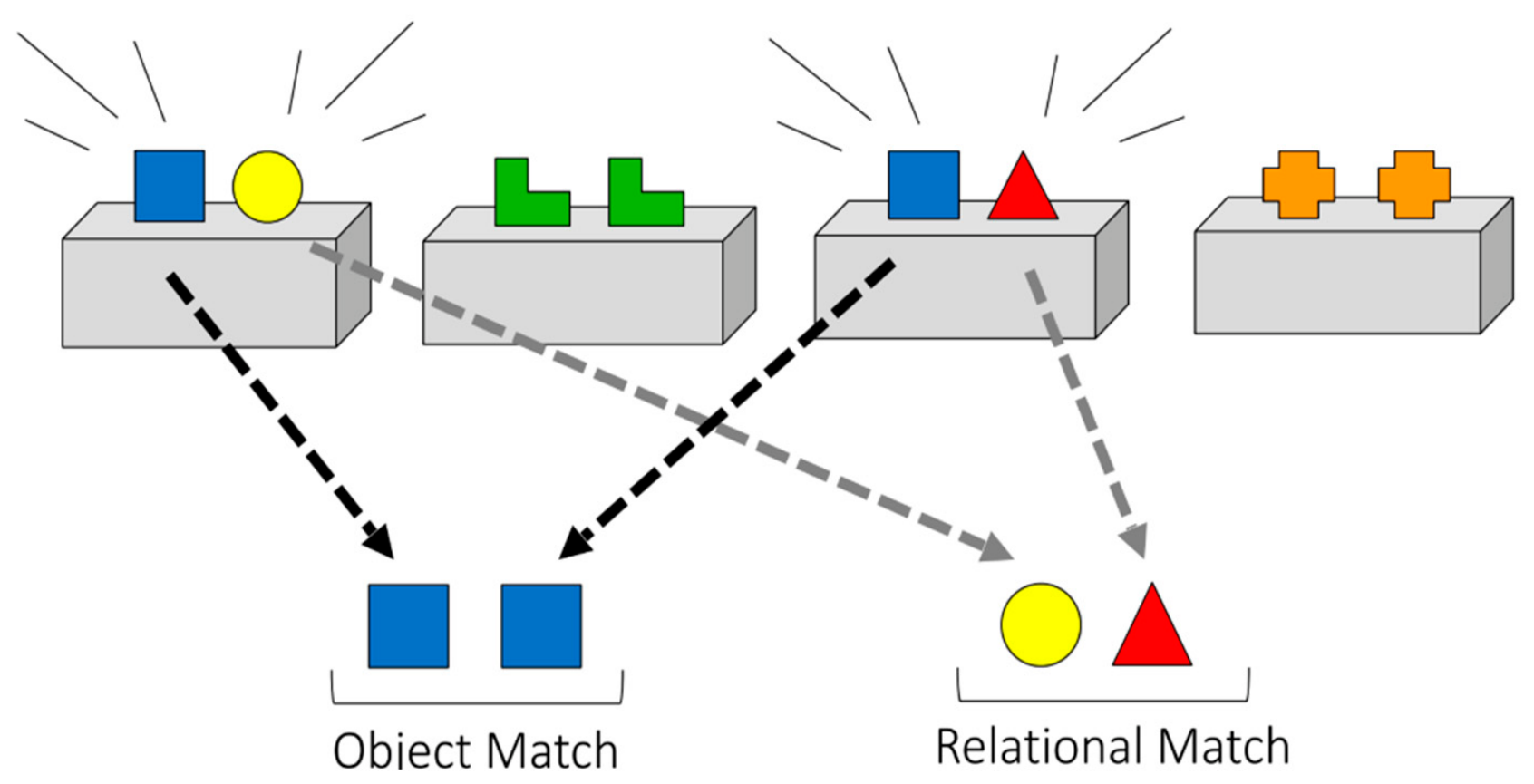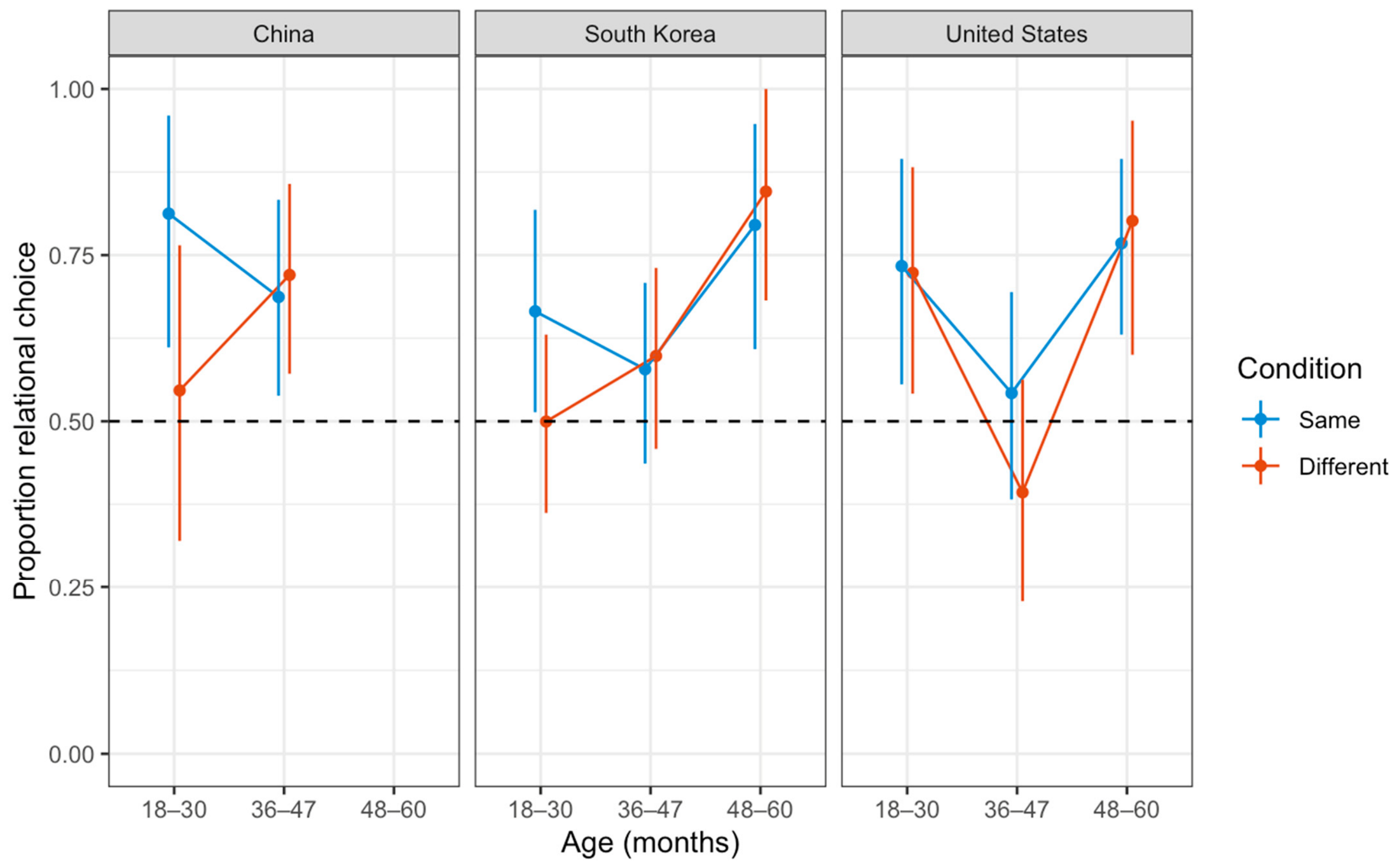
Relational Reasoning Across Cultures: Consistency and Variation in South Korea, the United States, and China

Abstract
1. Introduction
The Present Study
2. Experiment 1: Consistency in Early Emergence
2.1. Method
2.1.1. Participants
2.1.2. Procedure
2.2. Results and Discussion
3. Experiment 2: Variation in Relational Bias
3.1. Method
3.1.1. Participants
3.1.2. Procedure
3.2. Results and Discussion
4. Experiment 3: Variation in Relational Reasoning
4.1. Method
4.1.1. Participants
4.1.2. Procedure
4.2. Results and Discussion
5. General Discussion
Author Contributions
Funding
Institutional Review Board Statement
Informed Consent Statement
Data Availability Statement
Acknowledgments
Conflicts of Interest
| 1 | NB: the present study is not designed to evaluate contextually varying factors that may cause differences in relational reasoning, or to measure contextual variation between the U.S., South Korea, and China—these are remaining empirical questions—our goal here is to document bias in relational reasoning in a novel population to inform our general understanding of variation in relational bias, given that little data has been collected with children outside of English-speaking contexts in the U.S. |
| 2 | There were two exceptions to this policy in US recruitment: (1) we accidentally overrecruited US children in the same condition because of a miscommunication about the stopping rule, running 39 when we would have stopped at 23 if we had followed our plan, and (2) we intentionally overincluded US children in the different condition because we met our stopping rule at 10 participants, but followed reviewer feedback to include a minimum of 20 participants per condition; in both cases, our results are qualitatively similar for the smaller and larger samples and we therefore report statistics for the larger samples. We also implemented this 20-participant minimum with our Korean samples after meeting our stopping rule with 8 4-year-olds in each condition, overrecruiting to meet this minimum of 20 in the different condition, with 19 in the same condition because of a duplicate entry; again, our results are qualitatively similar for the smaller and larger samples and we therefore report statistics for the larger samples. |
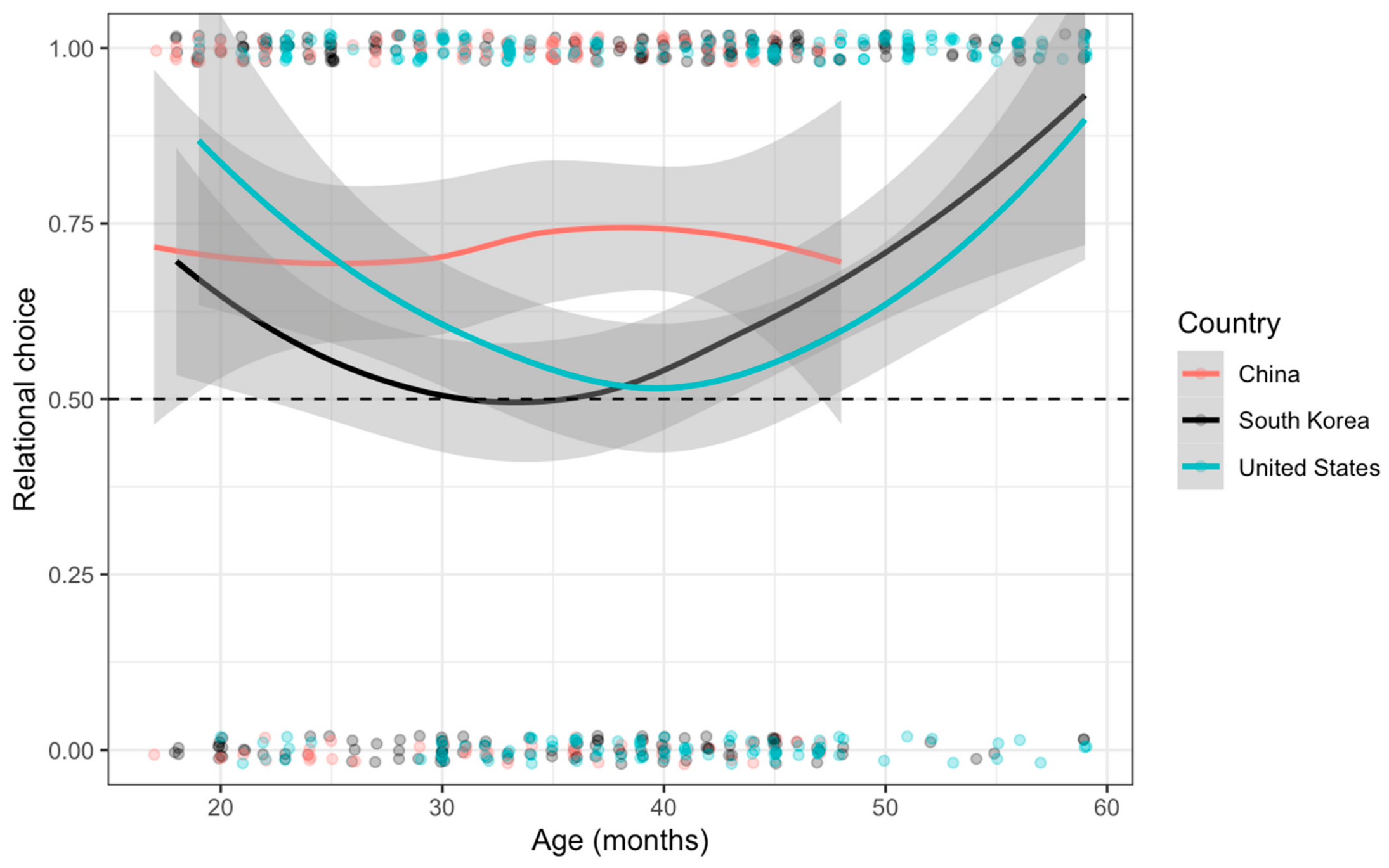
| 3 | We also fit a version of this model without the quadratic age term, but the model with quadratic age outperformed the simpler alternative in model comparison (χ2(6) = 15.86, p = 0.015). |
| 4 | The credible interval indicates the range within which 95% of posterior draws fall. As a practical rule of thumb, an effect whose 95% credible interval excludes zero can be interpreted similarly to a statistically significant result (roughly analogous to p < 0.05), though this is an informal heuristic rather than a strict equivalence. |
| 5 | See Carstensen et al. (in press) and Boccalato-Rodríguez et al. (2026) for cross-sectional cross-cultural studies of multiple factors including attention, social cognition, and relational reasoning. |
References
- Anderson, E. M., Chang, Y. J., Hespos, S., & Gentner, D. (2022). No evidence for language benefits in infant relational learning. Infant Behavior and Development, 66, 101666. [Google Scholar] [CrossRef] [Scilit] [PubMed]
- Beom, J., & Choi, Y. (2020). Informant’s age can trump accuracy in selective trust in Korean 5-year-olds but not in 4-year-olds. The Korean Journal of Developmental Psychology, 33(1), 53–64. [Google Scholar] [CrossRef] [Scilit]
- Boccalato-Rodríguez, L., Ruther, A., Carstensen, A., & Walker, C. (2026). Children’s reasoning, visual attention, and social cognition in the US and Mexico. In Proceedings of the 48th annual conference of the cognitive science society. Cognitive Science Society. [Google Scholar]
- Boduroglu, A., Shah, P., & Nisbett, R. E. (2009). Cultural differences in allocation of attention in visual information processing. Journal of Cross-Cultural Psychology, 40(3), 349–360. [Google Scholar] [CrossRef] [Scilit] [PubMed]
- Cao, A., Carstensen, A., Gao, S., & Frank, M. C. (2024). United States–China differences in cognition and perception across 12 tasks: Replicability, robustness, and within-culture variation. Journal of Experimental Psychology: General, 153(11), 2657–2685. [Google Scholar] [CrossRef] [Scilit] [PubMed]
- Carstensen, A., Cao, A., Tan, A. W. M., Liu, D., Liu, Y., Bui, M. K., Wang-Zhao, J., Diep, A. N., Frank, M. C., & Walker, C. M. (in press). US-China differences in children’s reasoning, visual attention, and social cognition. Topics in Cognitive Science. Available online: https://escholarship.org/content/qt4v11x3bz/qt4v11x3bz_noSplash_dc4d8379701dfeb3d678395d0f316248.pdf (accessed on 27 February 2026).
- Carstensen, A., Zhang, J., Heyman, G. D., Fu, G., Lee, K., & Walker, C. M. (2019). Context shapes early diversity in abstract thought. Proceedings of National Academy of Sciences, 116(28), 13891–13896. [Google Scholar] [CrossRef] [Scilit] [PubMed]
- Chan, C. C., Tardif, T., Chen, J., Pulverman, R. B., Zhu, L., & Meng, X. (2011). English-and Chinese-learning infants map novel labels to objects and actions differently. Developmental Psychology, 47(5), 1459–1471. [Google Scholar] [CrossRef] [Scilit] [PubMed]
- Choi, H. (2023). Is South Korea transforming into an individualistic society? Temporal changes in individualism in family structure, song lyrics, and baby names. Korean Journal of Social and Personality Psychology, 37(3), 327–351. [Google Scholar] [CrossRef]
- Choi, I., Dalal, R., Kim-Prieto, C., & Park, H. (2003). Culture and judgement of causal relevance. Journal of Personality and Social Psychology, 84(1), 46–59. [Google Scholar] [CrossRef] [Scilit]
- Choi, I., & Nisbett, R. E. (1998). Situational salience and cultural differences in the correspondence bias and actor-observer bias. Personality and Social Psychology Bulletin, 24(9), 949–960. [Google Scholar] [CrossRef] [Scilit]
- Choi, S., & Gopnik, A. (1995). Early acquisition of verbs in Korean: A cross-linguistic study. Journal of Child Language, 22(3), 497–529. [Google Scholar] [CrossRef] [Scilit] [PubMed]
- Christie, S., Gao, Y., & Ma, Q. (2020). Development of analogical reasoning: A novel perspective from cross-cultural studies. Child Development Perspectives, 14(3), 164–170. [Google Scholar] [CrossRef] [Scilit]
- Christie, S., & Gentner, D. (2014). Language helps children succeed on a classic analogy task. Cognitive Science, 38(2), 383–397. [Google Scholar] [CrossRef] [Scilit] [PubMed]
- Demetriou, A., Makris, N., Spanoudis, G., Karousou, A., Kazi, S., Oikonomakou, D., & Bikos, T. (2026). How profiles of general intelligence change with age: A comprehensive model. Cognitive Development, 79, 101735. [Google Scholar] [CrossRef] [Scilit]
- Demetriou, A., Savva, A., & Spanoudis, G. (2025). SARA-C: A core mechanism underlying g in evolution and development. Behavioral and Brain Science, 48, e85. [Google Scholar] [CrossRef] [Scilit] [PubMed]
- Duffy, S., Toriyama, R., Itakura, S., & Kitayama, S. (2009). Development of cultural strategies of attention in North American and Japanese children. Journal of Experimental Child Psychology, 102(3), 351–359. [Google Scholar] [CrossRef] [Scilit] [PubMed]
- Esmer, Ş. C., Turan, E., Karadöller, D. Z., & Göksun, T. (2025). Sources of variation in preschoolers’ relational reasoning: The interaction between language use and working memory. Journal of Experimental Child Psychology, 252, 106149. [Google Scholar] [CrossRef] [Scilit] [PubMed]
- Fernald, A., & Morikawa, H. (1993). Common themes and cultural variations in Japanese and American mothers’ speech to infants. Child Development, 64(3), 637–656. [Google Scholar] [CrossRef] [Scilit]
- Frank, M. C., Baumgartner, H. A., Braginsky, M., Kachergis, G., Lightbody, A. A., Sparks, R. Z., Zhu, R., Carlson, S. M., Graham, S., Lipina, S. J., Newcombe, N. S., Odgers, C. L., Pianta, R. C., Siegler, R. S., Snowling, M., Yoshikawa, H., Cubillo, A., & Dodge, K. A. (2025). Learning variability network exchange (LEVANTE): A global framework for measuring children’s learning variability through collaborative data sharing. Child Development, 96, 1867–1884. [Google Scholar] [CrossRef] [Scilit] [PubMed]
- Frank, M. C., Braginsky, M., Yurovsky, D., & Marchman, V. A. (2021). Variability and consistency in early language learning: The Wordbank project. MIT Press. [Google Scholar]
- Ge, X. (2026). Second thoughts about culture and cause: Why and how do the Chinese and Americans differ in causal attributions? Personality and Social Psychology Review, 30(1), 29–54. [Google Scholar] [CrossRef] [Scilit] [PubMed]
- Gentner, D. (1988). Metaphor as structure mapping: The relational shift. Child Development, 59, 47–59. [Google Scholar] [CrossRef] [Scilit]
- Gentner, D., & Rattermann, M. J. (1991). Language and the career of similarity. In S. A. Gelman, & J. P. Byrnes (Eds.), Perspectives on thought and language: Interrelations in development (pp. 225–277). Cambridge University Press. [Google Scholar]
- Gentner, D., Rattermann, M. J., Markman, A., & Kotovsky, L. (1995). Two forces in the development of relational similarity. In T. J. Simon, & G. S. Halford (Eds.), Developing cognitive competence: New approaches to process modeling (pp. 263–313). LEA. [Google Scholar]
- Goddu, M., Katz, T., & Walker, C. M. (2020). What else could happen? Two-, three-, and four-year-olds use variability information to infer novel causal outcomes. In Proceedings of the 42nd annual conference of the cognitive science society. Cognitive Science Society. [Google Scholar]
- Gopnik, A., Choi, S., & Baumberger, T. (1996). Cross-linguistic differences in early semantic and cognitive development. Cognitive Development, 11(2), 197–225. [Google Scholar] [CrossRef] [Scilit]
- Hochmann, J.-R., Carey, S., & Mehler, J. (2018). Infants learn a rule predicated on the relation same but fail to simultaneously learn a rule predicated on the relation different. Cognition, 177, 49–57. [Google Scholar] [CrossRef] [Scilit] [PubMed]
- Hochmann, J.-R., Mody, S., & Carey, S. (2016). Infants’ representations of same and different in match- and non-match-to-sample. Cognitive Psychology, 86, 87–111. [Google Scholar] [CrossRef] [Scilit] [PubMed]
- Hoyos, C., Shao, R., & Gentner, D. (2016). The paradox of relational development: Could language learning be (temporarily) harmful? In D. Grodner, D. Mirman, A. Papafragou, J. Trueswell, J. Novick, S. Arunachalam, S. Christie, & C. Norris (Eds.), Proceedings of the 38th annual conference of the cognitive science society (pp. 2507–2512). Cognitive Science Society. [Google Scholar]
- Hung, Y.-F., & Chang, C.-J. (2023). Developing early lexical composition in Mandarin-speaking children: A longitudinal study. Journal of Child Language, 51(4), 903–924. [Google Scholar] [CrossRef] [Scilit] [PubMed]
- Imada, T., Carlson, S. M., & Itakura, S. (2013). East-west cultural differences in context-sensitivity are evident in early childhood. Developmental Science, 16(2), 198–208. [Google Scholar] [CrossRef] [Scilit] [PubMed]
- Jeong, Y., & Choi, Y. (2026). Exploring caregivers’ influence in shaping cultural attention bias of their preschoolers. The Korean Journal of Developmental Psychology, 39(1), 47–66. [Google Scholar]
- Jurkat, S., Köster, M., Hernández Chacón, L., Itakura, S., & Kärtner, J. (2024). Visual attention across cultures: Similarities and differences in child development and maternal attention styles. Developmental Science, 27(5), e13368. [Google Scholar] [CrossRef] [Scilit] [PubMed]
- Kachergis, G., O’Reilly, F., Braginsky, M., Xiao, X., Lightbody, A., Shannon, K. A., Watson, Z., Zhang, L., Zhu, R., & Adani, B. (2025). Abutto creation and validation of the LEVANTE core tasks: Internationalized measures of learning and development for children ages 5-12 years. PsyArXiv. [Google Scholar] [CrossRef] [Scilit]
- Kazali, E., Spanoudis, G., & Demetriou, A. (2024). g: Formative, reflective, or both? Intelligence, 107, 101870. [Google Scholar] [CrossRef] [Scilit]
- Kim, J., & Choi, Y. (2025). Korean mothers’ cultural mode of attention in mother-toddler interactions. The Korean Journal of Developmental Psychology, 38(1), 45–60. [Google Scholar] [CrossRef]
- Kim, M., McGregor, K. K., & Thompson, C. K. (2000). Early lexical development in English-and Korean-speaking children: Language-general and language-specific patterns. Journal of Child Language, 27(2), 225–254. [Google Scholar] [CrossRef] [Scilit] [PubMed]
- Kim, M., Moon, J., Kim, G., Jeon, S., & Choi, Y. (2026). Systematic re-examination of early verb dominance: Verbal and nonverbal characteristics of caregiver input and their contribution to long-term language outcomes. Developmental Psychology, 62(5), 1067–1083. [Google Scholar] [CrossRef] [Scilit] [PubMed]
- Kruschke, J. (2014). Doing Bayesian data analysis: A tutorial with R, JAGS, and Stan. Academic Press. [Google Scholar]
- Kuwabara, M., & Smith, L. B. (2012). Cross-cultural differences in cognitive development: Attention to relations and objects. Journal of Experimental Child Psychology, 113(1), 20–35. [Google Scholar] [CrossRef] [Scilit] [PubMed]
- Kuwabara, M., & Smith, L. B. (2016). Cultural differences in visual object recognition in 3-year-old children. Journal of Experimental Child Psychology, 147, 22–38. [Google Scholar] [CrossRef] [Scilit] [PubMed]
- Lahat, A., Todd, R., Mahy, C. E., Lau, K., & Zelazo, P. D. (2010). Neurophysiological correlates of executive function: A comparison of European-Canadian and Chinese-Canadian 5-year-olds. Frontiers in Human Neuroscience, 3, 956. [Google Scholar] [CrossRef] [Scilit] [PubMed]
- Lapidow, E., Goddu, M., & Walker, C. M. (2025). Children’s developing ability to predict novel outcomes from variability information. Developmental Psychology. Advanced online publication. [Google Scholar] [CrossRef] [Scilit] [PubMed]
- Lim, E. M. (2021). A study on present status of English education in preschool. Educational Theory and Practice for Infants and Young Children, 6(3), 55–75. Available online: https://www.kci.go.kr/kciportal/ci/sereArticleSearch/ciSereArtiView.kci?sereArticleSearchBean.artiId=ART002794549 (accessed on 7 August 2026).
- Masuda, T. (2017). Culture and attention: Recent empirical findings and new directions in cultural psychology. Social and Personality Psychology Compass, 11(12), e12363. [Google Scholar] [CrossRef] [Scilit]
- Masuda, T., Gonzalez, R., Kwan, L., & Nisbett, R. E. (2008). Culture and aesthetic preference: Comparing the attention to context of East Asians and Americans. Personality and Social Psychology Bulletin, 34(9), 1260–1275. [Google Scholar] [CrossRef] [Scilit] [PubMed]
- Masuda, T., & Nisbett, R. E. (2001). Attending holistically versus analytically: Comparing the context sensitivity of Japanese and Americans. Journal of Personality and Social Psychology, 81(5), 922–934. [Google Scholar] [CrossRef] [PubMed]
- Miyamoto, Y., Nisbett, R. E., & Masuda, T. (2006). Culture and the physical environment: Holistic versus analytic perceptual affordances. Psychological Science, 17(2), 113–119. [Google Scholar] [CrossRef] [Scilit] [PubMed]
- Oh, J., Ju, N., Graham, S., & Choi, Y. (2024). Cultural divergence in children’s selective word learning: Korean and Canadian children differ in their trust of adult informants. Social Development, 33(1), e12707. [Google Scholar] [CrossRef] [Scilit]
- Park, H., & Lee, Y. (2004). A study on the relationship among individualism-collectivism, client’s expectations of the counselor’s role, and therapeutic factors with group counseling participants. Korean Journal of Counseling and Psychotherapy, 16(4), 571–596. Available online: https://krcpa.jams.or.kr/po/volisse/sjPubsArtiPopView.kci?soceId=INS000000428&artiId=SJ0000000056&sereId=SER000000001&submCnt=1 (accessed on 27 February 2026).
- Poulin-Dubois, D., Graham, S., & Sippola, L. (1995). Early lexical development: The contribution of parental labelling and infants’ categorization abilities. Journal of Child Language, 22(2), 325–343. [Google Scholar] [CrossRef] [Scilit] [PubMed]
- Rhode, A. K., Voyer, B. G., & Gleibs, I. H. (2016). Does language matter? Exploring Chinese–Korean differences in holistic perception. Frontiers in Psychology, 7, 1508. [Google Scholar] [CrossRef] [Scilit] [PubMed]
- Richland, L. E., Chan, T.-K., Morrison, R. G., & Au, T. K.-F. (2010). Young children’s analogical reasoning across cultures: Similarities and differences. Journal of Experimental Child Psychology, 105(1–2), 146–153. [Google Scholar] [CrossRef] [Scilit] [PubMed]
- Ross, J., Yilmaz, M., Dale, R., Cassidy, R., Yildirim, I., & Suzanne Zeedyk, M. (2017). Cultural differences in self-recognition: The early development of autonomous and related selves? Developmental Science, 20(3), e12387. [Google Scholar] [CrossRef] [Scilit] [PubMed]
- Rouder, J. N. (2014). Optional stopping: No problem for Bayesians. Psychonomic Bulletin & Review, 21(2), 301–308. [Google Scholar] [CrossRef] [Scilit] [PubMed]
- Sabbagh, M. A., Xu, F., Carlson, S. M., Moses, L. J., & Lee, K. (2006). The development of executive functioning and theory of mind: A comparison of Chinese and U.S. preschoolers. Psychological Science, 17(1), 74–81. [Google Scholar] [CrossRef] [Scilit] [PubMed]
- Santos, H. C., Varnum, M. E., & Grossmann, I. (2017). Global increases in individualism. Psychological Science, 28(9), 1228–1239. [Google Scholar] [CrossRef] [Scilit] [PubMed]
- Schirmbeck, K., Rao, N., & Maehler, C. (2020). Similarities and differences across countries in the development of executive functions in children: A systematic review. Infant and Child Development, 29(1), e2164. [Google Scholar] [CrossRef] [Scilit]
- Seiver, E. A. (2013). Causal attribution: Insights from developmental, cross-cultural work on social and physical reasoning (Publication No. 3593975) [Doctoral dissertation, University of California]. ProQuest Dissertations and Theses Global. [Google Scholar]
- Senzaki, S., Masuda, T., Takada, A., & Okada, H. (2016). The communication of culturally dominant modes of attention from parents to children: A comparison of Canadian and Japanese parent-child conversations during a joint scene description task. PLoS ONE, 11(1), e0147199. [Google Scholar] [CrossRef] [Scilit] [PubMed]
- Senzaki, S., & Shimizu, Y. (2022). Different types of focus: Caregiver–child interaction and changes in preschool children’s attention in two cultures. Child Development, 93, e348–e356. [Google Scholar] [CrossRef] [Scilit] [PubMed]
- Shin, G. W., & Choi, J. N. (2008). Paradox or paradigm? Making sense of Korean globalization. In Y. Chang, H.-H. Seok, & D. Baker (Eds.), Korea confronts globalization (pp. 268–290). Routledge. [Google Scholar]
- Tajima, Y., & Duffield, N. (2012). Linguistic versus cultural relativity: On Japanese-Chinese differences in picture description and recall. Cognitive Linguistics, 23(4), 675–709. [Google Scholar] [CrossRef] [Scilit]
- Tardif, T., Gelman, S. A., & Xu, F. (1999). Putting the “noun bias” in context: A comparison of English and Mandarin. Child Development, 70(3), 620–635. [Google Scholar] [CrossRef] [Scilit]
- Tardif, T., Shatz, M., & Naigles, L. (1997). Caregiver speech and children’s use of nouns versus verbs: A comparison of English, Italian, and Mandarin. Journal of Child Language, 24(3), 535–565. [Google Scholar] [CrossRef] [Scilit] [PubMed]
- Walker, C. M., Bridgers, S., & Gopnik, A. (2016). The early emergence and puzzling decline of relational reasoning: Effects of knowledge search on inferring abstract concepts. Cognition, 156, 30–40. [Google Scholar] [CrossRef] [Scilit] [PubMed]
- Walker, C. M., & Gopnik, A. (2014). Toddlers infer higher order relational principles in causal learning. Psychological Science, 25, 161–169. [Google Scholar] [CrossRef] [Scilit] [PubMed]
- Walker, C. M., & Gopnik, A. (2017). Discriminating relational and perceptual judgments: Evidence from human toddlers. Cognition, 166, 23–37. [Google Scholar] [CrossRef] [Scilit] [PubMed]
- Yoon, H., & Choi, Y. (2023). Cultural influence on parenting behavior: Distal parenting strategies are dominant in Korean mother-infant interactions. The Korean Journal of Developmental Psychology, 36(4), 83–101. [Google Scholar] [CrossRef]
- Yuan, L., Novack, M., Uttal, D., & Franconeri, S. (2024). Language systematizes attention: How relational language enhances relational representation by guiding attention. Cognition, 243, 105671. [Google Scholar] [CrossRef] [Scilit] [PubMed]
- Zhang, Y. B., Lin, M. C., Nonaka, A., & Beom, K. (2005). Harmony, hierarchy and conservatism: A cross-cultural comparison of confucian values in China, Korea, Japan, and Taiwan. Communication Research Reports, 22(2), 107–115. [Google Scholar] [CrossRef] [Scilit]
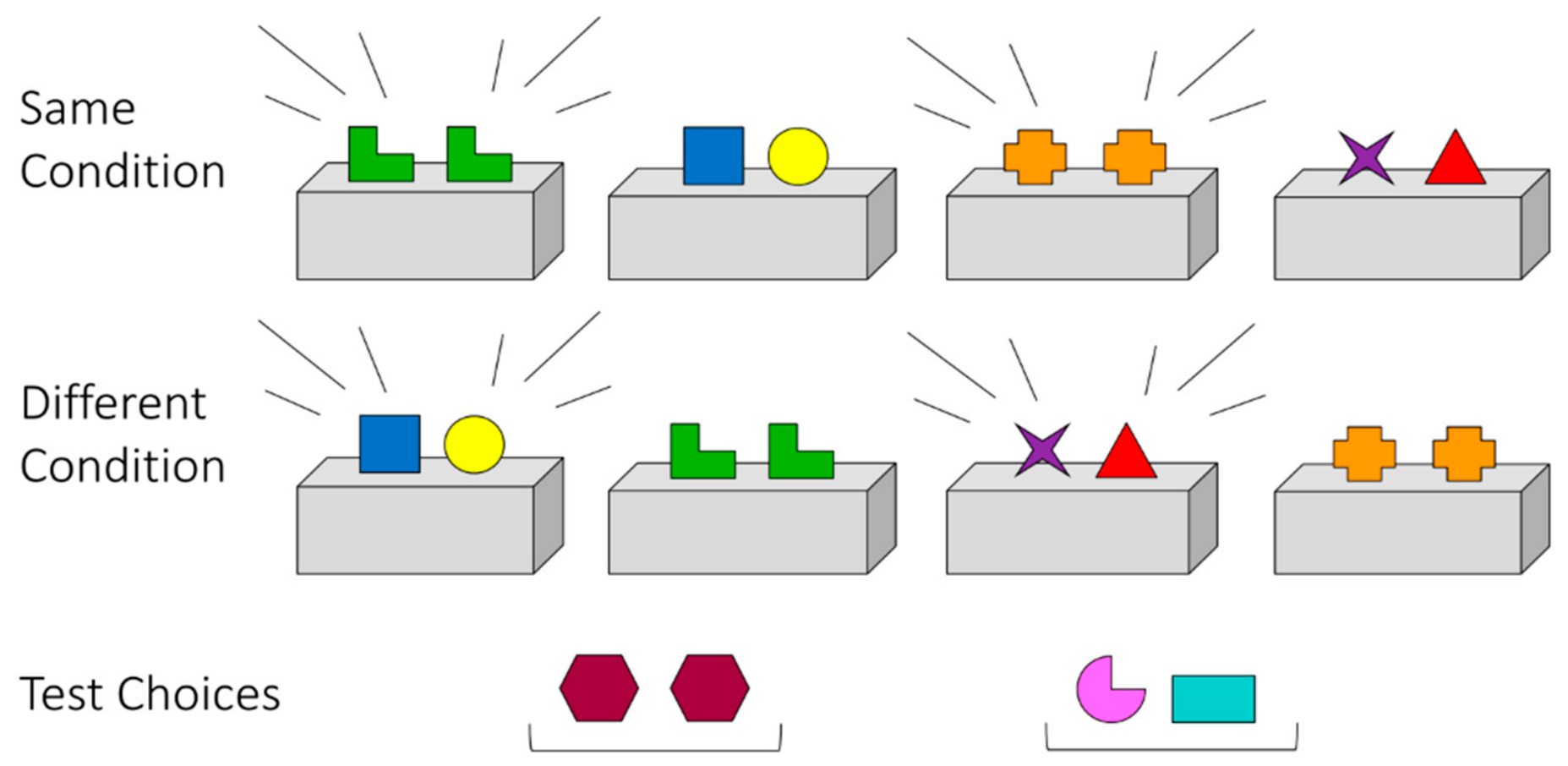

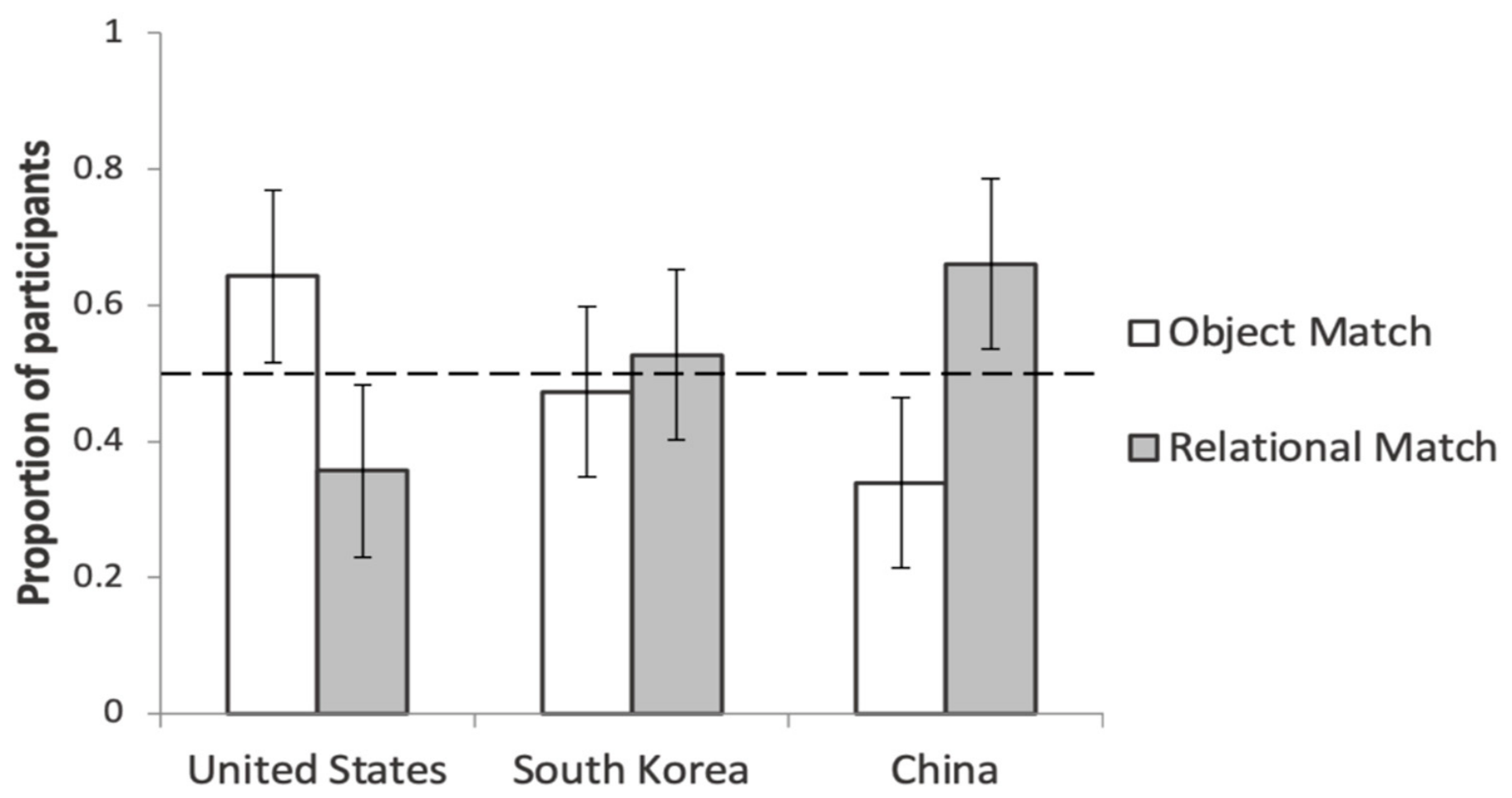

Disclaimer/Publisher’s Note: The statements, opinions and data contained in all publications are solely those of the individual author(s) and contributor(s) and not of MDPI and/or the editor(s). MDPI and/or the editor(s) disclaim responsibility for any injury to people or property resulting from any ideas, methods, instructions or products referred to in the content. |
© 2026 by the authors. Licensee MDPI, Basel, Switzerland. This article is an open access article distributed under the terms and conditions of the Creative Commons Attribution (CC BY) license.
Share and Cite
Carstensen, A.; Kim, M.; Choi, Y.; Walker, C.M. Relational Reasoning Across Cultures: Consistency and Variation in South Korea, the United States, and China. Behav. Sci. 2026, 16, 1406. https://doi.org/10.3390/bs16081406
Carstensen A, Kim M, Choi Y, Walker CM. Relational Reasoning Across Cultures: Consistency and Variation in South Korea, the United States, and China. Behavioral Sciences. 2026; 16(8):1406. https://doi.org/10.3390/bs16081406
Chicago/Turabian StyleCarstensen, Alexandra, Minju Kim, Youngon Choi, and Caren M. Walker. 2026. "Relational Reasoning Across Cultures: Consistency and Variation in South Korea, the United States, and China" Behavioral Sciences 16, no. 8: 1406. https://doi.org/10.3390/bs16081406
APA StyleCarstensen, A., Kim, M., Choi, Y., & Walker, C. M. (2026). Relational Reasoning Across Cultures: Consistency and Variation in South Korea, the United States, and China. Behavioral Sciences, 16(8), 1406. https://doi.org/10.3390/bs16081406