1. Introduction
Artificial intelligence (AI) is commonly framed as a family of computational methods that enable systems to perceive, learn from data, and support decision-making under uncertainty (
Garg, 2021;
Russell & Norvig, 2010). As the sports industry undergoes rapid technological change, AI has increasingly been positioned as an enabling capability across training, competition analysis, and practitioner decision support (
Hammes et al., 2022;
Sampedro, 2023). In contemporary sport settings, data obtained during competitions and training sessions can be analysed to inform athlete development and team strategies, contributing to more systematic and data-driven decision processes. Within this context, AI-based tools have been proposed to support coaches operating in time-constrained, high-stakes environments, where decision quality is shaped by context-specific constraints (
Aarons et al., 2024).
AI methods have also been applied to core sports-analytics tasks. Performance prediction has been explored using machine learning models trained on team and match features (
McCabe & Trevathan, 2008). In parallel, image and signal processing approaches have been widely reported across elite sports for extracting tactical and performance-relevant indicators from video, sensor, and wearable data, while modelling and planning approaches have gained increasing attention for decision support (
Hammes et al., 2022). More broadly, advances in machine learning and deep learning have strengthened capability in perception and pattern extraction tasks that underpin many applied sports-analytics pipelines (
Goodfellow et al., 2016).
Taekwondo is a martial art that requires fundamental motor skills and diverse physical attributes, and effective training approaches are required to optimise performance (
Karademir et al., 2022). AI techniques can support the analysis of taekwondo techniques through the observation of match videos and motion patterns, supporting the identification of strengths, weaknesses, and training targets (
Shin et al., 2024). Similarly, AI-enabled analysis of athlete- and equipment-derived data has been discussed across the broader sports domain, including applications related to efficiency improvement, injury risk estimation, and outcome-related insights (
Li, 2021). Work synthesising AI use in martial arts highlights applications such as movement recognition, posture prediction, movement evaluation, and athlete support, suggesting a contribution to more data-driven training methodologies (
Pang et al., 2024). However, taekwondo competition analysis has been reported as labour-intensive in practice because key events may be manually recorded by researchers, extending analysis time and contributing to variability in scale and accuracy (
Shin et al., 2024).
Technical feasibility alone does not determine adoption. Implementation in applied sport settings depends on whether practitioners perceive AI as useful, trustworthy, and consistent with their professional identity and relational expertise (
Sperlich et al., 2023;
Wachholz et al., 2025). This issue is particularly important in taekwondo because much of the emerging AI literature in martial arts remains oriented towards technical capabilities such as movement recognition, pose estimation, motion capture, and performance modelling, whereas less attention has been given to how coaches and athletes interpret these tools in relation to training practice, competition analysis, coaching authority, fairness, and human judgement. A stakeholder-centred study is therefore necessary because AI systems that are technically promising may still be resisted, misused, or only partially adopted if intended users regard them as opaque, unreliable, threatening to role identity, or insufficiently accountable in competitive contexts.
These considerations align with the concept of psychological readiness for AI implementation, understood here as an interpretive, qualitative lens for examining whether stakeholders perceive AI applications as understandable, trustworthy, and supportive of, rather than threatening to, human-centred practice. Psychological readiness complements, but is distinct from, purely technical or organisational readiness and is shaped by trust, perceived risk, and the perceived legitimacy of AI-supported decisions (
Kim et al., 2025). In this study, self-determination theory (
Ryan & Deci, 2000) and self-efficacy (
Bandura, 1977) are used only as sensitising theoretical lenses. They guided interpretation of readiness-related meanings in the interview data; they were not directly measured, operationalised as variables, or tested as explanatory models. Accordingly, autonomy, competence, relatedness, confidence, and perceived capability were interpreted abductively after data collection from participant accounts concerning control, professional capability, coach–athlete relationships, AI literacy, trust, risk, and willingness to rely on AI under human oversight.
Recent empirical work has begun to move the AI-in-sport literature beyond general technological promise towards more specific questions of quality, trust, perceived suitability, and human oversight. A recent narrative review of AI in sport identifies expanding applications across biomechanics, performance enhancement, sports medicine, health monitoring, coaching, and talent identification, while also emphasising the continuing need to address implementation challenges and responsible use (
Zhou et al., 2026). Evidence from exercise and training contexts further indicates that AI-generated training outputs should not be treated as automatically reliable. For example, expert evaluations of ChatGPT-generated running plans found that output quality improved when more detailed input information was provided, but the plans were not rated as optimal and were not recommended without expert coach feedback (
Düking et al., 2024). Similarly, a pilot study of recreational athletes found that users of AI-generated training plans reported higher trust than non-users, while experienced coaches were not always able to distinguish AI-generated plans from human-developed plans (
Wachholz et al., 2025). These findings suggest that AI capability, user trust, and professional judgement are increasingly interdependent in sport training contexts.
Recent research has also begun to examine the perceived suitability of AI coaches and GPT-based tools for coaching practice. Dindorf et al. investigated psychological and perceptual factors associated with AI-driven sports coaches and framed such systems as potentially augmenting, rather than simply replacing, human coaching in targeted training-support domains (
Dindorf et al., 2025). O’Brien and Prentice further showed that freely available GPT tools could support coach learning and athlete-development analysis by rapidly extracting patterns from coach–athlete conversational data, while also identifying risks related to contextual misunderstanding, verification burden, and privacy (
O’Brien & Prentice, 2025). In taekwondo specifically, Zhang et al. reported that an AI-supported video review approach using ChatGPT-4.5 and OpenPose showed strong agreement with international video review referees and substantially reduced review time in Paris Olympic taekwondo cases, while still concluding that human oversight remains necessary for ambiguous cases (
Zhang et al., 2025). Collectively, this recent literature supports the need for stakeholder-centred studies that examine not only whether AI can technically support sport, but also how coaches and athletes perceive its benefits, risks, role boundaries, and conditions for responsible implementation.
However, the existing evidence remains uneven. Much of the literature evaluates AI systems, generated training plans, or broad sport-technology adoption, while fewer studies examine how martial-arts stakeholders themselves interpret AI in relation to coaching authority, athlete trust, competition analysis, and referee decision support. This gap is especially important in taekwondo, where human judgement, coach–athlete relationships, tactical interpretation, and perceptions of fairness are central to the competitive environment. The present study therefore addresses this gap by examining coach and athlete perceptions of AI within a bounded university taekwondo championship context and by interpreting these accounts through readiness-related psychological lenses rather than by claiming to measure psychological readiness as a validated construct.
Within this scope, the aim of this study is to examine how university taekwondo coaches and athletes perceive potential AI applications in training, competition analysis, coaching, and refereeing, and to interpret readiness-related perceptions abductively through these qualitative sensitising lenses. The study does not empirically test self-determination theory, self-efficacy, or formal hypotheses; instead, it is guided by the following qualitative research questions:
- 1.
RQ1. How do university taekwondo coaches and athletes perceive the potential benefits and drawbacks of AI for training performance and athlete development?
- 2.
RQ2. How do university taekwondo coaches and athletes perceive the potential benefits and drawbacks of AI for competition analysis?
- 3.
RQ3. How do coaches perceive the implications of AI for the future coaching role, and how do athletes perceive AI-supported referee decision-making?
- 4.
RQ4. What readiness-related perceptions, including perceived knowledge, trust, competence, autonomy, role security, fairness, accountability, and human oversight, shape acceptance of or resistance to AI in this taekwondo context?
This paper makes the following contributions. First, it provides empirical evidence on AI perception patterns among competitive taekwondo coaches and athletes across multiple application domains. Second, it develops a qualitative interpretation of readiness-related perceptions, using self-determination theory and self-efficacy as sensitising lenses rather than claiming to measure or definitively evaluate psychological readiness. Third, it proposes a conceptual synthesis map that organises AI application domains according to participant-perceived benefit, perceived risk, and readiness-related indicators, treated as interpretive patterns rather than measured constructs. Fourth, it offers a role-comparative description of perceptions while retaining cautious descriptive gender breakdowns where they inform AI-literacy considerations. Fifth, it offers a stakeholder-centred perspective on AI integration in martial arts contexts that complements the predominantly technical orientation of the existing taekwondo AI literature.
This paper is structured as follows.
Section 2 reviews related work on AI in sports and technology acceptance.
Section 3 describes the research methodology.
Section 4 presents findings from the qualitative analysis.
Section 5 discusses the results.
Section 6 provides recommendations, including limitations (Section Limitations), and
Section 7 concludes the study.
3. Method
3.1. Research Ethics Approval
Ethics approval for the research was obtained from the Yozgat Bozok University Social and Human Sciences Ethics Committee on 16 April 2025 (decision number 24/19).
3.2. Research Design and Participants
Within a qualitative research framework, an embedded single-case study design was adopted to examine the views of university coaches and athletes regarding AI as an emerging digital capability in sport contexts. In this study, the bounded
case is defined as the Turkish inter-university taekwondo championship competition system during the 2024–2025 competitive cycle. This system was treated as one case because the participants competed within the same regulated championship environment, with shared competition rules, performance demands, qualification conditions, and decision contexts. The individual universities were therefore not conceptualised as separate institutional cases, since the study did not compare university policies, team cultures, or institutional implementation strategies. Instead, universities functioned as recruitment sites within the same championship system, and coaches and athletes were treated as embedded units of analysis within that bounded case. This framing is consistent with multi-site embedded case study designs in which the case is the shared institutional or practice setting and participants from multiple constituent units contribute to the contextualised understanding of how that case operates (
Chmiliar, 2010;
Hancock & Algozzine, 2006). In contrast to experimental approaches that prioritise controlled manipulation and hypothesis testing, case studies are frequently used to generate detailed descriptions and interpretive insights grounded in real-world conditions (
Hancock & Algozzine, 2006). In qualitative inquiry, case study designs support comprehensive examination of the phenomenon within its context, enabling the identification and interpretation of salient conditions, processes, and stakeholder perspectives (
Yıldırım & Simsek, 1999). Recruiting participants from multiple universities was therefore consistent with the single bounded case: it broadened the range of coach and athlete perspectives while preserving the common championship context as the analytical boundary. The generalisability of findings beyond this bounded system is not claimed.
The research involved voluntary participation by 23 coaches (10 female and 13 male), all university taekwondo team coaches, and 30 athletes (14 female and 16 male), all university student taekwondokas. Eligible participants were coaches responsible for university taekwondo teams and student-athletes who were members of university taekwondo teams competing in the inter-university championship context. Recruitment took place among teams accessible to the researcher during the championship setting. Coaches and athletes from multiple universities were approached when they were available, informed about the purpose of the study, and invited to participate voluntarily. Convenience sampling was used because participants were selected from those who met the eligibility criteria, were present in the championship context, were accessible to the researcher, and agreed to be interviewed; the sampling was not random, stratified, or designed to represent universities proportionally. The number of individuals who were approached, who declined participation, or who were excluded after initial contact was not systematically recorded; therefore, a response rate cannot be calculated, and this is acknowledged as a sampling-process limitation. Participants were recruited from multiple universities competing within the same championship context, rather than from a single institution. Sample size was not determined by an a priori power calculation since the study is qualitative and interpretive in orientation. Given the focused aim, specificity of the bounded case, and depth of cross-domain responses, the achieved sample was judged to provide sufficient information power for an exploratory qualitative case study (
Malterud et al., 2016). Demographic characteristics of coach participants are presented in
Table 1, and demographic characteristics of athlete participants are presented in
Table 2.
3.3. Data Collection and Analysis
Data were collected using the semi-structured interview technique, which combines a predefined set of guiding questions with flexibility to probe, clarify, and explore participant responses in depth (
Karasar, 1995).
Of the eight questions prepared for coaches, four collected demographic information (age, gender, coaching duration, and university), and four were open-ended interview questions: (1) Do you have knowledge about AI? If so, at what level? (2) What types of benefits and drawbacks might AI have for training performance? (3) What types of benefits and drawbacks might AI have for competition analysis? (4) What types of benefits and drawbacks might AI have for the future of the coaching role?
Of the nine questions prepared for athletes, five collected demographic information (age, gender, years of athletic experience, class year, and university), and four were open-ended interview questions: (1) Do you have knowledge about AI? If so, at what level? (2) What types of benefits and drawbacks might AI have for training performance? (3) What types of benefits and drawbacks might AI have for competition analysis? (4) What types of benefits and drawbacks might AI have regarding referee decisions?
The interview protocols for coaches and athletes were intentionally asymmetric in their final question. Coaches were asked about the future of the coaching role because this domain pertains most directly to their professional identity and forward-looking practice. Athletes were asked about referee decisions because this domain bears most directly on the procedural fairness and visibility conditions they experience in competition. The asymmetry is therefore a deliberate stakeholder-aligned design choice rather than an oversight, although it does mean that cross-stakeholder comparisons on the coaching-role and referee domains are not available from this dataset; this constraint is reflected in the Limitations section.
While the semi-structured interviews were designed inductively to capture broad, lived experiences of AI, the subsequent thematic interpretation was informed by self-determination theory and self-efficacy as sensitising concepts. This abductive approach allowed the researchers to ground the findings in participants’ accounts while interpreting readiness-related meanings cautiously. Consequently, the interview guide was not designed to measure psychological readiness as a scaled metric. Instead, readiness-related perceptions were treated analytically as a cross-cutting interpretive category inferred from responses concerning AI knowledge, perceived benefits, perceived drawbacks, trust, role implications, fairness, accountability, and human oversight.
The interview forms were evaluated by expert academicians and taekwondo coaches and were revised based on feedback. Data collection took place primarily at the inter-university championship venues in quiet areas where participants could speak privately, and, where necessary, through online video calls for participants unable to meet in person. Prior to the interviews, participants were provided with a written information sheet describing the study aim, the voluntary nature of participation, the right to withdraw, and the management of anonymity, and written informed consent was obtained. Interviews were conducted in Turkish and lasted an average of 25–30 min. With participant permission, interviews were audio-recorded for verbatim transcription; where recording was not possible or was not preferred by the participant, detailed contemporaneous notes were taken and expanded immediately after the interview. Although the interview guide was short, sufficient depth was sought through flexible follow-up probes attached to each open-ended question, including “Can you give an example?”, “Why would this be useful or risky?”, “How might this affect training or competition practice?”, and “Would AI support or replace human judgement?”. The interviewer continued probing until the participant’s meaning, examples, perceived benefits and risks, and role-related implications were sufficiently clear for coding. Responses were transcribed by the first author and subsequently organised by question for content analysis. Coding, theme development, and reliability checking were conducted on the original Turkish-language transcripts before the English reporting text was prepared. Reporting drew on coded sample statements presented in
Table 3,
Table 4,
Table 5,
Table 6,
Table 7,
Table 8,
Table 9 and
Table 10 and illustrative paraphrased statements presented in
Section 4. These statements were prepared from Turkish-language transcripts and coded response summaries by the first author, reviewed by a bilingual co-author, and cross-checked using machine translation as an auxiliary verification step; they are used to convey coded meanings rather than to reproduce verbatim participant wording. The use of Claude (Anthropic) for translation assistance with the English manuscript draft is disclosed in the acknowledgments; coding and analysis were not delegated to any large language model. As a limitation, an independent back-translation procedure was not undertaken. Decisions on idiomatic or culturally specific expressions were discussed between authors and resolved in favour of preserving the participant’s intended meaning, with caution against the smoothing of emotionally salient phrasing.
Because the tables report coded sample statements rather than extended interview extracts, the Findings section also includes anonymised illustrative paraphrased statements to show how the major coded meanings appeared in participant accounts. These statements synthesise the meaning of Turkish transcript segments and coded responses, are identified by anonymised participant labels for transparency, and should not be read as verbatim extracts or close word-for-word translations.
The interviewer was the first author, an academic working in sports management who has prior research experience in taekwondo. The interviewer was not in a supervisory or evaluative relationship with any participant. A small number of participants were known to the interviewer through prior professional contact at championship events; in these cases, the interviewer made the conditions of voluntary participation, anonymity, and the absence of any consequence for non-participation explicit at the outset of the interview, and the same interview protocol was used as for participants not previously known. Reflexivity discussions were held between authors during analysis to consider how prior familiarity with the championship setting and with taekwondo coaching practice may have shaped probing decisions and interpretation; these discussions are reflected in the framing of findings as context-specific and in the conservative interpretation of within-sample gender patterns.
After the interviews, transcripts were transferred to a computer environment, organised by question, and analysed through a staged qualitative content-analysis process. The stages were: familiarisation through repeated reading; initial manual coding using a shared hybrid deductive–inductive codebook; inductive refinement of codes generated from approximately one-third of the transcripts; theme condensation by grouping semantically related codes into sub-themes and higher-order themes; theoretical cross-reading through the sensitising lenses in
Table 11; a limited participant credibility check of the thematic interpretation; and final synthesis across coded patterns, illustrative paraphrased statements, and the conceptual map. Two coders, the first author and an associate professor in training science, independently coded the full set of Turkish-language transcripts manually (without qualitative analysis software), and each response could receive multiple non-mutually exclusive codes. Disagreements were tabulated, discussed in a structured adjudication meeting, and, where needed, referred to the third author; Cohen’s Kappa was computed on the independently coded dataset using the procedure described in
Section 3.4.
The analysis moved from discrete responses to broader interpretive themes by comparing the shared meanings, assumptions, and application domains linking individual codes, rather than simply listing fragmented categories. Thus, lower-level codes were treated as evidence for higher-order perceptions concerning benefit, risk, role change, fairness, accountability, and readiness. Codes were organised in Microsoft Excel, and frequency (
f) and percentage (%) values were calculated only as descriptive indicators of within-sample thematic salience; they are not inferential statistics, prevalence estimates, or generalisable population-level measures. Missing or unclassifiable data were minimal and are reported transparently: where a participant did not provide a codable response to an open-ended question, this is shown in the relevant table as a “No response/Unclassifiable” category rather than being excluded, so that all 23 coaches and 30 athletes are accounted for within each domain. Repetitive statements were grouped without disrupting semantic integrity. The illustrative paraphrased statements presented in
Section 4 use pseudonymous identifiers such as Coach-F
n, Coach-M
n, Athlete-F
n, and Athlete-M
n to preserve anonymity while indicating participant group and gender category.
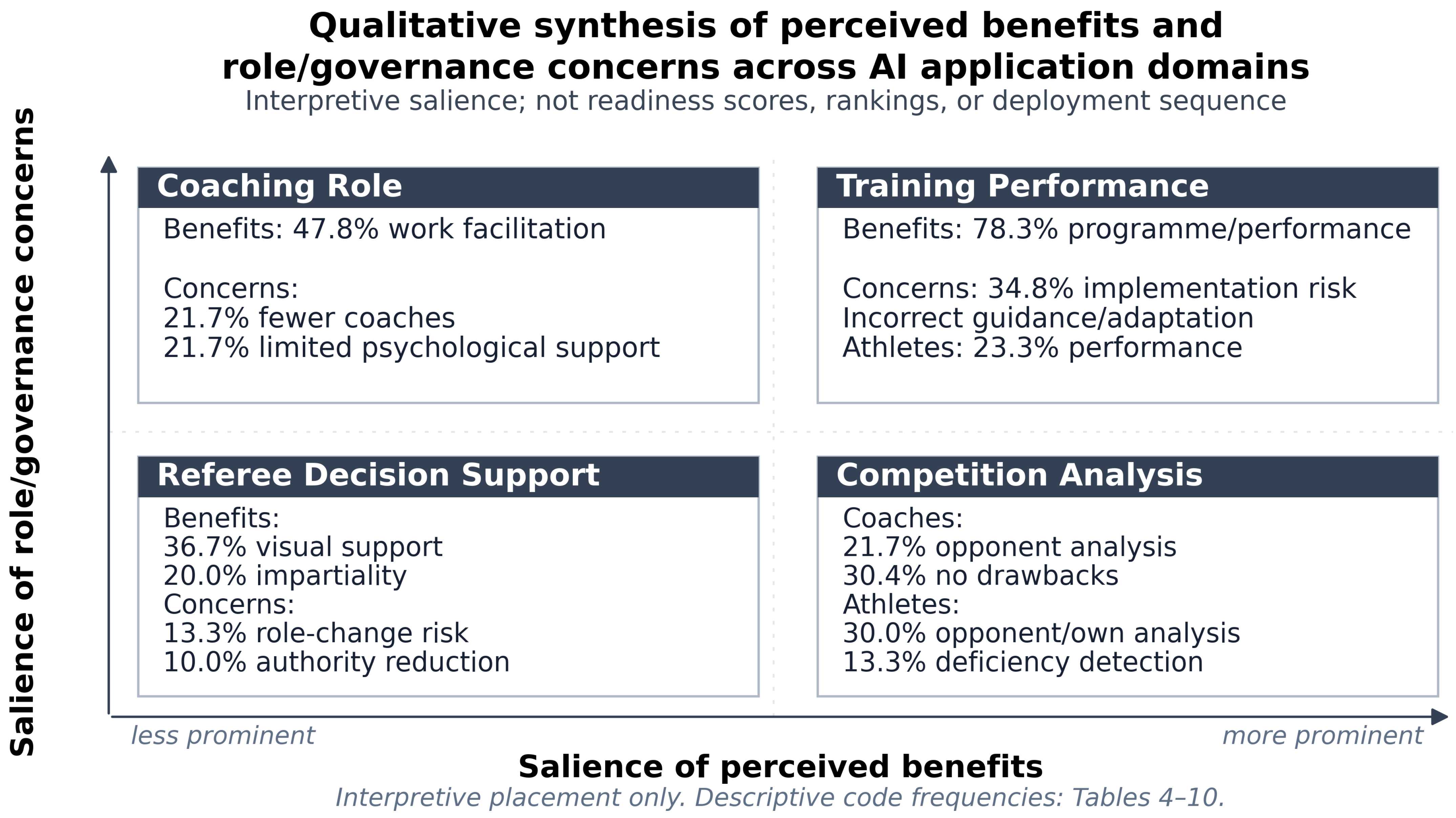
To support integrative interpretation, code frequencies were aggregated by application domain and used to inform a conceptual synthesis map (
Figure 1). The map uses qualitative placement to summarise the relative salience of benefit-oriented, risk-oriented, and readiness-related themes. Distances and locations in the map should not be read as computed scores, validated readiness zones, or inferential comparisons.
3.4. Validity and Reliability
Various strategies were applied during data analysis to support validity, reliability, and reflexive transparency. Content validity of the semi-structured interview form was supported by consulting expert coaches and academicians prior to content analysis. During coding and theme and sub-theme generation, inter-coder consistency was assessed by comparing the independently produced coding outputs. As a limited credibility check, a summary of the main themes was discussed informally with a small subset of participants to assess whether the interpretations broadly reflected their intended meanings. This process was used as a plausibility check on the thematic interpretation rather than as a formal member-checking or participant-validation procedure. The analysis process was conducted openly and systematically, and themes, sub-themes, and sample statements were supported with frequency and percentage tables.
Researcher positionality was also considered as part of the validity strategy. The first author’s familiarity with taekwondo and inter-university championship settings provided contextual knowledge that helped the interviewer understand technical expressions, identify when follow-up probes were needed, and situate participant accounts within realistic training and competition practices. At the same time, this familiarity may have shaped the interview interaction and interpretation by making some taekwondo-specific assumptions appear self-evident or by encouraging more detailed probing in areas already familiar to the researcher. To manage this risk, the same interview protocol and probing prompts were used across participants, analytic decisions were discussed among authors, coding was checked by a second coder who was not positioned identically to the interviewer, and findings were framed conservatively as context-specific interpretations rather than as general claims about all taekwondo coaches and athletes.
Both coders used a shared coding framework (codebook) with clearly defined categories, decision rules, and exemplar statements. The codebook included AI-related categories aligned with the interview prompts, such as AI knowledge levels and perceived AI benefits and risks across training, competition analysis, coaching roles, and referee decisions. For the psychological readiness interpretation, these coded categories were then cross-read using the mapping in
Table 11. Readiness was not coded as a standalone scale; rather, existing codes were interpreted as readiness-related evidence when they reflected perceived capability, trust, risk, autonomy, role security, relational support, fairness, accountability, or human oversight. Prior to full coding, the two coders conducted a brief pilot coding step on approximately one-fifth of the transcripts to align interpretation of the code definitions, discussed discrepancies, and refined category descriptions where needed.
Inter-coder consistency was determined using Cohen’s Kappa coefficient, computed as
, where
is the observed agreement and
is the expected agreement. Cohen’s Kappa was considered appropriate for the present design because two coders independently judged the same set of transcript units and because each non-mutually exclusive code could be represented as a binary present/absent decision. This approach avoided forcing participant responses into single mutually exclusive categories, while still providing a chance-corrected index of agreement beyond simple percentage agreement. Because the coding scheme assigns multiple non-mutually exclusive codes per participant response within each coding domain, Kappa was computed at the participant-by-code binary judgement level rather than at the response level: for each code within a coding domain, each participant was assigned a 1 if the code was present in their response and 0 otherwise, and Kappa was calculated over the binary present/absent matrix produced by the two coders. The aggregate Kappa reported for each coding domain in
Table 12 is the average of per-code Kappa values within that domain, weighted by the number of participant judgements contributing to each code. This procedure retains the multi-code structure of the qualitative analysis in the coding matrix, while acknowledging that Kappa itself evaluates agreement on simplified binary judgements rather than the full interpretive complexity of each response.
The Kappa results should therefore be read cautiously. First, for codes mentioned by only one or two participants, Kappa is unstable due to highly skewed marginals, and percent agreement is the more interpretable indicator at the individual-code level; the values reported in
Table 12 should therefore be understood as domain-level summaries rather than as evidence of equivalent agreement across all codes within a domain. Second, averaging per-code Kappa values can mask variability between high-prevalence and low-prevalence codes, and the statistic does not resolve the interpretive judgement involved in deciding whether a nuanced statement expresses a given theme. Third, Kappa is sensitive to prevalence and marginal imbalance, which is especially relevant in multi-code qualitative datasets where some concerns or benefits are naturally rare. In future studies, Krippendorff’s alpha, prevalence-adjusted agreement indices, or the reporting of Kappa alongside percent agreement statistics computed from the full two-coder contingency matrix could provide a more comprehensive treatment of multi-code qualitative reliability. In the present study, Cohen’s Kappa was retained because the reliability assessment involved exactly two coders making binary code-presence judgements, and because it remains a transparent and commonly understood agreement statistic for two-coder content analysis. Kappa values are reported in
Table 12 with interpretation bands following
Landis and Koch (
1977).
4. Findings
This section reports the findings through a thematic synthesis followed by detailed descriptive tables and illustrative paraphrased statements.
Figure 1 provides an overview of the main qualitative patterns across AI application domains. The figure is heuristic and interpretive; it does not present measured readiness scores, implementation rankings, or inferential comparisons.
The thematic map shown in
Figure 1 synthesises findings from
Table 4,
Table 5,
Table 6,
Table 7,
Table 8,
Table 9 and
Table 10. The horizontal dimension summarises whether participant accounts emphasised concrete benefits more strongly, while the vertical dimension summarises the salience of role-related and governance-related concerns. To make the placement logic explicit, each domain was positioned by comparing, within that domain, the relative salience of benefit-oriented codes against role-related and governance-related concern codes, as reported in
Table 4,
Table 5,
Table 6,
Table 7,
Table 8,
Table 9 and
Table 10. Domains in which benefit codes were raised more frequently and consistently than concern codes were placed further along the benefit dimension, and domains in which role or governance concerns were more prominent were placed higher on the concern dimension. No numerical scoring, weighting, or thresholding was applied; the positions express ordinal within-sample salience only and are not coordinates on a measured scale. These dimensions are interpretive and qualitative; they do not represent measured readiness scores, ranked priorities, or implementation phases. The map therefore highlights four broad patterns: competition analysis showed relatively higher benefit salience because participant accounts emphasised concrete benefits and role-displacement concerns were less prominent; training support showed a benefit-and-concern profile because programme-support benefits coexisted with guidance and adaptation concerns; referee decision support showed a benefit-and-concern profile because fairness and visibility benefits coexisted with authority and role concerns; and coaching-role AI showed greater concern salience due to identity, authority, psychological-support, and relationship themes. The overall pattern of readiness-related perceptions was therefore conditional: AI was regarded as acceptable when it augmented human roles and as less acceptable when it appeared to replace coach judgement, athlete agency, or referee authority.
The following demographic, knowledge-level, and domain-specific tables provide detailed descriptive evidence supporting this synthesis. Frequency tables are complemented by longer anonymised illustrative paraphrased statements so that the coded distributions are supported by richer qualitative evidence. Participant identifiers indicate role and gender category only; they do not correspond to names, institutions, or interview order. All gender-disaggregated values in this section are exploratory within-sample descriptors; the sample and subgroup cell sizes are too small to support inferential, psychological, or population-level claims about gender differences.
Coach participants comprised 43.5% female () and 56.5% male (). Regarding coaching experience, 30.4% of participants had 0–5 years, 21.7% had 6–10 years, 26.1% had 11–20 years, and 21.7% had 21 years and above of coaching experience. In addition, 82.6% of participants were from different universities, while 17.4% were from the same university.
Athlete student participants comprised 46.7% female () and 53.3% male (). Regarding athletic experience, 16.7% of participants had 0–5 years, 56.7% had 6–10 years, and 26.7% had 11 years and above of experience. In the class distribution, the highest proportion belonged to 1st year students at 56.7%. It was observed that 73.3% of participants were from different universities while 26.7% were from the same university.
Although age was collected during interviews, age values were not available in the anonymised dataset used for final analysis and reporting; therefore, the age mean and standard deviation cannot be reported. This is acknowledged as a demographic-reporting limitation.
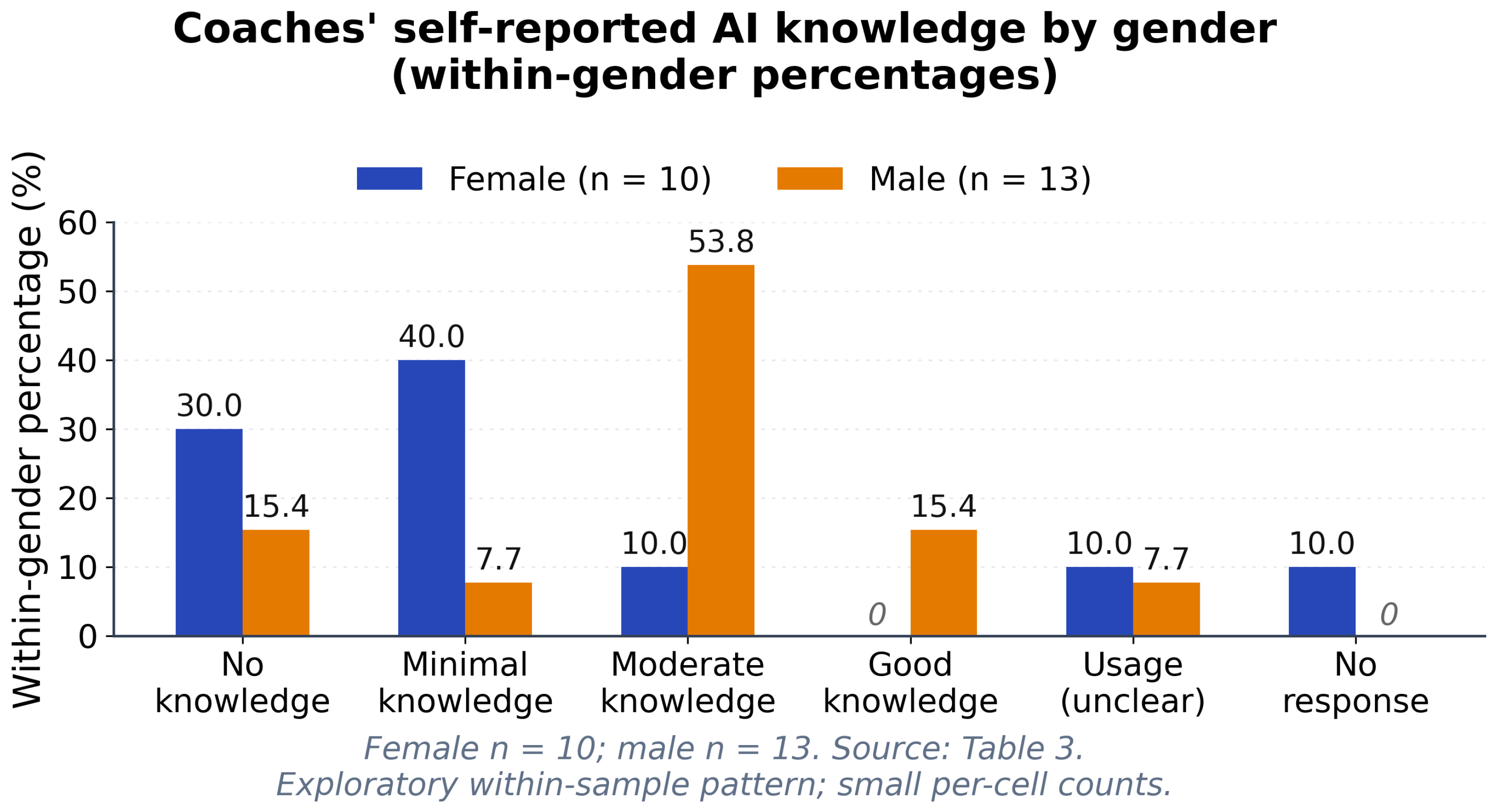
As shown in
Figure 2 and
Table 3, coaches’ self-reported AI knowledge varied across the sample. In this bounded sample, female coaches more often described no or minimal knowledge, whereas male coaches more often described moderate-to-good knowledge. These values are exploratory within-sample observations only; the small subgroup sizes do not support inferential, psychological, or population-level claims about gender differences. The illustrative paraphrased statements below show how perceived competence varied from basic awareness to uncertainty about practical application.
Illustrative paraphrased statement (Coach-F1): I have only minimal knowledge of AI. I have heard about it, but I have not yet explored how it works or how it could be used in taekwondo.
Illustrative paraphrased statement (Coach-M1): I have only learned about AI recently. I am still unsure how these tools would be applied practically during taekwondo training or competition preparation.
In
Table 4, coaches primarily framed AI as a support for training programming, performance development, and data-informed planning. The main drawback pattern concerned implementation risks, especially incorrect programmes and reduced training discipline. Read alongside athletes’ training responses (
Table 8), the table suggests a shared interest in AI as an augmentative planning aid, provided that coach judgement and contextual adaptation remain central. The following illustrative paraphrased statements show that coaches imagined AI as a data-supported planning aid, but not as a tool that should be followed uncritically.
Illustrative paraphrased statement (Coach-M2): One of the main benefits is that AI can help prepare training programmes using data. This could make the coach’s work easier and support improvements in athlete performance.
Illustrative paraphrased statement (Coach-F2): AI could support data-based training by helping us track athlete information, monitor health indicators, and follow motor development more systematically.
Illustrative paraphrased statement (Coach-F3): My main concern is the possibility of an incorrect training programme. If athletes simply follow a machine, there may be a loss of discipline and a risk of laziness in training.
Illustrative paraphrased statement (Coach-M3): AI can process numbers, but it does not have the experience or emotional understanding of a coach. It may not recognise injury risks or fatigue in the same way an experienced coach can.
According to
Table 5, coaches interpreted AI-supported competition analysis as useful when it offered technical and operational support, opponent pattern recognition, error detection, and performance data. The grouped pattern suggests a broader expectation that AI could make analysis more systematic rather than simply adding isolated technical functions. Drawbacks centred on implementation and competitive risks, particularly incorrect information, time required for use, and the possibility that opponents could use similar systems. The no-drawback or no-opinion responses indicate an acceptance-related pattern, but this should be interpreted cautiously because limited exposure to domain-specific failure modes may also have shaped these responses.
Illustrative paraphrased statement (Coach-M4): AI could be very useful for opponent analysis. It may help us identify patterns in an opponent’s fighting style that are difficult to see during the match.
Illustrative paraphrased statement (Coach-F4): AI could provide a more systematic competition analysis by detecting incorrect techniques and identifying errors that may happen too quickly for the human eye to notice.
Illustrative paraphrased statement (Coach-M5): There is a real risk if the system provides incorrect information. If the analysis is wrong and we build the match strategy around it, the athlete could be disadvantaged.
Illustrative paraphrased statement (Coach-F5): Even if AI provides data about speed, strength or performance, it may not be useful unless the coach can interpret that data correctly and apply it to training.
According to
Table 6, coaches most clearly positioned AI as a work-facilitation tool that could support programme preparation, analysis, information provision, and professional development. Concerns were organised around relational and psychological limits, role security, and implementation risks. The illustrative paraphrased statements below show the central tension between AI as work facilitation and AI as a possible threat to coaching authority, employment, and relational practice.
Illustrative paraphrased statement (Coach-M6): At its best, AI can facilitate the coach’s work. It can support analysis, reduce some of the workload, and help with programme preparation.
Illustrative paraphrased statement (Coach-F6): My concern is about the future of coaching. If these systems begin to do too much, the number of coaches may decrease and the profession may be weakened.
Illustrative paraphrased statement (Coach-M7): I worry that the coach could be pushed into the background. If athletes start relying more on the system than on the coach, coaching authority may be reduced.
Illustrative paraphrased statement (Coach-F7): AI may provide a diet or training programme, but it cannot provide psychological support. It cannot motivate an athlete who is anxious or struggling before a match.
Illustrative paraphrased statement (Coach-M8): The athlete–coach relationship is central in taekwondo. If we rely only on algorithms, that relationship may weaken and the human connection may be lost.
Illustrative paraphrased statement (Coach-F8): AI does not have the emotional intelligence needed in this sport. A coach knows when to push an athlete and when the athlete needs rest or support.
According to
Table 7, athletes’ self-reported AI knowledge was distributed across no, minimal, moderate, and good knowledge or regular-use categories. Within this sample, athlete responses were broadly similar across female and male participants. These values are exploratory within-sample observations only; the sample size is too small to support inferential, psychological, or population-level claims about gender differences. One illustrative paraphrased statement shows how practical exposure to generative AI could coexist with limited domain-specific expertise.
Illustrative paraphrased statement (Athlete-M1): I would describe my knowledge as moderate. I use tools such as ChatGPT for general purposes, so I understand the basic idea, but I am not an expert.
According to
Table 8, athletes framed AI training support around performance enhancement, planning, personalisation, nutrition, and technical or professional support. Their concerns focused less on opposition to technology itself and more on whether AI guidance would fit individual needs, avoid unsafe or unproductive prescriptions, and remain trustworthy. Athletes’ accounts similarly framed AI training support as useful only when it remained individualised and safe.
Illustrative paraphrased statement (Athlete-F1): If AI can analyse my physical data and provide a programme that is appropriate for my training needs, I think it could help improve my performance.
Illustrative paraphrased statement (Athlete-M2): If AI gives incorrect guidance or a programme that does not match my actual physical condition, I may struggle to adapt to it, and it could even increase the risk of injury.
According to
Table 9, athletes valued AI-supported competition analysis when it helped them understand opponents, recognise their own deficiencies, develop strategy, and receive more systematic evaluation. The grouped drawbacks show that this positive orientation coexisted with concerns about analytic reliability, information vulnerability, and practical relevance. The following illustrative paraphrased statements show that athletes valued competition analysis when it supported self-evaluation, opponent preparation, and strategic feedback.
Illustrative paraphrased statement (Athlete-F2): The biggest advantage for me would be learning my opponent’s strengths and weaknesses, while also seeing my own deficiencies more clearly.
Illustrative paraphrased statement (Athlete-M3): I would trust AI more if it provided accurate analysis and instant feedback that could help with strategy development.
According to
Table 10, athlete support for AI-assisted refereeing centred on visibility, fairness, decision support, and perceived error reduction. Concerns were not primarily about visual technology itself, but about the possibility that AI could weaken human authority, reshape the refereeing role, or make match management less relational and contestable. These illustrative paraphrased statements show that support for AI-assisted refereeing was strongest when AI was framed as improving fairness and visibility, but weaker when it appeared to displace human authority, contestability, and accountability.
Illustrative paraphrased statement (Athlete-M4): I support AI in refereeing because it can help see things that referees may miss. The actions are very fast, and AI could identify points that the human eye does not catch.
Illustrative paraphrased statement (Athlete-F3): It could make the competition fairer by reducing bias. Athletes would feel more confident that one side is not being favoured.
Illustrative paraphrased statement (Athlete-M5): AI could make match management clearer and more transparent. It may also reduce referee errors.
Illustrative paraphrased statement (Athlete-F4): My concern is that AI could eliminate the refereeing role. We still need human referees to manage the flow and safety of the fight.
Illustrative paraphrased statement (Athlete-M6): If AI becomes too dominant, it could damage the spirit of the sport. Managing a match only through AI would be problematic.
Illustrative paraphrased statement (Athlete-F5): There still needs to be human authority and initiative. If a sensor fails or a situation is complicated, a human referee should be able to make the final decision.
Illustrative paraphrased statement (Coach-M9): I am open to AI if it is used as supportive analysis. It should contribute to coach development and make our work easier, not replace the coach.
Illustrative paraphrased statement (Athlete-F6): AI can provide scientific data and technical support, but it should not replace the experience, judgement and emotional guidance of my coach.
Illustrative paraphrased statement (Coach-F9): For this to work safely, we need secure analysis and clear rules. Otherwise, information could be misused, and coaches may not trust the system.