The Influence of Social Rejection on Non-Suicidal Self-Injury Among Chinese Adolescents: A Longitudinal Moderated Mediation Model


Abstract
1. Introduction
1.1. Social Rejection and NSSI
1.2. The Mediating Role of Anxiety and Depression
1.3. The Moderating Role of Self-Esteem
1.4. The Current Study
2. Method
2.1. Participants
2.2. Measures
2.2.1. Social Rejection
2.2.2. Anxiety and Depression
2.2.3. Self-Esteem
2.2.4. NSSI
2.3. Procedure
2.4. Statistical Analysis
3. Results
3.1. Descriptive Statistics and Correlations
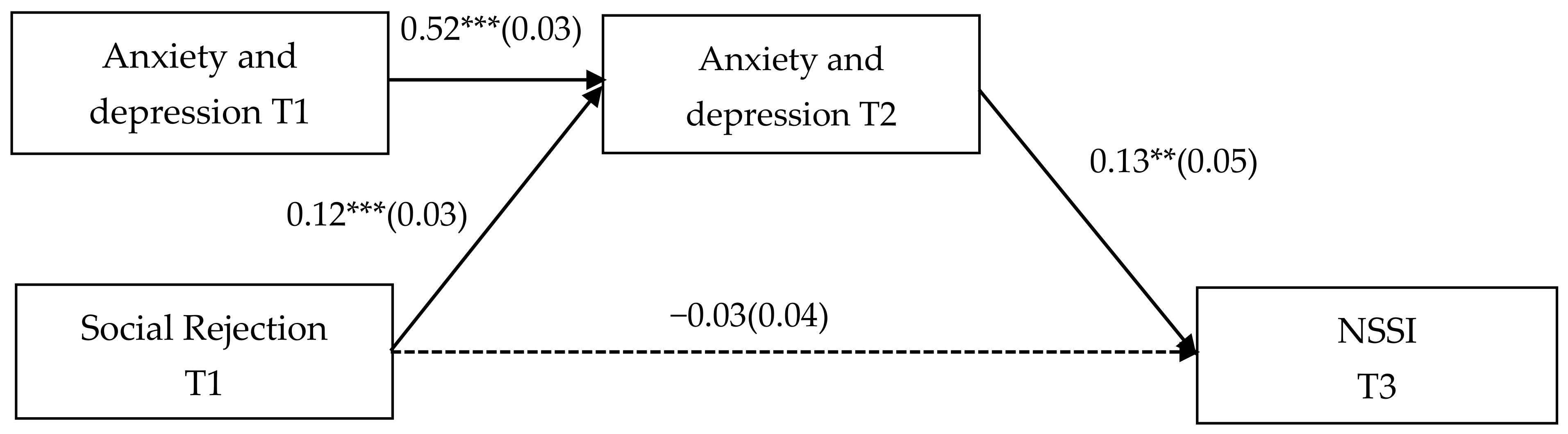
3.2. Mediation Analysis
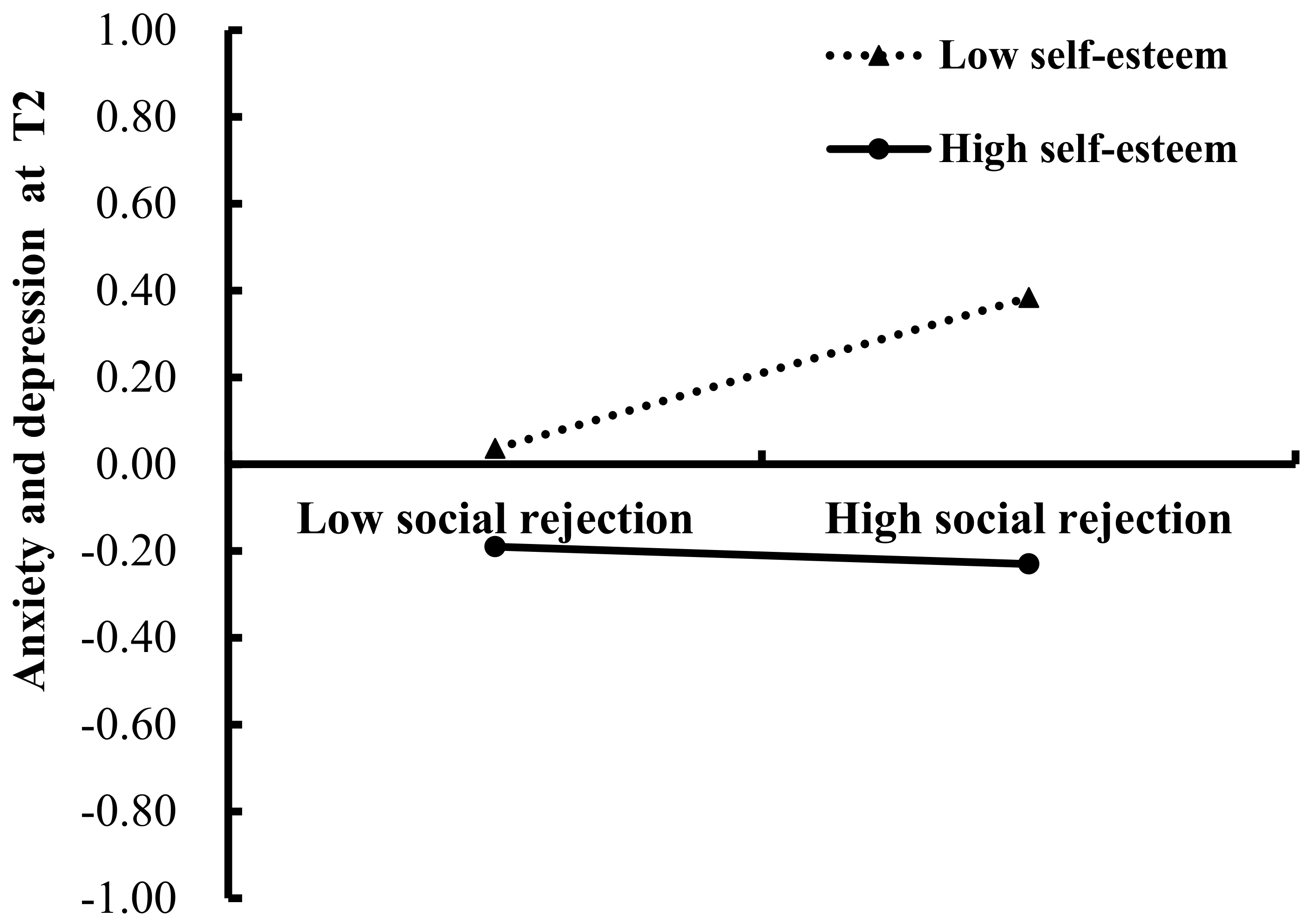
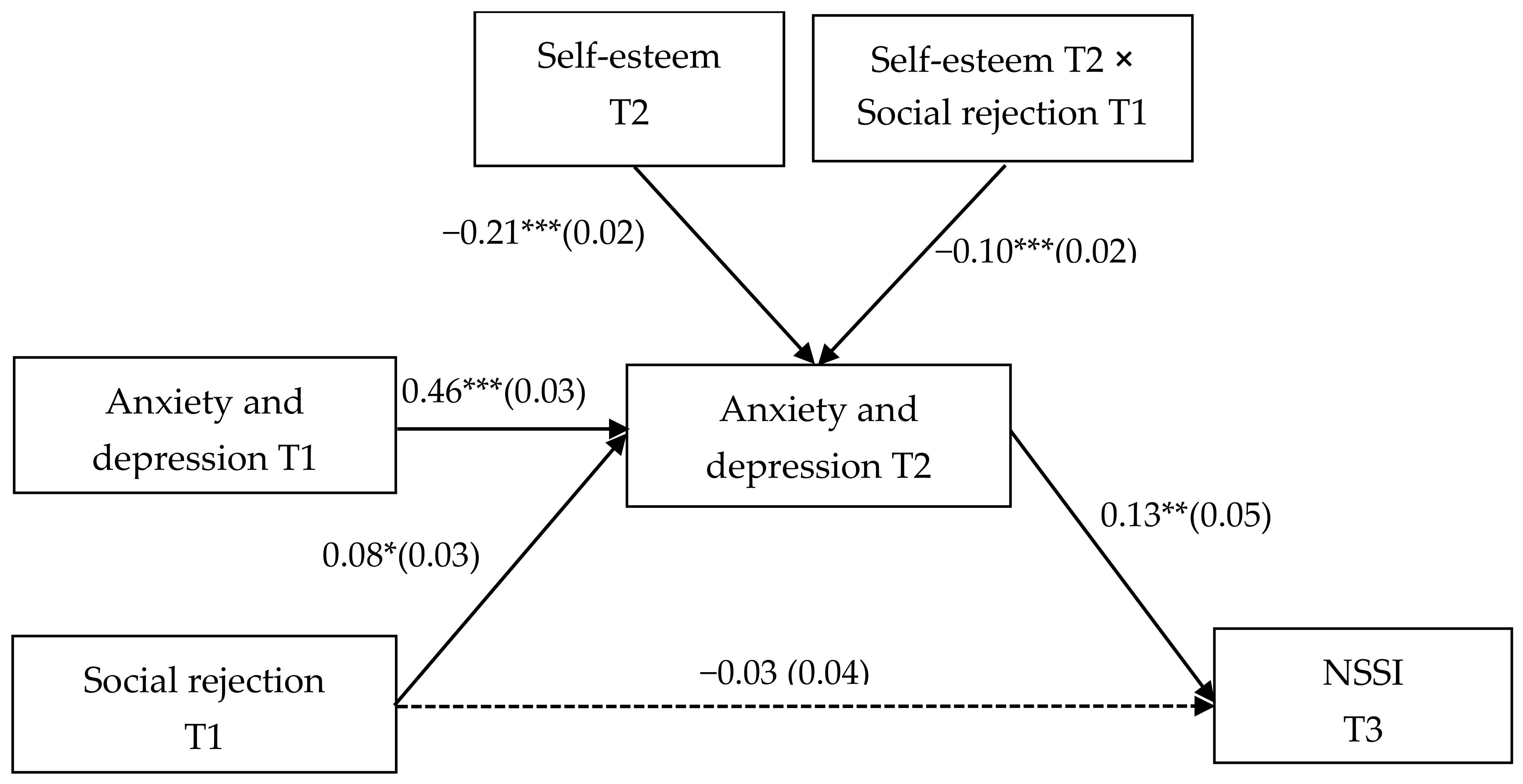
3.3. Moderated Mediation Analysis
4. Discussion
5. Limitations and Future Direction
6. Conclusions
Author Contributions
Funding
Institutional Review Board Statement
Informed Consent Statement
Data Availability Statement
Acknowledgments
Conflicts of Interest
References
- Achenbach, T. M. (1991). Manual for the youth self-report and 1991 profile. Department of Psychiatry, University of Vermont. [Google Scholar]
- Adachi, P., & Willoughby, T. (2015). Interpreting effect sizes when controlling for stability effects in longitudinal autoregressive models: Implications for psychological science. European Journal of Developmental Psychology, 12(1), 116–128. [Google Scholar] [CrossRef]
- Bierman, K. L. (2004). Peer rejection: Developmental processes and intervention strategies. Guilford Press. [Google Scholar]
- Cheek, S., Reiter-Lavery, T., & Goldston, D. (2020). Social rejection, popularity, peer victimization, and self-injurious thoughts and behaviors among adolescents: A systematic review and meta-analysis. Clinical Psychology Review, 82, 101936. [Google Scholar] [CrossRef] [PubMed]
- Choi, J. W., Hong, W., Abela, J. R. Z., & Cohen, J. R. (2020). Comorbid depression and anxiety symptoms in Chinese adolescents: Testing the explanatory power of a diathesis-anxiety model. Research on Child and Adolescent Psychopathology, 49(4), 503–517. [Google Scholar] [CrossRef] [PubMed]
- Cieślak, K., & Golusiński, W. (2018). Coping with loss of ability vs. emotional control and self-esteem in women after mastectomy. Reports of Practical Oncology and Radiotherapy, 23(3), 168–174. [Google Scholar] [CrossRef] [PubMed]
- Cipriano, A., Cella, S., & Cotrufo, P. (2017). Nonsuicidal self-injury: A systematic review. Frontiers in Psychology, 8, 1946. [Google Scholar] [CrossRef] [PubMed]
- Cummings, C. M., Caporino, N. E., & Kendall, P. C. (2014). Comorbidity of anxiety and depression in children and adolescents: 20 years after. Psychological Bulletin, 140(3), 816–845. [Google Scholar] [CrossRef] [PubMed]
- Gao, Y., Liang, C., Liu, X., Bai, R., & Xing, S. (2024). Self-esteem buffers the stress sensitizing effect of childhood maltreatment on adolescent nonsuicidal self-injury. Journal of Affective Disorders, 345, 85–93. [Google Scholar] [CrossRef] [PubMed]
- Gong, T., Ren, Y., Wu, J., Jiang, Y., Hu, W., & You, J. (2019). The associations among self-criticism, hopelessness, rumination, and NSSI in adolescents: A moderated mediation model. Journal of Adolescence, 72, 1–9. [Google Scholar] [CrossRef] [PubMed]
- Grodzinsky, E., Walter, S., Viktorsson, L., Carlsson, A. K., Jones, M. P., & Faresjö, Å. (2015). More negative self-esteem and inferior coping strategies among patients diagnosed with IBS compared with patients without IBS-a case–control study in primary care. BMC Family Practice, 16, 1–9. [Google Scholar] [CrossRef] [PubMed]
- Groschwitz, R. C., Plener, P. L., Groen, G., Bonenberger, M., & Abler, B. (2016). Differential neural processing of social exclusion in adolescents with non-suicidal self-injury: An fMRI study. Psychiatry Research: Neuroimaging, 255, 43–49. [Google Scholar] [CrossRef] [PubMed]
- Hale, W. W., III, Raaijmakers, Q. A. W., Muris, P., Van Hoof, A., & Meeus, W. H. J. (2009). One factor or two parallel processes? Comorbidity and development of adolescent anxiety and depressive disorder symptoms. Journal of Child Psychology and Psychiatry, 50(10), 1218–1226. [Google Scholar] [CrossRef] [PubMed]
- Hawton, K., Witt, K. G., Salisbury, T. L. T., Arensman, E., Gunnell, D., Hazell, P., Townsend, E., & van Heeringen, K. (2016). Psychosocial interventions following self-harm in adults: A systematic review and meta-analysis. Lancet Psychiatry, 3(8), 740–750. [Google Scholar] [CrossRef] [PubMed]
- Heimpel, S. A., Wood, J. V., Marshall, M. A., & Brown, J. D. (2002). Do people with low self-esteem really want to feel better? Self-esteem differences in motivation to repair negative moods. Journal of Personality and Social Psychology, 82(1), 128–147. [Google Scholar] [CrossRef] [PubMed]
- Hobfoll, S. E. (1989). Conservation of resources: A new attempt at conceptualizing stress. American Psychologist, 44(3), 513–524. [Google Scholar] [CrossRef] [PubMed]
- Hobfoll, S. E., Halbesleben, J., Neveu, J. P., & Westman, M. (2018). Conservation of resources in the organizational context: The reality of resources and their consequences. Annual Review of Organizational Psychology and Organizational Behavior, 5, 103–128. [Google Scholar] [CrossRef]
- Hooley, J. M., & St. Germain, S. A. (2014). Nonsuicidal self-injury, pain, and self-criticism: Does changing self-worth change pain endurance in people who engage in self-injury? Clinical Psychological Science, 2(3), 297–305. [Google Scholar] [CrossRef]
- Howard, M. C. (2019). The measurement, nomological net, and theory of perceived self-esteem instability: Applying the conservation of resources theory to understand the construct. Psychological Reports, 122(3), 1007–1042. [Google Scholar] [CrossRef] [PubMed]
- Jiang, Y., Ren, Y., Liu, T., & You, J. (2020). Rejection sensitivity and adolescent non-suicidal self-injury: Mediation through depressive symptoms and moderation by fear of self-compassion. Psychology and Psychotherapy-theory Research and Practice, 94, 481–496. [Google Scholar] [CrossRef] [PubMed]
- Kiekens, G., Hasking, P., Boyes, M., Claes, L., Mortier, P., Auerbach, R. P., Myin Germeys, I., & Myin Germeys, I. (2018). The associations between non-suicidal self- injury and first onset suicidal thoughts and behaviors. Journal of Affective Disorders, 239, 171–179. [Google Scholar] [CrossRef] [PubMed]
- Kline, R. B. (2016). Principles and practice of structural equation modeling (4th ed.). Guilford Press. [Google Scholar]
- Klonsky, E. D. (2007). The functions of deliberate self-injury: A review of the evidence. Clinical Psychology Review, 27(2), 226–239. [Google Scholar] [CrossRef] [PubMed]
- Leary, M. R., & Baumeister, R. F. (2000). The nature and function of self-esteem: Sociometer theory. In Advances in experimental social psychology (Vol. 32, pp. 1–62). Academic Press. [Google Scholar] [CrossRef]
- Lee, S., Park, J., & Lee, S. B. (2016). The interplay of Internet addiction and compulsive shopping behaviors. Social Behavior and Personality: International Journal, 44(11), 1901–1912. [Google Scholar] [CrossRef]
- Li, Y., Lin, S., Han, Y., Sheng, J., Wang, L., Yang, X., & Chen, J. (2023a). Cybervictimization and nonsuicidal self-injury: The mediating role of depressive symptoms and the moderating role of emotional reactivity. Journal of Adolescence, 95(6), 1106–1115. [Google Scholar] [CrossRef] [PubMed]
- Li, Y., Lin, S., Yang, X., Sheng, J., Wang, L., Han, Y., Cao, Y., & Chen, J. (2023b). A vicious cycle: The reciprocal longitudinal relationship between social rejection, social avoidance, and smartphone addiction among adolescents. International Journal of Mental Health and Addiction, 22(5), 2583–2599. [Google Scholar] [CrossRef]
- Lin, S., Li, Y., Sheng, J., Chen, L., Zhang, Y., & Chen, J. (2025). Non-suicidal self-injury in Chinese adolescents with problematic smartphone use: A one-year longitudinal study. Children and Youth Services Review, 169, 108101. [Google Scholar] [CrossRef]
- Lin, S., Li, Y., Sheng, J., Wang, L., Han, Y., Yang, X., Yu, C., & Chen, J. (2023). Cybervictimization and non-suicidal self-injury among Chinese adolescents: A longitudinal moderated mediation model. Journal of Affective Disorders, 329, 470–476. [Google Scholar] [CrossRef] [PubMed]
- Liu, R. T., Kraines, M. A., Massing-Schaffer, M., & Alloy, L. B. (2014). Rejection sensitivity and depression: Mediation by stress generation. Psychiatry, 77, 86–97. [Google Scholar] [CrossRef] [PubMed]
- Lou, N. M., & Li, L. M. W. (2017). Interpersonal relationship mindsets and rejection sensitivity across cultures: The role of relational mobility. Personality and Individual Differences, 108, 200–206. [Google Scholar] [CrossRef]
- Marshall, S. K., Tilton-Weaver, L. C., & Stattin, H. (2013). Non-suicidal self-injury and depressive symptoms during middle adolescence: A longitudinal analysis. Journal of Youth and Adolescence, 42, 1234–1242. [Google Scholar] [CrossRef] [PubMed]
- Masten, C. L., Eisenberger, N. I., Borofsky, L. A., Pfeifer, J. H., Mcnealy, K., Mazziotta, J. C., & Dapretto, M. (2009). Neural correlates of social exclusion during adolescence: Understanding the distress of peer rejection. Social Cognitive and Affective Neuroscience, 4, 143–157. [Google Scholar] [CrossRef] [PubMed]
- Maxwell, S. E., & Cole, D. A. (2007). Bias in cross-sectional analyses of longitudinal mediation. Psychological Methods, 12(1), 23–44. [Google Scholar] [CrossRef] [PubMed]
- Nock, M. K. (2010). Self-injury. Annual Review of Clinical Psychology, 6(1), 339–363. [Google Scholar] [CrossRef] [PubMed]
- Nock, M. K., & Prinstein, M. J. (2004). A functional approach to the assessment of self-mutilative behavior. Journal of Consulting and Clinical Psychology, 72(5), 885–890. [Google Scholar] [CrossRef] [PubMed]
- Ophir, Y. (2017). SOS on SNS: Adolescent distress on social network sites. Computers in Human Behavior, 68, 51–55. [Google Scholar] [CrossRef]
- Ophir, Y., Asterhan, C. S., & Schwarz, B. B. (2019). The digital footprints of adolescent depression, social rejection and victimization of bullying on Facebook. Computers in Human Behavior, 91, 62–71. [Google Scholar] [CrossRef]
- Orth, U., & Robins, R. W. (2013). Understanding the link between low self-esteem and depression. Current Directions in Psychological Science, 22(6), 455–460. [Google Scholar] [CrossRef]
- Plener, P. L., Schumacher, T. S., Munz, L. M., & Groschwitz, R. C. (2015). The longitudinal course of non-suicidal self-injury and deliberate self-harm: A systematic review of the literature. Borderline Personality Disorder and Emotion Dysregulation, 2, 2. [Google Scholar] [CrossRef] [PubMed]
- Rosenberg, M. (1965). Society and the adolescent self-image. Princeton University Press. [Google Scholar]
- Sanecka, E., Stasiła-Sieradzka, M., & Turska, E. (2023). The role of core self-evaluations and ego-resiliency in predicting resource losses and gains in the face of the COVID-19 crisis: The perspective of conservation of resources theory. International Journal of Occupational Medicine and Environmental Health, 36(4), 551. [Google Scholar] [CrossRef] [PubMed]
- Sloan, E., Hall, K., Moulding, R., Bryce, S., Mildred, H., & Staiger, P. K. (2017). Emotion regulation as a transdiagnostic treatment construct across anxiety, depression, substance, eating and borderline personality disorders: A systematic review. Clinical Psychology Review, 57, 141–163. [Google Scholar] [CrossRef] [PubMed]
- Valencia-Agudo, F., Burcher, G. C., Ezpeleta, L., & Kramer, T. (2018). Nonsuicidal self-injury in community adolescents: A systematic review of prospective predictors, mediators and moderators. Journal of Adolescence, 65, 25–38. [Google Scholar] [CrossRef] [PubMed]
- Varghese, M. E., & Pistole, M. C. (2017). College student cyberbullying: Self-esteem, depression, loneliness, and attachment. Journal of College Counseling, 20(1), 7–21. [Google Scholar] [CrossRef]
- West, K. (2018). Naked and unashamed: Investigations and applications of the effects of naturist activities on body image, self-esteem, and life satisfaction. Journal of Happiness Studies, 19(3), 677–697. [Google Scholar] [CrossRef]
- Westenberg, P. M., Gullone, E., Bokhorst, C. L., Heyne, D. A., & King, N. J. (2007). Social evaluation fear in childhood and adolescence: Normative developmental course and continuity of individual differences. British Journal of Developmental Psychology, 25, 471–478. [Google Scholar] [CrossRef]
- Yu, C., Li, X., Wang, S., & Zhang, W. (2016). Teacher autonomy support reduces adolescent anxiety and depression: An 18-month longitudinal study. Journal of Adolescence, 49, 115–123. [Google Scholar] [CrossRef] [PubMed]
- Zheng, Y., Yang, X., Liu, Q., Chu, X., Huang, Q., & Zhou, Z. (2020). Perceived stress and online compulsive buying among women: A moderated mediation model. Computers in Human Behavior, 103, 13–20. [Google Scholar] [CrossRef]
- Zhou, J., & Gong, X. (2023). Longitudinal relation between maladaptive parenting and nonsuicidal self-injury among Chinese early adolescents: The roles of internalizing symptoms and FKBP5 gene variation. Journal of Affective Disorders, 331, 33–42. [Google Scholar] [CrossRef] [PubMed]
- Zhou, J., Li, X., Tian, L., & Huebner, E. S. (2020). Longitudinal association between low self-esteem and depression in early adolescents: The role of rejection sensitivity and loneliness. Psychology and Psychotherapy: Theory, Research and Practice, 93(1), 54–71. [Google Scholar] [CrossRef] [PubMed]
- Zhu, J., Chen, Y., Su, B., & Zhang, W. (2021). Anxiety symptoms mediates the influence of cybervictimization on adolescent non-suicidal self-injury: The moderating effect of self-control. Journal of Affective Disorders, 285, 144–151. [Google Scholar] [CrossRef] [PubMed]
- Zou, H., Tang, D., Chen, Z., Wang, E. C., & Zhang, W. (2024). The effect of social anxiety, impulsiveness, self-esteem on non-suicidal self-injury among college students: A conditional process model. International Journal of Psychology, 59(6), 1225–1233. [Google Scholar] [CrossRef] [PubMed]



| 1 | 2 | 3 | 4 | 5 | 6 | 7 | 8 | 9 | |
|---|---|---|---|---|---|---|---|---|---|
| 1. Gender | 1 | ||||||||
| 2. Age | −0.00 | 1 | |||||||
| 3. SES | −0.06 * | 0.14 ** | 1 | ||||||
| 4. T1 Social rejection | 0.05 * | 0.03 | 0.11 ** | 1 | |||||
| 5. T1 AD | 0.13 ** | −0.01 | 0.11 ** | 0.63 ** | 1 | ||||
| 6. T2 AD | 0.08 ** | 0.02 | 0.05 | 0.45 ** | 0.60 ** | 1 | |||
| 7. T2 Self-esteem | −0.01 | −0.02 | −0.09 ** | −0.35 ** | −0.37 ** | −0.39 ** | 1 | ||
| 8. T2 NSSI | −0.11 ** | 0.00 | 0.05 * | 0.08 ** | 0.11 ** | 0.21 ** | −0.13 ** | 1 | |
| 9. T3 NSSI | −0.07 ** | 0.10 ** | −0.01 | 0.03 | 0.04 | 0.14 ** | −0.09 ** | 0.20 ** | 1 |
| Mean | - | 16.05 | 3.11 | 2.08 | 1.44 | 1.39 | 2.63 | 1.25 | 1.16 |
| SD | - | 0.85 | 0.52 | 0.98 | 0.44 | 0.43 | 0.38 | 0.79 | 0.65 |
Disclaimer/Publisher’s Note: The statements, opinions and data contained in all publications are solely those of the individual author(s) and contributor(s) and not of MDPI and/or the editor(s). MDPI and/or the editor(s) disclaim responsibility for any injury to people or property resulting from any ideas, methods, instructions or products referred to in the content. |
© 2026 by the authors. Licensee MDPI, Basel, Switzerland. This article is an open access article distributed under the terms and conditions of the Creative Commons Attribution (CC BY) license.
Share and Cite
Lin, S.; Liang, J.; Li, Y.; Chen, J.; Yang, H.; Li, Y.; Lin, Y.; Chen, L. The Influence of Social Rejection on Non-Suicidal Self-Injury Among Chinese Adolescents: A Longitudinal Moderated Mediation Model. Behav. Sci. 2026, 16, 1281. https://doi.org/10.3390/bs16081281
Lin S, Liang J, Li Y, Chen J, Yang H, Li Y, Lin Y, Chen L. The Influence of Social Rejection on Non-Suicidal Self-Injury Among Chinese Adolescents: A Longitudinal Moderated Mediation Model. Behavioral Sciences. 2026; 16(8):1281. https://doi.org/10.3390/bs16081281
Chicago/Turabian StyleLin, Shuang, Jiamin Liang, Yongjian Li, Jun Chen, Huifang Yang, Yulin Li, Yuwen Lin, and Lijun Chen. 2026. "The Influence of Social Rejection on Non-Suicidal Self-Injury Among Chinese Adolescents: A Longitudinal Moderated Mediation Model" Behavioral Sciences 16, no. 8: 1281. https://doi.org/10.3390/bs16081281
APA StyleLin, S., Liang, J., Li, Y., Chen, J., Yang, H., Li, Y., Lin, Y., & Chen, L. (2026). The Influence of Social Rejection on Non-Suicidal Self-Injury Among Chinese Adolescents: A Longitudinal Moderated Mediation Model. Behavioral Sciences, 16(8), 1281. https://doi.org/10.3390/bs16081281