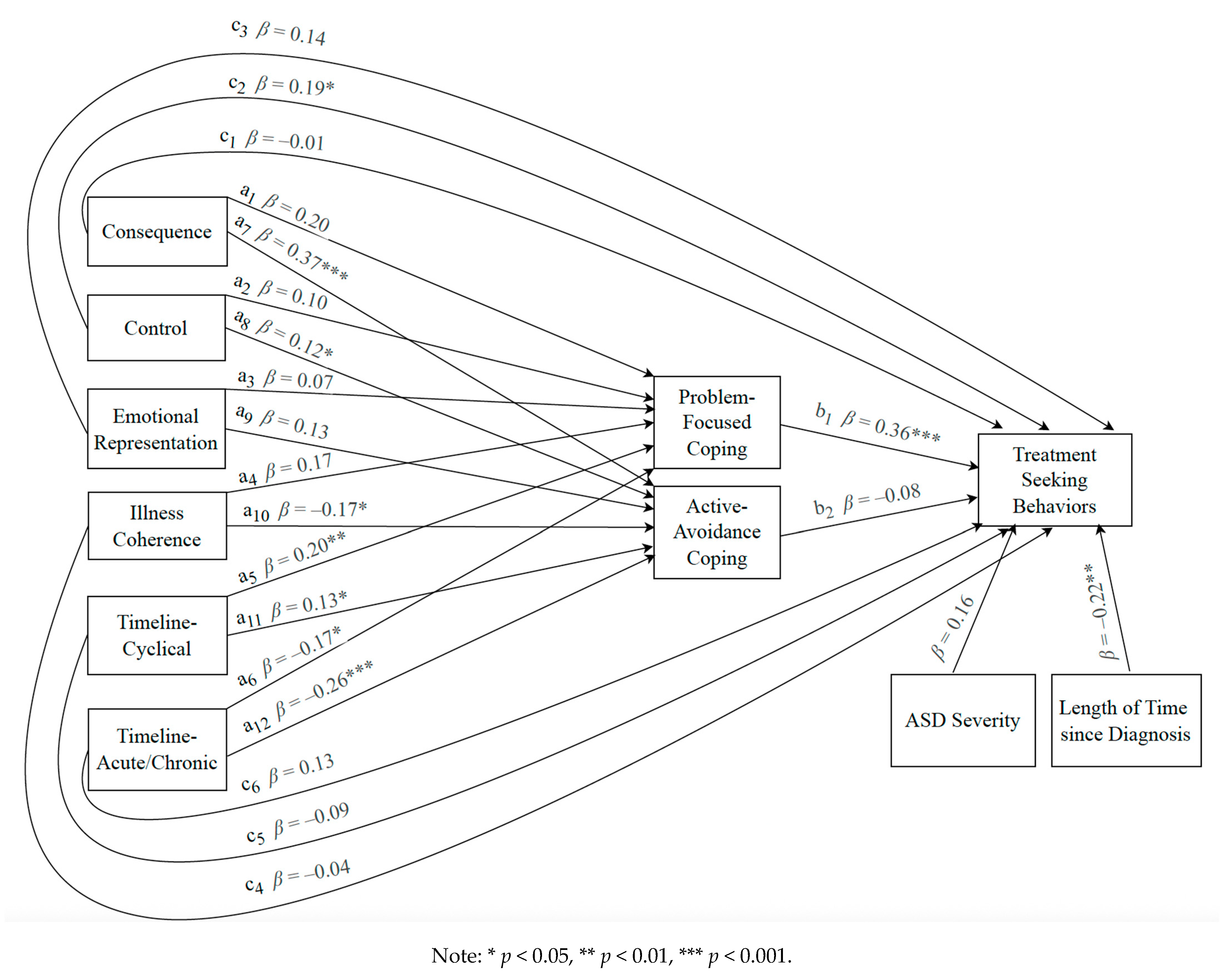
Factors Impacting Treatment Decisions in Caregivers of Autistic Children

Abstract
1. Introduction
2. Materials and Methods
2.1. Participants
2.2. Measures
2.3. Procedures
2.4. Data Analytic Plan and Preliminary Analyses
3. Results
4. Discussion
4.1. Clinical Implications
4.2. Limitations and Future Directions
5. Conclusions
Author Contributions
Funding
Institutional Review Board Statement
Informed Consent Statement
Data Availability Statement
Conflicts of Interest
Abbreviations
| CSM | Common Sense Model |
| ASD | Autism Spectrum Disorder |
| CBT | Cognitive-Behavioral Therapy |
| APA | American Psychiatric Association |
| IPQ-R | Illness Perception Questionnaire–Revised |
| Brief-COPE | Brief Coping Orientation of Problems Experienced Inventory |
| CI | Confidence Interval |
| RMSEA | Root Mean Square Error of Approximation |
| CFI | Comparative Fit Index |
| TLI | Tucker–Lewis Index |
| WRMR | Weighted Root Mean Square Residual |
References
- Al Anbar, N., Dardennes, R. M., Prado-Netto, A., Kaye, K., & Contejean, Y. (2010). Treatment choices in autism spectrum disorder: The role of parental illness perceptions. Research in Developmental Disabilities, 31, 817–828. [Google Scholar] [CrossRef] [PubMed]
- American Psychiatric Association. (2013). Neurodevelopmental disorders. In Diagnostic and statistical manual of mental disorders (5th ed.). American Psychiatric Association. [Google Scholar] [CrossRef]
- Baumeister, R. F., Masicampo, E. J., & Vohs, K. D. (2011). Do conscious thoughts cause behavior? Annual Review of Psychology, 62(1), 331–361. [Google Scholar] [CrossRef] [PubMed]
- Bennett, D. A. (2001). How can I deal with missing data in my study? Australian and New Zealand Journal of Public Health, 25(5), 464–469. [Google Scholar] [CrossRef] [PubMed]
- Carver, C. S. (1997). You want to measure coping but your protocol’s too long: Consider the brief COPE. International Journal of Behavioral Medicine, 4, 92–100. [Google Scholar] [CrossRef] [PubMed]
- Carver, C. S., Scheier, M. F., & Weintraub, J. K. (1989). Assessing coping strategies: A theoretically based approach. Journal of Personality and Social Psychology, 56(2), 267–283. [Google Scholar] [CrossRef] [PubMed]
- Chang, J., & Goin-Kochel, R. P. (2020). Vaccine hesitancy and attributions for autism among racially and ethnically diverse groups of parents of children with autism spectrum disorder. Autism Research, 13, 1790–1796. [Google Scholar] [CrossRef] [PubMed]
- Chen, Q., Liang, C., Zhao, Y., Kong, J., Zhang, H., Yan, X., & Zhang, H. (2024). The mediating role of coping styles in illness perception and self-management in patients with obstructive sleep apnea. Sleep Medicine, 113, 349–356. [Google Scholar] [CrossRef] [PubMed]
- Clark, M. L. E., Vinen, Z., Barbaro, J., & Dissanayake, C. (2017). School age outcomes of children diagnosed early and later with autism spectrum disorder. Journal of Autism and Developmental Disorders, 48, 92–102. [Google Scholar] [CrossRef]
- Crane, L., Chester, J. W., Goddard, L., Henry, L. A., & Hill, E. (2016). Experiences of autism diagnosis: A survey of over 1000 parents in the United Kingdom. Autism, 20(2), 153–162. [Google Scholar] [CrossRef] [PubMed]
- Dardennes, R. M., Anbar, A., Prado-Netto, N. N., Kaye, A., Contejean, K. Y., & Al Anbar, N. N. (2011). Treating the cause of illness rather than the symptoms: Parental causal beliefs and treatment choices in ASD. Research in Developmental Disabilities, 32(3), 1137–1146. [Google Scholar] [CrossRef] [PubMed]
- Dawson, G., Jones, E. J., Merkle, K., Venema, K., Lowy, R., Faja, S., Kamara, D., Murias, M., Greenson, J., Winter, J., Smith, M., Rogers, S. J., & Webb, S. J. (2012). Early behavioral intervention is associated with normalized brain activity in young children with autism. Journal of the American Academy of Child & Adolescent Psychiatry, 51(11), 1150–1159. [Google Scholar] [CrossRef] [PubMed]
- Dawson, G., Rogers, S., Munson, J., Smith, M., Winter, J., Greenson, J., Donaldson, A., & Varley, J. (2010). Randomized, controlled trial of an intervention for toddlers with autism: The early start Denver model. Pediatrics, 125(1), e17–e23. [Google Scholar] [CrossRef] [PubMed]
- Elder, Kreider, C. M., Brasher, S. N., & Ansell, M. (2017). Clinical impact of early diagnosis of autism on the prognosis and parent-child relationships. Psychology Research and Behavior Management, 10, 283–292. [Google Scholar] [CrossRef] [PubMed]
- Enders, C. K., & Bandalos, D. L. (2001). The relative performance of full information maximum likelihood estimation for missing data in structural equation models. Structural Equation Modeling, 8(3), 430–457. [Google Scholar] [CrossRef]
- Evangelou, C., Pappa, A., Gkanis, I., Iatraki, G., & Soulis, S.-G. (2025). Towards developing early intervention programmes supporting social skills for autistic children in early childhood: A systematic review. European Journal of Special Needs Education, 41(1), 1–19. [Google Scholar] [CrossRef]
- Fréchette-Simard, C., Plante, I., & Bluteau, J. (2018). Strategies included in cognitive behavioral therapy programs to treat internalized disorders: A systematic review. Cognitive Behaviour Therapy, 47(4), 263–285. [Google Scholar] [CrossRef] [PubMed]
- Goin-Kochel, R. P., Fombonne, E., Mire, S. S., Minard, C. G., Sahni, L. C., Cunningham, R. M., & Boom, J. A. (2020). Beliefs about causes of autism and vaccine hesitancy among parents of children with autism spectrum disorder. Vaccine, 38(40), 6327–6333. [Google Scholar] [CrossRef] [PubMed]
- Hagger, M. S., Koch, S., Chatzisarantis, N. L. D., & Orbell, S. (2017). The common-sense model of self-regulation: Meta-analysis and test of a process model. Psychological Bulletin, 143(11), 1117–1154. [Google Scholar] [CrossRef] [PubMed]
- Hastings, R. P., Kovshoff, H., Brown, T., Ward, N. J., Espinosa, F. D., & Remington, B. (2005). Coping strategies in mothers and fathers of preschool and school-age children with autism. Autism, 9(4), 377–391. [Google Scholar] [CrossRef] [PubMed]
- IBM Corp. (2023). IBM SPSS statistics for Macintosh (Version 29.0.2.0) [Computer software]. IBM Corp.
- Keenan, M., Dillenburger, K., Doherty, A., Byrne, T., & Gallagher, S. (2010). The experiences of parents during diagnosis and forward planning for children with autism spectrum disorder. Journal of Applied Research in Intellectual Disabilities, 23(4), 390–397. [Google Scholar] [CrossRef]
- Leventhal, H., Benyamini, Y., Brownlee, S., Diefenbach, M., Leventhal, E., Patrick-Miller, L., & Robitaille, C. (1997). Illness representations: Theoretical foundations. In K. J. Petrie, & J. Weinman (Eds.), Perceptions of health and illness (pp. 19–45). Harwood Academic. [Google Scholar]
- Leventhal, H., Leventhal, E. A., & Cameron, L. (2001). Representations, procedures, and affect in illness self-regulation: A perceptual-cognitive model. In A. Baum, T. A. Revenson, & J. E. Singer (Eds.), Handbook of health psychology (pp. 19–47). Lawrence Erlbaum Associates Pub. [Google Scholar]
- Leventhal, H., Meyer, D., & Nerenz, D. (1980). The common sense model of illness danger. In S. Rachman (Ed.), Medical psychology (Vol. 2, pp. 7–30). Pergamon. [Google Scholar]
- Leventhal, H., Nerenz, D. R., & Steele, D. S. (1984). Illness representations and coping with health threats. In A. Baum, S. E. Taylor, & J. E. Singer (Eds.), Handbook of psychology and health (Vol. 4, pp. 219–252). Harwood Academic. [Google Scholar]
- Leventhal, H., Phillips, L. A., & Burns, E. (2016). The common-sense model of self- regulation (CSM): A dynamic framework for understanding illness self-management. Journal of Behavioral Medicine, 39(6), 935–946. [Google Scholar] [CrossRef] [PubMed]
- Leys, C., Klein, O., Dominicy, Y., & Ley, C. (2018). Detecting multivariate outliers: Use a robust variant of the Mahalanobis distance. Journal of Experimental Social Psychology, 74, 150–156. [Google Scholar] [CrossRef]
- Malik-Soni, N., Shaker, A., Luck, H., Mullin, A. E., Wiley, R. E., Lewis, M. E., Fuentes, J., & Frazier, T. W. (2022). Tackling healthcare access barriers for individuals with autism from diagnosis to adulthood. Pediatric Research, 91(5), 1028–1035. [Google Scholar] [PubMed]
- Mensah-Bonsu, N., Mire, S. S., Sahni, L. C., Berry, L. N., Dowell, L. R., Minard, C. G., Cunningham, R. M., Boom, J. A., Voigt, R. G., & Goin-Kochel, R. P. (2021). Understanding vaccine hesitancy among parents of children with autism spectrum disorder and parents of children with non-autism developmental delays. Journal of Child Neurology, 36(10), 911–918. [Google Scholar] [CrossRef] [PubMed]
- Mire, S. S., Benoit, J. S., Fritz, J. N., Racine, M. D., Fein, R. H., Raff, N. S., Rosenbrock, G., & Dawson, K. (2022). Parenting perceptions and stress at treatment intake among families of children with autism. Family Relations, 71(2), 660–670. [Google Scholar] [CrossRef]
- Mire, S. S., Gealy, W., Kubiszyn, T., Burridge, A., & Goin-Kochel, R. P. (2017). Parental perception about autism spectrum disorder influence treatment choices. Focus on Autism and Other Developmental Disabilities, 32, 305–318. [Google Scholar] [CrossRef]
- Mire, S. S., Tolar, T. D., Brewton, C. M., Raff, N. S., & McKee, S. L. (2018). Validating the revised illness perception questionnaire as a measure of parent perceptions of autism spectrum disorder. Journal of Autism and Developmental Disorders, 48(5), 1761–1779. [Google Scholar] [CrossRef] [PubMed]
- Moreau, D. (2022). How malleable are cognitive abilities? A critical perspective on popular brief interventions. American Psychologist, 77(3), 409–423. [Google Scholar] [CrossRef] [PubMed]
- Muthén, B., Kaplan, D., & Hollis, M. (1987). On structural equation modeling with data that are not missing completely at random. Psychometrika, 52(3), 431–462. [Google Scholar] [CrossRef]
- Muthén, L. K., & Muthén, B. O. (2017). Mplus user’s guide (8th ed.). Muthén & Muthén. [Google Scholar]
- Papadopoulos, A., Siafaka, V., Tsapara, A., Tafiadis, D., Kotsis, K., Skapinakis, P., & Tzoufi, M. (2023). Measuring parental stress, illness perceptions, coping and quality of life in families of children newly diagnosed with autism spectrum disorder. BJPsych Open, 9(3), e84. [Google Scholar] [CrossRef] [PubMed]
- Pattison, E., Ure, A., Mittiga, S. R., Williams, K., & Freeman, N. C. (2022). The feedback session of an autism assessment: A scoping review of clinical practice guideline recommendations. Journal of Autism and Developmental Disorders, 52(4), 1821–1840. [Google Scholar] [CrossRef] [PubMed]
- Richardson, E. M., Schüz, N., Sanderson, K., Scott, J. L., & Schüz, B. (2017). Illness representations, coping, and illness outcomes in people with cancer: A systematic review and meta-analysis. Psycho-Oncology, 26(6), 724–737. [Google Scholar] [CrossRef] [PubMed]
- Saez, C. M., Davies, M. S., Kazemi, E., & Fields, A. (2023). Factors affecting parent treatment decisions for children with autism spectrum disorders: A brief review. Behavior Analysis in Practice, 16(1), 93–101. [Google Scholar] [CrossRef] [PubMed]
- Sahni, L. C., Boom, J. A., Mire, S. S., Berry, L. N., Dowell, L. R., Minard, C. G., Cunningham, R. M., & Goin-Kochel, R. P. (2020). Vaccine hesitancy and illness perceptions: Comparing parents of children with autism spectrum disorder to other parent groups. Children’s Health Care, 49, 385–402. [Google Scholar] [CrossRef] [PubMed]
- Shea, V., & Mesibov, G. B. (2009). Age-related issues in the assessment of ASD. In S. Goldstein, J. A. Naglieri, & S. Ozonoff (Eds.), Assessment of autism spectrum disorders (pp. 117–137). Guilford Press. [Google Scholar]
- Tao, T. J., Lim, T. K., Yeung, E. T. F., Liu, H., Shris, P. B., Ma, L. K. Y., Lee, T. M. C., & Hou, W. K. (2023). Internet-based and mobile-based cognitive behavioral therapy for chronic diseases: A systematic review and meta-analysis. NPJ Digital Medicine, 6, 80. [Google Scholar] [CrossRef] [PubMed]
- Thompson, R. D., Delaney, P., Flores, I., & Szigethy, E. (2011). Cognitive-behavioral therapy for children with comorbid physical illness. Child and Adolescent Psychiatric Clinics, 20(2), 329–348. [Google Scholar] [CrossRef]
- Traeger, L. (2020). Cognitive restructuring. In Encyclopedia of behavioral medicine (pp. 498–498). Springer International Publishing. [Google Scholar]
- Vivanti, G., & Dissanayake, C. (2016). Outcome for children receiving the early start Denver model before and after 48 months. Journal of Autism and Developmental Disorders, 46(7), 2441–2449. [Google Scholar] [CrossRef] [PubMed]
- Vivanti, G., Dissanayake, C., Duncan, E., Feary, J., Capes, K., Upson, S., Bent, C. A., Rogers, S. J., & Hudry, K. (2019). Outcomes of children receiving group-early start Denver model in an inclusive versus autism-specific setting: A pilot randomized controlled trial. Autism, 23(5), 1165–1175. [Google Scholar] [CrossRef] [PubMed]
- Yu, Y., McGrew, J. H., & Boloor, J. (2019). Effects of caregiver-focused programs on psychosocial outcomes in caregivers of individuals with ASD: A meta-analysis. Journal of Autism and Developmental Disorders, 49, 4761–4779. [Google Scholar] [CrossRef] [PubMed]
- Zhao, J., Chapman, E., Houghton, S., & Lawrence, D. (2022). Development and validation of a coping strategies scale for use in Chinese contexts. Frontiers in Psychology, 13, 845769. [Google Scholar] [CrossRef] [PubMed]



| Characteristic | M (SD) | Range (Years) |
|---|---|---|
| Caregiver Age | 40.67 (9.19) | 22–69 |
| N (%) | ||
| Caregiver Self-Reported Gender Identity | ||
| Woman | 180 (63.4) | |
| Man | 95 (33.5) | |
| Non-binary | 9 (3.2) | |
| Caregiver Race/Ethnicity | ||
| American Indian/Indigenous American/Alaskan Native | 1 (0.4) | |
| Native Hawaiian/Other Pacific Islander | 1 (0.4) | |
| Asian American | 14 (4.9) | |
| Hispanic/Latino(a)/Spanish Origin | 19 (6.7) | |
| African American/Black American | 43 (14.8) | |
| White | 201 (70.8) | |
| College-Educated | 184 (64.1) | |
| Caregiver Marital Status | ||
| Married/Partnered | 210 (73.9) | |
| Single | 38 (13.4) | |
| Divorced/Separated | 21 (7.4) | |
| Widowed | 7 (2.5) | |
| Caregiver Employment | ||
| Full-time | 187 (65.8) | |
| Part-time | 45 (15.8) | |
| Unemployed or Disabled | 52 (18.3) | |
| Caregiver Relation to Child | ||
| Biological Parent | 254 (89.4) | |
| Caregiver Income | ||
| $20,000 or less | 18 (6.3) | |
| $21,000 to $50,000 | 74 (26) | |
| $51,000 to $100,000 | 113 (39.8) | |
| $101,000 or more | 76 (26.8) | |
| Characteristic | M (SD) | Range (Years) |
|---|---|---|
| Child Age | 9.74 (4.47) | 2–17 |
| Child Age at First Concern | 35 months (29) | 0–180 months |
| Child Age at Diagnosis | 5.16 (2.87) | 1–15 |
| Total Hours of Weekly Treatment | 11.12 (11.48) | 0–50 |
| N (%) | ||
| Child Gender Identity (Caregiver Reported) | ||
| Boy | 195 (68.7) | |
| Girl | 76 (26.8) | |
| Transgender | 6 (2.1) | |
| Non-binary | 4 (1.4) | |
| Child Race/Ethnicity | ||
| American Indian/Indigenous American/Alaskan Native | 3 (1.0) | |
| Asian American | 11 (3.9) | |
| Hispanic/Latino(a)/Spanish Origin | 13 (4.6) | |
| African American/Black American | 36 (12.7) | |
| More than 1 Ethnicity Reported | 36 (12.7) | |
| White | 176 (62) | |
| Expert Diagnostician | ||
| Psychologist | 139 (48.9) | |
| Pediatrician/Physician/Nurse Practitioner | 124 (43.7) | |
| Length of Time Since Diagnosis | ||
| 0–2 years | 117 (41.8%) | |
| 3–6 years | 79 (28.2%) | |
| 7–15 years | 84 (30.0%) | |
| Child ASD Severity Specification | ||
| Level 1 (Requiring Support) | 116 (40.8) | |
| Level 2 (Requiring Substantial Support) | 91 (32.0) | |
| Level 3 (Requiring Very Substantial Support) | 31 (10.9) | |
| Comorbid Intellectual Developmental Disability | 81 (28.5) | |
| Child Language Ability | ||
| Preverbal or Nonspeaking | 25 (8.8) | |
| Babbling | 18 (6.3) | |
| Single Words Only | 17 (6.0) | |
| Phrase Speech | 50 (17.6) | |
| Fully Verbal | 173 (60.9) | |
| Current Receipt of Treatment | 215 (75.7%) | |
| Continuation of Treatment | 197 (69.5%) | |
| Treatments Received | ||
| Behavior therapy (e.g., Applied Behavior Analysis) | 108 (38.0%) | |
| Social skills training | 95 (33.5%) | |
| School-based speech/language therapy | 95 (33.5%) | |
| School-based occupational therapy | 78 (27.5%) | |
| Private speech/language therapy | 64 (22.5%) | |
| Cognitive-behavioral therapy | 62 (21.8%) | |
| Psychotropic mediation | 62 (21.8%) | |
| Variables | 1 | 2 | 3 | 4 | 5 | 6 | 7 | 8 | 9 | 10 | 11 |
|---|---|---|---|---|---|---|---|---|---|---|---|
| 1. Timeline-A/C (IPQ) | -- | ||||||||||
| 2. Consequences (IPQ) | 0.29*** | -- | |||||||||
| 3. Control (IPQ) | −0.16* | −0.03 | -- | ||||||||
| 4. Emotional Rep (IPQ) | −0.09 | 0.57*** | −0.01 | -- | |||||||
| 5. Illness Coh (IPQ) | 0.18** | −0.33*** | 0.13* | −0.55*** | -- | ||||||
| 6. Timeline-C (IPQ) | −0.14** | 0.32*** | 0.15* | 0.44*** | −0.35*** | -- | |||||
| 7. Avoidance (COPE) | −0.26*** | 0.41*** | 0.09 | 0.46*** | −0.43*** | 0.38*** | -- | ||||
| 8. Problem-Focused (COPE) | −0.11 | 0.22*** | 0.20*** | 0.21*** | −0.09 | 0.27*** | 0.24*** | -- | |||
| 9. Treatment Seeking Bxs | 0.04 | 0.18** | 0.21*** | 0.15* | −0.09 | 0.09 | 0.07 | 0.37*** | -- | ||
| 10. Time Since Diagnosis | 0.15* | 0.16** | 0.02 | 0.09 | 0.03 | −0.03 | 0.04 | 0.08 | −0.14* | -- | |
| 11. ASD Severity | 0.19** | 0.39*** | 0.04 | 0.22*** | −0.17* | 0.10 | 0.08 | 0.08 | 0.20** | −0.02 | -- |
| Mean (SD) | 20.84 (4.93) | 19.33 (5.31) | 25.40 (3.55) | 16.87 (5.68) | 17.74 (4.45) | 11.11 (3.71) | 13.94 (5.08) | 15.46 (4.12) | 5.56 (1.91) | 4.57 (3.94) | 1.64 (0.71) |
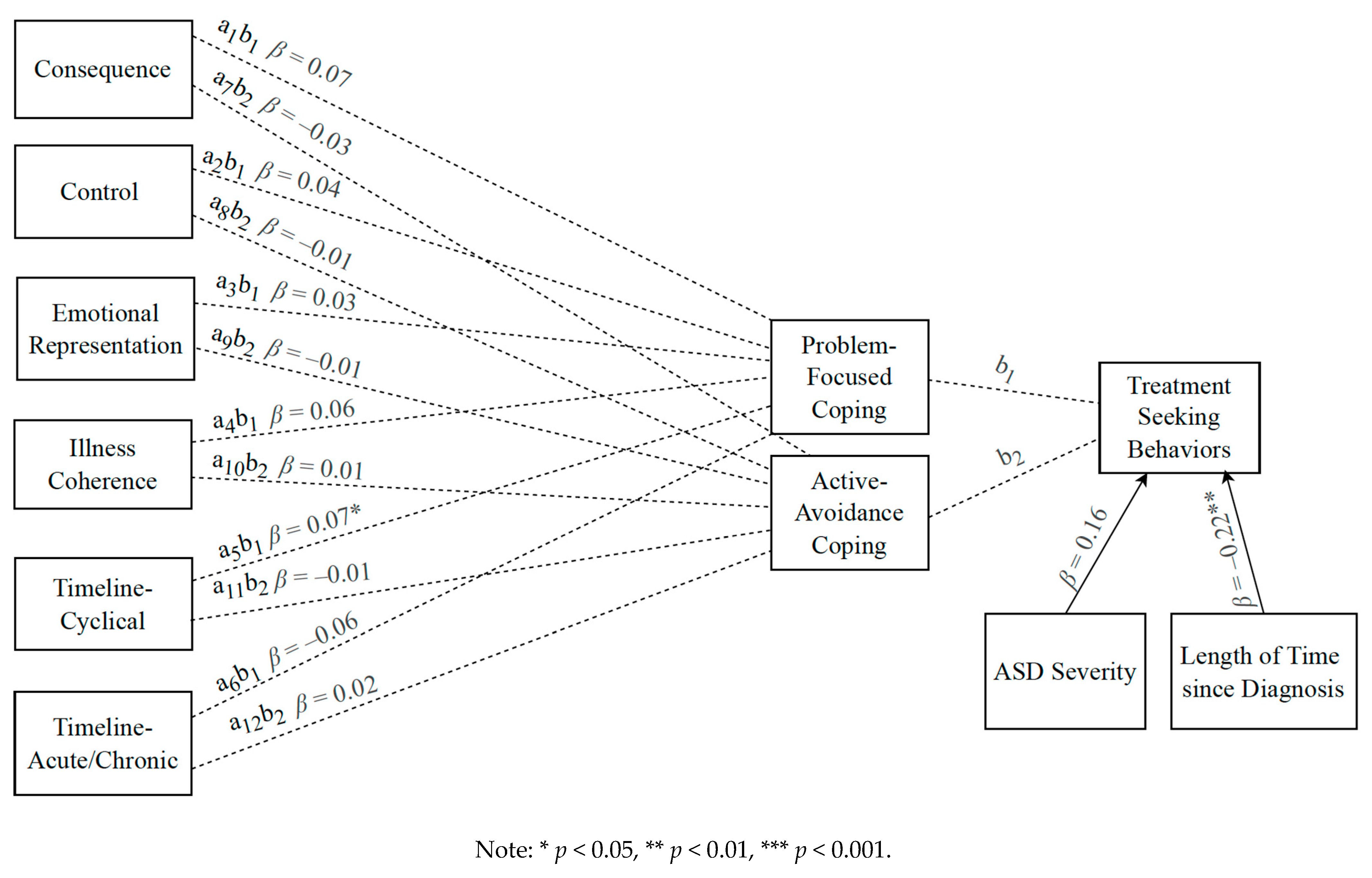
| Indirect Effect | Path Notation | β | p | 95% CI |
|---|---|---|---|---|
| Consequence → __ → Treatment Seeking Bxs | ||||
| Problem-Focused Coping | a1b1 | 0.07 | 0.09 | −0.01, 0.15 |
| Active-Avoidance Coping | a7b2 | −0.03 | 0.40 | −0.10, 0.04 |
| Control → __ → Treatment | ||||
| Problem-Focused Coping | a2b1 | 0.04 | 0.24 | −0.02, 0.09 |
| Active-Avoidance Coping | a8b2 | −0.01 | 0.57 | −0.04, 0.02 |
| Emotional Rep → __ → Treatment Seeking Bxs | ||||
| Problem-Focused Coping | a3b1 | 0.03 | 0.48 | −0.04, 0.09 |
| Active-Avoidance Coping | a9b2 | −0.01 | 0.57 | −0.04, 0.02 |
| Illness Coherence → __ → Treatment Seeking Bxs | ||||
| Problem-Focused Coping | a4b1 | 0.06 | 0.11 | −0.01, 0.13 |
| Active-Avoidance Coping | a10b2 | 0.01 | 0.43 | −0.02, 0.05 |
| Timeline-Cyclical → __ → Treatment Seeking Bxs | ||||
| Problem-Focused Coping | a5b1 | 0.07 | 0.02 | 0.01, 0.13 |
| Active-Avoidance Coping | a11b2 | −0.01 | 0.43 | −0.04, 0.02 |
| Timeline-Acute/Chronic → __ → Treatment Seeking Bxs | ||||
| Problem-Focused Coping | a5b1 | −0.06 | 0.06 | −0.13, 0.003 |
| Active-Avoidance Coping | a12b2 | 0.02 | 0.41 | −0.03, 0.07 |
Disclaimer/Publisher’s Note: The statements, opinions and data contained in all publications are solely those of the individual author(s) and contributor(s) and not of MDPI and/or the editor(s). MDPI and/or the editor(s) disclaim responsibility for any injury to people or property resulting from any ideas, methods, instructions or products referred to in the content. |
© 2026 by the authors. Licensee MDPI, Basel, Switzerland. This article is an open access article distributed under the terms and conditions of the Creative Commons Attribution (CC BY) license.
Share and Cite
Harris, T.G.; Record, J.; Smith, S.D. Factors Impacting Treatment Decisions in Caregivers of Autistic Children. Behav. Sci. 2026, 16, 1280. https://doi.org/10.3390/bs16081280
Harris TG, Record J, Smith SD. Factors Impacting Treatment Decisions in Caregivers of Autistic Children. Behavioral Sciences. 2026; 16(8):1280. https://doi.org/10.3390/bs16081280
Chicago/Turabian StyleHarris, Tiffany G., Julia Record, and Stephanie D. Smith. 2026. "Factors Impacting Treatment Decisions in Caregivers of Autistic Children" Behavioral Sciences 16, no. 8: 1280. https://doi.org/10.3390/bs16081280
APA StyleHarris, T. G., Record, J., & Smith, S. D. (2026). Factors Impacting Treatment Decisions in Caregivers of Autistic Children. Behavioral Sciences, 16(8), 1280. https://doi.org/10.3390/bs16081280