Understanding Multilevel Correlates of Long-Term Physical Activity Trajectories Among Middle-Aged and Older Adults: A Machine-Learning Analysis
Abstract
1. Introduction
2. Methods
2.1. Participants
2.2. Outcome Variables
2.3. Variables
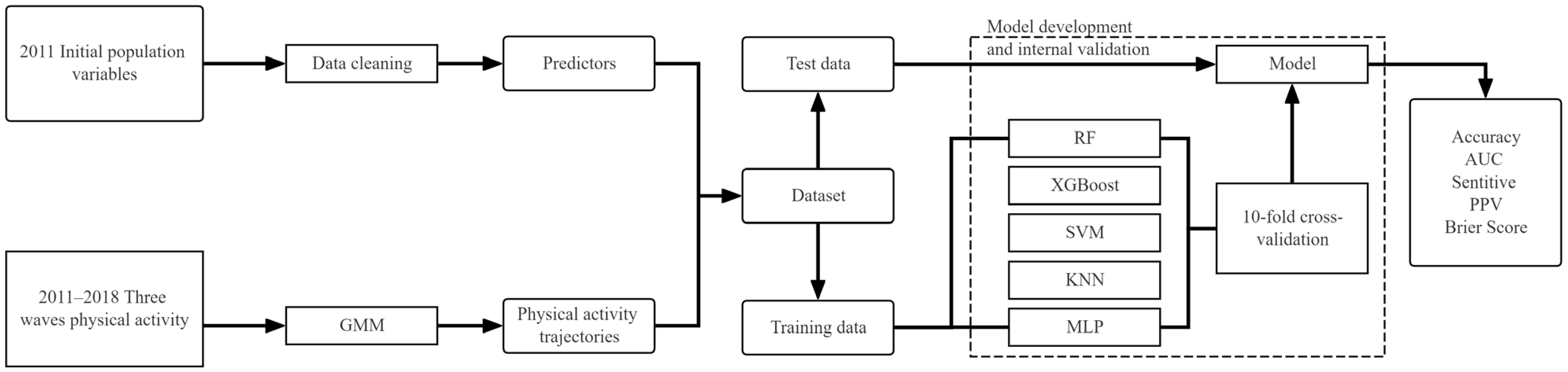
2.4. Data Analysis
3. Results
4. Discussion
5. Conclusions
Supplementary Materials
Author Contributions
Funding
Institutional Review Board Statement
Informed Consent Statement
Data Availability Statement
Conflicts of Interest
References
- Aggio, D., Papachristou, E., Papacosta, O., Lennon, L. T., Ash, S., Whincup, P. H., Wannamethee, S. G., & Jefferis, B. J. (2018). Trajectories of self-reported physical activity and predictors during the transition to old age: A 20-year cohort study of British men. International Journal of Behavioral Nutrition and Physical Activity, 15, 14. [Google Scholar] [CrossRef] [Scilit] [PubMed]
- Ahmadi, M. N., Pavey, T. G., & Trost, S. G. (2020). Machine learning models for classifying physical activity in free-living preschool children. Sensors, 20(16), 4364. [Google Scholar] [CrossRef] [Scilit] [PubMed]
- Baert, V., Gorus, E., Calleeuw, K., De Backer, W., & Bautmans, I. (2016). An administrator’s perspective on the organization of physical activity for older adults in long-term care facilities. Journal of the American Medical Directors Association, 17(1), 75–84. [Google Scholar] [CrossRef] [Scilit] [PubMed]
- Boulton, E. R., Horne, M., & Todd, C. (2018). Multiple influences on participating in physical activity in older age: Developing a social ecological approach. Health Expectations: An International Journal of Public Participation in Health Care and Health Policy, 21(1), 239–248. [Google Scholar] [CrossRef] [Scilit] [PubMed]
- Bu, F., Mak, H. W., Bone, J. K., Gao, Q., Sonke, J. K., & Fancourt, D. (2024). Leisure engagement and self-perceptions of aging: Longitudinal analysis of concurrent and lagged relationships. The Journals of Gerontology, Series B: Psychological Sciences and Social Sciences, 79(3), gbad182. [Google Scholar] [PubMed]
- Carvalho, J., Borges-Machado, F., Pizarro, A. N., Bohn, L., & Barros, D. (2021). Home confinement in previously active older adults: A cross-sectional analysis of physical fitness and physical activity behavior and their relationship with depressive symptoms. Frontiers in Psychology, 12, 643832. [Google Scholar] [CrossRef] [Scilit] [PubMed]
- Chen, H., Zhang, X., & Bian, W. (2024). Using machine learning to explore the predictors of life satisfaction trajectories in older adults. Applied Psychology: Health and Well-Being, 16(4), 2190–2203. [Google Scholar] [CrossRef] [Scilit] [PubMed]
- Chen, W., Zhang, Z., Giordani, B., & Larson, J. L. (2022). Technology-enhanced active intervention impacting psychological well-being and physical activity among older adults: A pilot study. International Journal of Environmental Research and Public Health, 19(1), 556. [Google Scholar] [CrossRef] [Scilit] [PubMed]
- Crossman, S., Drummond, M., Elliott, S., Kay, J., Montero, A., & Petersen, J. M. (2024). Facilitators and constraints to adult sports participation: A systematic review. Psychology of Sport and Exercise, 72, 102609. [Google Scholar] [CrossRef] [Scilit] [PubMed]
- D’Amore, C., Bhatnagar, N., Kirkwood, R., Griffith, L. E., Richardson, J., & Beauchamp, M. (2021). Determinants of physical activity in older adults: An umbrella review protocol. JBI Evidence Synthesis, 19(10), 2883–2892. [Google Scholar] [CrossRef] [Scilit] [PubMed]
- Deng, Y., & Paul, D. R. (2018). The relationships between depressive symptoms, functional health status, physical activity, and the availability of recreational facilities: A rural-urban comparison in middle-aged and older Chinese adults. International Journal of Behavioral Medicine, 25(3), 322–330. [Google Scholar] [CrossRef] [Scilit] [PubMed]
- Dijkhuis, T. B., Blaauw, F. J., Van Ittersum, M. W., Velthuijsen, H., & Aiello, M. (2018). Personalized physical activity coaching: A machine learning approach. Sensors, 18(2), 623. [Google Scholar] [CrossRef] [Scilit] [PubMed]
- Eime, R. M., Harvey, J. T., Charity, M. J., & Nelson, R. (2018). Demographic characteristics and type/frequency of physical activity participation in a large sample of 21,603 Australian people. BMC Public Health, 18, 5608. [Google Scholar] [CrossRef] [Scilit] [PubMed]
- Fang, H., Xiong, Z., Li, Y., Cui, W., Cheng, Z., Xiang, J., & Ye, T. (2023). Physical activity and transitioning to retirement: Evidence from the China Health and Retirement Longitudinal Study. BMC Public Health, 23(1), 1937. [Google Scholar] [CrossRef] [Scilit] [PubMed]
- Fingerman, K. L., Huo, M., Charles, S. T., & Umberson, D. J. (2020). Variety is the spice of late life: Social integration and daily activity. The Journals of Gerontology: Series B, 75(2), 377–388. [Google Scholar]
- Franco, M. R., Tong, A., Howard, K., Sherrington, C., Ferreira, P. H., Pinto, R. Z., & Ferreira, M. L. (2015). Older people’s perspectives on participation in physical activity: A systematic review and thematic synthesis of qualitative literature. British Journal of Sports Medicine, 49(19), 1268–1276. [Google Scholar] [CrossRef] [Scilit] [PubMed]
- Han, Y., Xing, F., Huang, J., & Wang, M. (2023). Associated factors of health-promoting lifestyle of the elderly based on the theory of social ecosystem. Atención Primaria, 55(9), 102679. [Google Scholar] [CrossRef] [Scilit] [PubMed]
- Hobbs, M., Moltchanova, E., Wicks, C., Pringle, A. R., Griffiths, C., Radley, D., & Zwolinsky, S. (2020). Investigating the environmental, behavioural, and sociodemographic determinants of attendance at a city-wide public health physical activity intervention: Longitudinal evidence over one year from 185, 245 visits. Preventive Medicine, 143, 106334. [Google Scholar] [CrossRef] [Scilit] [PubMed]
- Kandola, A., Ashdown-Franks, G., Hendrikse, J., Sabiston, C. M., & Stubbs, B. (2019). Physical activity and depression: Towards understanding the antidepressant mechanisms of physical activity. Neuroscience & Biobehavioral Reviews, 107, 525–539. [Google Scholar] [CrossRef] [Scilit] [PubMed]
- Karanth, S. D., Schmitt, F. A., Nelson, P. T., Katsumata, Y., Kryscio, R. J., Fardo, D. W., Harp, J. P., & Abner, E. L. (2021). Four common late-life cognitive trajectories patterns associate with replicable underlying neuropathologies. Journal of Alzheimer’s Disease, 82(2), 647–659. [Google Scholar] [CrossRef] [Scilit] [PubMed]
- Kerr, J., Rosenberg, D., Millstein, R. A., Bolling, K., Crist, K., Takemoto, M., Godbole, S., Moran, K., Natarajan, L., & Castro-Sweet, C. (2018). Cluster randomized controlled trial of a multilevel physical activity intervention for older adults. International Journal of Behavioral Nutrition and Physical Activity, 15(1), 32. [Google Scholar] [CrossRef] [Scilit] [PubMed]
- Knapova, L., Cho, Y. W., Chow, S. M., Kuhnova, J., & Elavsky, S. (2024). From intention to behavior: Within- and between-person moderators of the relationship between intention and physical activity. Psychology of Sport and Exercise, 71, 102566. [Google Scholar] [CrossRef] [Scilit] [PubMed]
- Kokolakakis, T., Lera-López, F., & Panagouleas, T. (2012). Analysis of the determinants of sports participation in Spain and England. Applied Economics, 44(21), 2785–2798. [Google Scholar]
- Lounassalo, I., Salin, K., Kankaanpää, A., Hirvensalo, M., Palomäki, S., Tolvanen, A., Yang, X., & Tammelin, T. H. (2019). Distinct trajectories of physical activity and related factors during the life course in the general population: A systematic review. BMC Public Health, 19(1), 271. [Google Scholar] [CrossRef] [Scilit] [PubMed]
- McLeroy, K. R., Bibeau, D., Steckler, A., & Glanz, K. (1988). An ecological perspective on health promotion programs. Health Education Quarterly, 15(4), 351–377. [Google Scholar] [CrossRef] [Scilit] [PubMed]
- Nawrin, S. S., Inada, H., Momma, H., & Nagatomi, R. (2024). Twenty-four-hour physical activity patterns associated with depressive symptoms: A cross-sectional study using big data-machine learning approach. BMC Public Health, 24(1), 1254. [Google Scholar] [CrossRef] [Scilit] [PubMed]
- Peng, X., Li, Z., Zhang, C., Liu, R., Jiang, Y., Chen, J., Qi, Z., Ge, J., Zhao, S., Zhou, M., & You, H. (2021). Determinants of physicians’ online medical services uptake: A cross-sectional study applying social ecosystem theory. BMJ Open, 11(9), e048851. [Google Scholar] [CrossRef] [Scilit] [PubMed]
- Peters, M., Ratz, T., Muellmann, S., Voelcker-Rehage, C., Lippke, S., & Pischke, C. R. (2024). Which social–ecological factors play a role in older adults’ participation in a blended physical activity intervention? Results of a multi-layered feedback analysis. Journal of Public Health, 34, 831–847. [Google Scholar] [CrossRef] [Scilit]
- Rubinger, L., Gazendam, A., Ekhtiari, S., & Bhandari, M. (2023). Machine learning and artificial intelligence in research and healthcare. Injury, 54, S69–S73. [Google Scholar] [CrossRef] [Scilit] [PubMed]
- Sallis, J. F., Cervero, R. B., Ascher, W., Henderson, K. A., Kraft, M. K., & Kerr, J. (2006). An ecological approach to creating active living communities. Annual Review of Public Health, 27(1), 297–322. [Google Scholar] [CrossRef] [Scilit] [PubMed]
- Spiteri, K., Broom, D., Bekhet, A. H., de Caro, J. X., Laventure, B., & Grafton, K. (2019). Barriers and motivators of physical activity participation in middle-aged and older adults: A systematic review. Journal of Aging and Physical Activity, 27(6), 929–944. [Google Scholar] [CrossRef] [Scilit] [PubMed]
- Stenholm, S., Pulakka, A., Kawachi, I., Oksanen, T., Halonen, J. I., Aalto, V., Kivimäki, M., & Vahtera, J. (2016). Changes in physical activity during transition to retirement: A cohort study. International Journal of Behavioral Nutrition and Physical Activity, 13(1), 51. [Google Scholar] [CrossRef] [Scilit] [PubMed]
- Thornton, C. B., Kolehmainen, N., & Nazarpour, K. (2023). Using unsupervised machine learning to quantify physical activity from accelerometry in a diverse and rapidly changing population. PLoS Digital Health, 2(4), e0000220. [Google Scholar] [CrossRef] [Scilit] [PubMed]
- Tong, Y. F. (2021). The latest dynamics and trends of Chinese ports: An analysis based on the data of the seventh national census. Journal of China Institute of Labor Relations, 35(1), 15–25. [Google Scholar] [CrossRef] [Scilit]
- Tyler, N. S., Mosquera-Lopez, C., Young, G. M., El Youssef, J., Castle, J. R., & Jacobs, P. G. (2022). Quantifying the impact of physical activity on future glucose trends using machine learning. Iscience, 25(3), 103888. [Google Scholar] [CrossRef] [Scilit] [PubMed]
- Van Dyck, D., Cardon, G., & De Bourdeaudhuij, I. (2016). Longitudinal changes in physical activity and sedentary time in adults around retirement age: What is the moderating role of retirement status, gender and educational level? BMC Public Health, 16(1), 1125. [Google Scholar] [CrossRef] [Scilit] [PubMed]
- Wang, X., Hu, P., Ai, Y., Zhou, S., Li, Y., Zhou, P., Chen, G., Wang, Y., & Hu, H. (2024). Dual group-based trajectories of physical activity and cognitive function in aged over 55: A nationally representative cohort study. Frontiers in Public Health, 12, 1450167. [Google Scholar] [CrossRef] [Scilit] [PubMed]
- Willetts, M., Hollowell, S., Aslett, L., Holmes, C., & Doherty, A. (2018). Statistical machine learning of sleep and physical activity phenotypes from sensor data in 96,220 UK Biobank participants. Scientific Reports, 8(1), 7961. [Google Scholar] [CrossRef] [Scilit] [PubMed]
- Wu, Y. Z., & Yu, K. H. (2019). A review of research on physical activity based on social ecological model: Based on literature research from 2007 to 2017. Zhejiang Sports Science, 41(3), 94–100. [Google Scholar]
- Young, T., & Sharpe, C. (2016). Process evaluation results from an intergenerational physical activity intervention for grandparents raising grandchildren. Journal of Physical Activity and Health, 13, 525–533. [Google Scholar] [CrossRef] [Scilit] [PubMed]
- Zhang, Z., Giordani, B., & Chen, W. (2020). Fidelity and feasibility of a multicomponent physical activity intervention in a retirement community. Geriatric Nursing, 41(4), 394–399. [Google Scholar] [CrossRef] [Scilit] [PubMed]
- Zhao, Y., Hu, Y., Smith, J. P., Strauss, J., & Yang, G. (2012). Cohort profile: The China Health and Retirement Longitudinal Study (CHARLS). International Journal of Epidemiology, 43(1), 61–68. [Google Scholar] [CrossRef] [Scilit] [PubMed]
- Zhou, F., Zhang, H., Wang, H. Y., Liu, L. F., & Zhang, X. G. (2024). Barriers and facilitators to older adult participation in intergenerational physical activity programs: A systematic review. Aging Clinical and Experimental Research, 36(1), 39. [Google Scholar] [CrossRef] [Scilit] [PubMed]
- Zlatar, Z. Z., Godbole, S., Takemoto, M., Crist, K., & Rosenberg, D. E. (2019). Changes in moderate intensity physical activity are associated with better cognition in the MIPARC study. American Journal of Geriatric Psychiatry, 27(10), 1012–1022. [Google Scholar] [CrossRef] [Scilit] [PubMed]



| Model | SABIC | Entropy | VLMR-LRT p Value | BLRT p Value | Smallest Class |
|---|---|---|---|---|---|
| LCGM | |||||
| LCGM2 | 112,761.143 | 0.894 | <0.001 | <0.001 | 0.188 |
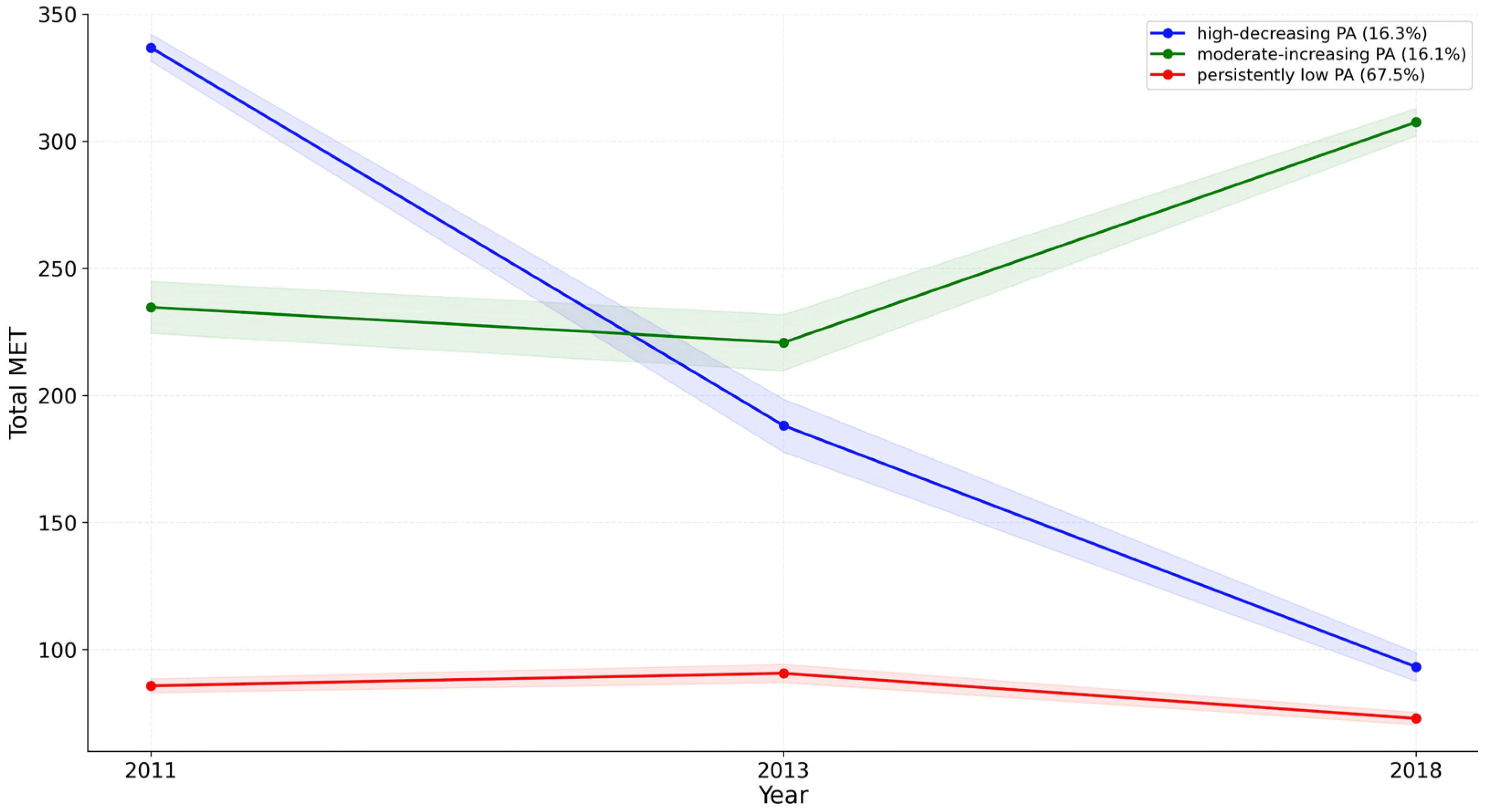
| LCGM3 | 112,414.577 | 0.853 | <0.001 | <0.001 | 0.161 |
| LCGM4 | 111,939.028 | 0.881 | 0.003 | <0.001 | 0.087 |
| LCGM5 | 111,845.004 | 0.876 | 0.403 | <0.001 | 0.054 |
| LCGM6 | 111,695.766 | 0.868 | 0.227 | <0.001 | 0.039 |
| GMM | |||||
| GMM3 | 112,226.326 | 0.853 | <0.001 | <0.001 | 0.161 |
| Variables | Physical Activity Trajectory (N = 3112) | p Value | ||
|---|---|---|---|---|
| Persistently Low PA n = 2102/67.5% | High-Decreasing PA n = 508/16.3% | Moderate-Increasing PA n = 502/16.1% | ||
| Age | 58.97 ± 8.95 | 56.8 ± 7.8 | 54.95 ± 6.62 | <0.001 |
| Gender | <0.001 | |||
| Male | 855 (40.7%) | 283 (55.7%) | 271 (54.0%) | |
| Female | 1247 (59.3%) | 225 (44.3%) | 231 (46.0%) | |
| Educational level | <0.001 | |||
| Illiteracy | 888 (42.2%) | 254 (50.0%) | 237 (47.2%) | |
| Elementary school | 443 (21.1%) | 116 (22.8%) | 119 (23.7%) | |
| High school | 660 (31.4%) | 136 (26.8%) | 141 (28.1%) | |
| University and above | 111 (5.3%) | 2 (0.4%) | 5 (1.0%) | |
| Marital status | <0.001 | |||
| With a partner | 1837 (87.4%) | 468 (92.1%) | 476 (94.8%) | |
| Without a partner | 265 (12.6%) | 40 (7.9%) | 26 (5.2%) | |
| Self-reported health status | 2.52 ± 0.98 | 2.48 ± 1.0 | 2.59 ± 0.97 | 0.157 |
| Depression | 8.01 ± 6.36 | 8.6 ± 6.14 | 8.68 ± 6.32 | 0.032 |
| Sleep | 0.800 | |||
| Insufficient Sleep | 586 (27.9%) | 153 (30.1%) | 141 (28.1%) | |
| Normal Sleep | 1339 (63.7%) | 311 (61.2%) | 323 (64.3%) | |
| Excessive Sleep | 177 (8.4%) | 44 (8.7%) | 38 (7.6%) | |
| Social participation | 1.7 ± 2.08 | 1.16 ± 1.69 | 1.24 ± 1.67 | <0.001 |
| Child support | 14.72 ± 19.34 | 13.26 ± 16.57 | 10.51 ± 14.76 | <0.001 |
| Subsidies | <0.001 | |||
| Without Subsidy | 1534 (73.0%) | 431 (84.8%) | 460 (91.6%) | |
| Receiving Subsidy | 568 (27.0%) | 77 (15.2%) | 42 (8.4%) | |
| Retirement status | <0.001 | |||
| Non-Retired | 1787 (85.0%) | 496 (97.6%) | 485 (96.6%) | |
| Retired | 315 (15.0%) | 12 (2.4%) | 17 (3.4%) | |
| life satisfaction | 3.09 ± 0.69 | 2.98 ± 0.67 | 3.0 ± 0.75 | <0.001 |
| Comparison | Model | Accuracy | AUC | Sensitivity | PPV | Brier Score |
|---|---|---|---|---|---|---|
| 1 vs. 2 | RF | 0.873 (0.863–0.881) | 0.943 (0.939–0.948) | 0.854 (0.841–0.865) | 0.888 (0.874–0.902) | 0.101 (0.098–0.104) |
| XGBoost | 0.854 (0.844–0.864) | 0.925 (0.919–0.931) | 0.820 (0.809–0.835) | 0.880 (0.870–0.893) | 0.105 (0.100–0.110) | |
| SVM | 0.754 (0.739–0.771) | 0.826 (0.813–0.843) | 0.857 (0.833–0.880) | 0.712 (0.696–0.728) | 0.167 (0.159–0.174) | |
| KNN | 0.771 (0.759–0.786) | 0.864 (0.853–0.877) | 0.939 (0.929–0.955) | 0.703 (0.692–0.717) | 0.163 (0.155–0.169) | |
| MLP | 0.776 (0.761–0.789) | 0.846 (0.832–0.857) | 0.845 (0.831–0.866) | 0.743 (0.729–0.757) | 0.156 (0.151–0.164) | |
| 1 vs. 3 | RF | 0.874 (0.866–0.883) | 0.945 (0.941–0.950) | 0.859 (0.845–0.873) | 0.886 (0.874–0.896) | 0.099 (0.096–0.103) |
| XGBoost | 0.859 (0.850–0.867) | 0.931 (0.924–0.936) | 0.830 (0.820–0.840) | 0.882 (0.868–0.893) | 0.101 (0.097–0.107) | |
| SVM | 0.761 (0.745–0.775) | 0.832 (0.819–0.846) | 0.870 (0.845–0.897) | 0.715 (0.702–0.734) | 0.163 (0.156–0.170) | |
| KNN | 0.784 (0.771–0.796) | 0.873 (0.861–0.883) | 0.943 (0.929–0.955) | 0.716 (0.702–0.728) | 0.156 (0.150–0.163) | |
| MLP | 0.786 (0.771–0.804) | 0.856 (0.840–0.870) | 0.856 (0.836–0.879) | 0.752 (0.735–0.769) | 0.151 (0.143–0.159) |
Disclaimer/Publisher’s Note: The statements, opinions and data contained in all publications are solely those of the individual author(s) and contributor(s) and not of MDPI and/or the editor(s). MDPI and/or the editor(s) disclaim responsibility for any injury to people or property resulting from any ideas, methods, instructions or products referred to in the content. |
© 2026 by the authors. Licensee MDPI, Basel, Switzerland. This article is an open access article distributed under the terms and conditions of the Creative Commons Attribution (CC BY) license.
Share and Cite
Liu, W.; Liu, J.; Shao, Y.; Guo, L. Understanding Multilevel Correlates of Long-Term Physical Activity Trajectories Among Middle-Aged and Older Adults: A Machine-Learning Analysis. Behav. Sci. 2026, 16, 1210. https://doi.org/10.3390/bs16071210
Liu W, Liu J, Shao Y, Guo L. Understanding Multilevel Correlates of Long-Term Physical Activity Trajectories Among Middle-Aged and Older Adults: A Machine-Learning Analysis. Behavioral Sciences. 2026; 16(7):1210. https://doi.org/10.3390/bs16071210
Chicago/Turabian StyleLiu, Wenjing, Jiao Liu, Yunru Shao, and Lu Guo. 2026. "Understanding Multilevel Correlates of Long-Term Physical Activity Trajectories Among Middle-Aged and Older Adults: A Machine-Learning Analysis" Behavioral Sciences 16, no. 7: 1210. https://doi.org/10.3390/bs16071210
APA StyleLiu, W., Liu, J., Shao, Y., & Guo, L. (2026). Understanding Multilevel Correlates of Long-Term Physical Activity Trajectories Among Middle-Aged and Older Adults: A Machine-Learning Analysis. Behavioral Sciences, 16(7), 1210. https://doi.org/10.3390/bs16071210