1. Introduction
Regular leisure-time moderate-to-vigorous physical activity (MVPA) is a core health behavior during emerging adulthood. Current physical activity guidelines recommend that adults accumulate 150–300 min of moderate-intensity aerobic activity, 75–150 min of vigorous-intensity activity, or an equivalent combination each week for substantial health benefits (
Bull et al., 2020). Insufficient physical activity is a global public health concern across adulthood, but young adulthood is especially important because activity routines often become less externally structured and more dependent on personal planning, social contexts, and daily life demands (
Strain et al., 2024). University students share several challenges with same-aged non-student young adults, including increasing autonomy, changing social networks, competing academic or work-related demands, and screen-based leisure. However, the university context is also distinct: students often have access to campus sport and fitness resources, but their exercise routines may also be disrupted by academic schedules, examination periods, shared living environments, peer norms, and sedentary study demands. The university years are therefore an important period for establishing repeated leisure-time exercise routines because students begin to manage their own schedules, living contexts, and health behaviors more independently.
Yet university students remain a population for whom sustained exercise can be difficult to establish and maintain. International evidence also suggests that this is not a narrow local issue: a systematic review of high school and university students across multiple countries identified lack of time, lack of motivation, and lack of accessible places as recurring barriers to physical activity (
Ferreira Silva et al., 2022). A recent systematic review using the Theoretical Domains Framework and COM-B concluded that university students’ physical activity is shaped most consistently by environmental context and resources, social influences, and goals, suggesting that student activity is constrained by competing demands and self-regulatory challenges rather than by motivation alone (
Brown et al., 2024).
This issue is particularly relevant among Chinese university students. Prior evidence suggests that physical inactivity among Chinese university students may be higher than in the general Chinese adult population, with reports of approximately 51.5% physical inactivity and 8.5–9.5 h/day of sedentary behavior (
Yu & Ye, 2023). In a recent six-region survey of 11,173 Chinese university students, the proportion reporting more than 60 min/day of MVPA was substantially higher among male students than female students, 8.2% versus 2.3%, respectively, highlighting a potential sex difference in high-volume MVPA participation (
Deng et al., 2024). These patterns may reflect contextual features of Chinese university life, including academic pressure or burden, screen-based study and leisure, shared campus living arrangements, and campus environmental opportunities for exercise (
Ma et al., 2024;
Zheng et al., 2024). At the same time, intervention evidence indicates that physical activity can be improved in university students, but effect heterogeneity remains substantial (
Yuan et al., 2024). Together, these findings suggest that the key problem is not simply whether students value exercise, but why some students who intend to be active follow through, whereas others do not.
This question lies at the center of the physical activity intention-behavior gap literature. Behavioral intention is a central proximal predictor in social-cognitive models, yet intention alone does not reliably translate into action. A recent systematic review and meta-analysis estimated an overall physical activity intention-behavior gap of 47.6%, meaning that a large proportion of people who intend to be active nevertheless fail to enact those intentions (
Feil et al., 2023). Similarly, Rhodes et al. concluded that the intention-physical activity relationship depends on additional moderators, particularly reflective and automatic processes (
Rhodes et al., 2022). Understanding exercise behavior therefore requires moving beyond intention as a stand-alone predictor toward mechanisms that explain intention enactment.
The Health Action Process Approach (HAPA) provides one influential account of this problem. HAPA distinguishes between a motivational phase, in which intentions are formed, and a volitional phase, in which intentions are translated into behavior (
Schwarzer, 2008). Within this volitional phase, planning has been conceptualized as a key self-regulatory mechanism bridging intention and action. A meta-analysis of the HAPA literature supported the distinction between motivational and volitional determinants and reinforced the importance of post-intentional processes in health behavior enactment (
Zhang et al., 2019). More specifically, action planning involves specifying when, where, how, and how often a behavior will be performed, whereas coping planning involves anticipating obstacles and identifying strategies to overcome them. Longitudinal work in physical activity has shown that planning can help explain how intentions are translated into subsequent behavior (
Scholz et al., 2008).
Although HAPA is highly useful for explaining volitional processes, recent theory in physical activity has emphasized that self-regulation alone is unlikely to fully explain stable exercise behavior. The Multi-Process Action Control (M-PAC) framework argues that physical activity reflects layered reflective, regulatory, and reflexive processes, and that regulatory tactics help maintain concordance between reflective motivation and behavior until more reflexive processes, such as habit, begin to co-determine action control (
Rhodes, 2021). This emphasis on reflexive processes is consistent with broader habit theory, which conceptualizes habit as cue-triggered automaticity that develops through repeated behavioral performance in stable contexts (
Gardner, 2015). More recent theoretical work has likewise argued that the next generation of physical activity behavior-change research needs more precise attention to behavior change itself and to the automatic processes that support maintenance and enactment (
Simpson et al., 2025). A model that jointly considers planning and habit automaticity is therefore well suited to explaining why some student intenders succeed whereas others do not.
At the same time, the relative roles of action planning and coping planning remain unsettled. A meta-analysis by Carraro and Gaudreau supported positive roles for both forms of planning in physical activity (
Carraro & Gaudreau, 2013), whereas a more recent meta-analytic structural equation modeling study suggested that coping planning may be more important than action planning for translating exercise intention into behavior (
Wang et al., 2025). Yet this issue has not been tested consistently in prospective studies focused on university students, nor in designs that simultaneously model prior-wave habit automaticity. This gap is important because student exercise is often embedded in fluctuating schedules, competing academic demands, and inconsistent routines, all of which may alter the relative importance of concrete scheduling versus obstacle management.
The need for such work is particularly evident in Chinese college student research. Existing studies in this population have shown that planning processes matter, but they have tended to address narrower questions. For example, Hou et al. used a six-wave design to show that both action planning and coping planning were implicated in the exercise intention-action link under higher self-efficacy (
Hou et al., 2022), whereas Zhu et al. examined action planning and habit in a moderated mediation model of Chinese college students’ exercise behavior (
Zhu et al., 2022). Related prior work by members of the present author team also examined attitude, habit strength, and the intention–leisure-time MVPA relationship among college students, but it did not compare action planning with coping planning or classify students into successful versus unsuccessful intenders (
Han et al., 2025). These studies are informative, but they do not resolve a more focused action-control question: among students who already intend to exercise regularly, which post-intentional processes uniquely distinguish successful from unsuccessful intenders when action planning, coping planning, and habit automaticity are considered together? Moreover, few studies have addressed this question using a behaviorally matched regular-exercise criterion assessed prospectively across waves.
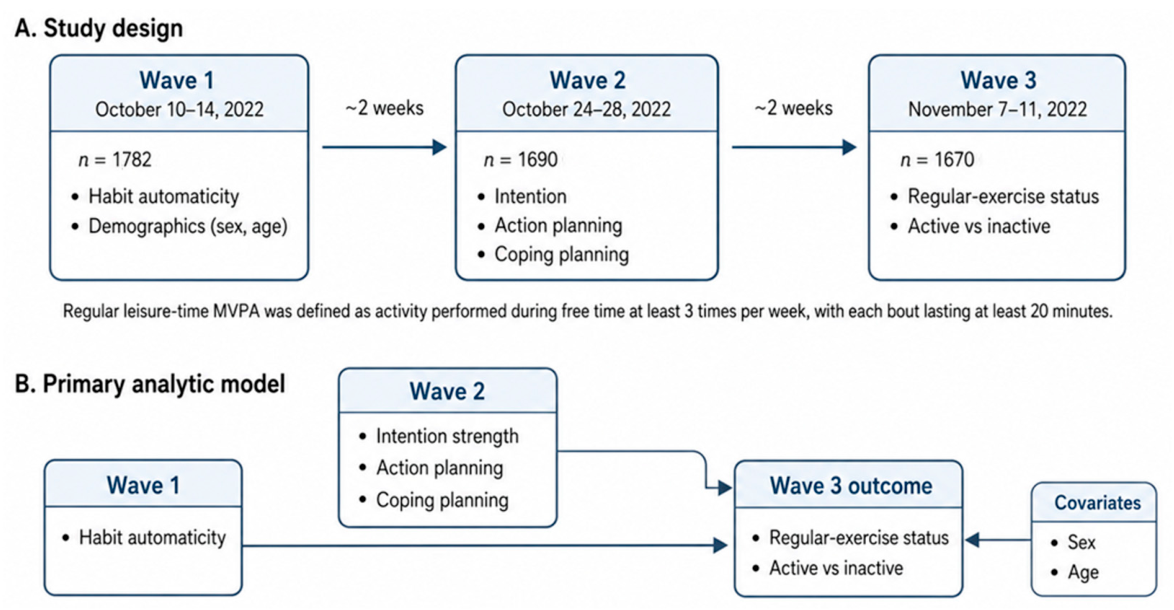
The present study addressed this gap by testing a partial volitional action-control model of regular leisure-time moderate-to-vigorous physical activity (MVPA) in Chinese undergraduates. The three-wave design was used to approximate the temporal sequence implied by action-control theory: prior habit automaticity as an indicator of established routine strength, subsequent intention and planning as post-intentional volitional processes, and later regular-exercise status as the enactment outcome. This design also reduced the limitations of assessing all focal constructs at a single time point and allowed a more prospective test of which post-intentional processes distinguish successful from unsuccessful intenders. We examined whether Wave 2 action planning and coping planning and Wave 1 habit automaticity distinguished which students later met a matched regular-exercise criterion at Wave 3. We also quantified action-control profiles—successful intenders, unsuccessful intenders, non-intenders who remained inactive, and non-intenders who were nevertheless active—and evaluated whether the conclusions were robust across alternative intention thresholds. This classification directly matched the study question because the central issue was not simply whether intention predicted behavior, but which post-intentional processes distinguished intenders who later reported regular exercise from intenders who did not. Guided by HAPA and M-PAC, we expected that stronger planning and stronger habit automaticity would be associated with successful exercise enactment. Because the literature is mixed regarding the comparative value of action planning versus coping planning, and because habit automaticity may potentially modify planning effects, these were treated as empirical questions.
3. Results
3.1. Attrition Analysis, Psychometric Properties, and Zero-Order Associations
An attrition analysis compared students retained in the final analytic sample (
n = 1670) with students who completed Wave 1 but were excluded from the final analysis because of incomplete data across waves (
n = 112). As shown in
Supplementary Table S6, retained and excluded participants did not differ significantly in age or Wave 1 habit automaticity. They differed significantly in sex distribution, although the effect size was small: excluded participants had a higher proportion of female students than the final analytic sample. These results suggest that attrition was limited and that the final analytic sample was broadly comparable to the initial Wave 1 sample on the available baseline characteristics, with the exception of a small sex-distribution difference.
Scale means indicated moderate-to-positive levels of intention and planning and moderate levels of habit automaticity (
Table 1). Internal consistency was excellent for all focal constructs, with Cronbach’s alphas of 0.91 for habit automaticity, 0.93 for intention, 0.92 for action planning, and 0.90 for coping planning; composite reliability estimates ranged from 0.93 to 0.95. The CFAs strongly supported the distinction between action planning and coping planning. The two-factor planning model fit the data substantially better than the one-factor planning model, and the full four-factor model fit better than the three-factor model in which all planning items were combined (
Supplementary Table S1). Standardized loadings were uniformly strong. These results justified treating action planning and coping planning as empirically distinct constructs in all subsequent analyses.
All focal psychological variables were positively associated with active status at Wave 3. Action planning showed the strongest bivariate association with Wave 3 activity status (r = 0.47), followed by intention (r = 0.47), habit automaticity (r = 0.40), and coping planning (r = 0.33; all p < 0.001). Intercorrelations among the psychological predictors were moderate to strong, especially between action planning and coping planning (r = 0.62) and between intention and action planning (r = 0.61). The correlation between intention and action planning was theoretically expected because action planning is a post-intentional self-regulatory process that is more likely to occur among students with stronger motivational commitment. However, this association did not indicate construct redundancy. The correlation of r = 0.61 corresponds to approximately 37% shared variance, leaving substantial nonshared variance between the constructs. In addition, the CFA results supported separating intention and action planning within the full four-factor model, and the measures were operationally distinct: intention assessed motivational commitment to perform regular leisure-time MVPA, whereas action planning assessed specific implementation details regarding when, where, what type, and how often the behavior would be performed. Taken together, the distinct item content, substantial nonshared variance, and four-factor CFA results provided evidence for the discriminant validity of intention and action planning in the present study.
3.2. Action-Control Profiles Under the Primary Intention Threshold
Using the primary threshold (mean intention ≥4.0), participants were classified into the four action-control groups shown in
Table 2. In these results, active status refers to students who self-reported currently meeting the study’s regular leisure-time MVPA criterion; no separate continuous MVPA frequency, duration, or minutes-per-week variable was analyzed. Of the 1670 participants, 43.23% were successful intenders, 23.77% were unsuccessful intenders, 24.73% were non-intenders who were inactive, and 8.26% were non-intenders who were active despite not meeting the intention threshold. The intention-behavior gap among intenders was 35.48%. Additional group-level descriptives are summarized in
Supplementary Table S2. Because the total numbers of female and male students differed, sex differences in the action-control profiles were examined descriptively using within-sex percentages rather than raw counts alone. The supplementary descriptives showed a pattern consistent with the adjusted models: female students were less likely than male students to be classified in the active groups overall, defined as successful intenders plus non-intenders who were active (42.69% vs. 58.71%). In brief, successful intenders showed the highest mean levels of action planning, habit automaticity, and intention, whereas non-intenders who were inactive showed the lowest levels on those same variables.
3.3. Hierarchical Logistic Regression Predicting Successful Enactment
Primary inferential analyses were conducted among participants classified as intenders under the primary threshold (
n = 1119). Results of the five logistic regression models are shown in
Table 3, with model-fit statistics and nested-model comparisons reported in
Supplementary Table S3.
In Model 1, female students had lower odds of being active at Wave 3 than male students, whereas age was not associated with successful enactment. Adding action planning and coping planning in Model 2 significantly improved model fit over Model 1. Within this model, action planning was a strong positive predictor of successful enactment, whereas coping planning did not account for unique variance after adjustment for sex and age.
Model 3 further improved its fit by adding habit automaticity. In this model, habit automaticity emerged as a significant positive predictor, and action planning remained strongly associated with successful enactment. Coping planning again remained non-significant.
Model 4 tested whether habit automaticity moderated the effects of action planning and coping planning. Adding the two interaction terms did not improve model fit relative to Model 3, and neither interaction term was statistically significant. Consistent with these regression results, the predicted-probability plots in
Supplementary Figures S1 and S2 show broadly parallel lines rather than visibly diverging functions.
Finally, Model 5 added continuous intention strength and again improved model fit. In the final model, stronger action planning, stronger habit automaticity, and stronger intention strength each independently predicted greater odds of being active at Wave 3, whereas coping planning did not show unique predictive value. Female students continued to have lower odds of successful enactment than male students, and age remained non-significant. The interaction terms also remained non-significant. The final model showed the strongest overall fit of the primary models (Nagelkerke R2 = 0.336).
Taken together, the primary-threshold analyses indicate that, among students who already intended to exercise regularly, successful enactment was prospectively distinguished by stronger action planning, stronger habit automaticity, and stronger intention strength. By contrast, coping planning did not add unique explanatory value once these variables were considered simultaneously.
3.4. Sensitivity Analyses
Sensitivity analyses examined whether the substantive conclusions depended on where the cutoff was placed for classifying participants as intenders. As shown in
Supplementary Table S4, changing the threshold altered the descriptive size of the intention-behavior gap in the expected direction. The gap increased to 39.86% under the more inclusive threshold of mean intention >3.5, decreased to 17.66% under the stricter threshold of mean intention ≥5.0, and was 39.41% under the single-item threshold. Thus, the descriptive prevalence of successful and unsuccessful intenders depended partly on the cutoff used to define intenders, but this variation followed the expected pattern whereby stricter thresholds selected a more committed subset of intenders.
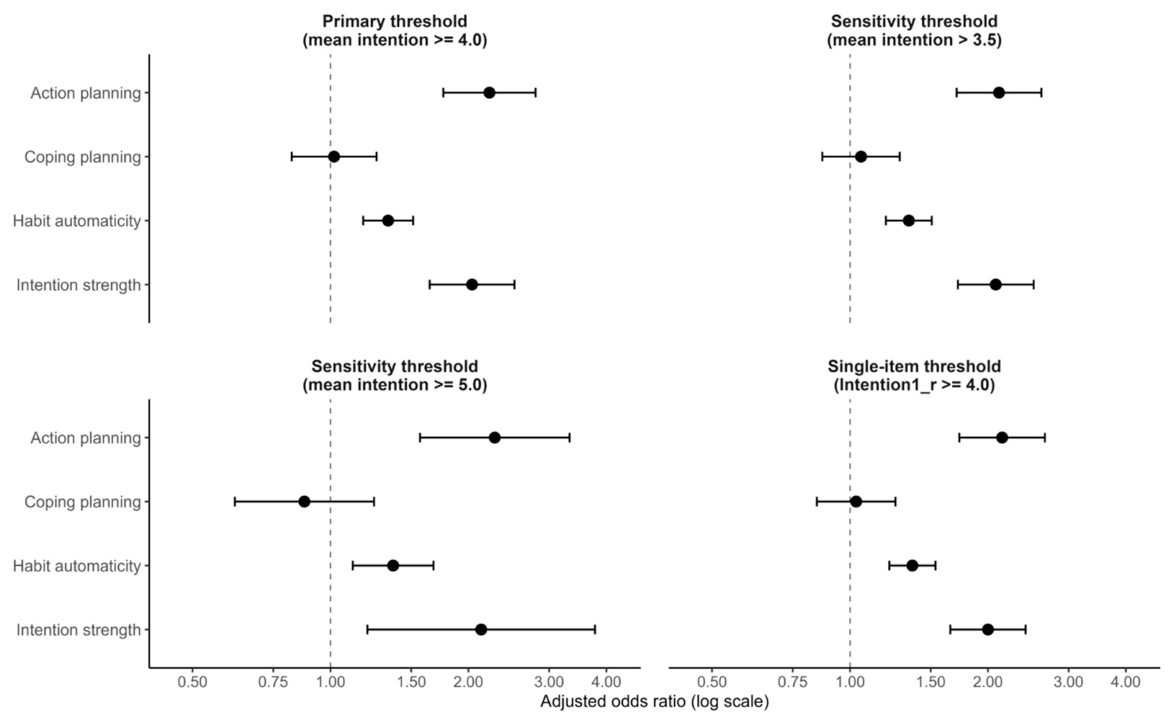
Importantly, however, the regression pattern was highly stable across all three sensitivity specifications (
Supplementary Table S5;
Figure 2). Across the alternative thresholds, stronger action planning, stronger habit automaticity, and stronger intention strength each remained significant predictors of successful enactment, whereas coping planning remained non-significant. Female sex also remained a significant negative predictor, while age remained unrelated to the outcome. Neither planning x habit interaction was supported in any of the sensitivity models. Thus, although the descriptive size of the intention-behavior gap varied across threshold definitions, the substantive conclusion was robust: successful enactment was consistently characterized by stronger action planning, stronger habit automaticity, and stronger intention strength, whereas coping planning did not show unique prospective predictive value.
4. Discussion
4.1. Intention–Behavior Gap and Successful Self-Reported Exercise Enactment
This three-wave study examined which post-intentional processes distinguish successful from unsuccessful intenders in self-reported regular leisure-time MVPA enactment among Chinese undergraduates. Four findings were central. First, a substantial intention-behavior gap was observed under the primary threshold, with more than one-third of intenders failing to report meeting the regular-exercise criterion at follow-up. Second, among students who intended to exercise regularly, stronger action planning, stronger habit automaticity, and stronger intention strength prospectively distinguished those who later reported meeting the behavior criterion from those who did not. Third, coping planning did not show unique predictive value once action planning, habit automaticity, and intention strength were considered simultaneously. Fourth, the substantive pattern was robust across different cutoff scores used to classify participants as intenders. Taken together, these findings support an action-control account of student exercise behavior in which intention remains important but is insufficient without complementary regulatory and reflexive resources (
Feil et al., 2023;
Rhodes, 2021). Because the dependent variable was self-reported regular-exercise status, references to successful MVPA enactment in the Results and Discussion should be understood as meeting this stage-based regular-exercise criterion, rather than as objectively measured MVPA frequency, duration, intensity, or volume.
The active non-intender group also deserves brief theoretical consideration. Although this group was relatively small and was not central to the primary research question, it suggests that self-reported regular exercise can occur even when students do not meet the predefined intention threshold. Such cases may reflect established routines or habit-like automaticity, social or environmental facilitation, weak explicit intention combined with strong contextual cues, or measurement mismatch between the intention threshold and the stage-based behavior item. We did not analyze this group further because the primary inferential question concerned successful versus unsuccessful enactment among intenders; however, future studies could examine active non-intenders more directly to clarify when physical activity is maintained with relatively low conscious intention.
4.2. Relative Roles of Action Planning and Coping Planning
The most theoretically consequential finding was that action planning, rather than coping planning, emerged as the uniquely important planning variable among students who already intended to exercise regularly. This result fits the broader planning literature in one respect and departs from it in another. On the one hand, it is consistent with evidence that planning can help bridge the intention-behavior gap in physical activity and that both action planning and coping planning tend to show positive associations with activity behavior in aggregate (
Carraro & Gaudreau, 2013). On the other hand, it contrasts with the recent meta-analytic structural equation modeling study by Wang et al., which suggested that coping planning may be the more important indirect pathway from intention to behavior (
Wang et al., 2025). The present findings therefore suggest that the relative value of specific planning forms may be context-dependent.
In the present sample of university students, the immediate challenge may have been translating an already formed intention into a repeated, scheduled routine. Under this behavioral context, specifying when, where, what type of activity, and how often to exercise may have been more directly relevant than preparing for possible barriers in a general way. This interpretation does not imply that competing goals or environmental constraints are irrelevant to coping planning. Rather, in routine student exercise contexts, these constraints may first need to be managed through concrete scheduling and daily life organization, whereas coping planning may become more important when barriers are especially salient, disruptive, or personally difficult to overcome (
Brown et al., 2024;
Carraro & Gaudreau, 2013;
Wang et al., 2025).
The null unique effect for coping planning should not be interpreted as evidence that coping planning is unimportant in general. Rather, it suggests that its role may be more contingent than that of action planning in this specific population, behavioral context, and analytic design. Coping planning may become especially important when barriers are salient, immediate, and personally consequential, such as during examination periods, schedule disruptions, facility constraints, poor weather, or competing academic demands. It may also be more predictive when students have sufficient self-efficacy or perceived behavioral control to implement barrier management strategies effectively. This possibility is consistent with Hou et al., who found that planning-related exercise processes depended on self-efficacy in Chinese students (
Hou et al., 2022), and with Wang et al., whose meta-analytic model incorporated perceived behavioral control as an important upstream determinant (
Wang et al., 2025). The present study did not directly assess barrier salience, self-efficacy, or perceived control; therefore, the findings should not be interpreted as a definitive test of when coping planning matters most.
In addition, the present linear logistic models cannot rule out the possibility that coping planning operates as a threshold, prerequisite, or nonlinear condition, such that some coping planning may be necessary for maintaining regular exercise, but higher levels beyond that point may not further increase enactment. In the present study, participants were already classified as intenders, and the target behavior was a clearly defined monthly regular-exercise pattern. Because the primary regression was restricted to intenders, the non-significant coping-planning finding should also not be generalized to non-intenders or to earlier transitions from non-intention to action, where barrier management may play a different role. Under those conditions, concrete scheduling may have been the more proximal requirement for success than generating obstacle-management strategies. Thus, the present findings qualify, rather than contradict, the emerging literature on coping planning by indicating that its unique role may vary across populations, designs, and behavioral contexts (
Wang et al., 2025;
Hou et al., 2022).
4.3. Habit Automaticity as a Reflexive Action-Control Resource
Habit automaticity also showed a robust independent association with successful enactment, even after planning and intention strength were entered into the model. This finding aligns closely with the M-PAC framework, which proposes that regulatory processes help preserve concordance between reflective motivation and behavior until reflexive processes such as habit begin to co-determine action control (
Rhodes, 2021). It is also consistent with habit theory more broadly, which characterizes habit as context-linked automaticity that can sustain behavior with reduced deliberative effort once repetition has occurred in stable contexts (
Gardner, 2015).
Conceptually, habit automaticity should not be equated with actual MVPA behavior; it captures the subjective automaticity with which leisure-time MVPA is initiated or performed, whereas regular-exercise status classifies whether students reported meeting a defined behavioral criterion. Importantly, the present findings do not imply that habit operates independently of reflective processes; rather, they indicate that habit automaticity contributed unique variance above and beyond planning and intention.
However, because baseline exercise behavior was not measured, this association should not be interpreted as evidence that habit automaticity predicted later regular-exercise status independently of prior exercise behavior. Habit automaticity is formed through repeated behavioral experience; therefore, Wave 1 habit automaticity may have partly reflected already established exercise routines or prior exercise history. In this sense, the results support an integrated perspective in which successful exercise enactment depends on both self-regulatory preparation and growing behavioral automaticity, a point that recent reviews have highlighted as increasingly important for the next generation of physical activity behavior change research (
Rhodes, 2021;
Gardner, 2015;
Simpson et al., 2025).
A further notable finding was that continuous intention strength remained a significant predictor even within the subgroup classified as intenders. This pattern reinforces the view that classifying participants as intenders or non-intenders based on a cutoff score is useful for action-control classification, but it does not exhaust all meaningful variation in motivational commitment. Rhodes and Rebar argued that physical activity intention measures often combine both a decision component and a strength or commitment component (
Rhodes & Rebar, 2017). The present results fit that argument well: once participants met the cutoff for being classified as intenders, those with stronger intentions were still more likely to enact them. This result also complements the broader intention-gap literature by showing that intention is neither sufficient nor irrelevant. Rather, intention continues to matter alongside post-intentional processes, which helps explain why the intention-behavior gap persists despite the predictive importance of intention itself (
Feil et al., 2023;
Rhodes & Rebar, 2017).
By contrast, the hypothesized habit x planning interactions were not supported. In the present data, habit automaticity and action planning appeared to function additively rather than multiplicatively. This result differs from Zhu et al., who reported a significant action planning x habit interaction in Chinese college students (
Zhu et al., 2022), but it is not inconsistent with the broader literature, which has reported mixed evidence on whether habit weakens, strengthens, or leaves unchanged the role of deliberative predictors. Differences in study design may be relevant here. Zhu et al. used a two-wave moderated mediation approach focused on general exercise behavior, whereas the present study used a three-wave action-control design, a threshold-matched regular-exercise outcome, and complete-case logistic models among intenders only (
Zhu et al., 2022). These design differences may have narrowed the question from general exercise correlates to the more specific problem of successful enactment among already motivated individuals. Under those conditions, main effects may be more stable than interactions. Accordingly, the present data favor the interpretation that action planning and habit automaticity each contribute to successful enactment without strong evidence that one changes the effectiveness of the other (
Rhodes, 2021;
Zhu et al., 2022).
4.4. Sex Differences in Successful Enactment
The sex effect in the present study also warrants comment as a distinct contextual finding. Female students were less likely than male students to be successful intenders across the primary and sensitivity models, whereas age was consistently unrelated to successful enactment. This pattern is consistent with broader evidence that insufficient physical activity is generally more prevalent among female than male adults globally and with recent evidence from Chinese university students showing lower high-volume MVPA participation among female students than male students (
Strain et al., 2024;
Deng et al., 2024). Thus, the observed sex difference provides some support for the external or nomological validity of the self-reported regular-exercise status outcome.
Importantly, female sex remained a significant negative predictor even after adjustment for action planning, coping planning, habit automaticity, and intention strength. This pattern suggests that the lower likelihood of successful enactment among female students may not be fully explained by the self-regulatory and reflexive processes measured in the present study. Instead, the intention–behavior gap for female students may also reflect external or contextual constraints that interfere with translating intention into regular exercise, such as unequal perceived access to exercise spaces, safety concerns, gendered social norms in campus sport or fitness settings, lower social support, or competing academic and daily life demands.
We caution against overinterpreting the mechanism of this effect because the present model did not include constructs that may help explain sex-linked disparities, such as perceived opportunity, social support, identity, safety, facility access, or gendered opportunity structures. However, this result is compatible with the broader student physical activity literature showing that enactment depends on contextual and social conditions, not only on motivation or planning. Future research should therefore test whether the lower odds of successful enactment among female students reflect differences in opportunity, competing demands, or other contextual constraints rather than weaker volitional processes per se (
Brown et al., 2024).
4.5. Strengths, Limitations, and Future Directions
Several strengths increase confidence in the present conclusions. The study used a three-wave design, clearly separated the temporal ordering of habit automaticity, planning, and behavior, employed a behaviorally matched intention and outcome criterion, and tested robustness across multiple cutoff scores for classifying participants as intenders. The psychometric evidence was also strong: action planning and coping planning were empirically distinguishable, and all focal scales showed excellent reliability. These robustness analyses are especially important because intention measures in physical activity research often combine decisional and strength-related meaning; demonstrating stable conclusions across different intention cutoffs strengthens the defensibility of the main results (
Rhodes & Rebar, 2017).
At the same time, several limitations should be acknowledged. First, all key variables were measured using self-report questionnaires, which may introduce recall bias, social desirability bias, and shared-method variance. This limitation is especially important for the dependent variable. Regular-exercise status was assessed using a single stage-based self-report item rather than objective physical activity indicators such as accelerometry, device-based MVPA minutes, or detailed activity logs. Therefore, the findings should be interpreted as explaining self-reported regular-exercise status rather than objectively measured MVPA frequency, duration, intensity, or total volume. The outcome was a stage-based active versus inactive indicator, which captures successful enactment or continuation of regular exercise but does not separate students who newly initiated regular exercise from those who were already maintaining regular exercise. Although this outcome was behaviorally matched to the intention items and was appropriate for the study’s action-control classification, it does not allow conclusions about objectively verified MVPA or compliance with guideline-based activity thresholds. This binary classification may also reduce behavioral information and limit comparability with studies using continuous MVPA frequency, duration, or volume outcomes. Another measurement consideration is that the focal predictors used different response scales; although these formats were retained to remain consistent with established measures, raw means and per-unit odds ratios should not be interpreted as directly comparable effect magnitudes across constructs. Future studies should incorporate device-based or diary-based physical activity measures to test whether the present action-control pattern generalizes objectively assessed MVPA. Future work should also test whether coping planning has nonlinear, threshold, or subgroup-specific effects, particularly among students facing salient barriers or lower perceived control.
A particularly important limitation is that baseline exercise behavior was not collected. Therefore, we could not conduct an additional analysis controlling for baseline exercise status, nor could we determine whether students were initiating regular exercise, maintaining an existing routine, or resuming a previous routine. This limitation is especially relevant for interpreting habit automaticity. Because habit automaticity develops through repeated performance in stable contexts, Wave 1 habit automaticity may have partly reflected already established exercise behavior rather than functioning as a behavior-free antecedent of later exercise status. Accordingly, the habit findings should be interpreted as prospective associations between baseline automaticity or established exercise routine strength and later self-reported regular-exercise status, rather than as evidence that habit automaticity predicts follow-up exercise independently of baseline behavior.
Intention and planning were measured in the same wave, so the study should not be interpreted as a formal mediation test. Finally, the use of complete-case analysis may have reduced precision if missingness was systematic, and the single-country undergraduate sample limits generalizability. These limitations suggest caution in causal interpretation, but they do not undermine the central action-control pattern observed here.
4.6. Practical Implications
The practical implications are reasonably clear. For university students who already want to exercise regularly, interventions may benefit more from helping them construct concrete action plans and repeat those plans in stable contexts than from assuming that additional motivational enhancement or general, non-specific obstacle-management planning alone will be sufficient. However, this implication should be interpreted in relation to the present study population and outcome. The findings do not suggest that coping planning should be abandoned, nor do they show that coping planning is unimportant for all students or under all conditions. Rather, among students who already intended to exercise regularly, concrete action planning may have been the more immediate self-regulatory requirement for reporting regular exercise at follow-up. A useful next step for intervention research would be to test whether action planning is especially effective early in the enactment process, whereas coping planning becomes more relevant under heightened barriers, lower perceived control, or transitions that disrupt routine.
Although the present sample was limited to Chinese undergraduates, the intention–behavior gap is not unique to this context; students in many countries face similar challenges in translating physical activity intentions into action, including time pressure, competing academic or work demands, social influences, screen-based routines, and variable access to supportive activity environments. What may differ across countries and education systems is the relative weight of these barriers. In the Chinese university context, academic expectations, campus living arrangements, peer norms, and structured educational schedules may shape when planning is feasible and whether repeated exercise can become habitual. Thus, the present findings should be viewed as both theoretically relevant to student physical activity more broadly and contextually conditioned by the cultural and educational environment in which the study was conducted.
More broadly, recent work in physical activity behavior change has emphasized the need to study behavior change more dynamically, to prioritize maintenance, and to better understand automatic processes. The present findings support those priorities by showing that, among students who already intended to exercise regularly, self-reported enactment was best characterized by strong intention, concrete action planning, and habit-like automaticity. Coping planning should still be understood as a volitional obstacle-management strategy, but it did not show unique predictive value in the present adjusted models (
Brown et al., 2024;
Simpson et al., 2025).