


Incorporating the Psychological Perspective into Traditional Prevention in Pediatric Dentistry with the PaFein+ Project: Trained Parents Can Help

 , ,
, ,  , , ,
, , ,
Abstract
1. Introduction
1.1. Background
1.2. Objectives
2. Materials and Methods
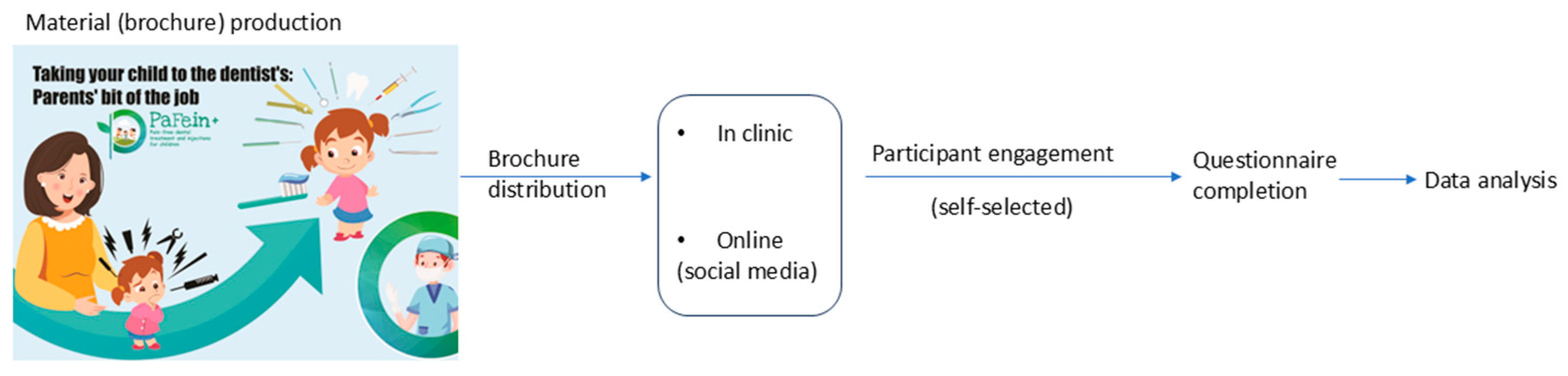
2.1. Study Design
2.2. Setting
2.3. Participants
2.4. Bias
2.5. Study Sampling and Sample Size
2.6. Variables and Data Sources
- -
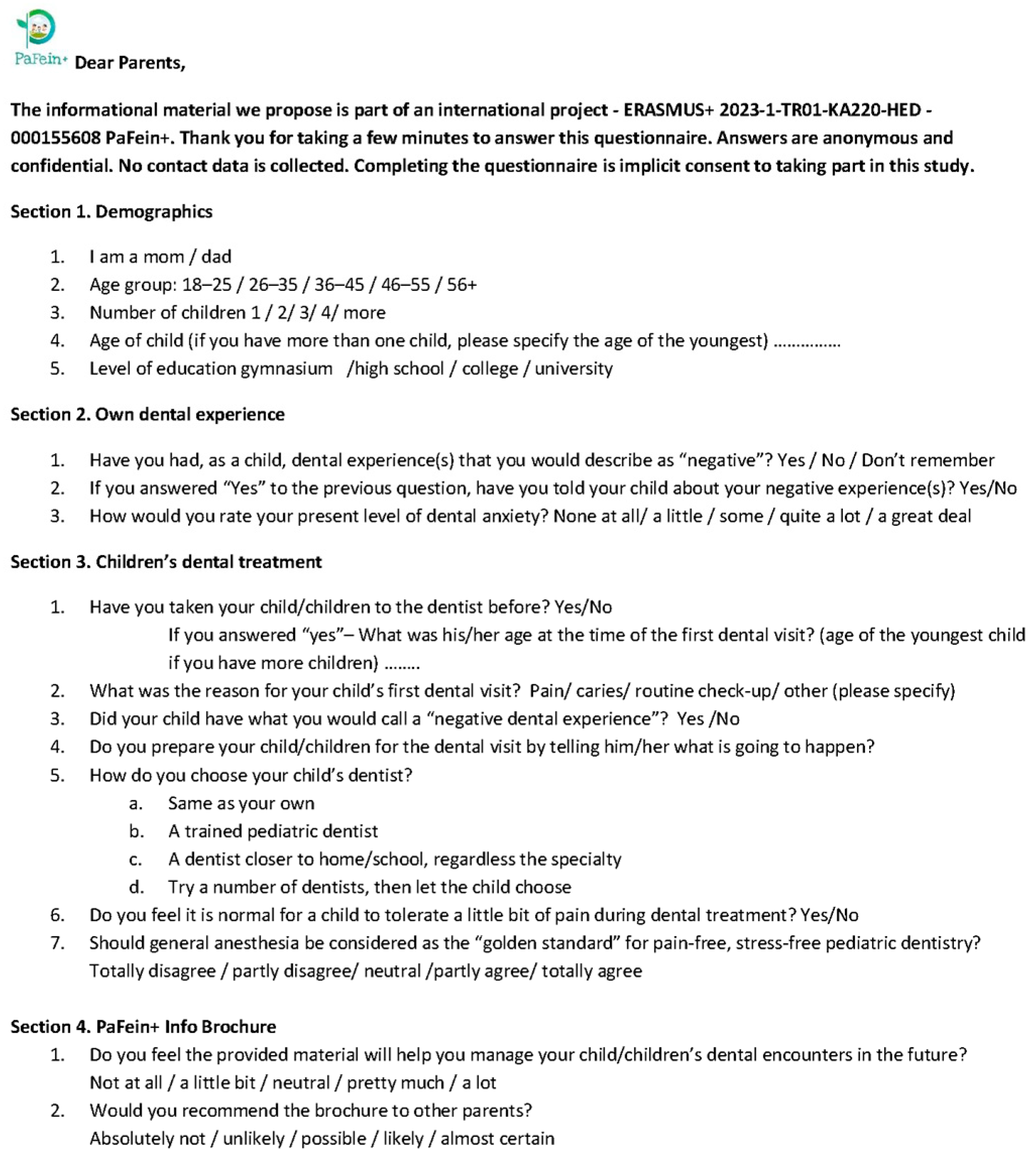
- Section 1 collected demographic information (parent gender, age group, number of children, age of children, level of education);
- -
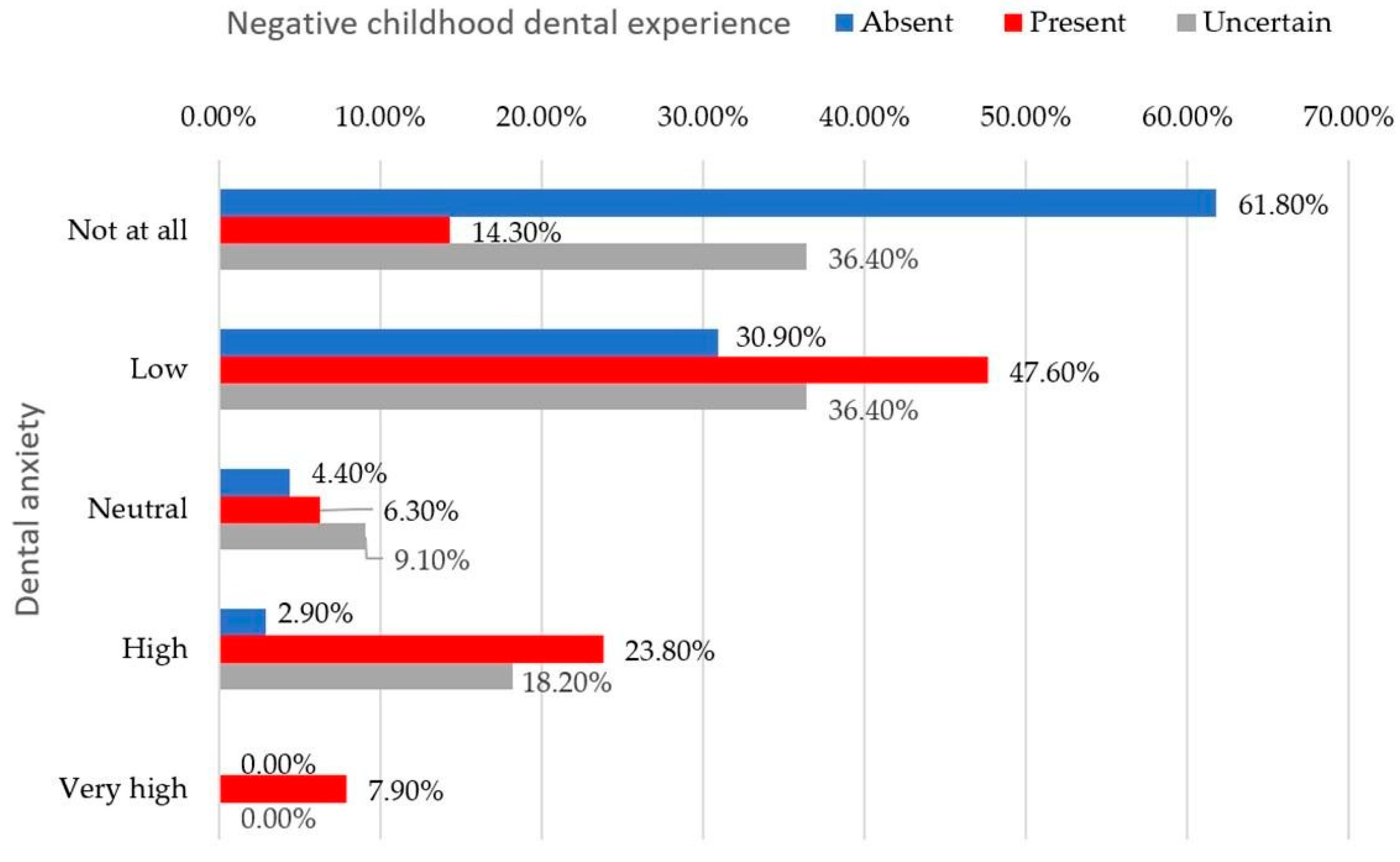
- Section 2 included three questions addressing the parents’ own childhood dental experiences and current attitudes toward dental care. Childhood dental experiences subjectively recalled as negative—defined as “dental experiences that you would describe as negative”—were recorded using a Yes/No/Don’t remember scale. The extent to which parents shared such negative experiences with their children was also assessed. To maintain simplicity in the questionnaire, participants’ current self-perceived level of dental anxiety was measured by a single-item self-report measure, using a five-point Likert scale (“none at all/a little/some/quite a lot/a great deal”);
- -
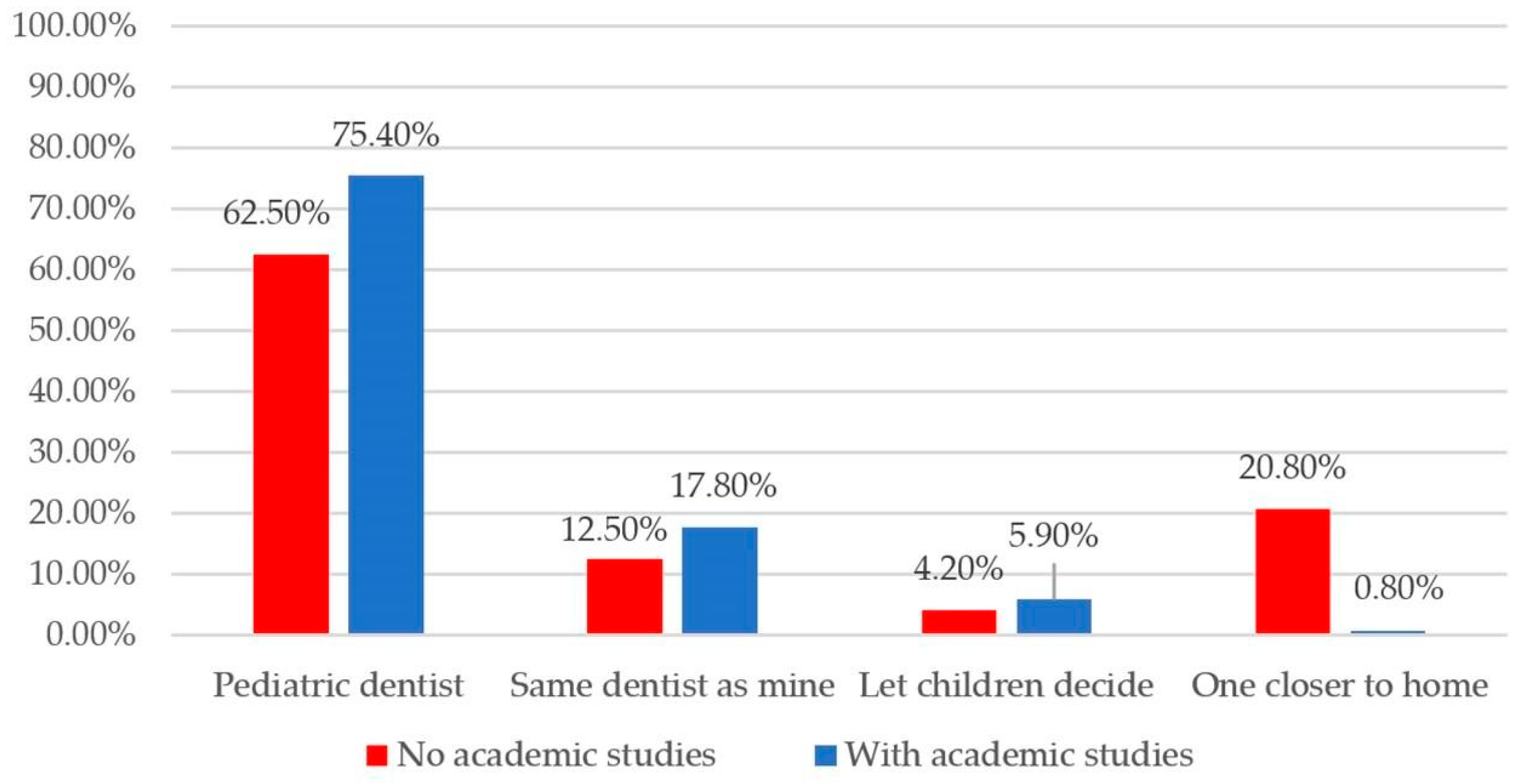
- Section 3—explored parental attitudes toward their children’s dental treatment (previous dental visit with children, reason for dental visit, recalled children’s negative dental experience, preparation of children for dental visit, opinion about dental pain tolerance in children, opinion about general anesthesia as gold standard, preferred criteria for selecting a dentist for their children).
- -
- Section 4 assessed the subjectively perceived usefulness of the educational material provided (opinion regarding helpfulness of PaFein+ brochure, level of recommendation to other parents).
2.7. Statistical Methods
3. Results
3.1. Demographic Data
3.2. Parents’ Own Childhood Dental Experiences and Current Level of Dental Anxiety
3.3. Attitudes Toward Children’s Dental Treatment
3.4. Perceived Usefulness of Provided Information
4. Discussion
4.1. Key Results
4.2. Limitations
5. Conclusions
Author Contributions
Funding
Institutional Review Board Statement
Informed Consent Statement
Data Availability Statement
Acknowledgments
Conflicts of Interest
Abbreviations
| PD | Pediatric Dentistry |
| BG | Behavior Guidance |
References
- Bagattoni, S., Nascimben, F., Biondi, E., Fitzgibbon, R., Lardani, L., Gatto, M. R., Piana, G., & Mattarozzi, K. (2022). Preparing children for their first dental visit: A guide for parents. Healthcare, 10, 2321. [Google Scholar] [CrossRef]
- Besiroglu-Turgut, E., Kayaalti-Yuksek, S., & Bulut, M. (2024). Evaluation of the relationship between dental anxiety and oral health status of mothers and their children. BMC Oral Health, 24, 749. [Google Scholar] [CrossRef] [PubMed]
- Dahlander, A., Soares, F., Grindefijord, M., & Dahllöf, G. (2019). Factors associated with dental fear and anxiety in children aged 7 to 9 years. Dentistry Journal, 7, 68. [Google Scholar] [CrossRef] [PubMed]
- Dalsochio, L., Montagner, A. F., Tedesco, T. K., Maske, T. T., & van de Sande, F. H. (2025). Experiences and parents’ perceptions regarding dental interventions performed on their children: A qualitative systematic review. International Journal of Paediatric Dentistry, 35, 1029–1045. [Google Scholar] [CrossRef] [PubMed]
- Deshpande, A., Jain, A., Shah, Y., Jaiswal, V., & Wadhwa, M. (2002). Effectiveness of self-designed dental storybook as behaviour modification technique in 5–7 year-old children: A randomized controlled study. Journal of Indian Society of Pedodontics and Preventive Dentistry, 40, 253–259. [Google Scholar] [CrossRef]
- Doğan, G. K., Polat, Y., & Özüdoğru, S. (2025). Parental awareness and attitudes towards pediatric dentistry and children’s oral health. BMC Oral Health, 25(1), 672, (Erratum in 2026, BMC Oral Health, 26(1), 139). [Google Scholar] [CrossRef]
- Emerson, L. M., Ogielda, C., & Rowse, G. (2019). A systematic review of the role of parents in the development of anxious cognitions in children. Journal of Anxiety Disorders, 62, 15–25. [Google Scholar] [CrossRef]
- Erdede, O., Sari, E., Uygur Külcü, N., & Sezer Yamanel, R. (2022). Parents’ awareness of their children’s oral-dental health: Knowledge, attitudes and practices. Medicine Science|International Medical Journal, 11, 1599. [Google Scholar] [CrossRef]
- Fox, C., & Newton, J. T. (2006). A controlled trial of the impact of exposure to positive images of dentistry on anticipatory dental fear in children. Community Dentistry and Oral Epidemiology, 34, 455–459. [Google Scholar] [CrossRef]
- Freeman, R. (2007). Viewing positive images of dentistry reduces anticipatory anxiety in children. Evidence-Based Dentistry, 8, 47. [Google Scholar] [CrossRef][Green Version]
- Grisolia, B. M., Dos Santos, A. P. P., Dhyppolito, I. M., Buchanan, H., Hill, K., & Oliveira, B. H. (2021). Prevalence of dental anxiety in children and adolescents globally: A systematic review with meta-analyses. International Journal of Paediatric Dentistry, 31, 168–183. [Google Scholar] [CrossRef] [PubMed]
- Kaushik, M., & Sood, S. (2023). A systematic review of parents’ knowledge of children’s oral health. Cureus, 15(7), e41485. [Google Scholar] [CrossRef] [PubMed]
- Marshman, Z., Rodd, H., Fairhurst, C., Porritt, J., Dawett, B., Day, P., Innes, N., Vernazza, C., Newton, T., Ronaldson, S., Cross, L., Ross, J., Baker, S. R., Hewitt, C., Torgerson, D., & Ainsworth, H. (2023). The CALM trial protocol: A randomised controlled trial of a guided self-help cognitive behavioural therapy intervention to reduce dental anxiety in children. Trials, 24, 15. [Google Scholar] [CrossRef] [PubMed]
- Meshki, R., Basir, L., Alidadi, F., Behbudi, A., & Rakhshan, V. (2018). Effects of pretreatment exposure to dental practice using a smartphone dental simulation game on children’s dental anxiety: A preliminary double-blind randomized clinical trial. Journal of Dentistry, 15, 250–258. [Google Scholar]
- Mittal, M., Chopra, R., Malhotra, D., Dharmasya, T., Gupta, N., Lokade, A., & Atri, M. (2025). Impact of dentistry modeling story on dental anxiety in 6–8-year-old children of industrial workers: A randomized controlled trial. Journal of Indian Society of Pedodontics and Preventive Dentistry, 43, 95–103. [Google Scholar] [CrossRef]
- Murshid, E. Z. (2017). Effectiveness of a preparatory aid in facilitating oral assessment in a group of Saudi children with autism spectrum disorders in Central Saudi Arabia. Saudi Medical Journal, 38, 533–540. [Google Scholar] [CrossRef]
- Nowak, A. J., & Casamassimo, P. S. (2002). The dental home: A primary care oral health concept. The Journal of the American Dental Association, 133, 93–98. [Google Scholar] [CrossRef]
- Oliveira, M. A., Vale, M. P., Bendo, C. B., Paiva, S. M., & Serra-Negra, J. M. (2017). Influence of negative dental experiences in childhood on the development of dental fear in adulthood: A case-control study. Journal of Oral Rehabilitation, 44, 434–441. [Google Scholar] [CrossRef]
- Ollendick, T. H., & King, N. J. (1991). Origins of childhood fears: An evaluation of Rachman’s theory of fear acquisition. Behaviour Research and Therapy, 29, 117–123. [Google Scholar] [CrossRef]
- Olsson, A., Nearing, K. I., & Phelps, E. A. (2007). Learning fears by observing others: The neural systems of social fear transmission. Social Cognitive and Affective Neuroscience, 2(1), 3–11. [Google Scholar] [CrossRef]
- Padung, N., Singh, S., & Awasthi, N. (2022). First dental visit: Age, reasons, oral health status, and dental treatment needs among children aged 1 month to 14 years. International Journal of Clinical Pediatric Dentistry, 15, 394–397. [Google Scholar] [CrossRef]
- Porritt, J., Buchanan, H., Hall, M., Gilchrist, F., & Marshman, Z. (2013). Assessing children’s dental anxiety: A systematic review of current measures. Community Dentistry and Oral Epidemiology, 41, 130–142. [Google Scholar] [CrossRef]
- Porritt, J., Rodd, H., Morgan, A., Williams, C., Gupta, E., Kirby, J., Creswell, C., Newton, T., Stevens, K., & Baker, S. (2016). Development and testing of a cognitive behavioral therapy resource for children’s dental anxiety. JDR Clinical & Translational Research, 2, 23–37. [Google Scholar]
- Raadal, M., Strand, G. V., Amarante, E. C., & Kvale, G. (2002). Relationship between caries prevalence at 5 years of age and dental anxiety at 10. European Journal of Paediatric Dentistry, 3, 22–26. [Google Scholar]
- Rachman, S. (1977). The conditioning theory of fear-acquisition: A critical examination. Behaviour Research and Therapy, 15(5), 375–387. [Google Scholar] [CrossRef]
- Ramesh, R., Sathyaprasad, S., Nandan, S., Havaldar, K. S., & Antony, A. (2024). Assessment of preappointment parental counseling on dental fear and anxiety in children in pedodontic dental operatory: A randomized controlled trial. International Journal of Clinical Pediatric Dentistry, 17, 346–351. [Google Scholar] [CrossRef]

| Parameter | Value |
|---|---|
| Section 1 | |
| Parent—gender (female) (No., %) | 125 (88%) |
| Parent—age (No., %) | |
| 18–25 years | 3 (2.1%) |
| 26–35 years | 20 (14.1%) |
| 36–45 years | 74 (52.1%) |
| 46–55 years | 42 (29.6%) |
| >55 years | 3 (2.1%) |
| Number of children (No., %) | |
| One | 62 (43.7%) |
| Two | 74 (52.1%) |
| Three | 6 (4.2%) |
| Child—age (mean ± SD, median (IQR)) | 8.4 ± 5.17, 8 (5–11) |
| Parent education (No., %) | |
| Lower secondary (gymnasium) | 2 (1.4%) |
| Secondary (high school) | 12 (8.5%) |
| Post-secondary (college) | 10 (7%) |
| Tertiary (university) | 118 (83.1%) |
| Section 2 | |
| Negative childhood experiences (No., %) | |
| Absent | 68 (47.9%) |
| Present | 63 (44.4%) |
| Don’t remember | 11 (7.7%) |
| Narration to children (No., %) | |
| Absent | 41 (65.1%) |
| Present | 18 (28.6%) |
| Don’t remember | 4 (6.3%) |
| Dentist anxiety (No., %) | |
| Not at all | 55 (38.7%) |
| Low | 55 (38.7%) |
| Neutral | 8 (5.6%) |
| High | 19 (13.4%) |
| Very high | 5 (3.5%) |
| Section 3 | |
| Dental visit of children (No., %) | 134 (94.4%) |
| Child—age—visit (mean ± SD, median (IQR)) | 4.45 ± 2.3, 4 (3–6) |
| Dental visit—reason (No., %) | |
| Pain | 8 (6.1%) |
| Check-up | 72 (54.5%) |
| Cavity | 32 (24.2%) |
| Other | 20 (15.2%) |
| Child—Negative experiences (No., %) | 12 (8.5%) |
| Informing children before visit (No., %) | 121 (85.2%) |
| Preferred dentist (No., %) | |
| Pediatric dentist | 104 (73.2%) |
| Same dentist as parents’ | 24 (16.9%) |
| Let children decide | 8 (5.6%) |
| One closer to home | 6 (4.2%) |
| Child pain tolerance during treatment—normal (No., %) | 95 (66.9%) |
| General anesthesia—ideal for pain control (No., %) | |
| Highly disagree | 56 (39.4%) |
| Disagree | 29 (20.4%) |
| Neutral | 34 (23.9%) |
| Agree | 20 (14.1%) |
| Highly agree | 3 (2.1%) |
| (a) Anxiety/Children narration (No., %) (N = 63) | Very low | Low | Neutral | High | Very high | p * |
| Absent | 8 (88.9) | 19 (63.3) | 4 (100) | 7 (46.7) | 3 (60) | 0.307 ϕc = 0.296 |
| Present | 1 (11.1) | 10 (33.3) | 0 (0) | 5 (33.3) | 2 (40) | |
| Don’t remember | 0 (0) | 1 (3.3) | 0 (0) | 3 (20) | 0 (0) | |
| (b) Anxiety/General anesthesia as ideal (No., %) (N = 142) | Very low | Low | Neutral | High | Very high | p * |
| Highly disagree | 23 (41.8) | 25 (45.5) | 4 (50) | 4 (21.1) | 0 (0) | 0.124 ϕc = 0.209 |
| Disagree | 9 (16.4) | 10 (18.2) | 1 (12.5) | 8 (42.1) | 1 (20) | |
| Neutral | 11 (20) | 14 (25.5) | 3 (37.5) | 5 (26.3) | 1 (20) | |
| Agree | 9 (16.4) | 6 (10.9) | 0 (0) | 2 (10.5) | 3 (60) | |
| Highly agree | 3 (5.5) | 0 (0) | 0 (0) | 0 (0) | 0 (0) |
| No. | % | ||
| Utility of information booklet | Not at all | 3 | 2.1% |
| Low | 13 | 9.2% | |
| Neutral | 23 | 16.2% | |
| High | 63 | 44.4% | |
| Very high | 40 | 28.2% | |
| Recommendation to other parents | Highly disagree | 0 | 0% |
| Disagree | 7 | 4.9% | |
| Neutral | 5 | 3.5% | |
| Agree | 53 | 37.3% | |
| Highly agree | 77 | 54.2% | |
Disclaimer/Publisher’s Note: The statements, opinions and data contained in all publications are solely those of the individual author(s) and contributor(s) and not of MDPI and/or the editor(s). MDPI and/or the editor(s) disclaim responsibility for any injury to people or property resulting from any ideas, methods, instructions or products referred to in the content. |
© 2026 by the authors. Licensee MDPI, Basel, Switzerland. This article is an open access article distributed under the terms and conditions of the Creative Commons Attribution (CC BY) license.
Share and Cite
Munteanu, A.; Vinereanu, A.; Sfeatcu, R.; Tănase, M.; Condurache, I.-A.; Garret-Bernardin, A.; Putrino, A.; Kușçu, Ö.Ö.; Peker, S.; Kargul, B.; et al. Incorporating the Psychological Perspective into Traditional Prevention in Pediatric Dentistry with the PaFein+ Project: Trained Parents Can Help. Behav. Sci. 2026, 16, 620. https://doi.org/10.3390/bs16040620
Munteanu A, Vinereanu A, Sfeatcu R, Tănase M, Condurache I-A, Garret-Bernardin A, Putrino A, Kușçu ÖÖ, Peker S, Kargul B, et al. Incorporating the Psychological Perspective into Traditional Prevention in Pediatric Dentistry with the PaFein+ Project: Trained Parents Can Help. Behavioral Sciences. 2026; 16(4):620. https://doi.org/10.3390/bs16040620
Chicago/Turabian StyleMunteanu, Aneta, Arina Vinereanu, Ruxandra Sfeatcu, Mihaela Tănase, Ilie-Andrei Condurache, Annelyse Garret-Bernardin, Alessandra Putrino, Özgür Önder Kușçu, Sertac Peker, Betul Kargul, and et al. 2026. "Incorporating the Psychological Perspective into Traditional Prevention in Pediatric Dentistry with the PaFein+ Project: Trained Parents Can Help" Behavioral Sciences 16, no. 4: 620. https://doi.org/10.3390/bs16040620
APA StyleMunteanu, A., Vinereanu, A., Sfeatcu, R., Tănase, M., Condurache, I.-A., Garret-Bernardin, A., Putrino, A., Kușçu, Ö. Ö., Peker, S., Kargul, B., & Galeotti, A. (2026). Incorporating the Psychological Perspective into Traditional Prevention in Pediatric Dentistry with the PaFein+ Project: Trained Parents Can Help. Behavioral Sciences, 16(4), 620. https://doi.org/10.3390/bs16040620

