GenAI-Supported Flipped Learning in Preservice Chemistry Teacher Education: Lesson-Design Performance, Learning Attitude, Self-Regulated Learning, and Critical Thinking Awareness
Abstract
1. Introduction
2. Literature Review
2.1. Constructivism and Flipped Learning
2.2. Generative AI in Higher Education
2.3. AI-Supported Flipped Learning
2.4. Learner-Related Variables in GenAI-Supported Flipped Learning
3. Research Objectives, Research Questions, and Hypotheses
4. Materials and Methods
4.1. Research Design
4.2. Participants and Context
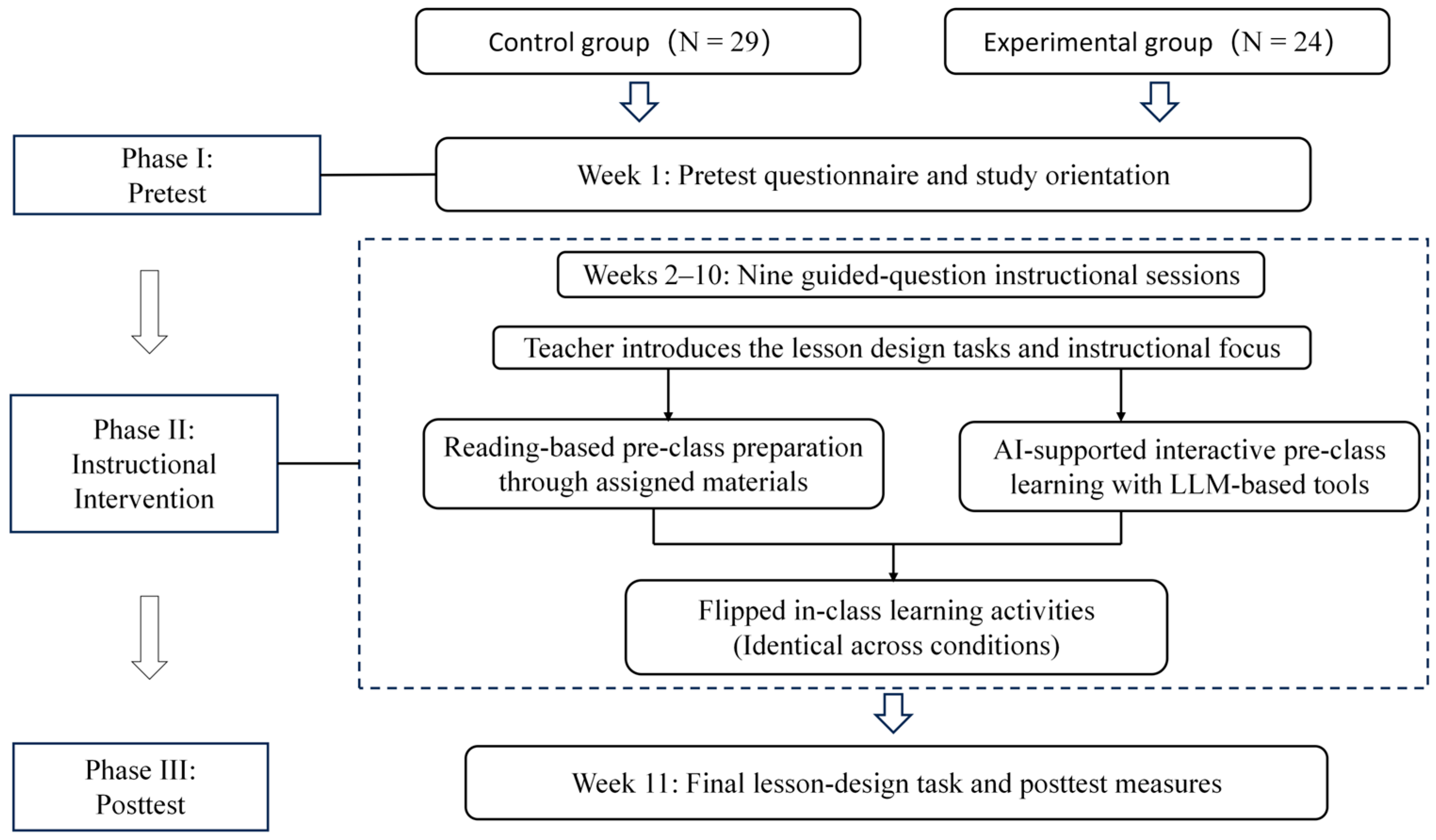
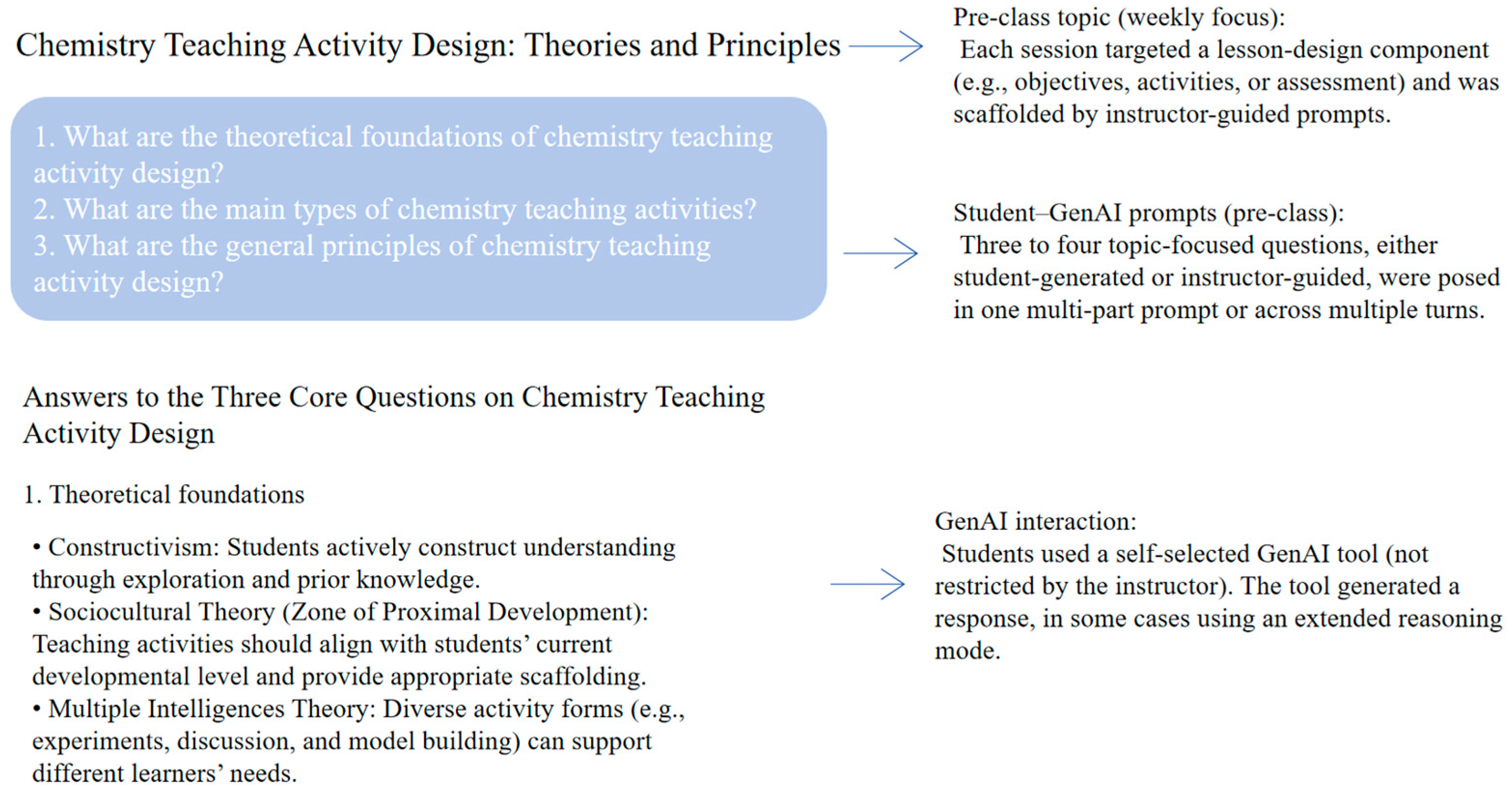
4.3. Intervention and Procedure
4.4. Measures
4.4.1. Objective Performance Task: Lesson Design Performance
4.4.2. Questionnaire Measures
4.5. Data Analyses
5. Results
5.1. Descriptive Statistics
5.2. Baseline Equivalence
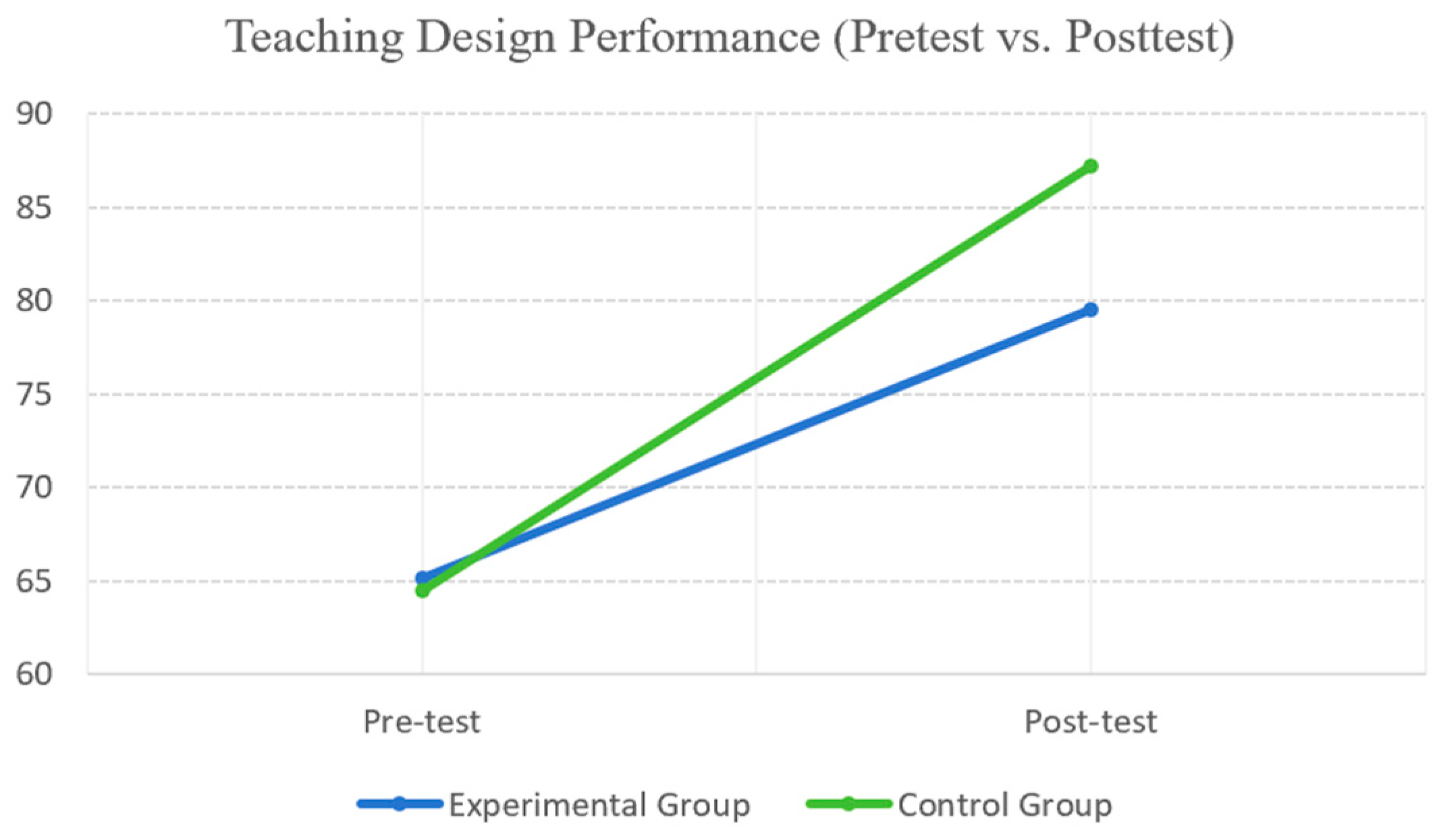
5.3. Lesson-Design Performance
5.4. Learning Attitude
5.5. Self-Regulated Learning
5.6. Critical Thinking Awareness
6. Discussion
7. Conclusions and Implications
Author Contributions
Funding
Institutional Review Board Statement
Informed Consent Statement
Data Availability Statement
Conflicts of Interest
Abbreviations
| GenAI | generative artificial intelligence |
| AI-FL | GenAI-supported flipped learning |
| R-FL | reading-based flipped learning |
| FL | flipped learning |
| SRL | self-regulated learning |
| ANCOVA | analysis of covariance |
| ICC | intraclass correlation coefficient |
| CLT | cognitive load theory |
Appendix A. Overview of the 11-Week Intervention: Weekly Topics and Guiding Questions

| Week | Phase/Purpose | Topic | Instructor-Provided Guiding Questions |
|---|---|---|---|
| 1 | Orientation and pretest | Course introduction and study orientation | — |
| 2 | Guided-question instructional session | Introduction to chemistry instructional design | (1) What is instructional design, and what are the main components of a complete instructional design? (2) What characteristics should a high-quality chemistry instructional design possess? (3) Identify an example of an excellent chemistry instructional design, analyse its main strengths, and suggest possible improvements. (4) How can instructional design be developed for a specific chemistry teaching topic? |
| 3 | Senior secondary chemistry curriculum standards and core competencies | (1) What are the main contents of the senior secondary chemistry curriculum standards? (2) How should the core competencies of chemistry be understood? (3) How should the implementation recommendations in the chemistry curriculum standards be interpreted? | |
| 4 | Design of teaching objectives | (1) What role do teaching objectives play in instruction? (2) What principles should be followed in designing teaching objectives? (3) What methods can be used to design chemistry teaching objectives? | |
| 5 | Design of teaching situations | (1) What is the theoretical basis for creating teaching situations in chemistry instruction? (2) What are the main types of teaching situations in chemistry teaching? (3) How can appropriate teaching situations be created in chemistry instruction? | |
| 6 | Selection of teaching methods | (1) What are the common teaching methods used in chemistry instruction? (2) What factors influence the selection of teaching methods? (3) How can appropriate teaching methods be selected in chemistry teaching? | |
| 7 | Design of teaching activities | (1) What is the theoretical basis for designing chemistry teaching activities? (2) What are the main types of chemistry teaching activities? (3) What general principles should be followed in designing chemistry teaching activities? | |
| 8 | Design of teaching media | (1) What is the theoretical basis for chemistry teaching media design? (2) What are the main types of teaching media used in chemistry instruction? (3) What strategies can be used for chemistry teaching media design in the digital era? | |
| 9 | Design of board writing | (1) What are the theoretical basis and instructional value of board writing? (2) What are the main types of board writing used in chemistry teaching? (3) How can board writing be effectively designed in chemistry instruction? | |
| 10 | Teaching evaluation | (1) What are the theoretical basis and instructional value of teaching evaluation? (2) What are the main types of teaching evaluation? (3) How can teaching evaluation be effectively implemented in chemistry instruction? | |
| 11 | Final task and posttest | Comprehensive lesson-design task and posttest | — |
Appendix B. Lesson-Design Evaluation Rubric
| Dimension | Criterion | Score |
|---|---|---|
| Objective design | (1) Objectives are clear, specific, understandable, and feasible; action verbs are used appropriately and wording is standardized. | 1.5 |
| (2) Objectives align with curriculum standards, reflect disciplinary features and student needs, and address knowledge, abilities, and innovative thinking. | 1.5 | |
| Content analysis | Relationships among prior, current, and subsequent knowledge are accurately described; key and difficult points are clearly identified. | 2 |
| Learner analysis | Students’ cognitive characteristics, prior knowledge, learning habits, and abilities are appropriately analyzed. | 2 |
| Teaching process design | (1) The instructional sequence is clear, coherent, and logically organized, and content treatment aligns with curriculum standards. | 2 |
| (2) Key points are emphasized, links are well integrated, depth is appropriate, and difficult points are accurately addressed. | 2 | |
| (3) Teaching methods are appropriate for learner characteristics and support task completion, key-point emphasis, and difficulty resolution. | 2 | |
| (4) Teaching aids, instructional materials, and modern technologies are adequately prepared and appropriately used. | 1 | |
| (5) Content is substantial and suitable for students’ level; the structure is well organized, practical, interactive, and conducive to thinking and problem solving. | 3 | |
| (6) Formative assessment is emphasized, together with the generation, resolution, and use of meaningful instructional problems. | 1 | |
| Extension design | Time allocation and support activities are appropriate; exercises, assignments, and discussions align with objectives and promote understanding and problem solving. | 2 |
| Document quality | Text, symbols, units, and formulas are standardized; language, layout, and formatting are clear, complete, and appropriate. | 2 |
| Design innovation | The lesson-plan design is innovative and reflects curriculum reform principles. | 3 |
| Total | 25 |
References
- Abeysekera, L., & Dawson, P. (2015). Motivation and cognitive load in the flipped classroom: Definition, rationale and a call for research. Higher Education Research & Development, 34(1), 1–14. [Google Scholar] [CrossRef]
- Abrami, P. C., Bernard, R. M., Borokhovski, E., Waddington, D. I., Wade, C. A., & Persson, T. (2015). Strategies for teaching students to think critically: A meta-analysis. Review of Educational Research, 85(2), 275–314. [Google Scholar] [CrossRef]
- Akçayır, G., & Akçayır, M. (2018). The flipped classroom: A review of its advantages and challenges. Computers & Education, 126, 334–345. [Google Scholar] [CrossRef]
- Arbaugh, J. B., Godfrey, M. R., Johnson, M., Pollack, B. L., Niendorf, B., & Wresch, W. (2009). Research in online and blended learning in the business disciplines: Key findings and possible future directions. The Internet and Higher Education, 12(2), 71–87. [Google Scholar] [CrossRef]
- Bai, Y., & Wang, S. (2025). Impact of generative AI interaction and output quality on university students’ learning outcomes: A technology-mediated and motivation-driven approach. Scientific Reports, 15(1), 24054. [Google Scholar] [CrossRef] [PubMed]
- Baig, M. I., & Yadegaridehkordi, E. (2023). Flipped classroom in higher education: A systematic literature review and research challenges. International Journal of Educational Technology in Higher Education, 20(1), 61. [Google Scholar] [CrossRef]
- Barcaui, A. (2025). ChatGPT as a cognitive crutch: Evidence from a randomized controlled trial on knowledge retention. Social Sciences & Humanities Open, 12, 102287. [Google Scholar] [CrossRef]
- Bauer, K., Von Zahn, M., & Hinz, O. (2023). Expl(AI)ned: The impact of explainable artificial intelligence on users’ information processing. Information Systems Research, 34(4), 1582–1602. [Google Scholar] [CrossRef]
- Bewersdorff, A., Hartmann, C., Hornberger, M., Seßler, K., Bannert, M., Kasneci, E., Kasneci, G., Zhai, X., & Nerdel, C. (2025). Taking the next step with generative artificial intelligence: The transformative role of multimodal large language models in science education. Learning and Individual Differences, 118, 102601. [Google Scholar] [CrossRef]
- Bishop, J., & Verleger, M. (2013, June 23–26). The flipped classroom: A survey of the research. 2013 ASEE Annual Conference & Exposition (pp. 23.1200.1–23.1200.18), Atlanta, Georgia. [Google Scholar] [CrossRef]
- Boud, D., & Molloy, E. (2013). Rethinking models of feedback for learning: The challenge of design. Assessment & Evaluation in Higher Education, 38(6), 698–712. [Google Scholar] [CrossRef]
- Brewer, R., & Movahedazarhouligh, S. (2018). Successful stories and conflicts: A literature review on the effectiveness of flipped learning in higher education. Journal of Computer Assisted Learning, 34(4), 409–416. [Google Scholar] [CrossRef]
- Brislin, R. W. (1970). Back-translation for cross-cultural research. Journal of Cross-Cultural Psychology, 1(3), 185–216. [Google Scholar] [CrossRef]
- Carby, N. (2023). Personalized feedback in a virtual learning environment. Journal of Educational Supervision, 6(1), 36–44. [Google Scholar] [CrossRef]
- Chai, C. S., Deng, F., Tsai, P.-S., Koh, J. H. L., & Tsai, C.-C. (2015). Assessing multidimensional students’ perceptions of twenty-first-century learning practices. Asia Pacific Education Review, 16(3), 389–398. [Google Scholar] [CrossRef]
- Chan, C. K. Y., & Hu, W. (2023). Students’ voices on generative AI: Perceptions, benefits, and challenges in higher education. International Journal of Educational Technology in Higher Education, 20(1), 43. [Google Scholar] [CrossRef]
- Chen, A., Xiang, M., Zhou, J., Jia, J., Shang, J., Li, X., Gašević, D., & Fan, Y. (2025). Unpacking help-seeking process through multimodal learning analytics: A comparative study of ChatGPT vs. Human expert. Computers & Education, 226, 105198. [Google Scholar] [CrossRef]
- Collie, R. J., & Martin, A. J. (2019). Motivation and engagement in learning. In R. J. Collie, & A. J. Martin (Eds.), Oxford research encyclopedia of education. Oxford University Press. [Google Scholar] [CrossRef]
- Çakıroğlu, Ü., & Öztürk, M. (2017). Flipped classroom with problem based activities: Exploring self-regulated learning in a programming language course. Educational Technology & Society, 20(1), 337–349. [Google Scholar]
- Deng, R., Jiang, M., Yu, X., Lu, Y., & Liu, S. (2025). Does ChatGPT enhance student learning? A systematic review and meta-analysis of experimental studies. Computers & Education, 227, 105224. [Google Scholar] [CrossRef]
- Diwanji, P., Hinkelmann, K., & Witschel, H. (2018). Enhance classroom preparation for flipped classroom using AI and analytics. In Proceedings of the 20th international conference on enterprise information systems (pp. 477–483). SCITEPRESS—Science and Technology Publications. [Google Scholar] [CrossRef]
- Ennis, R. H. (1985). A logical basis for measuring critical thinking skills. Educational Leadership, 43(2), 44–48. [Google Scholar]
- Facione, P. (2015). Critical thinking: What it is and why it counts. Insight Assessment. [Google Scholar]
- Fan, Y., Tang, L., Le, H., Shen, K., Tan, S., Zhao, Y., Shen, Y., Li, X., & Gašević, D. (2025). Beware of metacognitive laziness: Effects of generative artificial intelligence on learning motivation, processes, and performance. British Journal of Educational Technology, 56(2), 489–530. [Google Scholar] [CrossRef]
- Gao, L., López-Pérez, M. E., Melero-Polo, I., & Trifu, A. (2024). Ask ChatGPT first! Transforming learning experiences in the age of artificial intelligence. Studies in Higher Education, 49(12), 2772–2796. [Google Scholar] [CrossRef]
- Huang, C. (2011). Self-concept and academic achievement: A meta-analysis of longitudinal relations. Journal of School Psychology, 49(5), 505–528. [Google Scholar] [CrossRef]
- Huang, W., Hew, K. F., & Gonda, D. E. (2019). Designing and evaluating three chatbot-enhanced activities for a flipped graduate course. International Journal of Mechanical Engineering and Robotics Research, 8(5), 813–818. [Google Scholar] [CrossRef]
- Hudon, A., Demazure, T., Karran, A., Léger, P.-M., & Sénécal, S. (2021). Explainable Artificial Intelligence (XAI): How the visualization of AI predictions affects user cognitive load and confidence. In F. D. Davis, R. Riedl, J. Vom Brocke, P.-M. Léger, A. B. Randolph, & G. Müller-Putz (Eds.), Information systems and neuroscience (Vol. 52, pp. 237–246). Springer International Publishing. [Google Scholar] [CrossRef]
- Hwang, G.-J., Yang, L.-H., & Wang, S.-Y. (2013). A concept map-embedded educational computer game for improving students’ learning performance in natural science courses. Computers & Education, 69, 121–130. [Google Scholar] [CrossRef]
- Hyland, K., & Hyland, F. (2006). Feedback on second language students’ writing. Language Teaching, 39(2), 83–101. [Google Scholar] [CrossRef]
- Jensen, J. L., Kummer, T. A., & Godoy, P. D. D. M. (2015). Improvements from a flipped classroom may simply be the fruits of active learning. CBE—Life Sciences Education, 14(1), ar5. [Google Scholar] [CrossRef] [PubMed]
- Kalyuga, S. (2011). Cognitive load theory: How many types of load does it really need? Educational Psychology Review, 23(1), 1–19. [Google Scholar] [CrossRef]
- Kasneci, E., Sessler, K., Küchemann, S., Bannert, M., Dementieva, D., Fischer, F., Gasser, U., Groh, G., Günnemann, S., Hüllermeier, E., Krusche, S., Kutyniok, G., Michaeli, T., Nerdel, C., Pfeffer, J., Poquet, O., Sailer, M., Schmidt, A., Seidel, T., … Kasneci, G. (2023). ChatGPT for good? On opportunities and challenges of large language models for education. Learning and Individual Differences, 103, 102274. [Google Scholar] [CrossRef]
- Lai, C.-L., & Hwang, G.-J. (2016). A self-regulated flipped classroom approach to improving students’ learning performance in a mathematics course. Computers & Education, 100, 126–140. [Google Scholar] [CrossRef]
- Lai, E. R. (2011). Critical thinking: A literature review. Pearson. [Google Scholar]
- Lee, S. W.-Y., & Tsai, C.-C. (2011). Students’ perceptions of collaboration, self-regulated learning, and information seeking in the context of Internet-based learning and traditional learning. Computers in Human Behavior, 27(2), 905–914. [Google Scholar] [CrossRef]
- Li, H. (2023). Effects of a ChatGPT-based flipped learning guiding approach on learners’ courseware project performances and perceptions. Australasian Journal of Educational Technology, 39(5), 40–58. [Google Scholar] [CrossRef]
- Lin, H.-C., Hwang, G.-J., & Hsu, Y.-D. (2019). Effects of ASQ-based flipped learning on nurse practitioner learners’ nursing skills, learning achievement and learning perceptions. Computers & Education, 139, 207–221. [Google Scholar] [CrossRef]
- Liu, X., Guo, B., He, W., & Hu, X. (2025). Effects of generative artificial intelligence on K-12 and higher education students’ learning outcomes: A meta-analysis. Journal of Educational Computing Research, 63(5), 1249–1291. [Google Scholar] [CrossRef]
- Lo, C. K., & Hew, K. F. (2023). A review of integrating AI-based chatbots into flipped learning: New possibilities and challenges. Frontiers in Education, 8, 1175715. [Google Scholar] [CrossRef]
- Moreno, R. (2004). Decreasing cognitive load for novice students: Effects of explanatory versus corrective feedback in discovery-based multimedia. Instructional Science, 32(1–2), 99–113. [Google Scholar] [CrossRef]
- Namaziandost, E. (2025). Integrating flipped learning in AI-enhanced language learning: Mapping the effects on metacognitive awareness, writing development, and foreign language learning boredom. Computers and Education: Artificial Intelligence, 9, 100446. [Google Scholar] [CrossRef]
- Panadero, E. (2017). A review of self-regulated learning: Six models and four directions for research. Frontiers in Psychology, 8, 422. [Google Scholar] [CrossRef]
- Pricopie, V. (2020). Constructivism. In The SAGE international encyclopedia of mass media and society. SAGE Publications, Inc. [Google Scholar] [CrossRef]
- Prince, M. (2004). Does active learning work? A review of the research. Journal of Engineering Education, 93(3), 223–231. [Google Scholar] [CrossRef]
- Ravšelj, D., Keržič, D., Tomaževič, N., Umek, L., Brezovar, N., Iahad, N. A., Abdulla, A. A., Akopyan, A., Aldana Segura, M. W., AlHumaid, J., Allam, M. F., Alló, M., Andoh, R. P. K., Andronic, O., Arthur, Y. D., Aydın, F., Badran, A., Balbontín-Alvarado, R., Ben Saad, H., … Aristovnik, A. (2025). Higher education students’ perceptions of ChatGPT: A global study of early reactions. PLoS ONE, 20(2), e0315011. [Google Scholar] [CrossRef] [PubMed]
- Rehman, N., Huang, X., Mahmood, A., Zafeer, H. M. I., & Mohammad, N. K. (2025). Emerging trends and effective strategies in STEM teacher professional development: A systematic review. Humanities and Social Sciences Communications, 12(1), 32. [Google Scholar] [CrossRef]
- Rob, M., & Rob, F. (2018). Dilemma between constructivism and constructionism: Leading to the development of a teaching-learning framework for student engagement and learning. Journal of International Education in Business, 11(2), 273–290. [Google Scholar] [CrossRef]
- Ryan, R. M., & Deci, E. L. (2000). Self-determination theory and the facilitation of intrinsic motivation, social development, and well-being. American Psychologist, 55(1), 68–78. [Google Scholar] [CrossRef] [PubMed]
- Selwyn, N. (2019). Should robots replace teachers? AI and the future of education. Polity Press. [Google Scholar]
- Selwyn, N. (2024). On the limits of Artificial Intelligence (AI) in education. Nordisk Tidsskrift for Pedagogikk Og Kritikk, 10(1), 3–14. [Google Scholar] [CrossRef]
- Shi, J., Liu, W., & Hu, K. (2025). Exploring how AI literacy and self-regulated learning relate to student writing performance and well-being in generative AI-supported higher education. Behavioral Sciences, 15(5), 705. [Google Scholar] [CrossRef]
- Shih, M., Liang, J.-C., & Tsai, C.-C. (2019). Exploring the role of university students’ online self-regulated learning in the flipped classroom: A structural equation model. Interactive Learning Environments, 27(8), 1192–1206. [Google Scholar] [CrossRef]
- Sletten, S. R. (2017). Investigating flipped learning: Student self-regulated learning, perceptions, and achievement in an introductory biology course. Journal of Science Education and Technology, 26(3), 347–358. [Google Scholar] [CrossRef]
- Smith, J. D. (2013). Student attitudes toward flipping the general chemistry classroom. Chemistry Education Research and Practice, 14(4), 607–614. [Google Scholar] [CrossRef]
- Sun, J. C.-Y., Yu, S.-J., & Chao, C.-H. (2019). Effects of intelligent feedback on online learners’ engagement and cognitive load: The case of research ethics education. Educational Psychology, 39(10), 1293–1310. [Google Scholar] [CrossRef]
- Sun, Z., & Xie, K. (2020). How do students prepare in the pre-class setting of a flipped undergraduate math course? A latent profile analysis of learning behavior and the impact of achievement goals. The Internet and Higher Education, 46, 100731. [Google Scholar] [CrossRef]
- Sweller, J. (1988). Cognitive load during problem solving: Effects on learning. Cognitive Science, 12(2), 257–285. [Google Scholar] [CrossRef]
- Sweller, J., Ayres, P., & Kalyuga, S. (2011). Cognitive load theory. Springer. [Google Scholar] [CrossRef]
- Tian, J., & Zhang, R. (2025). Learners’ AI dependence and critical thinking: The psychological mechanism of fatigue and the social buffering role of AI literacy. Acta Psychologica, 260, 105725. [Google Scholar] [CrossRef]
- Trinovita, D., Nurchurifiani, E., Hastomo, T., Andewi, W., & Hasbi, M. (2025). Exploring the influence of generative AI on self-regulated learning: A mixed-methods study in the EFL context. Jurnal Iqra’: Kajian Ilmu Pendidikan, 10(2), 301–316. [Google Scholar] [CrossRef]
- Van Alten, D. C. D., Phielix, C., Janssen, J., & Kester, L. (2019). Effects of flipping the classroom on learning outcomes and satisfaction: A meta-analysis. Educational Research Review, 28, 100281. [Google Scholar] [CrossRef]
- Van Alten, D. C. D., Phielix, C., Janssen, J., & Kester, L. (2020). Self-regulated learning support in flipped learning videos enhances learning outcomes. Computers & Education, 158, 104000. [Google Scholar] [CrossRef]
- Vu, T. V., Scharmer, A. L., Van Triest, E., Van Atteveldt, N., & Meeter, M. (2024). The reciprocity between various motivation constructs and academic achievement: A systematic review and multilevel meta-analysis of longitudinal studies. Educational Psychology, 44(2), 136–170. [Google Scholar] [CrossRef]
- Wang, J., Xu, C., Leong, C. T., Li, W., & Li, J. (2024). Muffin: Mitigating unhelpfulness in emotional support conversations with multifaceted AI feedback. Findings of the Association for Computational Linguistics ACL, 2024, 567–585. [Google Scholar] [CrossRef]
- Weidinger, L., Uesato, J., Rauh, M., Griffin, C., Huang, P.-S., Mellor, J., Glaese, A., Cheng, M., Balle, B., Kasirzadeh, A., Biles, C., Brown, S., Kenton, Z., Hawkins, W., Stepleton, T., Birhane, A., Hendricks, L. A., Rimell, L., Isaac, W., … Gabriel, I. (2022, June 21–24). Taxonomy of risks posed by language models. 2022 ACM Conference on Fairness Accountability and Transparency (pp. 214–229), Seoul, Republic of Korea. [Google Scholar] [CrossRef]
- Xia, Q., Li, W., Yang, Y., Weng, X., & Chiu, T. K. F. (2025). A systematic review and meta-analysis of the effectiveness of Generative Artificial Intelligence (GenAI) on students’ motivation and engagement. Computers and Education: Artificial Intelligence, 9, 100455. [Google Scholar] [CrossRef]
- Xue, Z. (2023). Exploring Vygotsky’s zone of proximal development in pedagogy: A critique of a learning event in the business/economics classroom. International Journal of Education and Humanities, 9(3), 166–168. [Google Scholar] [CrossRef]
- Yilmaz, R., & Karaoglan Yilmaz, F. G. (2023). The effect of generative artificial intelligence (AI)-based tool use on students’ computational thinking skills, programming self-efficacy and motivation. Computers and Education: Artificial Intelligence, 4, 100147. [Google Scholar] [CrossRef]
- Zawacki-Richter, O., Marín, V. I., Bond, M., & Gouverneur, F. (2019). Systematic review of research on artificial intelligence applications in higher education—Where are the educators? International Journal of Educational Technology in Higher Education, 16(1), 39. [Google Scholar] [CrossRef]
- Zeevy-Solovey, O. (2024). Comparing peer, ChatGPT, and teacher corrective feedback in EFL writing: Students’ perceptions and preferences. Technology in Language Teaching & Learning, 6(3), 1482. [Google Scholar] [CrossRef]
- Zhai, X., Nyaaba, M., & Ma, W. (2025). Can generative AI and ChatGPT outperform humans on cognitive-demanding problem-solving tasks in science? Science & Education, 34(2), 649–670. [Google Scholar] [CrossRef]
- Zhang, C., Hu, M., Wu, W., Kamran, F., & Wang, X. (2025). Unpacking perceived risks and AI trust influences pre-service teachers’ AI acceptance: A structural equation modeling-based multi-group analysis. Education and Information Technologies, 30(2), 2645–2672. [Google Scholar] [CrossRef]
- Zheng, B., Ward, A., & Stanulis, R. (2020). Self-regulated learning in a competency-based and flipped learning environment: Learning strategies across achievement levels and years. Medical Education Online, 25(1), 1686949. [Google Scholar] [CrossRef]
- Zimmerman, B. J. (2001). Theories of self-regulated learning and academic achievement: An overview and analysis. In B. J. Zimmerman, & D. H. Schunk (Eds.), Self-regulated learning and academic achievement: Theoretical perspectives (2nd ed., pp. 1–37). Lawrence Erlbaum Associates Publishers. [Google Scholar]
- Zimmerman, B. J. (2002). Becoming a self-regulated learner: An overview. Theory Into Practice, 41(2), 64–70. [Google Scholar] [CrossRef]

| Variable | Group | Pretest, M (SD) | Posttest, M (SD) |
|---|---|---|---|
| Lesson-design performance | Experimental | 65.17 (10.06) | 79.50 (6.08) |
| Control | 64.50 (7.08) | 87.24 (5.85) | |
| Learning attitude | Experimental | 4.08 (0.39) | 4.72 (0.39) |
| Control | 4.18 (0.50) | 4.52 (0.43) | |
| Self-regulated learning | Experimental | 4.12 (0.40) | 4.27 (0.34) |
| Control | 4.03 (0.37) | 4.27 (0.52) | |
| Critical thinking awareness | Experimental | 4.00 (0.47) | 4.22 (0.36) |
| Control | 4.10 (0.49) | 4.05 (0.46) |
| Variable | Experimental, M (SD) | Control, M (SD) | t | df | p |
|---|---|---|---|---|---|
| Lesson-design performance | 65.17 (10.06) | 64.50 (7.08) | 0.282 | 51 | 0.779 |
| Learning attitude | 4.08 (0.39) | 4.18 (0.50) | −0.750 | 51 | 0.457 |
| Self-regulated learning | 4.12 (0.40) | 4.03 (0.37) | 0.804 | 51 | 0.425 |
| Critical thinking awareness | 4.00 (0.47) | 4.10 (0.49) | −0.779 | 51 | 0.439 |
Disclaimer/Publisher’s Note: The statements, opinions and data contained in all publications are solely those of the individual author(s) and contributor(s) and not of MDPI and/or the editor(s). MDPI and/or the editor(s) disclaim responsibility for any injury to people or property resulting from any ideas, methods, instructions or products referred to in the content. |
© 2026 by the authors. Licensee MDPI, Basel, Switzerland. This article is an open access article distributed under the terms and conditions of the Creative Commons Attribution (CC BY) license.
Share and Cite
Zhang, J.; Deng, X.; Wu, T.; Wang, K. GenAI-Supported Flipped Learning in Preservice Chemistry Teacher Education: Lesson-Design Performance, Learning Attitude, Self-Regulated Learning, and Critical Thinking Awareness. Behav. Sci. 2026, 16, 514. https://doi.org/10.3390/bs16040514
Zhang J, Deng X, Wu T, Wang K. GenAI-Supported Flipped Learning in Preservice Chemistry Teacher Education: Lesson-Design Performance, Learning Attitude, Self-Regulated Learning, and Critical Thinking Awareness. Behavioral Sciences. 2026; 16(4):514. https://doi.org/10.3390/bs16040514
Chicago/Turabian StyleZhang, Jun, Xinyue Deng, Tong Wu, and Kai Wang. 2026. "GenAI-Supported Flipped Learning in Preservice Chemistry Teacher Education: Lesson-Design Performance, Learning Attitude, Self-Regulated Learning, and Critical Thinking Awareness" Behavioral Sciences 16, no. 4: 514. https://doi.org/10.3390/bs16040514
APA StyleZhang, J., Deng, X., Wu, T., & Wang, K. (2026). GenAI-Supported Flipped Learning in Preservice Chemistry Teacher Education: Lesson-Design Performance, Learning Attitude, Self-Regulated Learning, and Critical Thinking Awareness. Behavioral Sciences, 16(4), 514. https://doi.org/10.3390/bs16040514