The Influence of Group Psychology on Network Cluster Behavior: A Moderated Mediation Model
Abstract
1. Introduction
2. Literature Review and Research Hypotheses
2.1. Theoretical Basis for the Formation of Network Cluster Behavior
2.2. The Influence of Group Psychology on Network Cluster Behavior
2.2.1. The Relationship Between the Spiral of Silence and Network Cluster Behavior
2.2.2. The Relationship Between Relative Deprivation and Network Cluster Behavior
2.2.3. Relationship Between Depersonalization and Network Cluster Behavior
2.2.4. The Relationship Between Emotional Infection and Network Cluster Behavior
2.2.5. Mediating Role of Group Polarization
2.2.6. The Regulatory Effect of Group Efficacy
2.2.7. The Mediating Role of Opinion Leaders
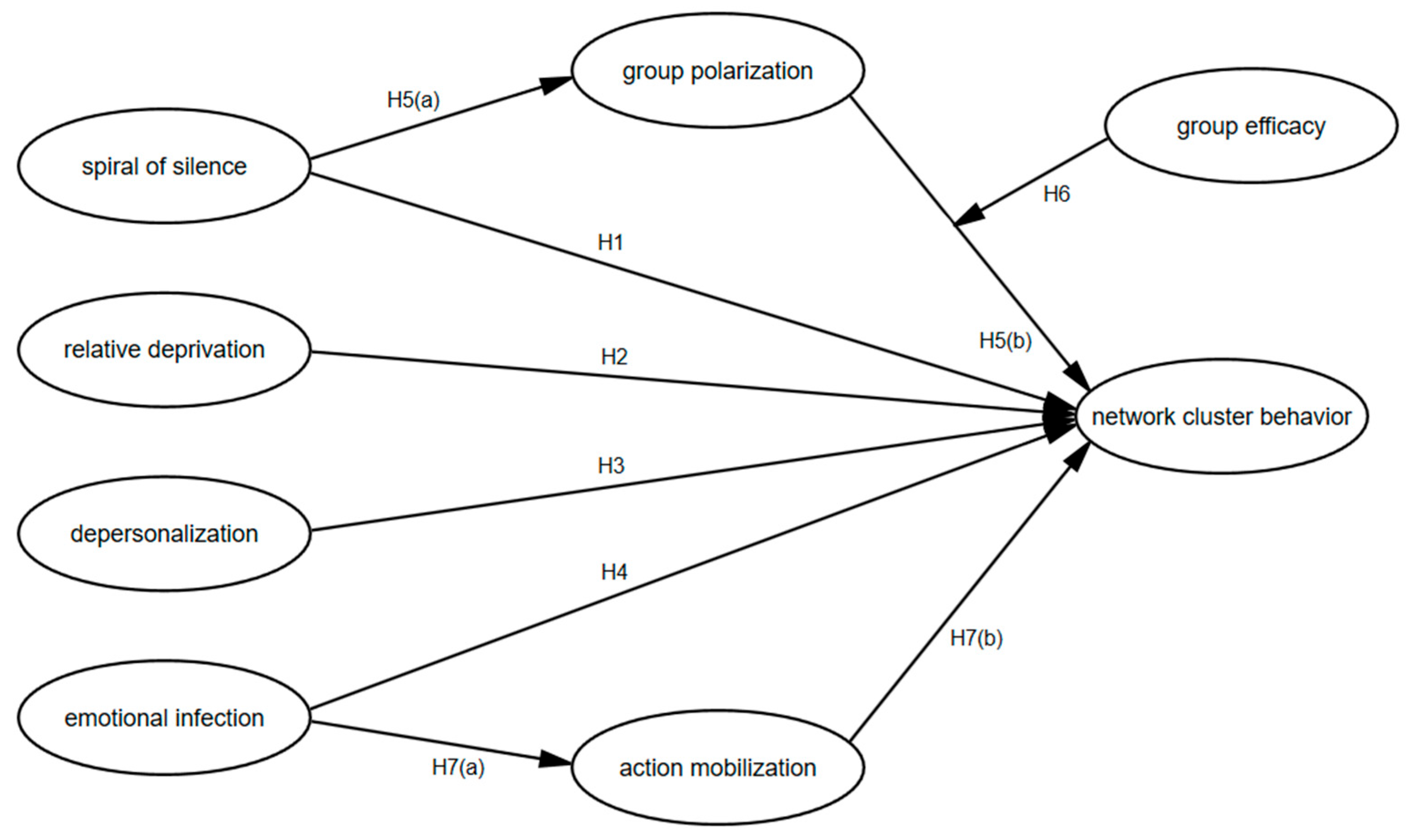
2.3. Research Hypothesis
3. Research Methods and Design
3.1. Participants and Data Collection
3.2. Measurements
3.2.1. Questionnaire Design and Development
3.2.2. Exploratory Factor Analysis
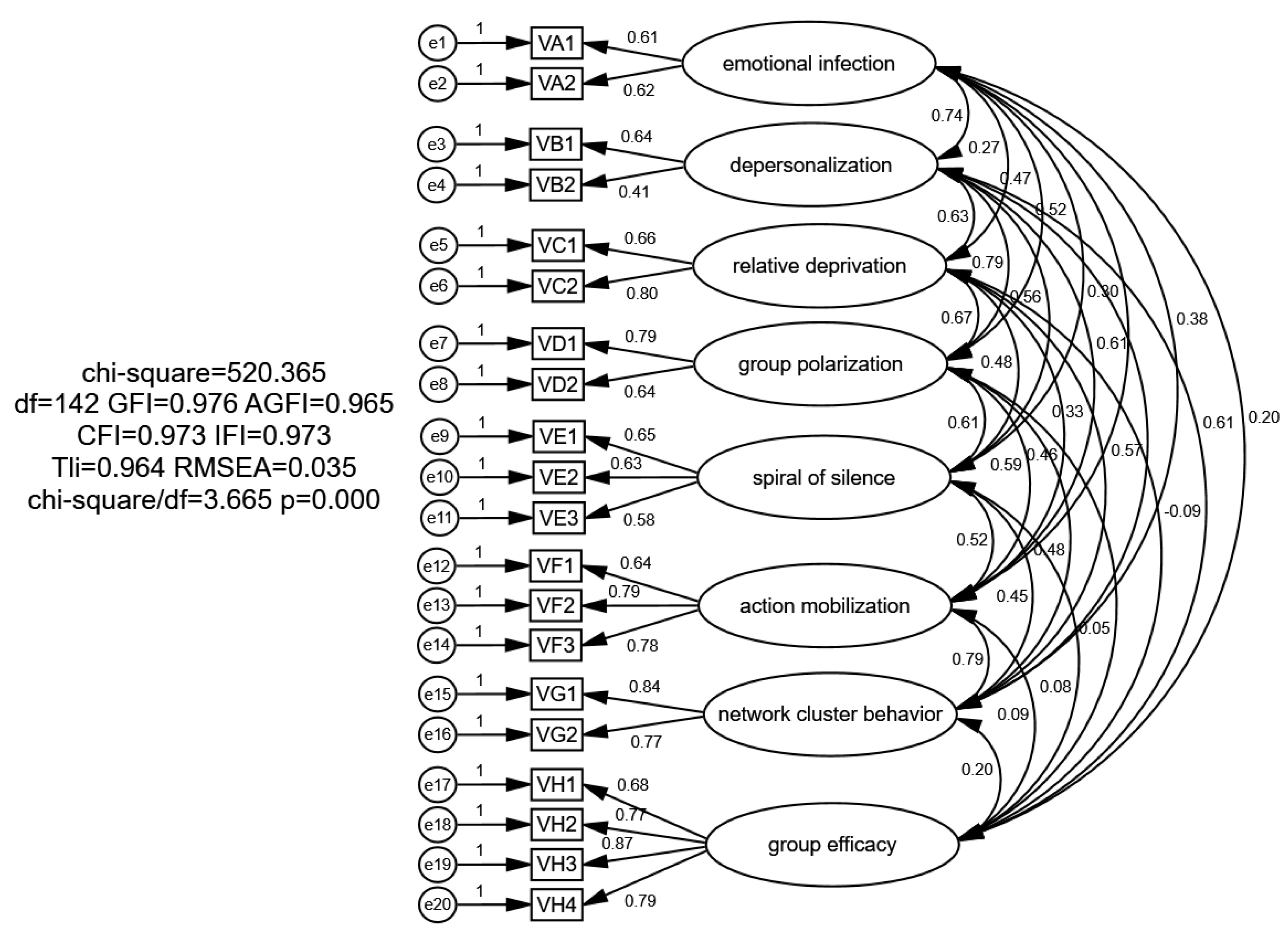
3.2.3. Confirmatory Factor Analysis
3.2.4. Reliability Analysis
3.2.5. Common Method Bias
3.2.6. Ethics Statement
4. Results
4.1. Descriptive Statistics and Correlation Analysis
4.2. Testing the Mediating Effect of Opinion Leaders
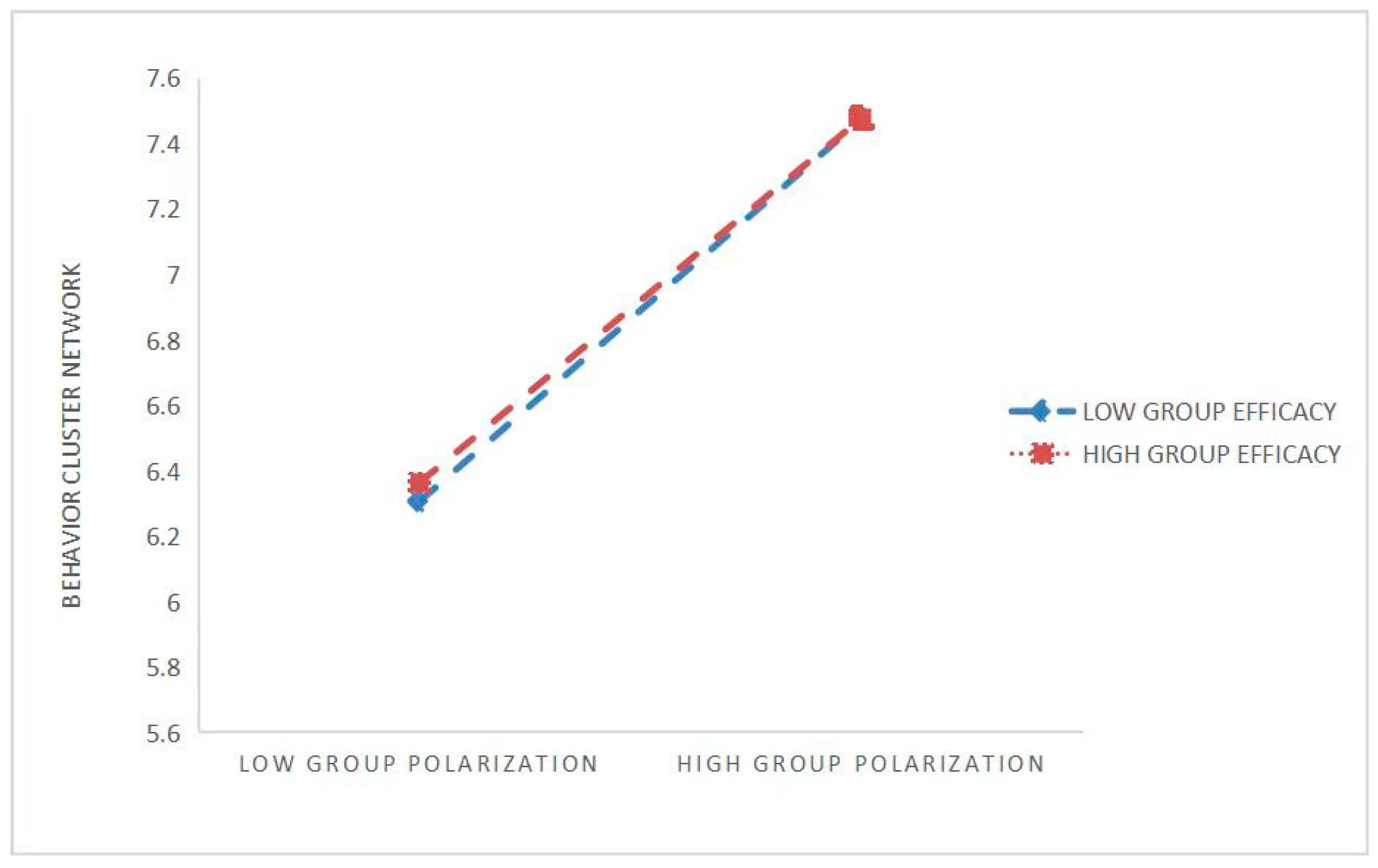
4.3. Effect Test with Moderation
5. Discussion
5.1. The Relationship Between Group Psychology and Network Cluster Behavior
5.2. Testing the Mediating Role of Opinion Leaders
5.3. The Mediating Role of Group Polarization and the Moderating Role of Group Efficacy
6. Limitations and Future Directions
7. Conclusions
Author Contributions
Funding
Institutional Review Board Statement
Informed Consent Statement
Data Availability Statement
Conflicts of Interest
References
- Amelkin, V., Bullo, F., & Singh, A. K. (2017). Polar opinion dynamics in social networks. IEEE Transactions on Automatic Control, 62(11), 5650–5665. [Google Scholar] [CrossRef]
- Badea, C., Binning, K. R., Sherman, D. K., Boza, M., & Kende, A. (2021). Conformity to group norms: How group-affirmation shapes collective action. Journal of Experimental Social Psychology, 95, 104153. [Google Scholar] [CrossRef]
- Bandura, A. (2000). Exercise of human agency through collective efficacy. Current Directions in Psychological Science, 9(3), 75–78. [Google Scholar] [CrossRef]
- Baumeister, R. F., & Vohs, K. D. (Eds.). (2007). Encyclopedia of social psychology (1st ed.). SAGE Publications. [Google Scholar]
- Bi, H. M., & Huang, Y. L. (2020). 重大突发事件中网络意见领袖行为失范及其治理 [Misbehavior of online opinion leaders in major emergencies and its governance]. Theory Guide, 10, 98–102. [Google Scholar]
- Bu, R. H. (2020). 群际互动与群际威胁:青年网络集群行为的动力学分析 [Intergroup interaction and intergroup threat: A dynamic analysis of youth network cluster behavior]. Journal of Shandong Youth University of Political Science, 36(1), 45–53. [Google Scholar] [CrossRef]
- Chen, J., & Xiong, M. (2023). 大学生相对剥夺感与社交焦虑的关系:一个有调节的中介模型 [The relationship between relative deprivation and social anxiety in college students: A moderated mediation model]. Studies of Psychology and Behavior, 21(1), 65–71. [Google Scholar]
- Chen, Y. X., Wang, S. J., & Liu, X. P. (2019). 青少年归属需要满足与去个性化网络行为:有调节的中介模型 [Adolescent belongingness need satisfaction and depersonalized online behavior: A moderated mediation model]. Chinese Journal of Clinical Psychology, 27(6), 1256–1259. [Google Scholar] [CrossRef]
- Coviello, L., Sohn, Y., Kramer, A. D. I., Marlow, C., Franceschetti, M., Christakis, N. A., & Fowler, J. H. (2014). Detecting emotional contagion in massive social networks. PLoS ONE, 9(3), e90315. [Google Scholar] [CrossRef]
- Dai, J. L., Zhu, J. M., & Wang, G. Q. (2022). Opinion influence maximization problem in online social networks based on group polarization effect. Information Sciences, 11, 195–214. [Google Scholar] [CrossRef]
- De La Sablonnière, R., & Tougas, F. (2008). Relative deprivation and social identity in times of dramatic social change: The case of nurses. Journal of Applied Social Psychology, 38(9), 2293–2314. [Google Scholar] [CrossRef]
- Drury, J., & Reicher, S. (2000). Collective action and psychological change: The emergence of new social identities. British Journal of Social Psychology, 39, 579–604. [Google Scholar] [CrossRef] [PubMed]
- Drury, J., & Reicher, S. (2005). Explaining enduring empowerment: A comparative study of collective action and psychological outcomes. European Journal of Social Psychology, 35(1), 35–58. [Google Scholar] [CrossRef]
- Ellison, N. B., Steinfield, C., & Lampe, C. (2007). The benefits of Facebook “friends”: Social capital and college students’ use of online social network sites. Journal of Computer-Mediated Communication, 12(4), 1143–1168. [Google Scholar] [CrossRef]
- Feng, G., & Huang, Y. (2021). 大学生网络舆情群体极化的成因与表征 [The causes and manifestations of group polarization in online public opinion among college students]. Journal of Ideological and Educational Research, 9, 93–98. [Google Scholar]
- Ferreira, P. D., & Menezes, I. (2021). The civic and political participation of young people: Current changes and educational consequences [Editorial]. Frontiers in Political Science, 3, 751589. [Google Scholar] [CrossRef]
- Foster, M. D., & Matheson, K. (1995). Double relative deprivation: Combining the personal and political. Personality and Social Psychology Bulletin, 21(11), 1167–1177. [Google Scholar] [CrossRef]
- Jain, L. (2022). An entropy-based method to control COVID-19 rumors in online social networks using opinion leaders. Technology in Society, 70, 102048. [Google Scholar] [CrossRef]
- Katz, E., & Lazarsfeld, P. F. (1955). Personal influence: The part played by people in the flow of mass communications. Free Press. [Google Scholar]
- Kelloway, K., Francis, L., Catano, V. M., & Teed, M. (2007). Predicting protest. Basic and Applied Social Psychology, 29(1), 13–22. [Google Scholar] [CrossRef]
- Lambert, M. V., Senior, C., Phillips, M. L., & David, A. S. (2000). Depersonalization in cyberspace. The Journal of Nervous and Mental Disease, 188(11), 764–771. [Google Scholar] [CrossRef]
- Lan, J. L., Lei, H. Z., & Yang, Y. (2019). 基于网络集群行为的负面信息传播收敛效应分析 [Analysis of the convergence effect of negative information dissemination based on network cluster behavior]. Study and Exploration, 3, 132–137. [Google Scholar]
- Le Bon, G. (1895). The crowd: A study of the popular mind. F. Alcan. [Google Scholar]
- Literat, I., & Kligler-Vilenchik, N. (2019). Youth collective political expression on social media: The role of affordances and memetic dimensions for voicing political views. New Media & Society, 21(6), 1461444819837571. [Google Scholar] [CrossRef]
- Liu, M. Z., Zhang, W. R., & Wang, J. X. (2025). 网络意见领袖在公共传播中的舆论引导作用探析 [Analysis of the role of online opinion leaders in guiding public opinion in public communication]. Media, 21, 20–23. [Google Scholar]
- Loader, B. D., Vromen, A., & Xenos, M. A. (2014). The networked young citizen: Social media, political participation and civic engagement. Information, Communication & Society, 17(2), 143–150. [Google Scholar] [CrossRef]
- Lu, G., Huang, W., & Liu, Y. (2023). 群体极化视域下突发事件网络舆情极端观点识别研究 [Research on identifying extreme opinions in online public opinion regarding emergency events from the perspective of group polarization]. Intelligence and Information Work, 44(1), 42–51. [Google Scholar]
- Meyer, A., Richter, D., & Hartung-Beck, V. (2022). The relationship between principal leadership and teacher collaboration: Investigating the mediating effect of teachers’ collective efficacy. Educational Management Administration & Leadership, 50(4), 593–612. [Google Scholar] [CrossRef]
- Myers, D. G., & Bishop, G. D. (1970). Discussion effects on racial attitudes. Science, 169(3947), 778–779. [Google Scholar] [CrossRef]
- Nian, F., & Zhang, Z. (2025). The influence of opinion leaders on public opinion spread and control strategies in online social networks. IEEE Transactions on Computational Social Systems, 12(5), 2494–2507. [Google Scholar] [CrossRef]
- Nie, H., & Lü, J. (2021). 高校大学生突发性舆情事件应对机制与策略研究—基于沉默螺旋理论的分析 [Research on the coping mechanisms and strategies for sudden public opinion incidents among college students: An analysis based on the spiral of silence theory]. Jiangsu Higher Education, 41(2), 49–53. [Google Scholar] [CrossRef]
- Noelle-Neumann, E. (1984). The spiral of silence: Public opinion—Our social skin (1st ed.). University of Chicago Press. [Google Scholar]
- Park, R. E., & Burgess, E. W. (1921). Introduction to the science of sociology. University of Chicago Press. [Google Scholar]
- Ran, L., & Zeng, T. Y. (2023). 大数据背景下网络集群行为生成机理研究 [Research on the generation mechanism of online collective behavior in the context of big data]. Journal of Intelligence, 42(5), 129–136. [Google Scholar]
- Reimert, I., Bolhuis, J. E., Kemp, B., & Rodenburg, T. B. (2013). Indicators of positive and negative emotions and emotional contagion in pigs. Physiology & Behavior, 109, 42–50. [Google Scholar] [CrossRef]
- Scheufele, D. A. (2008). Spiral of silence theory. In W. Donsbach, & M. W. Traugott (Eds.), The SAGE handbook of public opinion research (pp. 175–183). SAGE Publications Ltd. [Google Scholar]
- Shi, J., & Cui, L. J. (2014). 群体愤怒与群体效能对集体行动的驱动:内在责任感的中介作用 [The driving force of group anger and group efficacy on collective action: The mediating role of intrinsic sense of responsibility]. Psychological Science, 37(2), 412–419. [Google Scholar] [CrossRef]
- Smelser, N. J. (1963). Theory of collective behavior. Free Press. [Google Scholar]
- Smith, E. M., González, R., & Frigolett, C. (2021). Understanding change in social-movement participation: The roles of social norms and group efficacy. Political Psychology, 42(6), 1037–1051. [Google Scholar] [CrossRef]
- Smith, E. R. (2007). Agent-based modeling: A new approach for theory building in social psychology. Personality and Social Psychology Review, 11(1), 87–104. [Google Scholar] [CrossRef] [PubMed]
- Smith, H. J., Pettigrew, T. F., Pippin, G. M., & Bialosiewicz, S. (2012). Relative deprivation: A theoretical and meta-analytic review. Personality and Social Psychology Review, 16(3), 203–232. [Google Scholar] [CrossRef]
- Sohn, D., & Geidner, N. (2016). Collective dynamics of the spiral of silence: The role of ego-network size. International Journal of Public Opinion Research, 28(1), 25–45. [Google Scholar] [CrossRef]
- Sunstein, C. R. (2002). The law of group polarization. Journal of Political Philosophy, 10(2), 175–195. [Google Scholar] [CrossRef]
- Sunstein, C. R. (2009). Going to extremes: How like minds unite and divide. Oxford University Press. [Google Scholar]
- Tajfel, H., & Turner, J. C. (1979). An integrative theory of intergroup conflict. In W. G. Austin, & S. Worchel (Eds.), The social psychology of intergroup relations (pp. 33–47). Brooks/Cole. [Google Scholar]
- Tobon, S., & García-Madariaga, J. (2021). The influence of opinion leaders’ eWOM on online consumer decisions: A study on social influence. Journal of Theoretical and Applied Electronic Commerce Research, 16(4), 748–767. [Google Scholar] [CrossRef]
- Turcotte, J., York, C., Irving, J., Scholl, R. M., & Pingree, R. J. (2015). News recommendations from social media opinion leaders: Effects on media trust and information seeking. Journal of Computer-Mediated Communication, 20(5), 520–535. [Google Scholar] [CrossRef]
- Valkenburg, P. M., & Peter, J. (2011). Online communication among adolescents: An integrated model of its attraction, opportunities, and risks. Journal of Adolescent Health, 48(2), 121–127. [Google Scholar] [CrossRef]
- van Kleef, G. A., & Côté, S. (2022). The social effects of emotions. Annual Review of Psychology, 73, 629–658. [Google Scholar] [CrossRef]
- van Zomeren, M., Spears, R., & Leach, C. W. (2008). Exploring psychological mechanisms of collective action: Does relevance of group identity influence how people cope with collective disadvantage? British Journal of Social Psychology, 47(2), 353–372. [Google Scholar] [CrossRef] [PubMed]
- Wallach, M. A., Kogan, N., & Bem, D. J. (1962). Group influence on individual risk taking. Journal of Abnormal and Social Psychology, 65(2), 75–86. [Google Scholar] [CrossRef] [PubMed]
- Walter, F., & Bruch, H. (2008). The positive group affect spiral: A dynamic model of the emergence of positive affective similarity in work groups. Journal of Organizational Behavior, 29(2), 239–261. [Google Scholar] [CrossRef]
- Wan, J., Qin, M., Zhou, W., Zhou, H., & Li, P. (2023). Procedural justice, relative deprivation, and intra-team knowledge sharing: The moderating role of group identification. Frontiers in Psychology, 14, 994020. [Google Scholar] [CrossRef]
- Wang, H. M., Li, Y. Y., & Chen, J. (2024). Three-stage cascade information attenuation for opinion dynamics in social networks. Entropy, 26(10), 851. [Google Scholar] [CrossRef]
- Wang, J., Wu, P., & Shen, S. (2018). 突发事件中意见领袖对网民的情感影响建模研究 [Research on modeling the emotional impact of opinion leaders on netizens in emergency events]. Journal of Intelligence, 37(9), 120–126. [Google Scholar]
- Wang, N. (2021). 网络舆情群体极化的形成机理与传播路径研究 [Research on the formation mechanism and dissemination path of group polarization of online public opinion]. Thought Education Research, (9), 99–103. [Google Scholar]
- Wang, T. T., Liu, T. Z., & Li, C. C. (2025). “社会强化—个体调节” 双重机制影响下突发公共危机事件网络负面情绪传播模型 [The propagation model of negative emotions on the internet during sudden public crisis events under the dual mechanisms of “social reinforcement–individual regulation”]. Journal of Tsinghua University (Science and Technology), 22, 1–10. [Google Scholar] [CrossRef]
- Wei, L. (2021). 重返对话:网络群体极化现象化解路径研究 [Returning to dialogue: A study on the resolution paths of online group polarization phenomena]. Journalism and Communication Research, 10, 30–43+118. [Google Scholar] [CrossRef]
- Wen, Z. L., Liu, H. Y., & Hou, J. T. (2012). 调节效应和中介效应分析 [Analysis of moderating and mediating effects. Education Science Press. [Google Scholar]
- Wen, Z. L., & Ye, B. J. (2014). 有调节的中介模型检验方法:竞争还是替补? [Different Methods for Testing Moderated Mediation Models: Competitors or Backups?]. Acta Psychologica Sinica, 46(5), 714–726. [Google Scholar] [CrossRef]
- Wróbel, M., & Imbir, K. K. (2019). Broadening the perspective on emotional contagion and emotional mimicry: The correction hypothesis. Perspectives on Psychological Science, 14(3), 437–451. [Google Scholar] [CrossRef] [PubMed]
- Wu, H. (2021). 网络群体极化的意识形态效应及其治理 [The ideological effect of network group polarization and its governance]. Qinghai Social Sciences, 6, 71–81. [Google Scholar] [CrossRef]
- Yin, B., & Fei, C. Y. (2024). The effects of self-other overlap and group efficacy on group-based anger and collective action tendency: An online experimental study. Heliyon, 10(6), e28346. [Google Scholar] [CrossRef] [PubMed]
- Yuan, G. F., & Liu, C. P. (2022). 定义 “群众”:《乌合之众》在中国传播的知识社会学考察 [Defining “the masses”: A sociological examination of the dissemination of The Crowd in China]. Journal of News and Communication Research, 29(1), 48–65+127. [Google Scholar]
- Zhang, S. W. (2013). 群际威胁与集群行为意向:群体性事件的双路径模型 [Intergroup threat and cluster behavioral intention: A two-path model of group events]. Acta Psychologica Sinica, 45(12), 1410–1430. [Google Scholar] [CrossRef]
- Zhao, L. (2021). The impact of social media use types and social media addiction on subjective well-being of college students: A comparative analysis of addicted and non-addicted students. Computers in Human Behavior Reports, 4(Suppl. C), 100122. [Google Scholar] [CrossRef]
- Zhao, L., Luo, Z., & Zhang, Z. (2024). 突发事件网络舆情传播关键影响因素识别研究 [Research on identifying key influencing factors of online public opinion propagation in emergency events]. Journal of Hainan University (Humanities and Social Sciences), 42(3), 95–105. [Google Scholar] [CrossRef]
- Zhou, R. (2021). 自媒体时代大学生网络集群行为的特征、风险及控制策略 [Characteristics, risks, and control strategies of college students’ network cluster behavior in the era of self media]. Exploration of Higher Education, 8, 117–121. [Google Scholar]
- Zou, H., Xiong, M., Chen, W., & Zhou, Z. (2025). 程序公正对网络集群行为倾向的影响:群体相对剥夺与群体认同的作用 [The influence of procedural justice on the tendency of online collective behavior: The role of group relative deprivation and group identity]. Psychological Science, 48(1), 231–241. [Google Scholar]



| χ2/df | GFI | AGFI | IFI | CFI | NFI | RMSEA | RMR |
|---|---|---|---|---|---|---|---|
| 3.665 | 0.976 | 0.965 | 0.973 | 0.973 | 0.963 | 0.035 | 0.025 |
| Variables | M ± SD | 1 | 2 | 3 | 4 | 5 | 6 | 7 | 8 |
|---|---|---|---|---|---|---|---|---|---|
| 1. Emotional infection | 2.82 ± 0.75 | 1 | |||||||
| 2. Depersonalization | 2.63 ± 0.77 | 0.369 ** | 1 | ||||||
| 3. Relative deprivation | 2.18 ± 0.73 | 0.166 ** | 0.342 ** | 1 | |||||
| 4. Group polarization | 2.39 ± 0.74 | 0.295 ** | 0.465 ** | 0.497 ** | 1 | ||||
| 5. Spiral of silence | 2.56 ± 0.62 | 0.312 ** | 0.311 ** | 0.327 ** | 0.473 ** | 1 | |||
| 6. Action mobilization | 2.40 ± 0.73 | 0.205 ** | 0.376 ** | 0.341 ** | 0.474 ** | 0.390 ** | 1 | ||
| 7. Network clustering behavior | 2.57 ± 0.78 | 0.257 ** | 0.351 ** | 0.235 ** | 0.373 ** | 0.334 ** | 0.626 ** | 1 | |
| 8. Group efficacy | 3.32 ± 0.65 | 0.142 ** | 0.102 ** | −0.064 ** | −0.01 | 0.074 ** | 0.101 ** | 0.188 ** | 1 |
| Model 1 | Model 2 | Model 3 | ||||
|---|---|---|---|---|---|---|
| b(SE) | p | b(SE) | p | b | p | |
| Relative deprivation | 0.078(0.023) | 0.001 | −0.026(0.020) | 0.192 | ||
| Depersonalization | 0.229(0.023) | 0.000 | 0.099(0.020) | 0.000 | ||
| Spiral of silence | 0.176(0.018) | 0.000 | 0.057(0.016) | 0.000 | ||
| Emotional infection | 0.100(0.022) | 0.000 | 0.301(0.031) | 0.000 | 0.094(0.019) | 0.000 |
| Action mobilization | 0.392(0.014) | 0.000 | ||||
| R2 | 0.191 | 0.042 | 0.420 | |||
| F | 125.801 *** | 93.756 *** | 308.330 *** | |||
| Model 1 | Model 2 | Model 3 | Model 4 | |||||
|---|---|---|---|---|---|---|---|---|
| b(SE) | p | b(SE) | p | b(SE) | p | b(SE) | p | |
| Relative deprivation | 0.098(0.023) | 0.000 | 0.054(0.024) | 0.022 | 0.049(0.024) | 0.038 | ||
| Depersonalization | 0.216(0.022) | 0.000 | 0.180(0.023) | 0.000 | 0.180(0.023) | 0.000 | ||
| Emotional infection | 0.082(0.022) | 0.000 | 0.070(0.022) | 0.002 | 0.071(0.022) | 0.001 | ||
| Spiral of silence | 0.169(0.018) | 0.000 | 0.325(0.016) | 0.000 | 0.142(0.018) | 0.000 | 0.139(0.018) | 0.000 |
| Group efficacy | 0.087(0.012) | 0.000 | 0.028(0.011) | 0.013 | 0.083(0.012) | 0.000 | 0.167(0.033) | 0.000 |
| Group polarization | 0.156(0.025) | 0.000 | 0.408(0.094) | 0.000 | ||||
| Group efficacy × group polarization | 0.019(0.007) | 0.006 | ||||||
| R2 | 0.211 | 0.225 | 0.233 | 0.235 | ||||
| F | 114.193 *** | 310.555 *** | 107.568 *** | 93.432 *** | ||||
| Group Efficacy Level | β | Se | t | p | LLCI | ULCI | |
|---|---|---|---|---|---|---|---|
| Group polarization→network clustering behavior | −2.6002 | 0.4371 | 0.0275 | 15.8780 | 0.000 | 0.3831 | 0.4910 |
| 0 | 0.3909 | 0.0205 | 19.1005 | 0.000 | 0.3508 | 0.4311 | |
| 2.6002 | 0.3448 | 0.0274 | 12.5668 | 0.000 | 0.2910 | 0.3986 |
Disclaimer/Publisher’s Note: The statements, opinions and data contained in all publications are solely those of the individual author(s) and contributor(s) and not of MDPI and/or the editor(s). MDPI and/or the editor(s) disclaim responsibility for any injury to people or property resulting from any ideas, methods, instructions or products referred to in the content. |
© 2026 by the authors. Licensee MDPI, Basel, Switzerland. This article is an open access article distributed under the terms and conditions of the Creative Commons Attribution (CC BY) license.
Share and Cite
Ni, J.; Xiong, Z.; Wu, M. The Influence of Group Psychology on Network Cluster Behavior: A Moderated Mediation Model. Behav. Sci. 2026, 16, 465. https://doi.org/10.3390/bs16030465
Ni J, Xiong Z, Wu M. The Influence of Group Psychology on Network Cluster Behavior: A Moderated Mediation Model. Behavioral Sciences. 2026; 16(3):465. https://doi.org/10.3390/bs16030465
Chicago/Turabian StyleNi, Jianjun, Zhangbo Xiong, and Mingzheng Wu. 2026. "The Influence of Group Psychology on Network Cluster Behavior: A Moderated Mediation Model" Behavioral Sciences 16, no. 3: 465. https://doi.org/10.3390/bs16030465
APA StyleNi, J., Xiong, Z., & Wu, M. (2026). The Influence of Group Psychology on Network Cluster Behavior: A Moderated Mediation Model. Behavioral Sciences, 16(3), 465. https://doi.org/10.3390/bs16030465