Reward Motivation Adaptation Deficits Are Specific to Co-Occurring Subclinical Depression and Anhedonia
 , , and
Abstract
1. Introduction
2. Study 1
2.1. Participants
2.2. Measures
2.2.1. The Chinese Version of the Patient Health Questionnaire (PHQ-9)
2.2.2. The Chinese Version of the Chapman Social Anhedonia Scale (CSAS)
2.2.3. The Chinese Version of the Snaith–Hamilton Pleasure Scale (SHAPS)
2.2.4. The Chinese Version of the Temporal Experience of Pleasure Scale (TEPS)
2.2.5. The Online Reward Motivation Adaptation Task (RMAT)
2.3. Procedures
2.4. Data Analysis
2.5. Results
2.5.1. Demographic Information
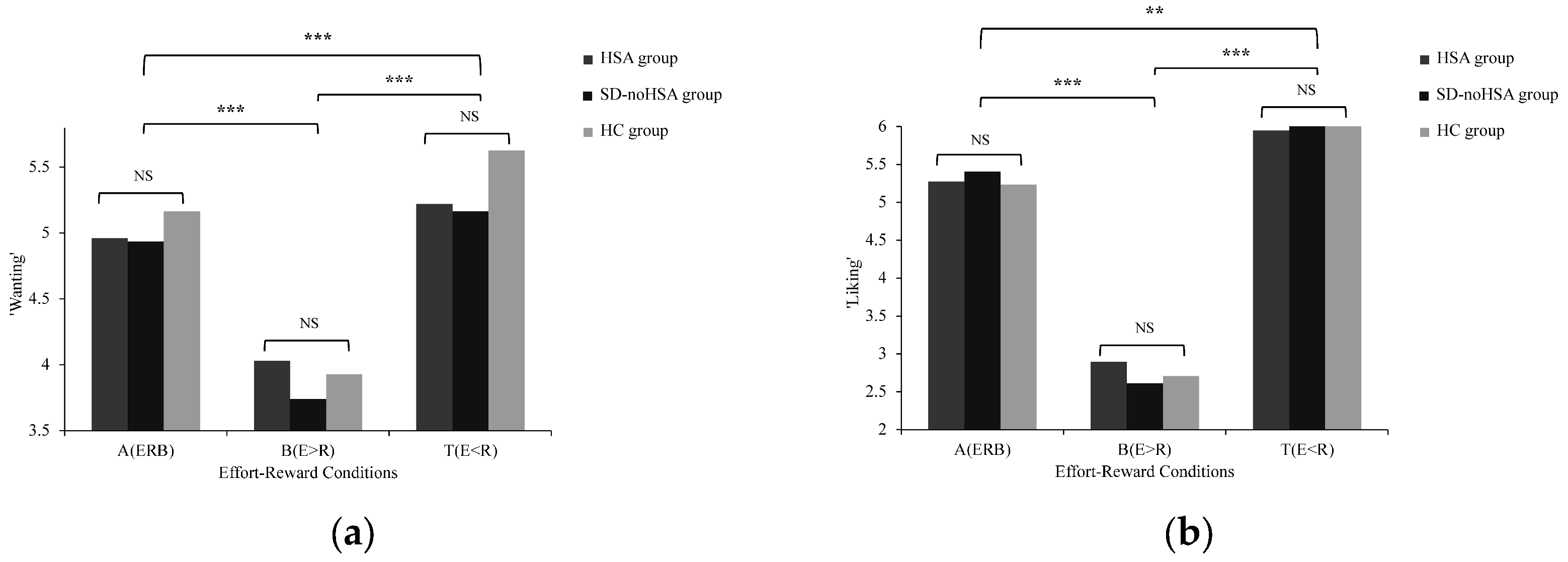
2.5.2. Repeated Measures ANOVA on Reward Motivation
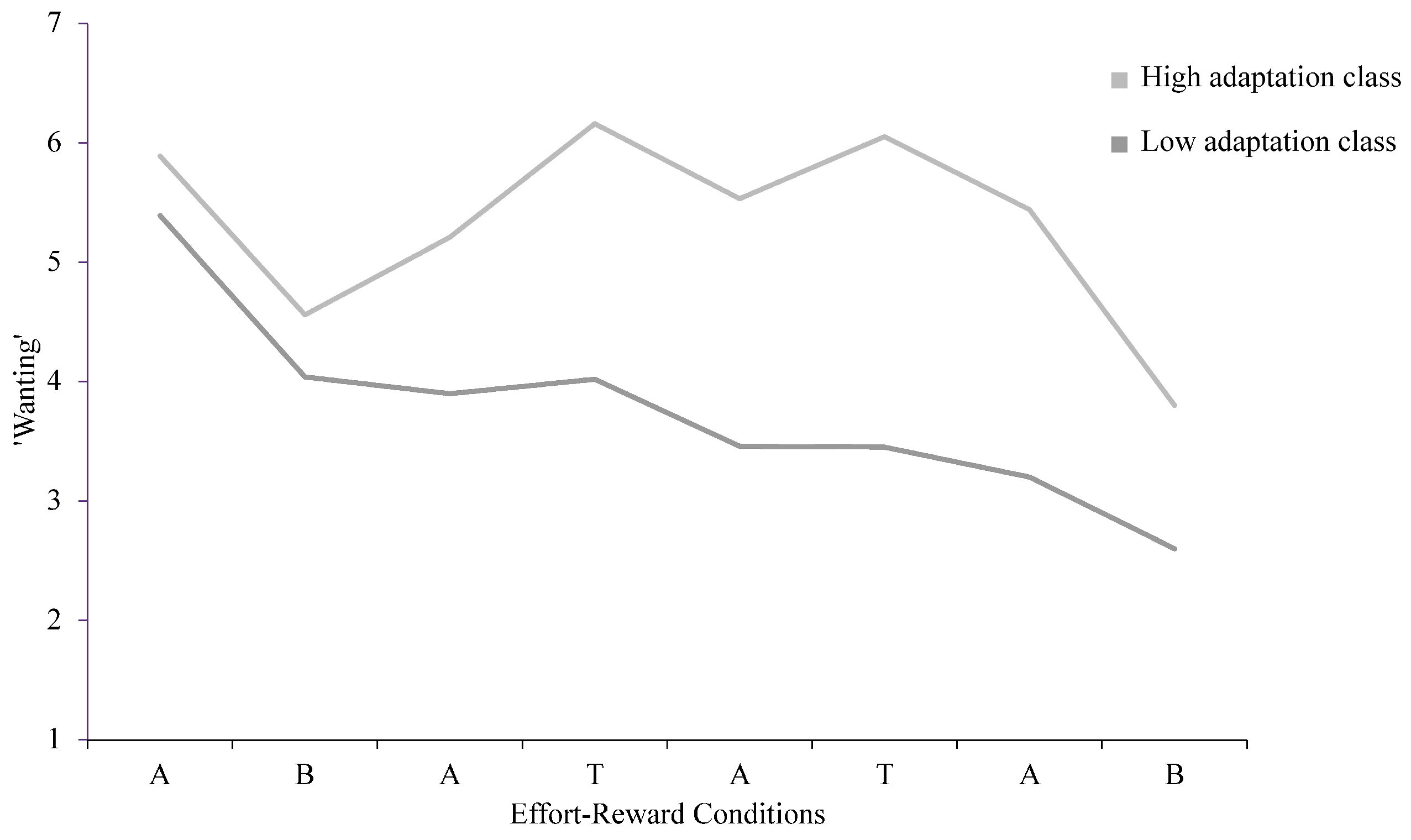
2.5.3. GMM-Based Classification of Reward Motivation Adaptation
2.5.4. Chi-Square Test Between Screening-Based Groups and Adaptation Classes
2.6. Discussion
3. Study 2
3.1. Participants
3.2. Measures
3.2.1. The Chinese Version of the Motivation and Pleasure Scale Self Report (MAP-SR)
3.2.2. The Chinese Version of the Effort–Reward Imbalance—School Version Questionnaire (ERI-S)
3.2.3. The Chinese Version of the Positive and Negative Affect Scale (PANAS)
3.3. Procedures
3.4. Data Analysis
3.5. Results
3.5.1. Demographic Characteristics and Questionnaire Scores
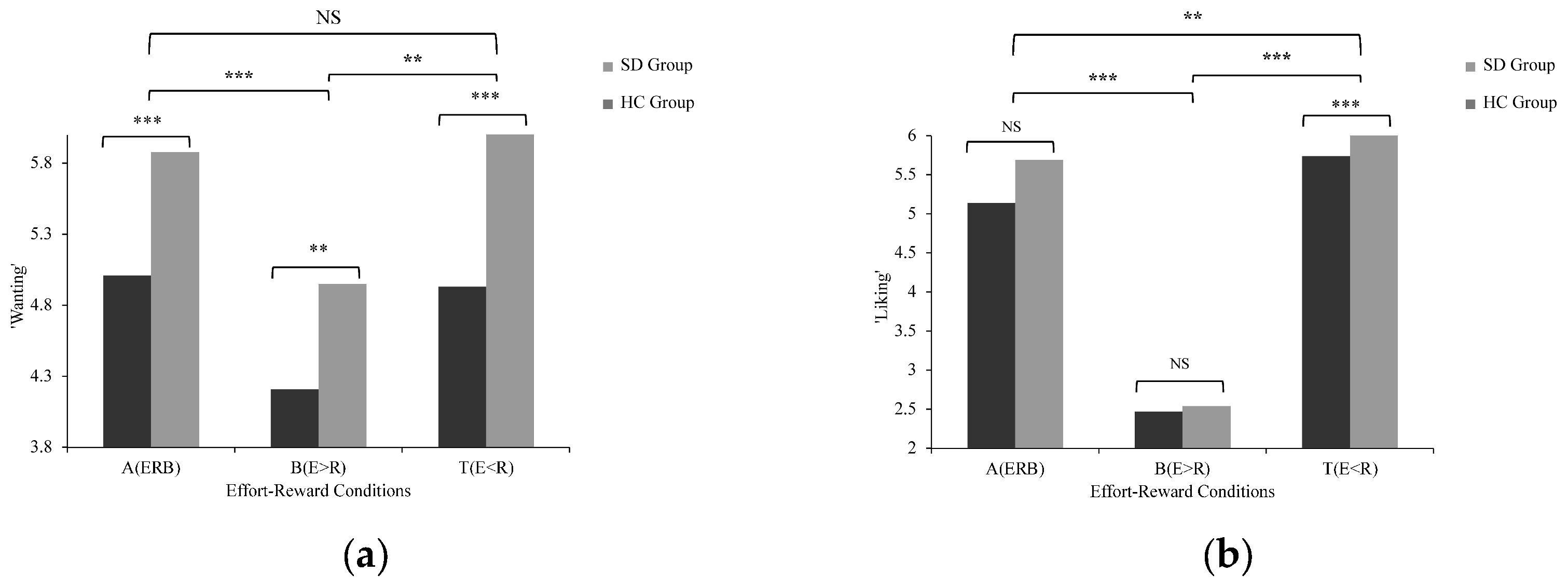
3.5.2. Repeated Measures ANOVA on Reward Motivation
3.5.3. Differences in Reward Motivation Adaptation Indicators in SD and HC Groups
3.6. Discussion
4. General Discussion
5. Conclusions
Supplementary Materials
Author Contributions
Funding
Institutional Review Board Statement
Informed Consent Statement
Data Availability Statement
Acknowledgments
Conflicts of Interest
References
- Barkus, E. (2021). The effects of anhedonia in social context. Current Behavioral Neuroscience Reports, 8(3), 77–89. [Google Scholar] [CrossRef]
- Baryshnikov, I., Aledavood, T., Rosenström, T., Heikkilä, R., Darst, R., Riihimäki, K., Saleva, O., Ekelund, J., & Isometsä, E. (2023). Relationship between daily rated depression symptom severity and the retrospective self-report on PHQ-9: A prospective ecological momentary assessment study on 80 psychiatric outpatients. Journal of Affective Disorders, 324, 170–174. [Google Scholar] [CrossRef] [PubMed]
- Beevers, C. G., Worthy, D. A., Gorlick, M. A., Nix, B., Chotibut, T., & Todd Maddox, W. (2013). Influence of depression symptoms on history-independent reward and punishment processing. Psychiatry Research, 207(1), 53–60. [Google Scholar] [CrossRef] [PubMed]
- Berridge, K. C. (2004). Motivation concepts in behavioral neuroscience. Physiology & Behavior, 81(2), 179–209. [Google Scholar] [CrossRef]
- Berridge, K. C., & Robinson, T. E. (2016). Liking, wanting, and the incentive-sensitization theory of addiction. American Psychologist, 71(8), 670–679. [Google Scholar] [CrossRef]
- Berridge, K. C., Robinson, T. E., & Aldridge, J. W. (2009). Dissecting components of reward: ‘Liking’, ‘wanting’, and learning. Current Opinion in Pharmacology, 9(1), 65–73. [Google Scholar] [CrossRef]
- Borsini, A., Wallis, A. S. J., Zunszain, P., Pariante, C. M., & Kempton, M. J. (2020). Characterizing anhedonia: A systematic review of neuroimaging across the subtypes of reward processing deficits in depression. Cognitive, Affective and Behavioral Neuroscience, 20(4), 816–841. [Google Scholar] [CrossRef]
- Case, J. A. C., Sullivan-Toole, H., Mattoni, M., Jacobucci, R., Forbes, E. E., & Olino, T. M. (2022). Evaluating the item-level factor structure of anhedonia. Journal of Affective Disorders, 299, 215–222. [Google Scholar] [CrossRef]
- Chan, R. C. K., Shi, Y., Lai, M., Wang, Y., Wang, Y., & Kring, A. M. (2012a). The Temporal Experience of Pleasure Scale (TEPS): Exploration and confirmation of factor structure in a healthy Chinese sample. PLoS ONE, 7(4), e35352. [Google Scholar] [CrossRef]
- Chan, R. C. K., Wang, Y., Yan, C., Zhao, Q., McGrath, J., Hsi, X., & Stone, W. S. (2012b). A study of trait anhedonia in non-clinical Chinese samples: Evidence from the chapman scales for physical and social anhedonia. PLoS ONE, 7(4), e34275. [Google Scholar] [CrossRef]
- Chapman, L. J., Chapman, J. P., & Raulin, M. L. (1976). Scales for physical and social anhedonia. Journal of Abnormal Psychology, 85(4), 374–382. [Google Scholar] [CrossRef] [PubMed]
- Chentsova-Dutton, Y., & Hanley, K. (2010). The effects of anhedonia and depression on hedonic responses. Psychiatry Research, 179(2), 176–180. [Google Scholar] [CrossRef] [PubMed]
- Collins, A. C., Lekkas, D., Struble, C. A., Trudeau, B. M., Jewett, A. D., Griffin, T. Z., Nemesure, M. D., Price, G. D., Heinz, M. V., Nepal, S., Pillai, A., Mackin, D. M., Campbell, A. T., Budney, A. J., & Jacobson, N. C. (2024). From mood to use: Using ecological momentary assessments to examine how anhedonia and depressed mood impact cannabis use in a depressed sample. Psychiatry Research, 339, 116110. [Google Scholar] [CrossRef] [PubMed]
- Eshel, N., & Roiser, J. P. (2010). Reward and punishment processing in depression. Biological Psychiatry, 68(2), 118–124. [Google Scholar] [CrossRef]
- Faul, F., Erdfelder, E., Buchner, A., & Lang, A.-G. (2009). Statistical power analyses using G*power 3.1: Tests for correlation and regression analyses. Behavior Research Methods, 41(4), 1149–1160. [Google Scholar] [CrossRef]
- Feighner, J. P. (1972). Diagnostic criteria for use in psychiatric research. Archives of General Psychiatry, 26(1), 57–63. [Google Scholar] [CrossRef]
- Franken, I. H. A., Rassin, E., & Muris, P. (2007). The assessment of anhedonia in clinical and non-clinical populations: Further validation of the Snaith–Hamilton Pleasure Scale (SHAPS). Journal of Affective Disorders, 99(1–3), 83–89. [Google Scholar] [CrossRef]
- Frey, A.-L., Kaya, M. S., Adeniyi, I., & McCabe, C. (2023). Anhedonia in relation to reward and effort learning in young people with depression symptoms. Brain Sciences, 13(2), 341. [Google Scholar] [CrossRef]
- Gard, D. E., Gard, M. G., Kring, A. M., & John, O. P. (2006). Anticipatory and consummatory components of the experience of pleasure: A scale development study. Journal of Research in Personality, 40(6), 1086–1102. [Google Scholar] [CrossRef]
- Geaney, J. T., Treadway, M. T., & Smillie, L. D. (2015). Trait anticipatory pleasure predicts effort expenditure for reward. PLoS ONE, 10(6), e0131357. [Google Scholar] [CrossRef]
- Grahek, I., Shenhav, A., Musslick, S., Krebs, R. M., & Koster, E. H. W. (2019). Motivation and cognitive control in depression. Neuroscience & Biobehavioral Reviews, 102, 371–381. [Google Scholar] [CrossRef] [PubMed]
- Halahakoon, D. C., Kieslich, K., O’Driscoll, C., Nair, A., Lewis, G., & Roiser, J. P. (2020). Reward-processing behavior in depressed participants relative to healthy volunteers: A systematic review and meta-analysis. JAMA Psychiatry, 77(12), 1286–1295. [Google Scholar] [CrossRef] [PubMed]
- Hallford, D. J., & Austin, D. W. (2022). Wanting and liking: Testing the factor structure of the temporal experience of pleasure scale in major depression and community samples. Assessment, 29(5), 1033–1044. [Google Scholar] [CrossRef] [PubMed]
- Hankin, B. L., Young, J. F., Abela, J. R. Z., Smolen, A., Jenness, J. L., Gulley, L. D., Technow, J. R., Gottlieb, A. B., Cohen, J. R., & Oppenheimer, C. W. (2015). Depression from childhood into late adolescence: Influence of gender, development, genetic susceptibility, and peer stress. Journal of Abnormal Psychology, 124(4), 803–816. [Google Scholar] [CrossRef]
- Horne, S. J., Topp, T. E., & Quigley, L. (2021). Depression and the willingness to expend cognitive and physical effort for rewards: A systematic review. Clinical Psychology Review, 88, 102065. [Google Scholar] [CrossRef]
- Höflich, A., Michenthaler, P., Kasper, S., & Lanzenberger, R. (2019). Circuit mechanisms of reward, anhedonia, and depression. International Journal of Neuropsychopharmacology, 22(2), 105–118. [Google Scholar] [CrossRef]
- Huang, L., Yang, T.-Z., & Ji, Z.-M. (2003). Applicability of the positive and negative affect schedule (PANAS) in Chinese populations. Chinese Mental Health Journal, 17(1), 54–56. (In Chinese) [Google Scholar]
- Judd, L. L., Rapaport, M. H., Paulus, M. P., & Brown, J. L. (1994). Subsyndromal symptomatic depression: A new mood disorder? The Journal of Clinical Psychiatry, 55, 18–28. [Google Scholar] [CrossRef]
- Keren, H., O’Callaghan, G., Vidal-Ribas, P., Buzzell, G. A., Brotman, M. A., Leibenluft, E., Pan, P. M., Meffert, L., Kaiser, A., Wolke, S., Pine, D. S., & Stringaris, A. (2018). Reward processing in depression: A conceptual and meta-analytic review across fMRI and EEG studies. American Journal of Psychiatry, 175(11), 1111–1120. [Google Scholar] [CrossRef]
- Kroenke, K., Spitzer, R. L., & Williams, J. B. W. (2001). The PHQ-9. Journal of General Internal Medicine, 16(9), 606–613. [Google Scholar] [CrossRef]
- Li, J., Shang, L., Wang, T., & Siegrist, J. (2010). Measuring effort–reward imbalance in school settings: A novel approach and its association with self-rated health. Journal of Epidemiology, 20(2), 111–118. [Google Scholar] [CrossRef] [PubMed]
- Liu, W., Wang, L., Zhu, Y., Li, M., & Chan, R. C. (2012). Clinical utility of the Snaith-Hamilton-Pleasure scale in the Chinese settings. BMC Psychiatry, 12(1), 184. [Google Scholar] [CrossRef] [PubMed]
- Llerena, K., Park, S. G., McCarthy, J. M., Couture, S. M., Bennett, M. E., & Blanchard, J. J. (2013). The Motivation and Pleasure Scale–Self-Report (MAP-SR): Reliability and validity of a self-report measure of negative symptoms. Comprehensive Psychiatry, 54(5), 568–574. [Google Scholar] [CrossRef] [PubMed]
- Löwe, B., Kroenke, K., Herzog, W., & Gräfe, K. (2004). Measuring depression outcome with a brief self-report instrument: Sensitivity to change of the patient health questionnaire (PHQ-9). Journal of Affective Disorders, 81(1), 61–66. [Google Scholar] [CrossRef]
- Luppa, M., Sikorski, C., Luck, T., Ehreke, L., Konnopka, A., Wiese, B., Weyerer, S., König, H.-H., & Riedel-Heller, S. G. (2012). Age- and gender-specific prevalence of depression in latest-life—Systematic review and meta-analysis. Journal of Affective Disorders, 136(3), 212–221. [Google Scholar] [CrossRef]
- McFarland, B. R., & Klein, D. N. (2009). Emotional reactivity in depression: Diminished responsiveness to anticipated reward but not to anticipated punishment or to nonreward or avoidance. Depression and Anxiety, 26(2), 117–122. [Google Scholar] [CrossRef]
- Otte, C., Gold, S. M., Penninx, B. W., Pariante, C. M., Etkin, A., Fava, M., Mohr, D. C., & Schatzberg, A. F. (2016). Major depressive disorder. Nature Reviews Disease Primers, 2(1), 16065. [Google Scholar] [CrossRef]
- Patton, G. C., Olsson, C., Bond, L., Toumbourou, J. W., Carlin, J. B., Hemphill, S. A., & Catalano, R. F. (2008). Predicting female depression across puberty: A two-nation longitudinal study. Journal of the American Academy of Child & Adolescent Psychiatry, 47(12), 1424–1432. [Google Scholar] [CrossRef]
- Pizzagalli, D. A. (2022). Toward a better understanding of the mechanisms and pathophysiology of anhedonia: Are we ready for translation? American Journal of Psychiatry, 179(7), 458–469. [Google Scholar] [CrossRef]
- Rodríguez, M. R., Nuevo, R., Chatterji, S., & Ayuso-Mateos, J. L. (2012). Definitions and factors associated with subthreshold depressive conditions: A systematic review. BMC Psychiatry, 12(1), 181. [Google Scholar] [CrossRef]
- Salk, R. H., Hyde, J. S., & Abramson, L. Y. (2017). Gender differences in depression in representative national samples: Meta-analyses of diagnoses and symptoms. Psychological Bulletin, 143(8), 783–822. [Google Scholar] [CrossRef]
- Serretti, A. (2023). Anhedonia and depressive disorders. Clinical Psychopharmacology and Neuroscience, 21(3), 401–409. [Google Scholar] [CrossRef] [PubMed]
- Sherdell, L., Waugh, C. E., & Gotlib, I. H. (2012). Anticipatory pleasure predicts motivation for reward in major depression. Journal of Abnormal Psychology, 121(1), 51–60. [Google Scholar] [CrossRef] [PubMed]
- Siegrist, J. (1996). Adverse health effects of high-effort/low-reward conditions. Journal of Occupational Health Psychology, 1(1), 27–41. [Google Scholar] [CrossRef] [PubMed]
- Siegrist, J., Starke, D., Chandola, T., Godin, I., Marmot, M., Niedhammer, I., & Peter, R. (2004). The measurement of effort–reward imbalance at work: European comparisons. Social Science & Medicine, 58(8), 1483–1499. [Google Scholar] [CrossRef]
- Snaith, R. P., Hamilton, M., Morley, S., Humayan, A., Hargreaves, D., & Trigwell, P. (1995). A scale for the assessment of hedonic tone the snaith–hamilton pleasure scale. British Journal of Psychiatry, 167(1), 99–103. [Google Scholar] [CrossRef]
- Solomonov, N., Victoria, L. W., Lyons, K., Phan, D. K., Alexopoulos, G. S., Gunning, F. M., & Flückiger, C. (2023). Social reward processing in depressed and healthy individuals across the lifespan: A systematic review and a preliminary coordinate-based meta-analysis of fMRI studies. Behavioural Brain Research, 454, 114632. [Google Scholar] [CrossRef]
- Steinmann, L. A., Dohm, K., Goltermann, J., Richter, M., Enneking, V., Lippitz, M., Repple, J., Mauritz, M., Dannlowski, U., & Opel, N. (2022). Understanding the neurobiological basis of anhedonia in major depressive disorder—Evidence for reduced neural activation during reward and loss processing. Journal of Psychiatry and Neuroscience, 47(4), E284–E292. [Google Scholar] [CrossRef]
- Studer, B., & Knecht, S. (2016). A benefit–cost framework of motivation for a specific activity. In Progress in brain research (Vol. 229, pp. 25–47). Elsevier. [Google Scholar] [CrossRef]
- Treadway, M. T., Bossaller, N. A., Shelton, R. C., & Zald, D. H. (2012). Effort-based decision-making in major depressive disorder: A translational model of motivational anhedonia. Journal of Abnormal Psychology, 121(3), 553–558. [Google Scholar] [CrossRef]
- Treadway, M. T., Buckholtz, J. W., Schwartzman, A. N., Lambert, W. E., & Zald, D. H. (2009). Worth the ‘EEfRT’? The effort expenditure for rewards task as an objective measure of motivation and anhedonia. PLoS ONE, 4(8), e6598. [Google Scholar] [CrossRef]
- Treadway, M. T., & Zald, D. H. (2011). Reconsidering anhedonia in depression: Lessons from translational neuroscience. Neuroscience & Biobehavioral Reviews, 35(3), 537–555. [Google Scholar] [CrossRef]
- Vrieze, E., Pizzagalli, D. A., Demyttenaere, K., Hompes, T., Sienaert, P., De Boer, P., Schmidt, M., & Claes, S. (2013). Reduced reward learning predicts outcome in major depressive disorder. Biological Psychiatry, 73(7), 639–645. [Google Scholar] [CrossRef]
- Wang, L., Ma, E. P. Y., Lui, S. S. Y., Cheung, E. F. C., Cheng, K. S., & Chan, R. C. K. (2020). Validation and extension of the Motivation and Pleasure Scale-Self Report (MAP-SR) across the schizophrenia spectrum in the Chinese context. Asian Journal of Psychiatry, 49, 101971. [Google Scholar] [CrossRef]
- Wang, S., Leri, F., & Rizvi, S. J. (2021). Anhedonia as a central factor in depression: Neural mechanisms revealed from preclinical to clinical evidence. Progress in Neuro-Psychopharmacology and Biological Psychiatry, 110, 110289. [Google Scholar] [CrossRef] [PubMed]
- Wang, W., Bian, Q., Zhao, Y., Li, X., Wang, W., Du, J., Zhang, G., Zhou, Q., & Zhao, M. (2014). Reliability and validity of the Chinese version of the Patient Health Questionnaire (PHQ-9) in the general population. General Hospital Psychiatry, 36(5), 539–544. [Google Scholar] [CrossRef] [PubMed]
- Watson, D., Clark, L. A., & Tellegen, A. (1988). Development and validation of brief measures of positive and negative affect: The PANAS scales. Journal of Personality and Social Psychology, 54(6), 1063–1070. [Google Scholar] [CrossRef] [PubMed]
- Whitton, A. E., Treadway, M. T., & Pizzagalli, D. A. (2015). Reward processing dysfunction in major depression, bipolar disorder and schizophrenia. Current Opinion in Psychiatry, 28(1), 7–12. [Google Scholar] [CrossRef]
- Wu, C., Mu, Q., Gao, W., & Lu, S. (2025). The characteristics of anhedonia in depression: A review from a clinically oriented perspective. Translational Psychiatry, 15(1), 91–98. [Google Scholar] [CrossRef]
- Wu, Q., He, J., Fang, S., Zhang, P., Luo, X., Zhang, J., Xiong, Y., Luo, F., Wang, X., Yao, S., & Wang, X. (2020). A novel construct of anhedonia revealed in a Chinese sample via the revised physical and social anhedonia scales. BMC Psychiatry, 20(1), 529. [Google Scholar] [CrossRef]
- Yan, Y., Hu, H., Zhang, Y., Wang, L., Pan, Y., Lui, S. S. Y., Huang, J., & Chan, R. C. K. (2024). Reward motivation adaptation in people with negative schizotypal features: Development of a novel behavioural paradigm and identifying its neural correlates using resting-state functional connectivity analysis. European Archives of Psychiatry and Clinical Neuroscience, 274, 941–953. [Google Scholar] [CrossRef]
- Yang, X., Huang, J., Zhu, C., Wang, Y., Cheung, E. F. C., Chan, R. C. K., & Xie, G. (2014). Motivational deficits in effort-based decision making in individuals with subsyndromal depression, first-episode and remitted depression patients. Psychiatry Research, 220(3), 874–882. [Google Scholar] [CrossRef]
- Zhang, R., Peng, X., Song, X., Long, J., Wang, C., Zhang, C., Huang, R., & Lee, T. M. C. (2023). The prevalence and risk of developing major depression among individuals with subthreshold depression in the general population. Psychological Medicine, 53(8), 3611–3620. [Google Scholar] [CrossRef]
- Zhang, R.-T., Gao, Y., Yang, T.-X., Yan, C., Wang, Y., Lui, S. S. Y., & Chan, R. C. K. (2025). Real-life affective forecasting in young adults with high social anhedonia: An experience sampling study. Schizophrenia Bulletin Open, 6(1), sgaf003. [Google Scholar] [CrossRef]
- Zhong, S., Chen, C., Chen, P., Tang, X., Chen, G., Lai, S., Zhang, Y., Ma, W., Zhang, Y., Zhang, S., Qi, Z., Tao, Q., Jia, Y., & Wang, Y. (2026). Shared and distinct alterations in brain connectivity and cognitive function in subthreshold and major depression. Psychological Medicine, 56, e69. [Google Scholar] [CrossRef]


| Variable | HSA (N = 38) | SD-noHSA (N = 38) | HC (N = 38) | ||||||
|---|---|---|---|---|---|---|---|---|---|
| Mean | SD | Mean | SD | Mean | SD | F/χ2 | df | p | |
| Age (years) | 22.25 | 2.51 | 21.51 | 1.89 | 22.10 | 2.54 | 1.081 | 111 | 0.343 |
| Gender (male/female) | 16/22 | 14/24 | 13/25 | 0.523 | 2 | 0.770 | |||
| Years of education (years) | 14.66 | 1.86 | 14.05 1 | 1.94 | 14.26 2 | 2.01 | 0.939 | 108 | 0.394 |
| Father’s years of education (years) | 10.61 | 4.25 | 9.84 1 | 3.18 | 11.03 2 | 4.00 | 0.905 | 108 | 0.408 |
| Mother’s years of education (years) | 11.00 | 5.32 | 8.62 1 | 3.53 | 10.75 2 | 4.59 | 3.127 | 108 | 0.048 |
| Calculation accuracy in RMAT | 0.70 | 0.14 | 0.70 | 0.11 | 0.67 | 0.13 | 0.444 | 111 | 0.643 |
| Variables | SD (N = 30) | HC (N = 30) | |||||||
|---|---|---|---|---|---|---|---|---|---|
| Mean | SD | Mean | SD | t | df | p | Cohen’s d | ||
| Demographic Characteristics | |||||||||
| Age (years) | 21.30 | 3.08 | 21.47 | 2.83 | −0.219 | 58 | 0.828 | −0.057 | |
| Years of Education (years) | 14.30 | 1.78 | 15.03 | 1.85 | −1.564 | 58 | 0.123 | −0.404 | |
| Father’s Age (years) | 49.83 | 10.60 | 51.60 | 5.22 | −0.819 | 58 | 0.416 | −0.211 | |
| Father’s Education (years) | 13.00 | 3.95 | 14.53 | 3.51 | −1.590 | 58 | 0.117 | −0.411 | |
| Mother’s Age (years) | 49.20 | 4.63 | 48.93 | 4.53 | 0.225 | 58 | 0.822 | 0.058 | |
| Mother’s Education (years) | 13.03 | 4.09 | 13.93 | 4.02 | −0.860 | 58 | 0.393 | −0.222 | |
| Scale | Subscale | ||||||||
| MAP-SR | Total | 49.10 | 8.76 | 58.30 | 6.72 | −4.563 | 58 | <0.001 | −1.178 |
| TEPS | Abstract_anticipatory | 18.27 | 3.67 | 20.23 | 2.91 | −2.302 | 58 | 0.025 | −0.594 |
| Concrete_anticipatory | 17.73 | 4.22 | 16.83 | 4.37 | 0.812 | 58 | 0.420 | 0.210 | |
| Abstract_consumatory | 27.47 | 4.25 | 28.27 | 4.76 | −0.687 | 58 | 0.495 | −0.177 | |
| Concrete_consumatory | 18.17 | 3.29 | 17.00 | 3.53 | 1.323 | 58 | 0.191 | 0.342 | |
| Total | 85.67 | 13.42 | 87.13 | 12.26 | 0.196 | 58 | 0.660 | −0.114 | |
| ERI-S | Effort–Reward ratio | 1.14 | 0.38 | 0.87 | 0.24 | 3.293 | 58 | 0.002 | 0.850 |
| SHAPS | Total | 25.07 | 6.13 | 20.50 | 4.72 | 3.235 | 58 | 0.002 | 0.835 |
| Dichotomous Score | 1.90 | 2.68 | 0.33 | 0.80 | 3.065 | 34.146 | 0.004 | 0.791 | |
| PANAS | Positive | 22.83 | 4.80 | 30.87 | 6.95 | −5.211 | 51.551 | <0.001 | −1.345 |
| Negative | 26.17 | 7.65 | 17.23 | 4.44 | 5.531 | 46.530 | <0.001 | 1.428 | |
Disclaimer/Publisher’s Note: The statements, opinions and data contained in all publications are solely those of the individual author(s) and contributor(s) and not of MDPI and/or the editor(s). MDPI and/or the editor(s) disclaim responsibility for any injury to people or property resulting from any ideas, methods, instructions or products referred to in the content. |
© 2026 by the authors. Licensee MDPI, Basel, Switzerland. This article is an open access article distributed under the terms and conditions of the Creative Commons Attribution (CC BY) license.
Share and Cite
Gao, X.; Pu, J.; Zhao, X.; Zhao, Y.; Mu, W.; Lui, S.S.Y.; Huang, J.; Chan, R.C.K. Reward Motivation Adaptation Deficits Are Specific to Co-Occurring Subclinical Depression and Anhedonia. Behav. Sci. 2026, 16, 464. https://doi.org/10.3390/bs16030464
Gao X, Pu J, Zhao X, Zhao Y, Mu W, Lui SSY, Huang J, Chan RCK. Reward Motivation Adaptation Deficits Are Specific to Co-Occurring Subclinical Depression and Anhedonia. Behavioral Sciences. 2026; 16(3):464. https://doi.org/10.3390/bs16030464
Chicago/Turabian StyleGao, Xin, Jie Pu, Xinyue Zhao, Yuxi Zhao, Wenting Mu, Simon S. Y. Lui, Jia Huang, and Raymond C. K. Chan. 2026. "Reward Motivation Adaptation Deficits Are Specific to Co-Occurring Subclinical Depression and Anhedonia" Behavioral Sciences 16, no. 3: 464. https://doi.org/10.3390/bs16030464
APA StyleGao, X., Pu, J., Zhao, X., Zhao, Y., Mu, W., Lui, S. S. Y., Huang, J., & Chan, R. C. K. (2026). Reward Motivation Adaptation Deficits Are Specific to Co-Occurring Subclinical Depression and Anhedonia. Behavioral Sciences, 16(3), 464. https://doi.org/10.3390/bs16030464