The Longitudinal Relationship Between Dark Triad Traits and Moral Disengagement in Adolescents: A Cross-Lagged Panel Network Analysis

Abstract
1. Introduction
1.1. Dark Triad Traits and Moral Disengagement
1.2. Gender Differences
1.3. Network Analysis and Theory
1.4. Current Study
2. Methods
2.1. Participants and Procedure
2.2. Measures
2.2.1. Dark Triad Traits
2.2.2. Moral Disengagement
2.3. Data Analysis
3. Results
3.1. Preliminary Analysis
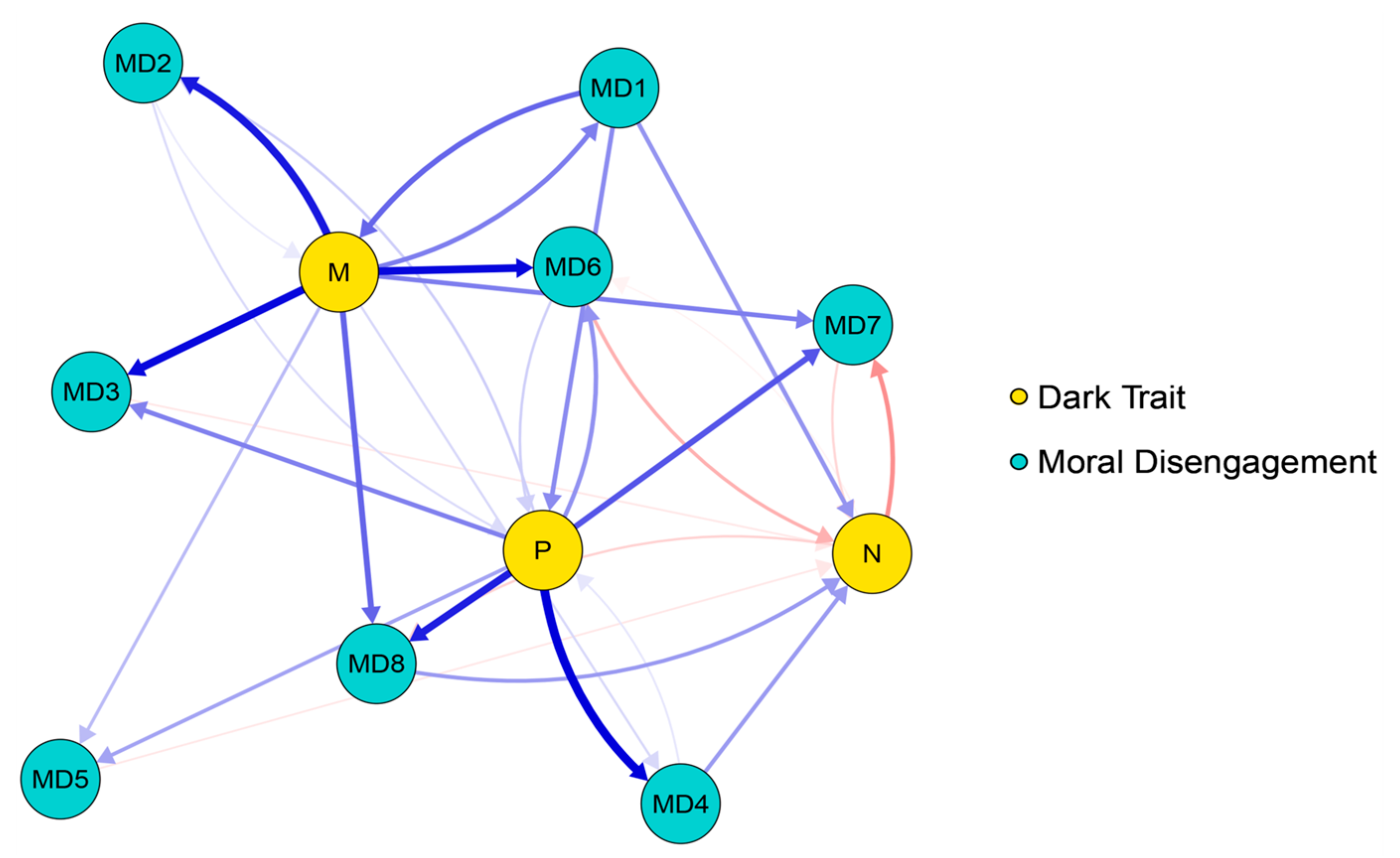
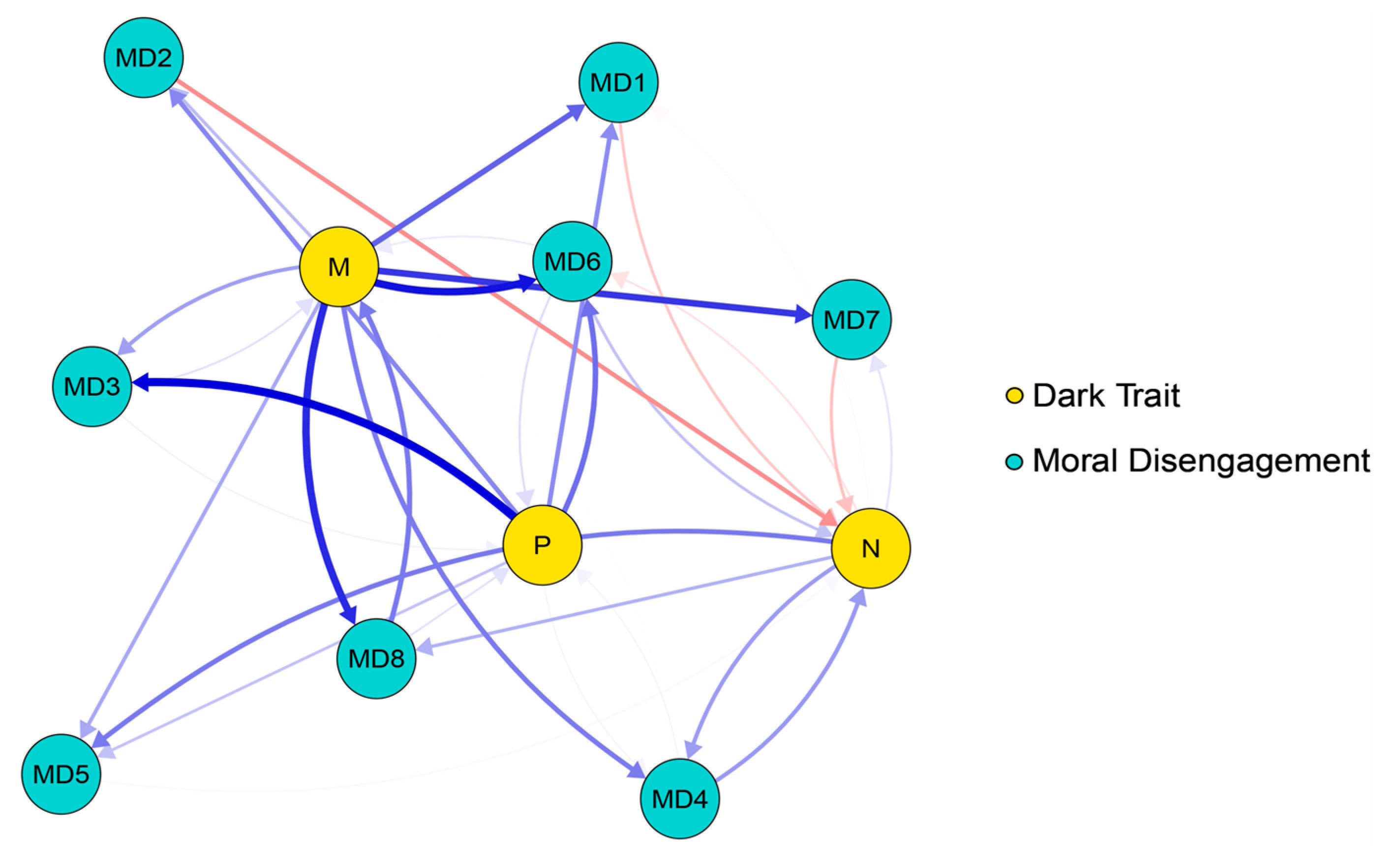
3.2. Network Analysis
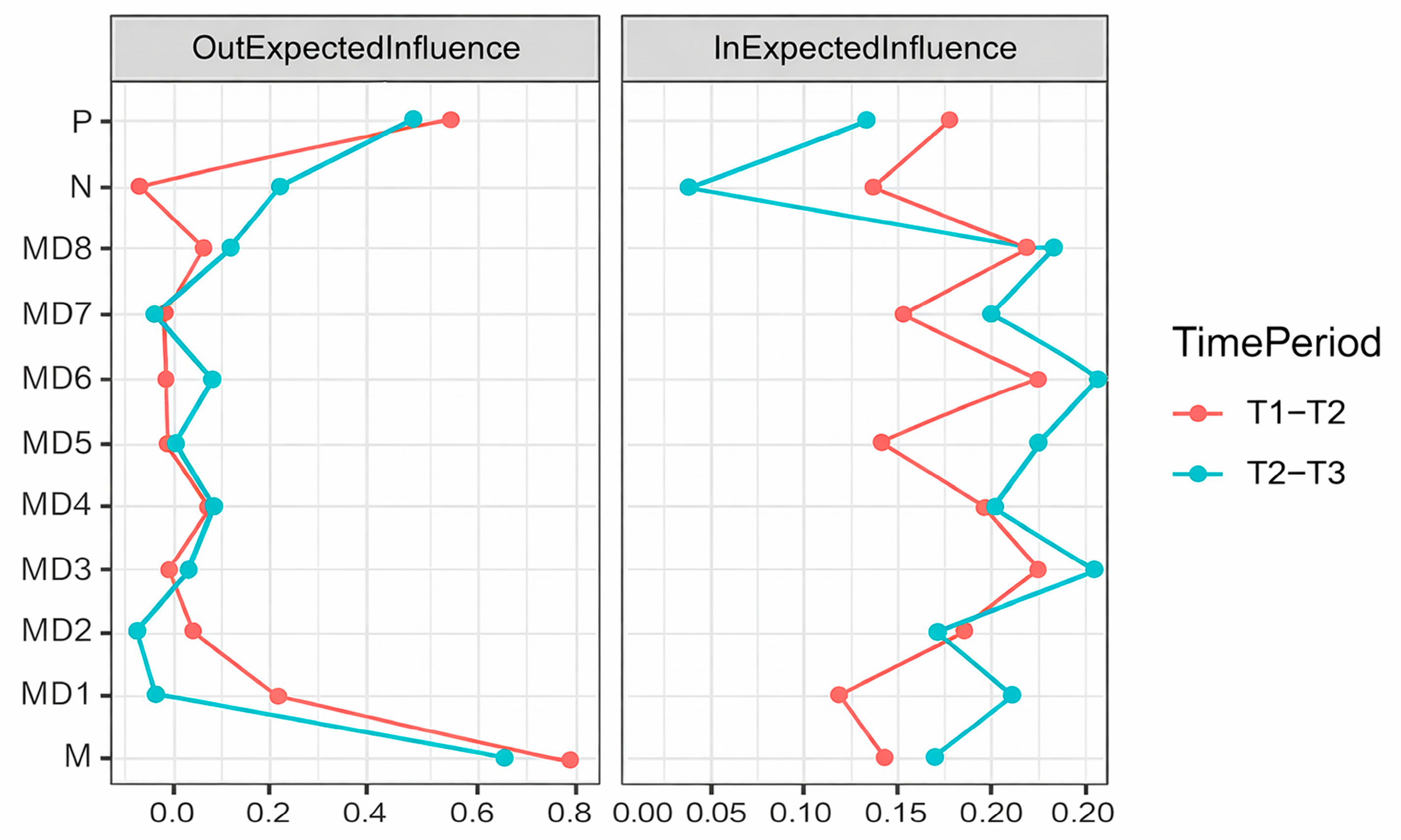
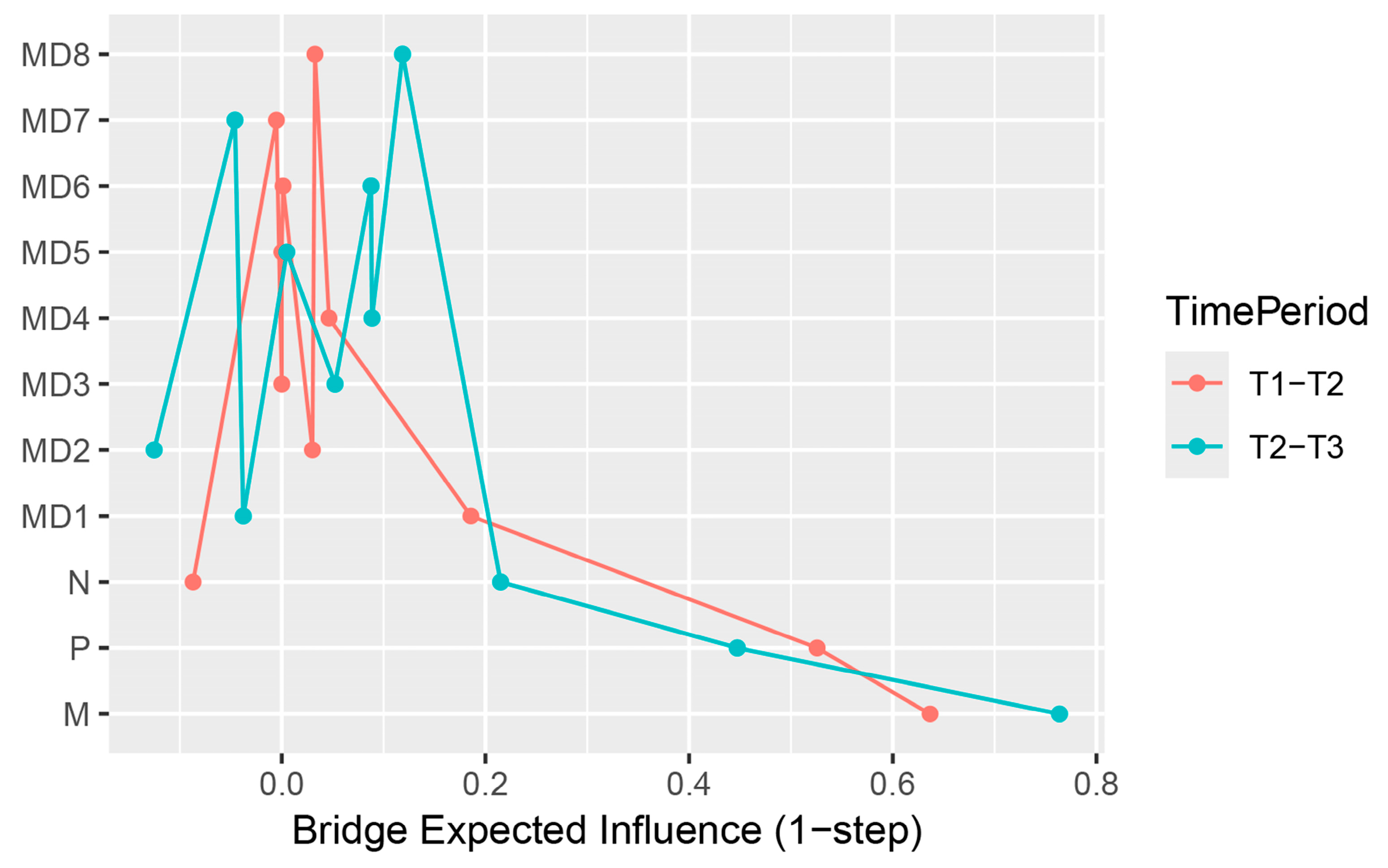
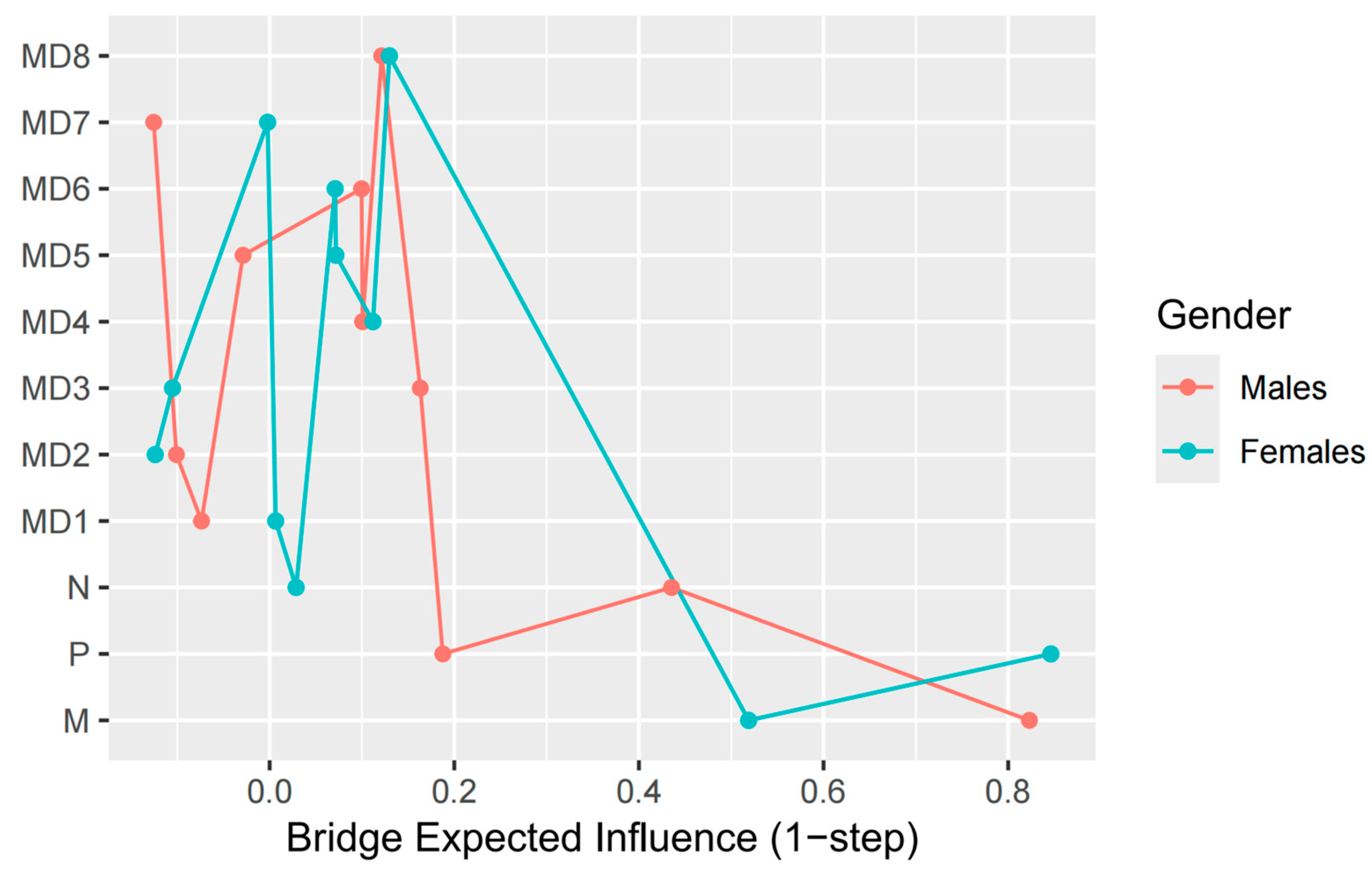
3.3. Centrality
3.4. Stability Analysis
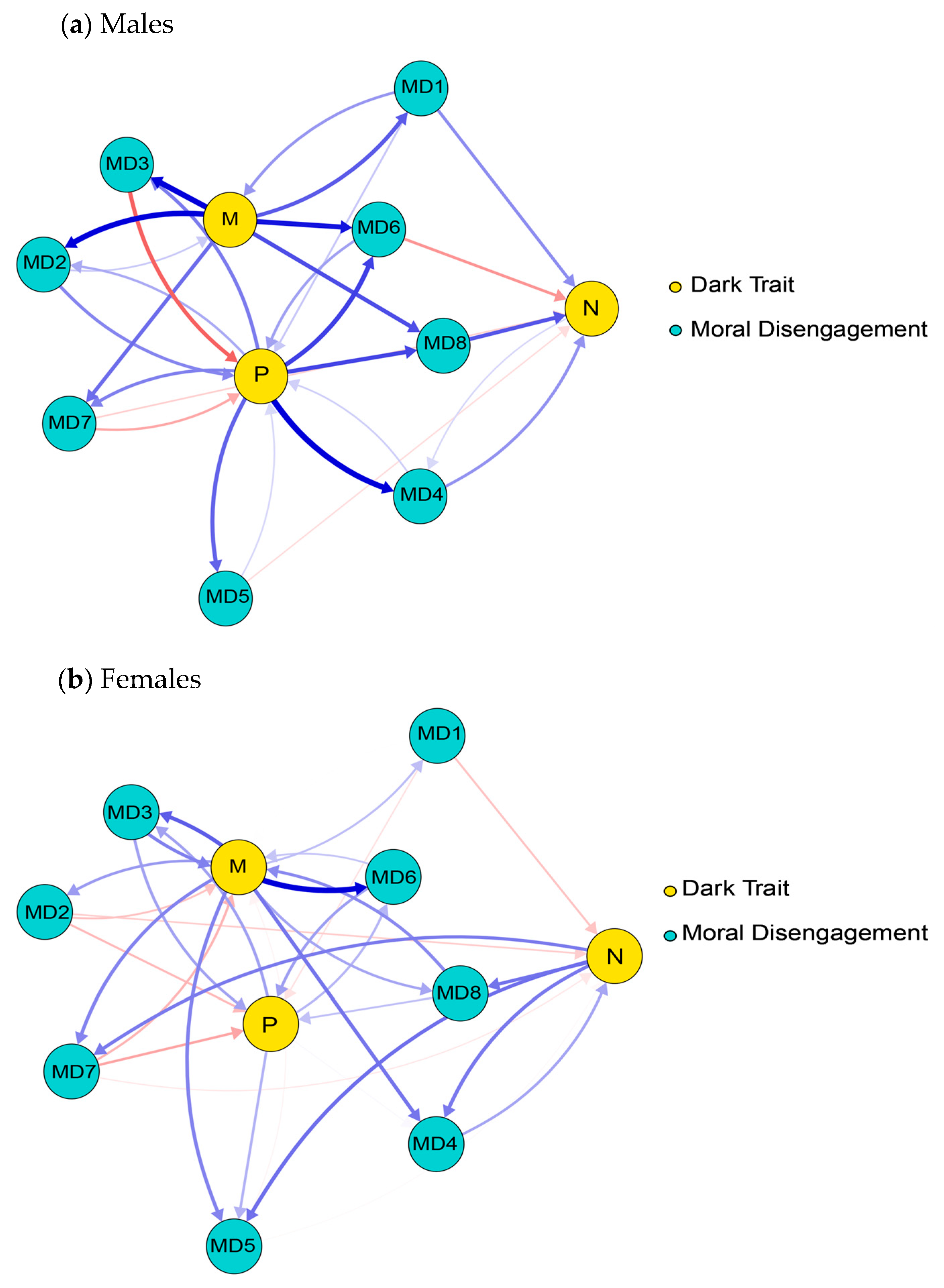
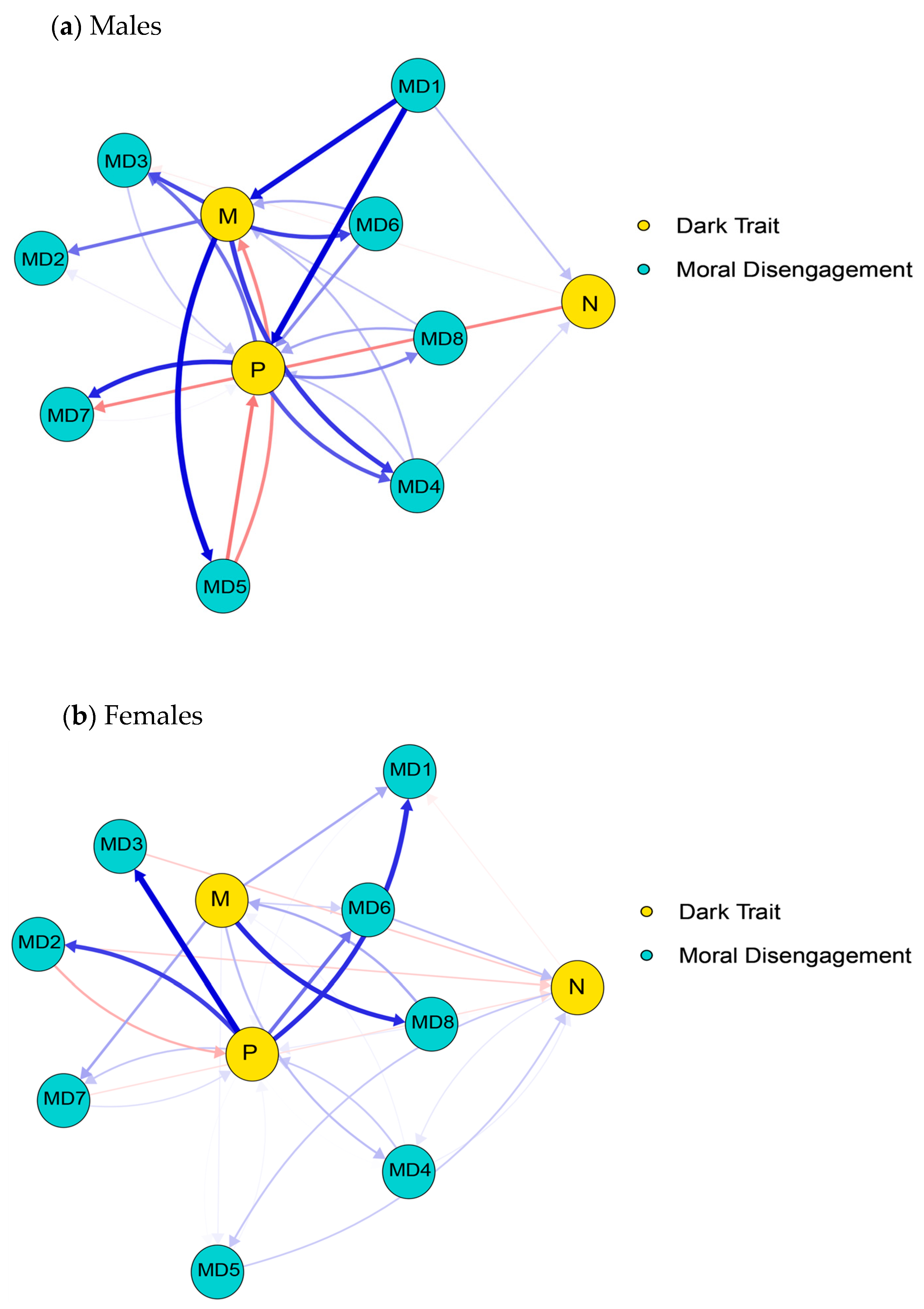
3.5. Gender-Based Network Comparison
4. Discussion
4.1. Relations Between DT Traits and MD
4.2. Gender Comparisons in the Network
4.3. Limitations and Implications
5. Conclusions
Supplementary Materials
Author Contributions
Funding
Institutional Review Board Statement
Informed Consent Statement
Data Availability Statement
Acknowledgments
Conflicts of Interest
Abbreviations
| MD | Moral disengagement |
| DT | Dark Triad |
| CLPN | Cross-Lagged Panel Network |
| MD1 | Moral justification |
| MD2 | Euphemistic labelling |
| MD3 | Advantageous comparison |
| MD4 | Displacement of responsibility |
| MD5 | Diffusion of responsibility |
| MD6 | Distortion of consequences |
| MD7 | Attribution of blame |
| MD8 | Dehumanization |
| O-EI | Out Expected Influence |
| I-EI | In Expected Influence |
| B-EI | Bridge Expected Influence |
| CIs | Confidence Intervals |
References
- Aharoni, E., Sinnott-Armstrong, W., & Kiehl, K. A. (2014). What’s wrong? Moral understanding in psychopathic offenders. Journal of Research in Personality, 53, 175–181. [Google Scholar] [CrossRef] [PubMed][Green Version]
- Bajovic, M., & Rizzo, K. (2021). Meta-moral cognition: Bridging the gap among adolescents’ moral thinking, moral emotions and moral actions. International Journal of Adolescence and Youth, 26(1), 1–11. [Google Scholar] [CrossRef]
- Bandura, A. (1989). Regulation of cognitive processes through perceived self-efficacy. Developmental Psychology, 25(5), 729–735. [Google Scholar] [CrossRef]
- Bandura, A. (1999). Moral disengagement in the perpetration of inhumanities. Personality and Social Psychology Review, 3(3), 193–209. [Google Scholar] [CrossRef]
- Campbell, W. K., Brunell, A. B., & Finkel, E. J. (2006). Narcissism, interpersonal self-regulation, and romantic relationships: An agency model approach. In K. D. Vohs, & E. J. Finkel (Eds.), Self and relationships: Connecting intrapersonal and interpersonal processes (pp. 57–83). The Guilford Press. [Google Scholar]
- Campbell, W. K., Goodie, A. S., & Foster, J. D. (2004). Narcissism, confidence, and risk attitude. Journal of Behavioral Decision Making, 17, 297–311. [Google Scholar] [CrossRef]
- Chen, W., Lu, J., Liu, L., & Lin, W. (2014). Gender differences of empathy. Advances in Psychological Science, 22(9), 1423–1434. [Google Scholar] [CrossRef]
- Detert, J. R., Treviño, L. K., & Sweitzer, V. L. (2008). Moral disengagement in ethical decision making: A study of antecedents and outcomes. Journal of Applied Psychology, 93(2), 374. [Google Scholar] [CrossRef]
- Egan, V., Hughes, N., & Palmer, E. J. (2015). Moral disengagement, the Dark Triad, and unethical consumer attitudes. Personality and Individual Differences, 76, 123–128. [Google Scholar] [CrossRef]
- Epskamp, S., Cramer, A. O., Waldorp, L. J., Schmittmann, V. D., & Borsboom, D. (2012). qgraph: Network visualizations of relationships in psychometric data. Journal of Statistical Software, 48, 1–18. [Google Scholar] [CrossRef]
- Epskamp, S., & Fried, E. I. (2018). A tutorial on regularized partial correlation networks. Psychological Methods, 23(4), 617. [Google Scholar] [CrossRef]
- Fried, E. I., van Borkulo, C. D., Cramer, A. O. J., Boschloo, L., Schoevers, R. A., & Borsboom, D. (2017). Mental disorders as networks of problems: A review of recent insights. Social Psychiatry and Psychiatric Epidemiology, 52(1), 1–10. [Google Scholar] [CrossRef] [PubMed]
- Gibbs, J. C. (2014). Moral development and reality: Beyond the theories of Kohlberg, Hoffman, and Haidt (3rd ed.). Oxford University Press. [Google Scholar]
- Gilligan, C. (1993). In a different voice: Psychological theory and women’s development. Harvard University Press. [Google Scholar]
- Goncalves, M. K., & Campbell, L. (2014). The Dark Triad and the derogation of mating competitors. Personality and Individual Differences, 67, 42–46. [Google Scholar] [CrossRef]
- Gómez-Tabares, A. S. (2024). Social-cognitive mechanisms of moral disengagement, sex differences and psychological predictors in young populations. Revista Colombiana de Psicología, 33(2), 63–83. [Google Scholar] [CrossRef]
- Grijalva, E., & Zhang, L. (2016). Narcissism and self-insight: A review and meta-analysis of narcissists’ self-enhancement tendencies. Personality and Social Psychology Bulletin, 42(1), 3–24. [Google Scholar] [CrossRef]
- Gutman, L. M., & Codiroli McMaster, N. (2020). Gendered pathways of internalizing problems from early childhood to adolescence and associated adolescent outcomes. Journal of Abnormal Child Psychology, 48(5), 703–718. [Google Scholar] [CrossRef]
- Heeren, A., Jones, P. J., & McNally, R. J. (2018). Mapping network connectivity among symptoms of social anxiety and comorbid depression in people with social anxiety disorder. Journal of Affective Disorders, 228, 75–82. [Google Scholar] [CrossRef]
- Hyde, L. W., Shaw, D. S., & Moilanen, K. L. (2010). Developmental precursors of moral disengagement and the role of moral disengagement in the development of antisocial behavior. Journal of Abnormal Child Psychology, 38, 197–209. [Google Scholar] [CrossRef]
- Jonason, P. K., Duineveld, J. J., & Middleton, J. P. (2015). Pathology, pseudopathology, and the Dark Triad of personality. Personality and Individual Differences, 78, 43–47. [Google Scholar] [CrossRef]
- Jonason, P. K., & Kroll, C. H. (2015). A multidimensional view of the relationship between empathy and the Dark Triad. Journal of Individual Differences, 36(3), 150–156. [Google Scholar] [CrossRef]
- Jonason, P. K., Lyons, M., Bethell, E. J., & Ross, R. (2013). Different routes to limited empathy in the sexes: Examining the links between the Dark Triad and empathy. Personality and Individual Differences, 54(5), 572–576. [Google Scholar] [CrossRef]
- Jonason, P. K., & Webster, G. D. (2010). The dirty dozen: A concise measure of the Dark Triad. Psychological Assessment, 22(2), 420. [Google Scholar] [CrossRef] [PubMed]
- Jones, D. N., & de Roos, M. S. (2017). Machiavellian flexibility in negative mate retention. Personal Relationships, 24(2), 265–279. [Google Scholar] [CrossRef]
- Jones, D. N., & Paulhus, D. L. (2009). Machiavellianism. In M. R. Leary, & R. H. Hoyle (Eds.), Handbook of individual differences in social behavior (pp. 93–108). Guilford. [Google Scholar]
- Jones, D. N., & Paulhus, D. L. (2011). Differentiating the Dark Triad within the interpersonal circumplex. In L. M. Horowitz, & S. Strack (Eds.), Handbook of interpersonal psychology: Theory, research, assessment, and therapeutic interventions (pp. 249–267). John Wiley & Sons, Inc. [Google Scholar]
- Jones, D. N., & Weiser, D. A. (2014). Differential infidelity patterns among the Dark Triad. Personality and Individual Differences, 57, 20–24. [Google Scholar] [CrossRef]
- Lapsley, D., & Carlo, G. (2014). Moral development at the crossroads: New trends and possible futures. Developmental Psychology, 50(1), 1–7. [Google Scholar] [CrossRef]
- Li, X. (2017). Gender differences in emotion expression—Social developmental perspective. Advances in Psychology, 7(3), 359–365. [Google Scholar] [CrossRef]
- Li, Y., Si, Y., H, C., Jin, C., & Wang, B. (2026). The dark triad, moral disengagement and online deviant behavior in adolescents: A half-longitudinal and latent transition study. Personality and Individual Differences, 250, 113555. [Google Scholar] [CrossRef]
- Lingán-Huamán, S. K., Dominguez-Lara, S., & Esteban, R. F. C. (2024). Gender-based differences in the impact of Dark Triad traits on academic dishonesty: The mediating role of moral disengagement in college students. Heliyon, 10(1), e23322. [Google Scholar] [CrossRef]
- Miller, J. D., Hoffman, B. J., Gaughan, E. T., Gentile, B., Maples, J., & Keith Campbell, W. (2011). Grandiose and vulnerable narcissism: A nomological network analysis. Journal of Personality, 79(5), 1013–1042. [Google Scholar] [CrossRef]
- Moore, C., Detert, J. R., Klebe Treviño, L., Baker, V. L., & Mayer, D. M. (2012). Why employees do bad things: Moral disengagement and unethical organizational behavior. Personnel Psychology, 65(1), 1–48. [Google Scholar] [CrossRef]
- Moore, K. E., Ross, S. R., & Brosius, E. C. (2020). The role of gender in the relations among Dark Triad and psychopathy, sociosexuality, and moral judgments. Personality and Individual Differences, 152, 109577. [Google Scholar] [CrossRef]
- Paciello, M., Fida, R., Tramontano, C., Lupinetti, C., & Caprara, G. V. (2008). Stability and change of moral disengagement and its impact on aggression and violence in late adolescence. Child Development, 79(5), 1288–1309. [Google Scholar] [CrossRef] [PubMed]
- Paulhus, D. L., & Williams, K. M. (2002). The Dark Triad of personality: Narcissism, Machiavellianism, and psychopathy. Journal of Research in Personality, 36(6), 556–563. [Google Scholar] [CrossRef]
- Petrides, K. V., Vernon, P. A., Schermer, J. A., & Veselka, L. (2011). Trait emotional intelligence and the Dark Triad traits of personality. Twin Research and Human Genetics, 14(1), 35–41. [Google Scholar] [CrossRef] [PubMed]
- Rhemtulla, M., Bork, R. V., & Cramer, A. (2017). Cross-lagged network models. Multivariate Behavioral Research. Available online: https://www.semanticscholar.org/paper/Cross-Lagged-Network-Models-Rhemtulla-Bork/fbb8ab2cea6c60c65b3254aeb2f0325009ac0f59 (accessed on 20 February 2025).
- Ritchie, M. B., & Forth, A. E. (2016). Without concern: Predicting personal-moral transgressions from psychopathy and gender. Personality and Individual Differences, 94, 247–252. [Google Scholar] [CrossRef]
- Rogoza, R., Żemojtel-Piotrowska, M., Jonason, P. K., Piotrowski, J., Campbell, K. W., Gebauer, J. E., Maltby, J., Sedikides, C., Adamovic, M., Adams, B. G., Ang, R. P., Ardi, R., Atitsogbe, K. A., Baltatescu, S., Bilić, S., Bodroža, B., Brulin, J. G., Bundhoo Poonoosamy, H. Y., Chaleeraktrakoon, T., … Włodarczyk, A. (2021). Structure of dark triad dirty dozen across eight world regions. Assessment, 28, 1125–1135. [Google Scholar] [CrossRef]
- Rubio-Garay, F., Amor, P. J., & Carrasco, M. A. (2019). The contribution of moral disengagement to dating violence and general aggression: The gender and age moderating effects. The Spanish Journal of Psychology, 22, e59. [Google Scholar] [CrossRef]
- Shen, K. (2023). The dark triad and depressive symptoms among Chinese adolescents: Moderated mediation models of age and emotion regulation strategies. Current Psychology, 42, 30949–30958. [Google Scholar] [CrossRef]
- Sijtsema, J. J., Garofalo, C., Jansen, K., & Klimstra, T. A. (2019). Disengaging from evil: Longitudinal associations between the Dark Triad, moral disengagement, and antisocial behavior in adolescence. Journal of Abnormal Child Psychology, 47, 1351–1365. [Google Scholar] [CrossRef]
- Thornberg, R., & Jungert, T. (2014). School bullying and the mechanisms of moral disengagement. Aggressive Behavior, 40(2), 99–108. [Google Scholar] [CrossRef]
- Tong, D., Isik, I., & Talwar, V. (2024). Relations among lie-telling self-efficacy, moral disengagement, and willingness to tell antisocial lies among children and adolescents. Journal of Experimental Child Psychology, 246, 105999. [Google Scholar] [CrossRef]
- Tremblay, R. E. (2010). Developmental origins of disruptive behaviour problems: The ‘original sin’ hypothesis, epigenetics and their consequences for prevention. Journal of Child Psychology and Psychiatry, 51(4), 341–367. [Google Scholar] [CrossRef]
- Zhao, H., Zhang, H., & He, W. (2025). Does childhood adversity make adolescents more morally disengaged? The effect of life history strategy and self-compassion. Personality and Individual Differences, 233, 112900. [Google Scholar] [CrossRef]




| Item | Label | Time 1 | Time 2 | Time 3 | |||
|---|---|---|---|---|---|---|---|
| M | SD | M | SD | M | SD | ||
| Machiavellianism | M | 2.73 | 1.52 | 3.11 | 1.56 | 3.20 | 1.41 |
| Psychopathy | N | 2.58 | 1.38 | 2.93 | 1.47 | 3.03 | 1.39 |
| Narcissism | P | 4.21 | 1.48 | 4.06 | 1.45 | 4.00 | 1.29 |
| Moral Justification | MD1 | 3.27 | 1.84 | 3.21 | 1.74 | 3.29 | 1.63 |
| Euphemistic Labelling | MD2 | 2.24 | 1.57 | 2.64 | 1.67 | 2.77 | 1.55 |
| Advantageous Comparison | MD3 | 1.75 | 1.41 | 2.43 | 1.74 | 2.60 | 1.63 |
| Displacement of Responsibility | MD4 | 2.99 | 1.82 | 3.19 | 1.75 | 3.27 | 1.59 |
| Diffusion of Responsibility | MD5 | 3.45 | 1.87 | 3.53 | 1.78 | 3.57 | 1.66 |
| Distortion of Consequences | MD6 | 1.88 | 1.46 | 2.48 | 1.74 | 2.68 | 1.64 |
| Attribution of Blame | MD7 | 3.28 | 1.96 | 3.31 | 1.89 | 3.26 | 1.67 |
| Dehumanization | MD8 | 2.95 | 1.76 | 3.18 | 1.78 | 3.29 | 1.59 |
Disclaimer/Publisher’s Note: The statements, opinions and data contained in all publications are solely those of the individual author(s) and contributor(s) and not of MDPI and/or the editor(s). MDPI and/or the editor(s) disclaim responsibility for any injury to people or property resulting from any ideas, methods, instructions or products referred to in the content. |
© 2026 by the authors. Licensee MDPI, Basel, Switzerland. This article is an open access article distributed under the terms and conditions of the Creative Commons Attribution (CC BY) license.
Share and Cite
Zhao, H.; Wang, K.; Xu, Y.; Zhang, H. The Longitudinal Relationship Between Dark Triad Traits and Moral Disengagement in Adolescents: A Cross-Lagged Panel Network Analysis. Behav. Sci. 2026, 16, 398. https://doi.org/10.3390/bs16030398
Zhao H, Wang K, Xu Y, Zhang H. The Longitudinal Relationship Between Dark Triad Traits and Moral Disengagement in Adolescents: A Cross-Lagged Panel Network Analysis. Behavioral Sciences. 2026; 16(3):398. https://doi.org/10.3390/bs16030398
Chicago/Turabian StyleZhao, Huanhuan, Kaiwen Wang, Yan Xu, and Heyun Zhang. 2026. "The Longitudinal Relationship Between Dark Triad Traits and Moral Disengagement in Adolescents: A Cross-Lagged Panel Network Analysis" Behavioral Sciences 16, no. 3: 398. https://doi.org/10.3390/bs16030398
APA StyleZhao, H., Wang, K., Xu, Y., & Zhang, H. (2026). The Longitudinal Relationship Between Dark Triad Traits and Moral Disengagement in Adolescents: A Cross-Lagged Panel Network Analysis. Behavioral Sciences, 16(3), 398. https://doi.org/10.3390/bs16030398