


The Effects of Question Prompts and Worked Examples on Primary School Students’ Scientific Achievement, Argumentation Skills, Motivation, and Cognitive Load
Abstract
1. Introduction
2. Literature Review
2.1. Scientific Argumentation
2.2. Question Prompts
2.3. Worked Examples
2.4. The Moderating Role of Prior Knowledge
3. Methods
3.1. Participants
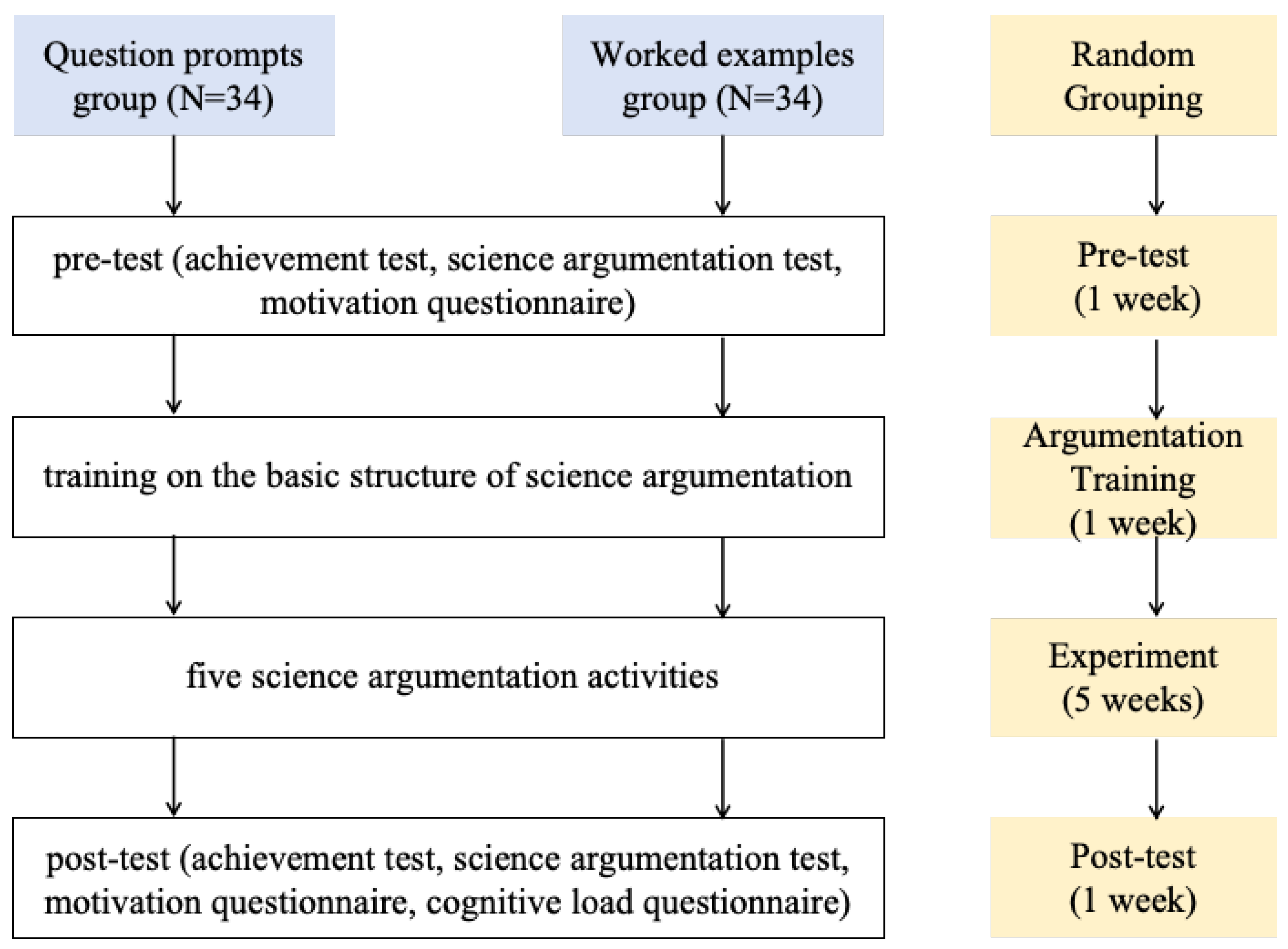
3.2. Procedure
3.3. Measuring Tools
3.3.1. Achievement Test
3.3.2. Scientific Argumentation Assessment
3.3.3. Learning Motivation Questionnaire
3.3.4. Cognitive Load Questionnaire
3.4. Data Analysis
4. Results
4.1. Comparison of the Achievement Tests Between the Two Groups
4.2. Comparison of the Scientific Argumentation Ability Between the Two Groups
4.3. Comparison of the Learning Motivation Between the Two Groups
4.4. Comparison of Cognitive Load Between the Two Groups
5. Discussion
6. Conclusions, Limitations and Future Study
Author Contributions
Funding
Institutional Review Board Statement
Informed Consent Statement
Data Availability Statement
Conflicts of Interest
References
- Belland, B. R., Walker, A. E., & Kim, N. J. (2017). A Bayesian network meta-analysis to synthesize the influence of contexts of scaffolding use on cognitive outcomes in STEM education. Review of Educational Research, 87(6), 1042–1081. [Google Scholar] [CrossRef] [Scilit]
- Cai, S., Huang, A., & Li, J. (2025). The impact of embedded question prompts on students’ reflective thinking and learning behaviors in AR learning environments. Journal of Science Education and Technology, 1–19. [Google Scholar] [CrossRef] [Scilit]
- Cavagnetto, A. R. (2010). Argument to foster scientific literacy: A review of argument interventions in K–12 science contexts. Review of Educational Research, 80(3), 336–371. [Google Scholar] [CrossRef] [Scilit]
- Christopoulos, A., & Mystakidis, S. (2023). Gamification in education. Encyclopedia, 3(4), 1223–1243. [Google Scholar] [CrossRef] [Scilit]
- Crippen, K. J., & Earl, B. L. (2007). The impact of web-based worked examples and self-explanation on performance, problem solving, and self-efficacy. Computers & Education, 49(3), 809–821. [Google Scholar] [CrossRef] [Scilit]
- Davis, E. A. (2000). Scaffolding students’ knowledge integration: Prompts for reflection in KIE. International Journal of Science Education, 22(8), 819–837. [Google Scholar] [CrossRef] [Scilit]
- Driver, R., Newton, P., & Osborne, J. (2000). Establishing the norms of scientific argumentation in classrooms. Science Education, 84(3), 287–312. [Google Scholar] [CrossRef]
- Duschl, R. A., Shouse, A. W., & Schweingruber, H. A. (2007). What research says about K-8 science learning and teaching. Principal, 87(2), 16. [Google Scholar]
- Fischer, F., Bauer, E., Seidel, T., Schmidmaier, R., Radkowitsch, A., Neuhaus, B. J., & Fischer, M. R. (2022). Representational scaffolding in digital simulations–learning professional practices in higher education. Information and Learning Sciences, 123(11/12), 645–665. [Google Scholar] [CrossRef] [Scilit]
- Ge, X., & Land, S. M. (2003). Scaffolding students’ problem-solving processes in an ill-structured task using question prompts and peer interactions. Educational Technology Research and Development, 51(1), 21–38. [Google Scholar] [CrossRef] [Scilit]
- Großmann, N., & Wilde, M. (2019). Experimentation in biology lessons: Guided discovery through incremental scaffolds. International Journal of Science Education, 41(6), 759–781. [Google Scholar] [CrossRef] [Scilit]
- Hefter, M. H., ten Hagen, I., Krense, C., Berthold, K., & Renkl, A. (2019). Effective and efficient acquisition of argumentation knowledge by self-explaining examples: Videos, texts, or graphic novels? Journal of Educational Psychology, 111(8), 1396. [Google Scholar] [CrossRef] [Scilit]
- Hmelo-Silver, C. E., Marathe, S., & Liu, L. (2007). Fish swim, rocks sit, and lungs breathe: Expert-novice understanding of complex systems. The Journal of the Learning Sciences, 16(3), 307–331. [Google Scholar] [CrossRef] [Scilit]
- Hoogerheide, V., Loyens, S. M. M., & Gog, T. (2014). Comparing the effects of worked examples and modeling examples on learning. Computers in Human Behavior, 41, 80–91. [Google Scholar] [CrossRef] [Scilit]
- Kalyuga, S., Chandler, P., Tuovinen, J., & Sweller, J. (2001). When problem solving is superior to studying worked examples. Journal of Educational Psychology, 93(3), 579. [Google Scholar] [CrossRef]
- Kalyuga, S., Rikers, R., & Paas, F. (2012). Educational implications of expertise reversal effects in learning and performance of complex cognitive and sensorimotor skills. Educational Psychology Review, 24(2), 313–337. [Google Scholar] [CrossRef] [Scilit]
- Kern, C. L., & Crippen, K. J. (2017). The effect of scaffolding strategies for inscriptions and argumentation in a science cyberlearning environment. Journal of Science Education and Technology, 26(1), 33–43. [Google Scholar] [CrossRef] [Scilit]
- Kim, M., & Roth, W. M. (2019). Dialogical argumentation in elementary science classrooms. Cultural Studies of Science Education, 13(4), 1061–1085. [Google Scholar] [CrossRef] [Scilit]
- Kim, M. C., & Hannafin, M. J. (2011). Scaffolding problem solving in technology-enhanced learning environments (TELEs): Bridging research and theory with practice. Computers & Education, 56(2), 403–417. [Google Scholar] [CrossRef] [Scilit]
- Kollar, I., Ufer, S., Reichersdorfer, E., Vogel, F., Fischer, F., & Reiss, K. (2014). Effects of collaboration scripts and heuristic worked examples on the acquisition of mathematical argumentation skills of teacher students with different levels of prior achievement. Learning and Instruction, 32, 22–36. [Google Scholar] [CrossRef] [Scilit]
- Kuhn, D. (2010). Teaching and learning science as argument. Science Education, 94(5), 810–824. [Google Scholar] [CrossRef] [Scilit]
- Kyza, E. A. (2009). Middle-school students’ reasoning about alternative hypotheses in a scaffolded, software-based inquiry investigation. Cognition and Instruction, 27(4), 277–311. [Google Scholar] [CrossRef] [Scilit]
- Latifi, S., Noroozi, O., & Talaee, E. (2023). Worked example or scripting? Fostering students’ online argumentative peer feedback, essay writing and learning. Interactive Learning Environments, 31(2), 655–669. [Google Scholar] [CrossRef] [Scilit]
- Law, V., & Chen, C. H. (2016). Promoting science learning in game-based learning with question prompts and feedback. Computers & Education, 103, 134–143. [Google Scholar] [CrossRef] [Scilit]
- Lee, S. J., Srinivasan, S., Trail, T., Lewis, D., & Lopez, S. (2011). Examining the relationship among student perception of support, course satisfaction, and learning outcomes in online learning. The Internet and Higher Education, 14(3), 158–163. [Google Scholar] [CrossRef] [Scilit]
- Lee, W., Mentzer, N., Jackson, A., Bartholomew, S., & Thorne, S. (2025). A thematic analysis of high school students’ scientific argumentation of what constitutes a ‘better’ engineering design journal. International Journal of Technology and Design Education, 1–30. [Google Scholar] [CrossRef] [Scilit]
- Lin, S. S., & Mintzes, J. J. (2010). Learning argumentation skills through instruction in socioscientific issues: The effect of ability level. International Journal of Science and Mathematics Education, 8(6), 993–1017. [Google Scholar] [CrossRef] [Scilit]
- Lin, T. C., Hsu, Y. S., Lin, S. S., Changlai, M. L., Yang, K. Y., & Lai, T. L. (2012). A review of empirical evidence on scaffolding for science education. International Journal of Science and Mathematics Education, 10(2), 437–455. [Google Scholar] [CrossRef] [Scilit]
- Maloney, J. (2007). Children’s roles and use of evidence in science: An analysis of decision-making in small groups. British Educational Research Journal, 33(3), 371–401. [Google Scholar] [CrossRef] [Scilit]
- McNeill, K. L., & Krajcik, J. S. (2011). Supporting grade 5–8 students in constructing explanations in science: The claim, evidence, and reasoning framework for talk and writing. Pearson. Available online: https://www.pearson.com/store/p/supporting-grade-5-8-students-in-constructing-explanations-in-science-the-claim-evidence-and-reasoning-framework-for-talk-and-writing/P10000113843/9780137043453 (accessed on 3 January 2011).
- Ministry of Education of the People’s Republic of China. (2022). Compulsory education science curriculum standards (2022 edition). Available online: http://www.moe.gov.cn/srcsite/A26/s8001/202204/t20220420_619921.html (accessed on 21 April 2022).
- Moser, S., Zumbach, J., & Deibl, I. (2017). The effect of metacognitive training and prompting on learning success in simulation-based physics learning. Science Education, 101(6), 944–967. [Google Scholar] [CrossRef] [Scilit]
- National Research Council. (2012). A framework for K-12 science education: Practices, crosscutting concepts, and core ideas. The National Academies Press. [CrossRef] [Scilit]
- Novak, A. M., & Treagust, D. F. (2018). Adjusting claims as new evidence emerges: Do students incorporate new evidence into their scientific explanations? Journal of Research in Science Teaching, 55(4), 526–549. [Google Scholar] [CrossRef] [Scilit]
- Omarchevska, Y., Lachner, A., Richter, J., & Scheiter, K. (2022). Do video modeling and metacognitive prompts improve self-regulated scientific inquiry? Educational Psychology Review, 34(2), 1025–1061. [Google Scholar] [CrossRef] [Scilit]
- Piaget, J. (1950). The psychology of intelligence. Routledge. [Google Scholar]
- Quintero-Manes, R., & Vieira, C. (2025). Differentiated measurement of cognitive loads in computer programming. Journal of Computing in Higher Education, 37(3), 945–962. [Google Scholar] [CrossRef] [Scilit]
- Rebello, C. M., Barrow, L. H., & Rebello, N. S. (2013). Effects of argumentation scaffolds on student performance on conceptual physics problems. In Physics education conference proceedings (pp. 293–296). American Association of Physics Teachers. [Google Scholar] [CrossRef] [Scilit]
- Renkl, A. (2014). Toward an instructionally oriented theory of example-based learning. Cognitive Science, 38(1), 1–37. [Google Scholar] [CrossRef] [Scilit]
- Sandoval, W. A., & Millwood, K. A. (2005). The quality of students’ use of evidence in written scientific explanations. Cognition and Instruction, 23(1), 23–55. [Google Scholar] [CrossRef] [Scilit]
- Solé-Llussà, A., Aguilar, D., & Ibáñez, M. (2021). Video worked examples to promote elementary students’ science process skills: A fruit decomposition inquiry activity. Journal of Biological Education, 55(4), 368–379. [Google Scholar] [CrossRef] [Scilit]
- Solé-Llussà, A., Aguilar, D., & Ibáñez, M. (2022). Video-worked examples to support the development of elementary students’ science process skills: A case study in an inquiry activity on electrical circuits. Research in Science & Technological Education, 40(2), 251–271. [Google Scholar] [CrossRef] [Scilit]
- Sweller, J. (2011). Cognitive load theory. In Psychology of learning and motivation (Vol. 55, pp. 37–76). Academic Press. [Google Scholar] [CrossRef] [Scilit]
- Sweller, J., & Cooper, G. A. (1985). The use of worked examples as a substitute for problem solving in learning algebra. Cognition and Instruction, 2(1), 59–89. [Google Scholar] [CrossRef] [Scilit]
- Tawfik, A. A., Koehler, A. A., Gish-Lieberman, J. J., & Gatewood, J. (2021). Investigating the depth of problem-solving prompts in collaborative argumentation. Innovations in Education and Teaching International, 58(5), 533–544. [Google Scholar] [CrossRef] [Scilit]
- Theobald, M., Colantonio, J., Bascandziev, I., Bonawitz, E., & Brod, G. (2024). Do reflection prompts promote children’s conflict monitoring and revision of misconceptions? Child Development, 95(4), e253–e269. [Google Scholar] [CrossRef] [Scilit] [PubMed]
- Toulmin, S. E. (1958). The uses of argument. Cambridge University Press. [Google Scholar]
- Tsai, C. Y. (2018). The effect of online argumentation of socio-scientific issues on students’ scientific competencies and sustainability attitudes. Computers & Education, 116, 14–27. [Google Scholar] [CrossRef] [Scilit]
- Tsai, P. S., & Tsai, C. C. (2013). College students’ skills of online argumentation: The role of scaffolding and their conceptions. The Internet and Higher Education, 21, 1–8. [Google Scholar] [CrossRef] [Scilit]
- Tyler, B., Britton, T., Iveland, A., Nguyen, K., Hipps, J., & Schneider, S. (2017). The synergy of science and English language arts: Means and mutual benefits of integration (Evaluation Report 2). WestEd. Available online: https://www.wested.org/resources/the-synergy-of-science-and-english-language-arts/ (accessed on 10 October 2017).
- Van Gog, T., & Rummel, N. (2010). Example-based learning: Integrating cognitive and social-cognitive research perspectives. Educational Psychology Review, 22(2), 155–174. [Google Scholar] [CrossRef] [Scilit]
- Venville, G. J., & Dawson, V. M. (2010). The impact of a classroom intervention on grade 10 students’ argumentation skills, informal reasoning, and conceptual understanding of science. Journal of Research in Science Teaching, 47(8), 952–977. [Google Scholar] [CrossRef] [Scilit]
- Vogel, F., Kollar, I., Ufer, S., Reichersdorfer, E., Reiss, K., & Fischer, F. (2016). Developing argumentation skills in mathematics through computer-supported collaborative learning: The role of transactivity. Instructional Science, 44(5), 477–500. [Google Scholar] [CrossRef] [Scilit]
- Vygotsky, L. (1978). Mind in society: The development of higher psychological processes. Harvard University Press. [Google Scholar]
- Wiersma, W., & Jurs, S. G. (1985). Educational measurement and testing. Allyn & Bacon. [Google Scholar]

| Inquiry Activity Phase | Question Prompts | Worked Examples |
|---|---|---|
| New Lesson Introduction | Present rock images to establish inquiry context; pose core questions to guide reflection on rock characteristics without providing specific methods or examples. Example: “When observing a rock, we see different grains or crystals (e.g., quartz, feldspar, mica) with unique properties. Some rocks contain one grain type, others multiple. How can we distinguish them?” | |
| Knowledge Exploration | Provide introductory materials on rock types; use prompts to guide reflection on limitations of single-characteristic judgment and recognize the need for multi-characteristic observation. Example: “Some minerals look alike—pyrite and gold are both golden. How would you distinguish them? Which represents the true mineral color: surface color or streak?” | Provide cyclic flow diagram of rock classification, characteristic comparison table with expert tips, and counterexamples (e.g., non-lustrous rocks are not necessarily sedimentary). Example: <Expert Tip> When observing pyrite and gold, scientists found that these two minerals have very similar surface colors, both appearing yellow; however, when scientists rubbed pyrite and gold separately on a white unglazed porcelain plate, they discovered that pyrite’s streak color is black, while gold’s streak remains yellow. Therefore, scientists concluded that streak color represents the true color of a mineral. |
| Claims Formulation | Create cognitive conflicts via opposing viewpoints; require students to state classification claims in complete sentences. Example: “Some believe granite contains quartz and feldspar. Do you agree? State your claim: I ____ (agree/disagree); I believe granite contains ____.” | Provide complete worked example of sandstone research demonstrating how scientists formulate claims; students imitate to propose their own claims. Example: Research question: What minerals does sandstone contain? Proposed claim: Sandstone includes quartz and feldspar two minerals. “1. Research question: What minerals do you think granite contains? My claim/hypothesis: ____” Students directly imitate the structure of the sandstone example to propose their own claims about granite. |
| Evidence Collection | Design step-by-step question chains to guide systematic observation; require recording results in observation forms; emphasize multi-dimensional evidence collection. Example: “How many differently-colored grains appear on the granite surface? What are their color, transparency, and luster?” | Present scientists’ complete inquiry steps and detailed observation data; students observe materials and complete identical forms by referring to scientists’ procedures. Example: First, use a magnifier to observe how many differently-colored grains appear on the granite surface; Then, observe the color, transparency, and luster of these grains respectively, and record the results in the observation table. |
| Reasoning and Argumentation | Guide comparative reasoning based on evidence via multi-dimensional question chains; prompt students to write claims, list characteristic evidence and reasoning processes, and draw scientific conclusions. Example: “My revised claim: ____. Evidence: ____. Reasoning: Because granite has ____ colored grains … matching ____ minerals’ characteristics …” | Provide flowchart-style worked example of scientists’ reasoning (claim–evidence–reasoning tripartite structure); demonstrate matching data with characteristics for classification conclusions. Example: My claim: Sandstone contains two minerals, quartz and feldspar. My evidence: According to the summary table, quartz features white surface, white streak, transparent, and glass luster; feldspar features flesh-red surface, white streak, opaque, and glass luster; mica features black surface, colorless streak, translucent, and silky luster. Using a magnifier to observe, sandstone surface has two differently-colored grains: Grain 1 appears white, transparent, and glass luster; Grain 2 appears flesh-red, opaque, and glass luster. My reasoning: 1. Because sandstone surface has two differently-colored grains, according to scientific definition, different colored grains represent different minerals, so sandstone contains two minerals; 2. Through observation, grains on sandstone surface match the characteristics of quartz and feldspar most closely, so sandstone contains two minerals, quartz and feldspar. |
| Skill | Level 1 | Level 2 | Level 3 | Level 4 |
|---|---|---|---|---|
| Claim | There is no hypothesis related to the proposition or an unclear claim is presented. | The opposing position is generalized, but it lacks specificity or provides unclear referents. | A general claim related to the proposition is presented, but it is not complete. | A clear and concrete generalization related to the proposition is stated. |
| Evidence | No supporting data is provided or the provided data is irrelevant to the claim. | The data or evidence provided is weak, inaccurate, or incomplete. | The provided data is relevant, but it is not complete. | The supporting data is persuasive, accurate, and relevant to the claim. |
| Reasoning | No rules or principles are provided. | Fails to connect the data with the claim, or most of the rules and principles are invalid or irrelevant. | The data is explained in some way, but this explanation is not specifically connected to the claim. | The explanation of the data clearly shows how these data support this claim. |
| Variable | Source | df | F | p | η2p |
|---|---|---|---|---|---|
| Achievement | Time | 1 | 116.76 | <0.001 *** | 0.64 |
| Group | 1 | 0.53 | 0.468 | 0.01 | |
| Time × group | 1 | 0.41 | 0.524 | 0.01 | |
| Argumentation Skill | |||||
| Claim | Time | 1 | 54.69 | <0.001 *** | 0.45 |
| Group | 1 | 0.02 | 0.901 | 0.00 | |
| Time × group | 1 | 0.07 | 0.796 | 0.00 | |
| Evidence | Time | 1 | 101.91 | <0.001 *** | 0.61 |
| Group | 1 | 0.65 | 0.425 | 0.01 | |
| Time × group | 1 | 10.98 | 0.001 ** | 0.14 | |
| Reasoning | Time | 1 | 120.72 | <0.001 *** | 0.65 |
| Group | 1 | 0.54 | 0.466 | 0.01 | |
| Time × group | 1 | 10.25 | 0.002 ** | 0.13 | |
| Learning Motivation | |||||
| Relevance | Time | 1 | 28.84 | <0.001 *** | 0.3 |
| Group | 1 | 0.68 | 0.413 | 0.01 | |
| Time × group | 1 | 0.21 | 0.647 | 0.00 | |
| Satisfaction | Time | 1 | 14.32 | <0.001 *** | 0.18 |
| Group | 1 | 0.30 | 0.584 | 0.00 | |
| Time × group | 1 | 4.46 | 0.038 * | 0.06 | |
| Variable | Group | Pre | Post | ||
|---|---|---|---|---|---|
| M | SD | M | SD | ||
| Achievement | QP | 48.76 | 15.31 | 72.12 | 13.43 |
| WE | 45.41 | 14.02 | 71.71 | 14.17 | |
| Argumentation Skill | |||||
| Claim | QP | 0.21 | 0.30 | 1.02 | 0.94 |
| WE | 0.19 | 0.46 | 1.06 | 0.80 | |
| Evidence | QP | 0.69 | 0.51 | 1.34 | 0.57 |
| WE | 0.46 | 0.47 | 1.74 | 0.71 | |
| Reasoning | QP | 0.35 | 0.45 | 1.02 | 0.69 |
| WE | 0.16 | 0.32 | 1.37 | 0.73 | |
| Learning Motivation | |||||
| Relevance | QP | 3.46 | 0.67 | 4.02 | 0.81 |
| WE | 3.39 | 0.63 | 3.86 | 0.72 | |
| Satisfaction | QP | 3.67 | 0.48 | 3.85 | 0.96 |
| WE | 3.50 | 0.49 | 4.16 | 0.71 | |
| Cognitive Load | |||||
| Intrinsic Cognitive Load | QP | - | - | 2.13 | 0.74 |
| WE | - | - | 1.82 | 0.83 | |
| Extraneous Cognitive Load | QP | - | - | 2.26 | 0.54 |
| WE | - | - | 1.95 | 0.70 | |
| Group | Skill | Group | N | U | Z | p |
|---|---|---|---|---|---|---|
| QP | claim | High | 9 | 32.000 | −0.760 | 0.447 |
| Low | 9 | |||||
| evidence | High | 9 | 30.500 | −0.919 | 0.358 | |
| Low | 9 | |||||
| reasoning | High | 9 | 37.000 | −0.316 | 0.752 | |
| Low | 9 | |||||
| WE | claim | High | 9 | 28.500 | −1.120 | 0.263 |
| Low | 9 | |||||
| evidence | High | 9 | 13.500 | −2.470 | 0.014 * | |
| Low | 9 | |||||
| reasoning | High | 9 | 25.500 | −1.351 | 0.177 | |
| Low | 9 |
Disclaimer/Publisher’s Note: The statements, opinions and data contained in all publications are solely those of the individual author(s) and contributor(s) and not of MDPI and/or the editor(s). MDPI and/or the editor(s) disclaim responsibility for any injury to people or property resulting from any ideas, methods, instructions or products referred to in the content. |
© 2026 by the authors. Licensee MDPI, Basel, Switzerland. This article is an open access article distributed under the terms and conditions of the Creative Commons Attribution (CC BY) license.
Share and Cite
Xu, C.; Zhu, J.; Wang, Y.; Zheng, Y. The Effects of Question Prompts and Worked Examples on Primary School Students’ Scientific Achievement, Argumentation Skills, Motivation, and Cognitive Load. Behav. Sci. 2026, 16, 335. https://doi.org/10.3390/bs16030335
Xu C, Zhu J, Wang Y, Zheng Y. The Effects of Question Prompts and Worked Examples on Primary School Students’ Scientific Achievement, Argumentation Skills, Motivation, and Cognitive Load. Behavioral Sciences. 2026; 16(3):335. https://doi.org/10.3390/bs16030335
Chicago/Turabian StyleXu, Chang, Jinghan Zhu, Yilin Wang, and Yafeng Zheng. 2026. "The Effects of Question Prompts and Worked Examples on Primary School Students’ Scientific Achievement, Argumentation Skills, Motivation, and Cognitive Load" Behavioral Sciences 16, no. 3: 335. https://doi.org/10.3390/bs16030335
APA StyleXu, C., Zhu, J., Wang, Y., & Zheng, Y. (2026). The Effects of Question Prompts and Worked Examples on Primary School Students’ Scientific Achievement, Argumentation Skills, Motivation, and Cognitive Load. Behavioral Sciences, 16(3), 335. https://doi.org/10.3390/bs16030335

