The Interplay of Morphosyntax and Verbal and Nonverbal Short-Term Memory in Children and Adolescents with Down Syndrome


Abstract
1. Introduction
1.1. Morphosyntax in DS: A Cross-Linguistic Perspective
1.2. Why Turkish Matters?
1.3. Phonology, Motor Speech Factors, and Their Interface with Morphology
1.4. Relationship Between Short-Term Memory and Morphosyntax
1.5. Heterogeneity
1.6. The Present Study
- Test the morphosyntactic profile of DS in Turkish, an agglutinative, morphophonologically regulated language.
- Contrast noun vs. verb morphology by comparing noun case suffixes (with richer morphophonological conditioning) to verb inflections.
- Evaluate task-specific STM predictors of morphosyntax by testing verbal STM (e.g., nonword repetition, digit/sentence span) and visual STM as predictors of expressive and receptive outcomes.
- Characterize heterogeneity by quantifying within-group variability and identifying individual relative strengths and weaknesses across morphosyntax and STM.
- What are the morphosyntactic characteristics of Turkish-speaking children with Down syndrome in an agglutinative language such as Turkish?
- How do children with Down syndrome perform on noun case morphology and verb inflections in Turkish, and are there observable differences between these domains?
- What are the relationships between morphosyntactic performance and short-term memory measures (verbal and visual STM) in Turkish-speaking children with Down syndrome?
- How much within-group variability exists in morphosyntactic and STM performance, and what individual patterns of strengths and weaknesses can be identified?
2. Method
2.1. Participants
2.2. Procedure
2.3. Measures
2.3.1. Syntax
2.3.2. Morphology
2.3.3. Phonological STM
2.3.4. Verbal and Nonverbal STM
2.3.5. Statistical Analysis
3. Results
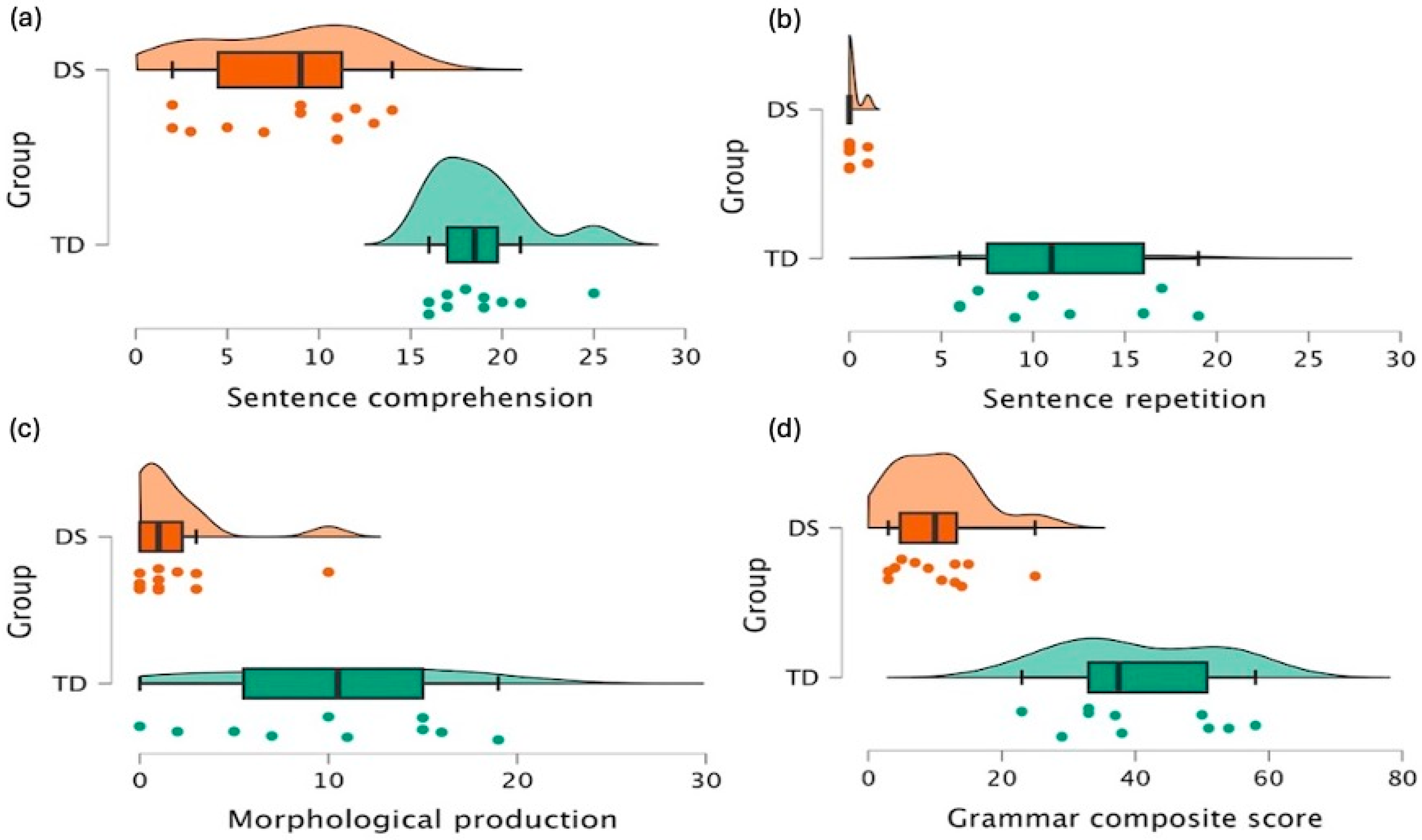
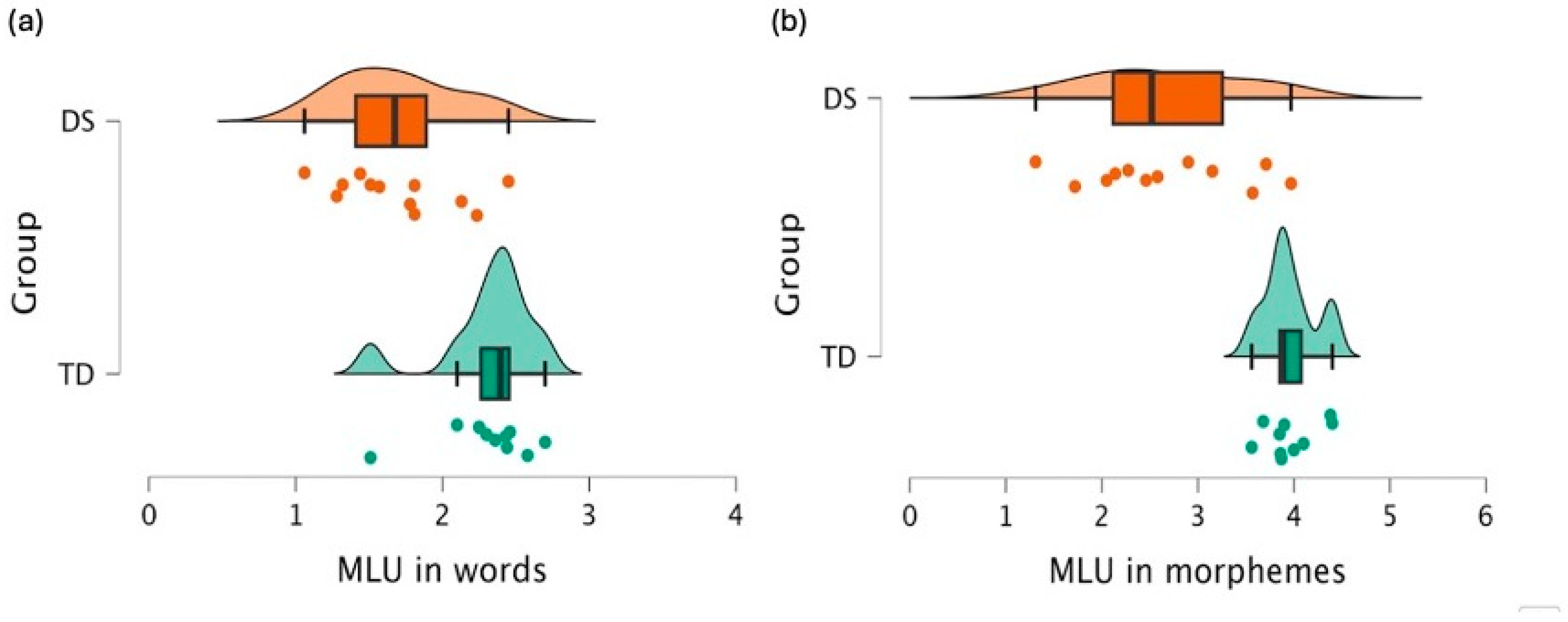
- Do individuals with DS show deficits in morphology and syntax compared to their MA-matched TD peers?
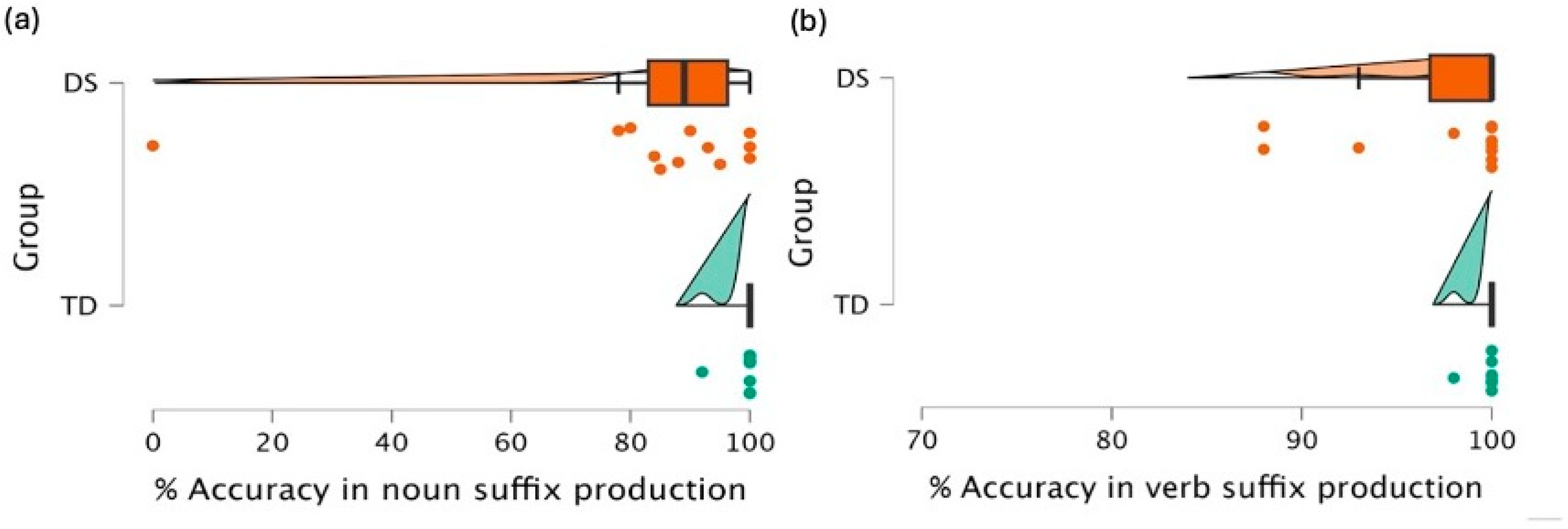
- Does Morphology Outperform Syntax, or is Comprehension Superior to Production?
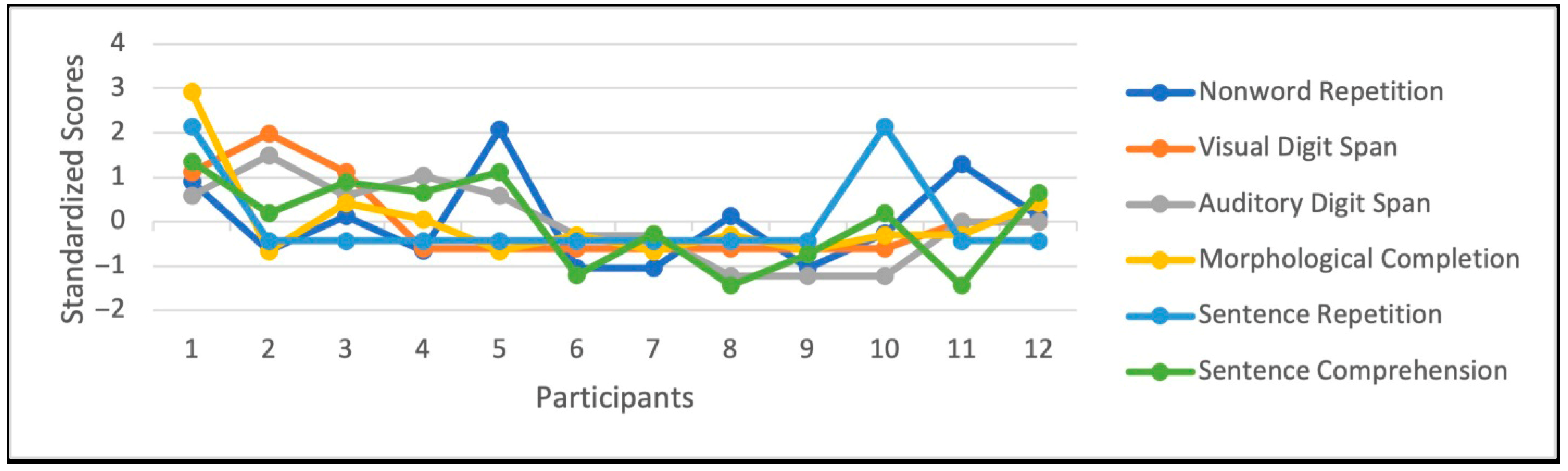
- Variability in the language and STM Scores within the DS Group
- What best predicts individuals with DS weaknesses in morphosyntax: verbal or nonverbal STM?
4. Discussion
5. Limitations of the Study
6. Clinical Implications
7. Conclusions
Supplementary Materials
Author Contributions
Funding
Institutional Review Board Statement
Informed Consent Statement
Data Availability Statement
Acknowledgments
Conflicts of Interest
References
- Abbeduto, L., Arias-Trejo, N., Thurman, A. J., Ramos-Sanchez, J., & del Hoyo Soriano, L. (2020). Language development in down syndrome. In J. A. Burack, J. O. Edgin, L. Abbeduto, & J. Busciglio (Eds.), The Oxford handbook of down syndrome and development (pp. 1–28). Oxford University Press. [Google Scholar] [CrossRef]
- Abbeduto, L., Murphy, M. M., Cawthon, S. W., Richmond, E. K., Weissman, M. D., Karadottir, S., & O’Brien, A. (2003). Receptive language skills of adolescents and young adults with down or fragile X syndrome. American Journal on Mental Retardation, 108(3), 149–160. [Google Scholar] [CrossRef] [PubMed]
- Abbeduto, L., Warren, S. F., & Conners, F. A. (2007). Language development in Down syndrome: From the prelinguistic period to the acquisition of literacy. Mental Retardation and Developmental Disabilities Research Reviews, 13(3), 247–261. [Google Scholar] [CrossRef] [PubMed]
- Acarlar, F., Miller, J., & Johnston, J. (2004). Türkçe dil örnekleri analiz programı. Ankara Üniversitesi Eğitim Bilimleri Fakültesi Özel Eğitim Dergisi, 7(2), 86–94. [Google Scholar] [CrossRef]
- Aksu-Koç, A., & Slobin, D. I. (1985). The acquisition of Turkish. In D. I. Slobin (Ed.), The crosslinguistic study of language acquisition (Vol. 1, pp. 839–878). Erlbaum. [Google Scholar]
- Archibald, L. M. D., & Gathercole, S. E. (2006). Short-term and working memory in specific language impairment. International Journal of Language & Communication Disorders, 41(6), 675–693. [Google Scholar] [CrossRef]
- Aronoff, M., & Fudeman, K. (2011). What is morphology? (2nd ed.). Wiley-Blackwell. [Google Scholar]
- Barnes, E. F., Roberts, J., Mirrett, P., Sideris, J., & Misenheimer, J. (2006). A comparison of oral structure and oral-motor function in young males with fragile X syndrome and down syndrome. Journal of Speech, Language, and Hearing Research, 49(4), 903–917. [Google Scholar] [CrossRef]
- Bol, G., & Kuiken, F. (1990). Grammatical analysis of developmental language disorders: A study of the morphosyntax of children with specific language disorders, with hearing impairment and with Down’s syndrome. Clinical Linguistics & Phonetics, 4(1), 77–86. [Google Scholar] [CrossRef]
- Booij, G. (2012). The grammar of words: An introduction to linguistic morphology (3rd ed.). Oxford University Press. [Google Scholar]
- Buckley, F. (2008). Modelling down syndrome. Down Syndrome Research and Practice, 12(2), 98–102. [Google Scholar] [CrossRef][Green Version]
- Byrne, A., Buckley, S., MacDonald, J., & Bird, G. (1995). Investigating the literacy, language and memory skills of children with down syndrome. Down Syndrome Research and Practice, 3(2), 53–58. [Google Scholar] [CrossRef]
- Carney, D. P. J. (2018). Verbal and visuospatial short-term memory in Down syndrome: Understanding profiles and patterns. In J. Rondal, S. Buckley, & D. P. J. Carney (Eds.), Cognitive development in individuals with down syndrome: Theoretical and practical issues (pp. 105–125). Wiley-Blackwell. [Google Scholar]
- Caselli, M. C., Vicari, S., Longobardi, E., Lami, L., Pizzoli, C., & Stella, G. (1998). Gestures and words in early development of children with Down syndrome. Journal of Speech, Language, and Hearing Research, 41(5), 1125–1135. [Google Scholar] [CrossRef]
- Chapman, R. S. (1997). Language development in children and adolescents with down syndrome. Mental Retardation and Developmental Disabilities Research Reviews, 3(4), 307–312. [Google Scholar] [CrossRef]
- Chapman, R. S. (2006). Language learning in down syndrome: The speech and language profile compared to adolescents with cognitive impairment of unknown origin. Down Syndrome Research and Practice, 10(2), 61–66. [Google Scholar] [CrossRef]
- Chapman, R. S., Hesketh, L. J., & Kistler, D. J. (2002). Predicting longitudinal change in language production and comprehension in individuals with down syndrome. Journal of Speech, Language, and Hearing Research, 45(5), 902–915. [Google Scholar] [CrossRef]
- Chapman, R. S., Schwartz, S., & Bird, E. K. R. (1991). Language skills of children and adolescents with down syndrome: I. Comprehension. Journal of Speech and Hearing Research, 34(5), 1106–1120. [Google Scholar] [CrossRef]
- Chapman, R. S., Seung, H. K., Schwartz, S. E., & Kay-Raining Bird, E. (1998). Language skills of children and adolescents with Down syndrome: II. Production deficits. Journal of Speech, Language, and Hearing Research, 41(4), 861–873. [Google Scholar] [CrossRef]
- Christodoulou, C. (2013). Tense and aspect in Cypriot Greek individuals with down syndrome. Linguistic Variation, 13(2), 233–258. [Google Scholar] [CrossRef]
- Clahsen, H., & Felser, C. (2006). Grammatical processing in language learners. Applied Psycholinguistics, 27(1), 3–42. [Google Scholar] [CrossRef]
- Cleland, J., Wood, S., Hardcastle, W., Wishart, J., & Timmins, C. (2010). Relationship between speech, oromotor, language, and cognitive abilities in children with down syndrome. International Journal of Language & Communication Disorders, 45(1), 83–95. [Google Scholar] [CrossRef]
- Conners, F. A., Tungate, A. S., Abbeduto, L., Merrill, E. C., & Faught, G. G. (2018). Growth and decline in language and phonological memory over two years among adolescents with down syndrome. American Journal on Intellectual and Developmental Disabilities, 123(2), 103–118. [Google Scholar] [CrossRef] [PubMed]
- Crawford, J. R., & Howell, D. C. (1998). Comparing an individual’s test score against norms derived from small samples. The Clinical Neuropsychologist, 12(4), 482–486. [Google Scholar] [CrossRef]
- Deckers, S. R. J. M., Van Zaalen, Y., Van Balkom, H., & Verhoeven, L. (2019). Predictors of receptive and expressive vocabulary development in children with down syndrome. International Journal of Speech-Language Pathology, 21(1), 10–22. [Google Scholar] [CrossRef]
- Dennis, E. L., & Thompson, P. M. (2013). Typical and atypical brain development: A review of neuroimaging studies. Dialogues in Clinical Neuroscience, 15(3), 359–384. [Google Scholar] [CrossRef]
- Eadie, P., Fey, M., Douglas, J., & Parsons, C. (2002). Profiles of grammatical morphology and sentence imitation in children with specific language impairment and down syndrome. Journal of Speech, Language, and Hearing Research, 45(4), 720–732. [Google Scholar] [CrossRef]
- Finestack, L. H., & Abbeduto, L. (2010). Expressive language profiles of verbally expressive adolescents and young adults with down syndrome or fragile X syndrome. Journal of Speech, Language, and Hearing Research: JSLHR, 53(5), 1334–1348. [Google Scholar] [CrossRef]
- Fortunato-Tavares, T., Andrade, C. R., Befi-Lopes, D., Limongi, S. O., Fernandes, F. D., & Schwartz, R. G. (2015). Syntactic comprehension and working memory in children with specific language impairment, autism, or down syndrome. Clinical Linguistics & Phonetics, 29(7), 499–522. [Google Scholar] [CrossRef] [PubMed]
- Fowler, A. E., Gelman, R., & Gleitman, L. A. (1994). The course of language learning in children with down syndrome. In H. Tager-Flusberg (Ed.), Constraints on language acquisition (pp. 91–110). Erlbaum. [Google Scholar]
- Godfrey, M., & Lee, N. R. (2018). Memory profiles in Down syndrome across development. Journal of Neurodevelopmental Disorders, 10, 5. [Google Scholar] [CrossRef] [PubMed]
- Göksel, A., & Kerslake, C. (2005). Turkish: A comprehensive grammar. Routledge. [Google Scholar] [CrossRef]
- Güven, S., & Leonard, L. B. (2020). The production of noun suffixes by Turkish-speaking children with developmental language disorder. International Journal of Language & Communication Disorders, 55(3), 387–401. [Google Scholar] [CrossRef]
- Güven, S., & Leonard, L. B. (2023). Verb morphology in Turkish-speaking children with and without DLD. Clinical Linguistics & Phonetics, 37(1), 99–123. [Google Scholar] [CrossRef]
- Heinke, D., Isenburg, J. L., Stallings, E. B., Short, T. D., Le, M., Fisher, S., Shan, X., Kirby, R. S., Nguyen, H. H., Nestoridi, E., Nembhard, W. N., Romitti, P. A., Salemi, J. L., Lupo, P. J., & National Birth Defects Prevention Network. (2021). Prevalence of structural birth defects among infants with down syndrome, 2013–2017: A US population-based study. Birth Defects Research, 113(2), 189–202. [Google Scholar] [CrossRef]
- Jarrold, C., & Baddeley, A. D. (1997). Short-term memory for verbal and visuospatial information in down’s syndrome. Cognitive Neuropsychiatry, 2(2), 101–122. [Google Scholar] [CrossRef]
- Jarrold, C., & Baddeley, A. D. (2001). Short-term memory in down syndrome. Down Syndrome Research and Practice, 7(1), 17–23. [Google Scholar] [CrossRef]
- JASP Team. (2019). JASP (Version 0.18.3) [Computer software]. Available online: https://jasp-stats.org (accessed on 4 July 2025).
- Karakaş, S., & Yalın, A. (1995). Görsel İşitsel sayı dizilei testi B formunun 13-54 yaş grupları Üzerideki standardizasyon Çalışması. Türk Psikoloji Dergisi, 10(34), 20–31. [Google Scholar]
- Katsarou, D., & Andreou, G. (2022). Morphosyntactic abilities in young children with down Syndrome: Evidence from the Greek language. International Journal of Language & Communication Disorders, 57(5), 937–947. [Google Scholar] [CrossRef] [PubMed]
- Kent, R. D., & Vorperian, H. K. (2013). Speech impairment in down syndrome: A review. Journal of Speech, Language, and Hearing Research: JSLHR, 56(1), 178–210. [Google Scholar] [CrossRef]
- Ketrez, F. N. (2012). A student grammar of Turkish. Cambridge University Press. [Google Scholar]
- Kornfilt, J. (1997). Turkish. Routledge. [Google Scholar]
- Kover, S. T., Davidson, M. M., Sindberg, H. A., & Ellis Weismer, S. (2014). Use of the ADOS for assessing spontaneous expressive language in young children with ASD: A comparison of sampling contexts. Journal of Speech, Language, and Hearing Research: JSLHR, 57(6), 2221–2233. [Google Scholar] [CrossRef]
- Krishnan, S., Alcock, K. J., Carey, D., Bergström, L., Karmiloff-Smith, A., & Dick, F. (2017). Fractionating nonword repetition: The contributions of short-term memory and oromotor praxis are different. PLoS ONE, 12(7), e0178356. [Google Scholar] [CrossRef]
- Kumin, L. (2003). Early communication skills for children with down syndrome: A guide for parents and professionals. Woodbine House. [Google Scholar]
- Lanfranchi, S., Jerman, O., & Vianello, R. (2009). Working memory and cognitive skills in individuals with down syndrome. Child Neuropsychology: A Journal on Normal and Abnormal Development in Childhood and Adolescence, 15(4), 397–416. [Google Scholar] [CrossRef] [PubMed]
- Laws, G., & Bishop, D. V. M. (2003). A comparison of language abilities in adolescents with down syndrome and children with specific language impairment. Journal of Speech, Language, and Hearing Research, 46(6), 1324–1339. [Google Scholar] [CrossRef] [PubMed]
- Lewis, G. L. (2001). Turkish grammar (2nd ed.). Oxford University Press. [Google Scholar]
- Loveall, S. J., Channell, M. M., Abbeduto, L., & Conners, F. A. (2019). Verb production by individuals with down syndrome during narration. Research in Developmental Disabilities, 85, 82–91. [Google Scholar] [CrossRef]
- Martin, G. E., Klusek, J., Estigarribia, B., & Roberts, J. E. (2009). Language characteristics of individuals with down syndrome. Topics in Language Disorders, 29(2), 112–132. [Google Scholar] [CrossRef]
- Mashaqba, B., Abu Sa’aleek, H., Huneety, A., & Al-Shboul, S. (2020). Grammatical number inflection in Arabic-speaking children and young adults with down syndrome. The South African Journal of Communication Disorders = Die Suid-Afrikaanse tydskrif vir Kommunikasieafwykings, 67(1), e1–e7. [Google Scholar] [CrossRef]
- Michael, S. E., Ratner, N. B., & Newman, R. (2012). Verb comprehension and use in children and adults with down syndrome. Journal of Speech, Language, and Hearing Research, 55(6), 1736–1749. [Google Scholar] [CrossRef]
- Miolo, G., Chapman, R. S., & Sindberg, H. A. (2005). Sentence comprehension in adolescents with down syndrome and typically developing children: Role of sentence voice, visual context, and auditory-verbal short-term memory. Journal of Speech, Language, and Hearing Research, 48(1), 172–188. [Google Scholar] [CrossRef]
- Næss, K., Lervåg, A., Lyster, S., & Hulme, C. (2015). Longitudinal relationships between language and verbal short-term memory skills in children with Down syndrome. Journal of Experimental Child Psychology, 135, 43–55. Available online: https://www.researchgate.net/publication/398824614_Early_intervention_and_transition_outcomes_for_children_with_Down_syndrome_Lived_experiences_of_parents_teachers_and_school_stakeholders_in_South_Africa (accessed on 4 July 2025). [CrossRef]
- Onnivello, S., Pulina, F., Locatelli, C., Marcolin, C., Ramacieri, G., Antonaros, F., Vione, B., Caracausi, M., & Lanfranchi, S. (2022). Cognitive profiles in children and adolescents with down syndrome. Scientific Reports, 12(1), 1936. [Google Scholar] [CrossRef]
- Penke, H. T. (2018). ELL students: Literacy development and language development. Journal of Curriculum, Teaching, Learning and Leadership in Education, 3(1), 11. [Google Scholar]
- Penke, M., & Witecy, B. (2021). Noun plural inflection in German-speaking individuals with down syndrome. In A. Botinis (Ed.), Proceedings of the 12th international conference on experimental linguistics (ExLing 2021) (pp. 173–176). ExLing Society. [Google Scholar] [CrossRef]
- Prehn-Kristensen, A., Molzow, I., Förster, A., Siebenhühner, N., Gesch, M., Wiesner, C. D., & Baving, L. (2017). Memory consolidation of socially relevant stimuli during sleep in healthy children and children with attention-deficit/hyperactivity disorder and oppositional defiant disorder: What you can see in their eyes. Biological Psychology, 123, 196–204. [Google Scholar] [CrossRef] [PubMed]
- Roberts, B. W., Kuncel, N. R., Shiner, R., Caspi, A., & Goldberg, L. R. (2007). The power of personality: The comparative validity of personality traits, socioeconomic status, and cognitive ability for predicting important life outcomes. Perspectives on Psychological Science: A Journal of the Association for Psychological Science, 2(4), 313–345. [Google Scholar] [CrossRef]
- Rondal, J. A. (1995). Exceptional language development in down syndrome: Implications for the cognition–language relationship. Cambridge University Press. [Google Scholar] [CrossRef]
- Rupela, V., Manjula, R., & Velleman, S. L. (2010). Phonological processes in Kannada-speaking adolescents with down syndrome. Clinical linguistics & Phonetics, 24(6), 431–450. [Google Scholar] [CrossRef]
- Smith, S. E., McCann, H. P., Dykens, E. M., & Hodapp, R. M. (2020). The disability-training needs of healthcare professionals: Scoping review and new initiatives. International Review of Research in Developmental Disabilities, 58, 219–264. [Google Scholar]
- Snowling, M. J. (2008). Specific disorders and broader phenotypes: The case of dyslexia. Quarterly Journal of Experimental Psychology, 61, 142–156. [Google Scholar] [CrossRef] [PubMed]
- Stathopoulou, N., & Clahsen, H. (2010). The perfective past tense in Greek adolescents with down syndrome. Clinical Linguistics & Phonetics, 24(11), 870–882. [Google Scholar] [CrossRef] [PubMed]
- Stoel-Gammon, C. (2001). Down syndrome phonology: Developmental patterns and intervention strategies. Down’s Syndrome, Research and Practice: The Journal of the Sarah Duffen Centre, 7(3), 93–100. [Google Scholar] [CrossRef]
- Thordardottir, E. (2021). Adolescent language outcomes in a complex trilingual context: When typical does not mean unproblematic. Journal of Communication Disorders, 89, 106060. [Google Scholar] [CrossRef]
- Topbaş, S., & Güven, S. (2017). Türkçe okul çağı dil gelişimi testi [Turkish school-age language development test]. Detay Yayıncılık. [Google Scholar]
- Topbaş, S., Kaçar-Kütükçü, D., & Kopkalli-Yavuz, H. (2014). Performance of children on the Turkish nonword repetition test: Effect of word similarity, word length, and scoring. Clinical Linguistics & Phonetics, 28(7–8), 602–616. [Google Scholar] [CrossRef] [PubMed]
- Uğurel-Şermin, R. (1987). Stanford Binet intelligence scale: Adaptation to Turkish with the sample Istanbul [In Turkish]. Istanbul University Faculty of Science Publications. [Google Scholar]
- Vallar, G., & Papagno, C. (1993). Preserved vocabulary acquisition in Down’s syndrome: The role of phonological short-term memory. Cortex: A Journal Devoted to the Study of the Nervous System and Behavior, 29(3), 467–483. [Google Scholar] [CrossRef] [PubMed]
- Verhagen, J., & Leseman, P. (2016). How do verbal short-term memory and working memory relate to the acquisition of vocabulary and grammar? A comparison between first and second language learners. Journal of Experimental Child Psychology, 141, 65–82. [Google Scholar] [CrossRef] [PubMed]
- Vicari, S., Marotta, L., & Carlesimo, G. A. (2004). Verbal short-term memory in Down’s syndrome: An articulatory loop deficit? Journal of Intellectual Disability Research: JIDR, 48(Pt 2), 80–92. [Google Scholar] [CrossRef] [PubMed]



| DS Group (n = 12) | |
|---|---|
| Type of DS | n (%) |
| Trisomy | 12 (100) |
| Chronological age in years | M, SD (range) |
| 12;1, 4;4 (6;7–15;11) | |
| Biological sex | n (%) |
| Male | 8 (67) |
| Hearing status | n (%) |
| Normal hearing 1 | 12 (100) |
| Nonverbal Mental Age in Months | M, SD (range) |
| 64.2, 12.4 (48–84) | |
| Intelligibility 2 | n (%) |
| Mild intelligibility problem | 10 (83) |
| Moderate intelligibility problem | 2 (17) |
| TD Group (n = 10) | |
| Chronological age in years | M, SD (range) |
| 67.1, 17.84 (48–96) | |
| Biological sex | n (%) |
| Female | 6 (60) |
| ID | Sentence Comprehension (n = 30) | Sentence Repetition (n = 36) | Morphological Production | Nonword Repetition (n = 30) | Visual Digit Span (n = 18) | Auditory Digit Span (n = 18) | ||
|---|---|---|---|---|---|---|---|---|
| Completion Task (n = 38) | MLU in | |||||||
| Words | Morphemes | |||||||
| 1 | 14 | 1 | 10 | 1.81 | 2.9 | 5 | 2 | 4 |
| 2 | 9 | 0 | 0 | 2.235 | 3.97 | 1 | 3 | 6 |
| 3 | 12 | 0 | 3 | 2.45 | 3.57 | 3 | 2 | 4 |
| 4 | 11 | 0 | 2 | 1.81 | 2.275 | 1 | 0 | 5 |
| 5 | 13 | 0 | 0 | 2.13 | 3.71 | 8 | 0 | 4 |
| 6 | 3 | 0 | 1 | 1.28 | 1.72 | 0 | 0 | 2 |
| 7 | 7 | 0 | 0 | 1.32 | 2.05 | 0 | 0 | 2 |
| 8 | 2 | 0 | 1 | 1.44 | 2.14 | 3 | 0 | 0 |
| 9 | 5 | 0 | 0 | 1.06 | 1.31 | 0 | 0 | 0 |
| 10 | 9 | 1 | 1 | 1.78 | 3.15 | 2 | 0 | 0 |
| 11 | 2 | 0 | 1 | 1.51 | 2.46 | 6 | - | - |
| 12 | 11 | 0 | 3 | 1.57 | 2.58 | 3 | - | - |
| Mean(SD) | 8.2(4.3) | 0.2(0.4) | 1.8(2.8) | 1.7(0.4) | 2.7(0.8) | 2.7(2.6) | 0.7(1.2) | 2.7(2.2) |
| ID | Syntactic Comprehension | Syntactic Production | Morphological Production | Phonological STM | Visual Digit Span | Auditory Digit Span | |
|---|---|---|---|---|---|---|---|
| Completion Task | Language Sample | ||||||
| 1 | √ | √ | √ | √ | √ | X | X |
| 2 | X | X | X | X | X | X | √ |
| 3 | X | X | √ | X | X | X | X |
| 4 | X | X | √ | √ | X | X | X |
| 5 | X | X | X | X | √ | X | X |
| 6 | X | X | √ | X | X | X | X |
| 7 | X | X | X | X | X | X | X |
| 8 | X | X | √ | X | X | X | X |
| 9 | X | X | X | √ | X | X | X |
| 10 | X | X | √ | X | X | X | X |
| 11 | X | X | √ | X | √ | X | X |
| 12 | X | X | √ | √ | X | X | X |
Disclaimer/Publisher’s Note: The statements, opinions and data contained in all publications are solely those of the individual author(s) and contributor(s) and not of MDPI and/or the editor(s). MDPI and/or the editor(s) disclaim responsibility for any injury to people or property resulting from any ideas, methods, instructions or products referred to in the content. |
© 2026 by the authors. Licensee MDPI, Basel, Switzerland. This article is an open access article distributed under the terms and conditions of the Creative Commons Attribution (CC BY) license.
Share and Cite
Sarıyer Temelli, M.N.; Güven, S. The Interplay of Morphosyntax and Verbal and Nonverbal Short-Term Memory in Children and Adolescents with Down Syndrome. Behav. Sci. 2026, 16, 315. https://doi.org/10.3390/bs16030315
Sarıyer Temelli MN, Güven S. The Interplay of Morphosyntax and Verbal and Nonverbal Short-Term Memory in Children and Adolescents with Down Syndrome. Behavioral Sciences. 2026; 16(3):315. https://doi.org/10.3390/bs16030315
Chicago/Turabian StyleSarıyer Temelli, Merve Nur, and Selçuk Güven. 2026. "The Interplay of Morphosyntax and Verbal and Nonverbal Short-Term Memory in Children and Adolescents with Down Syndrome" Behavioral Sciences 16, no. 3: 315. https://doi.org/10.3390/bs16030315
APA StyleSarıyer Temelli, M. N., & Güven, S. (2026). The Interplay of Morphosyntax and Verbal and Nonverbal Short-Term Memory in Children and Adolescents with Down Syndrome. Behavioral Sciences, 16(3), 315. https://doi.org/10.3390/bs16030315