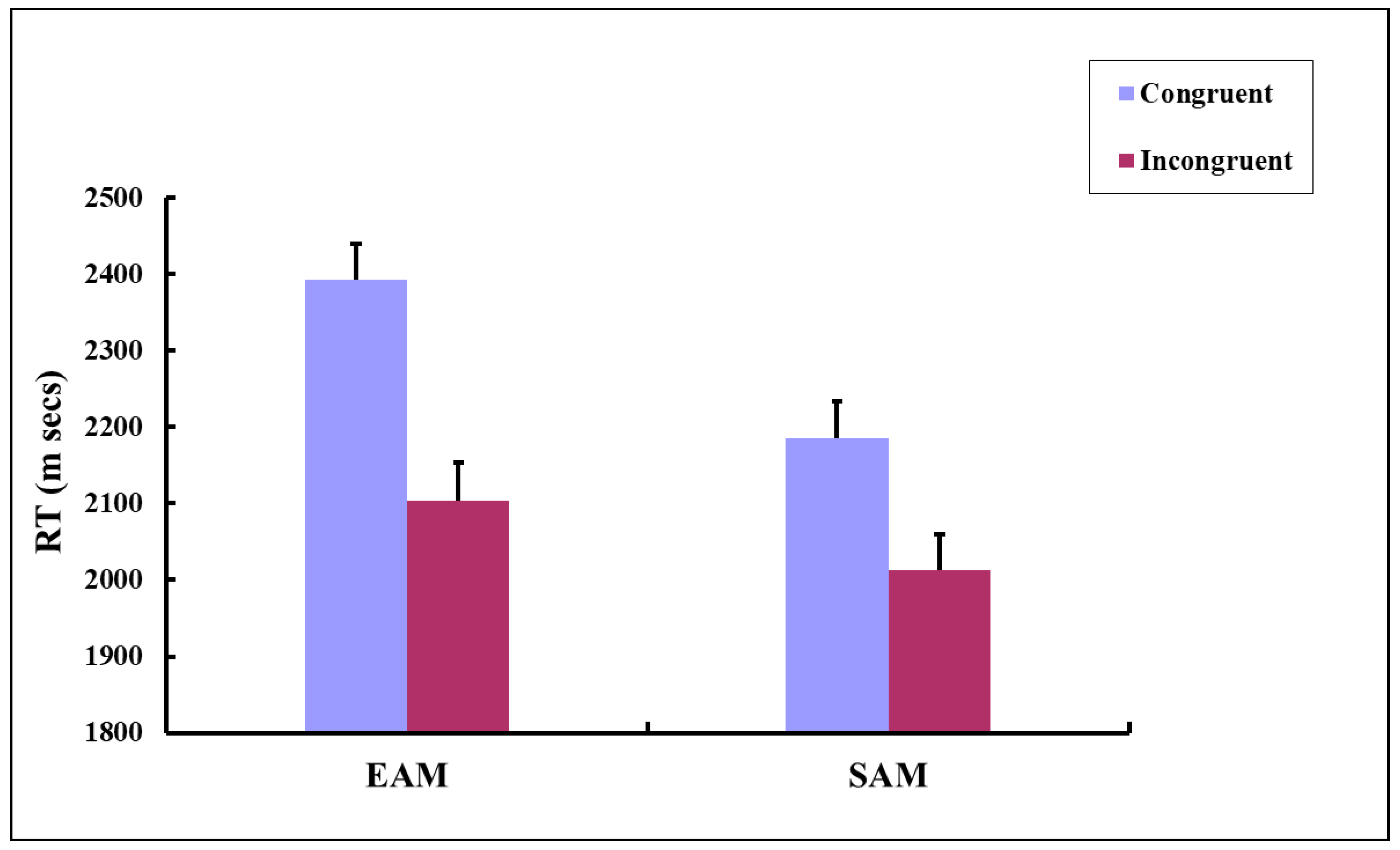
Representation of Autobiographical Memories Along a Sagittal Front-to-Back Mental Timeline: Evidence from Mandarin Speakers


Abstract
1. Introduction
- The representation of AM proceeds along a back-to-front timeline that aligns with the sensorimotor experience such as walking and running.
- The representation of AM develops along a front-to-back timeline that accords with spatiotemporal metaphoric mappings in these particular languages.
2. Experiment
2.1. Participants
2.2. Materials
2.3. Procedures
3. Results
4. Discussion
5. Conclusions
6. Limitations
Author Contributions
Funding
Institutional Review Board Statement
Informed Consent Statement
Data Availability Statement
Conflicts of Interest
References
- Awh, E., Serences, J., Laurey, P., Dhaliwal, H., Jagt, T., & Dassonville, P. (2004). Evidence against a central bottleneck during the attentional blink: Multiple channels for configural and featural processing. Cognitive Psychology, 48, 95–126. [Google Scholar] [CrossRef]
- Baddeley, A. (1990). Human memory: Theory and practice. Lawrence Erlbaum. [Google Scholar]
- Barsalou, L. W. (1999). Perceptions of perceptual symbols. Behavioral and Brain Sciences, 22, 637–660. [Google Scholar] [CrossRef]
- Barsalou, L. W. (2008). Grounded cognition. Annual Review of Psychology, 59, 617–645. [Google Scholar] [CrossRef]
- Beracci, A., & Fabbri, M. (2024). Vertical mental timeline is not influenced by visuospatial processing. Brain Sciences, 14, 184. [Google Scholar] [CrossRef]
- Bonato, M., Zorzi, M., & Umiltà, C. (2012). When time is space: Evidence for a mental time line. Neuroscience & Biobehavioral Reviews, 36, 2257–2273. [Google Scholar] [CrossRef] [PubMed]
- Boroditsky, L. (2000). Metaphoric structuring: Understanding time through spatial metaphors. Cognition, 75, 1–28. [Google Scholar] [CrossRef]
- Casasanto, D., & Boroditsky, L. (2008). Time in the mind: Using space to think about time. Cognition, 106, 579–593. [Google Scholar] [CrossRef] [PubMed]
- Casasanto, D., & Jasmin, K. (2012). The hands of time: Temporal gestures in English speakers. Cognitive Linguistics, 23, 643–674. [Google Scholar] [CrossRef]
- Chrabaszcz, A., Laurinavichyute, A., Ladinskaya, N., Baladzhaeva, L., Prior, A., Myachykov, A., & Dragoy, O. (2025). Writing direction influences the spatial representations of past- and future-tense forms: Evidence from eye tracking. Memory & Cognition, 53, 1079–1094. [Google Scholar]
- Chung, C., & Lin, Z. (2012). A cross-cultural examination of the positivity effect in memory: US vs. China. The International Journal of Aging and Human Development, 75, 31–44. [Google Scholar] [CrossRef]
- Corballis, M. C. (2019). Language, memory, and mental time travel: An evolutionary perspective. Frontiers in Human Neuroscience, 13, 217. [Google Scholar] [CrossRef]
- Dalmaso, M., Schnapper, Y., & Vicovaro, M. (2023). When time stands upright: STEARC effects along the vertical axis. Psychological Research, 87, 894–918. [Google Scholar] [CrossRef]
- de la Fuente, J., Santiago, J., Roman, A., Dumitrache, C., & Casasanto, D. (2014). When you think about it, your past is in front of you: How culture shapes spatial conceptions of time. Psychological Science, 25, 1682–1690. [Google Scholar] [CrossRef] [PubMed]
- Ding, X., Feng, N., He, T., Cheng, X., & Fan, Z. (2020). Can mental time lines co-exist in 3D space? Acta Psychologica, 207, 103084. [Google Scholar] [CrossRef] [PubMed]
- Faul, F., Erdfelder, E., Lang, A.-G., & Buchner, A. (2007). G*Power 3: A flexible statistical power analysis program for the social, behavioral, and biomedical sciences. Behavior Research Methods, 39, 175–191. [Google Scholar] [CrossRef]
- Fuhrman, O., & Boroditsky, L. (2010). Cross-cultural differences in mental representations of time: Evidence from an implicit nonlinguistic task. Cognitive Science, 34, 1430–1451. [Google Scholar] [CrossRef]
- Gu, Y., Zheng, Y., & Swerts, M. (2019). Which is in front of Chinese people, past or future? The effect of language and culture on temporal gestures and spatial conceptions of time. Cognitive Science, 43, e12804. [Google Scholar] [CrossRef] [PubMed]
- Guo, T., Ji, L.-J., Spina, R., & Zhang, Z. (2012). Culture, temporal focus, and values of the past and the future. Personality and Social Psychology Bulletin, 38, 1030–1040. [Google Scholar] [CrossRef]
- Haspelmath, M. (1997). Lincom studies in theoretical linguistics: Vol. 3. From space to time: Temporal adverbials in the world’s languages. Lincom Europa. [Google Scholar]
- Hendricks, R. K., Bergen, B. K., & Marghetis, T. (2018). Do metaphors move from mind to mouth? Evidence from a new system of linguistic metaphors for time. Cognitive Science, 42, 2950–2975. [Google Scholar] [CrossRef]
- Jiang, Y., Hao, F., Huang, Z., Chen, L., Cheng, X., Fan, Z., & Ding, X. (2023). Does walking/running experience shape the sagittal mental time line? Consciousness and Cognition, 116, 103587. [Google Scholar] [CrossRef]
- Karylowski, J. J., & Mrozinski, B. (2017). Time frame affects vantage point in episodic and semantic autobiographical memory: Evidence from response latencies. Frontiers in Psychology, 8, 615. [Google Scholar] [CrossRef] [PubMed]
- Landau, M. J., Meier, B. P., & Keefer, L. A. (2010). A metaphor-enriched social cognition. Psychological Bulletin, 136, 1045–1067. [Google Scholar] [CrossRef] [PubMed]
- Li, H. (2017). Time on hands: Deliberate and spontaneous temporal gestures by speakers of Mandarin. Gesture, 16, 396–415. [Google Scholar] [CrossRef]
- Li, H., & Cao, Y. (2017). Personal attitudes toward time: The relationship between temporal focus, space-time mappings and real life experiences. Scandinavian Journal of Psychology, 58, 193–198. [Google Scholar] [CrossRef]
- Li, J., & Guo, X. (2009). A functional approach to memory research. Advances in Psychological Science, 17, 923–930. [Google Scholar]
- Liang, N. (2021). Memory. In Y. Ye, C. He, & N. Liang (Eds.), General psychology (pp. 109–138). East China Normal University Press. [Google Scholar]
- Miles, L. K., Nind, L. K., & Macrae, C. N. (2010). Moving through time. Psychological Science, 21, 222–223. [Google Scholar] [CrossRef]
- Núñez, R. E., & Sweetser, E. (2006). With the future behind them: Convergent evidence from Aymara language and gesture in the crosslinguistic comparison of spatial construals of time. Cognitive Science, 30, 401–450. [Google Scholar] [CrossRef]
- Ouellet, M., Santiago, J., Funes, M. J., & Lupiáñez, J. (2010). Thinking about the future moves attention to the right. Journal of Experimental Psychology: Human Perception and Performance, 36, 17–24. [Google Scholar] [CrossRef]
- Pan, L., & Huang, X. (2024). The influence of spatial location on temporal order perception. Current Psychology, 43, 2052–2061. [Google Scholar] [CrossRef]
- Rubin, D. C. (1986). Autobiographical memory. Cambridge University Press. [Google Scholar]
- Santiago, J., Román, A., Ouellet, M., Rodríguez, N., & Pérez-Azor, P. (2010). In hindsight, life flows from left to right. Psychological Research, 74, 59–70. [Google Scholar] [CrossRef] [PubMed]
- Starr, A., & Srinivasan, M. (2021). The future is in front, to the right, or below: Development of spatial representations of time in three dimensions. Cognition, 210, 104603. [Google Scholar] [CrossRef] [PubMed]
- Sun, Y., Zhang, Y., Fang, Y., & Yang, W. (2022). Representations of diagonal time lines in English and Mandarin speakers. European Journal of Psychology Open, 81, 89–95. [Google Scholar] [CrossRef]
- Teghil, A., Marc, I. B., & Boccia, M. (2021). Mental representation of autobiographical memories along the sagittal mental timeline: Evidence from spatiotemporal interference. Psychonomic Bulletin & Review, 28, 1327–1335. [Google Scholar] [CrossRef]
- Torralbo, A., Santiago, J., & Lupiáñez, J. (2006). Flexible conceptual projection of time onto spatial frames of reference. Cognitive Science, 30, 749–757. [Google Scholar] [CrossRef]
- Tulving, E. (1972). Episodic and semantic memory. In E. Tulving, & W. Donaldson (Eds.), Organization of memory (pp. 381–403). Academic Press. [Google Scholar]
- Tulving, E. (1985). How many memory systems are there? American Psychologist, 40, 385–398. [Google Scholar] [CrossRef]
- Ulrich, R., Eikmeier, V., de la Vega, I., Ruiz Fernandez, S., Alex-Ruf, S., & Maienborn, C. (2012). With the past behind and the future ahead: Back-to-front representation of past and future sentences. Memory & Cognition, 40, 483–495. [Google Scholar]
- Valenzuela, J., Cánovas, C. P., Olza, I., & Carrión, D. A. (2020). Gesturing in the wild: Evidence for a flexible mental timeline. Review of Cognitive Linguistics, 18, 289–315. [Google Scholar] [CrossRef]
- Walker, E. J., Bergen, B. K., & Núñez, R. E. (2014). Disentangling spatial metaphors for time using non-spatial responses and auditory stimuli. Metaphor & Symbol, 29, 316–327. [Google Scholar]
- Walker, E. J., Bergen, B. K., & Núñez, R. E. (2017). The spatial alignment of time: Differences in alignment of deictic and sequence time along the sagittal and lateral axes. Acta Psychologica, 175, 13–20. [Google Scholar] [CrossRef] [PubMed]
- Wu, S. Q. (2021). A corpus-based study of the time orientation of qian “front” and hou “back” in Chinese. Corpus Linguistics and Linguistic Theory, 18, 447–475. [Google Scholar] [CrossRef]
- Yang, W., Gu, Y., Fang, Y., & Sun, Y. (2022). Mental representations of time in English monolinguals, Mandarin monolinguals and Mandarin-English bilinguals. Frontiers in Psychology, 13, 791197. [Google Scholar] [CrossRef] [PubMed]
- Yang, W., & Sun, Y. (2016a). A monolingual mind can have two time lines: Exploring space-time mappings in Mandarin monolinguals. Psychonomic Bulletin & Review, 23, 857–864. [Google Scholar]
- Yang, W., & Sun, Y. (2016b). English and Mandarin speakers’ mental representations of time: Some new evidence about the language-thought relationship. Review of Cognitive Linguistics, 14, 385–415. [Google Scholar] [CrossRef]
- Yang, Y., Sinha, C., & Filipovic, L. (2023). Sequential time construal is primary in temporal uses of Mandarin Chinese qian ‘front’ and hou ‘back’. Language Sciences, 95, 101511. [Google Scholar] [CrossRef]

Disclaimer/Publisher’s Note: The statements, opinions and data contained in all publications are solely those of the individual author(s) and contributor(s) and not of MDPI and/or the editor(s). MDPI and/or the editor(s) disclaim responsibility for any injury to people or property resulting from any ideas, methods, instructions or products referred to in the content. |
© 2026 by the authors. Licensee MDPI, Basel, Switzerland. This article is an open access article distributed under the terms and conditions of the Creative Commons Attribution (CC BY) license.
Share and Cite
Sun, Y.; Fang, Y.; Yang, W. Representation of Autobiographical Memories Along a Sagittal Front-to-Back Mental Timeline: Evidence from Mandarin Speakers. Behav. Sci. 2026, 16, 314. https://doi.org/10.3390/bs16030314
Sun Y, Fang Y, Yang W. Representation of Autobiographical Memories Along a Sagittal Front-to-Back Mental Timeline: Evidence from Mandarin Speakers. Behavioral Sciences. 2026; 16(3):314. https://doi.org/10.3390/bs16030314
Chicago/Turabian StyleSun, Ying, Ying Fang, and Wenxing Yang. 2026. "Representation of Autobiographical Memories Along a Sagittal Front-to-Back Mental Timeline: Evidence from Mandarin Speakers" Behavioral Sciences 16, no. 3: 314. https://doi.org/10.3390/bs16030314
APA StyleSun, Y., Fang, Y., & Yang, W. (2026). Representation of Autobiographical Memories Along a Sagittal Front-to-Back Mental Timeline: Evidence from Mandarin Speakers. Behavioral Sciences, 16(3), 314. https://doi.org/10.3390/bs16030314