Does Your Hat Speak Your Mind? Personality Traits and Aesthetic Preferences for Hats Among Italian Young Adults




Abstract
1. Introduction
The Interaction Between Personality and Aesthetic Preferences in Basic and Applied Psychology Research
2. The Study
2.1. Method
2.1.1. Participants
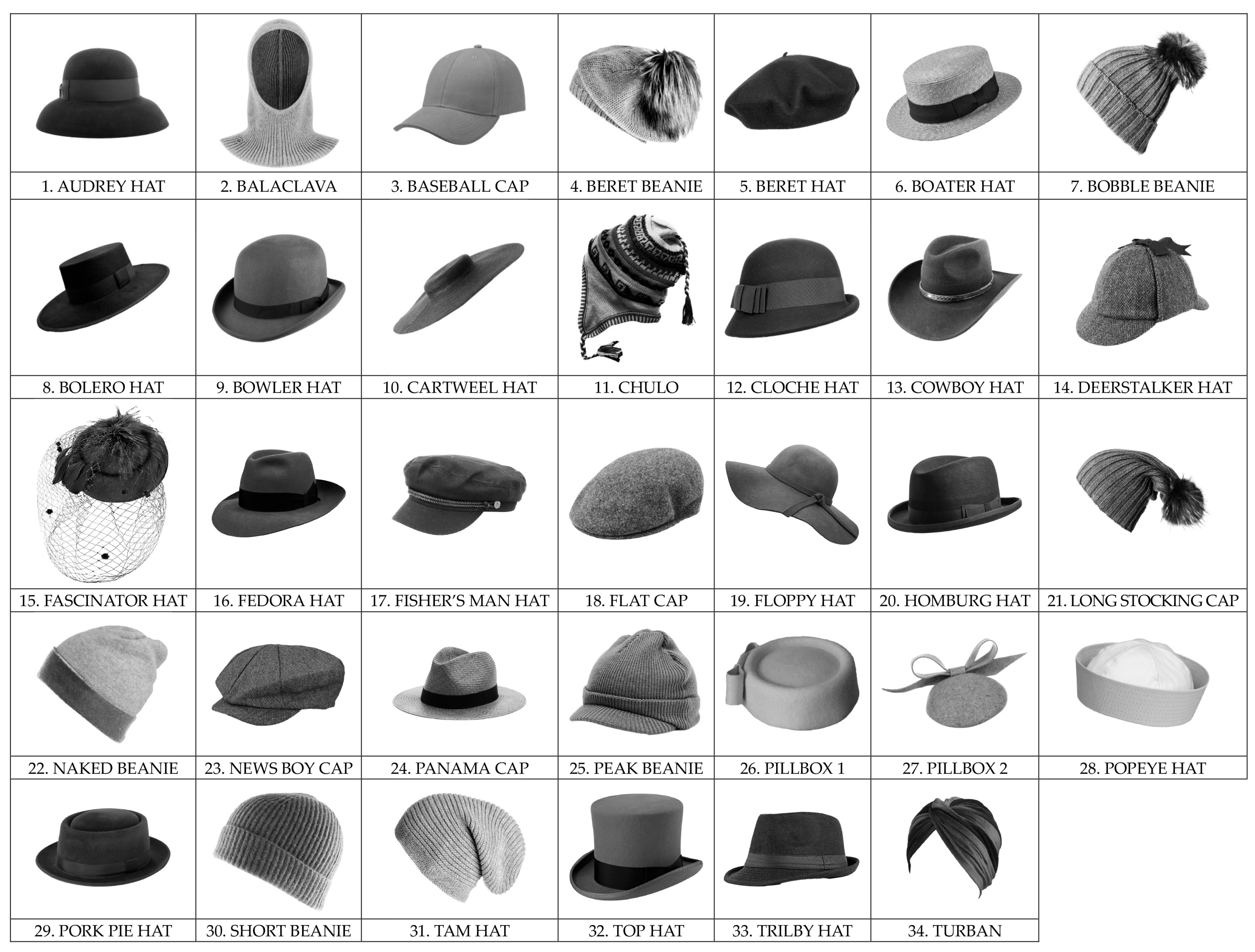
2.1.2. Materials
2.1.3. Procedure
2.1.4. Data Analysis
3. Results
3.1. The Larger Set: Various Types of Iconic Hats
3.1.1. The Relationships Between “I Like It” and “I Would Wear It” (Set 1)
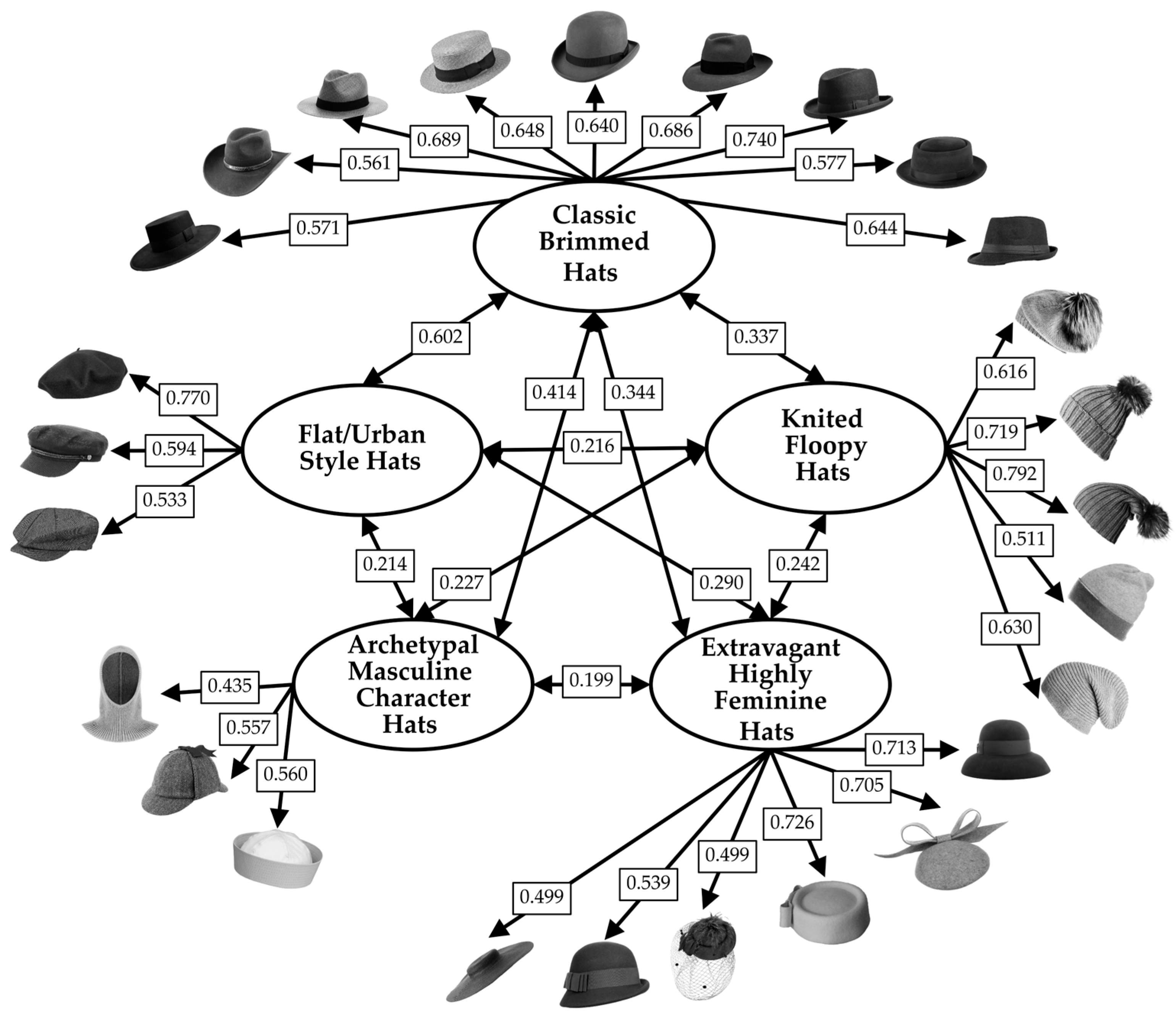
3.1.2. The Factors Underlying Responses of Liking (Set 1)
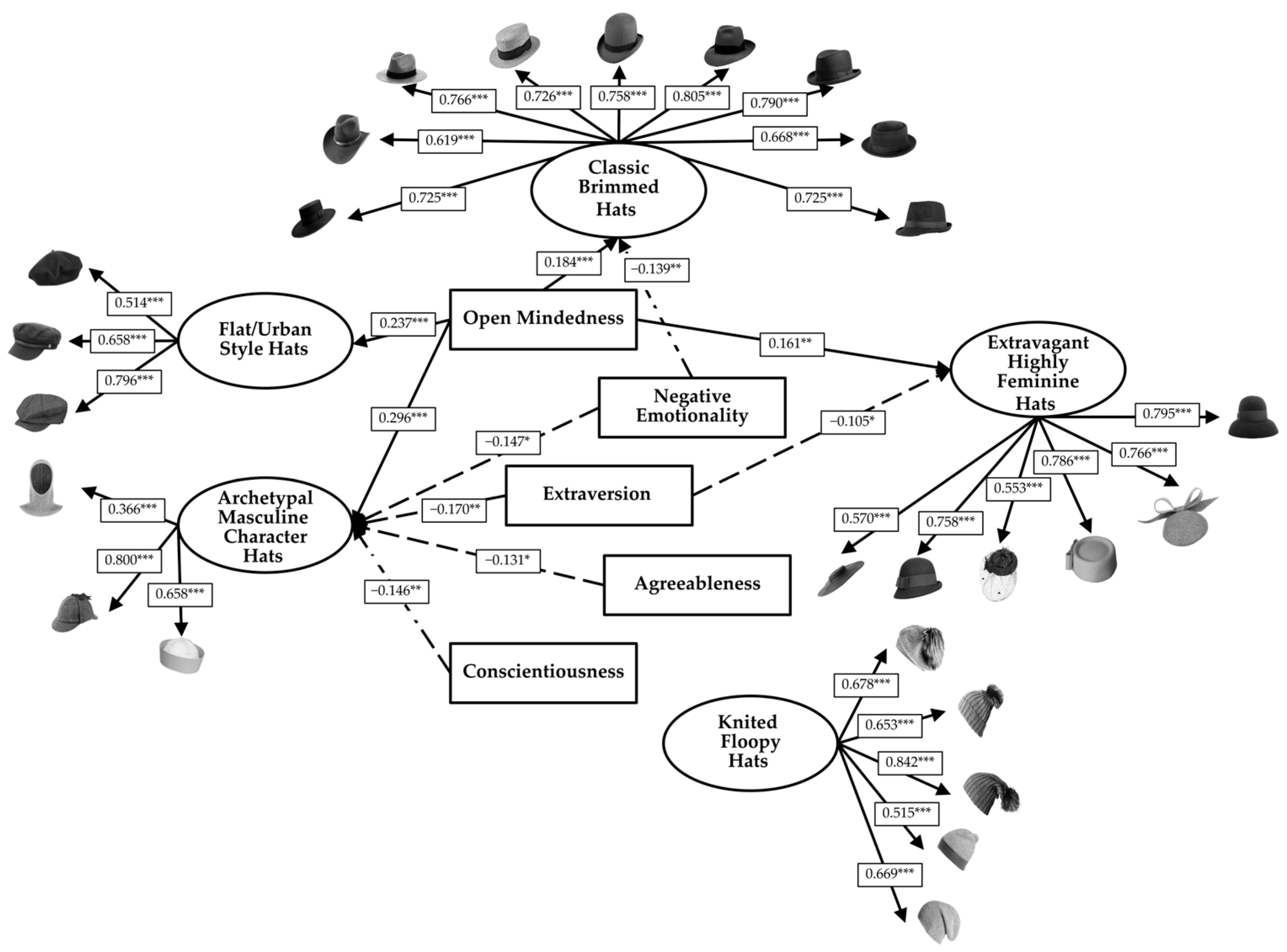
3.1.3. The Effect of Personality Traits and Gender on Liking (Set 1)
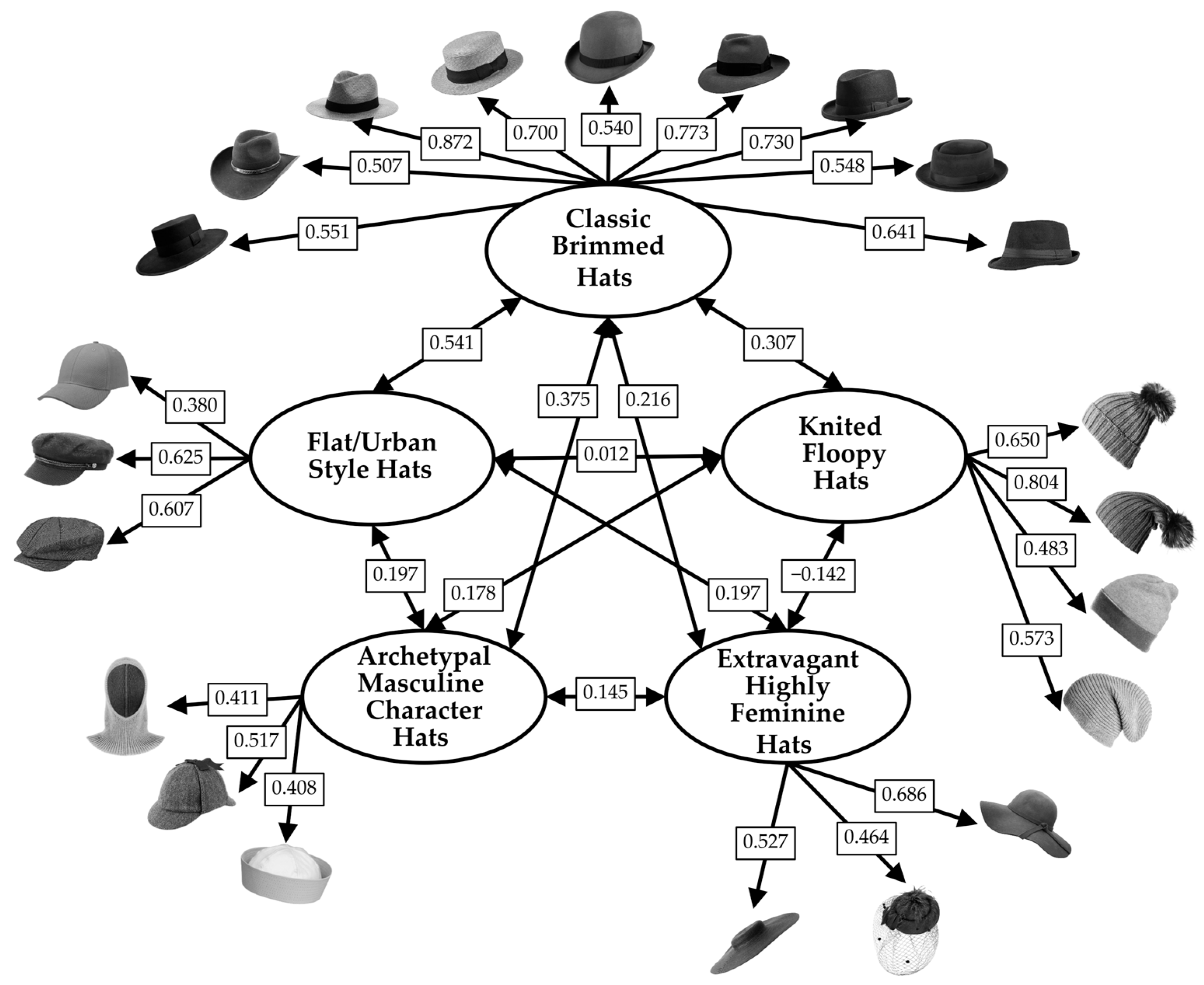
3.1.4. The Factors Underlying Responses of Willingness to Wear (Set 1)
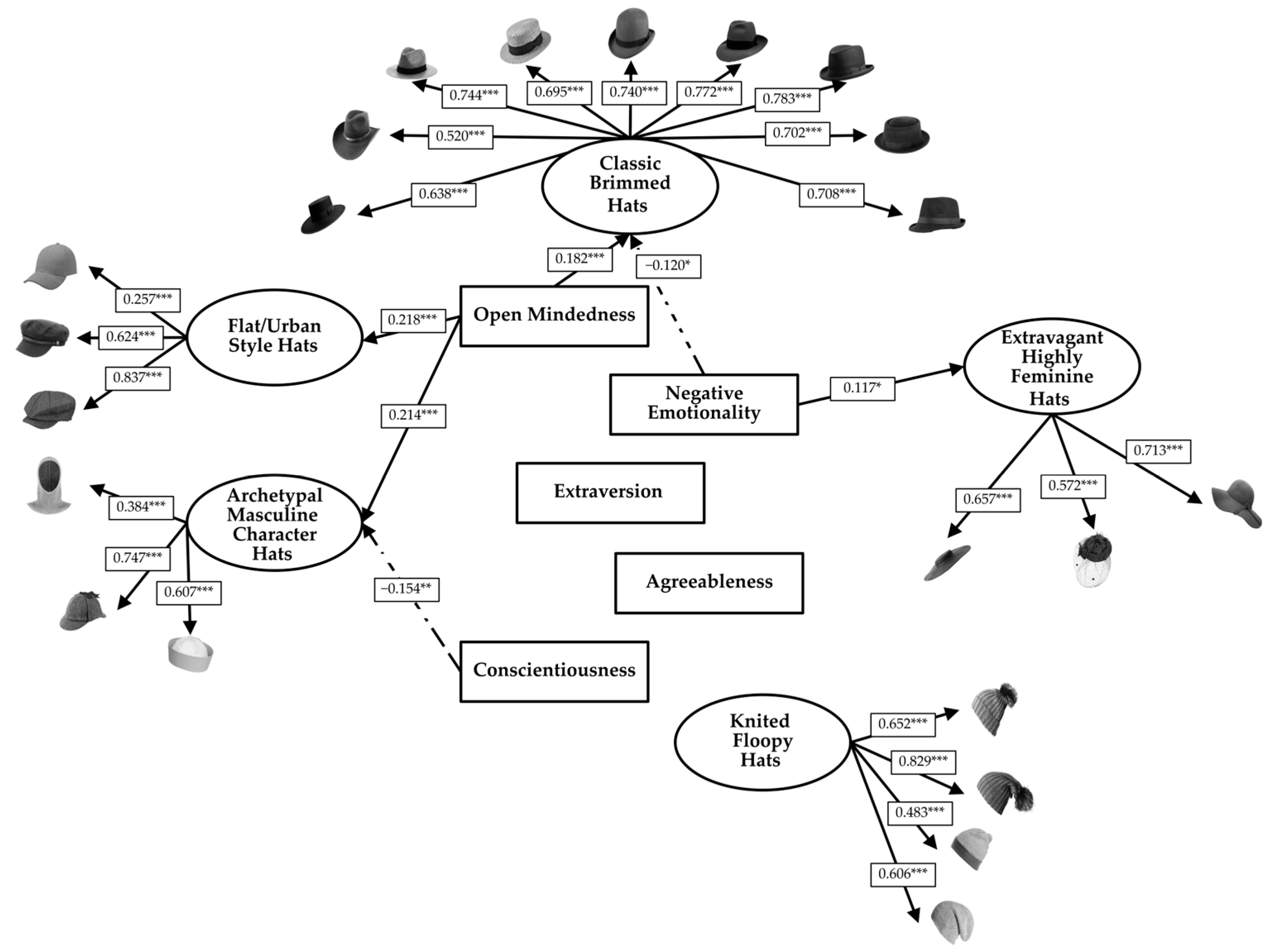
3.1.5. The Effect of Personality Traits and Gender on Willingness to Wear (Set 1)
3.2. Baseball Caps
3.2.1. Relationships Between “I Like It” and “I Would Wear It” (Set 2)
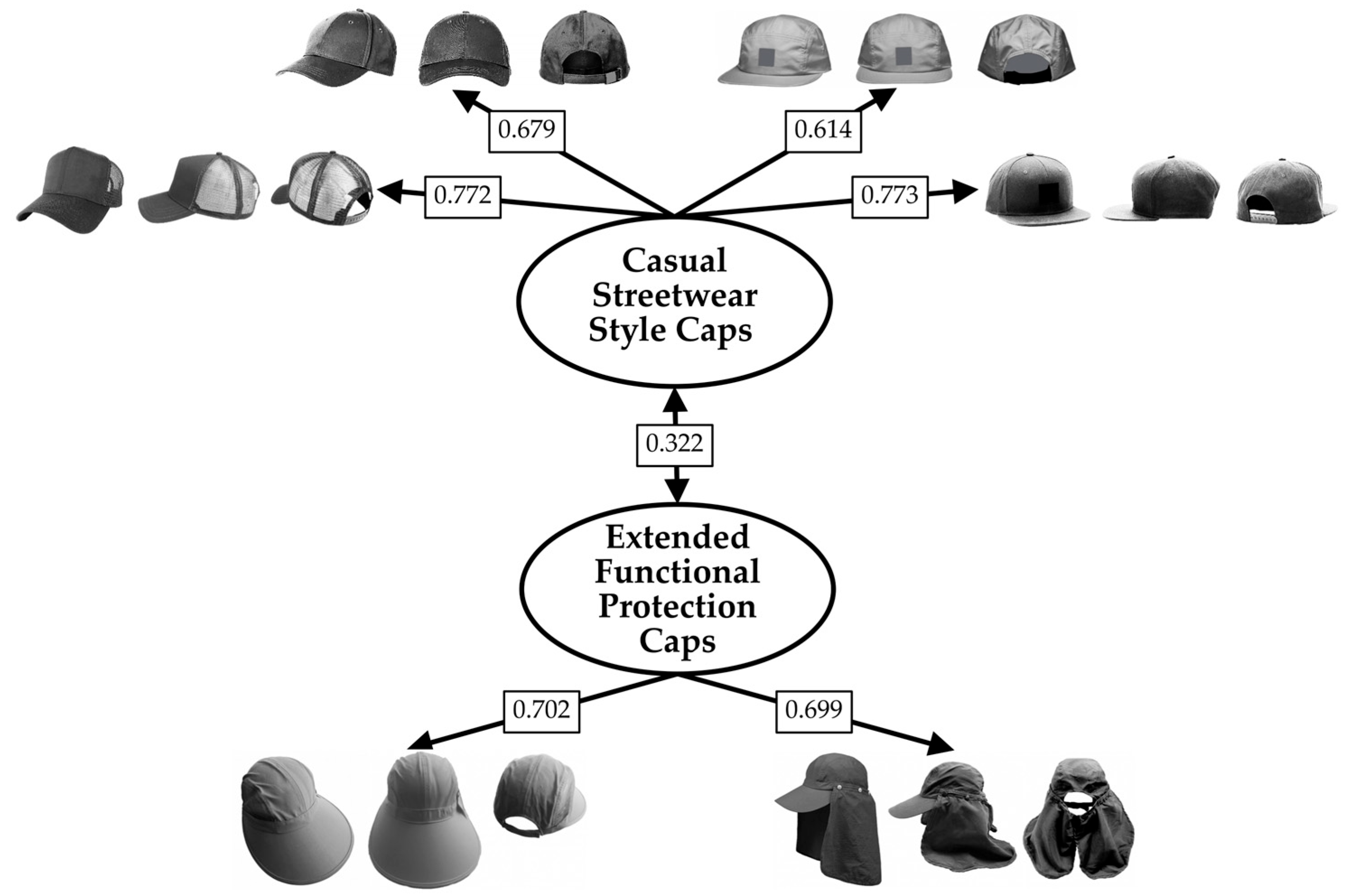
3.2.2. The Factors Underlying Responses of Liking (Set 2)
3.2.3. The Effect of Personality Traits and Gender on Liking (Set 2)
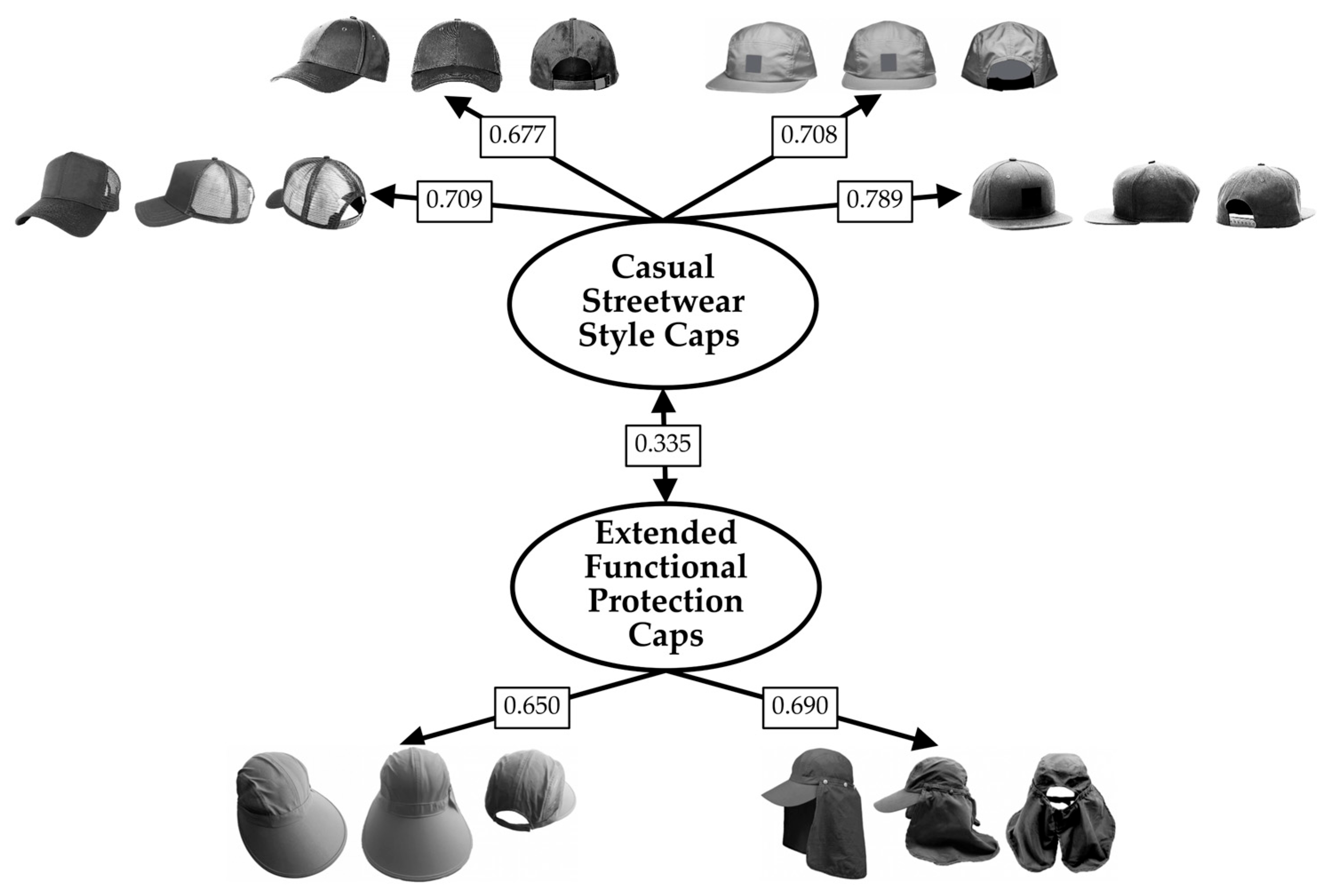
3.2.4. The Factors Underlying Responses of Willingness to Wear (Set 2)
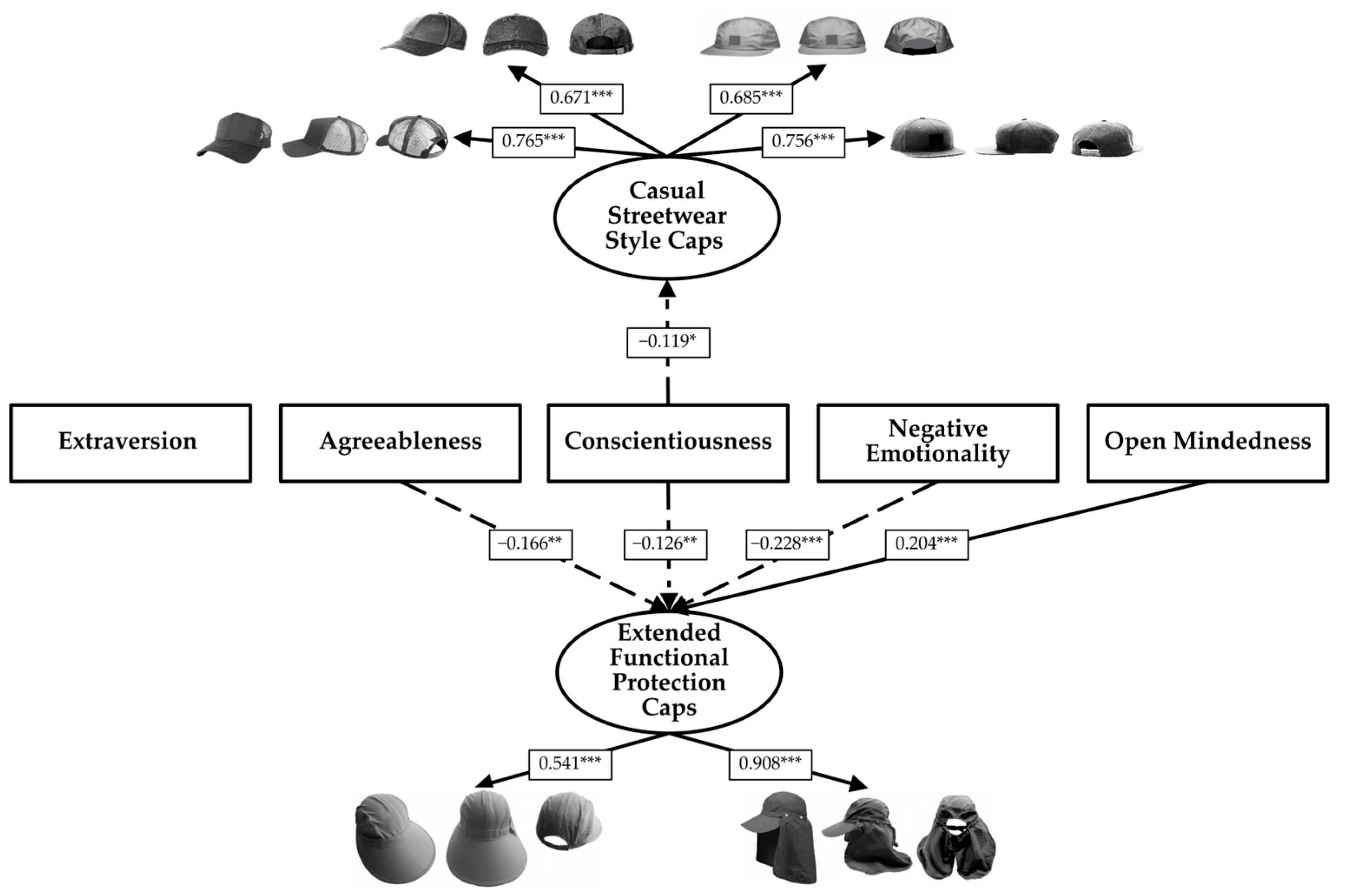
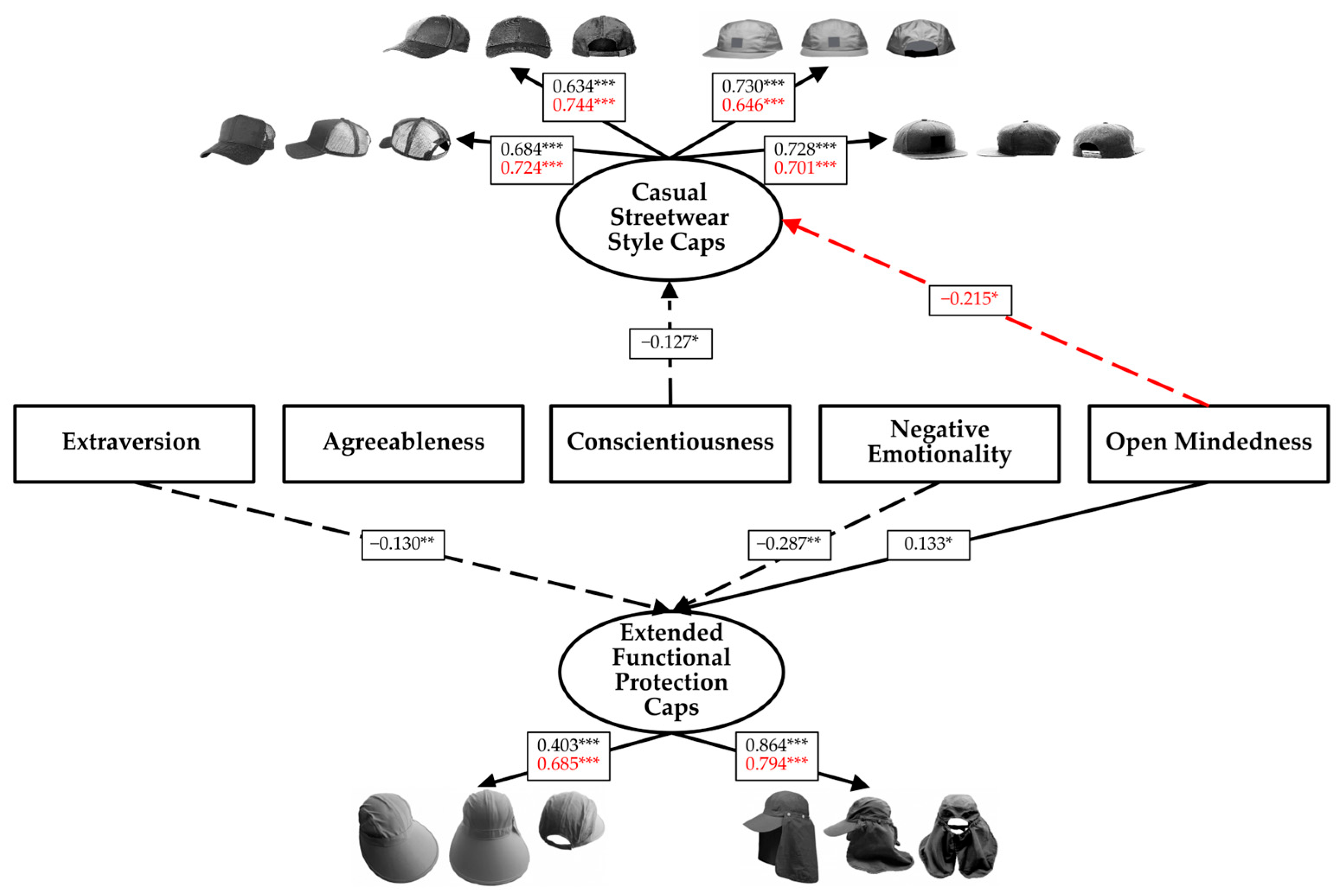
3.2.5. The Effect of Personality Traits and Gender on Willingness to Wear (Set 2)
4. Discussion
Author Contributions
Funding
Institutional Review Board Statement
Informed Consent Statement
Data Availability Statement
Conflicts of Interest
Appendix A


References
- Ackerman, P. L. (1996). A theory of adult intellectual development: Process, personality, interests, and knowledge. Intelligence, 22(2), 227–257. [Google Scholar] [CrossRef]
- Ackerman, P. L., & Heggestad, E. D. (1997). Intelligence, personality, and interests: Evidence for overlapping traits. Psychological Bulletin, 121(2), 219–245. [Google Scholar] [CrossRef] [PubMed]
- Al-Rifaie, M. M. M., Ursyn, A., Zimmer, R., & Javid, M. A. J. (2017). On symmetry, aesthetics, and quantifying symmetrical complexity. In International conference on evolutionary and biologically inspired music and art (pp. 17–32). Springer. [Google Scholar] [CrossRef]
- Asparouhov, T., & Muthén, B. (2009). Exploratory structural equation modeling. Structural Equation Modeling: A Multidisciplinary Journal, 16, 397–438. [Google Scholar] [CrossRef]
- Azemati, H., Jam, F., Ghorbani, M., Dehmer, M., Ebrahimpour, R., Ghanbaran, A., & Emmert-Streib, F. (2020). The role of symmetry in the aesthetics of residential building façades using cognitive science methods. Symmetry, 12(9), 1438. [Google Scholar] [CrossRef]
- Bauerly, M., & Liu, Y. (2008). Effects of symmetry and a number of compositional elements on interface and design aesthetics. International Journal of Human-Computer Interaction, 24(3), 275–287. [Google Scholar] [CrossRef]
- Berger, J., & Heath, C. (2007). Where consumers diverge from others: Identity signaling and product domains. Journal of Consumer Research, 34(2), 121–134. [Google Scholar] [CrossRef]
- Bertamini, M., Rampone, G., Makin, A. D., & Jessop, A. (2019). Symmetry preference in shapes, faces, flowers and landscapes. PeerJ, 7, e7078. [Google Scholar] [CrossRef] [PubMed]
- Brunel, F., & Kumar, R. (2007). Design and the Big Five: Linking visual product aesthetics to product personality. Advances in Consumer Research, 34, 238–239. [Google Scholar]
- Burro, R., Bianchi, I., & Raccanello, D. (2025). Improving the big five inventory-2 in an Italian context using rasch analysis (bfi-2-r). Current Psychology: A Journal for Diverse Perspectives on Diverse Psychological Issues, 44, 5870–5883. [Google Scholar] [CrossRef]
- Burro, R., Branchini, E., Capitani, E., Barnaba, V., Fermani, A., Paradis, C., & Bianchi, I. (2023). Is there an association between consumers’ personality traits and the sensory characteristics they look for in wine? Food Quality and Preference, 105, 104767. [Google Scholar] [CrossRef]
- Byrne, B. M., Shavelson, R. J., & Muthén, B. (1989). Testing for the equivalence of factor covariance and mean structures: The issue of partial measurement invariance. Psychological Bulletin, 105(3), 456–466. [Google Scholar] [CrossRef]
- Chakraborty, S., Hoque, S., Jeem, N. R., Biswas, M. C., Bardhan, D., & Lobaton, E. (2021). Fashion recommendation systems, models and methods: A review. Informatics, 8(3), 49. [Google Scholar] [CrossRef]
- Chamorro-Premuzic, T., & Furnham, A. (2004). Art judgment: A measure related to both personality and intelligence? Imagination. Cognition and Personality, 24(1), 3–24. [Google Scholar] [CrossRef]
- Chamorro-Premuzic, T., & Furnham, A. (2005). Personality and intellectual competence. Lawrence Erlbaum. [Google Scholar]
- Chamorro-Premuzic, T., Reimers, S., Hsu, A., & Ahmetoglu, G. (2009). Who art thou? Personality predictors of artistic preferences in a large UK sample: The importance of openness. British Journal of Psychology, 100, 501–516. [Google Scholar] [CrossRef]
- Chen, F. F. (2007). Sensitivity of goodness of fit indexes to lack of measurement invariance. Structural Equation Modeling, 14(3), 464–504. [Google Scholar] [CrossRef]
- Chen, K., Liang, C., Lee, Y., Han, J., & Lu, Y. (2019). Design criteria for Kansei-oriented elderly products. In M. Kurosu (Ed.), Human-computer interaction. Perspectives on design. (HCII 2019. Lecture Notes in Computer Science; Vol. 11566). Springer. [Google Scholar] [CrossRef]
- Chuquichambi, E. G., Vartanian, O., Skov, M., Corradi, G. B., Nadal, M., Silvia, P. J., & Munar, E. (2022). How universal is preference for visual curvature? A systematic review and meta-analysis. Annals of the New York Academy of Science, 1518(1), 151–165. [Google Scholar] [CrossRef] [PubMed]
- Corradi, G., Belman, M., Currò, T., Chuquichambi, E. G., Rey, C., & Nadal, M. (2019). Aesthetic sensitivity to curvature in real objects and abstract designs. Acta Psychologica, 197, 124–130. [Google Scholar] [CrossRef]
- Corradi, G. B., & Munar, E. (2020). The curvature effect. In M. Nadal Roberts, & O. Vartanian (Eds.), The Oxford handbook of empirical aesthetics (Vol. 34, pp. 35–52). Oxford University Press. [Google Scholar]
- De Bont, C. J. P. M., Schoormans, J. P. L., & Wessel, M. T. T. (1992). Consumer personality and the acceptance of product design. Design Studies, 13(2), 200–208. [Google Scholar] [CrossRef]
- Dehghani Tafti, M., Ahmadzad-Asl, M., Memarian, G., Tafti, M. F., Rajimehr, R., Soltani, S., Mirfazeli, F. S., Vahabie, A., Moein, S. T., & Mozaffar, F. (2024). Personality traits can predict architectural preferences: A machine learning approach. Psychology of Aesthetics, Creativity, and the Arts, 18(5), 750–761. [Google Scholar] [CrossRef]
- Desmet, P. M., Nicolás, J. C. O., & Schoormans, J. P. (2008). Product personality in physical interaction. Design Studies, 29(5), 458–477. [Google Scholar] [CrossRef]
- DeYoung, C. G. (2011). Intelligence and personality. In R. J. Sternberg, & S. B. Kaufman (Eds.), The Cambridge handbook of intelligence (pp. 711–737). Cambridge University Press. [Google Scholar] [CrossRef]
- Dhelim, S., Aung, N., Bouras, M. A., Ning, H., & Cambria, E. (2021). A survey on personality-aware recommendation systems. Artificial Intelligence Review, 55(3), 2409–2454. [Google Scholar] [CrossRef]
- Dolich, I. J. (1969). Congruence relationships between self-images and product brands. Journal of Marketing Research, 6(1), 80–84. [Google Scholar] [CrossRef]
- Dumitrescu, A. (2019). Product personality: Testing a new approach. UPB Science Bulletin Series D, 81(4), 327–340. [Google Scholar]
- Feist, G. J., & Brady, T. R. (2004). Openness to experience, non-conformity, and the preference for abstract art. Empirical Studies of the Arts, 22, 77–89. [Google Scholar] [CrossRef]
- Fujiwara, K., & Nagasawa, S. (2015a). Analysis of psychological factors that influence preference for luxury food and car brands targeting Japanese people. American Journal of Industrial and Business Management, 5(9), 590–600. [Google Scholar] [CrossRef][Green Version]
- Fujiwara, K., & Nagasawa, S. (2015b). Relationships among purchase intentions for luxury brands and personality traits based on the Big Five. American Journal of Industrial and Business Management, 5(11), 631–639. [Google Scholar] [CrossRef][Green Version]
- Furnham, A., & Chamorro-Premuzic, T. (2004). Personality, intelligence, and art. Personality and Individual Differences, 36, 705–715. [Google Scholar] [CrossRef]
- Furnham, A., & Thorne, J. D. (2013). Need for cognition: Its dimensionality and personality and intelligence correlates. Journal of Individual Differences, 34(4), 230–240. [Google Scholar] [CrossRef]
- Furnham, A., & Walker, J. (2001a). Personality and judgement of abstract, pop art, and representational paintings. European Journal of Personality, 15, 57–72. [Google Scholar] [CrossRef]
- Furnham, A., & Walker, J. (2001b). The influence of personality traits, previous experience of art, and demographic variables on artistic preference. Personality and Individual Differences, 31, 997–1017. [Google Scholar] [CrossRef]
- Goldberg, L. R. (1990). An alternative “description of personality”: The Big-Five factor structure. Journal of Personality and Social Psychology, 59(6), 121629. [Google Scholar] [CrossRef]
- Govers, P. C. M. (2004). “I love my jeep, because it’s tough like me”: The effect of product personality congruence on product attachment. Psychology Business. Available online: https://api.semanticscholar.org/CorpusID:141630109 (accessed on 21 January 2025).
- Govers, P. C. M., Hekkert, P., & Schoormans, J. P. L. (2003). Happy, cute and tough: Can designers create a product personality that consumers understand. In D. McDonagh, P. Hekkert, J. van Erp, & D. Gyi (Eds.), Design and emotion: The experience of everyday things: Proceedings of the 3rd international conference on design and emotion (pp. 345–349). Taylor and Francis. [Google Scholar]
- Govers, P. C. M., & Schoormans, J. P. L. (2005). Product personality and its influence on consumer preference. Journal of Consumer Marketing, 22(4), 18997. [Google Scholar] [CrossRef]
- Gómez-Puerto, G., Munar, E., & Nadal, M. (2016). Preference for curvature: A historical and conceptual framework. Frontieers of Human Neuroscience, 9, 712. [Google Scholar] [CrossRef]
- Gómez-Puerto, G., Rosselló, J., Corradi, G., Acedo-Carmona, C., Munar, E., & Nadal, M. (2018). Preference for curved contours across cultures. Psychology of Aesthetics, Creativity, and the Arts, 12(4), 432–439. [Google Scholar] [CrossRef]
- Greenberg, D., Ehrensperger, E., Schulte-Mecklenbeck, M., Hoyer, W. D., Zhang, Z. J., & Krohmer, H. (2019). The role of brand prominence and extravagance of product design in luxury brand building: What drives consumers’ preferences for loud versus quiet luxury? Journal of Brand Management, 27(2), 195–210. [Google Scholar] [CrossRef]
- Hartog, L., Weijs-Perrée, M., & Appel-Meulenbroek, R. (2018). The influence of personality on user satisfaction: Multitenant offices. Building Research and Information, 46(4), 402–416. [Google Scholar] [CrossRef]
- Huang, H. H., Mitchell, V., & Rosenaum-Elliott, R. (2012). Are consumer and brand personalities the same? Psychology & Marketing, 29(5), 334–349. [Google Scholar] [CrossRef]
- Hur, Y., Etcoff, N. L., & Silva, E. S. (2023). Can fashion aesthetics be studied empirically? The preference structure of everyday clothing choices. Empirical Studies of the Arts, 41(2), 525–545. [Google Scholar] [CrossRef]
- Hur, Y., Segal, N. L., Etcoff, N. L., & Silva, E. S. (2025). Understanding the psychology of fashion: Demographic, personality, and fashion factors underlying everyday clothing choices in the United Kingdom and United States. Psychology of Aesthetics, Creativity, and the Arts. advance online publication. [Google Scholar] [CrossRef]
- Jegethesan, K., Sneddon, J. N., & Soutar, G. N. (2012). Young Australian consumers’ preferences for fashion apparel attributes. Journal of Fashion Marketing and Management: An International Journal, 16(3), 275–289. [Google Scholar] [CrossRef]
- Johar, J. S., & Sirgy, M. J. (1991). Value-expressive versus utilitarian advertising appeals: When and why to use which appeal. Journal of Advertising, 20(3), 23–33. [Google Scholar] [CrossRef]
- Kang, Y.-J., & Park, S.-Y. (2016). The perfection of the narcissistic self: A qualitative study on luxury consumption and customer equity. Journal of Business Research, 69(9), 3813–3819. [Google Scholar] [CrossRef]
- Keller, K. L. (1993). Conceptualizing, measuring, and managing customer-based brand equity. Journal of Marketing, 57(1), 1–22. [Google Scholar] [CrossRef]
- Kline, R. B. (2016). Principles and practice of structural equation modeling (4th ed.). Guilford Press. [Google Scholar]
- Lüdecke, D., Ben-Shachar, M., Patil, I., & Makowski, D. (2020). Extracting, computing and exploring the parameters of statistical models using R. Journal of Open Source Software, 5(53), 2445. [Google Scholar] [CrossRef]
- MacCallum, R. C., Browne, M. W., & Sugawara, H. M. (1996). Power analysis and determination of sample size for covariance structure modeling. Psychological Methods, 1, 130–149. [Google Scholar] [CrossRef]
- Maehle, N., & Shneor, R. (2010). On congruence between brand and human personalities. Journal of Product & Brand Management, 19(1), 44–53. [Google Scholar] [CrossRef]
- Mair, C. (2018). The psychology of fashion. Routledge. [Google Scholar]
- Makin, A. D. J., Rampone, G., Wright, A., Martinovic, J., & Bertamini, M. (2014). Visual symmetry in objects and gaps. Journal of Vision, 14(3), 12. [Google Scholar] [CrossRef] [PubMed]
- Malhotra, N. K. (1981). A scale to measure self-concepts, person concepts, and product concepts. Journal of Marketing Research, 18(4), 456–464. [Google Scholar] [CrossRef]
- Matthews, G., Zeidner, M., & Roberts, R. D. (2006). Models of personality and affective influences on cognition. In G. Matthews, M. Zeidner, & R. D. Roberts (Eds.), Emotional intelligence: Science and myth (pp. 137–166). MIT Press. [Google Scholar]
- Matz, S. C., Gladstone, J. J., & Stillwell, D. (2016). Money buys happiness when spending fits our personality. Psychological Science, 27(5), 715–725. [Google Scholar] [CrossRef]
- McCrae, R. R., & John, O. P. (1992). An introduction to the five-factor model and its applications. Journal of Personality, 60(2), 175–215. [Google Scholar] [CrossRef]
- Moshagen, M., & Bader, M. (2024). semPower: General power analysis for structural equation models. Behavior Research Methods, 56, 2901–2922. [Google Scholar] [CrossRef] [PubMed]
- Mugge, R., Govers, P. C. M., & Schoormans, J. P. L. (2009). The development and testing of a product personality scale. Design Studies, 30(3), 287–302. [Google Scholar] [CrossRef]
- Mulyanegara, R. C., Tsarenko, Y., & Anderson, A. (2007). The Big Five and brand personality: Investigating the impact of consumer personality on preferences towards particular brand personality. Journal of Brand Management, 16(4), 234–247. [Google Scholar] [CrossRef]
- Munasinghe, S. (2018). The impact of brand personality on brand preference: A study on personal care products. International Review of Management and Marketing, 8(2), 9–11. [Google Scholar]
- Mussel, P. (2010). Epistemic curiosity and related constructs: Lacking evidence of discriminant validity. Personality and Individual Differences, 49(5), 506–510. [Google Scholar] [CrossRef]
- MyStyleBox. (2023). Hats: Choosing, styling, and types. Available online: https://www.mystylebox.ca/pages/hats-choosing-styling-and-types (accessed on 24 January 2023).
- Myszkowski, N., & Storme, M. (2012). How personality traits predict design-driven consumer choices. Europe’s Journal of Psychology, 8(4), 641–650. [Google Scholar] [CrossRef]
- O’Connor, P. J., Moss, J., Adams, J., Matemberere, C., & Kaya, M. (2022). What drives consumer automobile choice? Investigating personality trait predictors of vehicle preference factors. Personality and Individual Differences, 184, 111220. [Google Scholar] [CrossRef]
- Ortíz, N., Juan, C., Schoormans, J. P. L., & Aurisicchio, M. (2011). An approach to embody personality in product appearance. In IASDR 201: Proceedings of 4th world conference on design research “diversity and unity”, Delft, The Netherlands, 31 October–4 November 2011. TU Delft & IASDR. [Google Scholar]
- Ou, L.-C., Luo, M. R., Woodcock, A., & Wright, A. (2004). A study of colour emotion and colour preference. Part 1: Colour emotions for single colours. Color Research and Application, 29(3), 232–240. [Google Scholar] [CrossRef]
- Ozer, D. J., & Benet-Martinez, V. (2006). Personality and the prediction of consequential outcomes. Annual Review of Psychology, 57(1), 401–421. [Google Scholar] [CrossRef]
- Palmer, S. E., & Schloss, K. B. (2010). An ecological valence theory of human color preference. Proceedings of the National Academy of Sciences of the United States of America, 107(19), 8877–8882. [Google Scholar] [CrossRef]
- Palmer, S. E., Schloss, K. B., & Sammartino, J. (2013). Visual aesthetics and human preference. Annual Review of Psychology, 64, 77–107. [Google Scholar] [CrossRef]
- Palumbo, L., Rampone, G., & Bertamini, M. (2021). The role of gender and academic degree on preference for smooth curvature of abstract shapes. PeerJ, 9, e10877. [Google Scholar] [CrossRef]
- Palumbo, L., Rampone, G., Bertamini, M., Sinico, M., Clarke, E., & Vartanian, O. (2022). Visual preference for abstract curvature and for interior spaces: Beyond undergraduate student samples. Psychology of Aesthetics, Creativity, and the Arts, 16(4), 577–593. [Google Scholar] [CrossRef]
- Paryudi, I., Ashari, A., & Mustofa, K. (2022). The performance of personality-based recommender system for fashion with demographic data-based personality prediction. International Journal of Advanced Computer Science and Applications (IJACSA), 13(1), 360–368. [Google Scholar] [CrossRef]
- Pecchinenda, A., Bertamini, M., Makin, A. D. J., & Ruta, N. (2014). The pleasantness of visual symmetry: Always, never or sometimes. PLoS ONE, 9(3), E92685. [Google Scholar] [CrossRef]
- Plummer, J. T. (2000). How personality makes a difference. Journal of Advertising Research, 40(6), 79–83. [Google Scholar] [CrossRef]
- Post, R. A. G., Blijlevens, J., & Hekkert, P. P. M. (2016). ‘To preserve unity while almost allowing for chaos’: Testing the aesthetic principle of unity-in-variety in product design. Acta Psychologica, 163, 142–152. [Google Scholar] [CrossRef]
- Prieto, P., Briede, J. C., Beghelli, A., Canessa, E., & Barra, C. (2019). I like it elegant: Imprinting personalities into product shapes. International Journal of Design Creativity and Innovation, 8(1), 5–20. [Google Scholar] [CrossRef]
- Ratner, R. K., & Kahn, B. E. (2002). The impact of private vs. public consumption on variety seeking behavior. Journal of Consumer Research, 29, 246–258. [Google Scholar] [CrossRef]
- R Core Team. (2025). R: A language and environment for statistical computing. R Foundation for Statistical Computing. Available online: https://www.R-project.org/ (accessed on 2 November 2025).
- Rentfrow, P. J., & Gosling, S. D. (2003). The do re mi’s of everyday life: The structure and personality correlates of music preferences. Journal of Personality and Social Psychology, 84(6), 1236–1256. [Google Scholar] [CrossRef] [PubMed]
- Rosseel, Y. (2012). lavaan: An R package for structural equation modeling. Journal of Statistical Software, 48(2), 1–36. [Google Scholar] [CrossRef]
- Sinico, M., Bertamini, M., & Soranzo, A. (2021). Perceiving intersensory and emotional qualities of everyday objects: A study on smoothness or sharpness features with line drawings by designers. Art & Perception, 9(3), 220–240. [Google Scholar] [CrossRef]
- Soranzo, A., Bertacchini, F., & Bertamini, M. (2024). Aesthetics of contour, complexity and movement of abstract shapes: The importance of individual differences. Art and Perception, 12(3), 240–263. [Google Scholar] [CrossRef]
- Soto, C. J., & John, O. P. (2017). Short and extra-short forms of the Big Five Inventory–2: The BFI-2-S and BFI-2-XS. Journal of Research in Personality, 68, 69–81. [Google Scholar] [CrossRef]
- Stolovy, T. (2021). Styling the self: Clothing practices, personality traits, and body image among Israeli women. Frontiers in Psychology, 12, 719318. [Google Scholar] [CrossRef]
- Tyler, C. W. (2003). Human symmetry perception and its computational analysis. Psychology Press. [Google Scholar]
- van der Laken, P. (2023). Corrtable: Creates and saves out a correlation table with significance levels indicated (R package version 0.1.1). Available online: https://CRAN.R-project.org/package=corrtable (accessed on 2 November 2025).
- Van Geert, E., & Wagemans, J. (2021). Order, complexity, and aesthetic preferences for neatly organized compositions. Psychology of Aesthetics, Creativity and the Arts, 15, 484–504. [Google Scholar] [CrossRef]
- von Stumm, S., & Ackerman, P. L. (2013). Investment and intellect: A review of the relationship between personality, intelligence and interest. European Journal of Personality, 27(3), 231–246. [Google Scholar] [CrossRef]
- von Stumm, S., Chamorro-Premuzic, T., & Ackerman, P. L. (2011). Revisiting intelligence–personality associations: The importance of distinguishing between typical and maximal intellectual performance. Intelligence, 39(4), 245–254. [Google Scholar] [CrossRef]
- World Medical Association. (2013). World Medical Association Declaration of Helsinki ethical principles for medical research involving human subjects. JAMA: Journal of the American Medical Association, 310(20), 2191–2194. [Google Scholar] [CrossRef]
- Yu, S., Zheng, Q., Chen, T., Zhang, H., & Chen, X. (2023). Consumer personality traits vs. their preferences for the characteristics of wood furniture products. Bioresources, 18(4), 7443–7459. [Google Scholar] [CrossRef]
- Zalando. (2025a). Hats for men. Available online: https://www.zalando.it/cappelli-uomo/ (accessed on 24 January 2023).
- Zalando. (2025b). Hats for women. Available online: https://www.zalando.it/cappelli-donna/ (accessed on 24 January 2023).

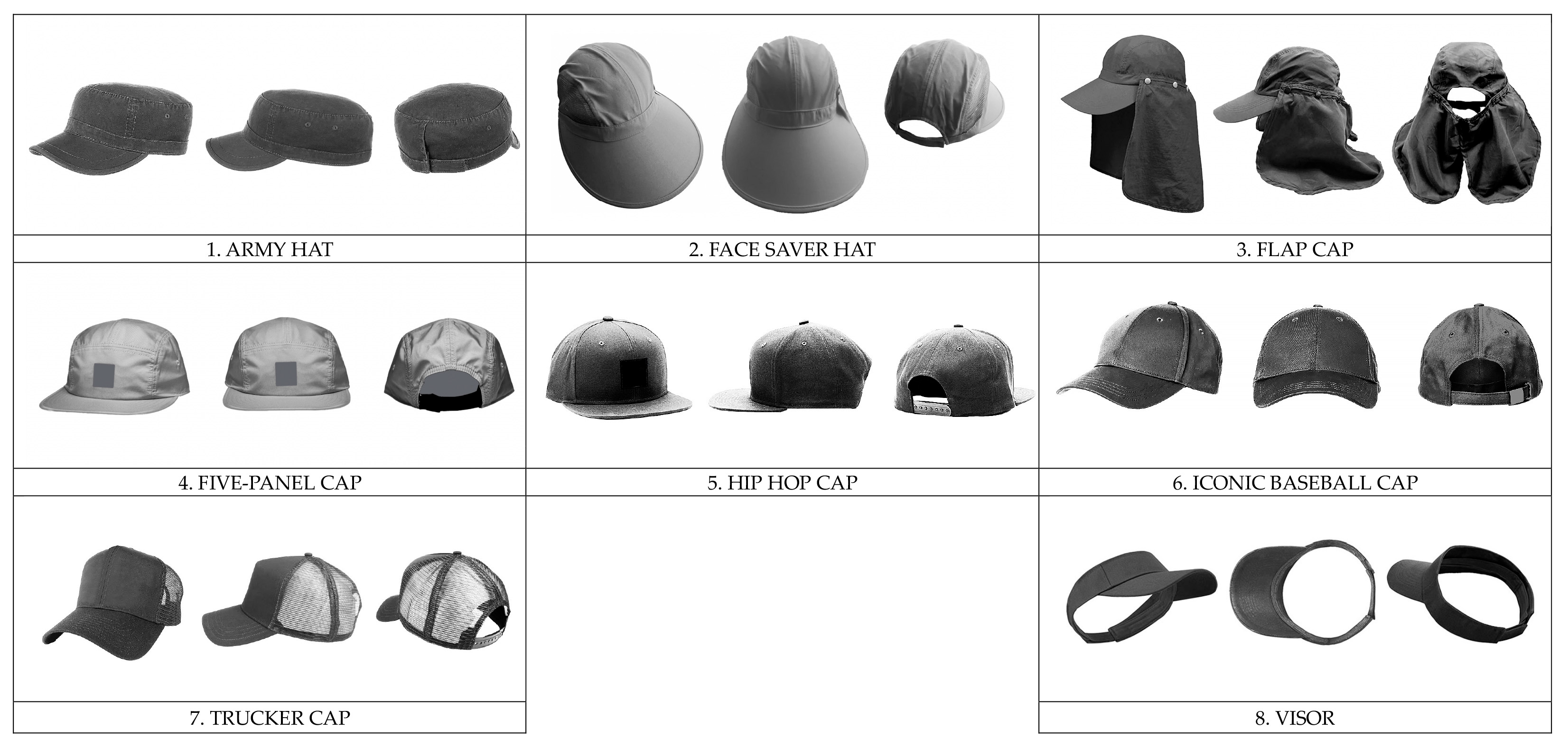



| Hat Model | Pearson r | Hat Model | Pearson r |
|---|---|---|---|
| Balaclava | 0.766 *** | News boy cap | 0.787 *** |
| Baseball cap | 0.837 *** | Panama hat | 0.782 *** |
| Beret beanie | 0.794 *** | Peak beanie | 0.846 *** |
| Beret hat | 0.774 *** | Pillbox 1 | 0.713 *** |
| Bobble beanie | 0.848 *** | Pillbox 2 | 0.715 *** |
| Bolero hat | 0.771 *** | Short beanie | 0.855 *** |
| Cartwheel hat | 0.716 *** | Tam hat | 0.848 *** |
| Chullo | 0.766 *** | Turban | 0.767 *** |
| Cloche | 0.677 *** | Audrey hat | 0.686 *** |
| Cowboy hat | 0.755 *** | Boater hat | 0.732 *** |
| Deerstalker hat | 0.700 *** | Bowler hat | 0.679 *** |
| Fascinator hat | 0.603 *** | Fedora hat | 0.768 *** |
| Fisherman | 0.850 *** | Homburg hat | 0.728 *** |
| Flat cap | 0.762 *** | Popeye hat | 0.605 *** |
| Floppy hat | 0.723 *** | Pork pie hat | 0.744 *** |
| Long stoking cap | 0.844 *** | Top hat | 0.543 *** |
| Naked beanie | 0.856 *** | Trilby hat | 0.789 *** |
| Path | Estimate (β-Std.) | SE | z | p-Value | |
|---|---|---|---|---|---|
| Flat/Urban Style Hats ← | |||||
| Extraversion | −0.013 | 0.006 | −0.236 | 0.814 | |
| Agreeableness | −0.015 | 0.008 | −0.286 | 0.775 | |
| Conscientiousness | −0.086 | 0.006 | −1.543 | 0.123 | |
| Negative Emotionality | 0.005 | 0.006 | 0.086 | 0.931 | |
| Open Mindedness | 0.237 | 0.007 | 4.618 | <0.001 *** | |
| Knitted Floopy Hats ← | |||||
| Extraversion | −0.055 | 0.006 | −0.999 | 0.318 | |
| Agreeableness | 0.058 | 0.007 | 1.213 | 0.225 | |
| Conscientiousness | 0.039 | 0.006 | 0.772 | 0.440 | |
| Negative Emotionality | −0.030 | 0.005 | −0.562 | 0.574 | |
| Open Mindedness | 0.053 | 0.007 | 0.961 | 0.337 | |
| Extravagant Highly Feminine Hats ← | |||||
| Extraversion | −0.105 | 0.006 | −2.054 | 0.040 * | |
| Agreeableness | −0.016 | 0.008 | −0.303 | 0.762 | |
| Conscientiousness | −0.030 | 0.006 | −0.575 | 0.565 | |
| Negative Emotionality | −0.087 | 0.005 | −1.592 | 0.111 | |
| Open Mindedness | 0.161 | 0.006 | 3.258 | 0.001 ** | |
| Archetypal Masculine Character Hats ← | |||||
| Extraversion | −0.170 | 0.007 | −2.863 | 0.004 ** | |
| Agreeableness | −0.131 | 0.008 | −2.471 | 0.013 * | |
| Conscientiousness | −0.146 | 0.006 | −2.759 | 0.006 ** | |
| Negative Emotionality | −0.147 | 0.006 | −2.532 | 0.011 * | |
| Open Mindedness | 0.296 | 0.007 | 5.704 | <0.001 *** | |
| Classic Brimmed Hats ← | |||||
| Extraversion | −0.056 | 0.006 | −1.136 | 0.256 | |
| Agreeableness | −0.050 | 0.007 | −1.006 | 0.315 | |
| Conscientiousness | −0.066 | 0.005 | −1.353 | 0.176 | |
| Negative Emotionality | −0.139 | 0.005 | −2.800 | 0.005 ** | |
| Open Mindedness | 0.184 | 0.006 | 3.804 | <0.001 *** | |
| Path | Estimate (β-Std.) | SE | z | p-Value | |
|---|---|---|---|---|---|
| Flat/Urban Style Hats ← | |||||
| Extraversion | −0.032 | 0.007 | −0.542 | 0.588 | |
| Agreeableness | −0.056 | 0.008 | −1.026 | 0.305 | |
| Conscientiousness | −0.075 | 0.006 | −1.380 | 0.168 | |
| Negative Emotionality | −0.054 | 0.006 | −0.878 | 0.380 | |
| Open Mindedness | 0.218 | 0.006 | 4.277 | <0.001 *** | |
| Knitted Floopy Hats ← | |||||
| Extraversion | −0.034 | 0.006 | −0.600 | 0.549 | |
| Agreeableness | 0.024 | 0.008 | 0.457 | 0.647 | |
| Conscientiousness | 0.049 | 0.006 | 0.921 | 0.357 | |
| Negative Emotionality | 0.018 | 0.005 | 0.337 | 0.736 | |
| Open Mindedness | 0.098 | 0.008 | 1.612 | 0.107 | |
| Extravagant Highly Feminine Hats ← | |||||
| Extraversion | 0.038 | 0.007 | 0.614 | 0.539 | |
| Agreeableness | 0.103 | 0.009 | 1.730 | 0.084 | |
| Conscientiousness | 0.064 | 0.006 | 1.137 | 0.255 | |
| Negative Emotionality | 0.117 | 0.005 | 2.210 | 0.027 * | |
| Open Mindedness | 0.114 | 0.008 | 1.868 | 0.062 | |
| Archetypal Masculine Character Hats ← | |||||
| Extraversion | −0.097 | 0.007 | −1.647 | 0.100 | |
| Agreeableness | −0.078 | 0.008 | −1.427 | 0.154 | |
| Conscientiousness | −0.154 | 0.006 | −3.137 | 0.002 ** | |
| Negative Emotionality | −0.098 | 0.006 | −1.645 | 0.100 | |
| Open Mindedness | 0.214 | 0.007 | 3.749 | <0.001 *** | |
| Classic Brimmed Hats ← | |||||
| Extraversion | −0.024 | 0.006 | −0.492 | 0.623 | |
| Agreeableness | −0.092 | 0.008 | −1.761 | 0.078 | |
| Conscientiousness | −0.040 | 0.005 | −0.883 | 0.377 | |
| Negative Emotionality | −0.120 | 0.005 | −2.538 | 0.011 * | |
| Open Mindedness | 0.182 | 0.006 | 3.708 | <0.001 *** | |
| Hat Model | Pearson, r |
|---|---|
| Face saver | 0.612 *** |
| Flap cap | 0.818 *** |
| Trucker cap | 0.855 *** |
| Army hat | 0.828 *** |
| Iconic baseball cap | 0.856 *** |
| Five panel cap | 0.867 *** |
| Hip hop cap | 0.825 *** |
| Visor cap | 0.702 *** |
| Path | Estimate (β-Std.) | SE | z | p-Value | |
|---|---|---|---|---|---|
| Extended Functional Protection Caps ← | |||||
| Extraversion | −0.070 | 0.006 | −1.438 | 0.150 | |
| Agreeableness | −0.166 | 0.008 | −3.240 | 0.001 ** | |
| Conscientiousness | −0.126 | 0.006 | −2.626 | 0.009 ** | |
| Negative Emotionality | −0.228 | 0.005 | −4.429 | <0.001 *** | |
| Open Mindedness | 0.204 | 0.006 | 4.656 | <0.001 *** | |
| Casual Streetwear Style Caps ← | |||||
| Extraversion | −0.026 | 0.006 | −0.493 | 0.622 | |
| Agreeableness | 0.050 | 0.007 | 1.026 | 0.305 | |
| Conscientiousness | −0.119 | 0.006 | −2.230 | 0.026 * | |
| Negative Emotionality | −0.080 | 0.005 | −1.518 | 0.129 | |
| Open Mindedness | −0.026 | 0.007 | −0.500 | 0.617 | |
| Males | Females | ||||||||
|---|---|---|---|---|---|---|---|---|---|
| Path | Estimate (β-Std.) | SE | z | p-Value | Estimate (β-Std.) | SE | z | p-Value | |
| Extended Functional Protection Caps ← | |||||||||
| Extraversion | 0.047 | 0.012 | 0.429 | 0.668 | −0.130 | 0.003 | −2.143 | 0.032 * | |
| Agreeableness | −0.084 | 0.016 | −0.750 | 0.453 | −0.063 | 0.004 | −1.078 | 0.281 | |
| Conscientiousness | −0.025 | 0.011 | −0.279 | 0.780 | −0.103 | 0.003 | −1.763 | 0.078 | |
| Negative Emotionality | 0.083 | 0.012 | 0.709 | 0.478 | −0.287 | 0.004 | −3.309 | 0.001 ** | |
| Open Mindedness | 0.138 | 0.015 | 1.245 | 0.213 | 0.133 | 0.004 | 1.973 | 0.049 * | |
| Casual Streetwear Style Caps ← | |||||||||
| Extraversion | 0.093 | 0.012 | 0.885 | 0.376 | −0.019 | 0.006 | −0.327 | 0.744 | |
| Agreeableness | 0.030 | 0.015 | 0.298 | 0.766 | 0.072 | 0.008 | 1.240 | 0.215 | |
| Conscientiousness | 0.075 | 0.013 | 0.685 | 0.494 | −0.127 | 0.006 | −2.151 | 0.031 * | |
| Negative Emotionality | 0.015 | 0.012 | 0.128 | 0.898 | 0.008 | 0.006 | 0.134 | 0.894 | |
| Open Mindedness | −0.215 | 0.013 | −2.175 | 0.030 * | 0.064 | 0.007 | 1.066 | 0.286 | |
Disclaimer/Publisher’s Note: The statements, opinions and data contained in all publications are solely those of the individual author(s) and contributor(s) and not of MDPI and/or the editor(s). MDPI and/or the editor(s) disclaim responsibility for any injury to people or property resulting from any ideas, methods, instructions or products referred to in the content. |
© 2026 by the authors. Licensee MDPI, Basel, Switzerland. This article is an open access article distributed under the terms and conditions of the Creative Commons Attribution (CC BY) license.
Share and Cite
Capitani, E.; Bianchi, I.; Burro, R. Does Your Hat Speak Your Mind? Personality Traits and Aesthetic Preferences for Hats Among Italian Young Adults. Behav. Sci. 2026, 16, 290. https://doi.org/10.3390/bs16020290
Capitani E, Bianchi I, Burro R. Does Your Hat Speak Your Mind? Personality Traits and Aesthetic Preferences for Hats Among Italian Young Adults. Behavioral Sciences. 2026; 16(2):290. https://doi.org/10.3390/bs16020290
Chicago/Turabian StyleCapitani, Elena, Ivana Bianchi, and Roberto Burro. 2026. "Does Your Hat Speak Your Mind? Personality Traits and Aesthetic Preferences for Hats Among Italian Young Adults" Behavioral Sciences 16, no. 2: 290. https://doi.org/10.3390/bs16020290
APA StyleCapitani, E., Bianchi, I., & Burro, R. (2026). Does Your Hat Speak Your Mind? Personality Traits and Aesthetic Preferences for Hats Among Italian Young Adults. Behavioral Sciences, 16(2), 290. https://doi.org/10.3390/bs16020290