


Matters of the Heart: Co-Creating a Peer-Led Social Health Intervention for People Living with Dementia

Abstract
1. Introduction
1.1. Informing Social Health Intervention Development
Individual Competencies and Meaningfulness
1.2. Development of the “Matters of the Heart” Social Health Intervention
1.2.1. Designing the Intervention Scaffolding
- Enhancing Connection with Oneself
- Enhancing Connection with Others
- Enhancing Connection with the Environment
1.2.2. Co-Creating the Intervention Content
1.3. Study Aim
2. Materials and Methods
2.1. Study Design
2.2. Setting and Sample
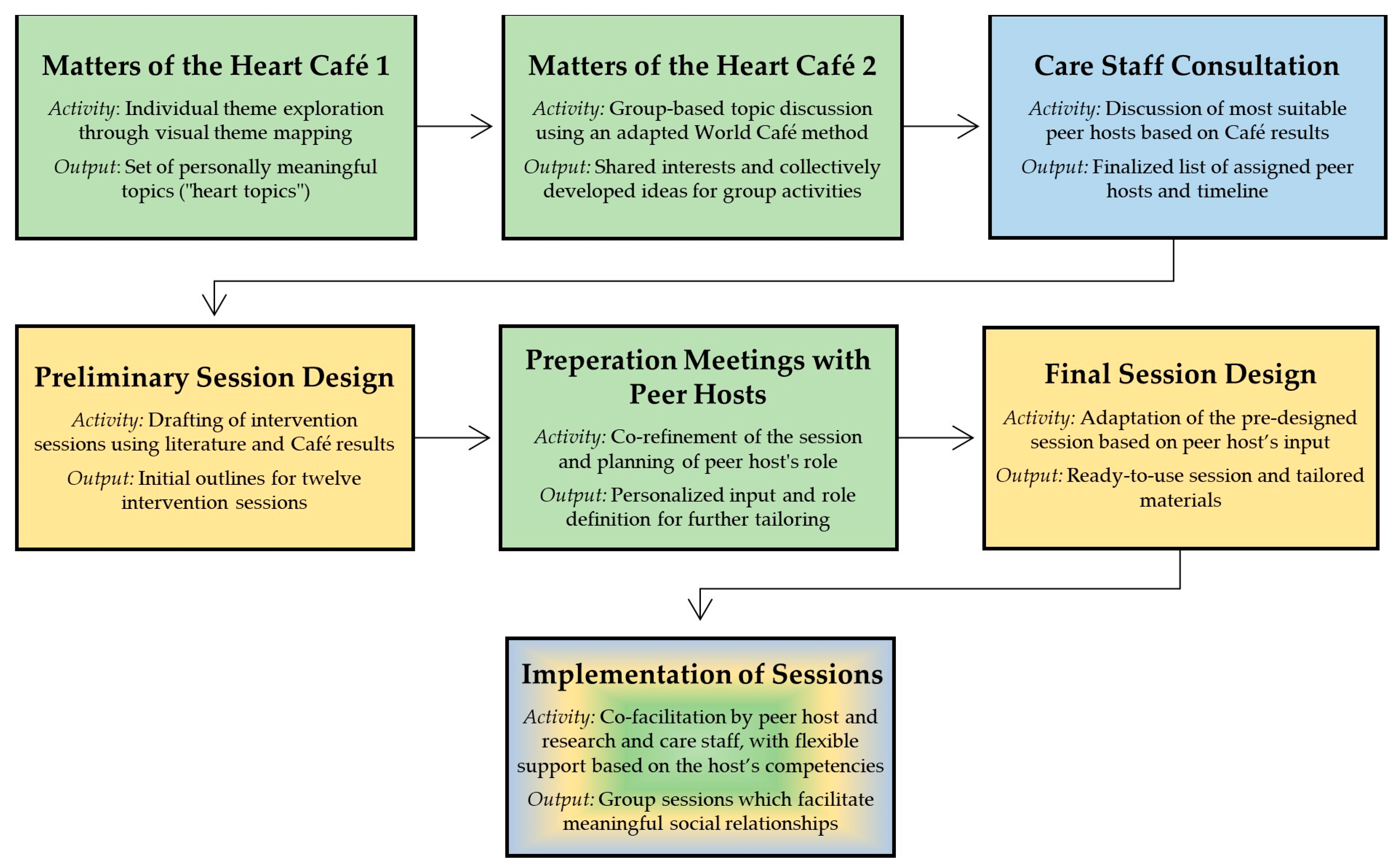
2.3. Co-Creation Process
2.4. Data Generation and Analysis in the Co-Creation Process
3. Results
3.1. Sample
3.2. Matters of the Heart Café 1
3.2.1. Implementation
3.2.2. Findings
3.3. Matters of the Heart Café 2
3.3.1. Implementation
3.3.2. Findings
- Holidays and Travels: Participants shared diverse holiday and travel experiences, ranging from trips within Germany and neighbouring countries (Italy, Austria, France) to other European destinations (Spain, England, Scotland, Scandinavia) and even further abroad (USA, China, Africa). One participant vividly recalled a safari in Kenya with encounters with elephants and the Massai. Others highlighted simpler holidays in the garden or on short bus trips. Activities such as skiing, hiking, and sailing were frequently mentioned, alongside memories of family holidays with parents, grandparents, or children. Several expressed a wish to share travel stories and learn about each other’s favourite destinations.
- Cooking and Baking: Many participants described their enjoyment of cooking and baking, ranging from making jams, soups, and traditional dishes to preparing and sharing fruit desserts, cakes, and bread. Baking was often emphasized, with mentions of cookies, apple cakes, and other fruit pastries. While some noted that they did not particularly enjoy cooking, they still valued baking and hosting. Biographical references included experiences of running a household or even a farm. Several participants highlighted their interest in cooking or baking together and in exchanging knowledge about recipes.
- Dressing up: Participants emphasized their joy in dressing up nicely, especially for church, concerts, theatre visits, or dances. Many described a preference for beautiful clothes and elegant shoes, sometimes with high heels, as well as make-up such as lipstick, mascara, rouge, or nail polish. Some recalled tailoring or sewing experiences in the family, wearing traditional clothing such as a Dirndl, or borrowing clothes from siblings. While everyday clothing was more practical, dressing up for special occasions was described as meaningful.
- Animals: Participants reported a strong preference for animals, with dogs, cats, and horses most frequently mentioned as favourites. Several shared biographical experiences such as growing up with pets (including horses, dogs, cats, birds, rabbits, hamsters, guinea pigs, or farm animals) or encounters with animals during safaris. Some also described fear of dogs, while still appreciating animals from a distance. Across accounts, participants expressed joy in remembering their animals, watching animal films and documentaries, visiting the zoo, and wishing for animal visits in the group.
- Sports: Participants mentioned a variety of sports interests including handball, volleyball, badminton, and skiing. Football was sometimes associated with rejection, but also with family traditions and personal enthusiasm. Some wished to talk about their favourite club, including experiences of traveling with fans to matches. Family connections to football and ice hockey (husband, children, grandchildren) were emphasized. The local football stadium emerged as both a sports venue and a landmark for walks and sightseeing. Some participants offered to explain the rules of different sports to the group.
- Family and Friends: Participants emphasized the central importance of family, frequently mentioning children, grandchildren, siblings, or parents. They expressed pride in their families, recalled childhood responsibilities such as caring for siblings during the war, or shared biographical stories including parental influence, artistic backgrounds, and special love stories like interdenominational marriages. Friendships were described as equally meaningful, from lifelong companions to close weekly contacts, fading ties, or strong bonds with fellow residents. Several participants wished to share stories about family histories, friendships, children, or love stories.
- Music and Dancing: Participants expressed a wide range of musical preferences, with many highlighting a fondness for folk music, Schlager, and waltzes. Classical music and jazz were also mentioned, and some named specific artists such as Marlene Dietrich. Dancing was described as a source of joy, especially waltz, polka, and foxtrot. Several participants had rich biographical experiences with music, including playing instruments such as piano, accordion, singing in choirs, or attending dance courses. Participants also voiced clear wishes for the present: they would like to listen to music, sing, or dance together in the group, and some even expressed interest in performing again, for example, by playing the accordion.
- Religion and Church: Participants spoke about their experiences of going to church, with many describing regular attendance on Sundays or for special occasions, sometimes even walking long distances. For some, church visits were associated with dressing up, evening services, or moments of rest and peace. Accounts of prayer practices included table prayers, praying with the family, and a particular importance of the Lord’s Prayer, while others did not pray at home. Several recalled their active involvement in church life, such as holding children’s services, singing in church choirs, or to live in a convent.
- Regional Identity and Dialects: Participants described their diverse regional and cultural backgrounds, mentioning origins from different regions of Bavaria, other German regions, and former German territories. Several highlighted regional dialects. Expressions of local identity included regional greetings, family roots in other regions or abroad, and feelings of being at home in Munich. Individual life paths were shared, such as moving for education or work. Participants also expressed an interest in knowing where the others come from and some want to teach their dialect to the group. In addition, memories of beer garden culture were highlighted, including traditional food, music, and beer mugs, along with the wish to share these customs with the group.
- Art and Handicrafts: Participants described painting as a meaningful and enjoyable activity, closely linked to personal expression. They spoke about their favourite colours and about preferred subjects such as nature motifs (trees, rivers, forests) as well as abstract watercolour painting in bright tones. Some also reported on textile handicrafts, which were not only hobbies but also served practical purposes such as making clothes for the family. Several expressed the wish to paint together, combined with music and conversation. Others mentioned showing photos of their own artworks and contributing stories connected to them, or suggested creating collective pieces such as garden-themed paintings. One participant offered to prepare painting templates for the group.
- Nature: Participants expressed a strong connection to nature, gardens, and hiking. Many emphasized joy in their own gardens and wished to share related experiences with the group—for example, talking about their gardens, planting flowers together, or growing herbs such as chives, parsley, and mint. Walking and hiking, both in the mountains and in the countryside, were frequently described as sources of happiness and wellbeing, with favourite destinations including the Alps, South Tyrol, and Austria. Some participants highlighted their wish to tell stories about time spent in nature or to show others aspects of the natural environment. Some talked about gardens as shared spaces of activity and relaxation.
- Movies and Theatre: Participants frequently recalled their enjoyment of cinema visits, especially comedies and romantic films. They also spoke about their favourite actors, e.g., Heinz Rühmann and Greta Garbo. Several described a strong connection to theatre, both as audience members and through their own active involvement, such as school theatre, amateur theatre groups, or even professional training and work in the film industry. Some participants also expressed that they would like to talk about actors and films. Across different accounts, participants emphasized that they would still like to act today.
3.4. Care Staff Consultation
3.5. Preliminary Session Design
3.6. Preparation Meetings with the Peer Hosts
3.7. Final Session Design
3.8. Implementation of Sessions
4. Discussion
4.1. The Co-Creation Process
4.2. The Matter of the Heart Cafés
4.3. The Social Health Intervention
4.4. Limitations
5. Conclusions
Author Contributions
Funding
Institutional Review Board Statement
Informed Consent Statement
Data Availability Statement
Acknowledgments
Conflicts of Interest
Abbreviations
| A | auditory |
| G | gustatory |
| INTERDEM | Early detection and timely INTERvention in DEMentia |
| M | Mean |
| MMSE | Mini-Mental State Examination |
| O | olfactory |
| SD | Standard Deviation |
| T | tactile |
| V | visual |
Appendix A

| Topic | Key Contents |
|---|---|
| Holidays and Travels | Ask the peer host about their travel experiences and favourite destinations. Inquire about travel companions, means of transport, luggage, traditions, and funny stories. Talk about souvenirs or photos they still have, and bring a selection of suitable pictures for them to choose from. |
| Cooking and Baking | Ask the peer host about their cooking and baking experiences, favourite cakes/dishes, and the utensils they used. Find out who helped them in the kitchen and for which occasions they cooked or baked. Let them choose a recipe to bake together (prepare a small selection). |
| Dressing up | Ask about the styles and fashion trends in their lives, and their favourite clothes. Find out which types of beauty products, hairstyles, makeup, shoes, and accessories they particularly liked or used frequently. Ask if they would like to share a beauty routine with the group. Bring a selection of pictures of style icons and let the peer host choose which ones to bring to the session. |
| Animals | Ask the peer host about their experiences with animals, especially with dogs or their own pets. Talk about favourite animals and funny stories. Ask about possible tricks with dogs and what they would like to show during the session. Meet with the therapy dog and the dog handler 30 min before the session to rehearse the planned commands and tricks. |
| Sports | Ask about their favorite sport and their passion as a fan. Talk about favourite athletes and memorable experiences related to them. Let the peer host explain sports rules or traditions. Bring a selection of sport games and let the peer host decide which one to do together during the session. |
| Family and Friends | Ask the peer host about their family, friends, and loved ones. Find out about their parents, spouses, children, or grandchildren, as well as family trips, special memories, and their love story. Talk about friendships and what makes a good friend. Bring several poems about friendship and family and let them choose one. Bring a selection of compliments and positive pictures and let them select a few. |
| Music and Dancing | Ask about memories and stories related to special songs, favourite singers, genres, and concert experiences. Play a selection of songs while showing pictures of the performers, and ask which ones they like best to create a personal playlist. Bring a small selection of illustrated dance step guides (e.g., waltz, polka) and practice the chosen dance together to demonstrate and teach it to the group. |
| Religion and Church | Ask about their religious experiences, traditions, and festivals. Find out which religions they know and how they celebrated events such as their baptism or wedding. Bring a selection of prayers and let them choose one to read to the group. Ask about religious symbols and songs and whether they would like to present one. Explore what their faith means to them. |
| Regional Identity and Dialects | Ask about their home region, traditions, and what is typical of their place of origin. Bring a selection of dialect words and let the peer hosts choose their favourites or contribute their own. Find out about local dishes, costumes, music, proverbs, and common stereotypes. Ask what they could teach to others from their traditions and which story they would like to share. |
| Art and Handicrafts | Ask about their own creativity and artworks, and whether they have pieces to show. Ask if they would like to demonstrate or guide the creation of an artwork in the group. Find out about their knowledge of famous paintings and artists. Let them choose favourite artworks or colouring templates from a selection. |
| Nature | Ask the peer host about their hiking and nature experiences, favourite routes, companions, duration, and animals or plants they have seen. Prepare a selection of natural materials, sounds, and hiking songs, and let the peer hosts choose. Ask about their backpacks and clothing. Bring drawing templates of mountains, trees, alpine flowers, and mountain animals, and let the peer hosts decide which to use. |
| Movies and Theatre | Ask about their experiences and stories related to theatre and cinema, including their favourite plays and films. Find out how they prepared for a theatre visit and who accompanied them. Talk about actors and any personal acting experiences. Bring a selection of short sketches, let them choose one, and practice it together to perform for the group. |
| Session | Peer-Lead Elements | Co-Creative Elements | Multisensory Elements |
|---|---|---|---|
| Travels Near and Far | (1) Storytelling about safari experiences, animals, people, and traditional clothing—embedded in a tailored guided imagery; (2) describing a typical holiday day; (3) showing travel photos and souvenirs | (1) “Packing the suitcase” together with prepared items; (2) creating a group map with all travel destinations (each person adds their own photo); (3) language quiz on how to say “hello” in different common holiday languages | (A) Plane sounds, drum rhythms, animal noises, holiday music (e.g., Italian songs); (O) sunscreen; (G) tropical fruits; (V) pictures of the Big Five, Maasai, safari truck, tents, and other holiday destinations (sea, mountains); (T, barefoot) sand, small pool, shells |
| Kitchen Stories | (1) Storytelling about the egg liqueur cake as the favourite family birthday cake; (2) giving advice on the recipe preparation and guiding the correct sequence in the baking puzzle | (1) Baking puzzle (egg liqueur cake recipe divided into picture cards to be arranged in the correct order); (2) baking the cake together—each person is responsible for one step; (3) eating the cake | (O) Ingredients and freshly baked cake; (G) egg liqueur cake and coffee; (V) pictures of various cakes and dishes; (T) sensory boxes with baking utensils and ingredients for the egg liqueur cake, hands-on baking experience |
| Fashion and Dressing up | (1) Demonstrating how to create an updo hairstyle; (2) advising other participants on individual suitable colours and styles using a selection of prepared images of different dirndls | (1) “Top or Flop” with style icons; (2) creating a joint birthday party outfit—embedded in a tailored guided imagery | (A) Music of famous style icons (e.g., Marilyn Monroe); (O) perfume and cosmetics; (G) sparkling wine and cookies; (V) pictures of style icons; (T) sensory boxes with different fabrics, beauty products, and accessories |
| Time with Animals | (1) Describing the beloved dog “Wasti”; (2) demonstrating pre-practiced commands and tricks with the therapy dog together with the dog handler | (1) Work with the dog together in the group; (2) “Top or Flop” of cutest animals | (A) Animal show songs and dog barking sounds; (G) cookies shaped like zoo animals; (V) pictures of farm animals, zoo animals, and pets, observing the dog; (T) petting the dog, sensory boxes with a dog bowl, leash, and toys |
| The World of Sports | (1) Storytelling, embedded in a tailored guided imagery, about being a fan of football club 1860 Munich and traveling with the fan club to matches; (2) explaining the “offside” rule | (1) “Top or Flop” of sports legends; (2) playing bowling together | (A) Fan chants and football songs; (G) typical stadium food (grilled sausages, beer); (V) pictures of famous athletes and various stadiums; (T) balls from different sports |
| Loved Ones and Good Times | (1) Reading the preselected poem about the importance of friendship; (2) storytelling about one’s own love story between a Catholic woman and a Protestant man and what it meant at that time | (1) Creating a shared “Tree of the Heart” including all people and beautiful moments important to each group member; (2) exchanging compliment cards from a prepared selection or self-written ones | (A) Songs about friendship; (G) “Merci” chocolates, cookies, juice; (V) charms, small pictures of positive things and group members, “tree of hearts,” compliment cards; (T) creative crafting activities |
| Our Playlist | (1) Introducing the selected favourite song and storytelling about its personal significance; (2) demonstrating the waltz dance steps | (1) Quiz about instrument sounds; (2) creating a group playlist; (3) singing along to the peer host’s selected songs (lyrics provided); (4) dancing the waltz steps together | (A) Sounds of various instruments, selected songs, Viennese waltz music; (G) sparkling wine and berries; (V) pictures of singers and bands related to the selected songs |
| Faith and Religion | (1) Storytelling about growing up in a monastery and leading children’s services; (2) reading the preselected prayer | (1) Quiz about world religions; (2) singing and praying together; (3) designing a large gratitude candle—each person adds a wax decoration and writes what they are grateful for | (A) Ecclesiastical music, church bells, organ sounds, and religious songs; (O) incense, candle wax; (G) berries and red juice; (V) pictures of world religions, famous churches, and religious symbols; (T) candle wax |
| Where We Come from | (1) Storytelling about one’s own homeland—embedded in a tailored guided imagery; (2) demonstrating how to cut radish and shape pretzels; (3) explaining the meaning and origin of one’s favourite dialect words | (1) Beer tasting in the group (guessing different beer types); (2) creating a group map showing where everyone comes from and which dialect is spoken there; (3) quiz on dialect words and how to say “I love you” in different dialects | (A) Traditional brass band and folk music; (O) freshly baked pretzels; (G) various beer types, pretzels, radish; (V) traditional clothing, beer garden decorations, pictures of regional dishes; (T) different beer mugs |
| Art and Handicrafts | (1) Storytelling about being an art teacher; (2) showing pictures of own paintings and artwork; (3) teaching the group painting techniques for creating a group artwork; (4) explaining how to mix colours | (1) Creating a group painting; (2) analysing famous artworks | (O) Acrylic paints; (G) red wine and berries; (V) pictures of paintings by artists such as Picasso, Monet, and Munch; (T) canvas, paintbrushes |
| In Nature on Foot | (1) Storytelling about personal hiking experiences, favourite routes, mountain storms, and observed animals—embedded in a tailored guided imagery; (2) reciting a humorous hiking poem | (1) Creating a group collage of a mountain landscape using colouring templates and natural materials | (A) Hiking songs, nature sounds of wind, water, storms, cowbells, and birds; (O) natural materials such as pine branches, bark, and moss; (G) bread, bacon, cheese, and wheat beer; (V) pictures of mountains, peak crosses, cows, marmots, and typical backpack items; (T) sensory boxes with natural materials |
| Stories on Stage and Screen | (1) Storytelling about own experiences as a theatre actress; (2) performing a prepared sketch; (3) teaching the group how to express emotions such as joy, anger, or fear through acting | (1) “Top or Flop” of famous actors; (2) quiz on famous film music; (3) acting out emotions together; (4) jointly developing an improvisational theatre scene performed live by staff | (A) Movie music; (G) prosecco and salmon sandwiches; (V) stage set for the sketch, movie posters, pictures of actors, and facial expressions of emotions |
References
- Abbott, K. M., & Pachucki, M. C. (2017). Associations between social network characteristics, cognitive function, and quality of life among residents in a dementia special care unit: A pilot study. Dementia, 16(8), 1004–1019. [Google Scholar] [CrossRef] [Scilit]
- Agnello, D. M., Anand-Kumar, V., An, Q., de Boer, J., Delfmann, L. R., Longworth, G. R., Loisel, Q., McCaffrey, L., Steiner, A., & Chastin, S. (2025). Co-creation methods for public health research—Characteristics, benefits, and challenges: A Health CASCADE scoping review. BMC Medical Research Methodology, 25(1), 60. [Google Scholar] [CrossRef] [Scilit]
- Altona, J., Wiegelmann, H., Lenart-Bulga, M., Vernooij-Dassen, M., Verspoor, E., Seifert, I., Misonow, J., Szcześniak, D., Rymaszewska, J., Chattat, R., Jeon, Y. H., Moniz-Cook, E., Roes, M., Perry, M., & Wolf-Ostermann, K. (2024). Instruments for assessing social health in the context of cognitive decline and dementia: A systematic review. Frontiers in Psychiatry, 15, 1387192. [Google Scholar] [CrossRef] [Scilit]
- Alzheimer’s Disease International. (2024). World Alzheimer report 2024: Global changes in attitudes to dementia. Available online: https://www.alzint.org/resource/world-alzheimer-report-2024/ (accessed on 12 August 2025).
- Bethell, J., Commisso, E., Rostad, H. M., Puts, M., Babineau, J., Grinbergs-Saull, A., Wighton, M. B., Hammel, J., Doyle, E., Nadeau, S., & McGilton, K. S. (2018). Patient engagement in research related to dementia: A scoping review. Dementia, 17(8), 944–975. [Google Scholar] [CrossRef] [Scilit] [PubMed]
- Bloska, J., Crabtree, S., Wollersberger, N., Mitchell, O., Coles, J., Halsey, C., Parry, G., Stewart, R., Thacker, S., Thacker, M., Claydon-Mueller, L., Winnard, Y., McMahon, K., Petrowitz, C., Smrokowska-Reichmann, A., van Doorn, B., Baker, F. A., Blauth, L., Bukowska, A. A., … Odell-Miller, H. (2024). Experiences of participant and public involvement in an international randomized controlled trial for people living with dementia and their informal caregivers. Research Involvement and Engagement, 10(1), 43. [Google Scholar] [CrossRef] [Scilit] [PubMed]
- Boamah, S. A., Weldrick, R., Lee, T. J., & Taylor, N. (2021). Social isolation among older adults in long-term care: A scoping review. Journal of Aging and Health, 33(7–8), 618–632. [Google Scholar] [CrossRef] [Scilit]
- Casey, A. N., Low, L. F., Jeon, Y. H., & Brodaty, H. (2016). Residents perceptions of friendship and positive social networks within a nursing home. Gerontologist, 56(5), 855–867. [Google Scholar] [CrossRef] [Scilit]
- Chapman, H., Bethell, J., Dewan, N., Liougas, M. P., Livingston, G., McGilton, K. S., & Sommerlad, A. (2024). Social connection in long-term care homes: A qualitative study of barriers and facilitators. BMC Geriatrics, 24(1), 857. [Google Scholar] [CrossRef] [Scilit]
- Dodd, E., Ismail, S., Christopher, G., Wildschut, T., Sedikides, C., & Cheston, R. (2022). Nostalgic conversations: The co-production of an intervention package for people living with dementia and their spouse. Dementia, 21(2), 489–502. [Google Scholar] [CrossRef] [Scilit]
- Doyle, D. M., & Link, B. G. (2024). On social health: History, conceptualization, and population patterning. Health Psychology Review, 18(3), 619–648. [Google Scholar] [CrossRef] [Scilit] [PubMed]
- Dröes, R. M., Chattat, R., Diaz, A., Gove, D., Graff, M., Murphy, K., Verbeek, H., Vernooij-Dassen, M., Clare, L., Johannessen, A., Roes, M., Verhey, F., & Charras, K. (2017). Social health and dementia: A European consensus on the operationalization of the concept and directions for research and practice. Aging & Mental Health, 21(1), 4–17. [Google Scholar] [CrossRef] [Scilit]
- Durgante, H., Perkins, A., Birt, L., Spector, A., & Stoner, C. (2025). Mechanisms of change in subjective wellbeing of people with dementia: A systematic review. Aging & Mental Health, 29(11), 1967–1980. [Google Scholar] [CrossRef] [Scilit]
- Fazio, S., Pace, D., Flinner, J., & Kallmyer, B. (2018). The fundamentals of person-centered care for individuals with dementia. The Gerontologist, 58(Suppl. 1), S10–S19. [Google Scholar] [CrossRef] [Scilit]
- Federal Ministry of Health. (2025). Care needs (Pflegebedürftigkeit). Available online: https://www.bundesgesundheitsministerium.de/themen/pflege/online-ratgeber-pflege/pflegebeduerftig-was-nun/pflegebeduerftigkeit.html (accessed on 30 June 2025).
- Folstein, M. F., Folstein, S. E., & McHugh, P. R. (1975). “Mini-mental state”. A practical method for grading the cognitive state of patients for the clinician. Journal of Psychiatric Research, 12(3), 189–198. [Google Scholar] [CrossRef] [Scilit]
- Gaffy, E., Brijnath, B., & Dow, B. (2022). Co-producing research with people impacted by dementia and service providers: Issues and challenges. Public Health Research & Practice, 32(2), 3222216. [Google Scholar] [CrossRef] [Scilit] [PubMed]
- Gale, S. A., Acar, D., & Daffner, K. R. (2018). Dementia. The American Journal of Medicine, 131(10), 1161–1169. [Google Scholar] [CrossRef] [Scilit]
- Gebhard, D., & Ellinger, J. (2025). Who benefits most? Intervention-induced changes in the social networks of people living with dementia. Social Networks. [Google Scholar] [CrossRef] [Scilit]
- Gebhard, D., & Frank, J. I. (2024). Everyday life and boredom of people living with dementia in residential long-term care: A merged methods study. BMC Geriatrics, 24(1), 1049. [Google Scholar] [CrossRef] [Scilit]
- Gebhard, D., Lang, L., Maier, M. J., & Dichter, M. N. (2024). Social interaction of people living with dementia in residential long-term care: An ecological momentary assessment study. BMC Health Services Research, 24(1), 1640. [Google Scholar] [CrossRef] [Scilit] [PubMed]
- Gebhard, D., & Mess, F. (2022). Feasibility and effectiveness of a biography-based physical activity intervention in institutionalized people with dementia: Quantitative and qualitative results from a randomized controlled trial. Journal of Aging and Physical Activity, 30(2), 237–251. [Google Scholar] [CrossRef] [Scilit] [PubMed]
- Gebhard, D., Wimmer, M., & Friedrich, J. (2025). Loneliness in people living with dementia in residential long-term care: A merged methods exploration of lived experience. Humanities and Social Sciences Communications. [Google Scholar]
- Groothuijse, J. M., van Tol, L. S., Leeuwen, C. C. M. T. H., van Delden, J. J. M., Caljouw, M. A. A., & Achterberg, W. P. (2024). Active involvement in scientific research of persons living with dementia and long-term care users: A systematic review of existing methods with a specific focus on good practices, facilitators and barriers of involvement. BMC Geriatrics, 24(1), 324. [Google Scholar] [CrossRef] [Scilit]
- Han, A., Radel, J., McDowd, J. M., & Sabata, D. (2016). Perspectives of people with dementia about meaningful activities: A synthesis. American Journal of Alzheimer’s Disease & Other Dementias, 31(2), 115–123. [Google Scholar] [CrossRef] [Scilit]
- Han, Y., Zhu, B., Huang, D., Lan, Y., Zhong, H., Zhang, Y., Zhou, H., Liu, C., & Zhou, P. (2025). Efficacy of reminiscence therapy in improving cognitive decline: A systematic review and meta-analysis. Neurological Sciences: Official Journal of the Italian Neurological Society and of the Italian Society of Clinical Neurophysiology, 46(3), 1087–1101. [Google Scholar] [CrossRef] [Scilit]
- Hayden, L., Passarelli, C., Shepley, S. E., & Tigno, W. (2022). A scoping review: Sensory interventions for older adults living with dementia. Dementia, 21(4), 1416–1448. [Google Scholar] [CrossRef] [Scilit]
- Innovations in Dementia. (2023). The Dementia Enquirers gold standards for co-research. Innovations in Dementia. Available online: https://dementiaenquirers.org.uk/wp-content/uploads/2023/02/gold-standard-for-co-research.pdf (accessed on 21 August 2025).
- Ismail, S., Christopher, G., Dodd, E., Wildschut, T., Sedikides, C., Ingram, T. A., Jones, R. W., Noonan, K. A., Tingley, D., & Cheston, R. (2018). Psychological and mnemonic benefits of nostalgia for people with dementia. Journal of Alzheimer’s Disease, 65(4), 1327–1344. [Google Scholar] [CrossRef] [Scilit]
- Ismail, S., Dodd, E., Christopher, G., Wildschut, T., Sedikides, C., & Cheston, R. (2022). The content of nostalgic memories among people living with dementia. International Journal of Aging and Human Development, 94(4), 436–458. [Google Scholar] [CrossRef] [Scilit]
- Jackman, V., Wolverson, E., Clarke, C., & Quinn, C. (2024). A participatory approach to understand what might be most meaningful to people living with dementia in a positive psychology intervention. Aging & Mental Health, 28(8), 1090–1099. [Google Scholar] [CrossRef] [Scilit] [PubMed]
- Jönsson, L., Wibom, M., Londos, E., & Nägga, K. (2025). Person-centered care at population scale: The Swedish registry for behavioral and psychological symptoms of dementia. Alzheimer’s & Dementia, 11(1), e70057. [Google Scholar] [CrossRef] [Scilit]
- Keogh, F., Carney, P., & O’Shea, E. (2021). Innovative methods for involving people with dementia and carers in the policymaking process. Health Expectations, 24(3), 800–809. [Google Scholar] [CrossRef] [Scilit]
- Kristanti, M. S., Vernooij-Dassen, M., Jeon, Y. H., Verspoor, E., Samtani, S., Ottoboni, G., Chattat, R., Brodaty, H., Lenart-Bugla, M., Kowalski, K., Rymaszewska, J., Szczesniak, D. M., Gerhardus, A., Seifert, I., A’la, M. Z., Effendy, C., & Perry, M. (2024). Social health markers in the context of cognitive decline and dementia: An international qualitative study. Frontiers in Psychiatry, 15, 1384636. [Google Scholar] [CrossRef] [Scilit] [PubMed]
- Liougas, M. P., Sommerlad, A., O’Rourke, H. M., Chapman, H., Dewan, N., McGilton, K. S., & Bethell, J. (2024). Assessing social connection for long-term care home residents: A scoping review of measure content. Alzheimer’s & Dementia, 10(3), e12488. [Google Scholar] [CrossRef] [Scilit]
- Lord, K., Kelleher, D., Ogden, M., Mason, C., Rapaport, P., Burton, A., Leverton, M., Downs, M., Souris, H., Jackson, J., Lang, I., Manthorpe, J., & Cooper, C. (2022). Co-designing complex interventions with people living with dementia and their supporters. Dementia, 21(2), 426–441. [Google Scholar] [CrossRef] [Scilit] [PubMed]
- Löhr, K., Weinhardt, M., & Sieber, S. (2020). The “World Café” as a participatory method for collecting qualitative data. International Journal of Qualitative Methods, 19. [Google Scholar] [CrossRef] [Scilit]
- Luxton, D., Thorpe, N., Crane, E., Warne, M., Cornwall, O., El-Dalil, D., Matthews, J., & Rajkumar, A. P. (2026). Systematic review of the efficacy of pharmacological and non-pharmacological interventions for improving quality of life of people with dementia. The British Journal of Psychiatry: The Journal of Mental Science, 228(1), 55–67. [Google Scholar] [CrossRef] [Scilit]
- Mack, D. P., Araten-Bergman, T., & Bigby, C. (2025). Non-pharmacological intervention experiences and expressed needs of people with young onset dementia: A scoping review. Disability and Rehabilitation, 1–17. [Google Scholar] [CrossRef] [Scilit]
- Mayring, P. (2022). Qualitative content analysis: Basics and techniques [Qualitative inhaltsanalyse: Grundlagen und techniken]. Beltz. [Google Scholar]
- McDermott, O., Charlesworth, G., Hogervorst, E., Stoner, C., Moniz-Cook, E., Spector, A., Csipke, E., & Orrell, M. (2019). Psychosocial interventions for people with dementia: A synthesis of systematic reviews. Aging & Mental Health, 23(4), 393–403. [Google Scholar] [CrossRef] [Scilit]
- Mitchell, A. J. (2009). A meta-analysis of the accuracy of the mini-mental state examination in the detection of dementia and mild cognitive impairment. Journal of Psychiatric Research, 43(4), 411–431. [Google Scholar] [CrossRef] [Scilit]
- Miyamae, F., Sugiyama, M., Taga, T., & Okamura, T. (2023). Peer support meeting of people with dementia: A qualitative descriptive analysis of the discussions. BMC Geriatrics, 23(1), 637. [Google Scholar] [CrossRef] [Scilit]
- Neal, D., Bartels, S. L., Berdai Chaouni, S., Caprioli, T., Comas-Herrera, A., Chattat, R., Diaz, A., Dröes, R. M., Faulkner, T., Felding, S. A., Franco-Martin, M., Giebel, C., Gonçalves-Pereira, M., Hesse, S., Holmerova, I., Koh, W. Q., Mena, E., Misonow, J., Mkrtchyan, A., … Hopper, L. (2025). Effective for whom? A review of psychological and social intervention recommendations in European Dementia Care Guidelines through the lenses of social health and intersectionality. Behavioral Sciences, 15(4), 457. [Google Scholar] [CrossRef] [Scilit]
- Neuhaus, M., Young, T., Ferris, L. J., Grimmel, C. L. M., & Reid, N. (2022). A narrative review of peer-led positive psychology interventions: Current evidence, potential, and future directions. International Journal of Environmental Research and Public Health, 19(13), 8065. [Google Scholar] [CrossRef] [Scilit]
- Niner, S., Bran, F., Mohan, D., & Warren, N. (2023). Evaluating the extent of participation of people living with dementia in research. International Journal of Qualitative Methods, 22, 16094069231211247. [Google Scholar] [CrossRef] [Scilit]
- Oliver, A., Wildschut, T., Redhead, E. S., Parker, M. O., Sharif, S., Wood, A. P., Sedikides, C., & Cheston, R. (2024). Benefits of nostalgic landmarks for people living with Alzheimer’s disease. Journal of Alzheimer’s Disease: JAD, 102(3), 683–702. [Google Scholar] [CrossRef] [Scilit]
- O’Rourke, H. M., & Sidani, S. (2017). Definition, determinants, and outcomes of social connectedness for older adults: A scoping review. Journal of Gerontological Nursing, 43(7), 43–52. [Google Scholar] [CrossRef] [Scilit] [PubMed]
- Redulla, R. (2020). Reminiscence therapy for dementia. Issues in Mental Health Nursing, 41(3), 265–266. [Google Scholar] [CrossRef] [Scilit]
- Regier, N. G., Hodgson, N. A., & Gitlin, L. N. (2017). Characteristics of activities for persons with dementia at the mild, moderate, and severe stages. The Gerontologist, 57(5), 987–997. [Google Scholar] [CrossRef] [Scilit]
- Reuther, S., Dichter, M., Bartholomeyczik, S., Nordheim, J., & Halek, M. (2016). Construct validity and internal consistency of the neuropsychiatric inventory–nursing home (NPI-NH) in German nursing homes. International Psychogeriatrics, 28(6), 1017–1027. [Google Scholar] [CrossRef] [Scilit]
- Robins, G., Lusher, D., Broccatelli, C., Bright, D., Gallagher, C., Karkavandi, M. A., Matous, P., Coutinho, J., Wang, P., Koskinen, J., Roden, B., & Sadewo, G. R. P. (2023). Multilevel network interventions: Goals, actions, and outcomes. Social Networks, 72, 108–120. [Google Scholar] [CrossRef] [Scilit]
- Ryan, R. M., & Deci, E. L. (2000). Self-determination theory and the facilitation of intrinsic motivation, social development, and well-being. The American Psychologist, 55(1), 68–78. [Google Scholar] [CrossRef] [PubMed]
- Ryan, R. M., & Deci, E. L. (2017). Self-determination theory: Basic psychological needs in motivation, development, and wellness. The Guilford Press. [Google Scholar] [CrossRef] [Scilit]
- Schwertner, E., Pereira, J. B., Xu, H., Secnik, J., Winblad, B., Eriksdotter, M., Nägga, K., & Religa, D. (2022). Behavioral and psychological symptoms of dementia in different dementia disorders: A large-scale study of 10,000 individuals. Journal of Alzheimer’s Disease: JAD, 87(3), 1307–1318. [Google Scholar] [CrossRef] [Scilit] [PubMed]
- Scott, J., & Carrington, P. J. (2011). The SAGE handbook of social network analysis. SAGE publications. [Google Scholar] [CrossRef] [Scilit]
- Skrajner, M. J., Haberman, J. L., Camp, C. J., Tusick, M., Frentiu, C., & Gorzelle, G. (2014). Effects of using nursing home residents to serve as group activity leaders: Lessons learned from the RAP project. Dementia, 13(2), 274–285. [Google Scholar] [CrossRef] [Scilit]
- Slattery, P., Saeri, A. K., & Bragge, P. (2020). Research co-design in health: A rapid overview of reviews. Health Research Policy and Systems, 18(1), 17. [Google Scholar] [CrossRef] [Scilit] [PubMed]
- Spector, A., & Orrell, M. (2010). Using a biopsychosocial model of dementia as a tool to guide clinical practice. International Psychogeriatrics, 22(6), 957–965. [Google Scholar] [CrossRef] [Scilit] [PubMed]
- Stöhr, D., Mayer, H., & Soom Ammann, E. (2022). ‘After mealtime is before mealtime’—An ethnographic exploration of nursing home residents’ practices of dealing with meal requirements. BMC Geriatrics, 22(1), 992. [Google Scholar] [CrossRef] [Scilit]
- Sullivan, M. P., Williams, V., Grillo, A., McKee-Jackson, R., Camic, P. M., Windle, G., Stott, J., Brotherhood, E., & Crutch, S. J. (2022). Peer support for people living with rare or young onset dementia: An integrative review. Dementia, 21(8), 2700–2726. [Google Scholar] [CrossRef] [Scilit]
- Theurer, K., Mortenson, W. B., Stone, R., Suto, M., Timonen, V., & Rozanova, J. (2015). The need for a social revolution in residential care. Journal of Aging Studies, 35, 201–210. [Google Scholar] [CrossRef] [Scilit]
- The World Café Community Foundation. (2025). Design principles. Available online: https://theworldcafe.com/key-concepts-resources/design-principles/ (accessed on 21 September 2025).
- Tierney, L., & Beattie, E. (2020). Enjoyable, engaging and individualised: A concept analysis of meaningful activity for older adults with dementia. International Journal of Older People Nursing, 15(2), e12306. [Google Scholar] [CrossRef] [Scilit]
- Tournier, I., Orton, L., Dening, T., Ahmed, A., Holthoff-Detto, V., & Niedderer, K. (2023). An investigation of the wishes, needs, opportunities and challenges of accessing meaningful activities for people living with mild to moderate dementia. International Journal of Environmental Research and Public Health, 20(7), 5358. [Google Scholar] [CrossRef] [Scilit]
- Tsekleves, E., Bingley, A. F., Luján Escalante, M. A., & Gradinar, A. (2020). Engaging people with dementia in designing playful and creative practices: Co-design or co-creation? Dementia, 19(3), 915–931. [Google Scholar] [CrossRef] [Scilit]
- Tuijt, R., Leung, P., Profyri, E., & Orgeta, V. (2020). Development and preliminary validation of the Meaningful and Enjoyable Activities Scale (MEAS) in mild dementia. International Journal of Geriatric Psychiatry, 35(8), 944–952. [Google Scholar] [CrossRef] [Scilit]
- van Corven, C. T. M., Bielderman, A., Wijnen, M., Leontjevas, R., Lucassen, P., Graff, M. J. L., & Gerritsen, D. L. (2021). Defining empowerment for older people living with dementia from multiple perspectives: A qualitative study. International Journal of Nursing Studies, 114, 103823. [Google Scholar] [CrossRef] [Scilit] [PubMed]
- van Haitsma, K., Abbott, K. M., Arbogast, A., Bangerter, L. R., Heid, A. R., Behrens, L. L., & Madrigal, C. (2020). A preference-based model of care: An integrative theoretical model of the role of preferences in person-centered care. The Gerontologist, 60(3), 376–384. [Google Scholar] [CrossRef] [Scilit]
- Vargas, C., Whelan, J., Brimblecombe, J., & Allender, S. (2022). Co-creation, co-design, co-production for public health—A perspective on definition and distinctions. Public Health Research & Practice, 32(2), e3222211. [Google Scholar] [CrossRef] [Scilit]
- Vernooij-Dassen, M., Moniz-Cook, E., Verhey, F., Chattat, R., Woods, B., Meiland, F., Franco, M., Holmerova, I., Orrell, M., & de Vugt, M. (2021). Bridging the divide between biomedical and psychosocial approaches in dementia research: The 2019 INTERDEM manifesto. Aging & Mental Health, 25(2), 206–212. [Google Scholar] [CrossRef] [Scilit]
- Vernooij-Dassen, M., Verspoor, E., Samtani, S., Sachdev, P. S., Ikram, M. A., Vernooij, M. W., Hubers, C., Chattat, R., Lenart-Bugla, M., Rymaszewska, J., Szczesniak, D., Brodaty, H., Welmer, A. K., Maddock, J., van der Velpen, I. F., Wiegelmann, H., Marseglia, A., Richards, M., Melis, R., … Wolf-Ostermann, K. (2022). Recognition of social health: A conceptual framework in the context of dementia research. Frontiers in Psychiatry, 13, 1052009. [Google Scholar] [CrossRef] [Scilit]
- Waite, J., Poland, F., & Charlesworth, G. (2019). Facilitators and barriers to co-research by people with dementia and academic researchers: Findings from a qualitative study. Health Expectations, 22(4), 761–771. [Google Scholar] [CrossRef] [Scilit]
- Walter, S., McArdle, R., Largent, E. A., Edelmayer, R., Sexton, C., Sandoval, S. L., Medsger, H., Meserve, N., Samaroo, R., Sierra, C., Smeitink, M. M. P., Gibson, A., Gregory, S., Karamacoska, D., Leroi, I., Molina-Henry, D., Suarez-Gonzalez, A., & Glover, C. M. (2025). Public and participant involvement as a pathway to inclusive dementia research. Alzheimer’s & Dementia, 21(1), e14350. [Google Scholar] [CrossRef] [Scilit]
- Wang, G., Marradi, C., Albayrak, A., & van der Cammen, T. J. M. (2019). Co-designing with people with dementia: A scoping review of involving people with dementia in design research. Maturitas, 127, 55–63. [Google Scholar] [CrossRef] [Scilit]
- Weimer, D. L., Saliba, D., Ladd, H., & Mukamel, D. B. (2022). Who visits relatives in nursing homes? Predictors of at least weekly visiting. Journal of the American Medical Directors Association, 23(7), 1153–1158.e1. [Google Scholar] [CrossRef] [Scilit] [PubMed]
- World Health Organization. (2017). Global action plan on the public health response to dementia 2017–2025. Available online: https://www.who.int/publications/i/item/9789241513487 (accessed on 30 August 2025).
- Wyman, D. L., Butler, L., Bright, P., Morgan-Trimmer, S., Budgett, J., & Cooper, C. (2022). A systematic review of process evaluations for psychosocial interventions designed to improve the wellbeing and quality of life of community-dwelling people with dementia and their carers. International Journal of Geriatric Psychiatry, 37(12). [Google Scholar] [CrossRef] [Scilit]
- Yang, H., Luo, Y., Hu, Q., Tian, X., & Wen, H. (2021). Benefits in Alzheimer’s disease of sensory and multisensory stimulation. Journal of Alzheimer’s Disease, 82(2), 463–484. [Google Scholar] [CrossRef] [Scilit] [PubMed]
- Zeilig, H., Tischler, V., van der Byl Williams, M., West, J., & Strohmaier, S. (2019). Co-creativity, well-being and agency: A case study analysis of a co-creative arts group for people with dementia. Journal of Aging Studies, 49, 16–24. [Google Scholar] [CrossRef] [Scilit] [PubMed]
- Zeilig, H., West, J., & van der Byl Williams, M. (2018). Co-creativity: Possibilities for using the arts with people with a dementia. Quality in Ageing and Older Adults, 19(2), 135–145. [Google Scholar] [CrossRef] [Scilit]
| Variables | M ± SD | Min–Max |
|---|---|---|
| Age (years) | 85.79 ± 4.81 | 77–93 |
| Functional status (care level) | 2.93 ± 0.75 | 2–4 |
| Cognitive status (MMSE) | 18.07 ± 4.31 | 10–25 |
| Themes | Questions |
|---|---|
| Me for Myself | What brings you joy or fun? (In the past/today) |
| What makes you happy? (In the past/today) | |
| Is there something you would like to (re)try or do (again)? | |
| Me for the Group | Is there something you are particularly good at? Would you like to show or teach it to the group? |
| Is there a topic you know a lot about? Would you like to share your knowledge with the group? | |
| Is there a story or experience you would like to share with the group? For example, what are you especially proud of or what has been your most beautiful experience? | |
| The Group for Me | What interests you about the other people in the group? |
| What would you like to learn from others? | |
| What would you like to do together with others? |
| Topic | Me for Myself | Me for the Group | The Group for Me |
|---|---|---|---|
| Holidays and Travels | Joy in traveling and hiking; preferences include holidays at the sea and in the mountains, especially in the Alps, but also in the local region | Sharing stories with the group about holidays, experiences while traveling alone as a woman, longer stays abroad, and special travel destinations such as the Orient | To hear from others about their holidays, and travel destinations; to engage in conversations about where the others have been on vacation |
| Cooking and Baking | Joy in cooking and baking, specifically in making jam, Christmas pastries, preparing meals, and enjoying food; preference for traditional German dishes | Cooking jam for everyone and preparing fruit dishes; sharing and enjoying food together | To learn whether others can cook with vegetables; to prepare fresh food together |
| Dressing up | Joy in dressing up nicely and getting ready for special occasions | / | / |
| Animals | Preference for animals and watching animal documentaries and films; positive experience of keeping pets; joy in animal visits, going to the zoo; interest in monkeys | Telling others about animals, especially horses | / |
| Sports | Joy in outdoor sports, e.g., hiking, walking, cycling, and swimming; joy in supporting the favourite football team; positive experiences in supporting children in sports | Share stories about football and the favourite team; showing cycling skills; shared activities such as going for walks | / |
| Family and Friends | Joy in the presence of family and friends, special importance placed on family still being there; happiness in visits from children and grandchildren; happiness when people connect with each other; appreciation of friendships with other residents, importance of having someone to talk to | Sharing family stories with the group, including the number of children and what has become of them; share personal stories on grandchildren, parents, family life history, and love | Wishing to know from others whether they are aware that they are liked; wishing to find out whether the others would also like to meet regularly; wondering whether the others know me |
| Music and Dancing | Joy in concerts, dancing (especially waltz, polka, and foxtrot), and listening to music; preference for folk music, Schlager, Polka, and classical music; positive experience playing instruments (piano, accordion) | Singing together, making music together, listening to folk music together | Listening to music and singing together, especially folk music; interest in learning what songs others like |
| Religion and Church | Joy in singing church songs, praying the Lord’s Prayer; positive experience working in the church, holding children’s services | Teaching the group church songs and prayers; telling the others that our world is beautiful and good | / |
| Regional Identity and Dialects | Joy in going to a traditional beer garden, drinking beer or shandy | Telling the group about the own home regions; sharing the own dialect with the group; teaching the group what belongs to a traditional beer garden visit | Learn more about where the others come from; in the context of flight from war and displacement, where they resettled; wishing to know how the others feel about Munich |
| Arts and Handicrafts | Joy in painting, specifically watercolour nature scenes or abstract motifs, and in textile handicrafts, especially knitting, embroidery, and sewing | Showing photos of own artwork, sharing self-embroidered pieces; engaging in joint handicrafts, painting nature scenes together | Painting together |
| Nature | Joy in spending time outdoors and in the garden, working in the garden, tending to a small allotment and sunbathing | Showing flowers; spending time together outdoors, nature as a shared experience | Everything together in the nature |
| Movies and Theatre | Joy in going to the opera, theatre, and cinema, watching TV; preference for comedies, romance films, animal films, music shows, and specific actors; positive experience in the film industry | Performing for others; sharing experiences from working in the film industry | / |
| General Statements | Fun is the most important thing; joy in working together on something; joy of helping others | Talk with others; showing curiosity about others; sharing what has been learned; reading aloud, such as a poem or text | Learn more about how the others are doing, what they enjoy, what they have learned/experienced, how men behaved in their lives; talk about shared experiences; spend time together; to be read to by others |
| Session | Peer-Lead Elements | Co-Creative Elements | Multisensory Elements |
|---|---|---|---|
| Travels Near and Far | (1) Storytelling about safari experiences, animals, people, and traditional clothing—embedded in a tailored guided imagery; (2) describing a typical holiday day; (3) showing travel photos and souvenirs | (1) “Packing the suitcase” together with prepared items; (2) creating a group map with all travel destinations (each person adds their own photo); (3) language quiz on how to say “hello” in different common holiday languages | (A) Plane sounds, drum rhythms, animal noises, holiday music (e.g., Italian songs); (O) sunscreen; (G) tropical fruits; (V) pictures of the Big Five, Maasai, safari truck, tents, and other holiday destinations (sea, mountains); (T, barefoot) sand, small pool, shells |
| Loved Ones and Good Times | (1) Reading the preselected poem about the importance of friendship; (2) storytelling about one’s own love story between a Catholic woman and a Protestant man and what it meant at that time | (1) Creating a shared “Tree of the Heart” including all people and beautiful moments important to each group member; (2) exchanging compliment cards from a prepared selection or self-written ones | (A) Songs about friendship; (G) “Merci” chocolates, cookies, juice; (V) charms, small pictures of positive things and group members, “tree of hearts,” compliment cards; (T) creative crafting activities |
| Stories on Stage and Screen | (1) Storytelling about own experiences as a theatre actress; (2) performing a prepared sketch; (3) teaching the group how to express emotions such as joy, anger, or fear through acting | (1) “Top or Flop” of famous actors; (2) quiz on famous film music; (3) acting out emotions together; (4) jointly developing an improvisational theatre scene performed live by staff | (A) Movie music; (G) prosecco and salmon sandwiches; (V) stage set for the sketch, movie posters, pictures of actors, and facial expressions of emotions |
Disclaimer/Publisher’s Note: The statements, opinions and data contained in all publications are solely those of the individual author(s) and contributor(s) and not of MDPI and/or the editor(s). MDPI and/or the editor(s) disclaim responsibility for any injury to people or property resulting from any ideas, methods, instructions or products referred to in the content. |
© 2025 by the authors. Licensee MDPI, Basel, Switzerland. This article is an open access article distributed under the terms and conditions of the Creative Commons Attribution (CC BY) license.
Share and Cite
Gebhard, D.; Lang, L. Matters of the Heart: Co-Creating a Peer-Led Social Health Intervention for People Living with Dementia. Behav. Sci. 2026, 16, 9. https://doi.org/10.3390/bs16010009
Gebhard D, Lang L. Matters of the Heart: Co-Creating a Peer-Led Social Health Intervention for People Living with Dementia. Behavioral Sciences. 2026; 16(1):9. https://doi.org/10.3390/bs16010009
Chicago/Turabian StyleGebhard, Doris, and Leonie Lang. 2026. "Matters of the Heart: Co-Creating a Peer-Led Social Health Intervention for People Living with Dementia" Behavioral Sciences 16, no. 1: 9. https://doi.org/10.3390/bs16010009
APA StyleGebhard, D., & Lang, L. (2026). Matters of the Heart: Co-Creating a Peer-Led Social Health Intervention for People Living with Dementia. Behavioral Sciences, 16(1), 9. https://doi.org/10.3390/bs16010009

