Dynamic Assessment as a Self-Regulation Strategy in the Acquisition of Textual Revision

Abstract
1. Introduction
2. Materials and Methods
2.1. Participants
2.2. Design
2.3. Assessment
2.4. Instructional Programs
2.5. Procedure
2.6. Data Analysis
3. Results
3.1. Mechanical Revision
3.2. Substantive Revision
4. Discussion
5. Conclusions
Author Contributions
Funding
Institutional Review Board Statement
Informed Consent Statement
Data Availability Statement
Acknowledgments
Conflicts of Interest
Abbreviation
| IRCE | Spanish acronym of Instrumento de Revisión de la Composición Escrita (Written Composition Revision Instrument) |
References
- Alamargot, D., & Chanquoy, L. (2001). Through the models of writing. Kluwer Academic Puvlishers. [Google Scholar]
- Arias-Gundín, O., & García, J. N. (2007). La tarea de reescritura para evaluar la revisión textual. Boletín de Psicología, 90, 33–58. [Google Scholar]
- Arias-Gundín, O., & García-Sánchez, J. N. (2006). El papel de la revision en los modelos de escfritura [The role of revision in writing models]. Aula Abierta, 88, 37–52. [Google Scholar]
- Arrimada, M., Torrance, M., & Fidalgo, R. (2019). Effects of teaching planning strategies to first-grade writers. British Journal of Educational Psychology, 89(4), 670–688. [Google Scholar] [CrossRef] [PubMed]
- Beal, C. R. (1996). The role of comprehension monitoring in children’s revision. Educational Psychology Review, 8(3), 219–238. [Google Scholar] [CrossRef]
- Bereiter, C., & Scardamalia, M. (1987). The psychology of written composition. Lawrence Erlbaum Associates. [Google Scholar]
- Berninger, V. W., & Amtmann, D. (2003). Preventing written expression disabilities through early and continuing assessment and intervention for handwriting and/or spelling problems: Research into practice. In H. L. Swanson, K. R. Harris, & S. Graham (Eds.), Handbook of learning disabilities (pp. 345–363). The Guilford Press. [Google Scholar]
- Bourdin, B., & Fayol, M. (2002). Even in adults, written production is still more costly than oral production. International Journal of Psychology, 37(4), 219–227. [Google Scholar] [CrossRef]
- Cameron, C. A., Edmunds, G., Wigmore, B., Hunt, A. K., & Linton, M. J. (1997). Children’s revision of textual flaws. International Journal of Behavioral Development, 20(4), 667–680. [Google Scholar] [CrossRef]
- Chanquoy, L. (1997). Thinking skills and composing: Examples of text revision. In J. H. M. Hamers, & M. Overtoom (Eds.), Inventory of European programmes for teaching thinking (pp. 179–185). Sardes. [Google Scholar]
- Chanquoy, L. (2001). How to make it easier for children to revise their writing: A study of text revision from 3rd to 5th grades. British Journal of Educational Psychology, 71(1), 15–41. [Google Scholar] [CrossRef]
- Chanquoy, L. (2009). Revision processes. In R. Beard, D. Myhill, J. Riley, & M. Nystrand (Eds.), The sage handbook of writing development (pp. 80–97). Sage. [Google Scholar]
- Cordeiro, C., Limpo, T., Olive, T., & Castro, S. L. (2019). Do executive functions contribute to writing quality in beginning writers? A longitudinal study with second graders. Reading & Writing, 33, 813–833. [Google Scholar]
- Cuenat, M. (2022). Development of writing abilities across languages and school-levels: Room descriptions produced in three languages at primary and secondary school. European Journal of Applied Linguistics, 11(1), 132–159. [Google Scholar] [CrossRef]
- Fayol, M. (1999). From on-line management problems to strategies in written composition. In M. Torrance, & G. Jeffery (Eds.), The cognitive demands of writing: Processing capacity and working memory effects in text production (pp. 15–23). University Press. [Google Scholar]
- Fitzgerald, J., & Markham, L. R. (1987). Teaching children about revision in writing. Cognition & Instruction, 4(1), 3–24. [Google Scholar]
- García, J. N., & Arias-Gundín, O. (2004). Intervención en estrategias de revisión del mensaje escrito. Psicothema, 16(2), 194–202. [Google Scholar]
- Graham, S. (1997). Executive control in the revising of students with learning and writing difficulties. Journal of Educational Psychology, 89, 223–234. [Google Scholar] [CrossRef]
- Graham, S. (2018). A revised writer(s)-within-community model of writing. Educational Psychologist, 53, 258–279. [Google Scholar] [CrossRef]
- Graham, S., Schwartz, S., & MacArthur, C. (1993). Knowledge of writing and the composing process, attitude toward writing, and self-efficacy for students with and without learning disabilities. Journal of Learning Disabilities, 26, 237–249. [Google Scholar] [CrossRef] [PubMed]
- Hacker, D. J. (2018). A metacognitive model of writing: An update from a developmental perspective. Educational Psychologist, 53, 220–237. [Google Scholar] [CrossRef]
- Hacker, D. J., Plumb, C., Butterfield, E. C., Quathamer, D., & Heineken, E. (1994). Text revision: Detection and correction of errors. Journal of Educational Psychology, 86(1), 65–78. [Google Scholar] [CrossRef]
- Harris, K. R., & McKeown, D. (2022). Overcoming barriers and paradigm wars: Powerful evidence-based writing instruction. Theory Into Practice, 61(4), 429–442. [Google Scholar] [CrossRef]
- Hayes, J. R. (2012). Modeling and remodeling writing. Written Communication, 29(3), 369–388. [Google Scholar] [CrossRef]
- Hayes, J. R., Flower, L., Schriver, K. A., Stratman, J. F., & Carey, L. (1987). Cognitive processes in revision. In S. Rosenberg (Ed.), Advances in applied psycholinguistics: Reading, writing, and language learning (Vol. 2, pp. 176–240). Cambridge University Press. [Google Scholar]
- Hayes, J. R., & Flower, L. S. (1980). Identifying the organization of writing processes. In L. W. Gregg, & E. R. Steinberg (Eds.), Cognitive processes in writing: An interdisciplinary approach (pp. 3–30). Lawrence Erlbaum Associates. [Google Scholar]
- Kellogg, R. T. (1996). A model of Working Memory in Writing. In C. M. Levy, & S. Ransdell (Eds.), The science of writing: Theories, methods, individual differences and applications (pp. 57–72). Lawrence Erlbaum Associates. [Google Scholar]
- Kellogg, R. T. (2008). Training writing skills: A cognitive developmental perspective. Journal of Writing Research, 1(1), 1–26. [Google Scholar] [CrossRef]
- Kline, R. B. (2011). Convergence of structural equation modeling and multilevel modeling. In M. Williams, & W. P. Vogt (Eds.), Handbook of methodological Innovation in social research methods. Sage. [Google Scholar]
- Lidz, C., & Elliott, J. (2000). Dynamic assessment: Prevailing models and applications. Elsevier Science. [Google Scholar]
- Limpo, T., & Alves, R. A. (2013). Modeling writing development: Contribution of transcription and self-regulation to Portuguese students’ text generation quality. Journal of Educationa Psychology, 105(2), 401–413. [Google Scholar] [CrossRef]
- Limpo, T., & Alves, R. A. (2018). Effects of planning strategies on writing dynamics and final texts. Acta Psychologica, 188, 97–109. [Google Scholar] [CrossRef]
- Limpo, T., Alves, R. A., & Fidalgo, R. (2014). Children’s high-level writing skills: Development of planning and revising and their contribution to writing quality. British Journal of Educational Psychology, 84(2), 177–193. [Google Scholar] [CrossRef]
- López, P., Torrance, M., & Fidalgo, R. (2019). The online management of writing processes and their contribution to text quality in upper-primary students. Psicothema, 31(3), 311–318. [Google Scholar] [CrossRef]
- MacArthur, C. A. (2016). Instruction in evaluation and revision. In C. A. MacArthur, S. Graham, & J. Fitzgerald (Eds.), Handbook of writing research (2nd ed., pp. 272–287). The Guilford Press. [Google Scholar]
- MacArthur, C. A., Graham, S., & Schwartz, S. (1991). Knowledge of revision and revising behaviour among learning disabled students. Learning Disability Quarterly, 14, 61–74. [Google Scholar] [CrossRef]
- MacArthur, C. A., Philippakos, Z. A., & Ianetta, M. (2015). Self-regulated strategy instruction in college developmental writing. Journal of Educational Psychology, 107(3), 855–867. [Google Scholar] [CrossRef]
- Marco, M. J., & Cubero, M. (1997). El aprendizaje en la edad adulta: Reflexiones sobre el qué y el cómo de la evaluación [Learning in adulthood: Reflections on the what and how of assessment]. Cultura & Educación, 6/7, 31–38. [Google Scholar]
- McCutchen, D. (2011). From novice to expert: Implications of language skills and writing-relevant knowledge for memory during the development of writing skill. Journal of Writing Research, 3, 51–68. [Google Scholar] [CrossRef]
- National Royal Decree 217. (2022). RD 217/2022, of 29 March, establishing the organisation and the minimum curriculum for compulsory secondary education. Available online: https://www.boe.es/buscar/pdf/2022/BOE-A-2022-4975-consolidado.pdf (accessed on 12 April 2023).
- Orrantía, J., Morán, M. C., & Gracía, A. D. (1997). Evaluación y zona de desarrollo próximo: Una aplicación a contenidos procedimentales [Assessment and the zone of proximal development: An application to procedural content]. Cultura & Educación, 6/7, 39–56. [Google Scholar]
- Orrantía, J., Morán, M. C., & Gracía, A. D. (1998). Evaluación estática versus evaluación dinámica. Una comparación experimental [Static assessment versus dynamic assessment: An experimental comparison]. Estudios de Psicología, 61, 35–50. [Google Scholar] [CrossRef]
- Perez, S. A. (2001). Revising during writing in a second grade classroom. Educational Research Quarterly, 25(1), 27–32. [Google Scholar]
- Piolat, A., & Roussey, J. Y. (1991). Narrative and descriptive text revising strategies and procedures. European Journal of Psychology of Education, VI(2), 155–163. [Google Scholar] [CrossRef]
- Poehner, M. E. (2008). Dynamic assessment: A Vygotskian approach to understanding and promoting L2 development. Springer. [Google Scholar]
- Reder, L. M., & Schunn, C. D. (1996). Metacognition does not imply awareness: Strategy choice is governed by implicit learning and memory. In L. M. Reder (Ed.), Implicit memory and metacognition (pp. 45–77). Erlbaum. [Google Scholar]
- Scardamalia, M., & Bereiter, C. (1983). The development of evaluative, diagnostic and remedial capabilities in children’s composing. In M. Martlew (Ed.), The psychology of written language: Developmental and educational perspectives (pp. 67–95). Wiley. [Google Scholar]
- Scardamalia, M., & Bereiter, C. (1985). The development of dialectical processes in composition. In D. Olson, N. Torrance, & A. Hildyard (Eds.), Literacy, language and learning: The nature and consequences of reading and writing (pp. 307–329). Cambridge University Press. [Google Scholar]
- Scott, B. J., & Vitale, M. R. (2003). Teaching the writing process to students with LD. Intervention in School and Clinic, 38(4), 220–224. [Google Scholar] [CrossRef]
- Sink, C. A. (2016). Incorporating a multi-tiered system of supports into school counsellor preparation. The Professional Counselor, 6(3), 203–219. [Google Scholar] [CrossRef]
- Spector, J. E. (1992). Predicting progress in beginning reading: Dynamic assessment of phonemic awareness. Journal of Educational Psychology, 84(3), 353–363. [Google Scholar] [CrossRef]
- Torrance, M., Fidalgo, R., & Arrimada, M. (2022). Procesos cognitivos implicados en el dominio de la escritura [Cognitive processes underlying writing proficiency]. In ¿Cómo prevenir las dificultades de aprendizaje en la escritura? La respuesta a la intervención como marco de referencia [How can writing learning difficulties be prevented? Response to Intervention as a framework] (M. Arrimada, R. Fidalgo, & M. Torrance, Coord.; pp. 57–84). Pirámide. [Google Scholar]
- Utley, C. A., & Obiakor, F. E. (2015). Special issue: Research perspectives on multi-tired system of support. Learning Disabilities: A Contemporary Journal, 13(1), 1–2. [Google Scholar]
- Wong, B. Y. L. (1998). Reflections on current attainments and future directions in writing intervention research in learning disabilities. In T. E. Scruggs, & M. A. Martropieri (Eds.), Advances in learning and behavioral disabilities (pp. 127–149). JAI Press Inc. [Google Scholar]
- Wong, B. Y. L. (1999). Metacognition in writing. In R. Gallimore, C. Bernheimer, D. McMillan, D. Speece, & S. Vaughn (Eds.), Developmental perspectives on children with high incidence disabilities (pp. 183–198). Erlbaum. [Google Scholar]
- Zimmerman, B. J., & Kitsantas, A. (1999). Acquiring writing revision skill: Shifting from process to outcome self-regulatory goals. Journal of Educational Psychology, 91(2), 241–250. [Google Scholar] [CrossRef]
- Zimmerman, B. J., & Kitsantas, A. (2002). Acquiring writing revision and self-regulatory skill through observation and emulation. Journal of Educational Psychology, 94(4), 660–668. [Google Scholar] [CrossRef]
- Zimmerman, B. J., & Schunk, D. H. (Eds.). (2011). Handbook of self-regulation of learning and performance. Routledge/Taylor & Francis Group. [Google Scholar]



| Group | Practice Rewriting | Experimental Mechanical Revision | Experimental Substantive Revision | Experimental Combined Revisions | Total Gender | |
|---|---|---|---|---|---|---|
| Gender | Male | 11 (9) | 13 (11) | 9 (7) | 10 (10) | 43 (37) |
| Female | 10 (9) | 10 (9) | 14 (13) | 11 (11) | 45 (42) | |
| Total group | 21 (18) | 23 (20) | 23 (20) | 21 (21) | 88 (79) | |
| Average age by group | 13.66 (13.67) | 13.30 (13.35) | 13.43 (13.40) | 13.28 (13.28) | ||
| min-max age | 13–15 (13–15) | 13–14 (13–14) | 13–15 (13–15) | 13–15 (13–15) | ||
| Variables | Description | Original Text | Student Revision Example |
|---|---|---|---|
| Mechanical Revision | |||
| Spelling | Word spelled incorrectly according to official orthographic rules | El lobo es un mamifero… [The wolf is a mammal…] . su estatura es grande, [.its size is large,] | El lobo es un mamífero… [The wolf is a mammal…] . Su estatura es grande, [. Its size is large,] |
| Grammar | Incorrect use of structures, verb tenses, agreement, or pronouns. | El lobo y el zorro se parecen… son carnivoro… [The wolf and the fox are similar… they are carnivore…] | El lobo y el zorro se parecen… son carnivoros… [The wolf and the fox are similar… they are carnivores…] |
| Punctuation | Incorrect use of punctuation marks | … el lobo es carnívoro es pequeño y de pelaje oscuro el ocico es puntuagudo… […the wolf is carnivorous is small and has dark fur its snout is pointed…] | … el lobo es carnívoro, pequeño y de pelaje oscuro. El ocico es puntuagudo… […the wolf is carnivorous, small, and has dark fur. Its snout is pointed…] |
| Substantive Revision | |||
| Addition | Add new content, which may consist of a single word | El zorro es un mamífero y come carne [The fox is a mammal and eats meat] | El zorro es un mamífero y come carne, por ejemple ovejas [The fox is a mammal and eats meat, for example sheep] |
| Deletion | Delete existing content, which may consist of a single word | … el lobo es carnívoro es pequeño y de pelaje oscuro… […the wolf is carnivorous is small and has dark fur…] | … el lobo es carnívoro, pequeño y de pelaje oscuro… […the wolf is carnivorous, small, and has dark fur…] |
| Change | Replace one item with another that represents the same meaning | …, y hasta cuando tiene mucha hambre ataca al hombre. […and when it is very hungry, it may even attack person.] | …, y hasta cuando tiene mucha hambre come humanos. […and when it is very hungry, it may even eat humans.] |
| Reorganized | Reorder the content of the text, either at the sentence level or at the paragraph level | El zorro es un mamífero y come carne igual que el lobo… y come aves de caza. [The fox is a mammal and eats meat like the wolf… and eats game birds.] | El zorro es un mamífero y come carne por ejemplo aves de caza… [The fox is a mammal and eats, as well as game birds.] |
| Mechanical Revision | Substantive Revision |
|---|---|
| Before introducing a new idea, it is important to pause and carefully read what has been written: | |
|
|
| Definition of the Textual Genre | This structure corresponds to texts in which the author’s aim is to compare two topics, specifying their similarities in the case of comparison and their differences in the case of contrast. |
| Structure | |
| Paragraph 1 | Introduction presenting the topic and purpose. |
| Paragraph 2 | Description of the first element being compared. |
| Paragraph 3 | Description of the second element being compared. |
| Paragraph 4 | Discussion of the similarities between the two elements. |
| Paragraph 5 | Discussion of the differences between the two elements. |
| Paragraph 6 | Conclusions and personal opinion. |
| Mechanical Aspects | Substantive Aspects | ||
|---|---|---|---|
| Session 3 | Session 4 | Session 3 | Session 4 |
| External appearance: formal presentation of the text, cleanliness, neat handwriting, and overall layout. | Is my handwriting clear and legible? Have I separated paragraphs appropriately? Have I respected the margins? Is my text presented neatly? | Word substitution: use of synonyms to replace repeated words and/or expressions. | Are there repeated words? What synonyms can I use to replace those words and/or expressions? |
| Spelling: correct application of spelling conventions. | Have I used capital letters correctly? Have I spelled all words correctly? Have I included all required accent marks? | Addition of content: expanding the text by incorporating relevant aspects, ideas, or details. | Have I forgotten any idea? Are additional details necessary? |
| Punctuation: correct use of punctuation rules. | Have I punctuated my text clearly so that it is easy to understand? | Deletion of material: removing aspects, ideas, or details that are irrelevant or repeated. | Should I delete any word or expression? Is there anything unnecessary in my text? |
| Grammar: correct use of grammatical rules, including function words and agreement. | Do all subjects agree with their verbs? Have I used verb tenses correctly? Do nouns agree with their articles and adjectives in gender and number? | Reordering: reorganizing and restructuring the content of the text. | Is the way I begin the text appropriate? Am I mixing ideas? |
| Variables | Group | Pretest | Posttest | ||
|---|---|---|---|---|---|
| Shapiro–Wilk Test | Levene Test | Shapiro–Wilk Test | Levene Test | ||
| Spelling | Practice | W(18) = 0.954, p = 0.491 | W(18) = 0.939, p = 0.280 | ||
| Mechanical | W(20) = 0.926, p = 0.130 | W(20) = 0.946, p = 0.313 | |||
| Substantive | W(20) = 0.968, p = 0.708 | W(20) = 0.909, p = 0.060 | |||
| Combined | W(21) = 0.932, p = 0.152 | W(21) = 0.970, p = 0.731 | |||
| Total | F(3,75) = 1.075, p = 0.372 | F(3,75) = 1.381, p = 0.183 | |||
| Grammar | Practice | W(18) = 0.976, p = 0.881 | W(18) = 0.952, p = 0.152 | ||
| Mechanical | W(20) = 0.967, p = 0.707 | W(20) = 0.940, p = 0.237 | |||
| Substantive | W(20) = 0.958, p = 0.498 | W(20) = 0.925, p = 0.125 | |||
| Combined | W(21) = 0.912, p = 0.070 | W(21) = 0.908, p = 0.090 | |||
| Total | F(3,75) = 0.675, p = 0.570 | F(3,75) = 2.217, p = 0.093 | |||
| Punctuation | Practice | W(18) = 0.955, p = 0.517 | W(18) = 0.971, p = 0.819 | ||
| Mechanical | W(20) = 0.955, p = 0.453 | W(20) = 0.913, p = 0.087 | |||
| Substantive | W(20) = 0.970, p = 0.750 | W(20) = 0.903, p = 0.079 | |||
| Combined | W(21) = 0.919, p = 0.084 | W(21) = 0.920, p = 0.096 | |||
| Total | F(3,75) = 1.193, p = 0.318 | F(3,75) = 0.133, p = 0.940 | |||
| Total Mechanical | Practice | W(18) = 0.953, p = 0.468 | W(18) = 0.937, p = 0.253 | ||
| Mechanical | W(20) = 0.903, p = 0.063 | W(20) = 0.959, p = 0.522 | |||
| Substantive | W(20) = 0.962, p = 0.579 | W(20) = 0.919, p = 0.095 | |||
| Combined | W(21) = 0.957, p = 0.458 | W(21) = 0.920, p = 0.086 | |||
| Total | F(3,75) = 2.164, p = 0.099 | F(3,75) = 2.617, p = 0.082 | |||
| Variables | Pretest | Posttest | ||
|---|---|---|---|---|
| 1. | 2. | 1. | 2. | |
| 1. Spelling | ||||
| 2. Grammar | 0.475 ** | 0.200 | ||
| 3. Puctuation | 0.438 ** | 0.065 | 0.432 ** | −0.127 |
| Variables | Practice Rewriting | Mechanical Revision | Substantive Revision | Combined Revision | ||||
|---|---|---|---|---|---|---|---|---|
| M Pre (SD) | M Post (SD) | M Pre (SD) | M Post (SD) | M Pre (SD) | M Post (SD) | M Pre (SD) | M Post (SD) | |
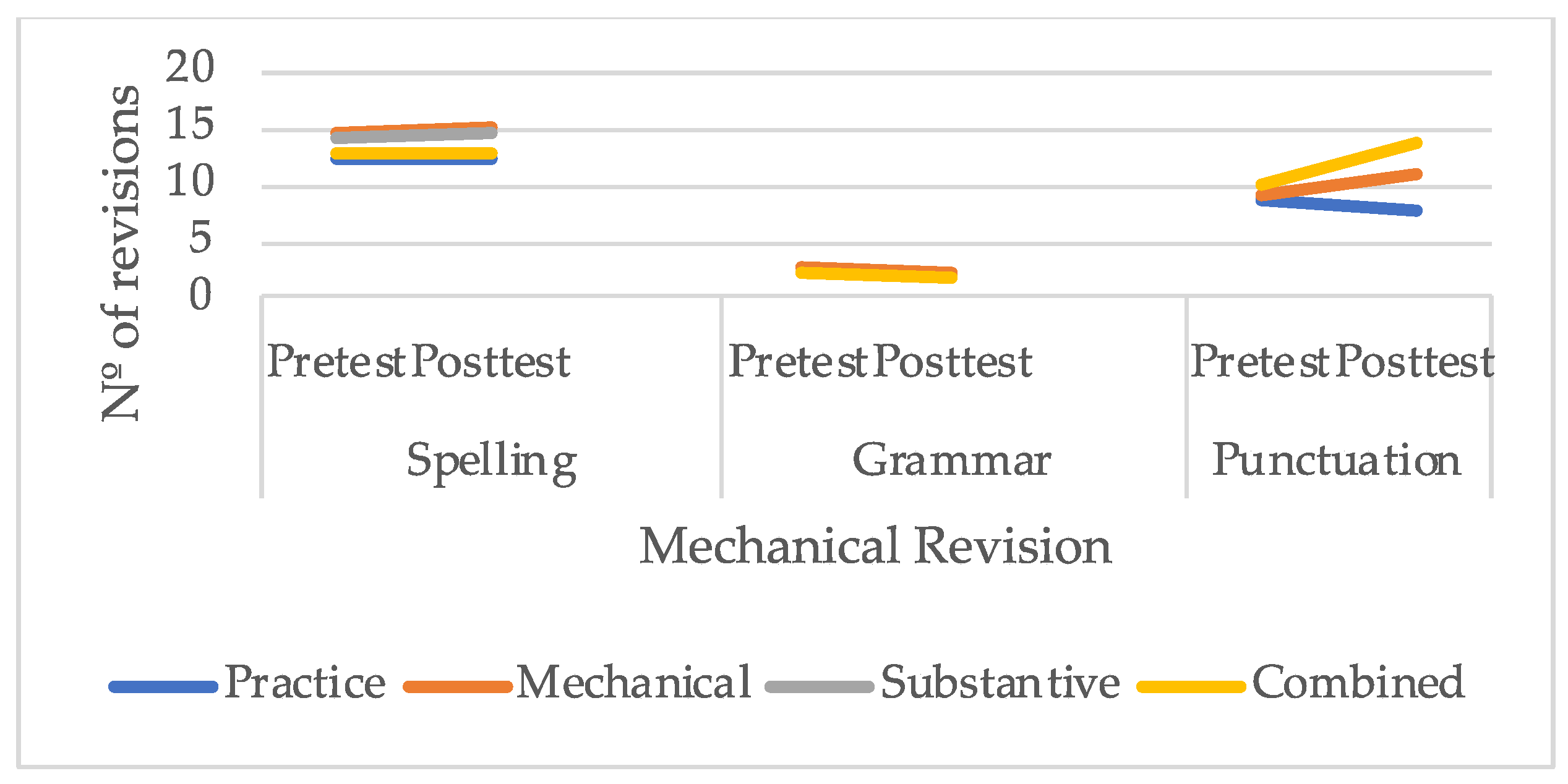
| Spelling | 12.44 (5.84) | 12.22 (6.45) | 14.65 (1.21) | 14.95 (3.35) | 13.90 (4.61) | 14.35 (3.83) | 12.76 (3.69) | 12.62 (3.77) |
| Grammar | 2.17 (0.92) | 2.33 (1.28) | 2.70 (0.86) | 2.20 (1.39) | 2.30 (0.92) | 1.90 (1.16) | 2.19 (0.81) | 1.81 (0.81) |
| Punctuation | 8.61 (4.68) | 7.72 (4.13) | 8.95 (3.00) | 10.90 (4.25) | 9.90 (4.27) | 13.65 (5.76) | 10.24 (5.27) | 13.43 (4.72) |
| Total Mechanical | 23.22 (10.30) | 21.67 (20.41) | 26.30 (5.93) | 24.65 (6.89) | 26.10 (7.67) | 29.50 (8.64) | 25.19 (7.77) | 27.62 (6.09) |
| Variables | Group | Pretest | Posttest | ||
|---|---|---|---|---|---|
| Shapiro–Wilk Test | Levene Test | Shapiro–Wilk Test | Levene Test | ||
| Addition | Practice | W(18) = 0.928, p = 0.132 | W(18) = 0.903, p = 0.072 | ||
| Mechanical | W(20) = 0.955, p = 0.452 | W(20) = 0.941, p = 0.283 | |||
| Substantive | W(20) = 0.945, p = 0.293 | W(20) = 0.910, p = 0.074 | |||
| Combined | W(21) = 0.929, p = 0.137 | W(21) = 0.954, p = 0.397 | |||
| Total | F(3,75) = 1.111, p = 0.324 | F(3,75) = 2.669, p = 0.064 | |||
| Deletion | Practice | W(18) = 0.972, p = 0.837 | W(18) = 0.952, p = 0.463 | ||
| Mechanical | W(20) = 0.975, p = 0.879 | W(20) = 0.917, p = 0.088 | |||
| Substantive | W(20) = 0.976, p = 0.881 | W(20) = 0.911, p = 0.068 | |||
| Combined | W(21) = 0.964, p = 0.603 | W(21) = 0.977, p = 0.883 | |||
| Total | F(3,75) = 0.299, p = 0.826 | F(3,75) = 1.461, p = 0.232 | |||
| Change | Practice | W(18) = 0.929, p = 0.134 | W(18) = 0.915, p = 0.132 | ||
| Mechanical | W(20) = 0.957, p = 0.461 | W(20) = 0.968, p = 0.293 | |||
| Substantive | W(20) = 0.971, p = 0.808 | W(20) = 0.902, p = 0.078 | |||
| Combined | W(21) = 0.946, p = 0.204 | W(21) = 0.948, p = 0.169 | |||
| Total | F(3,75) = 1.096, p = 0.356 | F(3,75) = 0.720, p = 0.543 | |||
| Reorganize | Practice | W(18) = 0.952, p = 0.502 | W(18) = 0.950, p = 0.293 | ||
| Mechanical | W(20) = 0.936, p = 0.372 | W(20) = 0.946, p = 0.258 | |||
| Substantive | W(20) = 0.957, p = 0.456 | W(20) = 0.923, p = 0.208 | |||
| Combined | W(21) = 0.901, p = 0.152 | W(21) = 0.908, p = 0.162 | |||
| Total | F(3,75) = 0.930, p = 0.430 | F(3,75) = 1.437, p = 0.239 | |||
| Total Substantive | Practice | W(18) = 0.926, p = 0.166 | W(18) = 0.907, p = 0.076 | ||
| Mechanical | W(20) = 0.936, p = 0.084 | W(20) = 0.912, p = 0.083 | |||
| Substantive | W(20) = 0.979, p = 0.926 | W(20) = 0.904, p = 0.059 | |||
| Combined | W(21) = 0.916, p = 0.072 | W(21) = 0.963, p = 0.575 | |||
| Total | F(3,75) = 1.075, p = 0.365 | F(3,75) = 0.583, p = 0.628 | |||
| Variables | Pretest | Posttest | ||||
|---|---|---|---|---|---|---|
| 1. | 2. | 3. | 1. | 2. | 3. | |
| 1. Addition | ||||||
| 2. Deletion | 0.450 ** | 0.499 ** | ||||
| 3. Change | −0.142 | −0.168 | 0.399 ** | 0.412 ** | ||
| 4. Reorganize | 0.099 | 0.187 | 0.207 | 0.083 | 0.189 | 0.182 |
| Variables | Practice Rewriting | Mechanical Revision | Substantive Revision | Combined Revision | ||||
|---|---|---|---|---|---|---|---|---|
| M Pre (SD) | M Post (SD) | M Pre (SD) | M Post (SD) | M Pre (SD) | M Post (SD) | M Pre (SD) | M Post (SD) | |
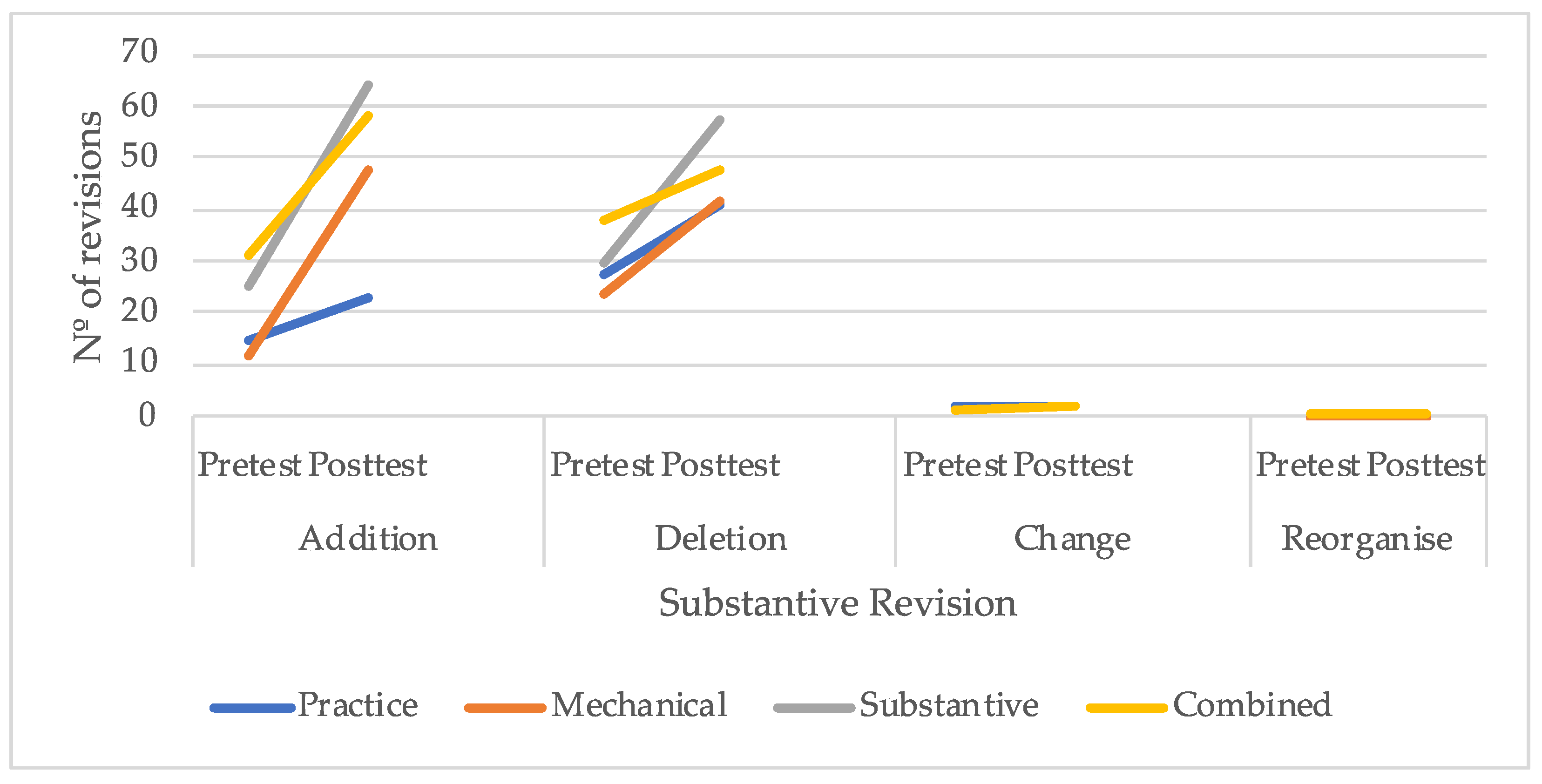
| Additon | 14.50 (14.79) | 22.67 (20.31) | 11.65 (12.76) | 47.90 (43.75) | 25.15 (14.16) | 64.10 (45.36) | 31.00 (26.32) | 58.43 (36.12) |
| Deletion | 27.06 (21.96) | 40.78 (26.25) | 23.35 (19.82) | 41.90 (27.77) | 30.00 (23.62) | 57.20 (18.99) | 37.62 (18.52) | 47.86 (24.34) |
| Change | 1.67 (1.91) | 1.94 (1.47) | 1.25 (1.21) | 1.90 (1.45) | 1.10 (1.45) | 2.20 (1.96) | 1.14 (1.39) | 1.62 (1.53) |
| Reorganize | 0.22 (0.73) | 0.37 (0.91) | 0.10 (0.45) | 0.05 (0.22) | 0.45 (0.83) | 0.45 (0.76) | 0.29 (0.64) | 0.24 (0.54) |
| Total Substantive | 43.33 (32.30) | 66.06 (44.63) | 46.35 (30.56) | 91.75 (67.38) | 56.70 (34.51) | 123.95 (55.54) | 60.05 (40.99) | 108.14 (55.54) |
Disclaimer/Publisher’s Note: The statements, opinions and data contained in all publications are solely those of the individual author(s) and contributor(s) and not of MDPI and/or the editor(s). MDPI and/or the editor(s) disclaim responsibility for any injury to people or property resulting from any ideas, methods, instructions or products referred to in the content. |
© 2026 by the authors. Licensee MDPI, Basel, Switzerland. This article is an open access article distributed under the terms and conditions of the Creative Commons Attribution (CC BY) license.
Share and Cite
Arias-Gundin, O.; Rodríguez, C.; Fidalgo, R. Dynamic Assessment as a Self-Regulation Strategy in the Acquisition of Textual Revision. Behav. Sci. 2026, 16, 123. https://doi.org/10.3390/bs16010123
Arias-Gundin O, Rodríguez C, Fidalgo R. Dynamic Assessment as a Self-Regulation Strategy in the Acquisition of Textual Revision. Behavioral Sciences. 2026; 16(1):123. https://doi.org/10.3390/bs16010123
Chicago/Turabian StyleArias-Gundin, Olga, Celestino Rodríguez, and Raquel Fidalgo. 2026. "Dynamic Assessment as a Self-Regulation Strategy in the Acquisition of Textual Revision" Behavioral Sciences 16, no. 1: 123. https://doi.org/10.3390/bs16010123
APA StyleArias-Gundin, O., Rodríguez, C., & Fidalgo, R. (2026). Dynamic Assessment as a Self-Regulation Strategy in the Acquisition of Textual Revision. Behavioral Sciences, 16(1), 123. https://doi.org/10.3390/bs16010123