Developing Time Management Competencies for First-Year College Students Through Experiential Learning: Design-Based Research


Abstract
1. Introduction
- (1)
- How can experiential learning theory be designed and implemented?
- (2)
- What design principles are valued by the students and why?
- (3)
- What design principles are not valued by the students, and what are the possible ways to improve them?
- (4)
- What are the benefits and limitations of this experiential learning approach?
2. Theoretical Framework for Design
2.1. Time Management
2.2. Experiential Learning
2.3. Integrating Self-Regulation, Time Management, and Technology Support
2.4. Theoretical Assumptions for the Design Phase
3. Methods
3.1. Design-Based Research
3.2. Research Context
3.3. Instructional Process
3.4. Data Collection and Analysis
4. Results
4.1. Iterative Evolution of Time Management Competencies
4.2. First Iteration
4.2.1. Implementation
4.2.2. Instrumentation
4.2.3. Evaluation
4.2.4. Reflection on Principles and Decisions
4.2.5. Revision
4.3. Second Iteration
4.3.1. Implementation
4.3.2. Instrumentation
4.3.3. Evaluation
4.3.4. Reflection on Principles and Decisions
4.3.5. Revision
4.4. Third Iteration
4.4.1. Implementation
4.4.2. Instrumentation
4.4.3. Evaluation
5. Discussion
5.1. Key Findings
5.2. Implications
5.3. Limitations and Future Directions
6. Conclusions
Supplementary Materials
Author Contributions
Funding
Institutional Review Board Statement
Informed Consent Statement
Data Availability Statement
Conflicts of Interest
References
- Abrantes, A. C. M., Passos, A. M., Cunha, M. P. e, & Santos, C. M. (2018). Bringing team improvisation to team adaptation: The combined role of shared temporal cognitions and team learning behaviors fostering team performance. Journal of Business Research, 84, 59–71. [Google Scholar] [CrossRef]
- Aeon, B., Faber, A., & Panaccio, A. (2021). Does time management work? A meta-analysis. PLoS ONE, 16(1), e0245066. [Google Scholar] [CrossRef] [PubMed]
- Arco-Tirado, J. L., Fernández-Martín, F. D., & Fernández-Balboa, J.-M. (2011). The impact of a peer-tutoring program on quality standards in higher education. Higher Education, 62(6), 773–788. [Google Scholar] [CrossRef]
- Arjmandi, M., Woo, M. W., Mankelow, C., Loho, T., Shahbaz, K., Auckaili, A., & Thambyah, A. (2023). Embedding computer programming into a chemical engineering course: The impact on experiential learning. Education for Chemical Engineers, 43, 50–57. [Google Scholar] [CrossRef]
- Banihashem, S. K., Noroozi, O., van Ginkel, S., Macfadyen, L. P., & Biemans, H. J. A. (2022). A systematic review of the role of learning analytics in enhancing feedback practices in higher education. Educational Research Review, 37, 100489. [Google Scholar] [CrossRef]
- Bargmann, C., & Kauffeld, S. (2023). The interplay of time management and academic self-efficacy and their influence on pre-service teachers’ commitment in the first year in higher education. Higher Education, 86(6), 1507–1525. [Google Scholar] [CrossRef]
- Beishuizen, J., & Steffens, K. (2011). A conceptual framework for research on self-regulated learning. In Self-regulated learning in technology enhanced learning environments: A European perspective (pp. 3–19). SensePublishers. [Google Scholar]
- Bhute, V. J., Sengupta, S., Campbell, J., Shah, U. V., Heng, J. Y. Y., & Brechtelsbauer, C. (2022). Effectiveness of a large-scale implementation of hybrid labs for experiential learning at Imperial College London. Education for Chemical Engineers, 39, 58–66. [Google Scholar] [CrossRef]
- Bian, Y., Zhou, C., Liu, J., Geng, W., & Shi, Y. (2022). The effect of reducing distraction on the flow-performance link in virtual experiential learning environment. Virtual Reality, 26(4), 1277–1290. [Google Scholar] [CrossRef]
- Black, S. L., DeGrassi, S. W., & Sweet, K. M. (2021). Multisource feedback as an experiential learning enabler in large-format management classes. Journal of Management Education, 45(3), 479–517. [Google Scholar] [CrossRef]
- Britton, B. K., & Tesser, A. (1991). Effects of time-management practices on college grades. Journal of Educational Psychology, 83(3), 405–410. [Google Scholar] [CrossRef]
- Brown, D. M., Robson, A., & Charity, I. (2020). International Masters’ student perspectives of team business simulations. The International Journal of Management Education, 18(3), 100268. [Google Scholar] [CrossRef]
- Cathro, V. (2020). An odyssey of virtual global team activity in the experiential learning environment of the Global Enterprise Experience (GEE). Computers in Human Behavior, 107, 105760. [Google Scholar] [CrossRef]
- Chen, Y., Daamen, T. A., Heurkens, E. W. T. M., & Verheul, W. J. (2020). Interdisciplinary and experiential learning in urban development management education. International Journal of Technology and Design Education, 30(5), 919–936. [Google Scholar] [CrossRef]
- Cifuentes Gomez, G., Guzmán, P., & Santelices, M. V. (2022). Transitioning to higher education: Students’ expectations and realities. Educational Research, 64(4), 424–439. [Google Scholar] [CrossRef]
- Dobbs-Oates, J. (2022). Quick Tips for Teaching Students How to Reflect. Experiential Learning and Teaching in Higher Education, 3(3), 3. [Google Scholar] [CrossRef]
- Du, J., Liu, L., & Zhao, S. (2025). Empowering students in online learning environments through a self-regulated learning–enhanced learning management system. Behavioral Sciences, 15(8), 1041. [Google Scholar] [CrossRef]
- Duckworth, A. L., Milkman, K. L., & Laibson, D. (2018). Beyond willpower: Strategies for reducing failures of self-control. Psychological Science in the Public Interest, 19(3), 102–129. [Google Scholar] [CrossRef]
- Evans, P., Vansteenkiste, M., Parker, P., Kingsford-Smith, A., & Zhou, S. (2024). Cognitive load theory and its relationships with motivation: A self-determination theory perspective. Educational Psychology Review, 36(1), 7. [Google Scholar] [CrossRef]
- Falloon, G. (2019). Using simulations to teach young students science concepts: An Experiential Learning theoretical analysis. Computers & Education, 135, 138–159. [Google Scholar] [CrossRef]
- Fayaza, M. F., & Ahangama, S. (2024). Systematic review of self-regulated learning with blended learning in digital space. IEEE Access, 12, 143090–143105. [Google Scholar] [CrossRef]
- Festinger, L. (1954). A theory of social comparison processes. Human Relations, 7(2), 117–140. [Google Scholar] [CrossRef]
- Francis, B., Craig, N., Hodgen, J., Taylor, B., Tereshchenko, A., Connolly, P., & Archer, L. (2020). The impact of tracking by attainment on pupil self-confidence over time: Demonstrating the accumulative impact of self-fulfilling prophecy. British Journal of Sociology of Education, 41(5), 626–642. [Google Scholar] [CrossRef]
- Fromm, J., Radianti, J., Wehking, C., Stieglitz, S., Majchrzak, T. A., & vom Brocke, J. (2021). More than experience?—On the unique opportunities of virtual reality to afford a holistic experiential learning cycle. The Internet and Higher Education, 50, 100804. [Google Scholar] [CrossRef]
- Goldman, J., Kuper, A., Baker, G. R., Bulmer, B., Coffey, M., Jeffs, L., Shea, C., Whitehead, C., Shojania, K. G., & Wong, B. (2020). Experiential learning in project-based quality improvement education: Questioning assumptions and identifying future directions. Academic Medicine, 95(11), 1745–1754. [Google Scholar] [CrossRef] [PubMed]
- Gore, P., & Metz, A. J. (2017). Promoting successful student transition: First-year experience programs. In J. C. Shin, & P. Teixeira (Eds.), Encyclopedia of International Higher Education Systems and Institutions (pp. 1–6). Springer Netherlands. [Google Scholar] [CrossRef]
- Groves, M., Leflay, K., Smith, J., Bowd, B., & Barber, A. (2013). Encouraging the development of higher-level study skills using an experiential learning framework. Teaching in Higher Education, 18(5), 545–556. [Google Scholar] [CrossRef]
- Hailikari, T., Katajavuori, N., & Asikainen, H. (2021). Understanding procrastination: A case of a study skills course. Social Psychology of Education, 24(2), 589–606. [Google Scholar] [CrossRef]
- Häfner, A., Stock, A., Pinneker, L., & Ströhle, S. (2014). Stress prevention through a time management training intervention: An experimental study. Educational Psychology, 34(3), 403–416. [Google Scholar] [CrossRef]
- Hsu, C.-Y., Horikoshi, I., Li, H., Majumdar, R., & Ogata, H. (2023). Supporting “time awareness” in self-regulated learning: How do students allocate time during exam preparation? Smart Learning Environments, 10(1), 21. [Google Scholar] [CrossRef]
- Illich, I. (1971). Deschooling society. Harper & Row. [Google Scholar]
- Jacob, S. A., & Boyter, A. C. (2023). “Having students is entirely necessary”: Tutors’ feedback of experiential learning in an MPharm programme (TELL Project). Studies in Educational Evaluation, 76, 101234. [Google Scholar] [CrossRef]
- Jin, Y., & Sercu, L. (2025). Approaches to researching intercultural competence in higher education: A review of the literature (2018–2022) as a platform for improving the design of future studies on technology-supported interventions. Review of Educational Research, 8(1). [Google Scholar] [CrossRef]
- Jonathan, L. Y., & Laik, M. N. (2024). Using experiential learning theory to improve teaching and learning in higher education. European Journal of Education, 7(2), 18–33. [Google Scholar] [CrossRef]
- Joplin, L. (1981). On defining experiential education. Journal of Experiential Education, 4(1), 17–20. [Google Scholar] [CrossRef]
- Kahu, E. R., & Picton, C. (2022). Using photo elicitation to understand first-year student experiences: Student metaphors of life, university and learning. Active Learning in Higher Education, 23(1), 35–47. [Google Scholar] [CrossRef]
- Khiat, H. (2022). Using automated time management enablers to improve self-regulated learning. Active Learning in Higher Education, 23(1), 3–15. [Google Scholar] [CrossRef]
- Kolb, A. Y., & Kolb, D. A. (2009). Experiential learning theory: A dynamic, holistic approach to management learning, education and development. In S. J. Armstrong, & C. V. Fukami (Eds.), The SAGE Handbook of Management Learning, Education and Development (pp. 42–68). SAGE Publications Ltd. [Google Scholar] [CrossRef]
- Kolb, D. A. (1984). Experiential learning—Experience as the source of learning and development (2nd ed.). Prentice-Hall. [Google Scholar]
- Kukulska-Hulme, A. (2021). Reflections on research questions in mobile assisted language learning. Journal of China Computer-Assisted Language Learning, 1(1), 28–46. [Google Scholar] [CrossRef]
- Kutija, L., & Skrbinjek, V. (2024). Understanding student dropout: Why students choose their studies and why they leave. In Proceedings of the MakeLearn 2024 International Conference: Artificial Intelligence for Human-Technologies-Economy Sustainable Development (pp. 605–613). ToKnowPress. [Google Scholar]
- Kuzilek, J., Zdrahal, Z., Vaclavek, J., Fuglik, V., Skocilas, J., & Wolff, A. (2023). First-year engineering students’ strategies for taking exams. International Journal of Artificial Intelligence in Education, 33(3), 583–608. [Google Scholar] [CrossRef]
- Kwon, C. (2021). A study on the verification of the effect of sensory extension through cutaneous sensation on experiential learning using VR. Virtual Reality, 25(1), 19–30. [Google Scholar] [CrossRef]
- Leal-Rodríguez, A. L., & Albort-Morant, G. (2019). Promoting innovative experiential learning practices to improve academic performance: Empirical evidence from a Spanish Business School. Journal of Innovation & Knowledge, 4(2), 97–103. [Google Scholar] [CrossRef]
- Lehmann, T., Hähnlein, I., & Ifenthaler, D. (2014). Cognitive, metacognitive and motivational perspectives on preflection in self-regulated online learning. Computers in Human Behavior, 32, 313–323. [Google Scholar] [CrossRef]
- Lim, L., Bannert, M., van der Graaf, J., Singh, S., Fan, Y., Surendrannair, S., Rakovic, M., Molenaar, I., Moore, J., & Gašević, D. (2023). Effects of real-time analytics-based personalized scaffolds on students’ self-regulated learning. Computers in Human Behavior, 139, 107547. [Google Scholar] [CrossRef]
- Liu, Q., Ma, J., Yu, S., Wang, Q., & Xu, S. (2022). Effects of an augmented reality-based chemistry experiential application on student knowledge gains, learning motivation, and technology perception. Journal of Science Education and Technology, 32(2), 153–167. [Google Scholar] [CrossRef]
- Macan, T. H., Shahani, C., Dipboye, R. L., & Phillips, A. P. (1990). College students’ time management: Correlations with academic performance and stress. Journal of Educational Psychology, 82(4), 760–768. [Google Scholar] [CrossRef]
- Matcha, W., Uzir, N. A. A., Gašević, D., & Pardo, A. (2019). A systematic review of empirical studies on learning analytics dashboards: A self-regulated learning perspective. IEEE Transactions on Learning Technologies, 13(2), 226–245. [Google Scholar] [CrossRef]
- Motta, V. F., & Galina, S. V. R. (2023). Experiential learning in entrepreneurship education: A systematic literature review. Teaching and Teacher Education, 121, 103919. [Google Scholar] [CrossRef]
- Nenzhelele, T. E. (2014). Employability through experiential learning course in open distance learning institution. Mediterranean Journal of Social Sciences, 5(20), 1602–1612. [Google Scholar] [CrossRef]
- Panadero, E. (2017). A review of self-regulated learning: Six models and four directions for research. Frontiers in Psychology, 8, 422. [Google Scholar] [CrossRef]
- Park, M., Jeong, M., Lee, M., & Cullen, L. (2020). Web-based experiential learning strategies to enhance the evidence-based-practice competence of undergraduate nursing students. Nurse Education Today, 91, 104466. [Google Scholar] [CrossRef]
- Paulsen, L., & Lindsay, E. (2024). Learning analytics dashboards are increasingly becoming about learning and not just analytics—A systematic review. Education and Information Technologies, 29(11), 14279–14308. [Google Scholar] [CrossRef]
- Perusso, A., Blankesteijn, M., & Leal, R. (2020). The contribution of reflective learning to experiential learning in business education. Assessment & Evaluation in Higher Education, 45(7), 1001–1015. [Google Scholar] [CrossRef]
- Pintrich, P. R. (2000). The role of goal orientation in self-regulated learning. In Handbook of self-regulation. Academic Press. [Google Scholar]
- Podolskiy, A. I. (2014). “There is nothing so practical as a good theory”: How to let it work in practice (the case of galperin’s theory). Psychology in Russia: State of the Art, 7(3), 4–12. [Google Scholar] [CrossRef]
- Qudrat-Ullah, H. (2010). Perceptions of the effectiveness of system dynamics-based interactive learning environments: An empirical study. Computers & Education, 55(3), 1277–1286. [Google Scholar] [CrossRef]
- Ribeiro, L., Rosário, P., Núñez, J. C., Gaeta, M., & Fuentes, S. (2019). First-year students background and academic achievement: The mediating role of student engagement. Frontiers in Psychology, 10, 2669. [Google Scholar] [CrossRef]
- Richardson, J. T. (2011). Eta squared and partial eta squared as measures of effect size in educational research. Educational Research Review, 6(2), 135–147. [Google Scholar] [CrossRef]
- Rigopouli, K., Kotsifakos, D., & Psaromiligkos, Y. (2025). Vygotsky’s creativity options and ideas in 21st-century technology-enhanced learning design. Education Sciences, 15(2), 257. [Google Scholar] [CrossRef]
- Scarparolo, G., & Mayne, F. (2022). Mixed-reality simulations as a tool to enhance parent-teacher conferencing in initial teacher education. Australasian Journal of Educational Technology, 72–86. [Google Scholar] [CrossRef]
- Shaunessy-Dedrick, E., Suldo, S. M., Roth, R. A., & Fefer, S. A. (2015). Students’ perceptions of factors that contribute to risk and success in accelerated high school courses. The High School Journal, 98(2), 109–137. [Google Scholar] [CrossRef]
- Simón-Grábalos, D., Fonseca, D., Aláez, M., Romero-Yesa, S., & Fresneda-Portillo, C. (2025). Systematic review of the literature on interventions to improve self-regulation of learning in first-year university students. Education Sciences, 15(3), 372. [Google Scholar] [CrossRef]
- Sotardi, V., & Dutton, H. (2022). First-year university students’ authentic experiences with evaluation anxiety and their attitudes toward assessment. Assessment & Evaluation in Higher Education, 47(8), 1317–1329. [Google Scholar] [CrossRef]
- Spector, J. M., Merrill, M. D., Elen, J., & Bishop, M. J. (Eds.). (2014). Handbook of research on educational communications and technology. Springer New York. [Google Scholar] [CrossRef]
- Steinert, Y., Mann, K., Anderson, B., Barnett, B. M., Centeno, A., Naismith, L., Prideaux, D., Spencer, J., Tullo, E., Viggiano, T., Ward, H., & Dolmans, D. (2016). A systematic review of faculty development initiatives designed to enhance teaching effectiveness: A 10-year update: BEME Guide No. 40. Medical Teacher, 38(8), 769–786. [Google Scholar] [CrossRef]
- Taneja, M., Kiran, R., & Bose, S. C. (2023). Understanding the relevance of experiential learning for entrepreneurial self-efficacy: A gender-wise perspective. International Journal of Management Education, 21(1), 100760. [Google Scholar] [CrossRef]
- Tao, X., & Hanif, H. (2025). The effects of self-regulated learning strategies on academic procrastination and academic success among college EFL students in China. Frontiers in Psychology, 16, 1562980. [Google Scholar] [CrossRef]
- Tembrevilla, G., Phillion, A., & Zeadin, M. (2024). Experiential learning in engineering education: A systematic literature review. Journal of Engineering Education, 113(1), 195–218. [Google Scholar] [CrossRef]
- Trentepohl, S., Waldeyer, J., Fleischer, J., Roelle, J., Leutner, D., & Wirth, J. (2022). How did it get so late so soon? The effects of time management knowledge and practice on students’ time management skills and academic performance. Sustainability, 14(9), 5097. [Google Scholar] [CrossRef]
- Valovirta, E., & Mannevuo, M. (2022). Affective academic time management in the neoliberal university: From timeliness to timelessness. European Journal of Cultural Studies, 25(5), 1307–1323. [Google Scholar] [CrossRef]
- Van Sluijs, M., & Matzat, U. (2023). Predicting time-management skills from learning analytics. Journal of Computer Assisted Learning, 40(2), 525–537. [Google Scholar] [CrossRef]
- Wolters, C. A., & Brady, A. C. (2021). College students’ time management: A self-regulated learning perspective. Educational Psychology Review, 33(4), 1319–1351. [Google Scholar] [CrossRef]
- Won, S., Wolters, C. A., Brady, A. C., & Hensley, L. C. (2025). Grit and self-regulated learning: Evaluating achievement goals as mediators. Social Psychology of Education, 28(1), 57. [Google Scholar] [CrossRef]
- Xavier, M., & Meneses, J. (2022). Persistence and time challenges in an open online university: A case study of the experiences of first-year learners. International Journal of Educational Technology in Higher Education, 19(1), 31. [Google Scholar] [CrossRef]
- Xie, J., Liu, M., Ding, S., Zhuqing, Z., Zeng, S., Liu, A., Zhou, J., Wang, S., & Cheng, A. S. K. (2020). Time management disposition and related factors among nursing managers in China: A cross-sectional study. Journal of Nursing Management, 28(1), 63–71. [Google Scholar] [CrossRef]
- Xu, Z., Zhao, Y., Liew, J., Zhou, X., & Kogut, A. (2023). Synthesizing research evidence on self-regulated learning and academic achievement in online and blended learning environments: A scoping review. Educational Research Review, 39, 100510. [Google Scholar] [CrossRef]
- Zimmerman, B. J. (2002). Becoming a self-regulated learner: An overview. Theory into Practice, 41(2), 64–70. [Google Scholar] [CrossRef]
- Zimmerman, B. J. (2013). From cognitive modeling to self-regulation: A social cognitive career path. Educational Psychologist, 48(3), 135–147. [Google Scholar] [CrossRef]


| Theoretical Dimension | Design Principles | Design Decisions | Supporting Literature |
|---|---|---|---|
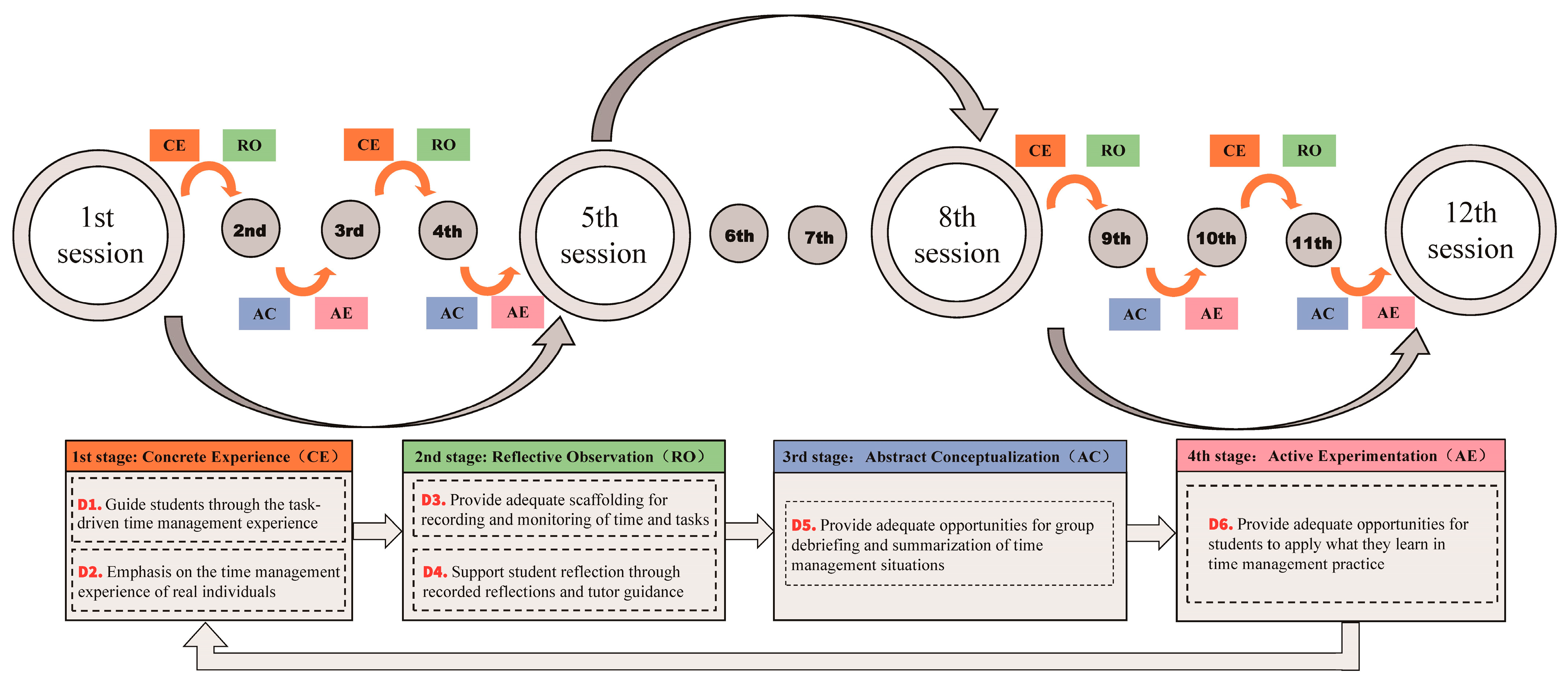
| Concrete Experience | D1. Guide students through the task-driven time management experience | Enforce students’ time management by assigning tasks that integrate the tasks into their daily lives as much as possible | (Joplin, 1981; Qudrat-Ullah, 2010) |
| D2. Emphasis on the time management experience of real individuals | Emphasize the real individual experience so students can record, analyze, reflect, and adjust based on their own personal lives | (Illich, 1971; Kwon, 2021) | |
| Reflective Observation | D3. Provide adequate scaffolding for recording and monitoring of time and tasks | Provide students with templates and framework guides for planning, documenting, and reflecting in the context of research as well as for real-world problems | (Cathro, 2020) |
| D4. Support student reflection through recorded reflections and tutor guidance | Help individual students to reflect based on real-world feedback; the instructor provides guidance and feedback before the second session of the assignment based on specific examples of students’ out-of-class time management performance and the class activities | (Black et al., 2021; Steinert et al., 2016) | |
| Abstract Conceptualization | D5. Provide adequate opportunities for group debriefing and summarization of time management situations | Provide voluntary or mandatory ways to guide students to conduct in-class debriefing presentations and summary reflections to share with their classmates during stage time | (Chen et al., 2020; Park et al., 2020) |
| Active Experimentation | D6. Provide adequate opportunities for students to apply what they learn in time management practice | Provide students with the opportunity to practice in two stages: the first stage is for free exploration stage, after reflecting and summarizing; in the second stage, student learning and feelings are applied again in practice | (Fromm et al., 2021; Leal-Rodríguez & Albort-Morant, 2019) |
| Iteration | Data Collection Format | Tool | Key Characteristics | Data Type |
|---|---|---|---|---|
| 1st iteration | Spreadsheet-based record | Excel | Manual daily entry; end-of-day self-report | Daily self-reported duration and ratings |
| 2nd iteration | Online daily questionnaire | Sojump | Structured daily self-report; fixed items | Daily self-reported ordinal ratings |
| 3rd iteration | Mobile daily check-in tool | Mini-program | Mobile-based daily self-report; real-time entry and feedback | Daily self-reported records and ratings |
| Grade | First Iteration | Second Iteration | Third Iteration | H | p | η2 | |
|---|---|---|---|---|---|---|---|
| Days of recording | Median | 19 | 12 | 28 | 124.564 | 0.000 | 0.447 |
| Mean | 18 | 16 | 27 | ||||
| Total planned | Median | 38 | 17 | 58 | 55.676 | 0.000 | 0.215 |
| Mean | 42 | 21 | 68 | ||||
| Total completed | Median | 32 | 19 | 66 | 752.587 | 0.000 | 0.207 |
| Mean | 40 | 22 | 69 | ||||
| Completed category count | Median | 5 | 6 | 6 | 4.659 | 0.097 | 0.021 |
| Mean | 5 | 6 | 6 | ||||
| Planned completion rate | Median | 0.82 | 0.81 | 0.73 | 14.540 | 0.000 | 0.059 |
| Mean | 0.88 | 0.82 | 0.66 | ||||
| Daily independent learning time (min) | Median | 207.17 | 81.85 | 103.35 | 70.705 | 0.000 | 0.269 |
| Mean | 224.48 | 95.84 | 126.43 | ||||
| Daily extracurricular time (min) | Median | 40.60 | 52.37 | 88.50 | 14.497 | 0.000 | 0.139 |
| Mean | 54.93 | 57.08 | 140.48 | ||||
| Daily self-evaluation scores | Median | 2.21 | 3.92 | 3.63 | 100.211 | 0.000 | 0.421 |
| Mean | 2.34 | 3.85 | 3.53 | ||||
| Category | Measured Variables | Instruments |
|---|---|---|
| Classroom observation (video and field notes) | Participation in experiential learning activities; Reported time management situation; Teacher feedback | rear-mounted cameras in the smart classroom and researchers |
| Student daily records | Task planning; Task execution; Self-assessment | scaffolds embedded in experiential learning activities (Excel) |
| Semi-structured interviews | Learning experience; Perceived changes in time management ability | Interview outline in the Supplementary Materials |
| Baseline questionnaire | Demographics; Prior time management experience | Questionnaire in the Supplementary Materials |
| Dimension | Design Principles | Pros | Cons |
|---|---|---|---|
| Concrete Experience | D1.Guide students through the task-driven time management experience | a. External motivation for change b. Increase social presence | a. Awaken negative emotions |
| D2. Emphasis on the time management experience of real individuals | a. Enhance personal engagement b. Integrate theory with practice c. Clear self-awareness | a. Privacy disclosure | |
| Reflective Observation | D3. Provide adequate scaffolding for recording and monitoring of time and tasks | a. Guide recording and monitoring b. Facilitate reflection and adjustment c. Quantify issues via time data d. Clear self-awareness e. Negative mood improvement | a. Time-consuming and burdensome b. Repetitive and tedious recording c. Privacy disclosure |
| D4. Support student reflection through recorded reflections and tutor guidance | a. Inspire introspection b. Method guidance c. Ameliorate learned helplessness | a. Much labor, little gain b. Delaying feedback c. Lacking targeted guidance | |
| Abstract Conceptualization | D5. Provide adequate opportunities for group debriefing and summarization of time management situations | a. Enhance decision-making quality b. Mutual supervision | a. Peer inactivity reduces effort b. Privacy leakage |
| Active Experimentation | D6. Provide adequate opportunities for students to apply what they learn in time management practice | a. Mitigate reluctance to mandatory tasks b. bolster intrinsic motivation c. Enhancing Self-Perception of Time | a. Limited impact on change |
| Design Principles | Major Revision in Design Decisions | Pros | Cons |
|---|---|---|---|
| D3. Provide appropriate online scaffolding for time recording and monitoring | Sojump (online link) to fill in | a. Simple and quick b. Balancing privacy and transparency c. Charting the path to improvement d. Reflecting on plans and contingencies e. Fostering emotional literacy | a. Personalization constrained b. Inconvenient to click and save c. Lost online inputs |
| D4. Support student reflection through feedback and tutor guidance | Data analysis table (teacher assistant) | a. Inspire introspection b. Method guidance c. Ameliorate learned helplessness | a. Much labor, little gain b. Delaying feedback c. Lacking targeted guidance |
| D5. Provide data support and autonomy for team summarization and reporting | Summary based on data discussion | a. Enhance decision-making quality b. Mutual supervision | a. Peer inactivity reduces effort b. Privacy leakage |
| Theoretical Dimension | Design Principles | Design Decisions |
|---|---|---|
| Concrete Experience | D1. Guide students through the task-driven time management experience | Enforce students’ management of their time by assigning tasks that they can integrate into their daily lives as much as possible |
| D2. Emphasis on the time management experience of real individuals | Emphasize real individual experience, so students can manage their time based on their own personal lives and habits. | |
| Reflective Observation | D3. Provide a task-categorization scaffold that enables students to plan, monitor, and evaluate their tasks systematically | Provide students with portable, instructional, privacy-sensitive formwork, and scaffolding |
| D4. Support student reflection through visual feedback and tutor guidance | Feedback-guided reflection based on real data, automated feedback from teachers, and technology | |
| Abstract Conceptualization | D5. Comparative analysis of individual situations and planning for improvement | Provide voluntary or mandatory means for students to report and reflect on their personal time management and share it with their classmates |
| Active Experimentation | D6. Provide adequate opportunities for students to apply what they learn in time management practice | Provide students with the opportunity to practice in two stages: the first stage is for free exploration; after reflecting and summarizing, students’ learning and feelings are applied again in practice in the second stage |
Disclaimer/Publisher’s Note: The statements, opinions and data contained in all publications are solely those of the individual author(s) and contributor(s) and not of MDPI and/or the editor(s). MDPI and/or the editor(s) disclaim responsibility for any injury to people or property resulting from any ideas, methods, instructions or products referred to in the content. |
© 2025 by the authors. Licensee MDPI, Basel, Switzerland. This article is an open access article distributed under the terms and conditions of the Creative Commons Attribution (CC BY) license.
Share and Cite
Wang, K.; Zuo, M.; Zhou, X.; Wang, Y.; Tang, P.; Luo, H. Developing Time Management Competencies for First-Year College Students Through Experiential Learning: Design-Based Research. Behav. Sci. 2026, 16, 27. https://doi.org/10.3390/bs16010027
Wang K, Zuo M, Zhou X, Wang Y, Tang P, Luo H. Developing Time Management Competencies for First-Year College Students Through Experiential Learning: Design-Based Research. Behavioral Sciences. 2026; 16(1):27. https://doi.org/10.3390/bs16010027
Chicago/Turabian StyleWang, Kunyu, Mingzhang Zuo, Xiaotang Zhou, Yunhan Wang, Pengxuan Tang, and Heng Luo. 2026. "Developing Time Management Competencies for First-Year College Students Through Experiential Learning: Design-Based Research" Behavioral Sciences 16, no. 1: 27. https://doi.org/10.3390/bs16010027
APA StyleWang, K., Zuo, M., Zhou, X., Wang, Y., Tang, P., & Luo, H. (2026). Developing Time Management Competencies for First-Year College Students Through Experiential Learning: Design-Based Research. Behavioral Sciences, 16(1), 27. https://doi.org/10.3390/bs16010027