Mutual Influence of Parental Depression and Parenting: An Actor–Partner Interdependence Analysis Based on Chinese Families with Adolescent Twins


Abstract
1. Introduction
2. Method
2.1. Participants and Procedure
2.2. Measures
2.2.1. Parenting Behaviors
2.2.2. Depression Scale (CESD)
2.3. Data Analysis
2.4. Common Method Deviation
3. Results
3.1. Descriptive Statistics and Correlation Analysis
3.2. Dyadic Patterns Between Depression and Parenting
4. Discussion
5. Practical Implications and Suggestions for Future Research
6. Conclusions
Supplementary Materials
Author Contributions
Funding
Institutional Review Board Statement
Informed Consent Statement
Data Availability Statement
Acknowledgments
Conflicts of Interest
References
- Brenning, K., Soenens, B., Braet, C., & Bal, S. (2012). The role of parenting and mother-adolescent attachment in the intergenerational similarity of internalizing symptoms. Journal of Youth and Adolescence, 41(6), 802–816. [Google Scholar] [CrossRef]
- Brody, G. H., Conger, R., Gibbons, F. X., Ge, X., McBride Murry, V., Gerrard, M., & Simons, R. L. (2001). The influence of neighborhood disadvantage, collective socialization, and parenting on African American children’s affiliation with deviant peers. Child Development, 72(4), 1231–1246. [Google Scholar] [CrossRef]
- Chen, J., Li, X., Zhang, J., Natsuaki, M. N., Leve, L. D., Harold, G. T., Chen, Z., Yang, X., Guo, F., Zhang, J., & Ge, X. (2013). The Beijing Twin Study (BeTwiSt): A longitudinal study of child and adolescent development—Corrigendum. Twin Research and Human Genetics, 16(1), 502. [Google Scholar] [CrossRef]
- Chen, J., Yu, J., & Zhang, J. (2016). Investigating unique environmental influences of parenting practices on youth anxiety: A monozygotic twin differences study. International Journal of Behavioral Development, 40(3), 205–212. [Google Scholar] [CrossRef]
- Chen, J., Zhou, X., & Bai, X. (2024). Associations between parents’ and grandparents’ depressive symptoms, intergenerational coparenting relationships, and (grand)parenting behaviors: An actor–partner interdependence mediation model. Family Process, 63(3), 1409–1428. [Google Scholar] [CrossRef] [PubMed]
- Cheung, K., & Theule, J. (2019). Paternal depressive symptoms and parenting behaviors: An updated meta-analysis. Journal of Child and Family Studies, 28(3), 613–626. [Google Scholar] [CrossRef]
- Cox, M. J., & Paley, B. (2003). Understanding families as systems. Current Directions in Psychological Science, 12(5), 193–196. [Google Scholar] [CrossRef]
- Davies, P. T., Sturge-Apple, M. L., Woitach, M. J., & Cummings, E. M. (2009). A process analysis of the transmission of distress from interparental conflict to parenting: Adult relationship security as an explanatory mechanism. Developmental Psychology, 45, 1761–1773. [Google Scholar] [CrossRef] [PubMed]
- Frost, A., Scherer, E., Chung, E. O., Gallis, J. A., Sanborn, K., Zhou, Y., Hagaman, A., LeMasters, K., Sikander, S., Turner, E., & Maselko, J. (2025). Longitudinal pathways between maternal depression, parenting behaviors, and early childhood development: A mediation analysis. International Journal of Behavioral Development, 49(3), 263–276. [Google Scholar] [CrossRef]
- Goodman, S. H., Simon, H. F. M., Shamblaw, A. L., & Kim, C. Y. (2020). Parenting as a mediator of associations between depression in mothers and children’s functioning: A systematic review and meta-analysis. Clinical Child and Family Psychology Review, 23(4), 427–460. [Google Scholar] [CrossRef]
- Jiang, N., Xu, J., Li, X., Wang, Y., Zhuang, L., & Qin, S. (2021). Negative parenting affects adolescent internalizing symptoms through alterations in amygdala-prefrontal circuitry: A longitudinal twin study. Biological Psychiatry, 89(6), 560–569. [Google Scholar] [CrossRef]
- Jiang, Q., Liu, P., Qin, Y., Zhao, Z., Bing, Y., Sun, J., Dai, Z., Qian, Y., & Yuan, L. (2024). Relationship between positive parenting and adolescents’ depressive symptoms: Evidence from a Chinese research survey. International Journal of Social Psychiatry, 70(2), 378–387. [Google Scholar] [CrossRef]
- Jocson, R. M. (2021). A dyadic analysis of depressive symptoms, harsh parenting, and rejection in filipino mothers and fathers. Family Process, 60(2), 556–569. [Google Scholar] [CrossRef]
- Karnilowicz, H. R., Waters, S. F., & Mendes, W. B. (2019). Not in front of the kids: Effects of parental suppression on socialization behaviors during cooperative parent–child interactions. Emotion, 19(7), 1183–1191. [Google Scholar] [CrossRef]
- Kelley, M. L., Lawrence, H. R., Milletich, R. J., Hollis, B. F., & Henson, J. M. (2015). Modeling risk for child abuse and harsh parenting in families with depressed and substance-abusing parents. Child Abuse & Neglect, 43, 42–52. [Google Scholar] [CrossRef] [PubMed]
- Kenny, D. A., Kashy, D. A., & Cook, W. L. (2006). Dyadic data analysis. Guilford. [Google Scholar] [CrossRef]
- Kenny, D. A., & Ledermann, T. (2010). Detecting, measuring, and testing dyadic patterns in the actor-partner interdependence model. Journal of Family Psychology, 24(3), 359–366. [Google Scholar] [CrossRef] [PubMed]
- Li, X. (2021). How do Chinese fathers express love? Viewing paternal warmth through the eyes of Chinese fathers, mothers, and their children. Psychology of Men & Masculinities, 22(3), 500–511. [Google Scholar] [CrossRef]
- Liu, C., & Wu, X. (2017). Dyadic patterns in the actor-partner interdependence model and its testing. Psychological Development and Education, 33(1), 105–112. [Google Scholar] [CrossRef]
- Luo, X., Wang, H., Xu, J., Liu, H., Suveg, C., & Han, Z. R. (2025). Dynamic processes of parent–adolescent conflict and warmth in Chinese families: Differences between mothers and fathers. Journal of Youth and Adolescence, 54(8), 1985–1998. [Google Scholar] [CrossRef] [PubMed]
- Parker. (1990). The parental bonding instrument. Psychiatric Epidemiology, 25, 281–282. [Google Scholar] [CrossRef]
- Pedro, M. F., Ribeiro, T., & Shelton, K. H. (2012). Marital satisfaction and partners’ parenting practices: The mediating role of coparenting behavior. Journal of Family Psychology, 26, 509–522. [Google Scholar] [CrossRef]
- Radloff, L. S. (1977). The CES-D scale: A self-report depression scale for research in the generalpopulation. Applied Psychological Measures, 1, 385–401. [Google Scholar] [CrossRef]
- Rubin, M., & Kelly, B. M. (2015). A cross-sectional investigation of parenting style and friendship as mediators of the relation between social class and mental health in a university community. International Journal for Equity in Health, 14(1), 87. [Google Scholar] [CrossRef] [PubMed]
- Wang, L., Xian, Y., Dill, S.-E., Fang, Z., Emmers, D., Zhang, S., & Rozelle, S. (2022). Parenting style and the cognitive development of preschool-aged children: Evidence from rural China. Journal of Experimental Child Psychology, 223, 105490. [Google Scholar] [CrossRef] [PubMed]
- Wang, X., & Chi, C. (2025). Father involvement and children’s developmental outcomes: A systematic review of the literature on Chinese population. International Journal of Social Science and Humanity, 15(1), 27–36. [Google Scholar] [CrossRef]
- Wilson, S., & Durbin, C. E. (2010). Effects of paternal depression on fathers’ parenting behaviors: A meta-analytic review. Clinical Psychology Review, 30(2), 167–180. [Google Scholar] [CrossRef] [PubMed]
- Woods, A. D., Gerasimova, D., Van Dusen, B., Nissen, J., Bainter, S., Uzdavines, A., Davis-Kean, P. E., Halvorson, M., King, K. M., Logan, J. A. R., Xu, M., Vasilev, M. R., Clay, J. M., Moreau, D., Joyal-Desmarais, K., Cruz, R. A., Brown, D. M. Y., Schmidt, K., & Elsherif, M. M. (2024). Best practices for addressing missing data through multiple imputation. Infant and Child Development, 33(1), e2407. [Google Scholar] [CrossRef]
- Xu, Q. (2021). The impact of women’s educational attainment on parenting division of labor: An empirical study based on the third survey of Chinese women’s social status. Journal of Chinese Women’s Studies, 30(6), 58–71. [Google Scholar]
- Zhou, H., & Long, L. (2004). Statistical testing and control methods for common method bias. Advances in Psychological Science, 12(6), 942–950. [Google Scholar]



| Sample | Dimension | M ± SD | CF-W | CF-H | CM-W | CM-H | F-W | F-H | M-W | M-H |
|---|---|---|---|---|---|---|---|---|---|---|
| 1 | Paternal Depression | −0.619 ± 0.856 | −0.188 ** | 0.119 ** | −0.156 ** | 0.110 ** | −0.313 ** | 0.246 ** | −0.199 ** | 0.173 ** |
| Maternal Depression | −0.423 ± 0.886 | −0.127 ** | 0.110 ** | −0.177 ** | 0.151 ** | −0.207 ** | 0.167 ** | −0.325 ** | 0.300 ** | |
| 2 | Paternal Depression | −0.619 ± 0.856 | −0.184 ** | 0.150 ** | −0.147 ** | 0.134 ** | −0.262 ** | 0.213 ** | −0.182 ** | 0.127 ** |
| Maternal Depression | −0.423 ± 0.886 | −0.120 ** | 0.107 ** | −0.178 ** | 0.154 ** | −0.200 ** | 0.164 ** | −0.302 ** | 0.239 ** |
| Variable | a1 | a2 | p12 | p21 | Saturated Model | Equality Model | Model with Ghost Variables | p12 = p21 | Mode | ||||||||
|---|---|---|---|---|---|---|---|---|---|---|---|---|---|---|---|---|---|
| χ2/df | RMSEA | CFI | NFI | χ2/df | p | k1 (95%CI) | k2 (95%CI) | χ2/df | p | χ2/df | p | ||||||
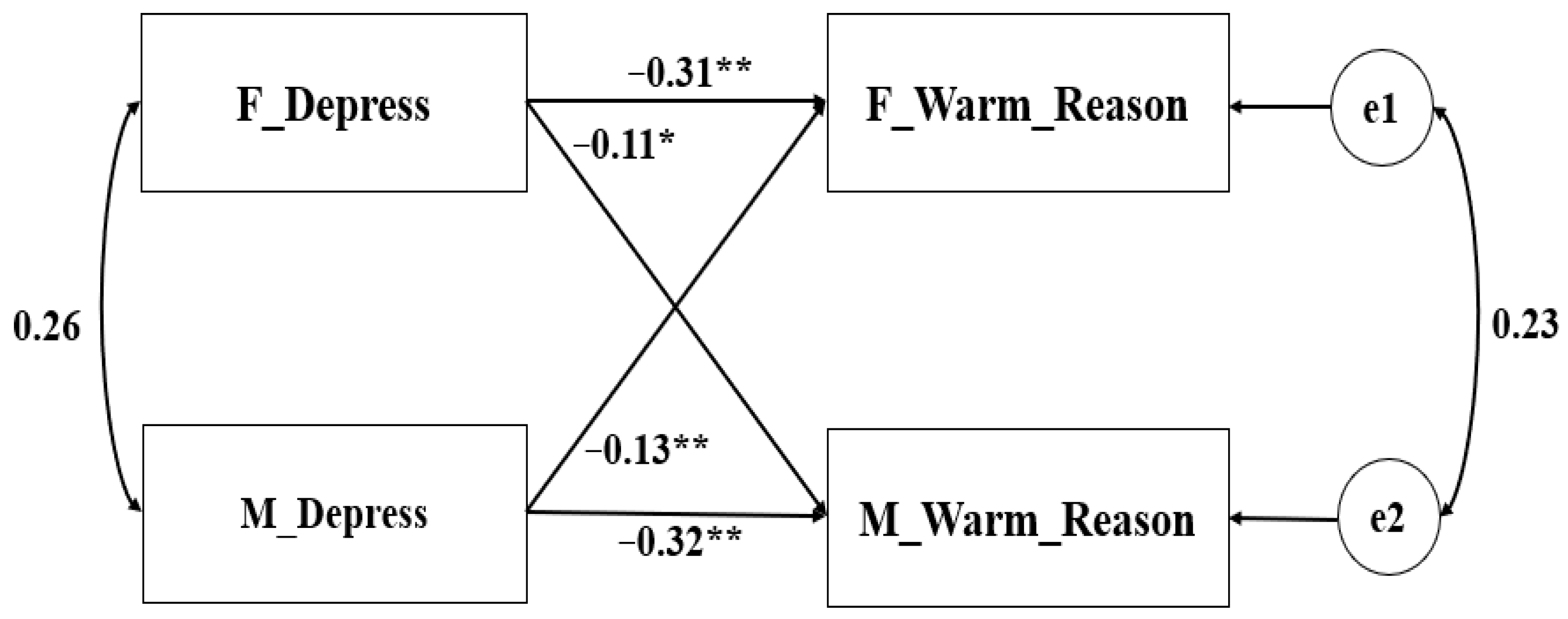
| P-W | −0.31 ** (−0.27 **) | −0.32 ** (−0.29 **) | −0.13 ** (−0.12 **) | −0.11 ** (−0.09 *) | 1.855 | 0.025 | 0.993 | 0.986 | 0.097 | 0.908 | 0.404 [0.200, 0.702] | 0.332 [0.128, 0.611] | 0.011 | 1.000 | 0.096 | 0.962 | Mixed Mode |
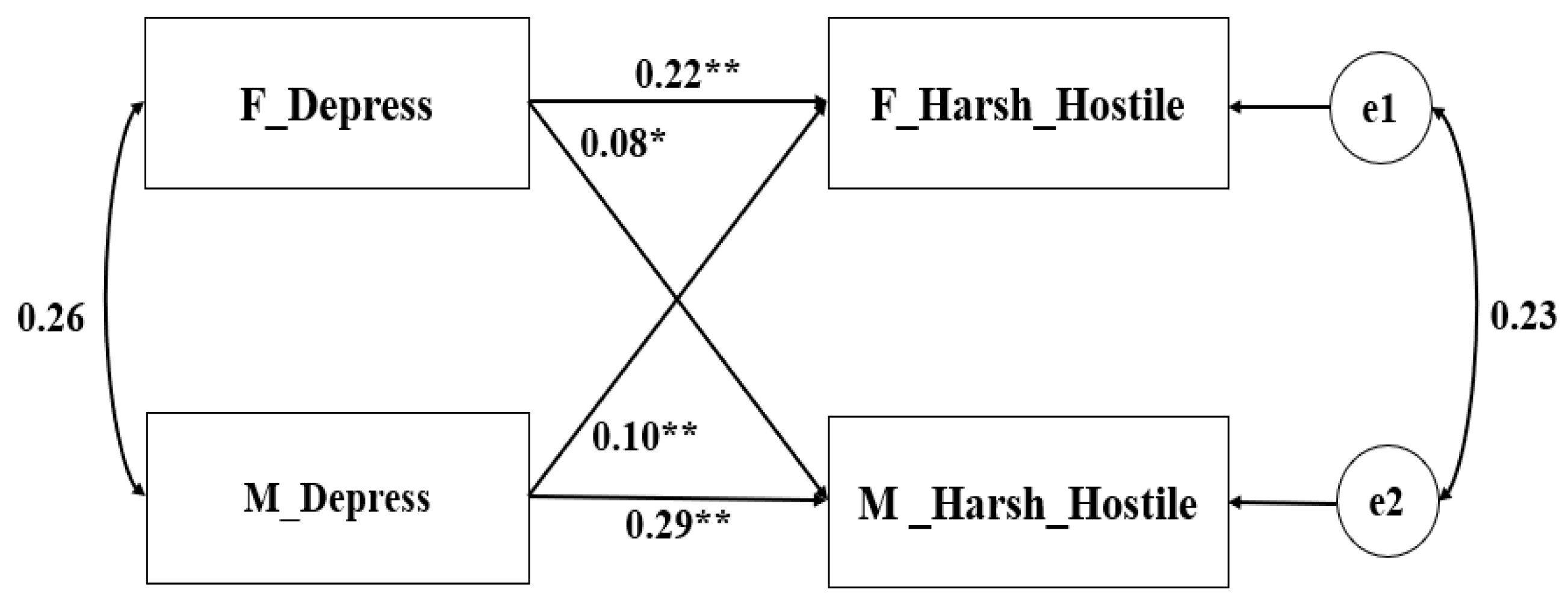
| P-H | 0.22 ** (0.21 **) | 0.29 ** (0.28 **) | 0.10 ** (0.10 **) | 0.08 * (0.08 *) | 1.855 | 0.025 | 0.993 | 0.986 | 1.499 | 0.223 | 0.442 [0.169, 0.852] | 0.297 [0.092, 0.556] | 0.051 | 0.995 | 0.133 | 0.940 | Mixed Mode |
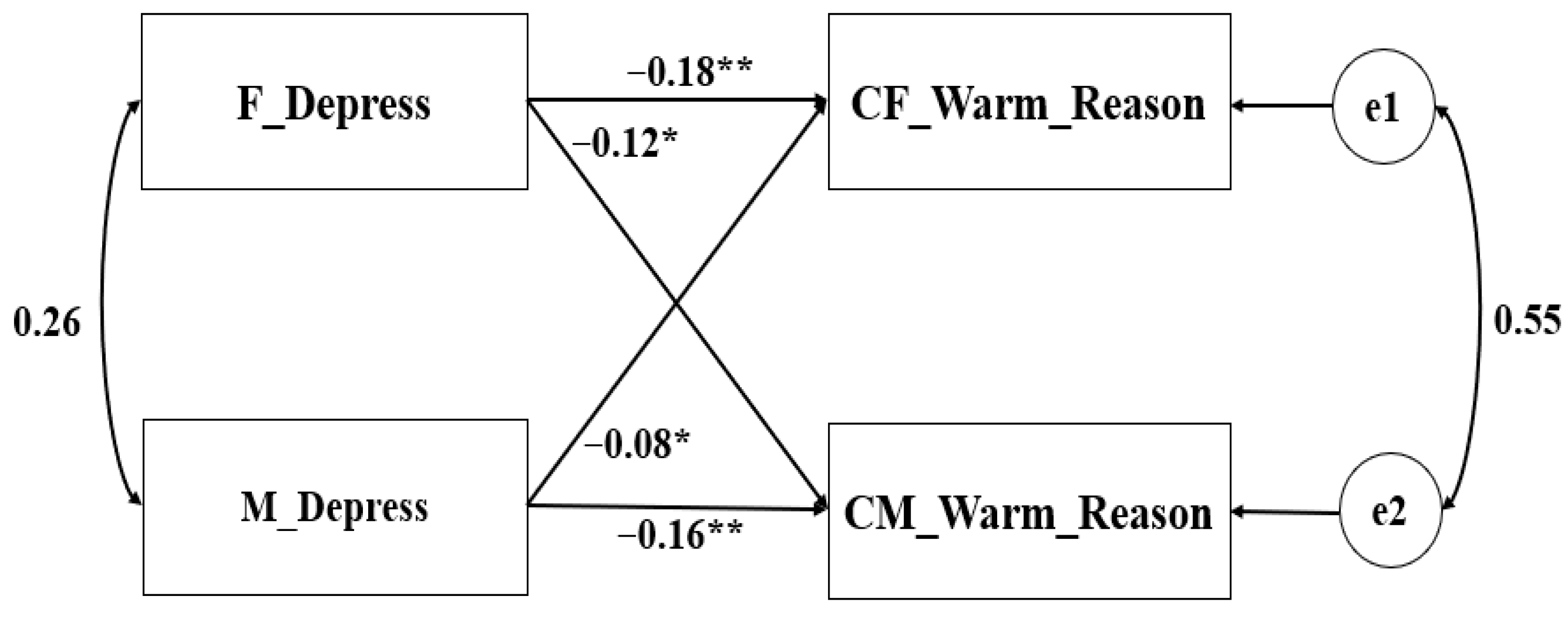
| C-W | −0.18 ** (−0.18 **) | −0.16 ** (−0.14 **) | −0.08 * (−0.07 *) | −0.12 ** (−0.10 *) | 1.855 | 0.025 | 0.995 | 0.990 | 0.311 | 0.733 | 0.432 [0.076, 1.045] | 0.748 [0.260, 1.559] | 0.258 | 0.905 | 0.952 | 0.414 | Mixed Mode |
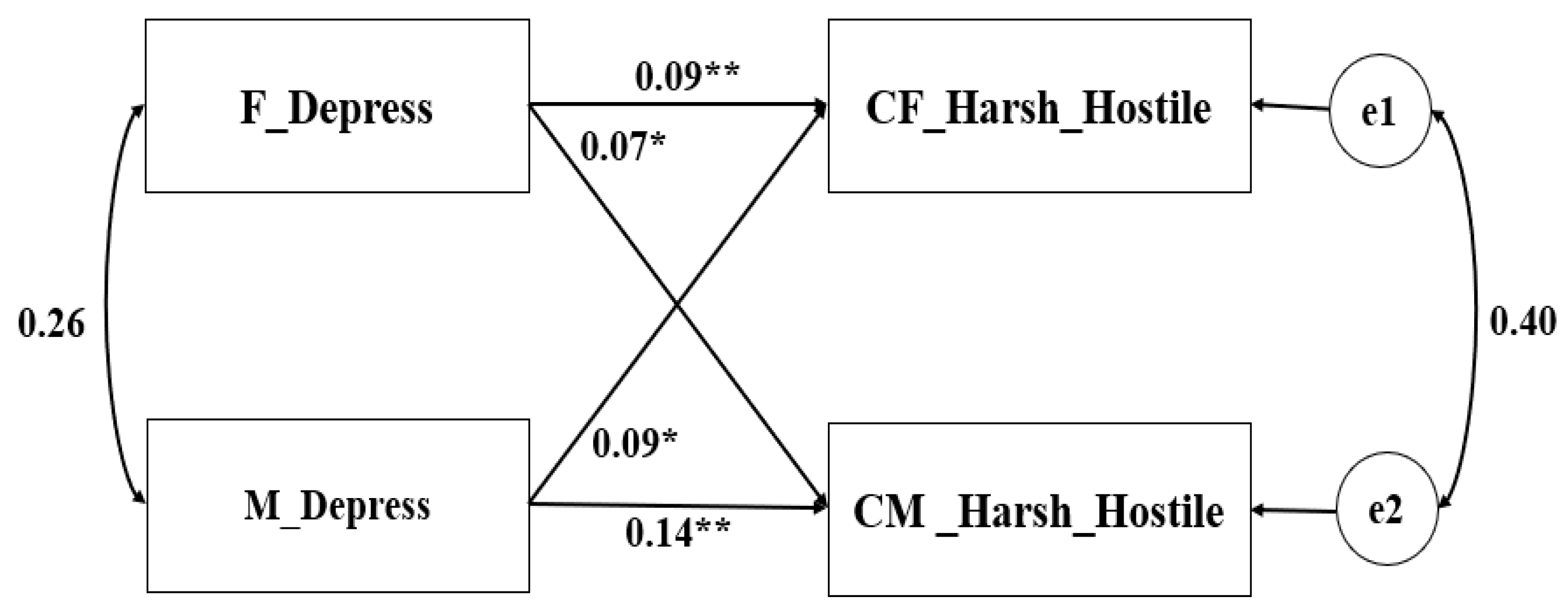
| C-H | 0.09 * (0.09 *) | 0.14 ** (0.13 **) | 0.09 * (0.08 *) | 0.07 * (0.06 *) | 1.855 | 0.025 | 0.993 | 0.986 | 0.681 | 0.506 | 0.904 [0.185, 1.791] | 0.500 [0.043, 1.374] | 0.103 | 0.981 | 0.089 | 0.966 | Mixed Mode |
Disclaimer/Publisher’s Note: The statements, opinions and data contained in all publications are solely those of the individual author(s) and contributor(s) and not of MDPI and/or the editor(s). MDPI and/or the editor(s) disclaim responsibility for any injury to people or property resulting from any ideas, methods, instructions or products referred to in the content. |
© 2026 by the authors. Licensee MDPI, Basel, Switzerland. This article is an open access article distributed under the terms and conditions of the Creative Commons Attribution (CC BY) license.
Share and Cite
Zhou, M.; Li, B.; Li, X.; Chen, J. Mutual Influence of Parental Depression and Parenting: An Actor–Partner Interdependence Analysis Based on Chinese Families with Adolescent Twins. Behav. Sci. 2026, 16, 103. https://doi.org/10.3390/bs16010103
Zhou M, Li B, Li X, Chen J. Mutual Influence of Parental Depression and Parenting: An Actor–Partner Interdependence Analysis Based on Chinese Families with Adolescent Twins. Behavioral Sciences. 2026; 16(1):103. https://doi.org/10.3390/bs16010103
Chicago/Turabian StyleZhou, Min, Bingtian Li, Xinying Li, and Jie Chen. 2026. "Mutual Influence of Parental Depression and Parenting: An Actor–Partner Interdependence Analysis Based on Chinese Families with Adolescent Twins" Behavioral Sciences 16, no. 1: 103. https://doi.org/10.3390/bs16010103
APA StyleZhou, M., Li, B., Li, X., & Chen, J. (2026). Mutual Influence of Parental Depression and Parenting: An Actor–Partner Interdependence Analysis Based on Chinese Families with Adolescent Twins. Behavioral Sciences, 16(1), 103. https://doi.org/10.3390/bs16010103