


Language and Cognitive Development in Bimodal Bilingual Deaf Children in Hearing Families: Three Case Studies

Abstract
1. Introduction
2. Background: Language Development in Deaf and Hard-of-Hearing Children
3. Background: Cognitive Development in Deaf and Hard-of-Hearing Children
4. The Family ASL Project
5. The Case Studies
6. Materials
6.1. Task 1: Screening
6.2. Task 2: Executive Function
6.3. Task 3: Vocabulary
6.4. Task 4: Overall Language
7. Results
7.1. Task 1: Screening
7.2. Task 2: Executive Function
7.3. Task 3: Vocabulary
7.4. Task 4: Overall Language
8. Discussion
9. General Discussion and Conclusions
Author Contributions
Funding
Institutional Review Board Statement
Informed Consent Statement
Data Availability Statement
Acknowledgments
Conflicts of Interest
| 1 | Visual inspection of the histogram indicates that over 30% of participants scored more than 2 standard deviations below the mean. |
| 2 | Commonly cited estimates for this number in the U.S. range between 10 and 30%, but these figures are not supported by current research. The last national survey of DHH children conducted by the Gallaudet Research Institute reported on data from 2013 to 2014 (Gallaudet Research Institute, 2014). This survey reported that ASL was used in the homes of 13.2% of DHH children. We know of only one recent quantitative survey in the US. Jones and Roberts (2024) surveyed 105 caregivers of 12–18-month-old DHH children, and found that 63.8% responded positively to, “I use sign with my child and/or others use sign with my child.” Figures are lower on surveys in other countries. Crowe et al. (2014) found that 20.9% of the 177 Australian caregivers they surveyed reported that sign was used with their child, but in a more recent and larger study, Howell et al. (2024) found that 8.7% of the 997 parents in their Australian survey reported using Auslan (Australian Sign Language) at home. |
| 3 | It should be borne in mind that scores on ‘non-verbal’ measures are often related to language experience (Quam & Coppola, 2023). |
References
- Akamatsu, C. T., Mayer, C., & Hardy-Braz, S. (2008). Why considerations of verbal aptitude are important in educating deaf and hard-of-hearing students. In M. Marschark, & P. C. Hauser (Eds.), Deaf cognition: Foundations and outcomes (pp. 131–169). Oxford University Press. [Google Scholar] [CrossRef] [Scilit]
- Allen, T. E., & Enns, C. (2013). A psychometric study of the ASL receptive skills test when administered to deaf 3-, 4-, and 5-year-old children. Sign Language Studies, 14(1), 58–79. [Google Scholar] [CrossRef] [Scilit]
- Antia, S. D., Lederberg, A. R., Easterbrooks, S., Schick, B., Branum-Martin, L., Connor, C. M., & Webb, M.-Y. (2020). Language and reading progress of young deaf and hard-of-hearing children. The Journal of Deaf Studies and Deaf Education, 25(3), 334–350. [Google Scholar] [CrossRef] [Scilit] [PubMed]
- Beer, J., Kronenberger, W. G., Castellanos, I., Colson, B. G., Henning, S. C., & Pisoni, D. B. (2014). Executive functioning skills in preschool-age children with cochlear implants. Journal of Speech Language and Hearing Research, 57(4), 1521. [Google Scholar] [CrossRef] [Scilit] [PubMed]
- Beer, J., Kronenberger, W. G., & Pisoni, D. B. (2011). Executive function in everyday life: Implications for young cochlear implant users. Cochlear Implants International, 12Suppl. S1, S89–S91. [Google Scholar] [CrossRef] [Scilit]
- Bouzaher, M. H., Wu, S., Ramanathan, D., Chi, D. H., Klaas, P., & Anne, S. (2024). Intelligence quotient testing in children with hearing loss: A systematic review. American Journal of Otolaryngology, 45(3), 104219. [Google Scholar] [CrossRef] [Scilit]
- Braden, J. P. (1994). Deafness, deprivation, and IQ. Springer Science & Business Media. [Google Scholar]
- Caselli, N. K., Lieberman, A. M., & Pyers, J. E. (2020). The ASL-CDI 2.0: An updated, normed adaptation of the macarthur bates communicative development inventory for American Sign Language. Behavior Research Methods, 52, 2071–2084. [Google Scholar] [CrossRef] [Scilit]
- Caselli, N. K., Pyers, J., & Lieberman, A. M. (2021). Deaf children of hearing parents have age-level vocabulary growth when exposed to American Sign Language by 6 months of age. The Journal of Pediatrics, 232, 229–236. [Google Scholar] [CrossRef] [Scilit]
- Cassandro, E., Nicastri, M., Chiarella, G., Genovese, E., Gallo, L. V., & Catalano, M. (2003). Development of communication and speech skills after cochlear implant in a sign language child. Acta Otorhinolaryngologica Italica, 23(2), 88–93. [Google Scholar]
- Chen Pichler, D. (2021). Constructing a profile of successful L2 signer hearing parents of deaf children. In R. Kikusawa, & F. Sano (Eds.), Minpaku sign language studies 2. Senri Ethnological Studies. [Google Scholar]
- Chen Pichler, D., Kuntze, M., Lillo-Martin, D., de Quadros, R. M., & Stumpf, M. R. (2018). Sign language acquisition by deaf and hearing children: A bilingual introduction. Gallaudet University Press. [Google Scholar]
- Ching, T. Y. C., Cupples, L., Seeto, M., Zhang, V., Hou, S., Wong, A., Flynn, C., Marnane, V., Leigh, G., & Dillon, H. (2025). Early intervention influences 9-year speech, language, cognitive, and quality-of-life outcomes in deaf or hard-of-hearing children. Ear and Hearing, 46(5), 1174–1188. [Google Scholar] [CrossRef] [Scilit]
- Ching, T. Y. C., Cupples, L., & Zhang, V. W. (2019). Language abilities and language growth in children with hearing loss. In J. S. Horst, & J. von K. Torkildsen (Eds.), International handbook of language acquisition (pp. 387–403). Routledge. [Google Scholar]
- Ching, T. Y. C., Dillon, H., Button, L., Seeto, M., Van Buynder, P., Marnane, V., Cupples, L., & Leigh, G. (2017). Age at intervention for permanent hearing loss and 5-year language outcomes. Pediatrics, 140(3), e20164274. [Google Scholar] [CrossRef] [Scilit]
- Ching, T. Y. C., Dillon, H., Leigh, G., & Cupples, L. (2018). Learning from the Longitudinal Outcomes of Children with Hearing Impairment (LOCHI) study: Summary of 5-year findings and implications. International Journal of Audiology, 57Suppl. S2, S105–S111. [Google Scholar] [CrossRef] [Scilit] [PubMed]
- Crowe, K., McLeod, S., McKinnon, D. H., & Ching, T. Y. C. (2014). Speech, sign, or multilingualism for children with hearing loss: Quantitative insights into caregivers’ decision making. Language, Speech, and Hearing Services in Schools, 45(3), 234–247. [Google Scholar] [CrossRef] [Scilit] [PubMed]
- Cupples, L., Ching, T. Y. C., Button, L., Seeto, M., Zhang, V., Whitfield, J., Gunnourie, M., Martin, L., & Marnane, V. (2018). Spoken language and everyday functioning in 5-year-old children using hearing aids or cochlear implants. International Journal of Audiology, 57Suppl. S2, S55–S69. [Google Scholar] [CrossRef] [Scilit] [PubMed]
- Dammeyer, J. (2010). Psychosocial development in a Danish population of children with cochlear implants and deaf and hard-of-hearing children. Journal of Deaf Studies and Deaf Education, 15(1), 50–58. [Google Scholar] [CrossRef] [Scilit]
- Davidson, K., Lillo-Martin, D., & Chen Pichler, D. (2014). Spoken English language development among native signing children with cochlear implants. Journal of Deaf Studies and Deaf Education, 19(2), 238–250. [Google Scholar] [CrossRef] [Scilit]
- Deák, G. O. (2014). Interrelationship of language and cognitive development (overview). In P. Brooks, & V. Kampe (Eds.), Encyclopedia of language development (pp. 284–291). SAGE Publications, Inc. [Google Scholar] [CrossRef] [Scilit]
- Delcenserie, A., Genesee, F., & Champoux, F. (2024). Exposure to sign language prior and after cochlear implantation increases language and cognitive skills in deaf children. Developmental Science, 27(4), e13481. [Google Scholar] [CrossRef] [Scilit]
- Dettman, S., Choo, D., Au, A., Luu, A., & Dowell, R. (2021). Speech Perception and language outcomes for infants receiving cochlear implants before or after 9 months of age: Use of category-based aggregation of data in an unselected pediatric cohort. Journal of Speech, Language, and Hearing Research, 64(3), 1023–1039. [Google Scholar] [CrossRef] [Scilit]
- Enns, C. J., & Herman, R. C. (2011). Adapting the assessing British Sign Language development: Receptive skills test into American Sign Language. Journal of Deaf Studies and Deaf Education, 16(3), 362–374. [Google Scholar] [CrossRef] [Scilit]
- Enns, C. J., Zimmer, K., Boudreault, P., Rabu, S., & Broszeit, C. (2013). American Sign Language: Receptive skills test. Northern Signs Research, Inc. [Google Scholar]
- Fenson, L., Pethick, S., Renda, C., Cox, J. L., Dale, P. S., & Reznick, J. S. (2000). Short-form versions of the MacArthur communicative development inventories. Applied Psycholinguistics, 21(1), 95–116. [Google Scholar] [CrossRef] [Scilit]
- Finton, E., Hall, W. C., Berke, M., Bye, R., Ikeda, S., & Caselli, N. K. (2024). Age-expected language and academic outcomes for deaf children with hearing caregivers. The Journal of Special Education, 58, 232–243. [Google Scholar] [CrossRef] [Scilit]
- Gallaudet Research Institute. (2014). Regional and national summary report of data from the 2013–2014 annual survey of deaf and hard of hearing children and youth. Gallaudet University. [Google Scholar]
- Geers, A. E., Mitchell, C. M., Warner-Czyz, A., Wang, N.-Y., & Eisenberg, L. S. (2017a). Authors’ response. Pediatrics, 140(5), e20172655E. [Google Scholar] [CrossRef] [Scilit]
- Geers, A. E., Mitchell, C. M., Warner-Czyz, A., Wang, N.-Y., Eisenberg, L. S., & the CDaCI Investigative Team. (2017b). Early sign language exposure and cochlear implantation benefits. Pediatrics, 140(1), e20163489. [Google Scholar] [CrossRef] [Scilit] [PubMed]
- Gioia, G. A., Espy, K. A., & Isquith, P. K. (2003). Behavior rating inventory of executive function—Preschool version. PAR. [Google Scholar]
- Gioia, G. A., Isquith, P. K., Guy, S. C., Kenworthy, L., Espy, K. A., & Roth, R. M. (2000). Behavior rating inventory of executive function. PAR. [Google Scholar]
- Goodwin, C., Carrigan, E., Walker, K., & Coppola, M. (2022). Language not auditory experience is related to parent-reported executive functioning in preschool-aged deaf and hard-of-hearing children. Child Development, 93(1), 209–224. [Google Scholar] [CrossRef] [Scilit] [PubMed]
- Goodwin, C., & Lillo-Martin, D. (2023). Deaf and hearing American Sign Language–English bilinguals: Typical bilingual language development. Journal of Deaf Studies and Deaf Education, 28(4), 350–362. [Google Scholar] [CrossRef] [Scilit]
- Hall, M. L. (2020). The input matters: Assessing cumulative language access in deaf and hard of hearing individuals and populations. Frontiers in Psychology, 11. [Google Scholar] [CrossRef] [Scilit]
- Hall, M. L., & De Anda, S. (2021). Measuring “Language Access Profiles” in deaf and hard-of-hearing children with the DHH language exposure assessment tool. Journal of Speech, Language, and Hearing Research, 64(1), 134–158. [Google Scholar] [CrossRef] [Scilit]
- Hall, M. L., & De Anda, S. (2022). Estimating early language input in deaf and hard of hearing children with the language access profile tool. American Journal of Speech-Language Pathology, 31(5), 2132–2144. [Google Scholar] [CrossRef] [Scilit]
- Hall, M. L., Eigsti, I.-M., Bortfeld, H., & Lillo-Martin, D. (2017). Auditory deprivation does not impair executive function, but language deprivation might: Evidence from a parent-report measure in deaf native signing children. Journal of Deaf Studies and Deaf Education, 22(1), 9–21. [Google Scholar] [CrossRef] [Scilit]
- Hall, M. L., Hall, W. C., & Caselli, N. K. (2019). Deaf children need language, not (just) speech. First Language, 39(4), 367–395. [Google Scholar] [CrossRef] [Scilit]
- Hall, W. C., Levin, L. L., & Anderson, M. L. (2017). Language deprivation syndrome: A possible neurodevelopmental disorder with sociocultural origins. Social Psychiatry and Psychiatric Epidemiology, 52(6), 761–776. [Google Scholar] [CrossRef] [Scilit]
- Hall, W. C., Li, D., & Dye, T. D. V. (2018). Influence of hearing loss on child behavioral and home experiences. American Journal of Public Health, 108(8), 1079–1081. [Google Scholar] [CrossRef] [Scilit]
- Hassanzadeh, S. (2012). Outcomes of cochlear implantation in deaf children of deaf parents: Comparative study. The Journal of Laryngology & Otology, 126(10), 989–994. [Google Scholar] [CrossRef] [Scilit]
- Herman, R., Holmes, S., & Woll, B. (1999). Assessing British Sign Language development: Receptive skills test. Forest Bookshop. [Google Scholar]
- Howell, T., Sung, V., Smith, L., & Dettman, S. (2024). Australian families of deaf and hard of hearing children: Are they using sign? International Journal of Pediatric Otorhinolaryngology, 179, 111930. [Google Scholar] [CrossRef] [Scilit]
- Humphries, T., Mathur, G., Napoli, D. J., Padden, C., & Rathmann, C. (2022). Deaf children need rich language input from the start: Support in advising parents. Children, 9(11), 1609. [Google Scholar] [CrossRef] [Scilit]
- Jamsek, I. A., Kronenberger, W. G., Pisoni, D. B., & Holt, R. F. (2022). Executive functioning and spoken language skills in young children with hearing aids and cochlear implants: Longitudinal findings. Frontiers in Psychology, 13, 987256. [Google Scholar] [CrossRef] [Scilit]
- Jones, M. K., & Roberts, M. Y. (2024). Speech, sign, or both? Factors influencing caregivers’ communication method decision making for deaf/hard of hearing children. Journal of Speech, Language, and Hearing Research, 67(1), 187–195. [Google Scholar] [CrossRef] [Scilit]
- Karltorp, E., Eklöf, M., Östlund, E., Asp, F., Tideholm, B., & Löfkvist, U. (2020). Cochlear implants before 9 months of age led to more natural spoken language development without increased surgical risks. Acta Paediatrica, 109(2), 332–341. [Google Scholar] [CrossRef] [Scilit]
- Kronenberger, W. G., Colson, B. G., Henning, S. C., & Pisoni, D. B. (2014). Executive functioning and speech-language skills following long-term use of cochlear implants. Journal of Deaf Studies and Deaf Education, 19(4), 456–470. [Google Scholar] [CrossRef] [Scilit] [PubMed]
- Lederberg, A. R., Branum-Martin, L., Webb, M., Schick, B., Antia, S., Easterbrooks, S. R., & Connor, C. M. (2019). Modality and interrelations among language, reading, spoken phonological awareness, and fingerspelling. The Journal of Deaf Studies and Deaf Education, 24(4), 408–423. [Google Scholar] [CrossRef] [Scilit] [PubMed]
- Lieberman, A. M., Mitchiner, J., & Pontecorvo, E. (2024). Hearing parents learning American Sign Language with their deaf children: A mixed-methods survey. Applied Linguistics Review, 15(1), 309–333. [Google Scholar] [CrossRef] [Scilit] [PubMed]
- Lillo-Martin, D., de Quadros, R. M., Chen Pichler, D., & Fieldsteel, Z. (2014). Language choice in bimodal bilingual development. Frontiers in Psychology, 5. [Google Scholar] [CrossRef] [Scilit]
- Lillo-Martin, D., Gale, E., & Chen Pichler, D. (2023). Family ASL: An early start to equitable education for deaf children. Topics in Early Childhood Special Education, 43(2), 156–166. [Google Scholar] [CrossRef] [Scilit]
- Lillo-Martin, D., & Henner, J. (2021). Acquisition of sign languages. Annual Review of Linguistics, 7(1), 395–419. [Google Scholar] [CrossRef] [Scilit]
- Maller, S. J. (2003). Intellectual assessment of deaf people. In M. Marschark, & P. E. Spencer (Eds.), Oxford handbook of deaf studies, language, and education (pp. 451–463). Oxford University Press. [Google Scholar]
- Marchman, V., Dale, P. S., & Fenson, L. (2023). MacArthur-bates communicative development inventories user’s guide and technical manual (3rd ed.). Brookes Publishing. [Google Scholar]
- Mayberry, R. I. (2002). Cognitive development in deaf children: The interface of language and perception in neuropsychology. In S. J. Segalowitz, & I. Rapin (Eds.), Handbook of neuropsychology (2nd ed., Vol. 8, Part II, pp. 71–107). Elsevier. [Google Scholar]
- Mayberry, R. I., & Kluender, R. (2018). Rethinking the critical period for language: New insights into an old question from American Sign Language. Bilingualism: Language and Cognition, 21(5), 886–905. [Google Scholar] [CrossRef] [Scilit]
- Mitchell, R. E., & Karchmer, M. A. (2004). Chasing the mythical ten percent: Parental hearing status of deaf and hard of hearing students in the United States. Sign Language Studies, 4(2), 138–163. [Google Scholar] [CrossRef] [Scilit]
- Morgan, G., Jones, A., & Botting, N. (2020). Links between language and cognitive development of deaf children. In G. Morgan (Ed.), Understanding deafness, language and cognitive development: Essays in honour of bencie woll (pp. 115–131). John Benjamins Publishing Company. [Google Scholar]
- Niparko, J. K., Tobey, E. A., Thal, D. J., Eisenberg, L. S., Wang, N.-Y., Quittner, A. L., & Fink, N. E. (2010). Spoken language development in children following cochlear implantation. JAMA, 303(15), 1498–1506. [Google Scholar] [CrossRef] [Scilit]
- Ortiz, S. O., & Cehelyk, S. K. (2024). The bilingual is not two monolinguals of same age: Normative testing implications for multilinguals. Journal of Intelligence, 12(1), 3. [Google Scholar] [CrossRef] [Scilit]
- Paludneviciene, R., & Leigh, I. W. (Eds.). (2011). Cochlear implants: Evolving perspectives. Gallaudet University Press. [Google Scholar] [CrossRef] [Scilit]
- Phillips, J., Wiley, S., Barnard, H., & Meinzen-Derr, J. (2014). Comparison of two nonverbal intelligence tests among children who are deaf or hard-of-hearing. Research in Developmental Disabilities, 35(2), 463–471. [Google Scholar] [CrossRef] [Scilit]
- Pisoni, D. B., Conway, C. M., Kronenberger, W., Henning, S., & Anaya, E. (2010). Executive function, cognitive control, and sequence learning in deaf children with cochlear implants. In M. Marschark, & P. E. Spencer (Eds.), The Oxford handbook of deaf studies, language, and education (Vol. 2, pp. 439–457). Oxford University Press. [Google Scholar]
- Pontecorvo, E., Higgins, M., Mora, J., Lieberman, A. M., Pyers, J., & Caselli, N. K. (2023). Learning a sign language does not hinder acquisition of a spoken language. Journal of Speech, Language, and Hearing Research, 66(4), 1291–1308. [Google Scholar] [CrossRef] [Scilit]
- Pontecorvo, E., Mitchiner, J., & Lieberman, A. M. (2024). Hearing parents as sign language learners: Describing and evaluating the ASL skills of parents learning ASL with their deaf children. Journal of Multilingual and Multicultural Development, 1–18. [Google Scholar] [CrossRef] [Scilit]
- Quam, M., & Coppola, M. (2023). Are measures of nonverbal reasoning truly nonlinguistic? Evidence from deaf, hard-of-hearing and typically hearing children. In P. Gappmayr, & J. Kellogg (Eds.), Proceedings of the 47th annual boston university conference on language development (pp. 618–631). Cascadilla Press. [Google Scholar]
- Sherman, E. M. S., & Brooks, B. L. (2010). Behavior rating inventory of executive function—Preschool version (BRIEF-P): Test review and clinical guidelines for use. Child Neuropsychology, 16(5), 503–519. [Google Scholar] [CrossRef] [Scilit]
- Shokrkon, A., & Nicoladis, E. (2022). The directionality of the relationship between executive functions and language skills: A literature review. Frontiers in Psychology, 13. [Google Scholar] [CrossRef] [Scilit]
- Stevenson, J., Kreppner, J., Pimperton, H., Worsfold, S., & Kennedy, C. (2015). Emotional and behavioural difficulties in children and adolescents with hearing impairment: A systematic review and meta-analysis. European Child & Adolescent Psychiatry, 24(5), 477–496. [Google Scholar] [CrossRef] [Scilit]
- Stevenson, J., McCann, D., Watkin, P., Worsfold, S., & Kennedy, C. (2010). The relationship between language development and behaviour problems in children with hearing loss. Journal of Child Psychology and Psychiatry, 51(1), 77–83. [Google Scholar] [CrossRef] [Scilit] [PubMed]
- The Joint Committee on Infant Hearing. (2019). Year 2019 position statement: Principles and guidelines for early hearing detection and intervention programs. The Journal of Early Hearing Detection and Intervention, 4(2), 1–44. [Google Scholar]
- Treffers-Daller, J., & Silva-Corvalán, C. (2016). Language dominance in bilinguals: Issues of measurement and operationalization. Cambridge University Press. [Google Scholar]
- Vernon, M. (2005). Fifty years of research on the intelligence of deaf and hard-of-hearing children: A review of literature and discussion of implications. The Journal of Deaf Studies and Deaf Education, 10(3), 225–231. [Google Scholar] [CrossRef] [Scilit]
- Voress, J. K., Maddox, T., & Hammill, D. D. (2012). Developmental assessment of young children (2nd ed.). Pearson. [Google Scholar]
- Wiig, E. H., Secord, W. A., & Semel, E. (2020). Clinical evaluation of language fundamentals preschool-3. Pearson. [Google Scholar]
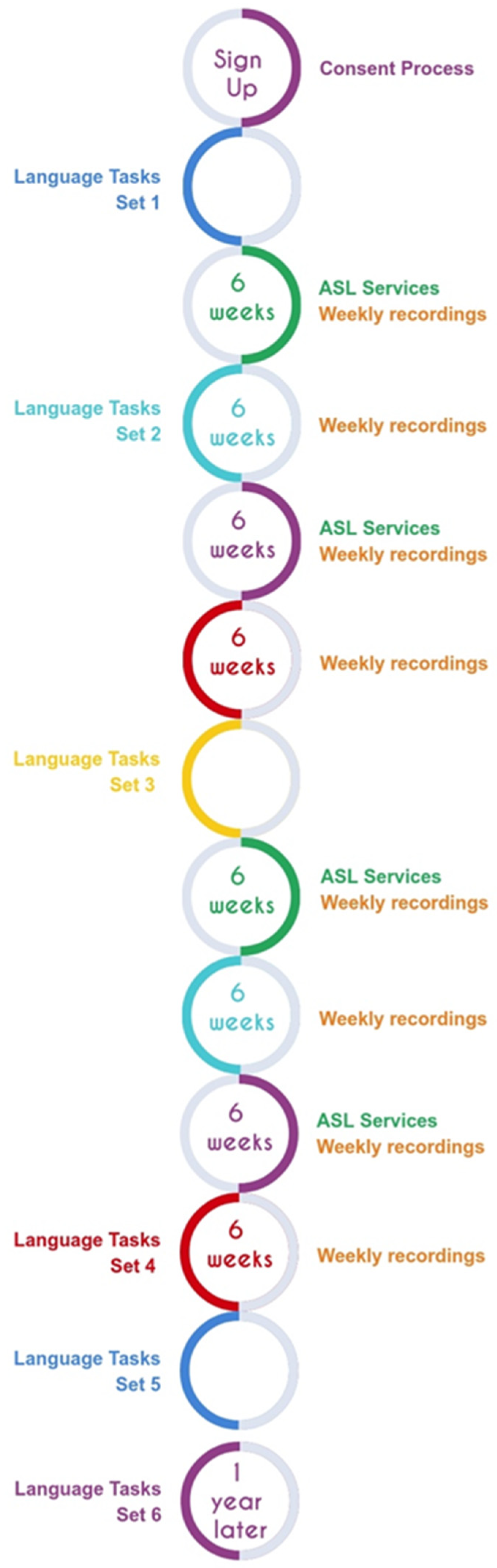
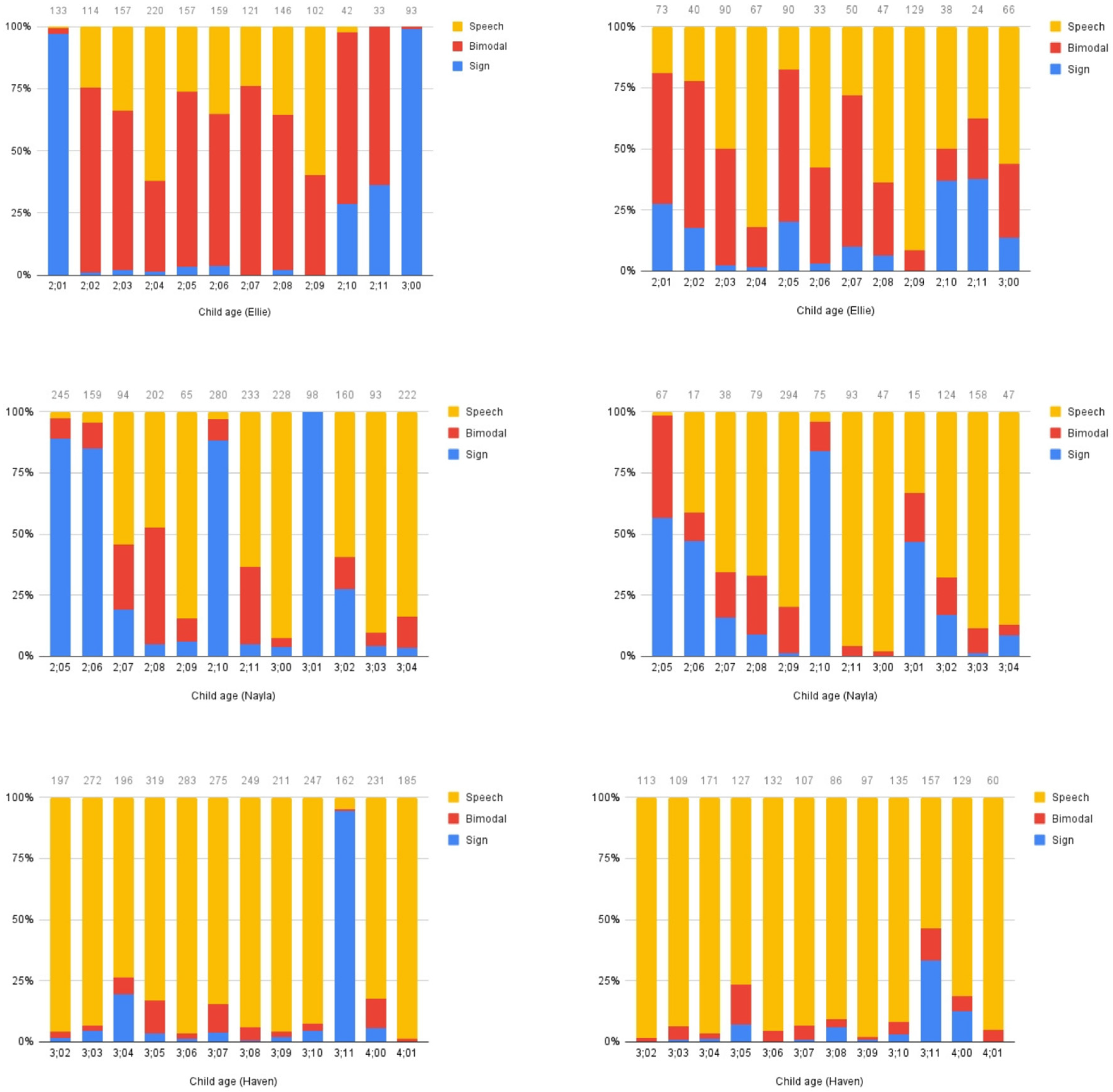

| Child | Chronological Age over Observation Period | Sex | Race | Mother’s Education | Siblings | Pre-Aided Hearing Level | Hearing Technology (Age at Activation) |
|---|---|---|---|---|---|---|---|
| Ellie | 2;00–4;04 | F | White | Completed undergraduate degree | 2 older (hearing) | Profound | Bilateral CI (1;08) |
| Nayla | 2;04–4;03 | F | White | Completed undergraduate degree | 1 older (hearing) | Profound | Bilateral CI (2;02) |
| Haven | 3;02–5;00 | F | White | Graduate degree | 1 older (hearing) | Profound | Bilateral CI (1;00) |
| Time 1 | Time 2 | Time 3 | |||||||
|---|---|---|---|---|---|---|---|---|---|
| Mother of | Age | Receptive | Expressive | Age | Receptive | Expressive | Age | Receptive | Expressive |
| Ellie | 2;02 | 100 | 100 | 2;08 | 100 | 100 | 3;00 | 100 | 100 |
| Nayla | 2;07 | 95 | 93 | 3;01 | 100 | 95 | 3;04 | 99 | 98 |
| Haven | 3;04 | 86 | 69 | 3;09 | 84 | 72 | 4;01 | 90 | 76 |
| Time 1 | Time 2 | Time 3 | |||||||
|---|---|---|---|---|---|---|---|---|---|
| Child | Age | Cog | Soc-Emo | Age | Cog | Soc-Emo | Age | Cog | Soc-Emo |
| Ellie | 2;05.12 | 113 | 130 | 2;11.5 | 116 | 124 | 4;00.27 | 94 | 107 |
| Nayla | 2;09.15 | 103 | 108 | 3;03.25 | 109 | 108 | 4;03.18 | 95 | 97 |
| Haven | 3;07.3 | 113 | 103 | 4;00.19 | 108 | 104 | 5;00.14 | 104 | 105 |
| Time 1 | Time 2 | Time 3 | |||||||||||||
|---|---|---|---|---|---|---|---|---|---|---|---|---|---|---|---|
| Child | Age | ISCI | FI | EMI | GEC | Age | ISCI | FI | EMI | GEC | Age | ISCI | FI | EMI | GEC |
| Ellie | 2;05.12 | 48 | 41 | 50 | 47 | 2;10.28 | 54 | 38 | 54 | 52 | 4;01.5 | 55 | 42 | 43 | 48 |
| Nayla | 2;09.15 | 63 | 47 | 79 | 68 | 3;03.19 | 48 | 36 | 54 | 48 | 4;00.28 | 50 | 45 | 38 | 42 |
| Haven | 3;06.26 | 66 | 52 | 67 | 64 | 4;00.10 | 49 | 45 | 40 | 42 | 5;00.3 | 67 | 68 | 48 | 59 |
| Time 1 | Time 2 | Time 3 | |||||||
|---|---|---|---|---|---|---|---|---|---|
| Child | Age | Receptive | Expressive | Age | Receptive | Expressive | Age | Receptive | Expressive |
| Ellie | 2;02 | 99 * | 81 * | 2;08 | 100 * | 99 * | 3;00 | 100 * | 99 * |
| Nayla | 2;07 | 87 * | 71 * | 3;01 | 94 * | 74 * | 3;04 | 97 * | 80 * |
| Haven | 3;04 | 39 | 7 | 3;09 | 60 | 23 | 4;01 | 72 | 35 |
| Time 1 | Time 2 | Time 3 | ||||
|---|---|---|---|---|---|---|
| Child | Age | Words Known | Age | Words Known | Age | Words Known |
| Ellie | 2;03.3 | 47 | 2;08.19 | 86 | 3;00.14 | 100 |
| Nayla | 2;06.23 | 40 | 3;00.9 | 71 | 3;04.1 | 80 |
| Haven | 3;04.10 | 84 | 3;09.25 | 80 | 4;01.10 | 97 |
| Child | Age | Raw Score | Standard Score |
|---|---|---|---|
| Ellie | 4;01.10 | 24 | 119 |
| Nayla | 4;01.8 | 19 | 112 |
| Haven | 4;09.24 | 16 | 108 |
| Child | Age | Core Language Standard Score |
|---|---|---|
| Ellie | 4;01 | 101 |
| Nayla | 4;02 | 106 |
| Haven | 4;11 | 106 |
Disclaimer/Publisher’s Note: The statements, opinions and data contained in all publications are solely those of the individual author(s) and contributor(s) and not of MDPI and/or the editor(s). MDPI and/or the editor(s) disclaim responsibility for any injury to people or property resulting from any ideas, methods, instructions or products referred to in the content. |
© 2025 by the authors. Licensee MDPI, Basel, Switzerland. This article is an open access article distributed under the terms and conditions of the Creative Commons Attribution (CC BY) license (https://creativecommons.org/licenses/by/4.0/).
Share and Cite
Lillo-Martin, D.; Chen Pichler, D.; Gale, E. Language and Cognitive Development in Bimodal Bilingual Deaf Children in Hearing Families: Three Case Studies. Behav. Sci. 2025, 15, 1124. https://doi.org/10.3390/bs15081124
Lillo-Martin D, Chen Pichler D, Gale E. Language and Cognitive Development in Bimodal Bilingual Deaf Children in Hearing Families: Three Case Studies. Behavioral Sciences. 2025; 15(8):1124. https://doi.org/10.3390/bs15081124
Chicago/Turabian StyleLillo-Martin, Diane, Deborah Chen Pichler, and Elaine Gale. 2025. "Language and Cognitive Development in Bimodal Bilingual Deaf Children in Hearing Families: Three Case Studies" Behavioral Sciences 15, no. 8: 1124. https://doi.org/10.3390/bs15081124
APA StyleLillo-Martin, D., Chen Pichler, D., & Gale, E. (2025). Language and Cognitive Development in Bimodal Bilingual Deaf Children in Hearing Families: Three Case Studies. Behavioral Sciences, 15(8), 1124. https://doi.org/10.3390/bs15081124

