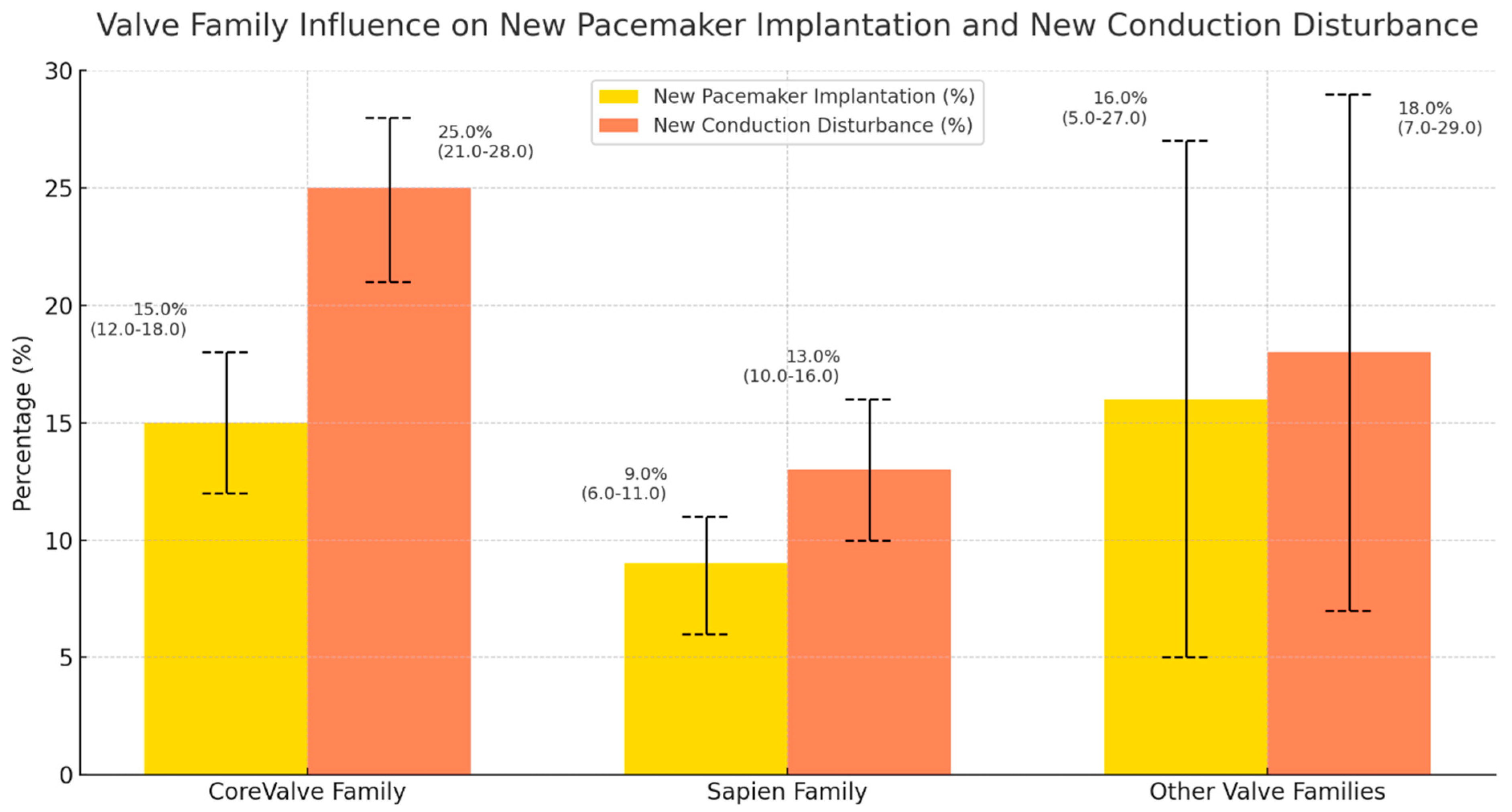

Incidence of Post-Procedural Conduction Disturbances and Rates of Permanent Pacemaker Implantation in Older and Newer Generations of Transcatheter Aortic Heart Valves
 , , and
Abstract
1. Introduction
2. Methods
2.1. Study Population and Design
2.2. Inclusive and Exclusive Criteria
2.3. Transcatheter Aortic Valve Replacement Procedure (TAVR) and Valve Selection [15]
2.4. Study Objectives
2.5. Statistical Methods
3. Results
3.1. Baseline Characteristics of the Study Population (Table 2)

| Characteristic | G1, n = 782 1 | G2, n = 400 1 |
|---|---|---|
| Age (years) | 81.74 (±5.58) | 82.04 (±5.92) |
| female | 378/782 (48.3%) | 210/400 (52.5%) |
| Height (cm) | 169.55 (±9.46) | 168.63 (±8.56) |
| Weight (kg) | 78.15 (±16.30) | 76.75 (±16.10) |
| BMI [kg/m2] | 27.10 (±4.95) | 28.69 (±8.69) |
| Diabetes | 256/782 (32.7%) | 105/400 (26.3%) |
| Dyslipidaemia | 436/782 (55.8%) | 253/400 (63.3%) |
| Hypertension | 703/782 (89.9%) | 357/400 (89.3%) |
| Atrial fibrillation or flutter | 338/782 (43.2%) | 123/400 (30.8%) |
| CAD | 519/782 (66.4%) | 232/400 (58.0%) |
| Previous cardiac surgery | 126/782 (16.1%) | 41/400 (10.3%) |
| COPD | 97/782 (12.4%) | 30/400 (7.5%) |
| PAD | 61/782 (7.8%) | 26/400 (6.5%) |
| Cerebrovascular disease | 130/782 (16.6%) | 48/400 (12.0%) |
| Pre dialysis | 9/782 (1.2%) | 3/400 (0.8%) |
| NYHA class | ||
| I | 34/782 (4.4%) | 33/400 (8.3%) |
| II | 174/782 (22.3%) | 85/400 (21.3%) |
| III | 490/782 (62.7%) | 239/400 (59.8%) |
| IV | 84/782 (10.7%) | 43/400 (10.8%) |
| STS Score [%] | 4.46 (±3.47) | 3.89 (±2.50) |
| Log EuroScore | 17.83 (±13.09) | 17.14 (±12.42) |
| EuroScore II | 4.46 (±3.47) | 3.89 (±2.50) |
| Ejection fraction (%) | 52.60 (±10.62) | 54.13 (±9.34) |
| Ejection fraction category | ||
| I | 524/782 (67.0%) | 295/400 (73.8%) |
| II | 134/782 (17.1%) | 68/400 (17.0%) |
| III | 72/782 (9.2%) | 21/400 (5.3%) |
| IV | 52/782 (6.7%) | 16/400 (4.0%) |
| AV-MPG (mmHg) | 40.12 (±15.27) | 42.52 (±15.77) |
| sPAP (mmHg) | 44.19 (±13.89) | 42.50 (±13.37) |
| AVA [cm2] | 0.75 (±0.17) | 0.71 (±0.18) |
3.2. Peri- and Post-Procedural Data and Outcomes (Table 3; Unweighted, Unadjusted and Table 4; IPTW-Adjusted)
| Characteristic | G1, n = 782 1 | G2, n = 400 1 | Unweighted p-Value 2 |
|---|---|---|---|
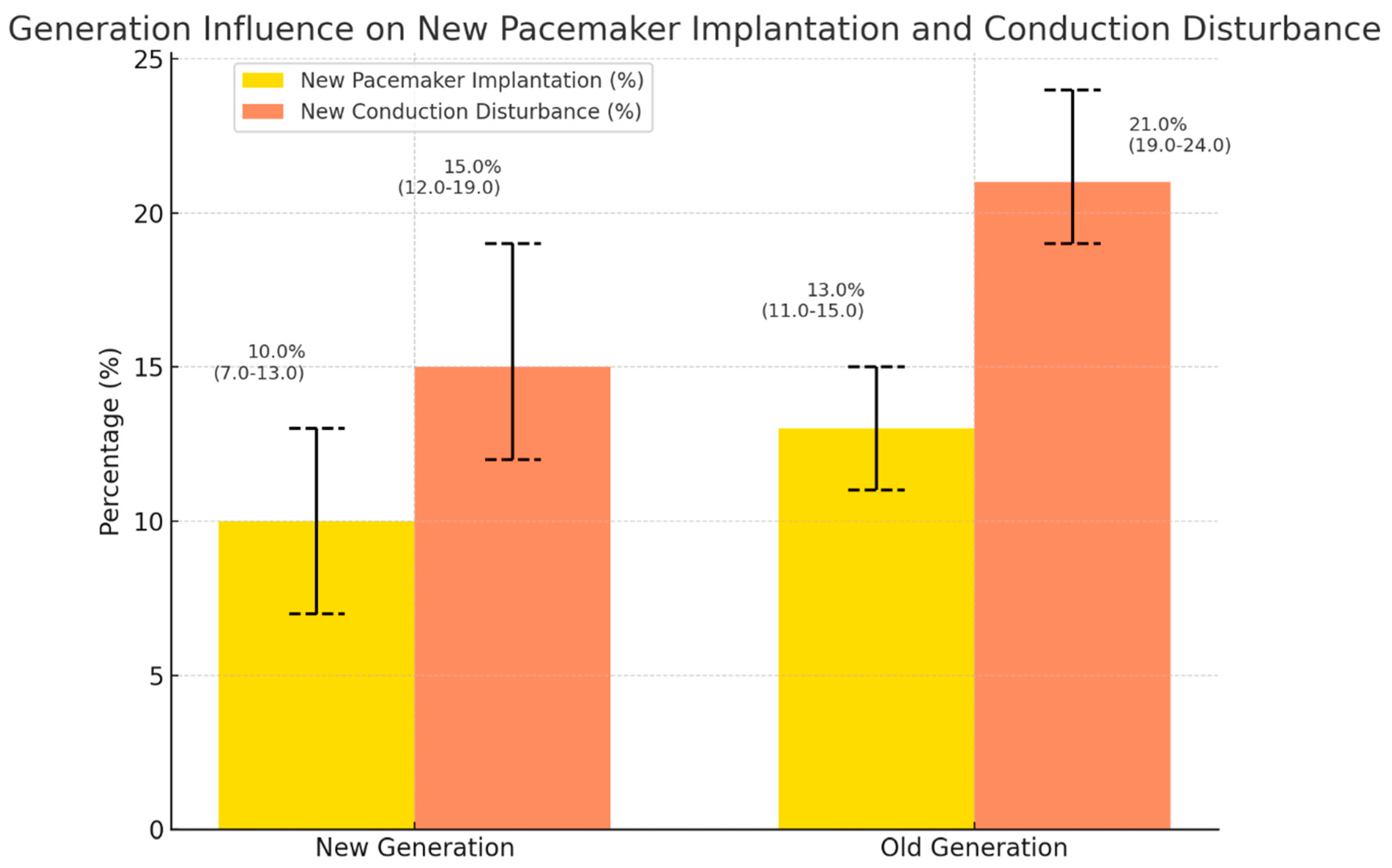
| New conduction disturbance | 168/782 (21.5%) | 61/400 (15.3%) | 0.01 |
| Type conduction disturbance | 0.24 | ||
| AVB I | 12/782 (1.5%) | 6/400 (1.5%) | >0.90 |
| AVB II | 5/782 (0.6%) | 2/400 (0.5%) | >0.90 |
| AVB III | 78/782 (10.0%) | 32/400 (8.0%) | 0.32 |
| SSS | 17/782 (2.2%) | 11/400 (2.8%) | 0.55 |
| LBBB | 74/782 (9.5%) | 16/400 (4.0%) | 0.001 |
| RBBB | 4/782 (0.5%) | 1/400 (0.3%) | 0.67 |
| SVT | 7/782 (0.9%) | 2/400 (0.5%) | 0.73 |
| Valve in valve | 22/782 (2.8%) | 13/400 (3.2%) | 0.81 |
| New pacemaker implantation | 102/782 (13.0%) | 41/400 (10.3%) | 0.19 |
| Type of pacemaker | <0.001 | ||
| VVI-PM | 16/782 (2.1%) | 5/400 (1.3%) | |
| DDD-PM | 67/782 (8.6%) | 33/400 (8.3%) | |
| CRT-P | 15/782 (1.9%) | 3/400 (0.8%) | |
| Valve type | <0.001 | ||
| EvolutTM R | 465/782 (59.5%) | 0/400 (0.0%) | |
| EvolutTM PRO | 0/782 (0.0%) | 146/400 (36.5%) | |
| SAPIEN 3 | 314/782 (40.2%) | 0/400 (0.0%) | |
| SAPIEN 3 Ultra | 0/782 (0.0%) | 207/400 (51.8%) | |
| ACURATE neo | 3/782 (0.4%) | 0/400 (0.0%) | |
| ACURATE neo2 | 0/782 (0.0%) | 5/400 (1.3%) | |
| Navitor | 0/782 (0.0%) | 30/400 (7.5%) | |
| Centra | 0/782 (0.0%) | 12/400 (3.0%) | |
| Valve type (release function) | <0.001 | ||
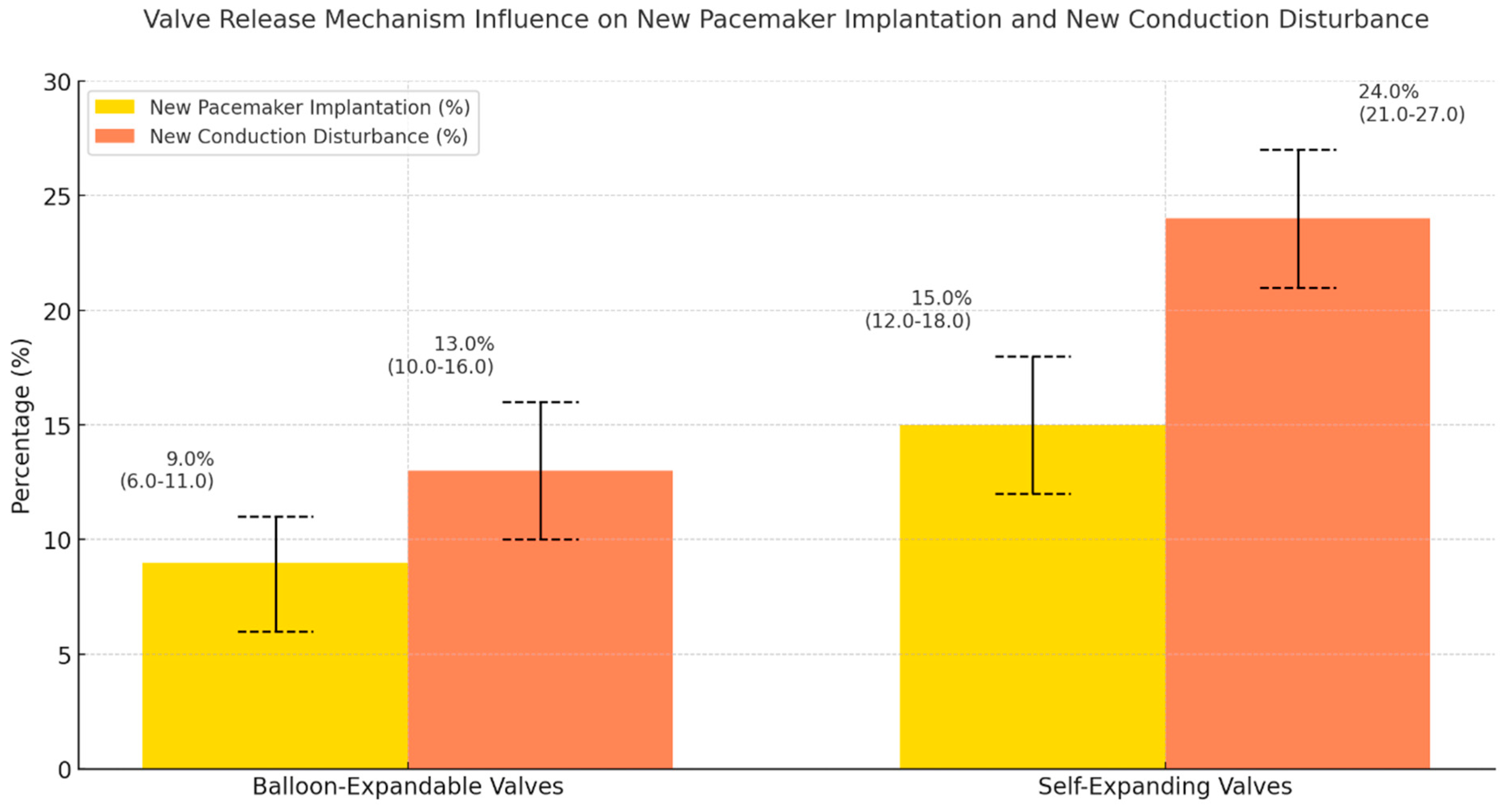
| self-expanding valves | 468/782 (59.9%) | 193/400 (48.3%) | |
| balloon-expandable valves | 314/782 (40.2%) | 207/400 (51.8%) | |
| Valve size | <0.001 | ||
| 20 mm | 0/782 (0.0%) | 3/400 (0.8%) | |
| 23 mm | 107/782 (13.7%) | 65/400 (16.3%) | |
| 25 mm | 2/782 (0.3%) | 9/400 (2.3%) | |
| 26 mm | 222/782 (28.4%) | 182/400 (45.5%) | |
| 27 mm | 1/782 (0.1%) | 11/400 (2.8%) | |
| 29 mm | 317/782 (40.5%) | 114/400 (28.5%) | |
| 34 mm | 133/782 (17.0%) | 16/400 (4.0%) | |
| Procedure Duration [min] | 53.08 (±21.4) | 44.12 (±17.9) | <0.001 |
| Contrast agent used [mL] | 88.32 (±30.7) | 79.05 (±33.4) | <0.001 |
| Post-procedural myocardial infarction | 3/782 (0.4%) | 1/400 (0.3%) | >0.90 |
| Stroke | 12/782 (1.5%) | 9/400 (2.3%) | 0.36 |
| ischaemic | 11/782 (1.4%) | 8/400 (2.0%) | 0.47 |
| haemorrhagic | 1/782 (0.1%) | 1/400 (0.3%) | >0.90 |
| undetermined | 8/782 (1.0%) | 2/400 (0.5%) | 0.51 |
| disabling | 4/782 (0.5%) | 7/400 (1.8%) | 0.05 |
| Vascular access site complications | 34/782 (3.6%) | 17/400 (4.5%) | 0.81 |
| major | 9/782 (1.2%) | 4/400 (1.0%) | >0.90 |
| minor | 25/782 (3.2%) | 13/400 (3.3%) | 0.75 |
| Characteristic | G1, Crude n/N (%)1 | G2, Crude n/N (%) 1 | IPTW-Adjusted OR (G2 vs. G1) 2 | 95% CI 2 | Weighted p-Value 2 |
|---|---|---|---|---|---|
| New conduction disturbance | 168/782 (21.5%) | 61/400 (15.3%) | 0.63 | 0.37–1.05 | 0.08 |
| Type conduction disturbance | |||||
| AVB I | 12/782 (1.5%) | 6/400 (1.5%) | 0.53 | 0.067–4.22 | 0.55 |
| AVB II | 5/782 (0.6%) | 2/400 (0.5%) | 1.74 | 0.19–16.2 | 0.63 |
| AVB III | 78/782 (10.0%) | 32/400 (8.0%) | 0.77 | 0.39–1.53 | 0.46 |
| SSS | 17/782 (2.2%) | 11/400 (2.8%) | 0.62 | 0.12–3.13 | 0.56 |
| LBBB | 74/782 (9.5%) | 16/400 (4.0%) | 0.36 | 0.14–0.91 | 0.03 |
| RBBB | 4/782 (0.5%) | 1/400 (0.3%) | 0.53 | 0.02–19.16 | 0.73 |
| SVT | 7/782 (0.9%) | 2/400 (0.5%) | 0.61 | 0.05–7.84 | 0.70 |
| Valve in valve | 22/782 (2.8%) | 13/400 (3.2%) | 1.53 | 0.55–4.22 | 0.41 |
| New pacemaker implantation | 102/782 (13.0%) | 41/400 (10.3%) | 0.72 | 0.39–1.35 | 0.31 |
| Post-procedural myocardial infarction | 3/782 (0.4%) | 1/400 (0.3%) | 0.53 | 0.02–19.16 | 0.73 |
| Procedure duration [min] | 53.08 (±21.4) | 44.12 (±17.9) | -- | -- | <0.001 |
| Contrast agent used [mL] | 88.32 (±30.7) | 79.05 (±33.4) | -- | -- | <0.001 |
| Stroke | 12/782 (1.5%) | 9/400 (2.3%) | 1.62 | 0.42–6.14 | 0.48 |
| ischaemic | 11/782 (1.4%) | 8/400 (2.0%) | 1.56 | 0.38–6.39 | 0.53 |
| haemorrhagic | 1/782 (0.1%) | 1/400 (0.3%) | 2.14 | 0.03–135.1 | 0.72 |
| undetermined | 8/782 (1.0%) | 2/400 (0.5%) | 0.53 | 0.04–6.72 | 0.63 |
| disabling | 4/782 (0.5%) | 7/400 (1.8%) | 3.79 | 0.65–22.07 | 0.14 |
| Vascular access site complications | 34/782 (3.6%) | 17/400 (4.5%) | 1.18 | 0.46–3.02 | 0.73 |
| major | 9/782 (1.2%) | 4/400 (1.0%) | 1.04 | 0.16–6.81 | 0.97 |
| minor | 25/782 (2.8%) | 13/400 (1.5%) | 1.23 | 0.42–3.58 | 0.71 |
3.3. Comparative Analysis of Valve Types
4. Discussion
5. Conclusions
Author Contributions
Funding
Institutional Review Board Statement
Informed Consent Statement
Data Availability Statement
Conflicts of Interest
Abbreviations
| AS | Aortic Stenosis |
| AVB | Atrioventricular Block |
| BE | Balloon-Expandable |
| CD | Conduction Disturbance |
| EP | Evolut PRO |
| ER | Evolut R |
| G1 | Older Generation of THV |
| G2 | Newer Generation of THV |
| LBBB | Left Bundle Branch Block |
| LCC | Left Coronary Cusp |
| LVOT | Left Ventricle Outflow Tract |
| PPMI | Permanent Pacemaker Implantation |
| PVL | Paravalvular Leak |
| RBBB | Right Bundle Branch Block |
| S3 | Sapien 3 |
| S3U | Sapien 3 Ultra |
| SE | Self-Expanding |
| TAVR | Transcatheter Aortic Valve Replacement |
| THV | Transcatheter Heart Valves, Transcatheter Aortic Prostheses |
References
- Leon, M.B.; Smith, C.R.; Mack, M.J.; Makkar, R.R.; Svensson, L.G.; Kodali, S.K.; Thourani, V.H.; Tuzcu, E.M.; Miller, D.C.; Herrmann, H.C.; et al. Transcatheter or surgical aortic-valve replacement in intermediate-risk patients. N. Engl. J. Med. 2016, 374, 1609–1620. [Google Scholar] [CrossRef] [PubMed]
- Reardon, M.J.; Van Mieghem, N.M.; Popma, J.J.; Kleiman, N.S.; Søndergaard, L.; Mumtaz, M.; Adams, D.H.; Deeb, G.M.; Maini, B.; Gada, H.; et al. Surgical or transcatheter aortic-valve replacement in intermediate-risk patients. N. Engl. J. Med. 2017, 376, 1321–1331. [Google Scholar] [CrossRef] [PubMed]
- Mack, M.J.; Leon, M.B.; Thourani, V.H.; Makkar, R.; Kodali, S.K.; Russo, M.; Kapadia, S.R.; Malaisrie, S.C.; Cohen, D.J.; Pibarot, P.; et al. Transcatheter aortic-valve replacement with a balloon-expandable valve in low-risk patients. N. Engl. J. Med. 2019, 380, 1695–1705. [Google Scholar] [CrossRef] [PubMed]
- Vahanian, A.; Beyersdorf, F.; Praz, F.; Milojevic, M.; Baldus, S.; Bauersachs, J.; Capodanno, D.; Conradi, L.; De Bonis, M.; De Paulis, R.; et al. 2021 ESC/EACTS Guidelines for the management of valvular heart disease. Eur. Heart J. 2022, 43, 561–632. [Google Scholar] [CrossRef]
- Otto, C.M.; Nishimura, R.A.; Bonow, R.O.; Carabello, B.A.; Erwin, J.P., 3rd; Gentile, F.; Jneid, H.; Krieger, E.V.; Mack, M.; McLeod, C.; et al. 2020 ACC/AHA Guideline for the management of patients with valvular heart disease. Circulation 2021, 143, e72–e227. [Google Scholar]
- Guerreiro, C.; Ferreira, P.C.; Teles, R.C.; Braga, P.; da Silva, P.C.; Patrício, L.; Silva, J.C.; Baptista, J.; de Sousa Almeida, M.; Ribeiro, V.G.; et al. Short- and long-term impact of TAVI in Portugal: National registry data. Rev. Port. Cardiol. (Engl. Ed.) 2020, 39, 705–717. [Google Scholar] [CrossRef]
- Arnold, S.V.; Lei, Y.; Reynolds, M.R.; Magnuson, E.A.; Suri, R.M.; Tuzcu, E.M.; Petersen, J.L.; Douglas, P.S.; Svensson, L.G.; Gada, H.; et al. Costs of periprocedural complications in TAVR. Circ. Cardiovasc. Interv. 2014, 7, 829–836. [Google Scholar] [CrossRef]
- Giustini, G.; Van der Boon, R.; Nicolas, J.; Dumonteil, N.; Chieffo, A.; de Jaegere, P.P.; Tchetche, D.; Marcheix, B.; Millischer, D.; Cassagneau, R.; et al. Impact of permanent pacemaker on mortality after TAVI: PRAGMATIC substudy. EuroIntervention 2016, 12, 1185–1193. [Google Scholar] [CrossRef]
- Boerlage-Van Dijk, K.; Kooiman, K.M.; Yong, Z.Y.; Wiegerinck, E.M.; Damman, P.; Bouma, B.J.; Tijssen, J.G.; Piek, J.J.; Knops, R.E.; Baan, J., Jr. Cardiac conduction disorders and pacing after TAVI. Pacing Clin. Electrophysiol. 2014, 37, 1520–1529. [Google Scholar] [CrossRef]
- Gomes, B.; Geis, N.A.; Chorianopoulos, E.; Meder, B.; Leuschner, F.; Katus, H.A.; Bekeredjian, R. Improved results with new-generation self-expanding TAVI prosthesis. J. Interv. Cardiol. 2017, 30, 72–78. [Google Scholar] [CrossRef]
- Edwards Lifesciences. Sapien 3 Ultra Transcatheter Heart Valve. 2019. Available online: https://www.edwards.com/healthcare-professionals/products-services/transcatheter-heart/transcatheter-sapien-3-ultra (accessed on 25 November 2025).
- Forrest, J.K.; Kaple, R.K.; Tang, G.H.L.; Yakubov, S.J.; Nazif, T.M.; Williams, M.R.; Zhang, A.; Popma, J.J.; Reardon, M.J. Three generations of self-expanding TAVs: Report from STS/ACC TVT Registry. JACC Cardiovasc. Interv. 2020, 13, 170–179. [Google Scholar] [CrossRef] [PubMed]
- Bharucha, A.H.; Kanyal, R.; Mullen, M.; Patel, K.; Smith, D.; Shome, J.; Blackman, D.J.; Aktaa, S.; Williams, P.D.; Khogali, S.; et al. TAVR with the Navitor system: Real-world UK experience. Am. J. Cardiol. 2024, 222, 23–28. [Google Scholar] [CrossRef] [PubMed]
- Cerrato, E.; Nombela-Franco, L.; Nazif, T.M.; Eltchaninoff, H.; Søndergaard, L.; Ribeiro, H.B.; Barbanti, M.; Nietlispach, F.; De Jaegere, P.; Agostoni, P.; et al. Evaluation of global TAVI practice: WRITTEN survey. Int. J. Cardiol. 2017, 228, 640–647. [Google Scholar] [CrossRef] [PubMed]
- Mendiz, O.A.; Noč, M.; Fava, C.M.; Gutiérrez Jaikel, L.A.; Sztejfman, M.; Pleskovič, A.; Gamboa, P.; Valdivieso, L.R.; Gada, H.; Tang, G.H.L. Impact of cusp-overlap view for TAVR with self-expandable valves on 30-day conduction disturbances. J. Interv. Cardiol. 2021, 2021, 9991528. [Google Scholar] [CrossRef]
- Chesnaye, N.C.; Stel, V.S.; Tripepi, G.; Dekker, F.W.; Fu, E.L.; Zoccali, C.; Jager, K.J. Introduction to inverse probability of treatment weighting in observational research. Clin. Kidney J. 2022, 15, 14–20. [Google Scholar] [CrossRef]
- Bagur, R.; Rodes-Cabau, J.; Gurvitch, R.; Dumont, É.; Velianou, J.L.; Manazzoni, J.; Toggweiler, S.; Cheung, A.; Ye, J.; Natarajan, M.K.; et al. Need for permanent pacemaker after TAVI vs SAVR. JACC Cardiovasc. Interv. 2012, 5, 540–551. [Google Scholar] [CrossRef]
- Nijhoff, F.; Abawi, M.; Agostoni, P.; Ramjankhan, F.Z.; Doevendans, P.A.; Stella, P.R. TAVI with Sapien 3 vs Sapien XT: Matched comparison. Circ. Cardiovasc. Interv. 2015, 8, e002212. [Google Scholar]
- Abdel-Wahab, M.; Mehilli, J.; Frerker, C.; Neumann, F.J.; Kurz, T.; Tölg, R.; Zachow, D.; Guerra, E.; Massberg, S.; Schäfer, U.; et al. Balloon-expandable vs self-expandable valves: CHOICE trial. JAMA 2014, 311, 1503–1514. [Google Scholar] [CrossRef]
- Manoharan, R.K.; Rodes-Cabau, J.; Wood, D.A.; Mok, M.; Leipsic, J.; De Larochellière, R.; Toggweiler, S.; Dumont, E.; Freeman, M.; Willson, A.B.; et al. TAVR with the Sapien 3 valve. JACC Cardiovasc. Interv. 2013, 6, 293–300. [Google Scholar]
- Athappan, G.; Patvardhan, E.; Tuzcu, E.M.; Svensson, L.G.; Lemos, P.A.; Fraccaro, C.; Tarantini, G.; Sinning, J.M.; Nickenig, G.; Capodanno, D.; et al. Aortic regurgitation after TAVR: Meta-analysis. J. Am. Coll. Cardiol. 2013, 61, 1585–1595. [Google Scholar] [CrossRef]
- Manoharan, G.; Walton, A.S.; Brecker, S.J.; Pasupati, S.; Blackman, D.J.; Qiao, H.; Meredith, I.T.; Gogas, B.; Mullen, M.; El-Jawahri, A.; et al. Novel supra-annular self-expanding TAVI system. JACC Cardiovasc. Interv. 2015, 8, 1359–1367. [Google Scholar] [CrossRef]
- Herrmann, H.C.; Thourani, V.H.; Kodali, S.K.; Makkar, R.R.; Szeto, W.Y.; Anwaruddin, S.; Desai, N.; Lim, S.; Malaisrie, S.C.; Kereiakes, D.J.; et al. One-year outcomes with Sapien 3 in high-risk TAVR. Circulation 2016, 134, 130–140. [Google Scholar] [CrossRef]
- Smith, C.R.; Leon, M.B.; Mack, M.J.; Miller, D.C.; Moses, J.W.; Svensson, L.G.; Tuzcu, E.M.; Webb, J.G.; Fontana, G.P.; Makkar, R.R.; et al. TAVR vs SAVR in high-risk patients. N. Engl. J. Med. 2011, 364, 2187–2198. [Google Scholar] [CrossRef]
- Minha, S. Pacemaker rates: First- vs second-generation TAVI. Catheter. Cardiovasc. Interv. 2021, 98, E648–E655. [Google Scholar] [CrossRef]
- Nazif, T.M.; Dizon, J.M.; Hahn, R.T.; Xu, K.E.; Babaliaros, V.; Douglas, P.S.; El-Chami, M.F.; Herrmann, H.C.; Mack, M.; Makkar, R.R.; et al. Predictors of permanent pacemaker after TAVR: PARTNER trial. JACC Cardiovasc. Interv. 2015, 8 Pt A, 60–69. [Google Scholar] [CrossRef] [PubMed]
- Fujita, B.; Schmidt, T.; Bleiziffer, S.; Bauer, T.; Beckmann, A.; Bekeredjian, R.; Möllmann, H.; Walther, T.; Landwehr, S.; Hamm, C.; et al. Pacemaker implantation after TAVR vs SAVR: 1-year outcome. Eur. J. Cardiothorac. Surg. 2020, 57, 151–159. [Google Scholar] [CrossRef] [PubMed]
- Mohananey, D.; Jobanputra, Y.; Kumar, A.; Krishnaswamy, A.; Mick, S.; White, J.M.; Kapadia, S.R. Clinical and echocardiographic outcomes following PPM after TAVR: Meta-analysis. Circ. Cardiovasc. Interv. 2017, 10, e005046. [Google Scholar] [CrossRef]
- Urena, M.; Webb, J.G.; Tamburino, C.; Muñoz-García, A.J.; Cheema, A.; Dager, A.E.; Serra, V.; Amat-Santos, I.J.; Barbanti, M.; Immè, S.; et al. Permanent pacemaker after TAVI: Long-term outcomes. Circulation 2014, 129, 1233–1243. [Google Scholar] [CrossRef]
- Chamandi, C.; Barbanti, M.; Munoz-Garcia, A.; Latib, A.; Nombela-Franco, L.; Gutiérrez-Ibanez, E.; Veiga-Fernandez, G.; Cheema, A.N.; Cruz-Gonzalez, I.; Serra, V.; et al. Long-term outcomes of new permanent pacemaker after TAVR. JACC Cardiovasc. Interv. 2018, 11, 301–310. [Google Scholar] [CrossRef]
- Tops, L.F.; Schalij, M.J.; Bax, J.J. Effects of right ventricular apical pacing on ventricular dyssynchrony. J. Am. Coll. Cardiol. 2009, 54, 764–776. [Google Scholar] [CrossRef]
- Curtis, A.B. Biventricular pacing for AV block and systolic dysfunction. N. Engl. J. Med. 2013, 369, 579–580. [Google Scholar]
- Tang, G.H.L.; Zaid, S.; Michev, I.; Ahmad, H.; Kaneko, T.; Undemir, C.; Babaliaros, V.; Leon, M.B.; Kodali, S.; Nazif, T.M.; et al. ‘Cusp-overlap’ view simplifies SE valve implantation. JACC Cardiovasc. Interv. 2018, 11, 1663–1665. [Google Scholar] [CrossRef]
- Jilaihawi, H.; Zhao, Z.; Du, R.; Staniloae, C.; Saric, M.; Neuburger, P.J.; Querijero, M.; Vainrib, A.; Hisamoto, K.; Ibrahim, H.; et al. Minimising permanent pacemaker following repositionable SE TAVR. JACC Cardiovasc. Interv. 2019, 12, 1796–1807. [Google Scholar] [CrossRef]


| Company | Older Generation (G1) | Newer Generation (G2) |
|---|---|---|
| Edwards Lifesciences (Irvine, CA, USA) |  |  |
| Sapien 3 (Edwards Lifesciences) Mechanism: BEV New Characteristics: Notable for its transformational design with a sealing skirt to reduce PVL, optimised for ease of use and enhanced sealing. Previous Version: SAPIEN XT | Sapien 3 Ultra (Edwards Lifesciences) Mechanism: BEV New Characteristics: Enhanced outer skirt to prevent PVL, crucial for severe AS. New material for improved biocompatibility and sealing. Previous Version: SAPIEN 3 | |
| 1-Edwards Lifesciences 2-Abbot (Chicago, IL, USA) |  |  |
| 1- Centera (Edwards Lifesciences) Mechanism: SEV New Characteristics: Motorised delivery system for simple, time-efficient procedures. Ultra-low profile for easy navigation. Previous version: new development | 1- Navitor (Abbott) Mechanism: SEV New Characteristics: NaviSealTM Cuff for dynamic sealing, minimising leakage. Designed for immediate function and future coronary access. Previous Version: Portico System | |
| Medtronic (Minneapolis, MN, USA) |  |  |
| CoreValve Evolut R (Medtronic) Mechanism: SEV New Characteristics: Conforming nitinol frame for better sealing. Recapture and repositioning capability for optimal deployment. Previous Version: CoreValve system | CoreValve Evolut PRO (Medtronic) Mechanism: SEV New Characteristics: External tissue wrap for increased sealing contact, advanced frame design to reduce PVL. Previous Version: Evolut R system | |
| Boston Scientific (Marlborough, MA, USA) |  Acurate Neo (Boston Scientific) Acurate Neo (Boston Scientific)Mechanism: SEV New Characteristics: Designed to simplify the procedure with a stable deployment mechanism, aims to reduce PVL. Previous version: new development |  Acurate Neo2 (Boston Scientific) Acurate Neo2 (Boston Scientific)Mechanism: SEV New Characteristics: Active PVsealTM technology for enhanced sealing. Precise placement system with dual anchoring. Open-frame design for future interventions. Previous Version: Acurate Neo |
Disclaimer/Publisher’s Note: The statements, opinions and data contained in all publications are solely those of the individual author(s) and contributor(s) and not of MDPI and/or the editor(s). MDPI and/or the editor(s) disclaim responsibility for any injury to people or property resulting from any ideas, methods, instructions or products referred to in the content. |
© 2025 by the authors. Licensee MDPI, Basel, Switzerland. This article is an open access article distributed under the terms and conditions of the Creative Commons Attribution (CC BY) license (https://creativecommons.org/licenses/by/4.0/).
Share and Cite
Salem, M.; Laing, P.; Kühling-thees, I.; Kasper, W.; Voran, J.; Seoudy, H.; Rangel, R.; Frank, J.; Frank, D.; Saad, M. Incidence of Post-Procedural Conduction Disturbances and Rates of Permanent Pacemaker Implantation in Older and Newer Generations of Transcatheter Aortic Heart Valves. Med. Sci. 2025, 13, 296. https://doi.org/10.3390/medsci13040296
Salem M, Laing P, Kühling-thees I, Kasper W, Voran J, Seoudy H, Rangel R, Frank J, Frank D, Saad M. Incidence of Post-Procedural Conduction Disturbances and Rates of Permanent Pacemaker Implantation in Older and Newer Generations of Transcatheter Aortic Heart Valves. Medical Sciences. 2025; 13(4):296. https://doi.org/10.3390/medsci13040296
Chicago/Turabian StyleSalem, Mostafa, Philipp Laing, Insa Kühling-thees, Wiebke Kasper, Jakob Voran, Hatim Seoudy, Rafael Rangel, Johanne Frank, Derk Frank, and Mohammed Saad. 2025. "Incidence of Post-Procedural Conduction Disturbances and Rates of Permanent Pacemaker Implantation in Older and Newer Generations of Transcatheter Aortic Heart Valves" Medical Sciences 13, no. 4: 296. https://doi.org/10.3390/medsci13040296
APA StyleSalem, M., Laing, P., Kühling-thees, I., Kasper, W., Voran, J., Seoudy, H., Rangel, R., Frank, J., Frank, D., & Saad, M. (2025). Incidence of Post-Procedural Conduction Disturbances and Rates of Permanent Pacemaker Implantation in Older and Newer Generations of Transcatheter Aortic Heart Valves. Medical Sciences, 13(4), 296. https://doi.org/10.3390/medsci13040296