
Article

Plagioclase Zoning and Sr Isotopes Constrain Mush–Magma Mixing in the Late Triassic Xiuyan Granitic Pluton, East China
1
Key Laboratory of the Northern Qinghai–Tibet Plateau Geological Processes and Mineral Resources, Qinghai Geological Survey Institute, Xining 810012, China
2
State Key Laboratory of Deep Earth Processes and Resources, Guangzhou Institute of Geochemistry, Chinese Academy of Sciences, Guangzhou 510640, China
3
Jiangxi Province Key Laboratory of Exploration and Development of Critical Mineral Resources, Jiangxi Geological Survey and Exploration Institute, Nanchang 330009, China
*
Authors to whom correspondence should be addressed.
Geosciences 2026, 16(3), 91; https://doi.org/10.3390/geosciences16030091
Submission received: 5 January 2026 / Revised: 12 February 2026 / Accepted: 18 February 2026 / Published: 24 February 2026
(This article belongs to the Section Geochemistry)

Abstract

Mafic microgranular enclaves (MMEs) are widespread in granitic plutons and provide valuable insights into mush–magma mixing processes in crustal magma reservoirs. In this study, we characterize chemical zoning and Sr isotopic compositions of plagioclase in the MMEs, gabbro and host monzogranite from the Late Triassic Xiuyan pluton in East China, to constrain the origin of MMEs and the role of crystal mushes in magma mixing. The MMEs in the Xiuyan pluton are angular and range from centimeters to several meters in size. They exhibit sharp contacts with the host monzogranite and show diverse disequilibrium textures. Plagioclase in MMEs occurs as fine-grained antecryst with normal zoning (An46–66 in the core and An17–29 in the rim). The cores are commonly characterized by coarse sieve textures, patchy zoning, and resorption surfaces at core–rim boundaries. In situ Sr isotopic compositions show subtle but systematic core–rim variations, with (87Sr/86Sr)i increasing slightly from cores (~0.70639) to rims (~0.70664), and rim values overlapping the whole-rock (87Sr/86Sr)i of MMEs. These features suggest that the rim was crystallized from locally hybridized melts produced by interaction between interstitial melts in a basaltic mush and granitic magma. Plagioclase in the gabbro occurs as medium-grained phenocryst with normal zoning (An46–65 in the core and An18–27 in the rim) but shows nearly homogeneous (87Sr/86Sr)i across individual grains (0.70612–0.70637), comparable to whole-rock gabbro values of 0.70623. The plagioclase cores in gabbro also show coarse sieve texture and patchy zoning with the resorption surface in the margin of the core and rim. We interpret the sieve textures in plagioclase cores from both MMEs and gabbro to record partial dissolution during rapid ascent and decompression of an initially H2O-undersaturated, crystal-bearing basaltic magma, during which increased effective water activity reduced plagioclase stability prior to the growth of the rim. Plagioclase in the host monzogranite is medium- to coarse-grained, compositionally homogeneous, and characterized by low An contents (An12–24) and elevated (87Sr/86Sr)i of ~0.70828. We propose that MMEs in the Xiuyan pluton formed when semi-consolidated mafic mush was mechanically disaggregated into angular fragments and subsequently entrained into coexisting granitic melt. This study reveals that MMEs formed by mechanical disaggregation of a semi-consolidated mafic mush into angular fragments, followed by their entrainment into the granitic melts.

1. Introduction

The generation, storage, and chemical differentiation of crustal magmas have long been considered to occur within melt-dominated magma chambers [1]. Over the past three decades, however, growing evidence indicates that most crustal magmas are stored in crystal-rich reservoirs, commonly referred to as magma mushes [2,3,4]. A magma mush is characterized by a mechanically coherent framework of >55 vol.% crystals permeated by interconnected interstitial melt [5,6]. The interstitial melt can migrate through the crystal framework under pressure gradients and accumulate in low-pressure regions [7]. As the melt fraction decreases to below ~20%, crystal contacts tighten, melt connectivity diminishes, and the mush progressively solidifies [8,9]. In this context, infiltration of external melts represents an efficient mechanism for reheating, rejuvenating, and chemically modifying crystal mushes [10,11].
Field observations indicate that interactions between mafic mushes and granitic magmas play a critical role in magma mixing and the evolution of granitic systems [6]. Such interactions typically involve crystal-laden magmas of contrasting compositions, followed by late-stage reactions between crystals and residual melts during continued framework growth [12]. Based on extensive studies of mafic microgranular enclaves (MMEs) in granitic plutons, four end-member modes of interaction between magma mushes and host granitic magmas have been identified [6]. These include: (1) magma–magma interaction between fully molten enclaves and host magmas; (2) mush–magma mixing involving exchange between interstitial melt in a crystal mush and surrounding granitic melt; (3) mechanical disaggregation of mushy enclaves formed elsewhere and transported as solid or sub-solid fragments; and (4) in situ mechanical mixing in layered intrusions where mafic fragment mixing with granitic mushes. Collectively, these processes represent the principal mechanisms responsible for the formation of MMEs in granitic systems.
MMEs are typically characterized by sharp contacts with host rocks, and a variety of disequilibrium mineral assemblages [13,14,15,16,17,18,19,20,21,22,23,24,25,26,27]. These features commonly include acicular apatite and amphibole, resorbed and sieved plagioclase, and quartz ocelli, reflecting rapid quenched and chemical disequilibrium during interaction between basaltic and granitic magmas [28]. Such textural characteristics indicate that MMEs preserve short-lived, dynamic processes associated with magma recharge, mixing, and mush disaggregation, and thus provide valuable records of basaltic magma involvement in the evolution of granitic systems [29]. Such processes can be decoded from complex textures of antecryst, i.e., the crystal was recycled one or several times before being incorporated into the host magma but originated from somewhere within the magmatic system [30].
Plagioclase is an effective recorder of magma mixing and differentiation processes, as its crystallization responds sensitively to variations in melt composition, temperature, pressure, and water content, while slow CaAl–NaSi diffusion allows internal chemical zoning to be preserved [31,32,33,34,35]. As a result, plagioclase in open magmatic systems commonly develops complex internal zoning patterns, including normal and reverse zoning, oscillatory zoning, patchy zoning, sieve textures, and resorption surfaces, which collectively record multistage histories of crystal growth and dissolution [33,36,37,38,39,40]. Moreover, strontium (Sr) is compatible in plagioclase, allowing for precise in situ determination of Sr isotopic compositions across individual crystals and providing additional constraints on magma mixing, recharge, and differentiation processes [41,42,43].
In this study, we investigate the chemical zoning patterns and in situ Sr isotopic compositions of plagioclase in MMEs, gabbro and host monzogranite from the Late Triassic Xiuyan pluton in East China. The results show that plagioclase grains in MMEs record growth in both basaltic mushes and granitic interstitial melts, and that the MMEs formed through mechanical disaggregation of semi-consolidated mafic mush into angular fragments followed by entrainment and quenching within granitic magma.

2. Geological Setting

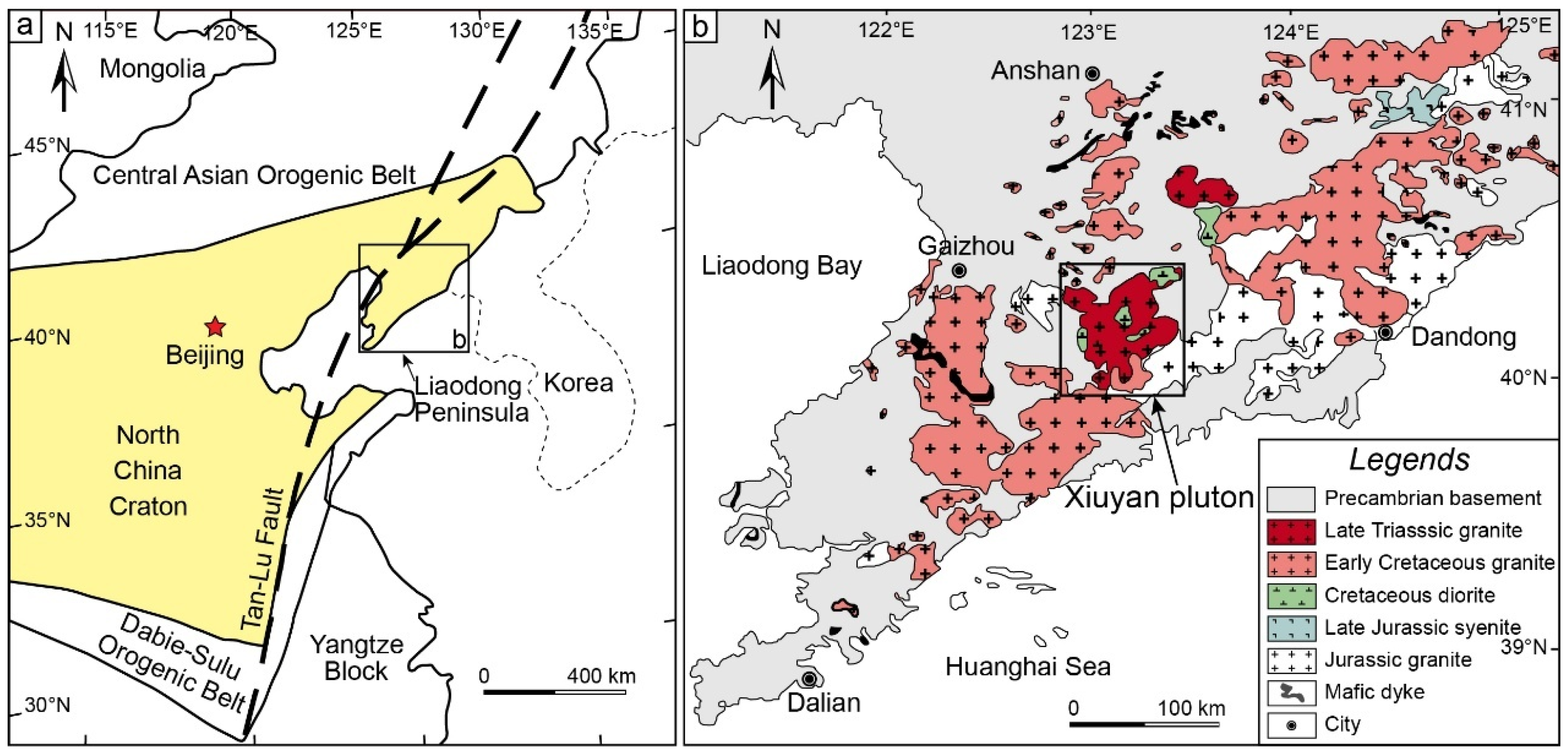
The North China Craton (NCC) in eastern China is bounded to the north by the Central Asian Orogenic Belt (CAOB), to the west by the Qilian Orogenic Belt, and to the south by the Dabie-Sulu Orogenic Belts (Figure 1a; [44]). The NCC basement is dominated by Neoarchean tonalite–trondhjemite–granodiorite (TTG) suites and supracrustal sequences, with minor Eoarchean material evidenced by 3.80–3.85 Ga detrital zircons from the Caozhuang metaquartzite and ~3.8 Ga zircon population interpreted as the protolith age of gneiss in the Anshan Complex [45,46,47]. These units are overlain by Mesoproterozoic–Neoproterozoic and Paleozoic sedimentary successions [48]. During the Mesozoic, the NCC experienced extensive cratonic destruction, expressed by voluminous magmatism and metallogeny, the emergence of metamorphic core complexes, and the development of sedimentary basins [49,50,51,52].
Within the eastern NCC, the Liaodong Peninsula exposes Archean–Paleoproterozoic basement overlain by unmetamorphosed Mesoproterozoic–Neoproterozoic and Paleozoic sedimentary–volcanic successions (Figure 1a; [53]). Early Archean crust (3.85–3.2 Ga), Late Archean diorite–tonalite–granodiorite intrusions (~2.50 Ga), and Paleo-Proterozoic Liaohe Group (~1.93 Ga) mark the cratonization of the eastern NCC [54]. The region was later covered by thick Meso–Neoproterozoic and Paleozoic strata and intruded by Paleozoic kimberlites, Late Triassic nepheline syenites, and Cenozoic gabbros. Regionally extensive Mesozoic intrusions can be divided into three stages: (1) Late Triassic (231–210 Ma) gabbro–diorite–monzogranite, commonly containing MMEs; (2) Jurassic (180–153 Ma) granodiorite–diorite and syn- to post-tectonic biotite monzogranite; and (3) Early Cretaceous (131–120 Ma) diorite–granodiorite–monzogranite–syenogranite. The Jurassic–Early Cretaceous episode is widely linked to lithospheric thinning beneath the NCC [55].
The Xiuyan pluton is a composite intrusive body that consists of monzogranite to granodiorite with associated mafic rocks (e.g., gabbro) and abundant MMEs [56]. Zircon U–Pb geochronology indicates Late Triassic emplacement of the monzogranite (~210 Ma), with essentially coeval ages for leuco-monzogranite and MMEs, implying synchronous interaction between basaltic and granitic magmas [57].
Figure 1. (a) A simplified geological map of the North China Craton (modified after [51]). (b) A simplified geological map of the Liaodong Peninsula showing the location of the Xiuyan pluton (modified after [58]).
Geosciences 16 00091 g001

3. Petrography

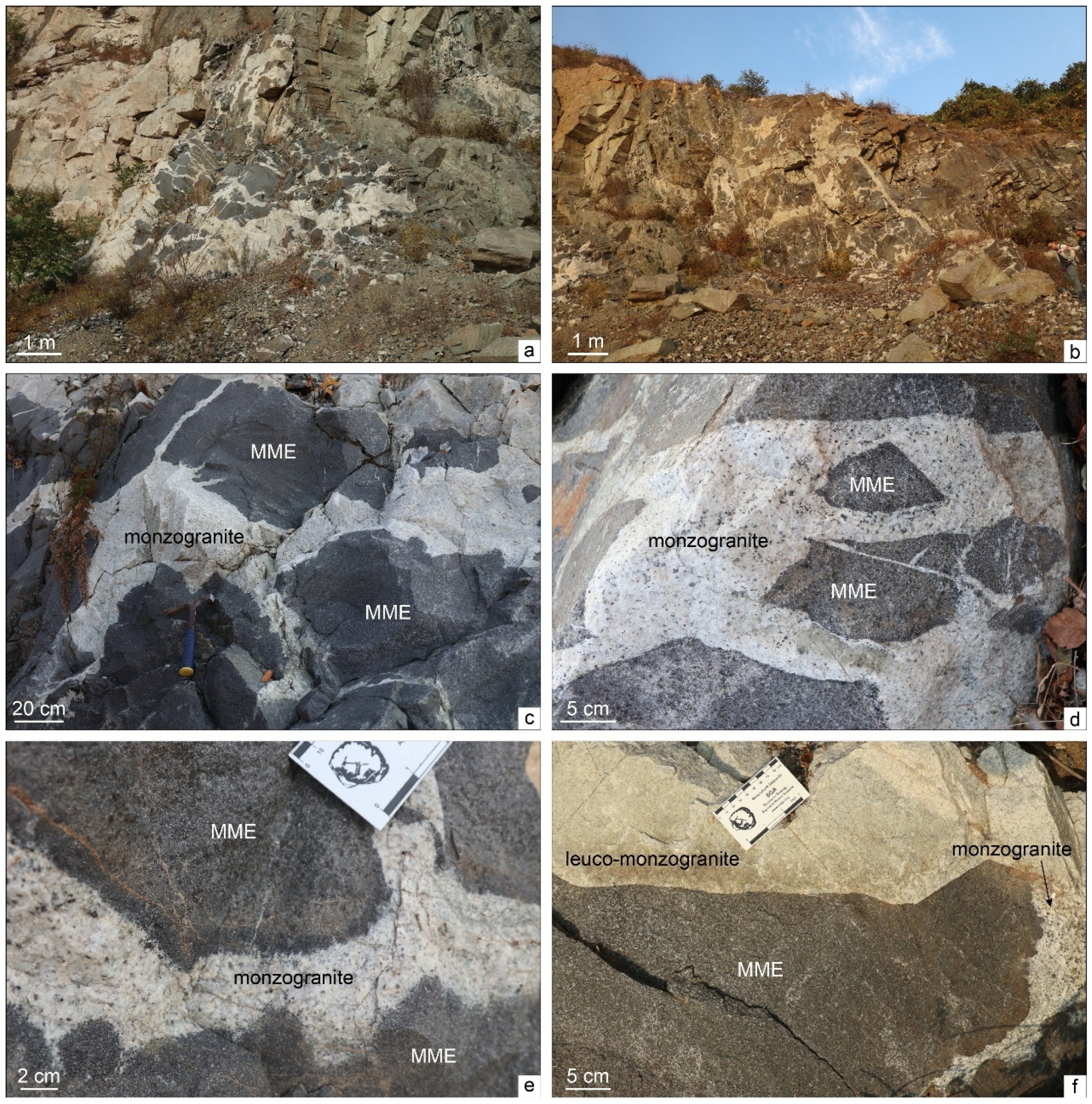
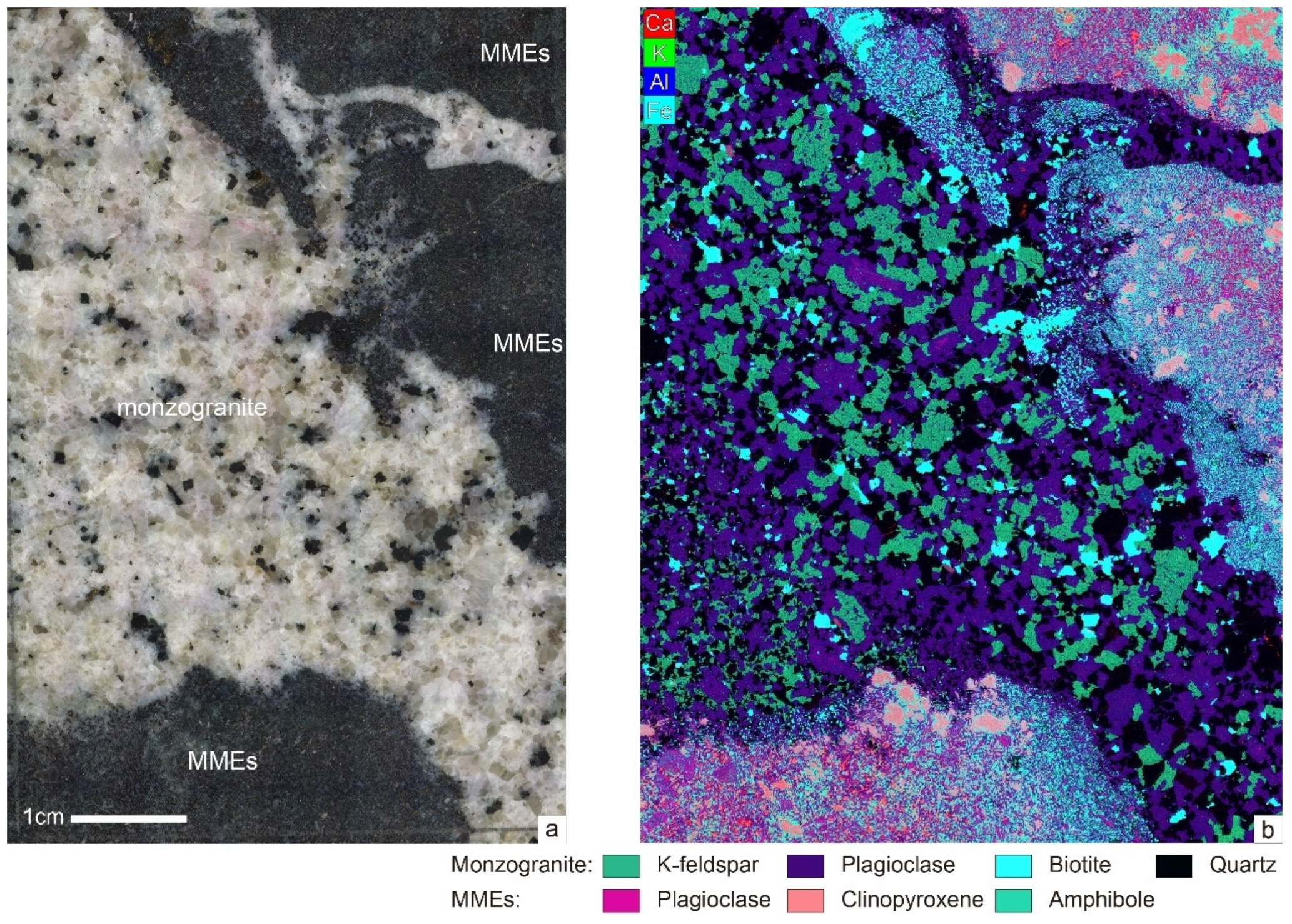
The Xiuyan pluton consists mainly of host monzogranite and abundant local MMEs (Figure 2a,b). MMEs are ubiquitous, ranging from centimeters to several meters in size. They exhibit sharp contacts with the host monzogranite, angular in shapes, and commonly form tapering, vein swarms that taper and terminate within the host monzogranite (Figure 2c,d). Some MMEs display saw-tooth contacts with the host monzogranite (Figure 2c), and narrow monzogranite veins penetrate MMEs’ interiors (Figure 2d). MMEs commonly show fine-grained chilled margins along their contacts with the host monzogranite, which appear as dark rims in hand specimens and grade inward to coarser-grained interiors (Figure 2e and Figure 3). Although MMEs, gabbro, host monzogranite, and leuco-monzogranite were broadly contemporaneous ca. 210 Ma [57], petrographic observations show that leuco-monzogranite is in planar contact with both MMEs and the host monzogranite (Figure 2f), suggesting that monzogranite intruded through and reacted with MMEs before the emplacement of leuco-monzogranite.
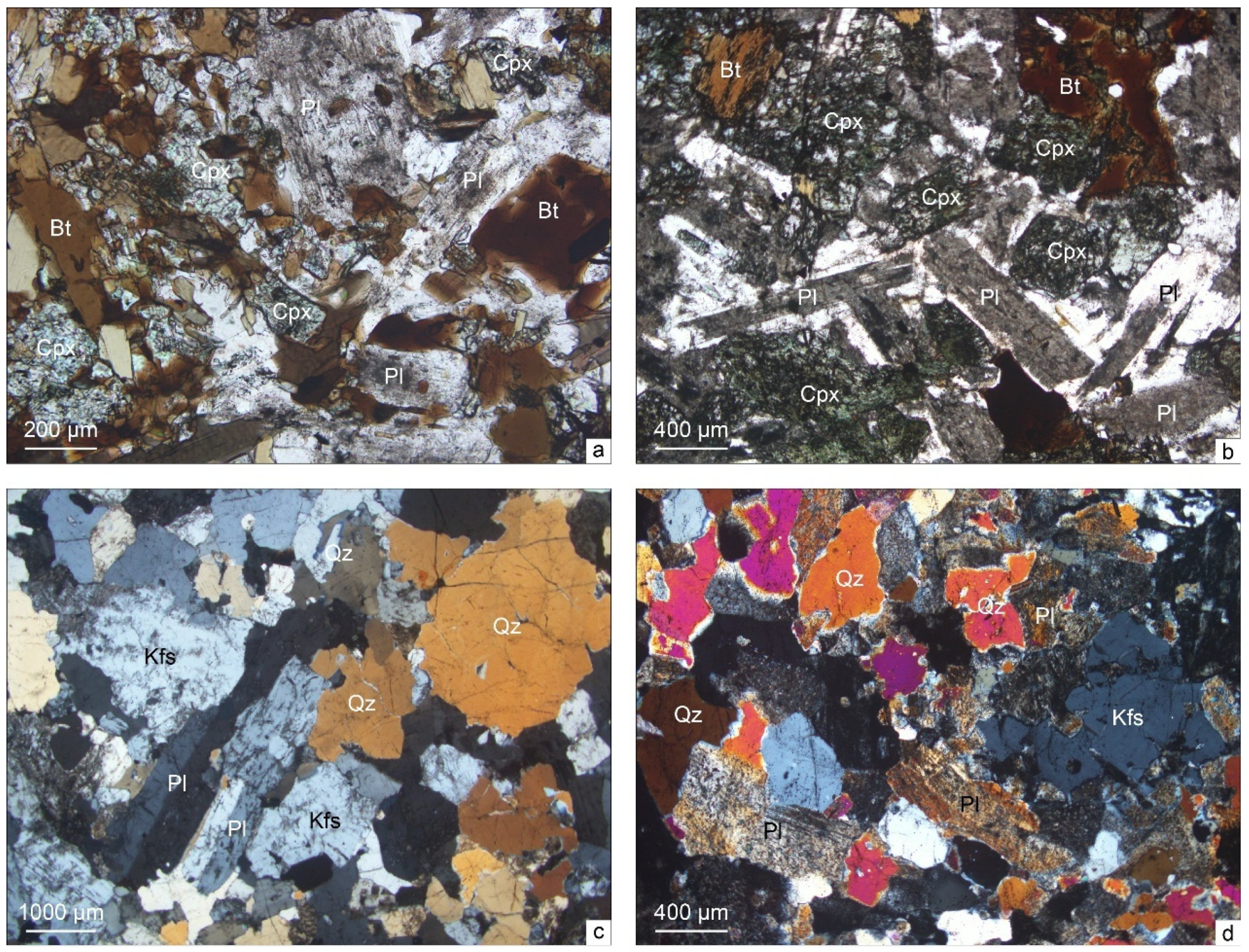
MMEs are generally fine-grained, although locally they become slightly coarser-grained with interlocking crystal aggregates (Figure 4a). MMEs consist of phenocryst (~70 vol.%) and fine-grained matrix (~30 vol.%). The phenocrysts include plagioclase (~30 to 35 vol.%), clinopyroxene (~20 to 25 vol.%), and biotite (~15 to 20 vol.%). The matrix consists of plagioclase (5 to 10 vol.%), clinopyroxene (5 to 10 vol.%), biotite (5 to 10 vol.%), and quartz (~5 vol.%), with minor acicular apatite, titanite and zircon (Figure 4a).
The gabbro is medium- to coarse-grained and holocrystalline, showing an equigranular granular texture with euhedral clinopyroxene and subhedral to euhedral plagioclase, and exhibits higher degrees of alteration than MMEs (Figure 4b). It consists of 40–45 vol.% clinopyroxene, 35–40 vol.% plagioclase, 15–20 vol% biotite, with minor amounts of amphibole and Fe–Ti oxides (Figure 4b).
The host monzogranite is hypidiomorphic, has a coarse-grained texture and is composed of 35–40 vol.% plagioclase, 30–35 vol.% K-feldspar, 20–30 vol% quartz, with minor amounts of biotite, zircon, apatite, and Fe–Ti oxides (Figure 4c). The leuco-monzogranite is composed of 35–40 vol.% plagioclase, 30–35 vol.% K-feldspar, 20–30 vol% quartz, with minor amounts of biotite, zircon, apatite, and Fe–Ti oxides (Figure 4d), but it is finer grained and more altered than the host monzogranite.

4. Analytical Methods

4.1. Elemental Mapping

Large-area (5 × 7 cm) multi-element mapping was acquired from polished rock slab containing MMEs and monzogranite using a SIGRAY AttoMap™-310 microbeam X-ray fluorescence (micro-XRF) (Sigray, Inc., Benicia, CA, USA) at the State Key Laboratory of Deep Earth Processes and Resources, Guangzhou Institute of Geochemistry, Chinese Academy of Sciences (GIGCAS). Analyses employed the Rh target at 45 kV and 550 μA to generate the primary X-rays, which optimally excite high-intensity Kα lines of Ca, K, Al, and Fe in a single scan. Elemental maps were collected in Fly Scan mode with a 35 μm spot on a 35 μm raster with dwell times of 50 ms per pixel.
Two-dimensional (2-D) elemental intensity mapping of plagioclase was conducted on a JEOL JXA-8230 electron probe micro-analyzer (EPMA) (JEOL, Ltd., Akishima, Tokyo, Japan) at the same laboratory. The operation conditions were 20 kV accelerating voltage, 100 nA probe current, 2 μm beam size, and a dwell time of 90 ms. Al Kα and Na Kα were analyzed using a TAP crystal, Ca Kα was analyzed using a PETJ crystal.

4.2. Whole-Rock Major and Trace Element and Sr-Nd Isotope Analyses

Whole-rock major and trace elements were analyzed at the Guangzhou Aoshi Mineral Laboratory (Guangzhou, China). Whole-rock major oxide analysis was carried out using a PANalytical PW2424 scanning wavelength dispersive X-ray fluorescence (XRF) (Malvern Panalytical Ltd., Almelo, The Netherlands). Geological Survey and Chinese national standards GB07105, NCSDC47009 and SARM-4 were chosen to calibrate major element concentrations of the samples analyzed. The relative uncertainties for major elements were lower than 5%.
Whole-rock trace element concentrations were determined by Agilent 7900 inductively coupled plasma mass spectrometry (ICP-MS). Approximately 50 mg of the powdered sample were digested in steel-jacketed Teflon bombs with 1.5 mL HF, 1.5 mL HNO3 and 0.01 mL HClO4. The digest was evaporated to dryness and then refluxed with 1 mL HF and 0.5 mL HNO3 at 190 °C for 12 h in an electric oven. After cooling, 1 mL of Rh solution was added as an internal standard, and the solution was evaporated at 150 °C. The residue was taken up in 1 mL of HNO3 and dried, and this dissolution–drying procedure was repeated twice. The final residue was re-dissolved by adding 8 mL of HNO3, and the bombs were resealed and heated at 110 °C for 3 h on a hot plate. The resulting solution was diluted to 100 mL with distilled deionized water. Geological Survey and Chinese national standards GBM321-8, MRGeo08, OREAS-25a, OREAS-45h, OREAS-100a, OREAS-120 and SY-4 were chosen to calibrate trace element concentrations of the samples analyzed. Relative accuracy is better than 5% for most trace elements.
Whole-rock Sr-Nd isotopic analyses were conducted in a Finnigan MAT 262 mass-spectrometer (Finnigan Instrument Corporation, Aurora, CO, USA) for solution at the University of Science and Technology of China. Approximately 150 mg of whole-rock powder was completely digested in a mixture acid of HF, HNO3, and HClO4 at 120 °C for 7 days. After complete dissolution, 6 N HCl was added to convert the fluoride salts to chloride salts, followed by evaporation to dryness. The residue was re-dissolved in 1 mL 3 N HCl, and Rb, Sr, Sm, and Nd were purified using a two-step ion exchange chromatography procedure. The 87Sr/86Sr and 143Nd/144Nd ratios were normalized to 86Sr/88Sr = 0.1194 and 146Nd/144Nd = 0.7219, respectively. The Sr standard (NBS987) and Nd standard (JNdi-1) yielded 87Sr/86Sr = 0.710285 ± 11 (n = 2) and 143Nd/144Nd = 0.512101 ± 5 (n = 2), respectively. The major and trace elemental compositions, along with the Sr-Nd isotopic compositions of the samples, are provided in Supplementary Materials, Table S1.

4.3. Major Oxide Compositions of Plagioclase

Major-element oxide concentrations of plagioclase were determined by the same EPMA at the same laboratory. Analytical conditions were an accelerating voltage of 15 kV, a beam current of 20 nA, and a focused beam diameter of 2 μm beam. Counting times for peak, upper and lower background were set to be 40, 20 and 20 s for Ti, Mn and Mg; 20, 10 and 10 s for Si, Fe, Ca and Al; and 10, 5 and 5 s for K and Na, respectively. All elements were analyzed measured on their Kα X-ray lines. American SPI standards used for primary calibration were plagioclase and Cr-diopside for Si, rutile for Ti, almandine for Al, magnetite for Fe, rhodonite for Mn, olivine for Mg, Cr-diopside for Ca, albite for Na and orthoclase for K. All data were processed with ZAF correction, and the element detection limit was 0.01%. The major oxide compositions of plagioclase are provided in Supplementary Materials, Table S2.

4.4. InSitu Sr Isotope of Plagioclase

In situ Sr isotopic compositions of plagioclase were measured by a NEPTUNE Plus multi-collector (MC)-ICP-MS (Thermo Fisher Scientific Inc., Waltham, MA, USA) coupled with a 193 nm ArF excimer laser system (LA-MC-ICP-MS) at the Institute of Geology and Geophysics, Chinese Academy of Sciences. Before laser analyses, the MC-ICP-MS was tuned using a Sr standard solution to maximize sensitivity. For Sr isotopic data acquisition, 60 µm laser spot size for plagioclase in MMEs and gabbro and 120 µm for plagioclase in the host monzogranite, a 6 Hz repetition rate, and an energy density of ~6 J/cm2 were employed. Two reference materials (BIL1 and BIL2) were measured after every ten samples for external calibration. Data reduction procedures followed the methods described in [59,60]. The Sr isotopic compositions of plagioclases and the measured and recommended values of the reference materials are provided in Supplementary Materials, Table S3.

5. Results

5.1. Whole-Rock Major and Trace Elemental and Sr–Nd Isotopic Compositions

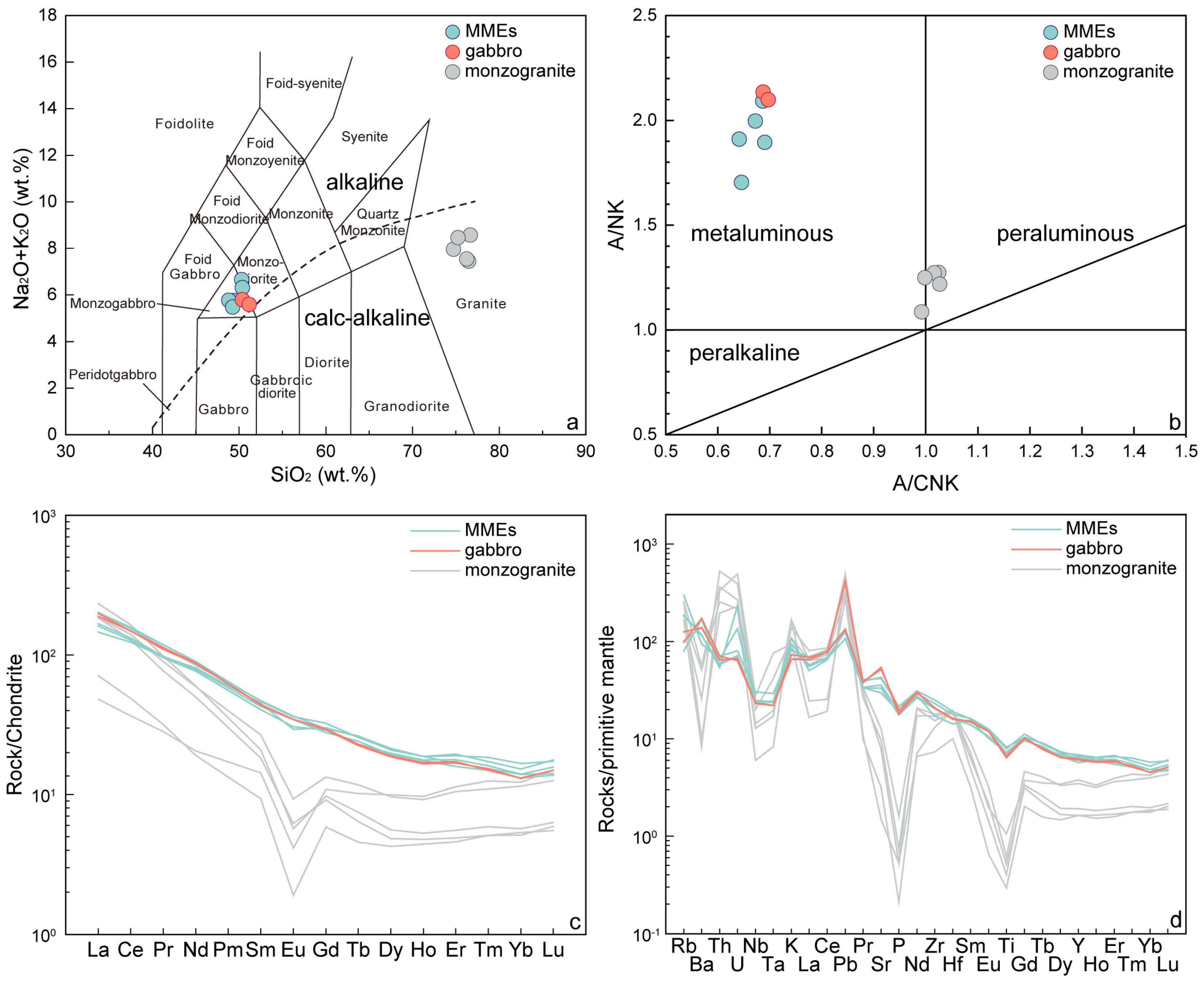
The samples of MMEs from the Xiuyan pluton contain 47.90 to 49.41 wt.% SiO2; 5.38 to 6.52 wt.% Na2O + K2O; and 5.60 to 8.72 wt.% MgO, with Mg# [100 × Mg/(Mg + Fe)] of 57 to 67, belonging to mafic in composition and falling in the field of monzogabbro to monzodiorite in the total alkali-silica (TAS) diagram (Figure 5a). MMEs are alkaline and metaluminous, with A/CNK [molar Al2O3/(CaO + Na2O + K2O)] ranging from 0.95 to 0.98 and A/NK [molar Al2O3/(Na2O + K2O)] ranging from 1.70 to 2.09 (Figure 5b). Other major oxides are TiO2 of 1.58–1.72 wt.%; Al2O3 of 14.94–16.72 wt.%; total Fe2O3 of 9.36–10.26 wt.%; and CaO of 8.06–8.77 wt.%. Samples of gabbro from the Xiuyan pluton contain 49.53 to 49.61 wt.% SiO2; 5.41 to 5.71 wt.% Na2O + K2O; and 5.79 to 6.03 wt.% MgO with Mg# of 56 to 57, belonging to monzogabbro in composition (Figure 5a). These rocks are calc-alkaline and metaluminous, with A/CNK ranging from 0.69 to 0.70 and A/NK ranging from 2.10 to 2.13 (Figure 5b), and have TiO2 of 1.42–1.45 wt.%; Al2O3 of 16.72–17.17 wt.%; total Fe2O3 of 8.35–8.95 wt.%; and CaO of 9.02–9.06 wt.%. The host monzogranite in the Xiuyan pluton contains 73.94 to 76.43 wt.% SiO2 and 7.40 to 8.54 wt.% Na2O + K2O, belonging to granite in composition (Figure 5a). The monzogranite is calc-alkaline and metaluminous to peraluminous, with A/CNK ranging from 0.99 to 1.03 and A/NK ranging from 1.09 to 1.27 (Figure 5b), and contains TiO2 of 0.04–0.21 wt.%; Al2O3 of 12.54–13.59 wt.%; total Fe2O3 of 0.96–1.44 wt.%; and CaO of 0.60–1.48 wt.% (Supplementary Materials, Table S1).
MMEs and gabbro are enriched in light rare earth elements (LREE) relative to heavy rare earth elements (HREE) and show no obvious Eu anomalies on chondrite-normalized patterns (Figure 5c). By contrast, the host monzogranite is strongly LREE-enriched and displays steep LREE and flat HREE segments with pronounced negative Eu anomalies (Figure 5c). On primitive mantle-normalized trace element patterns, MMEs and gabbro exhibit variable enrichment in Ba, K, Pb, Sr and Nd and depletion in Nb, Ta, La, Ce, P and Ti, whereas the monzogranite is enriched in Th, U, K, Pb, Nd, Zr and Hf and depleted in Ba, Nb, Ta, La, Ce, P and Ti (Figure 5d and Supplementary Materials, Table S1).
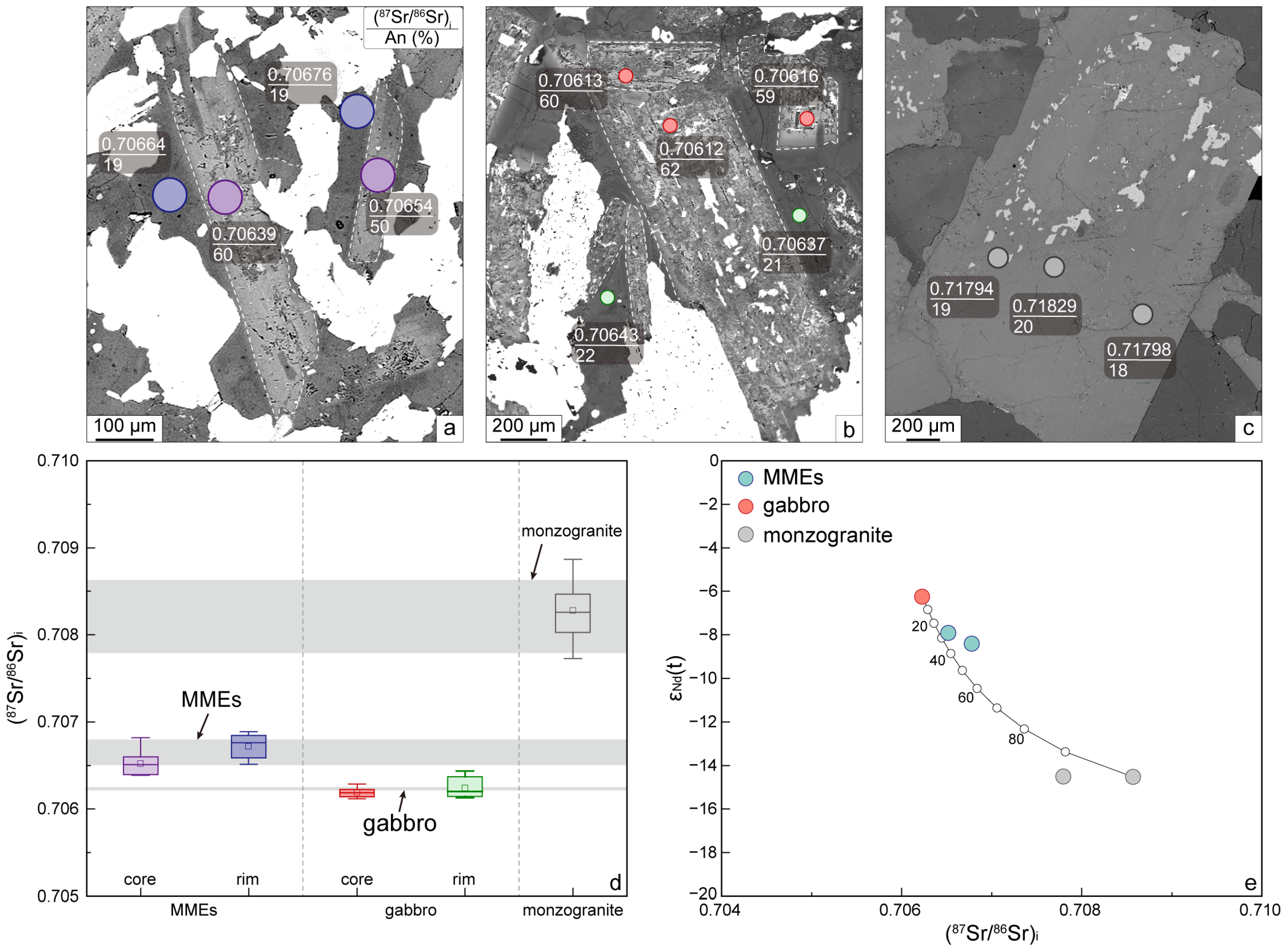
(87Sr/86Sr)i ratios and εNd(t) values were recalculated at 210 Ma based on zircon U–Pb ages for the rock suites [57]. MMEs and gabbro have similar (87Sr/86Sr)i ratios (0.7062–0.7069) and εNd(t) values (−6.3 to −8.9), in contrast to the host monzogranite, which shows higher (87Sr/86Sr)i ratios (0.7078–0.7086) and a strongly negative εNd(t) of −14.5 (Figure 6d and Supplementary Materials, Table S1). Overall, MMEs and gabbro show similar major- and trace-element compositions, comparable chondrite-normalized REE and primitive-mantle-normalized trace-element patterns, and coherent Sr-Nd isotopic compositions.

5.2. Chemical Zoning of Plagioclase in Different Rocks

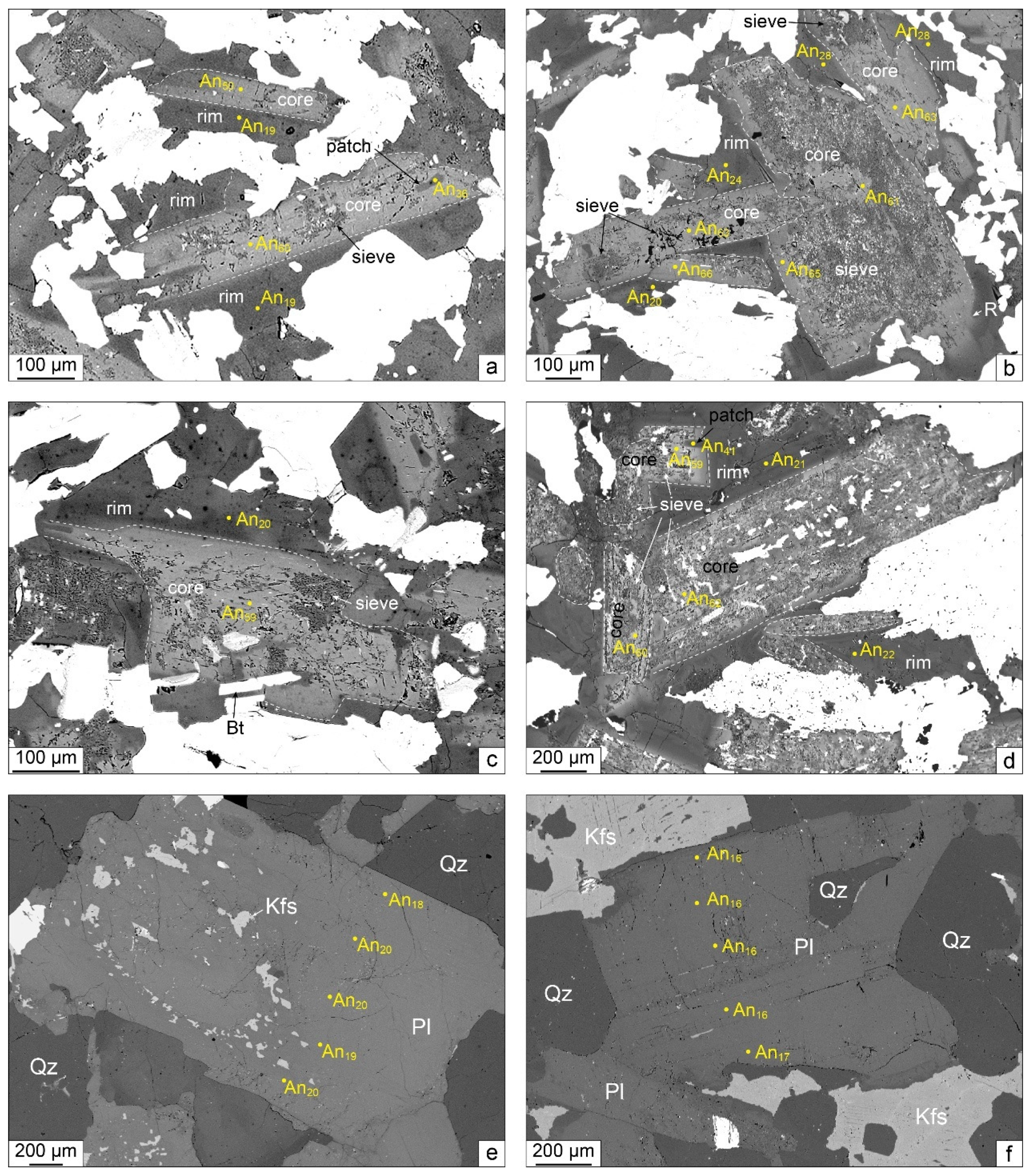
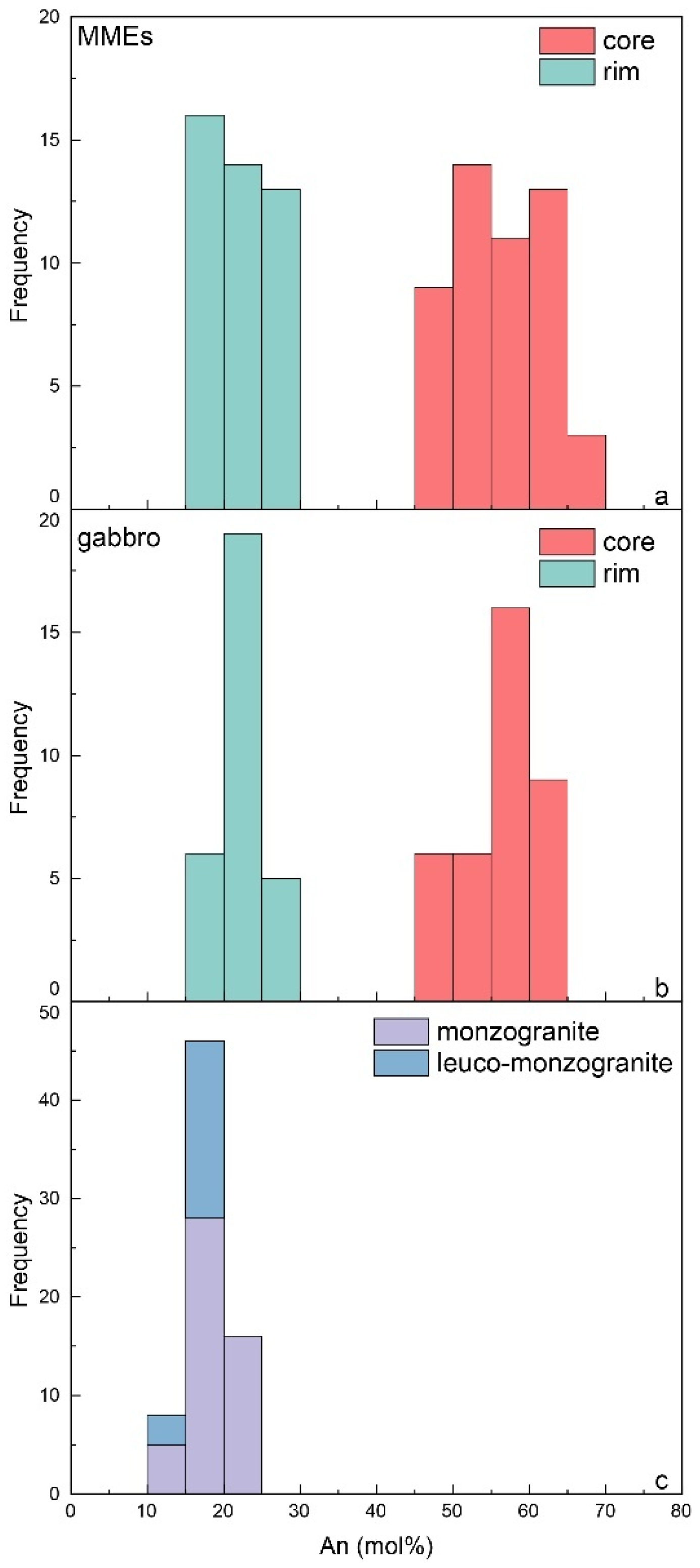
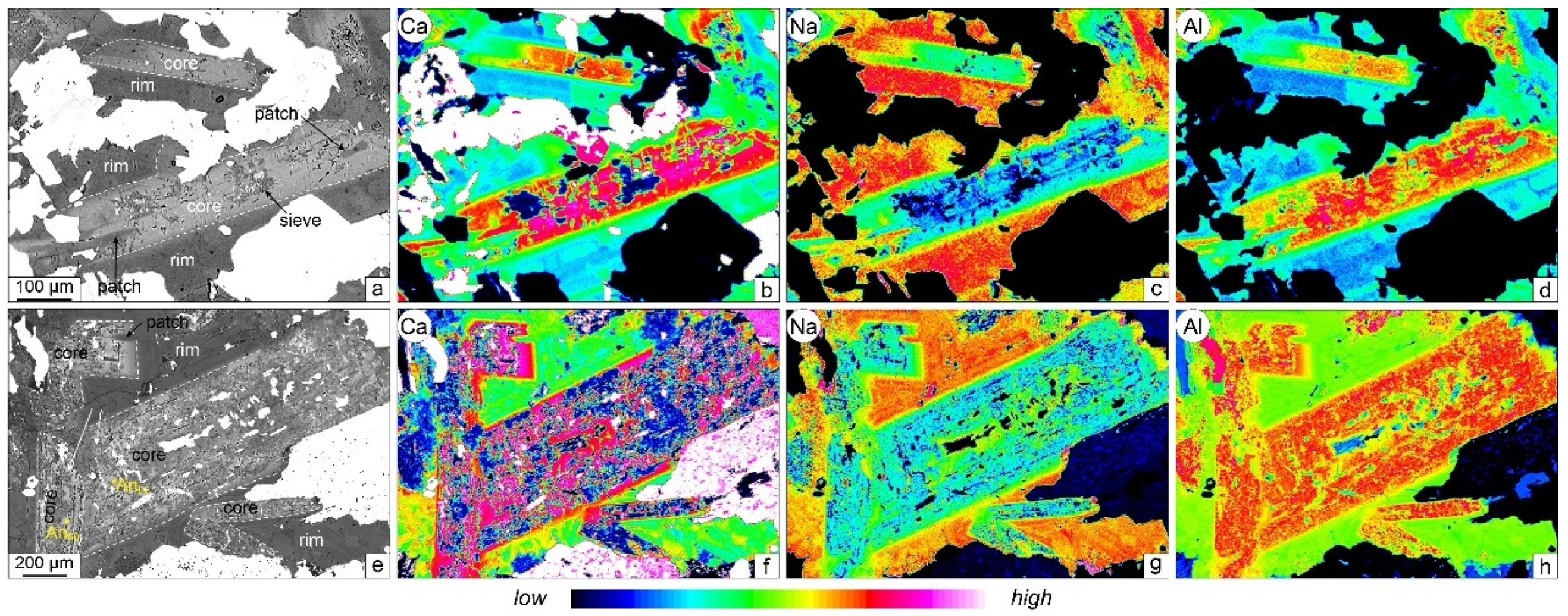
Plagioclase from MMEs is euhedral to subhedral in shape and ranges in length from 300 to 800 μm. It typically displays a dissolved core and an irregular rim (Figure 7a–c), and altered melt inclusions within the cores appear opaque in cross-polarized light (Figure 4a), imparting a porous aspect and producing a coarse sieve texture in backscattered electron (BSE) images (Figure 7a–c; [33,36,62]). Core–rim boundaries are discontinuous and commonly show patchy zoning and resorption (R) surfaces (Figure 7a,b). The anorthite content [XAn = molar Ca/(Ca + Na + K)] varies widely from 17 to 66%; the cores have XAn ranging from 46 to 66%, which decreases abruptly to 17–29% in the rim (Figure 8a; Supplementary Materials, Table S2), forming so-called normal zoning [63]. The patchy zones have An31–41 and are distinguished by marked contrasts in Ca, Na and Al intensities relative to those of the core and rim (Figure 9b–d; Supplementary Materials, Table S2). A representative plagioclase grain shows (87Sr/86Sr)i increasing from 0.70639 (core) to 0.70664 (rim) (Figure 6a; Supplementary Materials, Table S3). In general, plagioclases from MMEs have (87Sr/86Sr)i ranging from 0.70639 to 0.70689, compared with relatively restricted whole-rock (87Sr/86Sr)i of 0.70652 to 0.70678 (Supplementary Materials, Table S1). The cores have slightly lower (87Sr/86Sr)i than those to the rims (core = 0.70639–0.70682, rim = 0.70651–0.70689) (Figure 6d).
Plagioclase from gabbro is euhedral to subhedral in shape and ranges in length from 500 to 1500 μm (Figure 4b). It also displays core–rim texture, and core–rim boundaries are irregular (Figure 7d). The cores contain abundant biotite inclusions and sieve textures (Figure 7d). Plagioclases generally have XAn ranging from 18 to 65%, with the cores having An46–65, whereas rims have An18–27 (Figure 8b), forming so-called normal zoning. The sieve and patchy zones exhibit distinct differences in Ca, Na and Al intensities relative to those of the core and rim (Figure 9f–h). The intragrain Sr isotopic compositions show that the core has (87Sr/86Sr)i of ~0.70612, lower than those for the rim of 0.70637 (Figure 6b). Plagioclase grains overall have (87Sr/86Sr)i ranging from 0.70612 to 0.70643 against relatively restricted whole-rock (87Sr/86Sr)i of the gabbro (0.70623; Supplementary Materials, Table S1). As plagioclase in MMEs, the cores are slightly lower (87Sr/86Sr)i than those of the rims (core = 0.70612–0.70629, rim = 0.70613–0.70643) (Figure 9d; Supplementary Materials, Table S3).
Plagioclase form the host monzogranite is euhedral to subhedral in shape and ranges in length from 1000 to 4000 μm. It commonly shows well-defined outlines and low degrees of alteration, and local cores contain K-feldspar inclusions (Figure 4c and Figure 7e). BSE images indicate homogeneous compositions with An12–24 (Figure 8c). By comparison, plagioclases in the leuco-monzogranite are finer grained, subhedral to anhedral, and have XAn ranging from 12 to 18%, slightly lower than in the host monzogranite. The typical plagioclase grain in the host monzogranite shows homogeneous (87Sr/86Sr)i of 0.70794 to 0.70829, identical to the whole-rock (87Sr/86Sr)i of the monzogranite (Figure 6c,d).
In summary, plagioclase from MMEs and gabbro show similarly An-rich cores and Ab-rich rims (Figure 7a–d and Figure 8a,b). Their plagioclase (87Sr/86Sr)i ranges overlap and agree with corresponding whole-rock values. In contrast, plagioclase in the host monzogranite has XAn comparable to the rims form MMEs and gabbro; however, they have (87Sr/86Sr)i identical to those of whole-rock monzogranite, higher than those of the rim from MMEs and gabbro (Figure 6 and Figure 8).

6. Discussion

6.1. Growth of Plagioclases from Different Magmas

Plagioclase cores in both MMEs and gabbro exhibit sieve texture and patchy zoning (Figure 7a–d). Sieve texture in plagioclase was generally interpreted as the result of changes in temperature, pressure, or melt composition in open magmatic systems [18,33,36,64,65,66]. Under optical microscope, coarse sieve textures commonly appear opaque due to the presence of abundant melt inclusions and dissolution pores (Figure 4a,b), a feature widely reported in rapidly ascending basaltic magmas [40,65]. Experimental studies suggest that these textures may form either through isothermal decompression of plagioclase [33,67] or by reaction between Na-rich plagioclase and hotter, Ca-rich melt along the crystal–melt interface [37,68].
In MMEs and gabbro, the rims of plagioclase show lower XAn than their cores and are separated by sharp core–rim boundaries (Figure 7a–d and Figure 8a,b), implying partial resorption of the cores prior to rim growth. We infer that core resorption and the associated sieve textures were likely triggered during rapid ascent and decompression of an initially H2O-undersaturated, crystal-bearing basaltic magma. Decompression lowers H2O solubility and promotes volatile exsolution, thereby increasing effective water activity in the melt and reducing plagioclase stability, which facilitates dissolution of early crystallized cores [33,35,69]. The associated patchy zoning in the cores (Figure 7a–d), characterized by irregular outlines, is consistent with partial dissolution during decompression followed by later re-precipitation from lower-An melt [36,68,70].
The diverse disequilibrium textures preserved in plagioclase from MMEs therefore record multi-stage processes involving rapid decompression during ascent of crystal-laden basaltic magma, followed by chemical disequilibrium induced by repeated magma replenishment and melt–crystal interaction. Comparable textural associations have been documented in both plutonic and volcanic systems undergoing magma mush rejuvenation [3,71,72]. These features provide direct microstructural evidence for magma mixing facilitated by crystal mush, although localized thermal and chemical disequilibrium during interaction with granitic melt may have also contributed. The close similarity of plagioclase textures in MMEs and gabbro further indicates broadly comparable early magmatic histories prior to emplacement.
Plagioclase in the gabbro occurred as medium-grained, is euhedral to subhedral, and commonly contains biotite inclusions in their cores. They have similar (87Sr/86Sr)i ratios to whole-rock values (Figure 6d), suggesting crystallization largely within a closed basaltic magma system. The higher XAn values of the cores relative to the rims (Figure 7d and Figure 8b) are consistent with decompression-induced dissolution followed by rim growth from evolved interstitial melt within a crystal-rich mush [73,74].
The plagioclase cores in MMEs display (87Sr/86Sr)i ratios and XAn values comparable to those of the gabbroic plagioclase cores (Figure 6d and Figure 8a,b), indicating a similar basaltic source and comparable early magmatic histories. In contrast, the rims of plagioclase in the MME are fine-grained, angular, and locally associated with acicular apatite, consistent with rapid crystallization of interstitial melts during interaction with cooler granitic magma [28,75]. The slightly more radiogenic rim (87Sr/86Sr)i values, coupled with overlapping XAn ranges relative to the rims of plagioclase in the gabbro, suggest crystallization from locally mixed melts formed by interaction between basaltic interstitial melt and granitic melt within a mush-dominated system.
Plagioclase in the monzogranite, by contrast, exhibits homogeneous (87Sr/86Sr)i ratios identical to those of the whole-rock of monzogranite and uniformly low XAn values without recognizable zoning, suggesting crystallization from a relatively homogeneous granitic melt.

6.2. Origin of MMEs in the Xiuyan Pluton

MMEs and gabbro from the Xiuyan pluton display comparable SiO2 contents and similar REE and primitive mantle-normalized trace element patterns (Figure 5), indicating derivation from a common basaltic magma reservoir [13,18,21,29]. However, MMEs have slightly higher (87Sr/86Sr)i ratios and elevated Na2O + K2O contents relative to gabbro (Figure 5a and Figure 6d), suggesting limited chemical modification of the basaltic melt through interaction with the granitic melt [6,14,15]. At the contacts between MMEs and host monzogranite, abundant fine-grained plagioclase occurs, with mineral grain sizes significantly smaller than those in either MMEs’ interiors or host monzogranite (Figure 3b). These features indicate quenching and local dissolution along MME margins and are widely interpreted as evidence for rapid thermal and chemical re-equilibration during interaction with surrounding granitic magma [21,28,76]. The presence of sharp contacts between MMEs and host monzogranite (Figure 2), together with limited mineral-scale and whole-rock diffusive modification (Figure 3), further suggests that magma mixing was spatially restricted and short-lived [77,78]. These observations argue against in situ mingling between fully molten basaltic and granitic magmas, which would typically generate diffuse contacts and isotopic homogenization [14,20,79]. Instead, the combined field, petrographic, and geochemical evidence support a mixing process dominated by interaction between interstitial melt within a crystal-laden mafic mush and surrounding granitic magma. Similar mush-related MMEs formation processes have been documented in plutonic and volcanic systems [3,6,18,19,80].
In this scenario, basaltic magma crystallized to form a crystal-rich mush dominated by plagioclase and clinopyroxene prior to emplacement into the granitic magma reservoir. During ascent of crystal-laden basaltic magma, decompression likely promoted volatile exsolution and increased effective water activity, reducing plagioclase stability and causing partial dissolution of early-formed plagioclase. This process produced the sieve texture and patchy zoning preserved in plagioclase cores in both MMEs and gabbro [33,36,37,68,70]. Continued crystallization of interstitial melt generated low-An plagioclase rims in the gabbro.
The extent of magma mixing can be quantitatively evaluated by Sr–Nd isotopic mixing modeling. This approach is based on the principle that melts produced by binary magma mixing should plot along a mixing line between two compositional end-members on a diagram of (87Sr/86Sr)i versus εNd(t) [81]. In this study, the Sr–Nd isotopic compositions of the Xiuyan gabbro and monzogranite were selected to represent the mafic and felsic endmembers, respectively. The mafic endmember is characterized by 1145 ppm Sr and 40.5 ppm Nd, with (87Sr/86Sr)i of 0.7062 and εNd(t) of −6.3, whereas the felsic endmember contains 269 ppm Sr and 28 ppm Nd with (87Sr/86Sr)i of 0.7086 and εNd(t) of −14.5. The whole-rock Sr–Nd isotopic data for MMEs, gabbro, and monzogranite define a coherent mixing trend on the (87Sr/86Sr)i and εNd(t) diagram (Figure 6e). The modeling results indicate that incorporation of approximately 70% basaltic magma with ~30% granitic magma can reproduce the Sr–Nd isotopic compositions of MMEs. Taken together, gabbro and MMEs represent complementary expressions of a basaltic magmatic system preserved at different physical states and degrees of modification. The gabbro records relatively intact domains of basaltic crystal mush largely isolated from granitic melt, whereas MMEs formed where semi-consolidated mush was mechanically disaggregated into angular fragments and subsequently entrained into coexisting granitic magma. During this process, limited chemical exchange between granitic melt and interstitial melts within the mush fragments produced modest but systematic isotopic and compositional modification.
Locally, semi-consolidated mafic mush was mechanically disaggregated into angular fragments that were subsequently entrained into surrounding granitic magma and rapidly quenched, forming the observed MMEs. During this process, interstitial melts within the mushy fragments were able to exchange chemical components with the granitic melts, resulting in modest but systematic increases in (87Sr/86Sr)i ratios and higher alkali contents in the MMEs relative to the gabbro. This limited yet resolvable mush–magma mixing is recorded by plagioclase rims in MMEs, which display lower An contents and slightly more radiogenic Sr isotopic compositions than their cores (Figure 6 and Figure 8). The preservation of sharp core–rim boundaries and isotopic zoning suggest relatively short residence times after interaction and limited Sr diffusive re-equilibration [82]. Following rapid entrainment and quenching, MMEs behaved largely as sub-solid bodies within the granitic magma, as indicated by sharp contacts and restricted chemical exchange. Collectively, the MMEs in the Xiuyan pluton record transient and spatially limited interactions between mafic crystal mushes and granitic magmas, highlighting the importance of mush disaggregation and interstitial melt exchange in controlling magma-mixing processes within shallow crustal magma reservoirs [6,18].

7. Conclusions

MMEs and associated gabbro in the Xiuyan pluton were derived from a common basaltic magma reservoir and were subsequently emplaced within a granitic magma chamber. Plagioclase cores in both MMEs and gabbro exhibit sieve textures and patchy zoning, recording decompression during the ascent of crystal-laden basaltic magma. In contrast, plagioclase rims in the gabbro crystallized from evolved interstitial melt in the basaltic mush, whereas rims in MMEs crystallized from mixed melts formed by interaction between interstitial basaltic mush melt and granitic magma. The MMEs are interpreted as mechanically disaggregated fragments of a semi-consolidated basaltic crystal mush that were entrained into the coexisting granitic melt; limited hybridization occurred mainly through exchange between granitic melt and interstitial melts within the mushy fragments, producing fine-grained rims and locally quenched textures. This study provides stronger constraints on mush–magma mixing processes in granitic pluton. We further show that the diverse textures and compositions of antecrystic plagioclase in MMEs reinforce previous studies indicating that such features provide a sensitive proxy for tracing mush–magma mixing processes in crustal magma reservoirs.

Supplementary Materials

The following supporting information can be downloaded at: https://www.mdpi.com/article/10.3390/geosciences16030091/s1, Table S1: Whole-rock compositions of MMEs, gabbro and host monzogranite in the Xiuyan pluton; Table S2: The major elemental (wt.%) compositions of plagioclase from the Xiuyan pluton; Table S3: The Sr isotopic compositions of plagioclase from the Xiuyan pluton.

Author Contributions

Conceptualization, Z.Z. (Zisong Zhao), S.W., F.Y. and S.L.; Methodology, Z.Z. (Zisong Zhao) and S.W.; Software, Z.Z. (Zisong Zhao); Validation, Z.Z. (Zisong Zhao); Formal analysis, Z.Z. (Zisong Zhao); Investigation, Z.Z. (Zisong Zhao), S.W., F.Y., S.L. and Z.Z. (Zhiyi Zhao); Writing–original draft, Z.Z. (Zisong Zhao), S.W., F.Y., S.L. and Z.Z. (Zhiyi Zhao); Writing–review & editing, Z.Z. (Zisong Zhao); Visualization, Z.Z. (Zisong Zhao); Funding acquisition, Z.Z. (Zisong Zhao). All authors have read and agreed to the published version of the manuscript.

Funding

This study is financially supported by the Project of Qinghai Science & Technology Department (2025-ZJ-707), Project of Bureau of Geological Exploration & Development of Qinghai Province ([2025].33), China Postdoctoral Science Foundation (2024MD763991).

Data Availability Statement

The data underlying this article are available in its online Supplementary Material.

Acknowledgments

Many thanks to Yuying Bai for the assistance with Micro-XRF analyses, Chao Huang and Le Xu for the assistance with in in situ Sr isotope for plagioclase, and Ping Xiao for the assistance with Sr–Nd isotope analyses of rocks. We sincerely thank the three anonymous reviewers and the editor for their constructive and insightful comments, which greatly improved the quality of the manuscript.

Conflicts of Interest

The authors declare no conflict of interest.

References

  1. Irvine, T.N.; Andersen, J.C.Ø.; Brooks, C.K. Included Blocks (and Blocks within Blocks) in the Skaergaard Intrusion: Geologic Relations and the Origins of Rhythmic Modally Graded Layers. Bull. Geol. Soc. Am. 1998, 110, 1398–1447. [Google Scholar] [CrossRef]
  2. Cooper, K.M.; Kent, A.J.R. Rapid Remobilization of Magmatic Crystals Kept in Cold Storage. Nature 2014, 506, 480–483. [Google Scholar] [CrossRef]
  3. Cashman, K.V.; Sparks, R.S.J.; Blundy, J.D. Vertically Extensive and Unstable Magmatic Systems: A Unified View of Igneous Processes. Science 2017, 355, eaag3055. [Google Scholar] [CrossRef] [PubMed]
  4. Jackson, M.D.; Blundy, J.; Sparks, R.S.J. Chemical Differentiation, Cold Storage and Remobilization of Magma in the Earth’s Crust. Nature 2018, 564, 405–409. [Google Scholar] [CrossRef] [PubMed]
  5. Marsh, B.D. Solidification Fronts and Magmatic Evolution. Mineral. Mag. 1996, 60, 5–40. [Google Scholar] [CrossRef]
  6. Weinberg, R.F.; Vernon, R.H.; Schmeling, H. Processes in Mushes and Their Role in the Differentiation of Granitic Rocks. Earth-Sci. Rev. 2021, 220, 103665. [Google Scholar] [CrossRef]
  7. Sawyer, E.W. Melt Segregation in the Continental Crust. Geology 1994, 22, 1019–1022. [Google Scholar] [CrossRef]
  8. Schmeling, H.; Kruse, J.P.; Richard, G. Effective Shear and Bulk Viscosity of Partially Molten Rock Based on Elastic Moduli Theory of a Fluid Filled Poroelastic Medium. Geophys. J. Int. 2012, 190, 1571–1578. [Google Scholar] [CrossRef]
  9. Sparks, R.S.J.; Annen, C.; Blundy, J.D.; Cashman, K.V.; Rust, A.C.; Jackson, M.D. Formation and Dynamics of Magma Reservoirs. Philos. Trans. R. Soc. A Math. Phys. Eng. Sci. 2019, 377, 20180019. [Google Scholar] [CrossRef]
  10. Watson, E.B. Melt Infiltration and Magma Evolution. Geology 1982, 10, 236–240. [Google Scholar] [CrossRef]
  11. Petford, N.; Paterson, B.; McCaffrey, K.; Pugliese, S. Melt Infiltration and Advection in Microdioritic Enclaves. Eur. J. Mineral. 1996, 8, 405–412. [Google Scholar] [CrossRef]
  12. Lee, C.T.A.; Morton, D.M. High Silica Granites: Terminal Porosity and Crystal Settling in Shallow Magma Chambers. Earth Planet. Sci. Lett. 2015, 409, 23–31. [Google Scholar] [CrossRef]
  13. Didier, J. Granites and Their Enclaves; Elsevier: Amsterdam, The Netherlands, 1973. [Google Scholar]
  14. Sparks, S.R.J.; Sigurdsson, H.; Wilson, L. Magma Mixing: A Mechanism for Triggering Acid Explosive Eruptions. Nature 1977, 267, 315–318. [Google Scholar] [CrossRef]
  15. Clemens, J.D.; Bryan, S.E.; Mayne, M.J.; Stevens, G.; Petford, N. How Are Silicic Volcanic and Plutonic Systems Related? Part 1: A Review of Geological and Geophysical Observations, and Insights from Igneous Rock Chemistry. Earth-Sci. Rev. 2022, 235, 104249. [Google Scholar] [CrossRef]
  16. Clemens, J.D.; Bryan, S.E.; Stevens, G.; Mayne, M.J.; Petford, N. How Are Silicic Volcanic and Plutonic Systems Related? Part 2: Insights from Phase-Equilibria, Thermodynamic Modelling and Textural Evidence. Earth-Sci. Rev. 2022, 235, 104250. [Google Scholar] [CrossRef]
  17. Zhao, Z.; Wang, C.Y.; Wei, B.; Dou, J. Elemental and Nd Isotopic Compositions of Zoned Titanite in Mafic Microgranular Enclaves of the Early Cretaceous Sanguliu Granitic Pluton in the North China Craton: Insights into Magma Mixing Process. Lithos 2021, 392–393, 106138. [Google Scholar] [CrossRef]
  18. Zhao, Z.; Wang, C.Y.; Dou, J.; Wei, B. A Mush-Facilitated Magma Mixing Process Revealed by Complex Zoning of Plagioclase in Mafic Magmatic Enclaves of the Early Cretaceous Sanguliu Granitic Pluton, East China. J. Petrol. 2023, 64, egad048. [Google Scholar] [CrossRef]
  19. Zhao, Z.; Wang, B.; Wu, S.; Li, J. Titanite Textures, U-Pb Dating, Chemistry, and In Situ Nd Isotopes of the Lalingzaohuo Mafic Magmatic Enclaves and Host Granodiorites in the East Kunlun Orogen Belt: Insights into Magma Mixing Processes. Minerals 2025, 15, 886. [Google Scholar] [CrossRef]
  20. Eichelberger, J.C. Andesitic Volcanism and Crustal Evolution. Nature 1978, 275, 21–27. [Google Scholar] [CrossRef]
  21. Vernon, R.H. Microgranitoid Enclaves in Granites—Globules of Hybrid Magma Quenched in a Plutonic Environment. Nature 1984, 309, 438–439. [Google Scholar] [CrossRef]
  22. Bacon, C.R. Magmatic Inclusions in Silicic and Intermediate Volcanic Rocks. J. Geophys. Res. Solid Earth 1986, 91, 6091–6112. [Google Scholar] [CrossRef]
  23. Blundy, J.D.; Sparks, R.S.J. Petrogenesis of Mafic Inclusions in Granitoids of the Adamello Massif, Italy. J. Petrol. 1992, 33, 1039–1104. [Google Scholar] [CrossRef]
  24. Clemens, J.D. S-Type Granitic Magmas—Petrogenetic Issues, Models and Evidence. Earth-Sci. Rev. 2003, 61, 1–18. [Google Scholar] [CrossRef]
  25. Yang, J.-H.; Wu, F.-Y.; Wilde, S.A.; Xie, L.-W.; Yang, Y.-H.; Liu, X.-M. Tracing Magma Mixing in Granite Genesis: In Situ U–Pb Dating and Hf-Isotope Analysis of Zircons. Contrib. Mineral. Petrol. 2007, 153, 177–190. [Google Scholar] [CrossRef]
  26. Clemens, J.D.; Elburg, M.A.; Harris, C. Origins of Igneous Microgranular Enclaves in Granites: The Example of Central Victoria, Australia. Contrib. Mineral. Petrol. 2017, 172, 88. [Google Scholar] [CrossRef]
  27. Clemens, J.D.; Darbyshire, D.P.F.; Flinders, J. Sources of Post-Orogenic Calcalkaline Magmas: The Arrochar and Garabal Hill–Glen Fyne Complexes, Scotland. Lithos 2009, 112, 524–542. [Google Scholar] [CrossRef]
  28. Baxter, S.; Feely, M. Magma Mixing and Mingling Textures in Granitoids: Examples from the Galway Granite, Connemara, Ireland. Mineral. Petrol. 2002, 76, 63–74. [Google Scholar] [CrossRef]
  29. Barbarin, B. Mafic Magmatic Enclaves and Mafic Rocks Associated with Some Granitoids of the Central Sierra Nevada Batholith, California: Nature, Origin, and Relations with the Hosts. Lithos 2005, 80, 155–177. [Google Scholar] [CrossRef]
  30. Jerram, D.A.; Davidson, J.P. Frontiers in Textural and Microgeochemical Analysis. Elements 2007, 3, 235–238. [Google Scholar] [CrossRef]
  31. Grove, T.L.; Baker, M.B.; Kinzler, R.J. Coupled CaAl-NaSi Diffusion in Plagioclase Feldspar: Experiments and Applications to Cooling Rate Speedometry. Geochim. Cosmochim. Acta 1984, 48, 2113–2121. [Google Scholar] [CrossRef]
  32. Tsuchiyama, A. Partial Melting Kinetics of Plagioclase-Diopside Pairs. Contrib. Mineral. Petrol. 1985, 91, 12–23. [Google Scholar] [CrossRef]
  33. Nelson, S.T.; Montana, A. Sieve-Textured Plagioclase in Volcanic Rocks Produced by Rapid Decompression. Am. Mineral. 1992, 77, 1242–1249. [Google Scholar]
  34. Johannes, W.; Koepke, J.; Behrens, H. Partial Melting Reactions of Plagioclases and Plagioclase-Bearing Systems. In Feldspars and Their Reactions; Springer: Dordrecht, The Netherlands, 1994; pp. 161–194. [Google Scholar]
  35. Waters, L.E.; Lange, R.A. An Updated Calibration of the Plagioclase-Liquid Hygrometer-Thermometer Applicable to Basalts through Rhyolites. Am. Mineral. 2015, 100, 2172–2184. [Google Scholar] [CrossRef]
  36. Vance, J.A. Zoning in Igneous Plagioclase: Patchy Zoning. J. Geol. 1965, 73, 636–651. [Google Scholar] [CrossRef]
  37. Tsuchiyama, A. Dissolution Kinetics of Plagioclase in the Melt of the System Diopside-Albite-Anorthite, and Origin of Dusty Plagioclase in Andesites. Contrib. Mineral. Petrol. 1985, 89, 1–16. [Google Scholar] [CrossRef]
  38. Shore, M.; Fowler, A.D. Oscillatory Zoning in Minerals: A Common Phenomenon. Can. Mineral. 1996, 34, 1111–1126. [Google Scholar]
  39. Ginibre, C.; Wörner, G.; Kronz, A. Minor- and Trace-Element Zoning in Plagioclase: Implications for Magma Chamber Processes at Parinacota Volcano, Northern Chile. Contrib. Mineral. Petrol. 2002, 143, 300–315. [Google Scholar] [CrossRef]
  40. Ginibre, C.; Kronz, A.; Wörner, G. High-Resolution Quantitative Imaging of Plagioclase Composition Using Accumulated Backscattered Electron Images: New Constraints on Oscillatory Zoning. Contrib. Mineral. Petrol. 2002, 142, 436–448. [Google Scholar] [CrossRef]
  41. Davidson, J.P.; Tepley, F.; Palacz, Z.; Meffan-Main, S. Magma Recharge, Contamination and Residence Times Revealed by In Situ Laser Ablation Isotopic Analysis of Feldspar in Volcanic Rocks. Earth Planet. Sci. Lett. 2001, 184, 427–442. [Google Scholar] [CrossRef]
  42. Davidson, J.P.; Morgan, D.J.; Charlier, B.L.A. Isotopic Microsampling of Magmatic Rocks. Elements 2007, 3, 253–259. [Google Scholar] [CrossRef]
  43. Davidson, J.P.; Morgan, D.J.; Charlier, B.L.A.; Harlou, R.; Hora, J.M. Microsampling and Isotopic Analysis of Igneous Rocks: Implications for the Study of Magmatic Systems. Annu. Rev. Earth Planet. Sci. 2007, 35, 273–311. [Google Scholar] [CrossRef]
  44. Wang, H.; Mo, X. An Outline of the Tectonic Evolution of China. Episodes 1995, 18, 6–16. [Google Scholar] [CrossRef]
  45. Liu, D.Y.; Nutman, A.P.; Compston, W.; Wu, J.S.; Shen, Q.H. Remnants of ≥3800 Ma Crust in the Chinese Part of the Sino-Korean Craton. Geology 1992, 20, 339–342. [Google Scholar] [CrossRef]
  46. Wan, Y.; Liu, D.; Wang, S.; Dong, C.; Yang, E.; Wang, W.; Zhou, H.; Ning, Z.; Du, L.; Yin, X.; et al. Juvenile Magmatism and Crustal Recycling at the End of the Neoarchean in Western Shandong Province, North China Craton: Evidence from SHRIMP Zircon Dating. Am. J. Sci. 2010, 310, 1503–1552. [Google Scholar] [CrossRef]
  47. Wan, Y.; Liu, D.; Wang, S.; Yang, E.; Wang, W.; Dong, C.; Zhou, H.; Du, L.; Yang, Y.; Diwu, C. ∼2.7Ga Juvenile Crust Formation in the North China Craton (Taishan-Xintai Area, Western Shandong Province): Further Evidence of an Understated Event from U–Pb Dating and Hf Isotopic Composition of Zircon. Precambrian Res. 2011, 186, 169–180. [Google Scholar] [CrossRef]
  48. Lu, S.; Zhao, G.; Wang, H.; Hao, G. Precambrian Metamorphic Basement and Sedimentary Cover of the North China Craton: A Review. Precambrian Res. 2008, 160, 77–93. [Google Scholar] [CrossRef]
  49. Davis, G.A.; Darby, B.J.; Yadong, Z.; Spell, T.L. Geometric and Temporal Evolution of an Extensional Detachment Fault, Hohhot Metamorphic Core Complex, Inner Mongolia, China. Geology 2002, 30, 1003. [Google Scholar] [CrossRef]
  50. Yang, J.H.; Zhou, X.H. Rb-Sr, Sm-Nd, and Pb Isotopes Systematics of Pyrite: Implications for the Age and Genesis of Lode Gold Deposits. Geology 2001, 29, 711–714. [Google Scholar] [CrossRef]
  51. Liu, J.L.; Davis, G.A.; Lin, Z.Y.; Wu, F.Y. The Liaonan Metamorphic Core Complex, Southeastern Liaoning Province, North China: A Likely Contributor to Cretaceous Rotation of Eastern Liaoning, Korea and Contiguous Areas. Tectonophysics 2005, 407, 65–80. [Google Scholar] [CrossRef]
  52. Wu, F.-Y.; Yang, J.-H.; Xu, Y.-G.; Wilde, S.A.; Walker, R.J. Destruction of the North China Craton in the Mesozoic. Annu. Rev. Earth Planet. Sci. 2019, 47, 173–195. [Google Scholar] [CrossRef]
  53. Song, B.; Nutman, A.P.; Liu, D.; Wu, J. 3800 to 2500 Ma Crustal Evolution in the Anshan Area of Liaoning Province, Northeastern China. Precambrian Res. 1996, 78, 79–94. [Google Scholar] [CrossRef]
  54. Zhao, G.; Wilde, S.A.; Cawood, P.A.; Sun, M. Archean Blocks and Their Boundaries in the North China Craton: Lithological, Geochemical, Structural and P-T Path Constraints and Tectonic Evolution. Precambrian Res. 2001, 107, 45–73. [Google Scholar] [CrossRef]
  55. Wu, F.Y.; Lin, J.Q.; Wilde, S.A.; Zhang, X.; Yang, J.H. Nature and Significance of the Early Cretaceous Giant Igneous Event in Eastern China. Earth Planet. Sci. Lett. 2005, 233, 103–119. [Google Scholar] [CrossRef]
  56. Quan, Y.K.; Yang, D.B.; Mu, M.S.; Hao, L.R.; Yang, H.T.; Wang, A.Q.; Xu, W.L. Tectonic Evolution of the Northeastern North China Craton: Constraints from Geochronology and Sr–Nd–Hf–O Isotopic Data from Late Triassic Intrusive Rocks on Liaodong Peninsula, NE China. Lithos 2020, 362–363, 105489. [Google Scholar] [CrossRef]
  57. Yang, J.H.; Wu, F.Y.; Wilde, S.A.; Liu, X.M. Petrogenesis of Late Triassic Granitoids and Their Enclaves with Implications for Post-Collisional Lithospheric Thinning of the Liaodong Peninsula, North China Craton. Chem. Geol. 2007, 242, 155–175. [Google Scholar] [CrossRef]
  58. Yang, J.H.; Wu, F.Y.; Chung, S.L.; Wilde, S.A.; Chu, M.F. A Hybrid Origin for the Qianshan A-Type Granite, Northeast China: Geochemical and Sr-Nd-Hf Isotopic Evidence. Lithos 2006, 89, 89–106. [Google Scholar] [CrossRef]
  59. Yang, Y.H.; Wu, F.Y.; Yang, J.H.; Chew, D.M.; Xie, L.W.; Chu, Z.Y.; Zhang, Y.B.; Huang, C. Sr and Nd Isotopic Compositions of Apatite Reference Materials Used in U-Th-Pb Geochronology. Chem. Geol. 2014, 385, 35–55. [Google Scholar] [CrossRef]
  60. Xu, L.; Yang, J.H.; Wang, H.; Li, Y.; Zhou, B.Q.; Yang, Y.H.; Huang, C.; Xie, L.W.; Wu, S.T. A Natural Plagioclase Reference Material for Microbeam Sr Isotopic Analysis. J. Anal. At. Spectrom. 2022, 37, 1706–1714. [Google Scholar] [CrossRef]
  61. Sun, S.S.; McDonough, W.F. Chemical and Isotopic Systematics of Oceanic Basalts: Implications for Mantle Composition and Processes. Geol. Soc. Spec. Publ. 1989, 42, 313–345. [Google Scholar] [CrossRef]
  62. Renjith, M.L. Micro-Textures in Plagioclase from 1994-1995 Eruption, Barren Island Volcano: Evidence of Dynamic Magma Plumbing System in the Andaman Subduction Zone. Geosci. Front. 2014, 5, 113–126. [Google Scholar] [CrossRef]
  63. Smith, J.V. Feldspar Minerals: 2 Chemical and Textural Properties; Springer: Berlin/Heidelberg, Germany, 1974; ISBN 978-3-642-65745-0. [Google Scholar]
  64. Tsuchiyama, A.; Takahashi, E. Melting Kinetics of a Plagioclase Feldspar. Contrib. Mineral. Petrol. 1983, 84, 345–354. [Google Scholar] [CrossRef]
  65. Housh, T.B.; Luhr, J.F. Plagioclase-Melt Equilibria in Hydrous Systems. Am. Mineral. 1991, 76, 477–492. [Google Scholar]
  66. Humphreys, M.C.S.; Blundy, J.D.; Sparks, R.S.J. Magma Evolution and Open-System Processes at Shiveluch Volcano: Insights from Phenocryst Zoning. J. Petrol. 2006, 47, 2303–2334. [Google Scholar] [CrossRef]
  67. Cashman, K.V.; Stephen, R.; Sparks, J. How Volcanoes Work: A 25 Year Perspective. Bull. Geol. Soc. Am. 2013, 125, 664–690. [Google Scholar] [CrossRef]
  68. Berlo, K.; Blundy, J.; Turner, S.; Hawkesworth, C. Textural and Chemical Variation in Plagioclase Phenocrysts from the 1980 Eruptions of Mount St. Helens, USA. Contrib. Mineral. Petrol. 2007, 154, 291–308. [Google Scholar] [CrossRef]
  69. Pietranik, A.; Waight, T.E. Processes and Sources during Late Variscan Dioritic-Tonalitic Magmatism: Insights from Plagioclase Chemistry (Gesiniec Intrusion, NE Bohemian Massif, Poland). J. Petrol. 2008, 49, 1619–1645. [Google Scholar] [CrossRef]
  70. van Gerve, T.D.; Neave, D.A.; Almeev, R.R.; Holtz, F.; Namur, O. Zoned Crystal Records of Transcrustal Magma Transport, Storage and Differentiation: Insights from the Shatsky Rise Oceanic Plateau. J. Petrol. 2020, 61, egaa080. [Google Scholar] [CrossRef]
  71. Humphreys, M.C.S. Chemical Evolution of Intercumulus Liquid, as Recorded in Plagioclase Overgrowth Rims from the Skaergaard Intrusion. J. Petrol. 2009, 50, 127–145. [Google Scholar] [CrossRef]
  72. Rubin, A.E.; Cooper, K.M.; Till, C.B.; Kent, A.J.R.; Costa, F.; Bose, M.; Gravley, D.; Deering, C.; Cole, J. Rapid Cooling and Cold Storage in a Silicic Magma Reservoir Recorded in Individual Crystals. Science 2017, 356, 1154–1156. [Google Scholar] [CrossRef]
  73. Marsh, B.D. Dynamics of Magmatic Systems. Elements 2006, 2, 287–292. [Google Scholar] [CrossRef]
  74. Holness, M.B.; Stock, M.J.; Geist, D. Magma Chambers versus Mush Zones: Constraining the Architecture of Sub-Volcanic Plumbing Systems from Microstructural Analysis of Crystalline Enclaves. Philos. Trans. R. Soc. A Math. Phys. Eng. Sci. 2019, 377, 20180006. [Google Scholar] [CrossRef]
  75. Vernon, R.H. Microstructures of Melt-Bearing Regional Metamorphic Rocks. In Origin and Evolution of Precambrian High-Grade Gneiss Terranes, with Special Emphasis on the Limpopo Complex of Southern Africa; Geological Society of America: Boulder, CO, USA, 2011; Volume 1207. [Google Scholar]
  76. Holness, M.B.; Vukmanovic, Z.; Mariani, E. Assessing the Role of Compaction in the Formation of Adcumulates: A Microstructural Perspective. J. Petrol. 2017, 58, 643–674. [Google Scholar] [CrossRef]
  77. Ruprecht, P.; Simon, A.C.; Fiege, A. The Survival of Mafic Magmatic Enclaves and the Timing of Magma Recharge. Geophys. Res. Lett. 2020, 47, e2020GL087186. [Google Scholar] [CrossRef]
  78. Albert, H.; Trua, T.; Fonseca, J.; Marani, M.P.; Gamberi, F.; Spiess, R.; Marzoli, A. Time Scales of Open-System Processes in a Complex and Heterogeneous Mush-Dominated Plumbing System. Geology 2022, 50, 869–873. [Google Scholar] [CrossRef]
  79. Perugini, D.; Busà, T.; Poli, G.; Nazzareni, S. The Role of Chaotic Dynamics and Flow Fields in the Development of Disequilibrium Textures in Volcanic Rocks. J. Petrol. 2003, 44, 733–756. [Google Scholar] [CrossRef]
  80. Wiebe, R.A. Mafic-Silicic Layered Intrusions: The Role of Basaltic Injections on Magmatic Processes and the Evolution of Silicic Magma Chambers. Earth Environ. Sci. Trans. R. Soc. Edinb. 1996, 87, 233–242. [Google Scholar] [CrossRef]
  81. Karsli, O.; Dokuz, A.; Uysal, I.; Aydin, F.; Chen, B.; Kandemir, R.; Wijbrans, J. Relative Contributions of Crust and Mantle to Generation of Campanian High-K Calc-Alkaline I-Type Granitoids in a Subduction Setting, with Special Reference to the Harşit Pluton, Eastern Turkey. Contrib. Mineral. Petrol. 2010, 160, 467–487. [Google Scholar] [CrossRef]
  82. Cherniak, D.J.; Watson, E.B. A Study of Strontium Diffusion in Plagioclase Using Rutherford Backscattering Spectroscopy. Geochim. Cosmochim. Acta 1994, 58, 5179–5190. [Google Scholar] [CrossRef]
Figure 2. (a,b) Outcrop photographs showing the overall occurrence of MMEs in the Xiuyan pluton. (c,d) MMEs are separated by monzogranite, which forms dike-like structures between the MMEs. In some areas, fine veins of monzogranite extend into MMEs at the contact zones. (e) MMEs showing black chilled rinds at their contacts with the host monzogranite, grading inward to coarse-grained interiors. (f) The leuco-monzogranite in planar contacting with both MMEs and the host monzogranite.
Geosciences 16 00091 g002
Figure 3. Photograph (a) and micro-X-ray fluorescence element map (b) of a rock slab includes MMEs and monzogranite from the Xiuyan pluton.
Geosciences 16 00091 g003
Figure 4. Photomicrographs of MMEs, gabbro, monzogranite and leuco-monzogranite from the Xiuyan pluton. (a) MMEs comprise fine- to medium-grained plagioclase (Pl), fine-grained clinopyroxene (Cpx) and biotite (Bt). (b) The gabbro comprises coarse- to medium-grained clinopyroxene, plagioclase and biotite. (c) The monzogranite comprises coarse-grained plagioclase, k-feldspar and quartz. (d) The leuco-monzogranite comprises medium-grained plagioclase, k-feldspar and quartz. (a,b) are taken under transmitted plane-polarized light, while (c,d) are taken under transmitted cross-polarized light.
Geosciences 16 00091 g004
Figure 5. The plots of Na2O + K2O versus SiO2 (a), A/NK [Al2O3/(Na2O + K2O)] versus A/CNK [molar ratio Al2O3/(CaO + Na2O + K2O)] (b), chondrite-normalized rare earth element patterns (c), and primitive mantle-normalized trace element patterns (d) for MMEs, gabbro and monzogranite samples from the Xiuyan pluton. Alkaline and calc-alkaline fields are referenced from [57]. Chondrite and primitive mantle normalization values are from [61].
Geosciences 16 00091 g005
Figure 6. Variation of (87Sr/86Sr)i within individual plagioclase grains from MMEs (a), gabbro (b) and monzogranite (c) of the Xiuyan pluton. (d) Comparison of (87Sr/86Sr)i between plagioclase cores and rims in MMEs, gabbro, and monzogranite, together with whole-rock (87Sr/86Sr)i of the corresponding rock types. (e) Plot of whole-rock (87Sr/86Sr)i vs. εNd(t) for MMEs, gabbro, and monzogranite. The two end-members of the binary mixing line are the gabbro and monzogranite from the Xiuyan pluton.
Geosciences 16 00091 g006
Figure 7. Backscattered electron (BSE) images of plagioclase from MMEs, gabbro and monzogranite samples of the Xiuyan pluton. (ac) Subhedral to euhedral plagioclase in MMEs showing sieved texture, patchy, high-An core and irregular low-An rim. (d) Subhedral plagioclase glomerocryst in the gabbro showing sieved texture, patchy, high-An core and irregular low-An rim. (e) Euhedral plagioclase in the monzogranite containing K-feldspar inclusions and showing homogeneous low-An compositions. (f) Subhedral plagioclase in the leuco-monzogranite containing quartz inclusions and showing homogeneous low-An compositions.
Geosciences 16 00091 g007
Figure 8. Histograms of anorthite contents [XAn = molar Ca/(Ca + Na + K)] of plagioclase in MMEs (a), gabbro (b), and monzogranite and leuco-monzogranite (c) from the Xiuyan pluton.
Geosciences 16 00091 g008
Figure 9. BSE images and EPMA X-ray elemental intensity maps (Ca, Na and Al) of representative plagioclase in MMEs (ad) and gabbro (eh) from the Xiuyan pluton. All X-ray elemental intensity maps were obtained using WDS.
Geosciences 16 00091 g009
Disclaimer/Publisher’s Note: The statements, opinions and data contained in all publications are solely those of the individual author(s) and contributor(s) and not of MDPI and/or the editor(s). MDPI and/or the editor(s) disclaim responsibility for any injury to people or property resulting from any ideas, methods, instructions or products referred to in the content.