

Eye Blink Rates and Eyelid Twitches as a Non-Invasive Measure of Stress in the Domestic Horse


Simple Summary
Abstract
1. Introduction
2. Materials and Methods
2.1. Subjects and Housing
2.2. Treatments
2.3. Data Collection
2.4. Data Analysis
3. Results
4. Discussion
5. Conclusions
Supplementary Materials
Author Contributions
Funding
Acknowledgements
Conflicts of Interest
References
- Ramos, A.; Mormede, P. Stress and emotionality: A multidimensional and genetic approach. Neurosci. Biobehav. Rev. 1998, 22, 33–57. [Google Scholar] [CrossRef] [Scilit]
- Budzynska, M. Stress reactivity and coping in horse adaptation to environment. J. Equine Vet. Sci. 2014, 34, 935–941. [Google Scholar] [CrossRef] [Scilit]
- Yarnell, K.; Hall, C.; Royle, C.; Walker, S.L. Domesticated horses differ in their behavioural and physiological responses to isolated and group housing. Physiol. Behav. 2015, 143, 51–57. [Google Scholar] [CrossRef] [Scilit] [PubMed]
- Von Borell, E.; Langbein, J.; Després, G.; Hansen, S.; Leterrier, C.; Marchant-Forde, J.; Marchant-Forde, R.; Minero, M.; Mohr, E.; Prunier, A.; et al. Heart rate variability as a measure of autonomic regulation of cardiac activity for assessing stress and welfare in farm animals—A review. Physiol. Behav. 2007, 92, 293–316. [Google Scholar] [CrossRef] [Scilit] [PubMed]
- Janczarek, I.; Wilk, I.; Stachurska, A.; Krakowski, L.; Liss, M. Cardiac activity and salivary cortisol concentration of leisure horses in response to the presence of an audience in the arena. J. Vet. Behav. 2019, 29, 31–39. [Google Scholar] [CrossRef] [Scilit]
- Palme, R. Non-invasive measurement of glucocorticoids: Advances and problems. Physiol. Behav. 2019, 199, 229–243. [Google Scholar] [CrossRef] [Scilit]
- Merkies, K.; Sievers, A.; Zakrajsek, E.; MacGregor, H.; Bergeron, R.; König von Borstel, U. Preliminary results suggest an influence of psychological and physiological stress in humans on horse heart rate and behaviour. J. Vet. Behav. 2014, 9, 242–247. [Google Scholar] [CrossRef] [Scilit]
- McKinney, C.; Mueller, M.K.; Frank, N. Effects of therapeutic riding on measures of stress in horses. J. Equine Vet. Sci. 2015, 35, 922–928. [Google Scholar] [CrossRef] [Scilit]
- Visser, E.K.; van Reenen, C.G.; Hopster, H.; Schilder, M.B.H.; Knaap, J.H.; Barneveld, A.; Blokhuis, H.J. Quantifying aspects of young horses’ temperament: Consistency of behavioural variables. Appl. Anim. Behav. Sci. 2001, 74, 241–258. [Google Scholar] [CrossRef] [Scilit]
- Merkies, K.; McKechnie, M.J.; Zakrajsek, E. Behavioural and physiological responses of therapy horses to mentally traumatized humans. Appl. Anim. Behav. Sci. 2018, 205, 61–67. [Google Scholar] [CrossRef] [Scilit]
- Mason, G.; Mendl, M. Why is there no simple way of measuring animal welfare? Anim. Welf. Sci. 1993, 2, 301–319. [Google Scholar]
- Hall, C.; Huws, N.; White, C.; Taylor, E.; Owen, H.; McGreevy, P. Assessment of ridden horse behavior. J. Vet. Behav. 2014, 8, 62–73. [Google Scholar] [CrossRef] [Scilit]
- Young, T.; Creighton, E.; Smith, T.; Hosie, C. A novel scale of behavioural indicators of stress for use with domestic horses. Appl. Anim. Behav. Sci. 2012, 140, 33–43. [Google Scholar] [CrossRef] [Scilit]
- Squibb, K.; Griffin, K.; Favier, R.; Ijichi, C. Poker Face: Discrepancies in behaviour and affective states in horses during stressful handling procedures. Appl. Anim. Behav. Sci. 2018, 202, 34–38. [Google Scholar] [CrossRef] [Scilit]
- Yarnell, K.; Hall, C.; Billett, E. An assessment of the aversive nature of an animal management procedure (clipping) using behavioral and physiological measures. Physiol. Behav. 2013, 118, 32–39. [Google Scholar] [CrossRef] [Scilit]
- Mendl, M.; Burman, O.H.P.; Paul, E.S. An integrative and functional framework for the study of animal emotion and mood. Proc. Biol. Sci. 2010, 277, 2895–2904. [Google Scholar] [CrossRef] [Scilit]
- Giannakakis, G.; Pediaditis, M.; Manousos, D.; Kazantzaki, E.; Chiarugi, F.; Simos, P.G.; Mariasa, K.; Tsiknakis, M. Stress and anxiety detection using facial cues from videos. Biomed. Signal Process. Control 2017, 31, 89–101. [Google Scholar] [CrossRef] [Scilit]
- Cruz, A.A.V.; Garcia, D.M.; Pinto, C.T.; Cechetti, S.P. Spontaneous eyeblink activity. Ocul. Surf. 2011, 9, 29–41. [Google Scholar] [CrossRef] [Scilit]
- Koo Lin, L. Eyelid anatomy and function. In Ocular Surface Disease: Cornea, Conjunctiva and Tear Film; Holland, E.J., Mannis, M.J., Lee, W.B., Eds.; Elsevier: Cambridge, UK, 2013; pp. 11–15. ISBN 978-1-4557-2876-3. [Google Scholar]
- Blount, W.P. Studies of the movements of the eyelids of animals: Blinking. Exp. Physiol. 1927, 18, 111–125. [Google Scholar] [CrossRef] [Scilit]
- Portello, J.K.; Rosenfield, M.; Chu, C.A. Blink rate, incomplete blinks and computer vision syndrome. Optom. Vis. Sci. 2013, 90, 482–487. [Google Scholar] [CrossRef] [Scilit]
- Jie, Y.; Sella, R.; Feng, J.; Gomez, M.L.; Afshari, N.A. Evaluation of incomplete blinking as a measurement of dry eye disease. Ocul. Surf. 2019, 5. [Google Scholar] [CrossRef] [Scilit]
- Nakajima, S.; Takamatsu, Y.; Fukuoka, T.; Omori, Y. Spontaneous blink rates of domestic dogs: A preliminary report. J. Vet. Behav. 2011, 6, 95. [Google Scholar] [CrossRef] [Scilit]
- Bennett, V.; Gourkow, N.; Mills, D.S. Facial correlates of emotional behaviour in the domestic cat (Feliscatus). Behav. Proc. 2017, 141, 342–350. [Google Scholar] [CrossRef] [Scilit]
- Wathan, J.; Burrows, A.M.; Waller, B.M.; McComb, K. EquiFACS: The equine facial action coding system. PLoS ONE 2015, 10, e0131738. [Google Scholar] [CrossRef] [Scilit]
- Rubin, M.; Denise, H.; Dipanjana, D.; Melara, R. Inhibitory Control under Threat: The Role of Spontaneous Eye Blinks in Post-Traumatic Stress Disorder. Brain Sci. 2017, 7, 16. [Google Scholar] [CrossRef] [Scilit]
- Trost, K.; Skalicky, M.; Nell, B. Schirmer tear test, phenol red thread tear test, eye blink frequency and corneal sensitivity in the guinea pig. Vet. Ophthalmol. 2007, 10, 143–146. [Google Scholar] [CrossRef] [Scilit]
- McIntire, L.K.; McKinley, R.A.; Goodyear, C.; McIntire, J.P. Detection of vigilance performance using eye blinks. Appl. Ergon. 2014, 45, 354–362. [Google Scholar] [CrossRef] [Scilit]
- Weiner, E.A.; Concepcion, P. Effects of affective stimuli mode on eye-blink rate and anxiety. Clin. Psych. 1975, 31, 256–259. [Google Scholar] [CrossRef] [Scilit]
- Lemasson, A.; Boutin, A.; Boivin, S.; Blois-Heulin, C.; Hausberger, M. Horse (Equus caballus) whinnies: A source of social information. Anim. Cognit. 2009, 12, 693–704. [Google Scholar] [CrossRef] [Scilit]
- Gleerup, K.B.; Forkman, B.; Lindegaard, C.; Andersen, P. An equine pain face. Vet. Anaesth. Analg. 2015, 42, 103–114. [Google Scholar] [CrossRef] [Scilit]
- Argilés, M.; Cardona, G.; Pérez-Cabré, E.; Rodríguez, M. Blink rate and incomplete blinks in six different controlled hard-copy and electronic reading conditions. Investig. Ophthalmol. Vis. Sci. 2015, 56, 6679–6685. [Google Scholar] [CrossRef] [Scilit]
- Mott, R.; Hawthorne, S.; McBride, S. Spontaneous blink rate as a measure of equine stress. In Proceedings of the 14th Conference of the International Society for Equitation Science, Rome, Italy, 21–24 September 2018. [Google Scholar]
- Dalla Costa, E.; Minero, M.; Lebelt, D.; Stucke, D.; Canali, E.; Leach, M.C. Development of the Horse Grimace Scale (HGS) as a pain assessment tool in horses undergoing routine castration. PLoS ONE 2014, 9, e92281. [Google Scholar] [CrossRef] [Scilit]
- Hintze, S.; Smith, S.; Patt, A.; Bachmann, I.; Wurbel, H. Are eyes a mirror of the soul? What eye wrinkles reveal about a horse’s emotional state. PLoS ONE 2016, 11, e0164017. [Google Scholar] [CrossRef] [Scilit]
- Schanz, L.; Krueger, K.; Hintze, S. Sex and age don’t matter, but breed type does—Factors influencing eye wrinkle expression in horses. Front. Vet. Sci. 2019, 6, 154. [Google Scholar] [CrossRef] [Scilit]
- Roberts, K.; Hemmings, A.J.; Moore-Colyer, M.; Parker, M.O.; McBride, S.D. Neural modulators of temperament: A multivariate approach to personality trait identification in the horse. Physiol. Behav. 2016, 67, 125–131. [Google Scholar] [CrossRef] [Scilit]
- Jongkees, B.J.; Colzato, L.S. Spontaneous eye blink rate as predictor of dopamine-related cognitive function—A review. Neurosci. Biobehav. Rev. 2016, 71, 58–82. [Google Scholar] [CrossRef] [Scilit]
- Colzato, L.S.; van den Wildenberg, W.P.M.; van Wouwe, N.C.; Pannebakker, M.M.; Hommel, B. Dopamine and inhibitory action control: Evidence from spontaneous eye blink rates. Exp. Brain Res. 2009, 196, 467–474. [Google Scholar] [CrossRef] [Scilit]
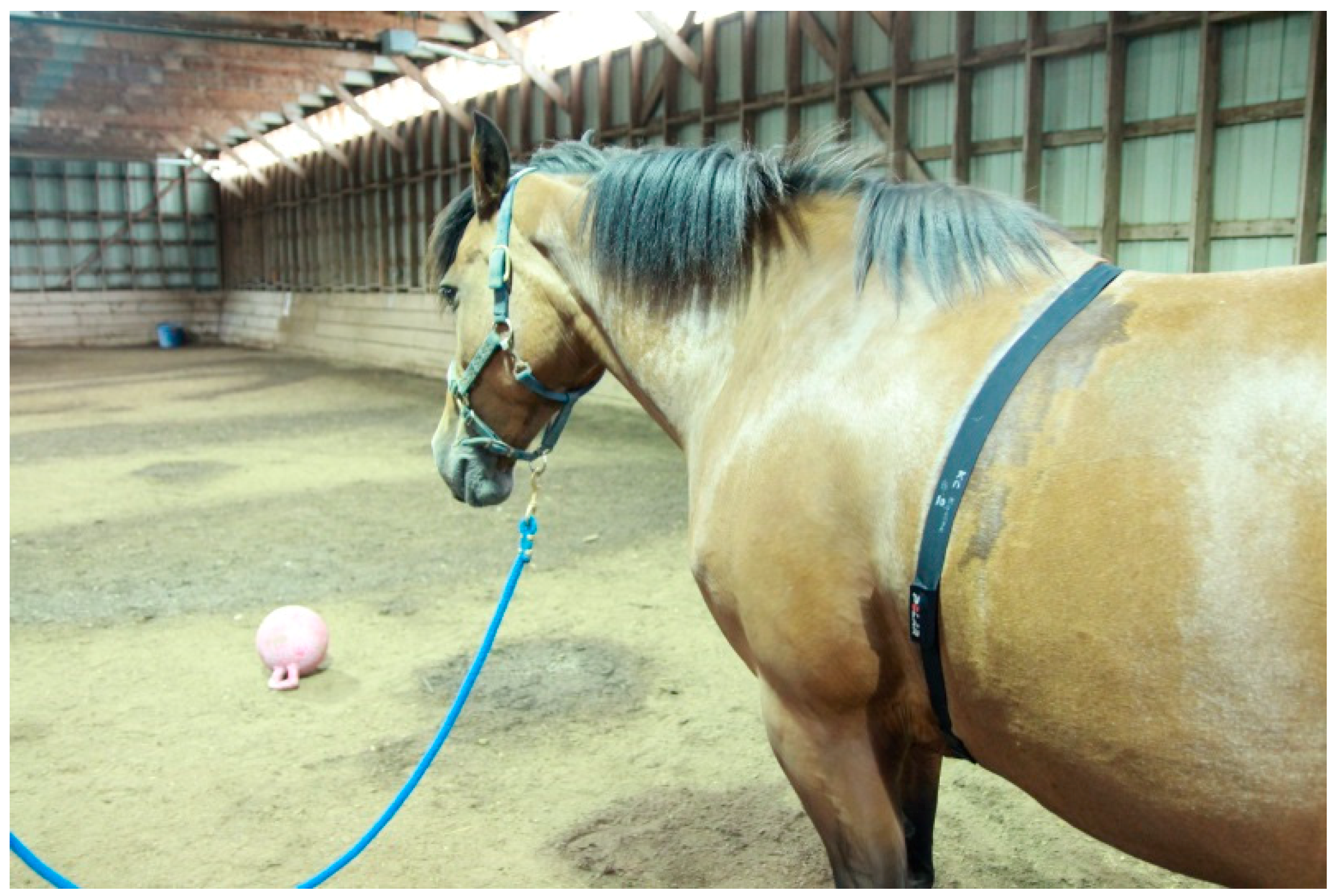
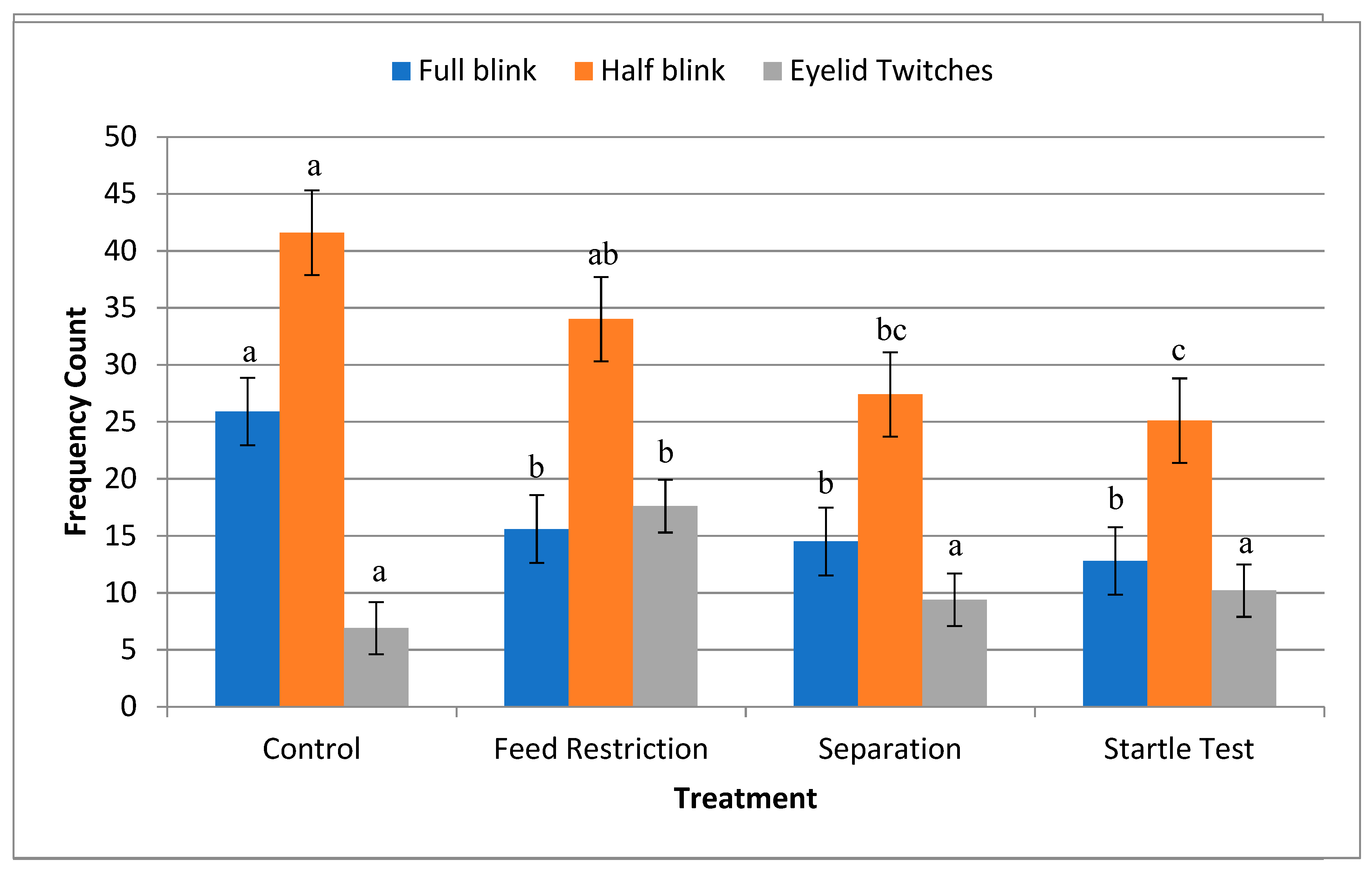
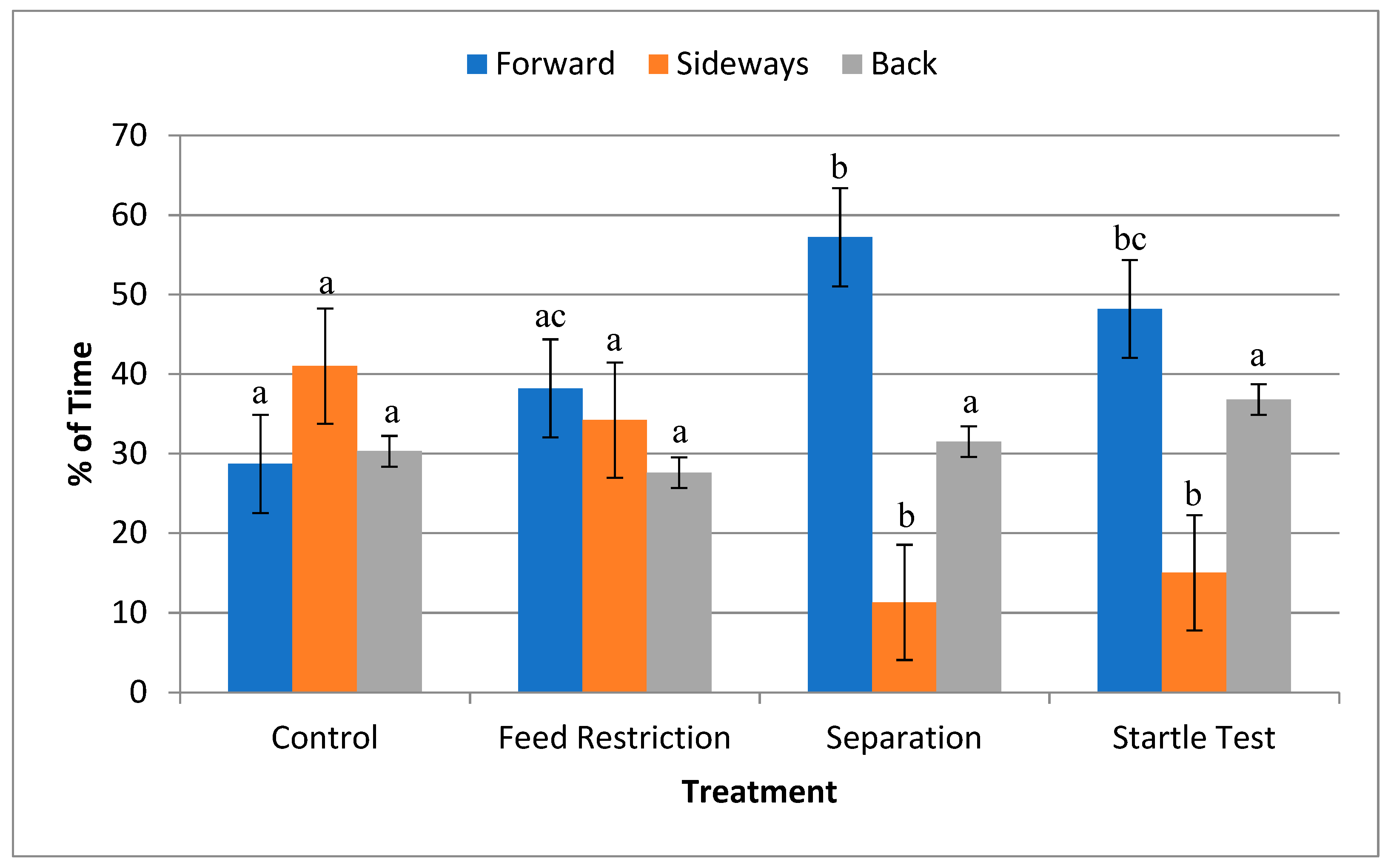
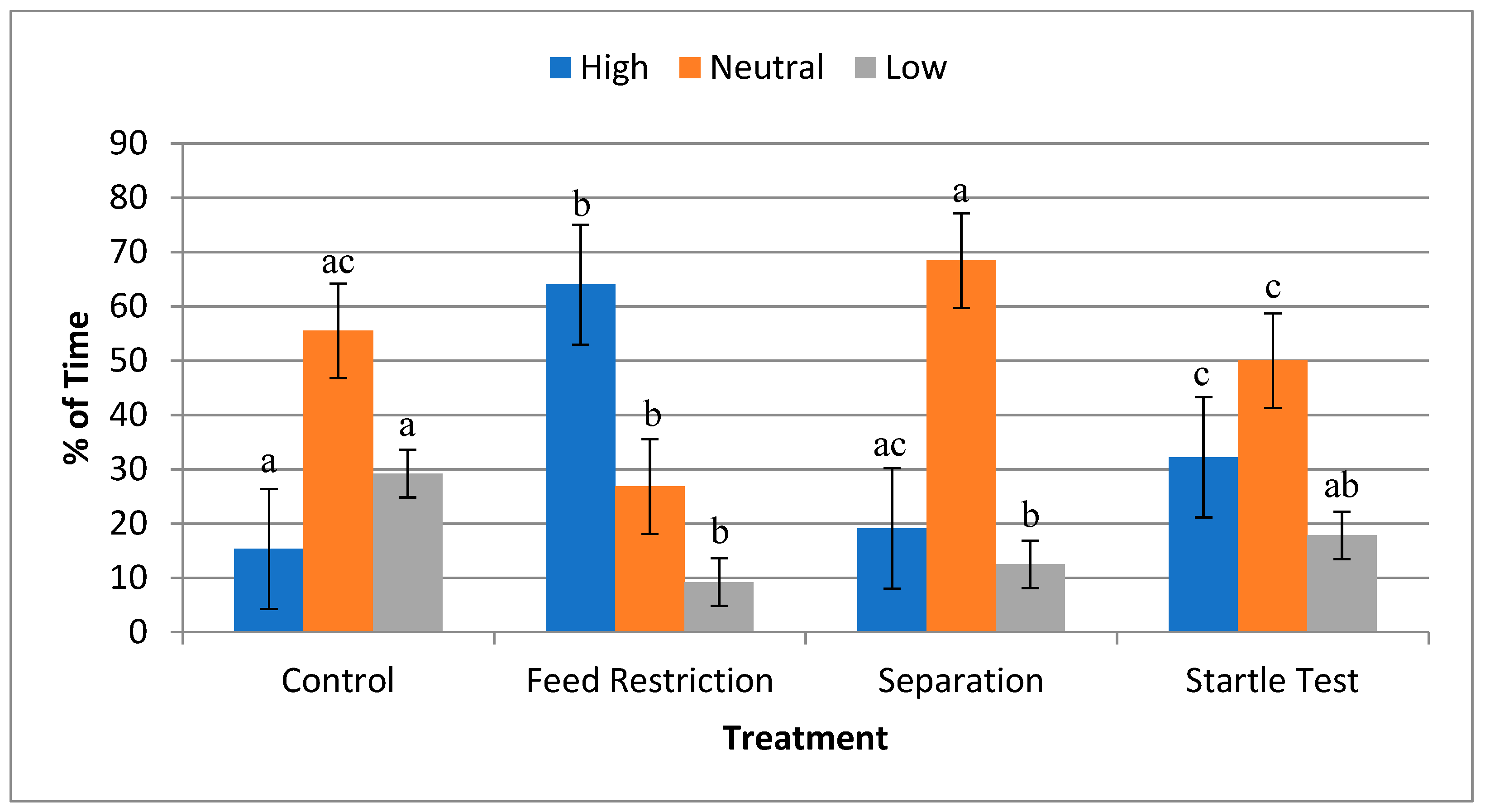

| Behaviour | Description |
|---|---|
| Eye—full blink | The right eye becomes momentarily but completely closed |
| Eye—half blink | The right upper lid moves toward the lower lid of the eye but does not cover the eye completely |
| Eyelid—twitch | Fine fibrillar movement of the skin involving the levator palpebrae superioris muscle of the upper eyelid |
| Ears—forward | The right ear points forward in an attentive manner |
| Ears—sideways | The right ear is angled to the side |
| Ears—back | The right ear is turned backward |
| Head—above withers | The right eye level goes above the height of the withers |
| Head—even with withers | The right eye is even with the height of the withers |
| Head—below withers | The right eye level drops below the height of the withers |
| Oral behaviour | The lips are in motion, either with mouth shut, with the tongue licking or coming out of the mouth, or chewing |
| Restlessness | Any movement made by the legs, including movement that causes the horse to move out of view of the camera |
© 2019 by the authors. Licensee MDPI, Basel, Switzerland. This article is an open access article distributed under the terms and conditions of the Creative Commons Attribution (CC BY) license (http://creativecommons.org/licenses/by/4.0/).
Share and Cite
Merkies, K.; Ready, C.; Farkas, L.; Hodder, A. Eye Blink Rates and Eyelid Twitches as a Non-Invasive Measure of Stress in the Domestic Horse. Animals 2019, 9, 562. https://doi.org/10.3390/ani9080562
Merkies K, Ready C, Farkas L, Hodder A. Eye Blink Rates and Eyelid Twitches as a Non-Invasive Measure of Stress in the Domestic Horse. Animals. 2019; 9(8):562. https://doi.org/10.3390/ani9080562
Chicago/Turabian StyleMerkies, Katrina, Chloe Ready, Leanne Farkas, and Abigail Hodder. 2019. "Eye Blink Rates and Eyelid Twitches as a Non-Invasive Measure of Stress in the Domestic Horse" Animals 9, no. 8: 562. https://doi.org/10.3390/ani9080562
APA StyleMerkies, K., Ready, C., Farkas, L., & Hodder, A. (2019). Eye Blink Rates and Eyelid Twitches as a Non-Invasive Measure of Stress in the Domestic Horse. Animals, 9(8), 562. https://doi.org/10.3390/ani9080562

