How to Apply Positive-Reinforcement-Based Training for Self-Loading and Self-Unloading in Dromedary Camels
 , , ,
, , ,  ,
,
Simple Summary
Abstract
1. Introduction
2. Materials and Methods
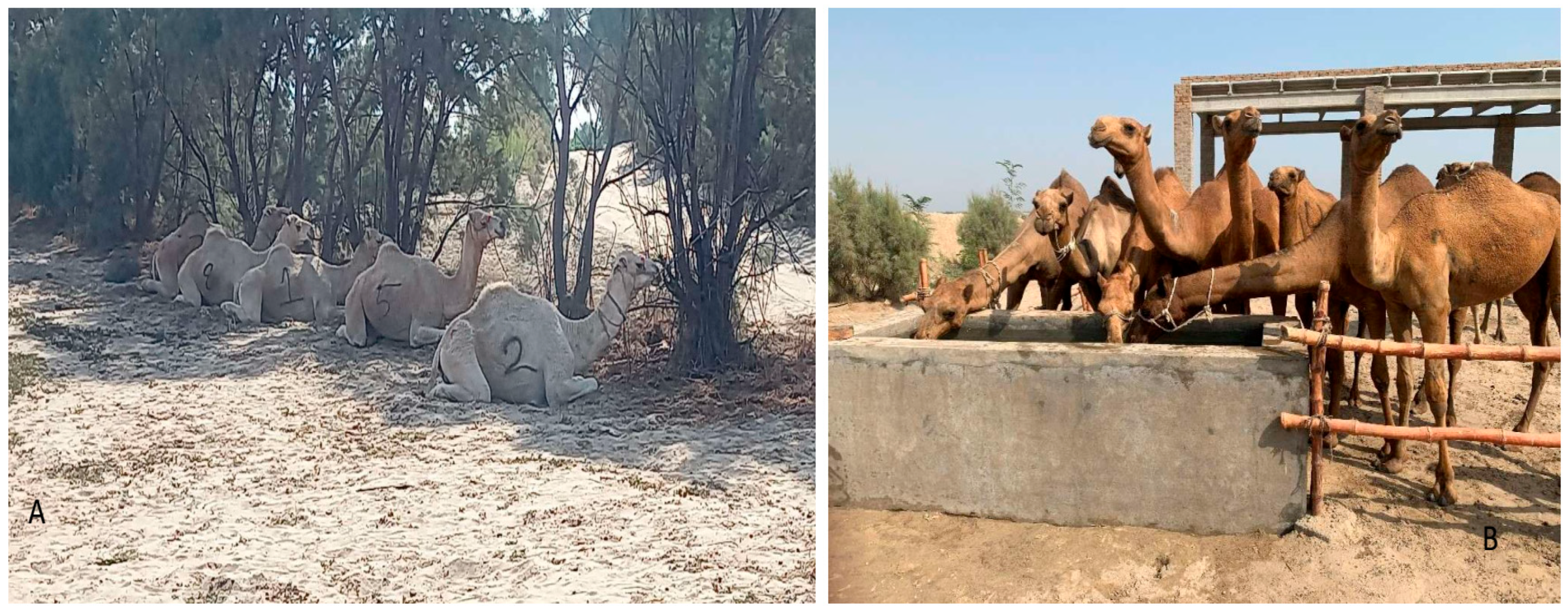
2.1. Animals
2.2. The Training Protocol
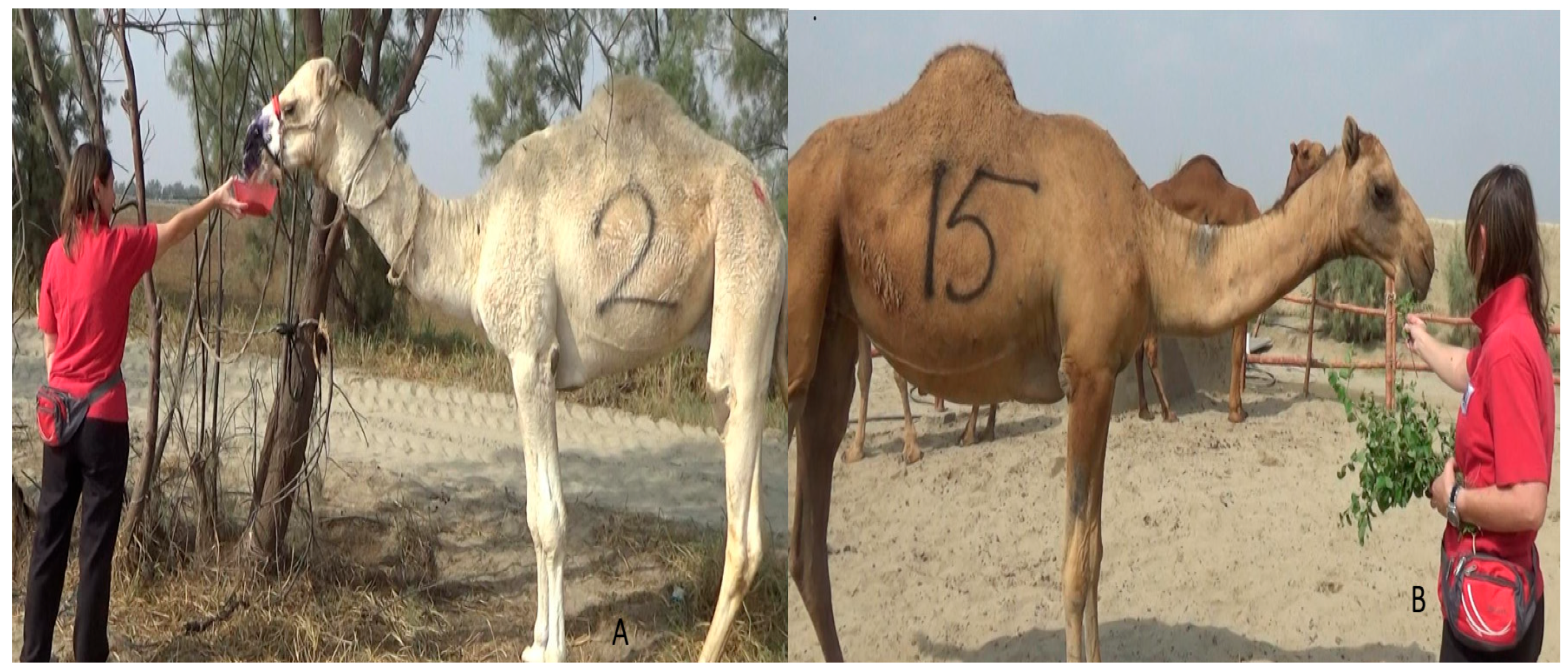
2.2.1. Loading the Clicker Phase
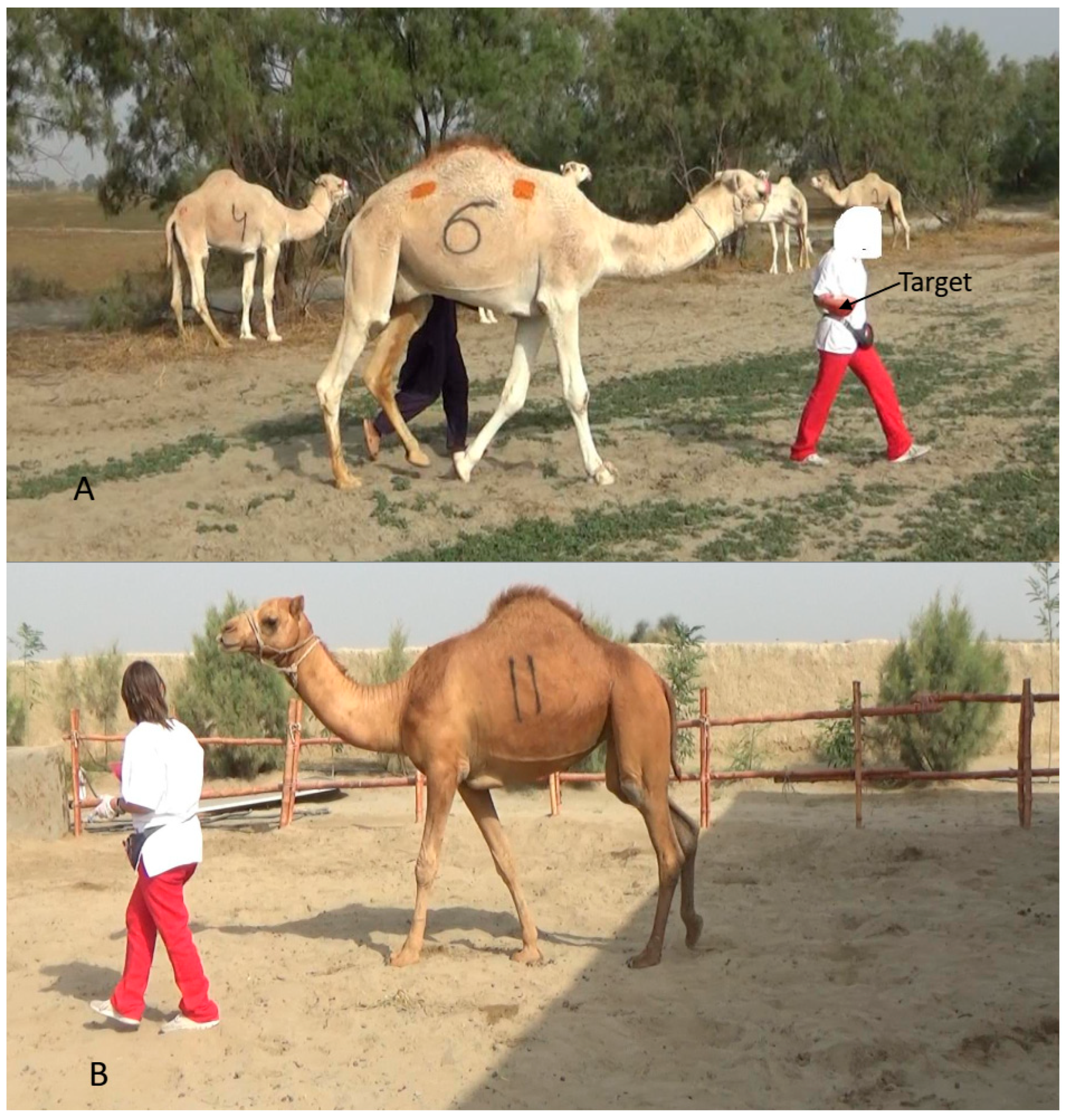
2.2.2. Approaching the Truck Phase
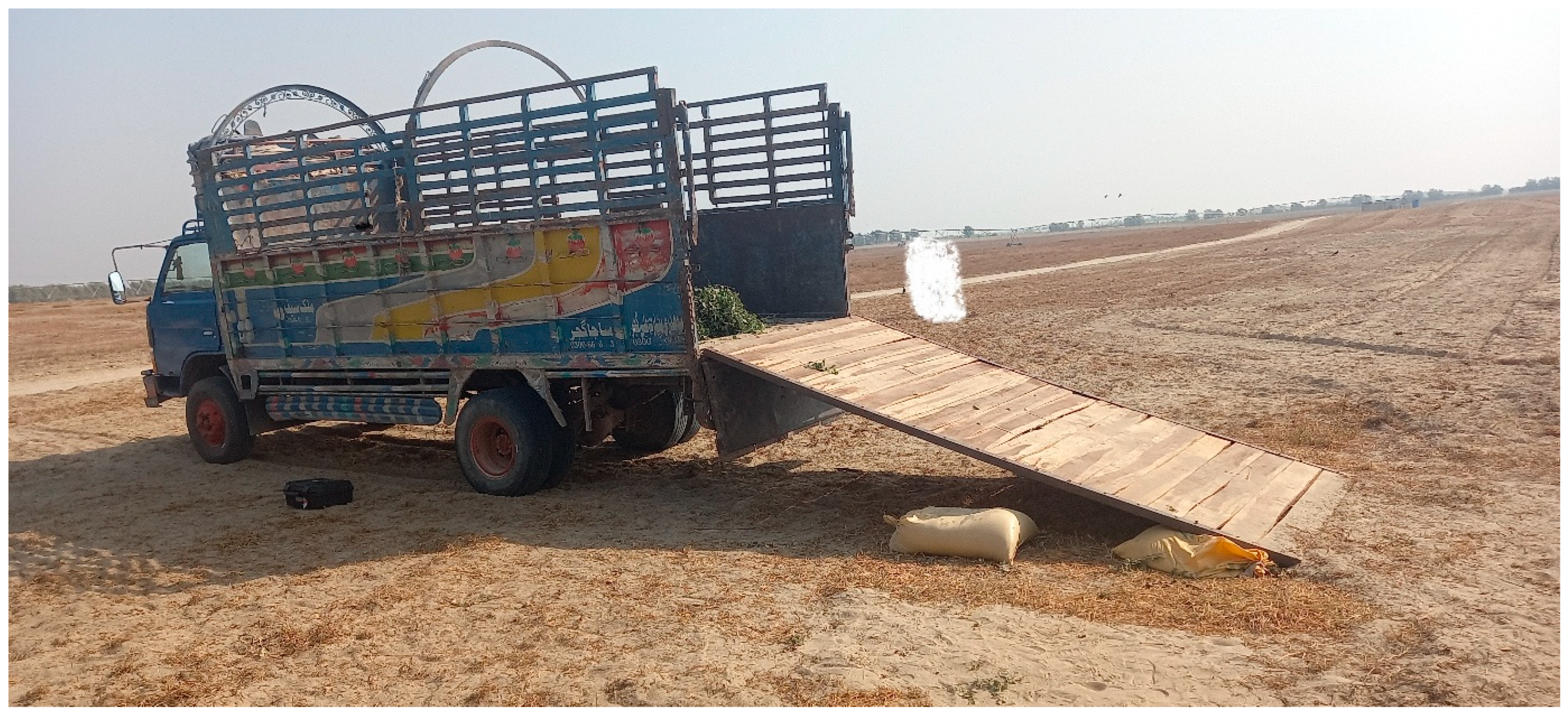
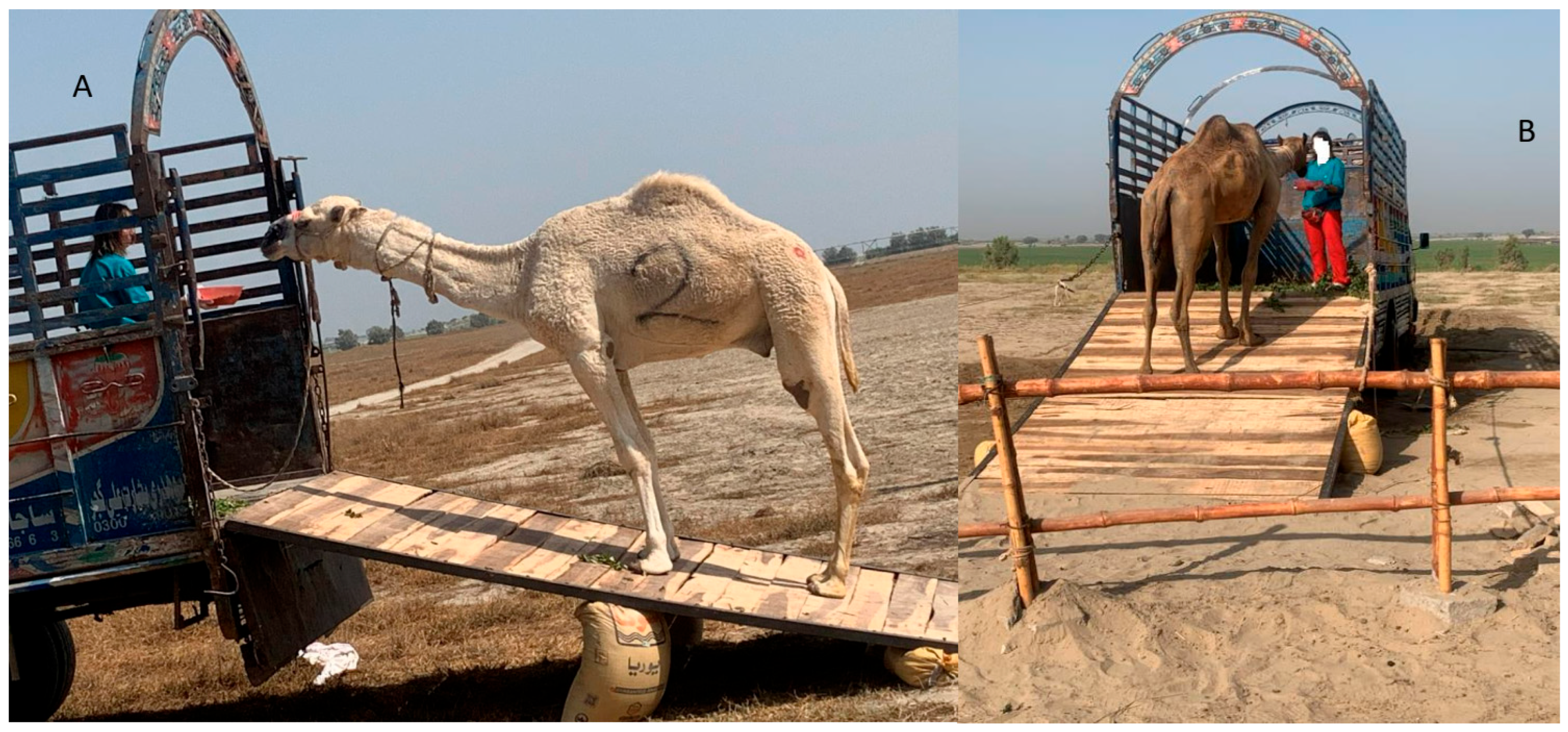
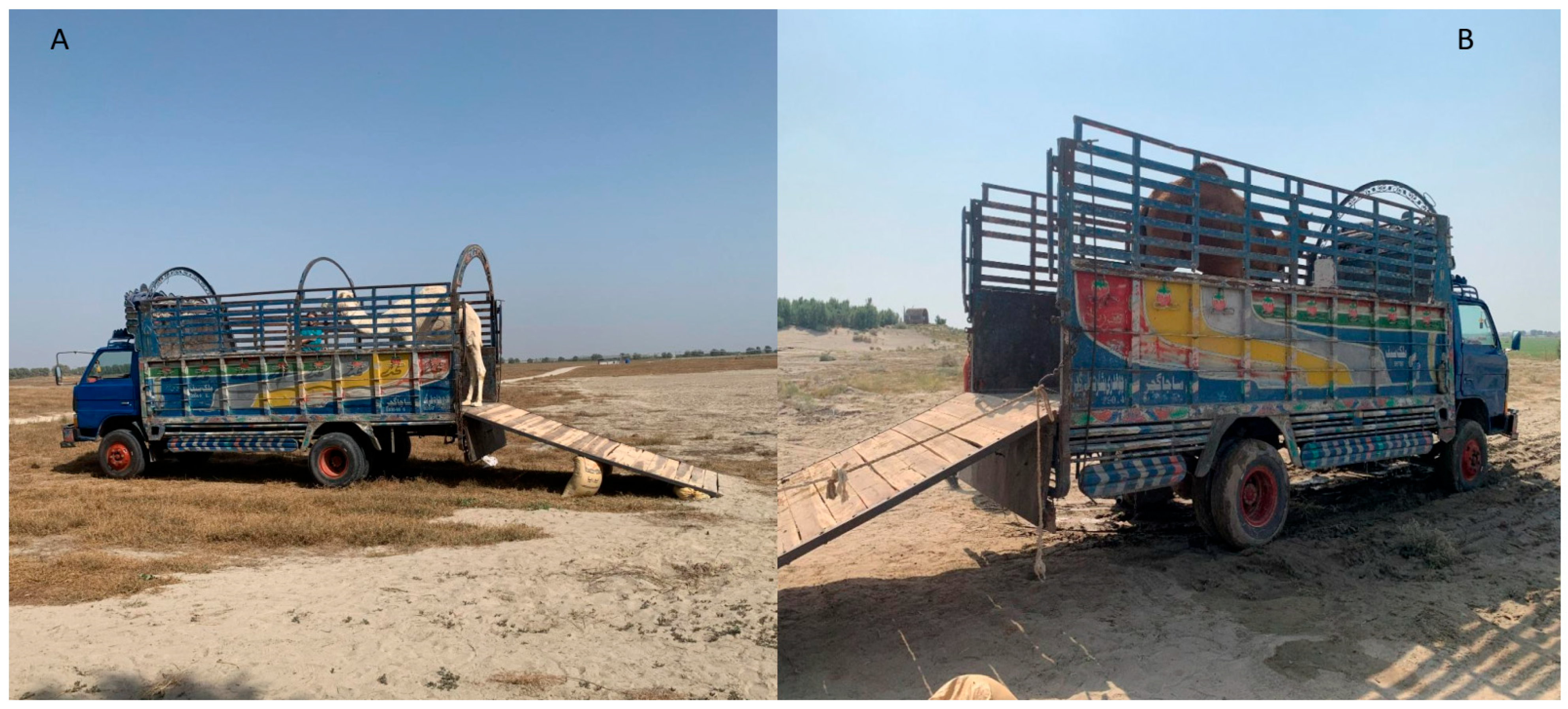
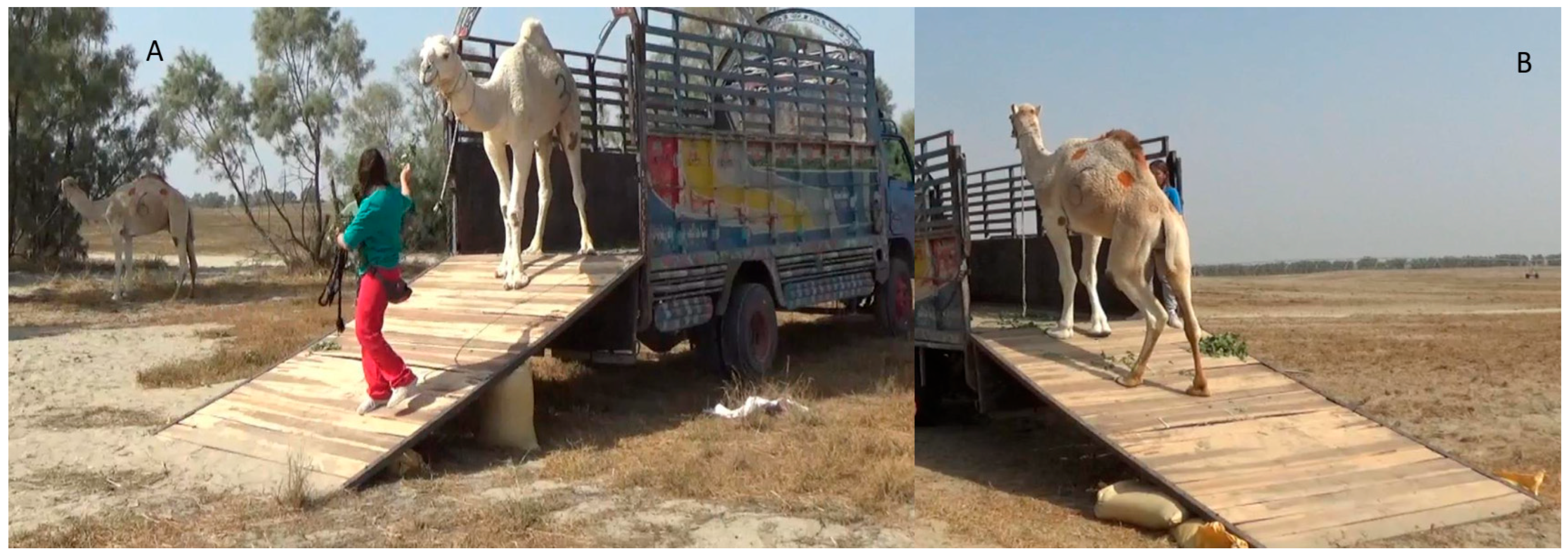
2.2.3. Ramp Phase
2.2.4. Truck Phase
2.2.5. Unloading Phase
2.2.6. Going Back to the Station
2.3. Behavioral Evaluation
2.4. Thermography of the Eye
2.5. Statistical Analysis
2.5.1. Behavioral Data
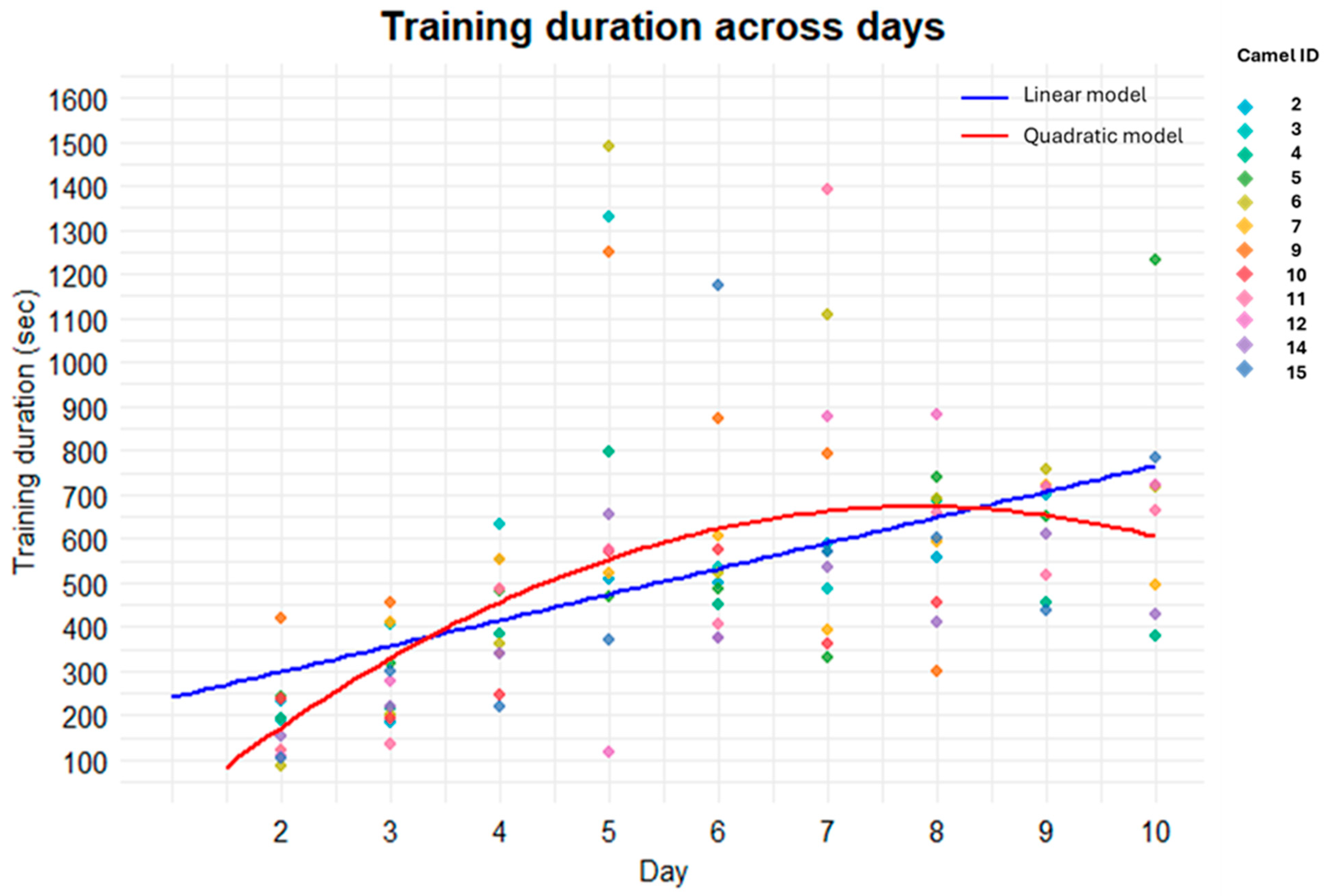
2.5.2. Training Duration Data
2.5.3. Infrared Thermography (IRT) Data
3. Results
3.1. Outcomes of the Behavioral Test on the First Day
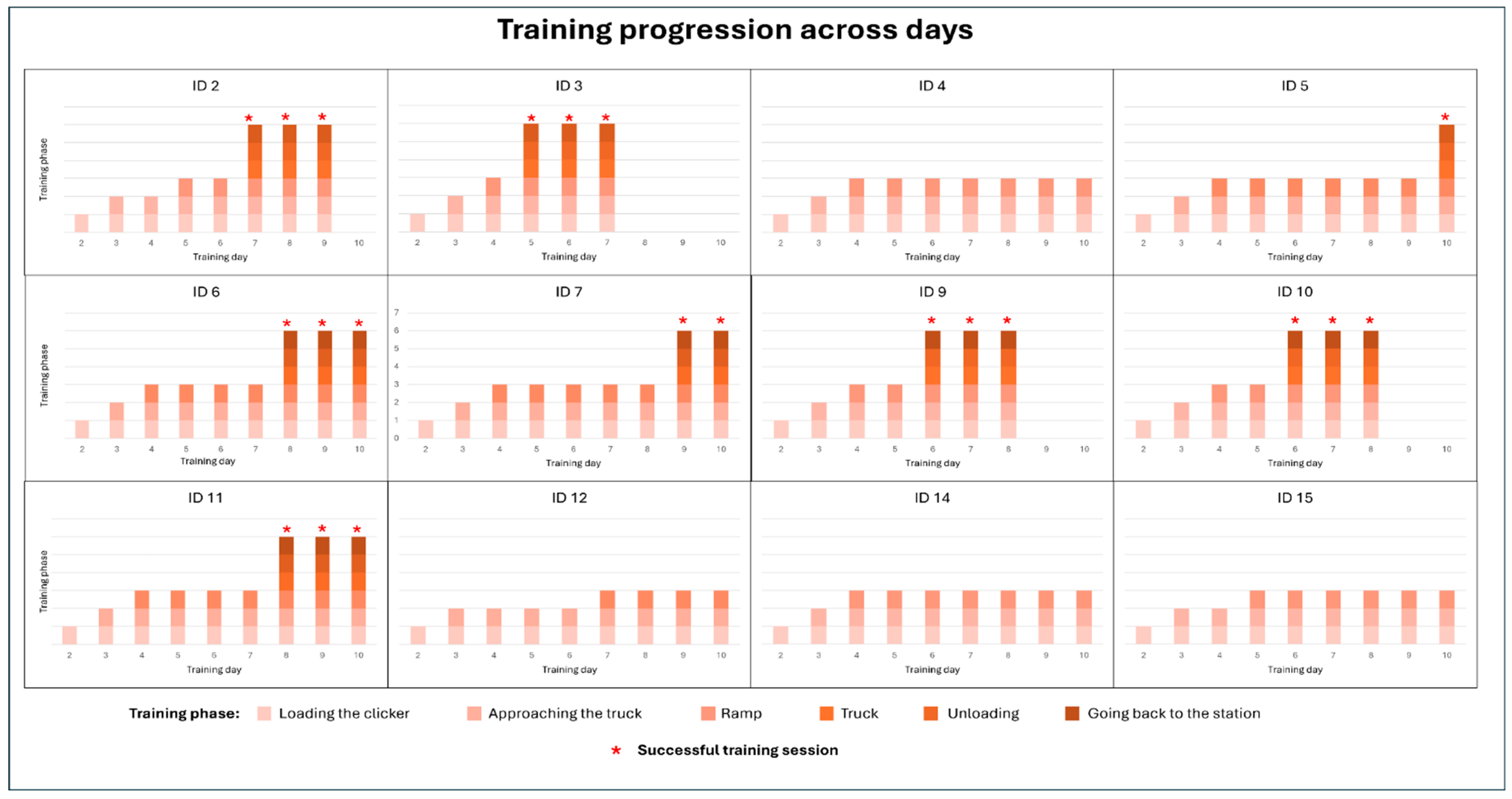
3.2. Training Progression and Summary of the Training Outcomes
3.3. Behavioral Analysis
3.3.1. Descriptive Statistics
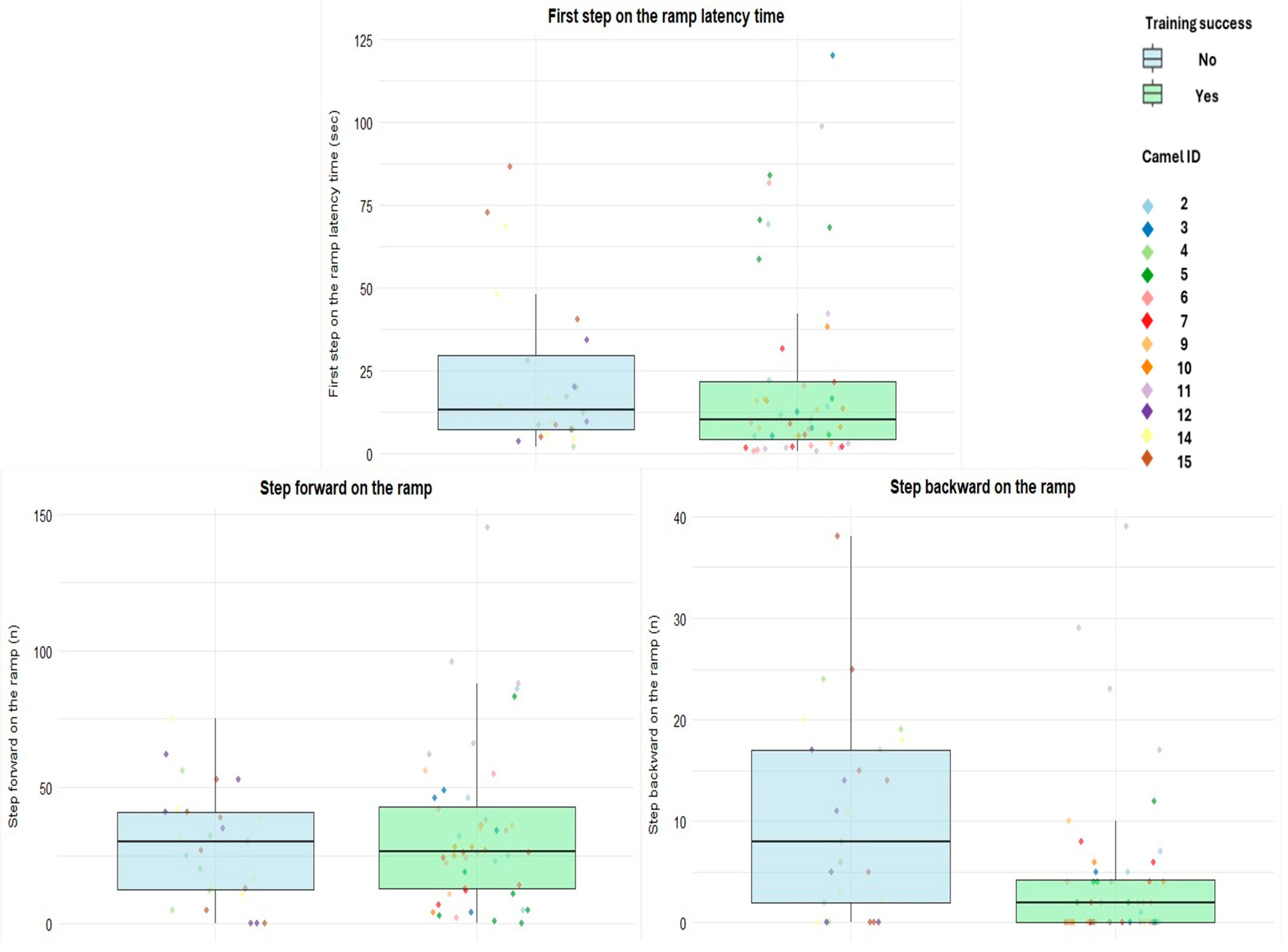
3.3.2. Behavioral Events
3.3.3. Behavioral States
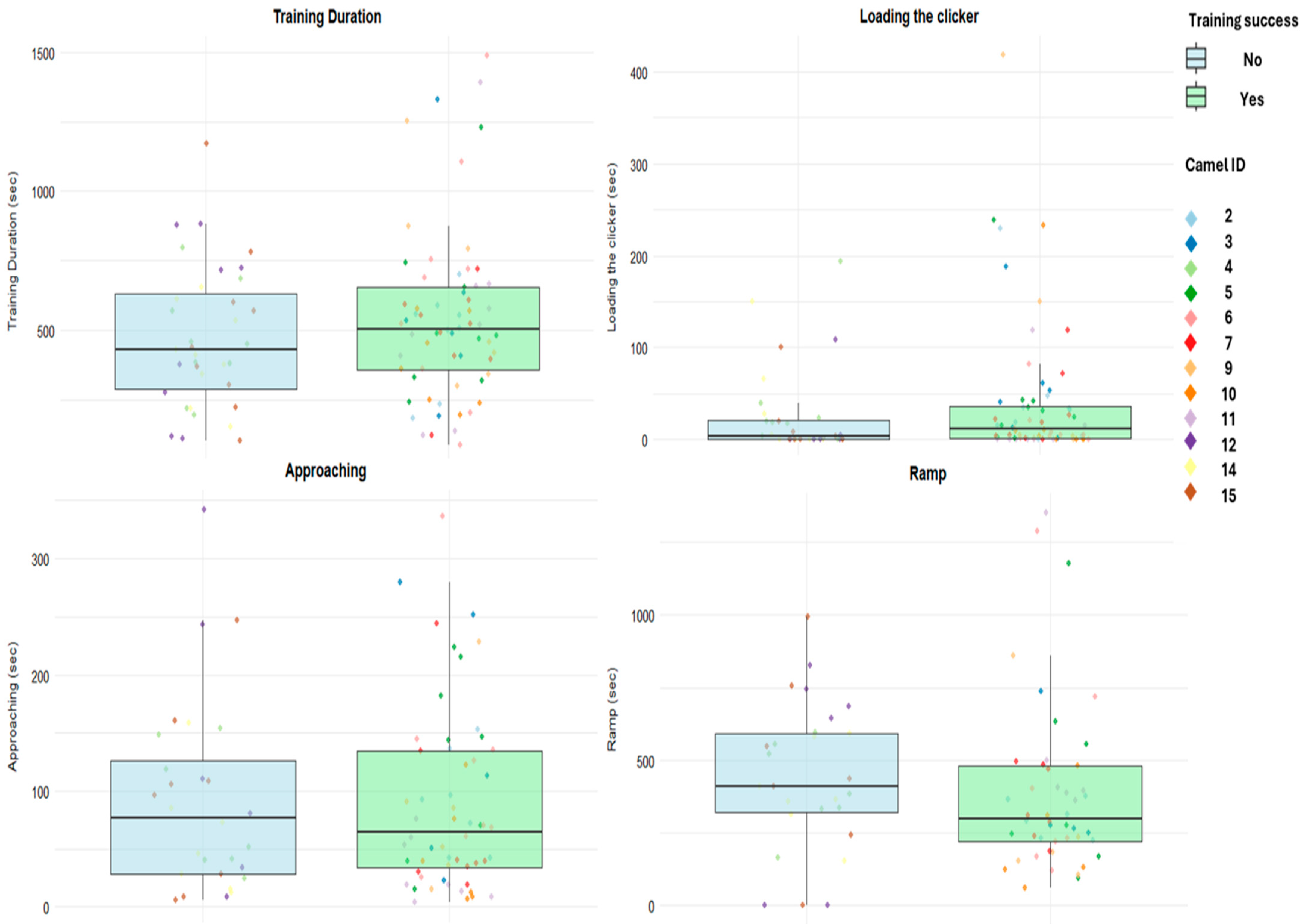
3.3.4. Phases of the Training and Overall Training Duration
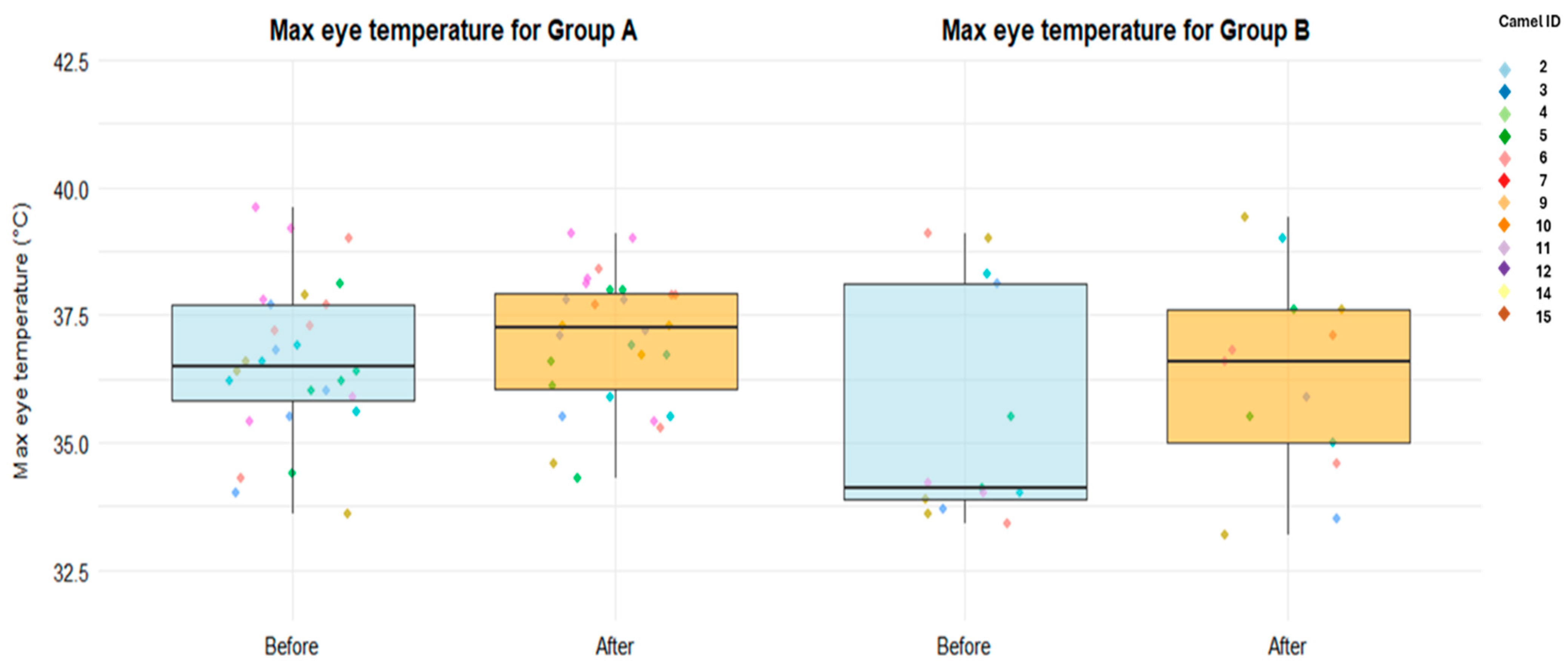
3.4. Infrared Thermography of the Eye
4. Discussion
5. Conclusions
Supplementary Materials
Author Contributions
Funding
Institutional Review Board Statement
Informed Consent Statement
Data Availability Statement
Acknowledgments
Conflicts of Interest
References
- EFSA Panel on Animal Health and Welfare (AHAW). Scientific opinion concerning the welfare of animals during transport. EFSA J. 2011, 9, 19666. [Google Scholar] [CrossRef]
- Adams, D. Transportation of animals and welfare. Rev. Sci. Tech.-Off. Int. Epizoot. 1994, 13, 153–169. [Google Scholar] [CrossRef] [PubMed]
- FAO. Livestock Transportation and Slaughter Practices–Practical Guidelines for Asia and the Pacific Region; FAO: Bangkok, Thailand, 2023. [Google Scholar]
- Tarrant, P. Transportation of cattle by road. Appl. Anim. Behav. Sci. 1990, 28, 153–170. [Google Scholar] [CrossRef]
- Lambooij, E. Animal Stress and Welfare During Transport and Slaughtering: An Outline for Future Policies. Animals 2024, 14, 3064. [Google Scholar] [CrossRef]
- El Khasmi, M. Stress transport in the dromedary camel. In Dromedary Camel Behavior and Welfare: Camel Friendly Management Practices; Springer: Berlin/Heidelberg, Germany, 2024; pp. 207–229. [Google Scholar]
- Emeash, H.; Mostafa, A.; Karmy, M.; Khalil, F.; Elhussiny, M.Z. Assessment of transportation stress in Dromedary camel (Camelus dromedarius) by using behavioural and physiological measures. J. Appl. Vet. Sci. 2016, 1, 28–36. [Google Scholar] [CrossRef]
- Broom, D.M. Causes of poor welfare in large animals during transport. Vet. Res. Commun. 2003, 27, 515–518. [Google Scholar] [CrossRef]
- Dai, F.; Toson, M.; Bertotto, D.; Dalla Costa, A.; Heinzl, E.U.L.; Lega, F.; Minero, M.; Padalino, B.; Stefani, A.L.; Trestini, S. Transportation to the Slaughterhouse: Can Training Reduce the Stress Response in Horses? Vet. Sci. 2025, 12, 547. [Google Scholar] [CrossRef]
- Bhatt, N.; Singh, N.P.; Mishra, A.K.; Kandpal, D.; Jamwal, S. A detailed review of transportation stress in livestock and its management techniques. Int. J. Livest. Res. 2021, 11, 30–41. [Google Scholar]
- Fukasawa, M. The calf training for loading onto vehicle at weaning. Anim. Sci. J. 2012, 83, 759–766. [Google Scholar] [CrossRef]
- EFSA Panel on Animal Health and Welfare (AHAW); Nielsen, S.S.; Alvarez, J.; Bicout, D.J.; Calistri, P.; Canali, E.; Drewe, J.A.; Garin-Bastuji, B.; Gonzales Rojas, J.L.; Schmidt, C.G.; et al. Welfare of cattle during transport. EFSA J. 2022, 20, e07442. [Google Scholar] [CrossRef] [PubMed]
- Helena Bauer, J.H. The Welfare of Dromedary Camels During Road Transport in the Middle East. Available online: https://camelides.cirad.fr/fr/actualites/Docs/AA_Cameltransport%20in%20the%20Middle%20East_screen.pdf (accessed on 6 February 2026).
- Dai, F.; Dalla Costa, A.; Bonfanti, L.; Caucci, C.; Di Martino, G.; Lucarelli, R.; Padalino, B.; Minero, M. Positive reinforcement-based training for self-loading of meat horses reduces loading time and stress-related behavior. Front. Vet. Sci. 2019, 6, 350. [Google Scholar] [CrossRef]
- Ferguson, D.L.; Rosales-Ruiz, J. Loading the problem loader: The effects of target training and shaping on trailer-loading behavior of horses. J. Appl. Behav. Anal. 2001, 34, 409–423. [Google Scholar] [CrossRef]
- Feng, L.C.; Howell, T.J.; Bennett, P.C. How clicker training works: Comparing reinforcing, marking, and bridging hypotheses. Appl. Anim. Behav. Sci. 2016, 181, 34–40. [Google Scholar] [CrossRef]
- Hart, B.L. The Art and Science of Clicker Training for Horses: A Positive Approach to Training Equines and Understanding Them; Souvenir Press: London, UK, 2011. [Google Scholar]
- Cannas, S.; Palestrini, C.; Canali, E.; Cozzi, B.; Ferri, N.; Heinzl, E.; Minero, M.; Chincarini, M.; Vignola, G.; Dalla Costa, E. Thermography as a non-invasive measure of stress and fear of humans in sheep. Animals 2018, 8, 146. [Google Scholar] [CrossRef]
- Stewart, M. Non-Invasive Measurement of Stress and Pain in Cattle Using Infrared Thermography. Ph.D. Thesis, Massey University, Palmerston North, New Zealand, 2008. [Google Scholar]
- Redaelli, V.; Luzi, F.; Mazzola, S.; Bariffi, G.D.; Zappaterra, M.; Nanni Costa, L.; Padalino, B. The use of infrared thermography (IRT) as stress indicator in horses trained for endurance: A pilot study. Animals 2019, 9, 84. [Google Scholar] [CrossRef]
- Arfuso, F.; Acri, G.; Piccione, G.; Sansotta, C.; Fazio, F.; Giudice, E.; Giannetto, C. Eye surface infrared thermography usefulness as a noninvasive method of measuring stress response in sheep during shearing: Correlations with serum cortisol and rectal temperature values. Physiol. Behav. 2022, 250, 113781. [Google Scholar] [CrossRef]
- Faraz, A.; Masebo, N.T.; Hussain, S.M.; Waheed, A.; Ishaq, H.M.; Tauqir, N.A.; Abbasi, A.R.; Saleem, F.; Padalino, B. Association of environmental temperature and relative humidity with ocular and flank temperatures in dromedary camels. Animals 2025, 15, 309. [Google Scholar] [CrossRef] [PubMed]
- Williams, J.; Friend, T.; Nevill, C.; Archer, G. The efficacy of a secondary reinforcer (clicker) during acquisition and extinction of an operant task in horses. Appl. Anim. Behav. Sci. 2004, 88, 331–341. [Google Scholar] [CrossRef]
- Menchetti, L.; Padalino, B. Welfare assessment in dromedary camels. In Dromedary Camel Behavior and Welfare: Camel Friendly Management Practices; Springer: Berlin/Heidelberg, Germany, 2024; pp. 31–53. [Google Scholar]
- EFSA Panel on Animal Health and Welfare (AHAW); Nielsen, S.S.; Alvarez, J.; Bicout, D.J.; Calistri, P.; Canali, E.; Drewe, J.A.; Garin-Bastuji, B.; Gonzales Rojas, J.L.; Schmidt, C.G.; et al. Welfare of equidae during transport. EFSA J. 2022, 20, e07444. [Google Scholar] [CrossRef] [PubMed]
- Aubè, L.; Fatnassi, M.; Monaco, D.; Khorchani, T.; Lacalandra, G.M.; Hammadi, M.; Padalino, B. Daily rhythms of behavioral and hormonal patterns in male dromedary camels housed in boxes. PeerJ 2017, 5, e3074. [Google Scholar] [CrossRef] [PubMed]
- Le Meur, C.; Padalino, B.; Faye, B. Camel handling and training. In Dromedary Camel Behavior and Welfare: Camel Friendly Management Practices; Springer: Berlin/Heidelberg, Germany, 2024; pp. 169–187. [Google Scholar]
- Yngvesson, J.; de Boussard, E.; Larsson, M.; Lundberg, A. Loading horses (Equus caballus) onto trailers—Behaviour of horses and horse owners during loading and habituating. Appl. Anim. Behav. Sci. 2016, 184, 59–65. [Google Scholar] [CrossRef]
- Altmann, J. Observational study of behaviour: Sampling methods. Behaviour 1974, 49, 227–267. [Google Scholar] [CrossRef]
- Smithson, M.; Verkuilen, J. A better lemon squeezer? Maximum-likelihood regression with beta-distributed dependent variables. Psychol. Methods 2006, 11, 54. [Google Scholar] [CrossRef]
- Lomb, J.; Mauger, A.; Von Keyserlingk, M.; Weary, D. Effects of positive reinforcement training for heifers on responses to a subcutaneous injection. J. Dairy Sci. 2021, 104, 6146–6158. [Google Scholar] [CrossRef] [PubMed]
- Heinsius, J.; Lomb, J.; Lee, J.; von Keyserlingk, M.; Weary, D. Training dairy heifers with positive reinforcement: Effects on anticipatory behavior. J. Dairy Sci. 2024, 107, 1143–1150. [Google Scholar] [CrossRef] [PubMed]
- Laule, G.; Desmond, T. Positive reinforcement training as an enrichment strategy. In Second Nature: Environmental Enrichment for Captive Animals; Smithsonian Institution Press: Washington, DC, USA, 1998; pp. 302–313. [Google Scholar]
- Yorke, A.; Matusiewicz, J.; Padalino, B. How to minimise the incidence of transport-related problem behaviours in horses: A review. J. Equine Sci. 2017, 28, 67–75. [Google Scholar] [CrossRef]
- Martin, A.L.; Franklin, A.N.; Perlman, J.E.; Bloomsmith, M.A. Systematic assessment of food item preference and reinforcer effectiveness: Enhancements in training laboratory-housed rhesus macaques. Behav. Process. 2018, 157, 445–452. [Google Scholar] [CrossRef] [PubMed]
- Riemer, S.; Ellis, S.L.; Thompson, H.; Burman, O.H. Reinforcer effectiveness in dogs—The influence of quantity and quality. Appl. Anim. Behav. Sci. 2018, 206, 87–93. [Google Scholar] [CrossRef]
- Iglesias Pastrana, C.; Navas González, F.J.; Ciani, E.; McLean, A.K.; Delgado Bermejo, J.V. Cognitive performance and variability in dromedary camels: Insights from a comparative psychometric approach. BMC Vet. Res. 2025, 22, 11. [Google Scholar] [CrossRef]
- Bandini, E.; Tennie, C. Exploring the role of individual learning in animal tool-use. PeerJ 2020, 8, e9877. [Google Scholar] [CrossRef]
- Shanahan, S. Trailer loading stress in horses: Behavioral and physiological effects of nonaversive training (TTEAM). J. Appl. Anim. Welf. Sci. 2003, 6, 263–274. [Google Scholar] [CrossRef] [PubMed]
- Grandin, T.; Shivley, C. How farm animals react and perceive stressful situations such as handling, restraint, and transport. Animals 2015, 5, 1233–1251. [Google Scholar] [CrossRef]
- Raderschall, C.A.; Magrath, R.D.; Hemmi, J.M. Habituation under natural conditions: Model predators are distinguished by approach direction. J. Exp. Biol. 2011, 214, 4209–4216. [Google Scholar] [CrossRef]
- Padalino, B. Effects of the different transport phases on equine health status, behavior, and welfare: A review. J. Vet. Behav. 2015, 10, 272–282. [Google Scholar] [CrossRef]
- Shnookal, J.; Tepper, D.; Howell, T.; Bennett, P. Counterconditioning-based interventions for companion dog behavioural modification: A systematic review. Appl. Anim. Behav. Sci. 2024, 276, 106305. [Google Scholar] [CrossRef]
- Pastrana, C.I.; González, F.J.N.; Ciani, E.; McLean, A.K.; Bermejo, J.V.D. Behavioural-type coping strategies in leisure dromedary camels: Factors determining reactive vs. proactive responses. Appl. Anim. Behav. Sci. 2024, 272, 106186. [Google Scholar] [CrossRef]
- Corgan, M.E.; Grandin, T.; Matlock, S. Evaluating the reaction to a complex rotated object in the american quarter horse (Equus caballus). Animals 2021, 11, 1383. [Google Scholar] [CrossRef]
- Stewart, M.; Webster, J.; Verkerk, G.; Schaefer, A.; Colyn, J.; Stafford, K. Non-invasive measurement of stress in dairy cows using infrared thermography. Physiol. Behav. 2007, 92, 520–525. [Google Scholar] [CrossRef]
- Fatnassi, M.; Padalino, B. Behaviour: Behavioural repertoire and Behavioural needs of camels. In Dromedary Camel Behavior and Welfare: Camel Friendly Management Practices; Springer: Berlin/Heidelberg, Germany, 2024; pp. 145–168. [Google Scholar]
- Abedellaah, B.; Sharshar, A.; Shoghy, K.; Rashed, R. Normal ocular structure of dromedary camel (Camelus dromedaries): Gross, ultrasonographic and computed tomographic study. Assiut Vet. Med. J. 2017, 63, 231–236. [Google Scholar]
- Patil, S.S.; Bhangale, J.H. Reducing Cattle Stress During Transport: Structural Design and Analysis of A Ramp-Gate System. Int. J. Environ. Sci. 2025, 11, 865–876. [Google Scholar] [CrossRef]





| Behavior | Measurement | Definition |
|---|---|---|
| Phases of the training | ||
| Loading the clicker a | Duration | The trainer provides feed and clicks, and the camel eats [16]. |
| Approaching the truck a | Duration | The camel walks from its station toward the ramp/truck following the trainer/target/container until reaching the ramp (modified from Ferguson and Rosales-Ruiz) [15]. |
| Ramp a | Duration | The camel stops in front of the ramp until it puts the first leg on the truck (modified from Ferguson and Rosales-Ruiz) [15]. |
| Truck a | Duration | The camel puts the first leg on the floor of the truck and steps, eats or stays inside the truck until it puts the first leg on the ramp to get down. |
| Unloading a | Duration | The camel gets down from the truck, either facing forward or backward, moving its hind leg or front leg onto the ramp until it puts the first leg on the field [9]. |
| Going back to the station | Duration | The camel walks back toward its station, and it follows the trainer/target at the end of the training session. |
| Behavioral states | ||
| Lying b | Duration | The animal is seated upright on its brisket with its legs tucked beneath the body, which is the natural resting posture of camels. The head may be lifted or resting on the ground [26]. |
| Standing b | Duration | The camel stands still on four legs [28]. |
| Following b | Duration | The camel does more than two complete steps and follows the trainer (modified from Aubè et al.) [26]. |
| Feeding c | Duration | The camel takes food into its mouth (plants or concentrate) and chews and swallows it after having been rewarded. The camel eats while walking and standing toward the ramp and back to its station/location [26]. |
| Eating from the ramp c | Duration | The camel ingests and eats feed from the ramp by himself without taking the feed from the trainer (modified from Aubè et al.) [26] |
| Eating from the truck c | Duration | The camel ingests feed and chews and swallows from the truck by himself [9]. |
| Behavioral events | ||
| Clickers | Frequency | The trainer uses the clicker when the camel shows the desired behavior (e.g., going forward or touching the container) [16]. |
| Food reward | Frequency | The camel is rewarded with food when it shows the desired behavior; it takes and eats concentrate/plants from the container or the hand of the trainer [16]. |
| Steps forward on the ramp | Frequency | The camel lifts a leg and places it down on the ramp, moving forward to the trainer/container until it reaches the truck [14]. |
| Steps backwards on the ramp | Frequency | The camel lifts a leg and places it down on the ramp, taking a backward step while it is on the ramp, moving away from the trainer/container [9]. |
| Steps forward inside the truck | Frequency | The camel lifts a leg and places it on the floor of the truck, moving forward to the trainer/container |
| Steps backwards inside the truck | Frequency | The camel lifts a leg and places it down, taking a backward step while it is on the truck, moving away from the trainer/container |
| Stopping | Frequency | The camel stops or pauses from walking by itself [9]. |
| Avoidance behavior | Frequency | The camel moves away from the trainer or the truck/ramp, moving its full body or part of it (i.e., its head, neck, front or back legs) sideways (modified from Yngvesson et al.) [28]. |
| Sniffing the ramp/truck | Frequency | The camel explores the environment by bringing the nose into contact with an object (e.g., ramp or truck) [26]. |
| Alert behavior | Frequency | The camel suddenly raises its head and extends its neck in response to a potential negative external stimulus (e.g., the sound of passing motorcycles/cars/tractors/machines) |
| Camel–trainer interaction | Frequency | The camel reaches the trainer with the head and interacts with them (sniffing, licking, touching, or rubbing) [27]. |
| Sound emission | Frequency | The camel produces audible sounds from its mouth, such as loud groaning or moaning or grunting [26]. |
| Defecation | Frequency | The camel drops feces [26]. |
| Camel ID | Temperament Test | Approaching Test | Level of Tame | Food Reward/Treats | Reward/Food Acceptance from the Trainer |
|---|---|---|---|---|---|
| 2 | Aggressive | Negative | Unbroken | Concentrate | Yes |
| 3 | Curious | Negative | Unbroken | Plants | Yes |
| 4 | Friendly, shy | Neutral | Unbroken | Concentrate | Yes |
| 5 | Calm | Neutral | Unbroken | Plants and concentrate | Yes |
| 6 | Friendly, calm | Positive | Unbroken | Concentrate | Yes |
| 7 | Uneasy | Neutral | Unbroken | Plants and concentrate | Yes |
| 9 | Calm | Positive | Well-tamed | Concentrate | Yes |
| 10 | Fearful | Negative | Well-tamed | Did not accept food on the first day | No |
| 11 | Curious | Positive | tamed | Concentrate | Yes |
| 12 | Friendly, calm, shy | Positive | Tamed | Concentrate | Yes |
| 14 | Calm | Neutral | Tamed | Plants and concentrate | Yes |
| 15 | Shy | Neutral | Tamed | Plants and concentrate | Yes |
| Camel ID | Training Outcome | Maximum Distance on the Ramp (Meters) | Total Training Time to First Successful Loading (Seconds) | Total Training Durations (Seconds) | Day of the First Successful Loading |
|---|---|---|---|---|---|
| 2 | Successful and completed | 3.5 | 2551 | 3805 | 7th |
| 3 | Successful and completed | 3.5 | 2551 | 3563 | 5th |
| 4 | Non-successful | 2 | Not loaded | 4108 | |
| 5 | Successful: put his feet on the truck on the last day | 3.5 | 4923 | 4923 | 10th |
| 6 | Successful and completed | 3.5 | 4434 | 5903 | 8th |
| 7 | Successful/still to consider that he loaded twice | 3.5 | 3899 | 4389 | 9th |
| 9 | Successful and completed | 3.5 | 2457 | 4836 | 6th |
| 10 | Successful and completed | 3.5 | 1812 | 3121 | 6th |
| 11 | Successful and completed | 3.5 | 3764 | 4943 | 8th |
| 12 | Non-successful | 3 | Not loaded | 4062 | |
| 14 | Non-successful | 2.8 | Not loaded | 3706 | |
| 15 | Non-successful | 2.8 | Not loaded | 4537 |
| Training Days | Training Phases (Time in Seconds) | Training Duration (Seconds) | ||||||||||||
|---|---|---|---|---|---|---|---|---|---|---|---|---|---|---|
| Loading the Clicker | Approaching the Truck | Ramp | Truck | Unloading | Going Back to the Station | |||||||||
| Mean ± SD | Min.–Max. | Mean ± SD | Min.–Max. | Mean ± SD | Min.–Max. | Mean ± SD | Min.–Max. | Mean ± SD | Min.–Max. | Mean ± SD | Min.–Max. | Mean ± SD | Min.–Max. | |
| 2 | 181.7 ± 92.8 | 82.6–418 | 181.7 ± 92.8 | 82.6–418 | ||||||||||
| 3 | 36.7± 41.3 | 1.8–149.6 | 181.0 ± 69.5 | 76.2–279.8 | 57.0 ± 19.2 | 29–91.2 | 274.8 ± 102.8 | 135.2–453.8 | ||||||
| 4 | 17.1 ± 17.675 | 0–61 | 130.2 ± 54.2 | 53.2–251.4 | 202.7 ± 104.3 | 0–389.4 | 0 ± 0 | 0–0 | 65.2 ± 24.8 | 34.8–100.4 | 415.2 ± 132.7 | 219–631.4 | ||
| 5 | 13.5 ± 17.76 | 0–48.2 | 101.5 ± 56.2 | 18.8–223.4 | 507.4 ± 346.7 | 0–1289 | 34.9 ± 77.9 | 0–197 | 51.3 ± 53.9 | 13.2–89.4 | 60.4 ± 52.3 | 20.2–198.4 | 718.4 ± 418.9 | 114.6–1485 |
| 6 | 13.0 ± 15.2 | 0–42.8 | 79.8 ± 90.9 | 8.6–341.8 | 363.4 ± 231.3 | 0–993.8 | 61.2± 129.6 | 0–418.2 | 54.5 ± 28.2 | 31–85.8 | 44.7 ± 17.5 | 17.4–76.4 | 570.7 ± 230.8 | 373.2–1169.2 |
| 7 | 15.9 ± 22.5 | 0–66.6 | 84.9 ± 96.6 | 12.2–336.2 | 453.4 ± 350.4 | 93.6–1350.2 | 67.3 ± 134.01 | 0–457.8 | 17.9 ± 13.9 | 4.6–36.8 | 45.2 ± 18.3 | 26.4–85.8 | 664.3 ± 321.6 | 327.8–1391 |
| 8 | 4.1 ± 6.6 | 0–19 | 38.6 ± 29.0 | 6.6–96.4 | 414.4 ± 239.6 | 60.2–825.8 | 82.9 ± 119.4 | 0–337.6 | 23.4 ± 17.4 | 5.4–49.6 | 44.3 ± 23.8 | 19.4–92.4 | 594.9 ± 163.5 | 296.2–879.4 |
| 9 | 2.6 ± 5.3 | 0–16 | 31.0 ± 24.9 | 3.8–72.2 | 426.0 ± 146.7 | 230.4–646.2 | 103.3 ± 161.8 | 0–385.8 | 16 ± 17.3 | 6–41.8 | 46.2 ± 52.6 | 1.8–175.4 | 616.4 ± 120.2 | 435.4–752.8 |
| 10 | 6.0 ± 9.3 | 0–22.6 | 20.7 ± 7.7 | 9–30 | 509.1 ± 347.6 | 120.4–1176 | 108.1 ± 166.4 | 0–453.8 | 9 ± 10.3 | 2.8–24.4 | 38.0 ± 30.8 | 15–99.4 | 675.0 ± 268.0 | 376.6–1226 |
| Overall | 35.5 ± 67.4 | 0–418 | 89.8 ± 79.5 | 3.8–341.8 | 407.8 ± 276.9 | 0–1350.2 | 63.5 ± 122 | 0–457.8 | 25.23 ± 24.9 | 2.8–89.4 | 50.8± 31.7 | 1.8–198.4 | 514.9 ± 289.8 | 82.6–1485 |
| Training Days | Behavioral Events (Frequency) | |||||||||
|---|---|---|---|---|---|---|---|---|---|---|
| Step Forward on the Ramp | Step Backward on the Ramp | Step Forward Inside the Truck | Step Backward Inside the Truck | First step on the Ramp Latency Time | ||||||
| Mean ± SD | Min.–Max. | Mean ± SD | Min.–Max. | Mean ± SD | Min.–Max. | Mean ± SD | Min.–Max. | Mean ± SD | Min.–Max. | |
| 2 | ||||||||||
| 3 | ||||||||||
| 4 | 7.4 ± 7.6 | 0–26 | 0.4 ± 1.2 | 0–4 | 0 ± 0 | 0–0 | 0 ± 0 | 0–0 | 49.8 ± 43.1 | 1.6–120 |
| 5 | 29.3 ± 22.5 | 0–66 | 4.3 ± 3.2 | 0–10 | 0.6 ± 1.6 | 0–5 | 0.3 ± 0.9 | 0–3 | 27.9 ± 28.7 | 1.2–86.4 |
| 6 | 23.9 ± 15.3 | 0–46 | 2.7 ± 4.2 | 0–15 | 3.0 ± 5.4 | 0–15 | 0.7 ± 1.4 | 0–4 | 22.3 ± 23.0 | 2.2–68.4 |
| 7 | 32.8 ± 37.1 | 1–145 | 6.8 ± 9.1 | 0–29 | 4.92 ± 9.9 | 0–33 | 2.5 ± 4.2 | 0–11 | 21.7 ± 27.8 | 0.6–83.8 |
| 8 | 45.0 ± 22.6 | 11–96 | 11.9 ± 12.8 | 0–38 | 6.7 ± 8.3 | 0–22 | 2.2 ± 2.9 | 0–8 | 19.6 ± 20.7 | 3.2–70.4 |
| 9 | 46.4 ± 28.3 | 19–88 | 12.2 ± 12.6 | 0–39 | 6.1 ± 8.3 | 0–18 | 1.3 ± 2.2 | 0–6 | 8.8 ± 8.2 | 1.4–22.2 |
| 10 | 45.8 ± 19.4 | 24–83 | 9.8 ± 8.5 | 0–25 | 6.5 ± 8. | 0–19 | 3.1 ± 4.6 | 0–11 | 7.5 ± 6.8 | 0.6–21.6 |
| Overall | 31.9 ± 26.2 | 0–145 | 6.5 ± 9.0 | 0–39 | 3.8 ± 7.2 | 0–33 | 1.4 ± 2.8 | 0–11 | 22.8 ± 27.4 | 0.6–120 |
Disclaimer/Publisher’s Note: The statements, opinions and data contained in all publications are solely those of the individual author(s) and contributor(s) and not of MDPI and/or the editor(s). MDPI and/or the editor(s) disclaim responsibility for any injury to people or property resulting from any ideas, methods, instructions or products referred to in the content. |
© 2026 by the authors. Licensee MDPI, Basel, Switzerland. This article is an open access article distributed under the terms and conditions of the Creative Commons Attribution (CC BY) license.
Share and Cite
Masebo, N.T.; Faraz, A.; Angeloni, M.G.; Saleem, F.; Buzdar, H.Q.; Padalino, B. How to Apply Positive-Reinforcement-Based Training for Self-Loading and Self-Unloading in Dromedary Camels. Animals 2026, 16, 1103. https://doi.org/10.3390/ani16071103
Masebo NT, Faraz A, Angeloni MG, Saleem F, Buzdar HQ, Padalino B. How to Apply Positive-Reinforcement-Based Training for Self-Loading and Self-Unloading in Dromedary Camels. Animals. 2026; 16(7):1103. https://doi.org/10.3390/ani16071103
Chicago/Turabian StyleMasebo, Naod Thomas, Asim Faraz, Maria Gaia Angeloni, Faizan Saleem, Hassan Qadir Buzdar, and Barbara Padalino. 2026. "How to Apply Positive-Reinforcement-Based Training for Self-Loading and Self-Unloading in Dromedary Camels" Animals 16, no. 7: 1103. https://doi.org/10.3390/ani16071103
APA StyleMasebo, N. T., Faraz, A., Angeloni, M. G., Saleem, F., Buzdar, H. Q., & Padalino, B. (2026). How to Apply Positive-Reinforcement-Based Training for Self-Loading and Self-Unloading in Dromedary Camels. Animals, 16(7), 1103. https://doi.org/10.3390/ani16071103