Balancing Effectiveness and Ethics: Global Systematic Review of Sus scrofa Population Control Methods

 ,
,  , ,
, ,
Simple Summary
Abstract
1. Introduction
2. Materials and Methods
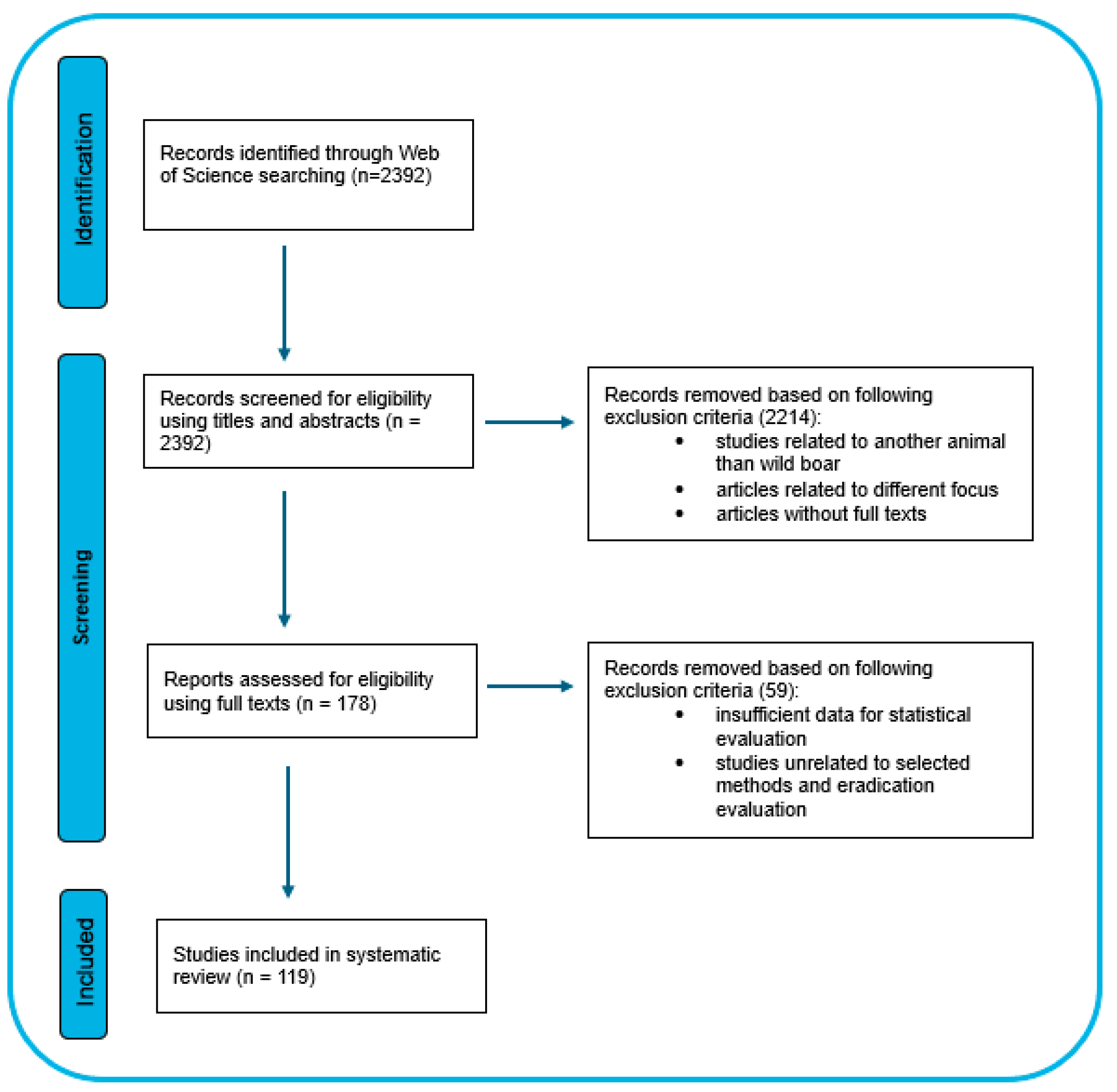
2.1. Literature Search Rules
2.2. Statistical Analysis
3. Results
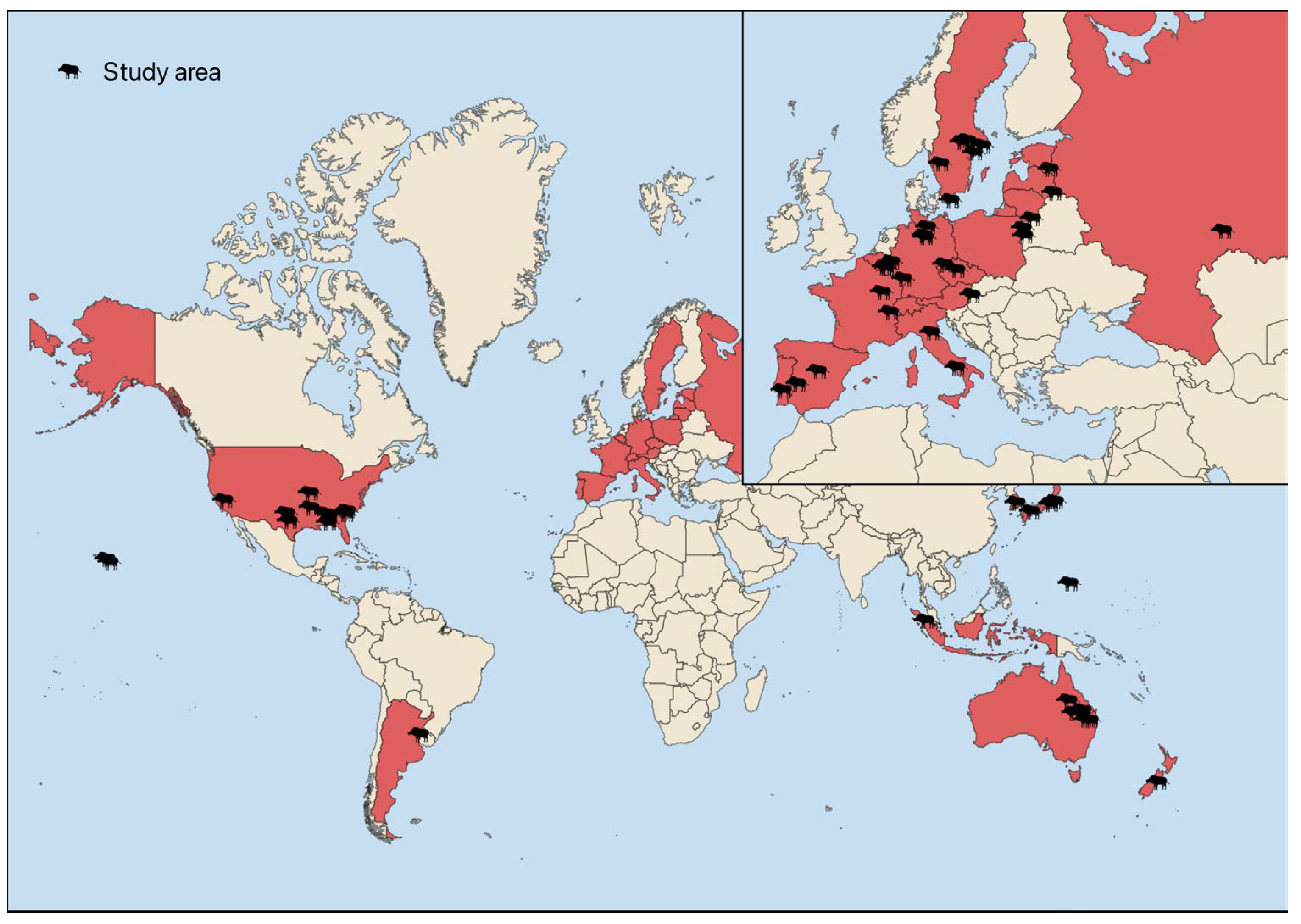
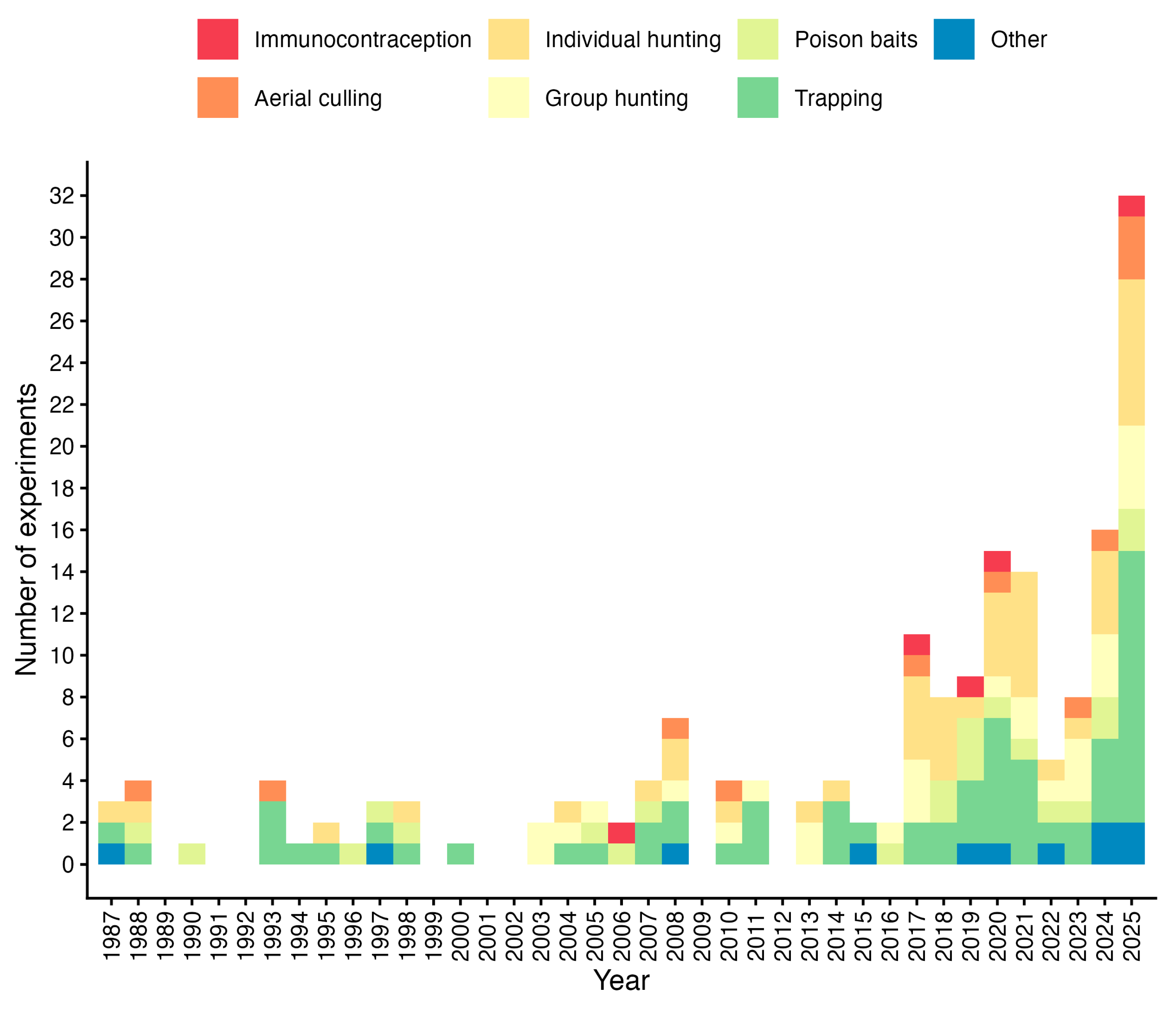
3.1. Overview of Wild Boar Population Reduction Methods
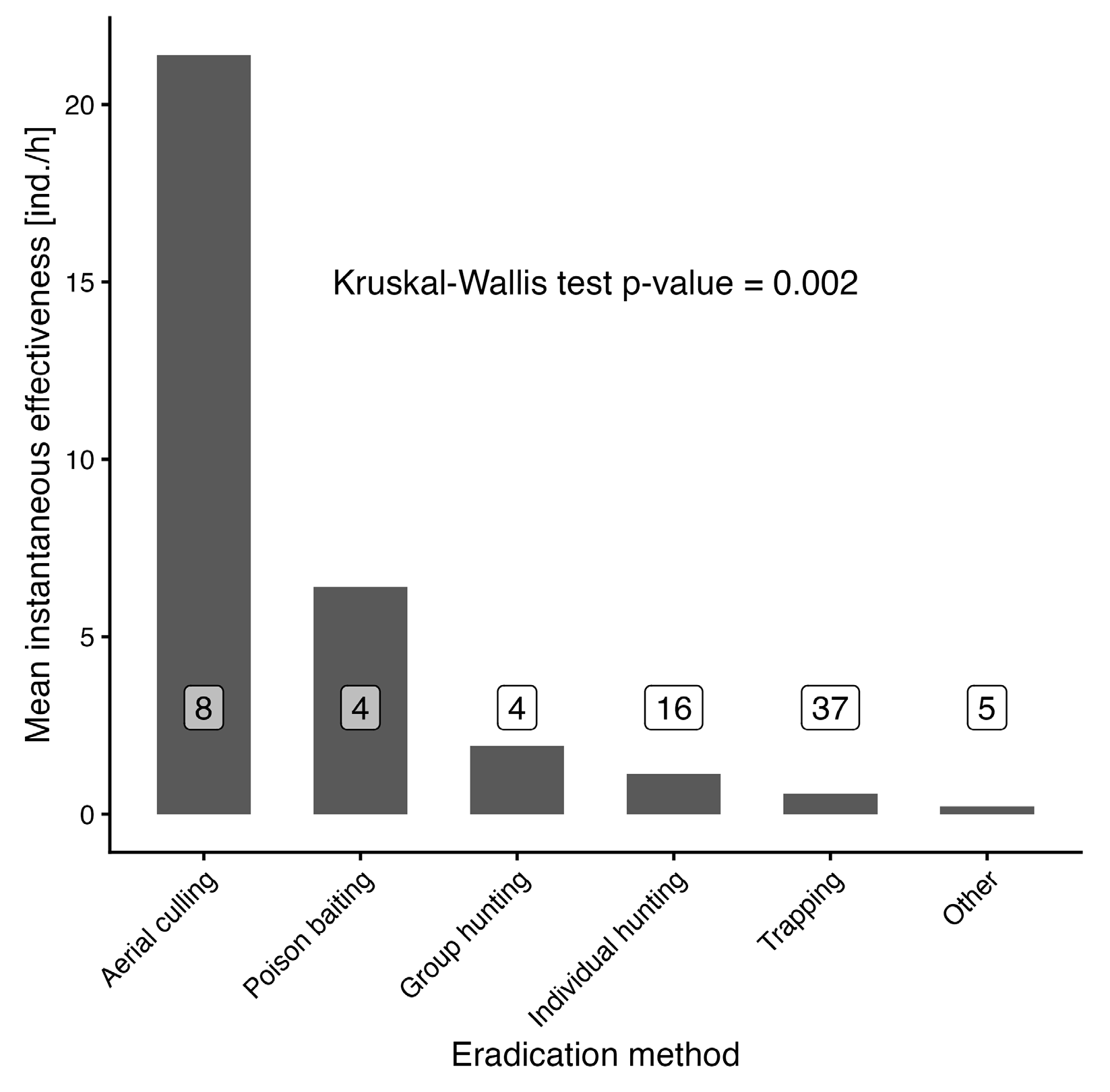
3.2. Eradication Effectiveness of Methods
3.3. Eradication of Subpopulation in Percents
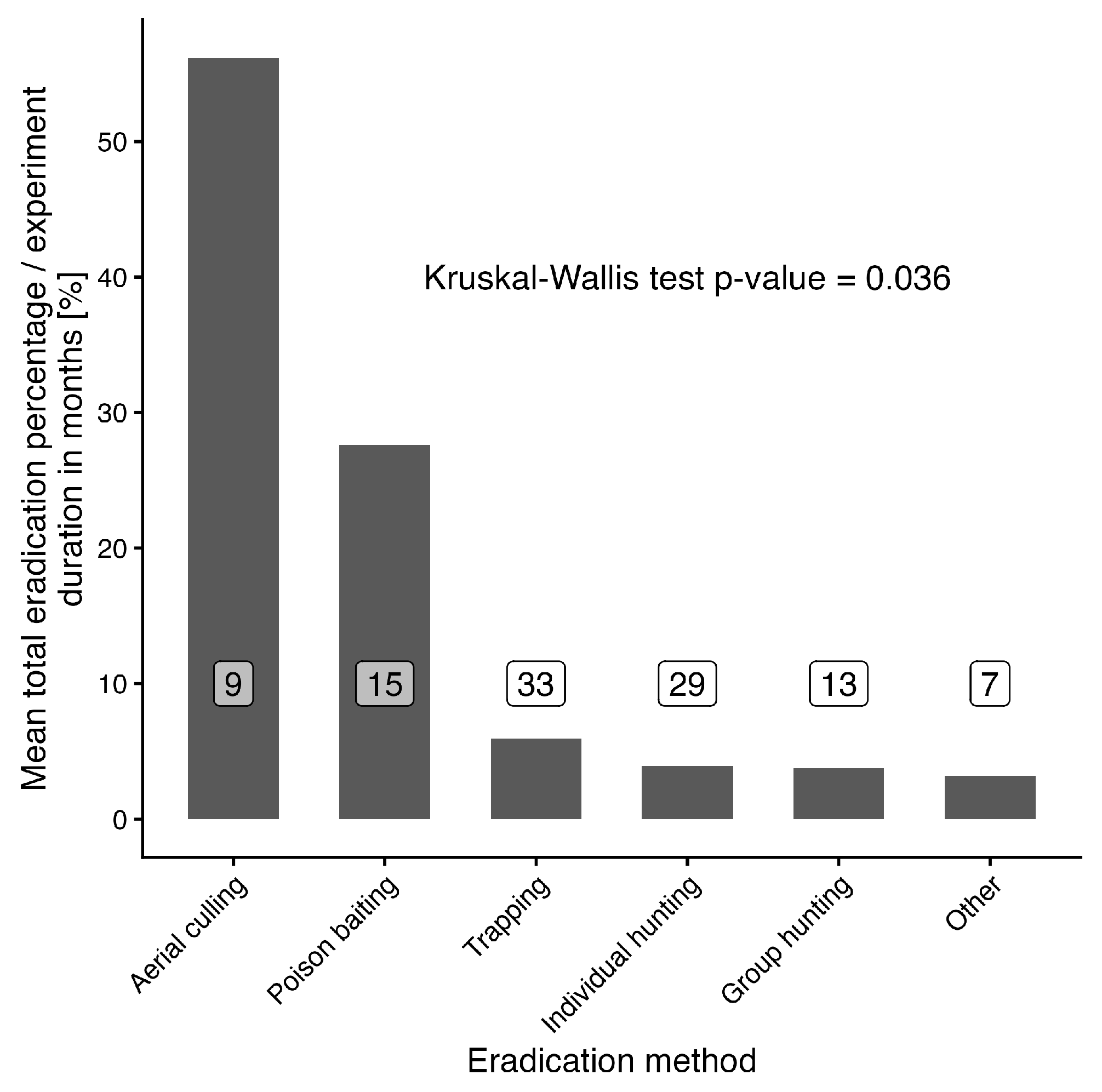
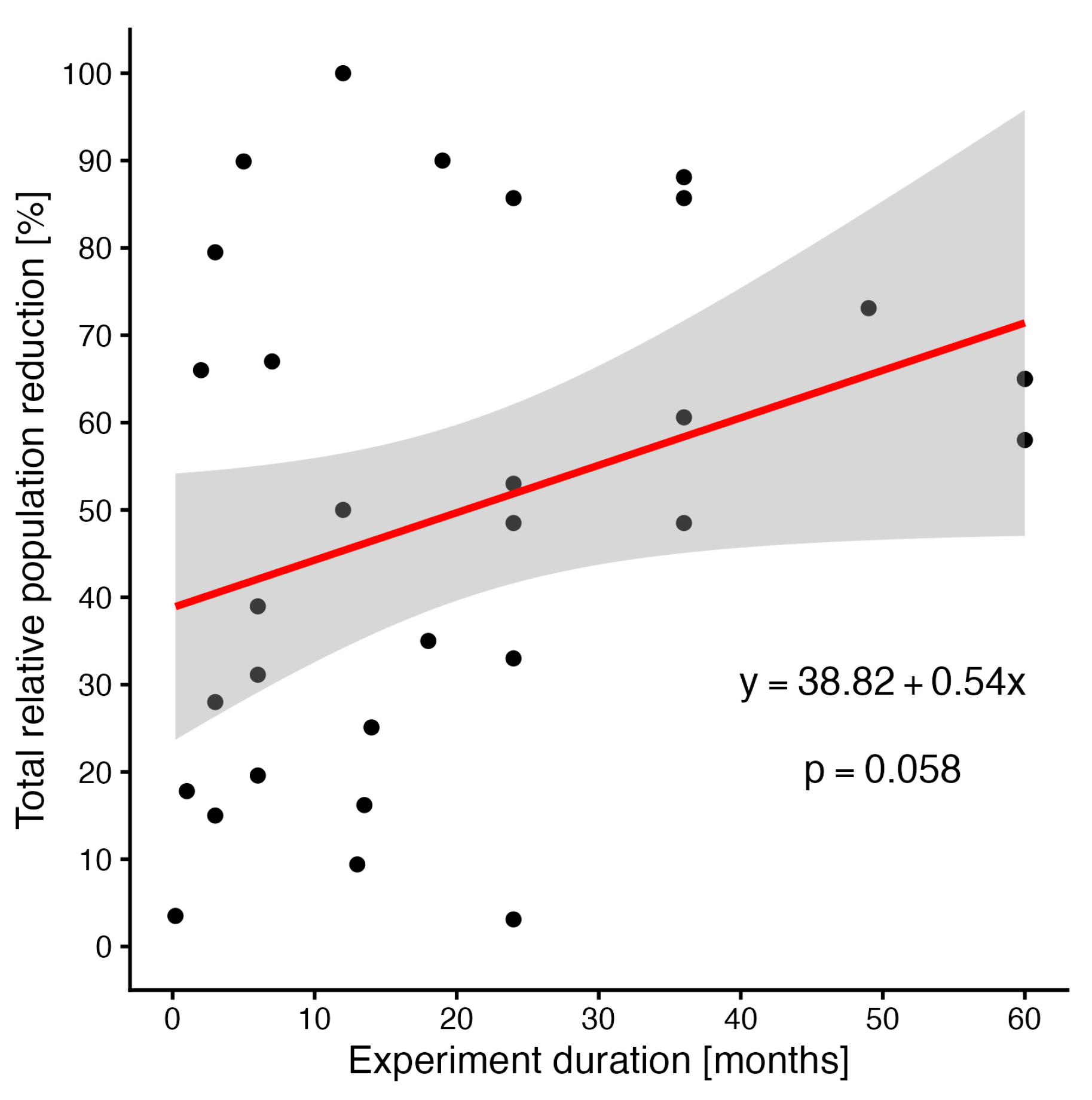
3.4. Population Reduction Based on Experiment Duration
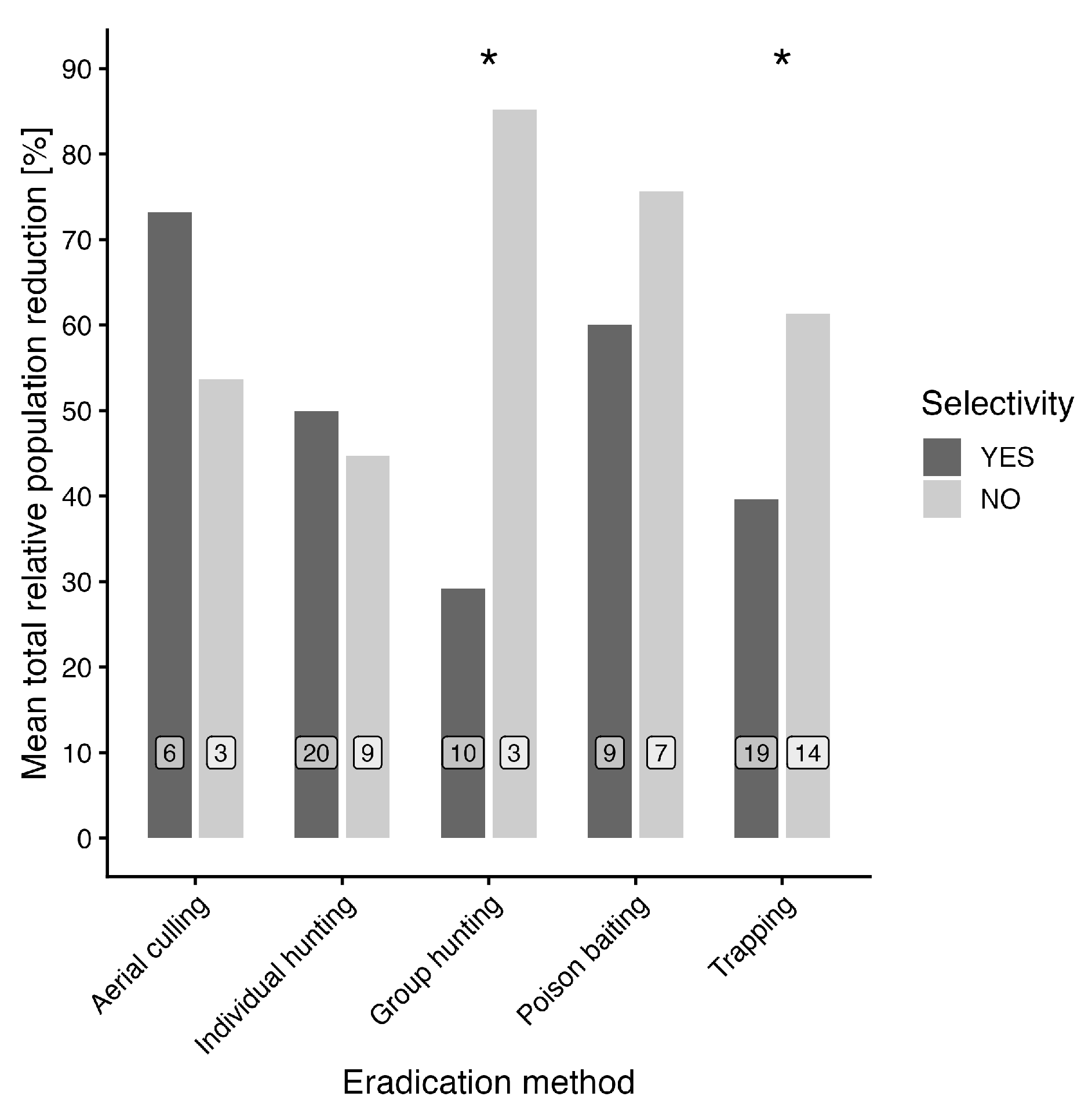
3.5. Selectivity of Methods
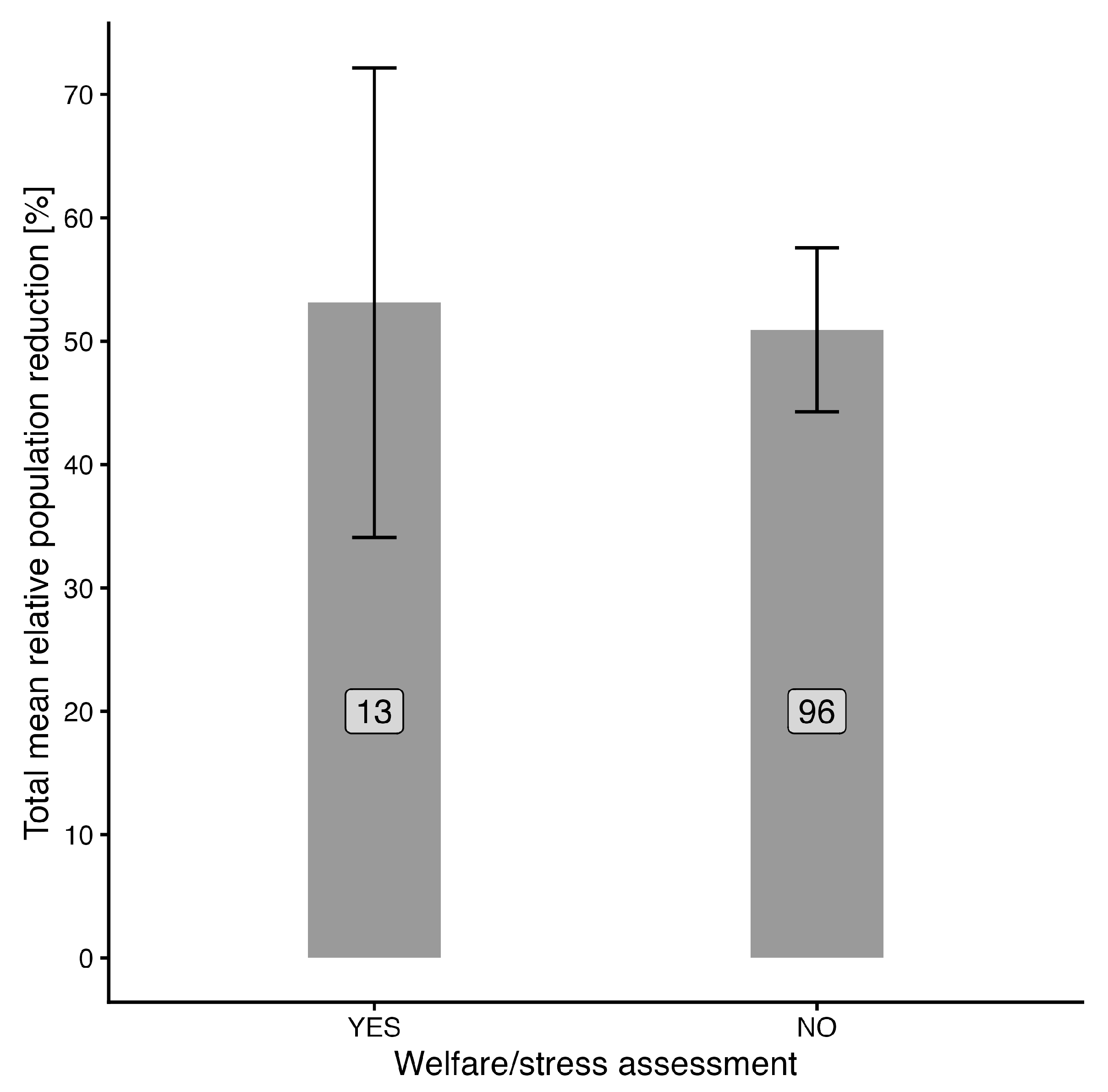
3.6. Aspect of Welfare
4. Discussion
5. Conclusions
- Standardize methodologies for evaluating both effectiveness and welfare.
- Combine multiple methods (e.g., trapping and selective shooting) based on local conditions and resources.
- Target adult females during the non-reproductive season, which may improve the long-term effectiveness of population control based on available studies.
- Promote public acceptance of ungulate population reduction and develop appropriate incentive mechanisms for hunters.
Supplementary Materials
Author Contributions
Funding
Institutional Review Board Statement
Informed Consent Statement
Data Availability Statement
Acknowledgments
Conflicts of Interest
References
- Barrios-Garcia, M.N.; Ballari, S.A. Impact of Wild Boar (Sus scrofa) in Its Introduced and Native Range: A Review. Biol. Invasions 2012, 14, 2283–2300. [Google Scholar] [CrossRef] [Scilit]
- Massei, G.; Kindberg, J.; Licoppe, A.; Gačić, D.; Šprem, N.; Kamler, J.; Baubet, E.; Hohmann, U.; Monaco, A.; Ozoliņš, J.; et al. Wild Boar Populations up, Numbers of Hunters down? A Review of Trends and Implications for Europe. Pest Manag. Sci. 2015, 71, 492–500. [Google Scholar] [CrossRef] [Scilit]
- Acevedo, P.; Escudero, M.A.; Muńoz, R.; Gortázar, C. Factors Affecting Wild Boar Abundance across an Environmental Gradient in Spain. Acta Theriol. 2006, 51, 327–336. [Google Scholar] [CrossRef] [Scilit]
- Keuling, O.; Baubet, E.; Duscher, A.; Ebert, C.; Fischer, C.; Monaco, A.; Podgórski, T.; Prevot, C.; Ronnenberg, K.; Sodeikat, G.; et al. Mortality Rates of Wild Boar Sus scrofa L. in Central Europe. Eur. J. Wildl. Res. 2013, 59, 805–814. [Google Scholar] [CrossRef] [Scilit]
- Gethöffer, F.; Sodeikat, G.; Pohlmeyer, K. Reproductive Parameters of Wild Boar (Sus scrofa) in Three Different Parts of Germany. Eur. J. Wildl. Res. 2007, 53, 287–297. [Google Scholar] [CrossRef] [Scilit]
- Pascual Rico, R.; Acevedo, P.; Apollonio, M.; Blanco-Aguiar, J.A.; Body, G.; Del Río, L.; Ferroglio, E.; Gomez, A.; Keuling, O.; Plis, K.; et al. Wild Boar Ecology: A Review of Wild Boar Ecological and Demographic Parameters by Bioregion All over Europe; EFSA Supporting Publications: Parma, Italy, 2022; Volume 19. [Google Scholar] [CrossRef] [Scilit]
- Schley, L.; Roper, T.J. Diet of Wild Boar Sus scrofa in Western Europe, with Particular Reference to Consumption of Agricultural Crops. Mamm. Rev. 2003, 33, 43–56. [Google Scholar] [CrossRef] [Scilit]
- Geisser, H.; Reyer, H.U. The Influence of Food and Temperature on Population Density of Wild Boar Sus scrofa in the Thurgau (Switzerland). J. Zool. 2005, 267, 89–96. [Google Scholar] [CrossRef] [Scilit]
- Herrero, J.; García-Serrano, A.; Couto, S.; Ortuño, V.M.; García-González, R. Diet of Wild Boar Sus scrofa L. and Crop Damage in an Intensive Agroecosystem. Eur. J. Wildl. Res. 2006, 52, 245–250. [Google Scholar] [CrossRef] [Scilit]
- Servanty, S.; Gaillard, J.M.; Allainé, D.; Brandt, S.; Baubet, E. Litter Size and Fetal Sex Ratio Adjustment in a Highly Polytocous Species: The Wild Boar. Behav. Ecol. 2007, 18, 427–432. [Google Scholar] [CrossRef] [Scilit]
- Frauendorf, M.; Gethöffer, F.; Siebert, U.; Keuling, O. The Influence of Environmental and Physiological Factors on the Litter Size of Wild Boar (Sus scrofa) in an Agriculture Dominated Area in Germany. Sci. Total Environ. 2016, 541, 877–882. [Google Scholar] [CrossRef] [Scilit] [PubMed]
- Bieber, C.; Ruf, T. Population Dynamics in Wild Boar Sus scrofa: Ecology, Elasticity of Growth Rate and Implications for the Management of Pulsed Resource Consumers. J. Appl. Ecol. 2005, 42, 1203–1213. [Google Scholar] [CrossRef] [Scilit]
- Cecchini, V.; Franchini, M.; Benfatto, M.; Filacorda, S.; Corazzin, M.; Bovolenta, S. The Effect of the Wild Boar Hunting System on Agricultural Damages: The North-East of Italy as a Case Scenario. Animals 2024, 14, 42. [Google Scholar] [CrossRef] [Scilit] [PubMed]
- Lombardini, M.; Meriggi, A.; Fozzi, A. Factors Influencing Wild Boar Damage to Agricultural Crops in Sardinia (Italy). Curr. Zool. 2017, 63, 507–514. [Google Scholar] [CrossRef] [Scilit]
- Treichler, J.W.; VerCauteren, K.C.; Taylor, C.R.; Beasley, J.C. Changes in Wild Pig (Sus scrofa) Relative Abundance, Crop Damage, and Environmental Impacts in Response to Control Efforts. Pest Manag. Sci. 2023, 79, 4765–4773. [Google Scholar] [CrossRef] [Scilit] [PubMed]
- Piekarczyk, P.; Tajchman, K.; Belova, O.; Wójcik, M. Crop Damage by Wild Boar (Sus scrofa L.) Depending on the Crop Composition in Central-Eastern Poland. Balt. For. 2021, 27, BF552. [Google Scholar] [CrossRef] [Scilit]
- Snow, N.P.; Smith, B.; Lavelle, M.J.; Glow, M.P.; Chalkowski, K.; Leland, B.R.; Sherburne, S.; Fischer, J.W.; Kohen, K.J.; Cook, S.M.; et al. Comparing efficiencies of population control methods for responding to introductions of transboundary animal diseases in wild pigs. Prev. Vet. Med. 2024, 233, 106347. [Google Scholar] [CrossRef] [Scilit]
- Skoták, V.; Drimaj, J.; Kamler, J. Evaluation of Damage to Forest Tree Plantations by Wild Boar in the Czech Republic. Hum. Wildl. Interact. 2021, 15, 66–73. [Google Scholar]
- Cukor, J.; Faltusová, M.; Vacek, Z.; Linda, R.; Skoták, V.; Václavek, P.; Ježek, M.; Šálek, M.; Havránek, F. Wild Boar Carcasses in the Center of Boar Activity: Crucial Risks of ASF Transmission. Front. Vet. Sci. 2024, 11, 1497361. [Google Scholar] [CrossRef] [Scilit]
- Sauter-Louis, C.; Conraths, F.J.; Probst, C.; Blohm, U.; Schulz, K.; Sehl, J.; Fischer, M.; Forth, J.H.; Zani, L.; Depner, K.; et al. African Swine Fever in Wild Boar in Europe—A Review. Viruses 2021, 13, 1717. [Google Scholar] [CrossRef] [Scilit]
- Blome, S.; Franzke, K.; Beer, M. African Swine Fever—A Review of Current Knowledge. Virus Res. 2020, 287, 198099. [Google Scholar] [CrossRef] [Scilit]
- Costard, S.; Mur, L.; Lubroth, J.; Sanchez-Vizcaino, J.M.; Pfeiffer, D.U. Epidemiology of African Swine Fever Virus. Virus Res. 2013, 173, 191–197. [Google Scholar] [CrossRef] [Scilit]
- Carpio, A.J.; Apollonio, M.; Acevedo, P. Wild Ungulate Overabundance in Europe: Contexts, Causes, Monitoring and Management Recommendations. Mamm. Rev. 2021, 51, 95–108. [Google Scholar] [CrossRef] [Scilit]
- Croft, S.; Franzetti, B.; Gill, R.; Massei, G. Too Many Wild Boar? Modelling Fertility Control and Culling to Reduce Wild Boar Numbers in Isolated Populations. PLoS ONE 2020, 15, e0238429. [Google Scholar] [CrossRef] [Scilit]
- Johann, F.; Handschuh, M.; Linderoth, P.; Dormann, C.F.; Arnold, J. Adaptation of Wild Boar (Sus scrofa) Activity in a Human-Dominated Landscape. BMC Ecol. 2020, 20, 4. [Google Scholar] [CrossRef] [Scilit] [PubMed]
- Vajas, P.; Von Essen, E.; Tickle, L.; Gamelon, M. Meeting the Challenges of Wild Boar Hunting in a Modern Society: The Case of France. Ambio 2023, 52, 1359–1372. [Google Scholar] [CrossRef] [Scilit]
- Escobar-González, M.; López-Martín, J.M.; Mentaberre, G.; Valldeperes, M.; Estruch, J.; Tampach, S.; Castillo-Contreras, R.; Conejero, C.; Roldán, J.; Lavín, S.; et al. Evaluating Hunting and Capture Methods for Urban Wild Boar Population Management. Sci. Total Environ. 2024, 940, 173463. [Google Scholar] [CrossRef] [Scilit] [PubMed]
- Massei, G.; Cowan, D. Fertility Control to Mitigate Human-Wildlife Conflicts: A Review. Wildl. Res. 2014, 41, 1–21. [Google Scholar] [CrossRef] [Scilit]
- Geisser, H.; Reyer, H.-U. Efficacy of hunting, feeding, and fencing to reduce crop damage by wild boars. J. Wildl. Manag. 2004, 68, 939–946. [Google Scholar] [CrossRef] [Scilit]
- Page, M.J.; McKenzie, J.E.; Bossuyt, P.M.; Boutron, I.; Hoffmann, T.C.; Mulrow, C.D.; Shamseer, L.; Tetzlaff, J.M.; Akl, E.A.; Brennan, S.E.; et al. The PRISMA 2020 Statement: An Updated Guideline for Reporting Systematic Reviews. BMJ 2021, 372, n71. [Google Scholar] [CrossRef] [Scilit]
- Wickham, H. Data analysis. In ggplot2: Elegant Graphics for Data Analysis; Springer International Publishing: Cham, Switzerland, 2016; pp. 189–201. [Google Scholar]
- Ståhl, K.; Boklund, A.E.; Podgórski, T.; Vergne, T.; Abrahantes, J.C.; Cattaneo, E.; Papanikolaou, A.; Mur, L. Epidemiological Analysis of African Swine Fever in the European Union during 2023. EFSA J. 2024, 22, e8809. [Google Scholar] [CrossRef] [Scilit]
- Bevins, S.N.; Pedersen, K.; Lutman, M.W.; Gidlewski, T.; Deliberto, T.J. Consequences Associated with the Recent Range Expansion of Nonnative Feral Swine. Bioscience 2014, 64, 291–299. [Google Scholar] [CrossRef] [Scilit]
- Choquenot, D.; Hone, J.; Saunders, G. Using Aspects of Predator-Prey Theory to Evaluate Helicopter Shooting for Feral Pig Control. Wildl. Res. 1999, 26, 251–261. [Google Scholar] [CrossRef] [Scilit]
- Hampton, J.O.; Edwards, G.P.; Cowled, B.D.; Forsyth, D.M.; Hyndman, T.H.; Perry, A.L.; Miller, C.J.; Adams, P.J.; Collins, T. Assessment of Animal Welfare for Helicopter Shooting of Feral Horses. Wildl. Res. 2017, 44, 97–105. [Google Scholar] [CrossRef] [Scilit]
- Pachauri, R.; Martínez-Guijosa, J.; Ferreras-Colino, E.; Ferreres, J.; Relimpio, D. Optimizing the Baiting Strategy for Oral Vaccine Delivery to Wild Boar. Eur. J. Wildl. Res. 2024, 70, 18. [Google Scholar] [CrossRef] [Scilit]
- Snow, N.P.; VerCauteren, K.C. Movement Responses Inform Effectiveness and Consequences of Baiting Wild Pigs for Population Control. Crop Prot. 2019, 124, 104835. [Google Scholar] [CrossRef] [Scilit]
- Pepin, K.M.; Snow, N.P.; VerCauteren, K.C. Optimal Bait Density for Delivery of Acute Toxicants to Vertebrate Pests. J. Pest Sci. 2020, 93, 723–735. [Google Scholar] [CrossRef] [Scilit]
- Snow, N.P.; Lavelle, M.J.; Halseth, J.M.; Glow, M.P.; VanNatta, E.H.; Davis, A.J.; Pepin, K.M.; Tabor, R.T.; Leland, B.R.; Staples, L.D.; et al. Exposure of a Population of Invasive Wild Pigs to Simulated Toxic Bait Containing Biomarker: Implications for Population Reduction. Pest Manag. Sci. 2019, 75, 1140–1149. [Google Scholar] [CrossRef] [Scilit] [PubMed]
- Verde, M.T.; Esposito, L.; Bonavolontà, F.; Tamburis, O.; Liccardo, A.; Piscopo, N. Wild Boars’ Selective Capture with IoT and Electronic Devices Solutions for Innovative, Sustainable and Ethical Management. Sensors 2025, 25, 2071. [Google Scholar] [CrossRef] [Scilit]
- Basak, S.M.; Hossain, M.S.; O’Mahony, D.T.; Okarma, H.; Widera, E.; Wierzbowska, I.A. Public Perceptions and Attitudes toward Urban Wildlife Encounters—A Decade of Change. Sci. Total Environ. 2022, 834, 155603. [Google Scholar] [CrossRef] [Scilit] [PubMed]
- Massei, G.; Genov, P.V. The Inveronmental Impact of Wild Boar. Galemys Span. J. Mammal. 2004, 16, 135–145. [Google Scholar] [CrossRef] [Scilit]
- Focardi, S.; La Morgia, V.; Montanaro, P.; Riga, F.; Calabrese, A.; Ronchi, F.; Aragno, P.; Scacco, M.; Calmanti, R.; Franzetti, B. Reliable Estimates of Wild Boar Populations by Nocturnal Distance Sampling. Wildl. Biol. 2020, 2020, 1–15. [Google Scholar] [CrossRef] [Scilit]
- Keuling, O.; Sange, M.; Acevedo, P.; Podgorski, T.; Smith, G.; Scandura, M.; Apollonio, M.; Ferroglio, E.; Vicente, J. Guidance on Estimation of Wild Boar Population Abundance and Density: Methods, Challenges, Possibilities; EFSA Supporting Publications: Parma, Italy, 2018; Volume 15, p. 1449E. [Google Scholar] [CrossRef] [Scilit]
- Mikulka, O.; Zeman, J.; Drimaj, J.; Plhal, R.; Adamec, Z.; Kamler, J.; Heroldová, M. The Importance of Natural Food in Wild Boar (Sus scrofa) Diet during Autumn and Winter. Folia Zool. Brno 2018, 67, 165–172. [Google Scholar] [CrossRef] [Scilit]
- Keuling, O.; Strauß, E.; Siebert, U. Regulating Wild Boar Populations Is “Somebody Else’s Problem”!—Human Dimension in Wild Boar Management. Sci. Total Environ. 2016, 554, 311–319. [Google Scholar] [CrossRef] [Scilit] [PubMed]
- TuckerWilliams, E.; Lepczyk, C.A.; Morse, W.; Smith, M. Perceptions of Wild Pig Impact, Management, and Policy in Alabama. Environ. Manag. 2024, 73, 1032–1048. [Google Scholar] [CrossRef] [Scilit]
- Schwarzfuchs, E.N.; Orenstein, D.E.; Ben-Ami, D.; Dayan, T. A Rich Person’s Problem? Socio-Ecological Analysis of Human-Wild Boar Conflict Distribution in an Urban Setting. Hum. Ecol. 2025, 53, 541–562. [Google Scholar] [CrossRef] [Scilit]





Disclaimer/Publisher’s Note: The statements, opinions and data contained in all publications are solely those of the individual author(s) and contributor(s) and not of MDPI and/or the editor(s). MDPI and/or the editor(s) disclaim responsibility for any injury to people or property resulting from any ideas, methods, instructions or products referred to in the content. |
© 2026 by the authors. Licensee MDPI, Basel, Switzerland. This article is an open access article distributed under the terms and conditions of the Creative Commons Attribution (CC BY) license.
Share and Cite
Cukor, J.; Pařízková, M.; Linda, R.; Vacek, Z.; Skoták, V. Balancing Effectiveness and Ethics: Global Systematic Review of Sus scrofa Population Control Methods. Animals 2026, 16, 1023. https://doi.org/10.3390/ani16071023
Cukor J, Pařízková M, Linda R, Vacek Z, Skoták V. Balancing Effectiveness and Ethics: Global Systematic Review of Sus scrofa Population Control Methods. Animals. 2026; 16(7):1023. https://doi.org/10.3390/ani16071023
Chicago/Turabian StyleCukor, Jan, Monika Pařízková, Rostislav Linda, Zdeněk Vacek, and Vlastimil Skoták. 2026. "Balancing Effectiveness and Ethics: Global Systematic Review of Sus scrofa Population Control Methods" Animals 16, no. 7: 1023. https://doi.org/10.3390/ani16071023
APA StyleCukor, J., Pařízková, M., Linda, R., Vacek, Z., & Skoták, V. (2026). Balancing Effectiveness and Ethics: Global Systematic Review of Sus scrofa Population Control Methods. Animals, 16(7), 1023. https://doi.org/10.3390/ani16071023